Seeds of doubt being sown, Part III: Will it reduce butterfat supply and impact industry’s cheese-focused future?

By Sherry Bunting, Farmshine, March 1, 2024

EAST EARL, Pa. — As seeds of doubt are being sown internally within the dairy industry about whole milk in schools, we have discussed Confusion (will it help milk prices?) and Consternation (unfounded fear about what will processors do with ‘all that skim?’)

This week, we look at the third C: ‘Competition’: If schoolchildren are offered whole milk, will it significantly impact butterfat supplies, raise butter prices, and compete with the industry’s cheap milk cheese-focused future?

Every winter conference for the past few years has had at least one speaker telling dairy farmers that fluid milk sales are declining because Americans are eating more of their milk instead of drinking it. 

Fair enough. Cheese is the future, and the industry wants to make more of it. Lots more of it. So much more cheese, in fact, that inventory is growing. Analysts at conferences put up slides with the words “Export or perish!” in large font. 

Yes, U.S. Dairy wants to export more cheese, including mozzarella. U.S. Dairy wants to export more butter and cream products. U.S. Dairy wants to export more of the higher-value products. (And we want to sell more cream to the upscale coffee houses and downscale McCafe drinks we adults get to choose while junior sips a paltry half-pint of fat-free chocolate milk, sugar water, in the back seat. What’s wrong with us?)
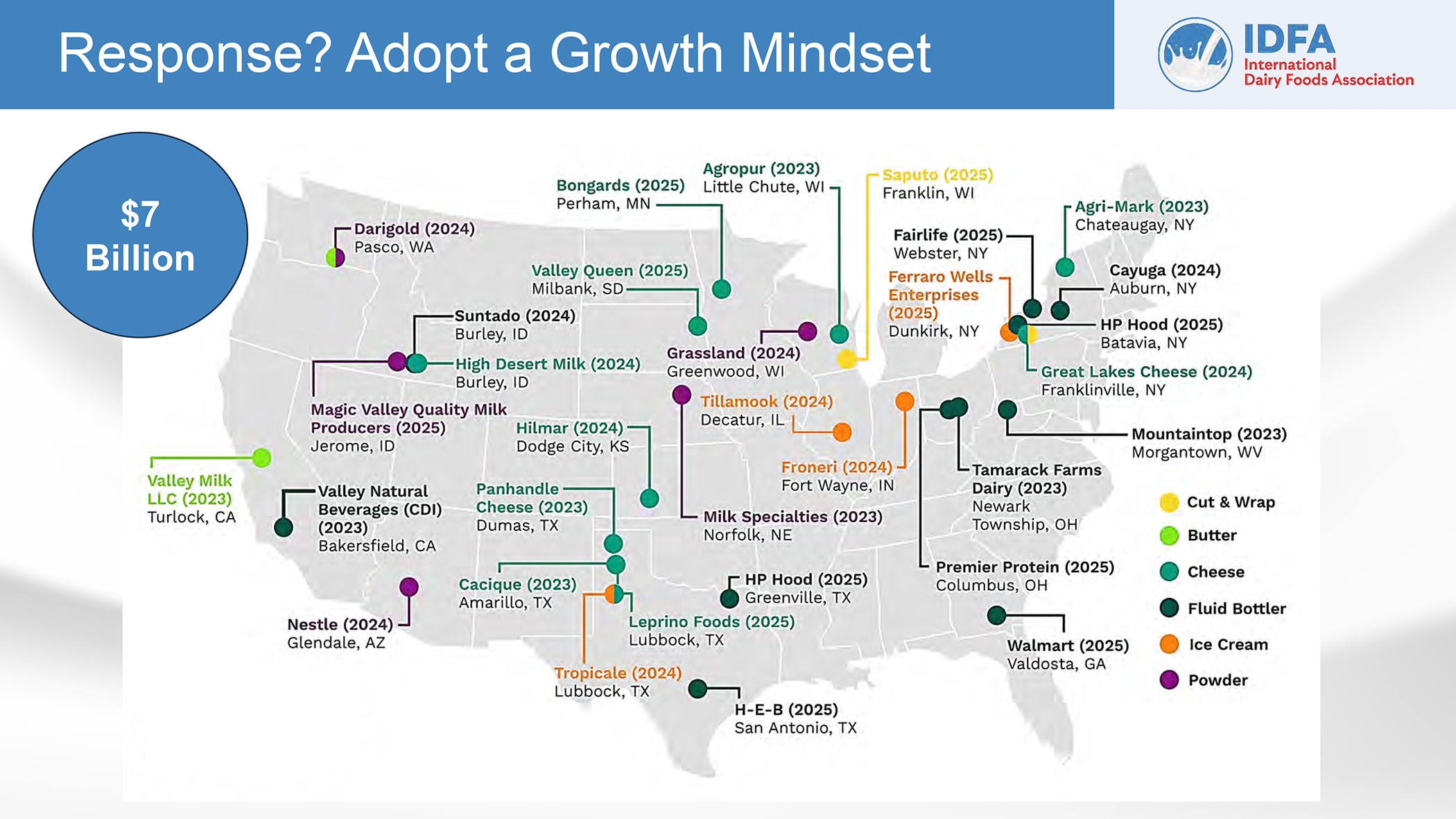
This map shows the over $7 billion in new processing coming online between now and 2026. “There’s a lot of cheese on this map,” said IDFA CEO Michael Dykes, presenting at the Georgia Dairy Conference. This slide has also been popping up in other industry conference speaker powerpoint decks this meeting season. IDFA data

The industry also wants to take milk down to its molecular level – to turn the jug of milk into ingredients at the start — to make new function-targeted products for the beverage space outside of Class I parameters within an increasingly Class III dominated processing infrastructure.

Toward that end, new processing capacity won’t convert milk to traditional products, leaving elements to be marketed as ingredients. Instead, these new state-of-the-art cheese and ingredient plants start by taking milk apart to the ingredients-level to be used in making health beverages, bars, and other products, as well as to make cheese. 

At the Georgia Dairy Conference in January, IDFA CEO Michael Dykes mentioned IDFA’s support for the Whole Milk for Healthy Kids Act, giving attendees a QR code to weigh-in with their Senators. 

Later in his presentation, he noted that a shift to more fat in school milk would make a 3% impact on the butter supply.

“I’m a believer that the markets work, when you take it one place, you make a difference and change it someplace else. Those are the things we can work through,” said Dykes.

So, we reached out to Calvin Covington, a former cooperative CEO who is intimately familiar with component pricing as it became part of the Federal Milk Marketing Order (FMMO) system over 20 years ago. We asked his thoughts on how increasing fat in the school milk supply would impact butter. 

“Increased Cheddar cheese production has used millions and millions of pounds of butterfat. No one complains about this. Doesn’t the dairy industry want to increase demand for all milk components?” he replied and sent forth his own calculations, providing a spreadsheet showing his estimates of milk used in schools and the additional fat that would be needed for all of that milk to go completely to 3.25% (whole) milk.

Covington ran the numbers, moving methodically through assumptions on Table 1 to conclude the impact of shifting from a school milk fat percentage of 0.5% (half fat-free and half 1%) all the way to 3.25% (whole milk) would have a small impact on the butterfat supply — raising the school milk’s usage of butterfat from 0.25% of total butterfat production at the current national average fat test of 4.11% to being 1.47% of total butterfat production at the average 4.11% fat test.
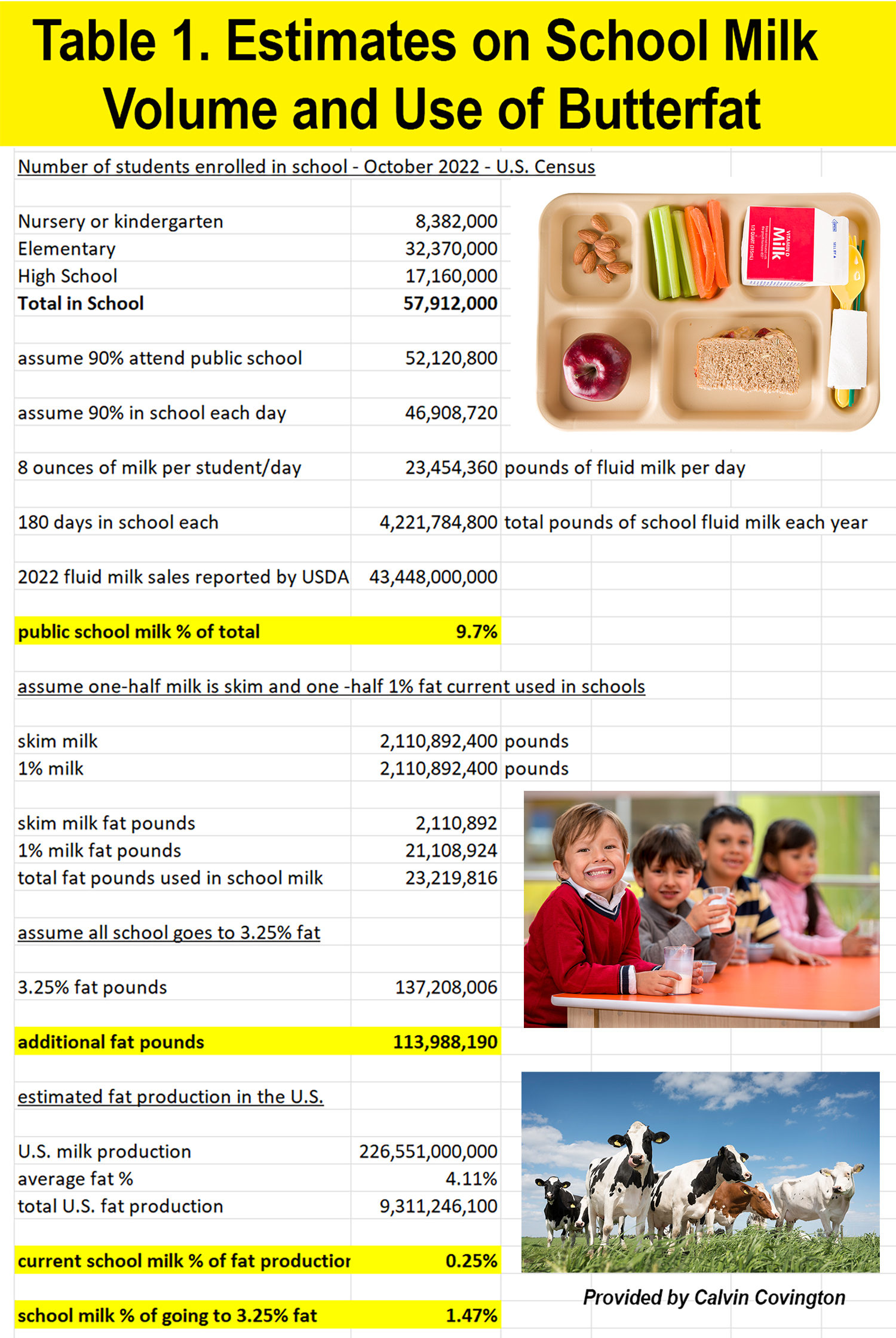
Using the identified assumptions, Table 1 shows estimates on school milk volume and use of butterfat under today’s fat-free and 1% low-fat milk requirement compared with a scenario in which all school milk pounds were at 3.25% fat as standardized whole milk. Provided by Calvin Covington

He estimates public schools use 9.72% of all fluid milk, and for the purpose of the spreadsheet exercise, he assumed that half of those school milk sales are currently fat-free and half are 1%. If that is the case, then going to 3.25% (whole) milk for all pounds of school milk sales, the additional fat that would be needed is almost 114 million pounds, he reports.

“This should be a non-issue,” Covington concludes, using estimates that are based on all of those school milk pounds moving to 3.25% fat. 

The more likely scenario, however, is that schools would implement a more gradual increase in fat percentage. If it mirrored the national average for fluid milk sales at 2% fat, the increase would be smaller initially. Using Covington’s chart and assumptions, the additional fat that would be needed if school milk fat content averaged 2% is closer to 84 million pounds, going from using 0.25% of total fat production to 0.9% of total fat production.

Not all schools will choose to offer all milk at 3.25%. Some may offer 2% milk, which has also been banned since 2010 and would be given regulatory relief under the Whole Milk for Healthy Kids Act. 

Even if 3.25% fat milk is universally offered, some schoolchildren will continue to choose low-fat milk, as they did in the Pennsylvania trial, where the preference was 3 to 1 for whole 3.25% over low-fat 1%.

While a potentially higher fat content in school milk is being scrutinized for its impact on butter and butterfat, the impact of aggressive increases in cheese production is ignored. This speaks a bit to industry priorities.

“As butter and cheese consumption increase, processors do not argue against the increase because utilizing more fat would increase the fat price,” Covington observes, wondering why anyone would be concerned about the impact on butterfat supply if children get to choose whole milk while not being concerned about the impact on butterfat supply in any other sector.

“An increase in fluid milk sales, in schools, or anywhere, benefits all dairy farmers. With all things being equal, it would shift milk from Class III and IV to Class I, which is a (normally) higher milk price,” Covington explains. “If Class III or IV need more milk to replace the loss to Class I, more money would need to be paid by Class III and IV milk buyers, again, helping dairy farmers.”

So, what is the current status of butterfat production and usage? 

The national butterfat average is 4.11%. A decade ago, it was 3.69. From 2011 to 2022, total butterfat pounds produced on farms in the U.S. grew by 2 billion pounds from 7.3 billion to 9.3 billion. That’s a butterfat volume response to a price signaling demand.

Where’s it all going? Around 20% goes to butter production, 8% to ice cream and frozen desserts, 10% in fluid milk sales, and close to 50% is used in cheese production. And then there is this growing market for cream used in coffee drinks.

Meanwhile, dairy producers out West report receiving a letter from a large cheese plant, putting in a new base program at 1.5% over base. 

Another producer in an unregulated state in the West reported receiving a letter from his cheese plant stating they will reduce the butterfat multiple in their cheese milk payment, beginning April 1. The reason, according to the letter, is the farms are making too much butterfat, and the plant is having to buy condensed solids (skim) to pair with the additional fat or sell the extra fat as excess sweet cream at a loss.

During the FMMO hearing, fluid milk bottlers complained that the higher fat and component levels in milk today are more costly for them to deal with, that they must move the excess cream at a loss, and they have to clean the separator more often because of ‘sludge’ buildup. (I kid you not, one witness called it ‘sludge.’)

Processors have petitioned USDA with multiple proposals to get regulated minimum prices down to their definition of a ‘market clearing’ level that then allows them to add market premiums to attract new milk. Read that sentence again.

Who would be paying those premiums to grow milk supply? Not the processors. It would be revenue coming out of the regulated minimum price benchmarks for all farmers, including farmers that are not growing, to then get added back in by the processors wherever they want to direct growth.

Cheap milk is the name of the game, while at the same time, dairy farmers are being challenged to grow to meet the future ‘demand gap’ to fill $7 billion in new processing investments that will become operational over the next few years.

Dairy analysts tell how milk production expansion to meet this investment will not be as easy to do and will take longer than in the past because of the shortage in replacement heifers. 

We’re at a standoff, so to speak. 

Dairy producers have bred beef-on-dairy to bring margin back to their farms after 10 years of dairy margin compression. This strategy has been a good hedge against overproduction of milk in the era of sexed-semen, and it has helped protect farm balance sheets by reinforcing the value of the cattle as collateral.

So, what tool will be used now to drive consolidation and growth in dairy? Dykes told Georgia producers that, “Sustainability will be one of the biggest drivers of consolidation we’ve seen in a generation. Why? Because it’s going to take investment, and it’s going to take scale. We need to figure it out, to measure it, verify it, account for it, not double count it. We’re going to need investments to make sure we have the infrastructure.”

He said sustainability will become the gateway for exports where countries have mandates and carbon taxes for purchased ag products.

So, here we are back at the question about milk supply, butterfat supply, skim supply and school milk. Wouldn’t whole milk sales to schools offer a much-needed tug on the demand side to help shift some milk away from this runaway, market-depressing, buildup of excess cheese production that elicits the powerpoint headline: ‘Export or perish?’ 

Just think, if the fluid milk sales to schools increased as they did in the Pennsylvania trial by 52%, or even half that, by 25% as more kids choose milk instead of refusing it, market principles could work — gaining something in one place to affect it someplace else. 

Meanwhile, the industry can do some soul-searching and adapting amid the double-speak. If more milk, fat and components are needed, then farmers need to be able to make a living milking cows and producing fat and components.

Is the problem not enough milk? Or too much milk? Not enough fat? Or too much fat? Not enough skim? Or too much skim? Or is the problem rooted in making sure milk can be bought cheap and that farmers are forced to find revenue in other ways, such as carbon monitoring?

Let’s get it straight please.

On the horizon, we see: Checkoff-funded fluid milk innovations for new beverages that identify and separate specific milk molecules for specific benefits (sleep drinks, energy drinks, immune function drinks, specific protein type drinks)? More on that in Milk Molecules Initiative Part I and Part II

-30-

From USDA to checkoff, no one in farmer’s corner

By Sherry Bunting, Farmshine, April 17, 2020

BROWNSTOWN, Pa.– From the fortress of the USDA to the ivory towers of the dietary command to the branches of the checkoff government-speech machine and the centralized, globalized food system ‘partners’ in between — No one is in the farmer’s corner. Not even the people paid by the farmers to be in their corner.

This much is crystal clear by now in the collapsing markets and stark realities laid bare by the COVID-19 pandemic.

The curtains have been opened.

And the usual players do what they do.

They pat themselves on the back, converse about their insights from within their echo-chamber, and lecture those who would dare call attention to the sight before us or deviate from the script.

Over the last week, dairy checkoff newsletters have bragged about what they are doing for dairy demand amid the deepening crisis; how DMI is “adjusting to move more dairy.”

Yep, the bulk butter and bulk cheese and bulk powder plants in growth areas are moving more dairy — right into the already bursting at the seams cold storage inventory warehouses.

Few if any reports from states with these large plants indicate any milk dumping whatsoever.

Butter inventories were already 25% higher than year ago heading into the COVID-19 pandemic and cheese inventory was already growing too.

Reports indicate such fully functioning cheese and whey or powder plants are running full tilt, while a shopper has to store-hop through three or more establishments to find a package of butter, walk into Walmart and see rows of empty cheese racks, try to walk out of a Walmart or Sam’s Club with two gallons of milk and be forced to give one back.

Other supermarkets aren’t much better, except for the smaller family-owned markets. Pictures and texts continue to pour in, while our leaders assure us that the purchasing limits are really lifted.

Go to Kroger’s website (a DMI partner) and see their explanation of why they’ve raised the price of milk. It’s because there is a shortage, they say, while farms all around them are forced to dump milk. Just six weeks ago, a Kroger executive I spoke with said, ‘no we can’t raise the price of milk — it was $1.25/gal pre-COVID (not in PA of course but elsewhere).

I was making the point that we have loss-led and commoditized this deal long enough. Please respect the milk. “No,” I was told, “raise the price? How is that going to sell more milk?”

What is Kroger doing today (and Walmart and other heavy hitters for that matter)? NOW, they are raising the price, even canceling some orders without much to spare, as they are being asked to stop limiting sales.

Meanwhile farmers are forced to dump milk.

As the commodities crash with barrel cheese at around $1/lb and butter headed there too, are the food system heavy-hitters holding back to buy that higher-priced inventory on the cheap just to turn it around and charge more?

We are getting to see how the system works — how the losses and consolidation of a decade or more are threatening our farms and food security. But leaders and policymakers are still convinced this system is the best, and thanks to new stricter rules coming on animal proteins and fat, it’s about to get better, more diluted, and void.

Take the DMI update in the ADA Northeast newsletter from April 6, how proud they are of the “seven ways checkoff is working for you during COVID-19” and how they are “adjusting to move more dairy”, how GENYOUth is “keeping the meals flowing to students”, while in reality the real school chefs and lunch ladies — even bus drivers — are out on the front lines figuring it out for real on their own every day; how proud they are that the National Dairy Council “sorted through milk myths.”

Now that last one is a doozie. Here’s one of the seven ways checkoff is working for you: “National Dairy Council is among the expert organizations to debunk claims that milk can help ward off coronavirus.”

Remember the news about milk and it’s immune-building properties? Even Hoards Dairyman noted milk was “flying off the shelves” as consumers sought the health benefits and comfort of milk.

Remember how DMI tells us “you can’t educate people to drink what you want them to drink?” How “we want to move people away from the habit of reaching for the jug and toward the new innovative products?”

It wasn’t even a week after fluid milk sales skyrocketed 40% that the National Dairy Council helped debunk some of that immune-building “myth” in Reuters story.

And yes, rest assured, DMI is talking to “your (their) partners” to get them to “move more dairy”.

So here’s the clincher. Watching the President’s daily COVID-19 press conference Wednesday evening (April 15), it really hit home, bringing together so much of what I have seen and heard over the past few weeks and the months and years before that.

Agriculture Secretary Sonny Perdue was part of President Trump’s daily presser Wednesday, and I was hopeful when he went to the microphone that he would talk about impact to food and agriculture during the COVID-19 pandemic.

He told Americans that “Our food system is strong, resilient and safe,” despite the bare shelves and limits on purchases that people are seeing in supermarkets.

“In the United States, we have plenty of food for all of our citizens,” Perdue said. “I want to be clear, the bare store shelves that you may see in ‘some’ cities in the country are a demand issue, not a supply issue.” (Huh? At least he didn’t phrase it the way Pennsylvania’s Ag Secretary does, saying in a PDA public service announcement to radio and television stations that store limits, bare shelves and dumped milk are a ‘hoarding issue”, and saying in a dairy industry conference call: “this is what happens when people hoard food.”

No Mr. Secretaries, this is not hoarding and it’s not a ‘demand’ issue, it’s a centralized, consolidated, globalized food industry structure issue.

Back to Sec. Perdue’s moment before the American people… Perdue said simply that there has been a large shift from people eating in restaurants and fast food businesses, and now eating at home, which has spiked in the last few weeks and placed a high demand on grocery stores.

“Our supply chain is sophisticated, efficient, integrated and synchronized, and it’s taken us a few days to relocate the misalignment between institutional settings and grocery settings.” Perdue said.

Bingo. The accelerated creation of this machine over the past decade has been designed by government policy from the flawed dietary guidelines, to the government speech farmers are forced to pay for, to the mergers and acquisitions and antitrust behaviors, to the globalization and centralized decision-making, to the erosion of local/regional milksheds and foodsheds.

Yes, Mr. Secretary, that sophisticated, efficient, integrated, synchronized food supply chain has moved our country closer to cow islands and food deserts and fracturing of regional food security.

Some of the best minds in agriculture economics are seeing it. Consumers are waking up to the realization of what that means when the chips are down. They are watching their communities’ farmers dump milk, depopulate poultry flocks, send milk herds to slaughter.

This pandemic has peeled back the band-aid covering gaping wounds inflicted for years, and now when it is open and bleeding for all to see, the Secretary reassures the nation that this big beautiful bountiful ag food system simply needs to “relocate a misalignment.”

Tammy Goldammer, a cattle rancher friend of mine in Missouri put it bluntly in a social media post after listening. Here are some of her words:

“Production Ag People?

Did you happen to listen to US Ag. Sec. Perdue’s comments today at the Rona Update press conference? Were you reassured about your occupation of raising the highest quality protein sources to feed the world?

Did you find it interesting that there was no mention about “producers” and what is going on with what they raise to feed people?
1. There was no mention of the killing of millions of ready to harvest chickens and turkeys…to leave them to compost.
2. There was no mention of the dumping orders for milk and the orders to let cows go dry and to sell the dairy cow herds.
3. There was no mention of the shuttering of ethanol plants and the resulting depletion (no supply) of by-products utilized in the livestock feeding industries.
4. There was no mention of the Mercantile Exchanges and the crashing commodity prices for livestock, dairy and grain futures.
5. There was no mention of the bankruptcies and insolvencies of feeders who grow the nation and the world’s protein sources.
6. There was no mention of the sucking sound to the south of the beef cattle industry.
7. There was a mention there are a few “slaughter” plant closures due to Covid-19 being detected in some employees.
8. There was a mention that our nation’s food supply is abundant and there should be no fear about food availability.
Do you all like math? Mr. Perdue? Your commentary today to assure the American public was absolutely “void” of speaking to the producers/people who produce what you stated is in good shape and rest assured there are no shortages.
To say I was “stunned” at your “void” on the big picture, well, let’s say I was totally bewildered.”

But never fear oh sophisticated, efficient, integrated and synchronized food system, President Trump followed the Perdue comments with news that there is $15 billion in tariff money left in Sec. Perdue’s charge to help farmers who were targeted and he gave the Secretary the go ahead to use it.

Later this evening, word came that the government will begin buying milk and meat. Yes, as mentioned by Pennsylvania’s own Secretary in his PSA ‘stop hoarding food’… ‘food banks need the food’… ‘we have a system…’

Yes, the integrated centralized system is the proper channel while communities take care of their own with whatever resources they can muster. Good people in communities like mine right here in Lancaster County, Pa. are buying milk, giving it to the needy or seeking processors (for pay) to process milk headed to manure pits so it can be donated, only to bump up against that integrated system.

Kudos to those businesses in the community who are buying milk to give to the needy or stepping up to allow their smaller processing plants get milk ready for food banks before it is wasted.

The efficient, sophisticated, integrated, synchronized food system is not. But it will when the price is low enough and the government starts buying.

-30-

Sudden impact. Dairy producers urged to document, communicate, re-evaluate, ‘manage what you control’

By Sherry Bunting

“It has been the suddenness of the impact. We’re going to have some losses, but our goal is to come out on the positive side at the other end of this. It’s going to take government, agribusiness, agri-lenders, and producers — all working together — to go through this situation,” said Dr. David Kohl, Virginia Tech professor emeritus, during a new PDPW Dairy Signal webcast Wednesday.

The Dairy Signal webcasts — insights for informed decisions — livestreamed Tuesday through Thursday Noon to 1:00 p.m. CDT and archived for viewing later. Check it out here.

What indicators is the world renown ag economics and finance expert watching?

  • Consumer sentiment index – Will it start coming back up toward fall? Will service industries — universities, sports complexes, etc. — begin coming back in the picture?
  • Value of the dollar – in relation to other countries.
  • Unemployment – How long it stays low, not how low it goes.
  • Weather in North and South America – input costs
  • Ethanol plants – Will oil price reduction war between Russia and Saudi Arabia drive them out? Energy resilience makes us strong.

He also urged producers to embrace these things:

  • Work together.
  • Keep detailed loss records.
  • Avoid knee-jerk reactions.
  • Use resources available to assist you.
  • Communicate with your lender.
  • Re-evaluate your goals: Where do you want to be in three years? What do you want your business to look like? How are current conditions changing what that might look like for you?
  • Manage what you control in business and in life — manage around the things you cannot control — tune out the noise.
  • Take time out and enjoy the simple things.

“Every producer should really get onto documenting everything. If you’re dumping milk, or your processor says we can’t handle the milk, you get those weights. You get those values. You document those losses,” said Kohl. “Having those good records is going to be very critical. Don’t let it slip through the cracks.”

According to PDPW executive director Shelly Mayer, who moderated the webcast, many questions came in on this topic of how to document milk dumped directly on the farm and not picked up by a handler.

Even though milk marketers have the responsibility for Federal Order measures and testing if the dumped milk is priced and pooled on the Order, measure and document your loss anyway. Even staff at USDA Dairy Programs told Farmshine recently that it is wise to measure and pull an agitated sample to do component and quality testing, especially when pulling the plug to dispose of the milk on your own farm without being picked up by a handler. If this wasn’t done for milk already dumped, be sure to record the next similar time frame of measurement, pull the next milk’s sample and get the previous milk’s data to come up with an average for your records.

“I like to err on more information being the better,” said Kohl. “Document everything that you can.”

In the PDPW webcast discussion, both Kohl and Jason Karszes, Cornell ag business management, agreed that getting a clear answer from the processor on what their “process” will be for documenting and covering dumped milk is a fair question to ask and expect an answer for. In the meantime, measure whatever you can measure about what you dumped, and get whatever records you can from the handler or processor so you can also document these losses.

This information will be important down the road so that lenders and producers and the agribusiness community — working together — can build the case for what is needed and be eligible for potential assistance at a later date, said Kohl.

“It is interesting as we go through this to see how we (as a people) are reacting and handling it,” Kohl observed, noting that the local creamery he is involved with in Virginia has seen the home-delivery waiting list quickly grow to 175. He also heard from a ‘cow-share’ producer that demand for his local un-processed milk has grown to where he could add 70 cows right now from new demand.

This observation about consumer behavior ties in with a more long-term webcast question:

“What will our world look like after we as a people walk through this?”

Speaking candidly, Kohl sees a move away from globalization to “selective globalization,” where we will see more industry move back into not just the U.S., but into North America, and where concentration and bigness will be challenged by consumers and politicians, bringing shock effects.

This is a good time for dairy operations to re-evaluate their goals, said Kohl. As producers make decisions about the future, he advised new considerations will be: assess consumer sentiment, available labor, management capacity, available milk market, and how these global-national-regional-local supply chain shifts might affect these factors.

-30-