What’s on Covington’s 5-year milk market radar?

Pennsylvania dairy producers were treated to a forward look at Calvin Covington’s milk market radar during R&J Dairy Consulting’s annual seminar. The bottom line is cheese, cheese, and more whey. Photo by Sherry Bunting

Cheese and whey, will continue driving bus, with big growth in processing capacity on the road ahead

By Sherry Bunting, Farmshine, Feb. 7, 2025

EAST EARL, Pa. – Looking at the milk markets for 2025, Calvin Covington sees farm-level milk prices in the Northeast averaging 25 to 75 cents per hundredweight higher this year. He said milk margins, nationally, averaged $11.86 for the first 11 months of 2024, and he expects similar good margins to prevail in 2025.

The caveat? These are forecasted averages, and farmers should expect price volatility in their income and input costs, along with the mixed bag of positive, negative, and unknown impacts from the Federal Milk Marketing Order changes implemented in the second half of the year. He expects butterfat prices to remain good, but lower in 2025; whey prices will be higher, but more volatile; and protein may be lower as huge new cheese processing capacity comes online

Covington mostly shared what’s on his radar for the next 3 to 5 years during R&J Dairy Consulting’s 18th Annual Dairy Seminar, attended by more than 250 farmers at Shady Maple Smorgasbord in eastern Lancaster County, Pennsylvania on Jan. 28th.

He remarked about the number of young farmers in the crowd, and pointed out that Lancaster County is the consummate dairy county in the U.S. — with more than 1100 Grade A dairies, producing over 2 billion pounds of milk last year, which is 4.5% of total U.S. output and more milk than half of the state totals across the nation.

Consumers: more cheese, more fat, more solids

“Cheese is driving the dairy industry, and consumers are consuming more milkfat. That’s what makes stuff taste good,” he said. “Cheese is one-third fat, and that’s one reason why milkfat consumption is growing.”

He also showed how increased fat consumption is demonstrated in fluid milk sales, with “whole milk coming up.”

This trend toward consuming products with more solids is also evident in ice cream sales, which are down, but the fat content is up; and in yogurt sales, which are flat, but move “more milk in the yogurt” in the form of more solids.

Now retired, Covington, a previous National Dairy Shrine Guest of Honor and World Dairy Expo Person of the Year, spent over 50 years working for dairy farmer organizations, including as a DHIA milk tester, CEO of American Jersey Cattle Breeders Association, and CEO of Southeast Milk Inc.

He said the total solids growth in the dairy sales is expected to continue, up from 27 billion pounds total a decade ago to 31 billion pounds in 2024.

The caveat, he said, is that “exports peaked a couple years ago at 17% of total milk solids, and last year (2024) was down at 16%. Exports are a big part of your market, but they have started to level off.”

When asked about imports, Covington said “they keep going up, especially on butterfat” as the U.S. now imports almost as much milkfat as it exports.

He noted increased consumer demand for Irish butter, which is made differently than U.S. butter, with more butterfat. “I hope we start making better-tasting butter in the U.S. instead of importing it,” he shared.

Amid the demand for milk solids, Covington said “it’s amazing what you are doing with your milk components as dairy farmers.” In the Northeast, producers are averaging 4.21 fat and 3.29 protein due to genetics and “the job farmers are doing with their nutritionists and feed companies.”
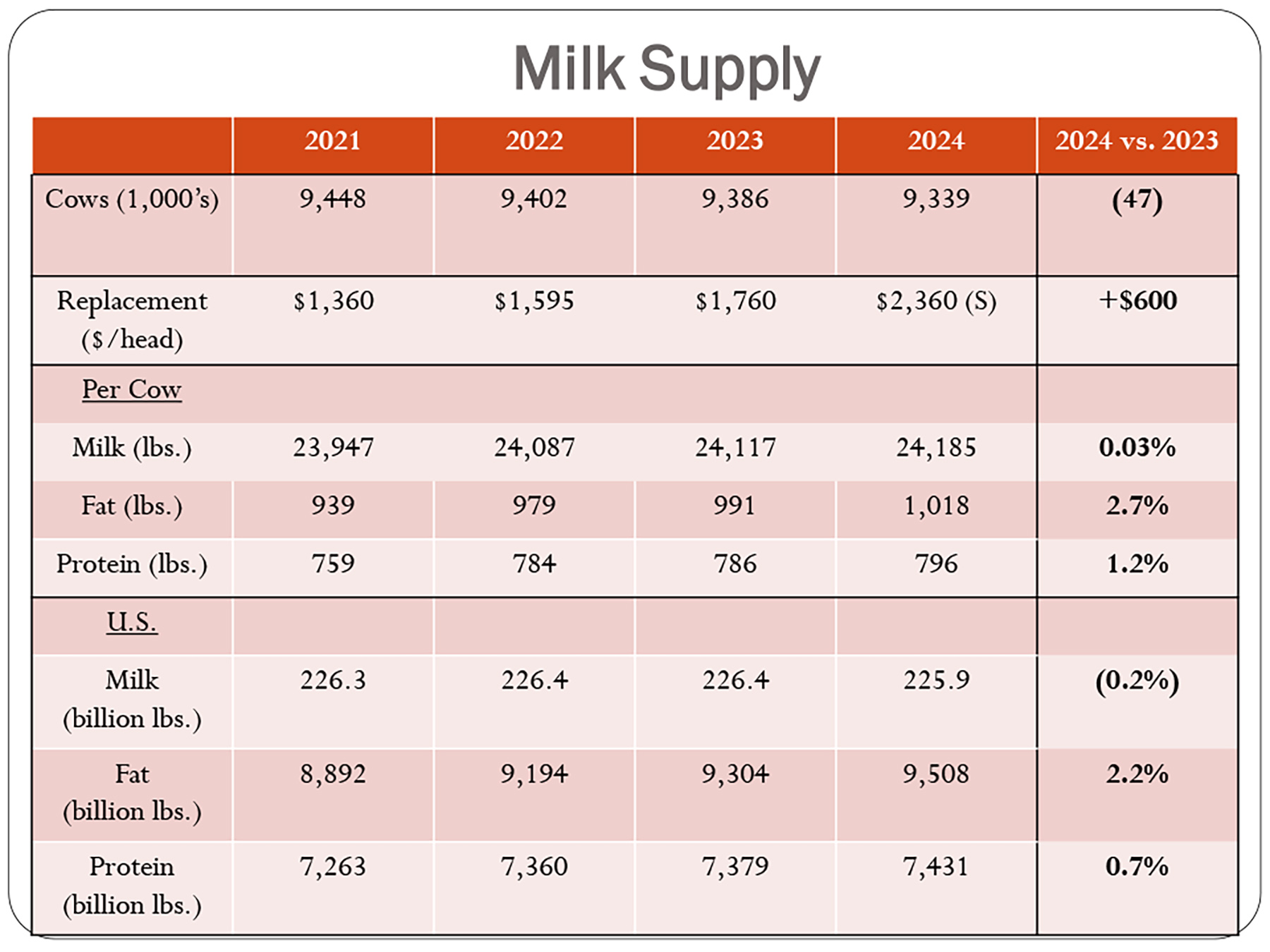
Covington demonstrated with 2023 vs. 2024 comparisons that farmers are increasing the amount of products made by increasing components year over year, instead of milk production and cow numbers.

Components are the big story on the supply side, a trend he also sees continuing. He doesn’t expect dairy cow numbers nor milk output per cow to go back to the year-over-year gains seen in the past any time soon.

With a chart he showed the stark 2024 vs. 2023 data: Cow numbers are down 47,000 head; replacement heifers sell for $600 more per head; average milk output per cow is flat; but average fat pounds per cow is up 2.7% and average protein pounds per cow up 1.2%. This means that even though total U.S. milk production at an estimated 225.9 billion pounds is down 0.2% from year-earlier, total fat pounds at 9.508 billion pounds are up 2.2%, and protein pounds at 7.431 billion pounds up 0.7%.

“You’re doing it with your components,” he said. “And that’s going to continue.”

Cheese (or maybe whey) is driving the bus

Putting aside the import and export caveats, Covington demonstrated that as the overall dairy market is growing, almost all of this growth has been in the cheese market, which has become a much bigger piece of the much bigger pie.

“Cheese has been driving the dairy industry for several years, and everything points to it driving the industry going forward,” he said, showing a chart of the product mix in the year 2000 when 167.4 billion pounds of milk was produced in the U.S., sold as half cheese, and one-third fluid milk, with 15% other products. This compares with 2024, when 225.9 billion pounds of milk was produced and 58% of the sales were in cheese, 20% fluid milk, and 22% other products.

Per capita trends also show “consumers are eating more of their milk instead of drinking it,” said Covington. “We have seen tremendous change since 1986, when consumers first started consuming more of their milk as cheese than as fluid milk. Look at 2023, people consumed 405 pounds of milk (equivalent) in the form of cheese and 128 pounds in the form of fluid milk.”

While home milk delivery is rare today, Covington said it happens now in the form of pizza.

“If I drive around the city on a Friday night, I’ve got to get out of the way of the pizza delivery people. I figure, on average, it takes a little over a gallon of milk to make one average size pizza. Just think how much home delivery we have today of milk, but in the form of something else, not the milkman dropping off half gallons,” he said.

“The market is changing, and it’s going to keep on changing.”

Why is cheese growing so much? Covington pointed to things he hopes are lessons for other products: 1) Convenience, innovation in packaging and varieties, with pizza accounting for 42% of all cheese; 2) Brand identity, there’s still a lot of this in cheese, not making it a commodity to try to get to the lowest price like in other dairy products (i.e. fluid milk); and 3) taste, people love cheese.

Big bets on the future

Big bets are being made for more cheese growth, and the revenue stream of whey ‘byproduct.’

“We are in a slurry right now of a pile of money being spent on new plant construction,” said  Covington, listing the states of Kansas, Texas, South Dakota, Minnesota, Wisconsin and New York. 

When all of this new construction is complete over the next year or so, Covington expects the need for 30 million pounds of milk a day to fill the new plants or expansions, which he estimates represent investments of at least $5 billion and are owned by private companies or groups of farmers or individual farms that are not cooperatives.

“This kind of money and growth is not being put out there unless there is confidence in getting a return on investment with cheese and whey product growth both domestically and internationally,” he pointed out.
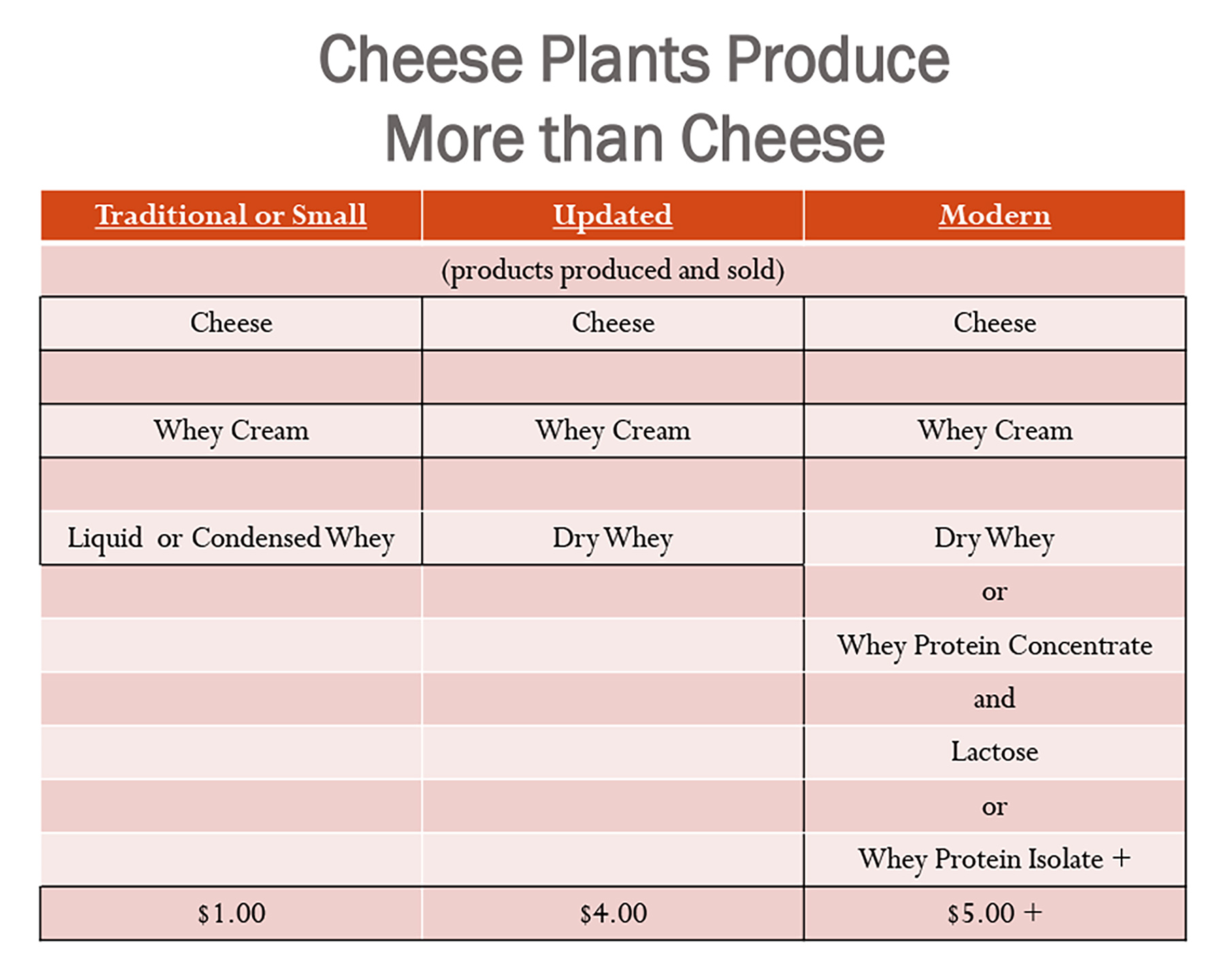
New cheese plant construction, when completed over the next year or so will take in more than 30 billion pounds of milk a day, and they gain a lot of additional revenue from what they do with the whey that smaller traditional cheese plants don’t have the equipment to do.

These new plants making all of this cheese will also have a lot of whey.

He explained that small plants get about $1.00/cwt for the whey cream and have the liquid whey to do something with. Some plants might dry it and get $3 per cwt for the dry whey plus the $1 for the whey cream, so that’s $4/cwt.

“Small traditional cheese plants can’t afford the equipment to do what some of these new plants are doing. These new companies not only dry the whey, they fractionate it to make whey protein concentrates. They separate out the lactose for whey protein isolates,” Covington said, rattling off a few items on the expanding list for everything from snacks and beverages, to pharmaceuticals and cosmetics, to milk replacers, to counter-top items, ‘pizza cheese,’ artificial seafood, canned hams, and more.

“It’s just amazing, and it brings in more revenue. When we think about cheese, it’s more than just the cheese, it’s also the income from the whey that’s left over,” he said, adding that the CEO of a large cheese company once told him: “Sometimes I think the cheese is the byproduct.”

With this kind of investment, the new plants are going to be making big volumes and getting income from the whey.

“This puts a crimp on the small cheese plants that can’t do this, and they’re going to have to get it out of the cheese end,” Covington observed, suggesting some potential structural change on the cheese side of the dairy industry with significant domestic and international sales growth needed to stay a step ahead.

On the positive side of the fluid milk industry, in addition to growing whole milk sales, Covington highlighted new investments. He sees a future with more dominance by grocery stores, pointing out the two new Walmart plants going into Georgia and Texas, which will be the largest in the country, processing 50 to 55 loads of raw milk a day.

Other big investments in the fluid milk sector in the Northeast are ultrafiltration and ESL packaging, such as the new fairlife plant under construction in western New York, new ESL expansion at the former Hood plant owned by Maola, and aseptic shelf-stable milk packaging at Cayuga Milk Ingredients.

-30-

DMI details decent dairy conditions on all fronts during industry, media calls

Exports up, Retail up, Food banks up, Inventories stable, Foodservice down but recovering, Future unknown

By Sherry Bunting, May 22, 2020

headshots.indd

CHICAGO, Ill. – How do dairy industry leaders view the status of dairy sales, marketing and promotion and what insights will they share? A few themes emerged from phone conferences with media and producers.

First, it appears that not only is Dairy Management Inc (DMI) working to move product to “hunger” systems, including schools, food banks and charitable organizations, they are also working to reassure consumers — both domestically and overseas — that the U.S. is producing a reliable supply of milk and dairy products, despite the news of so much milk dumping.

After six to eight weeks of supply chain disruptions, milk dumping news, sparse dairy case shelves and/or purchase limits, DMI says national, state and local teams have worked to get stores to remove limits, keep shelves stocked and assure domestic consumers and export buyers that the milk will keep coming.

The news from dairy checkoff leaders is pretty decent on how dairy looks on many of its marketing and inventory fronts. Exports are up. Retail sales are up. Food bank usage and government purchases are up. Inventories are stable. And the previously plunging foodservice sector is recovering.

Meanwhile, dairy farmers received April settlement milk checks in the $10 to $12 range, many with COVID-19 deductions as high as 87 cents/cwt. Some report milk checks netting a single-digit price for April milk. And for direct shippers to Dean Foods, zero checks or deposits were received in mid-May for April milk.

Top dairy leadership talked Tuesday on a media conference call as well as Monday on a producer ‘open mic’ call about some of the dairy market statistics and insight, and how DMI is “pivoting” during the Coronavirus pandemic to “get more dairy in the hands of consumers.”

On the research front — “We need to maintain the things we have to maintain and alter the things we can alter,” said DMI CEO Tom Gallagher in the May 19 media call. One example he emphasized is “DMI’s commitment to publishing milkfat research to keep that front and center.”

On the “open mic’ call with producers the day before, Gallagher said dairy checkoff has been involved in either funding or publishing 59 studies related to milkfat since 2002. He said that the Dietary Guidelines won’t change until there is a “preponderance” of evidence – a “mountain” that is so large — large enough to overcome 40 years of anti-fat dietary advice.

In looking at the list, most are studies related to full-fat cheeses and the role or impact of dairy consumption, no matter the fat content, on various health indicators. Some are studies of milkfat composition, beyond the saturated fat portion, and a handful of the 59 studies pertained to fluid milk of all fat percentages (more on this in a future edition of Farmshine).

On the foodservice front — Sharing data provided to DMI by Inmar Insights, Gallagher said that the foodservice losses can now be measured by transactions but not by dollars or volume, yet.

At the lowest point in the pandemic, the number of sales transactions in the quick serve restaurants (QSR) was down 42% below year ago, but now these transactions are down 20% from year ago.

For full-service restaurants, transactions were down 80% at the height of the pandemic, and now they are 60% below year ago as more full-service restaurants adopt curbside and contactless meal options.

“At the height of the pandemic, 70% of consumers said they would avoid eating outside the home. That percentage is now 50%, and we believe it will reduce over time,” said Gallagher.

Various fresh dairy products

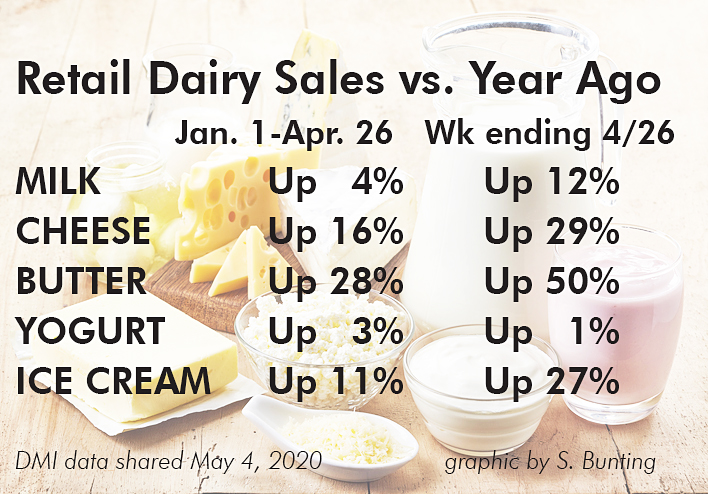
On the retail sales front — Gallagher shared that fluid milk sales pre-COVID were trending 5% below year ago. “But in the first two weeks of the pandemic, fluid milk sales jumped 34% higher, and now, in the past month or so, fluid milk sales are averaging 10% above year ago,” he said.

Looking at products that surround a milk choice, Gallagher noted that cereal sales have been declining 1 to 3% per year pre-COVID. But in the first two weeks of the pandemic, cereal sales jumped 78% and are now averaging 17% above year ago.

He said milk used on cereal has historically accounted for 3% of all fluid milk sales, so the rise in cereal sales is at least a partial factor in the increased fluid milk sales, according to Gallagher.

Looking ahead, Gallagher noted that DMI expects to receive “deep analysis” this week about “why people buy what they bought” both in the first two weeks of so-called “panic buying” and for the four to six weeks after as conditions stabilized.

“There is a lot of conjecture and a lot of opinions out there,” said Gallagher, “But we can’t be in the business of taking our opinion of nutritional or comfort reasons, we really have to understand what was the motivation.”

Gallagher noted that the total all-beverage sector saw very large increases in sales post-COVID, and that the alternative dairy beverage category showed very high percentage increases but are still a very small percentage of volume.

“On an incremental basis, (non-dairy alternative beverage) increases are nowhere near what the increase was for fluid milk sales,” he said.

Another retail category DMI highlighted was frozen pizza sales. “Historically, frozen pizza sales were flat, pre-COVID,” said Gallagher, adding that in the first two weeks of the pandemic, frozen pizza sales jumped 120% over year ago, with sales over the past month averaging 39% higher than year ago.

“That’s just as important to us as cereal sales,” said Gallagher.

Looking ahead, he noted that the “deep analysis” of why consumers buy what they bought will be used as a benchmark and monitored periodically for changes.

“Ultimately, what happens to sales will not be determined by some great ad or some smart thing that one group does, it will be determined by what is the behavior of consumers after this pandemic,” he explained. “We know going into this pandemic, we have moved from consumers spending 90% of their food dollars in the home in the 1950s and 60s to over 50% spent outside the home. Now, those at-home dollars are way up.

“At the end of this, what will their behavior be? Will they eat more at home? Will they keep eating cereal? Or will they go back to breakfast on the go? Will they still do more baking?” Gallagher wondered aloud.

“The idea that we can just educate and the problem will be solved, it wouldn’t,” said Gallagher. “If you look at the competition up and down the grocery aisle, there are two aisles with no dairy in them in the nutrient-rich niche market for on-the-go (shelf-stable). That could have been dairy, but now it’s not, and we have to play catchup.”

He said consumers “eating at home can be a hope that would be huge for the white gallon, but if we think the white gallon is the innovation of the future, it’s not.”

While Gallagher acknowledged that these current retail buying trends during COVID-19 bode well for fluid milk and butter, and DMI can market toward that once they understand why, he also countered these trends, observing that, “If consumers go back to where they were, then we are back to the same opportunities and issues that were always there. The reality will likely be somewhere between those two extremes.”

Gallagher pointed out that many people believe consumers are responding to messages about dairy nutrition, and that it might seem to be a good idea to “market to nutrition, but it’s not that simple,” he said. “What we do for dairy farmers has to be based on the reality of the data.”

In other words, DMI will market to the why’s behind the sales data once they receive the next layers of  “deep analysis” – to continue a promotion direction of following consumers with partner ‘innovations’ instead of leading them with an emphasis on product information.

On the export front — “The numbers look better than we anticipated for the first quarter of 2020 despite the virus, and we hope this will continue for the year,” said Tom Vilsack, president and CEO of the U.S. Dairy Export Council (USDEC).

Specifically, Vilsack reported that the U.S. exported 109,000 more metric tons of dairy products in the first three months of 2020 as compared with a year ago, and these exports were worth $528 million more than exports a year ago.

He expects to see a decline in exports into the summer with a rebound later in the year.

He said USDEC is “using aggressive social media in all export markets for U.S. cheese and dairy ingredients to make sure buyers know milk is still being produced here.”

According to Vilsack, export buyers are diversifying their purchases and spreading supply risk, “so some of that market share is coming our way from diversification,” he said. “Our price-competitiveness is good at the moment, and this is something we watch, so our ‘Next 5%’ plan for growth continues even in this much-changed landscape.”

USDEC is marketing with Costco in China and Southeast Asia, including significant advertising about American-made cheeses. In the Middle East, recipes using cheese are being included in grocery bags and hung on doorknobs, said Vilsack. Culinary efforts are also being geared to encourage the next generation of overseas chefs to use American cheeses.

On the inventory front — Vilsack noted that USDEC sent a “warning shot” letter to the European Union and other to be sure any dairy intervention does not lead to a stockpile of powder or dairy products like the EU accumulated in 2015, which had led to three of the past five years of dismal global milk prices.

In a producer call the day before, Gallagher’s guest Jim Mulhern from National Milk Producers Federation described U.S. dairy commodity inventories as “not that bad.”

Mulhern said some dairy product stocks were building at the start of the pandemic, but mostly inventories are “not really burdensome right now. We are not in bad shape (inventory-wise). That’s one reason barrels moved is stocks are not that large right now,” he said.

“That’s one of the reasons we focused on the need to have USDA buy products now and get them into commerce through feeding programs and into food banks right away. The need is there, and we have the product,” said Mulhern. “We don’t want to go back to holding product in storage and selling it on the market later.”

On the food bank front — Vilsack confirmed that there is a 70% increase in overall food demand by the food bank system, and Gallagher added that fluid milk is still the most requested item.

“Food banks get most of their food from retail, and this is a challenge at a time when the retail sector is challenged by this higher demand,” said Vilsack, who in addition to being CEO of the dairy checkoff-funded U.S. Dairy Export Council, sits on the board for the Feeding America national food bank system.

Vilsack noted there is a significant demand for volunteers and for equipment such as refrigeration to handle these higher volumes of food being supplied to serve the expanded need brought on by around 30 million newly unemployed workers during the COVID-19 economic shut down.

National Dairy Board president Barb O’Brien talked about the “emergency action team” that was assembled after foodservice and restaurant trade began to shut down with business restrictions.

“We shifted our focus,” said O’Brien, noting that DMI partner Kroger, with its 16 milk plants, got involved in moving “hundreds of thousands of gallons of milk into the hunger system.

“We also worked with other processors on fluid milk, cottage cheese and turning 40-pound blocks into smaller packages, and we worked with processors to solve infrastructure challenges around refrigeration, to get coolers and refrigerated trucks placed at pantries,” O’Brien said, explaining that their teams are looking at the supply chain issues in four quadrants: schools, hunger, foodservice, and retail and then “working with farmers, processors and cooperatives to redistribute product.”

For school feeding, some of the regional checkoffs developed free emergency menu resources, donated thousands of coolers at alternative school feeding sites, worked with school nutrition personnel and USDA to help translate the rules – to understand the waivers that allow bulk or gallon containers for multiple meal service.

On the schools front –  Also on the media call was Alexis Glick, CEO of GENYOUth. She talked about the COVID-19 School Fund that was launched on March 30 two weeks into the closure of schools and non-life-sustaining businesses.

The purpose of the fund, which has raised $5.5 million to-date, is to provide grants and resources to help schools package, distribute and deliver meals in the grab and go model. Glick said they have received $33 million in requests so far as 12,000 school buildings, to-date, have applied for individual $3000-grants for equipment needed for such distribution.

“So far, $5.5 million in cash and equipment has been awarded to support over 6000 schools, said Glick. She estimates that these 6000 are collectively delivering 50 million meals per week (two meals per day).

“We are aiming to approve 250 to 500 grants per week by prioritizing schools that are serving the highest number of meals with the highest numbers of (USDA) free- and reduced lunch eligibility,” she said.

Glick noted that “alongside dairy farmers,” support for the COVID-19 School Fund has come from financial institutions, Domino’s, PepsiCo, National Football League, United Healthcare and a recent partnership with the Rockefeller Foundation as well as private donations from chefs, athletes and celebrities.

“We are working with our health and wellness partners, our partners at USDA, the School Nutrition Association, celebrities and media entities to get the word out and draw awareness. Just because the school year ends, doesn’t mean the end for hungry kids,” said Glick.

GENYOUth’s technology partner SAP has developed a “resource locator” called SAP for Kids to connect families to school meal resources in their zipcodes.

Glick also said school meals will convert soon to summer feeding sites and then in the fall, meals at schools will likely change based on CDC recommendations for eating in classrooms instead of cafeterias. “Schools will need our help to buy equipment that they will need for that,” she said.

Moving and messaging — As mentioned in the Farmshine article last week, O’Brien again touted the “deep relationships” dairy farmers have with ‘some of the biggest foodservice partners.” saying those partners “extend what we can do to immediately drive incremental cheese volume.”

An example she gave is an extra two ounces of cheese on pizzas and new national ads to be run by Papa Johns and Pizza Hut now through the end of August about more cheese. She also highlighted Domino’s new concept launching carside delivery full-tilt in July, saying this will move “more cheese.”

Meanwhile, said O’Brien, the “Undeniably Dairy” messaging is focused on “building trust and bringing joy by reassuring people that dairy farmers and the dairy community are essential and working tirelessly to ensure a safe and consistent supply.”

They are also repurposing content to provide virtual farm tours for parents and teachers to access for at-home curriculum and promoting recipes.

“Consumers are still interested in where their food comes from and how it is produced,” said O’Brien. So, these “tell your story” and “sustainability” themes the checkoff has been focusing on pre-COVID will continue, but are changed a bit to conform to stay-at-home communication venues.

Among the planned media segments leading up to June Dairy Month are the one Monday, May 18 on Fox and Friends featuring Maryland dairy farmer Katie Dotterer-Pyle and the 30-second video produced with footage from several dairy farms that will be shown 20 times in the following weeks and will be picked up by other stations through online “streaming.”

She also said that the MilkPEP television commercial that was running about dairy farmers, haulers, bottlers, and store employees has now been “co-branded” with a large Undeniably Dairy logo, it reinforces the essential care of the entire dairy supply chain.

O’Brien hinted at a surprise promotion to happen May 21 in partnership with a major pizza chain on late-night-TV — a ‘pizza party’ celebrating 2020 graduates as their traditional graduation ceremonies have been suspended by COVID-19.

-30-