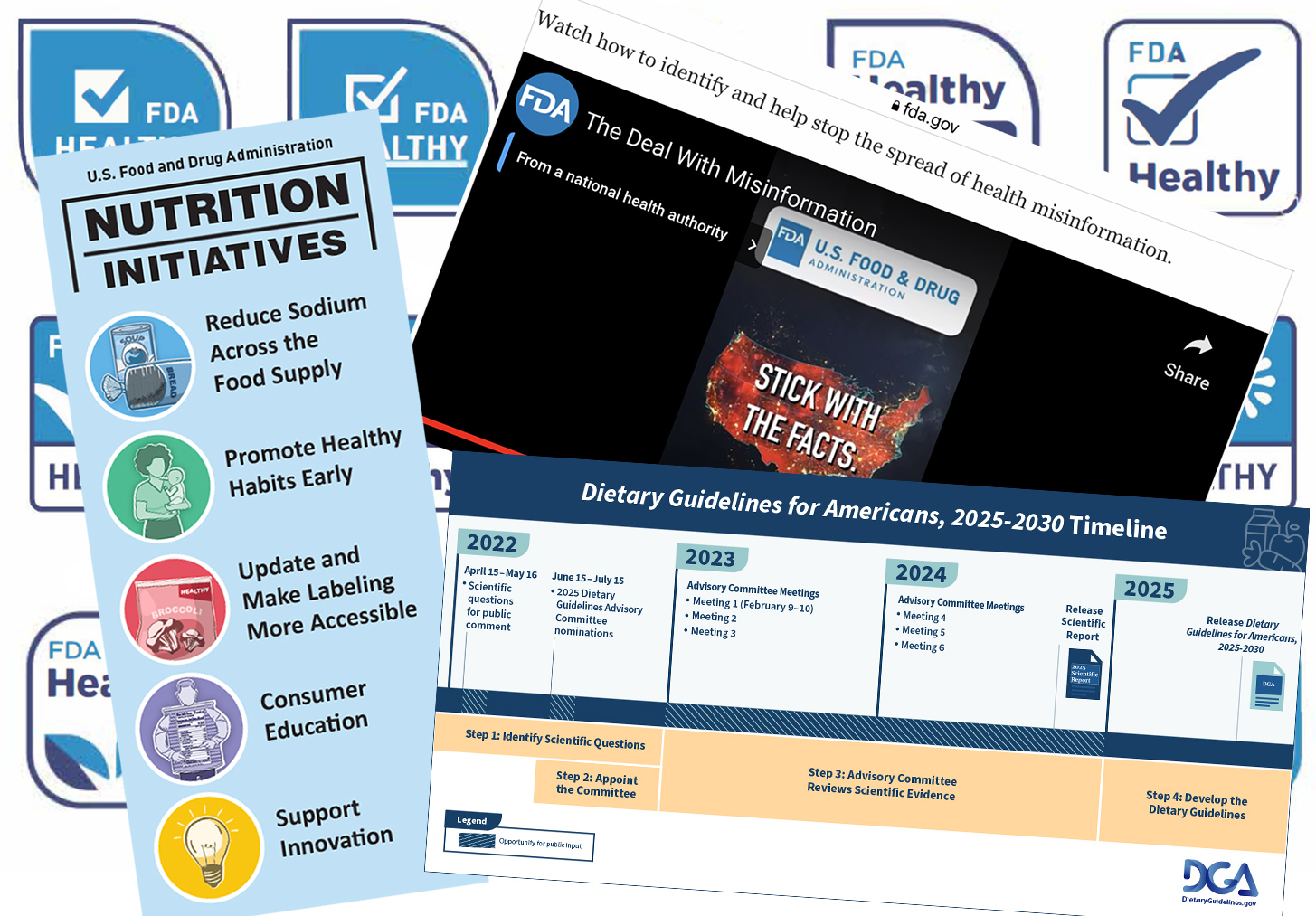
FDA launches ‘rumor control’ hub, will this eventually include its ‘nutrition initiatives’?

By Sherry Bunting, Farmshine, May 19, 2023

WASHINGTON D.C. — The Food and Drug Administration (FDA) launched a new “rumor control” webpage on May 16, described as the hub to stop what the FDA calls “false, inaccurate, or misleading health information” that is “negatively impacting the public’s health.” 

How does FDA define misinformation? “It’s information, spread intentionally and unintentionally, that is false, inaccurate, or misleading according to the best available evidence at the time,” the announcement explains.

Who decides what is the best available evidence at the time? An info-graphic recommends checking sources and cross-referencing the information with reliable sources.

What is a reliable source? FDA describes it in one section as “the federal government and its partners” and describes it in another section as “a non-profit fact-checking source or government resource.”

A video narrator at FDA rumor-control explains the next step is to read beyond the headlines on the internet for context and to “understand the purpose of the post.” 

Scrolling to the bottom of the landing page are instructions to report misinformation.

“We face the challenge of an overabundance of information related to our public health. Some of this information may be false and potentially harmful,” the FDA rumor control webpage states. “If you see content online that you believe to be false or misleading, you can report it to the applicable platform.” 

These words are followed by icons to click for administrators at Twitter, Facebook, TikTok, Instagram, LinkedIn, YouTube, and WhatsApp.

FDA has posted to this hub its ‘fact documents’ on several hot topics such as vaccines, dietary supplements, and sunscreen, stating that more topics will be added in the future.

Will nutrition become one of them, now that the Administration has placed a priority on FDA’s role as purveyors of the Dietary Guidelines as gospel?

Case in point, just three weeks prior to launching the rumor-control hub, the FDA announced it is “prioritizing nutrition initiatives to ensure people in the U.S. have greater access to healthier foods and nutrition information to identify healthier choices more easily… to improve eating patterns and, as a result, improve everyone’s health and wellness.”

These FDA initiatives came out of the “whole of government approach” pledged by President Biden and Ag Secretary Vilsack in the White House Strategy on Hunger, Nutrition and Health.

“People need to know what they should be eating, and the FDA is already using its authority around healthy labeling, so you know what to eat,” said the President during the White House Conference where the Biden-Harris National Strategy was unveiled in September 2022. 

The FDA proposed rule on ‘healthy labeling’ came out on the same day. Comments ended months ago but the final rule has not yet been published in the Federal Register.

The FDA nutrition initiatives are being pursued “to help accelerate efforts to empower consumers with information and create a healthier food supply.”

According to the FDA news release, the federal government currently believes obesity and chronic diet-related diseases are on the rise because American eating patterns are not aligning with the federal Dietary Guidelines. The press release states that most people consume too much saturated fat, sodium and added sugar, and the FDA nutrition initiatives aim to correct this.

FDA’s nutrition priorities in progress, include:

1)    Developing an updated definition and a voluntary symbol for the ‘healthy’ nutrient content claim, front-of-package labeling, dietary guidance statements and e-commerce labeling, and

2)    Supporting innovation by changing standards of identity such as labeling requirements for plant-based foods.

In addition to issuing its controversial plant-based milk labeling rule earlier this year, which would allow the pattern of fake milk proliferation to simply continue, the FDA in the first four months of 2023 sent letters of ‘no objection’ to three companies in their respective requests for GRAS (generally regarded as safe) status for cellular lab-created meat. 

Several ferrmentation-vat dairy protein analog makers — including Perfect Day with its genetically-altered yeast excrement posing as dairy protein — received their ‘no objection’ to GRAS letters from FDA in 2020.

As reported in Farmshine over the past several years, the FDA has been on its “multi-year nutrition innovation strategy” since 2018. However, the pace has accelerated since September 12, 2022, when Executive Order 14081 was signed by President Biden just 10 days before the White House Conference on Hunger, Nutrition and Health.

Entitled Advancing Biotechnology and Biomanufacturing Innovation for a Sustainable, Safe and Secure American Bioeconomy, the Presidential EO 14081 states: “For biotechnology and biomanufacturing to help us achieve our societal goals, the United States needs to invest in… and develop genetic engineering technologies and techniques to be able to write circuitry for cells and predictably program biology in the same way in which we write software and program computers; unlock the power of biological data, including through computing tools and artificial intelligence; and advance the science of scale‑up production while reducing the obstacles for commercialization so that innovative technologies and products can reach markets faster.”

(AUTHOR’S NOTE: All roads lead back to the umbrella of the Dietary Guidelines. The current DGA Committee began meeting recently in the process of formulating the 2025-30 DGAs. Entrenched in four decades of low-fat dogma, the USDA and HHS, along with the 2010, 2015 and 2020 DGA Committees, repeatedly left out of the discussion dozens of scientific papers, even research by the National Institutes of Health, that showed the neutral to beneficial impact of saturated fats on human health and the positive role of nutrient dense foods that are high in protein and essential nutrients but also contain saturated fat such as whole milk, full-fat dairy, and unprocessed red meat. Given the fact that childhood obesity and chronic diet-related disease incidence are rising rapidly, an objective fact-checker could easily determine that the Dietary Guidelines, themselves, are health misinformation. Clearly, children are the sector of the population whose eating patterns closely align with the Dietary Guidelines since 2010. They don’t have a choice. Most children today eat two meals a day, five days a week, three quarters of the year at school where the Dietary Guidelines rule with an iron hand. Let’s not forget the 2020 DGA Committee admitted that all of the DGA eating patterns came up short in essential nutrients found in animal foods, but when a committee member warned of this on final public reading, the saturated fat subcommittee chair mentioned taking vitamin pills and noted ‘new designer foods are coming.’)

OPINION: Abuse of dairy is long-running orchestration of deceit

By Sherry Bunting, Farmshine, March 3, 2023

In what appears to be scripted unison, the disappointing draft guidance on imitation milk labeling, published by the FDA on Feb. 22, is timed perfectly for Danone’s new advertising campaign to position its Silk Nextmilk as “the better milk.”

This includes putting imitation ‘Nextmilk’ mustaches on the adult daughters and sons of several “Got Milk” celebrities that donned real milk mustaches decades ago.

Never has the flagrant abuse of misleading marketing been more corrupt.

Danone officials have been quoted in news releases saying their NextMilk campaign is aimed at “inspiring a new generation of plant-based milk drinkers.”

In fact, Danone is deliberately corrupting the iconic milk mustache of the former MilkPEP ‘Got Milk’ campaign, which was originally launched by the California Milk Processor Board that started Got Milk 30 years ago.

This move by Danone’s Silk actually mocks producers of Real Milk. 

Several weeks ago, in Farmshine, I authored an article detailing Danone’s timeline on plant-based imitations for the milk, yogurt and cheese categories and the company’s stance on seeing this fake-milk area as the growth market they are investing in.

The recent FDA draft guidance on labeling of plant-based and other imitations is pathetic. FDA has caved to big global corporations seeking to exploit the nutritional benefits that are unique to real milk for their own fake-product financial gains. 

FDA even acknowledged in its draft guidance that consumers are confused about the nutritional differences and that a smaller percentage of consumers may even be confused about whether or not these products contain milk. Somehow, the FDA concluded that consumers are not being misled!

The FDA draft guidance “recommends” a “voluntary” statement about nutritional deficiencies, but this is not mandatory.

Even the voluntary statement criteria are described as being measured against USDA’s Food and Nutrition Service “substitution levels” for key nutrients, not what milk actually contains.

Furthermore, no importance is given in the FDA draft guidance to the differences between calcium additives and natural bioavailable calcium. No importance is given to milk as a COMPLETE protein with all 9 essential amino acids we must get from our foods and beverages because our bodies don’t make them.

Animal-derived protein, like in dairy and meat, contain all of these amino acids. Plant-derived proteins only contain some of these amino acids. Consumers need to know this.

There is much to say about the FDA’s track record of ignoring its own standards of identity for milk and other dairy products. The current administration shows little respect for milk’s integrity in the new draft guidance and other bureaucratic moves.

What will the dairy checkoff programs do about the manner in which Danone is stealing and perverting past real milk campaigns to dupe consumers into thinking NextMilk is real and better? What will be done about the packaging made to resemble whole milk?

We asked that question in an email to DMI’s press office and are still waiting for a response.

(UPDATE: The following response was provided to Farmshine by the DMI press office two days after this article was published: “The trademark registration for the ‘milk mustache’ expired and was not renewed by the organization which managed the campaign. And while imitation is the sincerest form of flattery, the national and local dairy checkoff teams along with MilkPEP, NMPF and IDFA remain focused on engaging consumers with the nutritional value that dairy from a cow provides. It’s important to note plant-based alternatives overall are down 2.6% year over year, according to IRI data.” )

To me, it appears the dairy checkoff organizations are unconcerned. We have researchers paid with checkoff dollars looking at ways to fractionate milk and develop new protein drinks that address other desires of consumers — practically giving in to their survey findings that consumers don’t think dairy protein has any advantage over plant protein. 

BUT IT DOES! Why are we not pushing that message? Does USDA forbid such comparisons by checkoff organizations? Or is that a convenient excuse?

Now is not the time to give up the fight. Now is not the time to say, oh well, protein is protein so let’s blend them and make new beverages or let’s focus on other ways to draw consumers. Now is not the time to be shy, but to be bold.

Now is the time to push the education of consumers and rally the troops to support real milk and dairy.

All of the checkoff emphasis on ‘sustainability’ is not going to sell milk.

All of the emphasis on Gen-Z and ‘meeting consumers where they are’ is not going to sell milk.

Gen-Z has been robbed of the opportunity to have good tasting whole milk in school where they grow up receiving two meals a day, five days a week, three-quarters of the year with the only milkfat option being fat-free and 1%. They have been sold a bill of goods by Big Food while farmers have paid billions out of their own pockets in checkoff funds over the past 12 years to ‘play nice’ with the enemy.

To be honest, soy beverage has always been an alternative for those who can’t consume milk, and it remains the most nutritious of the fakes. But the proliferation of fake imitations is now just completely out of control, and most of these beverages aren’t much more than water, flavor and additives.

Danone is using “artificial intelligence” to redesign its imitation products. This global giant takes the lazy and perverse path of stealing not only milk’s name through misleading advertising, it is using a former real milk advertising campaign to promote an imitation product. 

Danone is packaging Silk’s fake imitations in red and white cartons to resemble whole milk in the supermarket dairy case, and even adding the words ‘whole’ or ‘whole fat’ under the brand name to make consumers THINK it’s the whole milk more people are turning to. 

In 2019, Danone even trademarked the phrase and artwork for its imitation beverage: “Silk – the original nutrition powerhouse”.

Silk? Original? Nutrition Powerhouse? Give me a break!

Danone is thumbing its nose at dairy farmers and using “sustainability” as the virtue signal to get away with these perversions.

In fact, I got a text message from a farmer this week who caught the tail end of a Today Show spot on television, where they interviewed the Danone Silk models, wearing Nextmilk mustaches like their celebrity mothers or fathers did years ago in the Got Milk campaign. 

This farmer thought actor John Travolta was going to do a Got Milk mustache campaign. But no, Danone hired his daughter to do a Silk NextMilk mustache campaign. Even the Today Show headline called it a ‘new milk campaign’ and highlighted the way the FDA draft guidance makes it all possible. 

No one was there to talk about the nutritional differences or to talk about real milk. 

Americans are being misled, dairy farmers are being thrown under the bus, and children are being deprived, while government agencies facilitate, and checkoff organizations twiddle their thumbs or say their hands are tied. 

We are thankful there are champions in the United States Congress who have introduced legislation to try to turn these circumstances around. We are thankful that Pennsylvania lawmakers are working on resolutions to file with federal government agencies on these proposed rules.

We are thankful for people like dairy producer and country singer Stephanie Nash of Tennessee who was interviewed on the Fox Business channel about the FDA guidance. She put it straight: ‘Milk comes from cows, not a lab.’ 

This is going to require all of us to get involved.

Here’s what you can do:

Call your Senators and Representatives and ask them to cosponsor the Dairy Pride Act and Whole Milk for Healthy Kids Act.

Call your state lawmakers and ask them to pass resolutions in support of whole and 2% flavored and unflavored milk options in schools and then formally file those resolutions on the open USDA proposed rules docket.

Sign and promote others to sign the Whole Milk in Schools petition at https://www.change.org/p/bring-whole-milk-back-to-schools

Write a brief public comment and urge others to comment by April 10 on the USDA school nutrition proposed rule that would limit flavored milk in schools. Simply tell USDA our children need the nutrition whole milk provides, so school meals should include the options of whole and 2% unflavored and flavored milk. Comment on that docket at link https://www.regulations.gov/commenton/FNS-2022-0043-0001

Write a brief public comment and urge others to comment by April 24 to the FDA to stop allowing beverages that aren’t milk to be labeled as milk. Comment on that docket at https://www.regulations.gov/commenton/FDA-2023-D-0451-0002

And stay tuned on how to get involved as the next round of USDA Dietary Guidelines Advisory Committee deliberations recently got underway. The stage is already set for more demonization of milkfat and abuse of milk’s integrity there as well.

This abuse of milk cannot stand. It’s going to be up to us — the grassroots farmers and citizens — to stand in the gap for what is right.