While fakes campaign to BE ‘milk’, dairy checkoff aims to REINVENT milk. New ‘milk beverage platform’ deemed ultrafiltered, ESL, shelf-stable

As new milk beverage platform is developed, it sounds to me like people want the many attributes fresh whole unfooled-around-with fluid milk already delivers. It checks all the boxes! Maybe children just need to be allowed to have whole milk at school and daycare where they eat most of their meals, and maybe new generations of adults need the education about why and how the dairy protein and natural nutrition in real milk beat the imposters, hands down.

By Sherry Bunting, republished from March 2023 editions of Farmshine

SAVANNAH, Ga. — Dairy checkoff-funded researchers say a new milk beverage platform is being developed to provide “the keys to the kingdom.”

Their consumer studies show people want clean labels, and at the same time they want more attributes. On the one hand, they want energy and protein. On yet anotherhand, they want indulgent creaminess. 

Consumers also want flavor, but they want less sugar. They want sweeteners, but not artificial sweeteners. They want thickness without the thickeners. They do not want gums or gels, but they are okay with fibers and starches. 

Some consumers want higher protein products. Others want everyday nutrition that is reasonably priced. 

These are some of the highlights that were shared back in January 2023 during the Georgia Dairy Conference in Savannah. There, Dr. MaryAnne Drake, professor of food science at North Carolina State University and director of the Southeast Dairy Foods Research Center talked about the fluid milk innovation work funded through DMI.

The ‘new milk beverage platform’ leverages different processing applications for flavor and functionality around dairy protein, based on global protein trends in a rapidly growing nutritional drink market.

ESL shelf-stable milk: key to kingdom?

“We are after a shelf-stable milk that tastes great and meets our consumer’s sensory needs and our industry’s sustainability needs,” said Drake about the work of the four university research centers, including North Carolina State and Cornell, that are drilling into milk’s elements to sift, sort, and test different combinations, as part of the checkoff-funded Innovation Center for U.S. Dairy, under the DMI umbrella.

Through processes like membrane technology, ultrafiltration, and aseptic packaging, the physical, nutritional and sensory elements of milk are being isolated at a molecular level to create beverages that aim to deliver this broad list of what consumers say they are looking for. 

At the same time, researchers are using interpretive surveys to understand how consumer desires actually translate into purchases, and then work with processors to build relationships with retailers to get these new beverage products into stores.

Reinventing milk

What does all of this mean? Reinventing milk by focusing on the domains in which real milk has a clear advantage for consumers among so many plant-based and now cell-based options. 

For example, said Drake: “Consumers want to know from a credible source what the immune-boosting elements are in milk, not what we have added. They tell us they want to know the science. That’s new.” 

Drake explained that the findings from their interpretive surveys represent a huge and divergent set of innovations to sort through and capitalize on as part of a new strategy.

“Consumers don’t see the perceived value of animal protein vs. plant protein, so we had them graph what they want and don’t want, what they know and don’t know,” she said, adding that consumers gave the slight edge to plant protein over dairy protein. They rated the top three protein categories as plant protein, whey protein, and milk protein — in that order. (A large percentage believed whey protein is plant protein.)

As their familiarity with the differences between plant and animal protein increased, their liking of dairy protein increased, the researchers learned.

In other words, consumers do not know the science about the nutritional differences between plant and animal protein, and if they knew the differences, they would rank milk protein as number one. 

Clearly, this is a failure in consumer education and messaging. Isn’t that the domain of the dairy checkoff?

New strategy

Drake indicated that educating consumers about dairy protein as a ‘complete protein’ is one thing that can help. However, she said, the functionality around dairy protein is the innovation strategy that is being pursued by the industry.

“The number one label claim consumers are looking for in a protein beverage is ‘naturally sweetened.’ We own that, and this is where we can deliver,” Drake declared.

“We own protein functionality. We understand the process parameters that impact flavor and functionality, and we can leverage this over plant proteins on this platform,” she said.
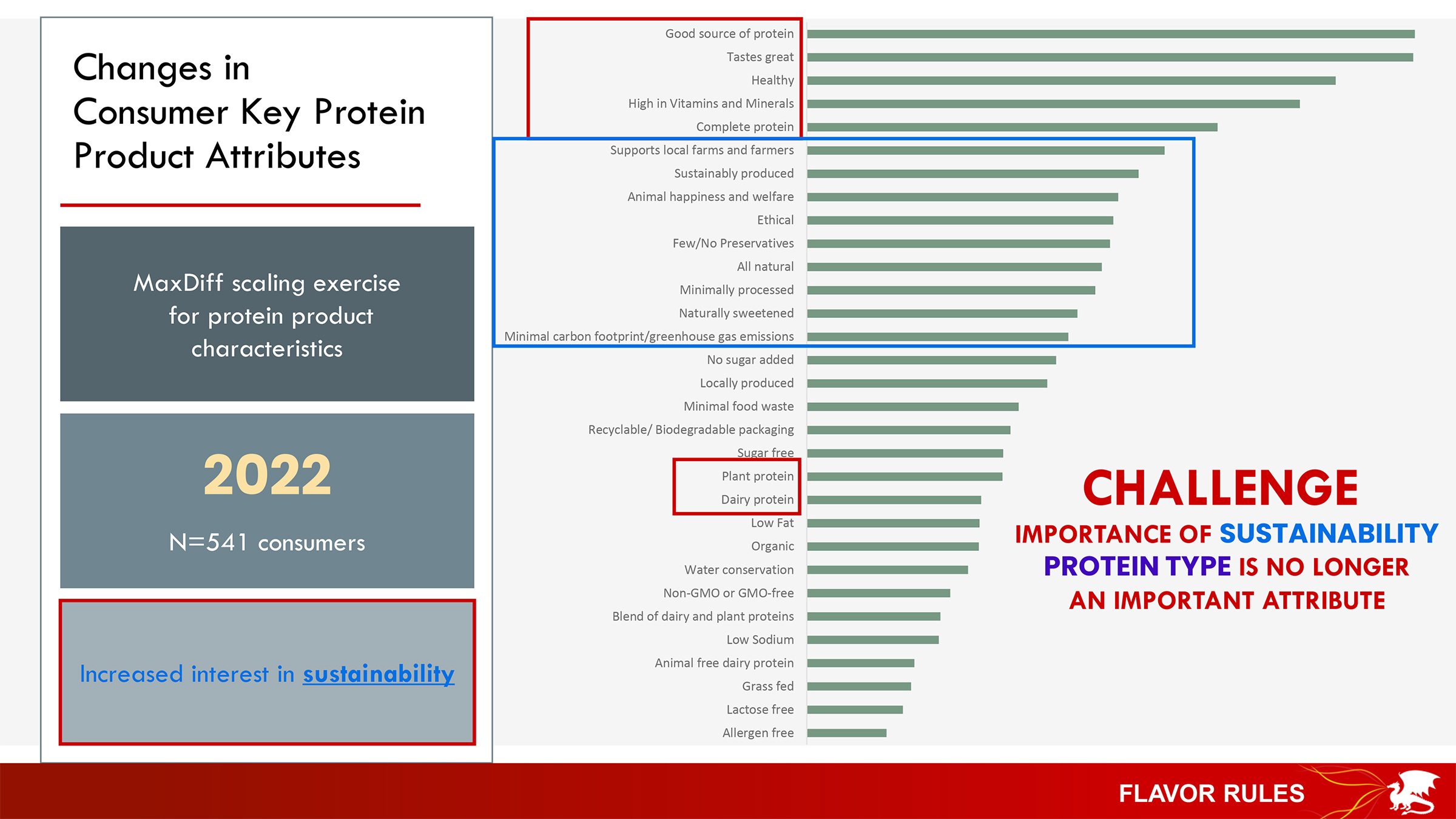
Bottom line: The surveys and flavor panels showed that consumers want “desirable flavor, texture and appearance. They want a protein drink that is nutritious, naturally sweetened, and has a clean label with simple ingredients,” said Drake. 

“They also want education, messaging and positioning, and they are looking at sustainability,” she added.

“We are working on what does clean label mean? It’s not what we think it is,” Drake reported. “It’s costing us sales if what they actually want is not on the shelf. We have the opportunity to deliver what consumers still want. We just have to find those things they want — that we have — and be more strategic in how we deliver them.”

Food technology and engineering was a big part of the picture painted for attendees that day.

Diversify processing

Producers were urged to challenge the status quo and to not just add processing, but to diversify it. They were also reminded that the 10 southeastern states had lost eight fluid milk plants in the previous roughly two-year period (2020-22).

During his annual market outlook that year, retired co-op executive Calvin Covington hit the nail on the head with this reminder, saying “that’s done some damage. The major challenge for milk markets in the Southeast is we need more of them,” he said. “A lot of the fluid milk products that are sold in the Southeast are not processed here. If we are going to have a viable dairy industry in the Southeast, we need growing and stable markets for milk produced in the Southeast.”

Covington also differentiated the trends for domestic and export demand, showing that both lagged their respective 5-year-average annual growth in 2022, with domestic demand growing by just 0.5%, while exports grew by 3.5%.

Keeping in mind as exports are expected to top 20% of U.S. milk production on a total solids basis in the next two years and fluid milk sales as a percentage of total milk production have fallen to just under 20%, seismic shifts are already occurring in the heavily fluid milk market of the Southeast.

Transformation brings investors

Geri Berdak, CEO of Dairy Alliance, the Southeast regional checkoff organization, talked about “creating a path forward” with objectives centered on driving milk volume, increasing dairy’s reputation and transforming dairy while building checkoff support.

She said transformation is necessary to “identify high-growth opportunities and stimulate outside investment, technology and innovation.”

The need for processing is big as plants are closing in response to declining fluid milk demand, leaving the the need for more diverse processing assets.

Exports drive innovation

“The biggest thing exports do is to drive value and innovation,” said Patti Smith, a food technology specialist and CEO of DairyAmerica, now wholly-owned by California Dairies Inc. (CDI) milk cooperative. Earlier in her career, Smith held a leadership position with Fonterra and has served at board and officer levels with IDFA and USDEC.

“Exports are a lot more than powder today. Our biggest item is still excess powder,” she said. “But we also export many other products — even UHT (ultra high temperature) and ESL (extended shelf life) fluid milk and cream.”

What Smith sees into the future are “opportunities for the right products and the right product configurations. We have the opportunities to capitalize on them and the technologies to grow them.”

Smith said the biggest benefit of exports to-date is to have a home for milk that grows the dairy industry without relying on core domestic demand for that growth, but that U.S. dairy processing infrastructure is not quite reflective of the new export era.

“We need to make our industry world renown, through a strategic plan that the whole industry will work on together, with digitized supply chains and infrastructure for growth that is reliable and can be consistently demonstrated, and that includes shipping,” said Smith, citing the Innovation Center for U.S. Dairy as the nexus, where the industry’s “strategic plan” for global trade is being built.

Developing ‘new milk beverage platform’

Emanating from the DMI-founded and checkoff-funded Innovation Center for U.S. Dairy is the marketing and promotion arm of new product alliances and the National Dairy Research arm through several universities looking to essentially create a milk beverage platform by drilling into milk’s elements, sifting, sorting and testing different combinations.

Dr. Drake said the new milk beverage platform holds the “keys to the kingdom” as global protein trends were valued at $38.5 million in 2020 and projected to grow. Meanwhile, the nutritional drink markets are growing steadily, with 42% of consumers eating healthy as a higher priority since Covid, and the number of conversations about protein (95% positive) steadily flowing across social media platforms. 

Those keys, she said, are membrane technology, ultrafiltration, aseptic packaging and research exploring all of the physical, nutritional and sensory elements of milk at the molecular level to bottle up what consumers say they are looking for, while also gauging through interpretive surveys how this translates to purchases, and then working with processors to build relationships with retailers to get new products into stores.

Drake shared details about the roadmap to play to dairy’s strengths through nutrition, education, capitalizing on calming and immune benefits and using dairy protein functionality to limit added ingredients in beverages to satisfy the clean label trend.

She talked about how elements like fat, protein and lactose at different levels impact milk’s flavor and appearance: “We want to determine the impact of ultrafiltration levels for different concentrations of fat and protein for different sensory or physical experiences.”

She talked about ultrafiltration in conjunction with aseptic packaging for shelf-stable storage using an elaborate diagram of processes.
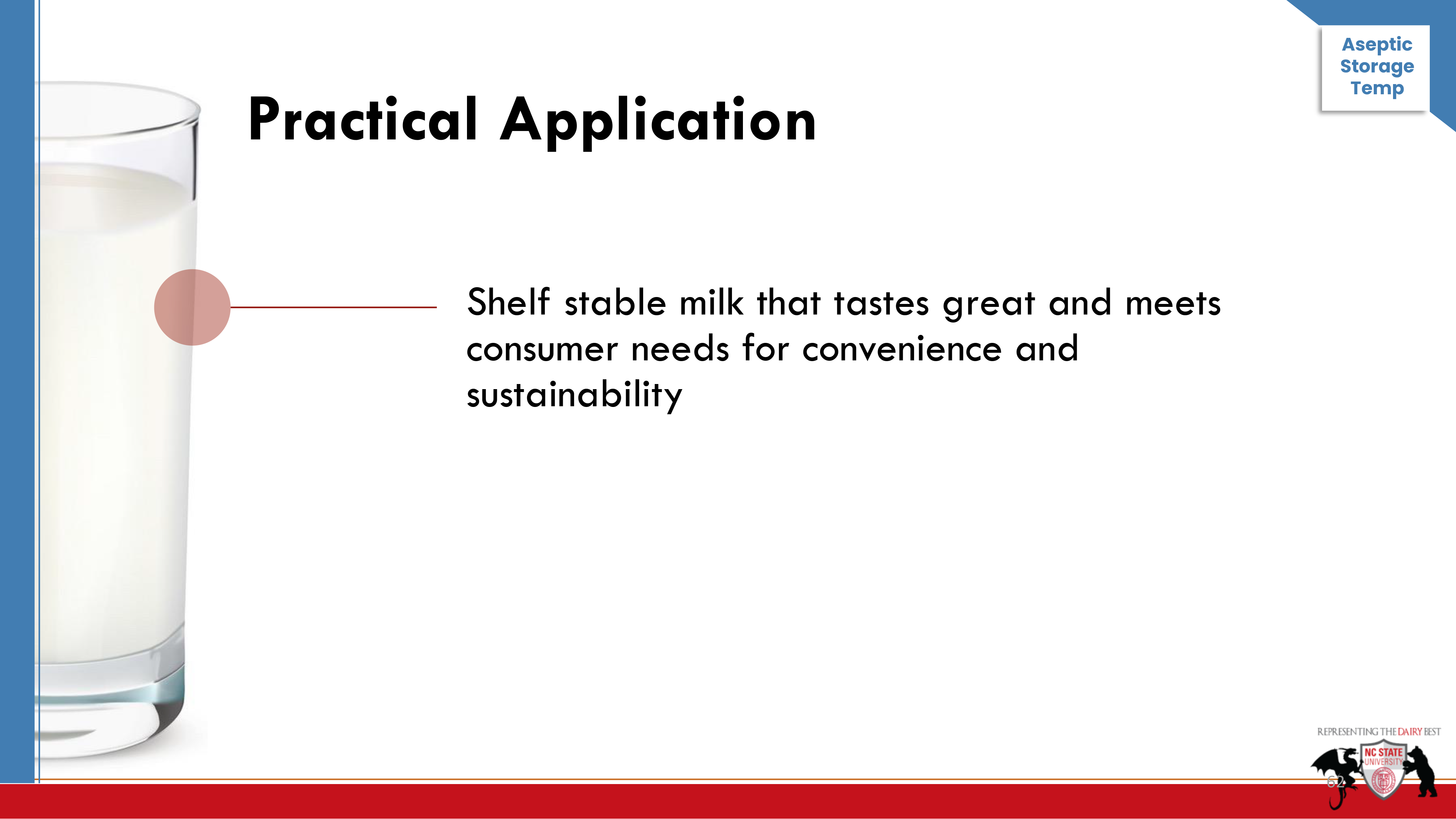
Bottomline, she said: “The chemistry of these (aseptic) milks is different.”

She described consumer flavor panels where shelf-stable and fresh fluid milk were served cold and compared. The flavor panels evaluated two different storage temperatures for the shelf-stable milk.

The North Carolina researchers worked with their Northeast Dairy Foods Research counterpart at Cornell and with Byrne Dairy, running grad students from North Carolina to Syracuse, New York when batches were available for study. (The Southeast and Northeast as well as Midwest and California Dairy Foods Research Centers all receive funding from checkoff and other sources.)

‘Training consumers’

“Consumer panels still liked the HTST (fresh fluid) milk best overall, but in 14-day and 6-month follow up, we found we can train them,” said Drake, reporting the two best storage temperature options for aseptic milk saw longer-term increase in acceptance.

HTST is the acronym for High Temperature Short Time pasteurization that is basically commodity fresh fluid milk vs. ‘value added’ UHT (ultra high temperature) and ESL (extended shelf life) as well as aseptically-packaged, which is milk processed for longer shelf life and then bottled in a special sterile process and package to last months without refrigeration, but will taste best served cold.

Schools are the gateway

“For 25 years, consumers have not liked aseptic milk,” said Drake, “but we are changing that. Consumers may not like it or want it, yet, but it is great for schools.”

She reported the practical applications to come up with “great tasting school lunch milk that contains no lactose (no natural sugar).” Another practical application is to  “determine the impact of storage temperature of 1% aseptic milk on physical and sensory properties.”

This partially checkoff-funded research is also working on “changing the chocolate milk formula to have zero sugar,” she said. “When we think about school milk, the question is how to get the sugar out of it. We want a chocolate milk that tastes great and new government standards on low- or no-added-sugars. Right now, chocolate milk has 8.5 grams of added sugar and 12 grams of natural sugar (lactose).”

In addition to ultrafiltration removing natural sugar, or lactose, they are exploring “non-nutritive” sweeteners like monk fruit and stevia. Additionally, they are looking at “lactose-hydrolized” to boost the flavor profile at much lower levels of sugars or other sweetener.

Whether talking about consumers or children, parents, and schools, the milk beverage platform is tricky “They want to know from a credible source what the immune-boosting elements are in milk, not what we have added. They tell us they want to know the science. That’s new.

“We have a huge and divergent set of innovations to sort through,” said Drake. 

-30-

Pa. orders dairy cattle movement restrictions, testing to protect against HPAI spread; detections now in 8 states

By Sherry Bunting, Farmshine, April 12, 2024

HARRISBURG, Pa. – Add North Carolina to the list of states with confirmed detections of bird flu in dairy cattle. 

While the USDA APHIS website had not yet updated its daily listing at 4 p.m. on April 10, the North Carolina Department of Agriculture and Consumer Services issued a press release at noon stating: “The National Veterinary Services Laboratory has detected Highly Pathogenic Avian Influenza (HPAI) in a dairy herd in North Carolina.”

This would bring the total to 19 dairy herds in 8 states: Texas (9), Kansas (3), New Mexico (2), Michigan (1), Idaho (1), Ohio (1), North Carolina (1), and South Dakota (1). (South Dakota was added to the list after Farmshine went to press)

“This is an evolving situation, and we are waiting for more diagnostics from NVSL and will work collaboratively with our federal partners and dairy farmers in North Carolina,” said Agriculture Commissioner Steve Troxler. “It is important to note the FDA has no concern about the safety or availability of pasteurized milk products nationwide.”

Introduction of HPAI A(H5N1) to dairy cattle has been shown to be by migratory birds, and USDA epidemiological studies show it may also be spreading between cows.

“Both are sources of introduction,” said Pennsylvania’s Assistant State Veterinarian Dr. Erin Luley, answering questions during the second Center for Dairy Excellence (CDE) weekly HPAI update conference call April 10.

USDA, in fact, reported on April 5 during a UN Food and Agriculture Organization (FAO) virtual meeting of scientists that they “have not seen any true indication that cows are actively shedding the virus and exposing it to other animals, or that it is replicating within the body of the cow — other than within the udder.”

This is why lactating dairy cattle are the focus of multiple state orders in recent days regarding restrictions, testing, and quarantine of interstate dairy cattle movement.

“The virus might be transmitted from cow to cow in milk droplets on dairy workers’ clothing or gloves, or in the suction cups attached to the udders for milking,” Dr. Mark Lyons, USDA Director of Ruminant Health, shared during the international meeting, according to a University of Nebraska Medical Center (UNMC) report.

The UNMC report also noted that dairy cattle are frequently transported from the southern parts of the country to the Midwest and north in the Spring. They are floating the possibility — without naming specific herds or locations — that all affected cows may trace back to a single farm. In fact, the confirmed positives in Idaho, Michigan, Ohio and now North Carolina are on premises where cattle had previously been brought in from Texas.

“The virus appears to replicate in mammary tissue, so those cattle that are not lactating do not have a high viral load for transmitting the virus,” noted Dr. Luley in the CDE call.

According to the epidemiologic data released by USDA, she said, the early cases, especially in Texas, New Mexico, and Kansas, show that HPAI was predominantly introduced by wild birds.

“For a few other detections, including in Michigan and Ohio, the main source seems to be the movement of animals from other states,” said Luley.

To prevent spread to dairy cattle in the Keystone State, the Pennsylvania Department of Agriculture issued an Interstate and International Quarantine Order on April 6 for the restriction of movement and pre-movement influenza testing of dairy cattle from states where HPAI has been detected in dairy cattle.

When asked how the Pennsylvania Order compares to what other states are doing, Dr. Luley said “ours is the most stringent. The goal is preventing the spread of this condition into our state — to proactively protect the animals in our state to the best of our ability.”

In short, the Pennsylvania Order applies to dairy cattle, not beef cattle. It restricts all movement of dairy cattle into the state for any reason from farms where HPAI has been detected.

Furthermore, dairy cattle coming into Pennsylvania for sale or show, must do pre-movement testing if they come from a non-affected farm in a state where HPAI has been detected. Those states to-date are Texas, Kansas, New Mexico, Idaho, Michigan, Ohio, and now North Carolina and South Dakota (updated by APHIS April 11).

The USDA APHIS website is updated daily and includes a map showing the states of HPAI detection in dairy herds at https://www.aphis.usda.gov/livestock-poultry-disease/avian/avian-influenza/hpai-detections/livestock

This should be consulted before movement of cattle from other states into Pennsylvania, to be sure the appropriate restrictions and pre-movement testing are applied.

Dairy cull cows from any state with a positive case, even if coming from a non-affected farm, that are destined for Pennsylvania slaughter facilities, are not subject to pre-movement testing if the animals are slaughtered within 72 hours of entry. However, they must go directly to a slaughter plant and cannot be commingled with other cattle at an auction center.

Calves under one year of age are considered low risk and are exempt from pre-movement testing at this time.

Pre-movement testing must be done through a laboratory in the national network, and the results must accompany the shipment. Acceptable test samples for non-lactating dairy cattle, such as bred heifers, are nasal swabs; however, the only acceptable test sample for a lactating animal is a milk sample. Again, this is because the mammary system is where HPAI viral replication is being seen.

“At present, the disease has not been shown to affect beef animals,” said Luley about why the Order is written only for dairy cattle.

She gave examples of how the Order is being implemented:

If a producer wants to import a group of bred heifers from Texas, and they come from a farm that had a confirmed positive, those heifers would not be allowed to come to Pennsylvania. If they come from a non-infected herd in Texas, they would need pre-movement testing with the farm’s veterinarian overseeing the sampling and the analysis done by a national network lab.

If a producer in Ohio wanted to move cull dairy cows directly to a slaughter facility in Pennsylvania, if they are coming from a currently unaffected farm in that state, no testing would be required. But, if they are from an affected farm in that state, those cull cows would not be permitted to come to a Pennsylvania slaughter facility.

If a producer from Virginia, where there have been no detections of HPAI, wanted to ship fresh heifers to Pennsylvania, there would be no requirement to test because no infection has been detected to-date in that state, so there is no movement restriction and no pre-movement testing requirement.

There are no quarantine orders on milk movement at this time; however, this would change if HPAI were detected anywhere in Pennsylvania. If that occurs, the state would enact its “Temporary Order Designating Dangerous Transmissible Diseases” provision, now amended to include “Influenza A Viruses in Ruminants.”

In such a scenario, a quarantine would be set up for an affected farm to work with animal health officials and their veterinarian to show appropriate biosecurity measures to qualify for a 30-day milk movement permit. With that permit, their milk could go only to a processing plant.

“The viral sequencing matches the circulating strains in the (migratory bird) flyways,” said Luley. “We can impose a quarantine, but we can’t apply it to migratory waterfowl, so that risk remains, and it is the reason why biosecurity is our best tool.”

USDA Wildlife Service biologists Tom Roland and Kyle Van Why said their winter surveillance of migratory waterfowl and raptors in the Susquehanna watershed, for example, shows the virus is here in these populations, but at lower numbers than last year.

Even though starlings and pigeons are not good transmitters of the disease, they do carry it, and the numbers of these birds are high, so they bear watching.

Roland said that with restrictions on how to handle migratory birds, including resident Canadian geese and vultures, farmers should contact the national hotline at 1.866.487.3297 to work with the Wildlife Service for case-by-case strategies to manage and mitigate bird use of the farm. They have tools that are not generally accessible.

Dr. Hayley Springer, Penn State extension veterinarian, said opportunities are available to help dairy farms build their own biosecurity plans. In-person open houses are being held across the state at county extension offices, check with yours.

“Everyday biosecurity is the first line of defense, and effective for Influenza A,” said Springer. Biosecurity Kits to assist are available from CDE.

According to Dr. Luley, one dairy farm in Pennsylvania reported signs that met the case definition closely enough to undergo the HPAI testing protocol, which thankfully turned out to be negative.

Dairy farmers seeing signs in their herd should contact their veterinarian. Clinical signs of HPAI in cattle, which the American Association of Bovine Practitioners this week announced it will rename as Bovine Influenza A, include:

1) a sudden drop in feed intake with concurrent decreased rumination and rumen motility;

2) a subsequent marked drop in herd level milk production with more severely affected cows having thickened milk that almost appears like colostrum or may have essentially no milk at all; and

3) changes in manure, especially tacky to dry manure.

Visit https://www.centerfordairyexcellence.org/hpai-industry-call/ for recordings and other valuable information.

Read Farmshine at farmshine.net for continuing coverage and previous articles April 5 and March 29

Seeds of doubt being sown, Part One, Confusion: ‘Will this bill really improve milk prices?”

By Sherry Bunting, Farmshine, Feb. 16, 2024

EAST EARL, Pa. — While decades of scientific debate in terms of childhood health and nutrition is the curtain opponents hide behind, the anti-animal agenda is the top hurdle for the Whole Milk for Healthy Kids Act in the Senate.

Senator Roger Marshall (R-Kan.) is the prime sponsor of the Senate bill, and he is a medical doctor in obstetrics and is taking a beating from billboards sponsored by Physicians Committee for Responsible Medicine (PCRM) in his home state of Kansas. PCRM is a known arm of PETA. This tells us quite a bit, doesn’t it?

Meanwhile, the top 3 C’s facing the bill within the dairy industry, itself, need to be addressed. 

1) Confusion… Will it really improve milk prices? Addressed in this article

2) Consternation (fear)… What will processors do with “all of that skim”? Addressed in Part II here

3) Competition… Will it reduce the butterfat supply and affect the ramp up in cheese manufacturing or other dairy products? Addressed in Part III here

Plus…. the Checkoff Commitments… Will it interfere with checkoff-funded Milk Molecules Initiative for new beverages that identify and separate specific milk molecules for specific benefits (sleep drinks, energy drinks, immune function drinks, specific protein type drinks)? 

All of these questions are quietly floating around and sowing seeds of doubt, leading to analysis-paralysis, while the industry focus is on innovation and exports, not on fresh milk, or a healthy next generation of U.S. milk consumers.

All of these questions will be answered one at a time over the next several weeks, starting with the first “C”: Confusion.

“Will this bill really improve our milk prices?” was the question I was asked by a few farmers at a recent farm show. My response was to ask them if they are concerned about kids having healthy milk options they enjoy and if they are concerned about seeing further erosion of fluid milk sales, and losing another generation of milk drinkers?

I reached out to Calvin Covington, former milk cooperative CEO in the fluid milk markets of the Southeast and a primary architect of pricing milk by component yield even before Order Reform during his years with American Jersey Cattle Breeders.

Covington ran the numbers using 2023 average prices, and calculating pounds of milk, fat, and skim, utilization, and values, which yield a gross value of a hundredweight of milk being used for fluid processing at different fat levels. 

“At a $3.00 Class I differential, a hundredweight of milk going for 3.25 fluid milk (whole milk as standardized), returns an additional 25 cents per hundredweight over skim milk,” Covington writes, noting that the difference will change based on different Class I differentials.

Even in the counties with small or zero location differentials on the map, the base differential of $1.60 per hundredweight is still included, which means at least a 13 cents per hundredweight difference.

Previously, Covington has noted in presentations that milk prices improve as the average fat level of total fluid milk sales increases. The current average of all sales, nationwide, stands at 2%. A few years ago, it was below 2%. A fractional change in either direction influences Federal Milk Marketing Order blend prices.

Fluid milk demand also plays a role in manufacturing class prices, affecting farmers in regions where prices are based almost exclusively on cheese. 

That’s especially true right now as cheese production has been exploding, and the Class III milk price has been imploding, creating a wide spread below Class IV and pushing FMMO blend prices lower as milk is not moving out of Class III to the higher value Class IV. But the Federal Milk Marketing Law gives Class I dibs to attract milk. So Class I demand is relevant for cheese milk pricing too.

As whole milk sales have increased year-over-year, whole milk became the largest category of fluid milk sales in 2021. It is a bright spot in the fluid milk category.

In 2023, gains in whole milk sales and in lactose-free milk sales are credited with boosting the entire fluid milk category for year-over-year gains in back-to-back months of October and November. This helped flatten the year-to-date loss-curve on total fluid milk sales that had been running 2 to 4% lower year-over-year to be just 1.5% lower cumulatively at year end compared with 2022, according to USDA’s December estimated packaged fluid milk sales report, released in mid-February.

Still, there is ground to make up, as fluid milk sales volume in 2023 is 7.8% lower than pre-Covid 2019, when volume totaled 46.24 billion pounds, down 1.8% from 2018. Then, during pandemic lockdowns, milk sales stabilized, putting the total at 46.2 billion pounds for 2020, virtually unchanged from 2019. In 2021, fluid milk sales volume declined 4.1% to 44.3 billion pounds, followed by a 2.4% decrease in 2022 to 43.3 billion pounds, and now a 1.5% decline in 2023 at 42.6 billion pounds.

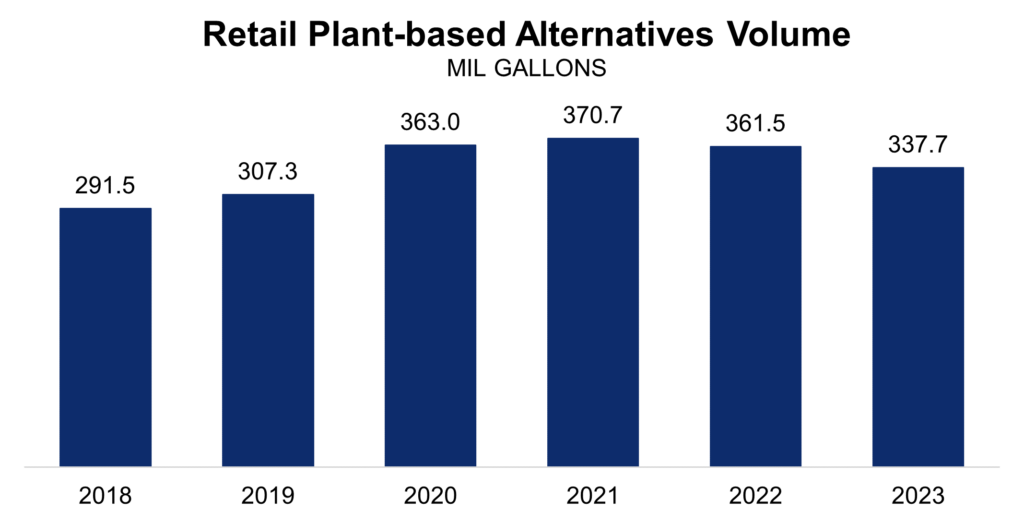
NMPF chart, Circana Inc. full-year 2023 data

Meanwhile, the big news reported recently is that plant-based fake-milk beverages saw sales decline by 6.6% in 2023, the second straight year of declines and the smallest sales since 2019, according to data from Circana Inc reported recently. 

Real dairy milk sales volume of 42.6 billion pounds in 2023 is not only a much larger category than the lookalikes at 337.7 million pounds, real dairy milk outperformed lookalikes on a trend basis in 2023 — down just 1.5% vs. plant-based being down 6.6%.

By comparison, plant-based beverage sales volume in 2023 was a fraction of 1% (0.8%) the size of real milk sales volume.

Whole milk education and awareness have helped drive this result. Consumers are paying attention to food science, even if the Dietary Guidelines Advisory Committee, USDA (and FDA on labeling) continue to ignore it. Still, more education and freedom for children to enjoy milk is needed. The concern is that even though it is a smaller percentage loss, the 1.5% sales volume loss in the real milk category in 2023 represented 644 million pounds; whereas a 6.6% sales volume loss in plant-based beverages in 2023 represented 24 million pounds.

Speaking with a local milk bottler and ice cream maker recently – a producer handler – I learned he focuses on how his cows are fed to maintain their rolling average 5% butterfat during the summertime to make ice cream and satisfy consumer demand for whole milk. Their whole milk sales have skyrocketed, and this in turn, to the delight of the grocery store they are in, has helped boost sales of all fluid milk as a category in that store.

This has him thinking of doing a 5% butterfat, non-standardized, maybe even cream top, full-fat milk in glass bottles for the store. The store displays a 97 Milk banner at the entrance and 97milk.com website stickers at the dairy case.

Speaking with a manager at a different grocery store chain with stores in Pennsylvania and surrounding states, I learned their sales of whole milk have also increased by leaps and bounds in the past several years, boosting the entire fluid milk category by 14% at their stores throughout the region. They include the 97milk.com website and information in their sales circulars to their shoppers.

As for the schools — If even half of the schools offered a mix of milkfat choices as the Whole Milk for Healthy Kids Act would allow them to do, the amount of butterfat sold as Class I would increase. This would improve the fat side of the fat/skim pricing in the three Southeast Orders and Arizona. It would also help the Federal Order pool dollars reach after actual components are paid first in Multiple Component Pricing Orders everywhere else.

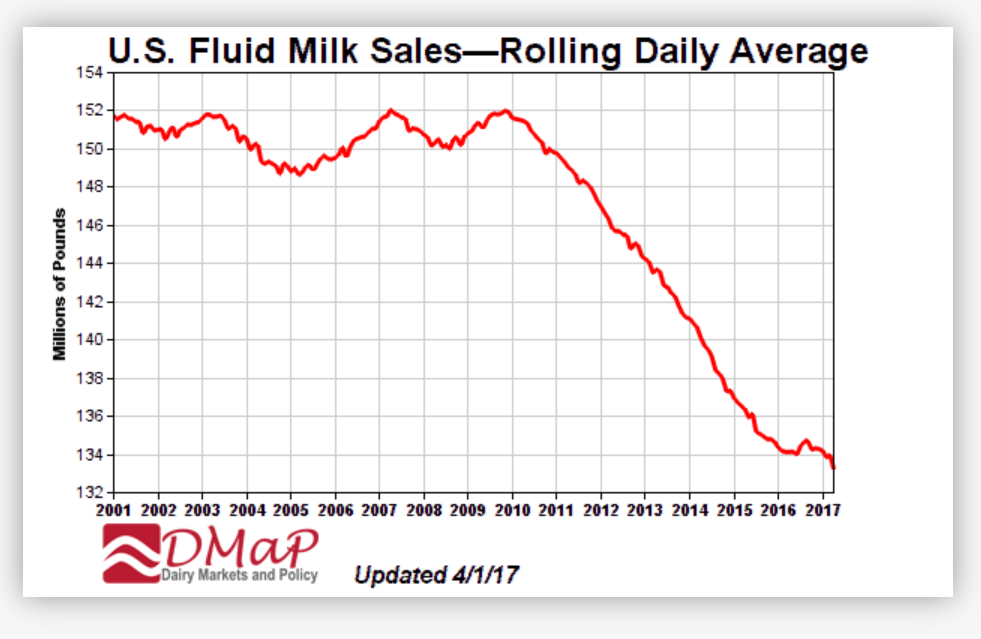
Total Class I fluid milk sales have dropped like a rock since Congress passed the Healthy Hunger Free Kids Act in 2010, which removed whole and 2% milk options from school meals, followed by USDA in 2012 further banning whole and 2% milk as a la carte or vending machine ‘competing beverage’ options in the Department’s Smart Snacks regulations.

Look at the graph above. It was shared as part of Dr. Mark Stephenson’s testimony in the recent USDA FMMO milk pricing hearing.

Improved total sales of school milk hold potential to increase total Class I fluid milk sales. A Pennsylvania school trial in 2019 showed a 52% increase in milk sales when whole and 2% milk options were offered. Students showed a 3 to 1 preference for whole milk over the 1% milk option.

When their options were expanded, more students chose milk instead of refusing it. Students were able to choose, and some of them continued to choose low-fat, and that’s okay! The Whole Milk for Healthy Kids Act is about choice.

A conservative estimate of a 25% increase in school milk sales can be anticipated if Whole Milk for Healthy Kids gets over the finish line in the Senate after its overwhelming passage in December in the House. That is half of the increase seen in the Pennsylvania school trial. If realized, a 25% increase in school milk sales equates to a little over one billion pounds of additional annual milk sales, which could raise the entire Class I fluid milk category by a little more than 2%.

This is based on the fact that kids aren’t just throwing away milk at school. Some are refusing to take the milk they are offered with school meals. This means sales are being lost.

Fluid milk sales declines will only get worse if USDA implements one of two draft proposals the Department announced a year ago. One would eliminate flavored milk from elementary and middle schools altogether. The other would require added sugar levels to be reduced dramatically in flavored milk at school. It’s widely known that when milkfat is retained in making chocolate milk, less added sugar is needed! 

Demand for whole milk is beneficial on both the milk fat and skim sides of the equation because whole milk sales move the nearly-complete product – the skim with the fat — leaving some of the fat through standardization, but not leaving any skim.

The result of these options in schools could be even better depending on how many schools choose to exercise these options.

If the industry doesn’t supply what consumers demand, sales are lost. Schoolchildren are already the dairy industry’s consumers, and they will hold the purse strings in the future.

Just as the Dietary Guidelines Committee and USDA continue to ignore science on milkfat, we are all ignoring our nation’s schoolchildren and what they are telling us about why they are turning away from nutrient-dense milk at a time when the nutrients milk delivers – that we may think they are receiving — have never been more important.

When the Pennsylvania school trial ended after one school year, a 95% reduction in the average daily volume of discarded milk was recorded. The school Student Council did an environmental project to measure this by measuring the volume of milk thrown away in unopened and partly consumed half-pint containers.

Shouldn’t we be listening to what the young people are telling us? They are our future, after all.

In the next part of this series, we’ll address the question: “What are the processors going to do with all of that skim?” Oh my!

In the meantime, consider this: Fresh fluid milk is the most notably locally-produced dairy product maintaining dairy farm relevance in regions and communities across America. What will the dairy industry look like five years from now, even one year from now? Maybe we should be asking the schoolchildren to answer that question.

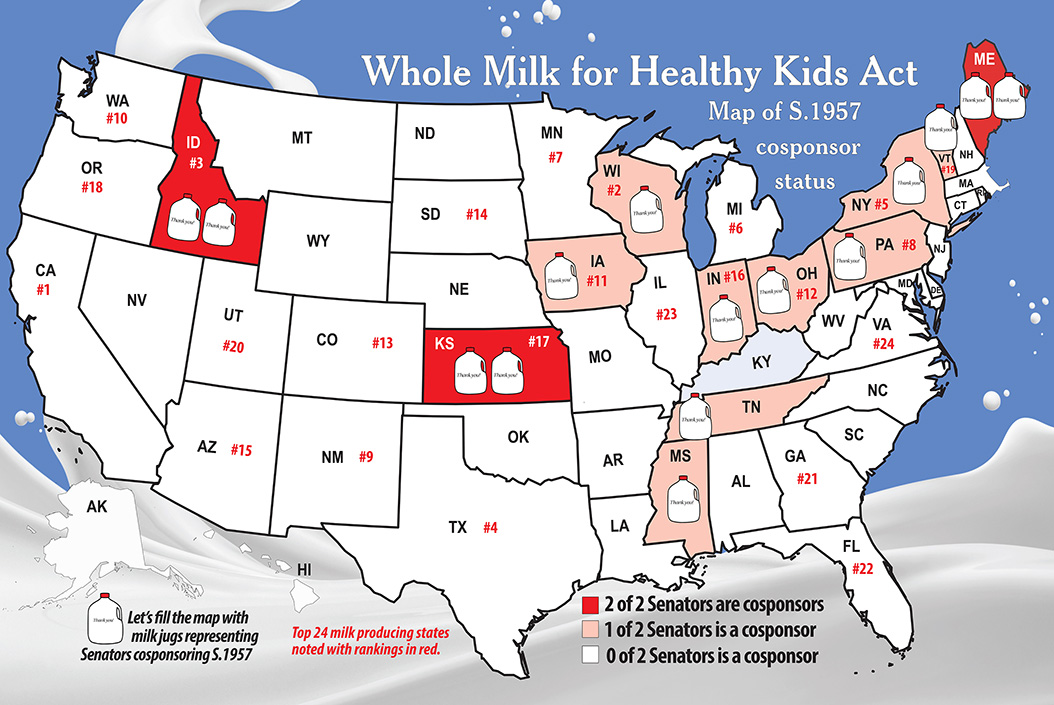
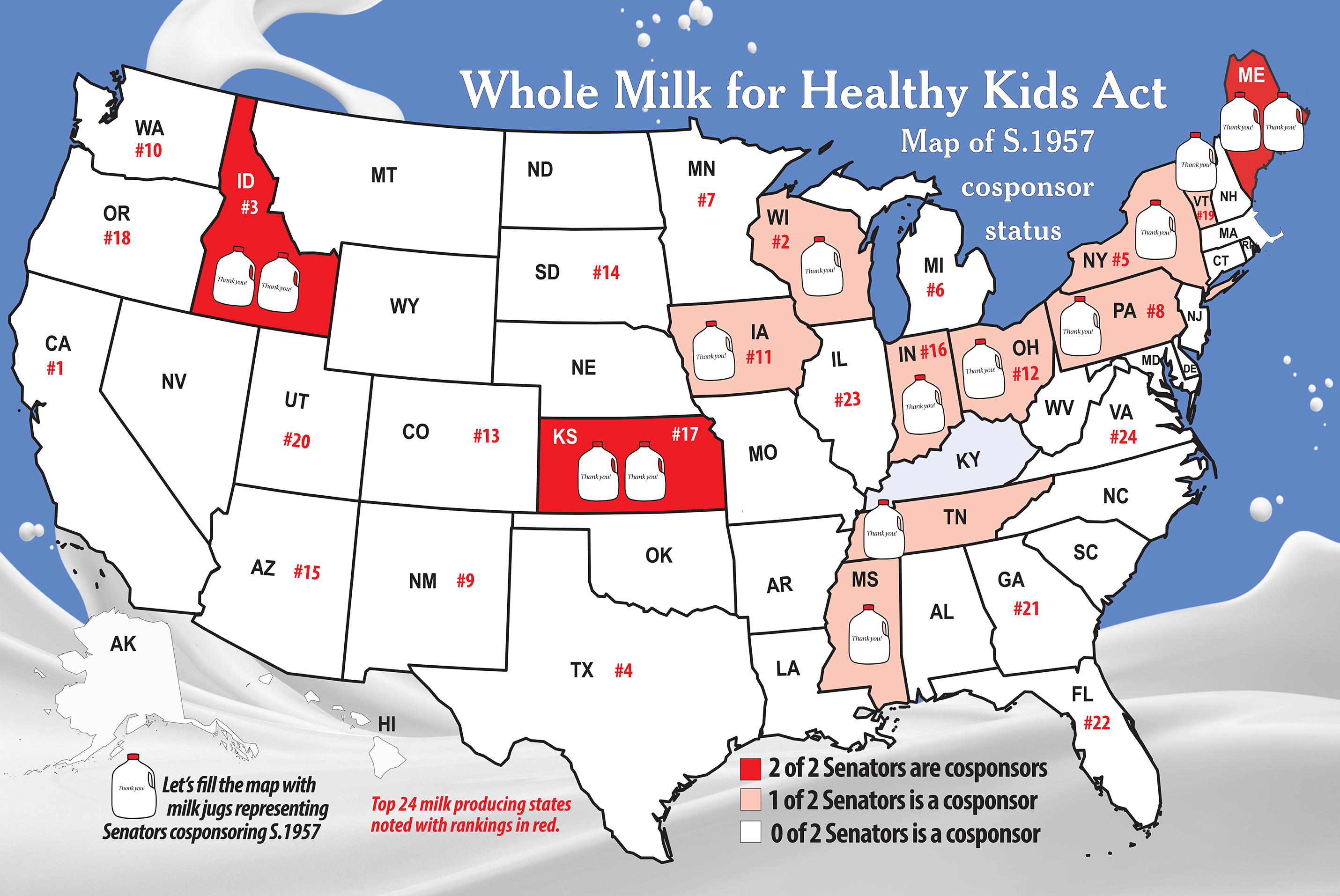
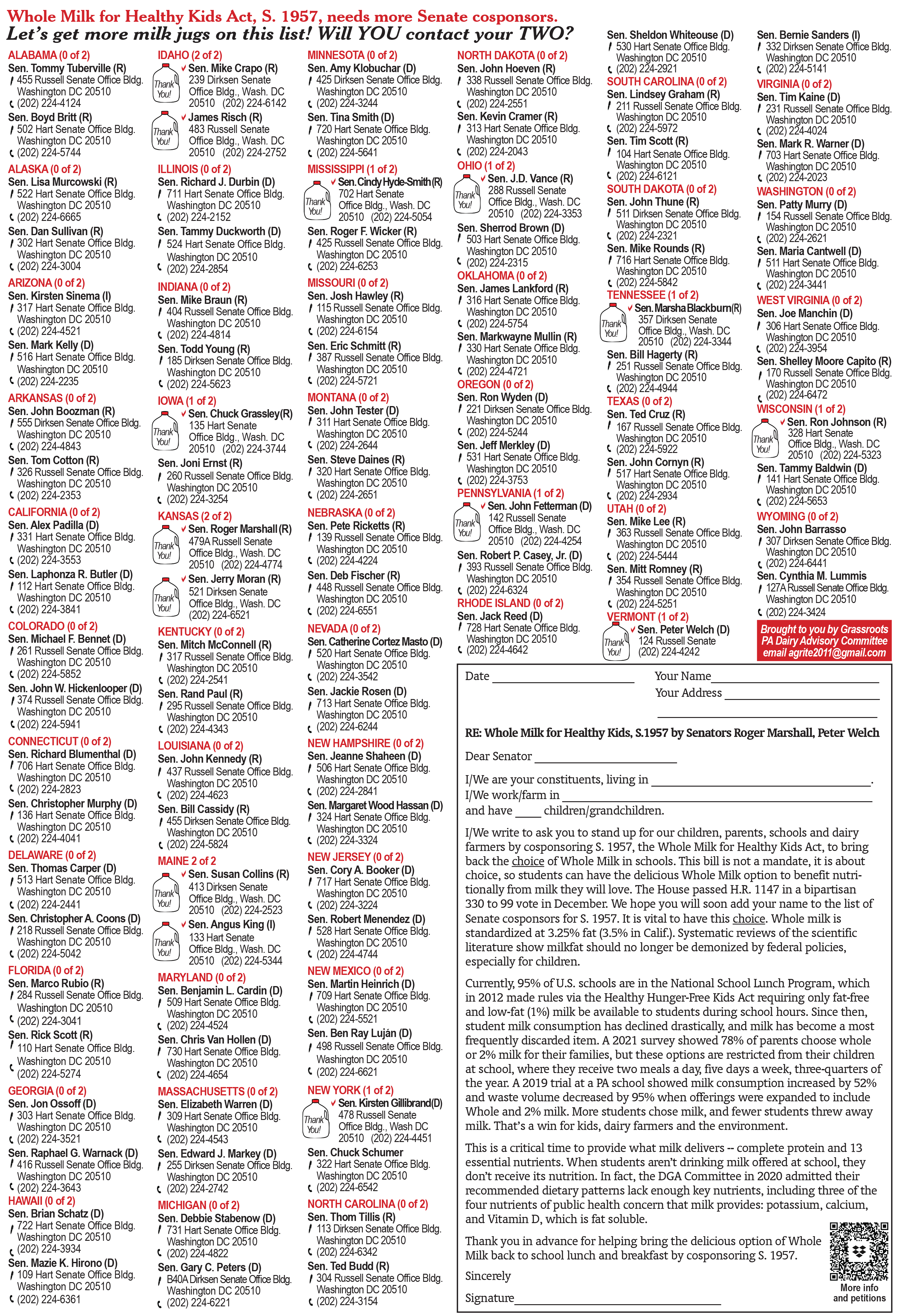
As of Feb. 14, 2024, the Whole Milk for Healthy Kids Act, S. 1957, has 15 sponsors from 12 states as illustrated on this map. Graphic by Sherry Bunting

Whole Milk for Healthy Kids Act S. 1957 needs more cosponsors: We need your help! Please contact your state’s two U.S. Senators

The Whole Milk for Healthy Kids Act has moooved to the Senate. S. 1957 is identical to H.R. 1147. As of Feb. 21, 2024, the Senate bill has 15 sponsors from 12 states. This map shows what states have both Senators or one Senator signed on and which states have none. We need more cosponsors to get this bill out of the Ag Committee and onto the Senate floor for a successful vote. Will YOU call or write TWO? Map by Sherry Bunting

By Sherry Bunting, Farmshine, January 26, 2024 (Cosponsor data updated Feb. 21, 2024)

WASHINGTON — The Whole Milk for Healthy Kids Act is now up to the Senate, where more cosponsors are definitely needed to push it past some barriers and get it to the floor for a successful vote.

Senate bill S. 1957 is not a mandate for whole milk. This bill ends a mandate against whole milk, which is federally banned from schools (2% reduced fat milk is also prohibited. Only fat-free and 1% low-fat milk are allowed to be offered with meals or a la carte or in vending machines).  

In December, Senator Debbie Stabenow (D-Mich.) blocked the unanimous consent motion by Senator Roger Marshall (R-Kan.). Marshall was seeking an immediate Senate vote on H.R. 1147 – Congressman G.T. Thompson’s bill – on Dec. 14, 2023, just one day after it was overwhelmingly passed in the House of Representatives by a bipartisan 330-99 vote. It was previously passed in the House Education Committee in a bipartisan 26 to 13 vote.

Marshall chugged a glass of whole milk and gave an inspiring speech about getting the bill to the President’s desk for Christmas. Sen. Marshall is a medical doctor, an obstetrician, and a member of the Senate Ag Committee.

“This is a slam-dunk for American families,” he said.

Sen. Stabenow played the role of the Grinch stealing the opportunity for immediate whole milk passage in the Senate on the heels of the overwhelming House vote as she objected to the unanimous consent request on Dec. 14.

But that’s not the end of this story, just the beginning.

An identical Senate bill, S. 1957, The Whole Milk for Healthy Kids Act was introduced in June 2023. It was read twice on the Senate floor and referred to the Senate Agriculture Committee, chaired by — you guessed it — Sen. Stabenow of Michigan. This means she is in a ‘gate-keeper’ position for this bill. If it doesn’t come before her committee, it will have trouble getting to the floor.

This is where we can help by raising the number of Senate cosponsors! There are 15 sponsors as of Feb. 21 (updated). We need to get to one-third or one-half of the Senate. That’s 35 to 50.

While news reports indicate Sen. Stabenow will retire after this term and is not seeking re-election, her legacy in caring about childhood nutrition and agriculture may be important to her. She stated on the Senate floor that these decisions about milk in school should be made by the scientific committees. She wants to “keep having these conversations.”

Let’s take her up on that by having conversations with our Senators to cosponsor S. 1957. The Dietary Guidelines Advisory Committee has for three cycles and over 15 years refused to consider the preponderance of sound evidence about the benefits of milkfat that the USDA keeps screening out of their deliberations process. 

The DGA Committee is meeting right now for 2025-30 DGAs that seek to refine the current dietary patterns, not re-evaluate them. Even the DGA Committee in 2020 admitted their recommended dietary patterns are deficient in key nutrients that milk delivers.

Here’s the bottom line: S. 1957 was introduced in June 2023 by Sen. Marshall (R-Kan.), along with Senators Peter Welch (D-Vt.), Kirsten Gillibrand (D-N.Y.), Ron Johnson (R-Wis.), John Fetterman (D-Pa.), Chuck Grassley (R-Iowa), Cindy Hyde-Smith (R-Miss.), James Risch and Mike Crapo (both R-Idaho), Susan Collins (R-Maine), and Angus King (I-Maine).

Four more cosponsors have been gained, they are Senators J.D. Vance (R-Ohio), Jerry Moran (R-Kan.), Marsha Blackburn (R-Tenn.), and Mike Braun (R-Ind.)

As of January 24, 2024, S. 1957 has 14 sponsors from 11 states in the U.S. Senate. Of these 15, seven are on the Senate Ag Committee (Marshall, Hyde-Smith, Gillibrand, Fetterman, Welch, Grassley, Braun). 

We need the rest of the Ag Committee, including Ranking Member John Boozman (R-Ark.). If you live in Arkansas, contact him. If you live in Minnesota, contact Ag Committee Senators Amy Klobuchar and Tina Smith; in Illinois, Sen. Richard Durbin; in Ohio, Sen. Sherrod Brown; in Kentucky, Sen. Mitch McConnell; in Iowa, Chuck Grassley has already signed on, but Joni Ernst has not; in North Dakota, talk with Sen. John Hoeven; in South Dakota, Sen. John Thune; in Nebraska, Sen. Deb Fischer; in Georgia, Sen. Raphael Warnack; in New Mexico, Sen. Ben Ray Lujan; in Alabama, Sen. Tommy Tuberville; in Colorado, Sen. Michael Bennet; and in New Jersey, Sen. Cory Booker.

No matter where you live, contact your state’s two U.S. Senators. We need as many Senate cosponsors as possible, and we need Senators motivated to speak with Chairwoman Stabenow, to ask her to please stop putting the ego and agenda of Washington bureaucrats above the health and welfare of America’s children and the economic stability of America’s dairy farmers.

This bill is about choice. It is not a mandate. It simply allows schools to offer whole and 2% flavored and unflavored milk at school lunch and breakfast without financial penalties for exceeding outdated milkfat limits that are unnecessary or even harmful to children.

If we want children to benefit from the nutrition milk delivers, then we need to deliver the permission for our children to be able to choose milk they will love at school where they have two meals a day, five days a week, three-quarters of the year. That’s how they actually benefit from the complete protein and 13 essential nutrients milk delivers.

Let’s stay positive. We can’t afford to lose ANOTHER generation of milk drinkers and think we will still have a dairy industry in many parts of the U.S. The Whole Milk for Healthy Kids Act is an opportunity for dairy farmers to revitalize and renew fluid milk demand, but more importantly, it’s an opportunity for schoolchildren to choose milk they will love for life and health. It’s also an opportunity to drastically cut the amount of wasted milk in school cafeterias, a win for stewardship of resources and the environment.

A 2021 survey by IDFA showed that 78% of American parents who described themselves as voters, choose 2% or Whole Milk for their families as the most delicious and nutritious option, but their children can choose neither 2% nor Whole milk at school where they have two meals a day, five days a week, three-quarters of the year.

This survey is consistent with what a Pennsylvania school trial in 2019 showed. The students preferred Whole Milk 3 to 1 over the 1% low-fat milk. When 2% and Whole Milk were offered in the coolers, students consumed 52% more total milk and the average daily volume of discarded milk was reduced by 95%. This means more students took the offered milk instead of refusing it, and fewer students threw away the milk they took with their meals.

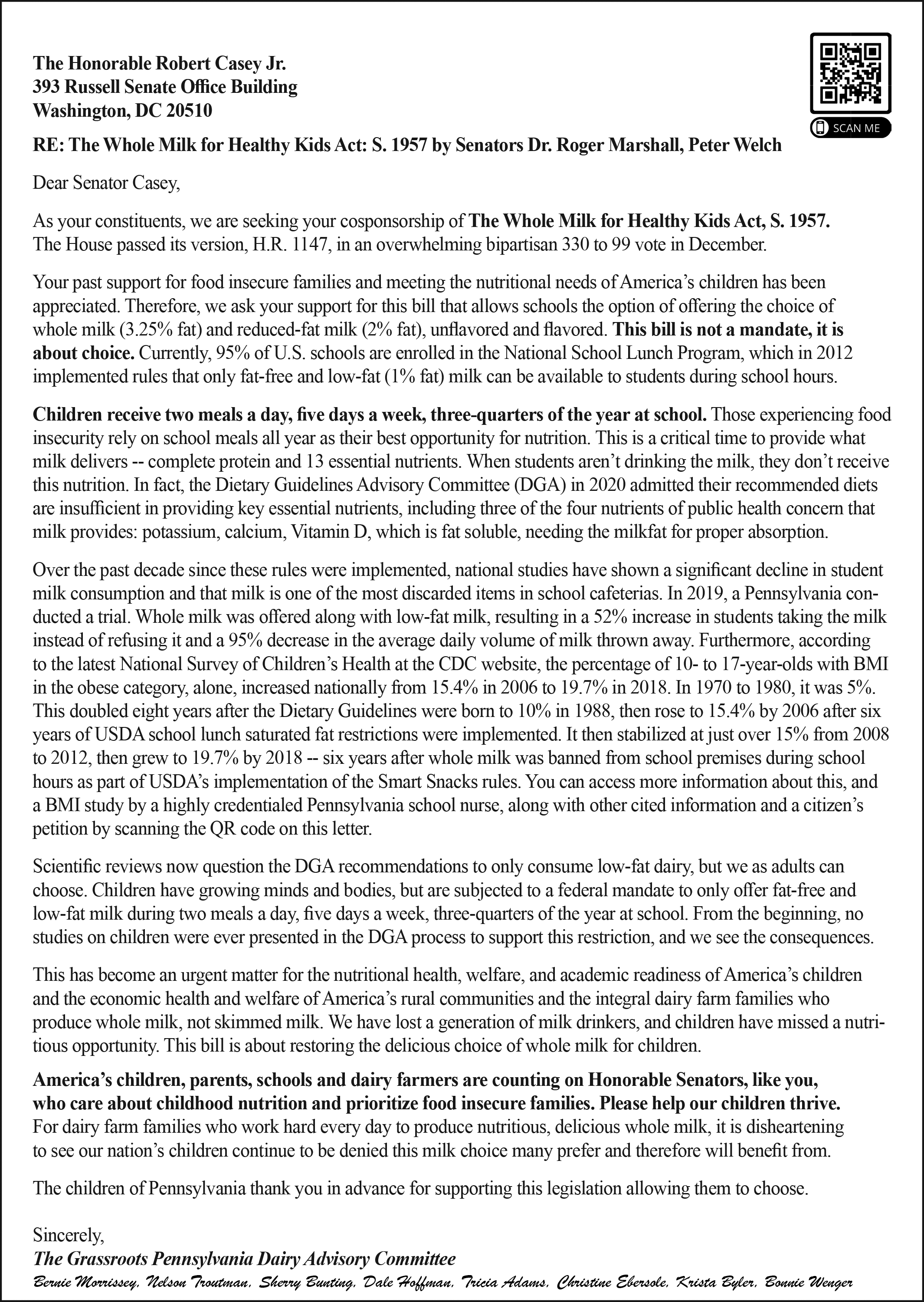
The Grassroots Pennsylvania Dairy Advisory Committee, under chairman Bernie Morrissey’s leadership, has launched a letter-writing and phone-calling campaign seeking cosponsors for S. 1957. They have put together the tools, but grassroots farmers and citizens must be the ones to carry it out and send the letters and make the calls.

We need to help Senate Ag Committee Chairwoman Debbie Stabenow understand this issue is about lifting the federal school lunch and breakfast ban that was placed on delicious nutritious whole milk in 2012 so that school districts, parents and students can make healthy milk choices that are enjoyed and not discarded.

This bill is not a mandate for whole milk. This bill ends a mandate against whole milk.  

This is about options, choice, and a future for kids and dairy farms. Will YOU call or write your TWO?

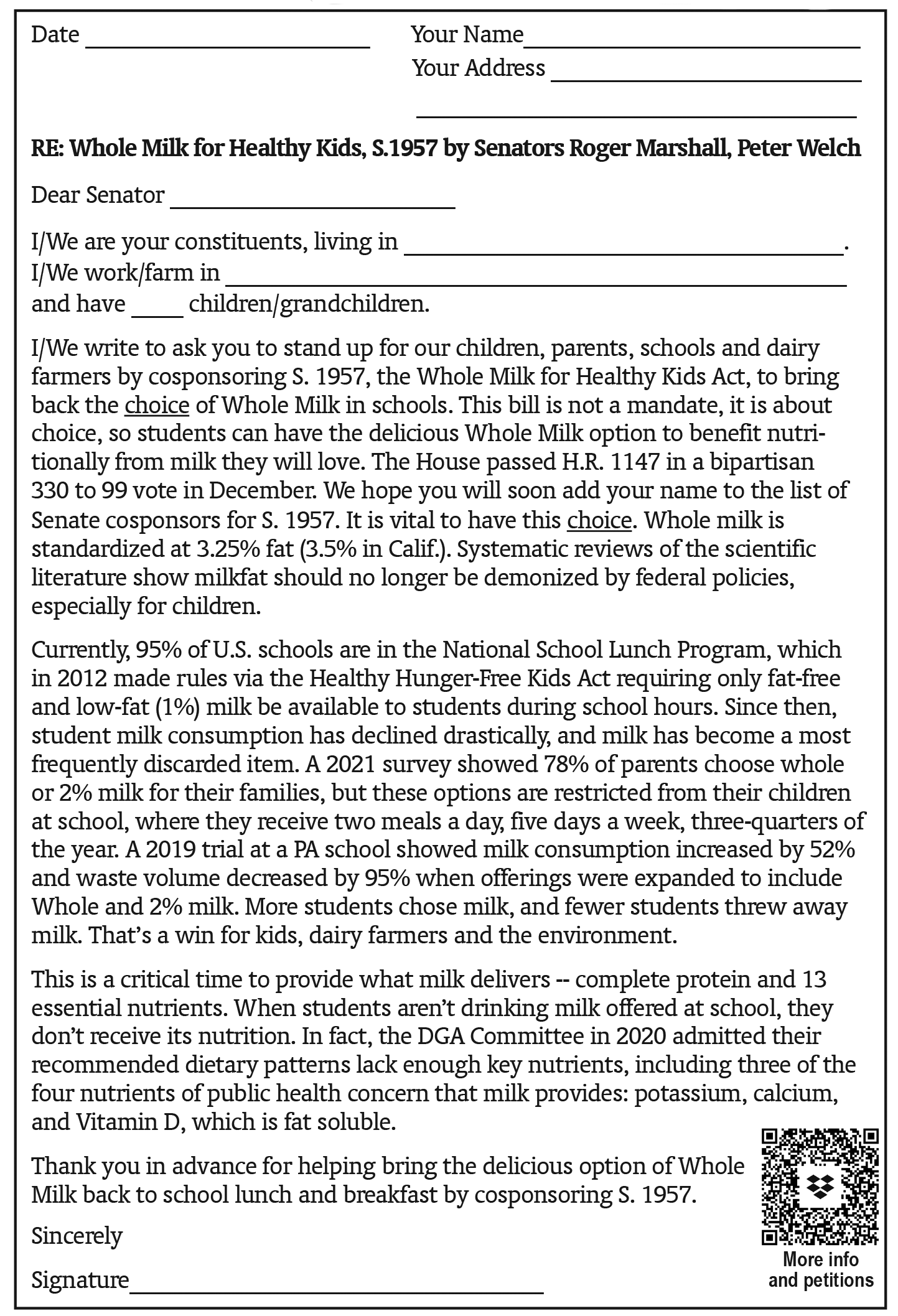
Let’s keep this bill moooving. Every state has two U.S. Senators. Click here for a sample letter.

Find the Washington addresses and phone numbers for your state’s Senators at https://www.senate.gov/ – Click the icon in the top left corner, select your state from drop-down menu to see how to contact them. Or look for your state in this printable directory.

For a more detailed letter, like the one sent by the Grassroots PA Dairy Advisory Committee to Senator Robert Casey, Jr. of Pennsylvania, click here.

For a simple phone message guide for contacting Senate Ag Committee Chairwoman Debbie Stabenow, Majority Leader Chuck Schumer and Minority Leader Mitch McConnell (and if in PA Senator Robert Casey) click here.

See the complete Action Packet and find some additional resources in a folder here

To email your Senators: Go to https://democracy.io/ – type in your address, city and zip code, click submit. Your two Senators and one Rep. will show up with red check marks. Click ‘Write to them.’ Then, on the next screen, write the body of your letter. If you want, you can start with who you are, where you live, what you do. You can also mention if you have school-aged children or grandchildren. Then copy and paste from the text below or write your own message simply asking your Senators to cosponsor S. 1957 The Whole Milk for Healthy Kids Act

**************

RE: Whole Milk for Healthy Kids, S.1957 by Senators Roger Marshall and Peter Welch

I write to ask you to cosponsor S. 1957, the Whole Milk for Healthy Kids Act, to bring back the choice of Whole Milk in schools. This bill is not a mandate, it is about choice, so students can have the delicious Whole Milk option to benefit nutritionally from milk they will love. The House passed this in a 330 to 99 vote in December. We hope you will soon add your name to the list of cosponsors for the Senate. Whole milk is standardized at 3.25% fat (3.5% in Calif.). Systematic reviews of the scientific literature show milkfat should no longer be demonized by federal policies, especially for children.

Currently, 95% of U.S. schools are in the National School Lunch Program, which in 2012 made rules requiring only fat-free and low-fat (1%) milk be available to students during school hours. Since then, student milk consumption has declined drastically, and milk has become a most frequently discarded item. A 2021 survey showed 78% of parents choose whole or 2% milk for their families, but these options are restricted at school, where kids receive two meals a day, five days a week, three-quarters of the year. A 2019 school trial showed milk consumption increased by 52%, and waste volume decreased by 95%, when offerings were expanded to include Whole and 2% milk. More students chose milk, and fewer students threw away milk. That is a win for kids, dairy farmers and the environment.

This is a critical time to provide what milk delivers — complete protein and 13 essential nutrients. When students aren’t drinking the milk offered at school, they don’t receive its nutrition. In fact, the Dietary Guidelines Committee in 2020 admitted their recommended dietary patterns lack enough key nutrients, including three of the four nutrients of public health concern that milk provides: potassium, calcium, and Vitamin D, which is fat soluble.

Thank you in advance for helping bring the nutritious, delicious option of Whole Milk back to school lunch and breakfast by cosponsoring S. 1957.

**************

-30-

Danone’s sale of Horizon Organic fulfills transition to fake-milk brands

New owner is global giant with $47 billion portfolio

By Sherry Bunting, Farmshine, Jan. 5, 2024

PARIS — On the first day of 2024, another brand of fluid milk was sold to a private equity firm. 

This time was no surprise: Paris, France-based Danone announced on Jan.1st its agreement to sell organic dairy businesses, including flagship Horizon Organic, to Platinum Equity, based in Los Angeles, California.

The sale is said to be part of the Renew Danone Strategy announced in March 2022 and is mentioned in Danone’s 2023 Climate Transition Plan. 

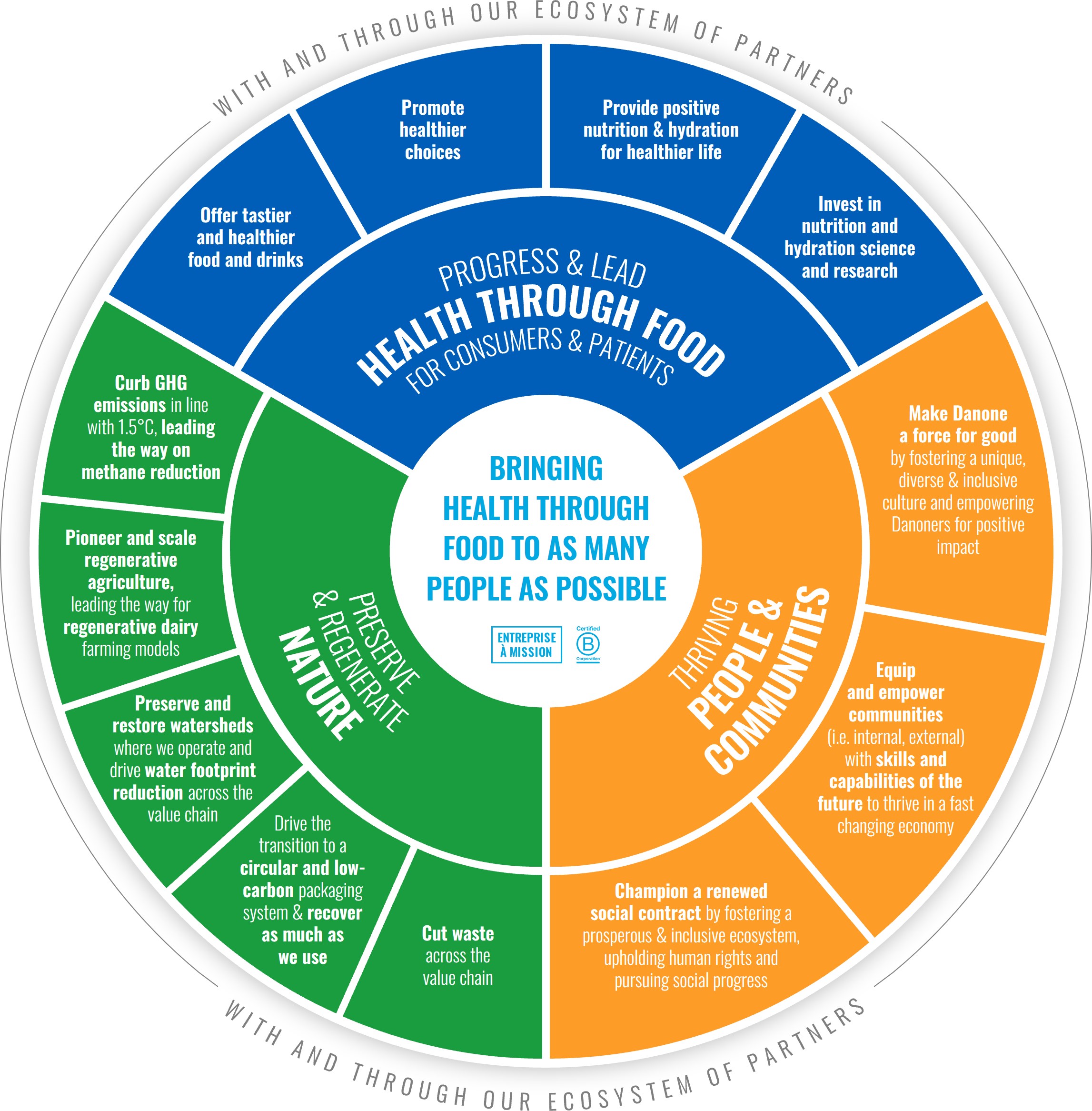
Danone graphs its “Impact Journey” this way in its 2023 “Climate Transition Plan,” which includes reducing methane emissions by 30% by 2030, aligning with the Global Methane Pledge, and achieving Net-Zero emissions by 2050 as the global giant says it will “continue to transform the food system.”  (Web image from Danone Climate Transition Plan)

The company reported its organic dairy sector represented approximately 3% of its global revenues in 2022 and had a “dilutive impact” on sales growth and operating margin.

But mainly, said CEO Antoine de Saint-Affrique, the organic dairy business “fell outside our priority growth areas of focus,” he said, reiterating his very words to investors a year ago when he first announced “eyeing sale” of Horizon Organic and Wallaby.

Terms of sale were not disclosed, but Danone will retain a non-consolidated minority stake in the business, executives said. The closing of the transaction is subject to customary conditions and regulatory approvals.

“Today marks an important milestone in delivering this (Renew Danone) commitment while giving the Horizon Organic and Wallaby businesses the opportunity to thrive under new leadership. This sale, once completed, will allow us to concentrate further on our current portfolio of strong, health-focused brands and reinvest in our growth priorities,” said de Saint-Affrique.

According to Platinum Equity’s New Year’s Day announcement of the acquisition, Horizon Organic is deemed the largest organic fluid milk company in the world and the first brand of organic milk available coast to coast in the United States. It has since grown to include organic creamers, yogurt, cheese and butter.

Platinum Equity Co-President Louis Samson said the acquisition will “build on that legacy and support Horizon Organic’s growth as a standalone company.”

Horizon Organic became the first public organic food company in 1994 and was purchased by Dean Foods in 2004, where it became part of WhiteWave holdings alongside International Delight, Silk and other fake-milk brands. A 2012 spin-off separated WhiteWave from Dean, taking former Dean CEO Gregg Engles with it as the WhiteWave CEO. In April of 2017, Danone purchased WhiteWave, and Engles continued as a current Danone S.A. board member.

Wallaby is an Australian-style organic yogurt found mostly in natural food stores as well as the Whole Foods chain throughout the U.S.

Platinum Equity estimates that the total U.S. dairy category is valued at $68 billion in sales with fluid milk comprising approximately $17 billion of that total. Of that $17 billion in packaged fluid milk sales, organic milk sales comprised 6.7% of the  volume for the first 10 months of 2023, according to the most recent USDA Monthly Packaged Fluid Milk Sales Report.

Meanwhile, Danone has launched full-force into expanding the fake side of its 2017 WhiteWave purchase, adding products and launching new brands of plant-based and AI-engineered biological concoctions of fake-milk, fake-yogurt, fake-cheese, and other fake-dairy products in its quest for so-called “Climate Transition” and “Food Transformation.”

The sale of Horizon to a global private equity firm that specializes in mergers and acquisitions also comes on the heels of Danone’s December 2021 decision to end contracts with all of its New England and eastern New York dairy farms after sourcing milk from larger organic farms to the west and south.

After the sale of Horizon Organic is completed, Danone will be able to completely withdraw from Federal Milk Marketing Orders (FMMO) to do Cost Performance Model (CPM) pricing with a much smaller number of dairy farms, just like with other ingredient sources. Only Class I fluid milk sales are required to participate in FMMOs, and the sale of Horizon Organic to Platinum Equity ends Class I milk sales for Danone because the rest of their former WhiteWave beverage holdings are plant-based.

While Danone moves on to grow its fake-dairy business, owning the largest plant-based manufacturing facility in the world located in northern Pennsylvania and launching new plant-based alternatives to disrupt the dairy case, the Managing Director of Horizon Organic’s new owner, Adam Cooper, sees organic and value-added products as the “premium offerings” that are “driving growth in the dairy milk category.

“Horizon Organic is a pioneer of that segment and is in position to continue capitalizing on and accelerating the trend,” said Cooper.

Platinum Equity has completed more than 450 acquisitions over the past 28 years, and today operates about 50 global businesses that have been shaken loose from larger corporate entities. The global firm’s current $47 billion portfolio includes a few other companies in the food and beverage sector, such as biscuits, wine, seafood, packaged meat and bakery products, and food ingredients distribution.

“We are excited about Horizon Organic’s potential as an independent business with a renewed sense of focus and a commitment to investing in its success,” said Cooper. “We look forward to partnering with Horizon Organic’s management team to ensure a seamless transition and chart a path for continued growth and expansion.”

Already deemed a “component stock of leading sustainability indexes,” Danone’s ambitions are entrenched with ESG investors, the Global Methane Pledge, Climate Transition, Food Transformation and aspirations to be the publicly-traded global company that is B-Corp certified at the global level in 2025. (Danone is already B-Corp certified in the U.S.)

Over the past seven years, Danone North America has moved toward branding its ‘sustainability’ as increasingly plant-based.

In 2022, Danone North America received a $70 million USDA Climate-Smart grant, which the company says will be used to: 1) reduce methane emissions for dairy through innovative manure management, 2) create infrastructure to sustainably grow and trace U.S. food-grade oats and soybeans, and 3) build processing for traceable organic soy.

During the White House Conference on Hunger, Nutrition and Health in September 2022, Danone announced a $22 million investment by 2030 to improve access to, and availability of, “nutritious and health-promoting foods,” the bulk of these funds will be used to “educate consumers and healthcare providers” (aka, marketing).

Shortly thereafter, the FDA Milk Labeling Proposed Rule hit the Federal Register for comment requiring only voluntary compliance for nutrition comparisons on labels of fake-milk using the term ‘milk.’ This rule has not been finalized as FDA continues to look the other way when it comes to milk and dairy label standards of identity abuses.

(Rest assured, Danone’s big goal is to become ‘net zero’ by 2050 by transforming food. Sound familiar?)

DANONE FOOD TRANSFORMATION TIMELINE

July 2016, Danone launched the Dannon Pledge for non-GMO verified, positioning its conventional milk supply around a concept of ‘almost-organic.’

Apr. 2017, Danone purchased the Dean WhiteWave spinoff, which included Horizon Organic and Silk, So Delicious, and Alpro plant-based brands. The DOJ Antitrust Division required Danone to simultaneously divest its Stonyfield Farms subsidiary.

Apr. 2018, Danone quietly notified smaller Horizon Organic dairy farms in the western states that their future contracts would not be renewed amid a glut of organic milk and differences in how USDA’s organic livestock origin rules were being applied. Some of these producers were offered conventional non-GMO milk contracts using Danone’s proprietary Cost Performance Model (CPM). Some found other markets, and many exited the business. According to Danone’s 2021 Regenerative Agriculture Report, more than half of all U.S. milk collected by Danone now comes from farms with CPM contracts. 

Feb. 2019Danone completed construction of the world’s largest plant-based yogurt factory in Dubois, Pennsylvania, where other non-dairy lookalike products are also made.

Feb. 2020, Danone told investors the rising global temperature is a business opportunity, and the company would accelerate food transformation with climate at the core of its growth strategy.

Oct. 2020, Danone announced its partnership with a bioscience startup to use artificial intelligence to explore new formulations to improve taste and texture of plant-based dairy alternatives.

Jan. 2021, Danone’s So Delicious launched its first plant-based cheese and Danone S.A. was acknowledged as the largest plant-based company in the world with 10% of total sales coming from plant-based dairy alternatives. The company told investors it would grow this with further acquisitions and a “plant-based acceleration unit.”

Apr. 2021, Danone and the EAT Lancet Commission announced a strategic partnership to promote a so-called “healthier and more sustainable food system by driving a change to planetary diets.” Danone pledged to use its ‘One Planet. One Health’ framework to “accelerate this food revolution.”

July 2021, Danone announced three new plant-based fake-milk launches for 2022, along with a list of other lookalikes. During the July 2021 earnings call, Danone executives identified the U.S. as a “key plant-based market,” but noted 60% of U.S. consumers are not in the category because of product taste and texture. They announced a plan to win them over “with new dairy-like technology under Silk NextMilk, under So Delicious Wondermilk and under Alpro Not Milk.”

Aug. 2021, Danone sent letters notifying all 89 of its organic dairy farms in New England and eastern New York that their milk contracts would be terminated in 12 months’ time. Later, under pressure from organic groups, officials and consumers, Danone agreed to a Feb. 2023 extension.

Jan. 2022, Danone launched the three new fake-milks: NextMilk, Wondermilk, and Not Milk. 

(Interestingly, the Silk NextMilk Whole Fat has 6 grams of saturated fat from processed coconut and seed oils. That’s more saturated fat per serving than Real Whole Dairy Milk naturally from cows. Danone’s Silk NextMilk is packaged in red and white cartons with the words ‘Whole Fat’ appearing directly under the brand name to mimic the Whole Milk appearance. Interestingly, the FDA’s proposed healthy labeling rule sets a tougher threshold for saturated fat in dairy products compared to saturated fats from plant-sources.)

Mar. 2022, Danone described its Horizon Organic and “traditional dairy” holdings as “troubled offerings,” telling investors: “There are no sacred cows,” as they “keep pruning” the portfolio to “boost growth” and “distance” the company from “underperformance”… by investing more in “winning products” and selling existing brands or buying new ones.

May 2022, Danone launched its “Dairy & Plants Blend” baby formula (60% plant-based, 40% dairy) “to expose children to food tastes early in life that can help shape their future food preferences… while shifting toward plant-rich diets and embracing alternative sources of protein to help reduce carbon emissions.”

Sept. 2022, Danone joined the White House Conference on Hunger, Nutrition, and Health to announce a $22 million ‘nutrition and health’ investment by 2030 with $15 of the $22 mil. Earmarked “to further nutrition education for consumers and healthcare providers.” (Sounds like marketing). This includes Danone’s new pledge to increase the nutrient density of its plant-based beverages.

Sept. 2022 — Danone was part of a team that was awarded a $70 million USDA Climate Smart grant for projects that include: 1) Reducing methane emissions for dairy through innovative manure management, 2) Creating the infrastructure to sustainably grow and trace U.S. food-grade oats and soybeans, 3) Building processing for traceable organic soy.

Oct. 2022, Danone announced it would use artificial intelligence through its bioscience partner BrightSeed, to reformulate over 70% of its plant-based fake-milk alternatives to reduce added sugars and increase nutrient density. At the same time, it allocated $15 million to “partner with retailers on healthy eating education” and $7 million to partner with community-based programs that provide nutritious foods.

(Timing is everything: Danone is among the financial supporters of the infamous Tufts University Food Compass, launched recently into the federal nutrition policy arena through the Biden-Harris Hunger, Health and Nutrition Strategy and the FDA proposed rule on  “healthy labeling.” The Food Compass nutrition profiling algorithm rates nonfat dairy yogurt high as an encouraged food, along with plant-based fake-milks; but real milk and cheese are rated lower as foods to moderate or discourage. More artificial intelligence, to be sure.)

Jan. 2023, Danone announced it was looking for a buyer for Horizon Organic, saying it fell outside of their growth areas of focus.

Feb. 2023, Contract extensions ended for terminated Horizon Organic dairy farms in the Northeast. Some have gone out of business. Others have gone to Stonyfield or Organic Valley, which eventually agreed to take on the remaining Northeast farms facing Horizon termination, along with 40 organic dairies cut last year by Maple Hill in New York.

Mar. 2023, Danone launched a fake-milk-mustache campaign for its Silk NextMilk brand using children, nieces, and nephews of three original real-milk-mustache celebrities to twist the knife.

Apr. 2023, Danone launched an organic alternative beverage: ‘So Delicious Organic Oatmilk’ in ‘original’ and ‘extra creamy.’

May 2023, Danone launched So Delicious Dairy-Free Yogurt

Jan. 2024, Danone announced its agreement to sell organic dairy businesses — Horizon Organic fluid milk and Wallaby yogurt to Platinum Equity.

-30-

Sweet Beginnings

Image

I had this idea many months ago to start a blog about the people, places an issues relating to the food we eat, and since I’ve spent my life as an ag journalist and avid photographer, the name of my blog is “foodography.”

I had the idea, the name, the framework, but it seems I’ve been too busy to jumpstart it. Today, I’ve been prodded to do my first post because of the confusion I see lately about milk. So I’m kicking off my foodographic blog with an opportunity to shed light on some of the controversey about a dairy / sweetener petition that has been talked about in social media and mainstream media the past few weeks.

Below are my dozen points of light… Please read and then use the link at the end to go to the FDA website to read the petition and to tell FDA what you think about non-caloric sweeteners in flavored dairy products and while you are at it, ask FDA to talk to USDA about its school lunch rules. Chocolate milk – and whole milk for that matter – is not the cause of childhood obesity.

1) I am an advocate for real foods, whole foods. The less artificial, the better, in my opinion. But I am also a busy mom who raised three kids and worked full time. I know what it’s like to be going 100 directions and still strive to put a healthy meal on the table. Today, I have grandchildren. I care what they eat and drink. Whole milk is, was, and forever shall be a staple in our house, period.

2) THE MOST IMPORTANT TAKE-HOME POINT: ***Dairy farmers work very hard 24/7/365 to ensure they are producing wholesome high quality milk, but by the time it reaches the store or the school cafeteria, the lowfat and nonfat varieties are not the flavorful creamy product that came from the cow! Farmers I talk to are frustrated by this and they are frustrated even further when they see headlines about the mere suggestion that certain sweeteners with a bad reputation could be put into their product, even though said non-calorie sweeteners would only relate to flavorings like chocolate, strawberry or fruit, and not to the milk itself! I don’t blame them for being mad. They want to sell unfooled-around-with milk, the best kind of course!

3) I do not approve of using aspartame in drinks intended for children. However, I would allow my kids (grandkids) to use stevia. Both stevia and the maligned aspartame are considered non-nutritive (which means no-calorie) sweetener alternatives to traditional caloric or nutritive sweeteners called sugar and high fructose corn syrup.

4) Current FDA standards of identity for milk and certain other dairy products do not allow the use of non-nutritive (no-calorie) sweeteners and this includes the flavorings that are added to make variations of these products (i.e. chocolate milk, which to me is no different than a marinated steak vs. a plain steak. One is pure from the animal and the other has a recipe of flavoring added!)

5) Most consumers – and even pediatricians – do not realize that whole milk is less than 4% fat to begin with. People think it’s 10%, even doctors are so misinformed.

6) Furthermore, the USDA school lunch program forces schools to reduce the lunch fat percentage to the equivalent of a heart patient’s diet so the milk that is offered is nonfat or 1% in order to meet the total lunch requirement. This is by REGULATION, even though current studies show kids who drink whole milk are leaner and that whole milk is better for the brain.

7) Because nonfat white milk is essentially tasteless, kids opt for the chocolate nonfat in the school lunch line. Now we have another wrinkle in the milk story: Starting in 2013, the USDA school lunch program is mandating reductions in sugar content of school lunches, so schools are forced to give up flavored milk if they can’t make their menus work. The full impact of this rule is YET TO COME.

8) #7 above is essentially one of the reasons the 2009 petition filed by IDFA and NMPF on non-nutritive sweeteners was revived four years later in 2013 and why FDA is now looking at it. It’s because the sugar rules will affect FLAVORED yogurt and FLAVORED milk servings in the school lunch program. Furthermore, older adults may want to limit their sugar intake and yet they may love a strawberry or chocolate milk. They can buy a flavoring at the store that is made with a non-nutritive sweetener and add it to their real milk at home, and that’s okay, but a bottler can’t do that right now and still call it “milk.” They have to change the name to chocolate or strawberry “milkshake” or “drink” or find a different name. Or in the case of a flavored yogurt sweetened with non-nutritive (no calorie) alternative they have to call it something else, like “smoothie”. 

9) In the case of the flavored milk beverage, this failure to observe standard of identity on the flavoring not the actual milk, puts the beverage in another “class” other than “class 1” for the purpose of milk pricing back to the farm.

10) The root problem is that whole-fat milk gets an unfair bad rap and should be promoted for its health benefits and surprising lack of fat less than 4%. The industry needs to stand firm and battle the increasing levels of misinformation. Chocolate milk sweetened with sugar or high fructose corn syrup gets a bad rap also, and should be touted for its perfect carb/protein ratio. The industry is doing that through promotion, but it needs to do more.

11) Sadly, the USDA school lunch regulators don’t care about the truth. They don’t care about whole foods or real foods. They are numbers people, bean counters, who want to see menus that add, subtract and multiply to the right mathematical answer! Meanwhile, Milk bottlers and dairy foods makers are trying to deal with these realities and to compete with other beverages and look-alikes that don’t have these standard-of-identity restrictions. For that matter, if milk has a standard-of-identity, how can crushed almond or soybean juice be called ‘milk’? But that’s another blog post!

12) For sure, Chocolate milk is not the cause of childhood obesity in this country. For that matter, kids could drink whole chocolate milk til the cows come home and it’s not the cause of childhood obesity. But, by the same token, the controversial sweetener petition is not affecting milk or yogurt or sour cream or any of the 17 products itself. It is specifically directed to the “use of any safe and suitable sweetener in the optional characterizing flavoring ingredients period.

13) This sweetener argument is sort of like arguing about what can be put in a marinade for a london broil if you want to call it beef at the grocery store. (i.e. London broil = real and pure beef) and the ingredients in a marinated London broil (beef plus whatever is in the marinade).  I read the label for those too, don’t you?

14) Read the petition here: http://www.regulations.gov/#!documentDetail;D=FDA-2009-P-0147-0012

15) Tell FDA what you think here: http://www.regulations.gov/#!submitComment;D=FDA-2009-P-0147-0012