Is there a middle ground for the greater good? Ultrasound operators still jailed, State provides some answers; Legal team responds

By Sherry Bunting, special for Farmshine, April 26, 2024 edition

HARRISBURG, Pa. — It has been two weeks since Rusty Herr, 43, of Christiana and Ethan Wentworth, 33, of Airville were arrested on April 10 and 11 and separately incarcerated in Lancaster and York County Prisons — their respective counties of residence.

As of April 24, both men are still in jail, without bail, and without seeing a judge.

“This is an unprecedented case of lawless persecution against two farmers who help other farmers with standard breeding practices, as is their right,” said Robert Barnes, Esq. of Barnes Law LLP, who accepted the case on April 17.

“The Pennsylvania Veterinary trade organizations conspired to protect their own monopoly in violation of the law and in a manner that has hurt farmers throughout Pennsylvania. The Pennsylvania Department of State (DOS), in a secret star chamber proceeding, ordered the unlawful imprisonment of Rusty Herr and Ethan Wentworth, who have still never seen an arrest warrant, heard the charges against them, had a hearing, or seen a judge,” Barnes continued in a statement provided to Farmshine Wed., April 24.

“In short, their due process rights have been obliterated. I will seek justice for Wentworth, Herr, and their families to the fullest extent of the law,” Barnes asserted.

The only dockets available for prior orders last week were two found on the website of the Pennsylvania Veterinary Medical Association (PVMA) as part of a package on their “advocacy” page asking members to file complaints with DOS by referencing the provided docket numbers, and then report back to PVMA so they can keep track. One was a 2010 docket with Herr as respondent and the other 2018 naming Wentworth. Both orders stated civil penalty, not criminal.

All other court and DOS system searches yielded nothing, and even those docket numbers came up “nonexistent.” 

In a PVMA press release dated April 19, the veterinary trade organization stated: “PVMA is unaware of the circumstances surrounding the arrest of two individuals on April 10 and 11 for contempt of court.”

And yet, in their 2020 Complaint that they had posted at their website before it was removed this week, the PVMA specifically stated: “Since these individuals continue to practice veterinary medicine without a license after their initial order to cease and desist, we request that the state file contempt charges with the Commonwealth Court. PVMA is able to supply additional witnesses upon request.”

Farmers, veterinarians and others in the dairy industry are discussing the case. Calls, texts and emails pour in from dairy farmers who appreciate NoBull Solutions and rely on them for breeding service.

Calls, texts and emails have also come in to make further accusations against the imprisoned men — none of which are mentioned in the PVMA complaint or their links to two previous civil orders, nor in any documentation provided now by the DOS.

After initiating a request for an interview on April 15 and submitting questions to the State Board of Veterinary Medicine on April 16, Farmshine received a few answers on April 24 from the Department of State (DOS).

On the current situation, the DOS responds: “We can neither confirm nor deny the existence of an investigation or matter.”

On the question of what hearing process may or may not have been available to Herr and Wentworth regarding past civil penalties and cease and desist orders, dockets were provided, one with Herr as the respondent in 2010, and one with Wentworth and another individual who has not been arrested named together as respondents in 2018.

“Speaking generally, the Department reviews every potential license violation of which it becomes aware, whether that is through a complaint filed directly to the Department, a notification from local law enforcement or through media reports. After review, a determination is made as to whether formal action is warranted,” the DOS press office explained in their email response. 

The long and short of the DOS response here is that all respondents have due process at some point, which includes notice and an opportunity to participate in those original proceedings, call witnesses, introduce evidence, and testify on their own behalf.

Herr and Wentworth did so, on their own behalf, without legal counsel, in 2010 and 2018, respectively, according to the documents provided by the DOS.

However, they were not noticed since then by the DOS, and nowhere in the responses from DOS or the adjudications they provided is an automatic 30-day prison term without bail stated as a consequence for “continuing to violate the Act” by ultrasounding cows they do not own. No proof of the process has been shown in the responses from the DOS apart from the 2010 and 2018 actions.

On the question about where pregnancy and diagnosis are linked in the law or regulations, the bottomline is they are not. The State Board of Veterinary Medicine decides this through adjudication and orders as the legislature grants the Board this authority.

“The Board adopted the position that, ‘both the performance of a surgical procedure, such as the Gymer/Stemer Toggle Suture Repair, and the diagnosis of a physical condition, such as detecting through ultrasound whether an animal is pregnant, constitute practice of veterinary medicine,’” the DOS reported, adding that the Act contains an exception for any person or an employee of that person or agent while practicing veterinary medicine on his or her own animals. (What constitutes an ‘agent’?)

The DOS included a copy of an Amended Adjudication and Order, Docket No. 2296-57-09, which came before the State Vet Board with Herr as respondent in May of 2010. Performance of toggle on six animals he didn’t own and performing ultrasound for detection of pregnancy on animals he didn’t own were both listed specifically in the determination of civil penalty.

This was 14 years ago, and the docket from 2010 confirms that Herr responded to say he is “no longer toggling other people’s cows.”

The amended adjudication goes on to explain “should the respondent continue to violate the Act, he may be subject to the imposition of a $10,000 civil penalty per act or practice.” 

Nowhere does it mention automatic 30 days in prison for continuing to detect pregnancy through ultrasound.

For Wentworth, the docket history supplied by the DOS began Sept. of 2017 while he and another named individual, who has not been arrested, were previously employed by Select Sires. Docket No. 1928-57-17, simply states “Respondents engaged in the practice of veterinary medicine without being properly licensed to do so under the Act” and describes this as “performed pregnancy examinations on cattle using ultrasound equipment.”

Both responded, and this led to a formal hearing, eventually in April of 2018, when the state’s expert witness, a University of Pennsylvania professor, could be available. 

Both respondents appeared without representation. They testified on their own behalf and were cross-examined. In May 2018, the matter was closed and determinations were made that both men used ultrasound equipment to “determine pregnancy of customers’ cows” and to “determine if cows were in heat or had other medical issues.”

Noted in the history is this statement that begs more questions: “The economic savings to the cow’s owner, based on a positive pregnancy or negative heat result, are outweighed by the risk of harm to the cow posed by the unlicensed practice (of ultrasound).”

That brings us to April 2024, which the DOS will not comment on.

What we are left with on that is a downloaded copy of the PVMA complaint requesting contempt charges via the Commonwealth Court. Attached to the complaint were pictures from the arrested men’s facebook pages showing ultrasound pregnancy detection.

Bottomline, according to the DOS response: “The State Board of Veterinary Medicine is responsible for enforcing the Veterinary Medicine Act as enacted by the General Assembly. Questions about the provisions of the Act (including the exception in 63 Stat 485.32) should be directed to the legislature.”

This response makes the timing and manner of the arrests more curious, coming six months after the Pennsylvania House Ag Committee opened discussion to look at ways to address the statewide shortage of large animal veterinary practitioners, including the Veterinary Practice Act to see if modifications are needed for a “middle tier” to help Pennsylvania farmers cope.

For veterinary practices, the economics are increasingly difficult in attracting and keeping practitioners and vet technicians in the large animal domain. Their financial and time investments are significant, often graduating $250,000 in debt, and the trend is for more to go into small animal practice with pets to realize a return.

“No large animal practitioner is doing this — for the money,” said one central Pennsylvania vet.

Farmers identify with that. They have significant investments, see their costs rising, and in much of the state, see fewer large animal vets and prohibitive costs for basic services from consolidating companies on small farms vs. large ones, so they look for options, including doing more themselves.

“We have good vets, and I have done some ultrasounding with Rusty, but my vet comes in for herd health, and I keep a good relationship with my vet,” said a dairy farmer from Kirkwood in a Farmshine call April 24.

“Rusty is not trying to take work from vets. He is just trying to help the farmers and provide service for them. He has supported me 100% to help me make breeding decisions in my herd. He will even suggest a mating to a bull outside of his genetic lineup. Instead of just trying to get more business for himself, he highly encouraged and helped teach me how to inseminate my own cows. He’s a mentor and true hero. If anything, he’ll come out of this stronger,” the Kirkwood dairyman continued.

There must be middle ground here. Clarity, transparency and solutions are needed.

“As farmers, we put our bodies and souls into this. As everything consolidates in this industry, how do we compete? This is what extinction looks like,” said Ben Masemore, an eastern Pennsylvania dairy farmer and friend of Herr and Wentworth, who is involved in NoBull Sires, a separate business from NoBull Solutions.

He shared a partial statement written by Herr from his prison cell.

“To this day, we have never once had a farmer or caretaker complain to the state about any single issue. I know that we have a tremendous amount of support behind us, and I realize this will all get resolved. I will be a better husband, father, and person because of this entire experience, and for that I am grateful,” wrote Herr.

He expressed his hope that fair-minded people “can come together… to create a level playing field, one in which we can all work together for the greater good of the industry… I hope and pray that good can come out of this and that someday we can all look back on this time as a steppingstone for meaningful and lasting change.”

Thanking the NoBull team and supporters, and grieving what the families are enduring, Herr wrote: “Thank you all so very much for your coveted prayers and support. Thank you for your financial generosity. Keep the faith and be strong, God is always good. This will all be over soon.”

NoBull Defense Funds have been set up at two local banks to help with legal defense to get them home. Separately, an online fund has raised over $17,000 so far at https://www.givesendgo.com/nobull?utm_source=sharelink&utm_medium=copy_link&utm_campaign=nobull

-30-
Our farmers are the thin green line between us and a ‘Holodomor’ – Let’s not forget it!

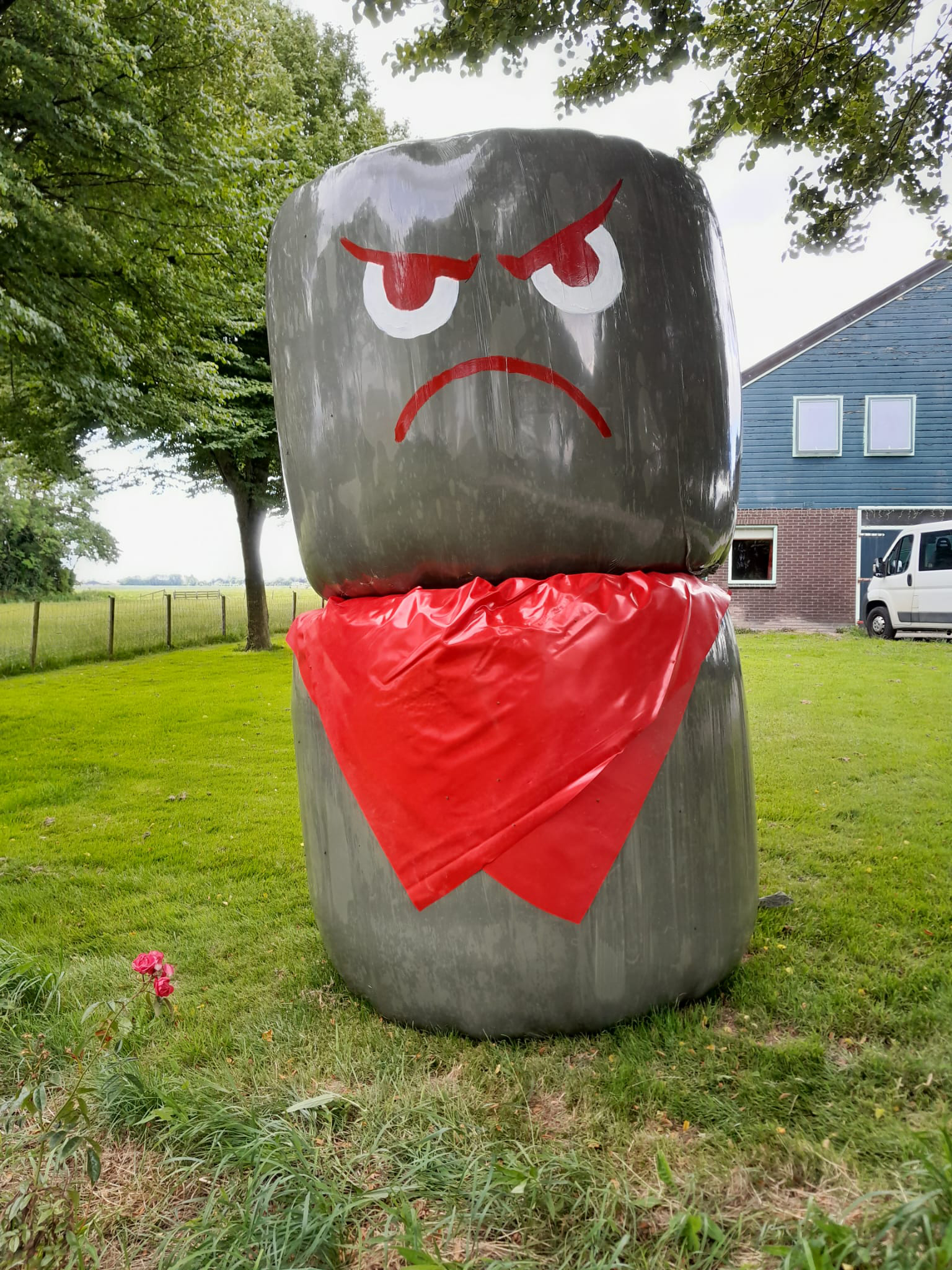
Bale art in Holland has a message. Displays like this are a ‘public-friendly’ way to protest the nitrogen (emissions) policy, and the red handkerchief has become the sign of support for farmer resistance.

By Sherry Bunting, Farmshine, July 22, 2022

The pain is necessary. The transition is unavoidable. The climate pledges are urgent. Race to zero. Net Zero Economy. Sustainable Nitrogen Management. Climate Champions, and on and on. 

These are just some of the pages and phrases at the United Nations Environmental Program (UNEP) website where resolutions are adopted, targets are pledged, sustainable development goals (SDGs) are constructed and updated, and Environment, Social, Governance (ESG) scoring is discussed for countries, cities, corporations, lenders, investors, institutions, states, provinces, networks, alliances, even individuals.

Dairy farmers are being asked to provide more and more of their business operations data, field agronomy, feed and energy purchases, inputs, output, upstream, downstream — a virtual farm blueprint.

While it is important that farmers have a baseline to know where they are and gauge where they are going, it is also critical that such details do not provide a centralizing entity the ability to map them into zones where requirements are passed down by milk buyers, government agencies, industry programs, or lenders deciding farmers in Zone A will be held to one standard while farmers in Zone B are held to another. 

Meanwhile, even the most aggressive standard is so trivial in the big picture that it is offset virtually overnight by unrestrained pollution in countries like China where no one is minding the store.

Sound familiar? Look at The Netherlands.

Activist NGOs have struck deals with everyone from the billionaire globalists, activist politicians, industry organizations, corporations and investors to create the world they envision and have invested in for a future return.

They use marketing platforms, global PR firms, thought-leadership networks, pre-competitive alliances, pseudo-foundations and even align with government agencies to flesh out the details and drive the bus.

As producers and consumers, it feels like we are along for the ride.

For example, Changing Markets Foundation, an offshoot of World Wildlife Fund, partners with NGOs to “leverage market forces to drive rapid and self-reinforcing change towards a more sustainable economy.”

It was formed to accelerate this transition.

Just this week Changing Markets published a study taking aim at dairy – warning investors to take a more active role in improving the dairy and meat sector’s “climate impact” by asking these companies, the processors, to disclose their emissions and investments and cut methane and other pollutants.

In other words, the NGOs, through a ‘marketing’ foundation, prods investors to push your milk buyers, lenders and vendors to obtain and track for them your information.

These NGOs and foundations are driving this bus a little too fast, and it needs to slow down. They take countries (like Holland) to court to hold up infrastructure projects, using their own pledged targets against them and forcing a faster timetable to gain the offsets needed for the stalled projects.

They publish self-fulfilling studies, surveys and warnings prodding investors to reach back into the dairy and meat sector and take a more active role in getting more reporting of downstream methane emissions (your farm).

They warn dairy and meat processors that if they don’t get this information and cough it up, investor confidence will be harmed and their assets could be stranded, resulting in large economic losses.

They salivate with anticipation, waiting for land purchase packages that they, as NGOs, can poorly manage as contractors alongside the purchasing government entities.

Let this sink in. The investor class is being deemed the farmer’s new customer – not the consumers whom our farmers are proud to feed and proud to show the truly valuable practices they use in caring for the land, practices that are often not very well monetized – like cover crops, for example.

If a country like the Netherlands with a progressive agriculture industry finds itself in the position that it can’t build or do infrastructure projects without first decreasing nitrogen emissions on the backs of farmers, where do we go from here with the fuzzy math being done on all greenhouse gases in the sidebars of highly-capitalized alternative meat and dairy lookalikes that are lining up — ready to burst on the scene to grab a foothold for investor returns?

The Changing Markets report, in fact, makes the claim that 37% of global GHG comes from food production and attributes most of this to meat and dairy — certainly embellishing the issue in this disingenuous phrasing and fuzzy math.

If farmers can’t be paid for the simplest of constructive practices that produce food for people — while at the same time being restorative to the land, why should billionaires and governments be able to come in and buy their land, plant trees, re-wild to scrub brush or half-hearted grassland status and get an offset?

None of what is happening makes sense unless we step back and recall what we know about the World Economic Forum’s Great Reset, Food Transformation, Net Zero Economy and the realities of so-called ESGs. This has been a process and most of us have only had glimpses of it to connect the dots.

I recall conversations over the years of my journalism career with a most respected ag economics professor, the late Lou Moore at Penn State. He worked with farmers and his peers in former Soviet countries after the breakup of the Soviet Union. He would tell the stories from Ukraine, described to him as handed down through generations of the period of terror and famine known as the Holodomor when the Soviets collectivized the farms of the Ukraine under communism – resulting in the starvation and death of 10 million or more in a transition.

Bottomline: Agenda 2030 has been under construction for some time now, and ‘climate urgency’ is being used today to target farming and food production, not just energy and fuel.

Our industry organizations keep telling us the public, consumers, are driving where this is going, that it is science based, and yet key questions at the farm level still can’t be answered.

At the regional levels, we see authentic models of conservation groups partnering with dairy farms and cooperatives to access grants for meaningful improvements that make financial and environmental sense but may not show up just so on a global NGO’s master sheet. 

There are ideas being generated to give companies of all sizes a way to be ‘climate champions’ by investing in Farm Bill conservation programs that really work. Congressman G.T. Thompson mentioned this recently at a farm meeting.

Let’s do the work that accomplishes what’s real and equitable for our farmers and hold off just yet providing too much detailed information.

We know NGOs and governments have set targets to protect 30% of the earth’s surface as non-working lands by 2030 and 50% by 2050. This boils down in the targets at the U.S. level as well.

Let’s be sure we don’t give away the farm.

The strength and diversity of our farmers is so important. You, our farmers worldwide, are the thin green line between us and a Holodomor.

-30-

A world without cattle?

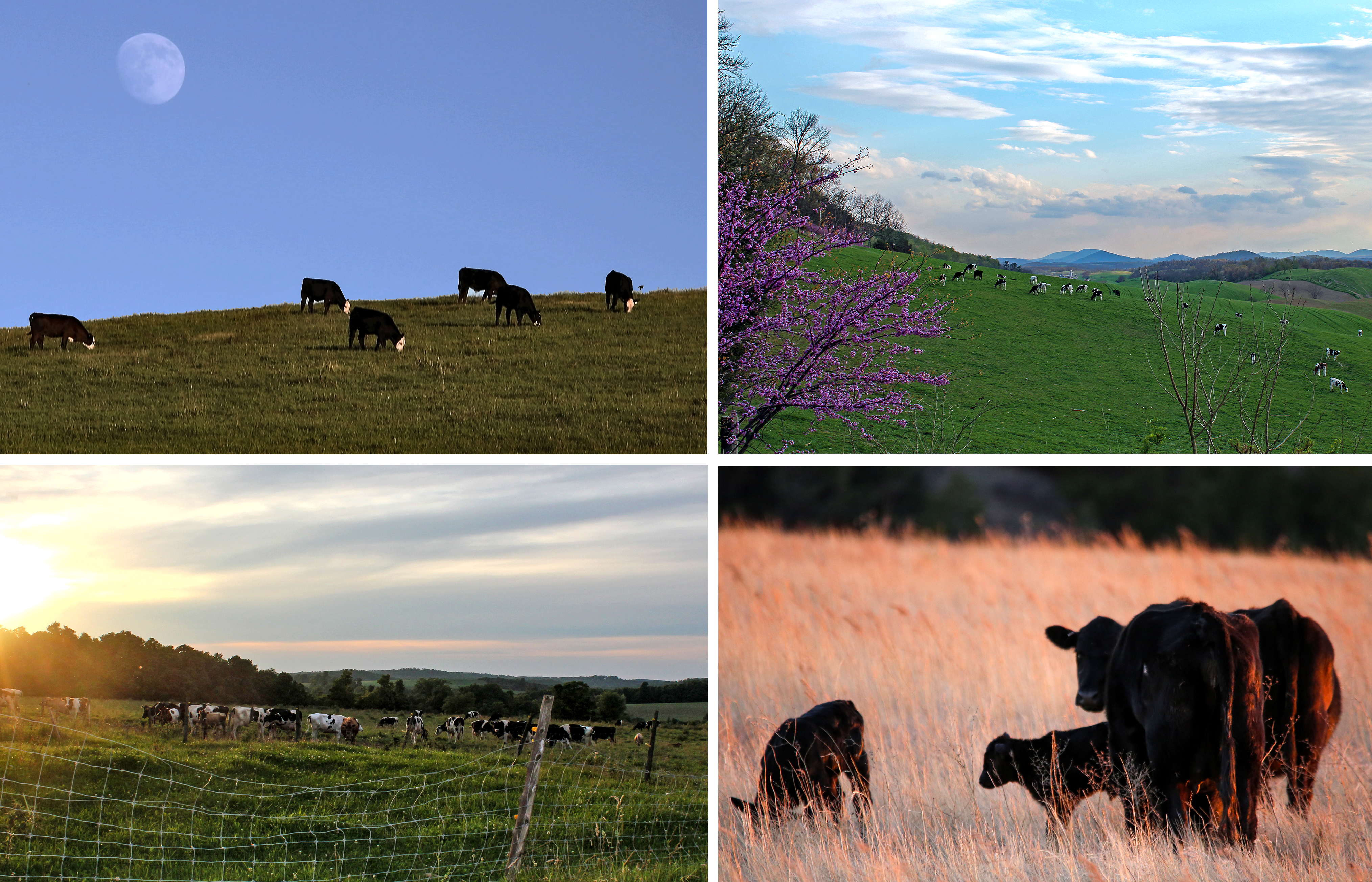
GL45-Earth Day(Bunting).jpgCaption: The health of the dairy and livestock economies are harbingers of the economic health of rural America … and of the planet itself. Here’s some food for thought as we celebrate Earth Day and as climate change discussions are in the news and as researchers increasingly uncover proof that dietary animal protein and fat are healthy for the planet and its people.

By Sherry Bunting, published April 22 Register-Star (Greene Media)

A world without cattle… would be no world at all.

How many of us still believe the long refuted 2006 United Nations Food and Agriculture Organization (FAO) report, which stated that 18 percent of all greenhouse gas emissions, worldwide, come from livestock, and mostly from cattle?

This number continues to show up in climate-change policy discussion even though it has been thoroughly refuted and dismissed by climate-change experts and biologists, worldwide.

A more complete 2006 study, by the top global-warming evaluators, the Intergovernmental Panel on Climate Change, stated that the greenhouse gas emissions from all of agriculture, worldwide, is just 10 to 12 percent. This includes not only livestock emissions, but also those from tractors, tillage, and production of petroleum based fertilizers, pesticides and herbicides.

Hence, the UN Environmental Program disputed the UN FAO assertion to state the percentage of emissions from total agriculture, worldwide, is just 11%, and that cattle — as a portion of that total — are responsible for a tiny percentage of that 11%. While cattle contribute a little over 2% of the methane gas via their digestive system as ruminants (like deer, elk, bison, antelope, sheep and goats), they also groom grasslands that cover over one-quarter of the Earth’s total land base, and in so doing, they facilitate removal of carbon dioxide from the atmosphere to be tied up in renewable grazing plant material above and below the ground — just like forests do!

Think about this for a moment. The UN Environmental Program and the Intergovernmental Panel on Climate Change are in agreement that cattle and other livestock are not the problem the anti-meat and anti-animal-ag folks would have us believe. In fact, they are in many ways a major solution.

Think about the fact that man’s most necessary endeavor on planet Earth — the ongoing production of food — comes from the agriculture sector that in total accounts for just 11 percent of emissions!

Why, then, are major environmental groups and anti-animal groups so fixated on agriculture, particularly animal agriculture, when it comes to telling consumers to eat less meat and dairy as a beneficial way to help the planet? Why, then, has the U.S. Dietary Guidelines Council pushed that agenda in its preliminary report to the U.S. Departments of Agriculture and Health and Human Services, that somehow the Earth will be better sustained if we eat less meat?

They ignore the sound science of the benefits livestock provide to the Earth. In fact, it is no exaggeration to say what Nicolette Niman has written in her widely acclaimed book “Defending Beef” that, “Cattle are necessary to the restoration and future health of the planet and its people.”

Niman is a trained biologist and former environmental attorney as well as the wife of rancher Bill Niman. She has gathered the data to overturn the myths that continue to persist falsely in the climate-change debate, and her book is loaded with indisputable facts and figures that debunk the “sacred cows” of the anti-animal agenda:

  • Eating meat causes world hunger. Not true. In fact, livestock are not only a nutrient dense food source replacing much more acreage of vegetation for the same nutritive value, livestock are deemed a “critical food” that provides “critical cash” for one billion of the planet’s poorest people — many of whom live where plant crops cannot be grown.
  • Eating meat causes deforestation. Not true. Forests, especially in Brazil, are cleared primarily for soybean production. Approximately 85 percent of the global soybean supply is crushed resulting in soybean oil used to make soy products for human consumption and byproduct soybean meal for animal consumption. A two-fer.
  • Eating meat, eggs and full-fat dairy products are the cause of cardiovascular disease. Not true. Researchers are re-looking at this failed advice that has shaped 40-years of American dietary policy. Its source was the 1953 Keys study, which actually showed no causative link! Meanwhile, excessive dietary carbohydrates have replaced fats in the diet, which turn to more dangerous forms of fat as we metabolize them than if we had consumed the natural saturated fats themselves. When healthy fats from nutrient-dense animal proteins are removed from the diet, additional sugars and carbs are added and these have led us down the road to increased body mass and diabetes.
  • Cattle overgrazing has ruined the western prairies. Not true. While improper grazing can have a localized detrimental effect, the larger issue is the pervasive negative effect that is largely coming from not grazing enough cattle. Higher stocking densities that are rotated actually improve the health of grasslands. Large herds provide the activity that loosens, aerates and disperses moisture along with the nutrients the cattle return to the soil — for more vigorous grass growth and soil retention — much as 30 million buffalo and antelope groomed the prairies two centuries ago. Meanwhile, the Bureau of Land Management has favored controlled burns over grazing and is taking away land rights our federal government once shared with ranchers. BLM reductions in allowable stocking densities have initiated a land-grabbing cycle of ranchers losing their land and livelihoods while the land is robbed of its benefits.

The anti-animal agenda continues — groundless, yet powerful. Rural economies, farm families, consumers and the Earth pay the price.

The majority of the lifecycle of supermarket beef and dairy products is rooted in grooming the grasslands and forage croplands that are vital to the Earth and its atmosphere. In addition, farmers and ranchers reduce tillage by planting winter cattle forage to hold soil in place, improve its organic matter and moisture-holding capacity, provide habitat for wildlife while providing temporary weed canopy between major crop plantings. Not only do cattle eat these harvested winter forages, they dine on crop residues and a host of other food byproducts that would otherwise go to waste.

Our planet needs livestock and the farmers and ranchers who care for them. They not only feed us — with more high quality dietary protein with all of the necessary amino acids, calcium, zinc, iron and other nutrients per serving than plant-based sources alone — they also feed the planet by providing necessary environmental benefits.

Enjoy your meat and dairy products without fear — certainly without guilt — and with gratefulness and appreciation for the gift of life given by the animals and because of the hard work and care they have been given by the men and women who work daily caring for the land and its animals. This Earth Day, we are grateful for the circle of life and the farmers and ranchers and their cattle, which sustain our existence, our economies, and our environment.

A former newspaper editor, Sherry Bunting has been writing about dairy, livestock and crop production for over 30 years. Before that, she milked cows. She can be reached at agrite2011@gmail.com

Learn more about the latest research to measure emissions due to the dairy and livestock industries.

-30-

Images by Sherry Bunting