Part Two: What drove rockier road for 2023 milk prices? Manure. Imports. Concentration.

— Along with more imports and shifts in cheese production, major manure-driven expansion in cheese-heavy Central U.S. put pressure on region’s ‘disrupted’ processing capacity

By Sherry Bunting, Farmshine, Updated in reflection from original publication in July 7, 2023 Farmshine

EAST EARL, Pa. — What has driven the rockier road for 2023 milk prices? Many things, and manure may be top on the list.

In fact, we’ll cover the ‘manure effect’ in a future article. But are we beginning to see the methane wheel-of-fortune behave with the ‘cobra effect’? (The British government, concerned about the number of venomous cobras in Delhi, offered a bounty for every dead cobra. Eventually, however, enterprising locals bred cobras for the income.)

This happened with greenhouse gases in the past. It happened with a byproduct gas of making refrigeration coolant. In 2005, when the UN Intergovernmental Panel on Climate Change began an incentive scheme. Companies disposing of gases were rewarded with carbon credits, which could eventually get converted into cash. The program set prices according to how serious the environmental damage was of the pollutant. (Like making cow methane seem like new methane when it’s not). As a result, companies began to produce more of the coolant in order to destroy more of the byproduct gas, and collect millions of dollars in credits. This increased production also caused the price of the refrigerant to decrease significantly.

With this prelude, let’s look back in retrospect on what I reported in the July 7, 2023 Farmshine when milk markets were in a tailspin hitting their low for the year — just 10 days before the gradual turnaround began.

As losses in the CME spot cheese markets and Class III milk futures markets continued through July 6, the Federal Order benchmark Class III price for June was pushed down to $14.91 per cwt. and protein down to $1.51/lb, July and August futures went well below the $15 mark, with Class III below $14.

Let’s look at the supply side of the January through June 2023 supply and demand equation.

Looking at the May Milk Production Report that was released in June, it’s hard to believe the bearish response we saw in milk futures and spot cheese markets that occurred based on a mere 13,000 more cows nationwide that month. It was a paltry 0.1% increase over a flat 2022, along with 11 more pounds of milk output per cow for the month (up 0.5% over flat 2022).

This flipped the switch from a gradually lower-than-2022 market to one that plunged sharply and suddently into the dumps – and all the analysts said: ‘We’ve got too much milk for demand.’ (In fact, two months later, processors are pointing to June and July milk dumping and $10 under class spot milk price as proof that USDA is setting Federal Milk Marketing Order minimum prices too high! — I digress).

As noted in Part One of this series that was published in the june 30 edition of Farmshine, other converging supply-and-demand factors plagued cheese markets that month until July 17 — despite basic fundamentals of these milk production reports not being all that bad. 

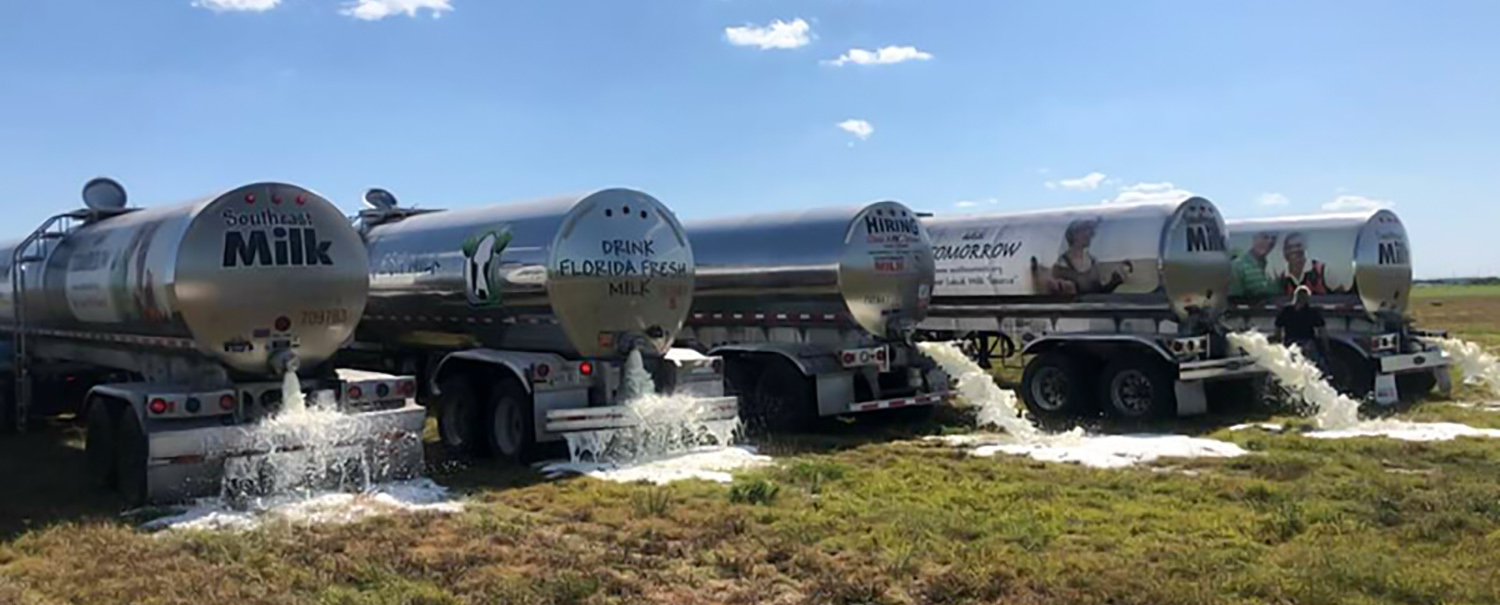
USDA Dairy Market News said spot loads of milk were being discounted in June by as much as $11 below the already abysmal FMMO Class III price in the Midwest. The milk dumping that reportedly began in May in Minnesota moved into Wisconsin through June and into July. The July 5th Milwaukee Journal Sentinel reported “Truckloads of fresh farm milk have been flushed down the drain into Milwaukee’s sewer system recently as dairy plants, filled to the brim, couldn’t accept more.” The story notes this had gone on for weeks, and the amount has declined to 5 trailer loads per week by the time The Milwaukee Journal Sentinel published its report.

For the price and milk dumping fallout, economists and analysts blamed the higher milk production (though it was modest on a national basis but huge in the Central U.S.). They blamed the higher cheddar cheese production (not accompanied by higher inventory), and they blamed the lower volume of exports (modestly below year ago on a year-to-date solids basis). 

Globally, milk production was up (it is declining this fall), they said, suggesting U.S. prices needed to get below the falling global prices in order to recover more export volume (instead of dumping in the sewer). Well, they got what they wanted as the U.S. prices dropped like a rock through June until the turnaround on July 17.

Of course, no one (but Farmshine) mentioned the rising imports that were reported in Part One of this series.

Looking for context on the imports, we reached out to retired cooperative executive Calvin Covington, who follows these things on a total solids basis and has been watching the whey market as a leading milk market indicator. We learned that his calculations on a total solids basis, pegged January through April 2023 imports of dairy products into the U.S. at levels 15% higher than a year ago!

“The 15% equals 39.3 million lbs. more solids,” Covington wrote in an email response to a Farmshine question. “Most of the imports are coming from Europe. Dairy demand is very weak in Europe, consumers have less money to spend. Those milk solids are moving out of Europe.”

Noted Covington in June: “On a total solids basis, ending dairy stocks as of April 30th are 3% higher than last April. The 3% equals 61.5 million lbs. more solids.”

This means the 15% increase in January through April dairy product imports — on a total solids basis — were equal to more than half (63%) of the 3% increase that was reported in April domestic ending stocks of all dairy product inventories on a total solids basis.

Think about that for a minute. Product came in and was inventoried while domestic milk was dumped, and producer prices were crushed so that the domestic price could fall below the global price so then the U.S. dairy exports could increase? It makes the head spin.

Class I sales were down during this time, especially in the Midwest where some fluid plants have closed. Fresh Italian cheese production was down, and that’s a big one for Wisconsin. Together these factors pushed more milk to make more American cheese at that time, some of it delivered to consumers in smaller packages (rationing). 

A wrinkle in the market-fabric comes from the dairy foods complex importing higher volumes, and there are the fake bioengineered microorganisms from which excrement is harvested and described as ‘dairy casein or whey protein without the cow.’ These analogs are being heavily marketed to large food manufacturers making dairy and bakery products as carbon-footprint-lowering dairy protein ‘extenders.’

So much so, that National Milk Producers Federation recently sent a letter to FDA asking the agency not to make the same mistake with these fake products as has been made with plant-based frauds.

However, as we look at the modest milk production increase for the first half of 2023, overall, and compare it to 2022, the total comparison was flattish then and it is declining now as we move toward Q3.

But there’s another major twist to this supply-demand equation:

The location and purpose of dairy expansion is undergoing accelerated transformation on a geographic and structural basis. This transformation is part of the “U.S. Dairy transformation” that the national dairy checkoff has promoted in its Pathways to Net Zero Initiative… and it is affecting the milk pricing for all U.S. dairy farmers, everywhere.

Here’s the problem: Milk production in the Central U.S. has expanded by much more than the national average. 

Even University of Wisconsin economics professor emeritus Bob Cropp noted in his writing after the May report that growth in the Midwest — where cheese rules the milk check — was outpacing processing capacity, and the existing capacity to process all this milk was being reduced by labor and transportation challenges.

The concentrated expansion of milk production in the Central U.S. has been accelerating since 2018, but a new paradigm is now in effect: New concrete is being poured in the targeted growth areas driven more by manure, than by milk, and new dairy processing plant construction that is completed and in the works is targeting the same areas.

This is creating a production bubble that is a flood within calmer seas.

Some are calling it the California RNG gold-rush as developers construct Renewable Natural Gas (RNG) projects — especially on new large dairies — for the California RNG market and to collect the low-carbon-fuel credits for the California exchange and other exchanges that are and will be emerging, thanks to the USDA Climate Smart wheel-of-fortune.

We’ve heard the national dairy checkoff managers from DMI talk about profitable sustainability, markets for manure, promotion of other revenue streams for dairy farms as part of the mantra the checkoff has assumed for itself as speaker for all-things-dairy for all-dairy-farmers on what is “sustainable” for the industry.

When the Net-Zero Initiative was launched — along with DMI’s industry transformation plan — it was something that had been in the works since 2008 and emerged more prominently in the 2017-21 period when the former and current U.S. Ag Secretary Tom Vilsack did his stint as top-paid DMI executive, presiding over the U.S. Dairy Export Center (USDEC) under DMI’s umbrella and as a top-talker on the Innovation Center for U.S. Dairy, also under DMI’s umbrella. 

All three: DMI, USDEC, and Innovation Center for U.S. Dairy are 501c6 non-profit organizations contracted to spend checkoff dollars. A 501c6 is essentially a non-profit that can lobby policymakers, whereas the 501c3 National Dairy Board cannot.

In 2020 and 2021, the Innovation Center — filing tax returns under the name Dairy Center for Strategic Innovation and Collaboration Inc. — doubled its revenue from around $100 to $150 million annually to $300 to $350 million.

We all heard it, read it, thought about it – maybe – that the checkoff was morphing into a facilitator for the transformation of the dairy industry led by manure-promotion, not necessarily milk promotion, with the mantra of feeding the world, being top-dog internationally, and meeting international climate targets with a Net Zero greenhouse gas pledge. (That pledge and the methane calculation are another story Farmshine readers are aware of, but we’ll leave that big driver off the table for this discussion.)

Here we are, now seeing an industry being created from within the broader dairy industry with new production driven by manure, in regions where new or expanding cheese, whey and ingredient plants are being located and potentially displacing production from plants and farms elsewhere that are not tied-into this manure-to-methane wheel-of-fortune using dubious science and math to overpeg a cow’s global warming impact.

While that production bubble is building in targeted growth regions with cheese-heavy milk checks, driven in part by manure-focused expansion, it bursted at the seams this summer due to a processing capacity bottleneck, compounded by supply chain disruptions and a sudden decrease in the production of fresh cheese at other plants and a sudden 18% decline in the amount of milk processed for Class I fluid use in the Upper Midwest.

Here’s the sticky wicket. A review of the 2022 end-of-year milk production report along with reports issued in the first half of 2023, revealed that, indeed, the Central U.S. was “awash in milk.” 

Zooming in on the milk production reports, we see South Dakota continuing its fast and uninterrupted growth — up 15.5% for 2022 vs. 2021, and up 7.4% Jan-May 2023 vs. 2022 — having leapfrogged Vermont, Oregon and Kansas and closing in on Indiana in the state rankings. 

Neighboring Iowa leapfrogged Ohio in 2022 with a 4.7% gain in milk production Jan-May 2023 vs. 2022. Number 7 Minnesota grew again after taking a breather with a 0.6% decline in 2022, then increasing 2% in production Jan-May 2023. 

The tristate I-29 corridor, where cheese processing capacity has been expanding, was up 3.3% in milk production collectively with 19,000 more cows Jan-May 2023. Add to this the 1.3% increase in number 2 Wisconsin’s May milk production, and we saw the quad-state’s collective increase was 203 million pounds of additional milk in the region vs. year ago in May, although Wisconsin’s contribution came from 3000 fewer cows, according to USDA.

Just west in number 3 Idaho, production jumped 3.1% with 7,000 more cows Jan-May 2023.

To the east in the Michigan-Indiana-Ohio tri-state region — where the large new cheese plant in St. John’s, Michigan is fully operational — collective milk output was up 2% over year ago with 11,000 more cows. In 2022, this tri-state region was down 2 to 3% for the year compared with 2021.

Number 5 New York made 2.1% more milk with 7,000 more cows in May vs. year ago, with most of this expansion in the western lake region. 

Number 1 California shrank milk production by 0.7% in May with 2000 fewer cows, and number 4 Texas flattened out its multi-year accelerated growth curve to make just 0.8% more milk in May than a year ago with just 1000 more cows, largely affected by the devastating Texas barn April fire resulting in the loss of around 20,000 cows. 

Neighboring New Mexico continued its multi-year downward slide, ranked number 9 behind a flat-to-slightly-lower milk output in number 8, Pennsylvania. 

Milk production in New Mexico fell 3.8% in May vs. year ago with 10,000 fewer cows. This followed an 8.4% decline in milk production and a 30,000-head cut in cow numbers for the year in 2022. Producers there cite well-access limitations, severe drought, high feed costs with reduced feed availability, as well as receiving the rock-bottom milk price as the reasons dairies in New Mexico are closing or relocating. 

With all of these factors in play, the production reports show a clear paradigm shift in how the dairy industry expands via transformation. It is being driven to where feed is available and milk output per cow is higher, and it’s now being driven by a non-milk-related factor: MANURE for the RNG ‘goldrush’

A saving grace is cattle are in short supply, with replacements bringing high prices. This fact is slowing the bubble, production is declining now, and prices are recovering from those unanticipated lows.

-30-
U.S. milk production falls 1% in May, FMMOs pool 13% less milk

OtherUsePooledMilk_Table_I(withMay2020) (1)

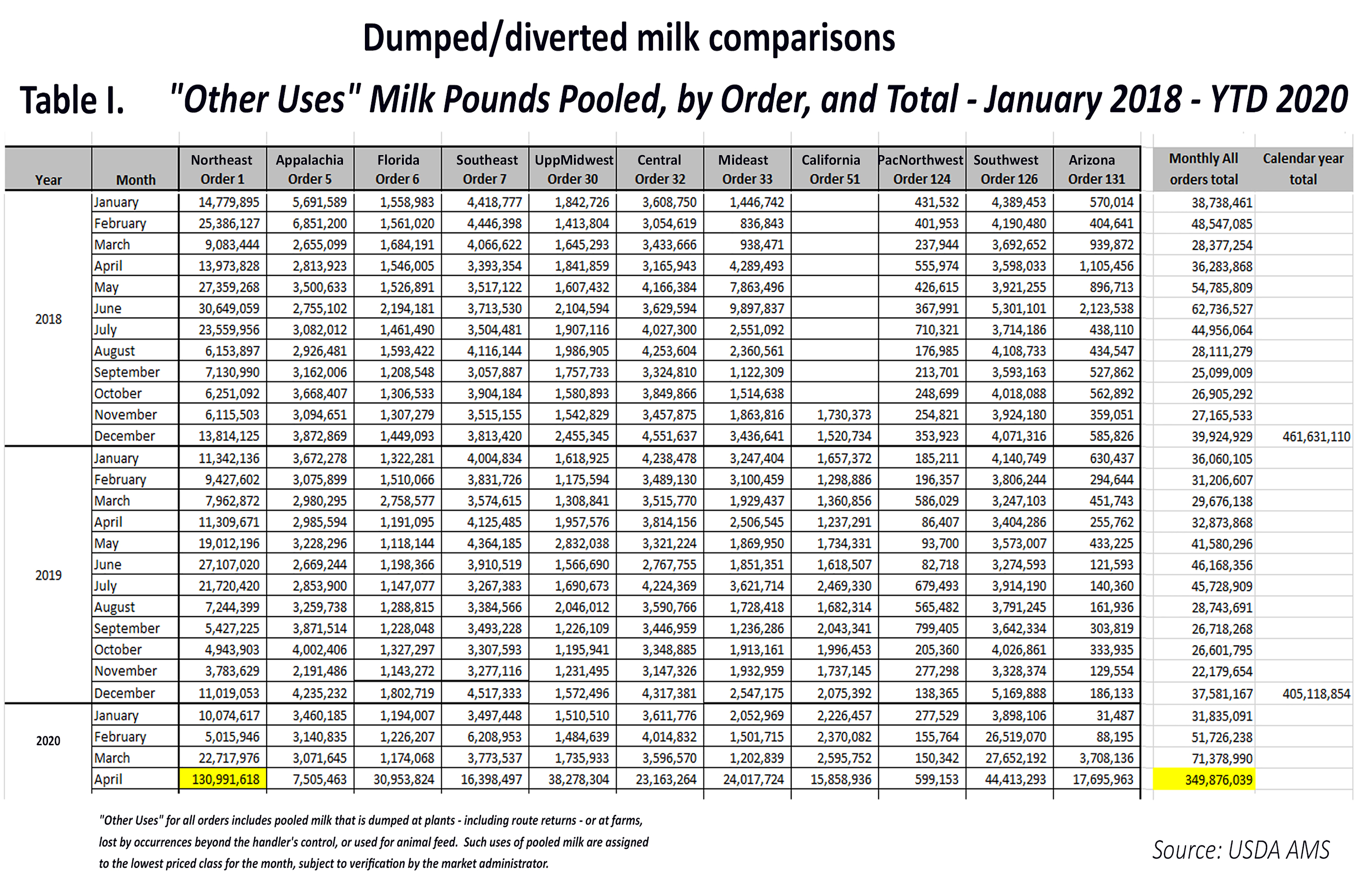
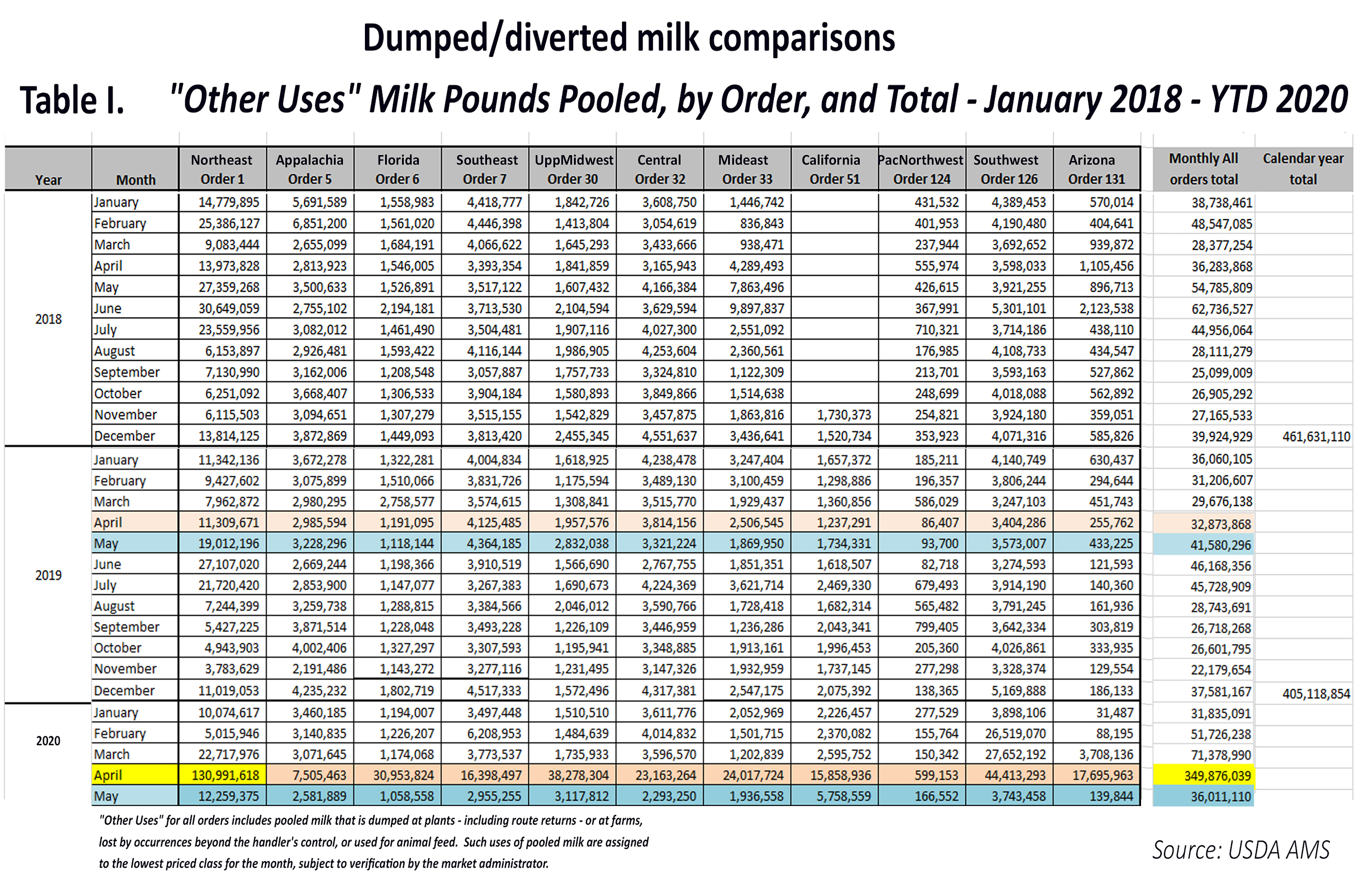
Table 1 showing “other use / milk dumpage” totals by Federal Order includes data for May 2020. The month of May saw 13% less milk pooled on Federal Orders compared with a year ago, and 13% less milk in the “other use / dumpage” category compared with a year ago — down dramatically from the enormous 350 million pounds of “other use” milk pooled in April 2020.

States east of Mississippi cut production, west mainly grow

By Sherry Bunting, Farmshine, June 26, 2020

WASHINGTON, D.C. — As April’s dismal Covid-impacted dairy market spilled into May milk checks, the supply-side of the ship turned in May at the same time as demand was strengthened by dairy donations, retail demand and food-service re-stocking.

USDA Dairy Market News reports each week have signaled progressively tighter milk supplies heading into summer vs. stable to strong demand pushing spot loads to sell above class price in some areas.

In April, cooperatives across the country set base limits on member milk production for May until further notice. Some severely discounted any milk provided that was above 80 to 90% of a member farm’s March marketings. Many producers chose to leave this penalty milk out of the tank.

As these co-op ‘base’ programs went into effect in May, the impact is demonstrated in the USDA May Milk Production report, estimating  U.S. output at 18.8 billion pounds, which is 1.1% below year ago for May.

Cow numbers were down 11,000 compared with April, according to USDA, but still 37,000 more milk cows were estimated on farms compared with a year ago.

Nationally, milk output per cow dropped by one pound/cow/day in May compared with a year ago, the report stated.

In addition, Federal Order milk pooling totals and “other use / dumpage” data provided to Farmshine by USDA AMS by request, showed the total volume of milk pooled across all Federal Orders in May dropped like a rock to levels 13% below year ago.

Similarly, the volume pooled as “other use / dumpage” across all Federal Orders fell to levels 13% below year ago nationwide — from the enormous 350 million pounds recorded in April to 36 million pounds in May. (See Table 1.)

What is eyebrow-raising is how the numbers in these reports geographically arrange themselves.

In last Thursday’s Monthly Milk Production Report, the national drop in total output for May masks the fact that among the 24 top milk producing states listed individually in the report, those east of the Mississippi accounted for all of the production decline – plus balancing the accelerated western growth to get the U.S. total a significant 1% below year ago.

States east of the Mississippi saw large decreases in production, while in contrast, the growth states of Texas, Colorado, Idaho, Kansas, Arizona, South Dakota saw increases in production ranging from 1.4 to 9.7% above year ago.

East of the Mississippi, the Northeast milkshed really clamped down on production with Pennsylvania 3% below year ago, New York down 3.7%, and Vermont down 6.4% vs. year ago in May.

Further south, Virginia and Florida were unchanged from a year ago, while Georgia’s production fell 1.4%.

In the Mideast and Midwest, Michigan was off a fraction (0.4%), Minnesota down 1.9% and Wisconsin’s production fell by 3.1% vs. year ago. Indiana, Illinois and Iowa were down 1.7 to 2%. Ohio was the outlier, gaining 0.4% in production over year ago.

In the West, May production was larger than a year ago with South Dakota leading on a percentage basis producing a whopping 9.7% more milk compared with a year ago. Number five Texas grew by 1.9%. Number three Idaho grew by 4.6%, and Colorado grew by 4.8%. Arizona grew by 1.4%, and Kansas by 2.4%.

Three western states were key outliers as California dropped production 1.5% below year ago, Utah was down 3%, and New Mexico fell a whopping 7.2% below year ago. The Pacific Northwest had generally steady production with Oregon unchanged from a year ago and Washington down fractionally.

In Federal Order pooling, the volume pooled nationwide was down a whopping 13% from 15.1 billion pounds in May of 2019 to 13.2 billion pounds this May of 2020.

In the Northeast, total pooled pounds on Federal Order One for April and May of 2020 were essentially equal at 2.3 billion pounds each, but relative to year ago, this was a decline of 1.7% while production on farms in the region fell a whopping 4%, collectively. The difference likely came from elsewhere.

Meanwhile, the amount pooled as “other use / dumpage” in the Northeast Order One dropped abruptly from the enormous 131 million pounds in April to 12.3 million pounds in May, representing a 35% drop in “other use / dumpage” compared with a year ago.

Pooled milk classified as “other use / dumpage” in the Appalachian, Florida and Southeast Orders 5, 6 and 7, also dropped significantly in May compared with April’s large records. In fact “other use” milk in those three Orders fell to levels that were 19% (Appalachian), 9% (Florida) and 32% (Southeast) below year ago. At the same time, total pooled pounds for these three Orders – 5, 6 and 7 – were calculate below year ago in May by 1% in Order 5 (Appalachian), 2.5% less in Order 6 (Florida) and a significant drop of 11.7% less milk pooled compared with a year ago in Order 7 (Southeast).

In a sense, the pull back in production in the Northeast, Mid-Atlantic and Southeast regions, where April’s dumping had been so extreme, helped bring down total pooled pounds in those areas to rein-in the “other use” pounds as well.

Growth areas of the nation showed significantly less “other use / dumpage” pounds in May vs. April. However, in some of the Orders, such as the Southwest (Order 126) and Upper Midwest (Order 30), the “other use / dumpage” category was still above year ago levels by a modest margin, according to the USDA AMS figures.

As the dairy industry right-sizes itself after COVID-19 supply-disruptions that abruptly cut 30 to 40% from producer milk checks, it remains to be seen how states east of the Mississippi can regain their footing as western growth areas kept shipping more milk right on through — without missing a beat.

-30-

Northeast bore brunt of huge milk dumping in April

USDA data: 350 million pounds dumped, diverted nationwide. Over one-third of it pooled on Northeast Federal Order. May data show improvement

DumpedMilk_Table_I (1)

By Sherry Bunting, Farmshine, June 19, 2020

BROWNSTOWN, Pa. – The picture for May has improved as “other use” milk totals pooled across all Federal Orders came back in line, and total “all use” pooled volume also receded.

But… Remember April? The figures are in, and they are ugly.

April was the month where the COVID-19 shutdown was at its height. Everyone was bracing to flatten the curve. Retail dairy case shelves were often empty or sparse, and many stores had two-item limits on milk, butter, even cheese, yogurt and sour cream.

The milk dumping that had begun during the last weekend of March ramped up in April. By the time final milk checks were received for April milk, producers were dismayed to find big deductions, almost $2 per hundredweight in some cases, as COVID-19 line items on top of additional marketing adjustments, reduced quality premiums, and the like. Of course, hauling was also a bigger deduction, some being told they were charged destination hauling on dumped milk that never left the farm! This, despite the fact that fuel prices fell like milk due in part to COVID.

What do the USDA data tell us?

According to “other use” milk pooling data supplied by USDA AMS Dairy Programs by request, milk pounds pooled at minimum class as “other use, milk dumpage and animal feed” for all Federal Orders totaled almost 350 million pounds in April (349.9 million pounds to be exact). That was 2.57% of the total pounds of milk pooled across all Federal Orders in April, according to USDA AMS data, and it was 1.8% of total U.S. April milk production (pooled or unpooled) as reported by USDA in its Monthly Milk Production Report.

Year-to-date milk dumpage and diversion by Federal Order and total combined — as well as for 2018 and 2019 — are shown graphically in Table 1.

While March saw the milk volume classified as “other use” grow by 142% compared with year ago at 71.3 million pounds. The volume of diverted milk in this “other use” category for April 2020 was absolutely enormous at 349.9 million pounds – up 960% from a year ago.

In fact, the Northeast Milk Marketing Area, Federal Order One, as usual, was dumping-zone-central as more than one-third (37.4%) of all the milk pooled as “other use” in the U.S. showed up in the Northeast pool as minimum class “other use.”

In other words, 37.4% of diverted milk in the entire U.S. was dumped on farms or at plants or otherwise diverted as “other use” including animal feed in the Northeast Milk Marketing Area.

The Northeast Order pooled 131 million pounds of “other use” milk in April – up more than 1000% from the 11.3 million pounds of “other use” milk in April 2019 and the 13.6 million pounds in April 2018. Table 1 shows this enormous amount dwarfing other months, other years and other Orders quite plainly as highlighted in yellow.

This means that the Northeast Order pooled 4.4 million pounds, or 80 loads, of dumped or diverted milk every single day for 30 days in April.

The second largest pooling of “other use” milk was the Southwest Order 126 at 44.4 million pounds, up 1200 percent from 3.4 million pounds a year ago (April 2019) and 3.6 million pounds in April of 2018.

Third largest was the Upper Midwest Order 30, with 38.3 million pounds of “other use” milk pooled, up 1855% from the 1.95 million pounds a year ago (April 2019) and 1.84 million pounds in April of 2018.

Fourth largest was the Florida Order 6, with 31 million pounds of “other use” milk pooled, up 1520% compared with 1.2 million pounds a year ago (April 2019) and 1.5 million pounds in April of 2018.

The Mideast Order 33 came in fifth with 24 million pounds of “other use” milk pooled, up 860% from 2.5 million pounds a year ago (April 2019) and up 460% from the 4.28 million pounds in April of 2018.

USDA AMS confirms that milk purchased by USDA for feeding programs, including the extra Section 32 purchases and new Farmers to Families Food Box milk purchases are included in receipts and utilization as the class of product purchased. This means when fluid milk is purchased with these government funds and then donated to families in need, the fluid milk is to be reported as Class I.

This is also true of milk purchases by businesses, individuals and fundraisers that then use these purchases as donations to families in need or the public at large. These sales also contribute to Class I utilization.

However, when milk destined for dumping or over-base milk kept aside is processed and packaged and donated outside of these marketing channels, it can be considered “other use”.

The equally disappointing news in April was that despite the fact that retail sales data show packaged milk sales to be running about 5% ahead of year ago for April and May, the USDA Class I utilization total for April across all Federal Orders was fell by 9.7% in April compared with March to 3.6 million pounds compared with 4.0 million pounds of milk utilized as Class I in March across all Federal Order pool data. This is down 3.3% from Class I utilization pounds, nationwide, a year ago.

As noted, the milk dumping situation in May improved compared with March and April as “other use” milk totals pooled across all Federal Orders came back in line, and were actually down 13% from a year ago at 36 million pounds – roughly 10% of what was discarded the month prior in April. Total “all use” pooled volume also receded as cooperative base programs kicked in. Government purchases for the CFAP Farmers to Families Food Box Program also began pulling milk the second half of May and will continue through June.

However, keep in mind, the cooperative base programs do cause some milk dumping of non-pooled pounds on farms that choose to only ship what they are paid a price for. Some are feeding cows and other livestock with extra milk. Others are finding local processors to bottle it so they can do community whole milk donations. Some may even be fertilizing fields with extra milk.

It isn’t easy for many to cut by 10 to 20% from March production in May – as many have been asked to do to avoid salvage value and stiff penalties for the “extra”.

Seasonal style dairies especially have their work cut out for them, and it appears the true seasonal dairies with little or no milk production in the first quarter of the year won’t be eligible for CFAP payments as 6 months of payment calculations are being based on production for the first 3 months of the year.

To be continued in next week’s Farmshine with May data on total pooled pounds, Class utilization trends, “other use” data, and other information for the month as well as year-to-date for all FMMOs and individually.

-30-

Regional milk and dairy food security in jeopardy

Widespread milk dumping continues, small regional co-ops face extinction

MilkTruck

Enter a caption

By Sherry Bunting, Farmshine, April 10, 2020

BROWNSTOWN, Pa. — As the dairy supply chain disruptions worsened this third week of COVID-19 pandemic stay-home orders in most states, large milk cooperatives continued rotating their milk dumping between members. For example, Dairy Farmers of America (DFA) — the nation’s largest cooperative — reports 12 to 15% less milk is needed under current conditions and wants to see the supply of milk they handle drop by 10% in the next several months to match the reduced demand for milk as processing and distribution capabilities have made seismic shifts amid the COVID-19 pandemic.

In this situation, small milk cooperatives and independent producers are finding themselves particularly vulnerable as a flurry of contract terminations fill voicemail and email, not to mention social media timelines.

This, from a family in Corry, Pennsylvania on their facebook page Monday (April 6): “Today we got it. The thing you know is possible but you just do not think it will be you. Not your farm. After all you have survived things for generations, it just cannot be you. But today it was.Today we got our letter, Rothenbühler Cheese Chalet canceled our contract. Today it all crashed down. Hope disappeared, and all our dreams vanished. We will be dumping our milk until we can figure it out how for 200-plus cows in the middle of a pandemic. No auctions, no sale barns, no options. It is heartbreaking to watch generations of work and dedication become meaningless. Wasted.”

The next day came the update that their 27-member cooperative in Northwest Pennsylvania has a few weeks to solve an abrupt concern, after previously being given three hours on a Friday afternoon — paperwork details that aren’t technically part of their milk contract that became effective March 1 with the Middlefield, Ohio cheese plant.

Farmers Union Milk Producers Association, based in Stoneboro, Pennsylvania, learned Tuesday (April 7) they have a few more weeks to address this paperwork request that had resulted in a contract termination email Friday (April 3) at 5:00 p.m. The cooperative has had a decades-long relationship with the Middlefield, Ohio cheese plant, but learned Friday at 2:00 p.m. that certain paperwork not detailed in their contract was required by 5 p.m.  that day to avoid termination.

“That’s three hours and not possible,” notes Lisa Royek. Her husband Walter is the current president of the cooperative.

Over the weekend, the co-op board went to work, received some legal advice, and asked the company for an opportunity to discuss the situation. Eventually, the company agreed to give Farmers Union until April 17 to meet this new request.

Even though it’s not in their current contract — signed last December and effective March 1 — Royek notes that, “We value this relationship and want to act in good faith in the hopes that the cheese plant will do the same.”

Despite this two week reprieve, some of the co-op’s members expressed concern Wednesday about milk sampling irregularities — leaving a few in jeopardy of their milk being excluded from pickup this week — and there were other questions about whether milk would be received from some of the member farms once it got to the plant.

But Farmers Union co-op is moving forward, doing what needs to be done, hoping to save their milk market with the plant they’ve done business with for as long as Royek can remember.

For producers in other small co-ops of northwest Pennsylvania and southwest and central New York, similar hurdles are being met.

Members of one small cooperative reported Wednesday that the cheese plant in Friendship, New York will no longer need their milk, indicating that Walmart had canceled orders.

While New York shippers for the Dean Foods bottling plant in Sharpsville, Pennsylvania often have their milk sent to the Friendship, N.Y. cheese plant, it is unclear whether a similar distribution status exists for the Middlefield, Ohio cheese plant in the Farmers Union cooperative situation.

The Dean Foods Sharpsville, Pa. bottling plant is one of 44 plants — nationwide — being purchased by DFA. Dean Foods receives a large share of its milk from DFA and this market accounts for a large share of the milk DFA ships. The 44-plant sale was approved by the court on Friday (April 3), pending final details before transition of assets after another hearing set for April 27.

Members of small co-ops shipping to the Middlefield, Ohio or Friendship, New York cheese plants were contacted for this report and did not know if their milk had ever been used to supply the Dean plant in Sharpsville or if these cheese plants ever supplied Class I markets in the Mideast Milk Marketing Order. Just the same, we called the plants and the Mideast Market Administrator to find out the pool status of these plants, and any recourse these producers might have. Our calls were not returned by either the plants or the Mideast Market Administrator.

Producers who are part of the small co-op cut off by the Saputo-owned Friendship, N.Y. plant, said the reason they were given was cancellation of orders by Walmart, Dollar General and others. Their members began dumping milk Wednesday (April 8) because there was no where for the milk to go.

IMG-3717

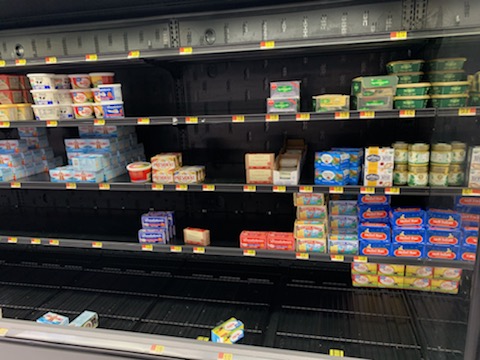
Just one of many photos submitted April 8-11 showing a continued shortage of real butter at Walmart stores in Pennsylvania, New York and Ohio, except for small quantities of unsalted or “lite”, and plenty of imitations and margarine.

On the very same day, no less than 20 texts, emails, and messages came in from people throughout Pennsylvania, New York and Ohio reporting that their Walmart stores were low on milk and had zero butter, sour cream or shredded cheese. Walmart and Sam’s Club shoppers also reported being limited to one or two gallons of milk with limits on other dairy products as well. (These reports persisted with documentation of empty Walmart butter shelves and limited or absent sour cream and shredded cheese, along with either no milk or very little milk, especially whole milk at Walmarts in Pennsylvania, New York and Ohio as recently as April 8-11.)

It is unclear what role Walmart’s Midwest supply chain via Prairie Farms, Great Lakes and Foremost — play in the Mideast Milk Marketing Order supply chain disruptions that are leaving small regional co-ops facing complete termination while at the same time the Walmart stores in the region show a stark lack of dairy products and depleted milk supplies for shoppers.

Walmart_PA_April_7

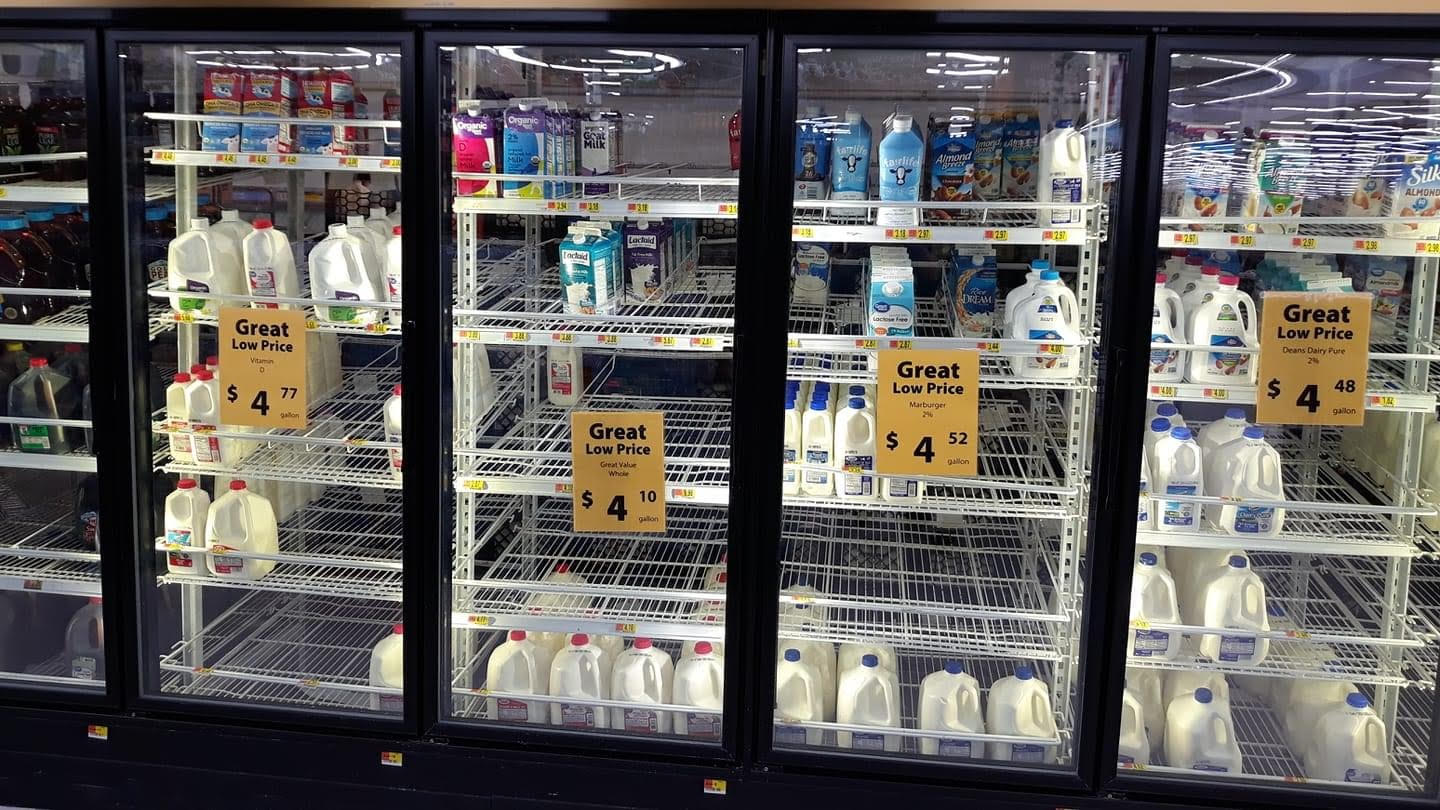
Walmart stores throughout the region, like this one in Kittanning, Pennsylvania on April 7, continue plowing through milk supplies rapidly. Meanwhile farms in the region continue to be forced to dump their milk or face the complete loss of their milk contracts. They are told it is because of a drop in dairy demand due to schools and restaurants closing and exports stalling. They are also told that retailers — like Walmart — are not increasing their orders, and are canceling some orders, despite the surge in consumer demand for real milk and dairy products.

The Dean Foods Sharpsville plant in western Pennsylvania is part of the USDA Mideast Milk Marketing Order that regulates Class I fluid milk in the western half of Pennsylvania, all of Ohio, all of Michigan, three-quarters of Indiana, most of West Virginia, and the northernmost part of Kentucky.

Pennsylvania also has a state-regulated milk marketing system. For the past three years, Walmart has been an approved ‘milk dealer/handler’ — not just a retailer in the Pennsylvania system, where the Milk Marketing Board (PMMB) sets minimum retail and wholesale prices for beverage milk that include an over-order premium intended by law for dairy farmers.

The state’s accounting system through PMMB only follows the over-order premium back to the farm level when the retail milk meets three specific criteria: produced, processed and sold in Pennsylvania. However, consumers pay this premium on all milk they buy in Pennsylvania — no matter what state it was produced in or processed, and no matter which side of the state border the wholesale warehouse transaction occurs.

These are all complicating factors of milk’s classified pricing system and large chunks of consolidating, centralized milk supply chain.

The Northeast Milk Marketing Order is having its share of problems also, and the Walmart stores in the Northeast are equally lacking in dairy products.

Reports surfaced this week from Central New York dairy producers that a small co-op downstate has been abruptly terminated by their milk processor in Menands, N.Y. until further notice.

In addition, Jefferson Bulk, a small upstate New York cooperative, had been able to market every drop of their milk since losing their contract with Kraft Cheese effective  January 1.

Jefferson Bulk’s marketing options in the region are now non-existent or very difficult to achieve amid the COVID-19 pandemic foodservice contract losses and as retailers — especially Walmart — are not providing enough milk, butter and other dairy products in their stores to keep up with surging consumer retail demand to feed their families at home.

As a national footprint cooperative with regional councils, the nation’s largest cooperative — DFA — answered questions last week about their assessment of the situation in the Northeast in comparison to the West in an email response to Farmshine Wednesday: “Like the coronavirus, this situation is not limited to one area of the country and is changing daily. At this time, we have requested that less than 10% of our members dispose of milk, as an absolute last resort. Primarily, disposal is happening in areas where a plant has reduced its schedule or has even shutdown, which forces us to try and quickly find a new home for our members’ milk.”

The explanation went on to say that, “There are times when there is no economical location to deliver milk, so in some regions, where there is no viable market for milk right now, we’ve had to ask some farms to dispose of raw milk, as a last resort.”

DFA also indicates that payments for the milk “will vary by region, as the marketing of milk is a very localized activity, DFA has provisions in place to compensate members for the milk that’s being disposed. Ultimately, an individual does not bear the cost of the disposal themselves, when they’re member of a cooperative, like DFA.”

Meanwhile, the widespread shortage of butter in supermarkets, especially Walmart stores, is going on three weeks now, so we turned to Land O’Lakes customer service for our inquiry due to the sheer number of consumer reports about these shortages of butter and limits on butter purchases.

Land O’Lakes is also a national footprint dairy cooperative with its famous butter brand and a significant butter/powder production plant in Carlisle, Pennsylvania.

Land O’Lakes has a base program that penalizes its farmer-members if they produce more than their base milk production amount. This program is being strictly enforced in the Northeast since early March. Some Land O’Lakes members in the Northeast also reported being forced to dump their milk last week. One farm was able to find another processor to take the milk strictly to make products for food banks.

By contrast, no base penalties have been reported by Land O’Lakes members in Minnesota, and dairy leaders in Minnesota report no milk has been dumped in their state, where Land O’Lakes is headquartered.

In fact, Farmshine could only verify one milk dumping occurrence west of the Mississippi in states where milk production has grown by leaps and bounds in recent years.

We asked Land O’Lakes customer service: Why are we seeing widespread butter shortages even though farmers are being penalized and forced to dump milk and even though USDA’s March 1 Cold Storage report pegged U.S. butter inventories to be 25% above year ago?

The answer we received in writing was this:

“We’re so sorry that you’re having difficulty finding our butter,” a Land O’Lakes customer service representative responded in a message. “Our whole co-op is working hard to make sure that your favorite products continue to be well-stocked, despite the business challenges posed by the COVID-19 outbreak. While our online product locator is helpful in finding stores that have recently sold our products, we know that supplies at the store shelf may vary over the next few weeks/months. We appreciate your patience and support during this trying time and wish the best to you and your family.”

-30-

92823124_1568862956610362_5176863088485335040_n

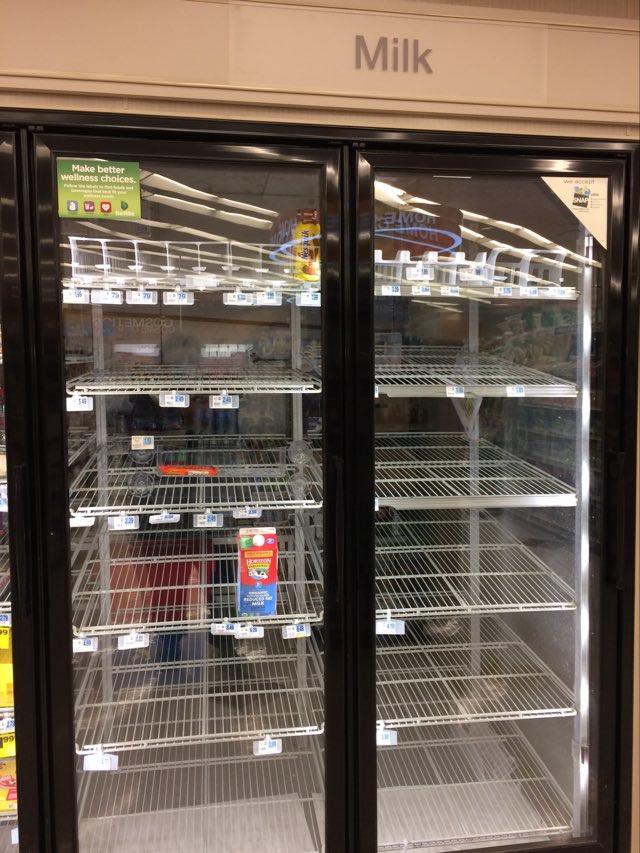
Dollar stores and pharmacies like this Rite Aid in Crawford County, Pa. April 10. Not only are dairy farms being forced to dump milk, small co-ops in the region face termination as milk suppliers.

Sudden impact. Dairy producers urged to document, communicate, re-evaluate, ‘manage what you control’

By Sherry Bunting

“It has been the suddenness of the impact. We’re going to have some losses, but our goal is to come out on the positive side at the other end of this. It’s going to take government, agribusiness, agri-lenders, and producers — all working together — to go through this situation,” said Dr. David Kohl, Virginia Tech professor emeritus, during a new PDPW Dairy Signal webcast Wednesday.

The Dairy Signal webcasts — insights for informed decisions — livestreamed Tuesday through Thursday Noon to 1:00 p.m. CDT and archived for viewing later. Check it out here.

What indicators is the world renown ag economics and finance expert watching?

  • Consumer sentiment index – Will it start coming back up toward fall? Will service industries — universities, sports complexes, etc. — begin coming back in the picture?
  • Value of the dollar – in relation to other countries.
  • Unemployment – How long it stays low, not how low it goes.
  • Weather in North and South America – input costs
  • Ethanol plants – Will oil price reduction war between Russia and Saudi Arabia drive them out? Energy resilience makes us strong.

He also urged producers to embrace these things:

  • Work together.
  • Keep detailed loss records.
  • Avoid knee-jerk reactions.
  • Use resources available to assist you.
  • Communicate with your lender.
  • Re-evaluate your goals: Where do you want to be in three years? What do you want your business to look like? How are current conditions changing what that might look like for you?
  • Manage what you control in business and in life — manage around the things you cannot control — tune out the noise.
  • Take time out and enjoy the simple things.

“Every producer should really get onto documenting everything. If you’re dumping milk, or your processor says we can’t handle the milk, you get those weights. You get those values. You document those losses,” said Kohl. “Having those good records is going to be very critical. Don’t let it slip through the cracks.”

According to PDPW executive director Shelly Mayer, who moderated the webcast, many questions came in on this topic of how to document milk dumped directly on the farm and not picked up by a handler.

Even though milk marketers have the responsibility for Federal Order measures and testing if the dumped milk is priced and pooled on the Order, measure and document your loss anyway. Even staff at USDA Dairy Programs told Farmshine recently that it is wise to measure and pull an agitated sample to do component and quality testing, especially when pulling the plug to dispose of the milk on your own farm without being picked up by a handler. If this wasn’t done for milk already dumped, be sure to record the next similar time frame of measurement, pull the next milk’s sample and get the previous milk’s data to come up with an average for your records.

“I like to err on more information being the better,” said Kohl. “Document everything that you can.”

In the PDPW webcast discussion, both Kohl and Jason Karszes, Cornell ag business management, agreed that getting a clear answer from the processor on what their “process” will be for documenting and covering dumped milk is a fair question to ask and expect an answer for. In the meantime, measure whatever you can measure about what you dumped, and get whatever records you can from the handler or processor so you can also document these losses.

This information will be important down the road so that lenders and producers and the agribusiness community — working together — can build the case for what is needed and be eligible for potential assistance at a later date, said Kohl.

“It is interesting as we go through this to see how we (as a people) are reacting and handling it,” Kohl observed, noting that the local creamery he is involved with in Virginia has seen the home-delivery waiting list quickly grow to 175. He also heard from a ‘cow-share’ producer that demand for his local un-processed milk has grown to where he could add 70 cows right now from new demand.

This observation about consumer behavior ties in with a more long-term webcast question:

“What will our world look like after we as a people walk through this?”

Speaking candidly, Kohl sees a move away from globalization to “selective globalization,” where we will see more industry move back into not just the U.S., but into North America, and where concentration and bigness will be challenged by consumers and politicians, bringing shock effects.

This is a good time for dairy operations to re-evaluate their goals, said Kohl. As producers make decisions about the future, he advised new considerations will be: assess consumer sentiment, available labor, management capacity, available milk market, and how these global-national-regional-local supply chain shifts might affect these factors.

-30-

Proposed Milk Crisis Plan would tie farm aid to production cuts, issue forgivable loans to processors, lift federal fat limits on school and WIC milk, funnel dairy inventory to needy

NMPF and IDFA jointly propose ‘Milk Crisis Plan’ for USDA. American Dairy Coalition and Minnesota Milk Producers have alternate proposal.

TankersDumpInSoutheast

This photo posted on facebook April 2 by Colleen Larson of south Florida was reposted many times by others across social media platforms this week — one of many examples from New York to Florida and Wisconsin and Texas — where dairy farmers were forced to dump significant amounts of milk as COVID-19 pandemic restrictions disrupt supply chains as the industry shifts from foodservice to retail packaged goods. Meanwhile, stores are not well stocked, some are choosing to limit purchases instead of increasing orders, and food banks are receiving more requests as over 15 million people are newly out of work. Against this backdrop of upheaval, a Milk Crisis Plans was proposed by National Milk Producers Federation and International Dairy Foods Association this week, and an alternate plan was also put forward by Minnesota Milk Producers and American Dairy Coalition.       Photo by Travis Larson

By Sherry Bunting, Farmshine, April 10, 2020

WASHINGTON, D.C. — In the face of potential dairy industry collapse in what many are calling a “mixed up supply chain” and “upside down market” due to the impact of the COVID-19 pandemic on every aspect of American life, the National Milk Producers Federation (NMPF) and International Dairy Foods Association (IDFA) came together to propose a “Milk Crisis Plan for USDA,” released Tuesday, April 7.

It is a top to bottom overhaul of dairy production, processing and government feeding programs, including a price program for producers to cut 10% of their production over the next six months as well as removing all restrictions from school lunch programs and the WIC program to allow consumer choice of milk, cheese, yogurt, etc. – including all fat percentages of milk!

Specifically, one element of the plan asks USDA to stop requiring 1% low-fat or fat-free milk for persons over two years of age in government feeding programs – including the WIC program and school meals (provided in or out of school) — even asking USDA to allow servings over 8 ounces per meal for schoolchildren. This means schools could offer whole milk (3.25% fat) and 2% milk at least for calendar year 2020, if the proposal is adopted by USDA.

These industry organizations representing dairy cooperatives and processors cite “collapse of the foodservice industry, export disruptions and massive economic insecurity” as the demand factors that are now colliding with a “seasonally rising milk supply creating a massive gap.”

Their proposal estimates milk supply exceeding demand by “at least 10% — a gap that could widen as supply increases to its seasonal peak and as ‘shelter in place’ conditions endure.”

The dairy industry is navigating a major upheaval as the supply chain tries to adjust to plunging foodservice and institutional sales at the same time that retail demand surges at grocery stores.

NMPF and IDFA state that this is leading to a lack of orders for finished goods, several processing plants cutting or stopping operations and in general leading to “cancelled milk orders.”

In addition to the significant and continuing dumping of milk in the U.S. — something that has also begun this week in Canada – reports are coming in about processors terminating or potentially terminating small co-op contracts; processors and cooperatives seeking voluntary supply reductions from their producers; and some even looking for ways to encourage producers to consider quitting dairy altogether.

Indicative of the collapsing dairy market is this projection in the NMPF-IDFA proposal stating that second quarter Class III futures averaged $13.14 Monday while Class IV were in the $11s. Using the Dairy Margin Coverage (DMC) formula, NMPF projects a milk margin over feed cost getting close to that $5 catastrophic margin, estimated at $5.80 for the second quarter of 2020 and $6.76 for the third quarter according to Monday’s futures prices for milk. The highest insurable DMC margin is $9.50.

The industry organizations also point out that, “There is financial stress across the supply chain, and with more than 10 million Americans already losing jobs, food banks are seeing significant increases in demand, a trend that will likely only intensify in the weeks ahead.”

The NMPF-IDFA proposal aggregates many different tools with the objectives of providing aid to dairy producers, easing financial liquidity risks across the supply chain, stabilizing the dairy commodity markets and filling food banks with dairy products and removing restrictions that would limit the availability of dairy products in USDA feeding programs.

As for the aid to dairy producers? NMPF-IDFA want to “tie producer aid to limits in their production.”

The NMPF-IDFA proposal regarding dairy producers asks USDA to “offset the steep decline in farm milk prices and encourage producers to reduce excess supply” which they say is the result of “demand disappearance.”

Specifically, the proposal seeks to pay producers $3 per hundredweight (extra) on 90% of their milk production IF they cut production by 10% below their March 2020 baseline over the next six months of April through September 2020. Payments during any of those months would be suspended if the average of Class III and IV prices in that month exceeds $16/cwt.

An alternate plan put forward by the Minnesota Milk Producers Association (MMPA) and supported by the American Dairy Coalition would provide aid to dairy farmers differently as a more immediate lump sum payment of $3 per hundredweight on 100% of each operation’s March 2020 baseline for three months (April-June), irrespective of market prices, and paid in April. MMPA’s Dairy CORE plan calls for reassess of conditions in June to see if another round is needed for the next three months (July-Sept). ADC and MMPA contend this approach would be more fair to all regions of the U.S., including seasonal grazing dairies.

American Dairy Coalition noted in a statement Wednesday that direct payments should not be conditioned on arbitrary, top-down, one-size-fits-all production cutbacks. The organization believes that if producers receive a needed large, one-time direct payment, milk handlers and processors would then be in a better position to implement their own marginal incentives to “right-size” their own milk supplies.

The NMPF-IDFA Milk Crisis Plan also calls for a Temporary Milk Disposal Reimbursement to compensate handlers for milk that must be disposed of because of supply chain disruptions resulting from the COVID-19 pandemic. This would provide coverage of milk at the USDA Class IV (or lowest value class) price for three months – April through June 2020.

NMPF and IDFA want USDA AMS Milk Marketing Orders to administer these programs through their audit functions.

Their proposal also seeks recourse loan programs to expand the availability of “working capital” for dairy processors. This proposed program would allow firms to carry heavier-than-normal inventories and reduce systemic financial risk associated with those heavy inventories they would carry. In addition to specialty cheese products that are often inventoried longer anyway for aging, the proposal wants this to apply to as many other products as possible, namely basic commodities.

Also in the proposal for processors is the request for forgivable loan programs similar to the ones for small (non-ag) businesses in the CARES program being administered currently through the Small Business Administration. To qualify, processors would have to continue to purchase milk from dairy producers and maintain their employee staffing.

The NMPF-IDFA proposal also requests the immediate purchase of substantial volumes of dairy products for feeding programs and the aforementioned end to mandates on low fat levels of milk in feeding programs.

In addition, the proposal asks USDA to allow producers to retroactively sign up for 2020 Dairy Margin Coverage (DMC) with no premium discount for the latecomers.

Other aspects of the proposal deal with how to “maximize the buying power of SNAP (food stamps) recipients” at a time when the nation face double-digit unemployment and reliance on SNAP is expected to increase. At the same time supporting that with continued purchasing of butter, cheese, fresh milk and powdered milk to the tune of $525.5 million.

-30-