Unknown's avatar

About Agmoos

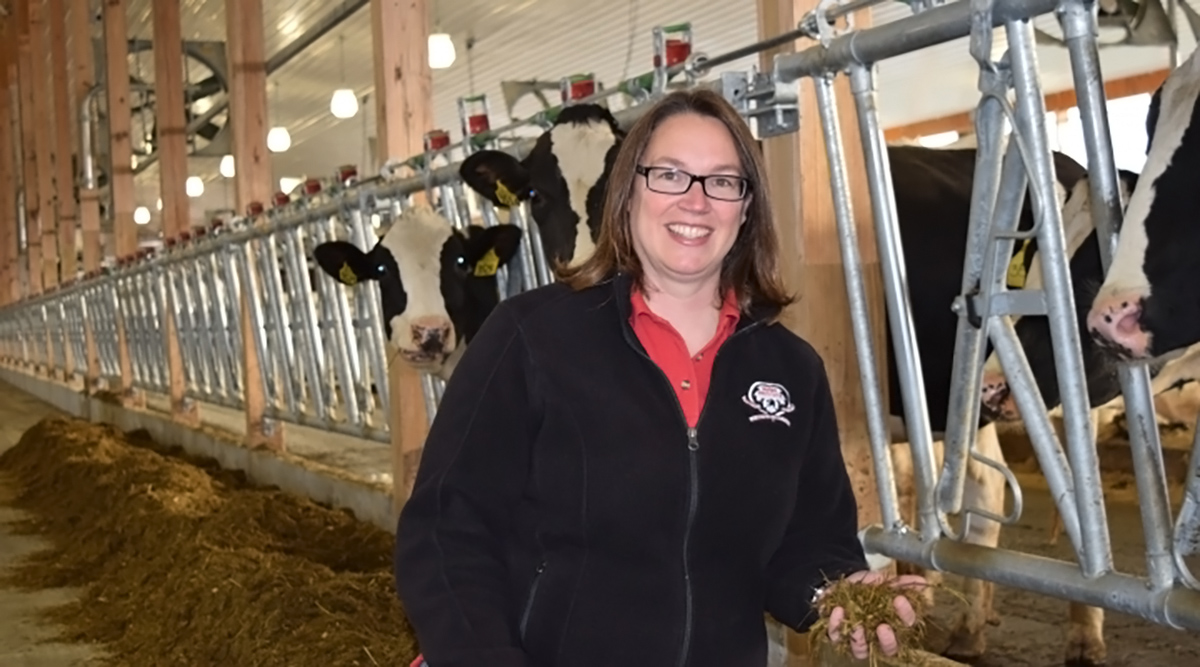
I am a journalist writing primarily about agriculture for various newspapers over the past 30 years...and before that, I milked cows and tended calves and heifers. I am also a mother and grandmother with three grown children: A teacher, restaurateur and homemaker. Our two sons and one daughter all like to cook and they are food conscious... not paranoid. My "foodographic" Agmoos blog is a place to find stories and photos of the people and places behind the food we eat and for commentary and analysis on food, farm and marketing issues facing producers and consumers.

Sen. Gillibrand calls for dairy farm payments, Senate hearings on pricing, investigation of corruption, antitrust concerns

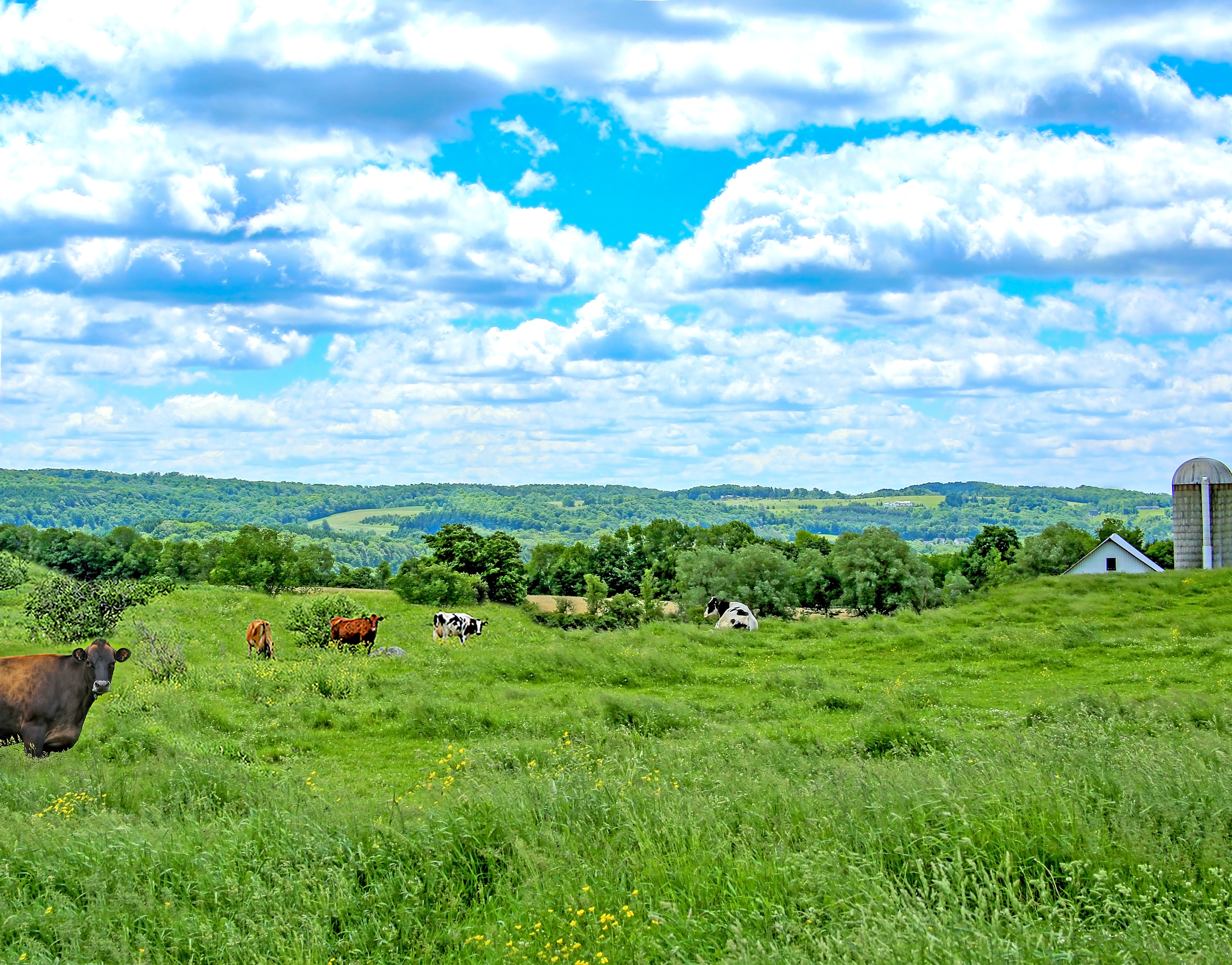
Summertime is pastoral on this central New York dairy farm, but U.S. Senator Kirsten Gillibrand (D-NY) says she is concerned about the state’s diverse dairies.

By Sherry Bunting, Farmshine, June 4, 2021

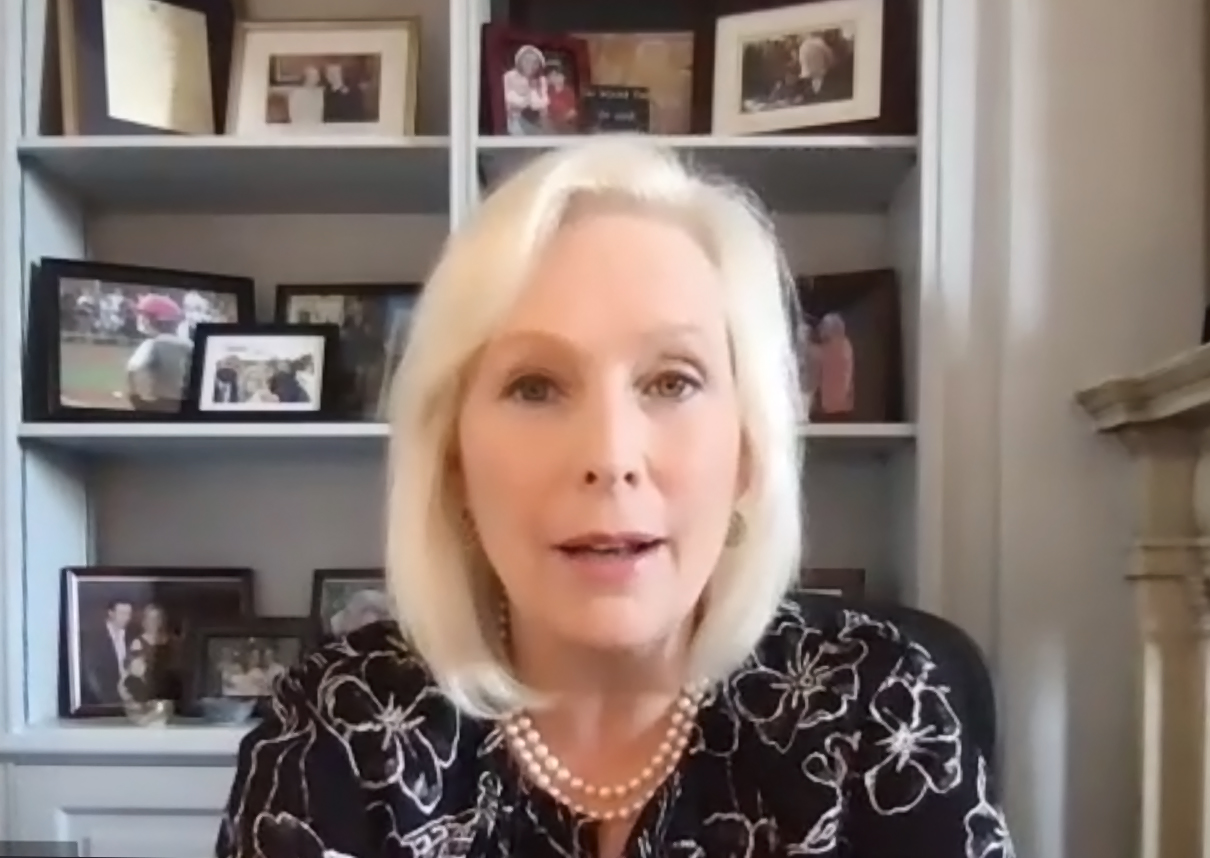
WASHINGTON, D.C. — Senator Kirsten Gillibrand (D-NY), chair of the Senate Agriculture Subcommittee on Dairy, Livestock and Poultry, told reporters last week that she is working on milk pricing legislation and wants to have dairy pricing hearings before the August congressional break. 

She also said she believes a thorough review and recommendations are needed regarding her concerns about corruption and antitrust activity in milk pricing.

After sending a bipartisan letter with 21 Senate co-signers to Agriculture Secretary Tom Vilsack, Sen. Gillibrand called a press conference by zoom on May 26 to cite dairy farm losses and push for use of existing funds to provide direct payments to dairy farmers for the first half of 2021, retroactive to Jan. 1.

“I’m working on legislation right now to change how we do dairy pricing in America, but ultimately we need something like a 9/11 style commission to actually investigate the industry. You’ve seen it in New York. We’ve had dairy farmers that have committed suicide. We’ve seen the dairy industry steadily decline over the last 20 years,” said Gillibrand, calling food production an issue of national security.

“We cannot lose the ability to feed our own people. If you have a market that’s fundamentally flawed and constantly are leaving producers unable to survive in the industry, there’s a problem. So I think we need a very thorough investigation of my concerns of corruption and antitrust activity,” she said.
Gillibrand told reporters that her office has “already asked to hold hearings. on dairy pricing to start the ball rolling on an investigation and have not been given permission yet from the larger committee,” she said, noting the Senate subcommittee she chairs would be appropriate to hold the hearings.

“I want to hear from producers, I want to hear from the middlemen, I want to hear from retailers. I want to figure out where this corruption lies, and then perhaps, based on the information we get, set up the commission, and I want it ready for the next farm bill,” Gillibrand explained. 

Right from the outset of the press conference, the Senator raised concerns about the Class I milk pricing change in the last farm bill that has had devastating effects in dairy farm income losses when hundreds of millions of dollars in collective Class I price devaluation occurred, contributing to de-pooling of milk, negative Producer Price Differentials (PPDs) and failure of  risk management tools amid the volatility of pandemic market disruptions.

Referencing the bipartisan letter from senators to Secretary Vilsack, Gillibrand said USDA has the funds available through the existing CFAP and Pandemic Assistance for Producers initiative to move right now to make direct payments to dairy farmers she said are necessary to help them recover.

“One of the few things that has helped dairy farmers offset some of their losses was the CFAP dairy payments,” she said. “This assistance was critical to farmers, but these payments were put on pause in January, when the administration announced it was doing a 60-day regulatory review. When the review was concluded, no further payments to dairy farmers were announced.”

Gillibrand noted that USDA announcements cite funding for purchases through the Dairy Donation Program within the new Pandemic Assistance for Producers, but USDA has failed to announce direct dairy farm payments in 2021.

“That’s why we sent the letter to Secretary Vilsack,” the senator said. “My colleagues and I outline the need for USDA to continue issuing payments to dairy farmers for the first six months of 2021 retroactive to January 1st.”

Senate Majority Leader Chuck Schumer (D-NY) also weighed in on dairy farm relief last week in a joint press release with Gillibrand. The two New York senators cited the importance the Empire State’s dairy farms and noted that U.S. dairy farmers collectively received a smaller and inequitable share of pandemic ag assistance payments to-date.

“For an industry that had razor thin margins before the pandemic, for some of our dairy farmers, receiving additional federal assistance is the difference between keeping their farms and losing their livelihoods,” Schumer said in a statement.

Asked how much money should be allocated for direct payments to dairy farmers, Gillibrand said it needs to be responsive to individual producers and their market conditions, to be flexible like the Paycheck Protection Program in being tailored to businesses that lost money during the pandemic.

“I’d like it to assess losses in any given market and what would make these dairy farmers whole. I’d like it to be nimble and specific,” she said. “The money’s there. This is in USDA’s hands, so we need to have a response from Secretary Vilsack.”

On dairy pricing, Senator Gillibrand was emphatic.

“Even before the pandemic, dairy farmers were struggling to receive a fair price for their milk,” she said, noting the change in the method of calculating the Class I mover “compounded this issue. That one change caused dairy farmers to lose out on $725 million in income since 2019.”

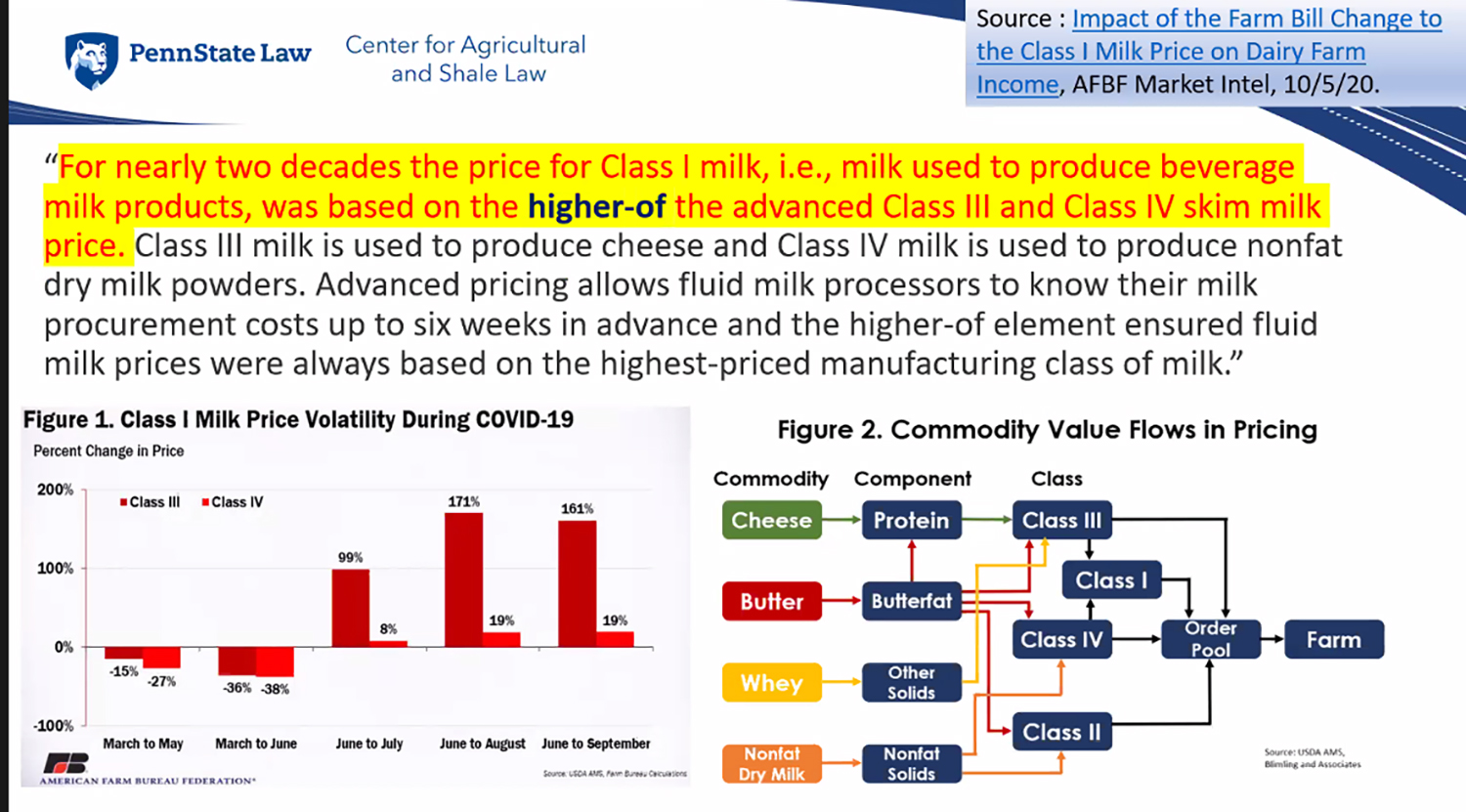
The 2018 Farm Bill changed the Class I price at the request of International Dairy Foods Association (IDFA) and National Milk Producers Federation (NMPF) to an averaging method plus 74 cents. This was implemented in May 2019. 

Previously, the Class I base price ‘mover’ was calculated using the ‘higher of’ Class III or IV prices.

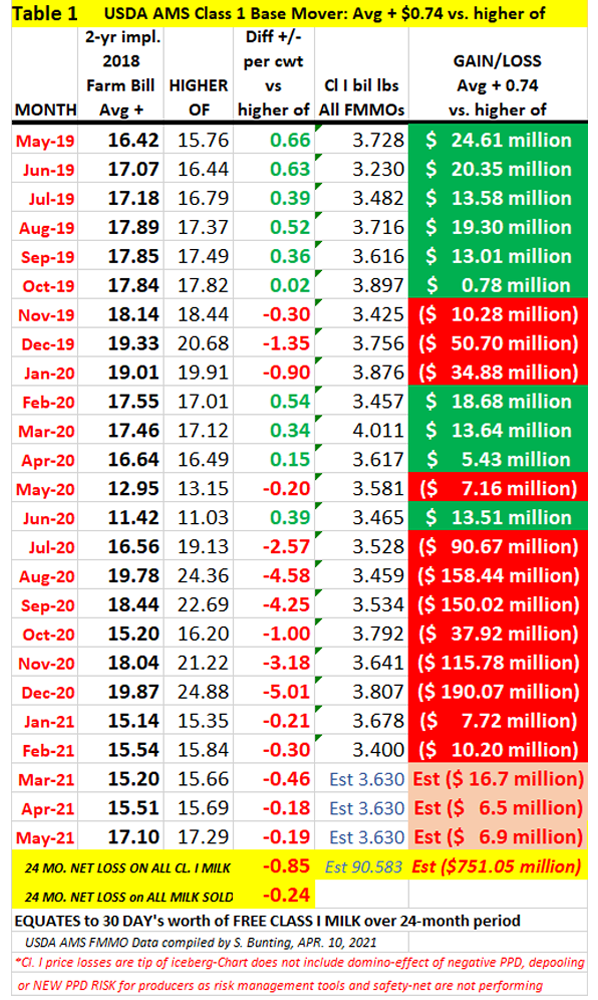
This Class I mover change not only resulted in net losses of now over $750 million from May 2019 through June 2021 but also contributed to negative PPDs across Federal Milk Marketing Orders for 17 of the past 24 months.

When government cheese purchases for food boxes and stop/start domestic and global economies during the pandemic created volatile shifts in demand, there were intervals of higher cheese and Class III milk prices that could have provided some much-needed milk-pricing relief for dairy farmers. 

However, as the averaging method devalued Class I in relation to Class III, milk handlers depooled massive volumes of milk — changing the blend price equation. While a few handlers may have passed some of that value on to their own producers, most did not.

As previously reported in Farmshine, American Dairy Coalition has been facilitating grassroots phone conference calls since early March on the Class I pricing, depooling and negative PPD issues to foster industry dialog on solutions. One idea that came from those grassroots discussions was to return, temporarily at least, to the higher-of method for calculating the Class I mover until a future path can be properly vetted by what is normally a lengthy USDA FMMO hearing process.

On April 12, after collecting signatures from hundreds of producers and state and national organizations, ADC sent a letter to NMPF and IDFA seeking a seat at the table for producers to seek solutions.

On April 23, NMPF floated its proposed solution to adjust the average-of ‘adjuster’ every two years and publicly announced its intentions to ask USDA for an expedited emergency FMMO hearing.

On April 27, four midwestern dairy groups — Edge Cooperative, Minnesota Milk Producers, Wisconsin Dairy Business Association and the Nebraska State Dairy Assiciation — put forward a Class III-plus proposal for calculating Class I and were joined by the South Dakota Dairy Producers in a May 19 request that USDA broaden the scope should there be an emergency FMMO hearing.

On April 26, Ag Secretary Tom Vilsack told reporters during a meeting of the North American Agriculture Journalists that the issue is “very complex,” and that “conversations need to mature before anybody makes a decision that there’s going to be a significant change.”

On May 5, Farm-First cooperative, based in Madison, Wisconsin, announced it would submit a proposal to revert to the higher-of method of Class I mover calculation if a USDA FMMO hearing is held.

On May 15, producers in the Southeast FMMOs began circulating a letter addressed to Secretary Vilsack seeking payments to dairy farmers that reflected inequitable losses in high Class I FMMOs.

On May 18, the letter from senators to Secretary Vilsack called for assistance in the form of direct payments to U.S. dairy farmers.

In the absence of action or response from USDA on relief or solutions at the time of the May 26 press conference, Sen. Gillibrand described a potential “two-part” Senate subcommittee hearing on dairy pricing, where experts could give testimony on all aspects of the problem.

The bipartisan letter from senators to Sec. Vilsack noted more than a decade of decline in dairy, multiple consecutive years of milk prices below cost of production and even mentioned competition from plant-based dairy alternatives labeled as ‘milk’.

“Our dairy farmers have really been hit hard for the last six years,” said Gillibrand, stressing the critical role dairy farmers play in the food supply chain, the economy, their communities and national security. 

“We really need answers now,” she said.

-30-
NY dairy farmer fights eminent domain as county moves to take best fields for cheese plant relocation, expansion

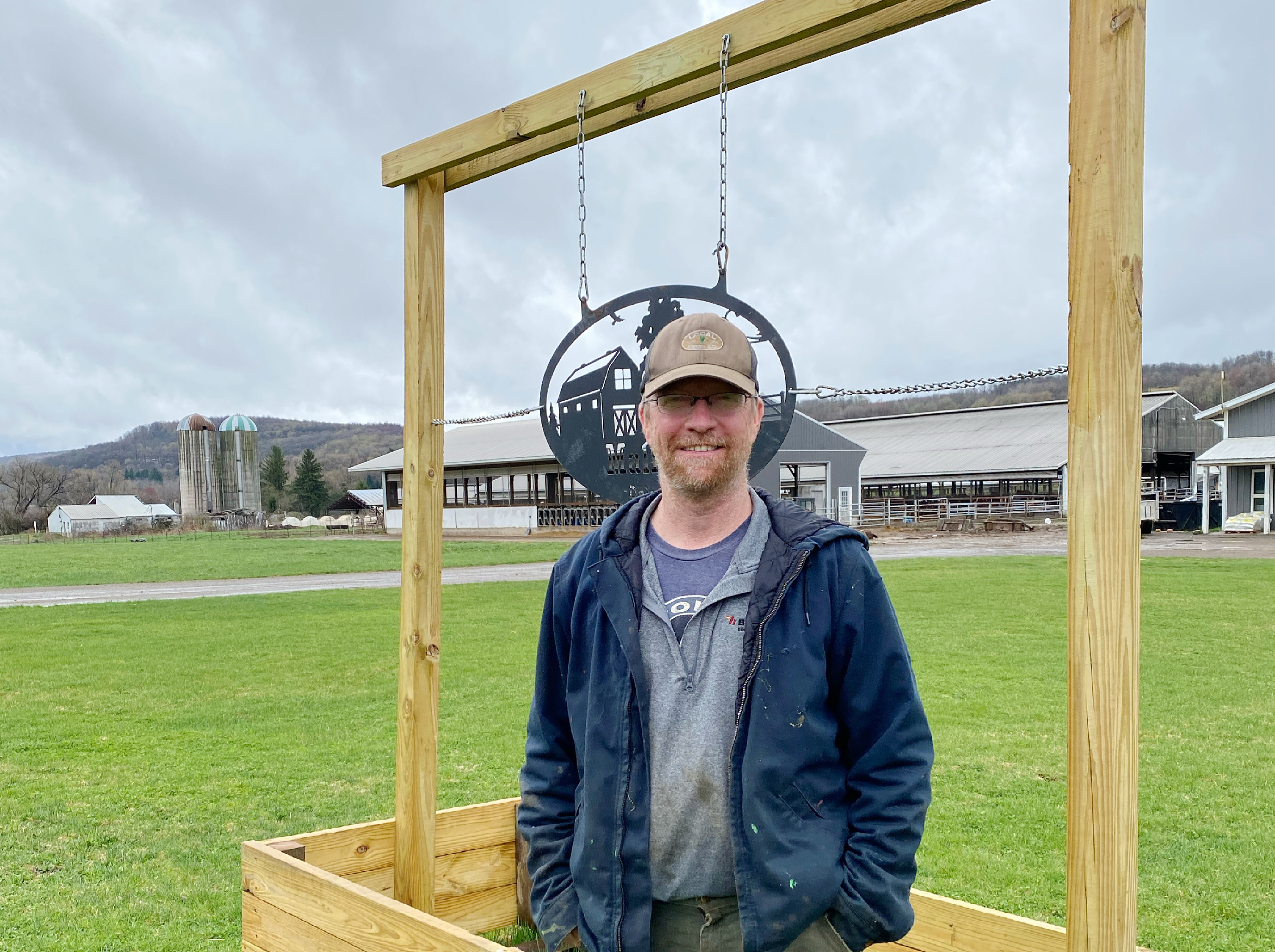
“If the state — under the auspices of the Industrial Development Agency — can decide how these properties can be used, I think as farmers, we need to realize we can lose our land through eminent domain takings,” says Charlie Bares. He is fighting to save fertile farmland that is key to feeding cows and managing manure nutrients at Mallards Dairy. Photo provided

By Sherry Bunting, Farmshine, May 21, 2021

ANGELICA, N.Y. — It feels like a no-win situation for Charlie Bares ever since Great Lakes Cheese set its sights on fertile Genesee River Valley land that is integral to growing forage and hauling manure for the 3000-cow Mallards Dairy.

The Allegany County (New York) Industrial Development Agency (ACIDA) has moved forward with eminent domain proceedings to condemn 321 acres of Bares’ land, identified in county documents as Marshland LLC, so the county can use the land to build a 480,000 square foot cheese manufacturing facility for Great Lakes Cheese.

The county has a deal with the Hiram, Ohio-based cheese company to give $220 million in tax savings and incentives to build the $500 million plant on Bares’ land. 

The new plant would double the company’s current production at its Empire Cheese plant in nearby Cuba, New York.

According to documents in the public record, Great Lakes Cheese intends to close the Cuba plant after production would begin at the plant it seeks to build on Bares’ land. 

ACIDA and the cheese company began working on this project in October 2019 and have set a timetable for groundbreaking later this year and operations to begin in January 2025.

The public record also indicates that 200 jobs at the Cuba plant, and additional jobs with the expansion, as well as milk markets, are “in jeopardy” if Great Lakes can’t build on this particular land.

Cows have been milked in this operation since 1860, according to Bares, who joined Joe Strzelec as a partner in the 1990s. As the ownership and business changed over the years — with Bares becoming the principle partner and expanding the operation — the Genesee River Valley land the county wants to take has become a key to the dairy business 20 miles away.

“IDA has begun the eminent domain process, and we are fighting it,” said Bares in a Farmshine phone interview. “We are arguing that this is not an overwhelming public benefit, but that it is an overwhelming private benefit.”

A few weeks ago, attorneys representing Bares and Marshacres LLC filed a petition challenging the county’s actions. The legal case is currently in the New York State Appellate Court.

Bares was approached a year ago about selling more than half of the 400 acres for the cheese plant.

“We didn’t want to sell, and we gave a price that reflected that. This land is the biggest and best field for us, and it is an integral part of our business. Selling it would weaken our dairy business,” he explained.

In addition, Bares is concerned about the environmental impact of losing land like this to concrete. While his operations are just outside of the Chesapeake Bay watershed, he is a supporter of the clean water blueprint for the Bay, and has invested over the years in technologies and best management practices profiled in 2015 in a Chesapeake Bay Foundation blog. Tree plantings and riparian buffers for water quality in the Genesee River Basin were also highlighted, among other things, in 2018. 

The ‘market value’ of this land is irrelevant under these conditions. What is relevant is the value of the land to Mallards Dairy and its owners.

In fact, in a letter reported by the Olean Times-Herald, Bares’ attorney John Cappellini observes:  “You are taking property from one company and giving it to another? You have decided that one commercial use, the farm, is somehow less important than a cheese factory.”

Explaining in the letter that the threats from Great Lakes Cheese to close all area facilities and leave the area have motivated officials against his client, Cappellini stated further that, “They are extorting from the taxpayers of Allegany County, and the County Legislature is complicit. They threaten to leave ‘unless you give us what we want.’”

The ACIDA notes that 80 sites were evaluated as Great Lakes Cheese had specific criteria to build a plant that would double its production after the Cuba plant is closed.

Of those 80 sites, the county says this is the only property that meets the company’s criteria.

Reports indicate the land meets three criteria: flat land, proximity to the river and being just off a major highway, I-86. The greenfield approach is the company and county’s least expensive build option with access to cheaper highway transportation.

Bares believes the company has not negotiated in good faith.

Answering questions about milk supply, Bares notes there has been no ‘provincial talk’ guaranteeing this project must use any percentage of its milk from New York State farms. No such stipulations are noted in the public record, except the ACIDA record includes a mention and link to Dairy Farmers of America (DFA).

Over the years, this region of New York has received milk from Michigan, Ohio and northern Indiana as it sits in a part of the state that falls just outside of Federal Milk Marketing Order maps — sitting as a bridge between the Northeast FMMO 1 and the Mideast FMMO 33.

The public record does show conditions that the over 200 employees at the existing Cuba plant would be offered jobs at the new plant.

Meanwhile, Mallards Dairy employs 35 to 40 people and feeds and milks 2500 cows with a total herd of 2900 mature animals. The land the county wants to take is key to that business.

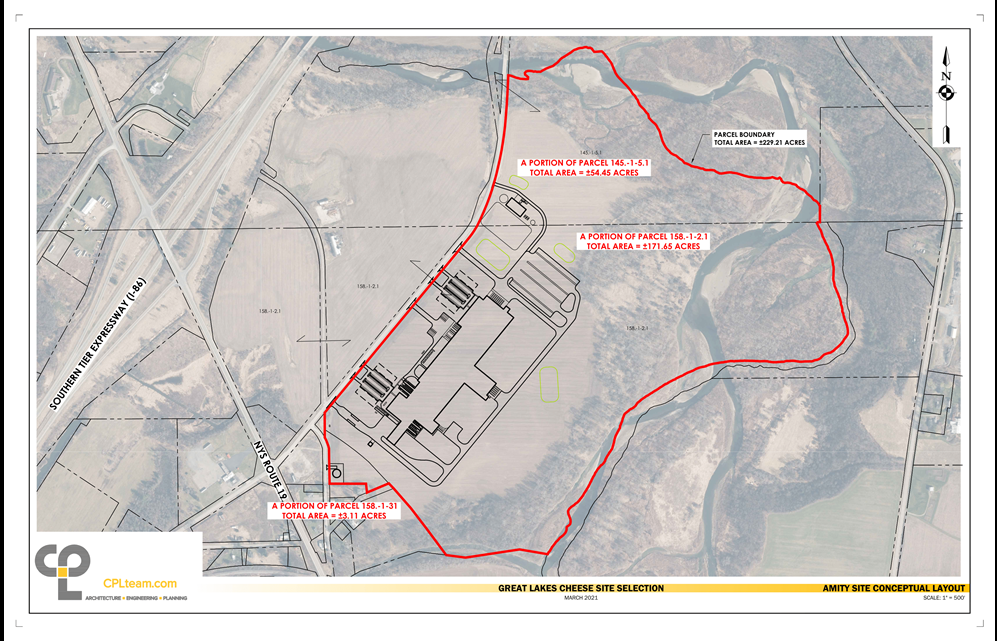
This Allegany County Industrial Development Agency drawing shows the Great Lakes Cheese project, including 480,000 square foot cheese plant, 50,000 square foot wastewater treatment plant, access roads and infrastructure planned for land now belonging to a New York dairy farmer. According to county meeting transcripts, “Building out the Crossroads area that is planned for I-86, Route 19 and CR-20 is the number one immediate priority.” Screenshot under projects at acida.org

At the March ACIDA meeting, officials noted publicly that they hope to break ground in the third quarter of 2021 and be fully operational by Jan. 1, 2025. If the ACIDA is successful in the eminent domain process it has begun, the county would own Bares’ land and lease it to Great Lakes Cheese.

At one point, early on, Bares notes that not only did the selling price he offered reflect the importance of the land to the dairy business, but also the idea of securing a milk market was mentioned to the company. He says Great Lakes Cheese declined, noting simply that they purchase their milk from cooperatives. 

A prime supplier of Great Lakes Cheese is DFA, as the public record reflects. Bares markets his milk through a small independent cooperative.

Having been unable to reach an agreement that would reflect the impact to his dairy business, Bares hired a lawyer.

“This area is very hilly with narrow valleys. There’s not a lot of farmland. This Genesee River Valley land is very good, very fertile, non-erosive land,” said Bares of the land around the main dairy operation outside of Cuba, and the land the county wants to take 20 miles away. “We want to hang on to this land because it’s hard to replace. Every farmer has land that is their best land, that they aren’t going to let go unless they are done farming.”

He says going through this process over the past year has only strengthened his resolve to keep the land and fight the eminent domain process. He notes that his wife Elizabeth has helped him tremendously.

New York’s history of interpretation for ‘public use’ in eminent domain cases is a broader notion than for most states. Bares knows it will be an uphill battle to fight the county’s taking, but he is hoping that his battle will ultimately help others in the future facing a taking of their land.

“Our dairy jobs — and the cows — depend on this collection of land resources we have grown,” says Bares. “This whole thing is wrong for the profitability of our dairy to chip away at the best land. It’s wrong for the environment because this is a beautiful riparian river valley and land like this is disappearing fast. It’s wrong from the social aspect the way the government is using eminent domain to help one private enterprise while harming another.”

He says his attorney is confident and always believes he can win every case until he loses, so Bares is trying to stay positive.

Their petition was filed recently in New York State Appellate Court. The Allegany County IDA has reportedly petitioned the court to expedite proceedings. Bares had expected both sides to be writing briefs through the summer with oral arguments in October, but that could be expedited to August or September.

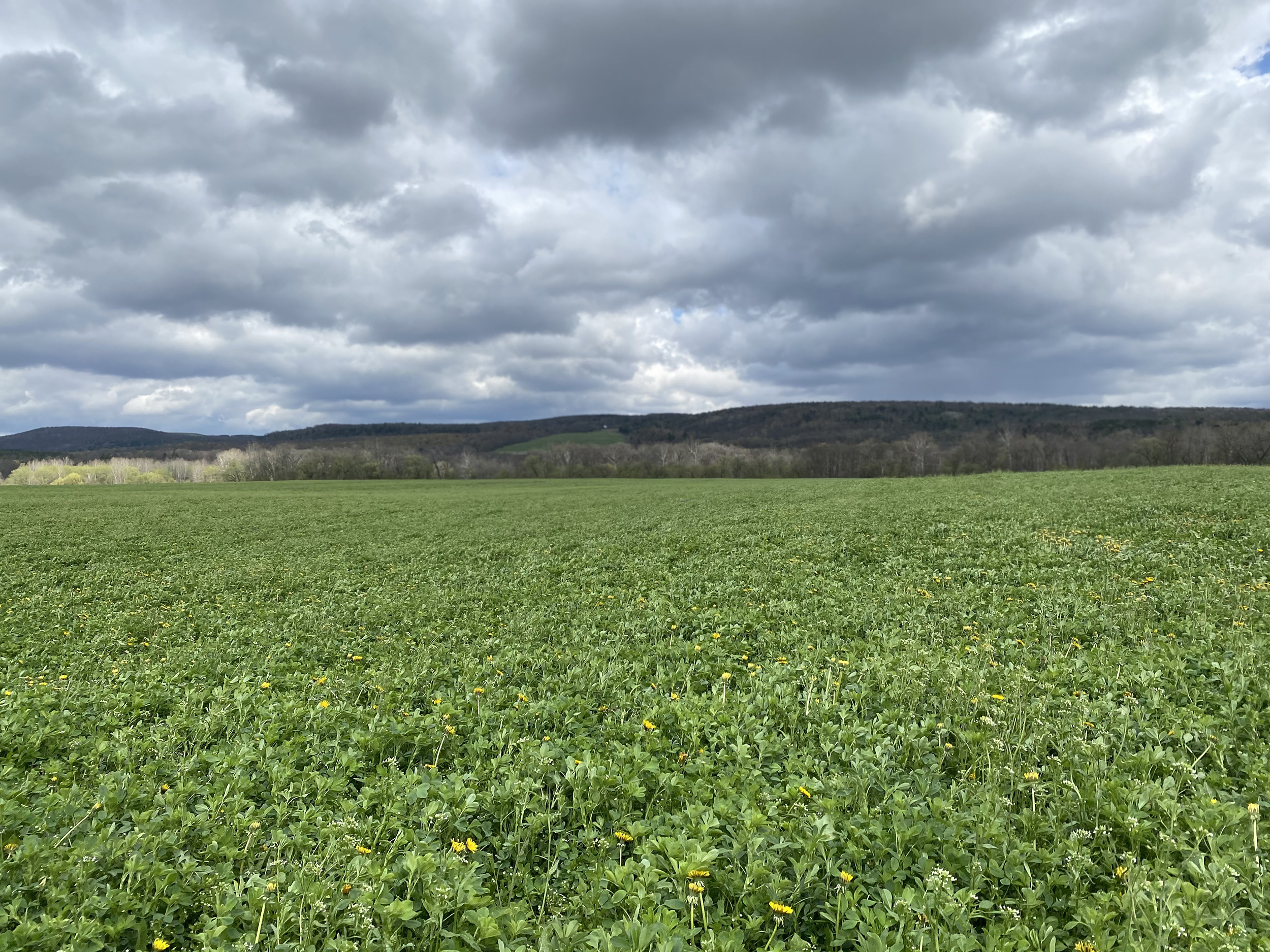
This land near Angelica, New York is farmed by Charlie Bares to primarily grow alfalfa and receive manure as a key part of nutrient management and forage production for the 3000-cow Mallards Dairy owned by Bares and his partner. The county wants to condemn it through eminent domain for a cheese plant.

“I think everyone should take a dim view of this. Every farmer — everyone — has a property that is head and heels above their other land, their best fields,” Bares suggests. “If the state — under the auspices of the Industrial Development Agency — can decide how these properties can be used, I think as farmers, we need to realize we can lose our land through eminent domain takings. My case is just an example.”

This case is an example because the ‘taking’ is not for a public use. It is for a private business use that the county is using economics to declare as a public use.

Bares has had some support from the community. Some rallies with some turnout, especially in April. There has been support online, and he has received a few phone calls. 

But largely, outside of the southern tier New York and northern tier Pennsylvania region, the story is not known.

A petition by Marshacres and citizens of Allegany County has been started, which has nearly 5500 signatures to-date at https://www.change.org/p/acida-stop-eminent-domain-seizure-of-working-farmland

“No one’s lining up (manure spreaders) at the county courthouse and threatening to open the valves, if that’s what you mean,” he answered.

After a long and quiet pause, he communicates just how difficult this situation has become for everyone.

“The farmers around me, my peers, they want this cheese plant and a stronger market. I believe that’s a big carrot, so it’s not easy. It seems there is little chance that I can come out ahead, either way. Either we chop off part of our business or the cheese plant will not expand here so everyone will view us as economic martyrs,” he explains.

“I feel like I cannot win.”

Even though each of two outcomes at the moment represent a different kind of difficult for Bares, he believes fighting the county’s eminent domain proceedings could help someone else — as untouched land like this that is important to agriculture and the environment is disappearing. 

“Once it’s paved over in concrete, ” he says, “it’s not coming back.”

-30- 

Producers seek checkoff vote and transparency as fake food transformation ramps up

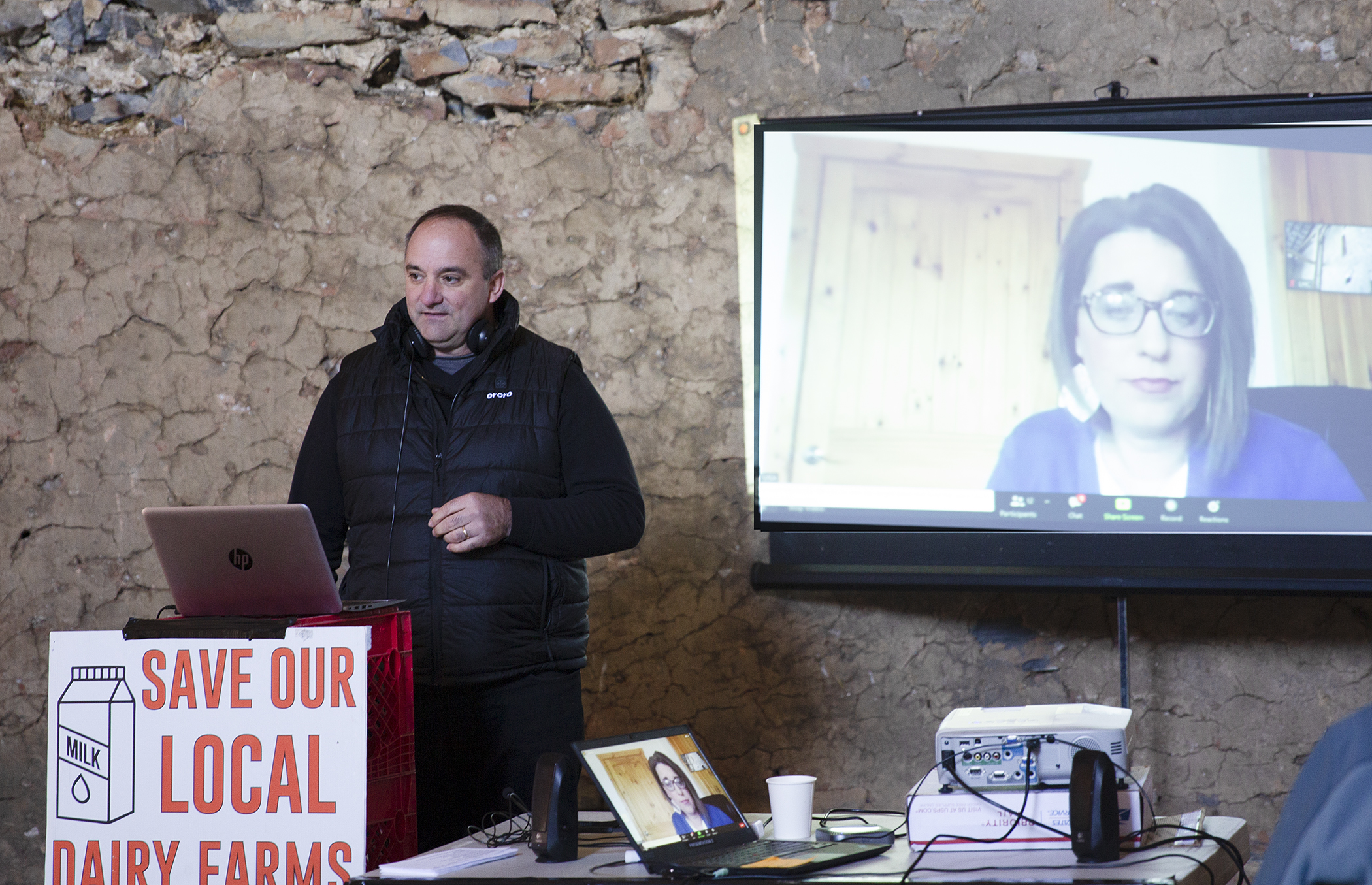
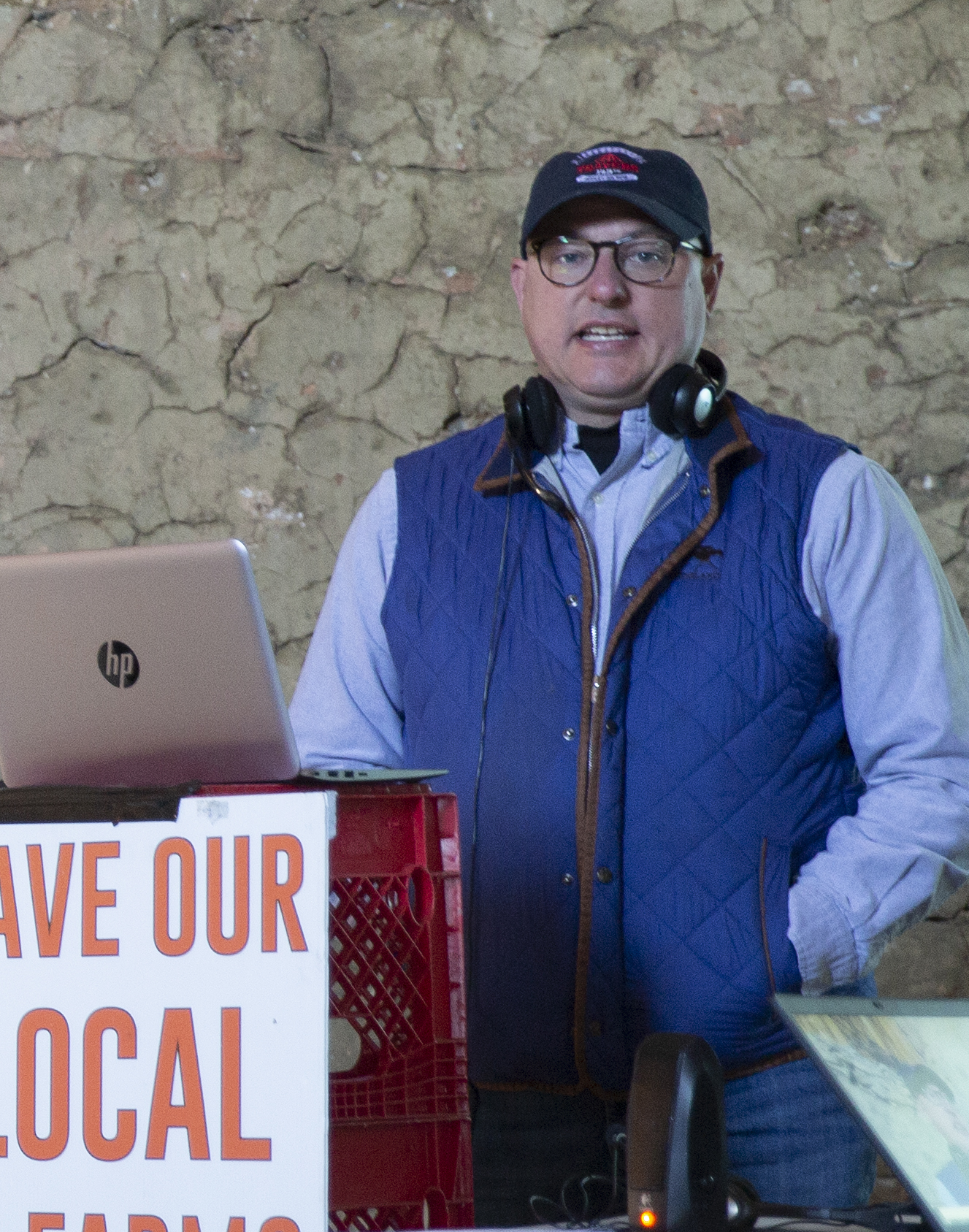
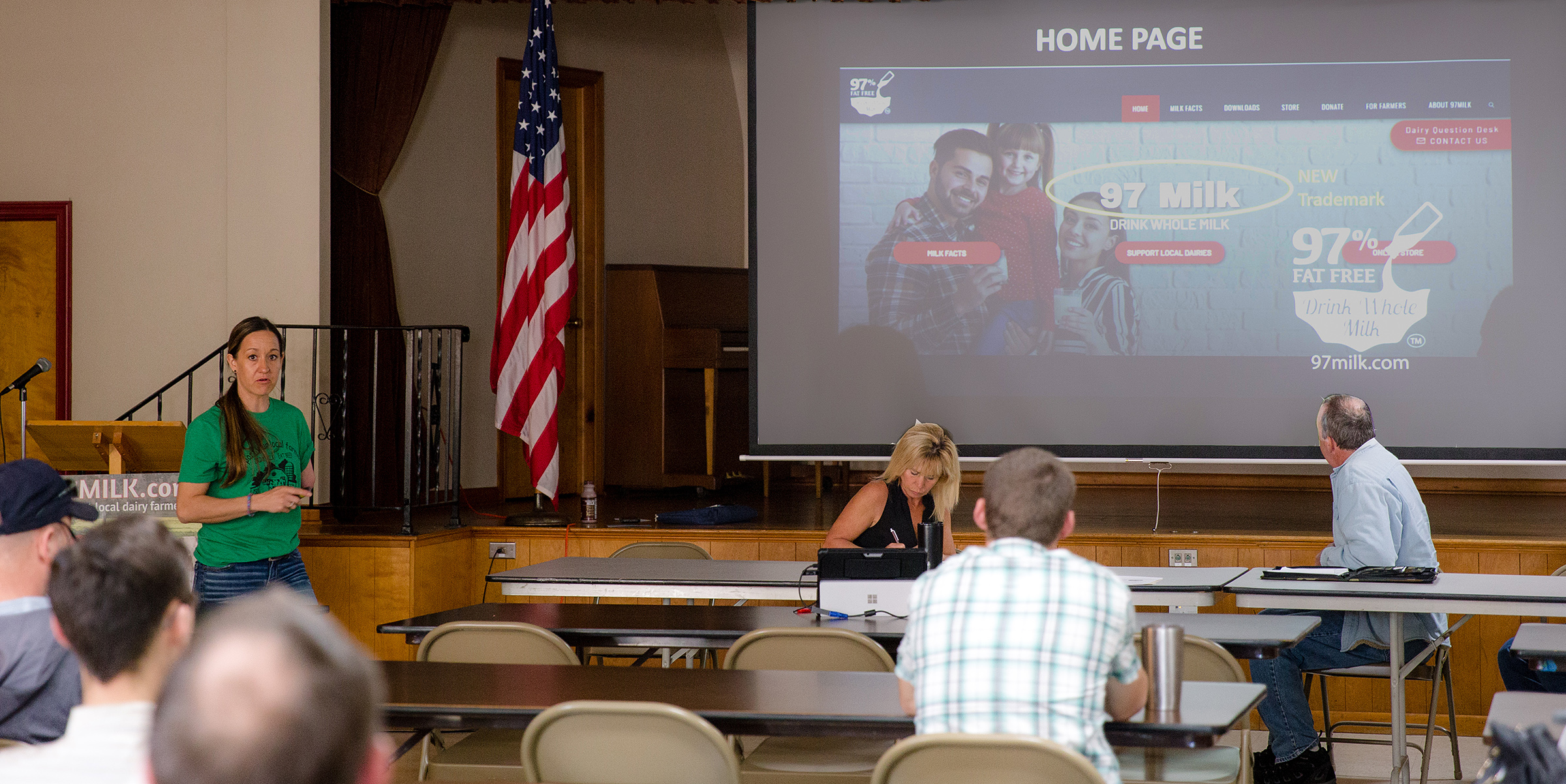
Mike Eby introduces Karina Jones who spoke to attendees live and virtually about the beef checkoff referendum petition. Jones was part of a panel of speakers on various topics during the daylong “Empowering Dairy Farmers” barn meeting at Eby’s farm in Lancaster County, PA on April 23. 

By Sherry Bunting, Farmshine, May 14, 2021

GORDONVILLE, Pa. – “Beef it’s what’s for dinner.” Remember that line?

For school kids, it could soon be Impossible Meat for lunch. USDA just approved a nutrition label for K-12 schools to substitute beef with the billionaire-invested Impossible Meat. Never mind that a May 2020 Newsweek article reported Beyond Meat, Impossible Meat and their competitors source most of their concentrated pea- and soy-protein from extrusion factories in China, even if the crops were grown in North America.

School foodservice directors report a barrage of supply-chain influencers touting fake meat meal options to reduce carbon emissions on the heels of the USDA nutrition label approval.

A local restaurant discovered last month that their wholesale food vendor added textured vegetable protein (concentrated soy and other additives) to the wholesale ‘Classic Beef Burger’ without warning. It is apparently part of a ‘cutting edge’ menu remake at the wholesale level – not the restaurant’s choice. (This particular restaurant switched promptly to Certified Angus burgers guaranteed to remain 100% beef).

Children came home from school this week with Junior Scholastics declaring “This meat could help save the planet!” accompanied by a photo of fake-beef in grocery packaging.

Junior Scholastic Weekly Reader came out with this story urging kids to eat less beef, just a week before USDA’s announcement this month (May 2021) of approval for the ‘Impossible Meat’ school lunch nutrition label, ushering in the barrage of global foodservice companies hounding school foodservice directors about reducing climate change with this stuff (cha-ching, cha-ching). Companies like Cargill and Tyson that are among the big 4 in BEEF processing — with strong ties to the lobbying side of the separate NCBA / CBB — are also going big into FAKE beef. The beef and dairy checkoff programs also have strong ties to World Wildlife Fund and collect checkoff money on imported beef and dairy so this clouds their ability to use the funds they mandatorily collect from U.S. farmers to promote U.S.-produced REAL beef and dairy.

These are just a few examples in the past three weeks of how rapidly the wheels set in motion a decade ago are hitting the pavement.

How did we get here? For 12 to 13 years, the World Economic Forum (WEF), World Wildlife Fund (WWF), Big Food, Big Tech and Big Ag have been coalescing around this idea of supply-chain “sustainability” leverage to steer global food transformation with cattle clearly in the crosshairs – especially for developed nations in Europe as well as the United States.

By partnering officially and unofficially with national dairy and beef checkoff boards on “precompetitive sustainability and innovation”, for example, WWF has — in effect — been channeling government-mandated producer checkoff dollars toward implementing WWF’s supply-chain strategy for impacting commodities WWF believes need intervention to improve biodiversity, water and climate. The global corporations behind ‘food transformation’ are laughing all the way to the bank while grassroots producers essentially fund their own demise.

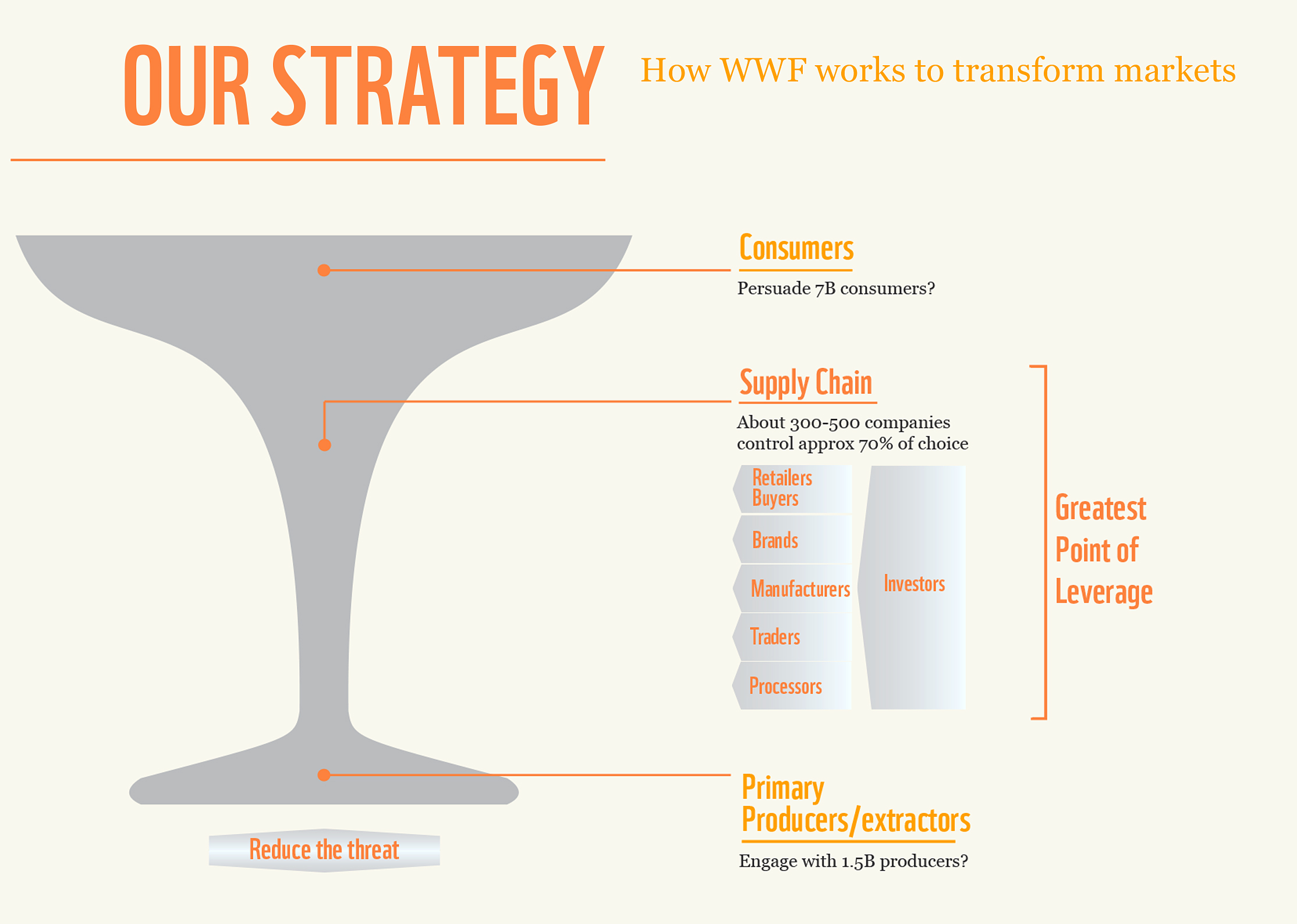
By partnering with dairy and beef checkoff national boards in a ‘pre-competitive’ arrangement, WWF implements its “supply-chain” leverage strategy, WWF has essentially used producer funds to implement their message and priorities both to consumers through supply chain decisions and to producers through checkoff-funded programs validating farm practices. The World Wildlife Fund in its 2012 Report “Better Production for a Living Planet” identifies this strategy to accomplish its priorities for 15 identified commodities, including dairy and beef, related to biodiversity, water and climate. Instead of trying to change the habits of 7 billion consumers or working directly with 1.5 billion producers, worldwide, WWF states that this “practical solution” is to leverage about 300 to 500 companies that control 70% of food choices. Image from 2012 WWF Report

In the 44-page 2012 paper “Better Production for a Living Planet,” the WWF Market Transformation Initiative identified dairy and beef as two of the prime commodities they target through supply-chain companies controlling 70% of food choices.

The checkoff-funded sustainability materials coming out of the National Cattlemen’s Beef Board and Dairy Management Inc (DMI) show firsthand this relationship with WWF, by the use of the WWF logo, and in the case of dairy, the acknowledgment that a decade-long memorandum of understanding existed.

Add to this the government policies emerging that align directly with this global food, agriculture and land transformation, and the use of the vehicle of checkoff-funded “government speech,” becomes a bit clearer. It’s a clever way to leverage the supply chain and promote a message to consumers while pushing producers to align.

The WWF 2012 paper explains that in 2010, “WWF convened some of the biggest players in the beef industry to form the Global Roundtable for Sustainable Beef (GRSB). They included the world’s biggest beef buyer, McDonald’s; the biggest beef retailer, Walmart; and two of the largest beef traders, JBS and Cargill.”

While dairy and beef checkoff programs use government-mandated funds collected from producers for valuable local and state promotion programs linking producers to consumers, it is the direction of national checkoff programs – engaged with WWF and the largest processors and retailers in this way — that has producers like Karina Jones, a fifth generation Nebraska cattlewoman concerned.

Jones heads up the petition drive for a producer referendum on the $1/head beef checkoff. The effort began in South Dakota and is spreading nationwide via R-CALF and other national and state organizations.

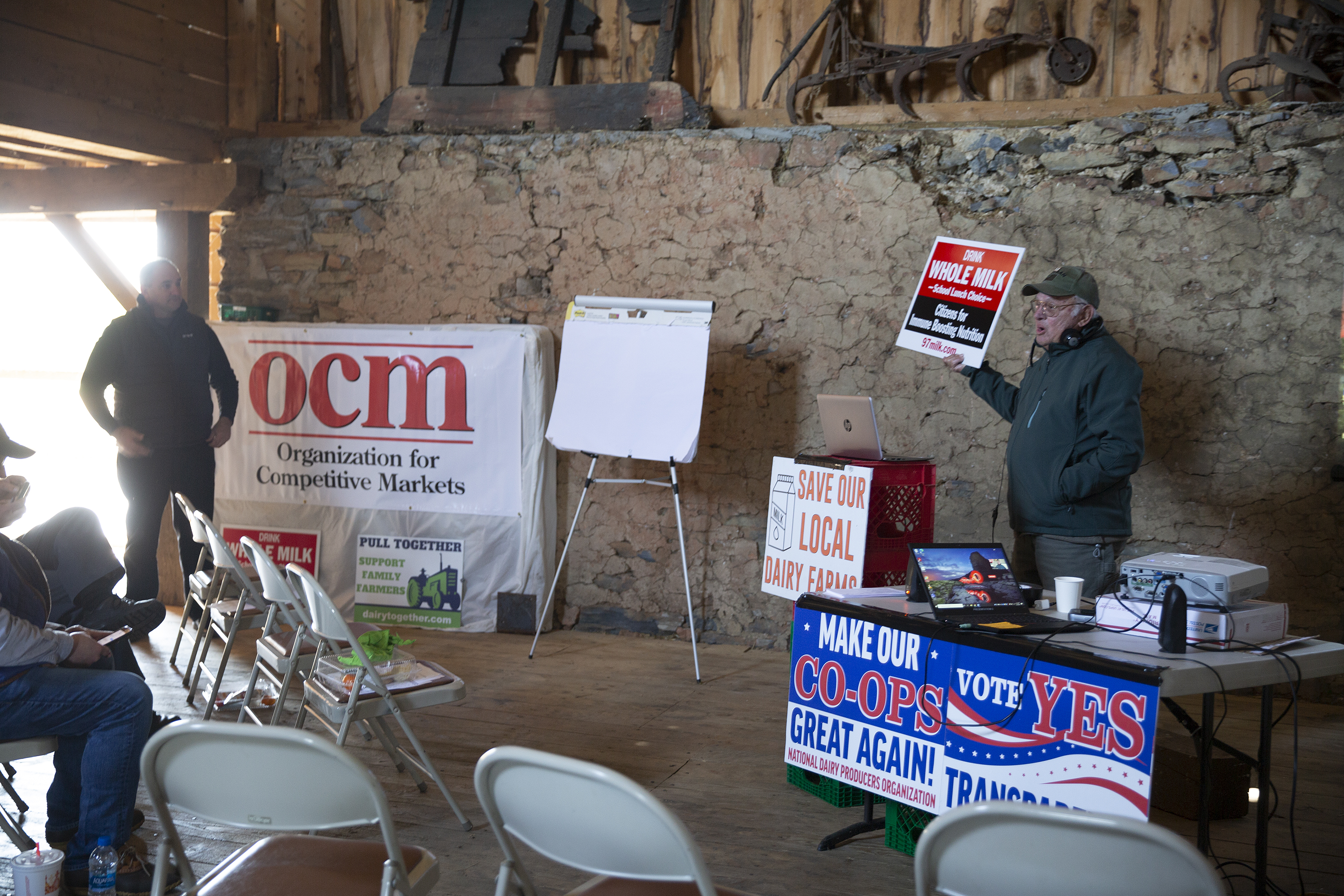
During the farmer empowerment barn meeting hosted by Mike Eby of National Dairy Producers Organization (NDPO) and Organization for Competitive Markets (OCM) at his farm in Gordonville, Pennsylvania recently, two of the day’s speakers talked about the need for transparency and accountability in mandatory checkoff programs.

Marty Irby of Organization for Competitive Markets (OCM) talked about bipartisan legislation seeking more transparency and accountability for all mandatory producer checkoff programs during the Empowering Dairy Farmers meeting last month.

Marty Irby of OCM talked about the OFF Act, which is bipartisan legislation seeking to amend the checkoff laws to reaffirm that these programs may not contract with organizations that engage in policy advocacy, conflicts of interest, or anticompetitive activities. It would require publication of all budgets and disbursement of funds for the purpose of public inspection and submit to periodic audits by the USDA Inspector General.

“It’s not about taking those promotion dollars away, but to have a just system of checks and balances,” said Irby about the proposed legislation.

But others are taking a grassroots vote approach  — concerned about government oversight of what is already determined to be ‘government speech’ funded by producer checkoff.

Jones talked at the barn meeting about the massive effort to gather over 100,000 signatures by July 2021 asking USDA to conduct a nationwide Beef Checkoff Referendum. A vote on the beef checkoff has not been conducted in 35 years. (See checkoffvote.com and the paper insert in the May 14, 2021 edition of Farmshine)

“It’s time to re-check the checkoff,” said Jones about the beef petition. “We want to signal to USDA that as cattle producers we are ready to vote again.”

She explained that in order for the Secretary of Agriculture to consider a referendum request, 10% of producers must sign the petition. This includes anyone who sold a beef animal and paid the $1/head checkoff, in the 12 months from July 2020 through July 2021, including beef cow-calf producers, seedstock producers, backgrounders, cattle feeders, dairy producers, and youth showing and selling livestock.

According to the 2017 Census, 10% of the beef producers would mean 89,000 signatures needed.

“But we don’t know the vetting process the Secretary will use to approve or deny the petition request, so we want to reach over 100,000 signatures by July 2021,” said Jones.

“The cattle landscape today is much different from 35 years ago,” she said. “Our checkoff does not support promotion of American-born-and-raised beef. We want to equalize the power for the grassroots U.S. cattle producer… the power and the dollars are falling into the hands of the few.”

According to Jones, the checkoff referendum petition seeks a return to balance as well as increased transparency and accountability, through the voting process. Proponents of the right to vote believe producers should be able to fund education and promotion that takes a stand for real, USA-produced beef, something the trends and supply chain partnerships emerging today – along with “government speech” rules — make difficult.

She talked about “mavericks” who were elected to the beef board in the past and tried to change the power structure of the lobbying groups and processing industry involvement. Jones said the current structure has gone on so long — uninterrupted — that a referendum petition is the only avenue many beef producers see today as a way to bring accountability back.

“This is a call to action. Many producers are still not aware of this beef checkoff referendum petition,” said Jones as she urged producers to be bold and harness the opportunities to set a direction that changes the balance of power.

To be continued

Empowering dairy farmers: knowledge, tools, ideas shared

By Sherry Bunting, Farmshine, April 2021

GORDONVILLE, Pa. — Empowerment. One word with power in it.

“I got to thinking about introducing this session and thought everyone knows what empowerment means, right? Give power. But then I looked up the opposite of empowerment,” said Kristine Ranger, a consultant in Michigan working with farms and writing and evaluates grants. She traveled to Gordonville, Pennsylvania  with National Dairy Producers Organization board member Joe Arens to the farm of Mike Eby, NDPO chairman, for the ‘Empowering dairy farmers’ barn meeting Friday, April 23, 2021.

What is the opposite of empowerment?

“Here are the words in the dictionary,” said Ranger. “Disallow, forbid, hinder, inhibit, preclude, prevent and prohibit. Have any of you been experiencing any of that as you try to build a livelihood with your dairy farms?”

Good question.

From there, the daylong barn meeting moved headlong into weighty topics, but stayed focus on the positive concept of encouraging producer involvement in seeking accountability and transparency in the systems that govern dairy.

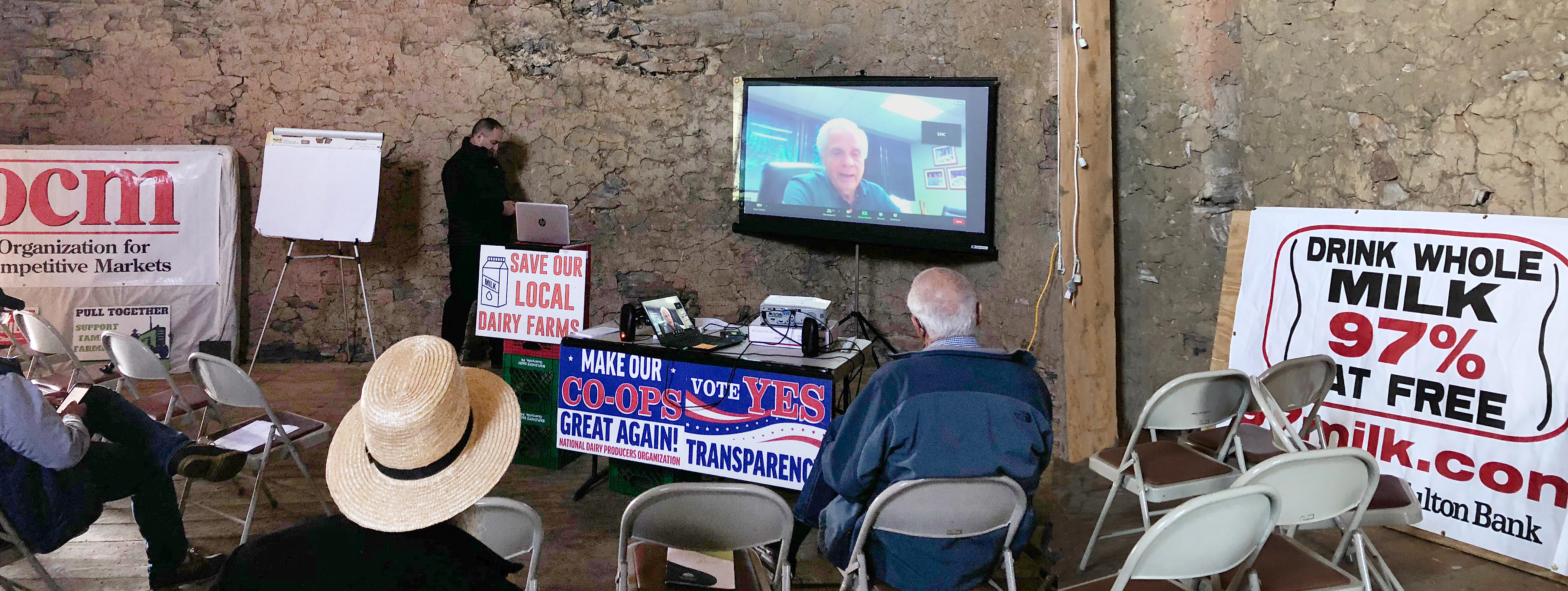
Although the sunshine and spring planting kept in-person attendance low, the event was livestreamed on visual and audio with producers listening in from all over.

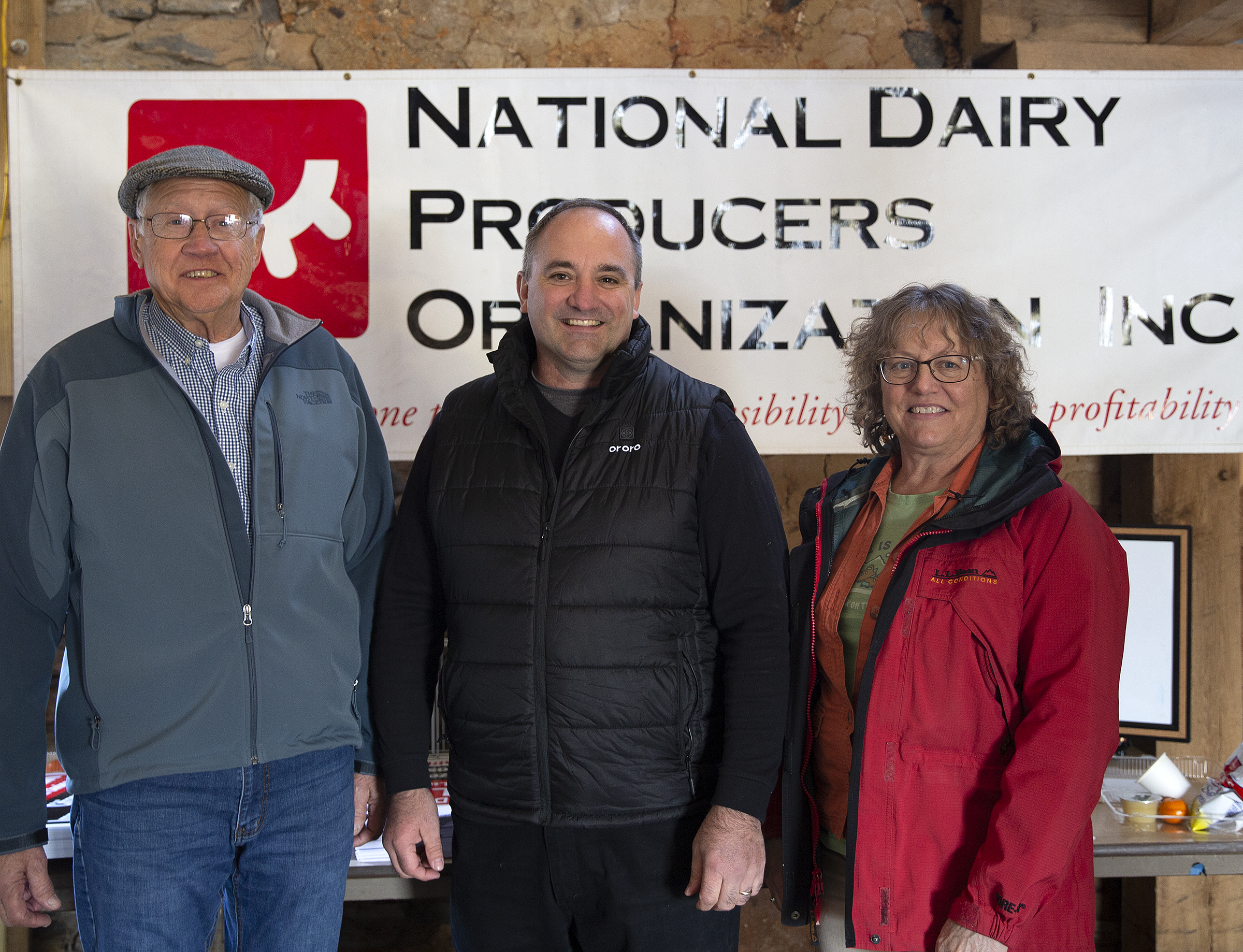
Traveling from Michigan to the Lancaster County, Pennsylvania farm of Mike Eby (center) for an ’empowering’ farmers meeting were Joe Arens (left), NDPO board member and Kristine Ranger, a knowledge consultant working with farms. Ranger worked with Eby to secure a grant for the in-person meeting and multi-media production. In addition to serving as NDPO (National Dairy Producers Organization) chairman, Eby is executive director of Organization for Competitive Markets (OCM), represents the south district on the PA Farmers Union board and is a member of the Grassroots PA Dairy Advisory Committee collaborating with 97 Milk education efforts.

A thought that kept surfacing in this reporter’s mind listening to the panel of speakers was this: The longer something goes uninterrupted, the more vulnerable it is to become corrupted.

In fact, it tied in directly with Arens’ personal account following Gary Genske on the program. Arens urged producers to look at annual reports and ask questions. “That’s what NDPO is all about, to support your efforts to get to the cooperative boards of directors about what they should be doing at the co-op level,” said Arens, a member of the NDPO board for two years.

“Members own the milk. Members have the power, but the whole thing has been tipped upside down,” said Arens.

“We need to do something to change this,” said Arens. “Get in front of your board members… They are talking about expanding plants, not talking about producer price. Their one and only responsibility is that price on the milk check settlement statement.”

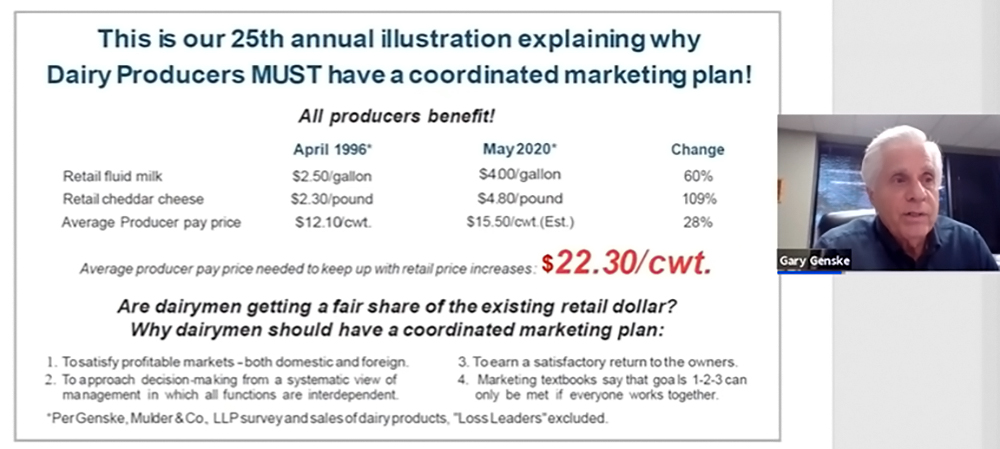
“If producers do not hold their co-ops accountable, then silence is your consent,” said Genske, a certified public accountant since 1974 based in California with a dairy in New Mexico.

He kicked things off at the barn meeting, presenting details about the roles and responsibilities of cooperatives, boards and members. He shared his insights into improving dairy farm milk prices.

Genske is a longtime member of the NDPO board. He highlighted the marketing concepts of 100% USA seal for milk and dairy products, returning to the true standards for fat and components in beverage milk that are still used today in California, and moving toward aligning milk production with profitable demand.

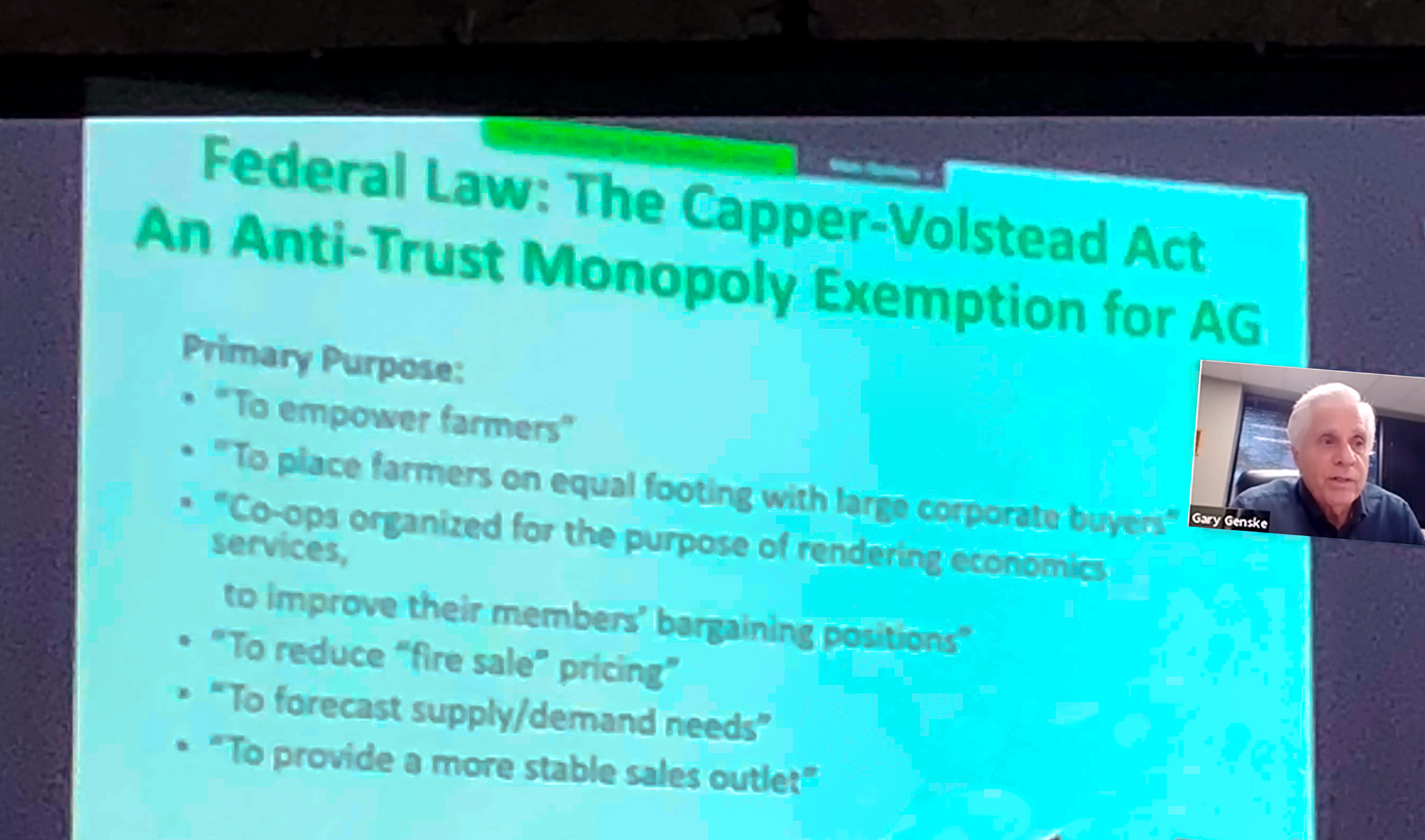
Gary Genske was the kickoff panelist, presenting virtually from his office in California.

The Genske Mulder firm does the financial statements for 2500 dairy farms each year and 10,000 farm tax returns annually. He sees the numbers and knows the deal.

Walking attendees through the various aspects of USDA regulation and the Capper Volstead Act, Genske gave producers the tools and encouragement to accept their responsibilities as cooperative members.

In October, he had a successful lawsuit in Kansas City. After requesting documents from the cooperative in which he is a member, and being denied or provided documents that were mostly redacted, he took the issue to court.

After a two-day hearing, the judge ruled in Genske’s favor on his request for documents, as a cooperative member, with a stated purpose.  

In short, Genske said, “We have to put people in the position of taking care of the members… We want to cull cows not dairy farmers.”

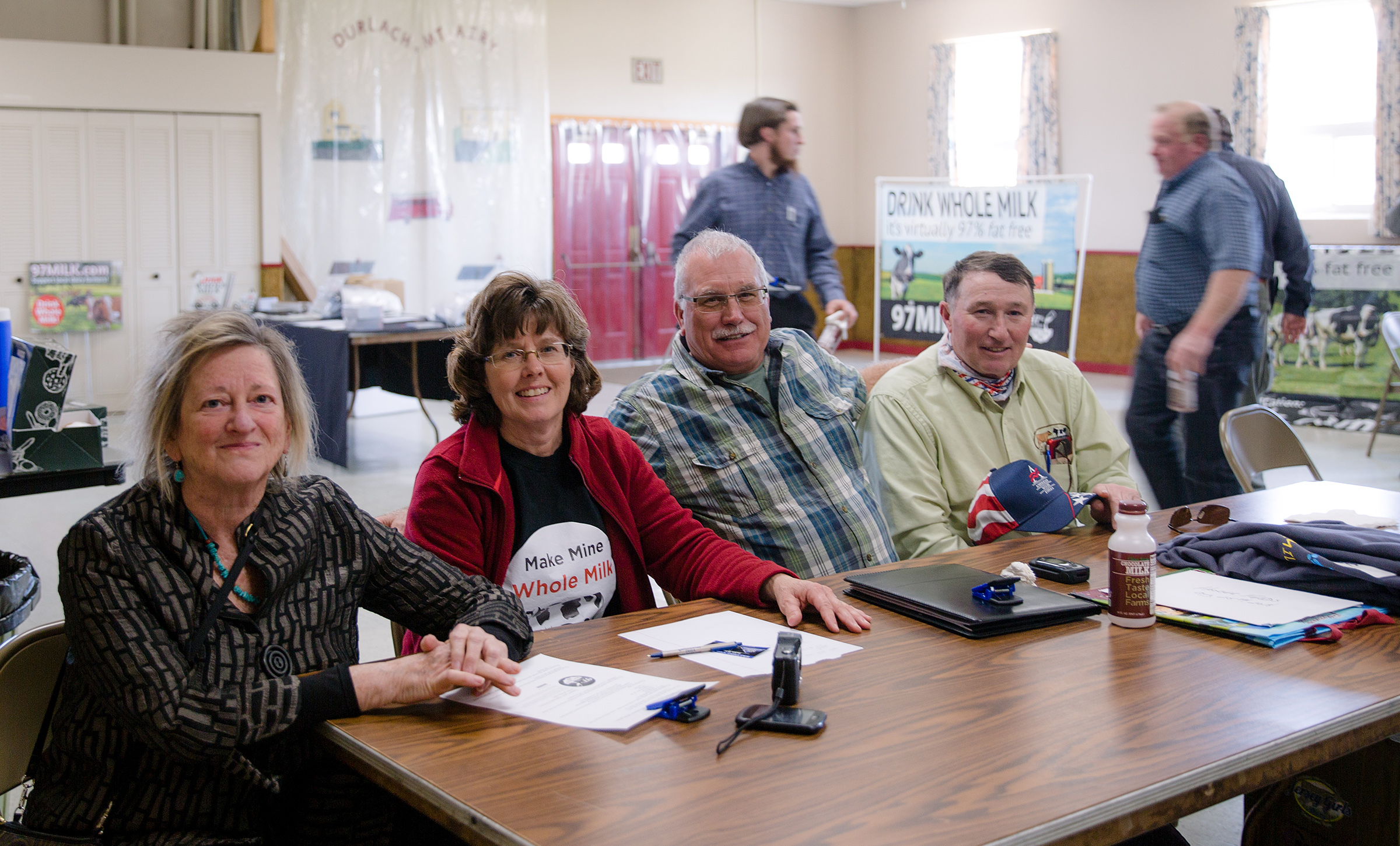
Bernie Morrissey, chairman of the Grassroots PA Dairy Advisory Committee talked after lunch about the 97 Milk effort when farmers empowered themselves to market whole milk, since no one else was; and all kinds of prohibiting, hindering, forbidding, preventing and precluding had been going on regarding whole milk availability and promotion.

“This is it,” said Bernie Morrissey. “The dairy farmers made me successful, so this is me giving back.” He talked about the whole milk education effort and the push to legalize whole milk choice in schools. If ever there was an example of the opposite of ’empower’, it would be the treatment of whole milk by industry and government, especially since 2008. The steep decline in fluid milk sales from 2010-2018 is starting to stabilize as consumers and policymakers are getting the message. Each step is hard work.

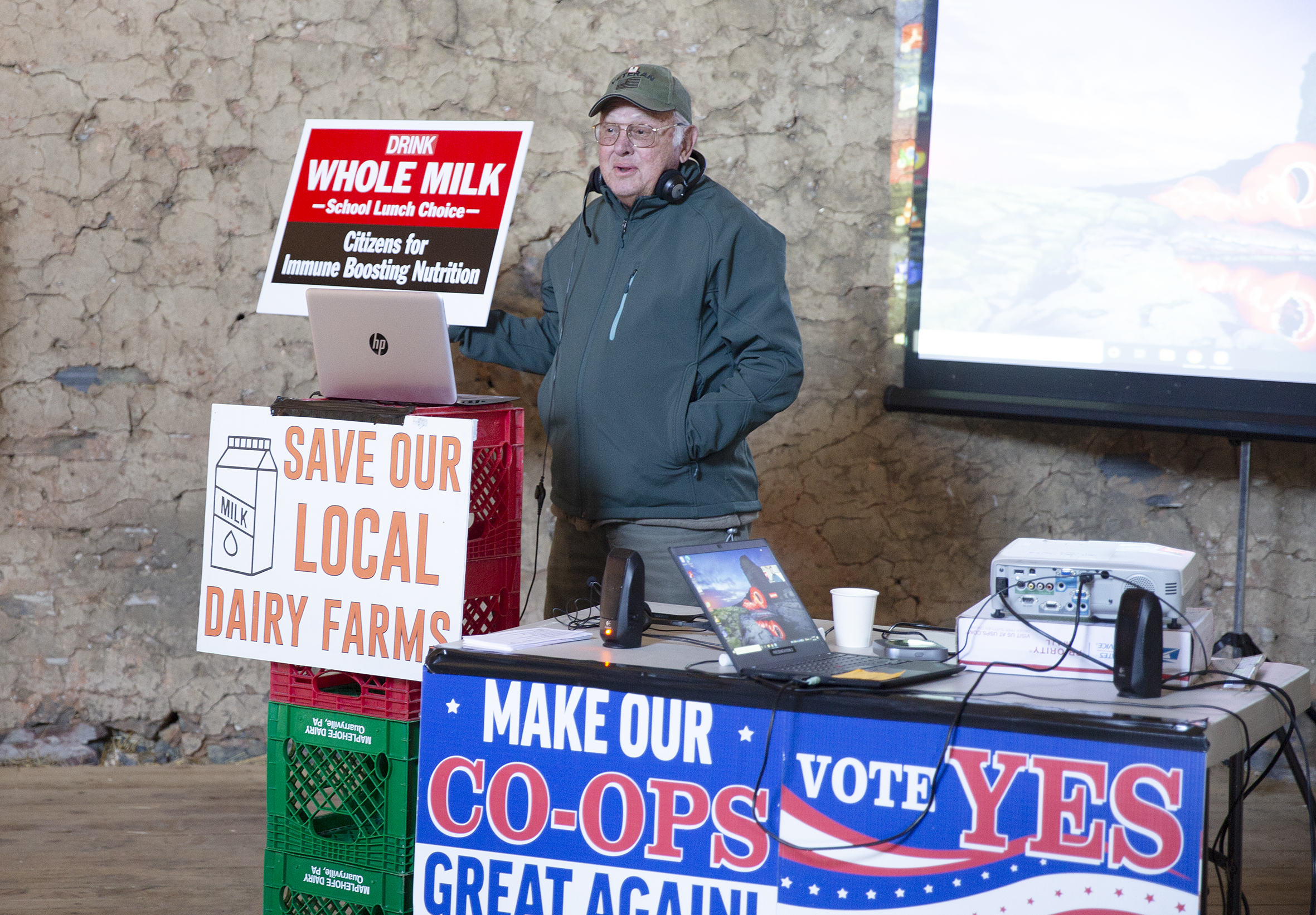
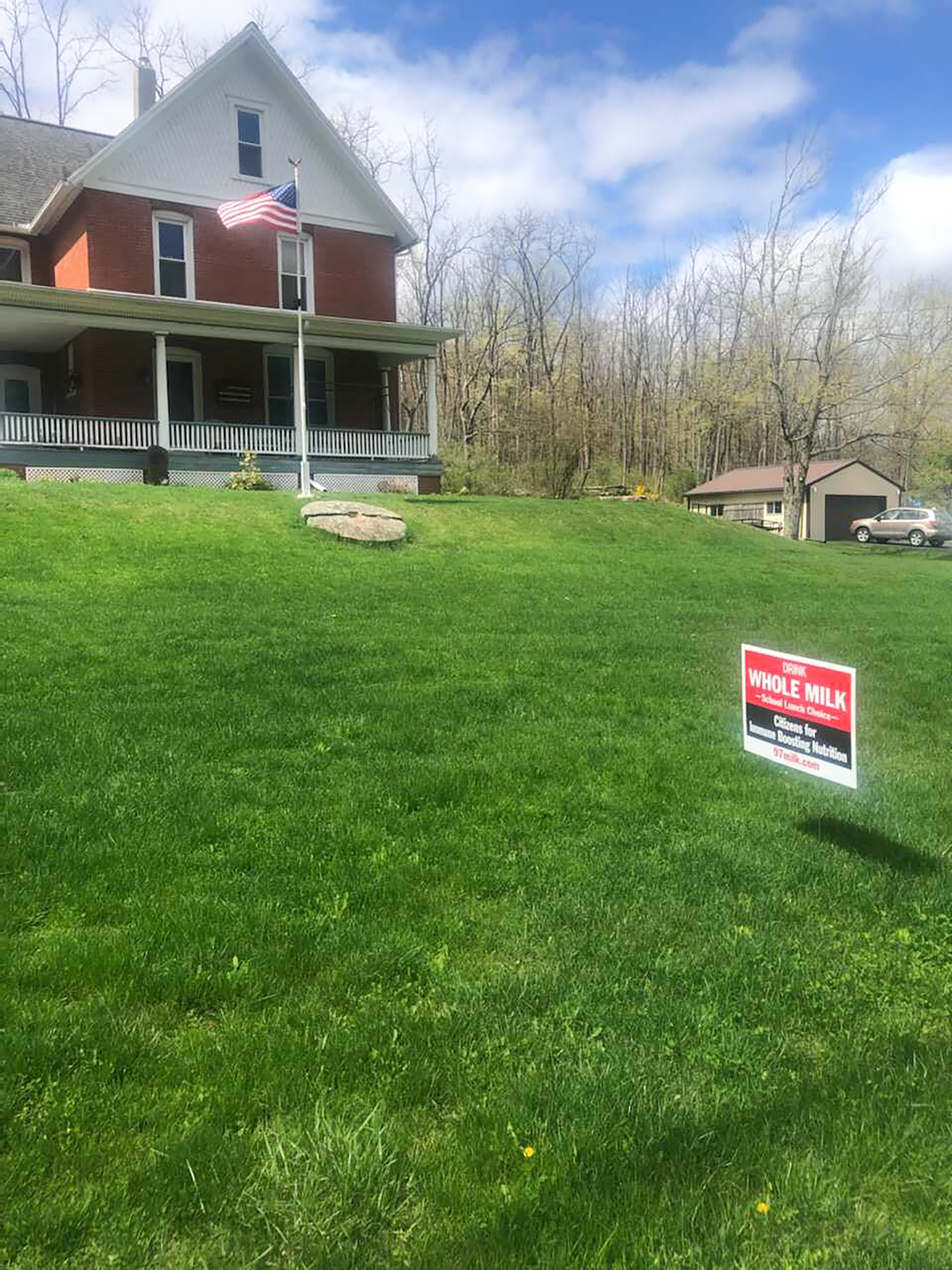
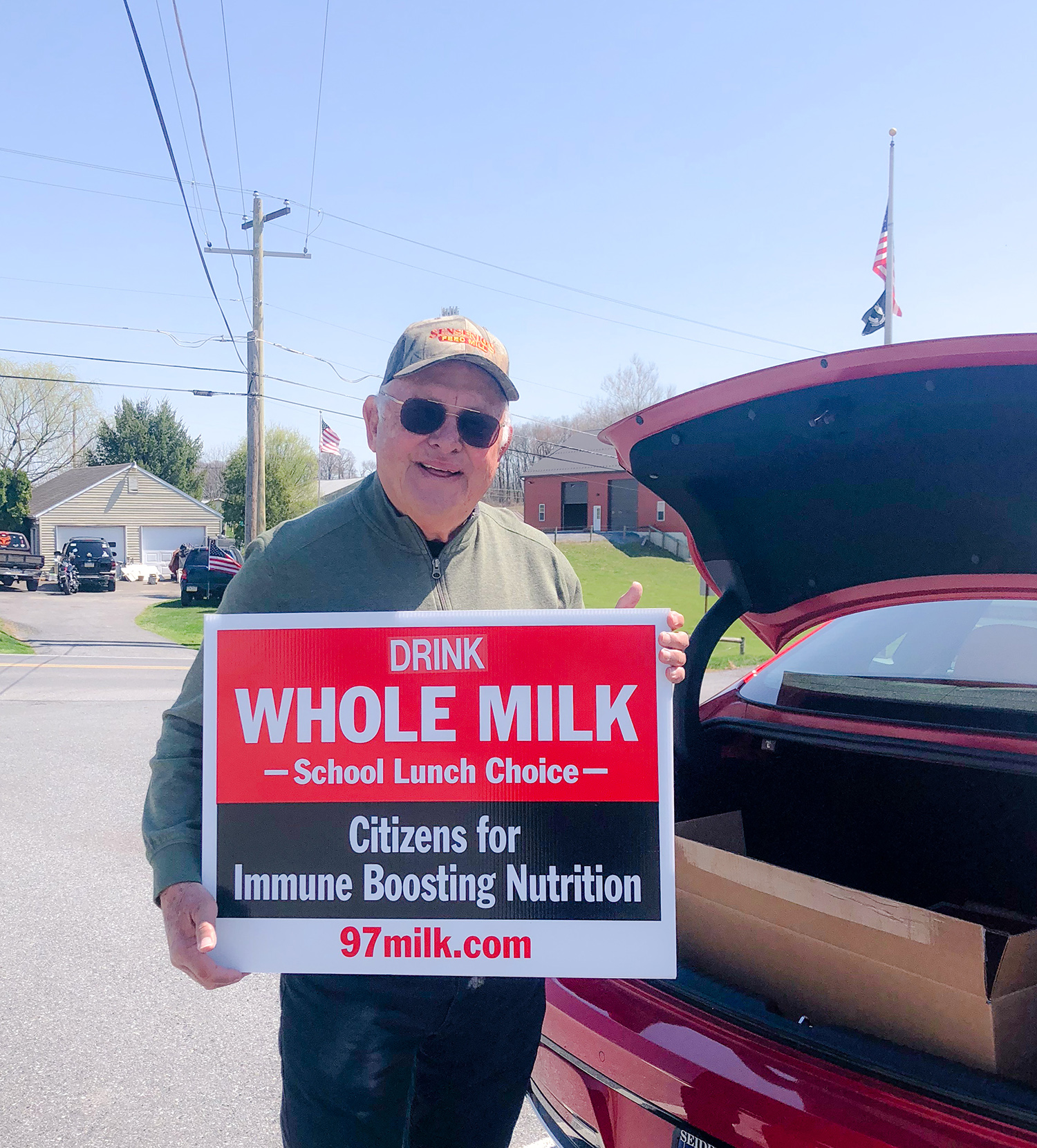
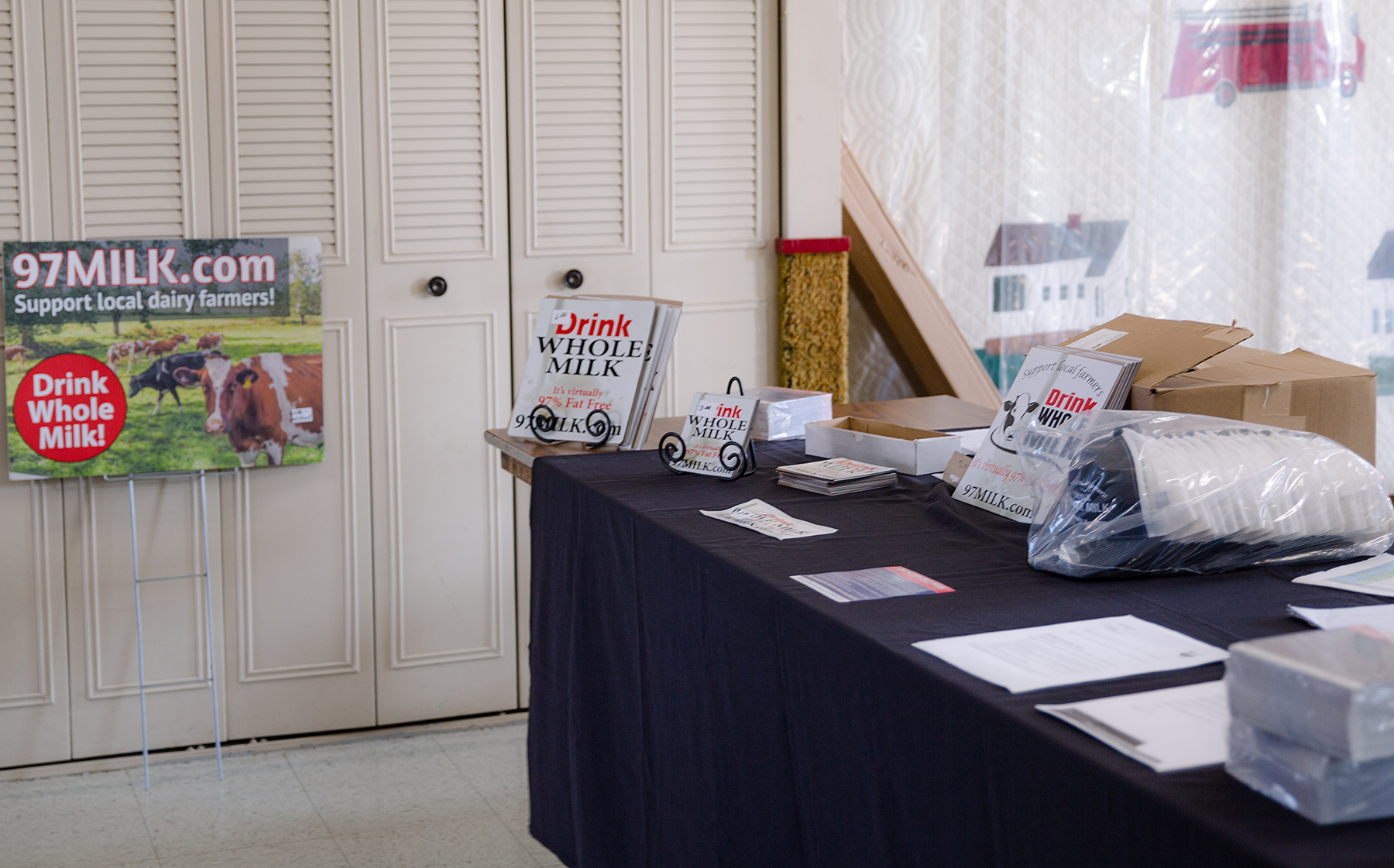
“It started with Nelson Troutman who painted the first round bale, just like that sign: Drink Whole Milk 97% Fat Free,” said Morrissey pointing to the large banners and holding up the Drink Whole Milk School Lunch Choice Citizens for Immune Boosting Nutrition yard signs.

With a joint effort underway now for a little over two years – working to educate lawmakers and consumers about whole milk, and pushing efforts to legalize whole milk choice in schools — Morrissey said “It’s working. Things are happening.”

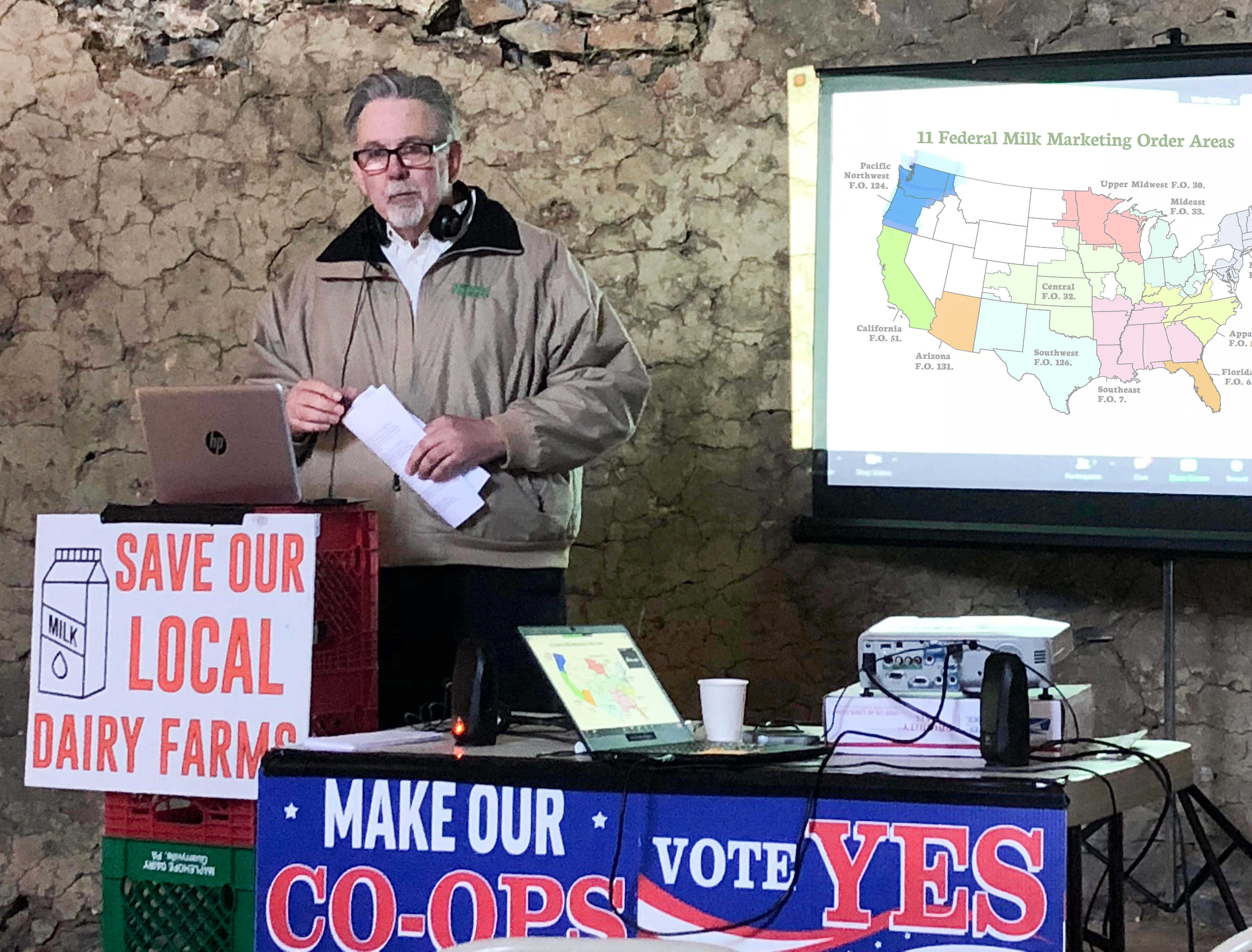
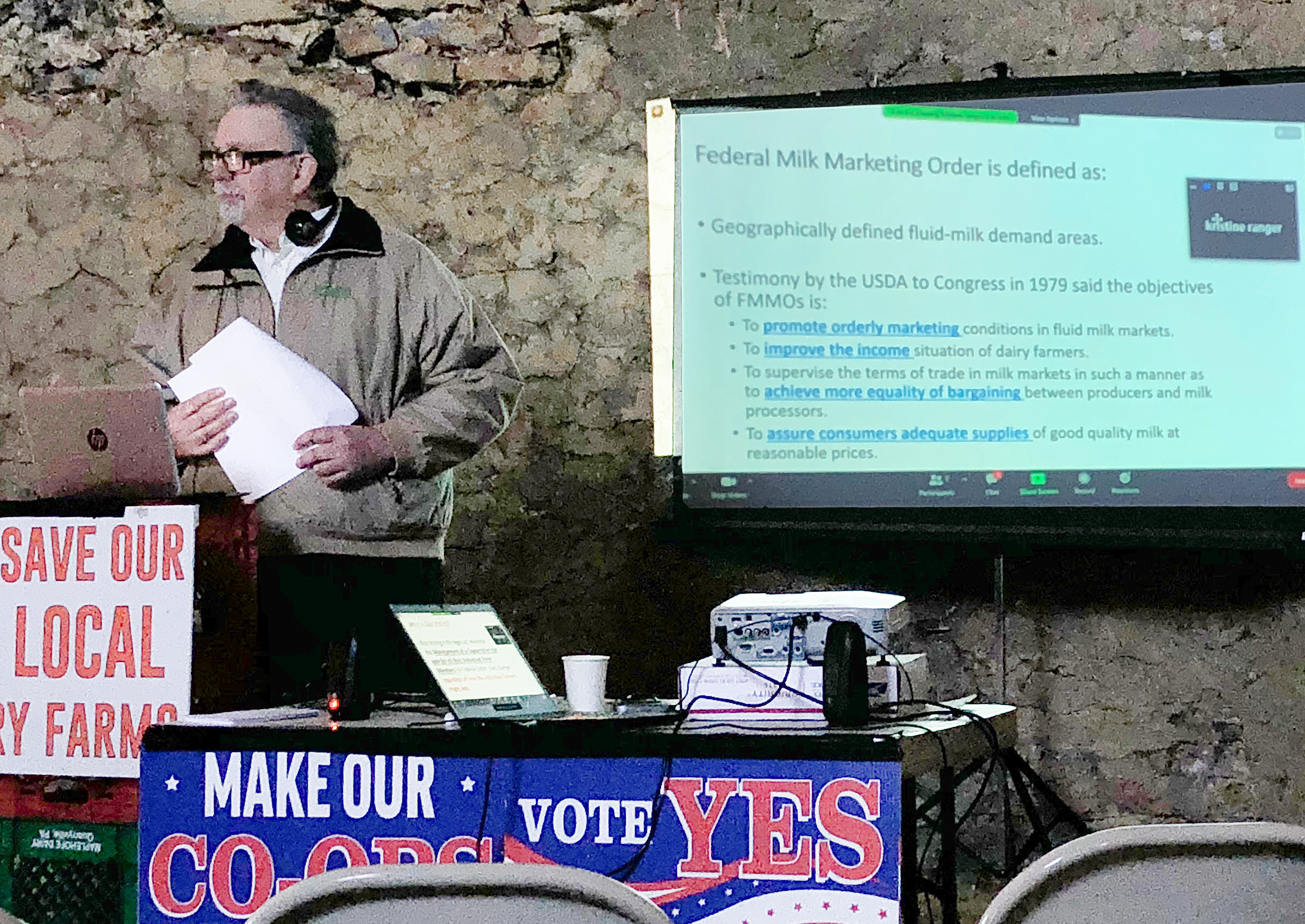
With the FMMO map on the screen behind him, Dick Bylsma of NFO talked about the history, purpose and hot FMMO topics of the day. He said the most empowering tool a dairy producer can have is the right to vote on milk order changes, instead of being bloc-voted by the cooperative.

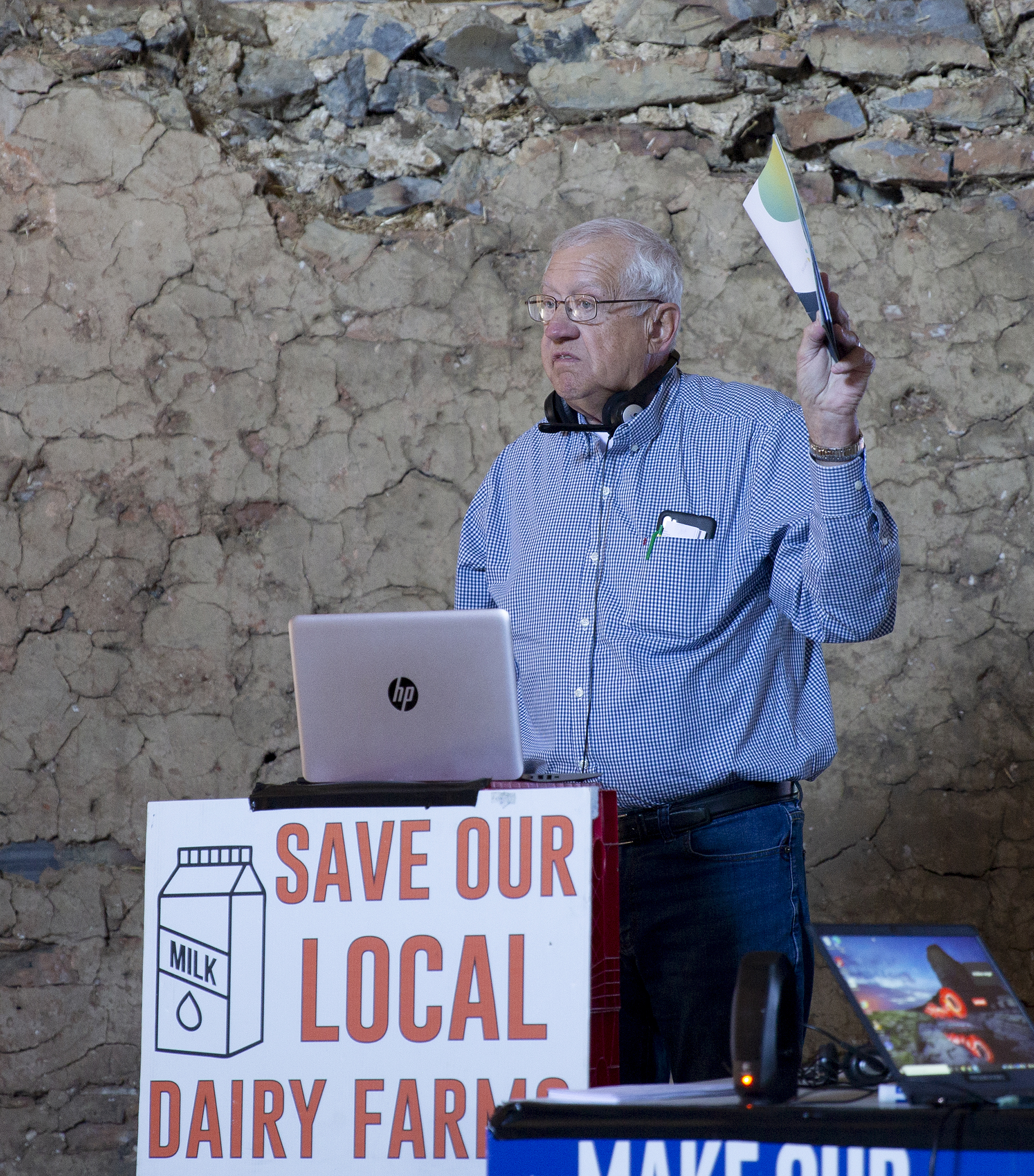
Dick Bylsma of National Farmers Organization (NFO) traveled from Indiana to brief producers on joint efforts between NFO, Farmers Union and Farm Bureau to empower dairy farmers by getting their individual votes back in Federal Order hearings. He traced the history of Federal Milk Marketing Orders, and the genesis of bloc voting at a time in history when there were hundreds of thousands of farmers and communication was slow.

“It’s time to end bloc voting,” said Bylsma, and he laid out some of the efforts underway around that proposition, also highlighting the purpose of the Federal Orders.

These are just some fast highlights from a day of deep learning. More from these speakers and additional speakers on co-op involvement, systems accountability, checkoff reforms and referendums, and other empowering topics — including more from Genske about ending the silence and exercising rights and responsibilities with communication tools that work for cooperative members — will be published in a future edition.

Similar in-person meetings recently encouraged producers in Michigan and northern Indiana, said Ranger.

For dairy producers who are interested in knowing more, want to get involved, but aren’t sure how, NDPO chairman Mike Eby suggests joining in on the NDPO weekly national Tuesday night call at 8:00 p.m. eastern time at 712-775-7035 Pin 330090#. Every dairy producer in America has a standing invitation.

To hear past calls and learn more, click here

To view a video or listen to a recording of the empowerment meeting, click here

Look for more in a future edition of Farmshine.

-30-
Vale Wood Farms stays steady, but nimble, delivering ‘moo to you’ since 1933

Carissa Itle Westrick enjoys working every day with her father, Bill Itle. They see whole milk, local connections and home delivery as big trends for dairy — even before the pandemic — that are key parts of their farm and processing for decades. They also share concerns about consumer confusion with the onslaught of imitation beverages in the dairy case.
 

By Sherry Bunting (updated since originally published in Farmshine in 2018)

LORETTO, Pa. — Take a step back to a simpler time. A time when dairy farmers were looked up to, not questioned. A time when the milkman delivered fresh dairy milk to the metal ice box on the doorstep. A time when milk’s good name was upheld. When milk was milk.

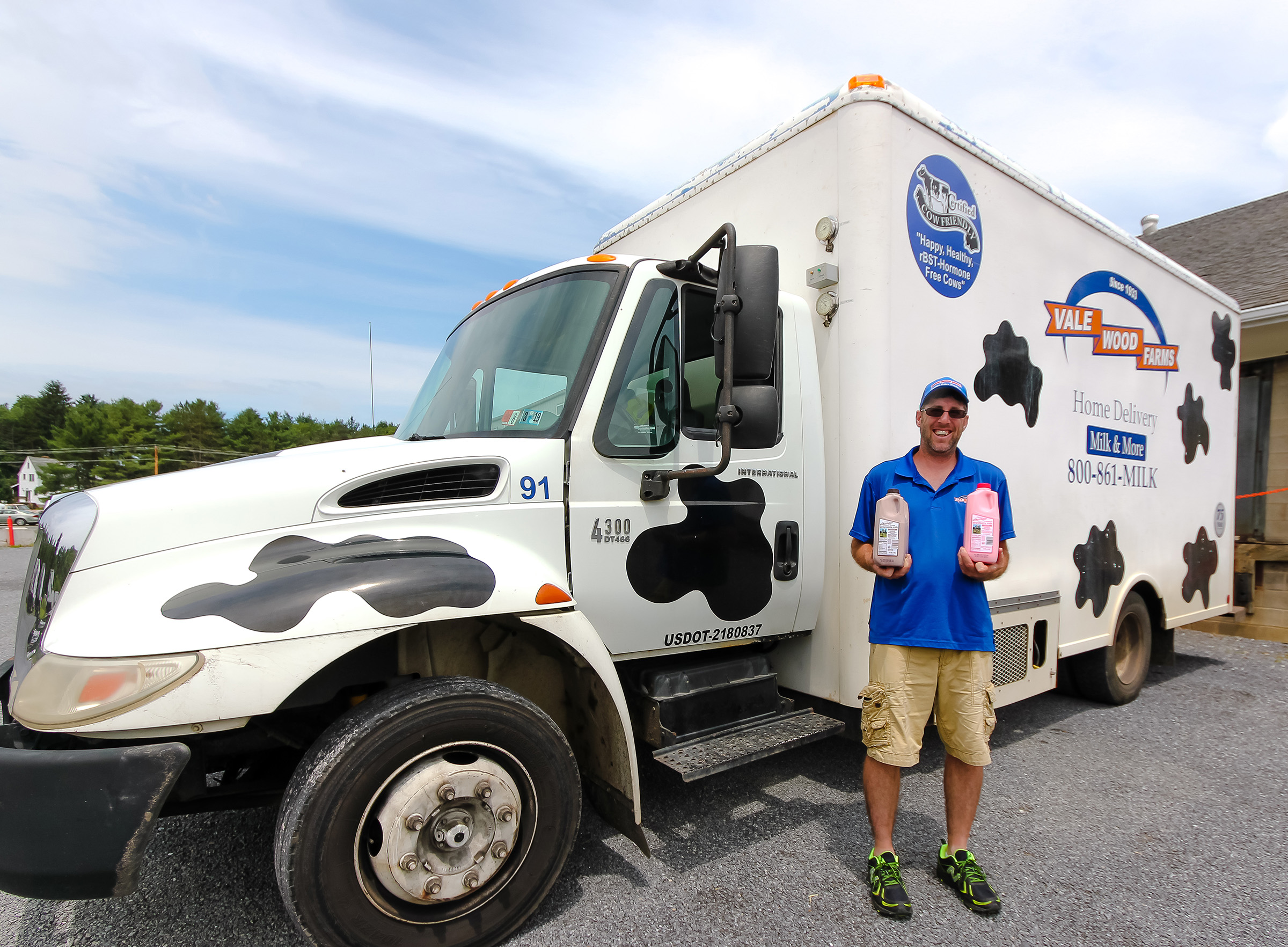
A visit to Vale Wood Farms, Loretto, Cambria County, Pennsylvania, is in some ways a step back in time, but it is also a bold look into the future — one that delivers fresh, local, real milk and dairy to consumers. One that develops farm-to-consumer relationships as everything old becomes new again.

It’s not easy to corral a few of the third and fourth generations of the Itle family as they go about their work here. Getting them to drop what they’re doing for a group photo? Forget about it. Everyone’s busy with three separate businesses under one sign. And they’re not keen on drawing attention to themselves, but rather draw attention to milk and dairy.

Converging trends shape their market, and consumer connections are critical. (For example, today, two years since this article was first published, people have rediscovered whole milk and cream and since the Coronavirus pandemic, local foods and home delivery are a trend.)

But in the overall dairy industry, there is a growing number of competing beverages marketing outside the lines of real milk’s FDA standard of identity — introducing a growing surge of competing imitations into the dairy case.

In these challenging times, many dairy farmers consider on-farm processing. Carissa Itle Westrick, director of business development at Vale Wood Farms, acknowledges the risk and insecurity of this business that relies on building consumer and community relationships.

She points out that in some of their sales – wholesale and institutional – they, too, are price takers.

“My great great grandfather (C.A. Itle) was grappling with difficult economic choices in 1933 when he hitched up his horse and wagon and went to town,” Carissa relates.

Today, the Itles have a window into seeing how milk production levels in excess of demand impact profits throughout the supply-chain.

In the dairy sector, we often hear the experts and consultants drive home the point that ‘the next pound of milk is the most profitable milk on the farm.’

Is it?

“Our economics are different,” Carissa points out. “That next pound of milk is not necessarily the most profitable. If we can’t sell that next pound of milk, then making it means we just made less profit on all the milk. For us, that approach doesn’t make sense.”

What does make sense is adding processing efficiencies and capitalizing on consumer trends, while helping to shape them.

“We have to make sure what we do fits today’s families,” Carissa notes. “We are small enough to be fairly nimble, which is so important to our business model.” For example, customers can sign up and manage their home-delivery online.

Technology-driven, home-delivery — Valewood-style — still comes with a personal touch. Of their 50 employees, five are drivers. 

“Our drivers cater to our customers. They might even be asked to let the cat out or pet the dog or put the product right in the fridge,” she says with a smile. “We are hyper-local, and it’s not just a selling point for us. We shake hands with whose buying our milk.”

Meanwhile, connecting consumer dots is very much a family affair as events like the mid-July Pasture Party draw in large numbers from the community and those members of the Itle family not involved daily in the business. They bring their friends and tell their neighbors.

“When people come to an event here and go on the crazy hay wagon ride, it’s us on that wagon. It’s my uncle Dan on that wagon,” she says. “That’s our one-on-one time to tell about our cows and how they are cared for. We focus our education on how much attention we pay to the cows. They are our livelihood, and we depend on them. The effort, time, energy and emotion we put into keeping them healthy and comfortable – that’s what we want people to understand.”

The nearby schools also bring classes to connect with the farm providing their milk. In fact, Carissa’s aunt, Jan Itle, developed the “Moo to You” formal school tour program that began with five teachers and today works with nearly 75 teachers and reaches up to 5000 students annually, in addition to the other community events hosted at the farm.

Jan was recognized as 2017 Pennsylvania Dairy Innovator of the Year. Her good-natured humor is evident when she talks about working with seven brothers. And she is enthusiastic about hosting school tours.

“Give back to the community at all times,” is something Jan says they learned from their parents.

For her generation growing up, the Itle house was the gathering place, Jan recalls. “Our house was like a train station, and we still extend that invitation to the community today — to come and see what we do and share our passion.”

As the public becomes more generations removed from farm life, and the dairy disconnect grows, the Itles are doing all they can to reconnect. That helps their business model and the dairy industry as a whole.

The Itle family has seen it all in their farm-to-consumer business at Vale Wood Farms. The land on which the farm and processing plant sit today has been in the family since 1841, and while they’ve been processing and home-delivering milk and dairy products since 1933, “we are still addicted to our cow habit,” says Carissa.

Carissa is one of six fourth-generation family members working full-time here. Her father Bill is one of eight third-generation siblings involved full-time, plus another involved to some degree with a career as a veterinarian.

As company president, Bill manages the processing side. His brother Pat manages the 500 acres of crops. His sister Jan is the herd manager with her nephew Zach as assistant herd manager.

Being one of the oldest of the 18 members of her generation, ranging from adults to infants, Carissa describes the overlap. It’s easy to see how her role serves as a bridge between generations.

All told, Vale Wood Farms employs 55 people, including family members. In fact, Carissa confirms that some of their employees are also multi-generational. In fact, even the many family members with careers outside of Vale Wood Farms, come back to help with events and such. “We were all raised to jump in and do, when we see something needing done,” says Carissa.

When Bill Itle looks at the future, he notes the confusion about what is real dairy is an issue.

“We feel the pain when farmers feel the pain, because we’re part of that, and it’s not always the processor making the money,” he says. While he has seen an increase in whole milk consumption, the overall drag on total fluid sales, says Bill, is confusion in the dairy case.

“It’s tough to get our name back and away from imitation products. They’ve been doing it a long time. They aren’t hiding in the woodwork,” Bill relates.

Carissa agrees, noting that some consumers don’t really know that almond milk isn’t milk.

“I have friends who ask why we don’t make it,” she says. “They think it’s a milk flavor.”

For all of its challenges and opportunities, this is a family that loves what they do.

“We appreciate how lucky we are to have this tradition here, and we also have a responsibility to keep it alive,” says Carissa, noting that for multiple generations to run three separate businesses together takes flexibility.

She recalls her grandmother often saying, “you can disagree without being disagreeable.”

“Balancing the generation with one foot out the door with the generation gaining life experience can be tricky,” says Carissa, admitting sometimes her role is more “cat herder” and interpreter. 

“In a family business, we learn that there will be differing opinions, but at the end of the day, we make decisions and everyone supports the decisions. In a family business, you learn to have good healthy debate and to strongly support your point of view, but then to compromise and accept a decision once it’s made, and that’s how you thrive.”

As the industry changes around them, the Itle family jumps in to make key consumer connections. As a result, they maintain a steady market for their steady milk supply, growing home-delivery sales in the face of increased competition and consolidation being the new reality in supermarket dairy case sales.

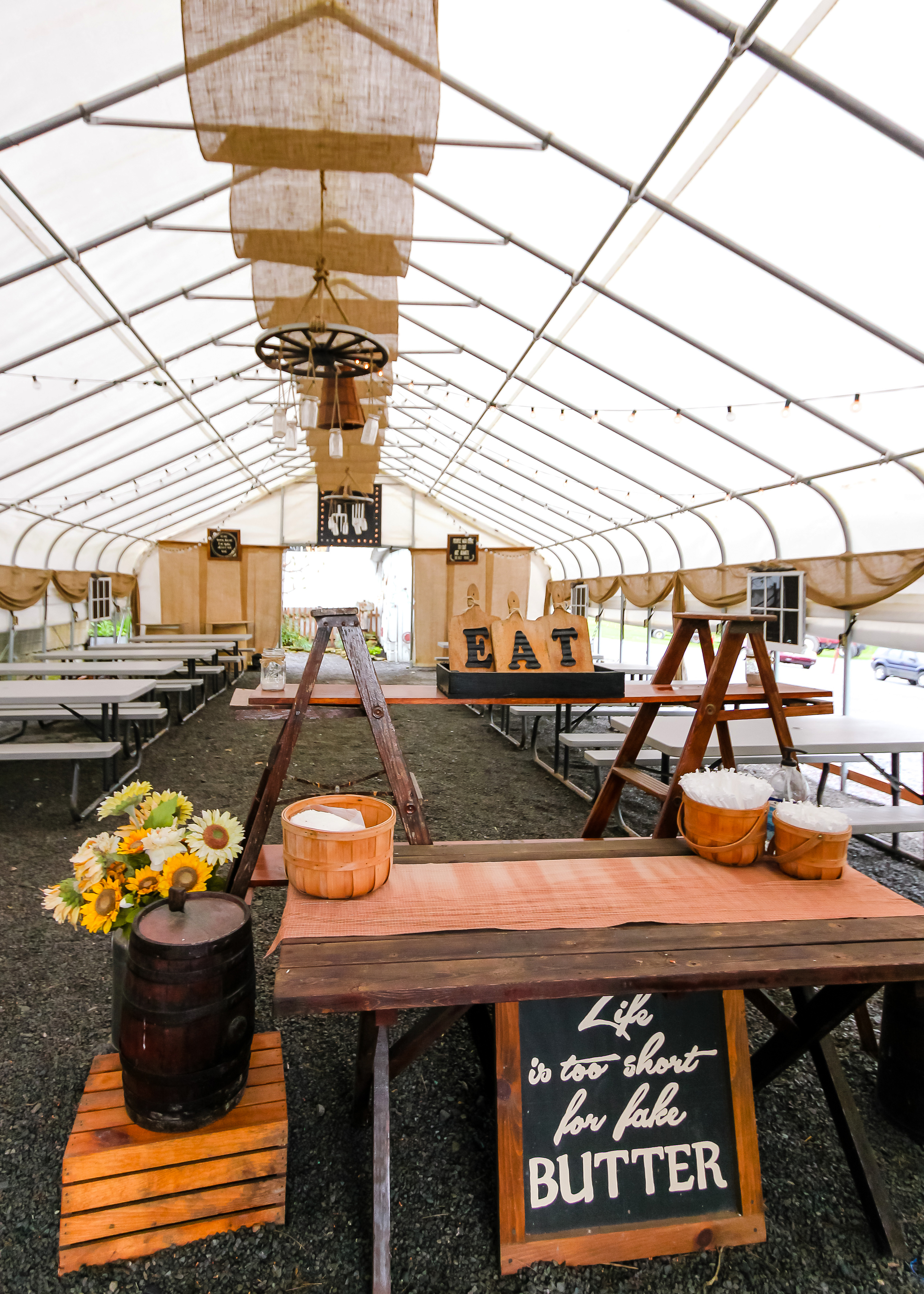
They have an on-site dairy store, but it is off the beaten track and represents just 2% of their sales. As we sit in the pavilion that Carissa’s sister Jen has decorated for the following week’s Pasture Party, Carissa explains the evolution of dairy trends coming full-circle.

She gives four examples: The resurgence of fresh, real and local foods; the ‘new’ idea of home delivery; how ‘old’ products like whole milk, butter, and cottage cheese, are making a comeback; and how those old paper cartons are making a comeback too.

(In fact, take a look at the dairy case the next time you go to the supermarket. Most ‘new’ plant-based non-dairy beverages and ‘new’ dairy case items like iced coffees are packaged in paper cartons.)

“Consumers are gravitating back to the carton,” says Carissa. While Vale Wood bottles a variety of sizes in plastic bottles, paper half-gallon cartons are also available “because our customers see this as a great thing, from an environmental standpoint, and we like it because it protects the milk from light.”

We talk about the growing number of consumers seeking food delivery services and how the meal kit companies have really taken off. In fact, the three biggest food retailers – Walmart, Kroger and Amazon/Whole Foods — have either bought or created meal kit or food box delivery services.

Even as total consumption of dairy milk continues to erode, the large chain supermarkets and big-box stores are getting into the game because their checkout scanners confirm that milk — real dairy milk — is still the most frequently found item in grocery baskets.

So the future will either be a competition for shrinking market share – or an all-out effort to expand the fluid market. Vale Wood pays attention to those trends to steady their market while opening eyes of consumers expand it.

The upheaval in the industry reveals the trend toward the nation’s larger retail chains wanting a bigger piece of the shrinking fluid market. Small processors, like Vale Wood, on the other hand, seek to appeal to consumers and increase product demand.

The direct competition for supermarket shelf space is becoming intense because milk, though consumption is down, is still a store’s gateway to win customer loyalty.

As all processors navigate the competitive pressures, it is the home delivery service that is steadying the ship for Vale Wood. That part of their business brings them back to that key: connecting with consumers. A big part of that connection is the cows at the farm.

“It’s unique that we still milk cows,” says Carissa. “The cows are central to our farm history and heritage and our sense of identity.”

The Itle family milks 200 cows. Their processing covers 400 cows, as they purchase milk from three neighboring dairy farms instead of expanding their own.

In addition to bottling milk and flavored milk and making ice cream, they do soft products like dips and cottage cheese, and are now doing flavored butters. They do “a little bit of everything” to capitalize on trends. This helps them deal with increased competition for fewer milk drinkers.

“We can never underestimate the effort required to get into (or keep) a market,” Carissa says. And those barriers to entry are becoming more challenging as store brand private label market share increases at the same time that non-dairy beverage alternatives compete for space in the dairy case.

Still, 95% of Vale Wood’s milk utilization is Class I, thanks in large part to their consumer connections and education that lead to product awareness and loyalty.

Achieving 7 lbs fat/protein has big impact on milk income

In the virtual breakout panel on maximizing components to improve the dairy’s bottom line, during the Pa. Dairy Summit recently, Heather Dann joined Pennsylvania producers Alan Waybright and Jennifer Heltzel. Dann is a research scientist at the William H. Miner Agricultural Research Institute, Chazy, New York.  Photo provided

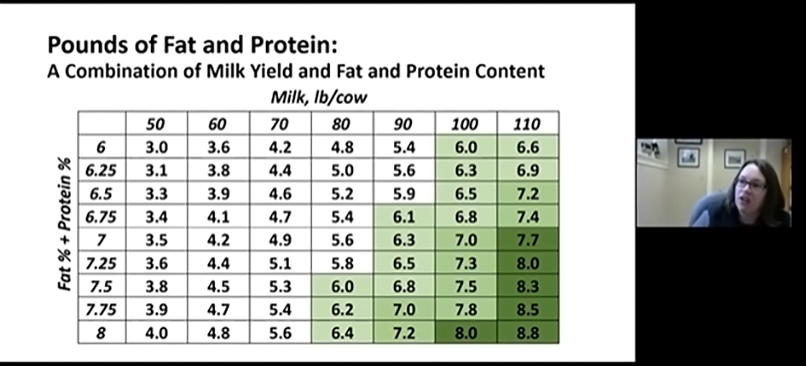
HARRISBURG, Pa. – Shipping 7 pounds of combined milk fat and protein is the threshold minimum for improved profitability. Heather Dann of Miner Institute in Northeast New York was part of a panel discussion during the Pennsylvania Dairy Summit, which included Alan Waybright of Mount Rock Dairy, Newville, milking over 800 Holsteins and crossbreds, and Jennifer Heltzel of Piney Mar Farm, Martinsburg, milking 120 Holsteins.

“Focusing on maximizing fat and protein is a key driver of profitability on the dairy farm,” said Dann, noting that a few years ago Cornell Pro Dairy did research showing return on assets (ROA) is highly correlated to milk income over feed cost (IOFC), and the biggest thing to affect IOFC is pounds of components produced.

At the Miner Institute, 480 Holsteins produce 98 pounds/cow with 1262 pounds of fat and 945 pounds of protein.

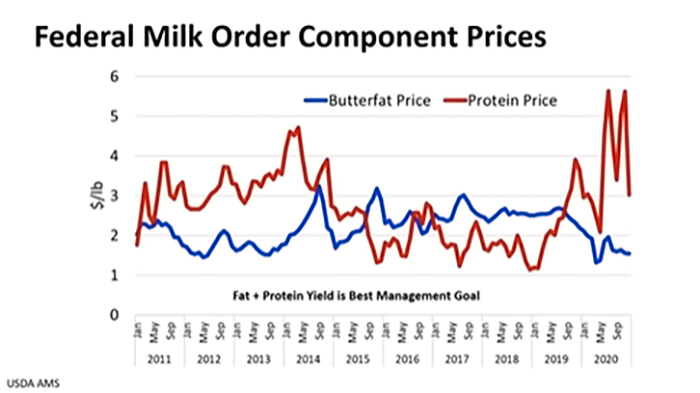
Dann showed a Federal Milk Marketing Order graph of the USDA milk price value of fat and protein over the past 10 years. No matter where milk prices are at — the combined pounds of fat and protein should be 7 pounds, or more, for the best return, she said.

“Protein has typically been worth more than fat,” Dann observed. “But the goal is to maximize both (protein and fat) to achieve profitability.”

She noted that this can be done through higher levels of milk production or through lower levels of milk production containing higher pounds of fat and protein.

To calculate, add the fat percentage and the protein percentage and multiply that total percentage to the pounds of milk. The goal is to be in the 7-pound range or higher, and at a minimum to be over 6 pounds total.

“To maximize components, get the diet and the dining experience right,” said Dann, noting that most farms use a nutritionist, so rations are formulated. Where the biggest area of opportunity lies is in the management of that ration – from the forages that are harvested, stored and utilized to the feedout, mixing and delivery of the TMR.

On larger farms with different people doing the feeding, Dann noted the importance of feed management software like TMR tracker.

Waybright talked about feeding to 3% refusals and then incorporating those refusals back into the TMR. Heltzel noted her husband feeds for accuracy to 1% refusals. Being that they milk 2x instead of 3x, the cows use the overnight time as resting time.

Dann talked about a research project at Miner where video cameras captured cow activity overnight when the bunk was purposely left empty. There was a lot of standing around at the bunk waiting for feed, she said.

“We never want to see an empty bunk,” she said. “We looked at what cows do when they don’t have feed. We removed feed and watched them, putting up trail cameras and videos to document. We tend to think if there’s no feed, they’ll go lay down, but what we found is they stand idly and wait for feed.”

During this study, they used different stocking densities to see the consequences of feed access as well.

“Cows running out of feed is bad for everyone, and even worse when cows are overcrowded. When the feed is delivered, if there is less time to access it, this changes their behavior and leads to slug feeding,” said Dann.

These are just some examples of how management of the feeding situation can contribute to low rumen pH that affect milk fat production to create milk fat challenges.

“We want to focus on ration formulation to optimize forage inclusion to maintain rumen health for milk component yields. And, if we think about the steps in the process, have a goal to make the metabolized ration the same as the formulated ration,” Dann explained.

On the forage side, harvesting and storage for a quality fermentation is critical. Also, when it comes to mixing feed for cows, loading ingredients in the right order and the right amounts with the appropriate mixing time and good maintenance of the mixer are important.

Dann noted that pushing up feed within the first hour of delivery helps with sorting.

Preparing the cow for the next lactation with how she is fed in the dry period is also important.

Both Waybright and Heltzel indicated they keep their dry cow rations simple.

“We look to control energy intake for her to have a good appetite after calving, while providing enough metabolizable protein to build her protein reserves as a dry cow,” said Dann, adding that they are big advocates of amino acid balancing for both lactation and dry cow rations.

Dann said the fat is the most variable component in milk. She talked about the composition of milk fat and testing that is available to know the fatty acid composition – whether preformed fatty acids, De Novo fatty acids and the amount of mixed profile fatty acids.

The De Novo fatty acids are made in the mammary gland and formulated through rumen activity. The mixed profile can include De Novo as well as pass-through ingredients from the ration.

“The fiber in the diet, when fermented in the rumen, creates the building blocks of the milk fat,” said Dann, adding that the microbial protein that is part of this process is also a great source of amino acids for the cow on the protein production side.

In a 40-herd study, Miner looked at the components and found high fat herds also had high levels of the De Novo fatty acids – the ones produced in the mammary gland from rumen function. This finding supports the idea that focusing on rumen health maximizes fat and protein production, whereas the amount of time cows spend in low rumen pH can reduce milk fat production and may reduce milk protein production.

The research showed that high De Novo fatty acid herds tend to have managers that are five times more likely to deliver feed twice a day in a freestall environment and 11 times more likely to deliver feed five times a day in tie stalls.

“Fresh feed delivery motivates cows to eat,” said Dann. “The 2x/day feeders vs. 1x/day feeders saw decreased sorting, increased feed intake and milk yield as well as rumination for a healthier rumen. That higher pH translated to more De Novo fatty acids which led to higher fat content in the milk.”

The research also showed that among the 40 herds, the higher fat herds were 10 times more likely to be provided with at least 18-inches of bunk space per cow and 5 times more likely to see stocking densities at 110% or less.

“Overstocking changes feed behavior,” said Dann. “With overcrowding, the cows slug feed and are more aggressive at the bunk, and this decreases rumination, which modifies rumen pH and increases risk of subacute acidosis or time spent in low pH. When we see up to two hours or more a day of low rumen pH, this affects milk yield and components.”

Miner research also has shown that cows will prioritize lying time over eating time. They will sacrifice eating time to compensate for lost resting time. This is why paying attention to the time budgets of cows in milking and holding time is important, as well as keeping feed at the bunk so they are not standing around at the bunk not eating.

“We want them eating or lying down, not standing and waiting,” said Dann.

In short, said Dann, “We want to manage the herd, the cows, to optimize key behaviors that maximize milk components.”

This means implementing cow comfort strategies that enhance rest and rumination, keep feed available 24/7 and lead to consistent feed quality.

Carefully formulated rations plus great forage and feed management plus top notch management of the environment add up to more components – a key to more milk income.

-30-
Grassroots efforts continue seeking solution to Class I formula change losses

While the buck is being passed, dairy producers are talking with lawmakers about the unintended consequences from the Class I mover change Congress enacted in the 2018 Farm Bill.

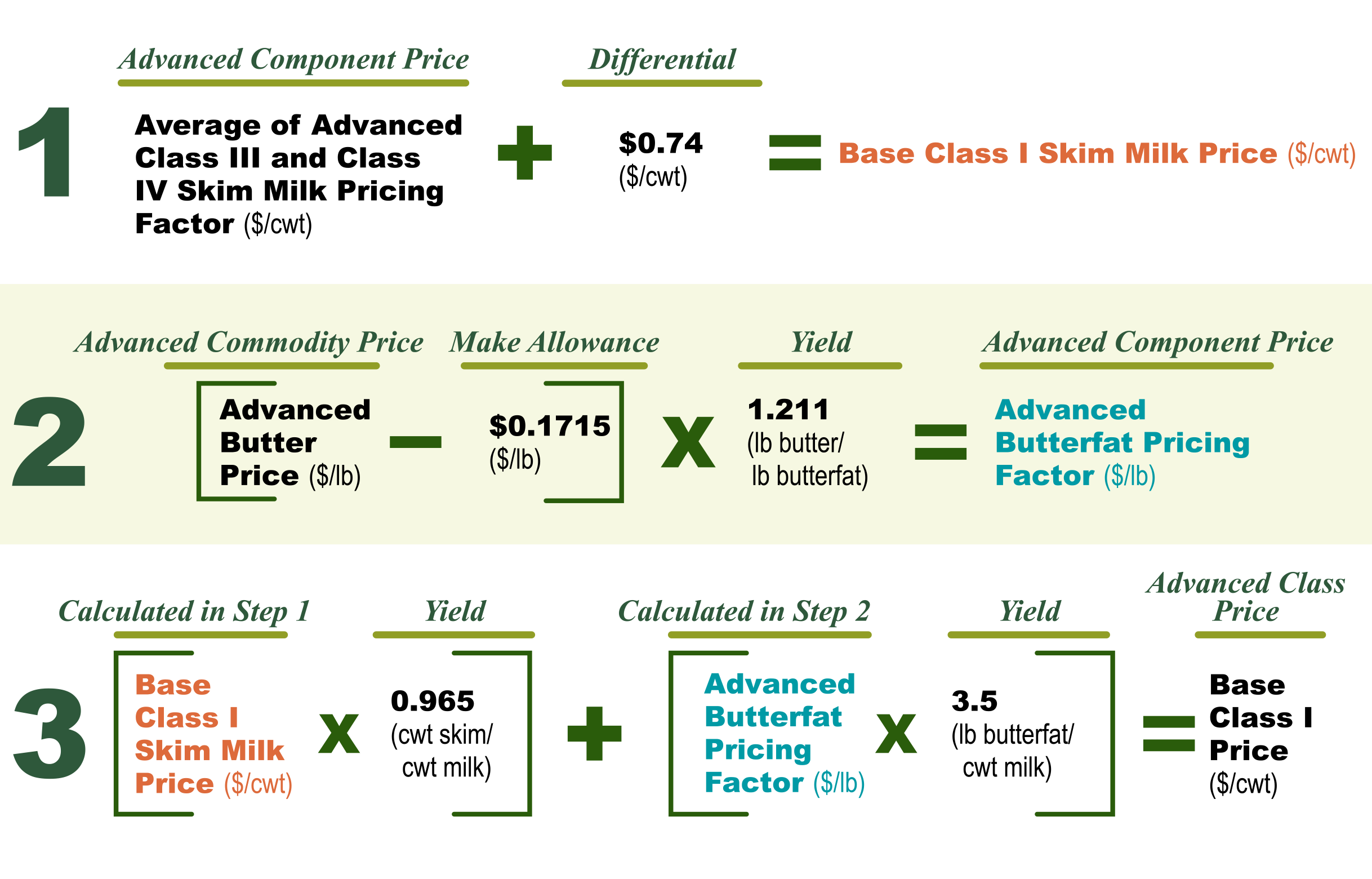
This illustrates the Class I mover formula since May 2019. Prior to that, the ‘higher of’ Class III or Class IV advance skim pricing factors was plugged into the first item under step 1 without the +74-cent adjuster to automatically be used as the Base Class I Skim Milk Price in the rest of the formula. Image Source: USDA

By Sherry Bunting, Farmshine, May 2021

WASHINGTON, D.C. — The Class I ‘mover’ is the subject of much discussion — two years after the averaging method plus 74 cents replaced the ‘higher of’ method to determine the base producer price of Class I beverage milk in May 2019.

A letter drafted by Senator Kirsten Gillibrand of New York is gathering signatures from Senators and will be sent to Ag Secretary Tom Vilsack regarding financial assistance to cover direct and indirect losses borne by dairy farmers due to the formula change exacerbated by the pandemic.

“By allocating more direct payments through CFAP, USDA could take action to reduce the strain that dairy farmers are facing. Specifically, the agency should continue issuing payments to dairy farmers under CFAP, or through any further assistance programs that USDA conceives, including the Pandemic Assistance for Producers initiative, for the first six months of 2021 and make these payments retroactive to January 1st,” the Senator’s letter states.

The American Dairy Coalition is urging producers to contact their Senators about signing onto the letter by end of day Monday, May 17. Senators should contact Dominic Sanchez at Senator Gillibrand’s office by email at Dominic_Sanchez@gillibrand.senate.gov

A transparent USDA hearing process was used 20 years ago to originally set the ‘higher of’ as the method when USDA rejected proposals for averaging Class III and IV due to depooling and negative differentials. However, in the 2018 Farm Bill, the Class I mover was changed from ‘higher of’ to an averaging method legislatively without hearings, without comment, without the producer referendum — without vetting.

Dairy groups are working to raise awareness among key lawmakers and USDA about the 24-month net loss of over $750 million in the Class I mover price from May 2019 through April 2021. In addition, these losses impacted orderly marketing and other factors, contributing to net losses exceeding $3 billion nationwide from inverted class price relationships that produced negative PPDs and led to depooling. In addition, dairy farmers had risk management losses when their milk was devalued, but they paid for risk management that failed because it was aligned with a “market value” they did not receive.

Sen. Gillibrand’s letter highlights the concern about the unintended consequences of the Class I formula change to averaging and away from ‘higher of’.

In the Northeast FMMO 1, for example, the Class I change, alone, accounted for a net loss of over $160 million in Class I devaluation over 24 months, and there were broader impacts of basis losses from reduced and negative producer price differentials (PPD) and depooling.

Northeast producer blend price losses are estimated to be $1.10/cwt, net, from May 2019 through April 2021. (Calculations are being done for other FMMO regions so stay tuned.)

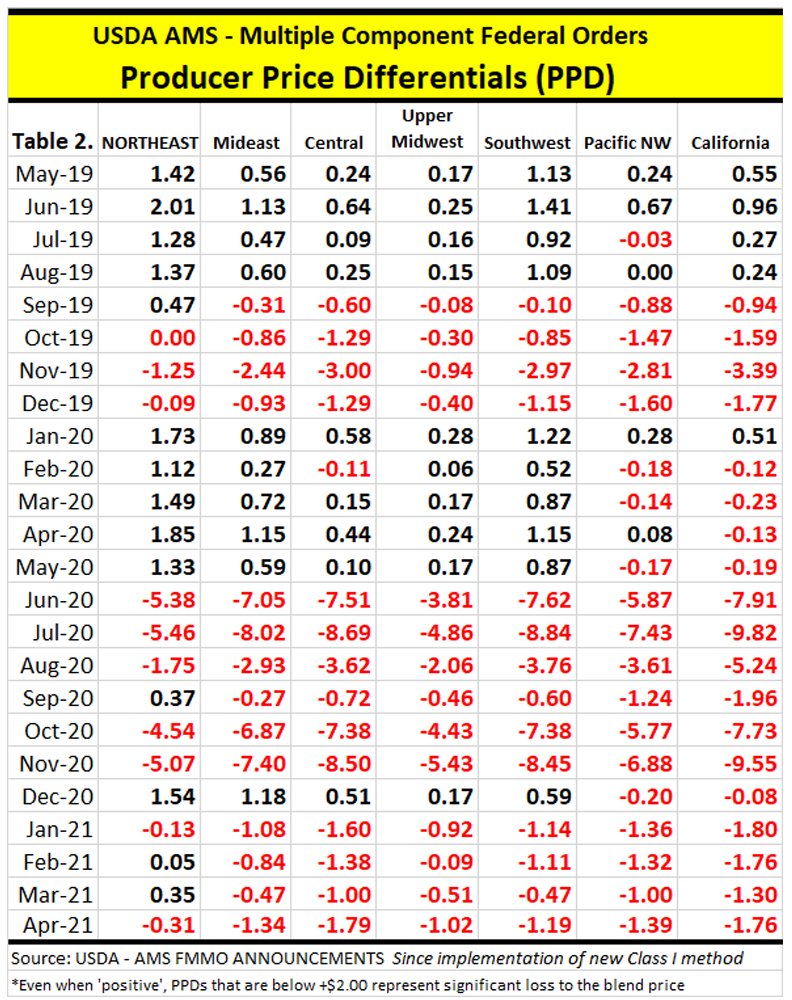
Similar loss estimations can be made for broader impacts across the U.S., depending upon how cheese plants determined pay prices for farmers when the FMMO uniform blend prices were suppressed by $1 to $10 across 7 of the 11 FMMOs that report producer price differentials. These PPDs were severely negative from October through December 2019 and from June 2020 through April 2021.

These formula-related losses are expected to continue through most of 2021 due to current market factors affecting how the class pricing formulas, with the change to Class I, relate to each other and how this impacts depooling.

Producers from the Southeast U.S. also began circulating a letter to Secretary Vilsack this week highlighting the steep losses in the three Southeast FMMOs and seeking direct payments through Coronavirus stimulus funds.

The Southeast letter asserts that milk producers in FMMO 5, 6, and 7 (Appalachian, Florida and Southeast) disproportionately bore 21% ($155 million) of the lost revenue directly attributable to the Class I mover change, because the 21% of Class I value loss fell on dairy farmers shipping just 5.5% of total milk pooled across all orders in the U.S.

Southeast producer blend price losses are pegged at $1.25/cwt.

The Southeast letter states that the loss was not shared equitably among all dairy farmers, due to depooling, which the letter indicates made it possible for dairy farmers marketing milk to cheese plants (Class III) to receive the shortfall.

However, many producers whose milk was depooled from FMMOs did not receive that shortfall from milk buyers, unless they had milk contracts based directly on cheese prices. Many manufacturing class handlers use the FMMO blend price as the benchmark for paying producers outside of pooling.

Several industry sources observe that this change turned out to be a big benefit to processors at great expense to producers. The problem surfaced under market conditions before the pandemic and was made worse by market conditions since the pandemic.

Even National Milk Producers Federation (NMPF) has admitted as much, stating that the International Dairy Foods Association (IDFA) wanted this change in the first place. NMPF indicates they went along with it after studying some historical trends thinking the 74-cent adjuster to the average would produce a result that was “revenue-neutral” for dairy farmers.

It was anything but ‘revenue-neutral’ for dairy farmers, even before the pandemic. The pandemic impact simply magnified the severity of loss.

Proposals continue surfacing since NMPF announced its intention to seek a USDA emergency hearing with a proposal to tweak the adjuster to the average every two years.

Minnesota Milk Producers, Wisconsin Dairy Business Association, Edge Cooperative and the Nebraska State Dairy Association joined together with a concept to change the Class I mover to a Class III-Plus that would be based on Class III announced prices instead of advance prices.

FarmFirst Cooperative based in Madison, Wisconsin, announced it would put forward a proposal to return to the ‘higher of’ calculation — if USDA holds a hearing. However, to-date, no official FMMO hearing requests have been received by USDA.

The first few months of the new Class I mover formula in 2019 were net-positive to the Class I price, but this dissolved by July, almost a year before the pandemic, when the gap between the rising Class III price and the averaging method for the Class I mover narrowed because the spread between Class III and IV widened.

Government food box dairy purchases through the pandemic included more Class III products (cheese) than Class IV (butter/powder) or Class II (soft products that are priced by Class IV).

But food boxes included plenty of Class I (fluid milk). Trouble is, fluid milk is not ‘market valued’ except for the value of its components in manufacturing. Fluid milk is discounted as a ‘loss-leader’ by large supermarkets, especially those that process milk.

Another factor that contributed to the wide spread between Class III and IV pricing has been the difference in product inventory as a factor of production, exports and imports.

In 2020, butter inventory reached a 20-year high, while cheese inventory declined. Butter production increased, especially in the first half of 2020, to exceed the record-breaking production of 2018, making less cream available for cheese production. Meanwhile, cheese exports rose 16% while butter exports declined 5%.

On the flip side, cheese imports declined 10% while butter imports were the second largest on record, up 15% over the previous year for the first 7 months of 2020. The U.S. ended 2020 with butter imports 6% above 2019.

The Class I formula change made FMMOs even more vulnerable to massive depooling against this volatile and divergent backdrop of Class III vs. IV. As averaging reduced Class I pricing, and the Class III milk was depooled, the net result was blend prices that reflected a larger portion of the much lower Class IV (and II). Dairy farmers have been educated to produce milk with higher component levels of fat and protein as a method to improve profitability, but negative PPDs snub this value at the farm level.

Looking through USDA Federal Milk Marketing Order statistical bulletins, this reporter calculates over 70 billion pounds of milk were depooled across all FMMOs from July 2019 through March 2021 due to inverted class pricing.

PPDs reflect the difference between the Class III market value of components minus the blend price of all classes in the pool. When PPDs are negative, it reflects insufficient pool funds to pay that value).

The depooling of Class III milk and the negative PPDs (above) began on the West Coast in July 2019. By September through December 2019, all multiple component FMMOs had negative PPDs, that became more negative as volumes of depooled milk were noted in the central part of the country, moving east.

The four skim/fat pricing FMMOs in the Southeast and Arizona were quite negatively affected by lower Class I minimums in the fall of 2019 and for many of the months thereafter. Topsy-turvy All-Milk and Mailbox Milk prices reported by USDA are further proof of shrinking basis in producer milk checks affecting the performance of purchased risk management tools. Even those USDA-reported All-Milk and Mailbox prices do not tell the whole story because USDA states that “the value is in the marketplace” even if it is not equitably shared with producers.

In essence, the Class I mover change was made to give large global companies buying large volumes of milk a means of ‘hedging’ their risk through forward-contracting on the futures markets. But this ‘benefit’ has resulted in taking real money out of dairy farm milk checks and has made it difficult, in some cases impossible, for producers to manage their risk with tools they purchase in the marketplace and through USDA.

Interestingly, the nation’s largest Class I fluid milk company — Dean Foods — filed for bankruptcy sale and reorganization in November 2019 in the midst of the first appearance of negative PPDs and depooling pre-pandemic.

By January 2020, PPDs turned positive but narrow in comparison to prior history, so that’s still a loss. Then, in February, a month before the Coronavirus shutdown, negative PPDs and depooling again showed up in the Central, Pacific and California FMMOs.

By June 2020 — in the midst of the Covid-19 pandemic and one month after the bankruptcy sale of most of the Dean Foods Class I fluid milk plants to DFA — severely negative PPDs of -$1 to -$10, exacerbated by depooling, were prevalent across all FMMOs, most every month from June 2020 through the present.

Even in the Northeast FMMO, where statistics show positive PPDs in some months when other FMMOs were negative, the basis loss to Northeast producers is real because even the positive PPDs in FMMO 1 over the past 24 months are $1 or more below where they were just two years earlier.

As reported in Farmshine last week, Secretary Vilsack says it’s “complicated” and the industry is “divided” so no “significant” changes can be made “quickly.”

NMPF says it intends to request an FMMO hearing of its proposal to adjust the adjuster to improve equitable treatment of producers.

IDFA is publicly silent.

Other groups are floating a proposal that, if officially proposed in an emergency hearing, would turn the deal into a full and lengthy FMMO hearing.

During a Hoards Dairy Livestream session May 5 with Erin Taylor from USDA AMS Dairy Division, a little more was learned about how USDA handles ‘emergency’ FMMO hearings. Taylor said proposals can be put forward with arguments as part of the package, explaining the emergency to make a case for why the USDA should move quickly. USDA then typically responds and gives the industry a 30 day notice if a hearing is granted, but the statute only requires 15 days, and 3 days at a minimum — depending on the emergency conditions.

Like other FMMO hearings, testimony is taken, and if USDA agrees with the proposal based on the evidence, the department could do a recommended decision, receive public comment and then publish a final decision and conduct the producer vote. Or, the Secretary can do a tentative final decision for immediate producer vote while taking testimony concurrently. In such a scenario, USDA would come back and consider that testimony, and if a change to the tentative final decision is made — based on testimony and comment — then a second producer vote would be conducted.

Generally speaking, according to Taylor, a move to use a tentative final decision cuts about 4 to 5 months out of the hearing process, but this is not done without proponents showing good cause and when there is no opposition to the proposal.

And the Congress? They made the change from ‘higher of’ to ‘average-plus’ at the request of IDFA with agreement by NMPF in the last Farm Bill.

Many members of Congress don’t know what they did. Others are “blowing it off” as “pandemic-related,” when in reality the issues began in 2019.

Lawmakers are also being told the 2018 ‘average-plus’ deal was an historic agreement between “producers” (NMPF) and “processors” (IDFA), when in reality the grassroots in either of those categories had no opportunity to be heard, to testify, to comment, and producers were denied a referendum on the change. In addition, there was little industrywide discussion.

National and state dairy organizations have been collaborating on weekly calls facilitated by American Dairy Coalition to thoughtfully approach a solution from both the short- and long-term perspectives.

While most would agree hearings on long-term FMMO reforms are needed, the short-term fix for the unvetted Class I formula change by Congress could be undone with legislation reverting to the previous formula, or through an expedited FMMO hearing as the flaws of the new formula have been revealed in both the pre- and post-pandemic markets by this average-plus change that was not vetted.

Grassroots efforts seek to raise awareness in Congress to move something forward legislatively.

While the Congress has always said it does not want to set precedent for making milk price formula changes outside of the vetting process of an FMMO hearing, and while the Congress rebuffed numerous requests for a national FMMO hearing in every Farm Bill since 2008, the Congress did go ahead and set that formula-changing precedent in 2018 by passing language in the Farm Bill to change the method for determining the Class I mover from the ‘higher of’ Class III or IV to ‘average-plus’… and here we are.

Producers can point this out when talking with lawmakers, to let them know that the current situation is unsustainable. Producers can explain to their legislators how this impacted them, to help them understand there is more to this story than “it’s the pandemic and you’ll be fine.”

If nothing is done, several industry observers see dairy farm exits rising at a faster rate in the coming year.

In short, the Class I mover change in the 2018 Farm Bill:

— was not vetted through a transparent hearing process,

— disrupted orderly marketing,

— undermined Federal Order purpose,

— created NET losses for producers of $751 million in Class I value (May 2019 through April 2021), and contributed to a net loss of over $3 billion in negative PPDs and depooling,

— created additional losses for producers in the failure of risk management tools not designed for inverted pricing, and

— undermined performance of the DMC safety net due to basis loss.

While the American Dairy Coalition continues to facilitate grassroots producer discussion and seeks a seat at the table for producers with NMPF and IDFA, ADC has also sent an email to dairy producers and organizations with a letter they can provide to lawmakers.

The most important thing is for lawmakers to understand how the pricing change, and the domino effect of negative PPDs and depooling have affected their already struggling dairy farm constituents over the past two years.

To locate the Senators and Representatives for your state, visit https://www.govtrack.us/congress/members

Proposals, hearing requests, grassroots outreach to lawmakers as Class I ‘mover’ debate heats up

By Sherry Bunting, Farmshine, April 30, 2021

WASHINGTON, D.C. — National Milk Producers Federation (NMPF) announced Friday, Apr. 23 a Class I mover reform proposal and intention to request a USDA Federal Milk Marketing Order (FMMO) hearing that would be limited to proposed changes to the Class I mover, after which USDA would have 30 days to issue an action plan that would determine whether the department would act on an emergency basis.

According to NMPF, their proposal would “modify the current Class I mover, which adds $0.74/cwt to the monthly average of Classes III and IV, by adjusting this amount every two years based on conditions over the prior 24 months, with the current mover remaining the floor.”

This adjuster change, if done today for the next two years, would pencil out above the current 74 cents (estimated $1.63).

The NMPF action comes after eight weeks of discussion by grassroots dairy producers and state and national dairy organizations seeking a seat at the table to address lost income and risk management disruptions influenced in part by the Class I mover change that was passed by Congress in the 2018 Farm Bill and implemented by USDA in May 2019.

While NMPF and IDFA have reportedly had conversations on the issue, IDFA has not yet publicly-announced a position.

On Tuesday (April 27), another proposal — called Class III Plus – was announced by a collaboration of state dairy groups in the Midwest. This proposal would also end Class I advance pricing factors.

Seasoned dairy policy analysts and economists suggest more proposals may be forthcoming.

USDA “will do the things it knows it can do to impact the (milk income) concern by providing better market opportunities, new market opportunities,” said U.S. Agriculture Secretary Tom Vilsack answer questions from North American Ag Journalists Monday, calling FMMO reform a “tough issue.”

On the specifics, though, the Secretary said simply that USDA would look to the industry “to work with them on the changes that need to take place.

“It’s a very very complicated issue, and not one that should be easily characterized. Anyone that tries to do that doesn’t understand the complexity of that particular topic. It’s very complex,” Vilsack explained. 

He acknowledged that conversations are occurring within the dairy industry, but said: “Those conversations need to mature a bit more before anybody makes a decision that there’s going to be a significant change.”

However, in contrast to the Secretary’s observations, a “significant change” has already been made across all FMMO’s, legislatively, and it was done without hearings, without comment, without a producer referendum, without much conversation and without the knowledge of many dairy producers.

So here we are. The buck is being passed as the ball is being volleyed between industry, legislative and administrative. The volley started when NMPF and IDFA proposed the mover change in 2017-18. Congress then passed it, thereby replacing the mover that had been set by administrative hearing process 20 years ago, when USDA chose the higher of instead of an averaging method and documented disorderly marketing, negative differentials and depooling, back then.

Now, the volley is open again for what looks to be a toss from legislative to industry to administrative hearing requests.

For its part, NMPF states that the current mover was “intended to be revenue neutral while facilitating increased price risk management by fluid milk bottlers. The new Class I mover contributed to disorderly marketing conditions last year during the height of the pandemic and cost dairy farmers over $725 million in lost income.” 

Analysis by various industry experts, including Farm Bureau’s Market Intel, peg the broader net farm losses at $3 billion when the change influenced a domino-effect of negative producer price differentials (PPDs) and massive depooling.

In the three fat/skim pricing FMMOs of the Southeast U.S. where PPDs are not shown, Calvin Covington calculates dairy farmers in FMMO 5, 6 and 7 collectively had net loss of $1/cwt off the blend price for 23 months due to the mover change from higher of to average-plus.

NMPF’s proposal is described as helping “recoup the lost revenue and ensure that neither farmers nor processors are disproportionately harmed by future significant price disruptions.”

A Penn State Ag Law Center webinar already planned on FMMOs this week, turned into a hot topic. Brook Duer, staff attorney for the center and moderator asked webinar guest Dr. Andrew Novakovic, Cornell professor emeritus about the specifics of the NMPF proposal.

“This proposal would recalculate the adjuster every two years, except the adjuster can never be less than 74 cents,” Novakovic said. “They are not talking about changing the ‘average of’ back to the ‘higher of.’”

In weekly producer conference calls facilitated by American Dairy Coalition after a letter was sent to NMPF and IDFA signed by hundreds of dairy farmers and organizations, a return to the higher of was identified as a short-term option while long-term proposals are vetted. American Dairy Coalition, and the grassroots groups who have been part of the conversation since February, sent emails with talking points, urging producers to contact key lawmakers and talk to them about the situation.

Proponents of a return to the higher of point out it was already vetted by USDA hearings, whereas the current average plus 74 cents was not.

“As the COVID-19 experience has shown, market stresses can shift the mover in ways that affect dairy farmers much more than processors. This was not the intent of the Class I mover formula negotiated within the industry,” noted Randy Mooney, chairman of NMPF’s Board of Directors in a press release. “The current mover was explicitly developed to be a revenue-neutral solution to the concerns of fluid milk processors about hedging their price risk.

“Dairy farmers were pleased with the previous method of determining Class I prices and had no need to change it, but we tried to accommodate the concerns of fluid processors for better risk management,” Mooney stated further. 

“Unfortunately, the severe imbalances we’ve seen in the past year plainly show that a modified approach is necessary. We will urge USDA to adopt our plan to restore equity and create more orderly marketing conditions.”

Modifying the adjuster every two years is backward-looking for forward-adjustments. 

The current mover is already challenged by timing between Class I advance-pricing and Class II, III, IV announced prices as well as the higher protein production on farms in a system that prices protein in manufacturing classes but prices fat and skim solids in the fluid class.

In the Class III Plus proposal jointly announced by Wisconsin Dairy Business Association, Edge Dairy Farmer Cooperative, Minnesota Milk Producers Association and Nebraska State Dairy Association, advance pricing of Class I would also be ended.

The mover would be linked to the Class III announced skim price, not the advance skim pricing factor. The proposal includes an adjuster that would be revised annually in September by USDA for the forthcoming calendar year. It would equal the average of the monthly differences between the higher of Class III and IV skim milk prices, and the Class III skim milk price during the prior 26 months. 

This adjuster would be floored at 36 cents just for the 2021-25 period “to facilitate faster convergence toward revenue-neutrality after COVID-19,” according to the announcement.

For its part, NMPF states that, “The significant gaps between Class III and IV prices that developed during the pandemic exposed dairy farmers to losses that were not experienced by processors, showing the need for a formula that better accounts for disorderly market conditions.”

To be sure, all FMMOs also saw gaps and inversion for three to six months in the pre-pandemic summer and fall of 2019.

When asked about the FMMO purpose and the ‘mover’ being set at the higher of to move milk to Class I use, Novakovic said USDA would have to look at the actual effect of the ‘average of’ on that purpose.

“Do we see any problem getting milk into Class I markets? Are they complaining there is not enough milk going to Class I?” he asks. “Probably the opposite direction is more true.”

Moving milk to Class I may be more of a discussion for the high fluid utilization areas of the Southeast, where producers end up indirectly ‘paying’ to bring milk in during deficient times of the year. This can be costly when there are price gaps and inversions as documented in the fall months of both 2019 and 2020.

When asked what recourse dairy producers may have in this, Novakovic indicated that lobbying the legislature is “theoretically possible” but that a legislative change is not likely apart from the next Farm Bill, which is three years away.

He also speculated that if someone put forward a proposal to return to the higher of for the next two years — and referred to the reasons given by USDA in its 2000 hearing decision – it’s “not inconceivable” that USDA could say they like what they had better than what Congress made them do, and perhaps like it better than changing adjusters or other ‘new’ proposals that would require a more lengthy hearing process if the industry is divided.

Novakovic was also asked how the Class III Plus proposal from the Midwest would affect Pennsylvania, given the state’s mostly Class I and IV utilization.

He responded to say Pennsylvania is part of FMMOs that include Class III (Northeast Order 1 and Mideast Order 33). He did not see any particular effect for the Northeast markets.

“Class IV would still be Class IV and II will be driven by IV values, and III would be unaffected, so the only question is what you would see happening with Class I,” said Novakovic. “The only way I see this proposal being viewed as a surprise is on the occasions when IV is higher than III, and that has occurred with some frequency in the past.”

The Northeast FMMO has seen a decline in Class III percentage relative to increase in Class IV and II over time. Class I sales also declined precipitously over the past decade but stabilized in 2019 and 2020 with rising sales of whole and 2% milk.

Novakovic confirmed that part of the problem in pricing Class I is the lack of beverage milk market indicators to do so.

As mentioned previously in Farmshine, Class I is required to participate in FMMO pooling, other classes are voluntary. Class I also has regulation at some state levels. On the other hand, in most states, beverage milk is used as a loss-leader in supermarkets, especially as large processing retailers dramatically cut the gallon price to compete for shoppers.

Under these factors, there is no way to gauge a ‘market value’ for Class I beverage milk apart from piggy-backing the other classes that value milk’s components in the manufacture of cheddar, butter, nonfat dry milk and dry whey.

The issue at hand is how to do that, now, in hindsight, after a significant surgical change was quietly made, and failed, and in the future within the context of FMMO reform.

-30-
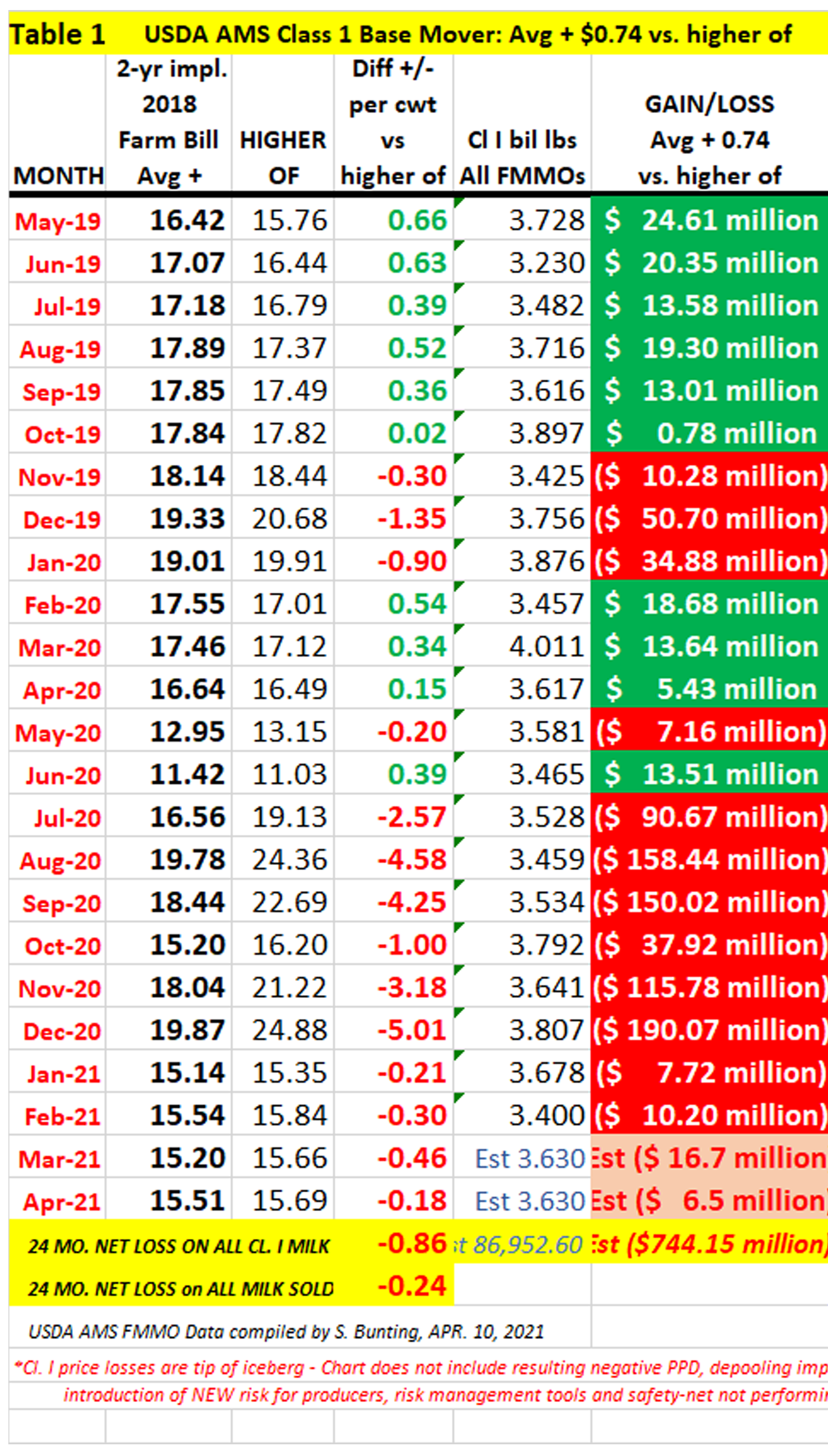
From DMI to NZI to DS4G: Harper, McCloskey explain how scale will drive dairy to net zero

Author’s Note: This is part one in a multi-part series about DMI’s Dairy Scale for Good piece of the Innovation Center for U.S. Dairy’s Net Zero Initiative.

By Sherry Bunting, updated from publication in Farmshine, April 23, 2021

ROSEMONT, Ill. — “Looking at the past 50 years of impressive achievement, everything ladders up to milk efficiency. It’s less land. It’s less manure. It’s less water and less carbon, but it’s all about that milk,” said Caleb Harper, executive director of the Dairy Scale for Good (DS4G) piece of the DMI Innovation Center for U.S. Dairy’s Net-Zero Initiative (NZI).

“For the next 50 years, what if it was all about everything other than the milk. As we continue to advance toward yield of milk… you’ll start to see a rise in the importance of everything else,” said Harper, posing a “value proposition” for the dairy industry.

Harper, along with Dr. Mike McCloskey, of Fair Oaks Farm, Fairlife and Select Milk Producers, talked about NZI and DS4G in an online Balchem ‘real science lecture series’ earlier this month. McCloskey is an officer on the board of National Milk Producers Federation and has chaired the DMI Innovation Center’s Sustainability Initiative since inception.

The future being created, according to Harper and McCloskey, is one of dairy being recognized as an “irreplaceable ecosystem asset — an environmental solution — inside a comprehensive management plan for emissions reduction inside of animal ag livestock.”

Citing the Nestle and Starbucks sponsorships and others coming on near term, Harper said the pilot projects associated with each company will be located in separate supply chains. The sponsorships are being made, he said, because these companies have made big commitments to reducing carbon.

“As checkoff, one of our limitations is the ability to do on-farm work, especially around technology acquisition or measurement, so we need these third-party dollars to come in and be the catalyst to get living laboratories set up,” Harper explained.

Before Harper’s presentation about how the Net Zero Initiative builds-out the ‘everything else’ pieces, McCloskey gave historical context about the birth of the Innovation Center for U.S. Dairy in 2007.

“The trajectory (since 1940) is just phenomenal when you lay out the statistics,” said McCloskey. “We came together – National Milk, DMI, USDEC – and had a great meeting of the minds (in 2007). We said this natural sustainability progress will continue, but we need to accelerate it and be catalytic in how we can become the organization to drive this at a faster speed to net-zero.”

According to McCloskey, 80% of the nation’s milk is represented at this NZI table, and the dairy industry is the one to “really come out of the gate on this.”

The whole value chain from distributors to processors to retailers and companies that create packaging (are represented), so we have a really good understanding of the entire value chain and can focus on how to eliminate carbon footprint to bring it to net-zero,” he said.

The baseline life-cycle assessments (LCA) were the first steps 10 to 13 years ago to figure out “exactly where” the carbon was coming from, and the April lecture discussion focused field to farm, noting that the processors have a separate working group looking post-farm through consumption.

McCloskey said the LCA categorized carbon in 4 areas:

1) Farming (feed production) practices
2) Manure management
3) Enteric emissions from cows
4) Energy intensity of the operation (including renewables)

“Once we knew where the carbon was coming from, we started initiatives to find processes and technologies to innovate and accelerate the process to net-zero even faster,” said McCloskey, explaining the heavy participation from companies serving on committees and through initiatives these past 13 years.

Then, a year and a half ago, “we committed to the term net-zero,” he said. “That was a big jump.”

This bit of history set the stage for Harper to talk about the part of the Net Zero Initiative he heads up: Dairy Scale for Good (DS4G).

Harper was hired by DMI last May for the DS4G position just weeks after exiting M.I.T.’s Media Lab April 30th, after his OpenAg Initiative there came under scrutiny and was quietly closed.

“Caleb is looking at the four areas and how we can take technologies and processes and innovate them into DS4G,” said McCloskey.

Harper noted that dairy and agriculture are not operating in a vacuum. He said the first “bold commitments” to net-zero time frames between now and 2050 were made by big tech companies like Facebook, Amazon, Google, followed by food brands, companies across the food value chain, and then the agricultural input sector.

Throughout his presentation, Harper referenced the Biden administration policies the work hinges on, using much of the same coordinated language that surfaces via the World Economic Forum Great Reset and United Nations Food Systems Summit and what is called “The Fourth Industrial Revolution” in which technology is already rapidly accelerating.

“We’re seeing a shift in philosophy and it’s being driven by all of these commitments,” said Harper, insisting that, “It’s being driven, of course, by consumers.”

He showed pre-Covid poll statistics from the Hartman group. One in particular noted that 88% of consumers surveyed “would like brands to help them be more environmentally friendly and ethical in their daily lives.”

“Dairy has made the commitment to being an environmental solution,” said Harper, which means becoming carbon neutral or better, optimizing water use while maximizing recycling, and improving water quality by optimizing utilization of manure and nutrients.

Three working groups or initiatives were formed within the field-to-farm Net Zero Initiative: 1) Research, analysis and modeling; 2) Viability study, which is DS4G headed by Harper; and 3) Adoption for collective impact.

The Adoption piece will distill and disseminate across the industry what is learned through research, modeling and Harper’s DS4G work.

It is all about driving consumer choices under this net-zero mantra. Industry consolidation also figures into this equation to “scale the process and drive out the risk,” said Harper.

Many of the numbers in Harper’s presentation were taken directly from the World Wildlife Fund (WWF) white paper An Environmental and Economic Path Toward Net Zero Dairy Farm Emission.”

Harper cited environmental pressure and animal activism pressure on the U.S. dairy industry. He said: “This program (Dairy Net-Zero) is being supported by the World Wildlife Fund and others in the environmental space as a path towards a solution on all of these issues.”

Insisting that the Net Zero Initiative and DS4G operate with a “counter-balance” of environment and economics, the examples discussed by Harper included estimates for what producers may expect as returns for various environmental products and services.

Illustrating carbon footprint for a gallon of milk across all sectors from field to consumer, Harper and WWF maintain that the field-to-farm portion represents the largest potential (70%) for reducing CO2 equivalent emissions more than retail, consumption, processing and distribution combined. Harper said he sees this as work and opportunity. McCloskey had noted earlier that the processors have their own working group looking at emissions from farm to consumption.

The WWF white paper lays out the “business case” for the Net Zero Initiative, based on a 3500 cow dairy (a Fair Oaks site with 3000 milking and 500 dry). In fact, Harper’s DS4G work will exclusively pilot and model on dairies of this size.

“This is to make maximum impact on the supply of milk in the short-term,” he said. “If we look at the kind of consolidation going on in the industry, the herd sizes above 1000 cows are a small percentage of the total herd; however, (they account for) 55% of the milk production.”

Harper explained the DS4G concept this way:

“The idea is to use scale to address these (net-zero) issues so we can drive down the risk of adoption, the risk of market-building, the risk of technology… to bring that down to a level and spread it across the industry, across the milk.”

Walking through the technologies and processes that the checkoff-funded DS4G is “thinking about,” Harper indicated that this is “evolving”, and all revenue potential figures are “approximate”.

He mentioned a billion dollars of investment in digesters over the last few years from private equity funds, pension funds, and venture investors, with digesters representing — “rule of thumb” — one-third of the revenue potential of net-zero going forward. The new market opportunities driving that revenue potential, he said, are natural gas prices and the increasing value of the low-carbon renewable fuel credit price. The combination is what is attracting investors, according to Harper.

Harper said he has visited 100 dairy farms in 17 states in his first 11 months as the dairy-checkoff employee heading up DS4G. Of the dairies he has visited with more than 2500 cows, he said not one did not either have a digester or was breaking ground for a digester or in the process of planning a partnership around one.

He also talked about feed additives to address enteric emissions, cropping practices, and manure management technology, including ultrafiltration of manure as part of a “technology train” for the future. To be continued

-30-
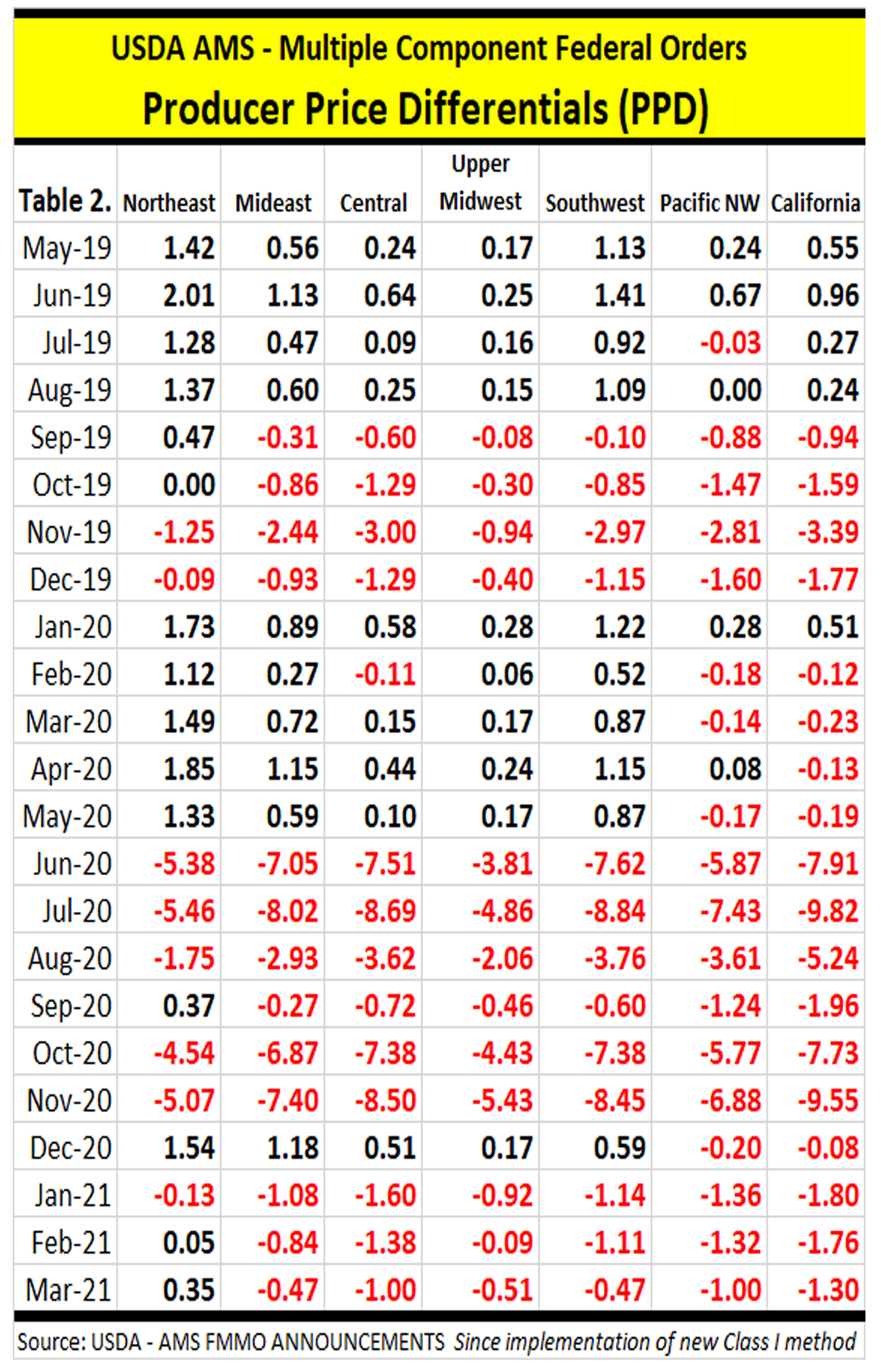
(Author’s Notes: The WWF Markets Institute released its dairy white paper Jan. 27, 2021. A mid-February Farmshine report revealed the WWF mathematical error that had inflated the magnitude of CO2 equivalent pounds contributed by all U.S. milk production. WWF on Feb. 25, 2021, corrected this baseline to show the much smaller collective impact of 268 billion pounds CO2 equivalent (not 2.3 trillion pounds). Both Harper and McCloskey serve on the WWF Market Institute’s Thought Leadership Group. Harper also served as a board member of New Harvest 2017-19, a global nonprofit building the field of cellular agriculture, funding startups to make milk, meat and eggs without animals. DMI confirms that dairy checkoff had an MOU with WWF from the inception of the Innovation Center for U.S. Dairy around 2008 through 2019. McCloskey has chaired the Innovation Center’s Sustainability Initiative since 2008. In 2008-09, two MOU’s were signed between DMI and USDA via former U.S. Ag Secretary Tom Vilsack — the Sustainability Initiative and GENYOUth. At the end of the Obama administration, Vilsack was hired by DMI dairy checkoff to serve as president and CEO of USDEC 2016-2021, and earlier this year he became Secretary of Agriculture again after President Joe Biden said Vilsack ‘practically wrote his rural platform and now he can implement it.” McCloskey and Harper also have another connection. According to the Sept. 2019 Chronicles of Higher Education, Caleb Harper’s father, Steve Harper, was a grocery executive. He was senior vice-president of marketing and fresh product development, procurement and merchandising from 1993 to 2010 for the H-E-B supermarket chain based in Texas. According to a 2020 presentation by Sue McCloskey, H-E-B was their first partner in the fluid milk business in the 1990s, followed by Kroger. According to the Houston Chronicle, the McCloskeys also partnered with H-E-B in 1996 to produce Mootopia ultrafiltered milk, an H-E-B brand. This was the pre-cursor to fairlife, the ultrafiltered milk beverage line in which DMI invested checkoff funds through the Innovation Center for U.S. Dairy partnering with the McCloskeys, Select, and Coca Cola.)

Congressman: ’97 Milk is leading the way’

“This is more than an organization, it is a movement, and I love that,” said Congressman Glenn ‘G.T.’ Thompson, speaking to dairy producers and enthusiasts at the 97 Milk meeting in Lancaster County, Pa.

By Sherry Bunting, previously published in Farmshine April 2021

EPHRATA, Pa. – “This organization is getting it done,” said U.S. Congressman Glenn “G.T.” Thompson (R-Pa.-15th). Thompson is the Republican leader of the U.S. House Agriculture Committee, and he gave the efforts of 97 Milk LLC and the Grassroots Pa. Dairy Advisory Committee two thumbs-up. Rep.

Thompson was a special guest addressing the group of mostly dairy farmers attending the 97 Milk reorganizational meeting at Mt. Airy Fire Hall near Ephrata, Pennsylvania, Tuesday, Apr. 6, 2021.

The groups’ efforts were formed in early 2019, after Berks County dairy farmer Nelson Troutman painted his first round bale with the words: “Drink Whole Milk 97% Fat Free”.

Nelson Troutman of Pennsylvania and Ann Diefendorf of New York talk ’round bale’ painting technique after the meeting — comparing notes.

At the 97milk.com and facebook page @97milk, are the words: “We believe… in supporting local dairy farmers. We believe we can make a difference by sharing facts, benefits, and the good taste of whole milk so consumers can make informed decisions.”

According to Congressman Thompson, the battle to improve milk demand and to legalize whole milk choice in schools has two fronts – legislative policy and milk messaging.

“97 Milk is leading the way in the nation on messaging. Going from bales and beyond, what you have done is just incredible,” the Congressman said. “Keep doing what you are doing with the well-designed combination of influencing, marketing and providing factual information.”

In fact, Rep. Thompson took home and now proudly displays a “Drink Whole Milk – School Lunch Choice – Citizens for Immune Boosting Nutrition” yard sign in his front yard.

Grassroots PA Dairy Advisory Committee chairman Bernie Morrissey has been printing and distributing hundreds of these yard signs with the donations of area agribusinesses, other organizations and individuals.

Rep. Thompson represents 24% of Pennsylvania’s land mass across 14 counties. Even before becoming the lead Republican in the U.S. House Agriculture Committee, dairy has always been a key farm focus for him, and bringing the choice of whole milk back to schools a key issue. As Ag Committee Ranking Member, he now also represents all of agriculture with responsiveness across the nation.

He reported that “progress is being made. But we are starting in the hole, not from a neutral position. We have lost a generation of milk drinkers since whole milk was demonized and removed from schools in 2010.”

His bill, the Whole Milk for Healthy Kids Act, could change that. H.R. 1861 is a bipartisan bill that has been reintroduced in this 2021-22 session of Congress with cosponsor Rep. Antonio Delgado, a Democrat from New York. The bill currently has 24 cosponsors.

In fact, among those attending the meeting in Pennsylvania was a contingent of folks from upstate New York looking to start a 97 Milk chapter there.

Also in attendance was David Lapp of Blessings of Hope. He confirmed that their partnership with 97 Milk was “a big success,” raising over $70,524 of which $16,000 remains for processing and buying milk. So far, those funds processed or purchased 45,000 gallons of whole milk for those in need, and over 20,000 packaged gallons were additionally donated during the pandemic.

Blessings of Hope was also involved in the Farmers to Families Food Box program through USDA, distributing a million gallons since May, of which Lapp said, 90% was whole milk!

GN Hursh, a Lancaster County dairy farmer and 97 Milk chairman, thanked everyone for doing their part to educate and promote whole milk. Referring to Berks County dairy farmer Nelson Troutman as “the seed” of the 97 Milk movement painting the first round bales with Drink Whole Milk 97% Fat Free, he asked Troutman to introduce the Congressman during the meeting — an honor Troutman put in the way only he can: “I never thought I would be introducing the Ranking Member of the House Ag Committee in ‘downtown’ Mt. Airy.”

That got a laugh from the group sitting in the rural town fire hall of northern Lancaster County.

The humble and persistent work of 97 Milk and the Grassroots PA Dairy Advisory Committee took root in southeast Pennsylvania, but is also being joined-in by dairy producers and supporters across the state and nation, noticed by dignitaries and officials in policy and legislative arenas and reaching every-day families and consumers across the nation and around the world.

The needle is being moved.

Marketing manager Jackie Behr said the key is to keep bringing ideas forward for the website, social media and events. She took the attendees through 97 Milk’s digital presence step by step and showed how the goal is to keep things fresh and keep bringing information and facts to the eyes of the growing traffic coming to the website.

Behr showed how the website and social media together give facts about whole milk, fun activities, recipes, and a personal connection of consumers to farmers.

“We always want to have new facts and something fun,” said Behr. “We rely on you to send us news articles and ideas that we can put on the website and post. We also rely on farmers to send in photos and thoughts and stories to keep it fresh.”

She reminded everyone that the website has a download section to download and print things, as well as a store to buy banners, t-shirts, hats and more. The store also has new items coming in to keep it fresh.

The Dairy Question Desk has been popular. “We want to be transparent and we want people asking questions,” said Behr.

While website visits are up, store purchases of promotional items and donations to 97 Milk are down. The 97 Milk board, including Behr, and others who assist at times with the social media work, as well as everyone doing events and other campaigns, are volunteers.

In the past 28 days, alone, the website had 1044 users and 2054 page views – 77% of them are new users. Businesses that have mentioned 97 Milk on their websites have driven traffic to 97milk.com as well. 

This is something Behr wants more agribusinesses to consider. It’s an easy way to support the movement, just by putting a link to 97milk.com on a business website to support dairy farmers and milk education. This improves searchability for 97milk.com when people look for information about milk.

The top referral sites over the past year were Farmshine, FM Browns, Lotus Web Designs, R&J Dairy Consulting, Sauder Brothers, and Sensenig’s Feed Mill.

Social media data show that every age group is represented in the traffic, and followers are 60% women, 40% men, with over 400,000 people reached in the past 28 days. Some months the million-mark has been reached!

“This is all free advertising,” said Behr about the posts done six days a week. She said 97 Milk has not paid to “boost” any social media posts.

A good post about something people are interested in and don’t know about, attracts that wider reach, according to Behr. 

Jackie Behr of R&J Dairy Consulting serves on the volunteer board of 97 Milk as marketing director. She talked about the impact and statistics showing how consumers are being reached through the 97milk.com website and social media platforms.

“We are making connections and keeping the message positive,” she said. “People are responding. Since the pandemic, we see opportunity in expanding our reach because people want to support local farms and small businesses. We are giving them the simple facts that they don’t know and aren’t getting anywhere els.”

It was reported during the meeting that whole milk sales nationwide were up 2.6% in 2020 and up 1% in 2019. Flavored whole milk was up over 8% in 2019 and off by 1% in 2020, perhaps as a function of offerings more than demand. It’s important to note that whole milk sales are the largest volume category and these are USDA volume statistics, and 2% reduced-fat milk is the second largest volume category.

On a value basis, other reports put the whole milk increase at more than 5% over two years. In addition 2% milk sales have gained, but whole milk is still number one for 2019 and 2020. In the Northeast Milk Marketing Area, 2% milk sales grew by 7%, while whole milk grew 2.6%.

In the heart of the area in Pennsylvania where the 97 Milk movement started, at least two large supermarket chains have confirmed a 10 to 14% increase in whole milk sales in 2020. This shows the potential a wider reach can have as the 97 Milk movement grows.

These gains in whole and 2% milk sales volume have helped stabilize the overall fluid milk volume decline that was steepest from 2010 through 2019, after the choice of whole milk was prohibited in schools.

While talking about his Whole Milk for Health Kids Act legislation, Thompson referenced this concern also, saying that the removal of whole milk from schools resulted in losing a whole generation of milk drinkers, and some of that generation are or will soon be raising the next generation.

Both he and Behr mentioned “ripple effects.” This is an opportunity where whole milk education can impact whether the ripple effect is positive or negative for farmers and families.

When asked about current Ag Secretary Tom Vilsack’s position on getting whole milk back in schools after Vilsack was Secretary when it was removed, Thompson explained that Congress should take most of that blame. The Healthy Hunger Free Kids Act was passed in 2010 when Speaker Pelosi was Speaker of the House. He said Michelle Obama had little to do with this move. He also noted that he has had discussions with Secretary Vilsack before he was confirmed by the Senate.

“The Secretary knows my priorities,” said Thompson. During his time bringing news from Washington, he touched on milk identity labeling, Federal Milk Marketing Order pricing, and other dairy-related policy, but focused on the issues around legalizing whole milk choice in schools.

He also explained that any legislation on school nutrition must come through the Education and Labor Committee.

Legalizing the choice of whole milk in schools is a federal and state issue across the country.

“I wish school nutrition legislation was in our Ag Committee jurisdiction. We would have fixed it by now. That’s something we can look into,” said Thompson, blaming bad science and those on the Dietary Guidelines for Americans (DGA) Committee with an agenda. He talked about working toward Congress having a way to approve DGAs, and his desire for hearings on the DGA process.

“To get things done and make them last, we have to work on both sides of the aisle,” the Congressman said, noting how tight the votes are between Democrats and Republicans in the House and Senate. Already, the list of cosponsors this session show interest among members of the Education and Labor committee.

Thompson also mentioned looking at other ways to legislatively approach the school beverage issue.

When asked what producers can do to help move the Whole Milk for Healthy Kids Act forward, Thompson said: “Keep doing what you are doing.”

In the business portion of the 97 Milk meeting April 6, chairman GN Hursh talked about how the group has navigated the pandemic to reach the public with the good news about whole milk.

Operated by volunteers and funded by donations and the 97milk.com store, 97 Milk accomplishes a lot with a little.

Treasurer Mahlon Stoltzfus reported income of $11,000 matching expenses of $11,000 and noted that donations have slowed even as progress in the group’s mission has increased.

Hursh asked producers to get involved. He noted that with all of the positive things happening, the key to keeping the momentum going is producer involvement.

Behr explained how important it is for dairy farmers to send in pictures and stories from their farms and ideas for social media posts.

For example, one idea that came from a farmer was to simply picture a red-cap gallon jug of whole milk and ask: “Reach for the red cap. Drink whole milk.” The post has been extremely popular and widely shared both times it was used.

From left are the 2019-20 97 Milk LLC board, GN Hursh, chairman; Lois Beyer, secretary; Mahlon Stoltzfus, treasurer; Jordan Zimmerman, campaign manager; Jackie Behr, marketing manager.

During the meeting, board elections were conducted. Remaining as chairman is Hursh of Ephrata, with Stoltzfus of Bird In Hand remaining as treasurer. Outgoing secretary is Lois Beiler of Lititz, and incoming secretary is Chris Landis, Stevens. Outgoing campaign coordinator is Jordan Zimmerman of East Earl, and incoming campaign manager is Mark Leid, New Holland. Jackie Behr of R&J Dairy Consulting will remain on the board as marketing manager.

“This effort is not about just one person. It’s everyone doing their part,” said Hursh.

“There are three parts to this organization: website and social media; promotional materials and events; and the third is the key that could be missing,” he said, passing around a mirror: You.

To send photos, farm stories and to share ideas, email 97wholemilk@gmail.com

To donate to the 97 Milk efforts, visit 97milk.com/donate/ where there is a paypal option to donate online. Or mail donations to 97 Milk LLC, PO Box 87 Bird In Hand, PA 17505