Revealing look at what’s behind the curtain

unnamed (79)

Having attended urban food conferences and working with people influencing the locally produced discussions, I have found that the quest by rank and file consumers is for real, local, minimally processed foods. By kowtowing to the global scheme for sustainability, we miss what is behind that curtain: the billionaire food system takeover agenda and the vegan activists who propel it and will quite simply never be satisfied.

By Sherry Bunting, Farmshine, May, 2019

Getting into a social media conversation with anti-animal activists is a truly educational experience. I’ve occasionally been in these back-and-forth discussions before, and didn’t have much tolerance for them.

Over the weekend, however, a simple ‘tweet’ on Twitter thanking farmers, ranchers and veterinarians for everything they do to deal with the tough decisions and situations on the real biological side of agriculture turned into a flurry of vegan responses that took me down a road I did not enjoy traveling.

They were mean, nasty, ridiculing and extreme. Instead of returning their insults, I came back with logic, reality, explanations that would satisfy most people. Instead, it fueled their attacks, and soon they were crawling out of the woodwork to do a pile-on tackle upon every tenet of animal care and agriculture many of us hold dear.

They posted links to flawed studies, talked about doctors telling patients to ditch dairy for causing a host of diseases. They harped on climate change, land and water resources, detailing how they believe cattle are ruining “the ecosystem.”

Quite often I found myself telling them that I respect their freedom to choose their dietary path, but cannot respect their attempts to push this on others or demean and degrade my choices.

Each time I provided a scientific piece of information or a link, they either ignored it and went on to some other seemingly crazy rationale or they called me an animal agriculture ‘shill.’

That word ‘shill’ was used over and over again. It’s their favorite insult. A shill is defined by Webster’s Dictionary as “an accomplice of a hawker, gambler or swindler who acts as an enthusiastic customer to entice or encourage others.”

They accused me of profiting off the misery of animals, of being selfish in destroying THEIR planet (as if it only belongs to them). They wrongly described so much about dairy and livestock farming that it was difficult to hold my figurative tongue and respond in 134 characters or less per tweet another side to the story they were portraying.

In fact, they were against pastured cattle, saying the grasslands should be re-forested and re-wilded. Their agenda became crystal clear in every detail.

What I am explaining here is just the tip of the iceberg, so I sat back and read their tweets, their links, their self-congratulatory tweets to each other as they presumed they had gotten the best of me.

What they didn’t know is that I was studying their game. I chose to respond only to tweets that I felt other ‘watchers’ could benefit in hearing a logical response. I avoided the insult name-game and did not go back repeatedly on one thought for more abuse, but kept my tweets to a minimum, refusing to be goaded.

So, by now you’re reading this wondering, what’s my point? We already know the 3% of the population that are truly vegan anti-animal activists are crazy, why ‘entertain’ them?

Here’s the point. The entire dialog began with a tweet of gratefulness for the less than 2% of our population taking care of food animals, and the veterinarians that are part of that deal. Simple. Gratefulness. There must have been a buzz word in that tweet that sent me to them through social media algorithms, who knows?

But here’s the larger point. They are armed with pseudo-science being published in even some of the more respected and mainstream news, financial and scientific journals.

They have a world view that is increasingly making its way a few steps at a time into U.S. and global dietary policy, environmental policy, regulations and the like.

But here’s an eye-opener. They will never be satisfied. Nothing, I mean nothing, we can do will appease this fringe in its march to infiltrate our institutions. Their less aggressive counterparts – HSUS, World Wildlife Fund (WWF) and others – are already internally working within government and industry.

It goes like this: “Work with us, take the steps we want you to take, and we’ll support you and hold you up as an acceptable animal ag industry.”

Baloney. The old adage of give them an inch and they’ll take a mile pertains here.

This is why I am concerned about the direction of our industry organizations, including the dairy checkoff with its multitude of new initiatives on diet and sustainability and animal care aimed at working with the enemy to somehow get a pass – a social license to exist.

But it’s not the non-governmental organizations, the NGOs, that give us the pass to exist, it is the consumer. Our consumers are being swayed bit by bit by the radical fringe only because we allow them to be. When we validate these NGOs with our internal strategies to “work together with external organizations” we endanger our ability to stand up for truth.

Should we be doing all we can to improve animal care and environmental practices? Sure!

Should we be talking about these improvements? Definitely.

But should we be aligning with the polished and refined versions of this fringe believing they offer us passage with their stamp of approval? No.

Why? Because they will never be satisfied. Not until we stop breeding dairy and beef cows. Not until we stop eating meat and drinking milk. Not until every farm produces plant-based diet alternatives and every pasture is re-wilded to its un-managed natural state.

They will not be satisfied.

Instead, we should be educating the other 97% of the population about the realities of animal biology. A Pennsylvania veterinarian on facebook is doing that. She gets real with her facebook posts and school presentations, and it’s refreshing.

The more we sugar-coat what we do to appease people who will never be satisfied, the more of our mile they will take because we have given them that inch.

This brings me to my next point. Dig below the surface of these fringe folks on Twitter and the organizations our industry is partnering with to build so-called consumer trust, what they advocate for, ultimately, is the world view of billionaires like Bill Gates, founder of Microsoft and the other Silicon Valley investors in fake meat and fake dairy.

Their view of the world is one that relies on their food technology to replace what farmers, ranchers and veterinarians do every day. It’s not that they don’t trust farmers and ranchers, it’s that they believe the world should have fewer cattle, rely more on plant and lab-created proteins, and yes, surprise, they will profit on their patient capital investment to provide that alternative.

There is an organization few know about that I have been researching, called Breakthrough Energy. On their website, they list the ventures and you can see their world view mapped out in great detail. At first blush, it appears to be related to energy, but look deeper, they want to change the food system. The investors and founding members are a who’s who of the rich and famous, including the big tech owners and CEOs of everything from Microsoft, Facebook, Google and Amazon, to big political investors like George Soros and Tom Steyer.

Meanwhile, our consumers live in the real world. And it is the millennials who are changing the consumer quotient as they are funneled into the new planetary lifestyle with the subtle steady drumbeat of fear from our educational institutions.

Animal ag needs strange bedfellows to get their story to be heard; but at the same time, those strange bedfellows are changing our story, leading to programs that will determine who and how to farm.

It’s time for local and regional alliances to be built more strongly than ever. It’s time to partner with rank-and-file consumers, not the big NGOs with billionaire wishes fueling them. It’s time to activate our communities to realize they, too, are being fooled and threatened.

In other words, we need to find other bedfellows – groups and organizations we can rely upon – not the self-proclaimed ‘cool kids’ who say we can be ‘in the club’ if we bend until we break. Because what they want, really, is for us to break.

-30-
WWF school milk waste report ignores the one small step that changes the WHOLE story!

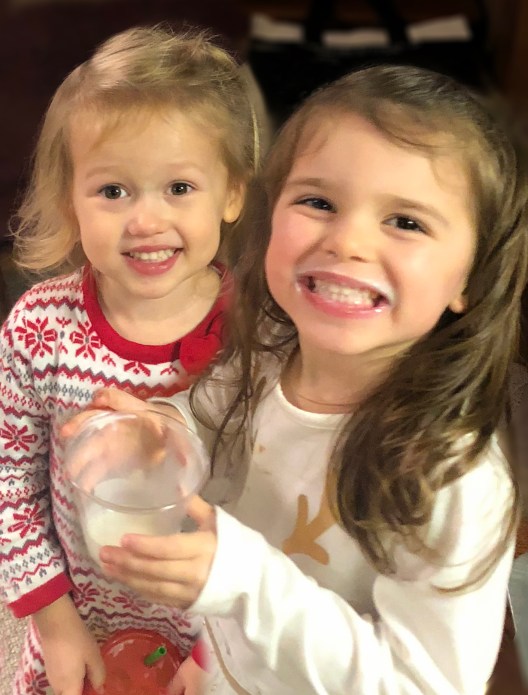
WholeMilkKidsBy the time these two little girls are in school, their happy smiles and enjoyment of milk will be but a memory as the low-fat and fat-free brain-washing will begin and the full-fat brain-building they get at home will come to an end. Milk will become yucky to them, and the one they get with their school lunch and/or breakfast will likely go into the trash. Such is the plight for millions of children in our schools every day over the nine years of government prohibition against whole milk. Meanwhile the weights and waste at U.S. schools are ballooning out of control. 
But never fear, the government (and its NGOs) are here! Dairy checkoff’s “sustainability” partner, the World Wildlife Fund (WWF) — in cooperation with the U.S. Environmental Protection Agency (EPA) — estimates 45 million gallons of milk are discarded at U.S. schools annually. Here’s the unbelievable part: They recommend schools reduce the size of milk containers, use self-serve dispensers and end the practice of ‘serving’ milk with every meal. Yes, the dairy checkoff’s sustainability partner is recommending less milk as the solution to more waste.

Meanwhile, one school is offering whole milk on a trial basis and gathering data showing how this one small step is changing the whole story — for healthy kids and a healthy planet. We are protecting the identity of this school from the USDA school milk police because if “caught” for doing what’s right, they could lose eligibility for state and federal education funds that are tied to participation in USDA’s low-fat school lunch rules.

By Sherry Bunting

Dairy Checkoff’s “sustainability” partner — the World Wildlife Fund (WWF) — released a 2019 “Food Waste Warriors” student-led audit report a few weeks ago indicating that U.S. schools discard an average of 28.7 containers of milk per student per year.

This amounts to an estimated 45 million gallons of milk discarded from schools annually, the report said.

Of the totals, elementary students discarded 37.6 cartons per student per year while middle schools discarded 19.4 cartons per student per year. The difference is middle and high school students have more alternative beverage options.

A gallon of skimmed milk weighs 8.63 pounds, so 45 million gallons amounts to over 388 million pounds per year and a cumulative estimated 3.5 billion pounds of discarded school lunch skimmed milk over the past nine years since USDA removed whole and 2% milk as choices in the 100,000 schools participating in the National School Lunch Program (95% of U.S. schools).

WWF funded the study, with support from Kroger Co. Foundation and the EPA, analyzing food waste in 46 schools in nine cities across eight states.

The objectives of the WWF project were to engage students in the act of measuring waste, foster an understanding of connections between food and its environmental impacts, and “formalize how we might gather more streamlined data on cafeteria food waste,” the report explained.

In its report, WWF identifies the National School Lunch Program as “one of the most influential programs for educating youth on conservation opportunities linked to our food system.”

Waste-reducing milk strategies used, compared and suggested in the WWF report are: 1) serve smaller containers of milk, 2) educate schools to realize they are actually not required by USDA to force students to take a milk with their lunch or breakfast in the first place, and 3) invest in bulk milk dispensers so students can take only the amount of milk they will drink.

So here we go. Let the WWF / USDA / EPA / DMI ‘sustainability’ propaganda begin. The idea of milk dispensers is a good one. But, what matters more is the fat content of the milk IN the dispensers, bottles or cartons!

Of course, the report does not identify the simplest, tastiest, most nutritious and ‘sustainable’ solution: Waste could be reduced overnight if USDA would simply allow the 100,000 schools enrolled in the National School Lunch Program to put whole milk on the menu! 

That’s right folks: 95% of U.S. schools are ruled by the iron-hand of the USDA milk police.

Not only are school nurses beginning to report to Farmshine that their annual student weight averages have climbed 7 to 9% in the 9 years that whole milk has been forcibly removed from school menus, one school reports it is doing its own study of student preferences and milk waste reduction this year.

We are keeping the names of the reporting schools anonymous to protect their identities from the USDA milk police.

Since September, one anonymous school’s study shows students are choosing whole milk 3 to 1 over 1% low-fat milk at the middle school and high school where the trial is being conducted.

Imagine that! Middle and high school students CHOOSING milk, and actually drinking it!

Oh, and by the way, when whole milk is used to make chocolate milk instead of using skimmed (1% or fat free) milk, less sugar is added!!

And, by the way, the data from this particular anonymous school shows that not only are their secondary students CHOOSING whole milk 3 to 1 over skimmed, the school has reduced its milk waste by 94%… in one year!

They report that their “milk not consumed” totals now average 32 ounces per day as compared with 4 gallons, or 512 ounces, per day the previous year!

Where school lunch is concerned, USDA’s rules are neither practical, nor are they logical, nor are they healthy for our kids or our planet. At the same time, WWF’s suggestions miss the mark completely!

Join in with those farmers and consumers asking Congress and USDA to bring back the choice of whole milk in schools. Sign the petition for choice and be part of the WHOLE solution. If you haven’t signed, you have until February 15 to do so online at this link: https://www.change.org/p/bring-whole-milk-back-to-schools

Also, to get signatures in your community, download the printable version of the petition at this link: WHOLE-MILK-IN-SCHOOL_PETITION_011520_


-30-

Surprise. Surprise. Whole Milk is on the rise!

… Even in the face of massive opposition by USDA, DMI and others

Editor’s note: Farmshine contributor Sherry Bunting continues her opinion and analysis on where the milk bus is heading and some thoughts on what to do about it.

editorialgraphic (1)

By Sherry Bunting, Farmshine, Friday, January 17, 2020

BROWNSTOWN, Pa. — Activist non-governmental organizations (NGOs) are increasingly driving the milk bus as dairy industry organizations, checkoff organizations and government agencies partner with entities such as World Wildlife Fund (WWF) on dietary and sustainability goals.

The leaders who are working with NGOs and government agendas long enough might think they speak for us as consumers, as society. They don’t. But through our organizations partnering with them, they ultimately and incrementally not only speak for us, they are driving the bus.

If we are listening, we’ve heard the model described by industry experts and thought-leaders in articles, at conferences, and in roundtable discussions: Build huge cheese and protein ingredient plants at designated growth locations. Innovate with ultrafiltration and reverse osmosis technologies. And begin to balance the export-driven dairy industry focus and consolidation by transporting ultrafiltered solids “more sustainably” – minus the 88% water portion – and do the reconstitution, extended shelf-life and aseptic packaging on location in the regions that are currently fluid-milk-centered markets, such as the Southeast, Mid-Atlantic and Northeast.

Rampant supermarket loss-leading on fluid milk by the nation’s largest retailers on one hand, with USDA-regulated farm-level price enforcement on fluid milk on the other hand, has produced the vice-grip in which the fluid milk sector has found itself over the past four to five years in particular.

Dairy producers were in the grip the past five years, but now that farm-level prices have ticked a bit higher the past five months, fluid milk bottlers suddenly find themselves unable to weather the margin compression, as we see in the recent high profile bankruptcy proceedings of Dean Foods and Borden, not to mention the smaller companies along the way.

As long as producers were the ones receiving the ugly side of the stick, the conversation could be generally centered on “too much milk” or “market forces” or “trade and tariffs.”

Now that farm-level milk prices have moved up (even though export volume was down), the unsustainable, low-margin, commodity treatment of fresh fluid milk is being seen as a primary factor fueling fluid milk processor bankruptcies – for those looking into these issues more deeply. In fact, checkoff leaders cite the milk bottler bankruptcies as proof that milk should be reinvented. Some have gone so far as to say — in presentations to industry groups — that the goal of innovation is to “move consumers away from the habit of reaching for the jug and toward these new and innovative products.”

While per-capita milk sales have been declining for 45 years, the past 10 years have seen faster rates of decline. This has been no accident. From dietary guidelines, to checkoff’s government speech requirements, to memorandums of understanding, to sustainability objectives, dairy’s own national checkoff organization has partnered with USDA, WWF, and others to move milk in a different direction – yes, intentionally.

Meanwhile, consumers are showing a thirst to know more about milk nutrition, and they are responding by buying more whole milk even in the face of this extreme neglect and alternative direction.

Case in point. While Coca-Cola, now 100% owner of fairlife, cites double-digit growth of the its 3% market share, the USDA Class I packaged milk sales show a different perspective.

The most recent report for October shows that the “other fluid products” category had year-to-date volume growth of over 300% but amounts to just 269 million pounds (10 months) — less than one percent (0.7%) of market share.

Meanwhile, whole milk’s growth for year-to-date volume of 12.5 billion pounds comes in at just under 1% (0.9%) on 33% of market share, which makes fresh whole milk the top VOLUME gainer this year, and it has surpassed sales of 2% reduced-fat milk.

Flavored whole milk is also growing by double-digits some months, with year-to-date sales through October of 629 million pounds – up 8.9% on 1.7% market share.

Under Organic brands, whole milk sales are up 4.4% year-to-date, with 412 million pounds representing 43% of organic milk market share.

Consider this: While whole milk is prohibited in schools and daycare centers, and it goes virtually un-promoted and is often poorly stocked in the dairy case, those sales still manage to be the largest volume growth category under all of these constraints.

Innovation can be good, but the fact remains that whole milk naturally meets many of the desires consumers have even though labeling makes its fat percentage a mystery, and even though it has to overcome a low-fat and fat-free promotion campaign pitted directly against it… In the face of all of that, whole milk’s growth is not too shabby.

In short, fresh whole fluid milk has the potential to solve many of the problems it was previously blamed for in diet and health trends, and it has a ‘clean’ label and local sourcing and flavor and nutrition going for it.

Whole milk checks all the boxes.

Trouble is, if whole milk sales grow faster, then the best laid plans for using innovation and sustainability and dietary edicts to lead farmers and consumers into dairy industry structural transformation would be in jeopardy.

What can be done? What can be accomplished?

Get USDA’s attention. Get the attention of the Administration and Congress and hold industry leaders accountable for the following steps:

Federal Order price reform has never been more needed. The regulated value center is mostly on the diminishing Class I fluid milk sector. That’s a big weight to carry. Many of the innovations and reinventions of fluid milk beverages are not even Class I. Small regional entities wanting to get into the fresh fluid Class I milk market have difficulty doing so because they must – in effect — pay the cartel. Now the recent bankruptcy and potential sale of Dean Foods’ assets to DFA, suggest we could see an even bigger cartel.

In that scenario, an even larger national footprint entity would run the table, deciding how fluid milk markets will be supplied, with what product mix, and from what plants. DFA CEO Rick Smith has already indicated some Dean plants should be shut down. DFA president Randy Mooney in his address at the DMI / NMPF convention a week before the Dean bankruptcy was announced said dairy resources should be consolidated to focus on plants that “make what consumers want”, instead of having “plants on top of plants” in a region.

Add to this the push to normalize ultrafiltration in FDA standards of identity for all sectors of dairy beverage and product development and production, and we see the stage being set for meeting “sustainability” objectives by removing water from the transportation scenario and moving more milk from designated export-growth areas into the markets with higher Class I utilization at a lower cost.

In effect, this trend would use the fluid milk markets to physically and financially ‘balance’ the designated growth regions and huge protein export plants more freely — weakening the position of farms operating in those Class I utilization markets.

Transportation cost is already diluted to where it is not the equalizer it should be for regional milksheds to take local milk first. Ultrafiltration and reinvention of milk in the name of innovation is all coming from the Sustainability Council of DMI’s Innovation Center for U.S. Dairy. At a certain point, the trend – especially with the help of the world’s largest players in ultrafiltration including Coca-Cola – make location and transport even less relevant with milk’s 88% ratio of water taken out of the transport equation. These trends need full and transparent discussion instead of creeping along quietly under the mantra of “innovation” and “sustainability.”

Uphold standards of identity, not just the plant-based deal on the left hand that we are all watching so intently. While the industry talks about FDA’s milk standard vs. the imitations, the right hand is busy behind the scenes working on other dairy identity standards to make changes.

One such change is getting FDA to overlook reconstitution of milk solids with water on long-haul transport. This is a step that could enable Class I fluid milk markets to become the balancer for the huge commodity export plants that are being built in designated growth centers, and which get the make allowances built into manufacturing class prices.

Cheaper transport of excess milk – without the water — into Class I FMMOs would, and potentially is, allowing those suppliers to use eastern fluid markets as the export plant balancers.

Draw a line in the sand with a retail minimum on fluid milk. This step is necessary, at least as an interim step until the larger pricing issues have a full airing. A simple $2/gallon line in the sand certainly allows for capitalistic free markets while stopping the supermarket insanity that makes milk the Cinderella-sister that all other dairy case beverages, dairy and non-dairy, market off the back of and are free to make and keep the profit at milk’s expense.

Unless Walmart and Amazon and Kroger and others want to eat their own loss-leading decisions, themselves, they should not have the ability to price milk at $1.50, $1.15, 99 cents, 67 cents per gallon. This is crushing the supply chain and further diminishing milk’s stature.

Stop dumping skimmed milk on our kids. We’ve already lost at least one generation of milk drinkers, simply allow whole milk at schools for all the reasons that have been written about over and over in Farmshine. It’s also what is right for our kids.

Stop forcing producers to pay a checkoff tax that promotes government speech, and aligns with NGO-influenced government agendas on the future of food. At the very least, allow regions and local entities to keep and target all of their checkoff funds to promote what is made with their milk and to promote sustainable regional supply chains and food security.

Ask checkoff leaders to start promoting all milk instead of using the qualifiers “low-fat / fat-free.” Stop beating everyone over the head with the familiar “fat-free and low-fat” refrain. It’s not helping farmers, and it’s certainly not helping the health and obesity crisis, and it clouds the healthy choices consumers are able to make – once they learn the truth.

This is just a start.


Borden second major milk co. in 60 days to file Chapter 11

Borden-Dairy (1)

‘Business as usual’ motions face lender objections over how cash reserve is accessed and used. Judge grants Jan. 7 ‘interim’ relief with authority to pay pre-petition ‘critical vendors’, including producers supplying milk. A hearing on the final order in regard to critical vendor payments and cash management is set for Jan. 23.

 By Sherry Bunting, Farmshine, Friday, January 10, 2020

WILMINGTON, Del. — Citing unsustainable debt, including pension funds, negative dairy industry trends, fluid milk category declines as well as margin pressure in a loss-leading, commodity-driven market, the Borden Dairy Company, based in Dallas, Texas, but organized in Delaware, became the second major fluid milk bottler in the past 60 days to file for Chapter 11 bankruptcy protection.

Unlike the November Dean Foods filing with intentions to sell assets, Borden states its intentions are to use the Chapter 11 process to restructure its business for the future.

The company seeks to combine the bankruptcy filings of its 12 affiliated milk plants and one transport company stretching from Texas to Florida and north to Ohio under Borden Dairy Holdings LLC, owned by Acon Investments LLC,which had recapitalized these assets as recently as 2017 when purchased from Laguna Dairy after they were spun off from Grupo Lala.

Processing 500 million gallons of fluid milk annually for customers including supermarkets and schools, Borden employs 3300 people at milk plants in Alabama, Florida, Georgia, Kentucky, Louisiana, Ohio, South Carolina, and Texas. Milk is supplied by dairy producers and milk cooperatives in these and other states.

In addition to licensed brands Borden and Poinsettia, other brands involved include Coburg, Dairy Fresh, Dairymens, Flav-O-Rich, Kid Builder, Saba Sunburst, Sallie’s Southern Tea, Sunburst, and Velda. DFA separately owns the Borden brand license for cheese.

In Delaware District Bankruptcy Court, Wilmington, Judge Christopher S. Sontchi heard Borden’s first day bankruptcy pleadings on January 7.

“Concurrent to the decline of the number of milk producers, dairy processers have seen bottling margins decline due to competitive pressures from milk suppliers and large (and sometimes vertically integrated) customers. Couple this with the fact that … consumption has steadily declined, and it is no surprise that Borden and other dairy suppliers (such as Dean Foods) have begun to feel the same negative effects that have plagued dairy farmers for the past decade,” said Borden Chief Financial Officer Jason Monaco in his declaration with the court.

While all expected motions were filed to allow Borden to continue ordinary business while restructuring under bankruptcy protection — including motions to use a cash deposit reserve to pay pre-petition critical vendors such as dairy producers — attorneys for unsecured creditors objected Tuesday.

The lenders argued that, “(Borden) should not, and cannot, be allowed to use chaos of their own making to distract from the clear facts. There is no economic justification for… sudden chapter 11 filings, and the debtors cannot use the lenders’ (cash) collateral to finance an attempt by Acon to re-trade the out-of-court transaction,” that the parties had previously been negotiating.

The unsecured lenders contend that the bankruptcy filing occurred virtually on the eve of their out-of-court terms being ready for signatures. They contend that the $30 million cash deposit reserve is collateral and that other cash collateral Borden seeks access for operations are “insufficient.”

Acknowledging the importance of Borden continuing operations to preserve equity for all parties, the objecting lenders seek various protections from the court, including a position of consent with some oversight of budgets for the use of cash reserve and payment to critical vendors, including milk producers.

A day earlier, Borden CEO Tony Sarsam cited major milestones for Borden last year, including the revival of its spokescow Elsie, the brand’s reintroduction in Ohio and the launch of several innovative products such as state-fair inspired milk flavors and a new Kid Builder flavored milk line using 2% milk and containing 50% more protein and calcium with no added sugar.

Sarsam also explained in a press release that the company “continues to be impacted by the rising cost of raw milk and market challenges facing the dairy industry” that have contributed to “making our current level of debt unsustainable. He said ultimately, reorganization through court-supervision was the only solution “for the benefit of all stakeholders.”

Court documents reveal that Borden reported 2018 consolidated net sales of $1.181 billion with gross profit of $292 million but experienced operational income loss of $2.6 million and total net income loss of $14.6 million. These losses continued into 2019, with reported operational income loss of $22.3 million and total net income loss of $42.4 million from January 2019 through December 7, 2019, according to court documents.

Borden maintains that its situation differs from the Dean Foods bankruptcy.

“We believe that, from an operational standpoint, we are in a much better position than Dean Foods. Borden is EBITDA-positive and growing, which means we have solid earnings and are healthy,” Sarsam said in a public statement. “Borden intends to continue operations and strengthen our position … whereas Dean Foods announced its intention to sell substantially all of its assets. We are confident that, once we fix our balance sheet, we will be equipped to win together in the market.”

Documents also note Borden’s “need to raise new investor capital” to “continue to innovate with new products, modernize our facilities and equipment and improve Borden’s ability to compete in today’s market.”

The bankruptcy process is still in preliminary stages with more than 45 items filed on the docket within the first 48 hours.

Stating that this bankruptcy reorganization will not affect dairy producer contracts, Borden announced on Jan. 5 that it fully expects business as usual and to move quickly and efficiently through the bankruptcy process.

However, on Jan. 6 and 7, unsecured lenders filed the objections to many of the motions that would allow business as usual – creating potential ripples in that scenario.

As of Wednesday afternoon, Jan. 8, a signed interim order from the Jan. 7 hearing authorizes Borden to maintain its cash systems and bank accounts and provides interim relief to pay certain pre-petition obligations, such as payments to ‘critical vendor,’ including milk suppliers.

A hearing on the final order in regard to critical vendor payments and cash management is set for Jan. 23.

In the meantime, dairy producers supplying milk to Borden plants, are advised they may need to file a proof of claim with the court to be eligible for payment or otherwise consult an attorney for guidance.

The company’s claims agent, Donlin Recano, can provide appropriate forms once a deadline for filing claims has been set by the court. For more information on that, dairy producers can call the Borden restructuring information center toll free at 1 (877) 295-7345 or e-mail bordeninfo@donlinrecano.com.

A special Borden restructuring website contains various documents, including one that answers questions for raw milk suppliers at https://www.bordenfinancialreorg.com/

-30-


Coca-Cola now sole owner of fairlife, beyond the headlines

lead-fairlife (2)By Sherry Bunting, Farmshine, Friday, Jan. 10, 2020
CHICAGO, Ill.  The Coca-Cola Company announced Friday (Jan. 3) that it has acquired the remaining stake in fairlife LLC from its joint venture partner Select Milk Producers, a 99-member cooperative run and founded by Dr. Mike and Sue McCloskey. Mike McCloskey is also co-founder and chairman of the board of Fair Oaks Farms, and he was chairman of the Sustainability Initiative of DMI’s Innovation Center for U.S. Dairy in 2014, when fairlife was officially launched.

As a result of the recent transaction, Coca-Cola now owns 100% of fairlife, up from its previous 42.5% minority stake, according to company statements.

Financial terms were not disclosed.

According to a company statement, fairlife will continue to operate as a standalone business and will continue to be based in Chicago, where the brand got its start as a joint venture of Select Milk Producers and Coca-Cola, and received partnership grants for research and promotion through the Innovation Center of the checkoff-funded Dairy Management Inc. (DMI).

“We are excited for the next chapter of fairlife’s growth and innovation,” said fairlife CEO Tim Doelman in a press release, emphasizing the strength and scale of the Coca-Cola Company.

“It’s important for fairlife to continue to operate as a standalone business based in Chicago,” stated Jim Dinkins, president of Coca-Cola North America in a press release. “This will continue to give Tim and his team the space and running room they need to innovate and build the fairlife brand in a unique and fast-changing category.”

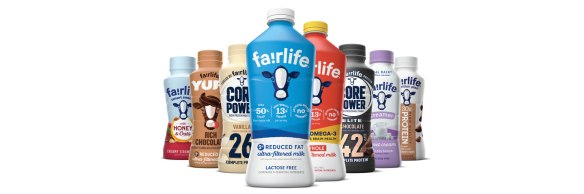
The fairlife LLC launched in 2012 to make use of a patented cold-filtration process known as ultrafiltration, which removes some natural sugars (lactose) while concentrating milk’s protein and calcium. The launch began with a high-protein milkshake called Core Power and has grown to offer a portfolio of products in what Coca-Cola calls “the fast-growing value-added dairy category in North America.”

In addition to Core Power, the line of products includes fairlife ultrafiltered milk with 50% more protein and 50% less sugar, fairlife DHA with DHA Omega-3 fatty acids, fairlife (drinkable) smart snacks, fairlife nutrition plan (shakes), and the new fairlife creamers for coffee.

Coca-Cola reports fairlife sales have grown by double-digits each year since 2014, playing a big role in what the company sees as steady growth of value-added dairy products in contrast with the traditional fluid milk category. The brand has been supported by the reach of Coca Cola’s distribution, both through the Minute Maid system and Coca-Cola bottlers across the country.

According to IRI data, fairlife’s first-year sales were $62 million, representing 0.36% of market share in 2014. According to Nielsen AMC, fairlife surpassed $500 million in retail sales last year, an 8-fold increase and representing just shy of 3% of market share.

A new fairlife milk facility is under construction in Goodyear, Arizona to expand production beyond its current plants in Waco, Texas and Coopersville, Michigan. In 2018, fairlife launched its products for sale in Canada and will begin local production and sourcing in Ontario this spring.

According to Dinkins, Coca-Cola “will continue to ensure that fairlife has the best distribution possible and will be here to provide resources and expertise in areas such as sustainability and supply chain management to make the brand stronger and better for the future.”

In the same week as the Coca-Cola announcement on acquiring whole ownership of fairlife, a joint public statement was released by fairlife and Fair Oaks Farms announcing their new and evolving four-part animal and worker care platform as their long term response to the animal abuse videos that became public last June involving one of the 12 separate dairies at Fair Oaks Farms. This was also mentioned in the ownership transaction press packet.

“To guide this journey, we’ve assembled a fairlife Animal Welfare Advisory Council to ensure we are both learning and leading for the short- and long-term,” Doelman stated in a public statement. “We’re working with our supplying farmers to outline more detailed animal welfare policies… investing with and in our farmers … And we continue to require that every farm in our supply chain is subject to regular third-party unannounced audits with clear action plans for learning and improvement after each audit.”

DMI officials have indicated funding promotion and exhibits at Fair Oaks Farms’ visitor center an hour south of Chicago in Indiana. However, DMI indicates that its financial grants to fairlife for promotion ended in 2019. To receive DMI promotion funding, companies with approved innovations must spend a comparatively larger amount of their own funds.

Available tax forms for 2017 and 2018 list DMI grants to fairlife of $8 million for promotion in each of those years, and prior support was available from affiliated research and development resources in the Chicago suburbs of Rosemont where DMI and Fonterra are both located.

Ultrafiltration is a process that can vary by dairy product application and is used around the world. A 2018 Transparency Market Research report pegged Coca-Cola among the companies it listed as “key players operating in the global ultrafiltered milk market, along with HP Hood LLC, Idaho Milk Products Inc., Fonterra Co-operative Group, Kerry Group, Tatura Milk Industries Ltd., Darigold Ingredients Company, Erie Foods International Inc., Enka Sut Company, Grassland Dairy Products and others.”

In 2017, the FDA said ultrafiltered milk could be used to make any fresh cheese product.

While fairlife milk is still considered a fresh product with a 90-day shelf-life, some products in the lineup are shelf-stable and aseptically packaged.

Dr. McCloskey confirmed in a presentation on “the road to innovation” at the 2016 Georgia Dairy Conference that fairlife ultrafiltered milk was at that time designated a Class I fluid milk product; however, some of the other beverages in the lineup are Class II.

-30-


Politics of whole milk, part 2: Vilsack banned whole milk in schools, gets dairy checkoff’s top pay

By Sherry Bunting, Farmshine, Dec. 13, 2019

The former Ag Secretary instrumental in removing whole milk from schools is now the highest-paid executive at Dairy Management Inc. (DMI) whose virtual $1 million/year in 2018 came from dairy farmers who are going bankrupt.

Farmshine Editor’s Note: Sherry Bunting has written a lengthy, well researched commentary on how the dairy economy and dairy product promotion and marketing evolved over the past decade with Tom Vilsack at the helm. Vilsack served as USDA Secretary in the Obama Administration and is the current chief of the U.S. Dairy Export Council (USDEC), an affiliate of Dairy Management, Inc. Wherever he has been since 2009, Vilsack is unquestionably one of America’s most powerful influencers when it comes to dairying. And the outcome has seldom been favorable to the nation’s milk producers. Part I of this reportappeared in the December 6th edition of Farmshine, page 20. Part II follows

In my journalistic pursuits of the past decade, two statements by checkoff-paid executives and dairy checkoff board members now reverberate in my mind:

1) On milk as a beverage: “Fluid milk is dead, we have to stop beating that horse and innovate for these new beverage markets.” – 2016 during questions after a presentation by a USDEC checkoff-paid employee at a meeting of dairy policy analysts and economists.

2) On dietary guidelines and school milk: “They are a different breed. We have our own plan. We have a friend inside the White House. We are already working with someone on this. And we finally have a drink that consumers want (fairlife).” — 2015 phone call to me from a DMI board member who also served on DFA’s board, challenging an article I had written that year. In the course of our conversation, he made this comment in response to my question to him asking why the dairy industry was being silent on the 2015 Dietary Guidelines that year, and why dairy was not joining forces with beef to push the solid science on animal fat as revealed in Nina Teicholz’s book Big Fat Surprise. I had also asked him why they weren’t supporting the beef industry’s opposition to the “sustainability” driven parts of the 2015 dietary guidelines.

In his Ag Secretary role in 2010, Vilsack was instrumental in the creation of GENYOUth through the MOU signed between USDA, National Dairy Council (Dairy Checkoff) and the NFL. (In fact, as Ag Secretary, Vilsack appointed some of the current Dairy Board members who then hired him at the end of the Obama administration as a DMI executive vice president and CEO of USDEC.)

Fuel Up and Play 60

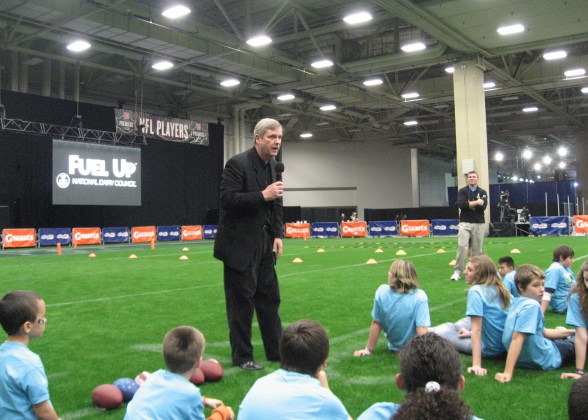
USDA Photo from Feb. 4, 2011 where then Agriculture Secretary Tom Vilsack spoke to young people at the Fuel Up to Play 60 (FUTP60) event held at the Sheraton Hotel in Dallas, Texas before the 2011 Super Bowl, the same day that the MOU was signed between NFL, USDA, Dairy Checkoff and GENYOUth to focus on ending childhood obesity with fat-free / low-fat foods and beverages and 60 minutes of daily exercise. And so, a decade later… here we are so much farther down this wrong road.

Today, GENYOUth is the bus on which more companies each year are hitching a ride into the schools — paid for primarily by dairy farmers in effect funding their own demise. Meanwhile, dairy farmers are the only ones not free to fully promote their best product, being relegated and regulated to government speech on fat-free / low-fat.

When Vilsack was presented the Vanguard Award during the 2017 GENYOUth Gala aboard the U.S.S. Intrepid in New York City Harbor, former President Bill Clinton spoke his accolades, and congratulated him on being the one to overcome the hurdle of getting beverage calories included in the school meal calculations. It is the very thing the current Senate Bill seeking to allow whole milk in schools would reverse.

Bill Clinton, a vegan, went on in his 2017 GENYOUth Gala speech to emphasize how beverages were a “huge” problem in the obesity epidemic, that we don’t think about how many calories kids consume in a drink, and that regulating school beverages was a big step forward on that front.

He was talking about whole milk. Whole milk is named, specifically, on the list of beverages prohibited from sale on school grounds during school hours.

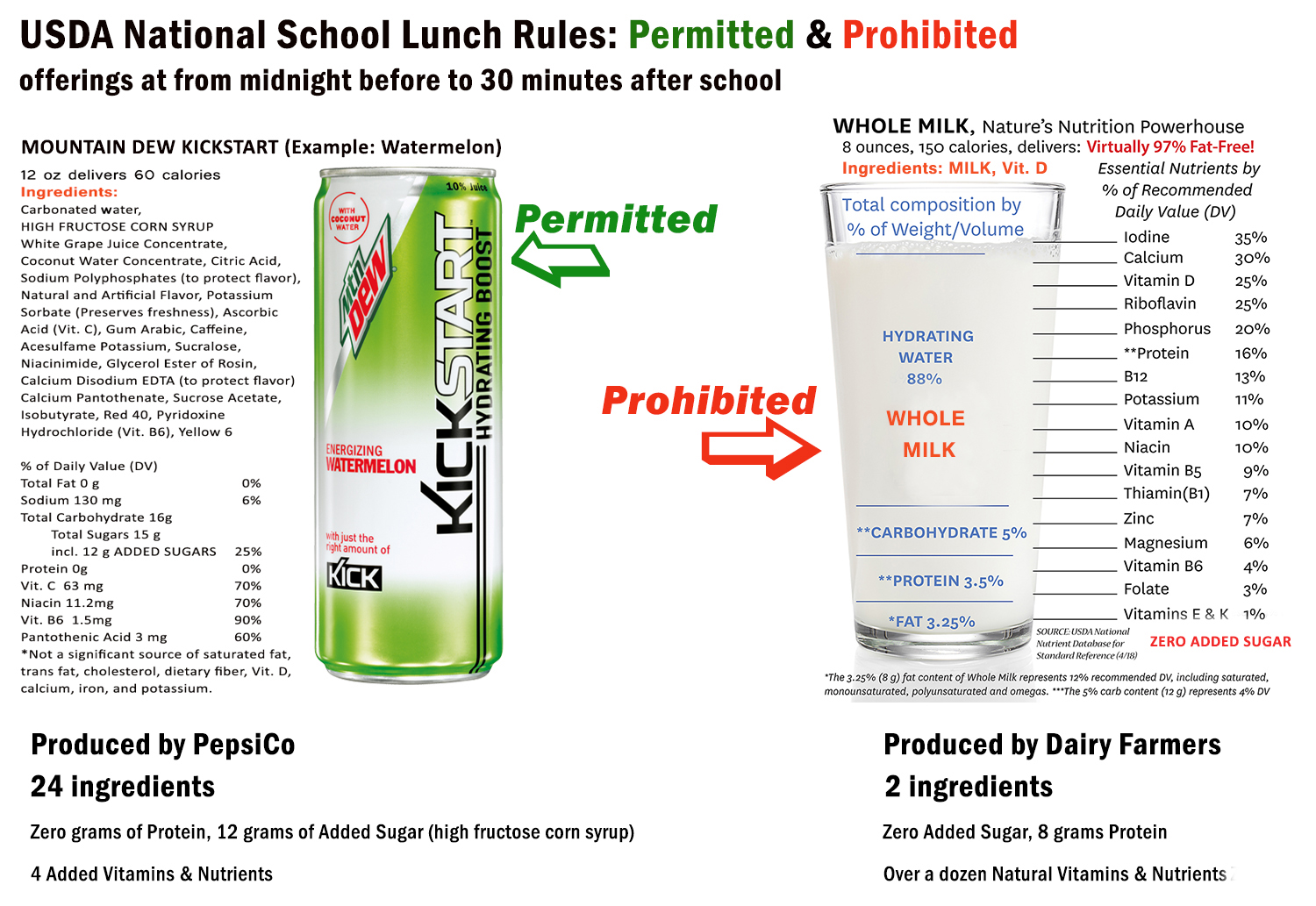
And yet plenty of PepsiCo beverages — made specially to meet the 60-calorie threshold with a combination of high fructose corn syrup and sucralose, including Gatorade and Mountain Dew Kickstart — are welcomed on those school lunch “smart snacks” acceptable beverage lists.

Vilsack started with DMI six days after the Obama Administration ended in January 2017. But 2018 was his first full year as a DMI executive, and he has been busy earning his highest-paid status.

In May, Vilsack wrote about how the U.S. dairy industry would meet its new goals to export 20% of production, and he praised the record level of exports in 2018 as “a banner year for exporters.” (We all know 2018 was anything BUT banner for dairy farmers paying his salary. In fact, export volumes were higher in 2018 than in 2017 and 2019 while prices paid to farmers were lower in 2018 than in 2017 and 2019.)

In June, Vilsack testified before Congress that the government should partner with the dairy industry to pay ‘pilot farms’ to develop and test the innovations “U.S. Dairy” will need in order to reach the Net Zero emissions goal he has been instrumental in setting. In fact, Senators referred to him as ‘the president of dairy innovation.’

The ultimate vehicle for those practices after they are tested on pilot farms will be the dairy checkoff-funded and NMPF-administrated FARM program initiated through the Innovation Center for U.S. Dairy.

At that “sustainability” hearing of the Senate Ag Committee in June, Vilsack earnestly stated that the Net Zero project – and government assistance for pilot farms to find the practices to achieve it — was essential for the U.S. dairy industry to have an edge in international markets.

In November, Vilsack endorsed former vice president Joe Biden for President of the United States and praised his candidacy “for including a path to addressing climate change while at the same time helping the rural economy and creating jobs by investing in green infrastructure, renewable fuels and low-carbon manufacturing,” according to an article about the Vilsack endorsement of Biden in the Nov. 23 edition of the Des Moines Register.

In fact, the Register article stated that Vilsack “helped write Biden’s plan for rural America.” But that’s not political involvement by a checkoff executive, is it?

It is interesting that when dairy checkoff board members are asked by the farmers paying the checkoff why they can’t stand up for whole milk in schools, the response they always get is: “That’s politics, and we can’t get into that.” Of course, the rules and regs of USDA overseeing checkoff are then cited forward and backward.

But, when it comes to Vilsack’s hands in the political pie – not to mention dairy farmers’ pockets – there are no rules and it’s all good. In fact, it’s encouraged because it’s part of the plan, the future of dairy, of food.

Vilsack is, after all, the dairy checkoff’s highest-paid executive, who is most culpable in his former position as Ag Secretary for putting the last nail in the fluid milk coffin. His policies on milk in schools and the fat-free / low-fat ‘government speech’ that now defines milk promotion, have at the very least contributed to – if not accelerated — the loss of fluid milk sales in the past decade of steepest decline.

In 2015, when confronted with what investigations have revealed about the science on animal fat, especially milk fat – according to the new and previously buried research — Vilsack said the preponderance of the evidence still favored low-fat diets. And with that proclamation, he signed the 2015 Dietary Guidelines that accelerated taking dairy markets – and our nation’s children – down the wrong road.

Think about this. From 2010 to 2018, the era in which the alliance between Vilsack’s USDA and the dairy checkoff was initiated and bloomed and in which he is now the highest paid executive – DMI controlled $140 to $159 million annually in mandatory dairy farmer funds. In that pool of funds, 25% went to salaries and other costs associated with core operations and another 30% went to contractors for promotion in ways that could be considered ‘core operations.’

In 2018, as in previous years, the NFL received $5 million; Edelman, the world’s largest PR firm, received $16 million; Fairlife $8 million, Domino’s $9 million, a marketing firm for GENYOUth with ties to Edelman $4 million, McDonald’s $5 million, and Vilsack got his virtual million.

Yes, folks, hindsight is 20/20. And here we are on the eve of 2020 with former Ag Secretary Vilsack – who was paid a $999,421 salary in 2018 from mandatory dairy producer checkoff funds and is now the top-paid DMI executive — to thank for the removal of whole milk and whole dairy products from our schools. And no one cares to ask him to testify to Congress about why whole milk should be allowed in schools, but he is politically involved in so many other discussions.

The dairy industry had and has Tom Vilsack — or vice versa.

110206_OSEC_AL_1642

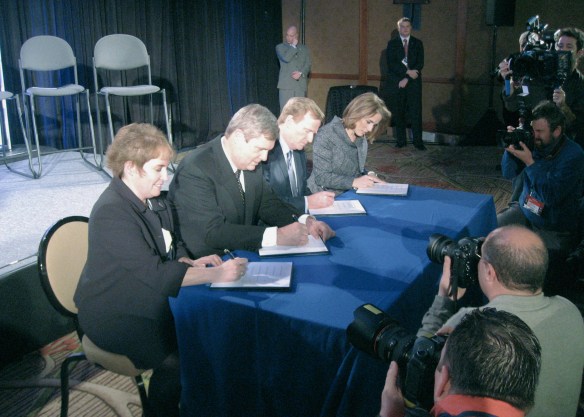
Memorandum of Understanding (MOU) was signed on Friday, Feb. 4, 2011 at Sheraton Hotel in Dallas, TX. The MOU outlines the joint commitment of the National Football League (NFL), Department of Agriculture, National Dairy Council (NDC), and Gen YOUth Foundation, to end childhood obesity. (Signing L to R President of the National Dairy Council Jean Regalie, Agriculture Secretary Tom Vilsack, NFL Commissioner Roger Goodell, and GENYOUth Foundation CEO Alexis Glick) 

Today, DMI IRS 990 forms show that Dairy Checkoff pays Tom Vilsack just shy of $1 million/year as DMI’s highest paid executive; Dairy Checkoff pays the world’s largest PR firm Edelman $15 to $17 million/year as the purpose-driven brain-trust behind the GENYOUth and Innovation Center ‘sustainability’ concepts; Dairy Checkoff pays the GENYOUth CEO over $200,000/year to run the foundation; Dairy Checkoff pays the core operations of GENYOUth to the tune of $1.5 million; Dairy Checkoff has USDA attorneys at every meeting and on every conference call to approve promotion projects and messages (government speech); and Dairy Checkoff pays the NFL $5 to $7 million annually for their part in this “promotion.” Meanwhile, NFL promotes its brand through flag-football sets to FUTP60-participating schools; USDA markets and enforces dietary guidelines with the financial assistance of dairy farmers through the checkoff; and other companies participating in GENYOUth, most notably PepsiCo, are able to market their own pet projects, products, brands and influence to kids while the dairy farmers are regulated to government speech. Dairy Checkoff touts the FUTP60 breakfast carts as serving milk with every breakfast, but only fat-free and 1% are promoted and permitted, and USDA’s own studies show that this fat-free and 1% low-fat school milk is among the most frequently discarded items. The entire deal ignores the fact that the dietary guidelines have exacerbated the obesity and diabetes trend, that children are not getting the valuable nutrients from the milk they are served if they don’t like the taste of fat-free and 1% and throw it away to buy something else. And the deal further ignores studies showing that body fatness was lower and Vit. D status higher in children drinking whole milk as compared with children drinking 1% low-fat milk. What will it take to see positive change when the very government figure who was influential in getting us here is now the dairy industry leader that the industry organizations revere and who is looked at by USDA, Congress and other policymakers as speaking for dairy? If he took whole milk out of the schools, and he now ‘speaks for dairy’ and is ‘believed’ to be so concerned about kids, who else matters in the discussion? Does the government care about the over 15,000 online and 5000 by mail signatures of dairy farmers, parents, grandparents, students, teachers, coaches, school boards, town boards, county commissioners, state lawmakers, health experts, nutrition experts, athletes, nurses, doctors, and generally comcerned citizens among these signatures asking for the choice of whole milk in schools

-30-

Mixed feelings prevail after Expo

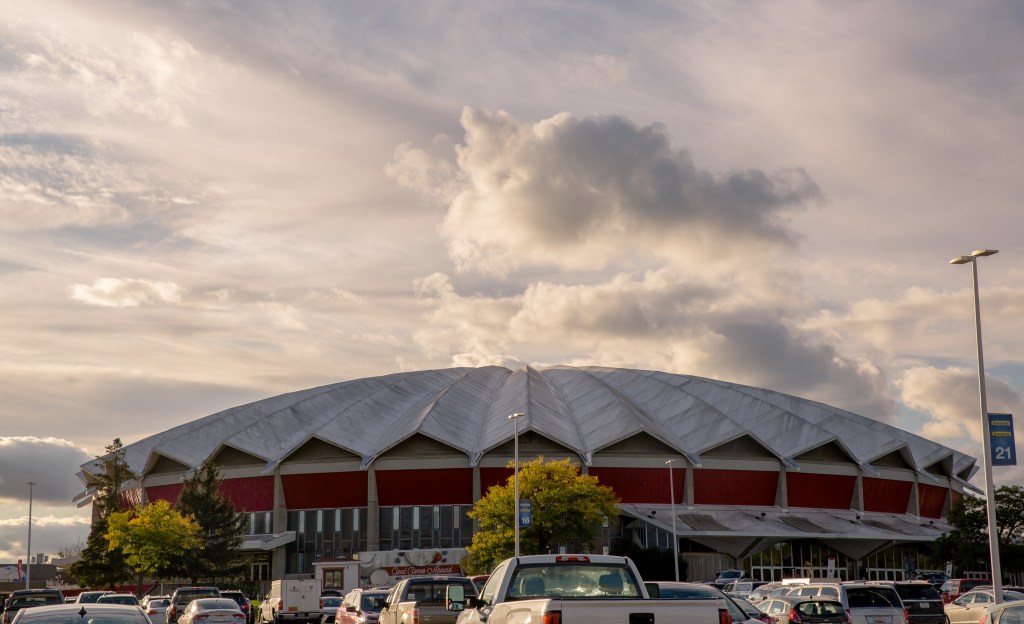
There were plenty of new things to see among the 859 trade show vendors, but the trade show was down a bit from 887 businesses exhibiting a year ago. Attendance was reported at just over 62,000, down from over 65,000 a year ago and over 68,000 two years ago. International attendance at 2,133 people from 94 countries last week was off by about about 200 compared with a year ago and 500 fewer than two years ago. Photo by Sherry Bunting

By Sherry Bunting, Farmshine, Friday, October 11, 2019

MADISON, Wis. — On the business side of the 53rd World Dairy Expo last week, I came away with feelings as mixed as the weather — gloomy skies and a deluge of rain at the beginning of the week gave way to sunny skies and brisk breezes at the end.

There were plenty of new things to see among the nearly 859 trade show vendors. Annual attendance is reported at around 62,000. U.S. and international attendance did appear to be down from previous years. 

For many, the first three days of the show felt slow in comparison even to last year. Some observed that the steep loss of family farms over the past 18 months was “being felt” at Expo.

Some pointed to the weather as heavy rains produced flooding Tuesday into Wednesday. 

Others blamed the discouraging — and twisted — headlines that came out of a town hall meeting with U.S. Secretary of Agriculture Sonny Perdue at the start of the week. The town hall was attended by around 200 dairy farmers, agribusiness representatives and organization leaders, along with dozens of reporters and television cameras.

What followed the hour of honest and detailed discussion (reported here as in Farmshine last week) were press accounts that warped Sec. Perdue’s comments and went viral through the wire services, starting with the Washington Post and Chicago Tribune and continuing into various agricultural press.

By Thursday, Wisconsin Farmers Union had sent op-ed responses to high profile news outlets, taking on the Secretary for his supposed comments about how we supposedly do things in America.

The stage was effectively set to cast the current Trump administration as purveyors of a factory farm model, attributing to the Secretary a proclamation that, “In America, the big get bigger and small get out.” This is now playing right into the hands of Democratic presidential hopefuls who are pal-ing around with HSUS in the Midwest, pretending to care about cows, farms and fly-over country.

Well, maybe some Democrats do care, but we know HSUS does not, and we know what the purveyors of the Green New Deal think of our cows. That’s another story.

Trouble is, the Secretary never said the words that have started this chain reaction. Or, at least, not in the order in which his words were parsed together in print.

You see, many other words were omitted. Context is everything.

From the sidelines and super busy with other pursuits at the Expo — but having attended the town hall meeting in person and having written my own coverage of the event in last week’s Farmshine — I began to see the headlines erupting on social media as share upon share made the news travel rapidly from Tuesday into Wednesday and then it was off to the races.

I began wondering how I could have missed such a derogatory comment. And I learned by Friday that, no, my notebook and partial recording had not failed me. Full transcripts were released by other reporters — providing that important context.

Transcripts showed clearly that the offending quote from Sec. Perdue was pulled from a very long and detailed response to a question and spliced together to make new statements. Not only is context everything, so is punctuation.

Too late, the discouraging and depressing headlines continued to beat small and mid-sized family farmers over the head all week. They began to feel as though even the USDA could care less about their survival – wanted them gone in fact to make way for “factory farming.”

The narrative was discouraging and many farmers confessed to me just how it made them feel. Several said reading those words made them feel like – why bother even going to Expo?

“Stick a fork in us. We’re done, according to Perdue,” a Wisconsin dairy farmer said to me Thursday.

Bad enough that the headlines erupted after Tuesday’s town hall were discouraging. Worse, that they were false in what they signaled to family farms. But there is also much truth in Sec. Perdue’s observation. He was describing “what we’ve seen in America,” not making a proclamation of how things will be done in America.

And the advancements in science and technology ARE what we have seen in America. Yes, they help smaller farms too, but it is science and technology that are contributing to the progress that is allowing rapid consolidation to take place.

For the record, I am pro-science and pro-technology and pro-innovation. But I also believe we are at a crossroads where it has gone so fast and so far, that we need to walk back and look at outcomes and impact and have a national conversation.

Just one day after the Expo closed, Land O’Lakes CEO Beth Ford and member farms like Dotterer’s Dairy, Mill Hall, Pa. were on CBS 60-minutes talking about how high-tech dairy is today and the market challenges being faced by dairy farmers at the same time.

The twisted quotes from Tuesday’s dairy town hall meeting at Expo gave the impression that Trump’s USDA is proclaiming a factory farm model for the future of agriculture. In a sense, as we embrace rapid technological advancement, we are embracing that transition. These are inescapable facts that must be sorted out and dealt with.

The Secretary was merely observing the reality of what has been happening in America’s rural lands with increasing speed over the past decade.

While some of Perdue’s specific answers to specific questions were disappointing and other responses were encouraging, none of those specifics were reported elsewhere with any attention. All attention was placed on the twisted quote.

We have a Secretary who can see what is happening and who can have an honest discussion about it, while being pragmatic about what the potential solutions are that can be accomplished without the help of a paralyzed Congress.

No matter what we think of Dairy Margin Coverage, it was put in place to help smaller farms withstand these difficult times and figure out their place in the future. That’s just reality.

At the same time, what was lost in those press reports is we have a Secretary that at least took time to cheer-lead for the small and mid-sized family farms by using his bully pulpit to advocate for whole milk in schools. No one picked up on that, except for Farmshine.

Perdue also touted “local” food as a way to bring value back to farms. I haven’t seen any other press reports talk about that.

Most reporters ignored those thoughts. They also ignored the fact that the stage for the rapid consolidation in dairy — that is occurring today — was set 10 years ago under former Secretary of Agriculture Tom Vilsack, who today has his salary paid by dairy farmers through their mandatory checkoff as president and CEO of the U.S. Dairy Export Council and defacto leader of the Innovation Center for U.S. Dairy that is streamlining “U.S. Dairy” through various checkoff funded innovations and programs.

Think about this for a moment: U.S. dairy has progressed with technological advancements that are unparalleled in the world. American farmers have always looked to technology and to the future to produce food for the growing population and to be good stewards of the land.

It is the love of science and technology – along with the love of cows — that draws throngs of U.S. and international visitors to the World Dairy Expo each year. They want to see what’s new. They want to learn from each other. They want to make progress to do more with less.

Technology allows farmers to do more with less. That has meant producing more food from fewer cows. At some point it also means producing more food from fewer farms.

Perhaps it is time to not just praise science and technology with the eagerness of children on Christmas morning, but to have an honest conversation about where science and technology are leading the food industry. 

Sec. Perdue was not very well informed when it came to the topics of fake meat and fake milk that are ramping up through USDA science and technology into cell-cultured and DNA-modified yeast factory vats and bioreactors. Instead of talking about factories replacing farms, he stated that “consumers will choose”, and he said currently those who are choosing fake meat and fake milk aren’t consuming the real stuff anyway.

That was the short-sighted comment that raised my eyebrow, not the parsed-together quote about big and bigger.

It’s time to dig into the structure of things.

Perhaps the real concern and conversation to be addressed is the structures and alliances that have been formed over the past 10 years as they are now coming to light. In former Secretary Vilsack’s talk at Expo about exports and dairy innovation, and in DMI’s workshop about what’s on the horizon, my initial impressions are that we are at a place where the industry is speeding up innovation and wanting more latitude on standards of identity at a time when we should be saying: “let’s push pause please.” 

The race to feed the world has produced immeasurable waste and loss already, will it now change the face of agriculture forever?

Where is science and technology supportive for the family fabric that has made our food production the envy of the world? And where is science and technology promoting a path that leads us away from that model of food production to take it out of the hands of many families enriched by competitive markets and put it into the new emerging models of fewer hands, consolidated markets and lack of competition.

Don’t blame Secretary Perdue for these wheels that have been in motion. Don’t expect the government to solve it. But what we can do is have the honest conversation, ask the questions, hold leaders accountable, and move the needle far enough to provide a more level field of play for the small and mid-sized family farms. 

You can count on Farmshine to break away from the narratives on both sides of this thing to do exactly that.

-30-

U.S. Ag Secretary Perdue: Small farms face difficult times

U.S. Secretary of Agriculture Sonny Perdue (right) and Wisconsin Secretary of Agriculture and Trade Brad Pfaff field questions and take in comments at dairy town hall meeting early Tuesday morning on the official first day of the 53rd World Dairy Expo in Madison, Wisconsin. Photo by Sherry Bunting

By Sherry Bunting, Farmshine, Friday, Oct. 4, 2019

MADISON, Wis. – Grabbing the headlines from a town hall meeting with U.S. Ag Secretary Sonny Perdue during the opening day of the 53rd World Dairy Expo, here in Madison, Wisconsin, was a comment the Secretary made about the viability of small family farms.

He was asked whether they will survive. To which he answered, “Yes, but they’ll have to adapt.”

In fact, the Secretary said that the capital needs and environmental regulations that impact farms today make it difficult for smaller farms to survive milking 50 to 100 cows.

“What we’ve seen is the number of dairy farms going down, but the number of dairy cows has not,” said Perdue. “Dairy farms are getting larger, and smaller farms are going out.”

But in additional discussion, Perdue said that consumers want local products. He said that marketing local, even without the buzzwords, can be done successfully to bring value to farms.

He noted two things about dairy farms. First, they can’t be sustainable without profitability and second, he described the dairy industry as prone to oversupply.

Picking up on these comments, recently retired northwest Wisconsin dairy producer Karen Schauf said Farm Bureau is looking at the Federal Milk Marketing Orders and how make some adjustments on the milk pricing.

“But what we really need to do is balance supply and demand of dairy products much closer,” she said. “I would ask if you would support a flexible mandatory supply management system to help producers keep that supply and demand in closer relationship.”

Perdue asked if she wanted the short answer or the long answer, stating that when his children want a quick answer, it’s always “no.”

Schauf replied, “Mr. Secretary, I just want you to think about it.” The subject went no further.

At another point in the questioning, a Wisconsin producer observed the disheartening price levels and said last year was a record high level of exports, while prices to farmers were worse than this year and worse than 2017.

He noted that exports hit 17.6% of milk produced, and settled out at 16% last year, which is a record, but his milk price averaged $14.60. He went on to say that, “our exports are off 2% this year, but I’ll probably come close to an average of $17 on my milk price.” He also noted that National Milk Producers Federation recently put out a press release stating 2015-18 as record years in domestic dairy consumption.

“This is all good,” the dairy farmer said, “but in Wisconsin we are losing 2.5 farms per day and I think the call centers are full with distressed farmers calling in, so beyond trade and some of these things you promote at the federal level, what can we be looking at so we never experience another five years like this?”

Perdue thanked the producer for his facts and said it is amazing that things “can be good and yet feel so bad.” He acknowledged that dairy has been under the most stress, and he said that the 2018 Farm Bill did “exactly the right thing” with the new Dairy Margin Coverage. He pointed out that this coverage is specifically in place for smaller dairy farms.

“Milk prices are cyclical, and I think we’ve met that trough, and things will improve for 2020,” said Perdue.

Referencing the 2% milk on the table in front of him, Perdue said: “You pretty much know what happened to milk in our schools, with the whole milk and the accusations about fat in milk. We hope to get some benefit, maybe, from the Dietary Guidelines this year, which drive a lot of this conversation.”

Noting that USDA “is leading” the Dietary Guidelines along with Health and Human Services, the Secretary said: “We have a great panel and they will bring together the best scientific facts about what is healthy, wholesome and nutritious for our young people and our older people  and all of us, so we’re looking forward to that.”

On trade, the Secretary was hopeful. He cited the recent trade agreement with Japan, but did not have exact numbers for dairy, just that it will be beneficial for dairy. On China, he was optimistic and said progress is being made, but that it has been important to take this stand because they have been “cheating” and are “toying with us.”

One area he mentioned in regard to trade with China is that U.S. agriculture has become too dependent on “what China will do.” He said the administration is really working on trade with other nations in the Pacific and elsewhere that do not represent such large chunks as to disrupt or distort markets as they come in and out of the game. This has held true for dairy exports from the U.S., which are rising in so many other parts of the world.

On the USMCA, Perdue said the outcome will depend on whether the Speaker of the House brings it to the floor for a vote. “It will pass both caucuses, but it has to come to the floor. We hope to see that happen by the end of the year, that distractions won’t get in the way,” said Perdue.

The town hall meeting covered a wide range of other questions and comments, and often, the answer to the toughest questions was “it’s complicated and we’ll be happy to look into it.”

On the Market Facilitation Program, several had questions about why alfalfa-grass is not included as a crop, just straight alfalfa. Perdue explained that alfalfa is a crop exported to China and that the crops in the eligible crops for MFP payments have to be “specifically enumerated.”

As with other questions, he emphasized the local FSA Committees who implement some of the more subjective pieces of these programs that farmers can appeal to their local committees if they’ve been denied.

In the prevent plant flexibilities for harvesting forage, Perdue said USDA is looking at this as perhaps something to be made permanent – the ability to harvest forage on prevent plant acres in September rather than waiting until Nov. 1.

Paul Bauer from Ellsworth Cooperative Creamery focused his comments on the spread between Cheddar blocks and barrels on the CME and how this is deflating the price paid to dairy farmers – especially in Wisconsin – but also across the U.S. because of how it affects the Class III pricing formula.

“For the last four years, the spread between blocks and barrels has been greater than 12 cents. Historically, the spread has been three cents or less per pound for the prior 50 years,” he said, noting that the spread at the end of the previous week stood at just shy of 35 cents per pound!

“The common thought is that this bounces back to a normal range, but it doesn’t,” said Bauer, noting that last year’s average spread cost dairy farmers 60 cents per hundredweight on their milk price. “Those farmers who ship to barrel plants, such as Ellsworth Cooperative Creamery, were affected by $1.20/cwt on their milk price due to this wide spread.

He noted that last week’s 34 ¾ cent spread between blocks and barrels cost dairy farmers $3.40/cwt, which is 20% of their base price.

Acknowledging that this is a complex issue, Bauer asked the Secretary if USDA will take the first step and admit there is a problem instead of “rolling their eyes because of the complexity.”

“This is unfavorable to our farmers and unfair to our producers,” said Bauer, explaining that all dairy products are priced off the block-barrel on the CME, ultimately.

“It’s important to get it right,” said Bauer, explaining that it is a problem when the industry can build barrel inventory to create this divergence in block / barrel prices on the CME, which in turn suppresses the price they pay to producers for the milk used in a multitude of other “modern” products.

“Barrel production comes from 16 plants (nationwide), and represents 6% of the nation’s dairy supply, and yet has had a 58% of the impact on all producers’ milk checks,” said Bauer. “When the system is out of sync, that negative value affects us all.

“It’s time for USDA to formally take action and for the data to come to light that are influencing the market,” said Bauer. 

He explained that the system is there to protect farmers and local buyers but is now being influenced by foreign cooperatives that keep one product – barrels – in oversupply in order to keep milk prices lower for products that are priced off the higher blocks in short supply. 

Bauer said the secrecy of buyers and sellers on the CME protects this practice. “It’s time to update the system to keep up with modern times to protect our farmers and our food supply also in terms of quality and safety.” 

Secretary Perdue drew laughter when he asked Bauer: “Would you repeat the question?”  But he took it in and asked for a written copy of the question to look into it. Perdue said that concerns are often raised about the Federal Milk Marketing Orders.

“They are a fairly complex issue, but we’d be happy to investigate. The government’s role in general is to be the balance between the producer and the consumer and ensure no predatory pricing practices,” said Perdue, “while not interfering with commerce and contracts.”

He gave the example of the fire at the Tyson beef plant in Holcomb, Kansas and the staggering loss to cattle prices since that fire over a month ago that have resulted in packer margins at an unprecedented $600 per head.

“We saw a spike in the delta – the difference between the live cattle price and the boxed beef price at historic highs, and we are investigating that, to make sure there was no pricing collusion,” said Perdue. “I’ve asked those packers to come in and give me their side of the story. That’s the role of USDA.”

Pete Hardin of the Milkweed asked about the cell cultured meat, citing a publicized comment by the Secretary last summer pointing to the value of this science. Hardin asked if any studies have been done on the safety of this technology.

Perdue did not know if any specific studies have been done, and he confessed to trying an Impossible Burger, adding “There’s now one restaurant I no longer attend.”

He stressed that these products cater to people who aren’t eating meat anyway for whatever reason, and he said: “In the end, consumers will be the ones to choose.”

Picking up on this in a separate question about how dairy and livestock farms can remain viable with all of the imitation products competing for consumers, the Secretary observed that, “As farmers we are independent and like to sit behind the farm gate and produce the best, most nutritious food in the world at the lowest cost anywhere in the world, but we’ve never told the story.

“It’s up to every one of us to speak out locally and statewide and federally, nationally in that area and tell the story of what’s happening. No longer can we hide behind the curtain,” said Perdue. 

“There’s a growing movement about knowing how you do your job, what’s in the milk, how the animals are treated, and there’s no going back from that. We have to engage with consumers. We have to tell the story loudly and proudly.”

-30-

Congressman to dairy farmers: ‘Government is between you and the consumer’

Dairy Advisory Committee formed, meets with federal, state lawmakers

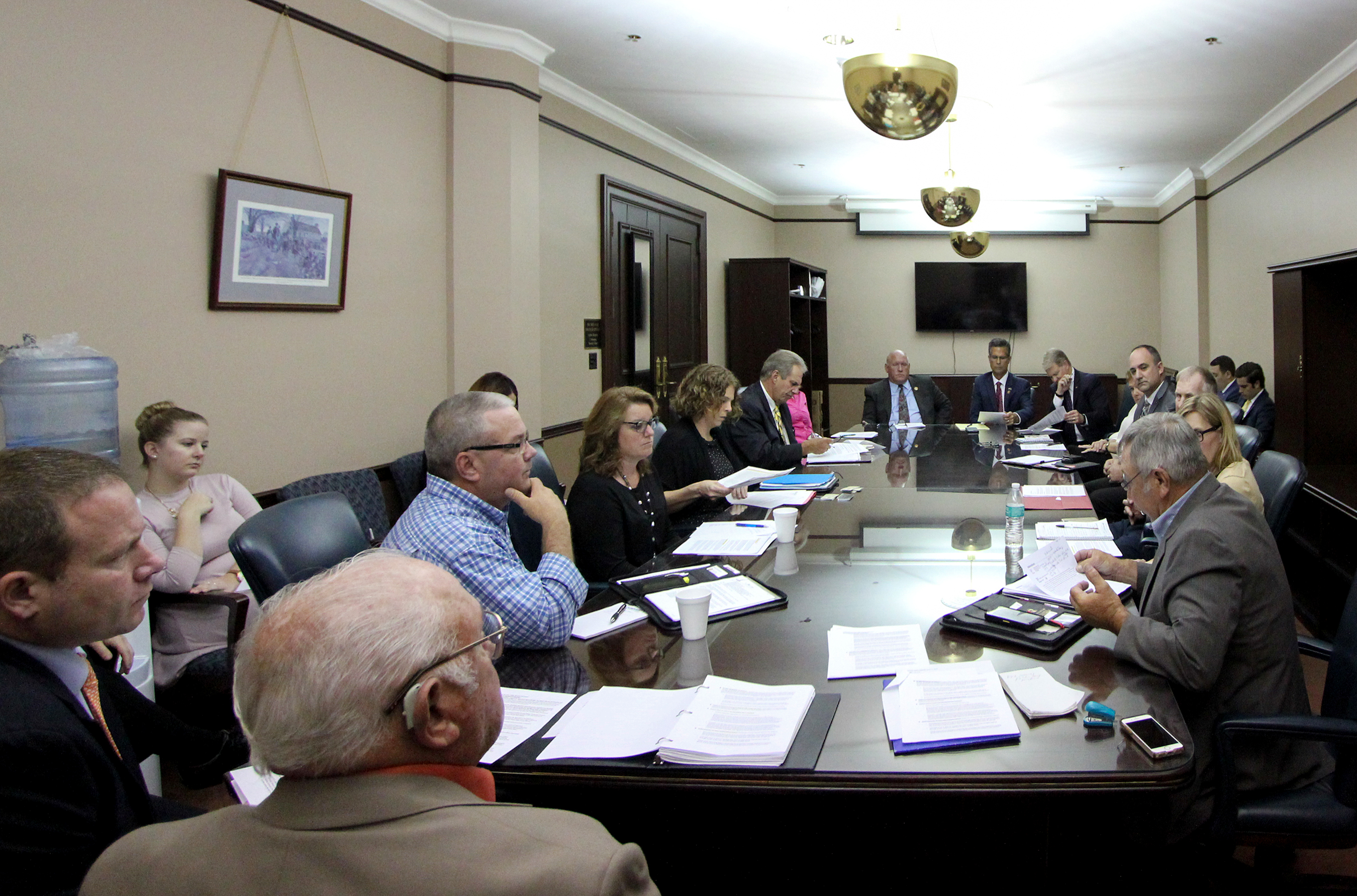
During a June 3 roundtable discussion between dairy stakeholders and Pennsylvania state and federal lawmakers, Nelson Troutman (right) said Pennsylvania is a fluid milk island with milk and consumers right here, but pressure pushing in from all sides. He said the state is losing its ability to compete as federal dietary rules suppress fluid milk sales while the state’s antiquated milk marketing law incentivizes more milk-swaps along the four borders as fluid milk sales decline. Clockwise from top left are U.S. Congressmen G.T. Thompson (R-15th) and Dan Meuser (R-9th), State Senator David Argall, Lolly Lesher, Mike Eby, Dale Hoffman, Tricia Adams, Nelson Troutman, Bernie Morrissey, State Senator Scott Martin, Karl Sensenig, Bonnie Wenger, Krista Byler, Craig Lutz for Sen. Argall’s office, and Katie Sattazahn. Also present were various legislative staff. Attendees shared USDA data showing that in the past 12 months, Pennsylvania lost more cows (29,000 head) and more production (66 mil. monthly pounds) than any other state in the nation, with the potential see even greater losses in the next 12 months without substantial change.

By Sherry Bunting, Farmshine, June 14, 2019

HARRISBURG, Pa. — “What I’m hearing here is that the government is between you and the consumer. You would have no problem marketing milk if you could get your message and product to the people,” said U.S. Congressman G.T. Thompson, representing Pennsylvania’s 15th legislative district over a swath of central and northcentral and northwest Pennsylvania.

That summed up the concerns related to school milk, dairy checkoff, fake milk labeling and other issues during a meeting between 11 dairy stakeholders and a dozen state and federal lawmakers and staff in Harrisburg on June 3.

It was a listening session that was followed by a productive work session as the grassroots group will continue to meet and correspond as a Dairy Advisory Committee.

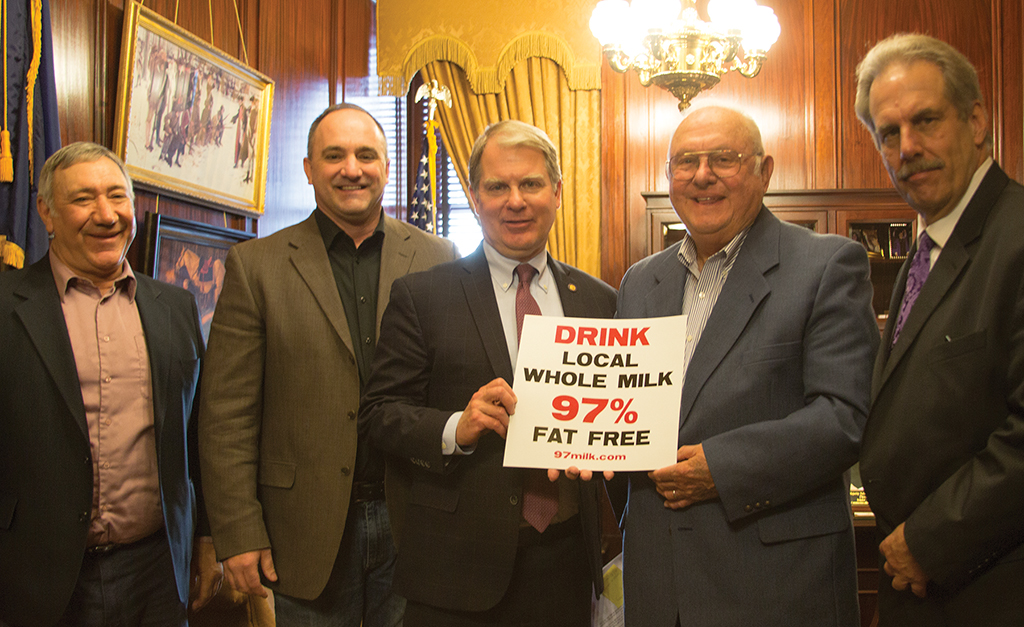
(l-r) Nelson Troutman, Mike Eby, Pa. State Senator David Argall, Bernie Morrissey, Craig Lutz.

Retired agribusinessman Bernie Morrissey and 97 Milk Baleboard initiator Nelson Troutman worked with Pa. State Senator David Argall of Berks and Schuykill counties to set up the meeting.

They pulled together an advisory committee of 11 people, including Troutman and Morrissey, along with Dale Hoffman and his daughter Tricia Adams of Hoffman Farms, Potter County; Mike Eby, a Lancaster County farmer and president of National Dairy Producers Organization; Lolly Lesher of Way-Har Farms, Berks County; Katie Sattazahn of Zahncroft Farms, Womelsdorf; Krista Byler, foodservice director for Union City School District in Crawford and Erie counties, whose husband operates a crop and dairy farm in Spartansburg; Bonnie Wenger of Wen-Crest Farms, doing custom cropping and heifer raising for dairies in Lebanon and Berks counties; and Karl Sensenig of Sensenig Feed Mill, New Holland. 

I was privileged to moderate the discussion, for which an outline was provided in advance.

Congressman Thompson was joined by Congressman Dan Meuser, who represents Pennsylvania’s 9th district covering Carbon, Columbia, Lebanon, Montour and Schuykill counties along with portions of Berks, Luzerne and Northumberland.

In addition to State Senator David Argall, State Senator Scott Martin of Lancaster County attended, as ded legislative aids for Senators Ryan Aument, Elder Vogel, and Mike Folmer with additional interest from State Representatives John Lawrence and David Zimmerman.

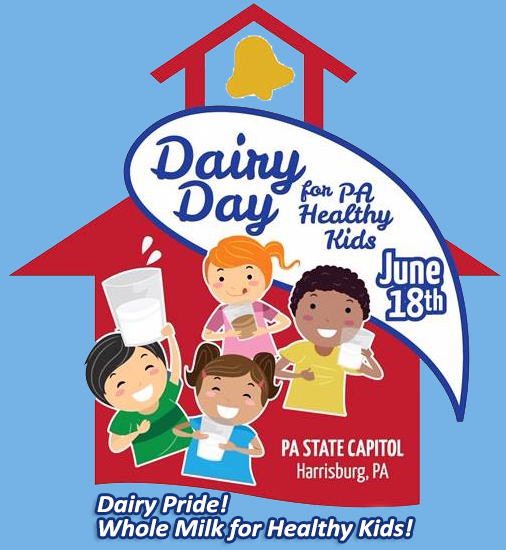
Lawmakers said they left the discussion with “more work to do” and an “elevated awareness.” Their message to dairy farmers was: “Keep it up. Keep doing what you’re doing (a nod to the 97 Milk campaign and the planned rally for the Whole Milk for Healthy Kids Act on June 18 at the state Capitol). They said raising public awareness is crucial.

“Every few days, the bill gets another cosponsor,” said Rep. Thompson of HR 832 introduced in late January. “It will take public support and momentum to reverse this. It’s a challenging task.”

Even with evidence that bad science led to the federal school lunch milkfat restrictions, Thompson said the House Committee on Education and Labor must take up the bill in order for it to move forward. He noted that current leadership of that committee is the same as in 2010 when The Healthy Hunger Free Kids Act tightened the vice grip on milk fat. (Learn more about the school lunch changes over the past 10 to 20 years here.)

The 2010 legislation with the blessing of former Ag Secretary Tom Vilsack not only prohibited whole milk in the National School Lunch Program, it also reduced total calories, required less than 10% calories from saturated fat and made the milk part of the meal’s nutrient analysis.

With a nod to Krista Byler, Thompson said he understands more is needed beyond HR 832. “We need to eliminate the beverage information from the nutrient standards limitations,” said Thompson.

Discussion followed about the current Childhood Nutrition Reauthorization process currently underway in the Senate and what opportunities might exist for a regulatory change there.

Byler noted that while every child gets a milk, many students throw the milk away and buy sugary drinks that don’t offer milk’s nutrition.

Legislators were surprised to learn that high school students can’t buy whole milk but they can buy Mountain Dew Kickstart at school. This 80-calorie beverage made by PepsiCo — the company that also created a Smart Snacks website for school foodservice directors and received the GENYOUth Vanguard Award last November — is deemed “okay” by the current USDA Dietary Guidelines because it has fewer calories than milk, zero fat and a list of added, not natural, vitamins and minerals. But it also has 20 grams of carbohydrate, 19 grams of sugar in the form of high fructose corn syrup and zero protein, whereas whole milk has 12 grams of natural carbohydrate and 8 grams of protein.

In addition to Mountain Dew Kickstart, students in high schools and middle schools across the U.S. can buy other sweetened drinks like PepsiCo’s Gatorade as well as iced tea coolers. In addition, high schools are also permitted to have coffee bars.

Yet schools are prohibited from offering whole milk (3.25% fat) or reduced-fat (2%) with its high-quality protein and long list of natural nutrients – unless a child has a medical note from a physician.

On the flip side, schools must provide non-dairy substitutes like soy and almond beverage if a parent, not a physician, writes a note. And no notes are needed for students to throw away the milk and grab a sweetened high-carb beverage from PepsiCo.

“My purpose in coming here, after speaking with other foodservice directors across the state, is the changes that were made to allow 1% flavored milk last spring are having disheartening results. Schools have been doing the fat-free flavored milk as a requirement for so long, they don’t all understand the new rule,” Byler explained.

Part of the issue, she said, is they have their cycle menus done far in advance, and the changes to the milk — even if whole milk were suddenly allowed — do not fit into the nutrient analysis of the meal.

Before 2010, the milk was not included in the nutrient analysis of the school lunch or breakfast.

“It’s a breath of fresh air to hear members of Congress talk about this,” said Byler. “This bill (HR 832) is amazing, but it doesn’t have legs to stand on without the regulatory change to exclude milk from the nutrient analysis of the meal. For schools to have this choice, this bill needs to pass, and the milk needs to be a standalone component of the meal, otherwise schools won’t be able to make it work.”

She said the same goes for the Smart Snacks program. An exception to regulations is needed so schools can offer whole milk, just as they can offer PepsiCo’s energy drinks.

At the federal level, Rep. Thompson said the Pennsylvania Congressional delegation is working on getting a companion bill for HR 832 in the U.S. Senate. (This actually did happene a day after this report was filed for press — Senators Pat Toomey (R-Pa.) and Ron Johnson (R-Wis.) introduced the Milk In Lunch for Kids (MILK) Act this week. Bill number and text have not yet been posted)

“The biggest thing we need is to generate enough public support,” said Thompson.

The Dairy Advisory Committee urged Pa. State Senators to support a resolution on the federal bills.

On The Dairy Pride Act, Thompson was more optimistic. He believes FDA is giving an indication that the public has been misled by competing alternative beverages that infer by the name “milk” to have the nutritional attributes of milk.

Tricia Adams spoke of the many school tours she conducts at Hoffman Farms in the spring and summer, and what the kids tell them about school milk.

She says the kids are “brutally honest. They tell us, ‘This is the good milk!’ But just to get whole milk for a tour, I have to special order weeks in advance,” she says. “It’s a struggle to get enough of it at one time. It’s just not available.”

 Her father Dale Hoffman observed that farmers are so busy, it’s tough to be involved in these things. He said it is scary how fast Pennsylvania is dropping in cow numbers and production.

“Somewhere, we need to get our foot in the door. This has got to be done if Pennsylvania is going to compete. We have the milk and the consumers right here,” said Hoffman. “We need your help. We hear it’s tough to get done, but it’s time to get whole milk back in the schools.”

Mike Eby said he sold his cows three years ago, but producers selling today “are getting half of what I got.” He said the dairy situation is increasingly difficult for farm families to manage whether they are staying in, or getting out, as the value of their assets shrink along with income.

“Where is our milk going to be coming from when we all go out?” he asked.

Eby describe the power of whole milk. He has been part of an effort to give out whole milk that is standardized to 3.5% fat instead of 3.25% to meet the California standards. 

“We give the milk away at four parades a year,” he said, and the math adds up to over 10,000 individual servings. “We could give more! They love it. People are screaming for that milk.”

Circling back to Rep. Thompson’s point. The problem isn’t the product, the problem is the government getting between the farmer and the consumer when it comes to marketing the high value, nutritious and delicious product they produce.

State issues were also discussed, including needed reforms to the Pennsylvania Milk Marketing Law. Each participant also gave a fast view of the long dairy situation.

“The average dairy farmer we serve is under 150 cows, and our feed mill has 107 years in the business. We’ve seen a lot, but nothing as bad as this,” said Karl Sensenig. “We are greatly concerned about what is the future for the generations to come in our business and on the farms. We have become their bank. The situation is beyond dire, and I’m afraid we haven’t begun to see the true loss of farms. Even if the price gets a little better, many are so far gone that there’s no way out.”

Katie Sattazahn also questioned the future. She is integral to the farm operated by her husband and his brother, and she works off the farm. They upgraded their facility three years ago, never expecting a downturn of this duration and magnitude.

“The biggest thing is, we are supposed to be glad when we have a breakeven year, but that has to change. As dairy farmers, we need to be profitable to put something back into our operations,” she said. “Every dollar we spend is spent locally. Our farms provide open space and benefits for the environment, and the money we spend in our business helps the economy.”

With two young children, Sattazahn says, “If it stays the way it is, why would we encourage them to do this?”

Bonnie Wenger explained the conditions she sees in the community of dairy farmers. She explained to lawmakers the added difficulty of this year’s prevented plantings, a struggle that will get worse this fall in terms of feeding cows.

Byler also talked about the dire situation in her county. “The dairy farms support our communities. They support other businesses and bring in revenues for our school districts,” she said. “What will be left for our small rural communities?”

On the school front, she showed examples of the marketing foodservice directors see, pushing them away from animal protein. This included visuals from Fuel Up To Play 60 and its focus on fat-free and low-fat. She wonders why they can’t just talk about milk, why they have to pound home the fat-free, low-fat with every caption, every sentence, over and over. She has trouble seeing the value in it from the side of the dairy farmer or the school program.

Lawmakers and staff were taking notes, writing in the margins and circling things on the outline provided. By the end of the session, Sen. Argall said, “You’ve created a lot of work for us.”

Congressman Meuser noted this is now an even higher priority for him.

Sen. Martin said this is on the Pennsylvania Assembly’s radar, and he mentioned a package of bills coming that are “just a start.” He mentioned the dairy commission being put together to advise the legislature on dairy. 

They reminded the group to urge others to attend the rally on June 18 at 11:00 a.m. at the Capitol Rotunda in Harrisburg to support the federal dairy bills on whole milk in schools and mislabeling of non-dairy beverages. The media will be there, and this is a chance to get the public involvement that is necessary.

Here is another link to 8 ways you can help. (Swipe to read second page of this pdf).

-30-

And the winner is: MILK!

By Sherry Bunting

INDIANAPOLIS, Ind. – It’s a roar not soon forgotten when the field of 33 drivers rounds the curve to the paddock straightaway and the pace car exits the track. The thrill of the Indianapolis 500 is unmatched in motorsports, and the refreshing, replenishing, refueling and revered beverage associated with this great race is MILK — Real Dairy Milk!

Wait for it… The patriotic blend of freedom and speed after the recognition of our military, the moment of silence and playing of Taps for fallen heroes, the Blue Angels flyover, the singing of America the Beautiful and the National Anthem, and Back Home in Indiana, the anticipated “Drivers Start Your Engines”, the breaking free of the pace cars as the field of Indy cars passes the paddock with Old Glory in tow!

For 103 years, on the Sunday of Memorial Day weekend, a patriotic display, Blue Angels fly-over, recognition of our military and moment of silence for our fallen precede the 500-mile race at the Indianapolis Motor Speedway (IMS).

And for 83 years, the legendary race is complete with the ice cold Drink of Milk in Victory Circle — deemed the “coolest trophy in sports”, awarded for the “greatest spectacle in racing,” also known as the largest single-day sporting event in the world.

Indy5294
2012 Milkman Dave Forgey (left) of River-View Dairy Farm, Logansport and his rookie Duane Hill of MayHill Farm, Fountain City.

Dave Forgey of Logansport was an Indy500 spectator for years before having the chance to be the ‘Milkman.’ As a dairy farmer he was enthusiastic when the Indiana milk promotion board began choosing dairy farmers, instead of executives, to be the ones to give the famed bottle of milk to the winning driver each year. After serving as the ‘rookie’ in 2011, he was lead Milkman in 2012.

“As dairy farmers, we bring a personal touch to the award, that brings it to the common level of the fans. At the end of the race, the Milk is always first,” said Forgey with a broad grin standing in front of the IMS Pagoda race day morning talking to fans in 2012.

The job of the Indy500 Milkmen (or women) begins long before Sunday, and continues throughout the year in venues such as Rotary Club presentations and small town parades, as well as other competitive events that capitalize on the Winners Drink Milk slogan of American Dairy Association Indiana.

By Sunday, the Milkmen are focused on keeping the Milk iced for Victory Lane and promoting milk and dairy farming to race-day fans. They ask all the drivers to choose between Whole, 2% and fat-free and have those selections ready since they don’t know who the winner will be. Whole milk has been topping the choices 2 to 1 over the past few years, and two top drivers, Ed Carpenter and James Hinchcliffe in 2019 said they would return to the buttermilk choice of 3x winner Louis Meyer in 1936, if it were an option!

In short, the Indy500 milkmen are charged with protecting the future of this unique sports award ruled tops for its “cool factor” according to Sports Illustrated writer Pete McEntegart, who in his si.com column ranked milk #1 among the Sports World’s top-10 unique trophies.

And in a recent interview, champions rate the Milk as the top tradition of this famed race that is certainly steeped in many traditions.

“It is certainly a tradition that everyone respects. What else can we do that is this national and international in scope?” Forgey observes. He said he came home to find an email from a friend in New Zealand who saw the whole thing on television.

“The fans are interested. They want to talk about our dairy farms,” says Forgey. When fans realized he was giving the bottle of mlk, they wanted to know how he qualified for the job. When Forgey explained that he and his rookie are Indiana dairy farmers, the fans were eager to know more. Of course, they also want to see the milk. Standing by the milkmen in front of the IMS Pagoda on race day morning, enthusiasm for “the milk” is evident. Fans paused to take pictures, and ask questions.

“There is always a lot of excitement for the milk among the racing fans,” says Forgey. “They know the tradition. They know about the milk. And when we can help them connect it back to the farmer, that generates interest.”

Indy500-4137
Thanks to Louis Meyer, 3-time winner who started the Winning Drink of Milk!

Initiated 83 years ago when the first three-time winner, Louis Meyer, asked for buttermilk to quench his thirst after the grueling 500-mile race, the Drink of Milk tradition has endured. Today, scientific evidence shows Louis Meyer knew what he was doing back in 1936, when he turned after that grueling race to the unique, natural and un-matched combination of hydrating re-fuel found in Real Dairy Milk with it’s healthy maitrix of fat, protein, carbohydrate, a dozen essential nutrients and refreshment. In fact, in those days, buttermilk was the name given to full-fat milk with extra heavy cream! Today’s drivers tend to choose Whole Milk (standardized at 3.25% fat) more than the reduced fat (2%) or fat-free options.

ADA Indiana coordinates the Indy500 Drink of Milk promotion today, and 45 years ago they added to the heritage by sponsoring the “Fastest Rookie” award on the Tuesday before the big race. The coveted award recognizes the first-year driver who achieves the fastest four-lap average speed from among fellow rookie competitors during time trials.

“The rookies are very interested in the milk and getting their pictures taken with the milk,” says Forgey.

Fast forward to 2016 with the 100th running of the Indy500 and what a celebration it was! Nearly half a million people attended in person. To put this into perspective, the largest-ever attendance of the NFL Superbowl was just over 100,000 people. The 100th running of the Indy500 in 2016 clocked in at 350,000 in the gates and another estimated 100,000 outside the gates just wanting to “be there.”

Prairie Farms, American Dairy Association Indiana and the IMS together gave commemorative, specially-packaged bottles of milk to fans for a winning milk toast and they were available in stores throughout the region.

After 500 miles, 200 laps, 54 lead changes and 13 different leaders, the winning of the 100th Indy500 came down to a fuel strategy that put Alexander Rossi — the 9th rookie ever, and the first since 2001 — into Victory Lane at the Indianapolis Motor Speedway for the sweet taste of victory — the 80th traditional ice cold drink of milk, delivered in 2016 by Milkwoman Janet Dague, a dairy farmer from Kewana, Indiana and rookie Joe Kelsay of Kelsay Farms, Whiteland.

“I was so excited to see our rookie win the 500,” said Dague, an avid race fan and dairy farmer after delivering the Drink of Milk to Rossi in Victory Circle. “I was jumping up and down, cheering when he crossed the finish line. I even said to Joe ‘I told you I wanted our rookie to win!’

By “our rookie,” Dague was referring to Rossi earning the 42nd Fastest Rookie award given annually by the ADA-Indiana at a special dairy-and-racing-focused luncheon on the Tuesday before the race. There, Rossi was honored as the qualifying rookie with the fastest 4-lap average speed on qualification day, at an average 228 mph.

Dague described Rossi as “so gracious about winning. I think because of the rookie luncheon that just took place, he understood how important this was for the ADA-Indiana and every other dairy farmer around the world,” she explained. “In every picture, he made sure to take a drink of the milk and even made sure our logo was facing front and center. We couldn’t ask for a better spokesperson.”

The whole crew was celebrating that win with their milk, along with race fans given commemorative bottles on the 100th anniversary. Owners Michael Andretti and Bryan Herta were toasting each other, drinking their milk. Andretti, in particular, was happy to taste the elusive beverage right from driver Rossi’s official bottle while Rossi did his victory interview with ESPN, and their chief mechanic was next for the taste of victory!

Rookie Milkman Kelsay was excited to be there for the first time with the Drink of Milk in that 100th year of the Indy500.

“To have the spotlight shine on the nutrition of milk in this way is just awesome,” he said during the parade honoring military and the heritage of the race on the day before. “It is an honor to represent fellow dairy farmers who are back home milking and feeding and listening to the race on the radio. It has been a humbling experience so far. It seems as important to the fans as it is to dairy farmers. Even one of the police officers mentioned what an honor it was to meet us, saying he would be sure to keep me safe if something happens.

“We just thank Louis Meyer for starting this trend over 80 years ago that we can highlight the healthy choice of milk and deliver that message to a global audience here at the Indy500,” Kelsay adds.

“What better way could we as dairy farmers promote our product than to be out in the forefront of this event, which is so significant worldwide?” says Forgey, who appreciated the honor of spending 2011 and 2012 representing the dairy farmers in Indiana and across the U.S., who work hard to produce a healthy product.

After all, #WinnersDrinkMilk because #RealMilkAlwaysWins #TasteTheVictory

2018 winner: Milk!
Hubs and I at the 100th Indy500 in 2016 in the paddock straightaway. He has followed the race his entire life. I was drawn in when we met in 1978 and was happy we could cover the 100th Anniversary run for Farmshine as farm media in 2016!