Good news may trump bad nutrition policies

Editorial Analysis: Tumultuous 2024 spills over into 2025 – Part One

By Sherry Bunting, Farmshine, January 3, 2025

EAST EARL, Pa. – Year 2024 was tumultuous, and 2025 is shaping up to be equally, if not more so. Spilling over from 2024 into 2025 are these three areas of potential for good news to trump bad nutrition policies that are having negative impacts on dairy farmers and consumers.

Farm bill and whole milk bill

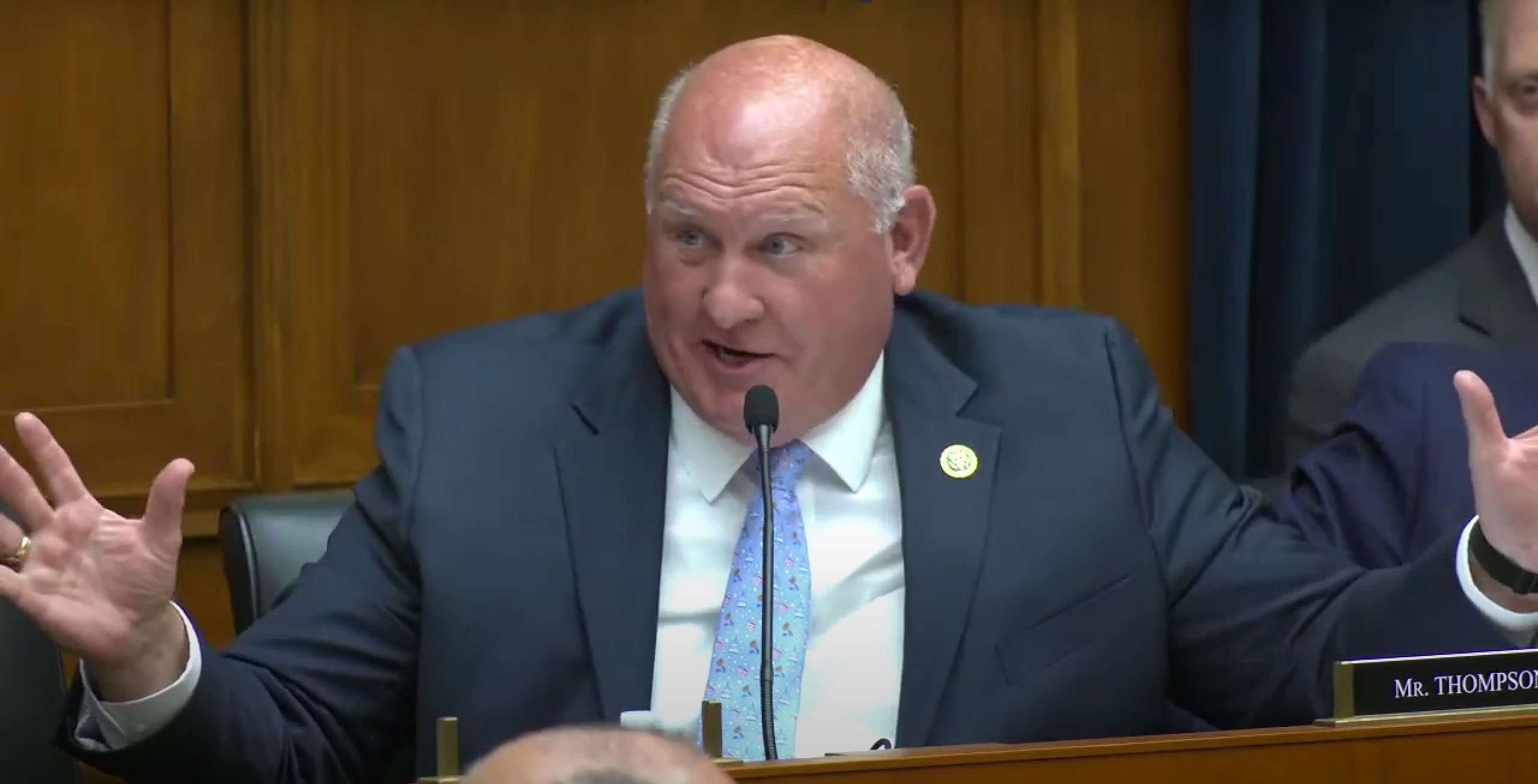
Both the farm bill and the whole milk bill showed promise at the start of 2024. No one championed the two pieces of legislation more than House Ag Committee Chairman Glenn ‘GT’ Thompson (R-15th-Pa.). He even found a way to tie them together — on the House side.

The Whole Milk for Healthy Kids Act made it farther than it ever has in the four legislative sessions in which Thompson introduced it over the past 8 to 10 years. It reached the U.S. House floor for the first time! But even the overwhelming bipartisan House vote to approve it 330 to 99 at the end of 2023 was not enough to seal the deal in 2024.

That’s because over in the U.S. Senate, then Ag Committee Chairwoman Debbie Stabenow (D-Mich.) blocked it from consideration — despite over half her committee signing on as cosponsors.

GT Thompson, found a workaround to include it in the House farm bill, which passed his Ag Committee on a bipartisan vote in May. The language was also part of the Senate Republicans’ draft farm bill under Ranking Member John Boozman (R-Ark.)

It too fell victim to Stabenow dragging her feet in the Senate. By the time the Ag Chairwoman released a full-text version of the Senate Democrats’ farm bill, little more than 30 days remained in the 2023-24 legislative session.

Key sticking points were the House focus on dollars for the farm side of the five-year package. It put the extra USDA-approved Thrifty Food Plan funding into the overall baseline for SNAP dollars and brought Inflation Reduction Act climate-smart funds under the farm bill umbrella while removing the methane mandates to allow states and regions to prioritize other conservation goals, like the popular and oversubscribed EQIP program.

Attempts to broker a farm bill deal failed, and on Dec. 20, another one-year extension of the current 2018 farm bill was passed in the continuing resolution that keeps the government funded into the first part of 2025, without amendments for things like whole milk in schools. However, Congress did manage to provide $110 billion of disaster relief for 2022-24 hurricanes, wildfires, and other events. Of this, roughly $25 billion will go to affected farmers and ranchers, plus another $10 billion in economic disaster relief for agriculture.

Looking ahead, there is good news for the farm bill and whole milk bill in the new 2025-26 legislative session. The House Ag Committee will continue under Rep. GT Thompson’s leadership as Chairman. On the Senate side, whole milk friendly Boozman will chair the Ag Committee. With Stabenow retiring, Sen. Amy Klobuchar (D-Minn.) will serve as Ranking Member, and she previously signed on as a Whole Milk for Healthy Kids Act cosponsor in March 2024.

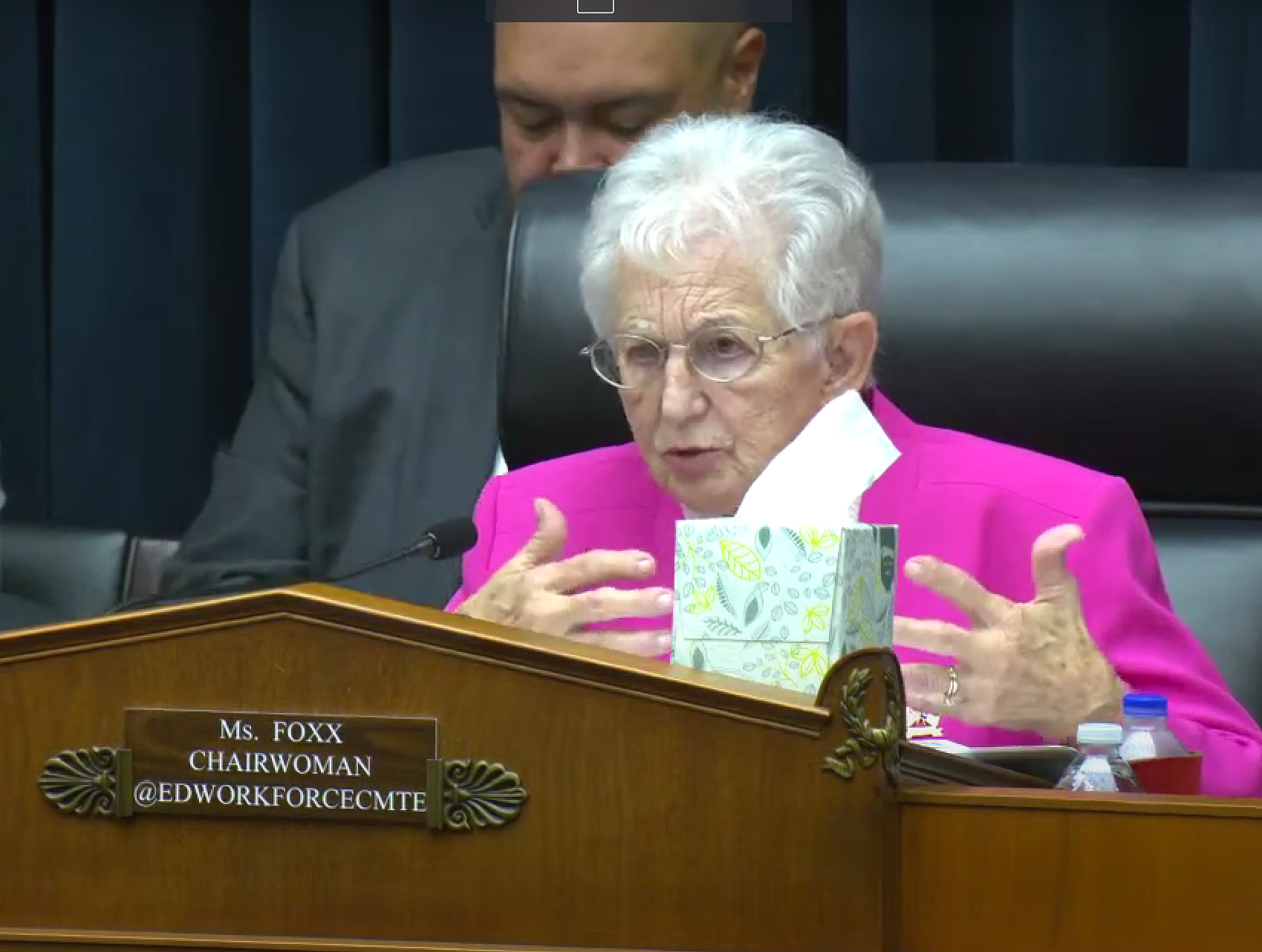
The whole milk bill will have to start over again in the Education and Workforce Committee with another vote on the House floor. It was enthusiastically supported by prior Education Committee Chairwoman Virginia Foxx (R-5th-N.C.). Her years of chairing this committee have expired, but the good news is Rep. Tim Walberg (R-5th-Mich.) will step in, and he was an early cosponsor of the Whole Milk for Healthy Kids Act in the 2021-22 and 2023-24 legislative sessions.

New Dietary Guidelines

The 2025-30 Dietary Guidelines Advisory Committee (DGAC) submitted its ‘Scientific Report’ to the outgoing USDA and HHS Secretaries on Dec. 19, 2024 — just 40 days before they head out the door to be replaced by incoming Trump appointees.

The Report is the guidance of the so-called ‘expert committee’ that reviews evidence and makes recommendations for the Secretaries of USDA and HHS to formalize into the 2025-30 Dietary Guidelines for Americans (DGAs). This process occurs every five years.

The DGAs are used in all USDA feeding programs, including school lunch, childhood daycare, and eldercare institutional feeding, as well as military mess halls. They also inform food offerings in many other controlled settings. 

The bad news is the Report has gone from being increasingly pro-plants over the past nine cycles to being outright anti-animal in this 10th cycle.

The good news is that dairy keeps its special spot on the so-called ‘My Plate.’ The bad news is that despite acknowledging evidence about the benefits of milkfat in nutrient dense milk and dairy foods, the DGAC rated the evidence as ‘limited’ – largely because USDA screened much of it out of the review process.

In the section on under-consumed nutrients of public health concern, especially for children and elders, the DGAC noted that whole and 2% milk were top sources of three of the four: Vit. D, calcium and potassium. Even this was not enough to persuade them to loosen the anti-fat grip that governs milk in schools, daycares and eldercare.

The DGAC states in its Report that their ‘limited access’ to research showing positive relationships between higher fat dairy and health outcomes was “too limited to change the Guidelines.”

They even doubled-down on the beverage category by recommending against flavor-sweetened fat-free and low-fat milk and that water be pushed as the primary beverage. 

In the Report, the DGAC also doubled-down on saturated fat with recommendations to “reduce butter, processed and unprocessed red meat, and dairy for replacement with a wide range of plant-based food sources, including plant-based protein foods, whole grains, vegetables, vegetable (seed) oils and spreads.”

This opens the door for more non-dairy substitutes beyond soy-milk, which is already allowed in the dairy category. In fact, the Report looks ahead to future cycles changing the name of the dairy category to broaden what qualifies as makers of new dairy alternatives improve their nutrition profiles via ultra-processing. At the same time, the DGAC punted the ball on the question they were given about “ultraprocessed” foods and beverages, stating they didn’t have access to enough evidence on health outcomes to answer that question. (The next HHS Secretary might have something to say about that.)

Other animal-based foods such as meat and eggs took a big hit this cycle. The 2025-30 Report uses stronger methods for discouraging consumption. They recommend moving peas, beans and lentils out of the vegetable category and into the protein category and listing them FIRST, followed by nuts and seeds, followed by seafood, then eggs, and lastly meat.

Once again ‘red meat’ is mentioned throughout the report as being lumped in with ‘processed meat’ even though not one stitch of research about negative health relationships with processed meats included any unprocessed red meat in the studies! Clearly, consumption of whole, healthy foods from cattle is in the crosshairs. This 10th edition of the Scientific Report just continues the trend. 

As in past cycles, a whole core of research on the neutral to beneficial relationships between consumption of saturated fat in high-protein, nutrient-dense foods was screened out of the DGAC’s review process by current Ag Secretary Vilsack’s USDA.

This Report essentially sets the stage for ultra-processed plant-based and bioengineered alternative proteins to play a larger role in the institutional meal preps of American schools, daycares, eldercare, and military.

But here’s the good news! The DGAC was late in finishing its 2025-30 Scientific Report!

The law requires a 60-day public comment period before USDA and HHS formulate the actual Guidelines for 2025-30. This mandatory comment period ends Feb. 10, 2025. Comments can be made at the Federal Register link at https://www.regulations.gov/document/HHS-OASH-2024-0017-0001

By the time the comment period ends, Vilsack and company will have left town. Let’s hope Senators confirm Trump appointees before the public comment period ends on Feb. 10 so their eyes are on this before the bureaucracy finishes the job.

This is a golden opportunity for the dairy and livestock sectors, along with health and nutrition professionals and health-conscious citizens to weigh-in. (Look for ways to participate in a future Farmshine.)

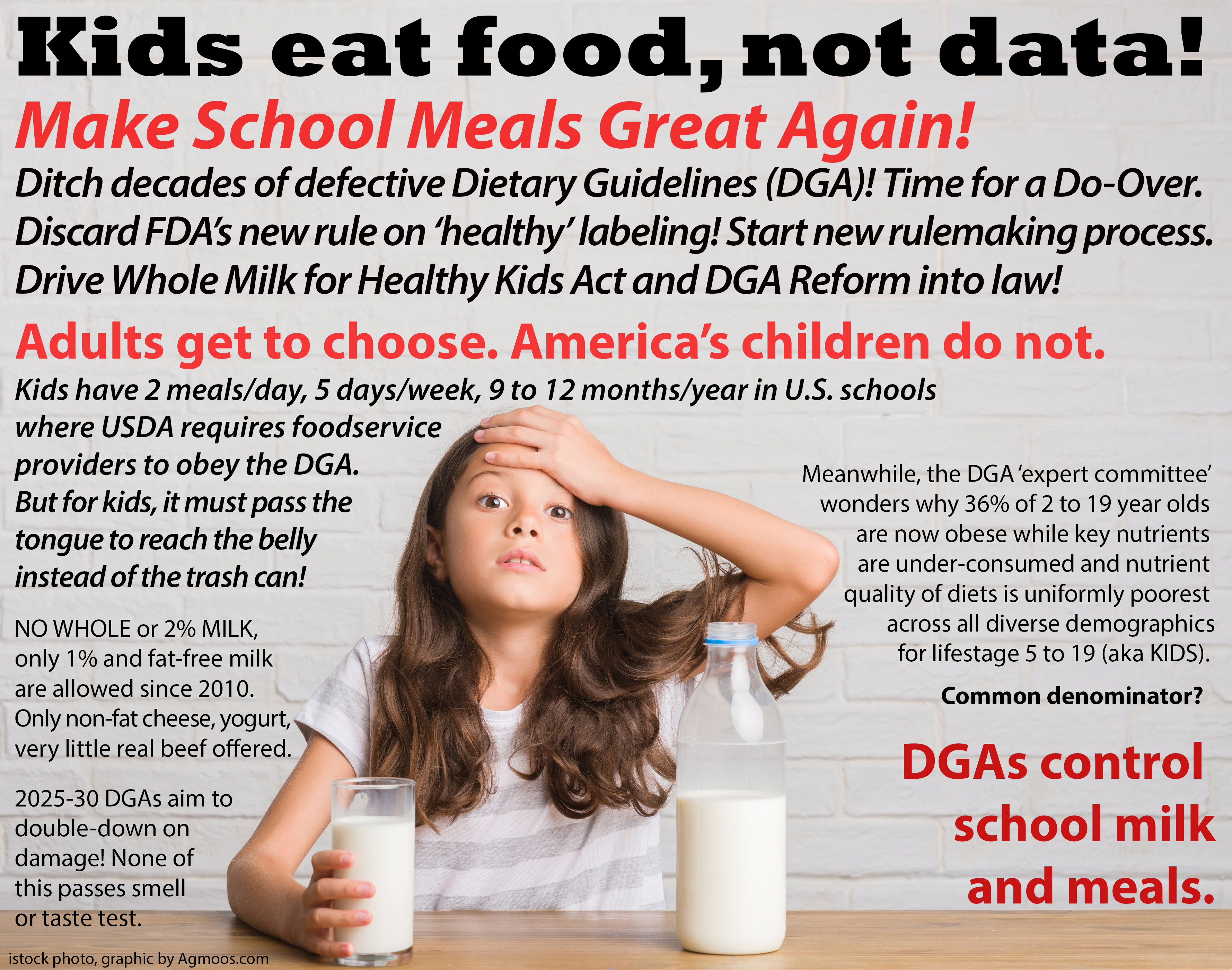
Meanwhile, commenters can remind the incoming Secretaries of how flawed the DGA process has become; how Americans, especially children, have become increasingly obese with increasing rates of chronic illness and underconsumption of key fat-soluble nutrients during the decades of the DGA’s increasingly restrictive anti-fat, anti-animal dogma.

Commenters should point out the fact that the Committee was not provided with all of the evidence on saturated fat. This is a message that is likely to land well with USDA Secretary designate Brooke Rollins and HHS Secretary designate Robert F. Kennedy Jr. In fact, RFK Jr. is on record opposing the low-fat dictates and has said nutrition will be among his first priorities, if he is confirmed by the Senate for the HHS post.

FDA’s final rule on ‘healthy’ labeling

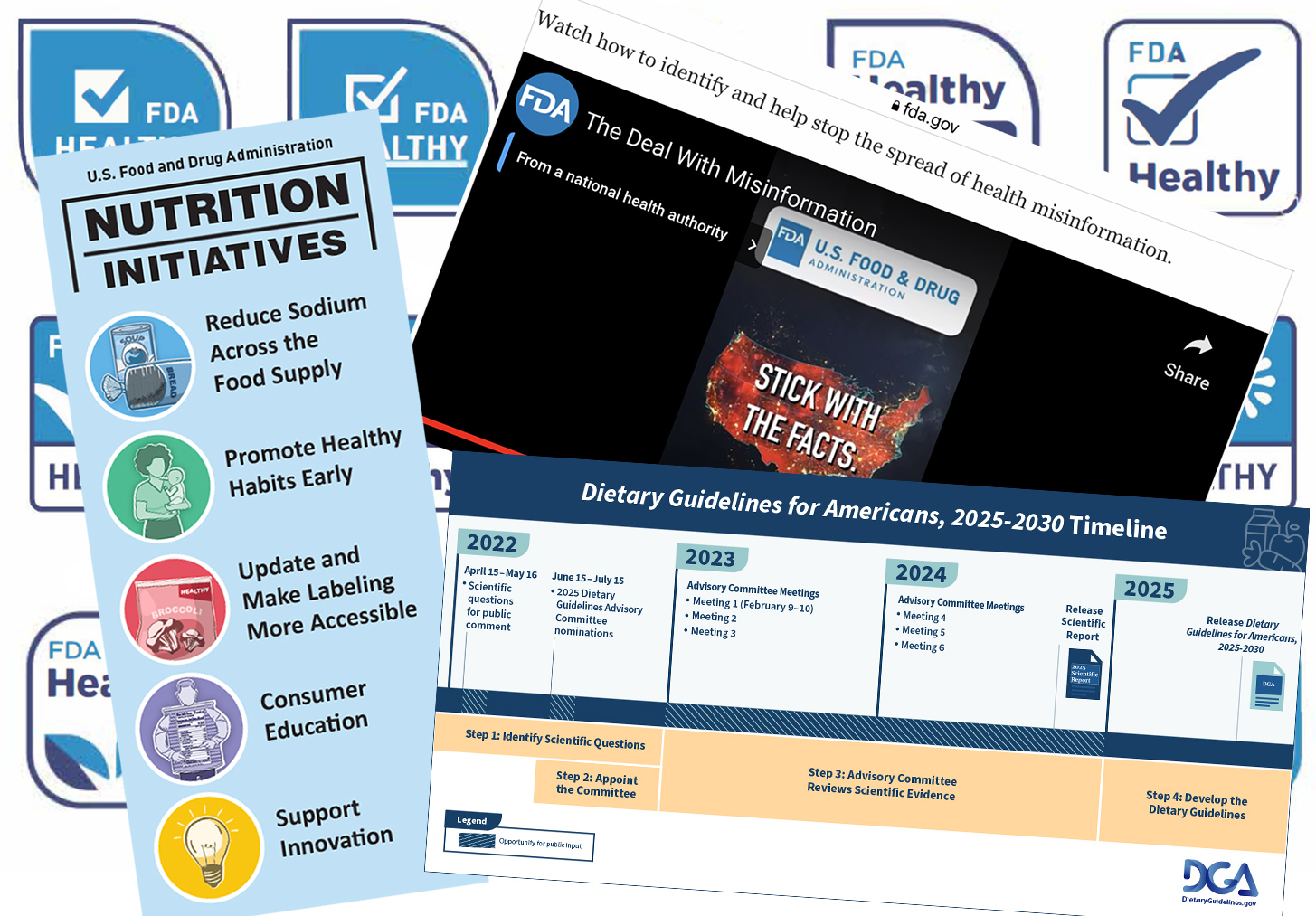
In the mad rush at the end of 2024, the FDA released its final rule about using the term “healthy” on the label of foods and beverages.

This process was outlined in the White House National Strategy on Hunger, Nutrition and Health. FDA’s preliminary ‘healthy’ labeling rule was released on Sept. 28, 2022, on the first day of the first White House Nutrition Conference since the 1980s.

At that Conference, Ag Secretary Vilsack said: “The National Strategy’s approach is a whole of government approach that involves the entire federal family.” And President Biden said: “We have to give families a tool to keep them healthy. People need to know what they should be eating, and the FDA is using its authority around healthy labeling so you know what to eat.”

In short, the FDA’s role here is to restrict healthy label claims to foods and beverages that meet its criteria and allow them to also use a new FDA ‘healthy’ symbol that is still under development.

“Nutrient-dense foods that are encouraged by the Dietary Guidelines – vegetables, fruits, whole grains, fat-free and low-fat dairy, lean game meat, seafood, eggs, beans, peas, lentils, nuts, and seeds – with no added ingredients except for water, automatically qualify for the ‘healthy’ claim because of their nutrient profile and positive contribution to an overall healthy diet,” the FDA final rule states.

No surprise that whole milk (3.25% fat) will not qualify, nor will real full fat cheeses, yogurts, and other dairy foods that are not fat-free or low-fat (1%). Natural, unprocessed beef, pork and poultry are off the ‘healthy’ list too.

Specifically, the FDA’s final rule states: “To meet the updated criteria for the ‘healthy’ claim, a food product must: 1) contain a certain amount of food from at least one of the food groups or subgroups (such as fruit, vegetables, grains, fat-free and low-fat dairy and protein foods) as recommended by the Dietary Guidelines for Americans, and 2) meet specific limits for added sugars, saturated fat, and sodium. 

The fat and sodium criteria are a double-whammy against most real dairy cheeses. A single 1-oz slice of American, Swiss, or Cheddar won’t make the cut on saturated fat or sodium; even part-skim Mozzarella is slightly over the limit. Furthermore, low-fat, high-protein cottage cheese barely makes the cut on saturated fat, but far exceeds the new limit on sodium. Likewise, a typical yogurt cup only qualifies if it is low-fat or non-fat, and fruited yogurts must steer clear of added sugars.

Dairy can’t win in this labeling scheme unless products are made with virtually no saturated fat and far less sodium. To sell flavorless cardboard and chalk water that fails to deliver key fat-soluble nutrients, products will undergo more ultra-processing, and Americans will consume more artificial sweeteners.

Under dairy products, FDA’s final rule for ‘healthy’ label claims states: 1) Must contain a minimum of 2/3 cup food group equivalent of dairy, which includes soy; and 2) Each serving must have under 2.5 g of added sugar, under 230 mg sodium, and under 2 g saturated fat.

This means even a serving size of exactly 2/3 cup (6 oz) of 2% milk might barely squeak by, and a full cup (8 oz) of 1% or fat-free milk would be – you guessed it – ‘healthy’. Flavoring the fat-free and low-fat milk will not qualify, except by using artificial sweeteners to stay within added sugar limits.

Under protein foods, the FDA is even more restrictive. The only protein foods listed in the ‘healthy’ labeling final rule are: game meat, seafood, eggs, beans, peas, lentils, seeds, nuts, and soy products. Furthermore, these options must meet the criteria of less than 1 g added sugars, less than 230 mg sodium and less than 1 to 2 g saturated fat.

But here’s the good news! This FDA final rule (21 CFR Part 101, RIN 0910-AI13) falls under the Department of Health and Human Services (HHS). It’s not likely to sit well with HHS Secretary designate RFK Jr. The rule becomes effective Feb. 25, 2025. The compliance date is three years later, so there is hope of requesting HHS initiate a new rulemaking process under new HHS leadership.

Bottom line is all three of these bad nutrition policies impact consumer health and dairy farm economic health and are rooted in the flawed Dietary Guidelines process.

There is good news on that front in Congress as well. House Ag Committee Chairman GT Thompson included DGA reform and oversight in the farm bill that had passed his Committee in the 2023-24 legislative session. It is critical that this issue be part of the new farm bill that moves forward in the 2025-26 legislative session.

Part II in a future Farmshine will look at the tumultuous 2024 dairy markets and margins spilling over into 2025.

-30-

Whole milk sales surge as Senate bill for schools remains blocked

By Sherry Bunting, Farmshine, May 10, 2024

EAST EARL, Pa. — Year-to-date Whole Milk sales for the first two months of 2024 are up a whopping 5% year-over-year (YOY) at 2.57 million pounds. Even when adjusted for Leap Year, the average daily increase is a substantial 3% surge, compared with the past several years of steady 1% increases YOY.

Flavored whole milk sales, year-to-date (YTD) are up a whopping18.6% YOY. Adjusted for Leap Year, the increase is a substantial 14%.

As the number one volume category representing more than one-third of the fluid milk category since 2020, the recent surge in whole milk sales has been enough to reverse the decline in total packaged fluid milk sales in four of the past five months.

USDA tallied 2023’s total packaged fluid milk sales down by a smaller margin of 1.5% for the year compared with previous years of decline; however, October and November sales were up 1% and 0.3% YOY for the first time since the months of the Covid shutdown when families ate at home. December’s total packaged fluid milk sales trailed year-earlier, but January and February 2024 have come back strong.

USDA estimates total fluid milk sales were up 2.4% and 2.5% YOY for January and February, respectively. When adjusted for Leap Year, the February increase is a respectable 0.8%. Similarly, when we adjust the YTD total of 7.325 million pounds in total fluid milk sales to reflect the extra consumption day in February, this is also 0.8% higher on an average daily basis vs. year ago.

This is good news! Let’s keep this upward trend MOOVING in fluid milk sales, led by surging whole milk sales — thanks to volunteers spreading the good word.

Now, if we could just get the United States Senate off the sidelines and into cosponsoring S. 1957 Whole Milk for Healthy Kids, we could really gain some ground — and America’s kids would be free to choose milk they love at school where they receive 2 meals a day, 5 days a week, 3/4 of the year. 

Thanks to the U.S. House of Representatives and the leadership of Congressman G.T. Thompson of Pennsylvania, the Whole Milk for Healthy Kids Act (H.R. 1147) passed the House on December 13, 2023 by an overwhelming bipartisan majority 330 to 99. If the U.S. Senate doesn’t have the opportunity to vote it through by December 31, 2024, we must start all over again in the next legislative session 2025-26!

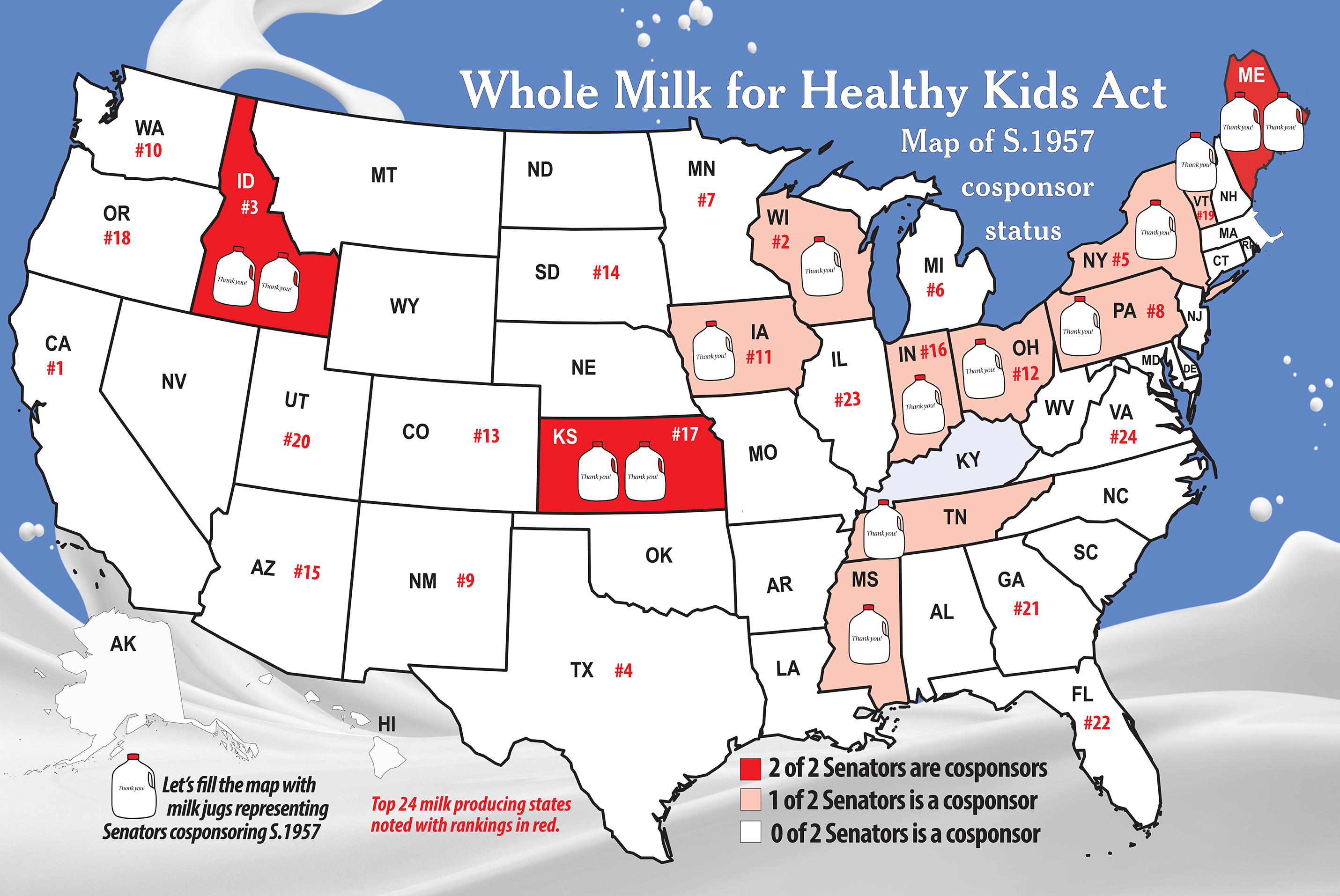
Check out the map above to see how S. 1957 remains stalled for the past 60 days at just 17 sponsors from 13 states. 

Where do your state’s U.S. Senators stand? Ask them! And think about their answers when going to the polls this fall. Elections have consequences. 

Also consider asking your state senators and representatives to follow Tennessee’s lead and get a whole milk bill passed in your state and signed by your Governor. 

Pennsylvania and New York State tried to be first, but leaders are afraid of USDA’s monetary penalties. Maybe the No. 8 and No. 5 milk producing states can be second and third in state whole milk bill passage.

Just think what would happen if more states passed bills that ALLOWED choice and sought creative language to let their schools choose to let children choose. Tennessee will make it available in bulk dispensers separate from the school lunch line. Pennsylvania sought to do it as a wholly in-state proposition. 

Meanwhile, DMI sent a press release on April 29 touting their “checkoff-led pilot in Cincinnati schools that offered lactose-free chocolate milk increased milk consumption…” Specifically, the pilot schools experienced a 16% increase in milk consumption and a 7% higher meal participation, according to DMI. 

(Of course, this lactose-free pilot was also fat-free per the USDA rules for milk at school built on the Dietary Guidelines that the dairy checkoff agreed to “advance” when the memorandum of understanding was signed between the USDA, National Dairy Council, GENYOUth and the NFL in 2010).

Remember, this reporter warned several years ago that checkoff and dairy industry leaders would wait until lactose-free shelf-stable milk was firmly entrenched in schools before pushing whole milk choice through. Senate Ag Chairwoman Debbie Stabenow is the main blockade this time around. She hails from the No. 6 milk producing state of Michigan, where the foundation fairlife plant is located, collecting milk from large producers in Michigan, Indiana and Ohio.

Wonder what consumption looks like when whole milk is offered as a choice. That’s right! A Grassroots PA Dairy Advisory Committee / 97 Milk trial in a school in northwestern Pennsylvania saw consumption grow 52% and waste decline 95%.

So, drink up Senators! Talk to your constituent Moms this Mother’s Day. Sales data and surveys both show what Moms think, and most don’t even realize the federal ban, the bait-and-switch their kids face at school where milk and dairy are concerned.

Then pour a tall cold glass of delicious, nutritious whole milk. It may just strengthen those political spines!

-30- 

Seeds of doubt being sown, Part III: Will it reduce butterfat supply and impact industry’s cheese-focused future?

By Sherry Bunting, Farmshine, March 1, 2024

EAST EARL, Pa. — As seeds of doubt are being sown internally within the dairy industry about whole milk in schools, we have discussed Confusion (will it help milk prices?) and Consternation (unfounded fear about what will processors do with ‘all that skim?’)

This week, we look at the third C: ‘Competition’: If schoolchildren are offered whole milk, will it significantly impact butterfat supplies, raise butter prices, and compete with the industry’s cheap milk cheese-focused future?

Every winter conference for the past few years has had at least one speaker telling dairy farmers that fluid milk sales are declining because Americans are eating more of their milk instead of drinking it. 

Fair enough. Cheese is the future, and the industry wants to make more of it. Lots more of it. So much more cheese, in fact, that inventory is growing. Analysts at conferences put up slides with the words “Export or perish!” in large font. 

Yes, U.S. Dairy wants to export more cheese, including mozzarella. U.S. Dairy wants to export more butter and cream products. U.S. Dairy wants to export more of the higher-value products. (And we want to sell more cream to the upscale coffee houses and downscale McCafe drinks we adults get to choose while junior sips a paltry half-pint of fat-free chocolate milk, sugar water, in the back seat. What’s wrong with us?)

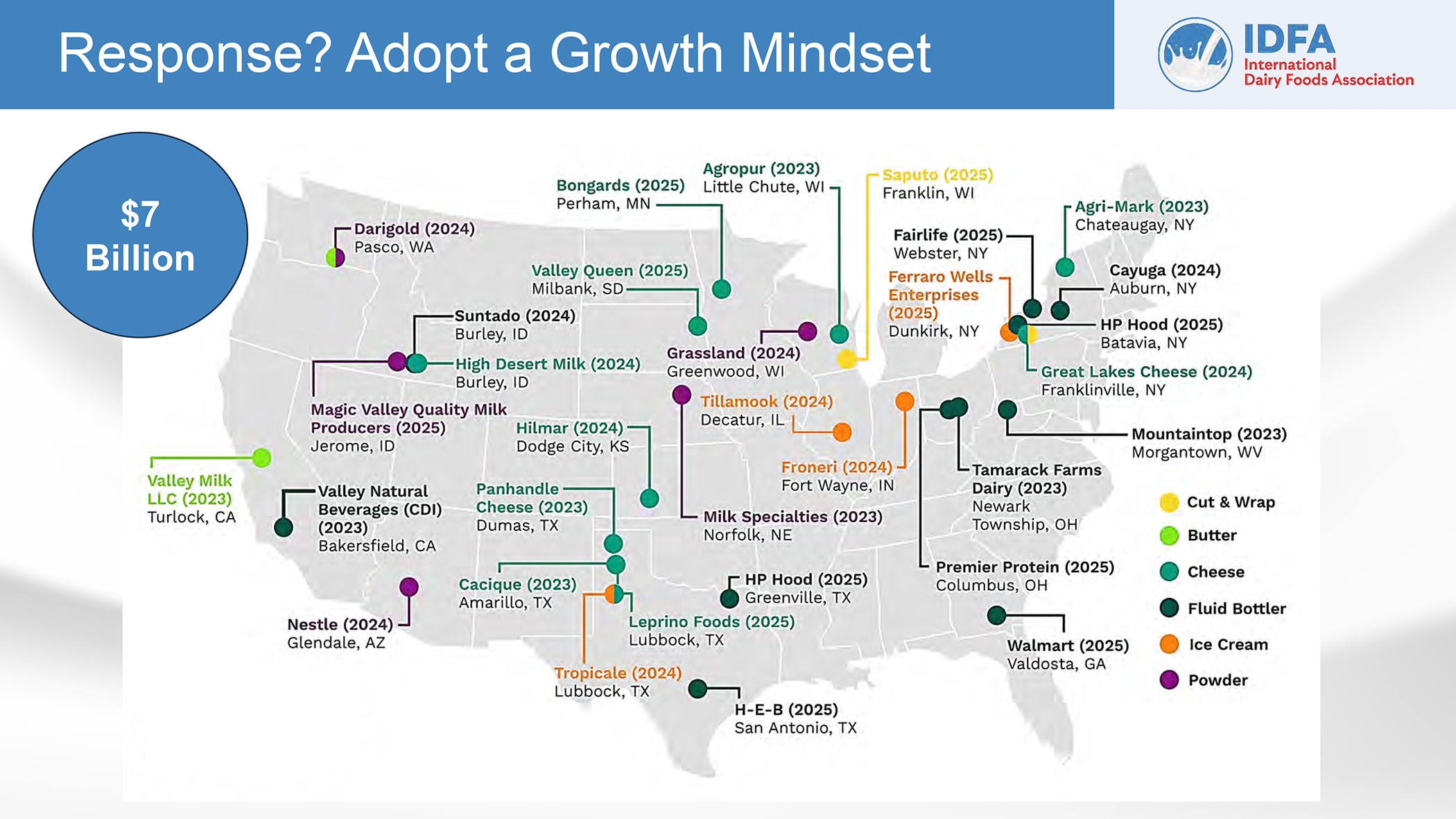
This map shows the over $7 billion in new processing coming online between now and 2026. “There’s a lot of cheese on this map,” said IDFA CEO Michael Dykes, presenting at the Georgia Dairy Conference. This slide has also been popping up in other industry conference speaker powerpoint decks this meeting season. IDFA data

The industry also wants to take milk down to its molecular level – to turn the jug of milk into ingredients at the start — to make new function-targeted products for the beverage space outside of Class I parameters within an increasingly Class III dominated processing infrastructure.

Toward that end, new processing capacity won’t convert milk to traditional products, leaving elements to be marketed as ingredients. Instead, these new state-of-the-art cheese and ingredient plants start by taking milk apart to the ingredients-level to be used in making health beverages, bars, and other products, as well as to make cheese. 

At the Georgia Dairy Conference in January, IDFA CEO Michael Dykes mentioned IDFA’s support for the Whole Milk for Healthy Kids Act, giving attendees a QR code to weigh-in with their Senators. 

Later in his presentation, he noted that a shift to more fat in school milk would make a 3% impact on the butter supply.

“I’m a believer that the markets work, when you take it one place, you make a difference and change it someplace else. Those are the things we can work through,” said Dykes.

So, we reached out to Calvin Covington, a former cooperative CEO who is intimately familiar with component pricing as it became part of the Federal Milk Marketing Order (FMMO) system over 20 years ago. We asked his thoughts on how increasing fat in the school milk supply would impact butter. 

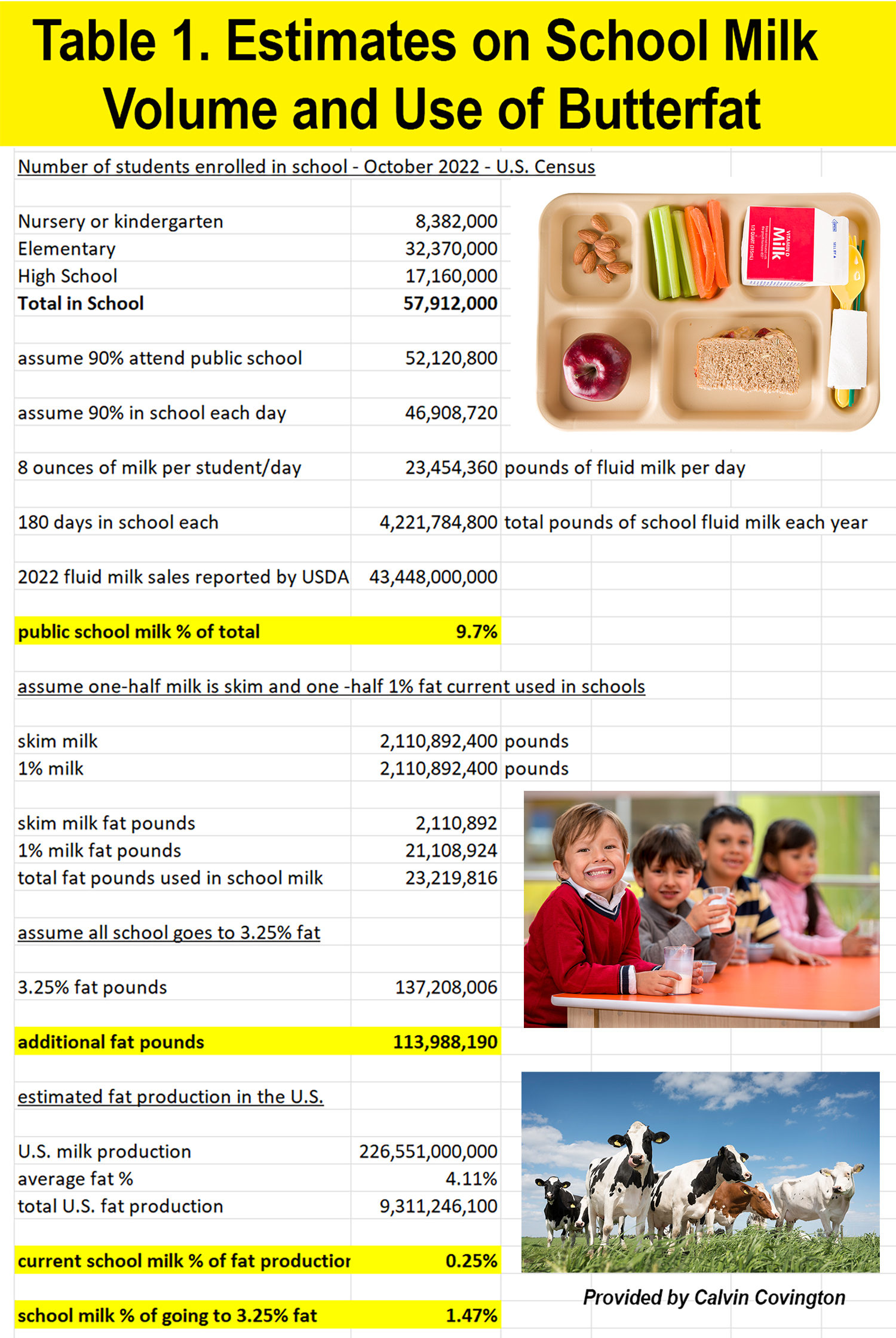
“Increased Cheddar cheese production has used millions and millions of pounds of butterfat. No one complains about this. Doesn’t the dairy industry want to increase demand for all milk components?” he replied and sent forth his own calculations, providing a spreadsheet showing his estimates of milk used in schools and the additional fat that would be needed for all of that milk to go completely to 3.25% (whole) milk.

Covington ran the numbers, moving methodically through assumptions on Table 1 to conclude the impact of shifting from a school milk fat percentage of 0.5% (half fat-free and half 1%) all the way to 3.25% (whole milk) would have a small impact on the butterfat supply — raising the school milk’s usage of butterfat from 0.25% of total butterfat production at the current national average fat test of 4.11% to being 1.47% of total butterfat production at the average 4.11% fat test.

Using the identified assumptions, Table 1 shows estimates on school milk volume and use of butterfat under today’s fat-free and 1% low-fat milk requirement compared with a scenario in which all school milk pounds were at 3.25% fat as standardized whole milk. Provided by Calvin Covington

He estimates public schools use 9.72% of all fluid milk, and for the purpose of the spreadsheet exercise, he assumed that half of those school milk sales are currently fat-free and half are 1%. If that is the case, then going to 3.25% (whole) milk for all pounds of school milk sales, the additional fat that would be needed is almost 114 million pounds, he reports.

“This should be a non-issue,” Covington concludes, using estimates that are based on all of those school milk pounds moving to 3.25% fat. 

The more likely scenario, however, is that schools would implement a more gradual increase in fat percentage. If it mirrored the national average for fluid milk sales at 2% fat, the increase would be smaller initially. Using Covington’s chart and assumptions, the additional fat that would be needed if school milk fat content averaged 2% is closer to 84 million pounds, going from using 0.25% of total fat production to 0.9% of total fat production.

Not all schools will choose to offer all milk at 3.25%. Some may offer 2% milk, which has also been banned since 2010 and would be given regulatory relief under the Whole Milk for Healthy Kids Act. 

Even if 3.25% fat milk is universally offered, some schoolchildren will continue to choose low-fat milk, as they did in the Pennsylvania trial, where the preference was 3 to 1 for whole 3.25% over low-fat 1%.

While a potentially higher fat content in school milk is being scrutinized for its impact on butter and butterfat, the impact of aggressive increases in cheese production is ignored. This speaks a bit to industry priorities.

“As butter and cheese consumption increase, processors do not argue against the increase because utilizing more fat would increase the fat price,” Covington observes, wondering why anyone would be concerned about the impact on butterfat supply if children get to choose whole milk while not being concerned about the impact on butterfat supply in any other sector.

“An increase in fluid milk sales, in schools, or anywhere, benefits all dairy farmers. With all things being equal, it would shift milk from Class III and IV to Class I, which is a (normally) higher milk price,” Covington explains. “If Class III or IV need more milk to replace the loss to Class I, more money would need to be paid by Class III and IV milk buyers, again, helping dairy farmers.”

So, what is the current status of butterfat production and usage? 

The national butterfat average is 4.11%. A decade ago, it was 3.69. From 2011 to 2022, total butterfat pounds produced on farms in the U.S. grew by 2 billion pounds from 7.3 billion to 9.3 billion. That’s a butterfat volume response to a price signaling demand.

Where’s it all going? Around 20% goes to butter production, 8% to ice cream and frozen desserts, 10% in fluid milk sales, and close to 50% is used in cheese production. And then there is this growing market for cream used in coffee drinks.

Meanwhile, dairy producers out West report receiving a letter from a large cheese plant, putting in a new base program at 1.5% over base. 

Another producer in an unregulated state in the West reported receiving a letter from his cheese plant stating they will reduce the butterfat multiple in their cheese milk payment, beginning April 1. The reason, according to the letter, is the farms are making too much butterfat, and the plant is having to buy condensed solids (skim) to pair with the additional fat or sell the extra fat as excess sweet cream at a loss.

During the FMMO hearing, fluid milk bottlers complained that the higher fat and component levels in milk today are more costly for them to deal with, that they must move the excess cream at a loss, and they have to clean the separator more often because of ‘sludge’ buildup. (I kid you not, one witness called it ‘sludge.’)

Processors have petitioned USDA with multiple proposals to get regulated minimum prices down to their definition of a ‘market clearing’ level that then allows them to add market premiums to attract new milk. Read that sentence again.

Who would be paying those premiums to grow milk supply? Not the processors. It would be revenue coming out of the regulated minimum price benchmarks for all farmers, including farmers that are not growing, to then get added back in by the processors wherever they want to direct growth.

Cheap milk is the name of the game, while at the same time, dairy farmers are being challenged to grow to meet the future ‘demand gap’ to fill $7 billion in new processing investments that will become operational over the next few years.

Dairy analysts tell how milk production expansion to meet this investment will not be as easy to do and will take longer than in the past because of the shortage in replacement heifers. 

We’re at a standoff, so to speak. 

Dairy producers have bred beef-on-dairy to bring margin back to their farms after 10 years of dairy margin compression. This strategy has been a good hedge against overproduction of milk in the era of sexed-semen, and it has helped protect farm balance sheets by reinforcing the value of the cattle as collateral.

So, what tool will be used now to drive consolidation and growth in dairy? Dykes told Georgia producers that, “Sustainability will be one of the biggest drivers of consolidation we’ve seen in a generation. Why? Because it’s going to take investment, and it’s going to take scale. We need to figure it out, to measure it, verify it, account for it, not double count it. We’re going to need investments to make sure we have the infrastructure.”

He said sustainability will become the gateway for exports where countries have mandates and carbon taxes for purchased ag products.

So, here we are back at the question about milk supply, butterfat supply, skim supply and school milk. Wouldn’t whole milk sales to schools offer a much-needed tug on the demand side to help shift some milk away from this runaway, market-depressing, buildup of excess cheese production that elicits the powerpoint headline: ‘Export or perish?’ 

Just think, if the fluid milk sales to schools increased as they did in the Pennsylvania trial by 52%, or even half that, by 25% as more kids choose milk instead of refusing it, market principles could work — gaining something in one place to affect it someplace else. 

Meanwhile, the industry can do some soul-searching and adapting amid the double-speak. If more milk, fat and components are needed, then farmers need to be able to make a living milking cows and producing fat and components.

Is the problem not enough milk? Or too much milk? Not enough fat? Or too much fat? Not enough skim? Or too much skim? Or is the problem rooted in making sure milk can be bought cheap and that farmers are forced to find revenue in other ways, such as carbon monitoring?

Let’s get it straight please.

On the horizon, we see: Checkoff-funded fluid milk innovations for new beverages that identify and separate specific milk molecules for specific benefits (sleep drinks, energy drinks, immune function drinks, specific protein type drinks)? More on that in Milk Molecules Initiative Part I and Part II

-30-

Seeds of doubt being sown, Part II: ‘What will processors do with all that skim?’ Oh my!

By Sherry Bunting, Farmshine, Feb. 23, 2024

EAST EARL, Pa. — The status of the Whole Milk for Healthy Kids Act, S. 1957, has 17 Senate sponsors from 13 states, including 12 Republicans, 4 Democrats, and 1 Independent. 

Even though both NMPF and IDFA have shown support for the measure, a bit of resignation can be sensed — riding the overwhelming House vote as enough progress for one legislative session. After taking bows for the performance of the bill in the House, representatives of both NMPF and IDFA – while speaking at winter meetings – have indicated a prevailing view that Senate opposition to S. 1957, is a big barrier. 

They say they are working to get the science in front of the Dietary Guidelines Committee, which has been tried before – over and over.

The DGA committee operates under a USDA that does not want whole milk options in schools or SNAP or WIC. This same USDA is proposing to remove chocolate milk options from schools, except for senior high students, and is proposing to reduce WIC milk by 3 gallons per recipient per month. This same USDA projects 20 billion more pounds of milk will be produced in the U.S. by 2030, according to IDFA CEO Michael Dykes, presenting future trends at the Georgia Dairy Conference in Savannah.

Seeds of doubt about the whole milk bill are being sown among farmers. Some asked me recently if their co-ops will lose money on the deal.

Last week, we discussed ‘Confusion’ — the first of 3 C’s that are facing the whole milk bill within the dairy industry. 

This week we look at the second C: ‘Consternation’ — a fancy word for fear.

“What will they do with all of our skim?” farmers asked me at a recent event. Is this something they are hearing from a milk buyer or inspector?

Here are some facts: Whole milk sales move the skim with the fat — leaving some of the fat through standardization, but not leaving any skim. Therefore, an increase in whole milk sales does not burden the skim milk market.

Surely, the practice of holding schoolchildren hostage to drinking the byproduct skim of butter and cream product manufacturing is a poor business model if we care about childhood nutrition, health, and future milk sales. 

Furthermore, the market for skim milk powder and nonfat dry milk is running strong as inventories are at multi-year lows in the U.S. and globally.

Cheese production, on the other hand, is what is cranking up, and it has been the market dog for 18 months. Like whole milk sales, cheesemaking uses both fat and skim. But cheesemaking leaves byproduct lactose and whey, and it can leave some residual fat depending on the ratios per cheese type.

Things are pretty bad for farmers right now in cheesemilk country. Some tough discussions are being had around kitchen tables. The 2022 Ag Census released last week showed the dire straits for farmers nationwide over the last five years as the number of U.S. dairy farms declined below 25,000, down a whopping 40% since 2017.

Wouldn’t an increase in whole milk sales through the school milk channels help pull some milk away from rampant excess cheese production that is currently depressing the Class III milk price, leading to price divergence and market dysfunction?

While there is no one data source to specifically document the percentage of the milk supply that is sold to schools, the estimates run from 6 to 7% of total fluid milk sales (Jim Mulhern, NMPF, 2019), to 8% of the U.S. milk supply (Michael Dykes, IDFA, 2023), to 9.75% of total fluid milk sales (Calvin Covington, independent analysis, 2024). 

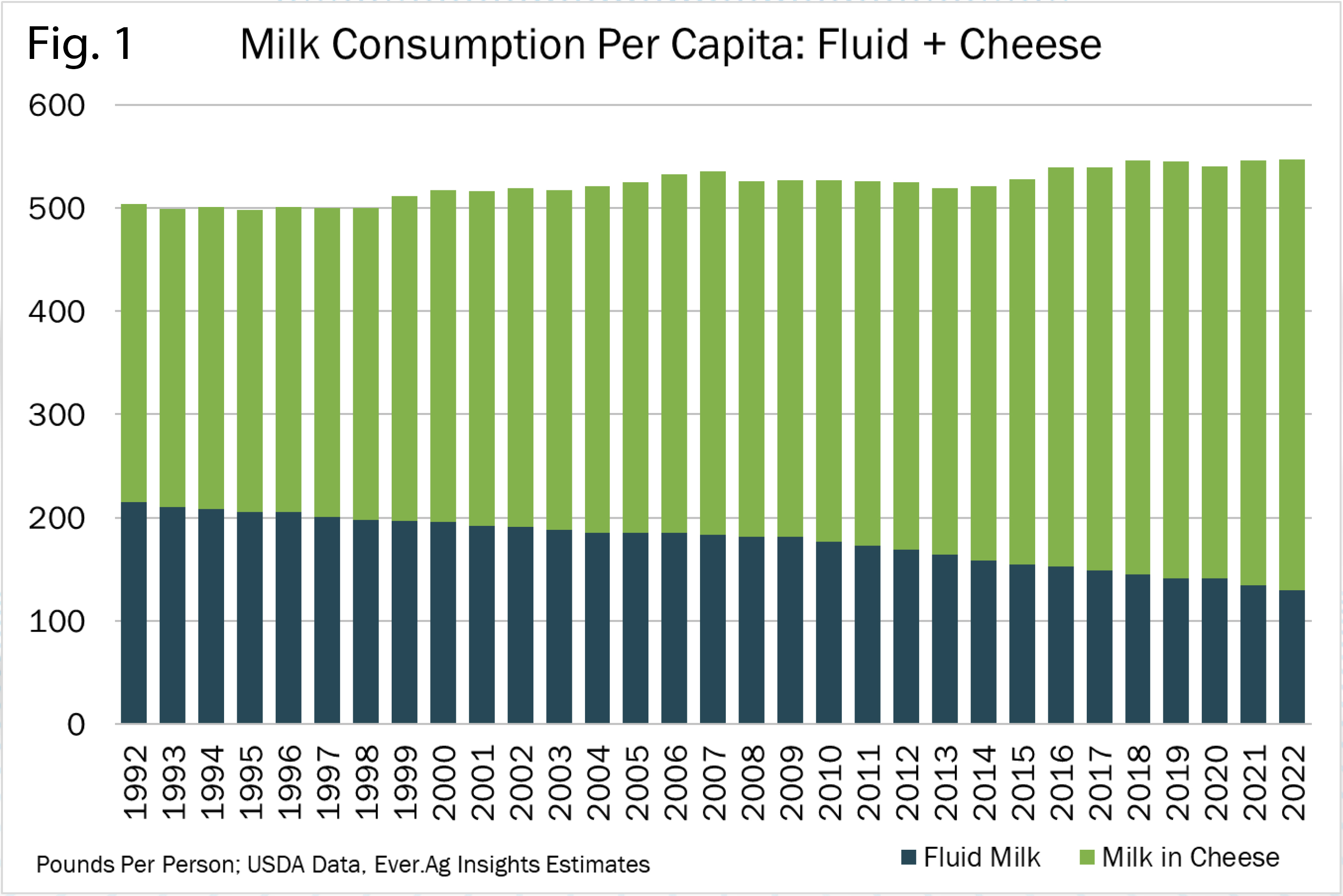
If even half of these sales became whole milk sales, it could modestly positively impact the amount of excess cheese being made even as processors say they plan to make more cheese because people eat more of their milk than are drinking it. (Fig. 1)

Meanwhile, the cheese price is under so much downward price pressure that there is a $2 to $4 divergence of Class IV over Class III causing farmers to lose money under the ‘averaging’ formula for Class I milk. In many parts of the country, farmers lose additional money when the milk that is used in Classes II and IV is depooled out of FMMOs.

Without the ‘higher of’ pricing mechanism that was in place from the year 2000 until May 2019, Class I can fall below the higher manufacturing price, removing incentive to pool, which leaves pooled producers with smaller payments for their milk and leaves the decision about what to pay depooled farmers up to the processors after they’ve succeeded in reducing the benchmark minimum by depooling.

Ultrafiltered (UF) milk represents 2.4% of fluid milk market share, having grown by more than 10% per year for four years with sales up 7.7% in 2023 vs. 2022, according to Circana-tracked market data shared by Dykes.

UF milk is also cheese-vat-ready-milk with capability to remove not just the lactose but also the whey as permeate at the front end for use in distilleries that are now funneling lactose into ethanol production in Michigan and whey into alcoholic beverages in Michigan and Minnesota.

Processors want farmers to do “a tradeoff” to decide how much revenue comes to their milk checks and how much goes to processing investments for the future. The future is being dictated by where we are in fluid milk consumption relative to cheese production.

This is one reason IDFA and Wisconsin Cheesemakers, as well as NMPF, had proposals asking USDA to increase the processor credits (make allowances) that are embedded in the dairy product price formulas. IDFA and Milk Innovation Group also put forward other proposals to further reduce regulated minimum prices.

We wonder with these new processing investments, how is it that the make allowances are too small? Only bulk butter, nonfat dry milk, dry whey, 40-lb block Cheddar and 500-lb barrel cheese (yellow not white) are surveyed for the circular class and component price formulas. Everything else that doesn’t meet CME spec for these specific product exchanges is excluded.

This means the costs to make innovative new products and even many bulk commodity-style products, such as bulk mozzarella, unsalted butter, whey protein concentrate and skim milk powder, can be passed on to consumers without being factored back into the FMMO regulated minimum prices paid to farmers.

If market principles are applied, processors wanting to encourage more milk production, to make more cheese, would pay more for the milk – not less. But when the margin can be assured with a make allowance that yields a return on investment, all bets are off. Cheese gets made for the ‘make’ not the market.

We saw processors petition USDA in the recent Federal Milk Marketing Order hearing to reduce the minimum prices in multiple ways so they can have the ability to pay market premiums to attract new milk. This would be value coming out of the regulated FMMO minimum price benchmark for all farmers to get added back in by the processors wherever they want to direct it.

Cheese is in demand globally, and the U.S. dairy industry is investing to meet this. Dykes told Georgia producers that processors want to grow and producers want to grow. He wasn’t wondering what to do with all of the skim when he asked: “Where will the milk come from for the over $7 billion in new processing investments that will be coming online in the next two to three years?”  

This is happening, said Dykes, “due to market changes from fluid milk to more cheese production (Fig. 1). There’s a lot of cheese in those plans. With over $7 billion in investment… These are going to be efficient plants. You’re going to see consolidation. If you are part of a co-op, you’re going to decide how much (revenue) comes in through your milk check and how much goes into investment in processing for the long-run, for the future. That’s the debate your boards of directors will have.” 

Even the planned new fluid milk processing capacity is largely ultra-filtered, aseptic and extended shelf life, according to Dykes.

“That’s the direction we are moving,” he said. “We are seeing that move because as we think about schools, are we still going to be able to send that truck driver 20 miles in any direction with 3 or 4 cases of milk 5 days a week? Or do we do that with aseptic so they can store it and put it in the refrigerator one night before, and get some economies of scale out of that, and maybe bring some margin back to the business?”

As the Class III milk price continues to be the market dog, we don’t see milk moving from Class III manufacturing to Class IV, perhaps because of the dairy processing shifts that have been led by reduced fluid milk consumption. 

Allowing schoolchildren to have the choice of whole milk at school is about nutrition, healthy choices, future milk consumers, and the relevance of fresh fluid milk produced by local family farms in communities across the country. Having a home for skim does not appear to be the primary factor affecting milk prices where Class III is dragging things down.

Bottomline, dairy farmers should have no consternation (fear) over what processors are going to do with “all of that skim” once they are (hopefully) allowed to offer schoolchildren milk with more fat.

Next time, we’ll address the third ‘C’ – Competition – If kids are offered whole milk in schools, will it reduce the butterfat supply and impact the industry’s cheese-centered future? 

A final note, just in case the question about ‘what to do with all that skim’ still bothers anyone… What’s wrong with animal feed markets for skim milk powder? Protein is valuable in animal health, there are livestock to feed, and people spend major bucks on their pets too. Did you know dog treats made with nonfat dry milk powder, flour and grated cheese are a thing?

That idea got a good laugh from those farmers when I suggested it.

However, Cornell dairy economist Dr. Chris Wolf noted recently how China’s purchases are what drive global skim milk powder and whey protein prices, and that much of that market for both is to feed… you guessed it… Pigs. 

Whole Milk for Healthy Kids Act S. 1957 needs more cosponsors: We need your help! Please contact your state’s two U.S. Senators

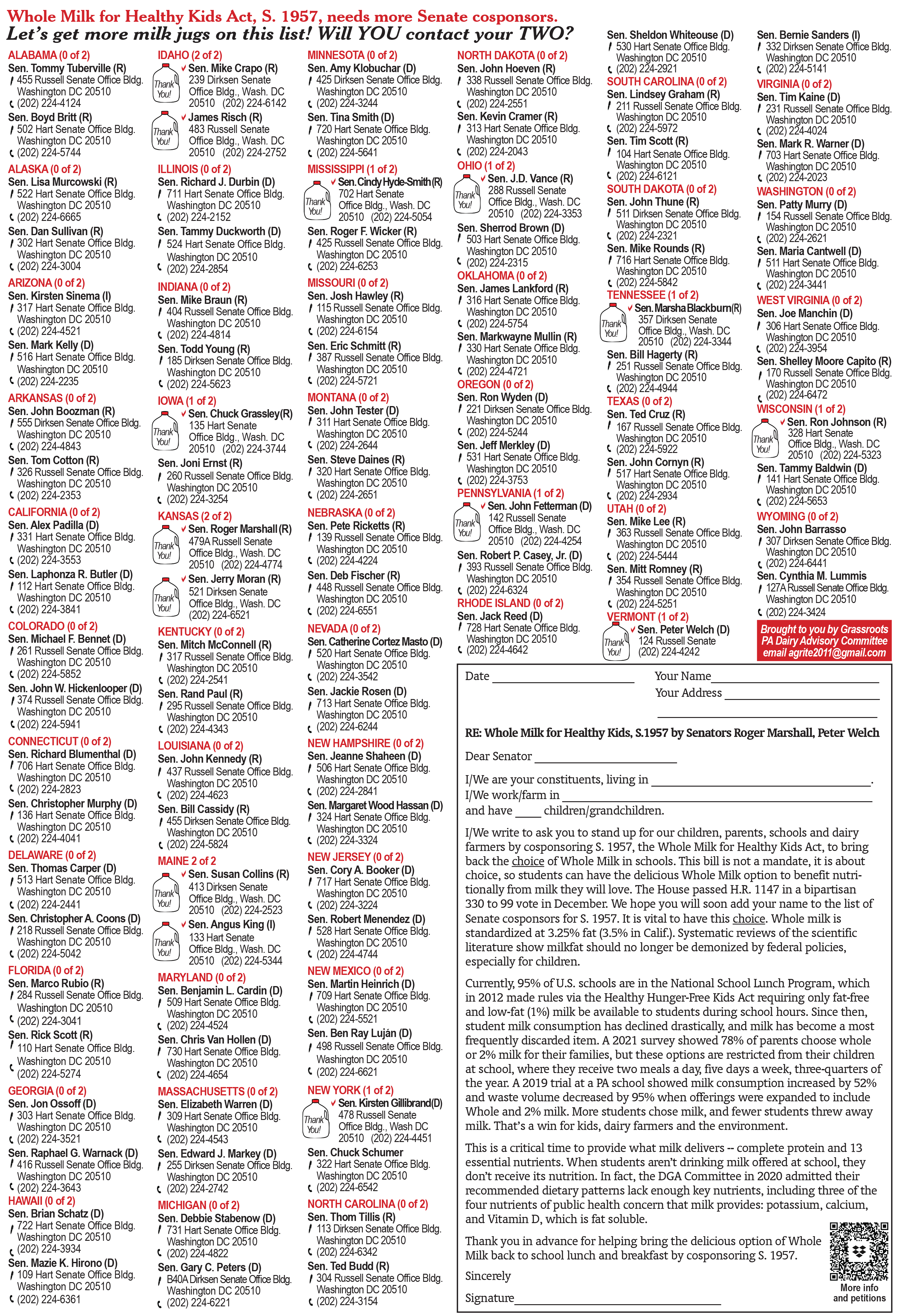
The Whole Milk for Healthy Kids Act has moooved to the Senate. S. 1957 is identical to H.R. 1147. As of Feb. 21, 2024, the Senate bill has 15 sponsors from 12 states. This map shows what states have both Senators or one Senator signed on and which states have none. We need more cosponsors to get this bill out of the Ag Committee and onto the Senate floor for a successful vote. Will YOU call or write TWO? Map by Sherry Bunting

By Sherry Bunting, Farmshine, January 26, 2024 (Cosponsor data updated Feb. 21, 2024)

WASHINGTON — The Whole Milk for Healthy Kids Act is now up to the Senate, where more cosponsors are definitely needed to push it past some barriers and get it to the floor for a successful vote.

Senate bill S. 1957 is not a mandate for whole milk. This bill ends a mandate against whole milk, which is federally banned from schools (2% reduced fat milk is also prohibited. Only fat-free and 1% low-fat milk are allowed to be offered with meals or a la carte or in vending machines).  

In December, Senator Debbie Stabenow (D-Mich.) blocked the unanimous consent motion by Senator Roger Marshall (R-Kan.). Marshall was seeking an immediate Senate vote on H.R. 1147 – Congressman G.T. Thompson’s bill – on Dec. 14, 2023, just one day after it was overwhelmingly passed in the House of Representatives by a bipartisan 330-99 vote. It was previously passed in the House Education Committee in a bipartisan 26 to 13 vote.

Marshall chugged a glass of whole milk and gave an inspiring speech about getting the bill to the President’s desk for Christmas. Sen. Marshall is a medical doctor, an obstetrician, and a member of the Senate Ag Committee.

“This is a slam-dunk for American families,” he said.

Sen. Stabenow played the role of the Grinch stealing the opportunity for immediate whole milk passage in the Senate on the heels of the overwhelming House vote as she objected to the unanimous consent request on Dec. 14.

But that’s not the end of this story, just the beginning.

An identical Senate bill, S. 1957, The Whole Milk for Healthy Kids Act was introduced in June 2023. It was read twice on the Senate floor and referred to the Senate Agriculture Committee, chaired by — you guessed it — Sen. Stabenow of Michigan. This means she is in a ‘gate-keeper’ position for this bill. If it doesn’t come before her committee, it will have trouble getting to the floor.

This is where we can help by raising the number of Senate cosponsors! There are 15 sponsors as of Feb. 21 (updated). We need to get to one-third or one-half of the Senate. That’s 35 to 50.

While news reports indicate Sen. Stabenow will retire after this term and is not seeking re-election, her legacy in caring about childhood nutrition and agriculture may be important to her. She stated on the Senate floor that these decisions about milk in school should be made by the scientific committees. She wants to “keep having these conversations.”

Let’s take her up on that by having conversations with our Senators to cosponsor S. 1957. The Dietary Guidelines Advisory Committee has for three cycles and over 15 years refused to consider the preponderance of sound evidence about the benefits of milkfat that the USDA keeps screening out of their deliberations process. 

The DGA Committee is meeting right now for 2025-30 DGAs that seek to refine the current dietary patterns, not re-evaluate them. Even the DGA Committee in 2020 admitted their recommended dietary patterns are deficient in key nutrients that milk delivers.

Here’s the bottom line: S. 1957 was introduced in June 2023 by Sen. Marshall (R-Kan.), along with Senators Peter Welch (D-Vt.), Kirsten Gillibrand (D-N.Y.), Ron Johnson (R-Wis.), John Fetterman (D-Pa.), Chuck Grassley (R-Iowa), Cindy Hyde-Smith (R-Miss.), James Risch and Mike Crapo (both R-Idaho), Susan Collins (R-Maine), and Angus King (I-Maine).

Four more cosponsors have been gained, they are Senators J.D. Vance (R-Ohio), Jerry Moran (R-Kan.), Marsha Blackburn (R-Tenn.), and Mike Braun (R-Ind.)

As of January 24, 2024, S. 1957 has 14 sponsors from 11 states in the U.S. Senate. Of these 15, seven are on the Senate Ag Committee (Marshall, Hyde-Smith, Gillibrand, Fetterman, Welch, Grassley, Braun). 

We need the rest of the Ag Committee, including Ranking Member John Boozman (R-Ark.). If you live in Arkansas, contact him. If you live in Minnesota, contact Ag Committee Senators Amy Klobuchar and Tina Smith; in Illinois, Sen. Richard Durbin; in Ohio, Sen. Sherrod Brown; in Kentucky, Sen. Mitch McConnell; in Iowa, Chuck Grassley has already signed on, but Joni Ernst has not; in North Dakota, talk with Sen. John Hoeven; in South Dakota, Sen. John Thune; in Nebraska, Sen. Deb Fischer; in Georgia, Sen. Raphael Warnack; in New Mexico, Sen. Ben Ray Lujan; in Alabama, Sen. Tommy Tuberville; in Colorado, Sen. Michael Bennet; and in New Jersey, Sen. Cory Booker.

No matter where you live, contact your state’s two U.S. Senators. We need as many Senate cosponsors as possible, and we need Senators motivated to speak with Chairwoman Stabenow, to ask her to please stop putting the ego and agenda of Washington bureaucrats above the health and welfare of America’s children and the economic stability of America’s dairy farmers.

This bill is about choice. It is not a mandate. It simply allows schools to offer whole and 2% flavored and unflavored milk at school lunch and breakfast without financial penalties for exceeding outdated milkfat limits that are unnecessary or even harmful to children.

If we want children to benefit from the nutrition milk delivers, then we need to deliver the permission for our children to be able to choose milk they will love at school where they have two meals a day, five days a week, three-quarters of the year. That’s how they actually benefit from the complete protein and 13 essential nutrients milk delivers.

Let’s stay positive. We can’t afford to lose ANOTHER generation of milk drinkers and think we will still have a dairy industry in many parts of the U.S. The Whole Milk for Healthy Kids Act is an opportunity for dairy farmers to revitalize and renew fluid milk demand, but more importantly, it’s an opportunity for schoolchildren to choose milk they will love for life and health. It’s also an opportunity to drastically cut the amount of wasted milk in school cafeterias, a win for stewardship of resources and the environment.

A 2021 survey by IDFA showed that 78% of American parents who described themselves as voters, choose 2% or Whole Milk for their families as the most delicious and nutritious option, but their children can choose neither 2% nor Whole milk at school where they have two meals a day, five days a week, three-quarters of the year.

This survey is consistent with what a Pennsylvania school trial in 2019 showed. The students preferred Whole Milk 3 to 1 over the 1% low-fat milk. When 2% and Whole Milk were offered in the coolers, students consumed 52% more total milk and the average daily volume of discarded milk was reduced by 95%. This means more students took the offered milk instead of refusing it, and fewer students threw away the milk they took with their meals.

The Grassroots Pennsylvania Dairy Advisory Committee, under chairman Bernie Morrissey’s leadership, has launched a letter-writing and phone-calling campaign seeking cosponsors for S. 1957. They have put together the tools, but grassroots farmers and citizens must be the ones to carry it out and send the letters and make the calls.

We need to help Senate Ag Committee Chairwoman Debbie Stabenow understand this issue is about lifting the federal school lunch and breakfast ban that was placed on delicious nutritious whole milk in 2012 so that school districts, parents and students can make healthy milk choices that are enjoyed and not discarded.

This bill is not a mandate for whole milk. This bill ends a mandate against whole milk.  

This is about options, choice, and a future for kids and dairy farms. Will YOU call or write your TWO?

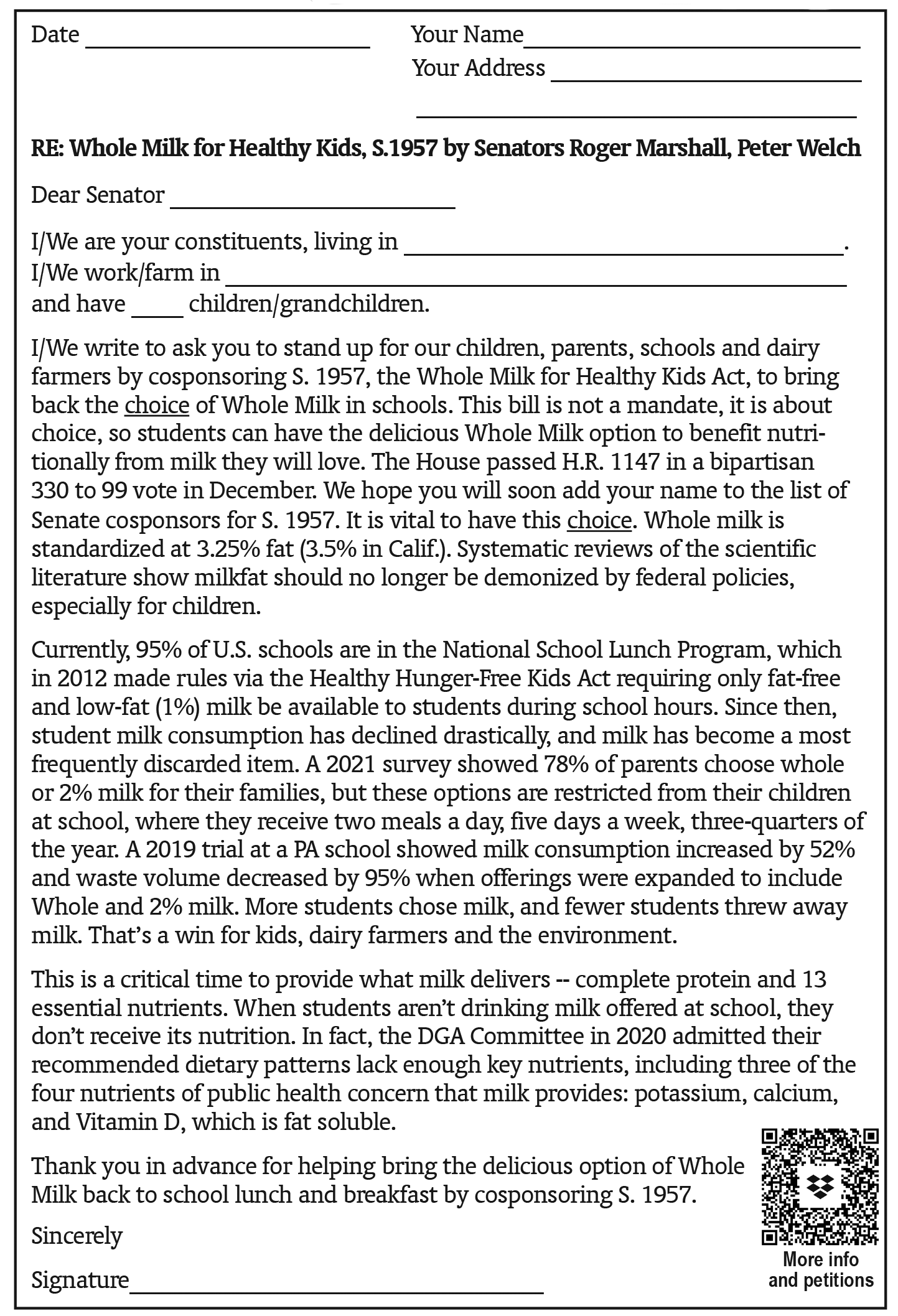
Let’s keep this bill moooving. Every state has two U.S. Senators. Click here for a sample letter.

Find the Washington addresses and phone numbers for your state’s Senators at https://www.senate.gov/ – Click the icon in the top left corner, select your state from drop-down menu to see how to contact them. Or look for your state in this printable directory.

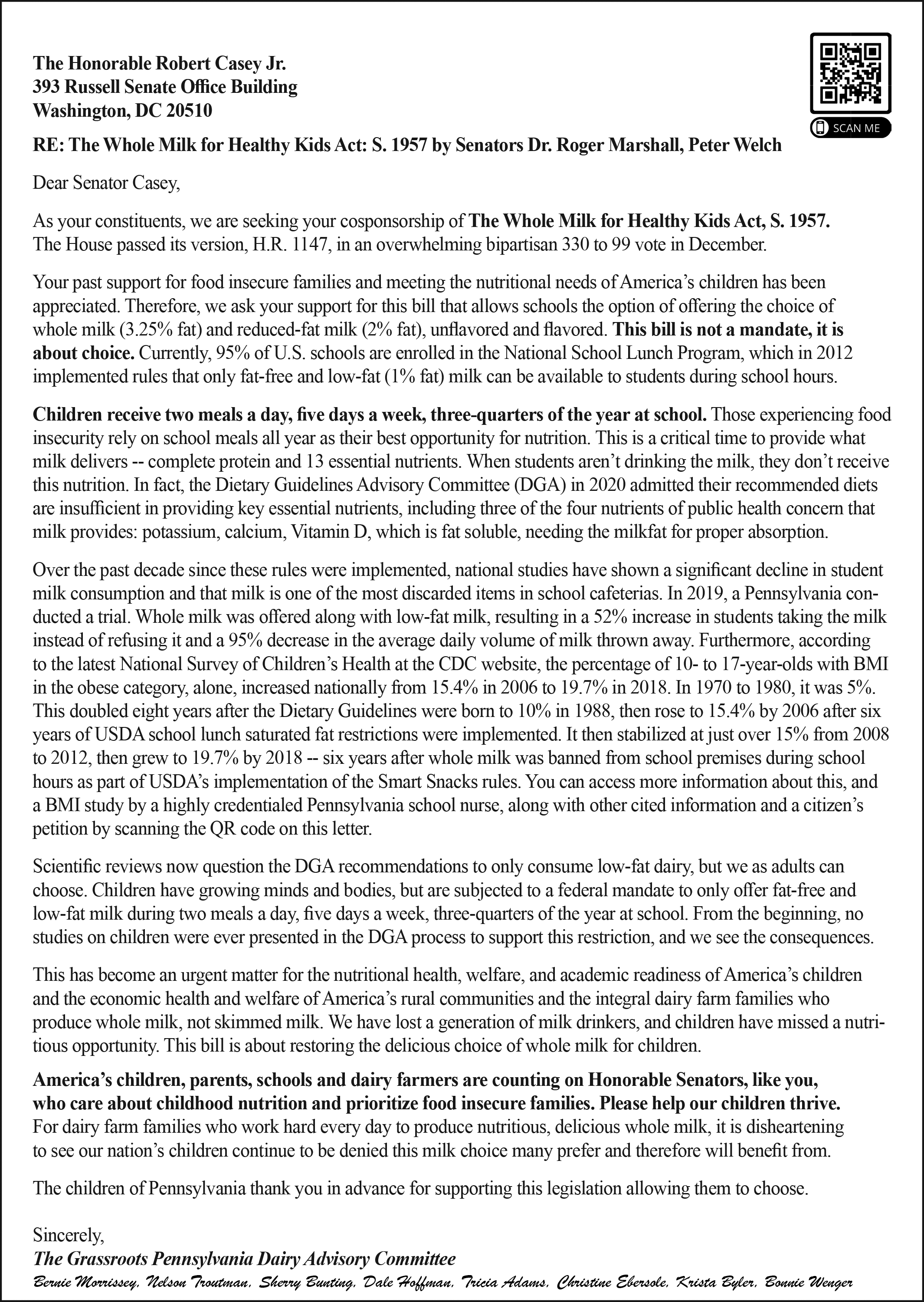
For a more detailed letter, like the one sent by the Grassroots PA Dairy Advisory Committee to Senator Robert Casey, Jr. of Pennsylvania, click here.

For a simple phone message guide for contacting Senate Ag Committee Chairwoman Debbie Stabenow, Majority Leader Chuck Schumer and Minority Leader Mitch McConnell (and if in PA Senator Robert Casey) click here.

See the complete Action Packet and find some additional resources in a folder here

To email your Senators: Go to https://democracy.io/ – type in your address, city and zip code, click submit. Your two Senators and one Rep. will show up with red check marks. Click ‘Write to them.’ Then, on the next screen, write the body of your letter. If you want, you can start with who you are, where you live, what you do. You can also mention if you have school-aged children or grandchildren. Then copy and paste from the text below or write your own message simply asking your Senators to cosponsor S. 1957 The Whole Milk for Healthy Kids Act

**************

RE: Whole Milk for Healthy Kids, S.1957 by Senators Roger Marshall and Peter Welch

I write to ask you to cosponsor S. 1957, the Whole Milk for Healthy Kids Act, to bring back the choice of Whole Milk in schools. This bill is not a mandate, it is about choice, so students can have the delicious Whole Milk option to benefit nutritionally from milk they will love. The House passed this in a 330 to 99 vote in December. We hope you will soon add your name to the list of cosponsors for the Senate. Whole milk is standardized at 3.25% fat (3.5% in Calif.). Systematic reviews of the scientific literature show milkfat should no longer be demonized by federal policies, especially for children.

Currently, 95% of U.S. schools are in the National School Lunch Program, which in 2012 made rules requiring only fat-free and low-fat (1%) milk be available to students during school hours. Since then, student milk consumption has declined drastically, and milk has become a most frequently discarded item. A 2021 survey showed 78% of parents choose whole or 2% milk for their families, but these options are restricted at school, where kids receive two meals a day, five days a week, three-quarters of the year. A 2019 school trial showed milk consumption increased by 52%, and waste volume decreased by 95%, when offerings were expanded to include Whole and 2% milk. More students chose milk, and fewer students threw away milk. That is a win for kids, dairy farmers and the environment.

This is a critical time to provide what milk delivers — complete protein and 13 essential nutrients. When students aren’t drinking the milk offered at school, they don’t receive its nutrition. In fact, the Dietary Guidelines Committee in 2020 admitted their recommended dietary patterns lack enough key nutrients, including three of the four nutrients of public health concern that milk provides: potassium, calcium, and Vitamin D, which is fat soluble.

Thank you in advance for helping bring the nutritious, delicious option of Whole Milk back to school lunch and breakfast by cosponsoring S. 1957.

**************

-30-

Congressman G.T. Thompson’s Whole Milk for Healthy Kids Act approved 26-13 by House Education Committee

Thompson: ‘This is a win for children and dairy farmers, but we’re not done’

“This policy has cheated our children and has led to economic demise in Rural America as we’ve seen a loss of dairy farms and small businesses that are in that supply chain. It’s time to reverse the mistake that was made in 2010. We need to follow real science, not political science. I question the process of the Dietary Guidelines Advisory Committee. These are unelected bureaucrats, and there’s no oversight. This is our chance to actually do something positive in that process to say ‘hey we’re watching what you’re doing. We’re looking over your shoulder,’” said Rep. GT Thompson (R-PA-15). In a bipartisan 26 to 13 vote, the Committee on Education and Workforce passed Thompson’s motion to report the Whole Milk for Healthy Kids Act, H.R. 1147, to the House of Representatives with recommendation of passage. On the Republican side, 21 voted yes and 4 were absent. On the Democratic side, 5 voted yes, 13 no, and 3 were absent. The next step is getting the bill on the calendar for a vote on the House floor.

By Sherry Bunting, Farmshine, June 9, 2023

WASHINGTON — The Whole Milk for Healthy Kids Act, H.R. 1147, reached a major milestone this week, passing mark-up in the U.S. House Committee on Education and Workforce.

Dairy farmers could not have asked for a better way to kick off June Dairy Month as the committee discussion exposed the sides of this issue, and Congressman Glenn ‘GT’ Thompson, the Republican from Pennsylvania and the bill’s prime sponsor, laid out the case for children to have true access to the most nutritional beverage — milk.

In the end, the Education Committee on Tuesday, June 6 approved the bill in a bipartisan 26 to 13 vote. 

(Cross-section highlights of Education and Workforce Committee discussion and vote.)

Now that it is recommended by the House Education and Workforce Committee, the next step is scheduling of the vote on the House floor.

This is the first time in three legislative sessions that the bill to restore the choice of whole and 2% unflavored and flavored milk in schools has made it this far in the legislative process.

“This is a win for children and dairy farmers, but we’re not done. I took a deep breath to see this satisfying outcome in this first stage and another deep breath as we move to the next stage to get it onto the House calendar,” said Rep. Thompson in a Farmshine interview after committee passage.

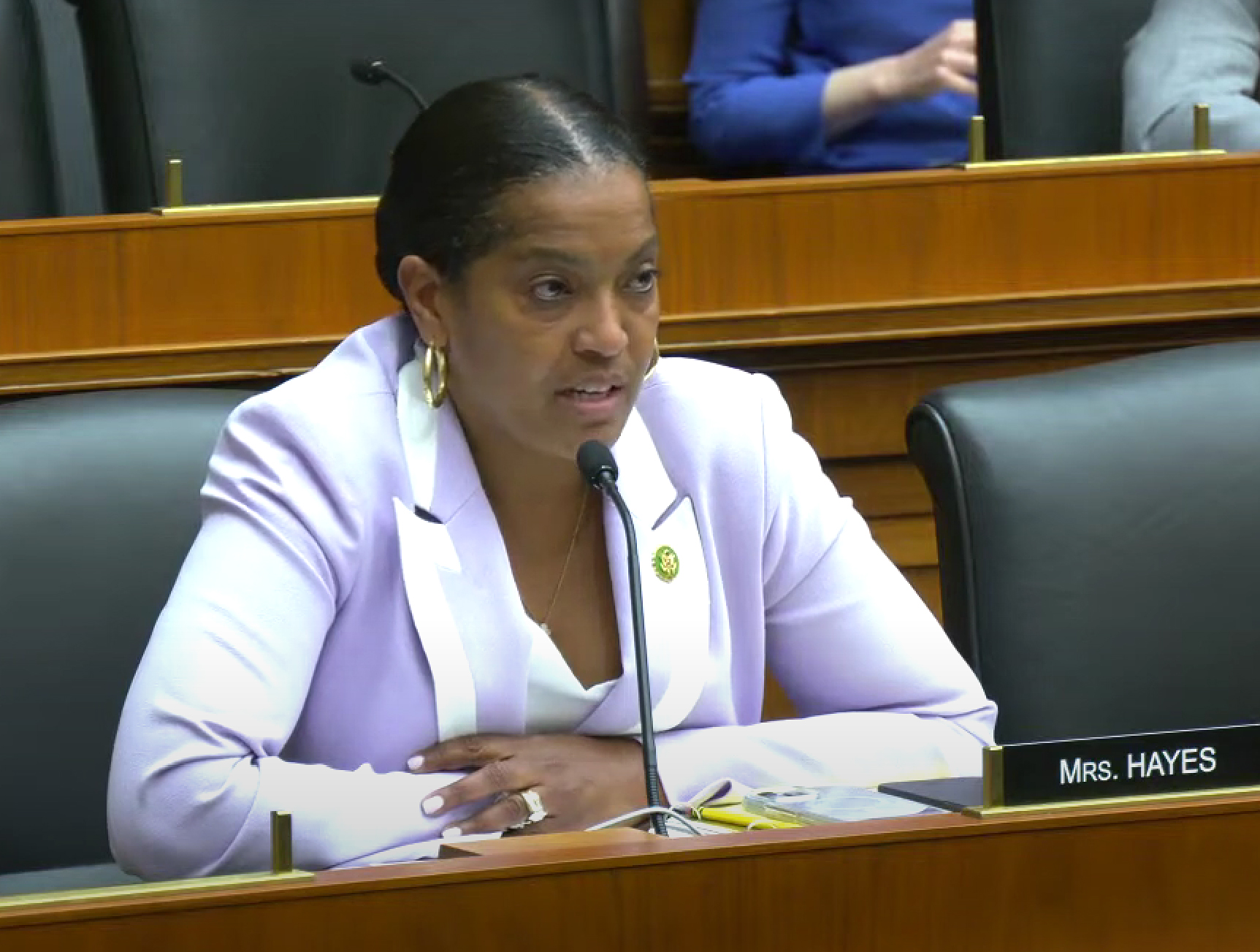
A further breath of bipartisan fresh air also came from Rep. Jahana Hayes, a Democrat and educator from Connecticut. She rose in support of the bill, quoting from the Dietary Guidelines 2020-25 report and from USDA, giving statistics about what is offered and what is consumed in recommended dairy intake, especially for children ages 2 to 18.

“I have belabored this point that children receive a huge amount of their daily nutrition at schools. Also, the school meal programs are a significant source of milk and dairy for kids,” said Hayes.

“But the part that sticks for me is that none of this matters if kids aren’t drinking the milk. We can have as much data and statistics on what kids need as dietary dairy intake, but if they’re not drinking it, then it’s all for naught,” she stressed. “We’ve seen students take less milk and throw away more milk when they don’t like the way it tastes.

“I support this amendment. I drink whole milk. My kids drink whole milk. We like it,” Hayes asserted.

Chairwoman Virginia Foxx, a Republican from North Carolina said the debate over whole milk “takes the cake.” 

She talked about how previous recommendations have been “walked back,” and she bemoaned the fact that there are “no checks and balances” over the Dietary Guidelines process of making these recommendations.

“I was shocked last year when I learned that whole milk has only 3.5% fat content, when we are saying to students: ‘drink skim milk or 1% milk,” the Chairwoman said. 

“Surely-to-goodness, that kind of fat content is not doing the damage that some people are saying. This Dietary Guidelines Advisory Committee is just a small group of unelected, appointed people, and we want to turn children’s lives over to groups like this? We should be dealing with this,” she added.

The bill’s champion, Rep. GT Thompson is a senior member of the Education Committee, and chairs the Agriculture Committee. 

Thompson said he is discussing the next stage with the House Majority Leader to schedule the legislation for a vote on the House floor.

“The bill had 106 bipartisan cosponsors supporting it from 39 states — before this committee vote — and we can build on that,” said Thompson. (As of June 16, there are 110 from 40 states).

This cosponsor list includes 22 members of the Education Committee. It also includes bipartisan cosponsors from the Agriculture Committee. It includes prime cosponsor Rep. Kim Schrier, a pediatrician from Washington State, and numerous members of Congress who are doctors, educators, parents. It has garnered the support of schools, students, parents and families throughout America who will benefit, according to Thompson.

His staff reports that more cosponsors continue notifying their office to sign on to the bill.

“This has been a really grassroots effort. Dairy farmers, the dairy industry, all of the rural businesses who provide inputs, the folks in the schools, the parents… we’ve had great support for this bill, and all of that helps,” said Thompson with a tip of the hat to the grassroots 97 Milk effort.

In fact, while speaking on his bill, Thompson mentioned “how this policy has negatively impacted the economy in Rural America. This (federal prohibition of whole milk in schools) negatively impacts kids and dairy farmers, and it’s time to turn that around.”

The Whole Milk for Healthy Kids Act allows the 95% of schools that are participating in the school lunch program to serve all varieties of flavored and unflavored milk, including whole milk. Thompson amended the bill from previous renditions to make minor technical changes that will help ensure foodservice workers have the flexibility they need in serving the students whole milk.

“Some Democrats on the committee spoke in opposition to the bill, using the same outdated science, but in the end, the committee vote to approve it was bipartisan,” said Thompson. 

During the committee discussion, he told his colleagues that he is focused on “listening to the school professionals who serve students every day and parents who are concerned about the lack of options.

“We need to follow real science, not political science. It’s time that we push back on the notion that federal bureaucrats know what’s best for students. Although there is more work to be done on school nutrition, this bill gives students access to the milk they want and need. The bottomline is the Whole Milk for Healthy Kids Act is all about ensuring students have the necessary nutrients to learn and grow,” he said.

Thompson was quick to point out that, “We’re not force-feeding anybody anything. We’re providing children options so we don’t turn them over to less healthy beverages.

“We’ve really ruined an entire generation of milk drinkers and have cheated them out of access to the most nutritional beverage. I appreciate the comments that there is nutrition also in 1% milk, but even that’s because of the milkfat, the vehicle that delivers the nutrition,” he explained.

This bill “will improve the nutritional status of our children going forward. If we give them a good milk experience …  I would argue we will see a reduction in childhood obesity,” he said, pointing to studies showing whole milk to be an effective drink weight management because of how satisfying it is.

To his colleagues citing ‘the science’, Thompson was tactful but blunt: “I agree we ought to do things with data and science, I just question the process of the Dietary Guidelines Advisory Committee. They’re completely appointed. These are unelected bureaucrats, and there’s no oversight. This is our chance to actually do something positive in that process to say ‘hey we’re watching what you’re doing. We’re looking over your shoulder.’”

Chairwoman Foxx reminded her committee that, “This is a choice. Instead of having bureacrats tell us what to do… we give a choice and not let someone else run our lives.”

At the start of the discussion, she explained the Whole Milk for Healthy Kids Act as “empowering food service providers and parents to make decisions on the health and welfare of children.”

Ranking Member Bobby Scott (D-VA-3, right) and Rep. Jamaal Bowman (D-NY-16) read from a letter of opposition to the whole milk bill from the Physician’s Committee for Responsible Medicine (PCRM). According to Guidestar, PCRM describes its vision as “creating a healthier world through a new emphasis on plant-based nutrition and scientific research conducted without using animals. ” In 2010, Newsweek and New York Times articles identified PCRM links to extreme animal rights organizations such as PETA. 

Ranking member Bobby Scott, a Democrat from Virginia, was one of four Democrats voicing opposition, saying H.R. 1147 is “an attempt to legislate nutrition standards and disregard evidence-based recommendations made by the Dietary Guidelines for America.” He said the bill would allow schools to “violate current science-based standards. 

“If it was consistent with science, we wouldn’t be here. The science-based committees would have already done this,” he said, also objecting to considering the bill outside of doing a comprehensive childhood nutrition reauthorization.

The last childhood nutrition reauthorization by Congress was the 2010 Healthy Hunger Free Kids Act, which tied schools more closely to the saturated fat restrictions of the Dietary Guidelines in the first place.

Scott noted the American Heart Association, Association of Nutrition and Dietetics, Center for Science in the Public Interest have “expressed concerns for this bill.” But mostly, he quoted from a letter of opposition from the Physicians Committee for Responsible Medicine. (PCRM is a known animal rights group tied to PETA.)

Rebutting Scott’s assertions in his characteristic calm and methodical manner, Congressman Thompson said he appreciated the recognition of science but that, “we don’t always get it right, and that’s what we’ve found with the Dietary Guidelines process. 

“You reference the Dietary Guidelines Committee, but the most recent Dietary Guidelines reported that more than two-thirds of school age children FAIL to meet the recommended level of dairy consumption, and a big part of that is, quite frankly, we gave them since 2010 an awful milk experience,” said Thompson.

“We’re talking about 3.5% milkfat. I was here for that 2010 debate. It’s been proven since then that it was bad science. The most recent science I referenced and our practioners, the American Academy of Pediatrics, have stated that dairy plays an important role in the diet of children, and it’s the leading food source for three of the four nutrients of public health concern — calcium, vitamin D and potassium,” said Thompson, providing 15 academic studies for the record on full fat dairy.

As members of Congress, “we visit our schools and spend time in the lunch line, and we see the waste and the unopened half-pint milk containers that are discarded. Quite frankly, we’ve been contributing to childhood obesity because … children are going to drink some type of beverage, and the substitutes have been high sugar beverages that do not have healthy outcomes,” said Thompson.

“This policy has cheated our children… and has led to economic demise in Rural America as we’ve seen a loss of dairy farms, dairy herds and small businesses that are in that supply chain. It’s time to reverse the mistake that was made in 2010,” he stressed.

Rep. Jamaal Bowman, a Democrat from New York agreed that the meals at school are for some kids the most important that they receive, and he said these meals should be consistent with the “latest science on nutrition.” 

However, he maintained that the Dietary Guidelines for Americans (DGAs) are “based on up-to-date science” and said “allowing whole milk to be served to children contradicts those recommendations.”

Rep. Bowman called the bill an “inappropriate attempt to legislate nutrition standards,” but he failed to acknowledge the shortcomings observed by other independent scientific bodies calling into question the research screening methods used in the DGA process, the make-up of the DGA committee, and the predetermined questions that form the boundaries for what “up-to-date research” will be included as “relevant” to the predetermined questions in each 5-year DGA cycle.

Bowman quoted extensively from the PCRM letter, which stated that “full fat milk is both unnecessary and harmful to children’s health.” Reading from the PCRM letter, Bowman said “early signs of heart disease, high total and LDL cholesterol and other indicators of impending cardiovascular disease are appearing in children with increasing frequency.”

(If that’s the case, then how can whole milk be blamed? How can saturated fat be blamed? Whole milk is nonexistent at school, and saturated fat is limited to less than 10% of calories in school meals since 2010. Children receive one, two, or even three meals a day, five days a week for at least three-quarters of the year at school. If the poor health outcomes the PCRM letter identifies are rising, doesn’t that tell us something about the scientific validity of the DGA recommendations? The PCRM’s own letter hits that nail on the head with its own statistics. PCRM calls “whole dairy milk a troubling source of saturated fat.” And yet, kids have not been allowed to have whole milk or 2%, and in some cases not even 1% fat milk, for the past 13 years during two meals a day, five days a week, most of the year!)

Here’s an eye-opener: Quoting again from PCRM, Bowman said lactose intolerance among communities that have been impacted by “historic racism” and “health inequities” are those less likely to be able to see a doctor for the doctor’s note to have dairy substitutes at school. The letter even mentioned children needing ‘climate friendly’ beverages. 

The roots of the anti-whole-milk agenda are clear in terms of encouraging more “non-dairy substitutes” for children in schools.

Rep. Alma Adams, a Democrat from North Carolina said the bill sets a “dangerous precedent” that takes the years of building nutrition programs backward, noting this would cause poor health outcomes. (But the poor outcomes were said to be already happening by those opposing the whole milk bill. This is occurring while whole milk is prohibited.)

During the committee markup, Thompson said he is proud of the number of cosponsors to-date and the broad and bipartisan support for the whole milk bill. 

“My legislation supports students and dairy farmers across America,” he explained.  “Milk is an essential building block for a well-rounded and balanced diet offering 13 essential nutrients and numerous health benefits. However, out of touch federal regulations have imposed dietary restrictions on the types of milk that students have access to in school meals… limited to fat free and low-fat milk since 2010. For our children to excel in the classroom and beyond, they must have access to more nutritious options they enjoy.”

Thompson  also stressed that the situation could become worse if the Whole Milk for Healthy Kids Act is not enacted into law. 

“The USDA’s latest proposed guidelines could roll back options even further by restricting flavored milk only to high school students and counting milk fat against weekly saturated fat allowances,” he said, giving several reasons why these top-down regulations are harmful to students and school districts that are forced to comply.

“First, we have seen students opt out (from milk) altogether,” said Thompson. “Let’s face it, the only way to benefit from milk’s essential nutrients is to consume it, and when students turn away from milk, they often opt for far less healthy alternatives.”

Thompson noted that these regulations also “perpetuate baseless claims that milk is bad for kids, but research has shown time and time again that whole and 2% milk are not responsible for childhood obesity and other health concerns. In fact, these beverages are so nutritious that research consistently shows positive health outcomes for children who consume milk.”

Referencing the 15 academic studies submitted from researchers across the country and around the world, Thompson asserted that, “These studies, and there are more, show that full fat dairy foods have no association with high blood pressure, cardiovascular disease, type II diabetes, obesity or cholesterol. In fact, several show full fat foods helped improve or lower negative health outcomes for children who drank more full fat dairy beverages.”

He also added to the record several letters of support, including a letter from the Nutrition Coalition (founded by science journalist Nina Teicholz, author of the Big Fat Surprise), the International Dairy Foods Association, the Northeast Dairy Foods Association, and a coalition of dairy producers from across the country. 

He said the bill has the support of schools and families across the country. 

This is evident by the tens of thousands of citizen petition signatures over the past few years and a 2021 IDFA survey of parents showing 78% find whole or 2% milk healthier for their families. Trouble is, their kids can’t get it at school where most of their meals are consumed.

-30-

FDA launches ‘rumor control’ hub, will this eventually include its ‘nutrition initiatives’?

By Sherry Bunting, Farmshine, May 19, 2023

WASHINGTON D.C. — The Food and Drug Administration (FDA) launched a new “rumor control” webpage on May 16, described as the hub to stop what the FDA calls “false, inaccurate, or misleading health information” that is “negatively impacting the public’s health.” 

How does FDA define misinformation? “It’s information, spread intentionally and unintentionally, that is false, inaccurate, or misleading according to the best available evidence at the time,” the announcement explains.

Who decides what is the best available evidence at the time? An info-graphic recommends checking sources and cross-referencing the information with reliable sources.

What is a reliable source? FDA describes it in one section as “the federal government and its partners” and describes it in another section as “a non-profit fact-checking source or government resource.”

A video narrator at FDA rumor-control explains the next step is to read beyond the headlines on the internet for context and to “understand the purpose of the post.” 

Scrolling to the bottom of the landing page are instructions to report misinformation.

“We face the challenge of an overabundance of information related to our public health. Some of this information may be false and potentially harmful,” the FDA rumor control webpage states. “If you see content online that you believe to be false or misleading, you can report it to the applicable platform.” 

These words are followed by icons to click for administrators at Twitter, Facebook, TikTok, Instagram, LinkedIn, YouTube, and WhatsApp.

FDA has posted to this hub its ‘fact documents’ on several hot topics such as vaccines, dietary supplements, and sunscreen, stating that more topics will be added in the future.

Will nutrition become one of them, now that the Administration has placed a priority on FDA’s role as purveyors of the Dietary Guidelines as gospel?

Case in point, just three weeks prior to launching the rumor-control hub, the FDA announced it is “prioritizing nutrition initiatives to ensure people in the U.S. have greater access to healthier foods and nutrition information to identify healthier choices more easily… to improve eating patterns and, as a result, improve everyone’s health and wellness.”

These FDA initiatives came out of the “whole of government approach” pledged by President Biden and Ag Secretary Vilsack in the White House Strategy on Hunger, Nutrition and Health.

“People need to know what they should be eating, and the FDA is already using its authority around healthy labeling, so you know what to eat,” said the President during the White House Conference where the Biden-Harris National Strategy was unveiled in September 2022. 

The FDA proposed rule on ‘healthy labeling’ came out on the same day. Comments ended months ago but the final rule has not yet been published in the Federal Register.

The FDA nutrition initiatives are being pursued “to help accelerate efforts to empower consumers with information and create a healthier food supply.”

According to the FDA news release, the federal government currently believes obesity and chronic diet-related diseases are on the rise because American eating patterns are not aligning with the federal Dietary Guidelines. The press release states that most people consume too much saturated fat, sodium and added sugar, and the FDA nutrition initiatives aim to correct this.

FDA’s nutrition priorities in progress, include:

1)    Developing an updated definition and a voluntary symbol for the ‘healthy’ nutrient content claim, front-of-package labeling, dietary guidance statements and e-commerce labeling, and

2)    Supporting innovation by changing standards of identity such as labeling requirements for plant-based foods.

In addition to issuing its controversial plant-based milk labeling rule earlier this year, which would allow the pattern of fake milk proliferation to simply continue, the FDA in the first four months of 2023 sent letters of ‘no objection’ to three companies in their respective requests for GRAS (generally regarded as safe) status for cellular lab-created meat. 

Several ferrmentation-vat dairy protein analog makers — including Perfect Day with its genetically-altered yeast excrement posing as dairy protein — received their ‘no objection’ to GRAS letters from FDA in 2020.

As reported in Farmshine over the past several years, the FDA has been on its “multi-year nutrition innovation strategy” since 2018. However, the pace has accelerated since September 12, 2022, when Executive Order 14081 was signed by President Biden just 10 days before the White House Conference on Hunger, Nutrition and Health.

Entitled Advancing Biotechnology and Biomanufacturing Innovation for a Sustainable, Safe and Secure American Bioeconomy, the Presidential EO 14081 states: “For biotechnology and biomanufacturing to help us achieve our societal goals, the United States needs to invest in… and develop genetic engineering technologies and techniques to be able to write circuitry for cells and predictably program biology in the same way in which we write software and program computers; unlock the power of biological data, including through computing tools and artificial intelligence; and advance the science of scale‑up production while reducing the obstacles for commercialization so that innovative technologies and products can reach markets faster.”

(AUTHOR’S NOTE: All roads lead back to the umbrella of the Dietary Guidelines. The current DGA Committee began meeting recently in the process of formulating the 2025-30 DGAs. Entrenched in four decades of low-fat dogma, the USDA and HHS, along with the 2010, 2015 and 2020 DGA Committees, repeatedly left out of the discussion dozens of scientific papers, even research by the National Institutes of Health, that showed the neutral to beneficial impact of saturated fats on human health and the positive role of nutrient dense foods that are high in protein and essential nutrients but also contain saturated fat such as whole milk, full-fat dairy, and unprocessed red meat. Given the fact that childhood obesity and chronic diet-related disease incidence are rising rapidly, an objective fact-checker could easily determine that the Dietary Guidelines, themselves, are health misinformation. Clearly, children are the sector of the population whose eating patterns closely align with the Dietary Guidelines since 2010. They don’t have a choice. Most children today eat two meals a day, five days a week, three quarters of the year at school where the Dietary Guidelines rule with an iron hand. Let’s not forget the 2020 DGA Committee admitted that all of the DGA eating patterns came up short in essential nutrients found in animal foods, but when a committee member warned of this on final public reading, the saturated fat subcommittee chair mentioned taking vitamin pills and noted ‘new designer foods are coming.’)

What does USDA’s ‘transitional’ standard on school milk REALLY mean?

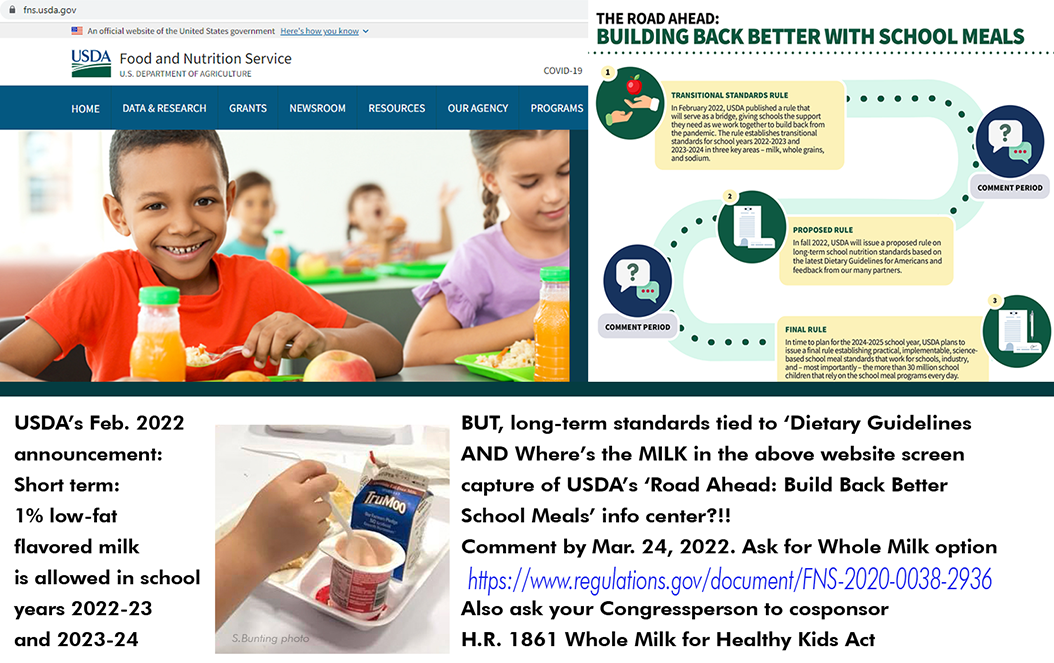
USDA announced a ‘transitional standards’ rule on Feb. 4 for milk, whole grains, and sodium for school years 2022-2023 and 2023-2024. In short, the transitional standards are only in place while USDA works with stakeholders to strengthen meal standards through a new rulemaking for the longer term. The proposed rule for the longer-term is expected in fall 2022 and will be based on the Dietary Guidelines for Americans 2020-2025 — effective school year 2024-2025. A “gradual implementation” plan for the long-term standards will be developed by USDA based on ‘stakeholder input.’ Read the transitional standards rule and comment here. Stay tuned for proposed long-term standards rule and comment period this fall. Even the American Association of School Superintendents (AASA) made a statement this week, believing the long-term standards will be ‘more stringent’ due to the Dietary Guidelines, and that “it is important to acknowledge that healthy meals are only healthy if students eat them.” That goes for the milk also. Milk consumption plummeted and waste skyrocketed since USDA’s 2012 fat-free/low-fat milk rules were set for both ‘served’ milk and competing a la carte offerings.

By Sherry Bunting, Updated (above) since published in Farmshine, Feb. 11, 2022

WASHINGTON — USDA announced ‘transitional’ nutrition standards on Friday, Feb. 4 that put low-fat 1% flavored milk back on the menu next school year, without the cumbersome waiver process. The announcement also delays the planned sodium reductions, helping the cheese side of school lunches. 

National Milk Producers Federation (NMPF) and International Dairy Foods Association (IDFA) came out with hearty applause for the news, thanking Congressmen G.T. Thompson (R-Pa.), author of the Whole Milk for Healthy Kids Act, and Joe Courtney (D-Conn.), author of the School Milk Nutrition Act, for their leadership on this issue through the years, using words that treat this USDA announcement as though it’s a done-deal, and all is good to go. 

But let’s hold our horses and examine the USDA announcement — described clearly as “transitional” based on schools “needing more time to adjust” post-pandemic. 

USDA stated that future nutrition standards will be proposed in the fall of 2022 as part of the administration’s “Build Back Better with School Meals, input will be gathered, and those will be the standards that go into place beginning with the 2024-25 school year. 

USDA also made it clear that these future long-term standards “will line up with the Dietary Guidelines” and input from schools and industry will be sought in “how to gradually implement them.”

In 2010, the Healthy Hunger Free Kids Act of Congress tied government food and nutrition programs, like school lunch, to the Dietary Guidelines. By 2012, under President Obama’s USDA — with Tom Vilsack at the helm then as now — had banned whole milk as an a la carte offering in the ‘Smart Snacks’ rules. At the same time, the Department required flavored milk to only be offered if it was fat-free and required unflavored milk to be either fat-free or low-fat 1%.

Milk sales plummeted and waste increased.

Then, the Trump-USDA in 2018, under Ag Secretary Sonny Perdue, “rolled back” some of the 2012 USDA standards, delaying the sodium rules and allowing low-fat 1% flavored milk to be offered through a waiver system at the state level. Some states, like Pennsylvania, made blanket waivers available, and many schools began offering low-fat 1% flavored milk over the next few years.

Then, a lawsuit took the Trump-era USDA to court for the rollbacks. The court ruled that the Trump-USDA did not use a proper public comment process before doing the rollbacks. So, beginning with the 2021-22 school year, the low-fat 1% flavored milk was again bumped out of school menus — except where waivers were sometimes granted for pandemic-related supply disruptions as justification for serving a higher fat milk.

Over the past year, USDA Food Nutrition Services has received comments about how to gradually implement nutrition standards to line up with the Dietary Guidelines on sodium, whole grains, and milkfat. Friday’s announcement on ‘transitional standards’ was accompanied by a detailed and lengthy rule that will be implemented July 1, 2022.

“USDA is giving schools time to transition from current, pandemic operations, toward more nutritious meals. In 2022, USDA will continue to prioritize supporting schools as they navigate the challenges of the pandemic and related operational issues,” the announcement said, adding that USDA “is also planning for the future by engaging with school meal stakeholders to establish long-term nutrition standards beginning in school year 2024-2025 that will be achievable.”

Ag Secretary Tom Vilsack was quoted in the announcement blaming the pandemic disruptions of the past two years for making schools “unprepared to fully meet those standards at this time” for milk, whole grains and sodium.

“These transitional standards are step one of a longer-term strategy to lean into the school meal programs as a crucial part of improving child health,” said Vilsack.

“Over the coming months and years, USDA will work closely with its school meal partners to develop the next iteration of nutrition requirements. We’ve got to find the right balance between standards that give our kids the best chance at a healthy future based on the latest nutrition science, and ensuring those standards are practical, built to last, and work for everyone,” Vilsack added.

The purpose of the “transitional” standards, according to the USDA announcement, is to “give schools clarity for the coming school years, allowing them to gradually transition from the extraordinary circumstances caused by the pandemic to normal program operations and meal standards that are consistent with the latest nutrition science, as required by law.”

Specifically, the transitional standards beginning with the 2022-23 school year are as follows:

1) Milk: Schools and childcare providers serving participants ages six and older may offer flavored low-fat (1%) milk in addition to nonfat flavored milk and nonfat or low-fat unflavored milk;

2) Whole Grains: At least 80% of the grains served in school lunch and breakfast each week must be whole grain-rich; and

3) Sodium: The weekly sodium limit for school lunch and breakfast will remain at the current level in SY 2022-2023. For school lunch only, there will be a 10% decrease in the limit in SY 2023-2024. (This affects school cheese).

The expressed linkage of long-term USDA nutrition standards to the anti-fat 2020-25 Dietary Guidelines was mentioned throughout the USDA announcement, giving an indication of where the school milk standards are headed, long-term.

That is, unless Congress acts to remove all doubt and make fuller fat milk — whole milk — a legal option for schools in the future.

For a true solution for the long-term, Congressional leadership is needed on the school milk issue.

-30-

Dr. Mitloehner clears the air on ‘net zero,’ sees narrative changing on America’s cows

Dr. Frank Mitloehner is a foremost authority on animal science and greenhouse gas emissions. Find him on Twitter @GHGGuru and @UCDavisCLEAR (Screen capture from American Dairy Coalition webinar)

‘Climate neutrality, not net zero carbon, should be dairy’s goal.’

By Sherry Bunting

‘Net zero’ seems like a simple term, but it’s loaded, according to Dr. Frank Mitloehner, professor and air quality specialist with the Department of Animal Science at University of California-Davis. 

He firmly believes dairy can be a climate solution, but the first step is to accurately define dairy’s contribution to the climate problem. Setting the record straight is his prime focus, and he also researches ways dairy, like every industry, “can do our bit to improve.”

Presenting on what ‘net zero’ really means for dairies, Mitloehner answered questions during the American Dairy Coalition (ADC) annual business meeting in December, attended by over 150 producers from across the country via webinar.

Based in Wisconsin, ADC is a national producer-driven voice with a regionally diverse board. President Walt Moore, a Chester County, Pennsylvania dairy producer, welcomed virtual meeting attendees, and CEO Laurie Fischer shared a federal dairy policy update. 

She said the ADC board is nimble, moves quickly, and wants to hear from fellow dairy farmers. She encouraged membership to make ADC stronger and shared about the organization’s federal policy focus in 2021 — from pandemic disruptions and assistance, Federal Order pricing, depooling and negative PPDs to real dairy label integrity, whole milk choice in schools, and farmers’ questions and concerns about dairy ‘net-zero’ actions.

“Too often, farmers think they may not understand something, so they don’t speak up,” said Fischer. “But we get calls and so much great advice from our farmers. We know you get it, you know it, because it is happening to you.” 

From this farmer input, the net-zero topic became the ADC annual meeting focus.

“We are rethinking methane, and this is influencing and shaping the discussion,” Dr. Mitloehner reported. He urged producers to use the information at the CLEAR Center at https://clear.ucdavis.edu/ and to do better networking, to have a better presence on social media. 

This is necessary because the activists are well-connected, and methane is the angle they use in their quest to end animal agriculture. He said Twitter is a platform where many of these discussions are happening. His handle there is @GHGGuru and the Center is @UCDavisCLEAR.

“This is something I have told the dairy industry. They say ‘net-zero carbon’, but they shouldn’t say that because it is not possible, and it is not needed. We need to be saying ‘net-zero warming’. That’s the goal. Then, every time you reduce methane, you instantaneously have an impact that is inducing a cooling effect,” said Mitloehner.

‘Climate neutrality’ is the more accurate term he uses to describe the pathways for U.S. dairy and beef. But it requires getting accurate information into policy in a fact-based way. 

It requires arming people with the knowledge that the constant and efficient U.S. dairy and livestock herds produce no new methane, that they are climate-neutral because not only is methane continuously destroyed in the atmosphere at a rate roughly equal to what is continuously emitted by cow burps and manure, that process involves a biogenic carbon cycle in which the cow is a key part.

One of the issues is how methane from cattle is measured, he said. Current policy uses a measurement from 30 years ago that fails to acknowledge the carbon cycle and ‘sinks’ alongside the ‘emissions.’ 

Mitloehner said accurate information is beginning to change the narrative. This is critical because methane is the GHG of concern for dairy, and the narrative about it has been incomplete and inaccurate. 

As a more potent heat-trapping gas than carbon dioxide, methane becomes the ‘easy’ target to achieve the warming limits in the Paris Accord. Methane was the focal point of ‘additional warming limits’ during the UN Climate Change Summit (COP26) in Glasgow in November.

Putting together the inaccurate narrative alongside international agreements to specifically reduce methane, it becomes obvious why cattle are in the crosshairs. Producers are already in the middle of this in California as methane regulation and carbon credit systems began there several years ago.

As the narrative is beginning to change, Mitloehner sees opportunities. He described the current California ‘goldrush’ of renewable natural gas (RNG) projects where large herds both in and out of state cover lagoons to capture and convert biogas into RNG. The state’s investments and renewable fuel standard provide a 10-year guarantee with the RNG companies typically owning the offset credits that can be traded on the California exchange from anywhere.

Getting the numbers right is mission-critical

“We are far and away an outlier because of our efficiency in the U.S with all livestock and feed representing 4% of the GHG total for the U.S,” Mitloehner confirmed. “Dairy, alone, is less than 2% of the U.S. total.”

This is much smaller than the 14.5% figure that is thrown about recklessly. That is a global number that includes non-productive cattle in India as well as the increasing herds in less efficient developing countries. This number also lumps in other things, such as deforestation.

He said the true global percentage of emissions for livestock and manure is 5.8%. Unfortunately, activists and media tend to use the inflated global figure and conflate it with these other things to inaccurately describe the climate impact of U.S. dairy and livestock herds as 14.5%.

The efficiency of U.S. production and the nutrient density of animal foods must be part of the food and climate policy equation.

Methane is not GHG on steroids

“Without greenhouse gases, life on earth would not be possible because it would be too cold here,” said Mitloehner. “We need GHG, but human activity puts too much into the atmosphere, and the toll is large concentrations.” 

The way all GHGs are measured has to do with their intensity as determined 30 years ago when scientists wanted one global warming potential (GWP) unit to compare cows to cars to cement production and so forth. They came up with GWP100, which converts methane to CO2 equivalents based on its warming potential.

Methane traps 28 times more heat than CO2, but it is short-lived, Mitloehner explained.

“Looking just at the warming potential, you get this idea that methane is GHG on steroids and that we need to get rid of all of it and all of its sources,” he said.

But is this the end of the methane story? No.

Sinks and cycles must count

Mitloehner described how ‘methane budgets’ look at sources and their emissions but ignore the carbon sinks that go alongside and ignore the chemical reactions that result in atmospheric removal of methane as well.

“Plants need sunlight, water, and a source of carbon. That carbon they need comes from the atmosphere to produce oxygen and carbohydrates,” he said, explaining how cows eat the carbohydrates and convert them to nutrient dense milk and beef. In that process, the rumen produces methane.

“Is this new and additional carbon added to the atmosphere? No it is not. It is recycled carbon,” he said.

“Say you work off the farm. You drive and burn fuel, adding new CO2 in addition to the stock in the atmosphere the day before. Stock gases accumulate because they stay in the environment. Currently, agencies treat methane as if it behaves the same way. But methane is a flow gas, not a stock gas. It is not cumulative,” said Mitloehner.

If the same farm has 1000 cows belching today and 1000 belching 10 years ago, those 1000 cows are not belching new methane because in 10 years it is gone from the atmosphere. It is cyclical.

“The take-home message is the carbon that our constant livestock herds produce is not new carbon in the atmosphere. It is a constant source because similarly to it being produced, it is also destroyed. The destruction part is not finding its way into the public policy system… but it will in the future,” he predicts.

Methane drives Paris Accord and COP26

Methane targets are driving intergovernmental agreements wanting to limit the “additional warming impact” of nations and industries.

Currently, cattle are viewed as global-warmers because they constantly emit methane. However, as Mitloehner drilled numerous times, this is not new methane, it is not additive, it is not cumulative. It is recycled carbon.

“If you have constant livestock herds, like in the U.S., then you are not causing new additional warming,” said Mitloehner.

Burning fossil fuels is much different. 

“Fossilized carbon accumulated underground. Over 70 years, we have extracted half of it and burned it, so where is it now? In the atmosphere. We added new and additional CO2 that is not a short-lived gas. It is a one-way street from the ground into the air,” he explained.

The problem for dairy and beef producers is their cattle are being depicted as though their emissions are additive, cumulative, like fossil fuels, which is not true, he said.

Signs the narrative is changing

One promising sign that the message is getting through has come from Oxford researchers acknowledging the constant cattle herds in the U.S. and UK are not adding new warming.

They acknowledge the GWP100 “grossly overestimates” the warming impact of cattle and are working on a new measurement that recognizes constant cattle herds are not adding new warming, said Mitloehner.

Another promising sign is that the International Panel on Climate Change (IPCC) issued a statement recently acknowledging that the current GWP100 overblows the warming impact of cattle by a factor of four. This new information is not in current policy, but it is making its way there.

Tale of two bathtubs

Mitloehner believes it is important to visualize climate neutrality. He described two bathtubs. One has a CO2 faucet with no drain, the other a methane faucet with a drain. Open the faucets, and even at a slow and steady rate, the CO2 bathtub continues to rise, while the methane bathtub drains as it fills to remain at a constant level.

He also explained that over the past 200 years the U.S. hasn’t seen any real change in that methane bathtub because prior to settlement in America, 100 million ruminants — buffalo and other wild herds — roamed. Today, there are around 100 million large ruminants in the U.S. dairy and beef industries.

What has changed is the U.S. does have more liquid manure lagoon storage that is producing more methane than solid manure storage. “But we know of ways to further reduce that,” he said.

Mitloehner pointed out how the current GWP100 poorly estimates the warming impact three example scenarios. If, over 30 years, methane is increased 35% from a source, or reduced 10%, or reduced 35%, the GWP100 would show significant continuous addition of cow-sourced methane in CO2 equivalents for all three scenarios because the destruction of the methane – the drain that operates with the faucet – is ignored.

The proper way to look at this, if the methane increased a lot, is that it would add a lot. But if it is balanced, then there is no new or additional warming. And, in that third scenario, he said, “where we pull a lot from the atmosphere when we reduce methane, it has the same impact as growing a forest.”

Bottom line, said Mitloehner, “We can be a solution and take it to the market and get paid for that,” but current policy does not yet reflect the neutral position of the constant and efficient U.S. herd.

Bullish about the future

‘Net zero’ is a term that is not yet clearly defined, said Dr. Frank Mitloehner several times during the American Dairy Coalition annual meeting by webinar in December. He sees the real goal as “climate neutrality,” to communicate the way constant U.S. dairy herds contribute “no additional warming,” in other words “net zero warming.”

The climate neutrality of U.S. cattle must be part of public policy, he said. Only then will dairies truly be on a path to marketing their reductions as ‘cooling offsets.’

Mitloehner, a University of California animal scientist and GHG expert is bullish about the future of “turning this methane liability into an asset, so if we manage toward reducing this gas, we can take that reduction to the carbon market,” he said.

“When we hear ‘net zero’, we think about carbon, but that would mean no more GHG is being produced, and that is not possible. I have told the dairy industry this for years. Why is (zero GHG) not possible? Because cows always belch, and we can’t offset that, and furthermore, we do not need to offset that because it is not new methane,” said Mitloehner.

On the other hand, “If we replace beef and dairy made in the U.S., this does not create a GHG reduction at all. This is because we are the most productive and efficient in the world,” he said.

Just stopping beef and dairy production here in the U.S. — and picking up the slack by producing it somewhere else or producing something else in its place — creates ‘leakage.’ This leakage, he said, is where the biogenic carbon cycle becomes disrupted. In other words, the bathtub has a faucet that is out of sync with the drain.

California’s RNG ‘goldrush’

Mitloehner touched on the strict California standards that mandate a 40% reduction of methane be achieved by the state by 2030. Again, methane is targeted because of its warming potential per the Paris Accord.

The good news, he said, is California is using incentives to encourage covering manure lagoons to capture a percentage of the biogas bubble so that it doesn’t go into the atmosphere but is trapped beneath the tarp and converted into renewable natural gas (RNG) that can be sold as vehicle fleet fuel to replace diesel. 

Because this RNG comes from a captured and converted methane source, it is considered a most carbon-negative fuel in the state’s low-carbon fuel standard. 

Those credits equate to $200 per ton of CO2 replaced with a carbon-negative renewable, said Mitloehner.

“This is a huge credit. This is why dairies are flocking to get lagoons covered to trap and convert. These credits are guaranteed for 10 years in California, but the anti-agriculture activists are fuming over them,” said Mitloehner.

Of all California investments made toward achieving the 40% methane reduction goal, dairy has received just 3% of funds, but has achieved 13% of reductions so far.

This “carrot” approach has incentivized the biogas RNG projects assuming $4000 income per cow, making an estimated $1500 to $2000 per cow per year on a 10-year California fuel standard guarantee.

Mitloehner noted that the carbon intensity of the reduction is presently viewed as greater when RNG is used in vehicles vs. generating electricity, but right now there is not enough RNG suitable for vehicle use. He sees the fuel use increasing in the future and explained that dairies anywhere can sell into the California market if they capture biogas and convert it to RNG.

The state’s 10-year guarantee has stimulated companies seeking to invest in RNG projects on large dairy farms, where they then own or share the credits.

Mitloehner answered a few questions from producers about the caveats. If the bottom and top of the lagoon are covered, what happens to the sludge that accumulates? He acknowledged there is no satisfactory answer to that question presently.

Another drawback is the technology only works for larger dairies because smaller lagoons won’t have the same breakeven. Community digester models are emerging as well, he said, but they also use clusters of large farms working together.

Soil carbon sequestration

Mitloehner cited soil carbon sequestration as a way dairy farms of any size can be a solution.

It’s the process by which agriculture and forestry take carbon out of the air via the plant root systems that allow the soil microbes to take it into the soil — unless the soil is disturbed by tilling or it is released through fires. With good forest and grassland management, as well as low- and no-till farming practices, carbon can be sequestered to stay in the ground forever, according to Mitloehner.

“Agriculture and forests are the only two ways to do this,” he said, adding that USDA seeks to incentivize practices that take and keep more of the atmospheric carbon in the soil.  

Answering questions from producers, he noted that he has not yet seen a scheme that would incentivize soil carbon sequestration through marketing offsets, but the discussions are heading in that direction.

“Many of the environmental justice communities are running wild on this. They do not want farmers to get any money for it. They are putting on significant pressure and threatening lawsuits, so it’s not settled yet,” he reported.

There is also a lot of confusion around soil carbon sequestration and “regenerative” agriculture. One big problem is that producers who are doing some of these things, already, won’t get the opportunity to capitalize on those practices when offset protocols are eventually developed — if those practices are not deemed “additive.”

“If you are doing something now and are not covered by a policy of financial incentive, then four years from now, if it is developed, they’ll say you don’t qualify because you are already doing it,” said Mitloehner. 

“They are calling it ‘additionality.’ It’s about the change to doing it to qualify. That seems crazy, but it’s like if you bought an electric vehicle 10 years ago when there was no tax credit, you don’t get a tax credit now for already owning an EV because the improvement is not ‘additional,’” he explained.

What about the burps?

For farms with under 1000 cows, other technologies like feed additives can be used on any size dairy with effects realized within a week, said Mitloehner, noting one product that is commercially available and several others on the docket.

If a 10 to 15% reduction can be achieved in enteric (belching) methane reduction, then it will be marketable. Right now, these reductions are not marketable. If an offset protocol is developed for this in the future, it will be taken to the carbon market, he said.

In the meantime, incentives are being offered within supply chains, according to Mitloehner. Companies like Nestle, Starbucks and others are doing pilot projects and buying feed additives for the farmers within their supply chains to reduce their products’ GHG. He said there is some evidence these products can enhance components and feed efficiency. This is a big area of research right now.

A question was also asked during the webinar, wondering about Amish farms using horses instead of tractors. Are they contributing to cooling?

Mitloehner replied that he has not yet seen a calculation for this, and while the impact of horses would be less than the impact of burning fossil fuels, there is still an environmental impact to calculate. 

Since the international focus is on ‘additional warming impact’, methane is – like it or not — the target. Whether a dairy farm is managed conventionally or in the Amish tradition, the cows, the methane, and how governments and industry measure the ‘additional warming impact’ of cow-sourced methane, is still the crux of the issue for all dairy farms. If efficiency is reduced, then the ability to position the dairy farm as ‘cooling’ may be more complicated, or less significant, he said.

In addition to accurate definitions that acknowledge climate neutrality of constant cattle herds producing no new methane, Mitloehner’s wish is for federal policy to also take productivity (and nutrient density) into stronger consideration when evaluating emission intensity “instead of just counting heads of cattle. 

“This can be good for large or small dairies with a high or low footprint. When the relative emissions are determined by how you manage the dairy, the hope is that this is more about the how than the cow.”

-30-

U.S. Senate nutrition hearing seeks new national strategy

50-year crisis cited, but no mention of 50-year low-fat regime’s role

By Sherry Bunting, Farmshine, November 5, 2021

WASHINGTON, D.C. – “Half of the U.S. population is pre-diabetic or has type II diabetes, and one out of almost every three dollars in the federal budget goes to healthcare, with 80% of that spending on treatment of preventable chronic diseases,” said Senator Cory Booker (D-N.J.), chairman of Senate Ag’s nutrition subcommittee as he and ranking member Mike Braun (R-Ind.) began the hearing on the state of nutrition in America Tuesday, Nov. 2. 

Calling the situation a crisis, senators and witnesses cited statistics that have worsened over the past 50 years.

“Our healthcare costs today are 20% of GDP. In the 1960s, it was 7%. It has tripled in 50 years,” said Sen. Braun. In 1960, he said, 3% of the population was obese. Today it’s over 40%, with more than 70% of the population either obese or overweight.

“More shocking,” said Booker, “is that 25% of teenagers are pre-diabetic or have type II diabetes, and 70% are disqualified from military service” — with the number one medical reason being overweight or diabetic.

Witnesses and senators blamed the “epidemic” on a food system designed to solve 20th century problems of ending hunger by investing in cheap calories – especially carbohydrates. They indicated that 21st century goals should be focused on designing a food system that delivers nutrition and makes the nation healthier.

“We want to rethink the way we approach food and nutrition policy. Our lives literally depend on it,” said Sen. Booker, “This nutrition crisis we face is a threat — the greatest threat to the health and well-being of our country and a threat to our economic security and our national security.”

That’s why Senators Booker and Braun recently introduced bipartisan legislation to convene public and private stakeholders in what would be the second White House conference ever to be held on food and nutrition. The first was convened in the late 1960s, when then Senators George McGovern and Bob Dole formed a select nutrition committee in a time of food shortages and high prices.

That time-period was also when the precursor to the Dietary Guidelines was established, which by the 1980s had become the official and now notorious Dietary Guidelines cycle.

While Tuesday’s hearing continually hit this notion that 52 years later we have all of these devastating statistics, it was interesting that there was zero mention of the Dietary Guidelines. Those words were not uttered by any senator or any witness at any point in the over two-hour-long hearing.

Another item that did not pass through any lips Tuesday was the acknowledgment that 52 years of the low-fat dietary regime has prevailed and has progressively tightened its hold over school diets even as these statistics, especially on youth, have worsened into crisis-mode. 

The closest anyone got to mentioning dietary fat was when Senator Roger Marshall (R-Kan.), a doctor by profession, asked witnesses if they thought the CDC missed an opportunity to do public service announcements about “nutrition and building up our own immune systems” during the COVID-19 pandemic.

He talked about volunteering in the ICU and ER of a south Kansas hospital in the spring of 2020 when COVID was sweeping the land.

“There were eight ICU beds and 11 patients, all in their 50s, and all had diabetes or pre-diabetes. Immediately, I called the CDC and said, ‘this virus is going to assault this country.’” He observed that our rates of morbidity and mortality are higher with this virus than some other countries because almost half of the population is diabetic or pre-diabetic.

Sen. Marshall voiced his frustration: “We’ve had a year and a half of this virus, and I thought this might be an awakening for this country, that if we had a better, healthier immune system, that’s how you fight viruses.”

One of the five witnesses — Dr. Dariush Mozaffarian of the Tufts University Friedman School of Food and Nutrition Policy – responded to say that alongside developing vaccines, treatments and guidelines for social distancing, “the huge additional foundational effort should have been to improve our overall metabolic health through better nutrition. So, every time we talk about vaccines, social distancing, mask wearing, why aren’t we talking about nutrition?”

“Everything we need to know about nutrition I learned from my mother and my grandmother,” said Sen. Marshall. “We need to be using our medical assets for nutrition education. Doctors need to understand that Vitamins D, A, E and K are fat-soluble vitamins, so we need to be drinking our whole milk and looking at these general concepts.”

This was the hearing’s only – and subtle — reference to dietary fat. It was the only, but quiet, nod to any suggestion of the impact of federal government restrictions on the diets of children during school hours while their rates of obesity and type II diabetes continue to rise to epidemic proportions. Not one witness or senator delved into this topic in any substantial way.

Throughout the hearing, that seemed to focus on a new paradigm in food and nutrition, there were also strong references to a key part of the problem — the food industry is controlled by a handful of large multinational corporations providing nutrient-poor, addictive and ultra-processed foods.

“Farmers answered the call of a growing population and issues with malnutrition 50 years ago. Through innovation, agriculture makes more from less and works to protect our soils along the way. We’ve made progress but are still geared to address caloric intake, not the content of the calories,” said Sen. Braun. 

He focused his comments on the healthcare industry being the place to make new investments in nutrition as a preventive solution and indicated SNAP purchase restrictions are in order.

Dr. Angela Rachidi, doing poverty studies at the American Enterprise Institute said putting SNAP program restrictions on sugary beverages and incentives for purchasing fruits and vegetables would be positive steps to show SNAP is serious about nutrition. She referenced studies showing that three of the five largest purchase categories with SNAP dollars are sweetened beverages, frozen prepared meals, and dessert items.

Mozaffarian was the first of the five witnesses. He did not mention his Tufts University “Food Compass” project by name, which was published three weeks ago, nor did he mention the $10 million grant received three weeks ago from USDA to develop a “cultivated meat industry,” including assessment of consumer attitudes and development of K-12 education on cell-cultured meat.

“We are on a path to disaster,” he said, calling type II diabetes America’s “canary in the coal mine,” on which the U.S. spends $160 billion annually.

Describing current food and nutrition policy as “fragmented and inefficient,” Mozaffarian said: “Nutrition has no home, no body for focus or leadership across the federal government.”

Mozaffarian’s six recommended government actions paint a picture of a centralized national structure and authority for food and nutrition policy with emphasis on integration of research, the healthcare system, programs like school lunch, and ramping up new innovation startups entering the food system.

He stressed his belief that a “real national strategy” is needed, one that “reimagines the future food system.” He said the science and tools are already available to do this, to integrate into existing programs and make changes – fast.

Perhaps the “tools” Mozaffarian was referring to are within the new Tufts Food Compass he helped create, which ranked “almondmilk” and “soymilk” ahead of skim milk and far ahead of whole milk. It also puts chocolate milk and some types of cheeses near the bottom of the ‘minimize’ category, along with unprocessed beef. 

In fact, the only high-scoring dairy product found in the ‘encouraged’ category was whole Greek yogurt. Cheerios and sweet potato chips ranked higher than dairy products, including the whole Greek yogurt.

Also testifying was Dr. Patrick Stover of Texas A&M’s Agri-Life Center. He noted the public’s “lack of trust” in nutrition science. 

He stressed that the nation’s land grant universities are “a network of extraordinary resources, a national treasure” that benefits from having public trust but lost federal investment levels over the years. 

Stover said Texas A&M is now launching an institute for advancing health through agriculture as well as an agriculture, nutrition and food science center for non-biased research on the human, environmental and economic success of proposed changes.

He supports a “systemic approach to connect people to food and health,” an approach that involves everyone from farm to consumer. He said Agri-Life is positioned to lead such an effort through the land grant university system. 

Stover noted scientists involved in the precision nutrition initiative at the National Institutes of Health are starting to understand how individuals interact with food in relation to these chronic diseases.

“One size does not fit all,” he said.

Witnesses Dr. Angela Odoms-Young, director of Food and Nutrition Education in Communities at Cornell, as well as Dr. Donald Warne, director of public health programs at the University of North Dakota School of Medicine, both talked about the cultural aspects of food. They referenced differing experiences of populations separated from lands and cultures where food was accessible and how certain demographic populations are being targeted by fast-food advertising that is leading to higher rates of chronic diet-related diseases among native Americans and people of color.

Poverty and reliance on cheap highly processed foods was part of that discussion.

“Poor diets and overconsumption of calories are a major crisis,” Dr. Rachidi stressed as a former deputy commissioner of New York City social services overseeing the SNAP program. “Nutrition assistance programs have mixed success” providing food security but also contributing to the problem of poor nutrition.

She said current nutrition policies lack a cohesive strategy. On the one hand harsh restrictions in some programs and no restrictions in others.

“We have to acknowledge the reality, the billions we spend to improve food security are used in a way that is a major contributor to poor health,” said Rachidi.

At the conclusion, chairman Booker stressed his belief that there is a misalignment of government.

“The farmer’s share of the consumer dollar from beef to broccoli has gone down 50% in a food system where everyone is losing,” said Booker. “We are losing the health of our country, seeing the challenges with farmers and the disappearance of family farms, the issues of food workers, what’s happening with animals and the environment. Let’s not be fooled. This is not a free market right now.”

He noted that farmers are “stuck in mono-cropping” without incentives to move to more regenerative agriculture. “We love farmers. They aren’t the problem. We have to figure out a way to align incentives with policy decisions because it is out of whack.”

Asked by Booker to give a ‘business perspective,’ ranking member Braun concluded that the best place to implement a solution is to do it where the most money is being spent on the problem and that is the healthcare system. Food is a bargain, which addresses hunger, “but we need to reconstitute the quality of the calories,” he said, putting the emphasis on the nutrient density of foods.

-30-