Covering Ag since 1981. The faces, places, markets and issues of dairy and livestock production. Hard-hitting topics, market updates and inspirational stories from the notebook of a veteran ag journalist. Contributing reporter for Farmshine since 1987; Editor of former Livestock Reporter 1981-1998; Before that I milked cows. @Agmoos on Twitter, @AgmoosInsight on FB #MilkMarketMoos
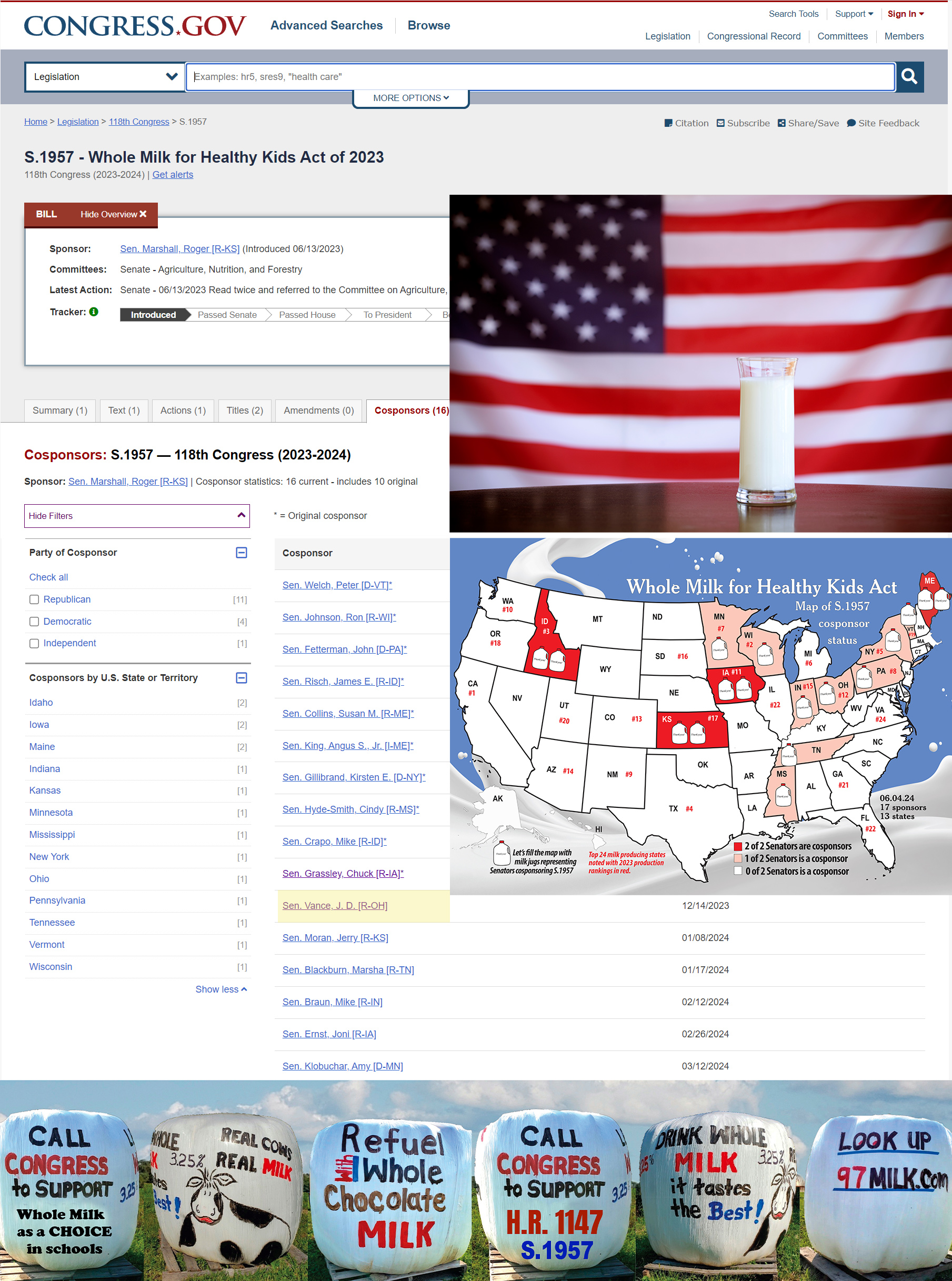
This was my first thought, when former President Donald Trump announced Senator J.D. Vance of Ohio as his running mate in the Republican campaign. (Vance is an early cosponsor of S. 1957, the Senate’s whole milk bill.)
Like others, I’ve been involved in the effort to bring the choice of whole milk back to schools for more than a decade. It’s about natural, simple goodness — to simply strip away the federal ban and allow hungry, learning children to be nourished by milk they will love.
Looking back at the years of this long fight, I realize that if it’s so painstakingly hard to get something so simple and so right accomplished for America’s children and farmers, we’ve got problems in this country.
With President Joe Biden now withdrawing from the campaign for a second term, and Vice President Kamala Harris as presumptive nominee launching her campaign this week in the Dairyland State, I’m reminded of where she stands on such things.
Harris is no friend to livestock agriculture. She was an original cosponsor of the Senate version of “The Green New Deal.” She has strong positions on climate change that may lead to harsher rules on methane emissions and water consumption in the dairy industry, while perhaps promoting methane digesters, which are not an equitable nor necessary solution. Cows are NOT the problem!
As a presidential candidate in 2019, in a CNN town hall, she was specifically asked: “Would you support changing the Dietary Guidelines to reduce red meat specifically to reduce emissions?”
“Yes, I would,” Harris replied, with a burst of laughter.
It’s not funny.
Earlier, she had said she “enjoys a cheeseburger from time to time,” but the balance to be struck is “what government can and should do around creating incentives, and then banning certain behaviors… that we will eat in a healthy way, and that we will be educated about the effect of our eating habits on our environment. We have to do a much better job at that, and the government has to do a much better job at that.”
Read those words again: “creating incentives and then banning certain behaviors.” In plain English, that means dangling the carrot and then showing us the stick.
As President Biden’s approval ratings fell, there were indications she would bring her side of the aisle to the table to negotiate a compromise to get the farm bill done this year.
Now that Biden has withdrawn from the race, and the pundits, media, and party organizers are breathless with excitement over Harris as presumptive nominee, it appears that the farm bill negotiations between the Committee-passed House version, the Republican Senate version and the Democrat Senate version have fallen apart.
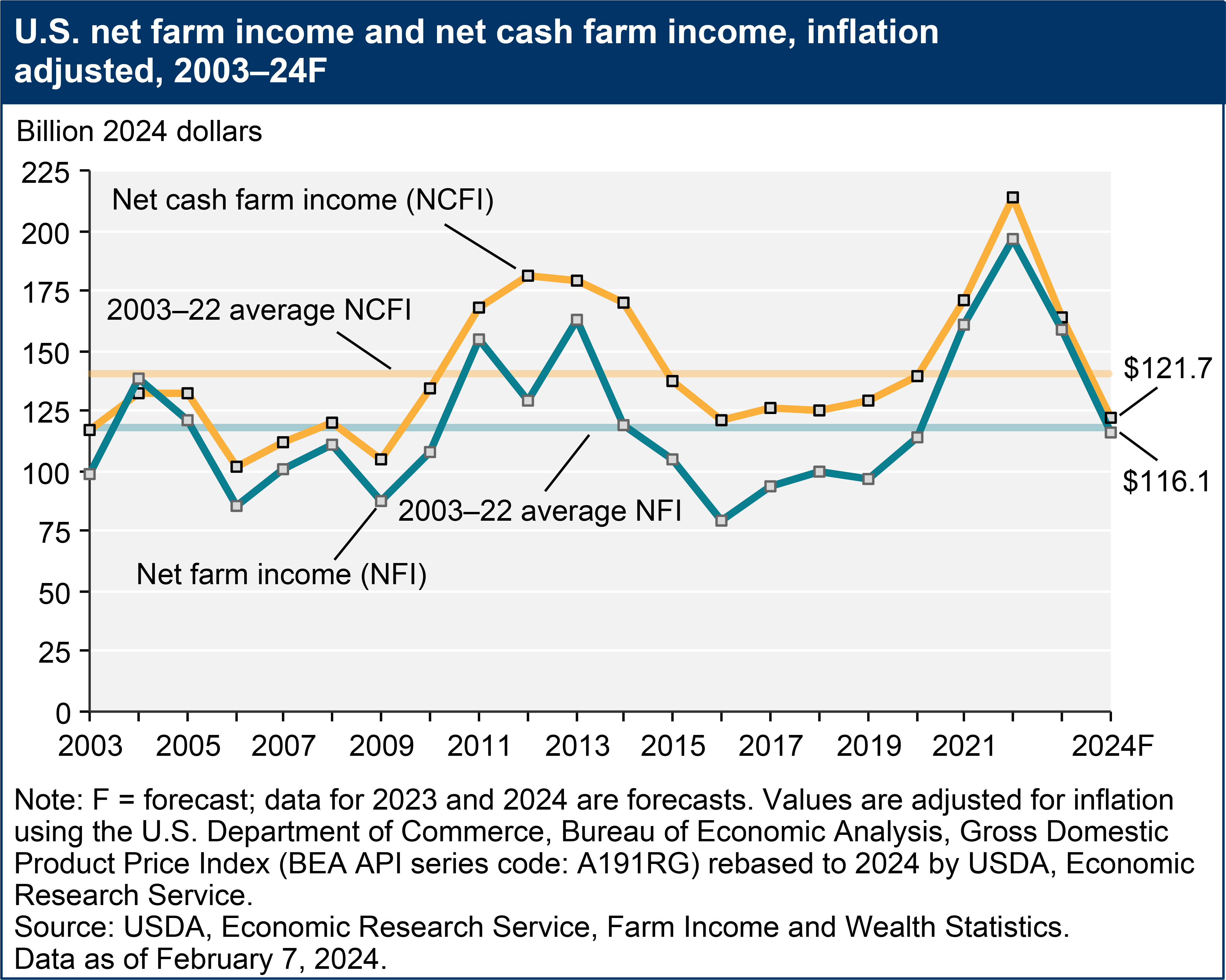
House Ag Chair G.T. Thompson (R-Pa.) has called upon his colleagues to get to the table and do the work because a perfect storm is brewing in Rural America as net farm income is forecast to fall by 27% this year on top of the 19% decline last year.
Meanwhile, there is political upheaval everywhere we look. Seeing Vance picked as Trump’s running mate and knowing he was among the early cosponsors of Senate Bill 1957 – The Whole Milk for Healthy Kids Act – offers some hope.
That bill — in true bipartisan spirit — was introduced in the U.S.Senate in June 2023 by Senator Dr. Roger Marshall (R-Kan.) with prime cosponsors Peter Welch (D-Vt.), Ron Johnson (R-Wis.), Kirsten Gillibrand (D-N.Y.), Chuck Grassley (R-Iowa), John Fetterman (D-Penna.), Mike Crapo and James Risch (R-Idaho), Susan Collins (R-Maine), Angus King (I-Maine), and Cindy Hyde-Smith (R-Miss.). The bill eventually earned cosponsorship from other Senators, including the influential Democrat from Minnesota, Amy Klobuchar.
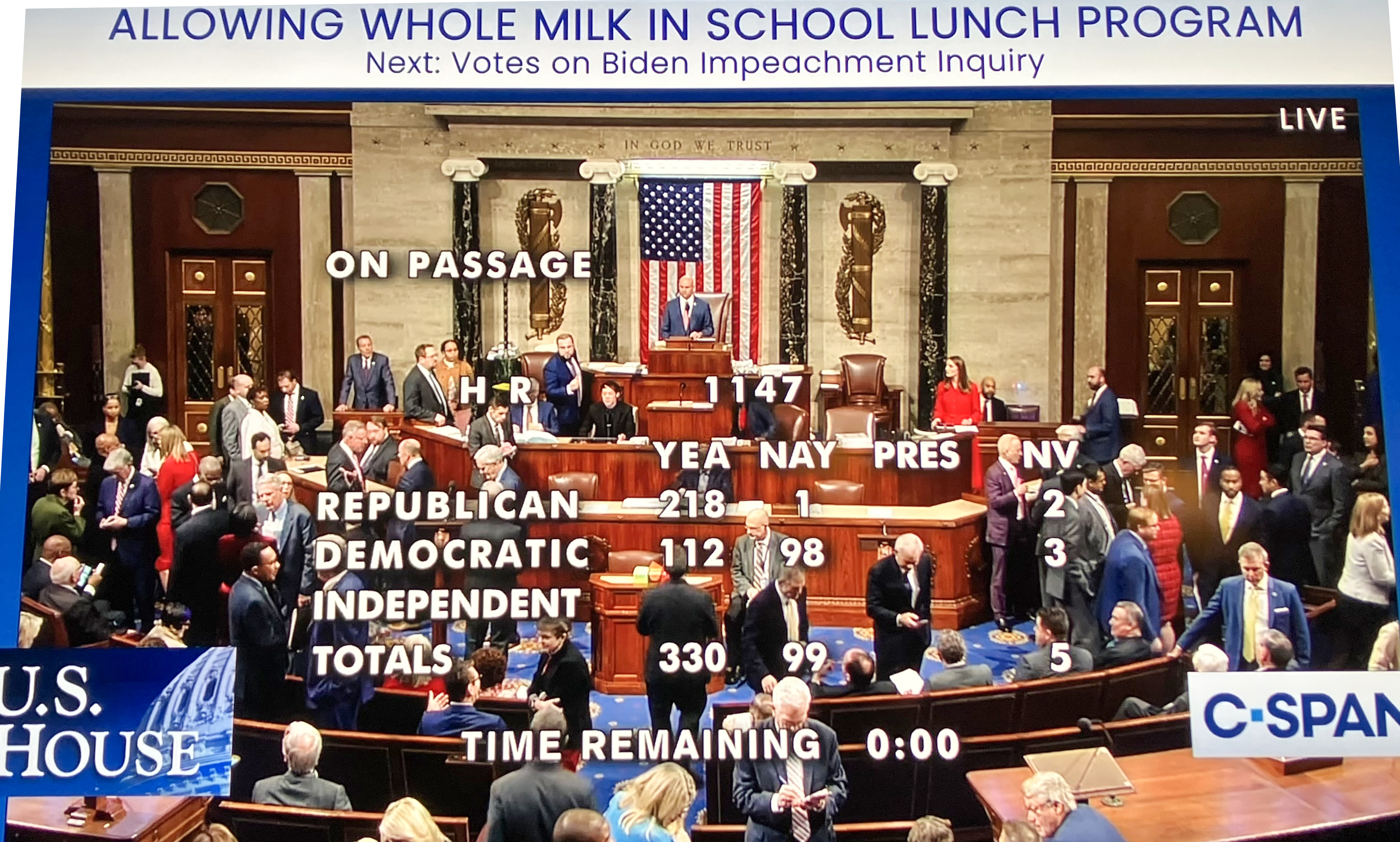
Vance signed on as cosponsor on December 14, 2023, one day after the U.S. House of Representatives had passed their version of the bill by an overwhelming bipartisan majority of 330 to 99.
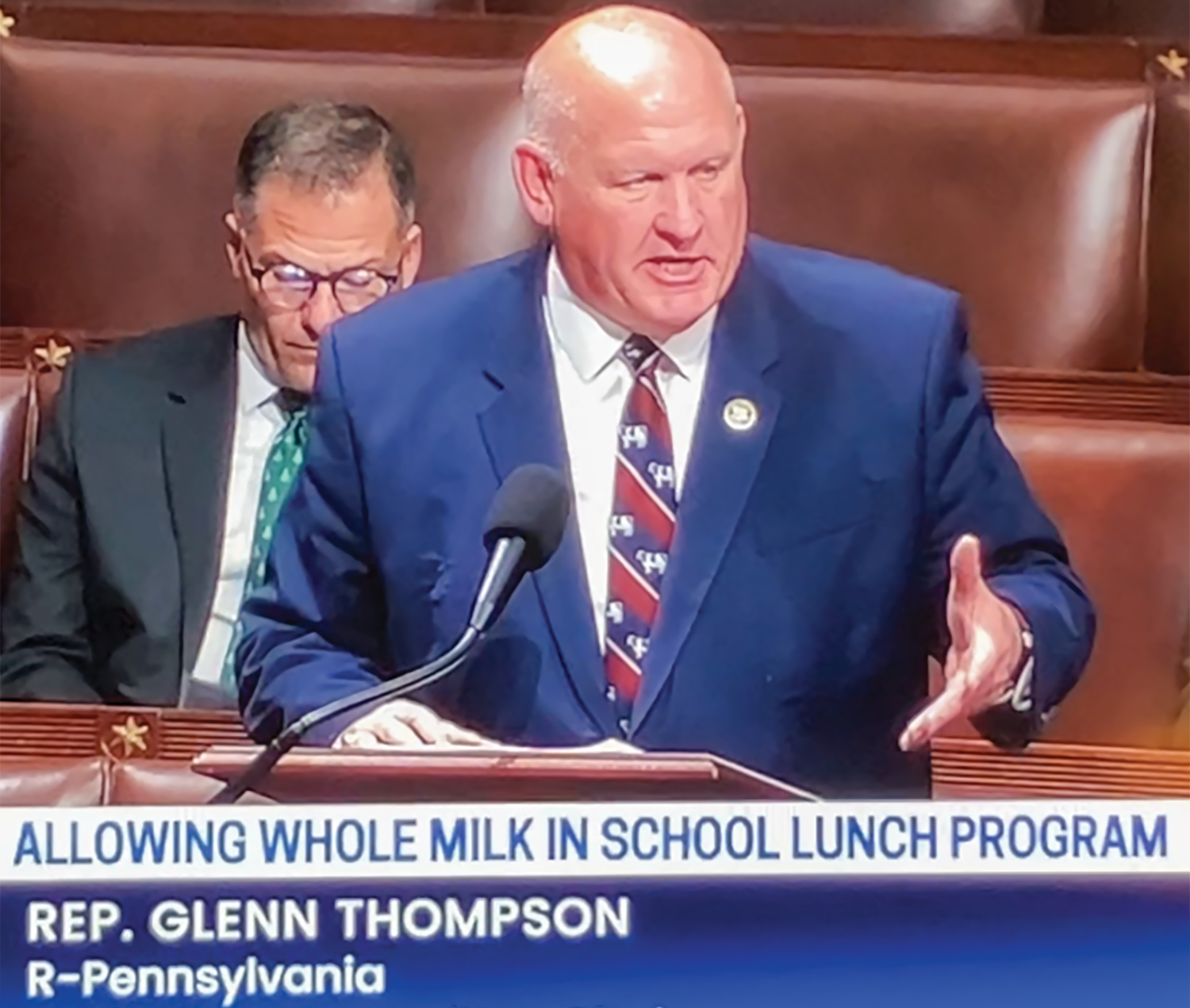
The Senate bill 1957 is identical to the successful House whole milk bill H.R. 1147, which was authored by Pennsylvania’s own Representative GT Thompson.
GT is a man of courage, conviction, compassion, of humility and humanity. I’ve heard him say more than once: “God gave us two ears and only one mouth for a reason.”
He is a determined man, doing the work. He included whole milk bill in the House Committee-passed farm bill. He’s standing firm on his pledge to put the farm back in the farm bill. He is concerned about the financial crisis in agriculture on the horizon, and held a hearing July 23 with witnesses from agriculture and banking giving stark warnings.
Even though whole milk choice in schools seems like a minor issue in the grand scheme of things today, it is really a linchpin. If we could just get something with broad bipartisan support accomplished, this could lead to other steps on common ground.
As the whole milk choice remains hung up in the Senate, let’s pause to think about how ridiculous it is that we adults get to choose, but our growing children do not. For them, whole milk is banned at two meals a day, five days a week, three-quarters of the year at school. (The federal government, via USDA school lunch rules, only allows fat-free and 1% milk to be offered with the meal or even a la carte.)
Maybe the Harris ticket would like to ban food choice behaviors for adults as well.
We have Republicans and Democrats supporting whole milk choice in schools. Both parties say they care about our nation’s farmers and ranchers who feed us and are the backbone of our national security.
WASHINGTON, D.C.— The extended 2018 farm law will expire Sept. 30 in the throes of a tumultuous election year while farm liquidity and cash flow decline in the face of an eroded farm bill safety net.
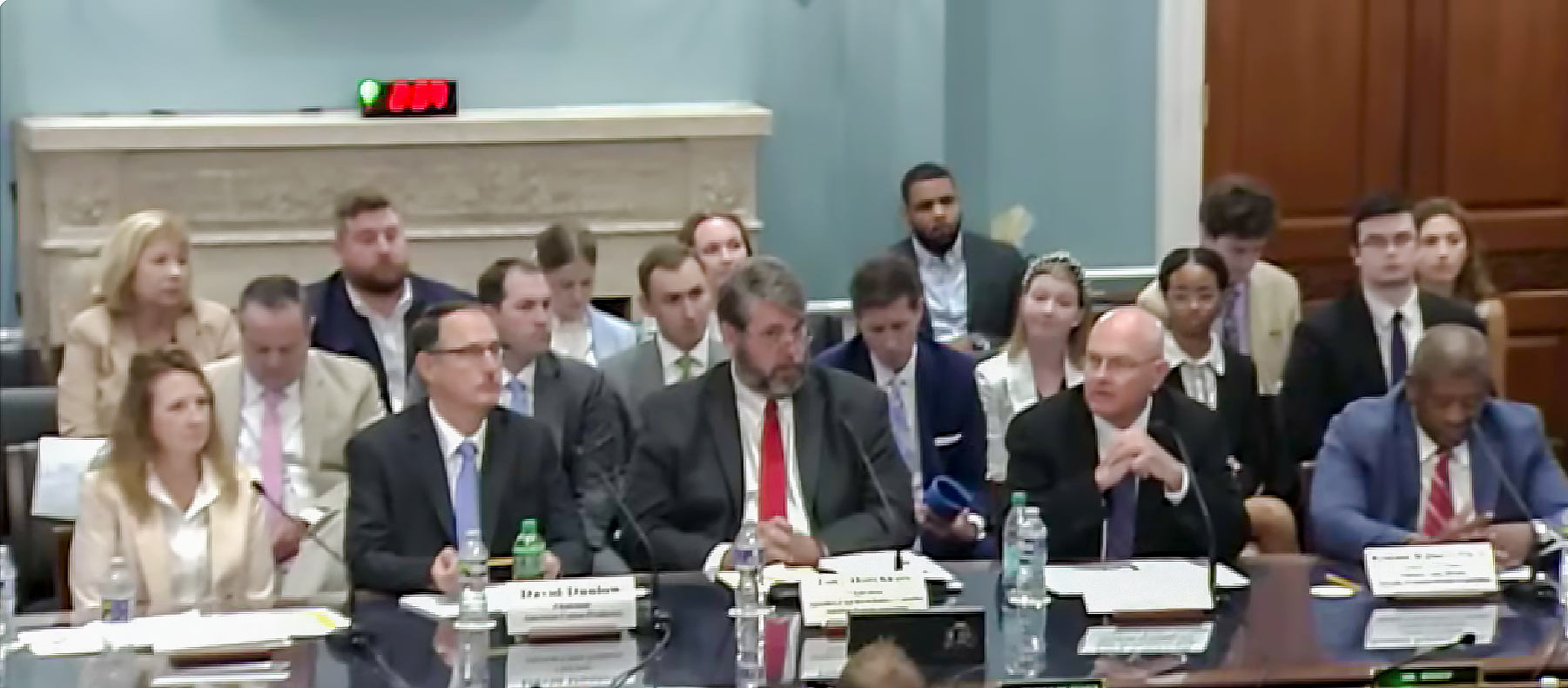
Witnesses before the House Ag Committee July 23rd were (l-r) Dr. Dana Allen-Tully for Minnesota Corn Growers, David Dunlow for American Cotton Growers, Tony Hotchkiss for Ag and Rural Bankers, Joey Caldwell for the Ag Retailers Association, and University of Arkansas ag economist Dr. Ron Rainey. Hearing livestream screen capture
Witnesses in a July 23 House Ag Committee hearing expressed support for the House bill and made it clear that another extension is a non-starter, with one witness describing the current law as facing a category-five hurricane with no protection.
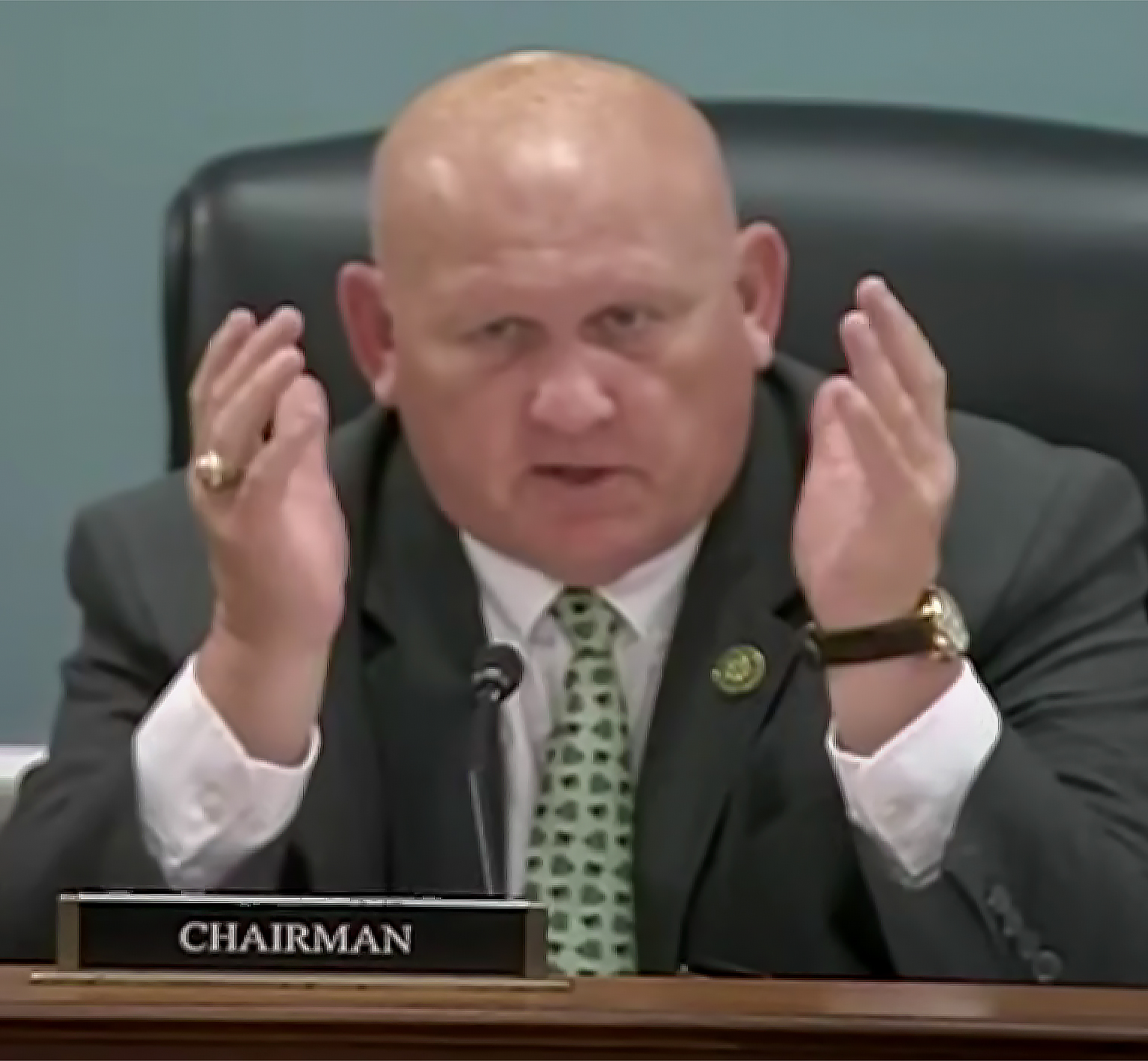
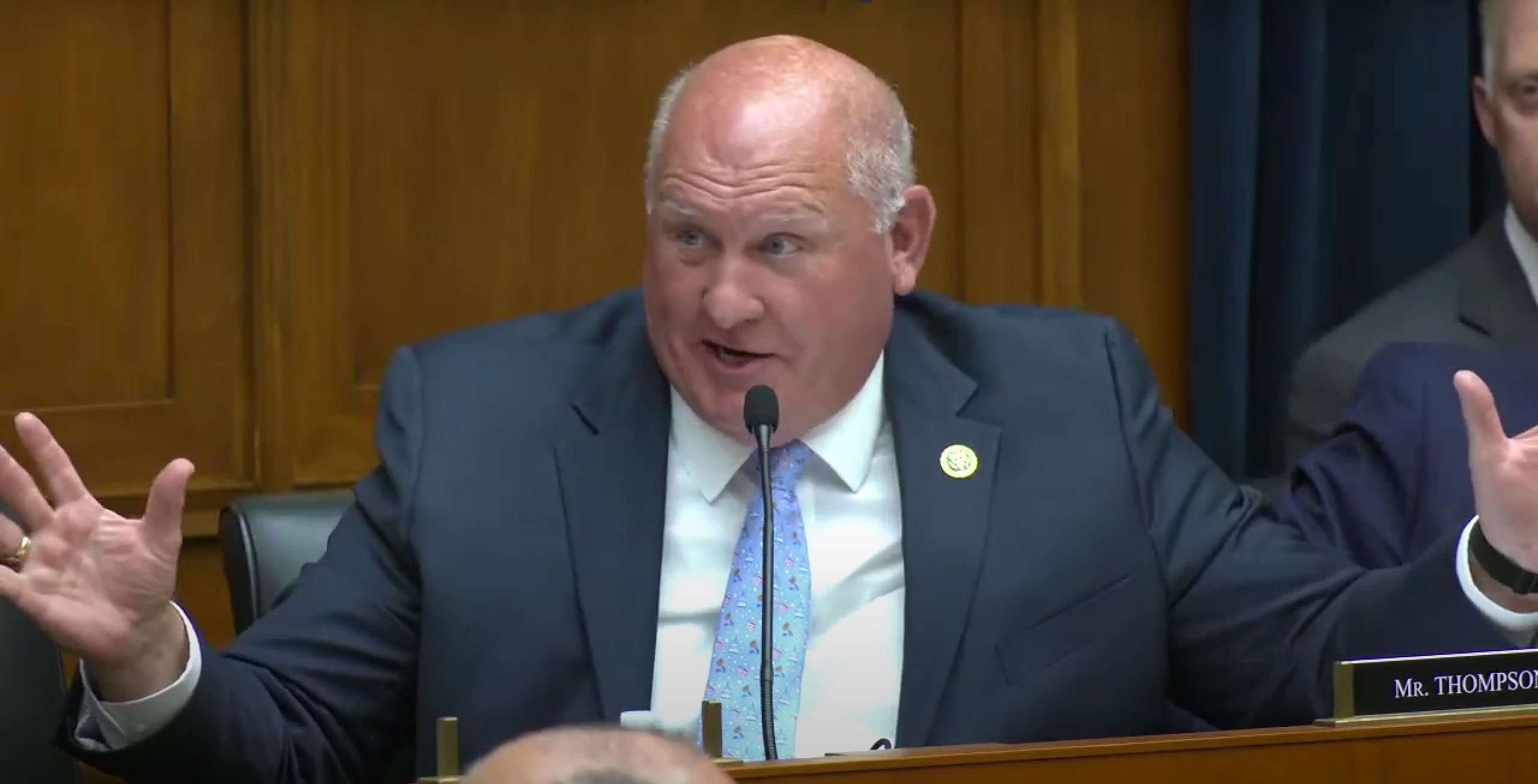
“Unprecedented challenges are facing the entire agricultural sector, threatening to ignite another farm financial crisis,” said House Ag Chairman Glenn ‘GT’ Thompson (R-Pa.) as he opened the hearing on financial conditions in farm country.
USDA estimates net farm income will see the steepest drop of $43 billion this year – down 27% from 2023 and down 40% from 2022. In its report, USDA notes that livestock farms will also see net cash farm income drop for 2024 across all specializations. Within the livestock sector, dairy farms are forecast to see the largest decrease in average net cash farm income in 2024.
“The impact won’t be fully understood until early next year when farmers are unable to secure operating loans because they can’t cash flow,” said Dr. Dana Allen-Tully, member of a diversified crop and dairy farming family near Eyota, testifying for Minnesota Corn Growers.
In addition to flooding in her region and drought elsewhere, crop producers face income losses of $150 to $233 per acre, she said, citing plummeting prices, high costs of production, doubling interest rates, natural disasters, and tightening credit.
Thompson said these factors create “a perfect storm that will compromise the foundation of our agricultural economy.”
He observed U.S. agriculture is in the largest two-year decline in farm income, and by the end of 2024, total farm sector debt will be the highest since 1970.
“Unfortunately, the farm safety net has not seen significant investment since 2002. The lack of support for those that feed the world is unacceptable,” the Chairman said, pointing to the many farm bill listening sessions across the country.
According to Thompson, the bipartisan House Committee-passed Farm, Food and National Security Act of 2024 represents the largest permanent farm bill investment in over two decades for the farm safety net, conservation, trade promotion, specialty crops, research, and livestock biosecurity.
“It will give renewed strength… just when producers need it most,” he declared, taking aim at “pundits spreading misinformation about this bill in order to sow division.”
Thompson said Democrats in Congress have “unilaterally added billions to climate and conservation programs, and the current Administration added one-quarter of one trillion dollars to nutrition programs — all while ignoring the farm safety net.”
“I will not apologize for advancing a bill that seeks to put the farm back in the farm bill. I am tired of the politics and gamesmanship, and I know folks out in the countryside are too,” he said.
Thompson stated further that this work has been “saddled with a meddling Senate Democrat and others who do not seem to appreciate the dire circumstances in farm country.”
As recently as last week, some Ag Committee Democrats have expressed a preference to see a farm bill fail before engaging in the process, Thompson reported, adding that his door remains open “to renegotiation from any partner willing to come to the table with a serious proposal — not more red lines.”
“For negotiation to be viable, Chairwoman Stabenow needs to unveil her bill text,” he challenged.
During the hearing, witnesses cited meaningful improvements to the safety net via updates to reference prices, crop insurance, and the conservation title.
Both the current 2018 law and the incomplete Senate summary do not meet the needs of farmers, witnesses indicated. Even the stronger safety net in the House bill is not enough, they said, but would help farmers weather the storm.
While pundits say the House bill cuts nutrition programs, Thompson has repeatedly demonstrated no program cuts in the bill, even though the Congressional Budget Office (CBO) score showed $30 billion in savings on the 10-year baseline compared with earlier scores.
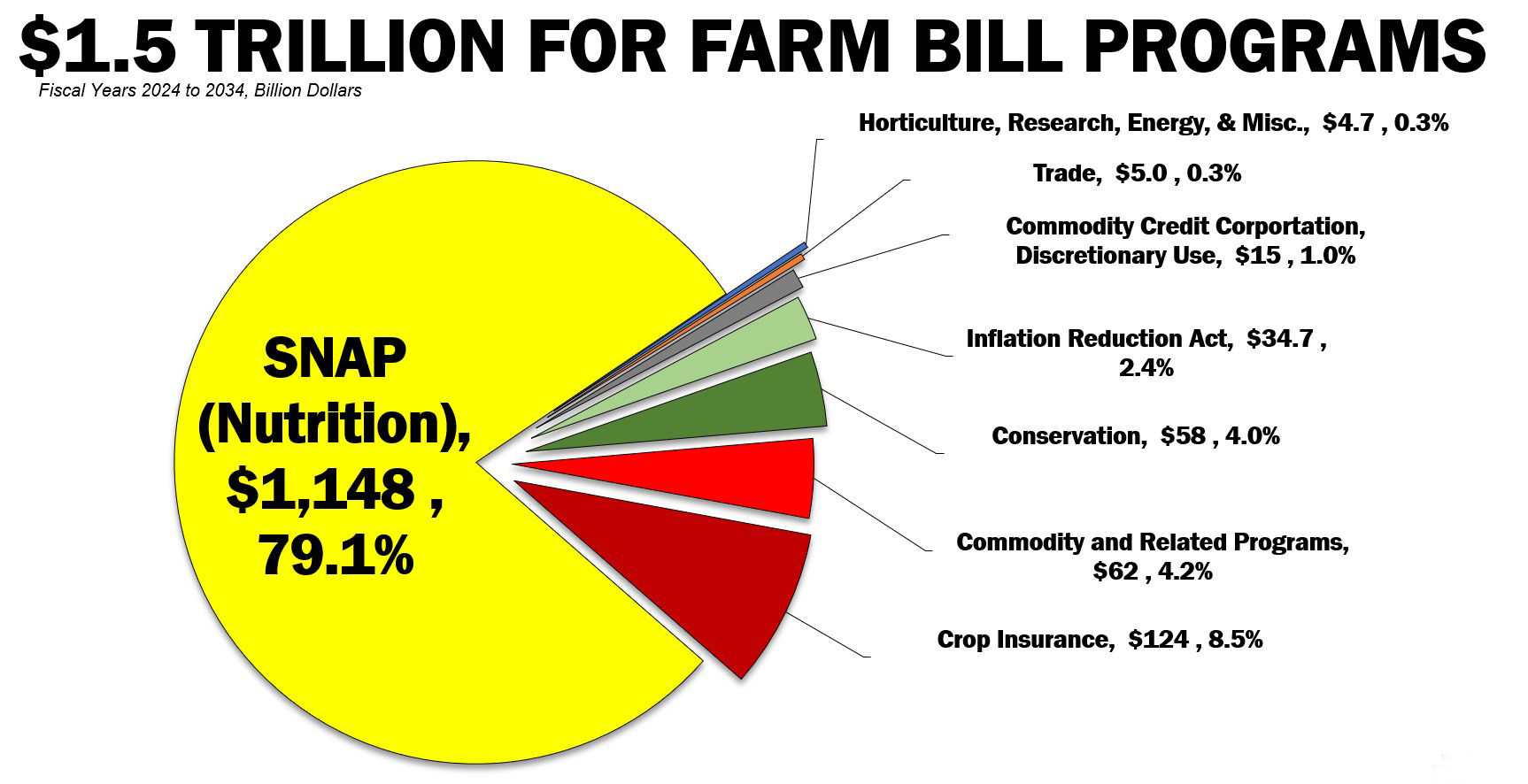
Nutrition Title spending accounts for nearly 80% of the estimated $1.5 trillion total farm bill. Nutrition spending also increases by 73% ($484 billion) since the 2018 farm bill enactment.
“Quite frankly, we are not going to have nutrition, if we do not have farmers, so our investment here is in the farm safety net,” Thompson stated.
The House farm bill seeks a stronger farm safety net within a shrinking piece of the total farm bill pie. Senate Ag Committee minority graphic
Ranking member David Scott (D-Ga.) emphasized in his remarks the Democrat position that CCC authority remains “exclusively in the hands of the Secretary of Agriculture,” without the congressional oversight proposed in the House bill.
The witnesses didn’t bite when asked about this. Several indicated it is more desirable to have a stronger safety net so the CCC does not have to be dipped into in the first place.
At the same time, witnesses indicated the need, now, for supplemental intervention under the current price squeeze.
To that point, Rep. Mark Alford (R-Mo.) asked: “Did you know we are losing 1000 farms every month in America right now? It’s a staggering number when we consider our food security and our national security.”
“Working capital is fast depleting,” Dr. Allen-Tully testified. She called John Deere’s layoffs “a canary in the coal mine” and warned against another farm bill extension because “it won’t stop the hemorrhaging. Even a new farm bill with a strong safety net may not be timely or sufficient, though I pray Congress will pass a new farm bill this year because it will help in the long run.
“We put everything on the line for a thin and often negative margin. Young people aren’t going into farming, and that’s why the average age of farmers is nearing 60… no parent wants their kids to go through life facing constant worry. We need our full-time farm and ranch families,” she said.
North Carolina farmer, David Dunlow testified for American Cotton Growers. He noted the size of operating loans farmers in all commodities take on every spring, and the lines of credit with input companies.
“That has to be paid back – every year — before we can go and get another operating loan,” he said. “The margins are very thin … under normal conditions, and with the economy now, nothing cash flows. It’s very difficult to get those loans paid and to move on to the next year.”
Testifying for the Ag and Rural Bankers, Tony Hotchkiss said lenders are seeing changes. Farmers are working through liquidity faster than anticipated and are now beginning to leverage equity through refinancing debt. This is further challenged by the cash flow needed for the refinancing payment.
“This has made ag bankers feel as though they are looking over the cliff,” Hotchkiss stated, stressing the need for ag policy changes, many of which are included in the 2024 House farm bill.
Joey Caldwell of GreenPoint Ag Holdings in the Southeast U.S., testified for the Ag Retailers Association. He said a strong farm bill safety net is critical to Rural America: “If the farmer is not successful, the supply chain is not successful, and this impacts the very fabric of our communities.”
University of Arkansas ag economist Dr. Ron Rainey also testified that farm debt levels are increasing as divergence between input costs over ag prices is widening, even if the overall price indices are higher.
He said more farmers need to be involved in using risk management, whether that is through better subsidy levels or technical assistance to enhance understanding and use of it.
“If they don’t have crop insurance, and if they are outside of the safety net, then they’re financing their risk on their balance sheets. The more we can move from ad hoc disaster assistance, the better off the farmers are,” said Dr. Rainey.
“But where we are now… that’s going to require some intervention. That’s just the bottom line,” he added.
Rep. Eric Sorenson (D-Ill.) brought up sustainable aviation fuel and the inequity in how current Energy Department tax credits are given for ethanol from Brazil and used cooking oil from China, while American farmers, who can serve this need, are getting nothing.
“Sustainable aviation fuel is one of the most exciting things coming as a corn farmer,” Dr. Allen-Tully replied. “But the way the Treasury Department has their guidance written excludes us. It is almost insulting to believe that we would bring in sugarcane ethanol in place of ethanol we can grow here.”
Rep. Mary Miller (R-Ill.) asked witnesses how the climate policies of the current administration are affecting farmers, and she gave her own opinion as a farmer: “It’s painful.”
Caldwell responded, pointing to energy and fertilizer as the largest costs, and they are much higher under these policies.
“Farmers need a strong farm bill,” said Caldwell. “When a farmer plants a crop, they put more than their job at risk. It is their home, their livelihood – a pillar of their community. For many, it is also their family legacy, passed down through generations that they hope to pass on to their kids… they risk losing it all.”
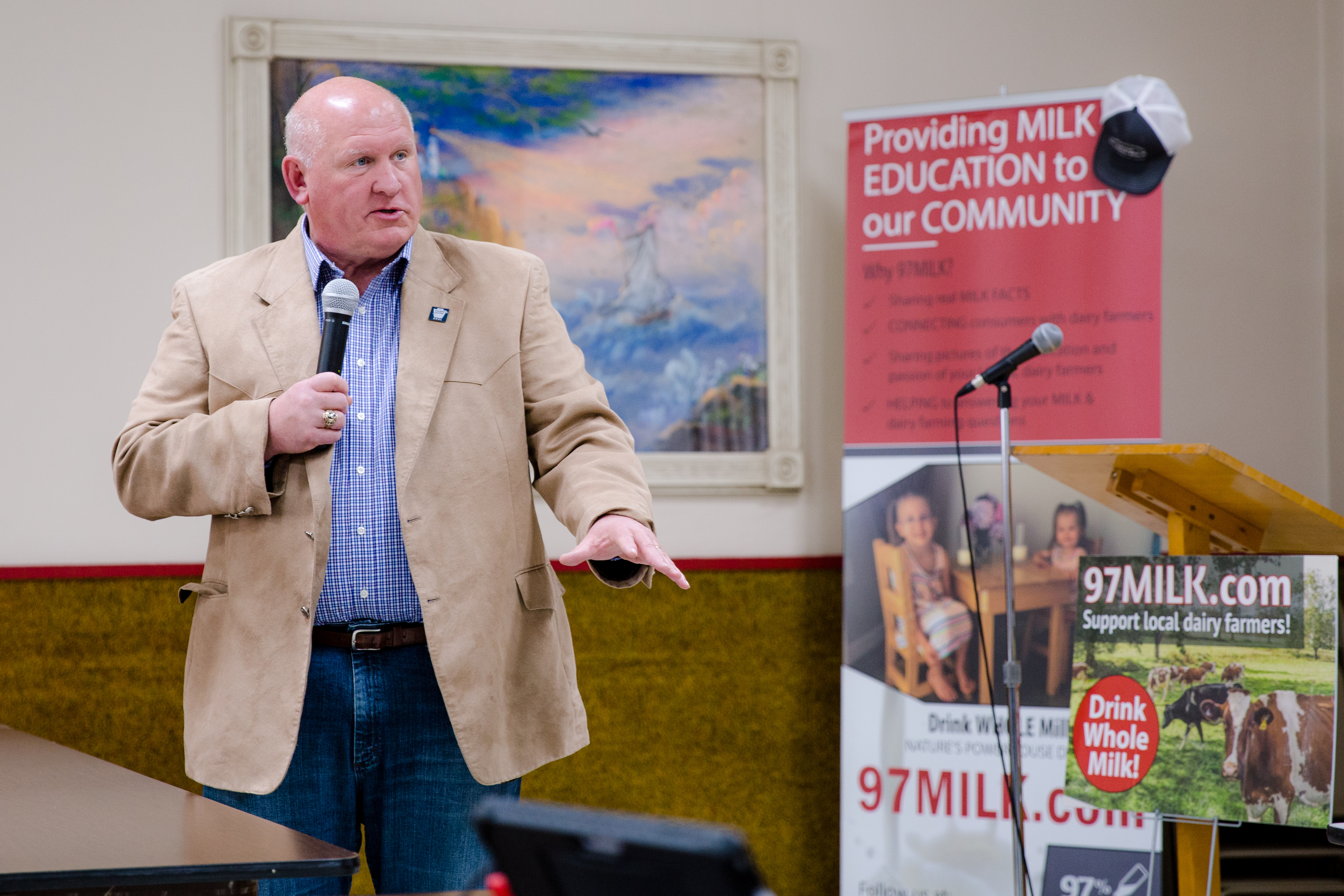
Representative GT Thompson of Pennsylvania once told a group of farmers gathered for a 97 Milk meeting that he has gone by a lot of titles and been called a lot of things over the years, and while it’s an honor to be the Chairman of the House Agriculture Committee, his favorite title is ‘Representative’ because, he said “that’s what we do. We are representing The People.” True to form, GT led the House 2023-24 farm bill process with representation in mind by making the bipartisan endeavor ‘tripartisan’ — going to great lengths to bring grassroots farmers into the process. One thing he heard repeatedly at the 85 listening sessions in 40 states was ‘bring whole milk choice back to schools,’ even though school meal rules fall under the childhood nutrition reauthorization led by the Education Committee, not the farm bill. But now he’s done that too. Bolstered by the overwhelmingly bipartisan 330 to 99 passage of H.R. 1147 on Dec. 13, 2023, he found a way to make Whole Milk for Healthy Kids part of his proposed farm bill that heads to House Ag Committee markup next week. He says he is intent on getting the whole milk legislation through the Senate blockade and “over the finish line.” File photo by Sherry Bunting
By Sherry Bunting, Farmshine, May 17, 2024
WASHINGTON – House Ag Committee Chairman Glenn ‘GT’ Thompson (R-Pa.) says the bipartisan farm bill has reached a milestone and holds the potential for being transformational.
The chairman’s mark, released ahead of committee markup set for May 23, demonstrates the listening that went on in his busy schedule traveling to 40 states and one territory for 85 listening sessions over the past two years.
“We are hopeful that the House Ag Committee markup of this chairman’s mark legislation helps feed the momentum to get this farm bill done,” said Chairman Thompson in a May 14 Farmshine phone interview.
There are important highlights here, including reforms to the Dietary Guidelines process for greater transparency and accountability with new checks and balances, as well as language to expand the reach, funding and impact of the dairy incentive and school meal programs by including full fat fluid milk, flavored and unflavored, as seen in H.R. 5099 and H.R. 1147 (Whole Milk for Healthy Kids Act).
“I was able to work with Dr. Virginia Foxx (chair of the House Education and Workforce Committee), and they will be providing a waiver after we mark this bill up, so we will be able to include Whole Milk for Healthy Kids in the farm bill,” Thompson shared.
He has previously stressed that, “This is about our kids and the outdated and harmful demonization of milkfat.”
“When we get to conference (with the Senate), it could be an issue, but Whole Milk for Healthy Kids passed the House by a 330 vote. I am intent on getting this provision over the finish line.
“It may be the most important thing we do out of many things in this farm bill for dairy farmers,” he said.
Other dairy subtitle provisions
The dairy subtitle includes language to return the Class I ‘mover’ price to the ‘higher of’ calculation instead of the ‘average plus 74 cents’ that was implemented in May 2019.
“We obviously recognize that USDA has now gone through an extensive hearing process, and will honor what USDA comes up with, which will supersede what we’re doing,” Thompson reported. “But it was the Ag Committees in the Congress through the 2018 farm bill that eliminated the ‘higher of’ language, which has been followed by significant unanticipated losses.”
Language has also been included to mandate biennial cost of processing surveys. This also appears in the Senate farm bill.
Processors making products used in Federal Milk Marketing Order (FMMO) formulas would participate in processing cost surveys every two years. In addition to reporting costs for those products, the Dairy Pricing Opportunities Act language that is rolled into the farm bill proposal states that the cost and yield information for all products processed in the same facility be included. (Note: This would ensure accurate allocation of plant costs that apply just to the products that are actually used in the FMMO pricing formulas so that the costs to process other value-added products that are not included in FMMO pricing, but are made in the same plant, do not influence future ‘make allowance’ hearings.)
These cost surveys would be published for the purposes of informing the regulatory or administrative (hearing) process for the establishment of pricing rules (such as determining how to use that published information to set ‘make allowance’ levels that are embedded in FMMO pricing formulas).
The dairy subtitle also expands the Dairy Margin Coverage (DMC) tier one cap on annual milk production history from 5 million pounds to 6 million pounds, similar to the Senate bill.
It also includes language for updating DMC production history and provides a 25% discount in premium costs for any producer signing up for all five years of DMC coverage.
“That’s quite a savings,” Thompson observed.
IRA funds included without ‘climate sideboards’
In the Conservation Title, the chairman’s mark brings Inflation Reduction Act (IRA) conservation funds into the farm bill baseline without the ‘climate sideboards’ and arbitrary measures that ride along in the Senate version.
“All conservation programs, as long as they are locally-led and voluntary, contribute to climate and carbon sequestration. What the IRA legislation did is make it overly prescriptive with a lot of practices we know are successful not being eligible for these conservation dollars.
“We believe that the principles of locally-led and voluntary are a huge part of what has made conservation programs so successful. Agriculture sequesters 6.1 gigatons of carbon annually, over 10% more than we emit,” said Thompson.
Timelines matter
There are a couple reasons timelines matter in getting this farm bill done. The IRA funding is one of them.
“Number one is the American farmer is struggling right now. The chairman’s mark, as we prepared it in the House Committee, will be of great service to them as producers of food, and to struggling families as consumers of food, quite frankly,” said Thompson.
“The other reason timelines matter is these IRA dollars. As the Secretary of Agriculture continues to push those dollars forward, the original $19 billion – between what he already spent and what the CBO projects he will not be able to spend – that number is now down to $14 billion,” Thompson explained. “That’s opportunity lost for the future, unless and until we pass and reauthorize the farm bill and roll those dollars into its baseline.”
Thompson continued, explaining that, “Every dollar in IRA conservation funds spent between now and the passage of the farm bill is a dollar lost to the baseline for the future. One of the flaws of the IRA is these conservation dollars expire in 2031. Whatever we bring into the farm bill – into the baseline – is there for perpetuity. It will be there for the 2050 and 2055 farm bills. That’s smart, and it’s good for agriculture and great for conservation.”
The Senate proposal also brings IRA conservation funds into the farm bill baseline, but puts climate requirements on these funds, especially in regard to methane.
Tripartisan effort produces nutrition cost-savings, not cuts
“My chairman’s mark is built on solid tripartisan input from Republicans and Democrats and the hardworking people of American agriculture,” Thompson affirmed. “The Senate proposal is a partisan proposal. They did not bring Senate Republicans to the table.”
In his May 10 open letter, Chairman Thompson stated that his door is always open.
“There exists a few, loud armchair critics that want to divide the Committee and break the process. A farm bill has long been an example of consensus, where both sides must take a step off the soapbox and have tough conversations,” he wrote. “The 2024 farm bill was written for these precarious times and is reflective of the diverse constituency and narrow margins of the 118th Congress. Each title takes into consideration the varying opinions of all who produce as much as those who consume. It is not one-sided, it does not favor a fringe agenda, and it certainly does no harm to the programs and policies that feed, fuel, and clothe our nation.”
Case in point, the CBO has scored the House farm bill chairman’s mark to save $28 to $29 billion in the Nutrition Title.
“Some would have you believe we are cutting $28 to $29 billion from feeding struggling families, but we are not,” Thompson declared. “There are no cuts to individual SNAP benefits in this bill. My Democratic colleagues say we are cutting by that much, but the CBO score on my proposal reflects cost savings from increased efficiencies, reduced fraud, and things that better meet the needs of families struggling in poverty.”
Justifiably proud of the intense work he and his committee have done on the nutrition programs lightning rod that makes up more than 80% of the farm bill baseline, Thompson said his proposal actually “creates a fire wall so that a future right-leaning administration would not be able to arbitrarily cut benefits either. It exercises our Article I prerogative on how we do market basket analysis, keeps the variables and the cost of living. These things are significant factors.”
His proposal also expands access to a couple populations not eligible for SNAP in the past, including families with adult children in school up to age 21 (not 18). In the past, their part-time jobs affected family eligibility.
Putting the farm back in the farm bill
The Commodities and Crop Insurance Titles also engaged input from farmers, farm groups and industry. On reference prices, Thompson said the Senate bill picks three crops and puts in a 5% increase for base acreage.
“In our proposal, we’ve worked with the stakeholders. We’ve done the math, the financial and risk analysis on what is needed.”
This includes a more commodity-specific update to reference prices and granting the Secretary of Agriculture authority to expand base acres.
“We have been committed to putting the farmer back into the farm bill commodities title,” he said.
This scratches the surface of what is included in the farm bill chairman’s mark. An overview and title by title summary are available at https://agriculture.house.gov/farmbill/
When asked about what other dairy topics could come up during markup, Thompson said he wouldn’t be surprised to see other amendments in committee.
“There are some labeling issues that are not in our purview or jurisdiction but come under the Energy and Commerce Committee. We could get the ball rolling, but we would need them to get on board for that to go forward,” he said.
Reflecting on the milestone this week, Thompson answered our question about what he’s most proud of to this point.
“The fact that this farm bill was built using the input of American farmers, ranchers, and foresters, and it reflects what their priorities are and what their needs are, and the fact that as I look at the chairman’s mark and all 12 titles according to the goal placed early on, two years ago as I started my leadership of this process:
“This will be not only a highly effective farm bill for our producers, processors and all of us who consume food, it will be transformational,” he said.
WASHINGTON — Wednesday, December 13th was a big day for dairy farmers and schoolchildren! After clearing the House Rules Committee Mon., Dec. 11, the Whole Milk for Healthy Kids Act, H.R. 1147, passed overwhelmingly in the U.S. House of Representatives.
The strong bipartisan 330 to 99 vote moves the choice of whole milk closer to school cafeterias across the nation with momentum for the next stop: the U.S. Senate, where S. 1957 has 12 bipartisan sponsors from 10 states – and more are needed.
“Students across the nation deserve school lunches that are both enjoyable and nutritious, and this legislation achieves these goals,” said Whole Milk for Healthy Kids Act champion Glenn ‘G.T.’ Thompson (R-PA-15), Chairman of the House Agriculture Committee and senior member of the Education and Workforce Committee as he testified before the Rules Committee Monday.
“Milk is an essential building block for a well-rounded and balanced diet, offering 13 essential nutrients and numerous health benefits. However, outdated and out-of-touch federal regulations have imposed restrictions … Students are not able to access any of the milk’s essential nutrients if they won’t drink the milk being served to them. As we have seen over the last decade, there has been a steady decline in school milk consumption. This bill does not mandate anything. It gives schools, parents, and students the option of whole milk,” said Thompson.
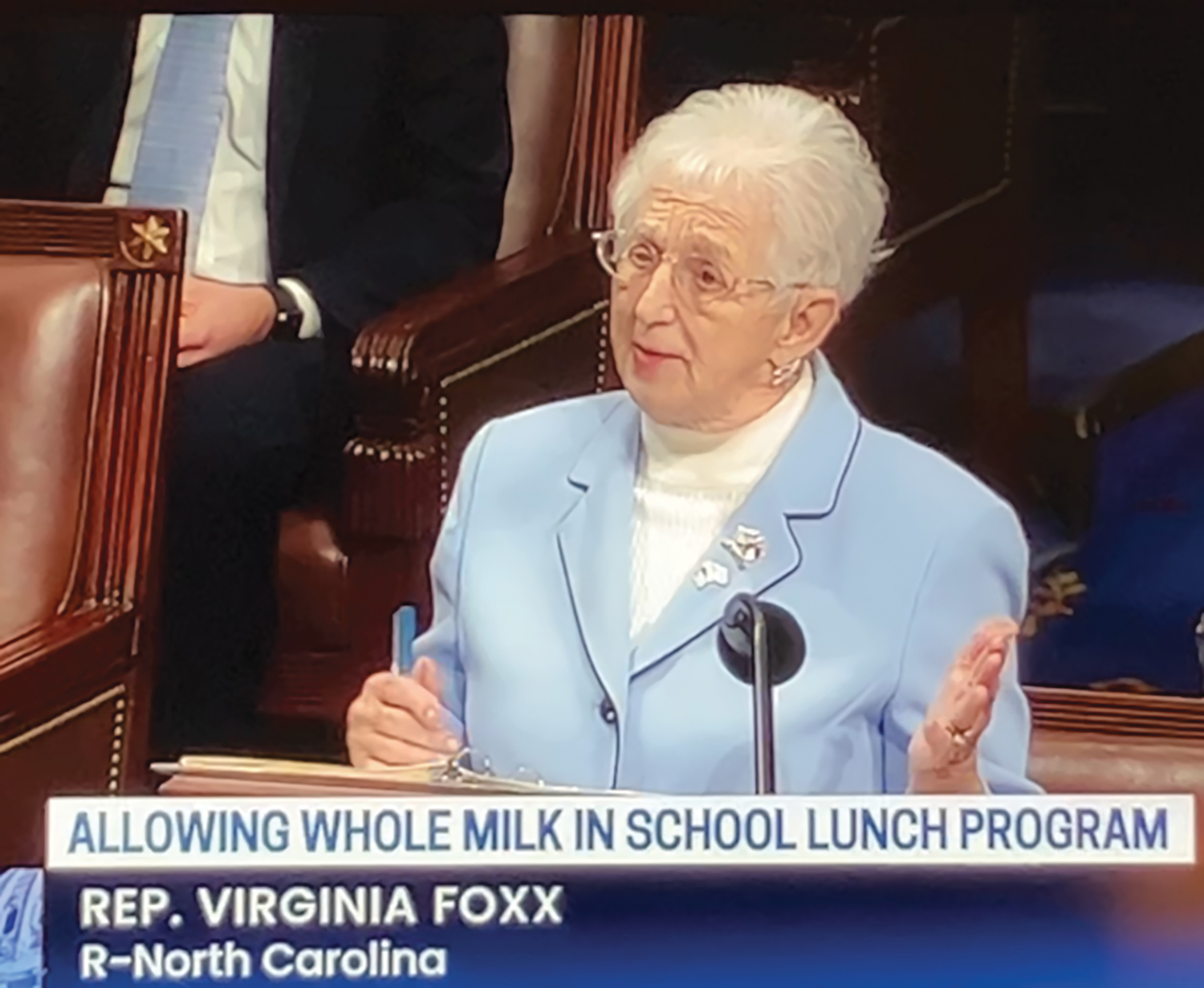
Education Committee Chairwoman Virginia Foxx (R-NC-5) was blunt on the House floor: “Whole milk isn’t just a beverage; it’s a vital source of nutrients essential for children’s growth. Denying access to its calcium, vitamin D, and protein threatens to inhibit their development. To the anti-milk advocates, I have one thing to ask of you: What do you have against milk? Let’s end this war on milk. Pass the bill!”
And they did. Resoundingly, the People’s House sent a strong message to the opposition that hung their hats on the flawed Dietary Guidelines for Americans (DGAs) as the end-all, be-all.
Education Committee Ranking Member Bobby Scott (D-VA-3rd) re-litigated his argument that was previously defeated in bipartisan Committee passage of H.R. 1147 in June. He kept referring to the DGAs. He insisted skim milk is the same as whole milk, nutritionally, but disregarded the roles of milkfat in key vitamin absorption and flavor to keep those nutrients from going down the drain.
Congress tied school meals closer to the DGAs in 2010, and the Obama-era USDA developed beverage rules in 2012 that banned whole milk — leading to the loss of a generation of milk drinkers and unprecedented increases in childhood obesity and diabetes — to the point where an April 2019 U.S. Senate hearing noted concern from U.S. military generals on fitness of recruits.
The Rules Committee asked why whole milk is being handled as a separate bill instead of within a Childhood Nutrition Reauthorization package. Thompson explained that the reauthorization has not occurred since the 2010 Healthy Hunger Free Kids Act created the issue.
“There is widespread bipartisan support in the Education and Workforce Committee, on the beverage part of this, milk in particular, because studies have shown the BMIs have gone up from what was a baseline prior to removing whole milk. Part of the urgency here is the significant impact that has had on the health of our youths,” he said.
Thompson cited the case study analysis of annual body mass index (BMI) data aggregated by Christine Ebersole RN, BSN, CSN, a school nurse from Martinsburg, Pennsylvania. She shared her data on 7th to 12th graders in a 97 Milk / Grassroots Pennsylvania Dairy Advisory Committee education session in Washington in June 2023 and in a State Senate hearing in Harrisburg in 2021.
Her data showed the percentage of students in the overweight and obese categories, combined, grew from 39% in 2008 to 52% in 2021. This mirrors national trends demonstrating the anti-milkfat approach has not helped and may have harmed. The trends in fact have worsened ever since DGAs were created to infiltrate institutional feeding programs.
According to the latest National Survey of Children’s Health at the CDC website, the percentage of 10- to 17-year-olds with BMI in the obese category, alone, increased nationally from 15.4% in 2006 to 19.7% in 2018. In 1970 to 1980, it was 5%. This doubled eight years after the DGAs were born to 10% in 1988, then rose to 15.4% by 2006 after six years of USDA school lunch saturated fat caps were implemented, then stabilized at just over 15% from 2008 to 2012, then grew to 19.7% by 2018 — six years into the USDA ban on whole milk in schools.
The big milestone for whole milk in schools comes on the 5-year anniversary of Berks County, Pennsylvania dairyman Nelson Troutman placing his first painted roundbale “Drink Whole Milk (virtually) 97% Fat Free” in a pasture by a crossroads, which led to questions, publicity, and the creation of 97 Milk.
The 97 Milk educational organization has worked alongside the Grassroots Pennsylvania Dairy Advisory Committee on the legislative side. As a team, they continue to lead the charge for children to have the choice of whole milk once again at school. They are pleased to have worked with the Nutrition Coalition, founded by Nina Teicholz, author of Big Fat Surprise, and to see other national dairy and farm organizations join in support in recent years — from the American Dairy Coalition and Farm Bureau to National Milk Producers Federation and International Dairy Foods Association.
“We are grateful for this bill’s champion, the honorable G.T. Thompson. We thank him for not giving up,” said 97 Milk Baleboard originator Nelson Troutman in a Farmshine phone interview about the bill. “So many legislators get pounded from the top down, and they give up… and really, G.T. didn’t have a lot to gain out of this except helping the people. He did this for the kids, for the people, for the farmers. This is not a mandate. This is a choice, and I cannot emphasize the word choice enough.”
“The reason we got here is G.T.’s dedication to children having nutritious and delicious milk choices, and he brought it to the finish line in the House,” said Bernie Morrissey, chairman of the Grassroots PA Dairy Advisory Committee. “We have to keep working on the Senate, and 97 Milk has been a major part of educating people about this choice kids will have when the Whole Milk for Healthy Kids Act becomes law. The people on our grassroots committee and 97 Milk – we are a team. Our teams help each other. When you have a great team and teamwork, that’s how things get done.”
“This is a strong step in the right direction, and we have to keep going to our total destination,” said G.N. Hursh, Lancaster County, Pa. dairy farmer and chairman of 97 Milk. “We at 97 Milk totally support this bill. Whole milk choice in schools is clearly a national improvement for our future leaders. This is a win for good taste and excellent nutrition!”
Dale Hoffman and his daughter Tricia Adams, also members of the Grassroots Pennsylvania Dairy Advisory Committee expressed their gratitude. Three generations operate Hoffman Farms in Potter County, Pa.
“G.T. has really fought for this and put a lot of work into this. We appreciate what he has done in helping out the kids and the farmers,” said Dale in a phone interview. “When you look at the health situation, the trends have gone the other way without whole milk in the schools. Kids are dumping the milk, and you can’t blame them. They need those nutrients physically and mentally. Milk is one of nature’s most perfect foods. We produce it and grew up with it. Children should be able to choose it.”
Grassroots committee member Krista Byler, of Spartansburg, Pa. is a Union City school foodservice director and head chef. She said the Whole Milk for Healthy Kids Act “is huge for me because I have seen this from the startup, and I finally seeing movement in the school nutrition organizations. I see the whole picture coming together. I am amazed to see it reach this point that now students are much closer to having a milk choice that meets their nutritional needs,” she said.
Byler notes that the milk carton shortage affecting school districts this year has been a catalyst for support among her peers for the expansion of choices in milkfat levels.
“It’s sad to say, but as we struggle on the milk carton shortage, it forces people in my position to think outside the box and look at alternative service methods,” said Byler. “We are seeing students asking for other milkfat options, such as whole milk.”
She says she sees more of her peers today are excited about this bill and how it is worded in a way that makes it possible for them, as school foodservice directors, to implement — to actually offer whole milk as an option for students and not be financially penalized by the federal government for exceeding arbitrary and outdated fat percentages on the meal.
“I’m excited to be closer to having this choice to meet students’ needs in a way that is nutritious and that they find delicious. My students will be so excited,” said Byler. “When it becomes law, it will be a huge win for kids everywhere, and our waste will certainly go down.”
Look for more in Farmshine about this milestone, what’s next, and the three amendments that were offered and approved along with the bill. They are: 1) allowing school milk to be either organic or non-organic, 2) preventing school milk from Chinese state-owned enterprises, and 3) prohibiting USDA from doing its proposed elementary school ban on flavored milk.
Thompson: ‘This is a win for children and dairy farmers, but we’re not done’
“This policy has cheated our children and has led to economic demise in Rural America as we’ve seen a loss of dairy farms and small businesses that are in that supply chain. It’s time to reverse the mistake that was made in 2010. We need to follow real science, not political science. I question the process of the Dietary Guidelines Advisory Committee. These are unelected bureaucrats, and there’s no oversight. This is our chance to actually do something positive in that process to say ‘hey we’re watching what you’re doing. We’re looking over your shoulder,’” said Rep. GT Thompson (R-PA-15). In a bipartisan 26 to 13 vote, the Committee on Education and Workforce passed Thompson’s motion to report the Whole Milk for Healthy Kids Act, H.R. 1147, to the House of Representatives with recommendation of passage. On the Republican side, 21 voted yes and 4 were absent. On the Democratic side, 5 voted yes, 13 no, and 3 were absent. The next step is getting the bill on the calendar for a vote on the House floor.
WASHINGTON — The Whole Milk for Healthy Kids Act, H.R. 1147, reached a major milestone this week, passing mark-up in the U.S. House Committee on Education and Workforce.
Dairy farmers could not have asked for a better way to kick off June Dairy Month as the committee discussion exposed the sides of this issue, and Congressman Glenn ‘GT’ Thompson, the Republican from Pennsylvania and the bill’s prime sponsor, laid out the case for children to have true access to the most nutritional beverage — milk.
In the end, the Education Committee on Tuesday, June 6 approved the bill in a bipartisan 26 to 13 vote.
(Cross-section highlights of Education and Workforce Committee discussion and vote.)
Now that it is recommended by the House Education and Workforce Committee, the next step is scheduling of the vote on the House floor.
This is the first time in three legislative sessions that the bill to restore the choice of whole and 2% unflavored and flavored milk in schools has made it this far in the legislative process.
“This is a win for children and dairy farmers, but we’re not done. I took a deep breath to see this satisfying outcome in this first stage and another deep breath as we move to the next stage to get it onto the House calendar,” said Rep. Thompson in a Farmshine interview after committee passage.
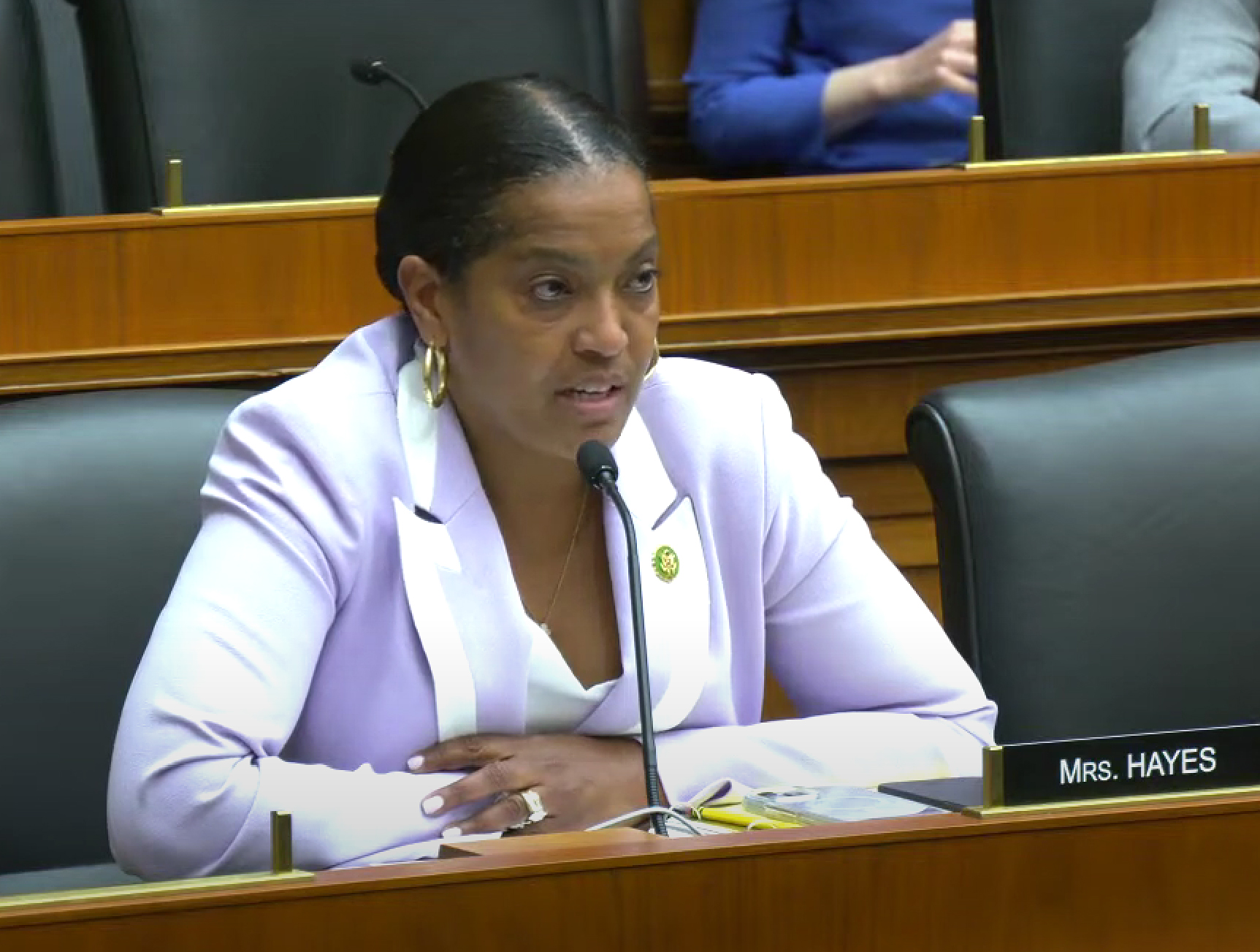
A further breath of bipartisan fresh air also came from Rep. Jahana Hayes, a Democrat and educator from Connecticut. She rose in support of the bill, quoting from the Dietary Guidelines 2020-25 report and from USDA, giving statistics about what is offered and what is consumed in recommended dairy intake, especially for children ages 2 to 18.
“I have belabored this point that children receive a huge amount of their daily nutrition at schools. Also, the school meal programs are a significant source of milk and dairy for kids,” said Hayes.
“But the part that sticks for me is that none of this matters if kids aren’t drinking the milk. We can have as much data and statistics on what kids need as dietary dairy intake, but if they’re not drinking it, then it’s all for naught,” she stressed. “We’ve seen students take less milk and throw away more milk when they don’t like the way it tastes.
“I support this amendment. I drink whole milk. My kids drink whole milk. We like it,” Hayes asserted.
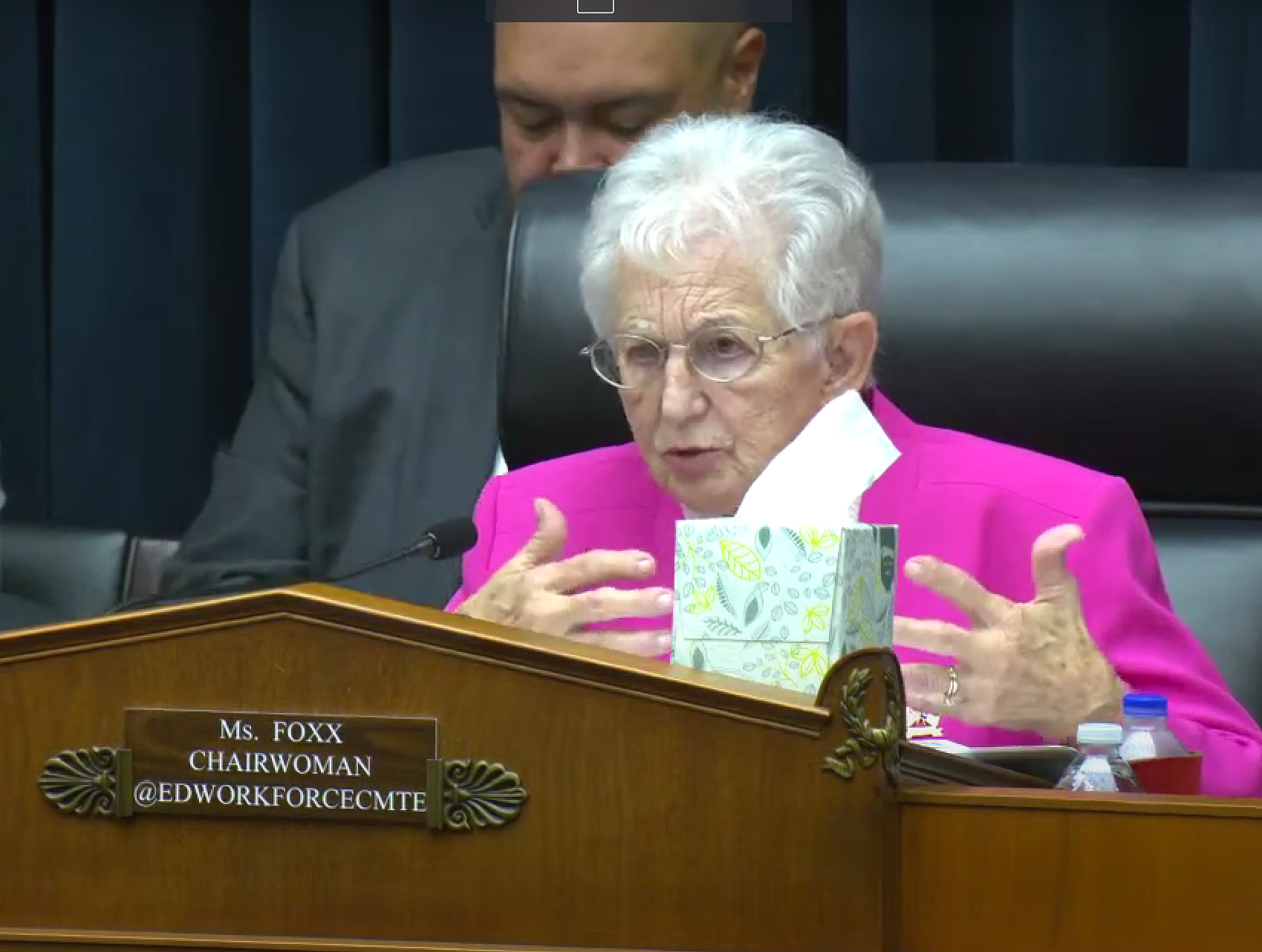
Chairwoman Virginia Foxx, a Republican from North Carolina said the debate over whole milk “takes the cake.”
She talked about how previous recommendations have been “walked back,” and she bemoaned the fact that there are “no checks and balances” over the Dietary Guidelines process of making these recommendations.
“I was shocked last year when I learned that whole milk has only 3.5% fat content, when we are saying to students: ‘drink skim milk or 1% milk,” the Chairwoman said.
“Surely-to-goodness, that kind of fat content is not doing the damage that some people are saying. This Dietary Guidelines Advisory Committee is just a small group of unelected, appointed people, and we want to turn children’s lives over to groups like this? We should be dealing with this,” she added.
The bill’s champion, Rep. GT Thompson is a senior member of the Education Committee, and chairs the Agriculture Committee.
Thompson said he is discussing the next stage with the House Majority Leader to schedule the legislation for a vote on the House floor.
“The bill had 106 bipartisan cosponsors supporting it from 39 states — before this committee vote — and we can build on that,” said Thompson. (As of June 16, there are 110 from 40 states).
This cosponsor list includes 22 members of the Education Committee. It also includes bipartisan cosponsors from the Agriculture Committee. It includes prime cosponsor Rep. Kim Schrier, a pediatrician from Washington State, and numerous members of Congress who are doctors, educators, parents. It has garnered the support of schools, students, parents and families throughout America who will benefit, according to Thompson.
His staff reports that more cosponsors continue notifying their office to sign on to the bill.
“This has been a really grassroots effort. Dairy farmers, the dairy industry, all of the rural businesses who provide inputs, the folks in the schools, the parents… we’ve had great support for this bill, and all of that helps,” said Thompson with a tip of the hat to the grassroots 97 Milk effort.
In fact, while speaking on his bill, Thompson mentioned “how this policy has negatively impacted the economy in Rural America. This (federal prohibition of whole milk in schools) negatively impacts kids and dairy farmers, and it’s time to turn that around.”
The Whole Milk for Healthy Kids Act allows the 95% of schools that are participating in the school lunch program to serve all varieties of flavored and unflavored milk, including whole milk. Thompson amended the bill from previous renditions to make minor technical changes that will help ensure foodservice workers have the flexibility they need in serving the students whole milk.
“Some Democrats on the committee spoke in opposition to the bill, using the same outdated science, but in the end, the committee vote to approve it was bipartisan,” said Thompson.
During the committee discussion, he told his colleagues that he is focused on “listening to the school professionals who serve students every day and parents who are concerned about the lack of options.
“We need to follow real science, not political science. It’s time that we push back on the notion that federal bureaucrats know what’s best for students. Although there is more work to be done on school nutrition, this bill gives students access to the milk they want and need. The bottomline is the Whole Milk for Healthy Kids Act is all about ensuring students have the necessary nutrients to learn and grow,” he said.
Thompson was quick to point out that, “We’re not force-feeding anybody anything. We’re providing children options so we don’t turn them over to less healthy beverages.
“We’ve really ruined an entire generation of milk drinkers and have cheated them out of access to the most nutritional beverage. I appreciate the comments that there is nutrition also in 1% milk, but even that’s because of the milkfat, the vehicle that delivers the nutrition,” he explained.
This bill “will improve the nutritional status of our children going forward. If we give them a good milk experience … I would argue we will see a reduction in childhood obesity,” he said, pointing to studies showing whole milk to be an effective drink weight management because of how satisfying it is.
To his colleagues citing ‘the science’, Thompson was tactful but blunt: “I agree we ought to do things with data and science, I just question the process of the Dietary Guidelines Advisory Committee. They’re completely appointed. These are unelected bureaucrats, and there’s no oversight. This is our chance to actually do something positive in that process to say ‘hey we’re watching what you’re doing. We’re looking over your shoulder.’”
Chairwoman Foxx reminded her committee that, “This is a choice. Instead of having bureacrats tell us what to do… we give a choice and not let someone else run our lives.”
At the start of the discussion, she explained the Whole Milk for Healthy Kids Act as “empowering food service providers and parents to make decisions on the health and welfare of children.”
Ranking Member Bobby Scott (D-VA-3, right) and Rep. Jamaal Bowman (D-NY-16) read from a letter of opposition to the whole milk bill from the Physician’s Committee for Responsible Medicine (PCRM). According to Guidestar, PCRM describes its vision as “creating a healthier world through a new emphasis on plant-based nutrition and scientific research conducted without using animals. ” In 2010, Newsweek and New York Times articles identified PCRM links to extreme animal rights organizations such as PETA.
Ranking member Bobby Scott, a Democrat from Virginia, was one of four Democrats voicing opposition, saying H.R. 1147 is “an attempt to legislate nutrition standards and disregard evidence-based recommendations made by the Dietary Guidelines for America.” He said the bill would allow schools to “violate current science-based standards.
“If it was consistent with science, we wouldn’t be here. The science-based committees would have already done this,” he said, also objecting to considering the bill outside of doing a comprehensive childhood nutrition reauthorization.
The last childhood nutrition reauthorization by Congress was the 2010 Healthy Hunger Free Kids Act, which tied schools more closely to the saturated fat restrictions of the Dietary Guidelines in the first place.
Scott noted the American Heart Association, Association of Nutrition and Dietetics, Center for Science in the Public Interest have “expressed concerns for this bill.” But mostly, he quoted from a letter of opposition from the Physicians Committee for Responsible Medicine. (PCRM is a known animal rights group tied to PETA.)
Rebutting Scott’s assertions in his characteristic calm and methodical manner, Congressman Thompson said he appreciated the recognition of science but that, “we don’t always get it right, and that’s what we’ve found with the Dietary Guidelines process.
“You reference the Dietary Guidelines Committee, but the most recent Dietary Guidelines reported that more than two-thirds of school age children FAIL to meet the recommended level of dairy consumption, and a big part of that is, quite frankly, we gave them since 2010 an awful milk experience,” said Thompson.
“We’re talking about 3.5% milkfat. I was here for that 2010 debate. It’s been proven since then that it was bad science. The most recent science I referenced and our practioners, the American Academy of Pediatrics, have stated that dairy plays an important role in the diet of children, and it’s the leading food source for three of the four nutrients of public health concern — calcium, vitamin D and potassium,” said Thompson, providing 15 academic studies for the record on full fat dairy.
As members of Congress, “we visit our schools and spend time in the lunch line, and we see the waste and the unopened half-pint milk containers that are discarded. Quite frankly, we’ve been contributing to childhood obesity because … children are going to drink some type of beverage, and the substitutes have been high sugar beverages that do not have healthy outcomes,” said Thompson.
“This policy has cheated our children… and has led to economic demise in Rural America as we’ve seen a loss of dairy farms, dairy herds and small businesses that are in that supply chain. It’s time to reverse the mistake that was made in 2010,” he stressed.
Rep. Jamaal Bowman, a Democrat from New York agreed that the meals at school are for some kids the most important that they receive, and he said these meals should be consistent with the “latest science on nutrition.”
However, he maintained that the Dietary Guidelines for Americans (DGAs) are “based on up-to-date science” and said “allowing whole milk to be served to children contradicts those recommendations.”
Rep. Bowman called the bill an “inappropriate attempt to legislate nutrition standards,” but he failed to acknowledge the shortcomings observed by other independent scientific bodies calling into question the research screening methods used in the DGA process, the make-up of the DGA committee, and the predetermined questions that form the boundaries for what “up-to-date research” will be included as “relevant” to the predetermined questions in each 5-year DGA cycle.
Bowman quoted extensively from the PCRM letter, which stated that “full fat milk is both unnecessary and harmful to children’s health.” Reading from the PCRM letter, Bowman said “early signs of heart disease, high total and LDL cholesterol and other indicators of impending cardiovascular disease are appearing in children with increasing frequency.”
(If that’s the case, then how can whole milk be blamed? How can saturated fat be blamed? Whole milk is nonexistent at school, and saturated fat is limited to less than 10% of calories in school meals since 2010. Children receive one, two, or even three meals a day, five days a week for at least three-quarters of the year at school. If the poor health outcomes the PCRM letter identifies are rising, doesn’t that tell us something about the scientific validity of the DGA recommendations? The PCRM’s own letter hits that nail on the head with its own statistics. PCRM calls “whole dairy milk a troubling source of saturated fat.” And yet, kids have not been allowed to have whole milk or 2%, and in some cases not even 1% fat milk, for the past 13 years during two meals a day, five days a week, most of the year!)
Here’s an eye-opener: Quoting again from PCRM, Bowman said lactose intolerance among communities that have been impacted by “historic racism” and “health inequities” are those less likely to be able to see a doctor for the doctor’s note to have dairy substitutes at school. The letter even mentioned children needing ‘climate friendly’ beverages.
The roots of the anti-whole-milk agenda are clear in terms of encouraging more “non-dairy substitutes” for children in schools.
Rep. Alma Adams, a Democrat from North Carolina said the bill sets a “dangerous precedent” that takes the years of building nutrition programs backward, noting this would cause poor health outcomes. (But the poor outcomes were said to be already happening by those opposing the whole milk bill. This is occurring while whole milk is prohibited.)
During the committee markup, Thompson said he is proud of the number of cosponsors to-date and the broad and bipartisan support for the whole milk bill.
“My legislation supports students and dairy farmers across America,” he explained. “Milk is an essential building block for a well-rounded and balanced diet offering 13 essential nutrients and numerous health benefits. However, out of touch federal regulations have imposed dietary restrictions on the types of milk that students have access to in school meals… limited to fat free and low-fat milk since 2010. For our children to excel in the classroom and beyond, they must have access to more nutritious options they enjoy.”
Thompson also stressed that the situation could become worse if the Whole Milk for Healthy Kids Act is not enacted into law.
“The USDA’s latest proposed guidelines could roll back options even further by restricting flavored milk only to high school students and counting milk fat against weekly saturated fat allowances,” he said, giving several reasons why these top-down regulations are harmful to students and school districts that are forced to comply.
“First, we have seen students opt out (from milk) altogether,” said Thompson. “Let’s face it, the only way to benefit from milk’s essential nutrients is to consume it, and when students turn away from milk, they often opt for far less healthy alternatives.”
Thompson noted that these regulations also “perpetuate baseless claims that milk is bad for kids, but research has shown time and time again that whole and 2% milk are not responsible for childhood obesity and other health concerns. In fact, these beverages are so nutritious that research consistently shows positive health outcomes for children who consume milk.”
Referencing the 15 academic studies submitted from researchers across the country and around the world, Thompson asserted that, “These studies, and there are more, show that full fat dairy foods have no association with high blood pressure, cardiovascular disease, type II diabetes, obesity or cholesterol. In fact, several show full fat foods helped improve or lower negative health outcomes for children who drank more full fat dairy beverages.”
He also added to the record several letters of support, including a letter from the Nutrition Coalition (founded by science journalist Nina Teicholz, author of the Big Fat Surprise), the International Dairy Foods Association, the Northeast Dairy Foods Association, and a coalition of dairy producers from across the country.
He said the bill has the support of schools and families across the country.
This is evident by the tens of thousands of citizen petition signatures over the past few years and a 2021 IDFA survey of parents showing 78% find whole or 2% milk healthier for their families. Trouble is, their kids can’t get it at school where most of their meals are consumed.
By Sherry Bunting, previously published in Farmshine
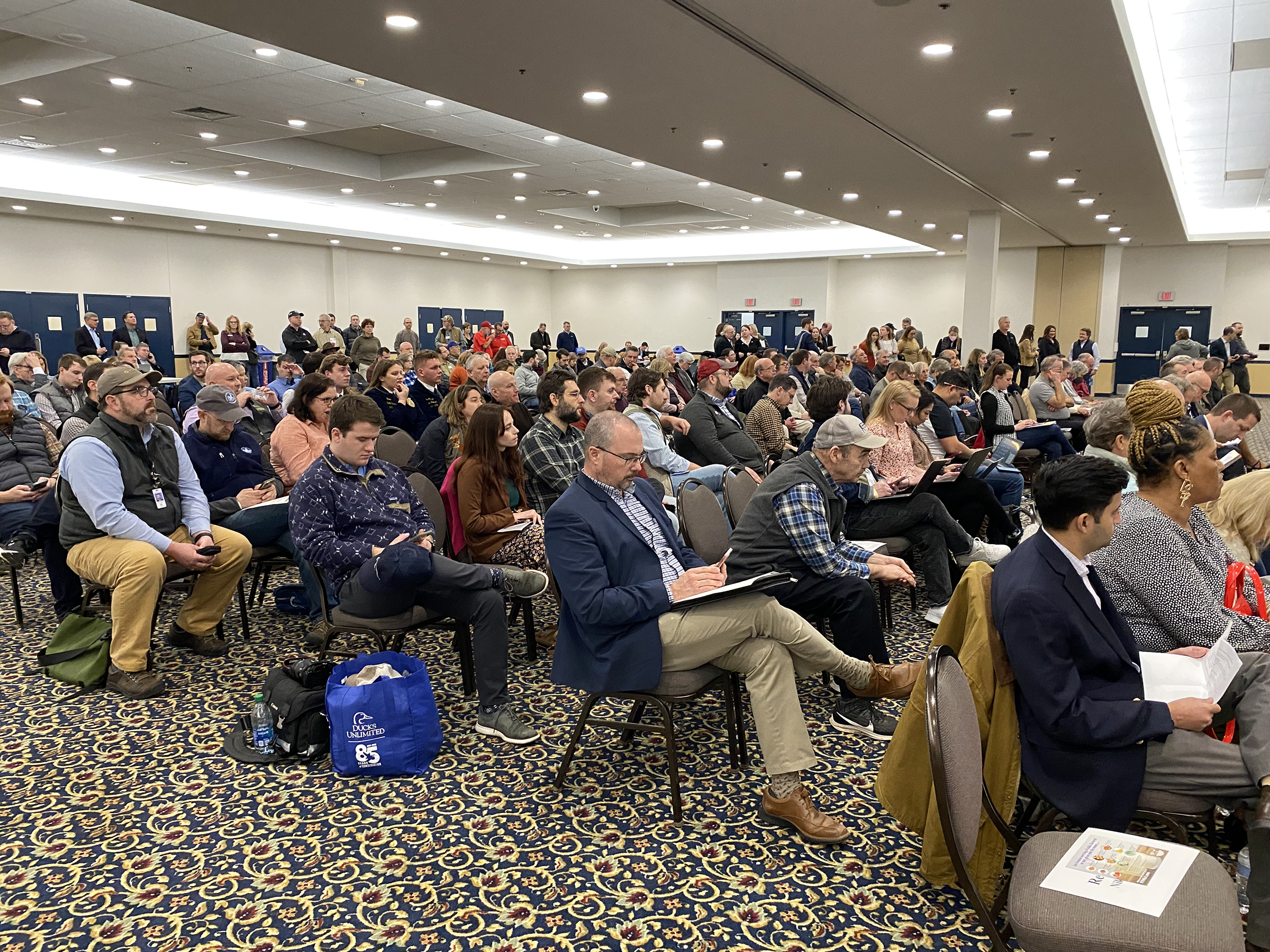
HARRISBURG, Pa. – “It’s crunch time and we are obligated to get this done on time and get it done right,” the new U.S. House Ag Committee Chaiman G.T. Thompson (15th-Penna.) told a packed room attending his first listening session for the 2023 Farm Bill on Jan. 13 during the Pennsylvania Farm Show in Harrisburg.
Thompson is the first Congressman from the Keystone State to chair the Ag Committee since 1855.
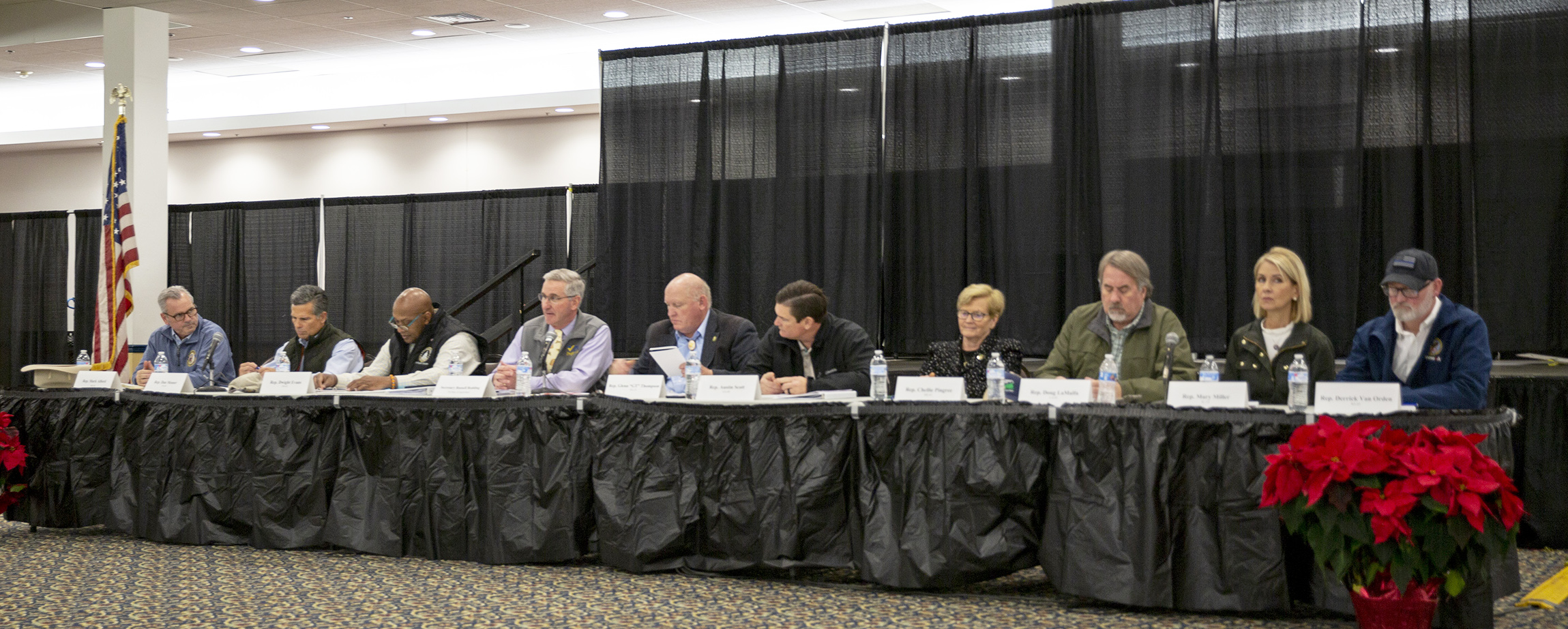
“We’re a little overdue,” he said, indicating he is proud and humbled to serve as he introduced eight of his colleagues joining him for the listening session, where 20 people from a diverse spectrum of agriculture and nutrition testified.
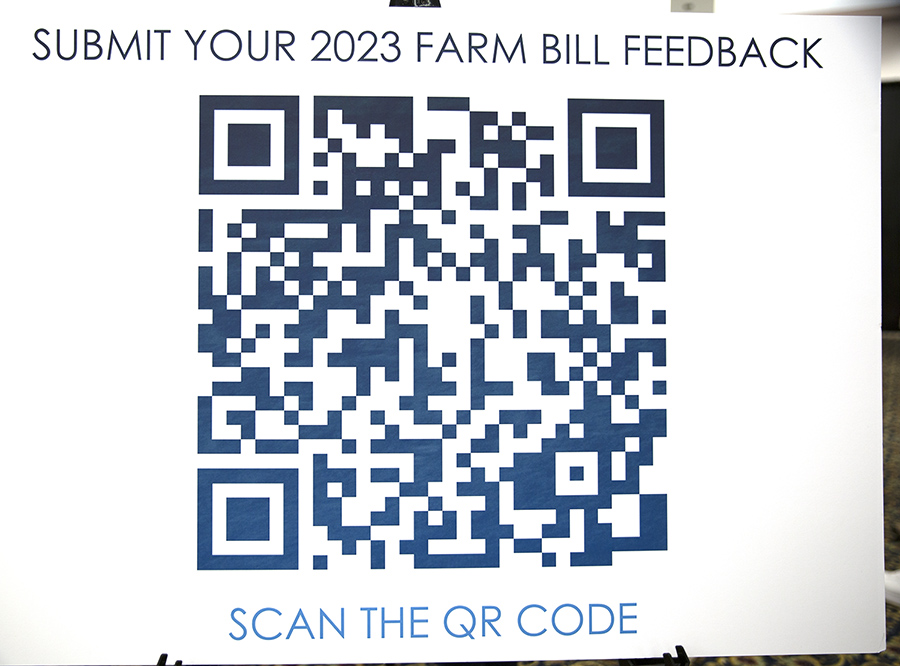
Thompson encouraged more feedback by scanning the QR code on signage posted around the room (or click here).
“We want to hear from rural America and the farmers who touch the lives of every American more times a day than any other industry,” said Thompson.
Joining him from Washington were several Ag Committee members who were officially named four days later on January 17: Austin Scott (8th-Ga.), Doug LaMalfa (1st-Calif.), Mark Alford (4th-Mo.), Chellie Pingree (1st-Maine), Mary Miller (15th-Ill.) and Derrick Van Orden (3rd-Wis.). Also joining the panel of lawmakers were Dwight Evans (3rd-Pa.), who formerly served on the House Ag Committee but is now on the Ways and Means Committee as well as Dan Meuser (9th-Penna.) serving on the Finance Committee.
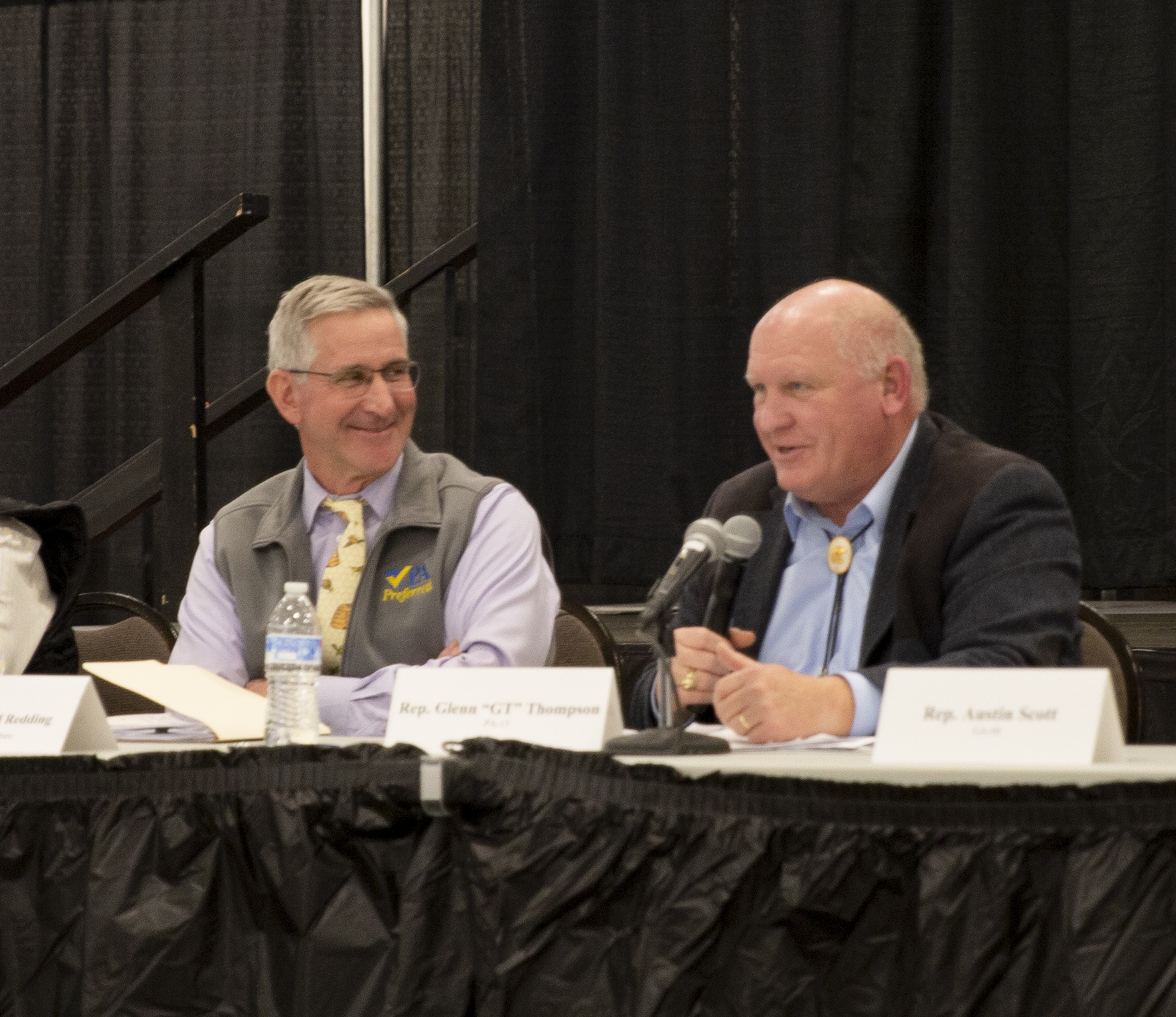
Pennsylvania Ag Secretary Russell Redding (above left) also participated, and it was announced that Redding has agreed to stay on as the Commonwealth’s Ag Secretary under incoming Governor Josh Shapiro. Chairman Thompson (above right) noted that Pennsylvania is the first to also have a state farm bill, which Redding said would not be possible without a federal farm bill.
On the importance of research, Dean Roush represented the Penn State College of Ag Sciences, stressing the need for more investment in land grant universities.
“A nation that controls its food controls its destiny. We are being outspent by China and others,” he said.
Crop insurance was deemed critical by many who testified, and suggestions were given to make good programs better and to make them easier for diverse farmers to participate.
On dairy, representing the Pennsylvania Dairymen’s Association, executive director Dave Smith, a dairy farmer in Lebanon County, said having a reliable workforce is essential, and he highlighted crop insurance and the Dairy Margin Coverage (DMC) program.
Smith said the Supplemental DMC was helpful in 2021, but that dairy farmers should have the opportunity to bring their production history more current. He also said the coverage cap for tier one should be raised to more adequately reflect the average U.S. herd size of 316 cows as of 2021.
Smith called for Congress to “make a good program better” by raising the highest coverage level above the current margin of $9.50 per hundredweight as other farm costs are going up that are not included in the milk over feed cost margin.
On milk pricing, Smith said real reforms are needed, but should be accomplished through federal order hearings, not through legislation.
“That process allows industry professionals to examine proposals more thoroughly,” said Smith as he touched on the Class I pricing change made in the last Farm Bill that was exacerbated by the pandemic and led to disorderly marketing.
“The Federal Milk Marketing Orders were established to ensure orderly marketing,” said Smith. “It’s failing and has led to a significant loss of dairy farmers. The Class I change was made with the best of intentions but has led to lost revenue.”
Smith concluded by stressing the need to get legislation over the finish line that restores whole milk in schools and allows whole milk to be offered throughout the government’s charitable feeding programs.
(Representing the Grassroots PA Dairy Advisory Committee was yours truly. In my testimony, I thanked G.T. Thompson for his sponsorship of the legislation seeking to bring whole milk choice back to schools, and that even though this doesn’t fall under the Farm Bill, the Nutrition Title should exempt nutrient-dense foods, like whole milk, from the out-dated and arbitrary fat limits of the Dietary Guidelines. I noted the poor performance of the Class I change made in the last Farm Bill and expressed farmer concerns on emissions tracking and how methane is calculated. See my full written testimony here.)
Frank Stoltzfus, a Lancaster County beef producer representing the Pennsylvania Cattlemen’s Association and NCBA (recently elected to the executive board), said a livestock title is “not necessary in the farm bill. We don’t want one. We don’t want to open the door to unnecessary regulations and mandates.”
However, he did cite the importance of strengthening risk management tools, disaster recovery, animal health and conservation programs to remain voluntary and incentive-based, where farmers are recognized for what they have already done for the environment.
“We are pretty good at this,” said Stoltzfus. “We can do it with your help.”
He also stressed that farm policy and climate policy should recognize cattle as a solution, not a problem — that beef cows efficiently use land not suited to crops to produce protein, nutrient dense food, that is “necessary for the sustaining of America and its people.” He applauded Chairman Thompson for adopting this position.
“Cattle take land that is too-something — too steep, too wet, too rocky, too-something — and they naturally turn that into a valuable food product,” said Stoltzfus, a past environmental stewardship award winner.
“Cattlemen and take blue sky and green grass and make red meat — a protein that really feeds the world,” he said.
A full house of farmers and ag-interested people attended House Ag Committee Chairman G.T. Thompson’s 2023 Farm Bill listening session at the Pennsylvania Farm Show last week.
Rep. Doug LaMalfa, chair of the Conservation and Forestry subcommittee, picked up on this. His family grows rice in northern California, and he was blunt.
“I would caution folks with cattle, that when cows are vilified on methane, stay strong. Don’t be pulled into that. Don’t be railroaded into doing all of this climate stuff,” said LaMalfa.
He went on to note his concern about the electric conversion of everything, mentioning the talk recently about banning gas-powered stoves and generators.
“We need to take a lot of this with a grain of salt and apply commonsense. We have a lot of commonsense in Rural America,” said LaMalfa.
Earlier in the listening session, Shawn Wolfinger of Horizon Farm Credit touched on climate, noting that “Agriculture is part of the solution for mitigating the impact, but our ask is that the farm bill provide voluntary, incentive-based assistance and that private sector and ag lending not be required to be conditioned on adoption of certain ag practices,” he said.
Conservation programs were highlighted as critical to agriculture and ecosystems, but testifiers noted these programs are 50% oversubscribed and need more funding to provide voluntary, incentive-based assistance to more farms.
Rep. Pingree of Maine said streamlining conservation programs so they are easier to use by small and specialty crop farms and dealing with food waste are important for the future. “We want to treat farmers as partners – our best partners – in renewable energy, innovation and research. We have to work hand-in-hand,” she said.
National Farmers Union president Michael Kovach highlighted the need for “decentralization of our food system” and “renewal of our soils.”
Representatives for Pennsylvania Farm Bureau and Pennsylvania Corn Growers both stressed the need for robust crop insurance programs to manage risk.
Among the panel of lawmakers, Rep. Austin Scott from Georgia, chairman of the subcommittee on General Commodities and Risk Management, made it clear these tools “are there to reduce risk, not guarantee profit.”
He said reference prices have not been updated since 2004, so that’s on tap for re-evaluation in this round, along with loan rates.
Rep. Mark Alford of the ‘show me’ state, said he comes from the media world with a career in television news and a desire to get the important farm bill messages out there.
“Our food security is our national security,” he said, noting his goals for a Farm Bill in which “farmers are protected, the nation is fed, children are healthy and we are good stewards of God’s resources.”
Rep. Mary Miller of Illinois, took the opportunity to state her support for whole milk for healthy kids. “We raise corn, cattle and kids,” she said. “Our seven children are all trim and healthy adults and they grew up on whole milk.”
Rep. Derrick Van Orden of Wisconsin said he looks forward to being a new member on the Ag Committee and is a firm believer that “milk comes from cows, not from nuts.”
He also touched on the need to reset baselines, look at the Federal Milk Marketing Orders and to reinforce nutrition in programs like SNAP.
There is no time like the present to get nutrition right. That was a central message pointed out by Joe Arthur, testifying as director of the Central Penn Food Bank, part of the Feeding America network.
“The food crisis is not over and we fear it might be deepening,” he said.
Stating the importance of the SNAP, WIC and TEFAP programs as a lifeline for food and nutrition, Arthur said one goal should be to strengthen the partnership with local farms when their markets face disruptions.
“We are now well beyond the pandemic, and the crisis of inflation and food system supply chain challenges are almost as impactful as the height of the pandemic,” he said. “We saw 20% more food bank distribution in 2022 than in 2019.”
Rep. Evans from Pennsylvania noted the importance of bridging the language gap between urban and rural for better understanding. “We are all in this together,” he said.
For his part, Pennsylvania’s continuing Ag Secretary Redding thanked Chairman Thompson for bringing the Farm Bill information-gathering process to Pennsylvania. He stressed that farm policy at the federal and state levels is critical to “food, jobs and quality of life. It’s rural and urban, west and east, north and south, and the pieces need to fit together and find that equilibrium.”
“We need all of you involved in this process,” said Thompson. “The only way to get it right, to restore a robust rural economy and grow it, is for farmers to be at the table and stay at the table.”
-30-
Pennsylvania dairy farmers Dale Hoffman (left) of Potter County and Nelson Troutman of Berks County are both members of the Grassroots PA Dairy Advisory Committee and attended the 2023 Farm Bill listening session Jan. 13 at the Pennsylvania Farm Show.
Berks County dairy farmer Nelson Troutman attended the Farm Bill listening session wearing his Drink Whole Milk – 97milk.com hat. In fact, he reports that Congresswoman Mary Miller of Illinois, who was recently named to the House Ag Committee, noticed his cap and came right over to him before the Farm Bill listening session began. She told him how much she loves whole milk and appreciates this education effort. He is pictured after the listening session with grandchildren (l-r) Emma, Madalyn, Jace, and Nolan.
Bipartisan bill would allow whole milk as option in school cafeterias
WASHINGTON – Making good on a promise to introduce legislation to bring whole milk back to schools, U.S. Representative Glenn ‘GT’ Thompson (R-PA) has joined forces with House Agriculture Committee Chairman Collin Peterson (D-MN) to introduce a bipartisan bill to allow for unflavored and flavored whole milk to be offered in school cafeterias.
Last year, the U.S. Department of Agriculture Secretary Sonny Perdue directed USDA to allow schools to serve 1% low-fat flavored milk in school meal programs that had been restricted previously to fat-free flavored milk.
H.R. 832 would take this further to allow whole milk to be included as well.
“Milk is the No. 1 source of nine essential nutrients in the diets of our students, but if they don’t drink it these health benefits are lost,” Rep. Thompson said in a press release Wednesday (Jan. 30). “Milk consumption has been declining in schools throughout the nation because kids are not consuming the varieties of milk being made available to them. It is my hope that the Whole Milk for Healthy Kids Act will bring a wider range of milk options to American lunchrooms so students can choose the kind they love best.”
“I’m proud to join Congressman Thompson in this effort that will provide more choices for nutritious and healthy milk to kids in schools, and a valuable market for dairy farmers in Minnesota, Pennsylvania and nationwide at a time when they’re continuing to face extremely difficult market conditions,” Chairman Peterson said in a statement.
Rep. Peterson is Chairman of the House Ag Committee and Rep. Thompson is a member of the House Ag Committee.
Thompson is also a member of the House Committee on Education and Workforce to which the bill was referred after its introduction on Jan. 29.
The nine original co-sponsors of the bill include Agriculture Committee Republican Leader Mike Conaway (R-TX) and three members of the Committee on Education and Workforce to which the bill was referred — Rep. Lloyd Smucker (R-PA), Rep. Dan Meuser (R-PA) and Rep. Elise Stefanik (R-NY).
Additional co-sponsors are Rep. Chris Collins (R-NY), Rep. Rodney Davis (R-IL), Rep. John Joyce (R-PA), and Rep. Mike Kelly(R-PA).
In a press release late last week, Thompson gave some background on this bill. He noted that in 2010, Congress passed the Healthy, Hunger-Free Kids Act which amended nutrition standards in the School Lunch Program. Among the changes, the law mandated that flavored milk must be fat-free within the program.
This 2010 law, along with lower participation in the program, led to an alarming decline in milk consumption in schools since 2010. Declining milk consumption in schools not only impacts students, but also dairy farm families and rural communities across the nation.
Two years ago, to help encourage nutritious options in the School Lunch Program and increase consumption, Rep. Thompson introduced legislation – H.R. 4101, the School Milk Nutrition Act of 2017 – which provided schools the option to serve 1% low-fat flavored milk varieties.
In May of 2017, the USDA announced a rule that allowed schools to receive waivers for low-fat (1%) flavored milk, rather than only fat-free, which is the essence of H.R. 4101.
On January 29, 2019, Rep. Thompson introduced this bipartisan bill — H.R. 832, the Whole Milk for Healthy Kids Act of 2019. This legislation builds on the previous bill and USDA’s rule by allowing whole milk (both unflavored and flavored) to be offered within the School Lunch Program.
Producers and consumers are urged to contact their representatives to support this bill. Key members of Congress to reach out to on the Committee on Education and Workforce, which will be the committee to consider the bill, include Rep. Joe Courtney (D-CT), Chairman Bobby Scott (D-VA), Rep. Marsha Fudge (D-OH). View all Congressmen and women serving on this committee here





 Bipartisan bill would allow whole milk as option in school cafeterias

 Ag Moos