New Year, New Hope: 2024 will be year of reckoning, Part One

From whole milk in schools to farm bill to climate-warped food transformation, scientists and lawmakers are getting busy, farmers need to get busy too
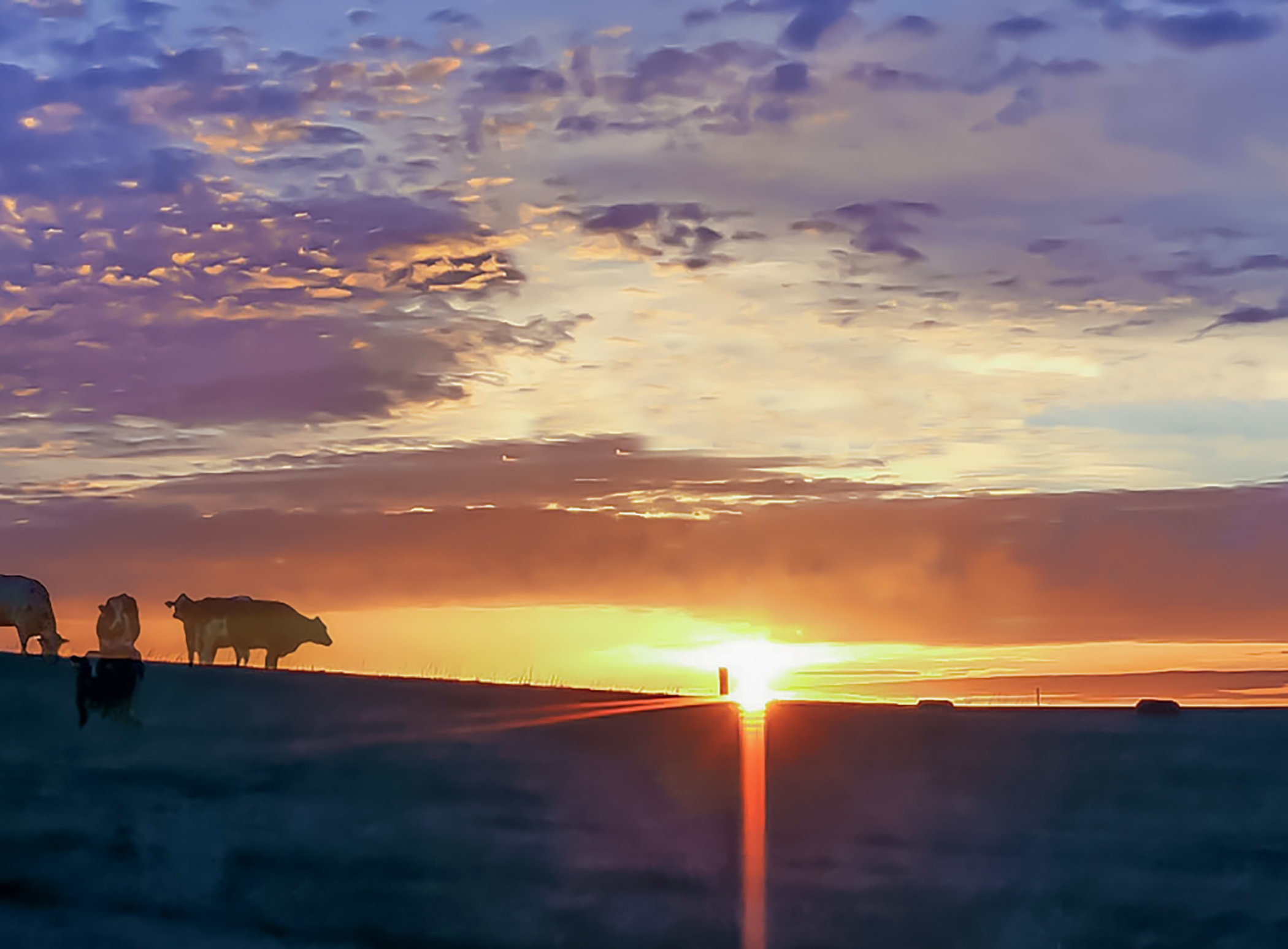

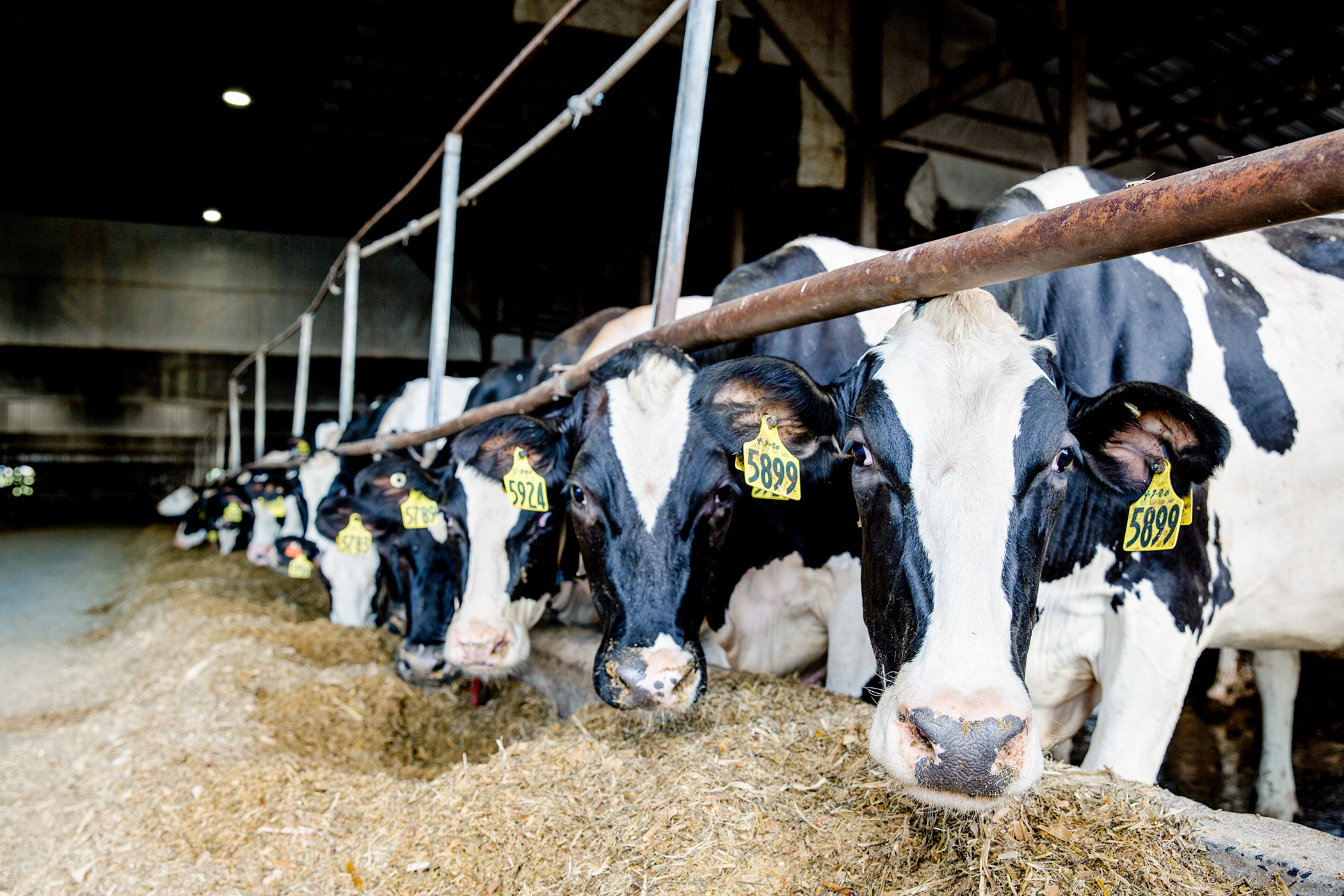
In the global anti-animal assault, real science must lock horns with political science and defend American farmers — the climate superheroes that form the basis of our national security. Photo by Sherry Bunting

By Sherry Bunting, Farmshine, Jan. 5, 2024

EAST EARL, Pa. – It’s a New Year, and we have new hope on several fronts that are all linked together, in my analysis.

Top 2023 headlines for dairy farmers revolved around dairy markets that underperformed, successes and challenges in the quest to get Whole Milk choice back in schools, a plethora of draft USDA and FDA proposals that dilute real dairy, farm losses and governmental hearings on federal milk pricing, negotiations and extensions for the farm bill, and acceleration of ‘climate-smart’ positives and negatives buckling down for business in an area where political science is trumping real science on the rollercoaster ride ahead.

All of these headlines are inextricably linked. There is a global anti-animal assault underway, but people are wising up to the not-so-hidden agenda that is grounded in climate transitions and food transformation that give more power and control over food to global corporations while diminishing what little power farmers have in Rural America where our national security is at risk.

Real science locks horns with political science

As we head into 2024, a bit of good news is emerging as scientists are mobilizing to defend the nutritional, environmental and social honor of livestock — especially the much-maligned cow.

After an international summit of scientists in October 2022, work has been underway to bring together an international pact.

Dubbed the Dublin Declaration of Scientists, experts around the world have authored and are getting colleagues to sign-on to this document that calls for governments, companies, and NGOs to stop ignoring important scientific arguments when pushing their anti-animal agendas in the name of climate, transformation, and the Global Methane Pledge.

To date, nearly 1200 scientists have signed the Dublin Declaration, aimed foremost at the Irish government’s proposal to slaughter cows to meet methane targets. The Dublin Declaration represents the work of scientists across the globe for a global audience beyond Ireland.

Here in the U.S., we are sitting on the cusp of Scope 3 emissions targets of global milk buyers that have been hastily formulated based on the science of greed, not the science of greenhouse gas emissions. It’s time for the dairy organizations and land grant universities that represent, serve and rely on farmers to drink up on their milk and strengthen their spines.

Farmshine has brought readers the news about what has been happening in Europe, such as in the Netherlands and Ireland, regarding proposed farm seizures and cow slaughter, and the response of farmers there has been to challenge the political establishment.

The U.S. is not far behind. At COP28 recently, American cattle industries were criticized, and even Congressional Ag Leaders are miffed by what they heard. 

Still, some of our dairy organizations brag about being at COP26, 27, 28 and taking part. Even the dairy farmers’ own checkoff program is caught flat-footed. They’ve already caved to the Danone’s, the Nestles, the Unilevers, and such.

In fact, DMI’s yearend review touted its increase in U.S. Dairy Stewardship Commitment adopters to 39 companies representing 75% of the milk supply with membership in the Dairy Sustainability Alliance standing at 200 member companies and organizations. But what are they doing with those relationships to STAND UP ON SCIENCE FOR THE COWS?

The Stewardship Commitment includes DMI’s Net-Zero Initiative, where the cyclical short-lived nature of methane and the role of cattle in the carbon cycle is still not appropriately accounted for and is one of the points made in the Dublin Declaration of Scientists.

In the U.S. dairy industry, the trend on GHG revolves around DMI’s Innovation Center for U.S. Dairy, which placates large multinational corporations in the development of voluntary programs, telling farmers they are in control with their organizations as a sort of gatekeeper. That is, until those programs become mandatorily enforced by those milk buying corporations, while the science on methane and the cow’s role in the carbon cycle as well as U.S. data vs. global data continue to be ignored when they are sitting in the midst of UN Food Transformation Summits, COP26, 27 and 28, and the WEF at Davos.

In fact, during the annual meeting webinar of American Dairy Coalition in December, U.S. House Ag Chairman G.T. Thompson of Pennsylvania was asked his thoughts on some of the statements that came out of COP28 recently criticizing American dairy and livestock consumption.

“My first response was to find it laughable because it really shows you the difference between political science and real science,” he said. “It’s sad when people are so illiterate about the industry that provides food and fiber that they don’t understand how livestock contribute to carbon sequestration.

“We have a real battle,” Thompson said, adding that those putting out such statements criticizing American livestock “don’t even know which end the methane comes from. The world needs more U.S. farmers and less UN if we want a better world. The facts and the science are on our side. Let’s not let the other side control the narrative.”

Bottomline for Thompson is this: “The American farmers are climate heroes sequestering 10% more carbon that we emit. No one does it better anywhere in the world. Let’s be speaking up and speaking out. We can push it back with the facts and the science. I would encourage each of us to do that and become effective just telling that story,”

In the same ADC webinar in December, Trey Forsythe, professional staff for Senate Ag Committee Ranking Member John Boozman of Arkansas agreed.

“The language coming out of COP28, a likely European-led effort, shows what we are up against from people with no background on the role of dairy and livestock. We have to keep beating that drum on the efficiency of U.S. dairy and livestock farms,” he said.

In the same accord, scientists are getting busy, and we all need to get more involved.

In a dynamic white paper released last year, scientists made 10 critical arguments on this topic of livestock greenhouse gas emissions (GHG). Here’s what the scientists behind the Dublin Declaration are saying and why it’s so important for our land grant university scientists to sign on.

“Livestock agriculture creates GHG emissions, which is a serious challenge for future food systems. However, arguing that climate change mitigation requires a radical dietary transition to either veganism or vegetarianism, or the restriction of meat and dairy consumption to very small amounts is overly simplistic and possibly counterproductive,” the scientists wrote in a recent description of the Dublin Declaration.

“Such reasoning overlooks that dietary change has only a modest impact on fossil fuel-intensive lifestyle budgets, that enteric methane is part of a natural carbon cycle and has different global warming kinetics than CO2, that the rewilding of agricultural land would generate its own emissions and that afforestation comes with many limitations, that global data should not be generalized to evaluate local contexts, that there are still ample opportunities to improve livestock efficiency, that livestock not only emit but also sequester carbon, and that foods should be compared based on nutritional value. Such calls for nuance are often ignored by those arguing for a shift to plant-based diets,” they continued, listing these 10 Arguments with scientific explanations for each one.

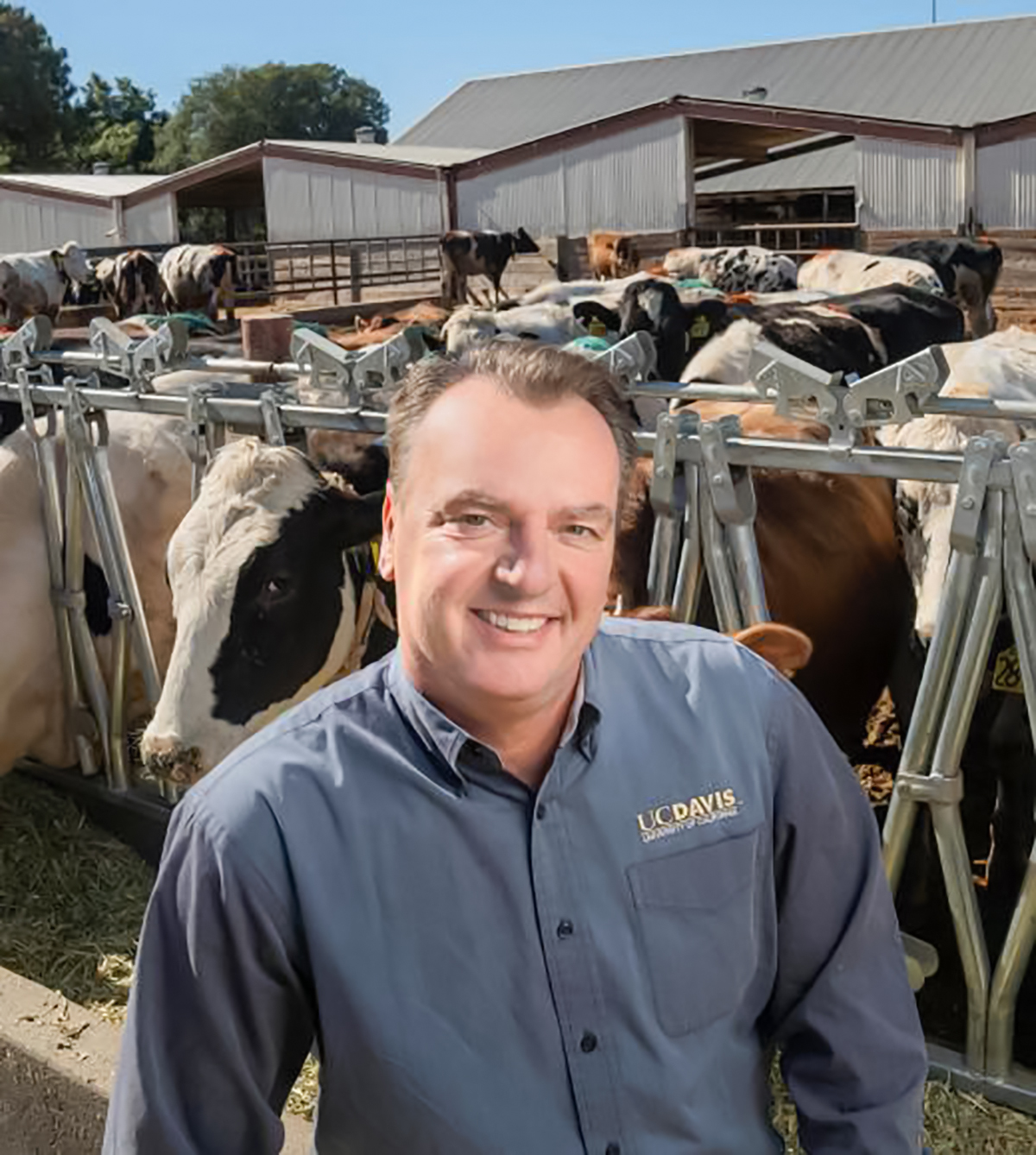
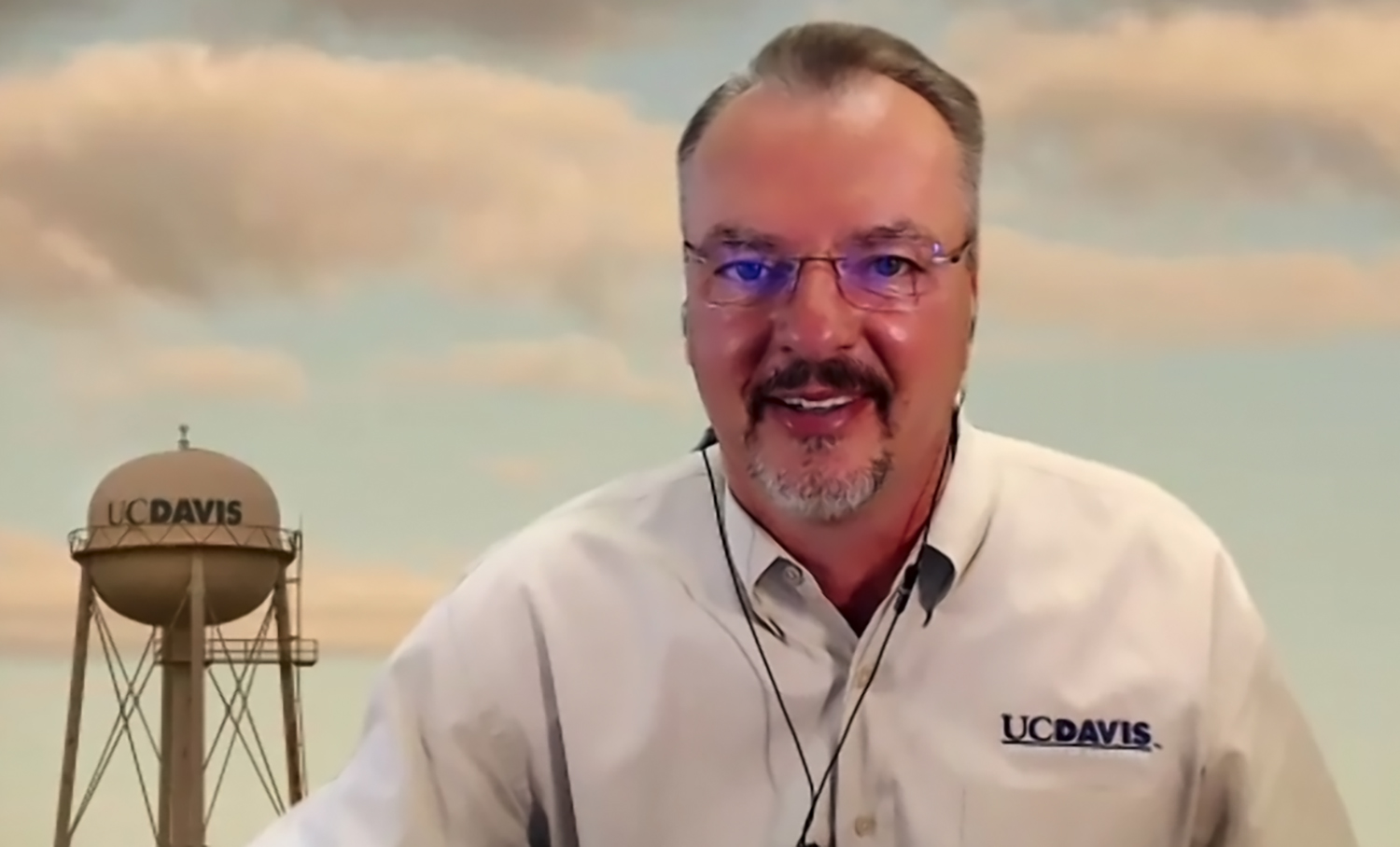
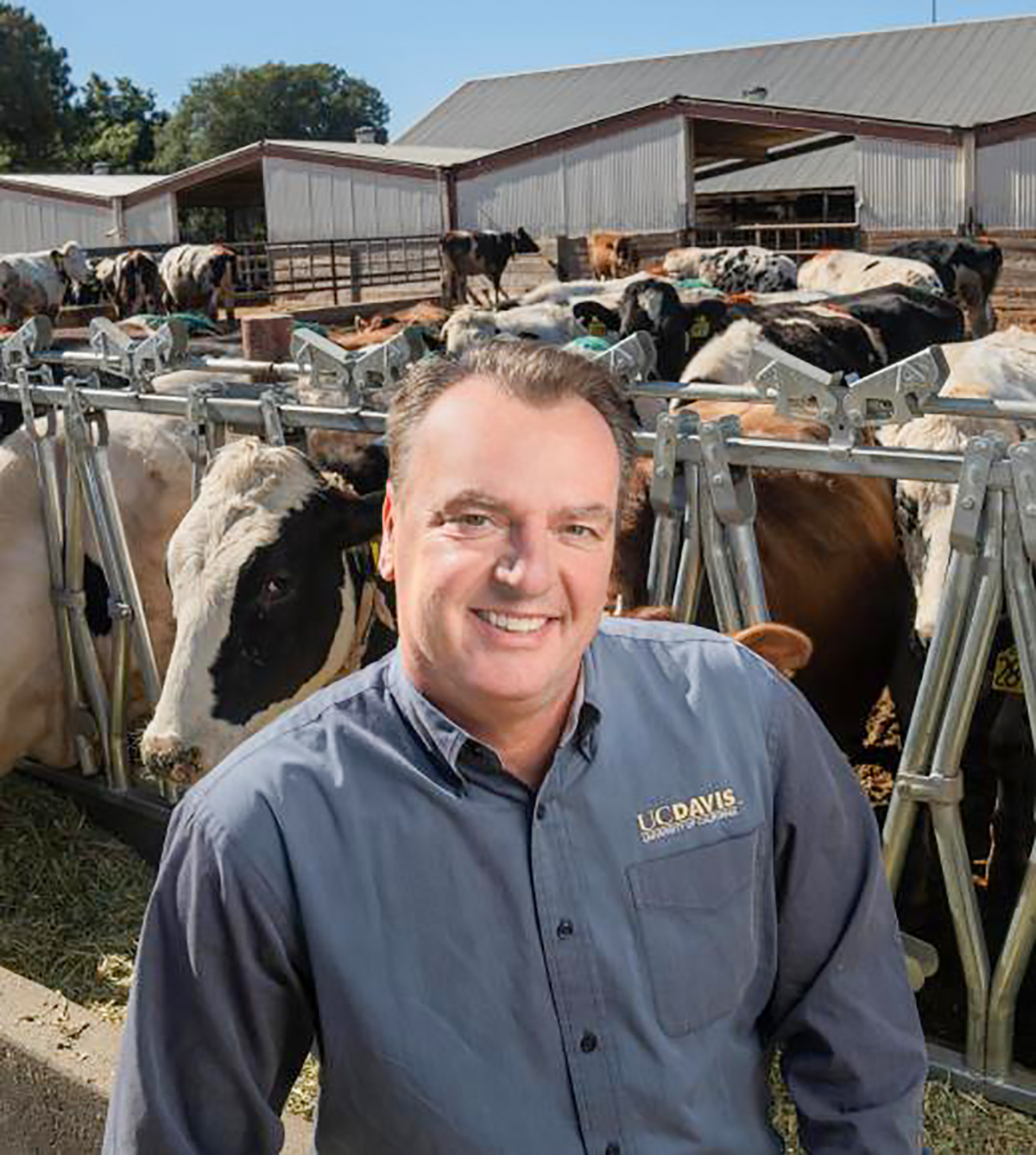
Here is how the growing number of international scientists, including Dr. Frank Mitloehner of UC-Davis, situate the problem:

Argument 1 – Global data should not be used to evaluate local contexts

Argument 2 – Further mitigation is possible and ongoing

Argument 3 – Only a relatively small gain can be obtained from restricting animal source foods

Argument 4 – Dietary focus distracts from more impactful interventions

Argument 5 – Nutritional quality should not be overlooked when comparing foods

Argument 6 – Co-product benefits of livestock agriculture should be accounted for

Argument 7 – Livestock farming also sequesters carbon, partially offsetting its emissions

Argument 8 – Rewilding comes with its own climate impact

Argument 9 – Large-scale afforestation of grasslands is not a panacea

Argument 10 – Methane should be evaluated differently than CO2  

These arguments take nothing away from the technologies that are being developed to help dairy and livestock producers further reduce emissions and sequester carbon. Technology has a role in amplifying the cow’s position as a solution, not to cure a problem she does not have! And farmers deserve to get credit for what they’ve already achieved.

Farm, food, and national security interdependent

The 2018 Farm Bill was extended for another year at the end of 2023, but the urgency to complete a new one continues as a big priority for House Ag Committee Chairman G.T. Thompson. In the recent ADC annual meeting webinar, he said: “You don’t want us writing farm bill legislation — or any legislation — just listening to voices inside the Beltway in Washington. It would not work out well.”

He thanked and encouraged farmers for being part of the process, saying there’s more to do.

“We’re building this farm bill listening to your voices, the voices of those who produce, those who process, and those who consume — all around the country,” said Thompson, noting nearly 40 states were visited for nearly 80 listening sessions over 2.5 years on the House side.

“This farm bill is about farm security. It’s about food security. And it’s about national security – all three of those are interdependent,” he added.

The extension and funding of the current farm bill for another year — while Congress works on the new one — means programs like Dairy Margin Coverage will continue for 2024, but the enrollment announcement has not yet been made by USDA.

In past years, the enrollment began in October of the previous year and ended at the end of January for that program year. When DMC first replaced the precursor MPP, enrollment was announced late and continued into March of the first program year (2019). At that time, farms could sign up for five years through 2023 or do it annually.

In 2023, DMC paid out a total of $1.27 billion in DMC payments for the first 10 months of the year.

Chairman Thompson noted that effective farm policy is the key, and the extension means no disruptions, he said: “We attached good data for dairy with policy changes, including for DMC, and some positive changes for the nutrition title within the debt ceiling discussion.”

On DMC, the supplemental production history was added in the legislation extending the current farm bill that was signed by the President at the end of November.

“It provides our dairy farmers the certainty that their additional production will be covered moving forward,” Thompson confirmed, adding that they are looking at moving up the tier one cap to be more reflective of the industry.

The farm bill is also being crafted to use no new tax dollars by reworking priorities, looking at the Inflation Reduction Act (IRA) funds, administrative funds and shoring up funds from the Commodity Credit Corporation (CCC) priorities to secure the farm bill baseline for the future.

The $20 billion in IRA funds being thrown about for conservation and environmental programs as well as ‘climate-smart’ grants is already down to $15 billion without spending a dime because of how it is designed to phase down and go away in 2031 and the fact that USDA is believed to not have the authority to keep these funds outside of the farm bill, Thompson explained. Negotiations are considering bringing this into the farm bill baseline so that it is there – and used for farmers – now and in the future.

“(The IRA) is not a victory if agriculture does not get the full benefit of these dollars. We can make that happen in this farm bill,” said Thompson. “Reinvesting the IRA dollars into the farm bill baseline will allow us to perpetually fund conservation in the future.”

Conservation programs are historically oversubscribed and underfunded.

Thompson expects crafting and advancing of the next farm bill to continue in earnest. He hopes to have a chairman’s mark of the bill released by the end of January and have it before the House by the end of February. Much of this timeline depends on House leadership, and the Senate has its own time frame, said Thompson.

He urged dairy farmers to spread the word to their members of Congress that farm security and food security are national security.

He also noted that the nutrition title had some of its toughest elements ironed out during the continuing resolution process in which the farm bill was extended. 

“I’ve managed this in such a way that we’ve accomplished already the hard things in that title,” said Thompson.

Deploying dairy farmers on legislative efforts

“Passage of the Whole Milk for Healthy Kids Act is good for kids good for the dairy industry, and good for the economy. It simply restores the option, the choice, of whole milk and flavored whole milk, and holds harmless our hardworking school cafeteria folks by making sure the milkfat does not count toward the meal recipe limitations,” Thompson reported.

He wanted well over 300 votes for H.R. 1147 in the House to send a strong message to the Senate. On Dec. 13, the House gave him 330 ‘yes’ votes for Whole Milk for Healthy Kids.

“I would like to deploy you now on the Senate. The bill in the Senate (S. 1957) has the same language and it is tri-partisan with Republican Senator Roger Marshall, a medical doctor, Democrat Peter Welch and Independent Angus King as original sponsors,” said Thompson to dairy farmers gathered virtually for the ADC annual meeting webinar.

“There are other co-sponsors as well (12), and from my state of Pennsylvania, Senator John Fetterman is a cosponsor. Our other Senator (Bob Casey, Jr.) has not cosponsored and seems to be in opposition to it,” he said. “We need you to weigh in with your senators that this is about nutrition and health of our kids and the health of our rural communities. You are in a good position to tell the story of what happened in 2010 when fat was taken out of the milk in schools.”

Thompson noted that, “As you are doing that, you are developing relationships that will help us in the farm bill also. On the farm bill, talk about return on investment, the number of jobs and economic activity and taxes from agribusinesses, about the food security and national security and environmental benefits, science, technology and innovation in agriculture,” he said. 

“Less than 1.75% of what we spend nationally is the farm bill. That’s a big return on investment, again, for food security and national security.”

Questioned about the milk labeling bill of Pennsylvania Congressman John Joyce, a doctor, Thompson said it is a strong bill. He confessed his dismay with USDA caving on this question and called FDA “a problem child” on milk labeling. 

“This bill is not self-serving for dairy. This is about consumers having the information to make proper decisions on their nutrition,” he said.

To be continued
Government is the problem, cows are the solution

By Sherry Bunting, Farmshine, September 29, 2023

WASHINGTON – Several important amendments aimed at limiting USDA and FDA powers in the administration’s climate agenda, nutrition mandates, even an amendment on checkoff transparency, peppered the hotly debated FY2024 Ag Appropriations bill in an overnight marathon at the end of September as House of Representatives worked to avoid a government shut-down Oct. 1.

Some amendments passed and others failed.

Perhaps most notable was the Spartz Amendment (76) related to commodity checkoff transparency. It passed on a voice vote in the near midnight hour Sept. 26, but a recorded vote was requested by the opposition, and it was soundly defeated 326 to 72 in the late afternoon on Wednesday.

Here’s what we’ve learned from C-SPAN coverage and other sources about key agricultural amendments that are included and excluded.

The defeated Spartz Amendment would have prohibited use of taxpayer funds to carry out, administer or oversee the 22 commodity checkoff programs.

Other amendments that succeeded would prohibit USDA’s use of the appropriated funds to carry out the administration’s “climate agenda” via a long list of executive orders. Some amendments that passed prohibit USDA’s use of appropriated funds to enforce certain school meal rules, such as a proposed to ban chocolate milk in elementary schools and the current 14-year ban on whole milk at all grade levels.

A half-dozen amendments targeted specific USDA and FDA bureaucrat’s salaries by using the Holman Rule to cut down to $1 the salaries of, for example, the USDA Food Nutrition Services deputy under secretary for her role in expanding SNAP eligibilities beyond congressional intent and in expanding USDA diet-police tactics in schools by implementing the whole milk ban from a la carte offerings in 2012.

On the failure side, in addition to the Spartz amendment, another amendment offered by Wyoming Congresswoman Harriet Hageman would have undone the USDA mandate for electronic cattle identification. It would have left the funding in place for farmers and ranchers wanting to use the electronic ID (EID) system, but would have removed the mandate language.

Said Hageman: “Ireland required this. Today, a year later, there are untold numbers of reports they must fill out for the government, and Ireland now is considering killing off 1.3 million head of cattle to reach their ‘climate targets.’ Their EID mandate will help them carry out this slaughter.”

She said mandatory EID “will cost ranchers millions in compliance cost, causing smaller farms to sell out and accelerating vertical integration so the farmers and ranchers will be nothing but serfs. This is supported primarily by the four big packers — two of which are owned by Brazil and by China.

In opposition to the EID amendment, Chairman of the House Ag Committee, Glenn G.T. Thompson (R-Pa.), said technology and innovation are needed to protect livestock agriculture from disease outbreaks.

On the Spartz checkoff amendment, Thompson said the place to handle this is in the farm bill, not appropriations.

In defense of her approps amendment, Indiana Congresswoman Victoria Spartz said: “I am a farmer, and my cosponsor is a farmer, and we want to stand with the farmers.

“Farmers used to pay a checkoff voluntarily to promote the commodities. Then Congress made it mandatory, and there is no transparency,” she said. “If you are going to force farmers to pay the money, they should know where their money goes. Do they promote commodities? Or do they promote very wealthy jobs?”

She explained further that her amendment had two parts. One calls for checkoff transparency language in the farm bill. The other sought to be included in the Ag Appropriations, simply stating that no taxpayer funds can be used to carry out or oversee checkoff programs.

“It’s a simple amendment, but the special interests have gone on the attack saying: ‘How can Congress ask us what we’re doing with the money?’” said Spartz. “Now it has become imperative since they are now lobbying with this money against this amendment and against transparency.

“They say they aren’t using taxpayer money… So, just clarify this to Congress — that no taxpayer dollars are going to these boards that who knows where they spend the money,” she explained.

Cosponsoring the amendment, Rep. Tom Massie of Kentucky said: “This program has gone rotten and no longer serves farmers. In fact, we just sent a bipartisan letter to Secretary Vilsack reminding him that the USDA is required to report annually to Congress on the disbursement of these funds and show a third-party audit of their effectiveness.”

Massie noted that these reports to Congress have not been filed since 2018 for dairy, during which time dairy farmers paid over $1 billion, and more than 6000 have gone out of business.

Thompson stressed that the debate on checkoff transparency “should be reserved for the farm bill, not appropriations.” He said taxpayer funds are not being used in checkoff programs nor to oversee them.

Thompson expressed caution that some recent challenges to checkoff programs can be a veiled attack by animal rights groups that see this as an opportunity to weaken livestock agriculture. He said the farm bill is the place, “where conversations are already occurring, to improve these programs, to refine them, and to make them more transparent. I see the farm bill process as the appropriate path forward for achieving this transparency.”

“They should already want to be transparent to show this great thing they do for farmers,” Spartz countered. “But they are serving large monopolies, contributing to more consolidation so the little guy cannot survive.”

Spartz noted that Congress should “not be afraid to challenge these programs… to be the lobby for the people.”

For the three days leading up to the vote on the Spartz amendment, many agricultural groups with close ties and joint programs with commodity checkoff organizations amassed a barrage of lobbying efforts in opposition.

National Milk Producers Federation and National Cattlemen’s Beef Association spearheaded these efforts, including a letter signed by 130 organizations, saying that the Spartz amendment “unfairly targeted ‘producer-led’ checkoff programs that only use funds collected from proceeds of sale of these commodities – not taxpayer funds.

Here’s how I see it… If that premise is true, then what are the lobbyists opposing it so afraid of? No foul, no harm, right?

Perhaps they are afraid of the auditing that may be required to prove to Congress that no taxpayer funds are used to carry out checkoff programs. In fact, at the 11th hour, the Ag Environmental Coalition signed on to the letter opposing the Spartz amendment that was sent broadly to congressional offices urging a ‘no’ vote.

Could it be that taxpayer funds in the USDA coffers are being coughed up to further so-called ‘net-zero’ pathways initiated by the national dairy checkoff via DMI and its various tentacles?

It was USDA Secretary Vilsack, himself, who was first to announce Dairy Net Zero while testifying to the U.S. Senate in 2019 — asking them to fund Net Zero pilot programs. At that time, he was employed by checkoff, pulling down a million dollar salary via checkoff.

Now, Net Zero is the centerpiece of DMI’s “U.S. Dairy transformation” and the USDA ‘climate agenda’.

In fact, during a debate on an amendment offered by Florida Congresswoman, Kat Cammack, she cited a recent report citing Vilsack’s coordination with Arabella Advisors, a Soros-funded group, on “transforming the U.S. food system.”

She said the U.S. “can’t produce and process food for this country and abroad if we can’t rely on fuel and food systems not to be hijacked by the extremest climate agenda” and noted “many of these radical things do more harm than good to our environment. Our farmers and ranchers are the best in the world, and this amendment prevents the Biden administration from pushing its climate initiatives. It safeguards farmers and ranchers from these misguided policies.”

Could there be some blurred lines between taxpayer and checkoff funds piled into the climate-smart wheel-of-fortune?

Is there some leakage of taxpayer funds into certain checkoff industry structures and pre-competitive proprietary partnerships that create winners and losers among farms, among processors, among regions?

Certainly, Secretary Vilsack’s salary has been drawn from two pockets over the past 15 years (taxpayer, then checkoff, then taxpayer). This raises eyebrows as do the shared pathways to the same destination (net-zero) being paved with funds from both pockets. Each may fund a different track, but moving in unison to the same destination: putting the cow in the loser column so that Big Food and Big Tech can collect Big Money with the tools to move her over to the winner column (temporarily, folks, because cows don’t stop belching).

The way I see it, DMI and its many tentacles have charted a path for dairy that deems the cow a loser while developing the pathway to be her savior — to turn her into a winner and then tell her story. They promote the RNG projects, feed additives and sustainability practices that reduce her natural methane emissions, but forget to promote the fact that

With or without these pathways to Net Zero, the cow is already a winner! Cows are not the problem! A cow’s global warming potential (GWP) is not new, it is a constantly recycled baseline in a natural biochemical cycle that is as old as life itself. Math matters here!

Meanwhile, some of the checkoff-promoted tools deemed to make her loser-methane a “winner” will actually consolidate the dairy industry even more rapidly.

Large new production sites hinge on huge Renewable Natural Gas (RNG) projects that hinge on lucrative renewable fuel credits. Each permit recorded over the past two years and forward for the next five equals 2500 to 10,000 cows in expansions and new dairy sites.

These operations are less dependent on the level of the milk price to cash-flow, and they are bound by contracts to milk large numbers of cows to produce quantities of methane to then offset via RNG production to then generate credits for the exchanges.

At the federal milk pricing hearing in Indiana, we have heard processors lament that the FMMO minimum prices are too high. They’ve said the proof is the negative premiums and dumped milk this summer.

Are they really looking at getting the milk price minimums low enough that they can pay for those large new and expanded farm methane credits for their own scope 3 portfolios? Some processor testimony has mentioned sustainability costs in the make allowance part of the FMMO hearing. Do they want to weaken FMMO uniform pricing so they can cut farms that don’t measure up and use creative methane math to buy credits from others via milk premiums built on lower FMMO minimum prices?

We even have a global processor in New York State already doing a ‘pilot’ right now to monitor methane by analyzing their shippers’ Dairy One milk test data to benchmark farm methane emissions and make “recommendations.”

There’s a lot of money to be made by keeping cows in the loser column, and then building the consolidated pathways to move her into the Net Zero winner column.

Unfortunately, the math doesn’t add up, and the real losers will be our beloved cows – foster mothers of the human race — and our children and grandchildren who are already deprived of the very best our cows have to offer during 2 meals a day, 5 days a week, 9 months a year at school.

Farmshine editor and publisher Dieter Krieg hit the nail on the head in his editorial in the September 22 edition. The anti-animal agenda is real, and that fox is has been inside our henhouse with an agenda that began in 1995 when DMI was created to manage both halves of the checkoff structure, and it has become more obvious since 2008, when the Innovation Center for U.S. Dairy was created. This is also the year the whole milk ban train started rolling and DMI began conspiring with USDA to “advance the dietary guidelines” via a memorandum of understanding that initiated GENYOUth.

We’ve reported extensively on the murky methane math, the ten-fold typographical errors, the worsening dietary guidelines that ignore science, and the progressively more restrictive fat rules for school meals that are now morphing to anti-cow climate considerations.

More recently, we’ve reported on how the bubble-up in milk production in the Central U.S. that led to dumping of milk and unforeseen disastrous prices this summer was largely fueled by new RNG projects like are promoted by checkoff to help our very-bad, no-good cows become good for the planet.

The misappropriation of math and science has been staggering. Government is the problem, not the solution. Cows are the solution, not the problem. Newsflash: cows are already good for the planet, and they provide us with optimum natural nutrition we enjoy.

Part Two: What drove rockier road for 2023 milk prices? Manure. Imports. Concentration.

— Along with more imports and shifts in cheese production, major manure-driven expansion in cheese-heavy Central U.S. put pressure on region’s ‘disrupted’ processing capacity

By Sherry Bunting, Farmshine, Updated in reflection from original publication in July 7, 2023 Farmshine

EAST EARL, Pa. — What has driven the rockier road for 2023 milk prices? Many things, and manure may be top on the list.

In fact, we’ll cover the ‘manure effect’ in a future article. But are we beginning to see the methane wheel-of-fortune behave with the ‘cobra effect’? (The British government, concerned about the number of venomous cobras in Delhi, offered a bounty for every dead cobra. Eventually, however, enterprising locals bred cobras for the income.)

This happened with greenhouse gases in the past. It happened with a byproduct gas of making refrigeration coolant. In 2005, when the UN Intergovernmental Panel on Climate Change began an incentive scheme. Companies disposing of gases were rewarded with carbon credits, which could eventually get converted into cash. The program set prices according to how serious the environmental damage was of the pollutant. (Like making cow methane seem like new methane when it’s not). As a result, companies began to produce more of the coolant in order to destroy more of the byproduct gas, and collect millions of dollars in credits. This increased production also caused the price of the refrigerant to decrease significantly.

With this prelude, let’s look back in retrospect on what I reported in the July 7, 2023 Farmshine when milk markets were in a tailspin hitting their low for the year — just 10 days before the gradual turnaround began.

As losses in the CME spot cheese markets and Class III milk futures markets continued through July 6, the Federal Order benchmark Class III price for June was pushed down to $14.91 per cwt. and protein down to $1.51/lb, July and August futures went well below the $15 mark, with Class III below $14.

Let’s look at the supply side of the January through June 2023 supply and demand equation.

Looking at the May Milk Production Report that was released in June, it’s hard to believe the bearish response we saw in milk futures and spot cheese markets that occurred based on a mere 13,000 more cows nationwide that month. It was a paltry 0.1% increase over a flat 2022, along with 11 more pounds of milk output per cow for the month (up 0.5% over flat 2022).

This flipped the switch from a gradually lower-than-2022 market to one that plunged sharply and suddently into the dumps – and all the analysts said: ‘We’ve got too much milk for demand.’ (In fact, two months later, processors are pointing to June and July milk dumping and $10 under class spot milk price as proof that USDA is setting Federal Milk Marketing Order minimum prices too high! — I digress).

As noted in Part One of this series that was published in the june 30 edition of Farmshine, other converging supply-and-demand factors plagued cheese markets that month until July 17 — despite basic fundamentals of these milk production reports not being all that bad. 

USDA Dairy Market News said spot loads of milk were being discounted in June by as much as $11 below the already abysmal FMMO Class III price in the Midwest. The milk dumping that reportedly began in May in Minnesota moved into Wisconsin through June and into July. The July 5th Milwaukee Journal Sentinel reported “Truckloads of fresh farm milk have been flushed down the drain into Milwaukee’s sewer system recently as dairy plants, filled to the brim, couldn’t accept more.” The story notes this had gone on for weeks, and the amount has declined to 5 trailer loads per week by the time The Milwaukee Journal Sentinel published its report.

For the price and milk dumping fallout, economists and analysts blamed the higher milk production (though it was modest on a national basis but huge in the Central U.S.). They blamed the higher cheddar cheese production (not accompanied by higher inventory), and they blamed the lower volume of exports (modestly below year ago on a year-to-date solids basis). 

Globally, milk production was up (it is declining this fall), they said, suggesting U.S. prices needed to get below the falling global prices in order to recover more export volume (instead of dumping in the sewer). Well, they got what they wanted as the U.S. prices dropped like a rock through June until the turnaround on July 17.

Of course, no one (but Farmshine) mentioned the rising imports that were reported in Part One of this series.

Looking for context on the imports, we reached out to retired cooperative executive Calvin Covington, who follows these things on a total solids basis and has been watching the whey market as a leading milk market indicator. We learned that his calculations on a total solids basis, pegged January through April 2023 imports of dairy products into the U.S. at levels 15% higher than a year ago!

“The 15% equals 39.3 million lbs. more solids,” Covington wrote in an email response to a Farmshine question. “Most of the imports are coming from Europe. Dairy demand is very weak in Europe, consumers have less money to spend. Those milk solids are moving out of Europe.”

Noted Covington in June: “On a total solids basis, ending dairy stocks as of April 30th are 3% higher than last April. The 3% equals 61.5 million lbs. more solids.”

This means the 15% increase in January through April dairy product imports — on a total solids basis — were equal to more than half (63%) of the 3% increase that was reported in April domestic ending stocks of all dairy product inventories on a total solids basis.

Think about that for a minute. Product came in and was inventoried while domestic milk was dumped, and producer prices were crushed so that the domestic price could fall below the global price so then the U.S. dairy exports could increase? It makes the head spin.

Class I sales were down during this time, especially in the Midwest where some fluid plants have closed. Fresh Italian cheese production was down, and that’s a big one for Wisconsin. Together these factors pushed more milk to make more American cheese at that time, some of it delivered to consumers in smaller packages (rationing). 

A wrinkle in the market-fabric comes from the dairy foods complex importing higher volumes, and there are the fake bioengineered microorganisms from which excrement is harvested and described as ‘dairy casein or whey protein without the cow.’ These analogs are being heavily marketed to large food manufacturers making dairy and bakery products as carbon-footprint-lowering dairy protein ‘extenders.’

So much so, that National Milk Producers Federation recently sent a letter to FDA asking the agency not to make the same mistake with these fake products as has been made with plant-based frauds.

However, as we look at the modest milk production increase for the first half of 2023, overall, and compare it to 2022, the total comparison was flattish then and it is declining now as we move toward Q3.

But there’s another major twist to this supply-demand equation:

The location and purpose of dairy expansion is undergoing accelerated transformation on a geographic and structural basis. This transformation is part of the “U.S. Dairy transformation” that the national dairy checkoff has promoted in its Pathways to Net Zero Initiative… and it is affecting the milk pricing for all U.S. dairy farmers, everywhere.

Here’s the problem: Milk production in the Central U.S. has expanded by much more than the national average. 

Even University of Wisconsin economics professor emeritus Bob Cropp noted in his writing after the May report that growth in the Midwest — where cheese rules the milk check — was outpacing processing capacity, and the existing capacity to process all this milk was being reduced by labor and transportation challenges.

The concentrated expansion of milk production in the Central U.S. has been accelerating since 2018, but a new paradigm is now in effect: New concrete is being poured in the targeted growth areas driven more by manure, than by milk, and new dairy processing plant construction that is completed and in the works is targeting the same areas.

This is creating a production bubble that is a flood within calmer seas.

Some are calling it the California RNG gold-rush as developers construct Renewable Natural Gas (RNG) projects — especially on new large dairies — for the California RNG market and to collect the low-carbon-fuel credits for the California exchange and other exchanges that are and will be emerging, thanks to the USDA Climate Smart wheel-of-fortune.

We’ve heard the national dairy checkoff managers from DMI talk about profitable sustainability, markets for manure, promotion of other revenue streams for dairy farms as part of the mantra the checkoff has assumed for itself as speaker for all-things-dairy for all-dairy-farmers on what is “sustainable” for the industry.

When the Net-Zero Initiative was launched — along with DMI’s industry transformation plan — it was something that had been in the works since 2008 and emerged more prominently in the 2017-21 period when the former and current U.S. Ag Secretary Tom Vilsack did his stint as top-paid DMI executive, presiding over the U.S. Dairy Export Center (USDEC) under DMI’s umbrella and as a top-talker on the Innovation Center for U.S. Dairy, also under DMI’s umbrella. 

All three: DMI, USDEC, and Innovation Center for U.S. Dairy are 501c6 non-profit organizations contracted to spend checkoff dollars. A 501c6 is essentially a non-profit that can lobby policymakers, whereas the 501c3 National Dairy Board cannot.

In 2020 and 2021, the Innovation Center — filing tax returns under the name Dairy Center for Strategic Innovation and Collaboration Inc. — doubled its revenue from around $100 to $150 million annually to $300 to $350 million.

We all heard it, read it, thought about it – maybe – that the checkoff was morphing into a facilitator for the transformation of the dairy industry led by manure-promotion, not necessarily milk promotion, with the mantra of feeding the world, being top-dog internationally, and meeting international climate targets with a Net Zero greenhouse gas pledge. (That pledge and the methane calculation are another story Farmshine readers are aware of, but we’ll leave that big driver off the table for this discussion.)

Here we are, now seeing an industry being created from within the broader dairy industry with new production driven by manure, in regions where new or expanding cheese, whey and ingredient plants are being located and potentially displacing production from plants and farms elsewhere that are not tied-into this manure-to-methane wheel-of-fortune using dubious science and math to overpeg a cow’s global warming impact.

While that production bubble is building in targeted growth regions with cheese-heavy milk checks, driven in part by manure-focused expansion, it bursted at the seams this summer due to a processing capacity bottleneck, compounded by supply chain disruptions and a sudden decrease in the production of fresh cheese at other plants and a sudden 18% decline in the amount of milk processed for Class I fluid use in the Upper Midwest.

Here’s the sticky wicket. A review of the 2022 end-of-year milk production report along with reports issued in the first half of 2023, revealed that, indeed, the Central U.S. was “awash in milk.” 

Zooming in on the milk production reports, we see South Dakota continuing its fast and uninterrupted growth — up 15.5% for 2022 vs. 2021, and up 7.4% Jan-May 2023 vs. 2022 — having leapfrogged Vermont, Oregon and Kansas and closing in on Indiana in the state rankings. 

Neighboring Iowa leapfrogged Ohio in 2022 with a 4.7% gain in milk production Jan-May 2023 vs. 2022. Number 7 Minnesota grew again after taking a breather with a 0.6% decline in 2022, then increasing 2% in production Jan-May 2023. 

The tristate I-29 corridor, where cheese processing capacity has been expanding, was up 3.3% in milk production collectively with 19,000 more cows Jan-May 2023. Add to this the 1.3% increase in number 2 Wisconsin’s May milk production, and we saw the quad-state’s collective increase was 203 million pounds of additional milk in the region vs. year ago in May, although Wisconsin’s contribution came from 3000 fewer cows, according to USDA.

Just west in number 3 Idaho, production jumped 3.1% with 7,000 more cows Jan-May 2023.

To the east in the Michigan-Indiana-Ohio tri-state region — where the large new cheese plant in St. John’s, Michigan is fully operational — collective milk output was up 2% over year ago with 11,000 more cows. In 2022, this tri-state region was down 2 to 3% for the year compared with 2021.

Number 5 New York made 2.1% more milk with 7,000 more cows in May vs. year ago, with most of this expansion in the western lake region. 

Number 1 California shrank milk production by 0.7% in May with 2000 fewer cows, and number 4 Texas flattened out its multi-year accelerated growth curve to make just 0.8% more milk in May than a year ago with just 1000 more cows, largely affected by the devastating Texas barn April fire resulting in the loss of around 20,000 cows. 

Neighboring New Mexico continued its multi-year downward slide, ranked number 9 behind a flat-to-slightly-lower milk output in number 8, Pennsylvania. 

Milk production in New Mexico fell 3.8% in May vs. year ago with 10,000 fewer cows. This followed an 8.4% decline in milk production and a 30,000-head cut in cow numbers for the year in 2022. Producers there cite well-access limitations, severe drought, high feed costs with reduced feed availability, as well as receiving the rock-bottom milk price as the reasons dairies in New Mexico are closing or relocating. 

With all of these factors in play, the production reports show a clear paradigm shift in how the dairy industry expands via transformation. It is being driven to where feed is available and milk output per cow is higher, and it’s now being driven by a non-milk-related factor: MANURE for the RNG ‘goldrush’

A saving grace is cattle are in short supply, with replacements bringing high prices. This fact is slowing the bubble, production is declining now, and prices are recovering from those unanticipated lows.

-30-

Is the dairy checkoff getting its methane math right? Nope!

Study says dairy should aim for climate neutrality, not net-zero carbon. Dr. Frank Mitloehner explains meaningful metric, achievable goal post during webinar

Sherry Bunting, previously published in Farmshine

BROWNSTOWN, Pa. — Net-zero carbon, net-zero GHG, net-zero GHG footprint, carbon neutrality, GHG neutrality… These terms are being used to describe the dairy checkoff’s 2050 commitments via DMI’s Net Zero Initiative.

But do they consider the warming impact of methane from dairy cows over time? 

Bottomline, the so-called “Net-Zero Initiative” of DMI is a set up to be always chasing the cow’s biology without measuring her methane as the flow gas it really is — without considering the short-lived nature of methane and the biogenic cycle cattle are a part of.

If net-zero carbon is the goal, and if methane is measured on carbon dioxide equivalency without considering its short-lived cycle, then dairy farmers could find themselves in the position of unnecessarily and continually chasing the natural biology of their cows without a meaningful and accurate metric and without an achievable goal post that satisfies what all industries around the world are really being asked to do, and that is to limit additional warming.

A new study by foremost animal scientists and air quality specialists Dr. Frank Mitloehner and Dr. Sara Place is calling for the U.S. dairy industry to aim for climate neutrality (net-zero warming) rather than net-zero carbon or net-zero GHG.

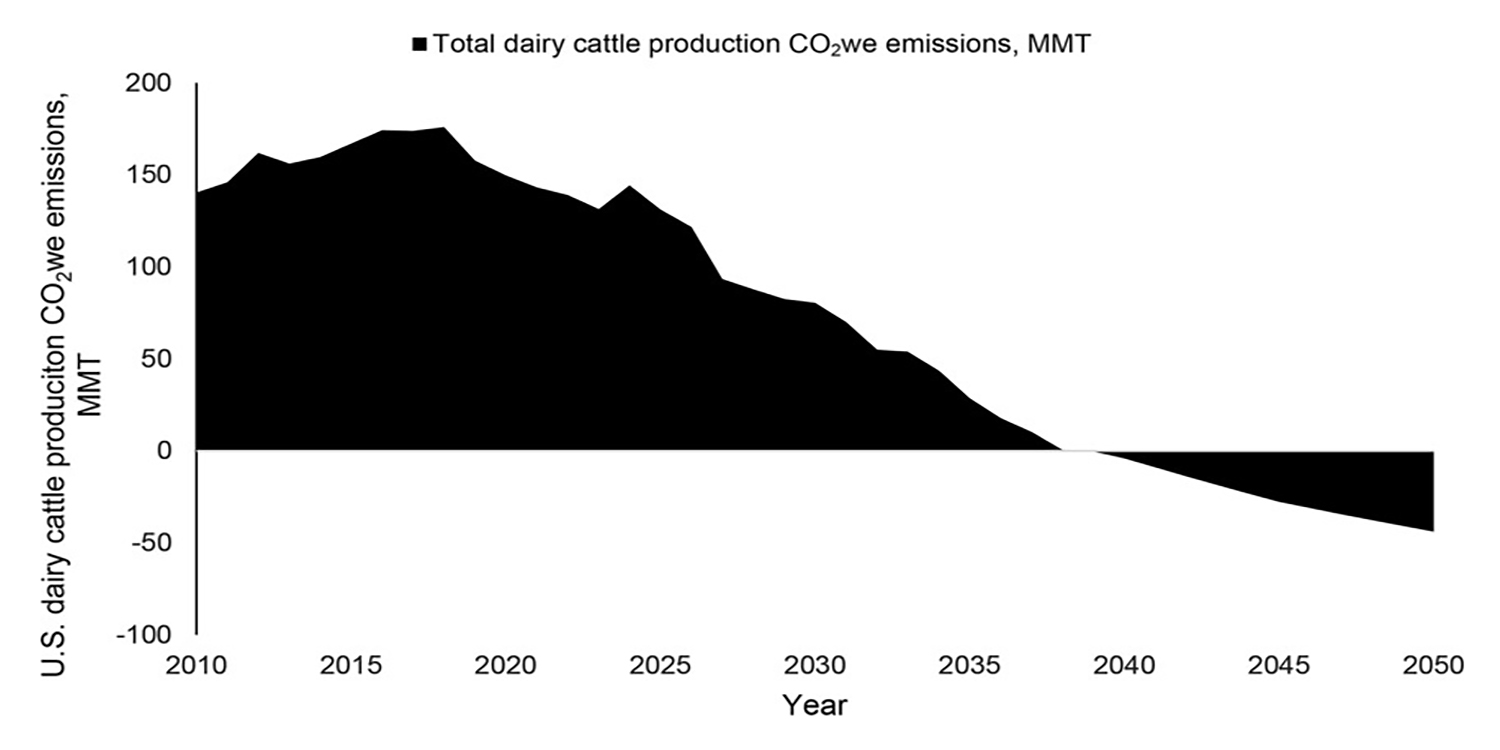
The peer-reviewed study from the University of California-Davis CLEAR Center and Elanco Animal Health was published recently in the Journal of Dairy Science. It outlines a path for the U.S. dairy industry to reach climate neutrality by 2041 with small methane reductions every year, and even sooner with more aggressive reductions.

Dr. Mitloehner brought dairy farmers up to date and took questions during the American Dairy Coalition’s annual meeting by webinar in December.

One important take-home message was for dairy producers to understand that how methane’s global warming potential is quantified (whether GWP100 or GWP*) “has a profound impact on the predicted warming of your industry. The only way you can become climate neutral is by using a metric fit for purpose, one that predicts the warming, and that is GWP*,” said Mitloehner.

He explained how methane is an important and powerful greenhouse gas (GHG), but it is different from other gases because it is the only one that undergoes atmospheric removal in a chemical process that takes about a decade. This does not occur for carbon dioxide or nitrous oxide, which are stock gases that remain in earth’s atmosphere for 1000 and 100 years, respectively.

“Methane is the most important gas for agriculture, so its removal must be included in the calculation also,” he confirmed, noting that GWP* does that. “Methane is fast and furious. It has a good punch that is 28 times more trapping of heat from the sun (vs. carbon dioxide), but it is also fast. It doesn’t stay in the atmosphere for long.”

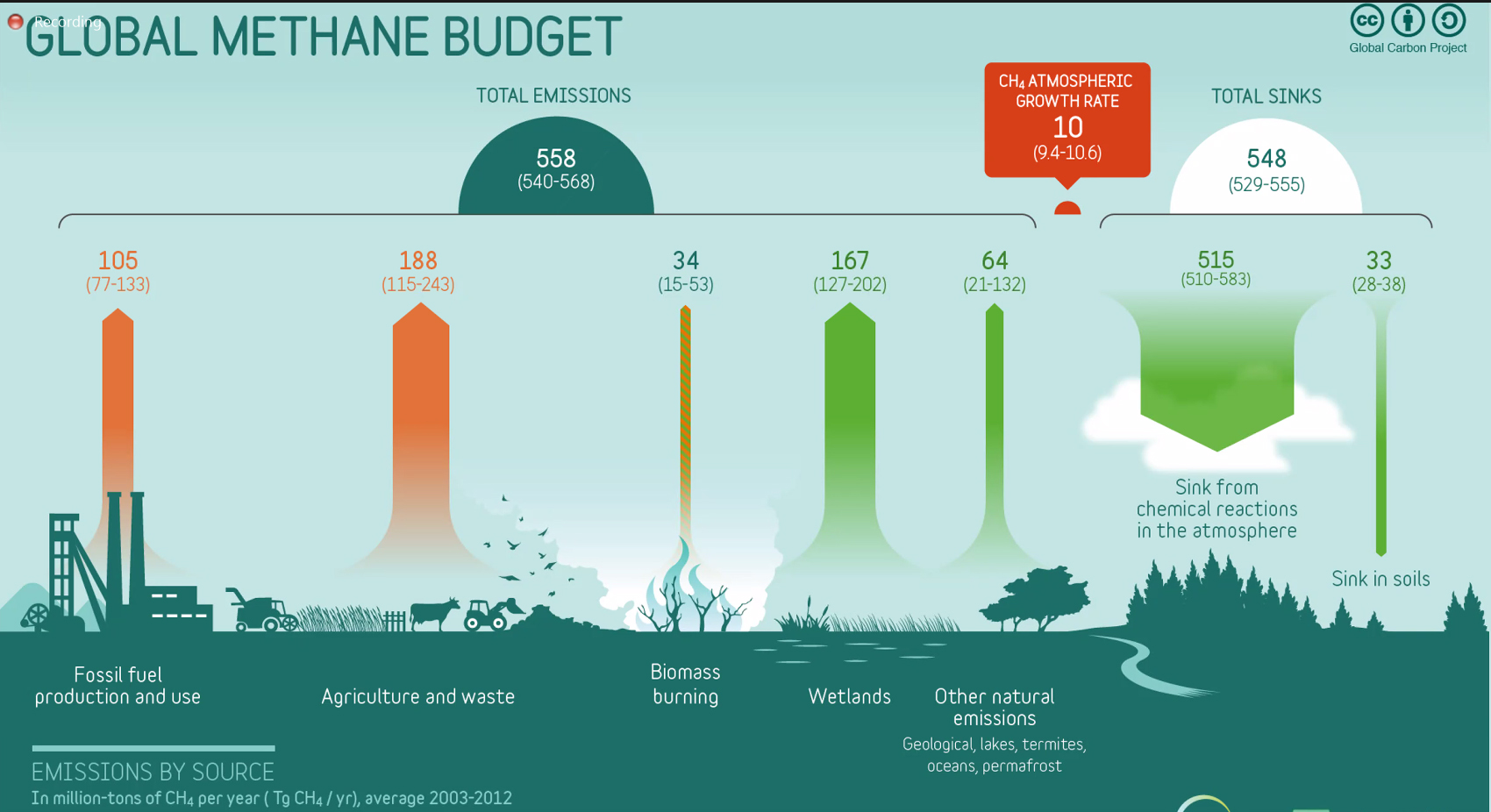
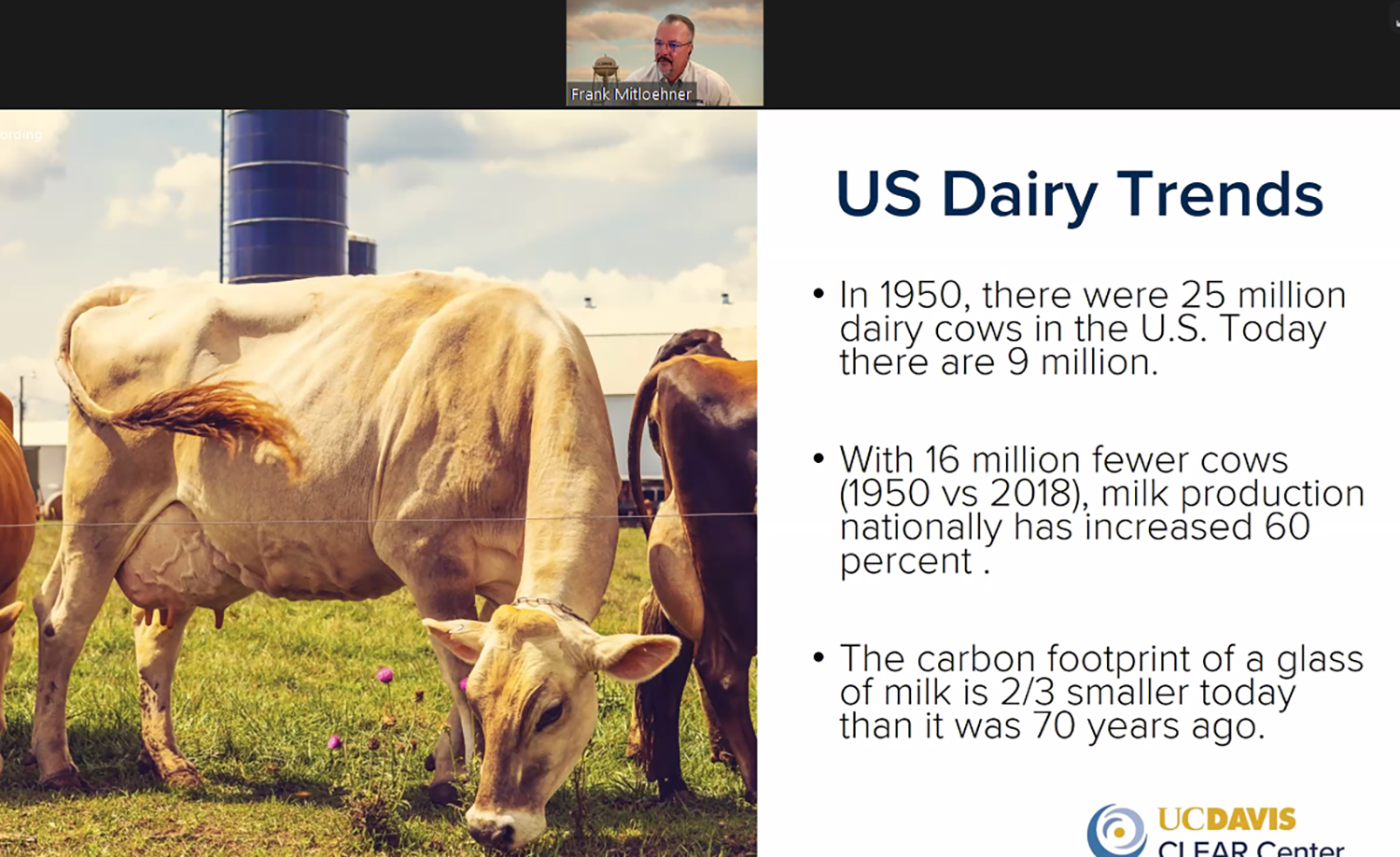
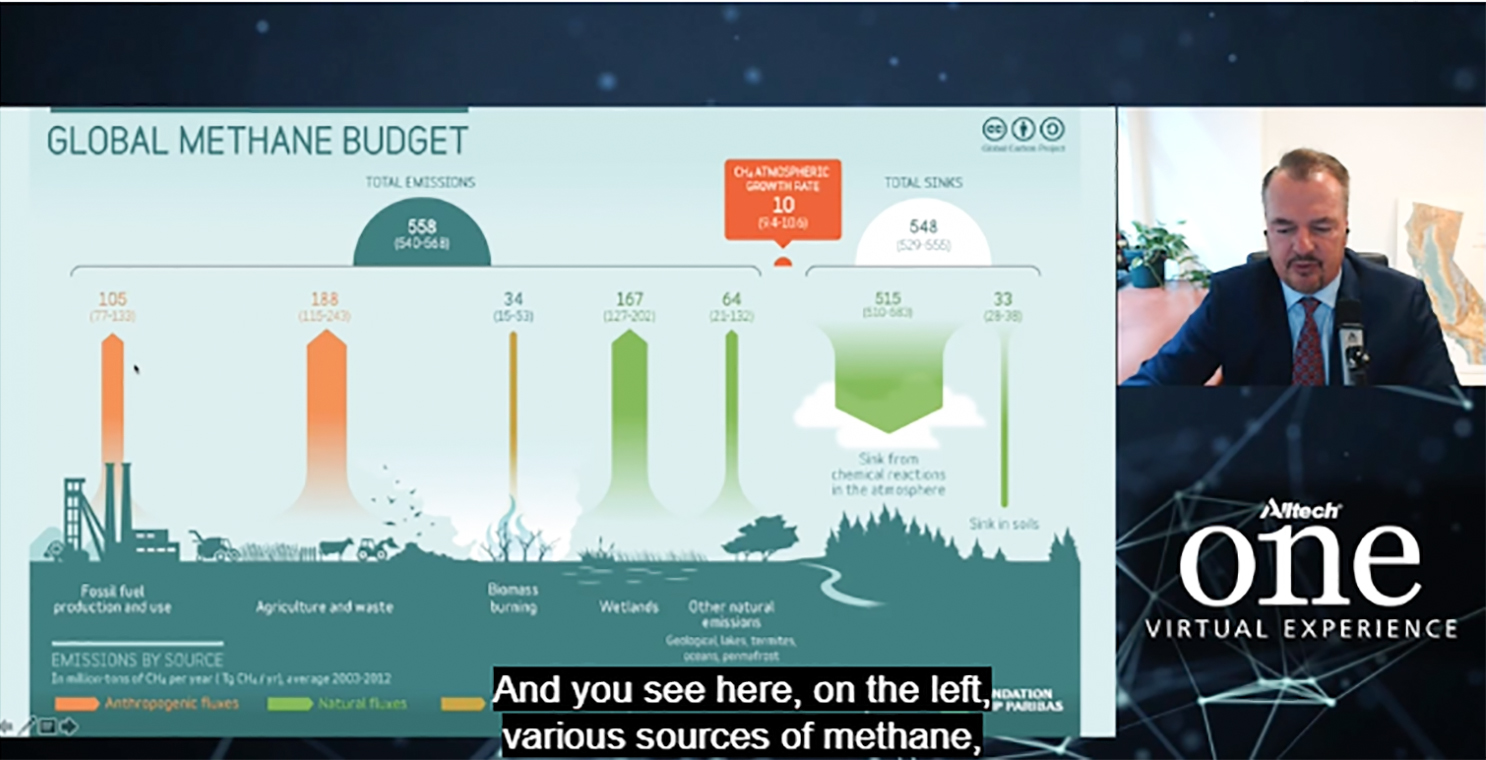
In a slide showing all global methane sources and sinks, Mitloehner noted that nearly 560 terragrams of methane are produced worldwide annually, and at the same time 550 are destroyed by this natural atmospheric process.

In terms of atmospheric growth, “the net is then 10. This is still a number we want to reduce, but it is not 560,” he said.

As the DMI Innovation Center’s Sustainability goals, Net Zero Initiative and FARM program are on the cusp of calculating these things at the farm level, both the measurement and the goal matter.

A net-zero carbon or GHG commitment poses a problem for dairy farmers. This is compounded by the CO2 equivalency for methane being calculated using GWP100. 

The GWP100 metric has been around since the 1990s, but it describes stock gases, whereas methane is a flow gas.

Using GWP100 with a net-zero carbon commitment is not only unnecessary, it’s problematic.

“It means the belches from your cows are (being calculated) in addition to what they belched last year, and the year before that, and so forth 10 years from now,” said Mitloehner. “In reality, constant herds are a constant source of methane that generates a constant warming, not a new warming. That’s what the Paris Treaty asks all sectors to do – to limit additional warming.”

Aiming for climate neutrality or net-zero warming instead of net-zero carbon would put the focus where it needs to be — on the warming impact of the emitted methane over time. This is important because methane makes up 62% of the estimated total GHG for dairy, according to the CLEAR Center study.

“If we use GWP100 to describe a relatively constant source, to characterize that methane, then we are overblowing its impact by a factor of 3 to 4, and we are overlooking the ability for the U.S. dairy industry to reduce warming when we reduce methane,” said Mitloehner, citing page 173 of the Intergovernmental Panel on Climate Change (IPCC) 2021 Assessment Report 6.

The metric GWP-star (GWP*) is also mentioned on this page of the IPCC report. GWP* was developed by the University of Oxford. It is based on GWP100, but it looks at how methane warms the planet over time. It characterizes methane as the flow gas that it is and calculates it based on CO2 warming equivalents (CO2we), not as accumulating CO2 stock equivalents (CO2e).

A white paper published with the peer-reviewed CLEAR Center study explains it this way:

“Net zero carbon refers to a state where carbon is removed from the atmosphere (through carbon sinks or other offsets) at a rate equal to carbon being emitted into the atmosphere. This balance between carbon emission and removal creates a ‘net-zero’ carbon output. Climate neutrality, on the other hand, focuses on temperature impacts from emission sources, referring to the point in which no additional warming is added to the atmosphere.”

The paper goes on to explain how “climate neutrality is analogous to net-zero carbon when dealing with long-lived greenhouse gases such as carbon dioxide, but short-lived pollutants like methane do not need to reach net-zero carbon to be climate-neutral.”

“Is it new and additional carbon being added to the atmosphere? Do constant herds add new warming? No, they do not,” said Mitloehner.

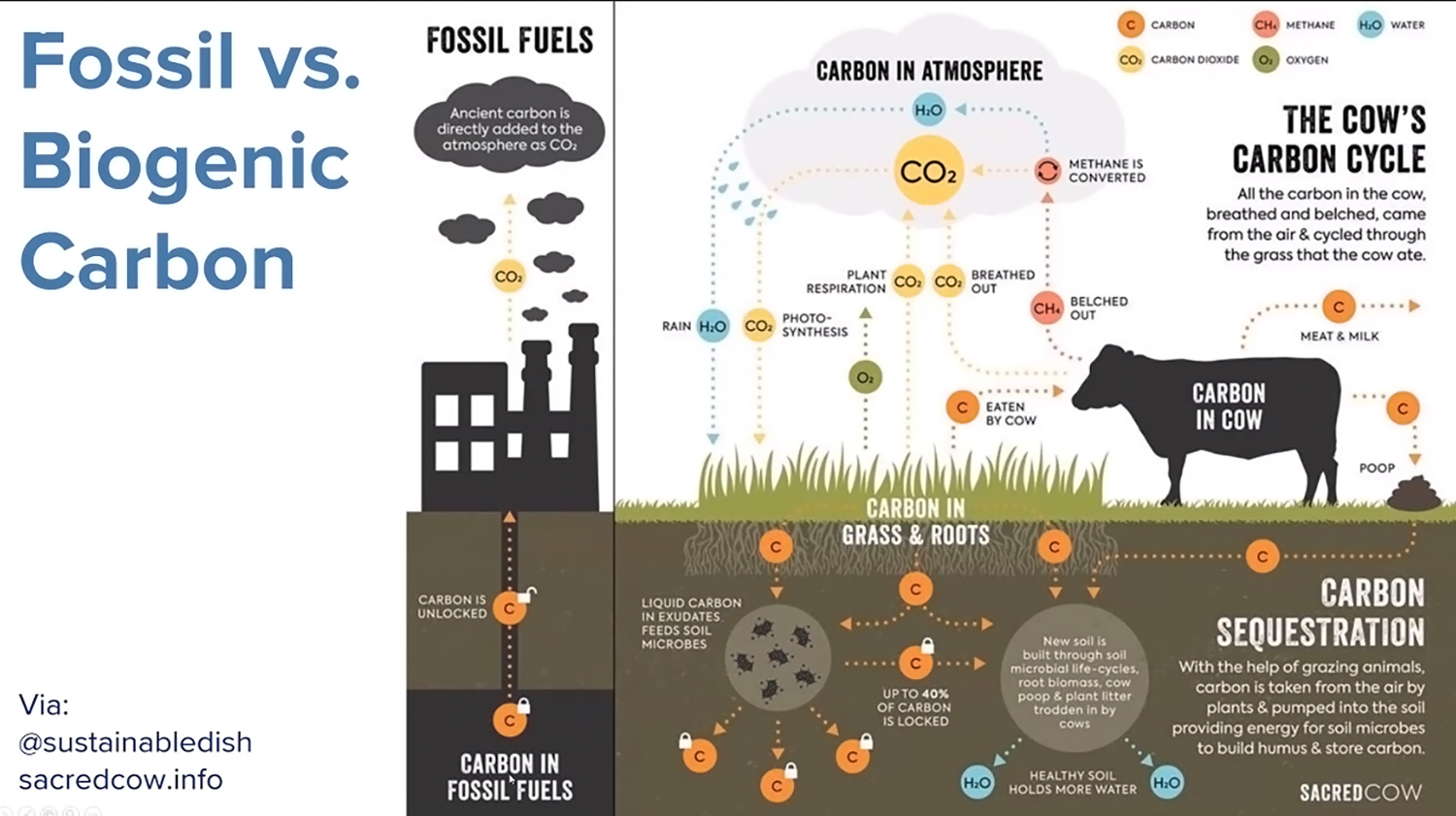
“Belched out methane is the number one source in agriculture, but again, it doesn’t stay in the atmosphere for 1000 or even 100 years like carbon dioxide and other GHG,” he explained while also noting the pathway of the carbon in this methane is already present in the atmosphere, is captured by plants, then consumed by cows. Some of this consumed carbon (energy) is converted to carbohydrate and some of it is emitted in the methane by the cow in a continuous cycle. 

Unlike fossil fuel emissions, this is not ancient carbon brought out of the ground and into the atmosphere as a one-way-street, he explained: “Do not fall for the people who are comparing cars to cows. The University of Oxford says this is a mischaracterization, and I agree.”

What is exciting, “is if we reduce methane, we can come to a point where we produce negative warming or a cooling effect. That’s what my work is about (Fig. 4). If we do a couple of things to reach no new warming, and if we then get aggressive to go further, we can sell credits as offsets,” said Mitloehner, referencing the implications, limitations and conclusions of the CLEAR Center study.

As innovations related to managing cattle diets are being developed, the good news is emerging tools show the promise of steering more of that carbon, that energy, toward milk yield and components and less of it to methane that is belched back into the cycle.

In contrast, a net-zero carbon or net-zero GHG goal that measures methane as a stock gas (GWP100) and does not accurately describe its warming impact and flow-gas status in the way GWP-star (GWP*) does, would leave dairy farmers needlessly and continually chasing what under the GWP100 scenario are accumulated and continuing belches from their cows. 

If the industry continues to chart net zero carbon, will dairy farms be forever chasing their belching cows with tech investments and offsets?

“In my opinion, you will never reach net zero carbon. Your cows will always produce methane no matter how aggressive you are. You will over promise and leave stakeholders disappointed. We are dealing with a biological system, the microbial fermentation in the rumen. It is not feasible and I have advised the industry in the past against it, but that is the direction it goes – in general,” said Mitloehner.

As for unintended consequences on the path to ‘net zero,’ Dr. Mitloehner was clear to say: “What matters is climate neutrality. If you tell the world you want to be climate neutral with no new warming and achieve it through annual reductions of 0.3 to 0.5%, you will indeed be climate neutral in less than 20 years. At a 1% per year reduction in methane, you will accelerate that timeline. But you will never achieve it with GWP100. It’s not possible and not necessary to go that way of treating methane as if it were a stock gas. It doesn’t account for the reduction.”

A piece of good news, he said, is that GWP-star (GPW*) can be used parallel to GWP100. The maitrix is a more scientific predictor of what you (dairy) has to do to bend that curve and how strongly.

“The excel spreadsheet calculator in the white paper helps you identify when in the future as a creamery or a statewide association reach the point that you are no longer creating additional warming, and that should be the goal,” Mitloehner explains.

Net zero carbon or net zero GHG is a setup to always be chasing the cow’s biology without acknowledging her gas is a flow gas, not a stock gas. It does not accumulate. Some will say “you can use offsets” for the cow’s biology. But why? They are not necessary as offsets and could be viewed as solutions if the dairy industry gets its math right. (We’ve seen this movie before)

Dutch farmer protest update: What if you woke up tomorrow and learned your farm is to be reduced or closed based on climate targets that use fuzzy math?

When food is plentiful, and climate reduction targets kick-in… How do farmers attract the strong public support they need to continue?

By Sherry Bunting, previously published in Farmshine

NETHERLANDS — Headlines here in the U.S. indicate the Dutch government is offering buy-out of up to 3000 farms and other so-called ‘peak polluters’ to reduce ammonia and nitrous oxide emissions to bring the country into compliance with EU pledged targets. They say farms will be offered more than 100% of their value to quit, but the value of these farms is now reduced by the reduction targets. 

A November 30 article in The Guardian quotes the Dutch nitrogen minister Christianne van der Wal saying “there will be a stopping scheme that will be as attractive as possible,” and that forced buyouts will follow next year if the voluntary measures this year fail. 

Some may read these headlines and figure Holland is such a progressive agricultural powerhouse that the number of planned closures is but a dent. 

Think again.

Farms in Holland and around the world are the thin green line. Challenging them with inflated climate data and restrictive targets puts world food security at risk.

Consider that the BBC reported recently that Ireland is also looking at agricultural emissions, namely methane from cattle and sheep, in terms of meeting its Climate Action Plan targets of a 25% reduction by 2030. Estimates vary on how much culling would need to occur to meet these targets, how the methane is measured, and how fast various feed additives can help farms meet new targets. The most glaring concern is how carbon equivalents and methane are measured.

What if you woke up tomorrow and learned that your farm is targeted for similar reductions or closure based on the location of your farm on a map, based on climate targets set by your state or your milk buyer or the federal government, based on making cuts from where you are now — not from where you might have been before whatever improvements you’ve already made?

We reached out to Dutch dairy farmer Ad Baltus this week for an update from Holland, having interviewed him six months ago for the story about the Dutch farmer protests in July 2022.

Baltus farms 170 acres in the village of Schermerhorn with his wife and 7-year-old daughter. They milk 130 dairy cows, grazing in summer and growing corn and collecting fresh grass and dry hay from fields as well.

In July, he reported that his farm is one of the “luckier” ones. He is in a location in North Holland that will have to reduce the amount of nitrogen (or sell cows) by 10 to 15%. Some zones have been designated to reduce by up to 75 to 90%. The percentages are to meet reduction targets, and are not based on what a farm is measured to produce. Building and infrastructure projects can’t move forward without near-term offsets, which is why the situation has reached this extreme point in the Netherlands.

“It feels like the government throws figures in the air, and they wait to see what will happen,” says Baltus. “In my point of view, they try to make farmers worried as a tactic of smoking them out. That’s what you see now. The farms (targeted for higher reductions based on location) nearby the nature areas are getting tired of it, and they sell. I see the last couple of months a lot of farms, nice farms, being sold, and that worries me. If they stop farming, and go abroad, what will be left in Holland?”

He observes that the older farmers stay on the farm until they stop for retirement.  “But when the young farmers stop and go abroad — that’s the future leaving. The young farmers are the future. The young farmers don’t want to wait for what is clear and what is going to happen. The problem is now — in the next five years,” he says, indicating a cycle of new targets that never seems to end. “Every time the government throws new figures out. This time it’s the nitrogen, then it’s the water quality, and then it’s the biodiversity, then there is CO2. Every time there comes new regulation, young farmers worry about their future.”

He sees agriculture in his country at a crossroads and warns that if this can happen in Holland, where agriculture is so progressive, it can happen anywhere.

“It could go the right way, and they will begin to appreciate farming in Holland, or it could go the other way, and farming may be over in 10 or 20 or 30 years. My biggest worry is you need some minimum amount of farmers to let the companies behind the farms live. I see it that when you have a feed company, they need a certain amount of farms to deliver their feeding products. When it comes down below some level, they say that is too small for us, and it is a spiral going down. That’s a worry for me, that we make it difficult for too many farmers, and they stop.”

Baltus confirms that the large Dutch farmer protests of the summer have quieted down, but the efforts and periodic protests continue on a different scale. “We are not giving up. We are struggling ’til the end, but it is a hard battle to convince (the government) that this is not the good way to go.

“We also see the farm groups talking to the government. We see the (symbolic) red handkerchief. The Dutch flags turned upside down for a month got attention. The protest is maybe not as loud as it was, but it is still there, and a little spark to the gunpowder barrel, it will explode again,” he says, noting that there are elections in March 2023.

As for the big picture, Baltus describes it as Dutch farmers having to ‘catch up’ quickly to the long-time networks built by the NGOs.

“Farmers have been too long on their own farms, and now you see things changing. Since 2019, when the first farmer protests began, you see farmers are now talking more to the media. They get a better speech to government officials,” says Baltus.

On the other hand, the NGOs, like Greenpeace, and a variety of others, are a small number of people relative to the population of Holland, but they have already been working 20 to 30 years on this. They are well-organized, well-funded, and have people throughout all levels of government and media, he explains.

“We are just now three or four years fighting against that, and it takes a time to change and get that understanding of nature and practice to the government,” Baltus relates, adding that it also takes time for new technologies to come to market that will help farms make further reductions, though European farms are already pretty progressive that way.

Baltus sees European farmers coming together more for each other now — even if their respective governments are not. As other countries in the EU are beginning to experience similar pressures of emissions targets that could essentially reduce dairy and livestock numbers or put farms out of business, solidarity is on the rise among those farmers who are paying attention.

Farming is hard work with a lot of risk, but as Baltus points out, Holland is a good place to farm, with good soil, good logistics, and a good climate for crops and livestock.

“It is one of the best jobs in the world. I love what I do. I want the adventure that every day is different. I like working in nature, working outside,” he says. “When the younger generation doesn’t have to worry about all of the things which are not farming, then they will go to farming because the work is that good. It is only the things that come from outside into the farm that make it hard.”

One part of a future solution is exemplified in something Baltus has done at his farm for 30 years — providing a school on the farm to teach young children how to make cheese and to make jam. His cheese school reaches a few thousand children each year.

“We do it so the children learn how much work it is to make that little piece of cheese and that little pot of jam,” he says. “When they learn the effort that goes into food, they appreciate it more, I think.”

The children get a bucket of milk, and in two hours they go home with a little cheese. They have to turn in 14 days and put on a little salt, and in another 14 days they eat their own cheese. When Baltus started the cheese school 30 years ago, maybe one or two farms did this kind of thing.

Today, more farms are doing similar memorable learning experiences. Baltus sees more farms connecting with the public in recent years. Some have cabins on the farm that they rent to the public. Others provide daycare on the farm, so children can grow up with some real-world attachment to farming. In his neighborhood, there are four farms with daycare. 

“The new generation learns what it is to farm, so maybe they will be farming or an advocate. If they go to work as a plumber or a trucker, but as a child lived a few years on a farm at a daycare, it’s good for when they are older, even if they work in other things,” he explains.

“The solution is also that everyone you speak with — say to them what you are doing. When you are at a party or on holiday, say you are a farmer, say how you do things, why you do things — explain it,” Baltus suggests. “People come to appreciate these things when they know about them. There are things (farmers) can do better, but when we explain that we need 5 or 10 years (as technology develops), they accept we’re not perfect but are working to make it more perfect.”

In general, Baltus has found the public has a good opinion of farmers. When he meets someone from the city, they say “Oh, you’re a farmer. That is good of you.” And that’s that. They think well of farmers, but have no reason to worry about food, and therefore don’t make the connection to the impact of the threat the farmers face.

“People have other worries. Do I have a job next year? Can I pay my bills for electricity? Will my children have a good education? But food? There is always food. People will worry about food when there is no food,” he says.

As it stands now in Holland, “What is happening with farms is not really their business. People can go to the supermarket, and most everything they want they can buy there,” Baltus observes, saying he understands this disconnection.

Even if there are changes to the mix of foods available in stores and restaurants, there is no fear of finding food to eat. While Holland is considered a large agricultural exporter, Baltus notes that his country is a net-importer of food when looking at it on a protein and energy needs basis. 

“We have the cheese and potatoes and cabbage, but we don’t have the coffee, the cocoa and the citrus. I see it in the way of trading. When that balance is lost, what happens when there is a shortage and we don’t have the cheese or potatoes to export?”

The bottom line, says Baltus, is that “When you are a carpenter or a plumber and there is, every day, food in the supermarket, why would you have to worry about food?

“In Africa, they know food is important. They know what it is like to not have food. But in the western world, there is food everywhere. You can pick up the phone, and in 30 minutes have a pizza on your plate.”

-30-

COW TALK: Thoughts inspired by cows’ breath on cold morning

By Sherry Bunting, republished from Farmshine, November 18, 2022

These cows are wondering what’s going on. Five days ago, they enjoyed balmy 70-degree temps. This morning, they could see their own breath freezing in mid-air.

They’ve been listening to their farmer’s radio this week and heard that President Biden pledged to give $11.4 billion ANNUALLY to other countries for a climate transition. They heard that climate pledges were being made at COP27 that could make what is happening to some of their friends in Europe happen here in the U.S. to them too.

This got their attention because they’ve also been hearing how the methane in their burps is being overblown by a whopping 3 to 4 times its actual warming potential over 20 years.

(They could have told you that if they could talk).

Yep, they know they are getting a raw deal here. Even the world’s foremost authorities on what units of measure to use for methane agree that the GWP100 is overblowing the cow problem, whereas the GWP* they hear Dr. Frank Mitloehner talk about when their farmer has a zoom webinar airing within earshot is more accurate and gives them a chance to be the SOLUTION they know they are instead of the PROBLEM they know they are not.

But cows can’t talk, so they can’t stick up for themselves. Are we sticking up for them?

Bessie and her friends have heard that their farmer must pay 15 cents for every 100 pounds of milk they make to an organization in Chicago that is content to use the inflated unit, content to keep driving their net-zero talking points even though net-zero GHG is impossible because, well, because cows continue to breathe and burp, so getting the unit of measure correct may literally save their lives some day.

Even their tiny cow-sized brains are smart enough to know that inflating a problem to make a buck is not a good idea.

What is a good idea for the cows and their farmers, and for the world, is for the 15-cent-takers to change their narrative and talk about true warming potential and climate neutrality instead of net-zero, ad-nauseum.

One can sense these cows wish they could speak up to say: “Stop overblowing our burps please! It’s impolite!”

They might even say something like this: “Our ‘hot air’ is nothing compared to the steam rising off the loads of bull coming out of Washington, D.C. and COP27 in Egypt!”

These cows have also heard on their farmer’s radio station that the mid-term elections are still undecided as to what party will be in leadership of the People’s House. And yes, they’ll admit that over the past eight days, they’ve placed a few bets on the outcomes between mouthfuls of TMR at the feedbunk where they discuss current events.

They’ve even wondered if they should start a new political party of their own: the COW-MP party, which stands for Commonsense Organization of Whole Milk Producers. After all, some people think skim milk is their product. That one really gets them mooing.

This Thanksgiving, we’re thankful for our dairy farm families and the people of this industry who work hard every day to feed the world. But this year, we’re giving a special ode of gratitude to the bovine beauties, themselves, that make it all possible. Where would we be without the cows?

While the climate policy wonks, activists, even industry organizations perpetuate or allow this verbal abuse of our cows to continue, we’re thanking God for providing the essential irreplaceable cow.

We’re pretty sure He knew what He was doing a whole lot better than those in the ivory towers making policy, devising hoops for cows to jump through in order to exist and funding startups to make fake protein from fermentation vats in labs and factories under the mantra of saving the planet from the inflated overblown warming potential of our burping cows.

Even those of us with tiny cow-sized brains are smart enough to realize it’s really all about making money and controlling food.

Have a Happy Thanksgiving, and let’s think more about how we should be standing up for our cows.

Dairy checkoff is ‘negotiating’ your future: Train wreck ahead. Stop the train. Correct the track. (DMI Net Zero – Part One)

By Sherry Bunting, Farmshine, Sept. 16, 2022

Dairy farmers are being used without regard. Their future ability to operate is right now being negotiated, and they are paying those negotiators through their 15-cents-per-hundredweight mandatory checkoff with no idea how the negotiations will ultimately affect their businesses and way of life.

Inflated baselines and an inflated methane CO2 equivalent assigned to cows is setting the stage for a head-on collision, a train wreck on the misaligned track laid by DMI’s Innovation Center for U.S. Dairy.

In fact, the Net Zero Initiative has been designed to help everyone but the dairy farmer. It sets up a methane money game for carbon traders at the expense of those dairy farms that have long been environmentally conscious with no-till, cover crops, grazing, and other practices already on their farms.

Such farms will be of no use in what is shaping up to be a focus on harvesting reductions, not attaining neutrality, in DMI’s Net Zero Initiative (NZI).

Small and mid-sized dairy farms that are already at or near carbon-neutral could show smaller reductions for the industry to harvest. 

Conversely, the largest dairies installing the newest biogas systems are realizing even this route could become a dead-end because the credits are signed over and sold for big bucks, a few bucks get kicked back to the dairy, but the methane capture becomes the property of other industries outside of the dairy supply chain.

If the industry does not act now to stop the NZI train for a period of re-examination, adjustment and correction, then the current trajectory may actually move food companies clamoring for reductions ever closer to alternatives and analogs that boast their climate claims solely on the fact that they are produced without cows.

This is a big money game that is operating off the backs of our cows, and the checkoff has been at best complicit as a driver.

RNG (renewable natural gas) operators are signing up large (3000+ cows) dairies left and right for digesters and covered lagoons to capture methane piped to clustered scrubbing facilities to be turned into renewable fuel for vehicles or electricity generation. Meanwhile dairy protein analogs are being created without cows by ‘precision fermentation’ startups partnering with the largest global dairy companies.

In turn, millions if not billions of dollars in carbon credits are generated while farmers and their milk buyers will be left figuring out how to show their reductions when they are left holding the inflated methane bag.

Six organizations, four of them non-profits under the DMI umbrella, officially launched the Net Zero Intitiative (NZI) in the fall of 2019, five months after Ag Secretary Tom Vilsack made headlines talking about it in a Senate hearing while he was pulling down a million-dollar salary as a DMI executive in 2018.

NZI is the proclaimed vehicle for negotiating the terms for U.S. Dairy to continue, terms based on showing carbon reductions that many family farms may find difficult to meet — especially if the farm is already at or close to carbon neutral.

As DMI’s sustainability negotiators data-collect all previous reductions into farm-by-farm comprehensive baseline estimates, where will those farms find new reductions? 

According to DMI staff, over 2000 dairy farms have already gone through their environmental stewardship review via the FARM program to establish their “comprehensive estimates.”

The six organizations, four of them filing IRS 990s under the national dairy checkoff, that launched NZI are: Dairy Management Inc. (DMI), Innovation Center for U.S. Dairy, U.S. Dairy Export Council (USDEC) and Newtrient, along with the other two organizations being National Milk Producers Federation (NMPF), and International Dairy Foods Association (IDFA).

They have collectively bought-into the global definition that inflates the CO2 equivalent used for methane, effectively committing the cow to perpetual GHG purgatory. 

Because the NZI structure is based on continually showing GHG reductions, no farm is insulated with a get-out-of-jail-free-key — not even the largest farms with the most advanced biogas systems.

Why haven’t checkoff funds been used to defend the cow – to get the numbers right, to get the current practices farmers have invested in counted toward reductions not baselines, and to get the methane CO2 equivalent correct — instead of giving in to this notion that feels an awful lot like ‘cows are bad and we are committed to making them better?’

Perhaps it was ignored or embraced because this inflated methane CO2 equivalent gives the suite of tech tools being assembled by DMI’s Newtrient a bigger runway to show reductions — a money maker for the RNG biogas companies and others that will in many cases end up owning the carbon credits after paying the farmer a nominal fee. 

Carbon trading rose 164% last year to $851 billion, according to a Reuters January 2022 report. A big chunk of this is coming from the methane capture and fossil fuel replacement of RNG biogas projects, mostly in California but popping up elsewhere at a rapid rate and mostly traded on the California exchange.

Farmers are getting some money for these projects, but they don’t own the carbon credits once they are sold or signed over. When they are sold outside of the dairy supply chain, this reduction becomes someone else’s property, so it is no longer part of the dairy farm’s footprint nor the footprint of their milk buyer. 

Likewise, this inflated methane equivalent — along with the emphasis on reductions, not neutrality — has some processors wondering if they’ll be able to come up with the Scope 3 reductions they need in ESG scoring.

They are facing upstream pressure from retailers and consumer packaged goods (CPG) companies as well as asset managers to show reductions, and they have counted on big numbers from their Scope 3 suppliers, the dairy farms.

The problem for dairy processors and dairy farmers comes down to the central definitions of methane equivalent and carbon asset ownership — the rights of farmers to own their past, present and future reductions, whether or not they’ve signed them over as offsets to a milk buyer or a project investor and whether or not they’ve sold the resulting credits on a carbon exchange, and whether or not they’ve installed new practices that are now part of a baseline but represent a new investment every year as they operate their businesses.

Back in June, the American Dairy Coalition added this concern to their list of federal milk pricing priorities because of the impact this climate and carbon tracking will have on milk buying and selling relationships and contracts — and the lack of clarity or fairness in this deal for essential food producers at the origination point that is closest to nature, the farm. 

ADC worded their “carbon asset ownership” priority this way: “No matter where a dairy farm’s milk is processed, that farm should be able to retain 100% ownership at all times of its earned and achieved carbon assets, even if this information is shared with milk buyers to describe the resulting products that are made from the milk.”

For its part, IDFA took a swing last Friday, going one step farther to recommend global accounting methods that would allow the dairy supply chain (farmers and processors) to retain carbon credits even if they are sold on a carbon exchange or signed over to an asset company that invested in an on-farm technology. 

IDFA executives penned the Sept. 9 opinion piece in Agri-Pulse laying out the concerns of their members who are starting to realize the future consequences of the rapid and inflated monetization of methane — and the race to sell carbon credits — leaving dairy processors unable to get those credits they were counting on from the farms that supply them with milk, while at the same time being stuck facing the cow’s inflated methane CO2 equivalent in their downstream Scope 3 even while they try to get reductions in their own controlled areas of Scopes 1 and 2.

When dairy farms no longer own their reduction or cannot show a large reduction because they are already virtually neutral, processors become concerned about how they will gain the Scope 3 reductions that are part of the ESG scoring the large retailers and global food companies are pushing. 

All of this has come down through the non-governmental organizations like World Wildlife Fund (WWF), investment and asset management sector via the World Economic Forum (WEF), the global corporate structures through the Sustainability Roundtable and through government entities via the United Nations Agenda 2030. DMI has been at those tables for at least 14 years.

“It is becoming clearer every day that the global accounting standards underpinning GHG measurement and reporting are biased against the very people making the (GHG) reductions,” the IDFA executives wrote in their opinion.

In other words, while some farmers are beginning to profit from GHG-reducing practices that are turned into offsets and traded on the carbon markets, the system is tilted against them because it leaves them without the offsets they traded and leaves them in a position of having to continually reduce in order to secure a position in the value chain.

IDFA points out that under the current rules, once the offset is sold outside of the value chain as a carbon credit – it is gone. The current GHG accounting system says only the buyer of that reduction can claim ownership.

Those farms can no longer claim their own reduction, and it means the company buying milk or other commodities from a producer cannot integrate the reduction into the description of their final product.

This weakens U.S. Dairy, the IDFA opinion states, and it makes dairy farmers less competitive sources of pledge-meeting carbon reductions for retailers and manufacturers – setting real dairy up for fake dairy dilution with the inclusion of whey proteins and other pieces of milk that are being produced in fermentation vats by genetically modified yeast, fungi and bacteria, as well as other analogs.

A bigger problem not mentioned in the IDFA opinion may be the inflated baselines that leave farms that have implemented best practices years ago positioned to show smaller reductions.

While the American Farm Bureau earlier this year lobbied against proposed SEC accounting intrusions for quantifying ESG scoring, it has been silent on the issue of carbon asset ownership for food producers. AFBF has also said little about the recently signed climate bill (Inflation Reduction Act).

National Milk Producers Federation, on the other hand, as reported last week, sang its praises for being right in line with where the industry’s Net Zero Initiative is going.

DMI voices its pride to have been leading the way, positioning its Innovation Center as founded by dairy farmers. They have conceded that dairy farms impact the environment and launched NZI as a collective pledge to reduce that impact.

In other words, DMI submitted to the idea that cows impact the environment, but never fear, through NZI, the Innovation Center and Newtrient, farmers will make them better, and turn them into a climate solution.

This is a fool’s errand given the inflated methane equivalent and the movement of carbon reductions to entities outside of the dairy supply chain such as paper mills, bitcoin miners, and the fossil fuel industry.

Did dairy farmers have a say in any of this? Not really. They were kept in the dark as this was developed over the past decade or more, and the boards representing them on the six organizations that launched NZI (four of them under the checkoff umbrella) have been duped.

Farmers are largely unaware of the NZI train, and their silence as it runs down the track becomes a further signal to the industry and to the government that they approve of the track they are on.

As the industry sits at this crossing, the Net Zero train full of dairy farmer passengers is barreling high speed down the track DMI has laid.

This train must be stopped because the future-bound track needs to be re-examined, adjusted and re-aligned so that the passengers are not ejected by the train wreck – the accelerated consolidator — that lies ahead.

Fundamentals must be vigorously revisited. Every passenger on that train, every dairy farm, must be recognized as an essential food producer, get credit for their prior investment in current practices, and be able to retain ownership of their carbon assets as part of their farm’s footprint — even if these assets have been provided, sold or signed over as offsets to milk buyers or project investors or traders on an exchange.

Furthermore, this train – built with farmer dollars – should protect the so-called founding farmers from being denied a market based on the size of their GHG reductions. If a carbon neutral farm can’t show reductions to its milk buyer, will that buyer look for other downstream vendors who can fulfill their Scope 3 reduction needs?

Will those vendors be other farms with larger perceived GHG reductions or will they be alternative analogs created without cows?

Nestle announced this week it is partnering with Perfect Day toward that end. In fact, the proliferation of plant-based, cell cultured, DNA-altered microbe excrement analogs for dairy protein and other elements are entering the market on big GHG reduction claims based on being made without the cow and the inflated methane CO2 equivalent she has been assigned!

The current standard for methane CO2 equivalency is inflated by orders of magnitude. Dr. Frank Mitloehner has addressed this repeatedly and other researchers back his view with efforts to change it.

As Mitloehner and others point out, climate neutrality should be the goal, not net-zero. Furthermore, the current methane CO2 equivalent is calculated based only on the much greater warming effect of methane vs. CO2. However, the current calculation does not account for the fact that methane is short-lived in Earth’s atmosphere — about 10 years compared with 100 to 100 years for CO2 and other GHG. It also does not account for the cow’s role in the biogenic carbon cycle.

Remember, DMI and company have ignored or embraced this definition. At the same time, the Innovation Center’s data collection of progressive accomplishments are included in the baselines from which new reductions (opportunities) must be found.

These two trains run in opposite directions for a future head-on collision on a mis-aligned track. 

The bigger the perceived GHG problem, the bigger the reduction through technology, and the bigger the monetization of that reduction outside of the dairy supply chain. At the same time, this creates an even bigger problem for farms that are unable to participate in biogas projects, farms that don’t fit the Innovation Center’s 3500-cow-dairy-as-solution template, farms that may be carbon neutral or close to it already.

DMI and company have played fast and loose with the truth. 

Farmshine readers will recall the glaring error reported more than a year ago in the white paper written by WWF for DMI. It showcased these biogas projects and the 3500-cow dairy template it proclaimed could be Net Zero in five years, not 30. 

That paper inflated U.S. Dairy’s total GHG footprint by an order of magnitude! A Pennsylvania dairy farmer brought the error to Farmshine’s attention. In turn, the magnitude of the error was confirmed by Dr. Mitloehner who then contacted DMI. A corrected copy of the white paper magically replaced all internet files with no discussion from DMI or WWF. That number was changed, but all of the assumptions in the paper were left as-is.

Put simply: DMI does not appear to be concerned about inflating the size of dairy’s perceived GHG problem. The bigger the perceived problem, the bigger the reduction that can be monetized, but that is now happening outside of the dairy supply chain. 

-30-

Dr. Mitloehner clears the air on ‘net zero,’ sees narrative changing on America’s cows

Dr. Frank Mitloehner is a foremost authority on animal science and greenhouse gas emissions. Find him on Twitter @GHGGuru and @UCDavisCLEAR (Screen capture from American Dairy Coalition webinar)

‘Climate neutrality, not net zero carbon, should be dairy’s goal.’

By Sherry Bunting

‘Net zero’ seems like a simple term, but it’s loaded, according to Dr. Frank Mitloehner, professor and air quality specialist with the Department of Animal Science at University of California-Davis. 

He firmly believes dairy can be a climate solution, but the first step is to accurately define dairy’s contribution to the climate problem. Setting the record straight is his prime focus, and he also researches ways dairy, like every industry, “can do our bit to improve.”

Presenting on what ‘net zero’ really means for dairies, Mitloehner answered questions during the American Dairy Coalition (ADC) annual business meeting in December, attended by over 150 producers from across the country via webinar.

Based in Wisconsin, ADC is a national producer-driven voice with a regionally diverse board. President Walt Moore, a Chester County, Pennsylvania dairy producer, welcomed virtual meeting attendees, and CEO Laurie Fischer shared a federal dairy policy update. 

She said the ADC board is nimble, moves quickly, and wants to hear from fellow dairy farmers. She encouraged membership to make ADC stronger and shared about the organization’s federal policy focus in 2021 — from pandemic disruptions and assistance, Federal Order pricing, depooling and negative PPDs to real dairy label integrity, whole milk choice in schools, and farmers’ questions and concerns about dairy ‘net-zero’ actions.

“Too often, farmers think they may not understand something, so they don’t speak up,” said Fischer. “But we get calls and so much great advice from our farmers. We know you get it, you know it, because it is happening to you.” 

From this farmer input, the net-zero topic became the ADC annual meeting focus.

“We are rethinking methane, and this is influencing and shaping the discussion,” Dr. Mitloehner reported. He urged producers to use the information at the CLEAR Center at https://clear.ucdavis.edu/ and to do better networking, to have a better presence on social media. 

This is necessary because the activists are well-connected, and methane is the angle they use in their quest to end animal agriculture. He said Twitter is a platform where many of these discussions are happening. His handle there is @GHGGuru and the Center is @UCDavisCLEAR.

“This is something I have told the dairy industry. They say ‘net-zero carbon’, but they shouldn’t say that because it is not possible, and it is not needed. We need to be saying ‘net-zero warming’. That’s the goal. Then, every time you reduce methane, you instantaneously have an impact that is inducing a cooling effect,” said Mitloehner.

‘Climate neutrality’ is the more accurate term he uses to describe the pathways for U.S. dairy and beef. But it requires getting accurate information into policy in a fact-based way. 

It requires arming people with the knowledge that the constant and efficient U.S. dairy and livestock herds produce no new methane, that they are climate-neutral because not only is methane continuously destroyed in the atmosphere at a rate roughly equal to what is continuously emitted by cow burps and manure, that process involves a biogenic carbon cycle in which the cow is a key part.

One of the issues is how methane from cattle is measured, he said. Current policy uses a measurement from 30 years ago that fails to acknowledge the carbon cycle and ‘sinks’ alongside the ‘emissions.’ 

Mitloehner said accurate information is beginning to change the narrative. This is critical because methane is the GHG of concern for dairy, and the narrative about it has been incomplete and inaccurate. 

As a more potent heat-trapping gas than carbon dioxide, methane becomes the ‘easy’ target to achieve the warming limits in the Paris Accord. Methane was the focal point of ‘additional warming limits’ during the UN Climate Change Summit (COP26) in Glasgow in November.

Putting together the inaccurate narrative alongside international agreements to specifically reduce methane, it becomes obvious why cattle are in the crosshairs. Producers are already in the middle of this in California as methane regulation and carbon credit systems began there several years ago.

As the narrative is beginning to change, Mitloehner sees opportunities. He described the current California ‘goldrush’ of renewable natural gas (RNG) projects where large herds both in and out of state cover lagoons to capture and convert biogas into RNG. The state’s investments and renewable fuel standard provide a 10-year guarantee with the RNG companies typically owning the offset credits that can be traded on the California exchange from anywhere.

Getting the numbers right is mission-critical

“We are far and away an outlier because of our efficiency in the U.S with all livestock and feed representing 4% of the GHG total for the U.S,” Mitloehner confirmed. “Dairy, alone, is less than 2% of the U.S. total.”

This is much smaller than the 14.5% figure that is thrown about recklessly. That is a global number that includes non-productive cattle in India as well as the increasing herds in less efficient developing countries. This number also lumps in other things, such as deforestation.

He said the true global percentage of emissions for livestock and manure is 5.8%. Unfortunately, activists and media tend to use the inflated global figure and conflate it with these other things to inaccurately describe the climate impact of U.S. dairy and livestock herds as 14.5%.

The efficiency of U.S. production and the nutrient density of animal foods must be part of the food and climate policy equation.

Methane is not GHG on steroids

“Without greenhouse gases, life on earth would not be possible because it would be too cold here,” said Mitloehner. “We need GHG, but human activity puts too much into the atmosphere, and the toll is large concentrations.” 

The way all GHGs are measured has to do with their intensity as determined 30 years ago when scientists wanted one global warming potential (GWP) unit to compare cows to cars to cement production and so forth. They came up with GWP100, which converts methane to CO2 equivalents based on its warming potential.

Methane traps 28 times more heat than CO2, but it is short-lived, Mitloehner explained.

“Looking just at the warming potential, you get this idea that methane is GHG on steroids and that we need to get rid of all of it and all of its sources,” he said.

But is this the end of the methane story? No.

Sinks and cycles must count

Mitloehner described how ‘methane budgets’ look at sources and their emissions but ignore the carbon sinks that go alongside and ignore the chemical reactions that result in atmospheric removal of methane as well.

“Plants need sunlight, water, and a source of carbon. That carbon they need comes from the atmosphere to produce oxygen and carbohydrates,” he said, explaining how cows eat the carbohydrates and convert them to nutrient dense milk and beef. In that process, the rumen produces methane.

“Is this new and additional carbon added to the atmosphere? No it is not. It is recycled carbon,” he said.

“Say you work off the farm. You drive and burn fuel, adding new CO2 in addition to the stock in the atmosphere the day before. Stock gases accumulate because they stay in the environment. Currently, agencies treat methane as if it behaves the same way. But methane is a flow gas, not a stock gas. It is not cumulative,” said Mitloehner.

If the same farm has 1000 cows belching today and 1000 belching 10 years ago, those 1000 cows are not belching new methane because in 10 years it is gone from the atmosphere. It is cyclical.

“The take-home message is the carbon that our constant livestock herds produce is not new carbon in the atmosphere. It is a constant source because similarly to it being produced, it is also destroyed. The destruction part is not finding its way into the public policy system… but it will in the future,” he predicts.

Methane drives Paris Accord and COP26

Methane targets are driving intergovernmental agreements wanting to limit the “additional warming impact” of nations and industries.

Currently, cattle are viewed as global-warmers because they constantly emit methane. However, as Mitloehner drilled numerous times, this is not new methane, it is not additive, it is not cumulative. It is recycled carbon.

“If you have constant livestock herds, like in the U.S., then you are not causing new additional warming,” said Mitloehner.

Burning fossil fuels is much different. 

“Fossilized carbon accumulated underground. Over 70 years, we have extracted half of it and burned it, so where is it now? In the atmosphere. We added new and additional CO2 that is not a short-lived gas. It is a one-way street from the ground into the air,” he explained.

The problem for dairy and beef producers is their cattle are being depicted as though their emissions are additive, cumulative, like fossil fuels, which is not true, he said.

Signs the narrative is changing

One promising sign that the message is getting through has come from Oxford researchers acknowledging the constant cattle herds in the U.S. and UK are not adding new warming.

They acknowledge the GWP100 “grossly overestimates” the warming impact of cattle and are working on a new measurement that recognizes constant cattle herds are not adding new warming, said Mitloehner.

Another promising sign is that the International Panel on Climate Change (IPCC) issued a statement recently acknowledging that the current GWP100 overblows the warming impact of cattle by a factor of four. This new information is not in current policy, but it is making its way there.

Tale of two bathtubs

Mitloehner believes it is important to visualize climate neutrality. He described two bathtubs. One has a CO2 faucet with no drain, the other a methane faucet with a drain. Open the faucets, and even at a slow and steady rate, the CO2 bathtub continues to rise, while the methane bathtub drains as it fills to remain at a constant level.

He also explained that over the past 200 years the U.S. hasn’t seen any real change in that methane bathtub because prior to settlement in America, 100 million ruminants — buffalo and other wild herds — roamed. Today, there are around 100 million large ruminants in the U.S. dairy and beef industries.

What has changed is the U.S. does have more liquid manure lagoon storage that is producing more methane than solid manure storage. “But we know of ways to further reduce that,” he said.

Mitloehner pointed out how the current GWP100 poorly estimates the warming impact three example scenarios. If, over 30 years, methane is increased 35% from a source, or reduced 10%, or reduced 35%, the GWP100 would show significant continuous addition of cow-sourced methane in CO2 equivalents for all three scenarios because the destruction of the methane – the drain that operates with the faucet – is ignored.

The proper way to look at this, if the methane increased a lot, is that it would add a lot. But if it is balanced, then there is no new or additional warming. And, in that third scenario, he said, “where we pull a lot from the atmosphere when we reduce methane, it has the same impact as growing a forest.”

Bottom line, said Mitloehner, “We can be a solution and take it to the market and get paid for that,” but current policy does not yet reflect the neutral position of the constant and efficient U.S. herd.

Bullish about the future

‘Net zero’ is a term that is not yet clearly defined, said Dr. Frank Mitloehner several times during the American Dairy Coalition annual meeting by webinar in December. He sees the real goal as “climate neutrality,” to communicate the way constant U.S. dairy herds contribute “no additional warming,” in other words “net zero warming.”

The climate neutrality of U.S. cattle must be part of public policy, he said. Only then will dairies truly be on a path to marketing their reductions as ‘cooling offsets.’

Mitloehner, a University of California animal scientist and GHG expert is bullish about the future of “turning this methane liability into an asset, so if we manage toward reducing this gas, we can take that reduction to the carbon market,” he said.

“When we hear ‘net zero’, we think about carbon, but that would mean no more GHG is being produced, and that is not possible. I have told the dairy industry this for years. Why is (zero GHG) not possible? Because cows always belch, and we can’t offset that, and furthermore, we do not need to offset that because it is not new methane,” said Mitloehner.

On the other hand, “If we replace beef and dairy made in the U.S., this does not create a GHG reduction at all. This is because we are the most productive and efficient in the world,” he said.

Just stopping beef and dairy production here in the U.S. — and picking up the slack by producing it somewhere else or producing something else in its place — creates ‘leakage.’ This leakage, he said, is where the biogenic carbon cycle becomes disrupted. In other words, the bathtub has a faucet that is out of sync with the drain.

California’s RNG ‘goldrush’

Mitloehner touched on the strict California standards that mandate a 40% reduction of methane be achieved by the state by 2030. Again, methane is targeted because of its warming potential per the Paris Accord.

The good news, he said, is California is using incentives to encourage covering manure lagoons to capture a percentage of the biogas bubble so that it doesn’t go into the atmosphere but is trapped beneath the tarp and converted into renewable natural gas (RNG) that can be sold as vehicle fleet fuel to replace diesel. 

Because this RNG comes from a captured and converted methane source, it is considered a most carbon-negative fuel in the state’s low-carbon fuel standard. 

Those credits equate to $200 per ton of CO2 replaced with a carbon-negative renewable, said Mitloehner.

“This is a huge credit. This is why dairies are flocking to get lagoons covered to trap and convert. These credits are guaranteed for 10 years in California, but the anti-agriculture activists are fuming over them,” said Mitloehner.

Of all California investments made toward achieving the 40% methane reduction goal, dairy has received just 3% of funds, but has achieved 13% of reductions so far.

This “carrot” approach has incentivized the biogas RNG projects assuming $4000 income per cow, making an estimated $1500 to $2000 per cow per year on a 10-year California fuel standard guarantee.

Mitloehner noted that the carbon intensity of the reduction is presently viewed as greater when RNG is used in vehicles vs. generating electricity, but right now there is not enough RNG suitable for vehicle use. He sees the fuel use increasing in the future and explained that dairies anywhere can sell into the California market if they capture biogas and convert it to RNG.

The state’s 10-year guarantee has stimulated companies seeking to invest in RNG projects on large dairy farms, where they then own or share the credits.

Mitloehner answered a few questions from producers about the caveats. If the bottom and top of the lagoon are covered, what happens to the sludge that accumulates? He acknowledged there is no satisfactory answer to that question presently.

Another drawback is the technology only works for larger dairies because smaller lagoons won’t have the same breakeven. Community digester models are emerging as well, he said, but they also use clusters of large farms working together.

Soil carbon sequestration

Mitloehner cited soil carbon sequestration as a way dairy farms of any size can be a solution.

It’s the process by which agriculture and forestry take carbon out of the air via the plant root systems that allow the soil microbes to take it into the soil — unless the soil is disturbed by tilling or it is released through fires. With good forest and grassland management, as well as low- and no-till farming practices, carbon can be sequestered to stay in the ground forever, according to Mitloehner.

“Agriculture and forests are the only two ways to do this,” he said, adding that USDA seeks to incentivize practices that take and keep more of the atmospheric carbon in the soil.  

Answering questions from producers, he noted that he has not yet seen a scheme that would incentivize soil carbon sequestration through marketing offsets, but the discussions are heading in that direction.

“Many of the environmental justice communities are running wild on this. They do not want farmers to get any money for it. They are putting on significant pressure and threatening lawsuits, so it’s not settled yet,” he reported.

There is also a lot of confusion around soil carbon sequestration and “regenerative” agriculture. One big problem is that producers who are doing some of these things, already, won’t get the opportunity to capitalize on those practices when offset protocols are eventually developed — if those practices are not deemed “additive.”

“If you are doing something now and are not covered by a policy of financial incentive, then four years from now, if it is developed, they’ll say you don’t qualify because you are already doing it,” said Mitloehner. 

“They are calling it ‘additionality.’ It’s about the change to doing it to qualify. That seems crazy, but it’s like if you bought an electric vehicle 10 years ago when there was no tax credit, you don’t get a tax credit now for already owning an EV because the improvement is not ‘additional,’” he explained.

What about the burps?

For farms with under 1000 cows, other technologies like feed additives can be used on any size dairy with effects realized within a week, said Mitloehner, noting one product that is commercially available and several others on the docket.

If a 10 to 15% reduction can be achieved in enteric (belching) methane reduction, then it will be marketable. Right now, these reductions are not marketable. If an offset protocol is developed for this in the future, it will be taken to the carbon market, he said.

In the meantime, incentives are being offered within supply chains, according to Mitloehner. Companies like Nestle, Starbucks and others are doing pilot projects and buying feed additives for the farmers within their supply chains to reduce their products’ GHG. He said there is some evidence these products can enhance components and feed efficiency. This is a big area of research right now.

A question was also asked during the webinar, wondering about Amish farms using horses instead of tractors. Are they contributing to cooling?

Mitloehner replied that he has not yet seen a calculation for this, and while the impact of horses would be less than the impact of burning fossil fuels, there is still an environmental impact to calculate. 

Since the international focus is on ‘additional warming impact’, methane is – like it or not — the target. Whether a dairy farm is managed conventionally or in the Amish tradition, the cows, the methane, and how governments and industry measure the ‘additional warming impact’ of cow-sourced methane, is still the crux of the issue for all dairy farms. If efficiency is reduced, then the ability to position the dairy farm as ‘cooling’ may be more complicated, or less significant, he said.

In addition to accurate definitions that acknowledge climate neutrality of constant cattle herds producing no new methane, Mitloehner’s wish is for federal policy to also take productivity (and nutrient density) into stronger consideration when evaluating emission intensity “instead of just counting heads of cattle. 

“This can be good for large or small dairies with a high or low footprint. When the relative emissions are determined by how you manage the dairy, the hope is that this is more about the how than the cow.”

-30-

‘GHG Guru’ talks about cows as key to ‘climate neutrality’

FrankMitloehner_UniversityPhoto

Innovation in the face of disruption, that was one of the themes of the Alltech ONE Virtual Experience last week. In fact, Alltech CEO and president Dr. Mark Lyons talked about how innovation has been the driving force behind 35 years of the annual “ideas conference”.

This year, due to COVID-19 preventing the conference from happening in-person, innovation turned the ONE conference into a virtual experience for the first time with participation by over 23,000 people from 144 countries.

“We live in a time of great opportunity, we have younger people asking questions, and when farmers get those questions, they should answer them and not defer,” said Dr. Frank Mitloehner. Friday’s ONE keynote speaker.

Dr. Mitloehner is a University of California-Davis animal science professor and air quality specialist as well as world renown greenhouse gas (GHG) emissions expert. He talked on his favorite subject: “Clearing the air: Debunking the myths of agriculture.”

Mitloehner is a foremost authority on air quality emissions and how to mitigate them within the context of livestock and agriculture, and he is an integral part of a benchmarking project for the environmental footprint for livestock.

The project he deems most important of his career is “getting animal agriculture to a place where we consider it climate neutral,” he said, adding that climate was top-of-mind before COVID-19, and will be again. “There’s a lot of interest in this.”

But the path to climate neutrality begins with proper accounting for methane and how it behaves in the biogenic cycle.

“The one missing entity is the media on this,” said Mitloehner. “We are seeing a major new narrative about animal agriculture and the accurate quantifying of methane, but it is problematic that media are not reporting about it.”

Despite lack of media coverage, Mitloehner expects the new narrative to take hold.

He gave a vivid example of why accurate measurement is needed. Speaking in Ireland recently, he compared photos of the Emerald Isle to photos of Los Angeles to photos of a coal-fired power plant in Europe.

Ireland is so green, with pastures, hedges and forages everywhere, he said. But the way carbon is conventionally quantified, Ireland would have the largest carbon footprint of the three examples.

“But the change in how we perceive GHG is materializing as we speak. We have to think about methane not just produced but also degraded, and how GHG is sequestered,” Mitloehner explained.

MitloehnerONE_02 (2)

In the old way of quantifying carbon by looking at methane budgets (left side of graphic), not only are methane’s short-lived properties as a ‘flow gas’ ignored, but also the sequestration (shown on the right side) provided by agriculture and forestry as part of a biogenic cycle. Screenshot from Friday’s keynote presentation by Dr. Frank Mitloehner during Alltech’s ONE Virtual Conference.

Using the old way, “They don’t think of sectors like forestry and agriculture serving as a sink for GHG,” he said, comparing the three GHGs — carbon dioxide, methane and nitrous oxide — in terms of their heat trapping capacity.

“So they look at methane and translate it to a CO2 equivalent. That’s what people have been doing since 1990,” he said. “At that time, scientists had several footnotes and caveats, but they were cut off and people ran with the slides without the footnotes. That is a dangerous situation that has gotten animal agriculture into a lot of trouble actually.”

He explained that CO2 is a long-lived climate pollutant, whereas methane is short lived. Methane is different. Unfortunately, when methane emissions are calculated globally for sectors each year, they don’t consider the whole picture.

“If we don’t get this question right, and the livestock moves, then we have ‘leakage,’” he said. “Most people add it up and stop discussion there, but they shouldn’t. On the right side of the graph are these sinks, and they amount to a respectable total, so the net methane per year is a fraction of the total number they are using.”

Another difference is the life span of these gases. CO2 lives 1000 years, nitrous oxide hundreds of years, methane 10 years, Mitloehner explained. “The methane our cows put out will be gone after 10 years, it is produced and destroyed.”

Dr. Mark Lyons brought up all the talk about “planetary diets” and the “spin and marketing” of eating for you and the planet.

Mitloehner said “the inference of diet on environment is greatly overplayed for PR purposes. The impacts are much lower than some people say who want to sell their alternatives. If and when comparing food groups, it must be done fairly. A pound of beef has a different footprint than a pound of lettuce, but it also has a vastly different nutritional profile.”

Another example he gave was dairy vs. almond juice. “Using the old way of assessing the impact of dairy milk, it is 10 times greater, but almond juice has a 17 times greater water footprint. You can make any food shine, but drill into it and there is no silver bullet. People will continue to eat animal sourced foods and the sound argument is to allow us to produce what people need and crave in the lowest impact possible and that is the route we are going.”

The good news, he said, is that for every one vegan, there are five former vegans. The retention is not good.

He talked the virtual ONE attendees through the process of where carbon comes from and where it ends up. This is why GHG from livestock are significantly different from other sources such as fossil fuel.

Plants need sunlight, carbon in the form of CO2, which is made into carbohydrate, cellulose or starch, ingested by the cow into the rumen where some of it is converted into methane. And after a decade, that methane is converted back into CO2 needed by the plants to make carbohydrate.

“The carbon from our methane originates in the atmosphere, goes through plants, to animals, to air, and again, on repeat,” said Mitloehner.

In this biogenic cycle, if there are constant livestock herds, “then you are not adding carbon to the atmosphere, it is all recycled,” he explained. “What I’m saying here doesn’t mean methane doesn’t matter, but the question really is: Do our livestock herds add to additional methane for additional warming, and the answer is NO.”

This is a total change in the narrative around livestock, and it will be the narrative in the years to come, according to Mitloehner. Because dairy and beef herds have declined so much since the 1950s and 1970s — producing more animal protein at the same time, “We have not caused an increasing amount of carbon in the atmosphere but have decreased the amount of carbon we put in the atmosphere,” said Mitloehner.

The difference between animal agriculture and fossil fuels is a cycle vs. a one-way street.

“Each time you drive to work, you put CO2 into the atmosphere that lasts 1000 years, and it is a stock gas that adds up each day,” Mitloener said. “Everytime we put it in the atmosphere we add to the existing stock. This is why the curve always goes up, because it is a long-lived climate pollutant. Methane on the other hand is flow gas. Cows can put in the air Monday, but on Tuesday a similar amount that is put in is also being taken out. By having a constant number of cows, you are not adding methane into the atmosphere. The only time you add is throughout the first 10 years of its existence or by increasing herd size.”

He quoted researchers from Oxford University who are also communicating this science and technical papers to the public. But again, the media in general are ignoring it.

What really gets Mitloehner energized are the concepts like biogas and use of it as a renewable fuel in vehicles, for example, and other technologies where dairy and livestock operations can take their climate neutrality and turn it into a cooling effect by counteracting the warming caused by other sectors.

“The current way of accounting for it is a flawed way of looking at it, because it does not account for the fact that keeping methane stable, the amount of warming added is actually zero,” he said. And this is where to build incentive to make up for other sectors that are actively adding to the warming.

“If we were to reduce methane, we could induce cooling,” he said. “We have the ability to do that. This is how agriculture, especially animal agriculture, can be the solution to the warming caused by other sectors of the economy and life.”

Mitloehner measures to quantify the impact of mitigation technologies to see if we can get to that point of reducing other emissions. He talked about California law mandating reduction of methane by 40% by 2030.

“They’ve reduced by 20%, using the carrot instead of the stick. The state incentivizes the financing of technologies that mitigate,” said Mitloehner. “We are now at 25% of the 40% total reduction. If we can do it here, it can be done in other parts of the country and the world… and it means our livestock sector will be on the path of climate neutrality.”

If you have a ‘beef’ with GHG reporting, contact Dr. Mitloehner on Twitter. You can follow him there @GHGGuru. He urges farmers to get involved, get engaged.

— By Sherry Bunting

-30-

A world without cattle?

GL45-Earth Day(Bunting).jpgCaption: The health of the dairy and livestock economies are harbingers of the economic health of rural America … and of the planet itself. Here’s some food for thought as we celebrate Earth Day and as climate change discussions are in the news and as researchers increasingly uncover proof that dietary animal protein and fat are healthy for the planet and its people.

By Sherry Bunting, published April 22 Register-Star (Greene Media)

A world without cattle… would be no world at all.

How many of us still believe the long refuted 2006 United Nations Food and Agriculture Organization (FAO) report, which stated that 18 percent of all greenhouse gas emissions, worldwide, come from livestock, and mostly from cattle?

This number continues to show up in climate-change policy discussion even though it has been thoroughly refuted and dismissed by climate-change experts and biologists, worldwide.

A more complete 2006 study, by the top global-warming evaluators, the Intergovernmental Panel on Climate Change, stated that the greenhouse gas emissions from all of agriculture, worldwide, is just 10 to 12 percent. This includes not only livestock emissions, but also those from tractors, tillage, and production of petroleum based fertilizers, pesticides and herbicides.

Hence, the UN Environmental Program disputed the UN FAO assertion to state the percentage of emissions from total agriculture, worldwide, is just 11%, and that cattle — as a portion of that total — are responsible for a tiny percentage of that 11%. While cattle contribute a little over 2% of the methane gas via their digestive system as ruminants (like deer, elk, bison, antelope, sheep and goats), they also groom grasslands that cover over one-quarter of the Earth’s total land base, and in so doing, they facilitate removal of carbon dioxide from the atmosphere to be tied up in renewable grazing plant material above and below the ground — just like forests do!

Think about this for a moment. The UN Environmental Program and the Intergovernmental Panel on Climate Change are in agreement that cattle and other livestock are not the problem the anti-meat and anti-animal-ag folks would have us believe. In fact, they are in many ways a major solution.

Think about the fact that man’s most necessary endeavor on planet Earth — the ongoing production of food — comes from the agriculture sector that in total accounts for just 11 percent of emissions!

Why, then, are major environmental groups and anti-animal groups so fixated on agriculture, particularly animal agriculture, when it comes to telling consumers to eat less meat and dairy as a beneficial way to help the planet? Why, then, has the U.S. Dietary Guidelines Council pushed that agenda in its preliminary report to the U.S. Departments of Agriculture and Health and Human Services, that somehow the Earth will be better sustained if we eat less meat?

They ignore the sound science of the benefits livestock provide to the Earth. In fact, it is no exaggeration to say what Nicolette Niman has written in her widely acclaimed book “Defending Beef” that, “Cattle are necessary to the restoration and future health of the planet and its people.”

Niman is a trained biologist and former environmental attorney as well as the wife of rancher Bill Niman. She has gathered the data to overturn the myths that continue to persist falsely in the climate-change debate, and her book is loaded with indisputable facts and figures that debunk the “sacred cows” of the anti-animal agenda:

  • Eating meat causes world hunger. Not true. In fact, livestock are not only a nutrient dense food source replacing much more acreage of vegetation for the same nutritive value, livestock are deemed a “critical food” that provides “critical cash” for one billion of the planet’s poorest people — many of whom live where plant crops cannot be grown.
  • Eating meat causes deforestation. Not true. Forests, especially in Brazil, are cleared primarily for soybean production. Approximately 85 percent of the global soybean supply is crushed resulting in soybean oil used to make soy products for human consumption and byproduct soybean meal for animal consumption. A two-fer.
  • Eating meat, eggs and full-fat dairy products are the cause of cardiovascular disease. Not true. Researchers are re-looking at this failed advice that has shaped 40-years of American dietary policy. Its source was the 1953 Keys study, which actually showed no causative link! Meanwhile, excessive dietary carbohydrates have replaced fats in the diet, which turn to more dangerous forms of fat as we metabolize them than if we had consumed the natural saturated fats themselves. When healthy fats from nutrient-dense animal proteins are removed from the diet, additional sugars and carbs are added and these have led us down the road to increased body mass and diabetes.
  • Cattle overgrazing has ruined the western prairies. Not true. While improper grazing can have a localized detrimental effect, the larger issue is the pervasive negative effect that is largely coming from not grazing enough cattle. Higher stocking densities that are rotated actually improve the health of grasslands. Large herds provide the activity that loosens, aerates and disperses moisture along with the nutrients the cattle return to the soil — for more vigorous grass growth and soil retention — much as 30 million buffalo and antelope groomed the prairies two centuries ago. Meanwhile, the Bureau of Land Management has favored controlled burns over grazing and is taking away land rights our federal government once shared with ranchers. BLM reductions in allowable stocking densities have initiated a land-grabbing cycle of ranchers losing their land and livelihoods while the land is robbed of its benefits.

The anti-animal agenda continues — groundless, yet powerful. Rural economies, farm families, consumers and the Earth pay the price.

The majority of the lifecycle of supermarket beef and dairy products is rooted in grooming the grasslands and forage croplands that are vital to the Earth and its atmosphere. In addition, farmers and ranchers reduce tillage by planting winter cattle forage to hold soil in place, improve its organic matter and moisture-holding capacity, provide habitat for wildlife while providing temporary weed canopy between major crop plantings. Not only do cattle eat these harvested winter forages, they dine on crop residues and a host of other food byproducts that would otherwise go to waste.

Our planet needs livestock and the farmers and ranchers who care for them. They not only feed us — with more high quality dietary protein with all of the necessary amino acids, calcium, zinc, iron and other nutrients per serving than plant-based sources alone — they also feed the planet by providing necessary environmental benefits.

Enjoy your meat and dairy products without fear — certainly without guilt — and with gratefulness and appreciation for the gift of life given by the animals and because of the hard work and care they have been given by the men and women who work daily caring for the land and its animals. This Earth Day, we are grateful for the circle of life and the farmers and ranchers and their cattle, which sustain our existence, our economies, and our environment.

A former newspaper editor, Sherry Bunting has been writing about dairy, livestock and crop production for over 30 years. Before that, she milked cows. She can be reached at agrite2011@gmail.com

Learn more about the latest research to measure emissions due to the dairy and livestock industries.

-30-

Images by Sherry Bunting