There is NO basis for two Class I movers in FMMO recommended decision!

AUTHOR’S NOTE: Who’s the wizard behind the curtain on USDA’s last-minute milk pricing surprise, the splitting of the Class I baby to favor ESL? Vilsack, of course, with a little help from his checkoff cronies at Midwest Dairy and DMI — masquerading as ‘dairy farmers.’

By Sherry Bunting

USDA’s recommended decision on Federal Milk Marketing Order Class I (fluid milk) formulas brought a big surprise getting very little attention. That surprise: “splitting the Class I baby” and adding what constitutes a “fifth Class” of milk — TWO Class I movers announced each month.

ZERO proposals to divide Class I into a two-mover system were aired at the national hearing. Even USDA’s analysis shows the two movers would differ by as much as $1 apart — or more — in any given month.

The hearing record is woefully inadequate, indeed completely void of testimony for a second Class I mover. No proposal. No evidence. No testimony. No analysis. No parameters. No definition.

What does this surprise two-mover decision mean? 

Fresh, conventionally processed (HTST) milk would go back to being priced by the prior method, using the higher of the Class III or IV advance pricing factors to determine the Class I skim milk base price portion of the mover. 

On the other hand, milk used to make extended shelf life (ESL) fluid milk products, defined only as “good for 60 days or more,” would continue to be priced using the average of these two pricing factors, plus-or-minus a rolling adjuster of the difference between the higher-of and average-of for 24 months, with a 12-month lag.

Confused yet? 

The industry is calling this surprise two-mover twist ‘innovative’ and ‘creative’, even ‘brilliant.’ But let’s hold the horses a moment. 

With two movers, fluid milk costs could be different for plants in the same location based on shelf life. Could processors change the label to move between the movers and pay whichever mover was lower? Who knows? There is no clear definition for the new class, and the parameters to qualify are non-existent.

ESL processors will know the rolling adjuster 12 months in advance, due to the “lag.” They will know the two advance-priced movers a month in advance. They will have it charted in an algorithm no doubt, and make decisions accordingly.

Dairy farmers, on the other hand, will find out how their milk was used and priced two weeks after all their milk for the month was trucked off the farm. If the two-price Class I system becomes law, dairy producers’ milk checks will be even less transparent than they are now!

Not only does the USDA hearing record and decision fail to clearly define ESL, the industry doesn’t even have an exact and generally-accepted definition or standard for ESL.

ESL is both a loose and specific term.

Generally speaking, ESL is a term covering a broad range of products — ranging from UHT (ultra high temperature) or ultra pasteurization, aseptic packaging, to the inclusion of a process that combines microfiltration, skim separation, and indirect heating (in stages). These processes yield what is more specifically referred to as ESL fresh milk with a longer shelf life in refrigeration, but is not shelf-stable.

What’s at the root here?

Dairy checkoff personnel have openly identified ESL — especially shelf stable aseptically packaged milk — as its “new milk beverage platform.” Dairy farmers’ promotion funds are being used to research and promote ESL milk, as well as studying and showing how consumers can be “taught” to accept it.

For the past few years, the four research centers supported by the checkoff have been drilling into milk’s elements to sift, sort, and test different combinations to reinvent milk as new beverages.

In 2023, North Carolina State researcher Dr. MaryAnne Drake —speaking at the 2023 Georgia Dairy Conference — talked about this “new milk beverage platform. We are after a shelf-stable milk that tastes great and meets our consumer’s sensory needs and our industry’s sustainability needs,” she said.

Bingo. Dairy checkoff funds for ESL are being driven by the net-zero sustainability targets. And now USDA’s federal milk order changes are proposing to lower dairy farmers’ Class I income and/or competitively favor, and in a way subsidize, ESL processors over fresh HTST fluid milk processors. Follow the money.

Dr. Michael Dykes of IDFA, at the Georgia Dairy Conference in January 2024, told dairy producers that “this is the direction we (processors) are moving… to get to some economies of scale and bring margin back to the business.” He said the planned new fluid milk processing capacity investments are largely ultra-filtered, aseptic, and ESL — 10 of the 11 new fluid plants on the IDFA map he displayed are ESL. Some will also make ultrafiltered milk and plant-based beverages too.

The linchpin to regional dairy systems and markets for milk from farms that fit USDA’s description of small businesses is the processing of fresh, conventionally pasteurized (HTST) fluid milk.

Meanwhile, dairy checkoff overseers, in cahoots with processors, are making big bets that consumers will embrace the obvious conversion underway to the consolidating shelf stable ESL milk, emboldened by the average-of pricing that has failed farmers miserably over the past five years and is now part of the proposed two-price Class I system mysteriously added to the USDA recommended decision when a two-price Class I system was never noticed as part of the hearing scope.

In the recommended decision, USDA notes that ESL currently represents 8 to 10% of total fluid milk sales but does not present the full picture of how the industry began aggressively converting to ESL since 2019 when Class I average-of was implemented. More of these accelerated investments will become operational in 2024-26.

Before we know it, the industry will have converted to ESL, and dairy farmers will once again experience disorderly marketing, depooling, and the basis risk of the mysterious average-of mover.

Dairy farmers have seen this movie before. 

In 2018, the average-of method — which changed how the Class I base was calculated — was portrayed by National Milk and the IDFA as “revenue neutral.” But at the recent national milk order hearing, testimony revealed that farmers experienced Class I revenue losses totaling nearly $1.25 billion from May 2019 through July 2024… and other impacts. 

Disorderly markets via the ‘average-of’ continue to result in losses and disrupt performance of risk management tools that fail to protect farmers against the intervals of extreme basis risk.

Proponents say the proposed rolling 36-to-13-month ESL adjuster on the second mover in USDA’s decision provides compensation to farmers for the difference between average-of and higher-of. However, that occurs gradually — over time — with a lagged interval. If tight milk supplies boost commodity prices and drive up all classes of milk, then dairy farmers’ incomes will at least partially lag years behind real-time markets!

ESL processors like Nestle and fairlife testified that the average-of method over the past five years allowed them to use Class III and IV hedges on the CME to offer flat 9- to-12-month pricing to wholesale customers and increase their sales. Nice to know the big corporations made money on that inequitable Class I pricing system.

Would a two-mover system ultimately reduce farmers’ access to milk markets in some regions and diminish the food security of those consumers? Watch the impact of a new, unregulated ESL plant now being built in Idaho!

Many legitimate questions lack answers

Milk is commonly prized as the freshest, least processed, most regionally local food at the supermarket. Will the USDA recommended decision accelerate consolidation and a reduction in fresh fluid milk availability for consumers?

Has USDA considered the purpose of the FMMO system is to promote orderly marketing and the adequate supply of fresh fluid milk? Will consumers accept the taste of the not-so-fresh ESL, or migrate faster to other beverages if fresh fluid milk is less available to them?

How will the two-mover system impact dairy farms located outside of the industry’s very specific identified growth centers? 

Will this perpetuate the wide divergence between Classes III and IV that has been an issue since 2019, further punishing dairy farmers with disorderly marketing and opportunistic depooling?

Who knows? The hearing failed to define, examine, or obtain evidence on any such questions… or any other questions that the hearing process is meant to be open to because this decision falls outside of the hearing scope!

Vilsack strikes again?

This proposal — a price break favoring ESL milk — fits the climate and export goals set forth by Ag-Secretary-then-DMI-executive-then-Secretary-again, Tom Vilsack. The pathway to rapidly consolidate the dairy industry to meet those goals is to tilt the table against fresh fluid milk. This is something Vilsack already put a big dent in by removing whole milk from schools.

It’s like one well respected veterinarian in the industry observed recently in conversation: “Someone decided: Thou shalt drink low-fat milk and like it.”

That “someone” is apparently equally convinced that the industry shall move to ESL and aseptic milk processing… while using dairy farmers’ checkoff funds to figure out how to get consumers to like that too.

-30-

Feb. 16, 2024 Milk Market Moos in Farmshine: SHRINKFLATING DAIRY — steep loss of dairy farms, down 40%, and much, much more

By Sherry Bunting, Farmshine Weekly Column

Carrot… and stick?

Opening the Feb. 14th House Ag Committee hearing with USDA Secretary Tom Vilsack, Committee Chairman G.T. Thompson of Pennsylvania said the clear message he has heard as he has traveled across the country on farm bill listening sessions is that, “Agriculture needs government to work for them, not against them.”

Vilsack was pressed at least 8 times by 8 different members of the Committee for clarity and details on the Climate Smart deal. Representatives wanted an update on how the billions of dollars in Inflation Reduction Act (IRA) funds for conservation programs and Climate Smart Partnerships are making it directly to farmers.

Rep. Mary Miller of Illinois went so far to say the climate cult is a scam and pointed to what is happening in Europe, airing her concerns about incentives for solar panels on good farmland pricing farms out of rented acres. She expressed concern about getting farmers reliant on “environmental payments” instead of a food system that allows farms to succeed producing food, and she wondered about being beholden to the global climate-cult, which means (I’m paraphrasing) she is concerned about the stick that follows the climate-smart carrot.

While the purpose of these conservation and Climate-Smart IRA funds, said Vilsack, is to ‘get money to farmers,’ his update acknowledged that, “There’s a lot of work to do. We’re assisting and guiding (farmers) into participating,” he said.

“We’ve increased the number of people working at NRCS (1500 new hires, total 4000 new hires planned). We’ve entered into cooperative agreements so we have a broader reach (hire estimated 3000 technical staff through conservation partners), so that those who might not be able to understand that they qualify for the program are finding out,” Vilsack explained, noting that this is necessary in order to actually implement the Inflation Reduction Act.

(Translation: Money hasn’t gone directly to farmers so much as it has gone to program infrastructure, such as more USDA staff, partnership staff, and developing the herding routines to get farmers ‘guided’ on board for Climate Smart data collection and monitoring. In contrast, the IRA funds going to traditional and oversubscribed conservation program EQIP have largely been obligated to farmers at this point.)

“Roughly 85 to 88% of farmers in this country today require off farm income to be able to keep the farm. It’s about people who love what they’re doing and frankly want to do more of it, but they don’t have the income streams to support it, so they have to have an off farm job,” said Vilsack, defending the deal.

“To me, the key here is to create opportunities for that farm to generate more revenue,” he added.

Rep. Marie Gluesenkamp Perez of Washington State made the point that, “Farmers should not have to rely on value added ventures to survive, like agro-tourism or solar panel installations. These are ventures in their own right and should not be necessary for farmers to continue and pass on their farms to the next generation,” she said.

Rep. Doug LaMalfa of California pushed the point that farmers like the traditional conservation programs, like EQIP, but the IRA-funded Climate-Smart Partnerships deal for “tying up carbon is going to require them to jump through hoops,” he said, noting that no-till and cover crops aren’t possible on some types of farms, like rice production.

Vilsack countered: “It’s voluntary. It gives us the opportunity to figure out what works and what doesn’t work, and it doesn’t necessarily put people at a competitive disadvantage.”

He maintains that these projects “do not require farms to go through hoops and in some cases, it’s actually paying them for what they’re already doing.

“The idea here is to measure, monitor and verify the results so that we know what works and what doesn’t work, so that we don’t invest in what doesn’t work,” said Vilsack.

Congresswoman Abigail Spanberger of Virginia gave the example of a farmer in her district doing no-till and cover crops. Vilsack nodded and replied: “There is an opportunity, potentially, for that farm to qualify for ecosystem market payments. So, now, instead of just a crop, they’re going to get an environmental payment.”

That’s the carrot, where are they hiding the stick?

40% decline and a loss of 15,866 dairy farms in 5 years.

The number of dairy farms in the U.S. declined by 40%. That’s 4 in 10 dairies lost over 5 years. The 2022 Census of Agriculture Report released Tues., Feb. 13 held a bit of a surprise not seen on available summaries. Clicking through the ‘quick stats’, we learn that the number of dairy farms with milk sales on December 31, 2022 totaled 24,082, and the number of farms with milk sales but no milk cows or calves in inventory at the end of 2022 was 388 for a total 24,470 dairy farms with milk sales in the U.S. at the end of 2022.

It’s also 3,462 fewer dairy farms than the 27,932 licensed dairies reported as an average number for 2022 last February as part of the January 2023 milk production report.

(Note: The 2023 annual average dairy data that was included in the January 2024 Monthly Milk Production Report Feb. 21 pegged the average number of licensed dairies in the U.S. in 2023 at 26,290, down 6% from the annual report filed for 2022. The Census and NASS Milk Production Reports count some types of multi-site dairies under the same ownership differently. By the way, USDA revised the entire 2023 year of production lower yet for the fourth time, now revising 11 of the 12 months of prior data reported for milk production, cattle numbers, and output per cow. We questioned the figures all last year, asking where the cattle were coming from, pointing to cattle inventory numbers on heifer replacements a year ago indicating a shortage of freshening 2-year-olds, etc., and pointing to the substantial increase in Whole Milk Powder Imports into the U.S. and other factors USDA may have left unaccounted for in prior estimations.)

In Pennsylvania, dairy farm numbers declined from 6,914 on Dec. 31, 2017 to 4,027 on Dec. 31, 2022, that’s a 42% decline over 5 years. It’s also 973 short of the average number of licensed dairies reported by USDA NASS for the 2022 year.

The 2022 Census of Ag also shows that of the 24,470 farms with milk sales, 3,439 accounted for 59% of milk sales and 1012 accounted for 46%. This compares with the 2017 Census, which reported 3819 farms accounted for 55% of milk sales and 793 farms accounted for 43%.

We will dig into the national and state by state 2022 Census data relative to dairy in a future report.

In agriculture, overall, the 2022 Census of Ag shows a loss of 142,000 farms (down 7%) and a loss 20 million farm acres (down 3%) in the past 5 years.

Between 2017 and 2022, the number of U.S. agricultural producers held steady at 3.4 million, while the number of farms continued to decline at 1.9 million covering 880.1 million acres that generated food, fiber and fuel. Average age of farmers was up at 58 years. But the number of beginning farmers (over 1 million), increased also, according to the Report.

The number of small and mid-sized farms across all commodities declined between 2017 and 2022. Large (sales $1-5 million) and very large farms (sales of $5 million or more) increased in number. The 105,384 farms in those top two categories (sales of $1 million or more) represented fewer than 6% of all U.S. farms and sold more than 75% of all agricultural products. The largest farming operations and a small number of states accounted for the majority of agricultural production and sales.

The overall value of agricultural production and income increased between 2017 and 2022, according to the Ag Census. 2022 was a high year in agricultural price cycles, and government payments were still part of the economic calculus through prior CFAP and Pandemic Assistance. Milk made it into the top 5 commodities (at No. 5). Combined, the top 5 — accounted for two-thirds of the value of all agricultural production.

The value of crop production was $281 billion, up 45% in 2022 vs. 2017, while the value of livestock production (including dairy) was $262 billion, up 35% over the same period.

Shrinkflation this, shrinkflation that

The January Consumer Price Index (CPI) released Tues., Feb. 13 increased 0.3% on a seasonally adjusted basis. Over the last 12 months, the all items index increased 3.1% before seasonal adjustment. The food index, up 0.4% in January, increased 2.6% over the last 12 months. The food at home index was up 0.4% in January, and up 1.2% over 12 months, while the food away from home index rose 0.5% over the month and 5.1% over 12 months. The dairy and related products index is up 0.2% in January, down 1.1% over 12 months.

In contrast, the energy index fell 0.9% over the month, down 4.6% on the year due mainly to the decline in the gasoline index.

The Biden Administration announced intentions to investigate supermarkets for over-charging as the food index has not followed energy lower. What further complicates the food inflation indexes is that food commodities like milk and eggs have moderated while processed consumer packaged goods continue to inflate.

Another ripple is captured in the new term coined by food, ag, and business analysts — “shrinkflation” — meaning smaller packages, same price.

For farmers, shrinkflation is a good way to describe what is happening to milk margins. Yes the central feed and energy costs are moderating, but many other fixed and adjustable costs — from interest rates and insurance to supplies and services — continue to move higher, shrinkflating profit margins.

Meanwhile, the Census of Ag data showed big gains for farm revenue and net income in 2022 vs. 2017, but this unique comparison does not factor in the margin-squeeze in 2023, nor the impact of losing the last of the CFAP and Covid pandemic assistance payments that were still trickling into 2022.

In the dairy sector, the milk markets send mixed messages as the Class IV milk price sits $4 above Class III, with cheese being the market dog for the past 12 months. Yet milk is not moving from Class III manufacturing (cheese/whey) to Class IV (butter/powder). Why? New Class III manufacturing capacity has come online and will continue, needing to run full to turn a profit.

At the recent Pennsylvania Dairy Summit in a presentation about navigating the future, Phil Plourde of Ever.Ag highlighted the critical importance of exports to the industry. “Export or perish!” he said, focusing the admonition on the opportunities to export more cheese, including mozzarella.

IDFA CEO Michael Dykes in a presentation in January, issued the challenge to producers to fill the production gap that $7 billion in planned processing investments will bring online in the next three to five years.

Meanwhile, U.S. dairy farmers are seeing price pressure from a buildup of cheese via lackluster exports suffering from what are seen as inadequate trade policies and lack of new trade agreements.

Reflecting on the recently concluded FMMO hearing of 21 milk pricing proposals — some of which seek to reduce regulated minimum milk prices — we see processors are focused on a shrinkflated milk pricing system, shrink prices and inflate capacity because growth has got to happen.

They say USDA sets the regulated minimum prices too high, which must be reduced to ‘market clearing’ levels so they can have the freedom and band width to then be able to pay market premiums to their farmers.

On the eve of the Pennsylvania Dairy Summit Feb. 6, Cornell economist Dr. Chris Wolf talked about the recent FMMO hearing, noting that, “Regulated minimum prices are the whole deal right now. Premiums are gone.”

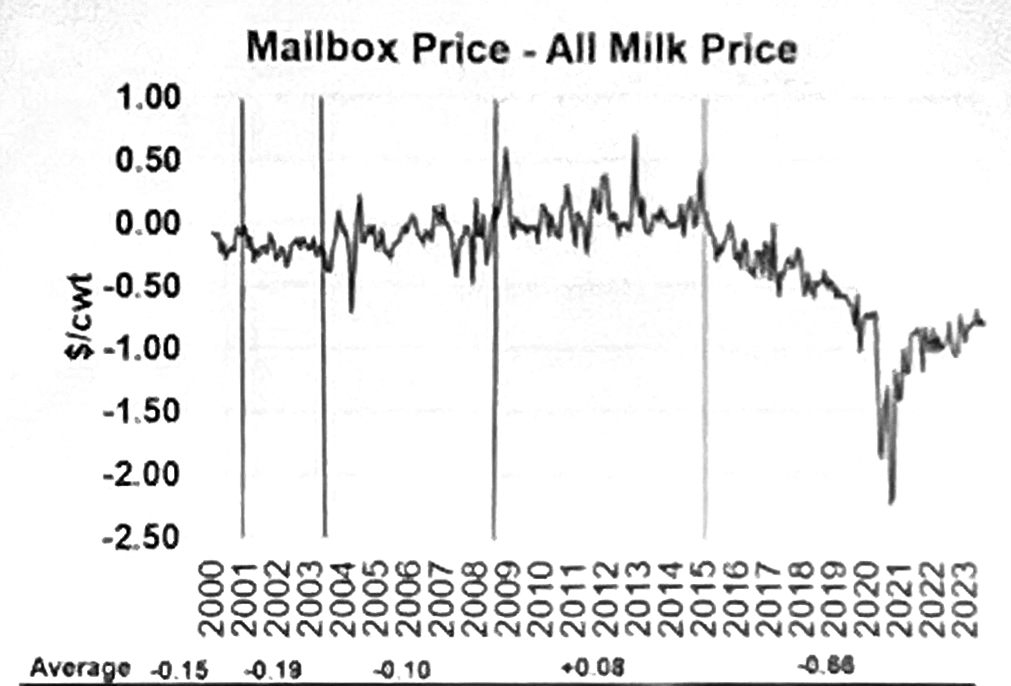
He showed charts tracking the difference between the All Milk price and Mailbox price (above), progressively negative since 2015, reflecting higher transportation costs and evaporation of over-order premiums, not to mention milk check assessments, marketing adjustments, balancing fees.

If regulated minimum prices are reduced, will processors voluntarily fill that gap by paying more premiums so producers have the financial wherewithal to fill the production gap?

Things are pretty bad for farmers right now in the milk markets that are based on cheese, where capacity has ramped up in the Central U.S., and where tough discussions are being had around kitchen tables about operating margins and the future.

Milk futures move lower

Milk futures were unevenly lower this week, with most of the downward pressure on first-half 2024 contracts for both Class III and IV milk. The spread between Class III and IV milk — according to this week’s CME futures markets continues to be range between $2.20 and $4.00 per cwt in every single month of 2024, well above the $1.48 mark where the ‘averaging’ formula is a loser for orderly marketing compared with the ‘higher of.’ On the close Wed., Feb. 14, Class III milk futures for the next 12 months averaged $17.91, down 10 cents from the previous Wednesday. Class IV milk contracts average was $20.57 — down 7 cents.

Back on the see-saw

The daily CME spot market for dairy products was mixed and mostly lower this week, except dry whey was higher and barrel cheese fully steady. Spot butter was pegged at $2.7175/lb, down a nickel from a week ago with zero loads trading. Grade A nonfat dry milk was $1.18/lb, down 4 cents with a single load changing hands. On the Class III side, 40-lb block Cheddar gave up 7 cents in Wednesday’s session, alone, when declining bids with no trades left the spot price pegged at $1.5150/lb, down 11 cents from the previous week. Barrel trade had moved higher earlier in the week, but a 2-penny loss Wednesday left the spot price firm on the week at $1.5750/lb with 2 loads trading. Dry whey at 52 cents/lb was 3 cents higher than a week ago with no trades.

-30-

Politics of whole milk: Dairies go bankrupt, Vilsack gets top pay

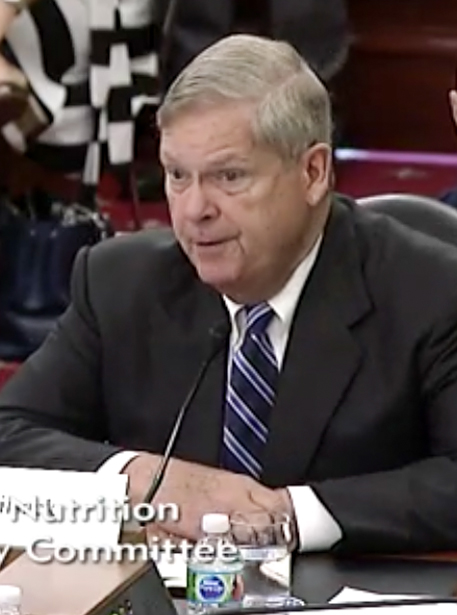
When it comes to ‘politics,’ DMI talks out of both sides of the mouth: Top paid executive Tom Vilsack shown here in June asking Senate Ag Committee for government ‘support’ to pay DMI’s ‘pilot farms’ to develop practices for ‘U.S. Dairy’ to reach Net Zero emissions. But ask if DMI can  support whole milk in schools and the response is: “Oh no, that is ‘political’ and we aren’t ‘allowed’ to be ‘political.'” Truth is, DMI’s current top-paid executive — Tom Vilsack — is the one who while serving as Ag Secretary, spearheaded the removal of whole milk from schools in the first place.

By Sherry Bunting, Farmshine, Friday, Dec. 6, 2019

The former Ag Secretary who was instrumental in removing Whole Milk from schools is now the highest-paid executive at Dairy Management Inc. (DMI) whose virtual $1 million/year in 2018 came from mandatory checkoff funds paid by dairy farmers who are going bankrupt. 

On Monday (Dec. 2), the Milwaukee Journal Sentinel reported that their early look at DMI’s IRS 990 forms for fiscal 2018 show that Tom Vilsack became the highest paid DMI executive earning $999,921 in 2018, which was his first full year as an executive vice president of DMI, president and CEO of DMI’s U.S. Dairy Export Council (USDEC), and defacto leader of the Net Zero Project and sustainability and innovation platforms of the Innovation Center for U.S. Dairy.

Let’s go back a decade. Think back to 2009. The bottom fell out of the dairy markets. It was arguably the worst of economic times in memory for dairy farmers as farm level milk prices fell to $10, and equity in the value of cow herds plummeted. 

As farmers were busy trying to save their farms, and the industry and lawmakers were busy outwardly debating National Milk’s version of “supply management” in the Farm Bill that year, dairy leaders and regulators holding overlapping former and current positions within USDA, DMI, NMPF, DFA and IDFA, began charting a future for dairy in terms of pursuing international dominance, developing “sustainability” frameworks, partnering for “innovation”, and focusing on the zone of investment for consolidating the milk production footprint with ultrafiltration technology as the way to move milk without the water.

It all fits together, like pieces of a puzzle — with no picture on the box to show outwardly what it will all look like when complete.

Back in 2010, the Innovation Center for U.S. Dairy was busy on “sustainability” and getting fairlife ‘the better milk’ up and going, with the DMI Innovation Center’s sustainability council leader being none other than Fair Oaks’ / fairlife’s Dr. Mike McCloskey. 

Then Secretary of Agriculture Tom Vilsack was busy too that year. In addition to restricting school milk to fat-free and 1% and promulgating rules that listed Whole Milk as “prohibited” on school grounds during school hours, Vilsack was signing Memorandums of Understanding (MOU’s) with National Dairy Council to create GENYOUth to promote that dogma, and with DMI to link the “sustainability” framework of Vilsack’s USDA to the “sustainability” framework of DMI’s fledgling Innovation Center for U.S. Dairy.

Dairy farmers were coming out of 2008-09 devastation — starved for good news — and were encouraged by all this talk of innovation and sustainability and international markets because they thought it meant the industry was looking to sell more milk and dairy products in such a way as to raise prices paid to them for their milk. 

Who could question this high pursuit of innovation and sustainability and exports – right? That’s the trifecta, the holy grail.

2014’s high milk prices seemed to validate that all was going to be right with the dairy world. But most were not paying attention to the USDA / DMI alliance that was formed and growing — and what it might mean for the future.

Quietly – without much fanfare or protest – USDA began tightening milk restrictions in the school lunch program during this time. In fact, so quiet was this shift that many parents to this day do not realize their kids are getting watered-down milk, cheese, imitation butter, and half-beef-half-soy patties at school.

As the 2010 Dietary Guidelines were implemented, a democrat-controlled Congress passed the Healthy Hunger-Free Kids Act – under the avid lobbying efforts of President Obama’s USDA Secretary Tom Vilsack for the legislation that would tighten school lunch screws even more.

The dairy checkoff had already been called “government speech” in its 2005 Supreme Court defense, so with USDA’s blessing and encouragement – under Vilsack – the low-fat and fat-free dogma became entrenched and proliferated through the GENYOUth alliance. 

And it set the stage for a new era in dairy that today’s leaders speak of. We are hearing it now. A recent DFA newsletter tells members “milk must evolve to remain relevant.” DFA / NMPF chairman Randy Mooney stated last month that the industry needs to consolidate plants to make new products. Northeast DFA leaders heard from a food science writer and DMI contractor about how dairy proteins will complete plant-based diets during their recent meeting in Syracuse. Dairy dilution is all around us. And the industry points to Dean Foods’ bankruptcy as proof that Real Whole Milk isn’t good enough, isn’t sustainable. (Well, of course not, no one is truly marketing it and the government thanks to Vilsack is prohibiting kids from having it. This is not rocket science folks.)

Yes, folks, hindsight is 20/20. And here we are on the eve of 2020 with former Ag Secretary Vilsack – who was paid a $999,421 salary in 2018 from mandatory dairy producer checkoff funds and is now the top-paid DMI executive — to thank for the removal of Whole Milk and whole dairy products from our schools.

And no one cares to ask him to testify to Congress about why Whole Milk should be allowed in schools, but he is politically involved endorsing presidential candidates and writing their rural platforms, testifying in so many other discussions, including climate change and sustainability and seeking Senate approval of funds for Net Zero pilot farms.

Yes, folks, the dairy industry had and has Tom Vilsack — or vice versa.

See part two.

-30-

Who is empowering whom? PART ONE: Dairy check-off’s GENYOUth thin on milk.

AUTHOR’S NOTE: They call it “the dairy farmers’ youth wellness program” because it has been depicted as the brainchild of the National Dairy Council… But GENYOUth — including its flagship Fuel Up to Play 60 (FUTP60) — is thin on milk and threatens to steal even more demand as future milk drinkers are steered away from nutritious whole milk products. Meanwhile, the anti-animal and environmental NGO’s (non-governmental organizations) have been infiltrating new billionaire “sustainability” alliances poised to profit on the main course, while dairy farmers bow-down in hopes of crumbs. This is Part One of an investigative multi-part series.

Gala_Logo.png

Depicted above is the illustration used to promote and glorify the 2018 GENYOUth Gala that was held at the Ziegfeld Ballroom in New York City on Nov. 27. The “superheroes” sponsors are listed further down on the 2018 GENYOUth Gala website. PepsiCo was the “hero” sponsor at $150,000. Champion sponsors of $100,000 each were UnitedHealthcare, Corteva Agriscience, Inmar and fairlife. So-called “defender” sponsors included Domino’s, Ecolab, Jamba Juice, Land O’Lakes, NFLPA, SAP, Leprino Foods, Schreiber, Ameritrade, RBC Capital Markets and Omnicom Group, each of which gave $50,000.

By Sherry Bunting, from Farmshine, Friday, January 11, 2019

BROWNSTOWN, Pa. — How serious is the National Dairy Board about improving fluid milk sales? We see some renewed emphasis on this lately, but our most important sales — those to children in school — threaten to steal even more demand from the future as we lose future milk drinkers with the forced service of only fat-free and 1% low-fat milk in the school lunch and breakfast programs.

Recent studies show that children and teenagers in the poorest demographic of the U.S. population are leading the epidemic of obesity and diabetes. One study by University of Michigan Health System, for example, revealed that for every 1% increase in low-income status among school districts, there as a 1.17% increase in rates of overweight/obese students. Researchers used data collected from mandated screenings that began in Massachusetts schools in 2011, and the percentage of overweight/obese students was compared with the percentage of students in each district eligible for free and reduced school lunch, transitional aid or food stamps (SNAP).

The meals these students receive at school are their best two options for nutrition and satiety all day. There are few restrictions for cheap, high-carb, high-fructose-corn-syrup foods and beverages that can be purchased with SNAP cards, so what will they find at the end of the day for their hunger at home? Soda pop and Dollar Store snacks.

What role is the National Dairy Council and its GENYOUth program playing?

The GENYOUth collaboration is aimed at making “a lasting difference in the lives of children.” That sounds great, but what have been both the intended and unintended lasting consequences?

Certainly, there is a long list of dairy research projects funded by the NDC. That’s a good thing.

But where the rubber meets the road, GENYOUth and its flagship program Fuel Up to Play 60 (FUTP60) are aimed at promoting a “healthy lifestyle” that focuses on 60 minutes of physical activity daily and consumption of fruits and vegetables, whole grains and lean protein “including low-fat and fat-free dairy.”

For nearly 10 years, the dairy checkoff has parroted the Dietary Guidelines on dairy service to children (and adults) when it comes to institutional feeding — the largest category of the food economy and the place where seeds are planted for lifelong choices based on nutrition education and flavor.

Let’s look at how GENYOUth was launched in 2010.

At the Nov. 27, 2018 gala in New York City, NFL Commissioner Roger Goodell stated that GENYOUth was the concept of Dairy Management Inc (DMI) CEO Tom Gallagher. Gallagher today serves as chairman of the GENYOUth board.

In a YouTube video of Goodell’s remarks — before handing the coveted 2018 Vanguard Award to PepsiCo CEO Albert Carey — Goodell stated that Gallagher came to him with the idea for GENYOUth 10 years ago, which was then “founded” in 2010 as a partnership between the National Dairy Council (NDC) and the National Football League (NFL).

In fact, in its 2014 Progress Report, GENYOUth’s beginning is described as making “cultural shifts” in school nutrition and exercise, stating further that, “Through signing a six-way Memorandum of Understanding (MOU) between the National Dairy Council, the National Football League, and the U.S. Department of Agriculture, Education, and Health and Human Services, we have created a productive synergy that has made the sky the limit for GENYOUth.”

According to a report at its website, genyouthnow.org, the foundation seeks to “convene leaders in a movement to empower America’s youth to create a healthier future.”

The 2018 GENYOUth Gala in New York City was billed as “honoring America’s everyday superheroes” and the Vanguard Award, as mentioned, went to PepsiCo.

But let’s go back to the second gala on Dec. 7, 2017 aboard the Intrepid in New York City. Former U.S. Secretary of Agriculture Tom Vilsack — who now serves as CEO of dairy checkoff-funded U.S. Dairy Export Council (USDEC) — was presented with the Vanguard Award that year.

The GENYOUth website cited “Vilsack’s accomplishments for dairy farmers” under President Obama — for having “legislated to improve the health of America’s kids.”

More specifically, the Vilsack accolades stated that he partnered with First Lady Michelle Obama on her “Let’s Move!” initiative — “alongside GENYOUth to improve the health of America’s children.”

These words show the partnership the NDC / DMI has had with the Obama / Vilsack administration on shared goals of promoting exercise and low-fat / high carb diets for children and youth.

According to the former GENYOUth foundation website before it was revamped to genyouthnow.org, the Vanguard Award presentation to Vilsack was described in January 2018 as follows:

“Sec. Vilsack helped pass and implement the Healthy, Hunger-Free Kids Act to help combat child hunger and obesity by making the most significant improvements to U.S. school meals in 30 years.”

What was included in these “significant improvements” in 2010?

For starters, America’s schools were forced to offer only fat-free flavored milk and only 1% or fat-free white milk, while the screws were tightened on the requirement that less than 10% of a school meal’s calories could come from saturated fat and by reducing the total number of calories in a meal served to children at school, while at the same time putting both program and promotion emphasis on plant-based meals containing scant lean protein.

This means that not only are dairy producers prohibited from putting their best and most nutritious foot forward with future milk drinkers at school, the schools are forced to serve butter substitutes and imitation cheese or cheeses that are diluted with starch to decrease the amount of calories the students receive from fat).

During the Pennsylvania Dairy Summit in February 2018, keynote speaker Nina Teicholz, author of The Big Fat Surprise — without realizing the significance of her statement — put these USDA / GENYOUth ideas to shame. She stated:

“The fat we eat is not the fat we get. The idea that 60 minutes of exercise can make up for a bad diet is disingenuous. You can’t exercise your way out of a bad diet.”

And Teicholz backed up her statement with facts, studies and charts.

Her 2014 book details her 10-years investigation, revealing the lack of sound science to support low-fat diets. Not only are new studies bearing this out, old studies were found to have been “buried” by the National Institute of Health (NIH) and American Heart Association, because they did not support the fat-heart hypothesis of Ancel Keys.

GENYOUth and FUTP60 not only dutifully “followed” these government guidelines but in reality worked alongside the Obama administration to develop them and further the reach of this low-fat dogma.

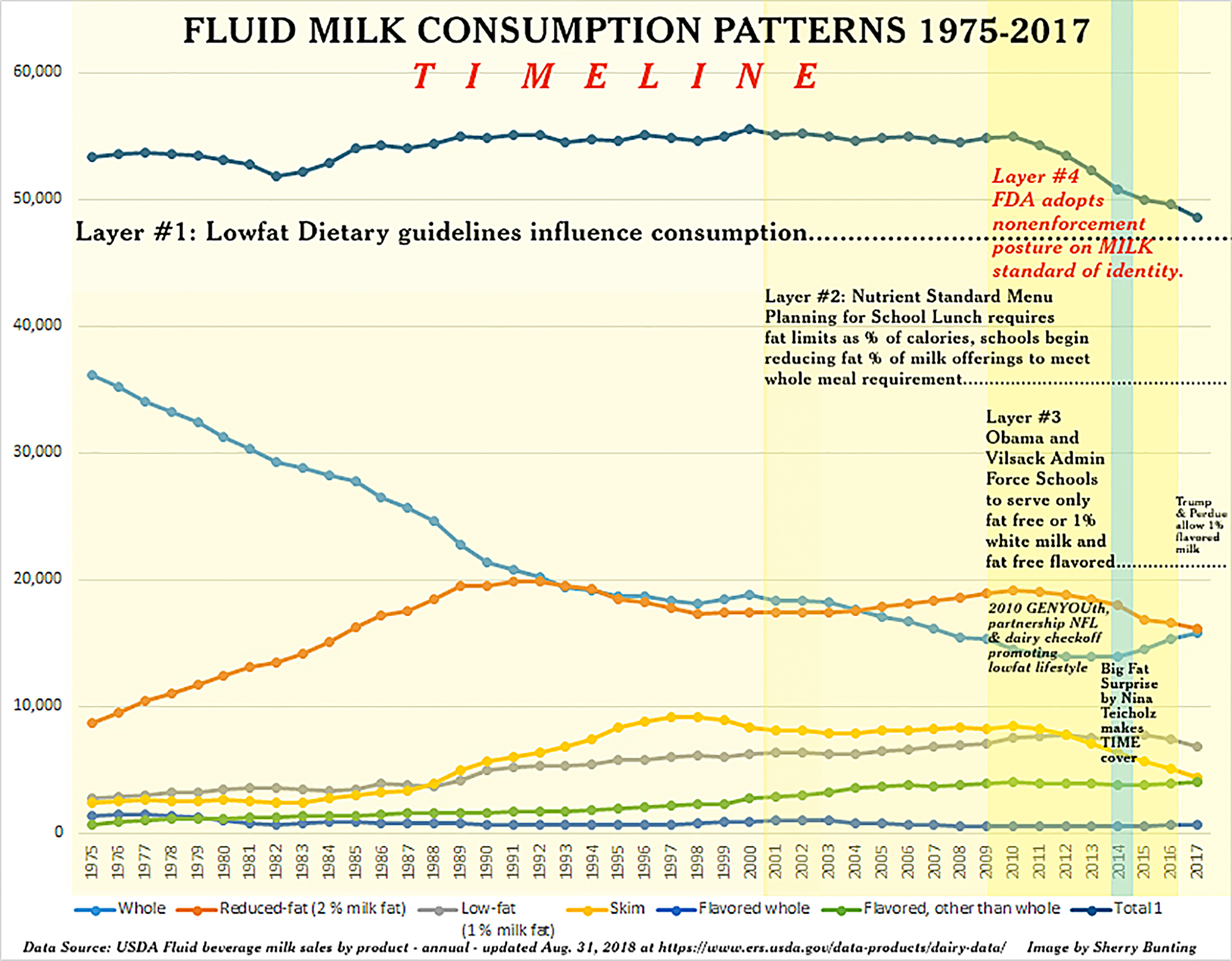
The implementation of those school milk rules have cost dairy farmers plenty in lost milk sales. Losses so steep that they drove the gradual declines in fluid milk consumption (see Fluid Milk Timeline chart below) plunging downward like a rock from 2010 through 2017 (most recent full-year figures)

FluidMilkTimeline-bunting.jpg

Timelines don’t lie. As we look at this fluid milk timeline, we can see the layered effects of government dietary policy, USDA requirements for fat-free milk (2010), that move occurring alongside the creation of GENYOUth (2010) and some reversal in whole milk trends moving higher after Nina Teicholz’s book Big Fat Surprise made the cover of Time magazine. Meanwhile, the past decade has also been one of FDA non-enforcement of milk’s standard of identity, allowing plant-based alternatives to take hold and proliferate. 

Bob Gray for the Northeast Association of Farm Cooperatives addressed these losses on a dairy policy forum panel in Washington exactly one year ago on January 8, 2018. Gray said: “For the last six years (2010 through 2016 data), we have not been able to sell 1% milk in the schools.”

He noted that in just the four years from 2012 to 2015, dairy producers had “lost 288 million half pints of sales to schoolchildren because of this move, alone.” And those losses continued through 2016 and 2017 and into 2018, despite the small move by the Trump administration to allow 1% flavored milk back into schools.

This is an uphill battle to turn around — what with all the fat-free and low-fat promotion and the fact that schools are already aligned with processors that prefer to keep the fat-free pipeline going.

In addition to GENYOUth honoring Secretary Vilsack with the 2017 Vanguard Award, the National Dairy Board provided him a checkoff-funded salaried position as CEO of USDEC, where his rallying cry has been to get export sales to 20% of expanding total milk production while Class I sales as a percentage of total milk production declined to below 20% by the end of 2017.

Remember, experts at various dairy market forums throughout 2018 have made the point that exports do not raise farm-level milk prices because they are “commodity clearing markets.”

But maybe that is the point.

If fluid milk consumption erodes as a percentage of milk production, the cost of milk to processors is reduced for the many other products competing globally for export sales to increase. Meanwhile, a pipeline for fat-free milk sales keeps the cost of milkfat for other products from accelerating in the farm milk check.

The highest-value class under the Federal Order pricing scheme is the shrinking piece of an expanding commodity-dairy-production-for-export pie.

Meanwhile, the past decade has been one of FDA non-enforcement of milk’s standard of identity, allowing plant-based alternatives to take hold and proliferate.

One can argue that the National Dairy Council — whether simply following USDA’s lead or by working alongside USDA to lead — has played right into the hands of GENYOUth ‘friend’ PepsiCo / Quaker.

Remember, Quaker was a company that DMI specifically partnered with a few years back, but the milk part of the Quaker Oatmeal promotion never really materialized, just like we don’t see the milk part promoted in any of the NFL’s Fuel Up to Play 60 spots. But the NFL is joined at the hip to PepsiCo with side-by-side logos during televised games.

Now, just six weeks after receiving the 2018 Vanguard award from GENYOUth, PepsiCo is launching its own Quaker Oat beverage.

In fact, PepsiCo CEO Albert Carey had the audacity to do a brief sales-pitch for what he called “our new oat milk” in his remarks after NFL commissioner Goodell handed him the highest GENYOUth award on behalf of the NFL and the National Dairy Council.

We’ll dig into that in future parts of this investigative series.

-30-