Senate Ag hearing overwhelmingly endorses whole milk in schools

By Sherry Bunting, Farmshine, April 4, 2025

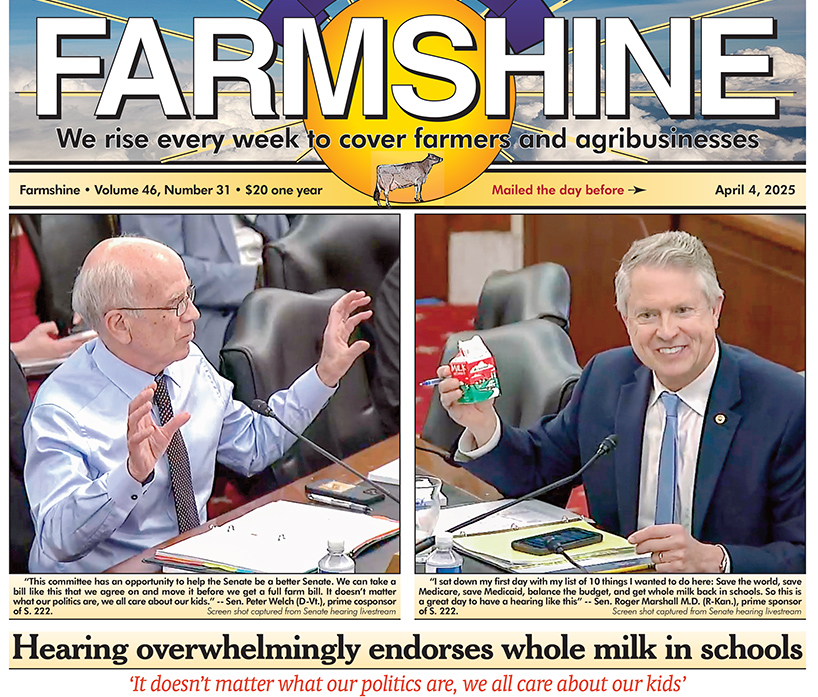
WASHINGTON, D.C. – We need to be the change-makers that our students and farmers both need. We need to bring back the ability to offer milk fat choice in schools, including nutrient dense whole milk – which, by the way, is just 3.25 to 3.5% fat,” said Krista Byler, a witnesses during the hearing by the U.S. Senate Committee on Agriculture, Forestry, and Nutrition to “review the Whole Milk for Healthy Kids Act, S. 222, and improve children’s health.”

April 1st, the day of the hearing, was a great day for America’s children and dairy farmers, and that’s no April Fools joke!

The livestreamed hearing opened with a reminder from Senate Ag Chairman John Boozman (R-Ark.) that the whole milk bill had passed the House in the last Congress “by an impressive 330 to 99 vote” and his desire to “make progress in the Senate.” 

Ranking Member Amy Klobuchar (D-Minn.) expressed her support for the bill and thanked Sen. Roger Marshall (R-Kan.) for introducing it. She also set the stage to broaden the hearing to other school nutrition matters. (To be covered in a separate article at another time).

The hearing ended with universal expressions of bipartisan support, thanking the Senate’s ‘milkman’ Marshall. Several Senators urged moving the bill forward as a standalone without delay.

“If we can do something that’s good, let’s do it, and then we’ll do the next thing that’s good,” said Senator Peter Welch (D-Vt.), the bill’s prime cosponsor, addressing the Chair. “This committee has an opportunity to help the Senate be a better Senate, we can take a bill like this that we agree on and move it before we get a full farm bill. It doesn’t matter what our politics are, we all care about our kids. I hope as we pursue this whole milk opportunity for our kids and our farmers that it’s the beginning of a real commitment to nutritious, locally produced, natural foods.”

In between the open and close, the Senate Ag Committee heard from and questioned five witnesses, spending the first chunk of time with Dr. Eve Stoody, Director of the Nutrition Guidance and Analysis Division at the Center for Nutrition Policy, within the Food Nutrition Service of the USDA. 

She is tasked with supporting the development of the Dietary Guidelines (DGA) since the 2010 edition and is the self-described career subject matter expert on the DGA process.

She revealed that 90% of Americans don’t consume the daily recommended amount of dairy, a statistic that has worsened over time, setting the stage for nutrient shortfalls.

“Across the board… whatever the form is, we need to have greater consumption of dairy,” she said, citing national survey data showing that on any given day, the percentage of adolescents reporting drinking milk was 75% in the 1970s, just under 50% in the early 2000s, and about 35% in the most recent data.

Chairman Boozman asked what justification was used to remove whole and 2% milk from schools in 2010?

Instead of addressing that question, specifically, Dr. Stoody said the current Dietary Guidelines recommend “most” dairy be low-fat or fat-free, but the guidelines (10 years later) in 2020 were constructed as overall dietary patterns with more flexibility.

“It’s also a reality that we kind of have a number of calories that individuals should consume, so across the guidelines we recommend consuming foods from all of those different food groups and that most should have little to no added sugars or saturated fat to help us stay within those calorie limits,” she said. “We don’t have a lot of room in the calories of the diet to consume milk and dairy with higher fat.”

Stoody parsed this as a population-level guideline: “That doesn’t mean whole milk and higher fat dairy can’t be part of a healthy diet, but it’s really important to look at the overall diet. The DGAs are there to provide flexibility based on needs and preferences.”

(This confusing ambiguity opened the door for the next panel to walk through, even though only two of the remaining four witnesses talked about the whole milk bill, while the other two talked exclusively about USDA’s recent cuts to programs like the local farm-to-school cooperative grants and concern about changes to how school lunch eligibility. Even those witnesses agreed that simplifying regulations and providing flexibility allows schools to focus on the quality of the meals instead of being bogged down by red tape.)
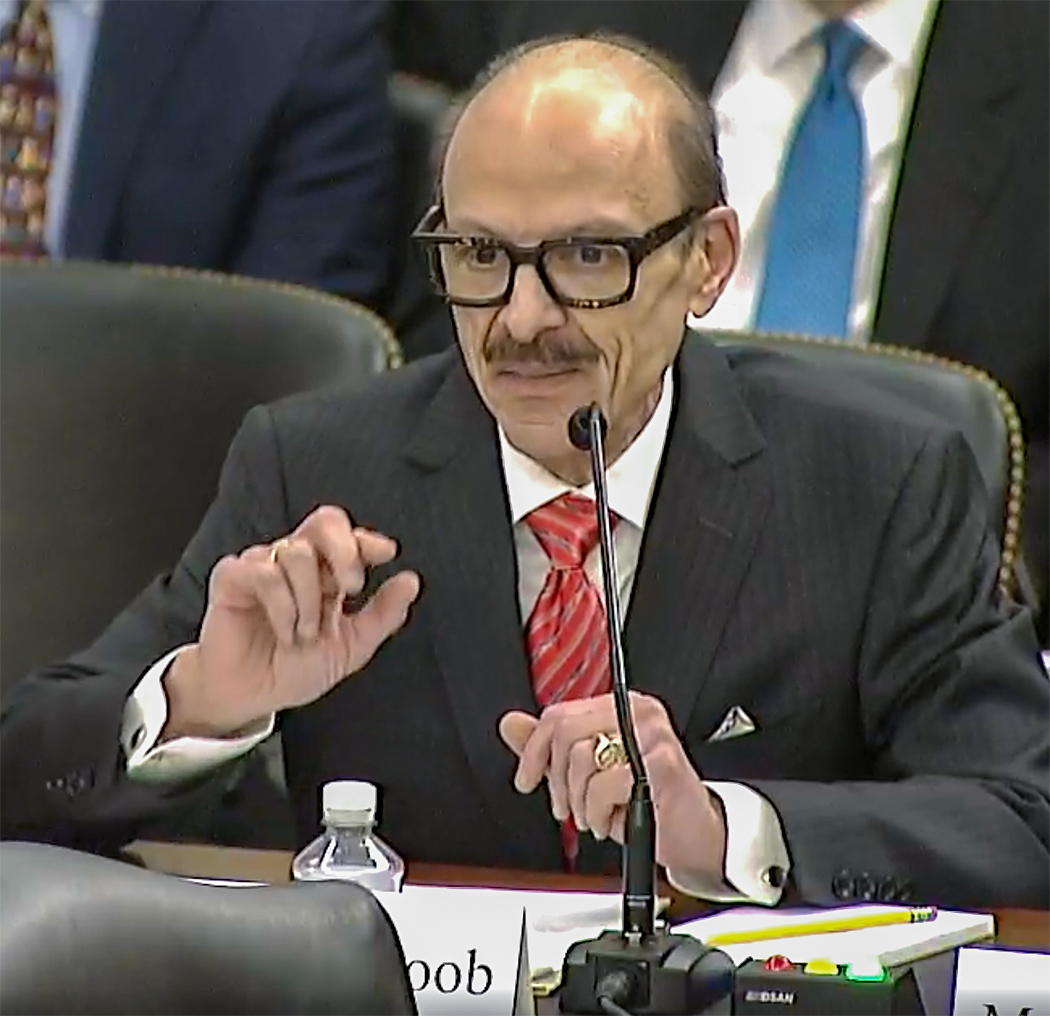
“I’m here because this issue matters to the children I serve, so it matters to me,” said witness Dr. Keith Ayoob, Associate Professor of Pediatric Nutrition at the Albert Einstein College of Medicine in New York City. He runs a diagnostic and treatment clinic working with mostly low-income children, and their families, in the Bronx.

“A plethora of research demonstrates consumption of cow’s milk provides children with better bone health, a lower risk of type II diabetes, and a lower risk for cardiovascular disease,” he shared, as he zeroed-in on milk’s 13 essential nutrients, including 3 of the 4 under consumed nutrients calcium, potassium and Vitamin D.

He said saturated fat does not occur in foods in isolation, and new research shows the protein-fat matrix “behaves differently” in the body. “While other foods that are lower in saturated fat can also lower cardiometabolic risk, they can’t deliver the 13 essential nutrients in milk. Milk delivers a package I’ve not been able to find in any other food or beverage.”
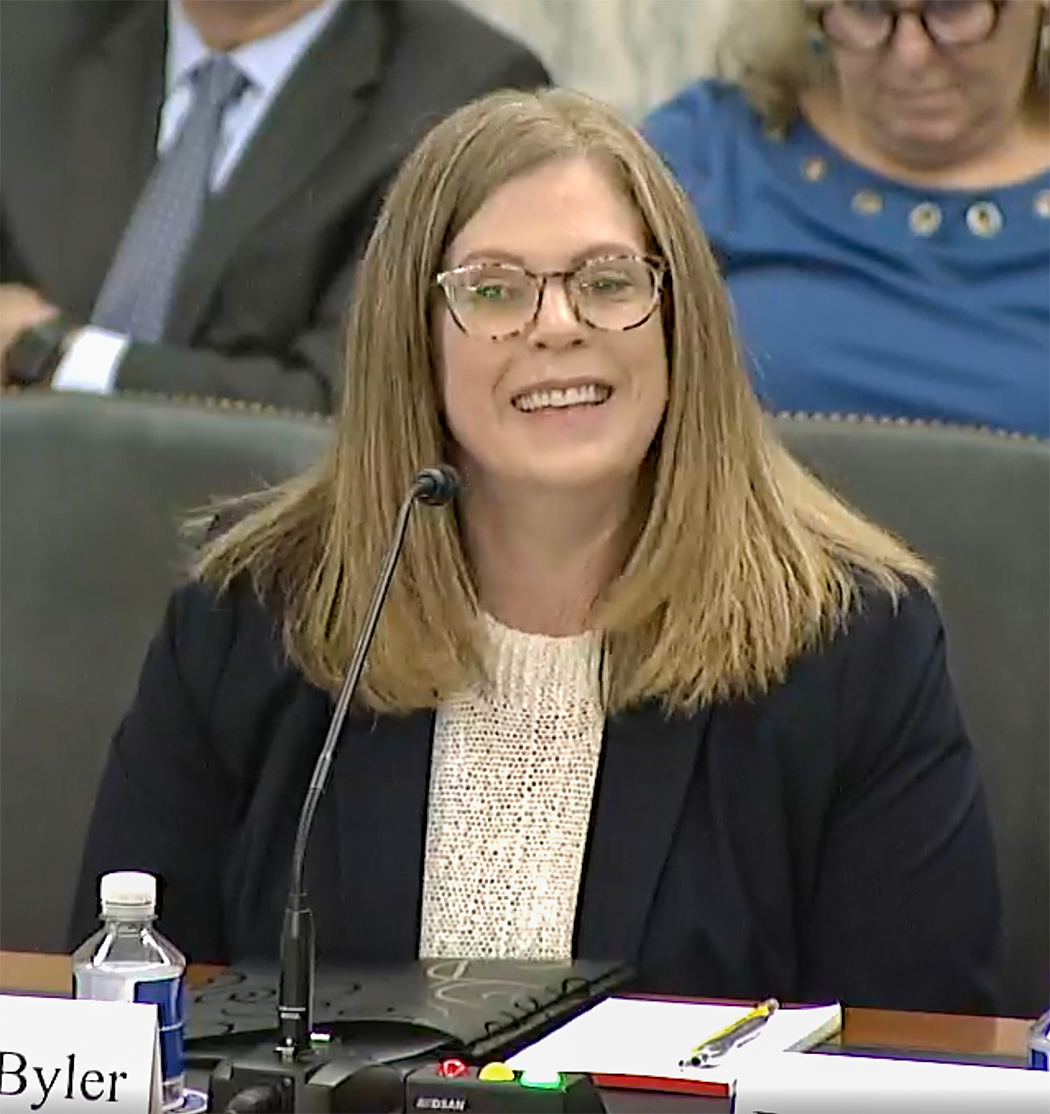
Krista Byler of Spartansburg, Pennsylvania testified next. She is the Foodservice Director and District Chef for the past 20 years at Union City Area School District, or as she puts it: “The professional chef turned lunch lady.”

The granddaughter and wife of former dairy farmers, she was the one witness to bring a combined experience in dairy farming, culinary arts, and childhood nutrition, saying she believes “access to good quality nutrient dense whole food is a basic right of education.”

Byler spoke from the heart, bringing experience and data. She described the impact of the 2010 Childhood Nutrition Reauthorization’s school milk changes on students and dairy farm families.

“It was heartbreaking… we were seeing a huge increase in waste and a huge decline in the amount of milk that I was actually ordering because our children were not choosing to take the milk,” she said.

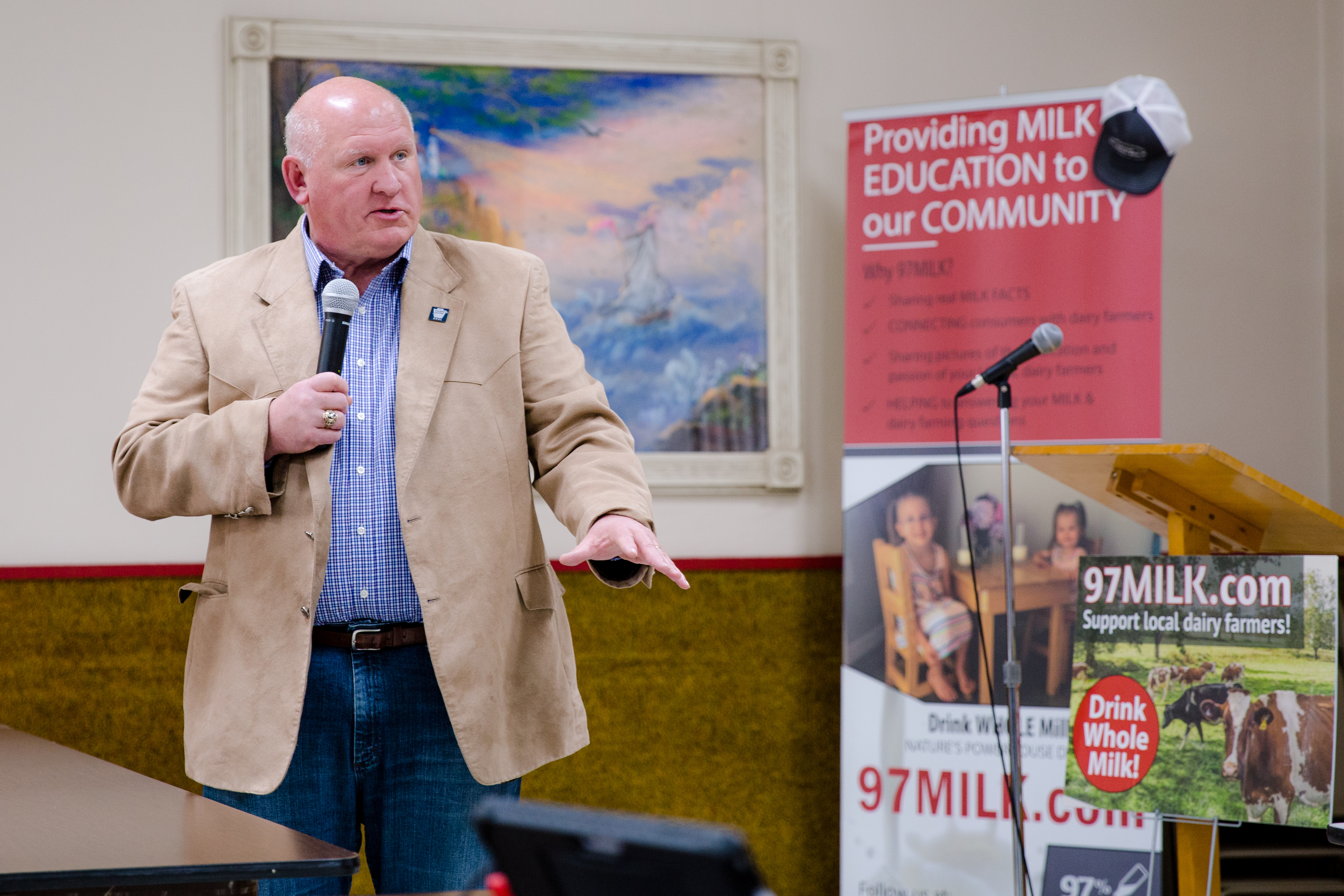
In 2018, Byler attended an event with the School Nutrition Association where she met Rep. Glenn ‘GT’ Thompson (R-Pa.) – the decade-long champion for The Whole Milk for Healthy Kids Act. 

At that meeting, Byler said she heard her peers also talking about the large amounts of waste. She was later introduced to the Grassroots Pennsylvania Dairy Advisory Committee of dairy farmers and school-involved parents, affiliated with what later became the separate milk education nonprofit 97 Milk.

(The Grassroots PA Dairy Advisory Committee is chaired by Bernie Morrissey, with current participants that include dairy farmers Nelson Troutman of Berks County (the Milk Baleboard painter), along with Dale Hoffman and Tricia Adams of Potter County, certified RN school nurse Christine Ebersole of Blair County, Dr. Ed Silverman, a retired internal medicine physician, Mike Sensenig of Sensenig’s Feed Mill, and this reporter who helps in communication. Like the separate board comprising 97 Milk, all the work is done by volunteers without compensation.)

This grassroots committee invited Byler to do some data collection. She explained that in the 2019-20 school year, with the blessing of her school board of directors, they conducted a school milk choice trial at the middle and high school, offering all levels of milkfat, both flavored and unflavored.

“The results are astounding.” Byler said, referencing her written testimony to find more complete data and survey results.

“What I want to really drive home are two main data points: The 50% increase in milk consumption (evidenced by ordering more milk) and the 95% — that’s right – the 95% reduction in milk waste, just because we offered a variety of milk choices that fit our students’ needs,” she said to the visibly astonished Senators who had previously unsuccessfully asked the first witness from USDA for such data.

“That’s incredible. It’s amazing when we give a little education and we give the choices, eventually the consumer makes the right choice,” said Sen. Marshall who is a medical doctor and prime sponsor of the bill in the Senate. He described his frustration in seeing the impact of osteoporosis and osteopenia, when bone density has not been built in the first 26 to 28 years of life.

Byler explained that the school student council helped collect, measure, and document the waste, and they “took a little heat after the 2020 school year when we (ended the trial) and went back to not being able to offer the variety. Overwhelmingly, students said they want something that is satisfying. Athletes, especially, were very vocal about wanting something that sticks with them. It’s a perfect recovery drink.”

Dr. Ayoob agreed: “My kids in my clinic have said that they find skim milk ‘watery.’ They may take that carton of milk. The school will get reimbursed. But I’m concerned that they drain that carton, not just take a few sips. Not only is there less food waste but more nutrition goes into the children.”

Sen. Ben Ray Lujan (D-Calif.) reminisced that he didn’t grow up with much money in the bank, but was blessed to have a dairy down the street. “Today when I get a carton of milk at the store, my habit is still to shake it because growing up that cream rose to the top, and we knew we had to shake it if we were going to enjoy it.”

“Our kids want to do better. They want to eat better. We have their attention,” said Sen. Jim Justice (R-W.V.), who spent his days with students as a longtime coach. “We have an opportunity here to step up. I am absolutely, wholeheartedly in favor of moving forward with whole milk.”

Every Senator present and asking questions expressed or implied support from both sides of the aisle.

With a nod to “the milkman Sen. Marshall,” Sen. Dick Durbin (D-Ill.) said he had to read through the list he had been provided of the organizations that are opposed to the bill, including the American Heart Association, American Academy of Pediatrics, and American Academy of Nutrition and Dietetics. He then asked the USDA representative what health organizations are for it? Dr. Stoody said she didn’t have that information.

(Perhaps more to the point, were her continued circular answers that forced this realization: The “population-level guidelines” get drilled down to individuals in governmental feeding environments, which then feed into the health and nutrition organizations and back again. Meanwhile, individual health and nutrition practitioners are out there seeing real people as individuals every day, wondering how to get off the spinning merry-go-round.)

Chairman Boozman asked Dr. Ayoob how policymakers have gotten it so wrong in drawing a correlation between whole milk and obesity?

“Actually, the correlation is inverse,” Dr. Ayoob declared. “A review of the studies in my written testimony show that greater consumption of dairy foods, including whole fat milk, has been associated with less obesity and less cardiometabolic risk.”

He said in 2010 when whole and 2% milk were first removed from school meals, obesity prevalence was about 17%. Since that removal, it has increased. “It’s now 21%, and it’s higher, about 25%, in black and Hispanic children, the population that I work with.” 

Ranking Member Klobuchar came back to calcium, asking Dr. Ayoob to explain why it’s so important at this stage.

“We don’t have our whole lives to build our bone bank. We have the first 25-ish years,” he replied. “If they skip milk in school, that might seem like it’s no big deal for a day, maybe even for a week. But if they forgo a glass of milk every day they are in school for 12 years, we’re going to graduate kids with a diploma and not very good bones. We owe our kids better than that. Osteoporosis and osteopenia are really pediatric diseases with adult consequences.”

Sen. Marshall drove this point home in his questions for all witnesses. He talked about the milk fat as carrying key vitamins and facilitating absorption. He and Dr. Ayoob talked back and forth about how replacement beverages, like soda, take the missed opportunity with milk and add further negative impacts.

“No matter what type of milk is offered in school, none of it is nutritious until students drink it, and they don’t drink it often enough, which presents nutrition and dietary gaps, especially in low-income groups, where 77% of a child’s opportunity for milk intake is from school meals,” said Dr. Ayoob.

“Chef Byler, what’s your advice to us as we look at bringing whole milk back to schools?” asked Sen. Marshall.

“It’s been said very well by others today, that we can do better,” she replied. “If we just bring back the milk choice to schools, we would see a huge increase in consumption, a huge decrease in waste, and satisfaction for our students would be through the roof.” 

-30-
Whole milk choice for schools takes center stage

Whole Milk for Healthy Kids Act reintroduced in style!

‘Most nutritious drink known to humankind’ takes center stage at Ag Secretary confirmation hearing

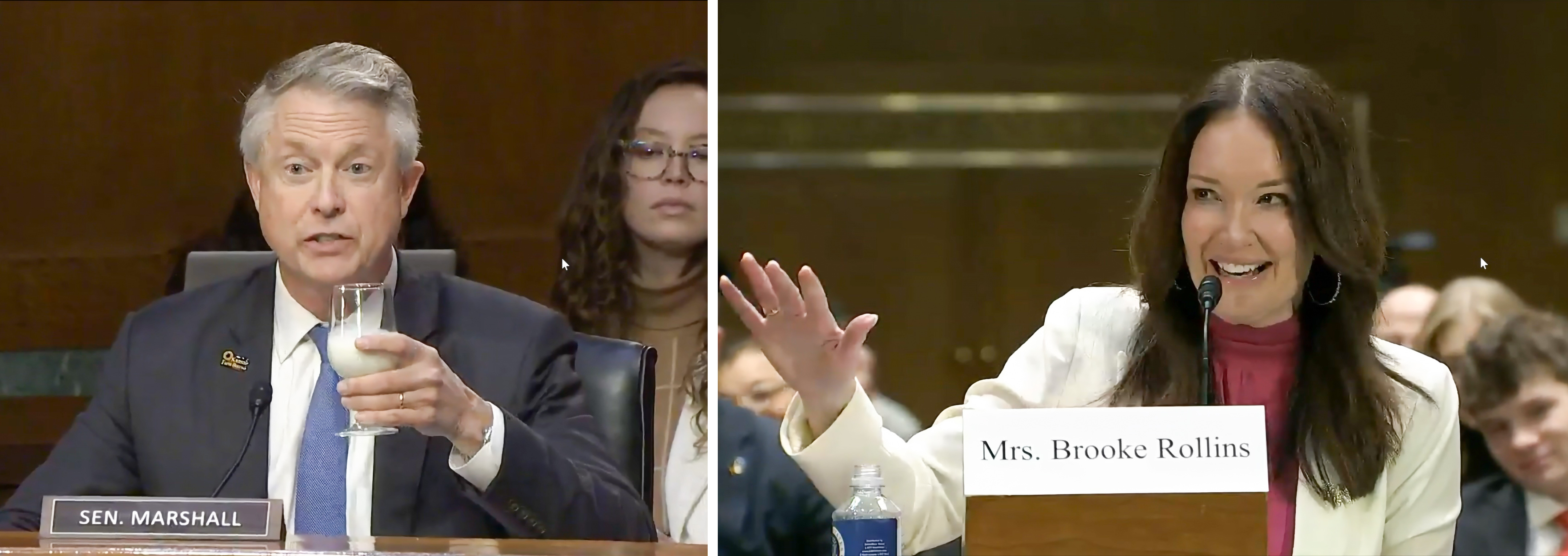
This split-screen moment captures Sen. Roger Marshall, M.D. and Agriculture Secretary Nominee Brooke Rollins during their confirmation hearing exchange on bringing whole milk choice back to schools. Sen. Marshall always comes prepared with THE MILK! Livestream screen capture by Sherry Bunting

From grassroots volunteers to halls of Congress, ‘hat’s off to 97 Milk’

By Sherry Bunting, Farmshine, January. 31, 2025

WASHINGTON, D.C. – It was the high point of the four-hour confirmation hearing on Jan. 23rd for President Trump’s Ag Secretary nominee Brooke Rollins, when Senator Roger Marshall, MD (R-Kan.) poured himself a glass of whole milk in front of the television cameras, and said:

Ms. Rollins, welcome. I want to know if you agree with me that whole milk is the most nutritious drink known to humankind and belongs in our school lunches.”

He then promptly took a big swig of nature’s nutrition powerhouse that American children have been banned from consuming at school meals since 2012.

Yes, there was a ripple of good-natured laughter throughout the room at the absurdity of it all – the absurdity that this nutrition powerhouse has actually been banned for 13 years on school grounds to even be bought with one’s own money from midnight before the start of the school day to 30 minutes after the end of the school day, per the 12-years of King Vilsack that Secretary Perdue’s interruption even failed to overturn.

The new Ag Secretary nominee Rollins responded with a hand motion to her mother two rows back among the family, friends, colleagues, ag teacher, fellow former FFA state officers and current little league team she coaches in attendance for the confirmation hearing, as she replied with a hearty and all-too-knowing laugh:

“Senator, I don’t know that you have met my mom – yet. But this is all we had in our refrigerator growing up – not anything else – just whole milk. She is absolutely never going to let us forget this – the fact that this is coming up! But yes, this hits home to me very quickly,” said Rollins.

On the very same day, whole milk champion U.S. Representative Glenn ‘GT’ Thompson (R-Pa.) with prime cosponsor and pediatrician Rep. Kim Schrier (D-Wash.), along with Senator Marshall and prime cosponsoring Senators Peter Welch (D-Vt.), Dave McCormick (R-Pa.) and John Fetterman (D-Pa.) led the re-introduction of the bipartisan, bicameral Whole Milk for Healthy Kids Act of 2025, known as H.R. 649 in the House with 90 total cosponsors to-date, and S. 222 in the Senate with 12 total cosponsors to-date.

The bill in its fifth attempt will allow unflavored and flavored whole (3.25 to 3.5% fat) and reduced-fat (2%) milk to once again be offered in school cafeterias, which are currently only permitted to have fat-free and 1% milk available for growing children, much of which is shunned or thrown away.

“Federal policy, based on flawed, outdated science has kept whole milk out of school cafeterias for more than a decade,” said Rep. Thompson in a Jan. 23rd press statement. “Milk provides 13 essential nutrients for growth and health, two key factors contributing to academic success. The Whole Milk for Healthy Kids Act of 2025 provides schools the flexibility they need to offer a variety of options, while supporting students and America’s hard-working dairy farmers.”

“As a pediatrician, I know how important a balanced and nutritious diet is for children’s health, well-being, and development,” added Rep. Schrier. “A healthy diet early in life leads to proper physical growth and improved academic performance and can set the foundation for lifelong healthy eating habits. Milk contains essential nutrients… This bill simply gives schools the option of providing the types of milk most kids prefer to drink.”

Sen. Marshall was blunt, saying, “(It) should never have been excluded from the National School Lunch Program. Now, 13 years after its removal, nearly 75% of children do not receive their recommended daily dairy intake. I believe in a healthier future for America, and by increasing kids’ access to whole milk in school cafeterias, we will help prevent diet-related diseases down the road, as well as encourage nutrient-rich diets for years to come.”

“Milk provides growing kids with key nutrients they need. Dairy is also an important part of Vermont’s culture and local economy, which is why our bipartisan bill to expand access to whole milk in our schools is a win for Vermont’s students and farmers,” said Sen. Welch.

Sen. McCormick said the bill “puts milk back in schools that growing kids actually want to drink. Pennsylvania’s dairy farmers supply this country (with it)… allowing schools to serve (it) in the lunchroom is just commonsense.

“Kids need it,” said Sen. Fetterman. “Let’s give them the option to enjoy whole milk again in schools – it’s good for them, they’ll actually drink it, and it supports our farmers. This bill is a simple solution that benefits everyone.”

Both National Milk Producers Federation (NMPF) and International Dairy Foods Association (IDFA) rushed to the forefront singing the bill’s praises and promptly issuing press releases, something that in past attempts took a little time.

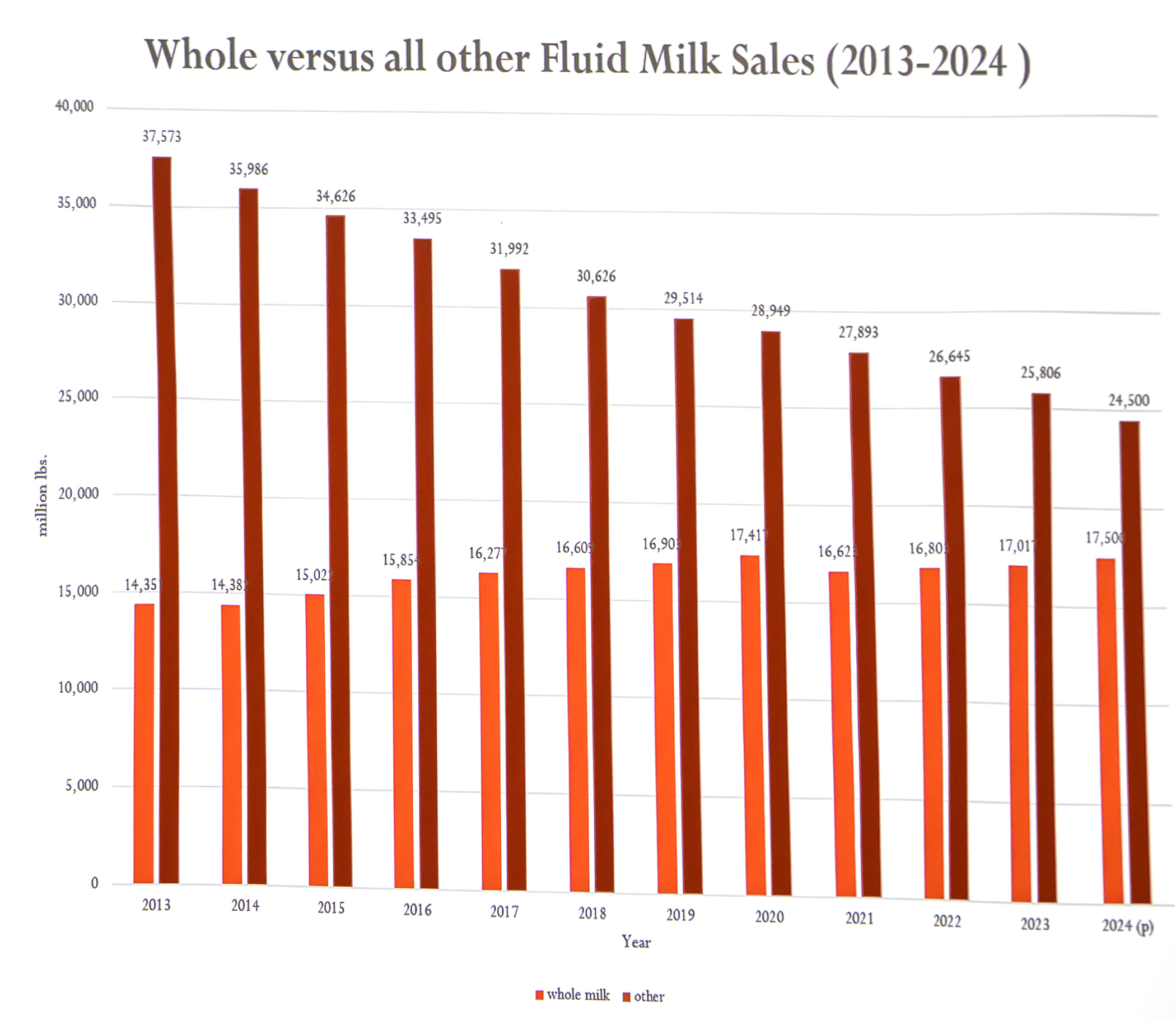
As longtime milk market guru Calvin Covington noted at the R&J Dairy Consulting seminar in eastern Lancaster County Jan. 28th, kudos go to the grassroots efforts. He showed the increase in whole milk sales nationally, while other fluid milk categories have declined. This has somewhat stabilized the steep losses the entire fluid milk category has suffered most steeply in the past 14 years. 

“My hat’s off to all of you and what you have done here in Pennsylvania, throughout the state and country, in promoting whole milk. I just wish other dairy farmers would be grassroots like you are and get involved,” said Covington. “Your work has paid off. Look at this graph. In 2013, whole milk sales were a little over 14 billion pounds. Last year (2024 with 11 months of data) I’m estimating 17.5 billion pounds. Whole milk is coming up, and everything else is going down.”

Covington dug into the graph (above) further to show that in 2019, the amount of whole milk sold was 16.9 billion pounds. “But look what happened in 2020, it jumped up to 17.4 and then back down to 16.62 in 2021. That was the pandemic. People were home. Schools were closed,” he said.

“When they were home, they drank good-tasting milk, but unfortunately when the schools opened back up, they had to go back to the other stuff. But my hat’s off to what you’ve done here. We’re selling more whole milk, and one thing people forget is that 100 pounds of Class I milk sales with higher fat content — last year it averaged 2.4 in this market compared to what it was 15 years ago when it averaged less than 2% — the more fat sold in Class I milk, the more income for you as dairy farmers. Class I butterfat is worth more than butterfat in the other markets, so my hat’s off to what you’re doing.”

(Author’s Note: Yes, Covington is speaking of the good work, the hard work, of 97 Milk volunteers who formed the non-profit in 2019 after dairy farmer Nelson Troutman’s painted bales began appearing. This good work is sustained by a handful of volunteers and donations. Just think what could be accomplished with more involvement. One of those volunteers is Jackie Behr of R&J, who puts her marketing skills to work for 97 Milk. She reminded farmers that donations are needed to keep the milk education movement going. An Amish Wedding Feast fundraiser is scheduled for Feb. 8 at Solanco Fairgrounds, with sponsorships still available. The next 97 Milk meeting open to all dairy farmers is March 25 at Durlach-Mt. Airy Fire Hall near Ephrata, Pennsylvania. Check out 97milk.com to learn more about the milk education movement, and hit the donate tab to find out how you can help.)

-30-

House Ag Chair and new Ranking Member share bipartisan priorities at Farm Show listening session

Whole milk, new farm bill top their bipartisan to-do list

By Sherry Bunting, Farmshine, Jan. 17, 2025

HARRISBURG, Pa. – Bipartisan priorities were evident — especially on getting whole milk back in schools and completing a new farm bill — during Rep. Glenn ‘GT’ Thompson’s annual listening session on opening day of the Pennsylvania Farm Show Jan. 4th in Harrisburg.

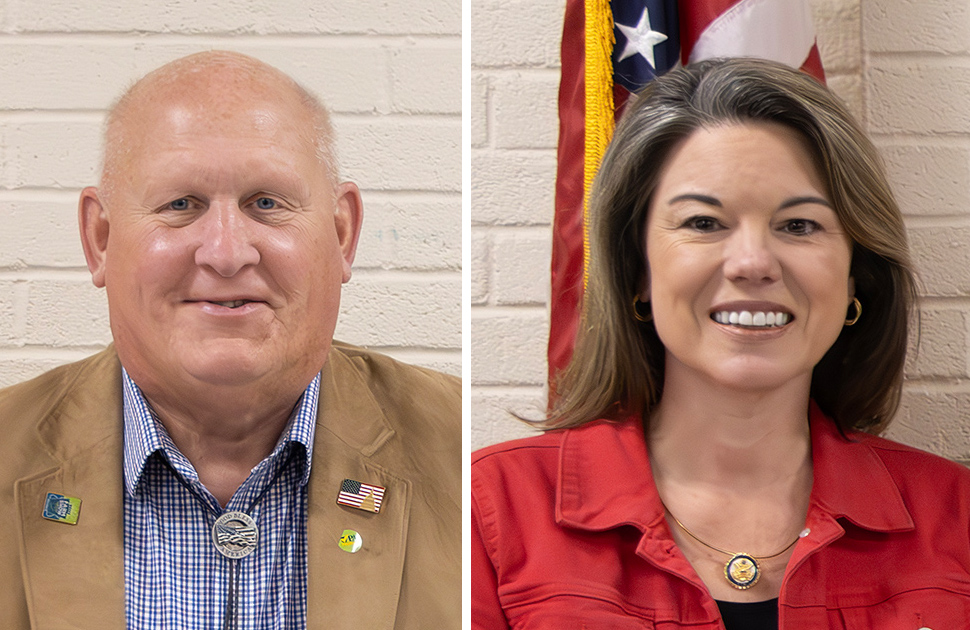
With a thin Republican House majority, Thompson, who represents the largely rural 15th district of north central Pennsylvania, will continue as Chairman of the Ag Committee. 

He introduced the more than 100 attendees to the Ag Committee’s new top Democrat, Ranking Member Angie Craig, who represents the mostly rural 2nd district of southeast Minnesota.

They were joined by Ag Committee and Ag Appropriations Committee member, Rep. Chellie Pingree, representing the 1st district of Maine, and by Pennsylvania Secretary of Agriculture Russell Redding.

Whole milk

“We got really close to getting this done,” said Thompson about his Whole Milk for Healthy Kids Act after Berks County dairy farmer Nelson Troutman with the Grassroots Pennsylvania Dairy Advisory Committee asked: What’s next for the bill in the new 2025-26 Congress?

“We have to start over, but there is a lot more support this time,” Thompson replied. He doesn’t see any obstacles on the House side after overwhelming bipartisan support in the 2023 floor vote.

He expects the bill to move quickly through the Education and Workforce Committee under its new Chairman Tim Walberg (R-Mich.), a whole milk bill cosponsor. Then Thompson will work with House leadership to get it on the calendar for a 2025 vote.

He said the Senate side also looks “very promising” as Sen. John Boozman (R-Ark), a supporter of the bill, replaces former Ag Committee Chair Debbie Stabenow (D-Mich.) who had blocked it.

Craig gave further assurance. She and the new Ag Committee Ranking Member on the Senate side, Amy Klobuchar (D-Minn.), are working together on this. “We do not see what we saw last time on the Democratic side to get this done for GT,” said Craig.

Both are Democrats from Minnesota who previously cosponsored the bill – Craig on the House side, Klobuchar on the Senate side.

Thompson credited the education and leadership of the Grassroots Pennsylvania Dairy Advisory Committee and 97 Milk in raising awareness and support. “The grassroots effort also helped improve the bill by suggesting language that makes sure the calories don’t count toward the fat in the school meal,” he said.

Pingree is also a big supporter of whole milk in schools. She was “amazed” to see all the Drink Whole Milk signs, banners, and painted bales while visiting her brother-in-law in Lancaster County, Pennsylvania. 

“I don’t know too many states where you see something this interesting while you’re driving down the road. It’s pretty impressive. It has spread far and wide,” she noted.

Congresswoman Chellie Pingree (D-Maine) was “impressed” by the Drink Whole Milk signs along roadsides when she spent time in Lancaster County, Pennsylvania. That was music to the ears of Berks County dairy farmer Nelson Troutman with the Grassroots Pennsylvania Dairy Advisory Committee. His original painted round bales in December 2018 motivated the launch of the 97 Milk education movement in February 2019. It is run by volunteers and donations at 97milk.com

ESL milk

Troutman asked if the bill could address extended shelf life (ESL) milk in schools. He is concerned about taste and acceptance by students, saying “schools should only be allowed to serve ESL milk if that’s the only option available to them.”

His concern arises from the volume of new plant capacity coming online across the country for ESL and aseptic shelf-stable milk packaging, along with new Federal Milk Marketing Order formulas that will price Class I milk differently based on shelf life. This creates potential competitive issues, especially in Pennsylvania, for bottlers of conventionally pasteurized milk that tends to be more local vying for school contracts with ESL milk coming from potentially more distant locations.

Farm-to-School

State lawmakers and young people in attendance voiced further concerns about the quality of school meals and the practice of schools shipping-in prepackaged meals prepared out-of-state, leaving Pennsylvania agriculture out of the loop. 

They requested incentives for local farm-to-school food programs. Frank Stoltzfus, a 9th generation farmer from Lancaster County pointed to the PA Beef to PA Schools program as a successful example.

These discussions come under the jurisdiction of the House Education and Workforce Committee and its “long overdue overhaul,” said Thompson: “The Childhood Nutrition Reauthorization is where we reform and refine to update school meals. I’ll be encouraging Chairman Walberg that we do that reauthorization, and this (ESL question) is something we can certainly take a look at.”

Pingree noted “some farm bill funding also goes to school meals, and we can put more into resupplying kitchens for on-site meal prep and local procurement.”

Nutrition overhaul

The last time Congress did a Childhood Nutrition Reauthorization was in 2010, when it tied school meals more strictly to the Dietary Guidelines for Americans (DGAs).

“When it comes to nutrition, if kids won’t eat it, then it’s not nutritional, and we are seeing a lot of waste today,” Thompson observed.

On that score, he pointed to “good reforms” to the Dietary Guidelines process that will again be part of the markup of the farm bill to “take some of the food politics out of the process coming from the so-called ‘experts.’ We want science-based not agenda-based guidelines.”

Farm bill

Asked about a timeline for the new farm bill, Thompson was optimistic. New committees are still being populated, and new members will need some farm bill education.

“But I would love to see this farm bill go to committee markup in the first quarter of this year — that is my goal – and then see it move quickly to the floor,” he said in a Farmshine interview after the event. “We will continue to do listening sessions, but I want to move ahead. We’ve had great input from all across the country, but I do think it’s important that we keep listening and touching base.”

Both he and Craig shared concerns about nosediving grain prices and net farm income. They differed on what constitutes cuts vs. cost-control on the Supplemental Nutrition Assistance Program (SNAP) that makes up the bulk of the now over $1 trillion farm bill. They both want the Inflation Reduction Act (IRA) funds pulled into the conservation title and baseline, but they differ on removing the IRA’s climate mandates for these funds.

Thompson warned about competition from conservatives who are interested in using these funds as ‘pay-fors’ on tax policy, which he said Ag Committee Republicans would oppose. “I want these IRA funds in this farm bill,” he said.

Craig said the IRA funds best practices like carbon sequestration, and Pingree said she likes the focus on resilience for healthy soils. They pointed to carbon markets that see the value and lauded Sec. Vilsack’s use of $3 billion in CCC funds for pilot projects that will “help give us better metrics.”

While there is general agreement that most practices on farms improve the planet, the question is – how do the things farmers already do get monetized?

“They are not getting enough credit for their ecosystem services — carbon sequestration, air quality, water quality, filtration of rain. Farmers improve our environment just by farming,” said former State Senator Mike Brubaker. “Is there some way for them to get paid?”

SUSTAINS Act

Thompson said the farm bill does not address this specifically, but legislation passed in 2022 includes the SUSTAINS Act, which he described as “providing a framework for private industry to be involved.”

Corporations and foundations can donate funds to USDA for conservation purposes, like improving technical assistance for more farmers to have access to popular programs like EQIP. He cited a “great return on investment” from Chesapeake Bay Foundation initiatives as an example.

But he pushed back on the Ag Secretary’s use of CCC funds for such purposes because administrations come and go, with their own changing priorities.

“Having certainty going forward is incredibly important,” he said. “Sec. Vilsack wanted to do things by regulation and his interpretation of how CCC funds could be used. He should have come to us (Congress), instead.”

Likewise, concerns were voiced about emerging land use policies at local, county, state and federal levels.

Renewable energy

Asked for their views on traditional and alternative energy, a bipartisan preference emerged for balancing affordable and renewable sources with science, technology and innovation as “pathways for solutions.”

“We need ‘all of the above’ because energy will be a mix for a very long time,” said Pingree. “But we have to stay in this (renewable) dialog.”

Thompson said the ultimate destination of the Farm Show butter sculpture — a digester on a Pennsylvania dairy farm — is a good example of renewable energy produced from cow manure and food waste.

Craig said biofuels through E15 standards are vital for corn and soybean farmers in her district of Minnesota, with new biobased aviation fuel standards an exciting opportunity that U.S. farmers should benefit from, not imported corn from Brazil.

“Our farmers have to be at the forefront of it, we have to get this right,” said Craig. “As Ranking Member, I’ve got to manage my caucus just like GT does as Chairman, to work together for the right solutions, which are probably somewhere in the middle.”

Food security

Questions were also raised about invasive species, animal health, and safeguarding the food supply — especially in regard to inspection of border crossings for invasive pests that threaten all types of agriculture and novel cross-species migration of highly pathogenic avian influenza (HPAI H5N1) in poultry and now dairy operations.

“We have to make sure we keep investing in our laboratories, inspections, and research,” said Thompson.

According to Redding, the Pennsylvania Diagnostic Laboratories System (PADLS) was born out of the poultry industry’s first difficult encounter with avian influenza back in the early 1980s. Today PADLS is instrumental as the state is one of the first to enter the mandatory national bulk milk testing strategy, and has established some protocols credited to the poultry industry.

He stressed the importance of cross-species engagement between Pennsylvania’s top two ag sectors of poultry and dairy, where biosecurity is essential.

“We’re at about 100% of milk representing our nearly 5000 dairy farms, and we’ve not found (H5N1) on the third cycle of testing now,” Redding reported. “The difficulty with a national strategy is finding a model that fits the diversity of all the states.”

Craig said HPAI is a big concern for her home state of Minnesota, which is No. 1 in turkey production and No. 7 in dairy.

They look forward to working with the new U.S. Secretary of Agriculture on what the national strategy looks like going forward “without overburdening the farmers.”

-30-

Good news may trump bad nutrition policies

Editorial Analysis: Tumultuous 2024 spills over into 2025 – Part One

By Sherry Bunting, Farmshine, January 3, 2025

EAST EARL, Pa. – Year 2024 was tumultuous, and 2025 is shaping up to be equally, if not more so. Spilling over from 2024 into 2025 are these three areas of potential for good news to trump bad nutrition policies that are having negative impacts on dairy farmers and consumers.

Farm bill and whole milk bill

Both the farm bill and the whole milk bill showed promise at the start of 2024. No one championed the two pieces of legislation more than House Ag Committee Chairman Glenn ‘GT’ Thompson (R-15th-Pa.). He even found a way to tie them together — on the House side.

The Whole Milk for Healthy Kids Act made it farther than it ever has in the four legislative sessions in which Thompson introduced it over the past 8 to 10 years. It reached the U.S. House floor for the first time! But even the overwhelming bipartisan House vote to approve it 330 to 99 at the end of 2023 was not enough to seal the deal in 2024.

That’s because over in the U.S. Senate, then Ag Committee Chairwoman Debbie Stabenow (D-Mich.) blocked it from consideration — despite over half her committee signing on as cosponsors.

GT Thompson, found a workaround to include it in the House farm bill, which passed his Ag Committee on a bipartisan vote in May. The language was also part of the Senate Republicans’ draft farm bill under Ranking Member John Boozman (R-Ark.)

It too fell victim to Stabenow dragging her feet in the Senate. By the time the Ag Chairwoman released a full-text version of the Senate Democrats’ farm bill, little more than 30 days remained in the 2023-24 legislative session.

Key sticking points were the House focus on dollars for the farm side of the five-year package. It put the extra USDA-approved Thrifty Food Plan funding into the overall baseline for SNAP dollars and brought Inflation Reduction Act climate-smart funds under the farm bill umbrella while removing the methane mandates to allow states and regions to prioritize other conservation goals, like the popular and oversubscribed EQIP program.

Attempts to broker a farm bill deal failed, and on Dec. 20, another one-year extension of the current 2018 farm bill was passed in the continuing resolution that keeps the government funded into the first part of 2025, without amendments for things like whole milk in schools. However, Congress did manage to provide $110 billion of disaster relief for 2022-24 hurricanes, wildfires, and other events. Of this, roughly $25 billion will go to affected farmers and ranchers, plus another $10 billion in economic disaster relief for agriculture.

Looking ahead, there is good news for the farm bill and whole milk bill in the new 2025-26 legislative session. The House Ag Committee will continue under Rep. GT Thompson’s leadership as Chairman. On the Senate side, whole milk friendly Boozman will chair the Ag Committee. With Stabenow retiring, Sen. Amy Klobuchar (D-Minn.) will serve as Ranking Member, and she previously signed on as a Whole Milk for Healthy Kids Act cosponsor in March 2024.

The whole milk bill will have to start over again in the Education and Workforce Committee with another vote on the House floor. It was enthusiastically supported by prior Education Committee Chairwoman Virginia Foxx (R-5th-N.C.). Her years of chairing this committee have expired, but the good news is Rep. Tim Walberg (R-5th-Mich.) will step in, and he was an early cosponsor of the Whole Milk for Healthy Kids Act in the 2021-22 and 2023-24 legislative sessions.

New Dietary Guidelines

The 2025-30 Dietary Guidelines Advisory Committee (DGAC) submitted its ‘Scientific Report’ to the outgoing USDA and HHS Secretaries on Dec. 19, 2024 — just 40 days before they head out the door to be replaced by incoming Trump appointees.

The Report is the guidance of the so-called ‘expert committee’ that reviews evidence and makes recommendations for the Secretaries of USDA and HHS to formalize into the 2025-30 Dietary Guidelines for Americans (DGAs). This process occurs every five years.

The DGAs are used in all USDA feeding programs, including school lunch, childhood daycare, and eldercare institutional feeding, as well as military mess halls. They also inform food offerings in many other controlled settings. 

The bad news is the Report has gone from being increasingly pro-plants over the past nine cycles to being outright anti-animal in this 10th cycle.

The good news is that dairy keeps its special spot on the so-called ‘My Plate.’ The bad news is that despite acknowledging evidence about the benefits of milkfat in nutrient dense milk and dairy foods, the DGAC rated the evidence as ‘limited’ – largely because USDA screened much of it out of the review process.

In the section on under-consumed nutrients of public health concern, especially for children and elders, the DGAC noted that whole and 2% milk were top sources of three of the four: Vit. D, calcium and potassium. Even this was not enough to persuade them to loosen the anti-fat grip that governs milk in schools, daycares and eldercare.

The DGAC states in its Report that their ‘limited access’ to research showing positive relationships between higher fat dairy and health outcomes was “too limited to change the Guidelines.”

They even doubled-down on the beverage category by recommending against flavor-sweetened fat-free and low-fat milk and that water be pushed as the primary beverage. 

In the Report, the DGAC also doubled-down on saturated fat with recommendations to “reduce butter, processed and unprocessed red meat, and dairy for replacement with a wide range of plant-based food sources, including plant-based protein foods, whole grains, vegetables, vegetable (seed) oils and spreads.”

This opens the door for more non-dairy substitutes beyond soy-milk, which is already allowed in the dairy category. In fact, the Report looks ahead to future cycles changing the name of the dairy category to broaden what qualifies as makers of new dairy alternatives improve their nutrition profiles via ultra-processing. At the same time, the DGAC punted the ball on the question they were given about “ultraprocessed” foods and beverages, stating they didn’t have access to enough evidence on health outcomes to answer that question. (The next HHS Secretary might have something to say about that.)

Other animal-based foods such as meat and eggs took a big hit this cycle. The 2025-30 Report uses stronger methods for discouraging consumption. They recommend moving peas, beans and lentils out of the vegetable category and into the protein category and listing them FIRST, followed by nuts and seeds, followed by seafood, then eggs, and lastly meat.

Once again ‘red meat’ is mentioned throughout the report as being lumped in with ‘processed meat’ even though not one stitch of research about negative health relationships with processed meats included any unprocessed red meat in the studies! Clearly, consumption of whole, healthy foods from cattle is in the crosshairs. This 10th edition of the Scientific Report just continues the trend. 

As in past cycles, a whole core of research on the neutral to beneficial relationships between consumption of saturated fat in high-protein, nutrient-dense foods was screened out of the DGAC’s review process by current Ag Secretary Vilsack’s USDA.

This Report essentially sets the stage for ultra-processed plant-based and bioengineered alternative proteins to play a larger role in the institutional meal preps of American schools, daycares, eldercare, and military.

But here’s the good news! The DGAC was late in finishing its 2025-30 Scientific Report!

The law requires a 60-day public comment period before USDA and HHS formulate the actual Guidelines for 2025-30. This mandatory comment period ends Feb. 10, 2025. Comments can be made at the Federal Register link at https://www.regulations.gov/document/HHS-OASH-2024-0017-0001

By the time the comment period ends, Vilsack and company will have left town. Let’s hope Senators confirm Trump appointees before the public comment period ends on Feb. 10 so their eyes are on this before the bureaucracy finishes the job.

This is a golden opportunity for the dairy and livestock sectors, along with health and nutrition professionals and health-conscious citizens to weigh-in. (Look for ways to participate in a future Farmshine.)

Meanwhile, commenters can remind the incoming Secretaries of how flawed the DGA process has become; how Americans, especially children, have become increasingly obese with increasing rates of chronic illness and underconsumption of key fat-soluble nutrients during the decades of the DGA’s increasingly restrictive anti-fat, anti-animal dogma.

Commenters should point out the fact that the Committee was not provided with all of the evidence on saturated fat. This is a message that is likely to land well with USDA Secretary designate Brooke Rollins and HHS Secretary designate Robert F. Kennedy Jr. In fact, RFK Jr. is on record opposing the low-fat dictates and has said nutrition will be among his first priorities, if he is confirmed by the Senate for the HHS post.

FDA’s final rule on ‘healthy’ labeling

In the mad rush at the end of 2024, the FDA released its final rule about using the term “healthy” on the label of foods and beverages.

This process was outlined in the White House National Strategy on Hunger, Nutrition and Health. FDA’s preliminary ‘healthy’ labeling rule was released on Sept. 28, 2022, on the first day of the first White House Nutrition Conference since the 1980s.

At that Conference, Ag Secretary Vilsack said: “The National Strategy’s approach is a whole of government approach that involves the entire federal family.” And President Biden said: “We have to give families a tool to keep them healthy. People need to know what they should be eating, and the FDA is using its authority around healthy labeling so you know what to eat.”

In short, the FDA’s role here is to restrict healthy label claims to foods and beverages that meet its criteria and allow them to also use a new FDA ‘healthy’ symbol that is still under development.

“Nutrient-dense foods that are encouraged by the Dietary Guidelines – vegetables, fruits, whole grains, fat-free and low-fat dairy, lean game meat, seafood, eggs, beans, peas, lentils, nuts, and seeds – with no added ingredients except for water, automatically qualify for the ‘healthy’ claim because of their nutrient profile and positive contribution to an overall healthy diet,” the FDA final rule states.

No surprise that whole milk (3.25% fat) will not qualify, nor will real full fat cheeses, yogurts, and other dairy foods that are not fat-free or low-fat (1%). Natural, unprocessed beef, pork and poultry are off the ‘healthy’ list too.

Specifically, the FDA’s final rule states: “To meet the updated criteria for the ‘healthy’ claim, a food product must: 1) contain a certain amount of food from at least one of the food groups or subgroups (such as fruit, vegetables, grains, fat-free and low-fat dairy and protein foods) as recommended by the Dietary Guidelines for Americans, and 2) meet specific limits for added sugars, saturated fat, and sodium. 

The fat and sodium criteria are a double-whammy against most real dairy cheeses. A single 1-oz slice of American, Swiss, or Cheddar won’t make the cut on saturated fat or sodium; even part-skim Mozzarella is slightly over the limit. Furthermore, low-fat, high-protein cottage cheese barely makes the cut on saturated fat, but far exceeds the new limit on sodium. Likewise, a typical yogurt cup only qualifies if it is low-fat or non-fat, and fruited yogurts must steer clear of added sugars.

Dairy can’t win in this labeling scheme unless products are made with virtually no saturated fat and far less sodium. To sell flavorless cardboard and chalk water that fails to deliver key fat-soluble nutrients, products will undergo more ultra-processing, and Americans will consume more artificial sweeteners.

Under dairy products, FDA’s final rule for ‘healthy’ label claims states: 1) Must contain a minimum of 2/3 cup food group equivalent of dairy, which includes soy; and 2) Each serving must have under 2.5 g of added sugar, under 230 mg sodium, and under 2 g saturated fat.

This means even a serving size of exactly 2/3 cup (6 oz) of 2% milk might barely squeak by, and a full cup (8 oz) of 1% or fat-free milk would be – you guessed it – ‘healthy’. Flavoring the fat-free and low-fat milk will not qualify, except by using artificial sweeteners to stay within added sugar limits.

Under protein foods, the FDA is even more restrictive. The only protein foods listed in the ‘healthy’ labeling final rule are: game meat, seafood, eggs, beans, peas, lentils, seeds, nuts, and soy products. Furthermore, these options must meet the criteria of less than 1 g added sugars, less than 230 mg sodium and less than 1 to 2 g saturated fat.

But here’s the good news! This FDA final rule (21 CFR Part 101, RIN 0910-AI13) falls under the Department of Health and Human Services (HHS). It’s not likely to sit well with HHS Secretary designate RFK Jr. The rule becomes effective Feb. 25, 2025. The compliance date is three years later, so there is hope of requesting HHS initiate a new rulemaking process under new HHS leadership.

Bottom line is all three of these bad nutrition policies impact consumer health and dairy farm economic health and are rooted in the flawed Dietary Guidelines process.

There is good news on that front in Congress as well. House Ag Committee Chairman GT Thompson included DGA reform and oversight in the farm bill that had passed his Committee in the 2023-24 legislative session. It is critical that this issue be part of the new farm bill that moves forward in the 2025-26 legislative session.

Part II in a future Farmshine will look at the tumultuous 2024 dairy markets and margins spilling over into 2025.

-30-

What’s the future for fluid milk?

Fluid milk sales are up, Whole Milk for Healthy Kids Act is moving. Meanwhile industry globalists put big bets on ESL, shelf-stable, with favor from Vilsack  

By Sherry Bunting, Farmshine, October 18, 2024

EAST EARL, Pa. — Protein is all the rage right now, and consumers are turning back to real milk as they realize its natural high quality protein benefits. Year-to-date fluid milk sales continue to outpace year ago, and that’s good news. Here are some key factors in the future of fluid milk in the U.S.

Fluid milk sales up!

July’s total packaged fluid milk sales more than recovered the June slump — in a big way, and August looks promising too.

USDA estimated packaged fluid milk sales at 3.4 billion pounds in July, up 4.3% year-on-year (YOY). This amplifies the pivotal year-to-date trend above year ago for the first time in decades (except the 2020 pandemic year).

Specifically, USDA’s Estimated Fluid Milk Product Sales Report for July, released in late September, noted conventional fluid milk sales total 3.7% higher YOY, with organic up 11.7%.

Conventional unflavored whole milk sales were up 4.7% YOY in July, while organic whole milk sales were up 17.1%.

Flavored whole milk sales were mixed because these sales rely upon what processors are willing to make and offer on store shelves, not necessarily reflecting what consumers want to buy. When fewer packages of whole flavored milk are offered, the full potential of sales are restrained.

Year-to-date (YTD) sales of all fluid milk products for the first seven months of 2024, at 24.7 billion pounds, are up 0.7% YOY, adjusted for Leap Year. Of this, YTD conventional whole milk sales for the first seven months of 2024, at 8.8 billion pounds, are up 2.1% and organic whole milk sales at 914 million pounds are up 12.6%.

The August report to be released in the coming weeks is shaping up similarly. August Class I utilization pounds reported last week by USDA are up 1.1% YOY and 1.1% YTD (Jan-Aug).

Making more fat, importing it too?

Meanwhile, the monthly World Agricultural Supply and Demand Estimates (WASDE) released Oct. 9 reduced its milk price forecasts for the rest of 2024 and into 2025, expecting Class III prices to fall from September highs as cheese price declines are expected to more than offset the higher whey prices.

This report is looking at all the major new cheese capacity coming online in the next 12 months, which is expected to saturate the cheese market to drive prices lower so that U.S. cheese makers can be globally competitive and continue exporting record amounts of cheese.

But is the milk available to do this? Likely not without robbing from Classes I, II and IV channels. Still, the WASDE forecasts lower Class IV prices also due to the abruptly declining butter price being only partially offset by the higher nonfat dry milk prices.

In short, dairy farms are making higher-fat milk, and the food industry is importing more milkfat, especially in the form of whole milk powder. WMP imports have been up by a record amount YOY in each of the past four years, especially 2024.

Restoring whole milk choice for kids!

Now would be a particularly good time for whole milk choice to be restored in our nation’s schools since we apparently have too much milkfat and not enough skim. Given this scenario, how can anyone in this industry still believe the whole milk in schools would hurt the industry’s ability to make enough butter and cheese. 

Unless it is excess butter and cheese that is needed to push prices down in order to continue beating record exports at reduced prices paid to farmers. 

Getting whole milk choice into schools would help. IDFA has been touting the Whole Milk for Healthy Kids Act. NMPF says they are on board too. This means the industry is united, right?

What are the chances that GT Thompson’s bill to bring whole milk choice back to schools will finally make it all the way to the President’s desk?

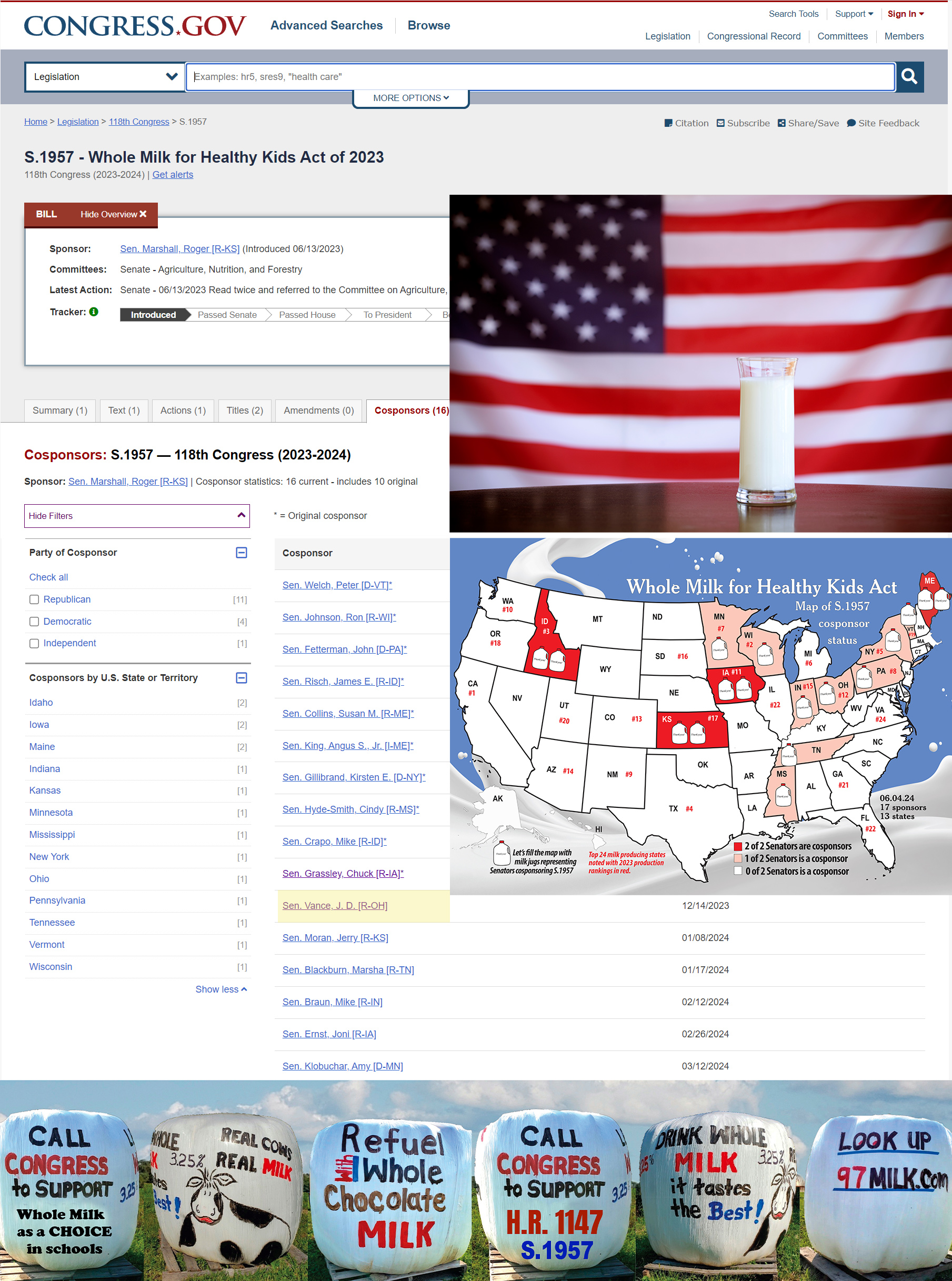
For starters, it passed the House by an overwhelming bipartisan majority last December. The Senate bill, S. 1957, has 11 Republicans, one Independent and five Democrats signed on, including notable Democrats such as Amy Klobuchar of Minnesota, Peter Welch of Vermont, Kirsten Gillibrand of New York, and John Fetterman of Pennsylvania who chairs the Senate Ag Subcommittee on Nutrition. 

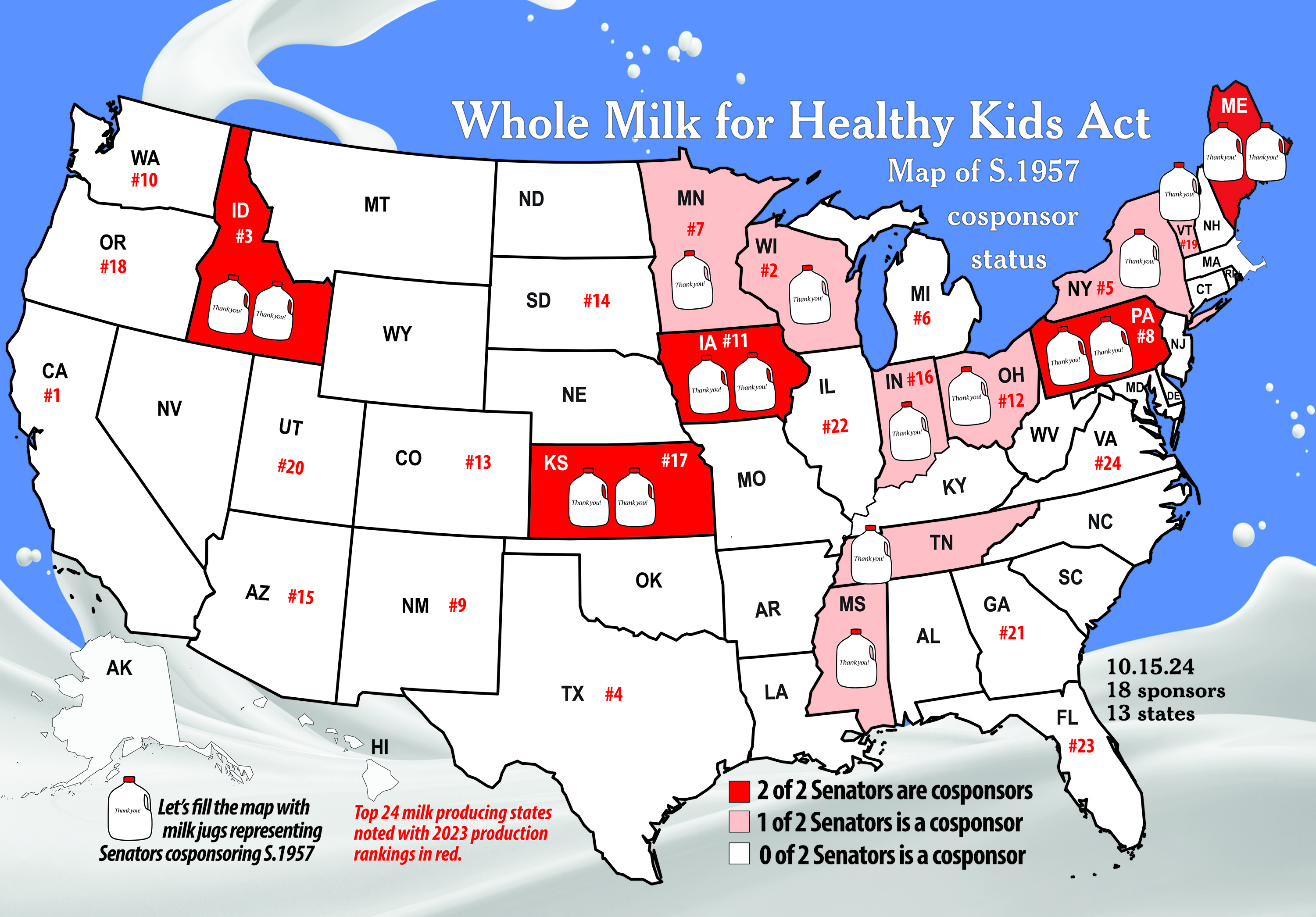
The main sponsor is Republican Senator Roger Marshall of Kansas, a doctor. States represented are Pennsylvania, Vermont, Wisconsin, Idaho, New York, Iowa, Ohio, Indiana, Tennessee, Maine, and Mississippi.

In fact, Pennsylvania now has both Senators signed on. Senator Bob Casey Jr. (D-Pa.) is late to the party, but he has finally signed on as a cosponsor of S. 1957 on Sept. 19. It’s nice to see both senatorial milk jugs filled on the map for the Keystone State, but the bill needs more cosigners to fend off the blockade by Senate Ag chairwoman Debbie Stabenow (D-Mich.).

GT has included the Whole Milk for Healthy Kids Act in the House Ag Committee-passed farm bill. Word from Washington over the past few weeks is that a new farm bill is expected to get done after the elections in the lame duck session, and that GT will fight to keep the Whole Milk for Healthy Kids Act in the bill. Let’s hope so.

USDA: two movers for Class I?

Also related to Class I fluid milk sales, the dairy industry awaits a final decision on USDA’s proposed changes to federal milk pricing formulas, which includes a surprise for fluid milk: splitting the baby and adding a fifth class of milk in the form of two Class I mover announcements each month. 

The hearing record is woefully inadequate. No proposal. No evidence. No testimony. No analysis. No parameters. No definition. Even USDA’s own static analysis shows these two movers would be as much as $1 or more apart in any given month.

Fresh, conventionally processed (HTST) milk would go back to being priced by the the higher of the Class III or IV advance pricing factors to determine the Class I skim milk base price portion of the mover. 

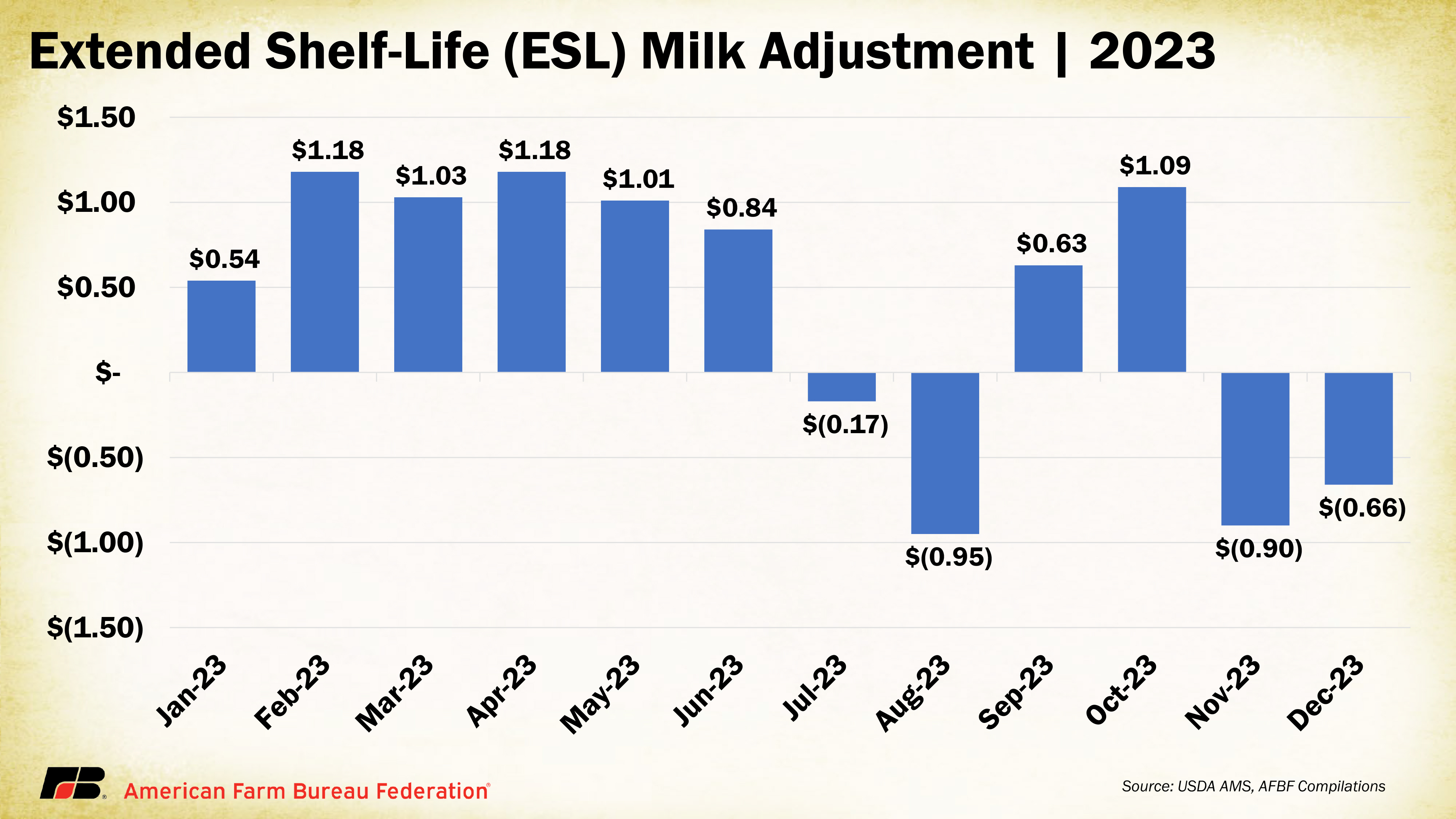
However, milk used to make extended shelf life (ESL) fluid milk products, defined only as “good for 60 days or more,” would continue to be priced using the average of these two pricing factors, plus-or-minus a rolling adjuster of the difference between the higher-of and average-of for 24 months, with a 12-month lag.

With two movers, fluid milk costs could be different for plants in the same location based on shelf life, with no clear definition for the new class, nor parameters established to qualify. Could we see label changes to move between movers?

Processors will know the rolling adjuster 12 months in advance, due to the “lag.” They will know the two advance-priced calculations (higher-of and average-of) a month in advance. They will have it charted in an algorithm no doubt and make decisions accordingly.

Farmers, on the other hand, will find out how their milk was used and priced two weeks after all their milk for the month was shipped. Those milk checks will be even less transparent than they are now.

Big bets on ESL, shelf stable

The dairy checkoff has openly identified ESL, especially shelf stable aseptically packaged milk, as its “new milk beverage platform,” using dairy farmer funds to research and promote it and to study and show how consumers can be “taught” to accept it.

The whole deal is driven by the net-zero sustainability targets. So, follow the money.

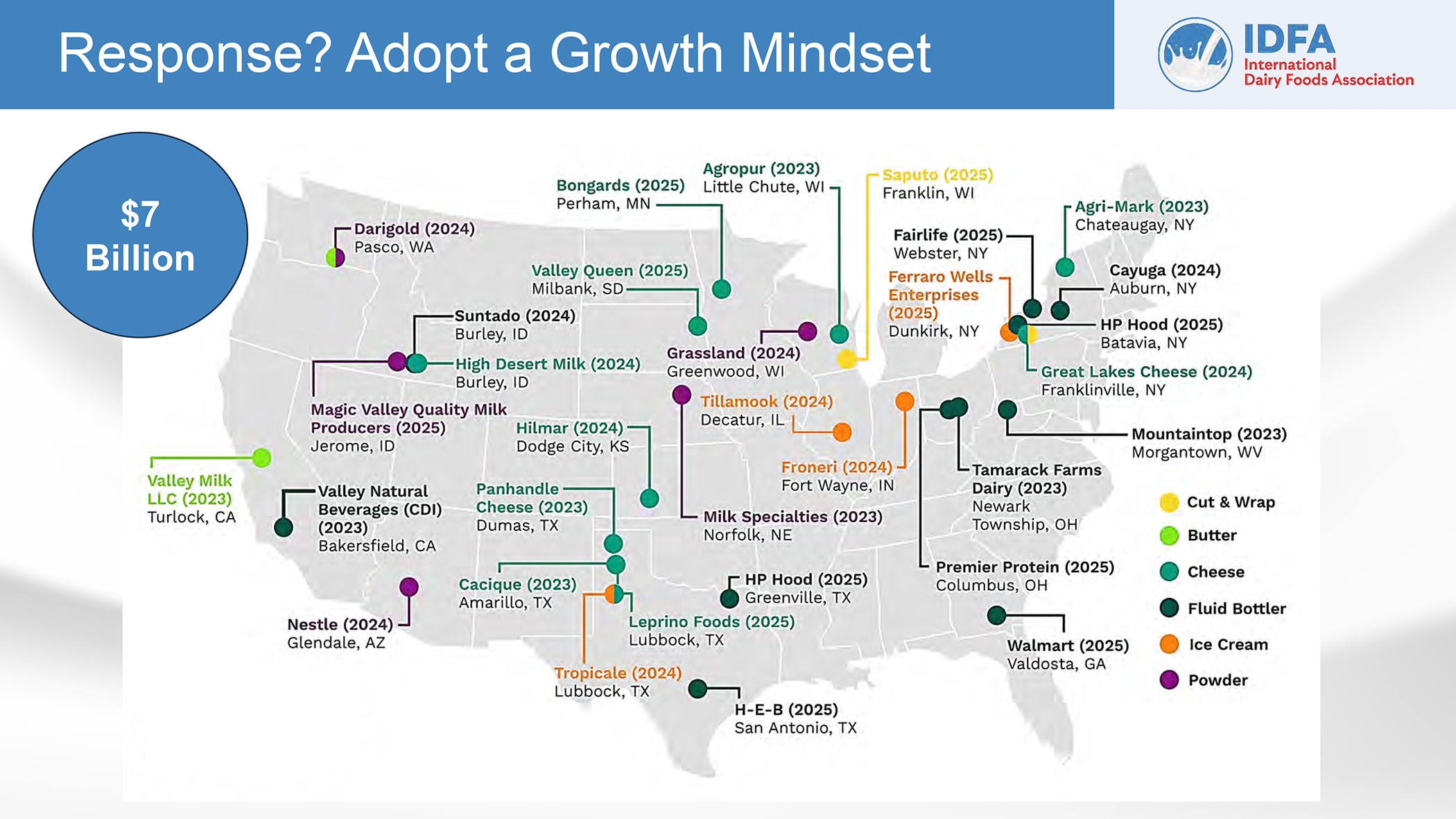
Dr. Michael Dykes of IDFA, at the Georgia Dairy Conference in January 2024, told dairy producers that “this is the direction we (processors) are moving… to get to some economies of scale and bring margin back to the business.”

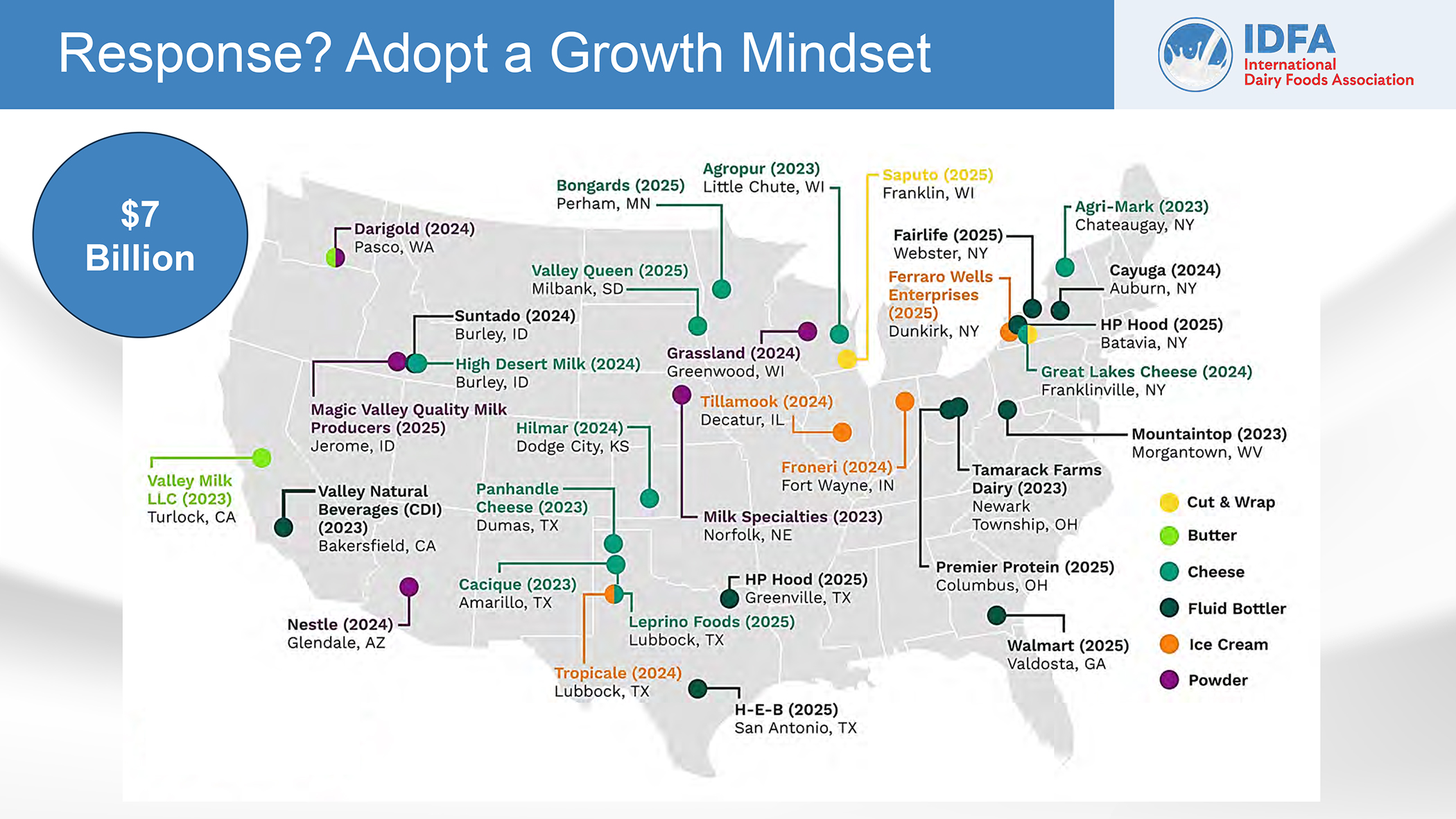
He said the planned new fluid milk processing capacity investments are largely ultra-filtered, aseptic, and ESL — 10 of the 11 new fluid plants on the IDFA map he displayed are ESL. Some will also make ultrafiltered milk, and some will make plant-based beverages also.

Meanwhile, the linchpin of regional dairy systems is conventionally pasteurized (HTST) fluid milk, prized as the freshest, least processed, most regionally local food at the supermarket.

To be sure, this two-mover proposal fits the climate and export goals set forth by the current Ag Secretary Tom Vilsack when he was working as the highest paid dairy checkoff executive in between the Obama and Biden administrations. 

The pathway to rapidly consolidate the dairy industry to meet those goals is to tilt the table against fresh fluid milk, something he already put a big dent in when removing whole milk from schools.

They decided thou shalt drink low-fat milk and like it. Apparently, they are equally convinced about ESL / shelf stable milk as the way of the future and will continue using mandatory farmer checkoff funds to figure out how to get consumers to like that too.

Just this week, the food writer for The Atlantic did a piece on shelf-stable milk, calling it “a miracle of food science” and lamenting in her Op-Ed that it’s a product “Americans just can’t learn to love.”

Author Ellen Cushing took jabs at America’s preference for fresh natural milk from a global perspective, without a thought for the local dairy farms and regional food systems that are tied to fresh milk. She states that by worldwide standards, other countries have gone shelf-stable milk, which she describes as “one of the world’s most consumed, most convenient and least wasteful types of dairy.”

Processors are making big bets on consumer conversion to ESL and shelf-stable.  There are cards to play in every hand. TO BE CONTINUED!

-30-

Editorial: ‘Wouldn’t it be great if we could unite the country with whole milk?”

By Sherry Bunting, Farmshine July 26, 2024

‘Wouldn’t it be great if we could unite the country with whole milk?”

Those words were messaged to me by a friend and colleague a year ago, right after the Whole Milk for Healthy Kids Act had passed the House Education Committee in bipartisan fashion before the overwhelming passage on the House floor Dec. 13, 2023 and before Senate Ag Chair Debbie Stabenow (D-Mich.) blocked it the next day, Dec. 14, 2023.

This was my first thought, when former President Donald Trump announced Senator J.D. Vance of Ohio as his running mate in the Republican campaign. (Vance is an early cosponsor of S. 1957, the Senate’s whole milk bill.)

Like others, I’ve been involved in the effort to bring the choice of whole milk back to schools for more than a decade. It’s about natural, simple goodness — to simply strip away the federal ban and allow hungry, learning children to be nourished by milk they will love. 

Looking back at the years of this long fight, I realize that if it’s so painstakingly hard to get something so simple and so right accomplished for America’s children and farmers, we’ve got problems in this country.

With President Joe Biden now withdrawing from the campaign for a second term, and Vice President Kamala Harris as presumptive nominee launching her campaign this week in the Dairyland State, I’m reminded of where she stands on such things.

Harris is no friend to livestock agriculture. She was an original cosponsor of the Senate version of “The Green New Deal.” She has strong positions on climate change that may lead to harsher rules on methane emissions and water consumption in the dairy industry, while perhaps promoting methane digesters, which are not an equitable nor necessary solution. Cows are NOT the problem!

Some in the dairy industry are on record stating that this would be good for dairy because the DMI Net Zero goals fall in-line and tout some of the same objectives. But no matter how you slice and dice all the fancy offsets, insets, innovations, grants, projects and the billions of dollars, the bottom line leaves cattle holding the bag. 

Cattle are in the crosshairs of a very long game set to control land, food and people.

Harris has already indicated she would use the Dietary Guidelines to reduce red meat consumption on the basis of this erroneous climate impact claim about cattle that we are all being brainwashed to quite literally buy into.

As a presidential candidate in 2019, in a CNN town hall, she was specifically asked: “Would you support changing the Dietary Guidelines to reduce red meat specifically to reduce emissions?”

“Yes, I would,” Harris replied, with a burst of laughter.

It’s not funny.

Earlier, she had said she “enjoys a cheeseburger from time to time,” but the balance to be struck is “what government can and should do around creating incentives, and then banning certain behaviors… that we will eat in a healthy way, and that we will be educated about the effect of our eating habits on our environment. We have to do a much better job at that, and the government has to do a much better job at that.”

Read those words again: “creating incentives and then banning certain behaviors.” In plain English, that means dangling the carrot and then showing us the stick.

Harris joins Senators like Ag Chair Stabenow, as well as Bob Casey from Pennsylvania, as card-carrying members of perennial Ag Secretary Vilsack’s food and climate police.

Not only is Ag Chair Stabenow blocking the whole milk bill in her Committee, she is dragging her feet on the critical farm bill. 

As President Biden’s approval ratings fell, there were indications she would bring her side of the aisle to the table to negotiate a compromise to get the farm bill done this year.

Now that Biden has withdrawn from the race, and the pundits, media, and party organizers are breathless with excitement over Harris as presumptive nominee, it appears that the farm bill negotiations between the Committee-passed House version, the Republican Senate version and the Democrat Senate version have fallen apart.

House Ag Chair G.T. Thompson (R-Pa.) has called upon his colleagues to get to the table and do the work because a perfect storm is brewing in Rural America as net farm income is forecast to fall by 27% this year on top of the 19% decline last year. 

Meanwhile, there is political upheaval everywhere we look. Seeing Vance picked as Trump’s running mate and knowing he was among the early cosponsors of Senate Bill 1957 – The Whole Milk for Healthy Kids Act – offers some hope.

That bill — in true bipartisan spirit — was introduced in the U.S.Senate in June 2023 by Senator Dr. Roger Marshall (R-Kan.) with prime cosponsors Peter Welch (D-Vt.), Ron Johnson (R-Wis.), Kirsten Gillibrand (D-N.Y.), Chuck Grassley (R-Iowa), John Fetterman (D-Penna.), Mike Crapo and James Risch (R-Idaho), Susan Collins (R-Maine), Angus King (I-Maine), and Cindy Hyde-Smith (R-Miss.). The bill eventually earned cosponsorship from other Senators, including the influential Democrat from Minnesota, Amy Klobuchar.

Vance signed on as cosponsor on December 14, 2023, one day after the U.S. House of Representatives had passed their version of the bill by an overwhelming bipartisan majority of 330 to 99.

The Senate bill 1957 is identical to the successful House whole milk bill H.R. 1147, which was authored by Pennsylvania’s own Representative GT Thompson.

GT is a man of courage, conviction, compassion, of humility and humanity. I’ve heard him say more than once: “God gave us two ears and only one mouth for a reason.”

He is a determined man, doing the work. He included whole milk bill in the House Committee-passed farm bill. He’s standing firm on his pledge to put the farm back in the farm bill. He is concerned about the financial crisis in agriculture on the horizon, and held a hearing July 23 with witnesses from agriculture and banking giving stark warnings.

Even though whole milk choice in schools seems like a minor issue in the grand scheme of things today, it is really a linchpin. If we could just get something with broad bipartisan support accomplished, this could lead to other steps on common ground. 

Cows are not the climate problem. Cows are a solution. Cows are part of a carbon cycle, they don’t take carbon out of the ground and put new carbon into the air. 

Carbon is essential to life. It seems that those seeking full control of land, food, and people, are starting with carbon. 

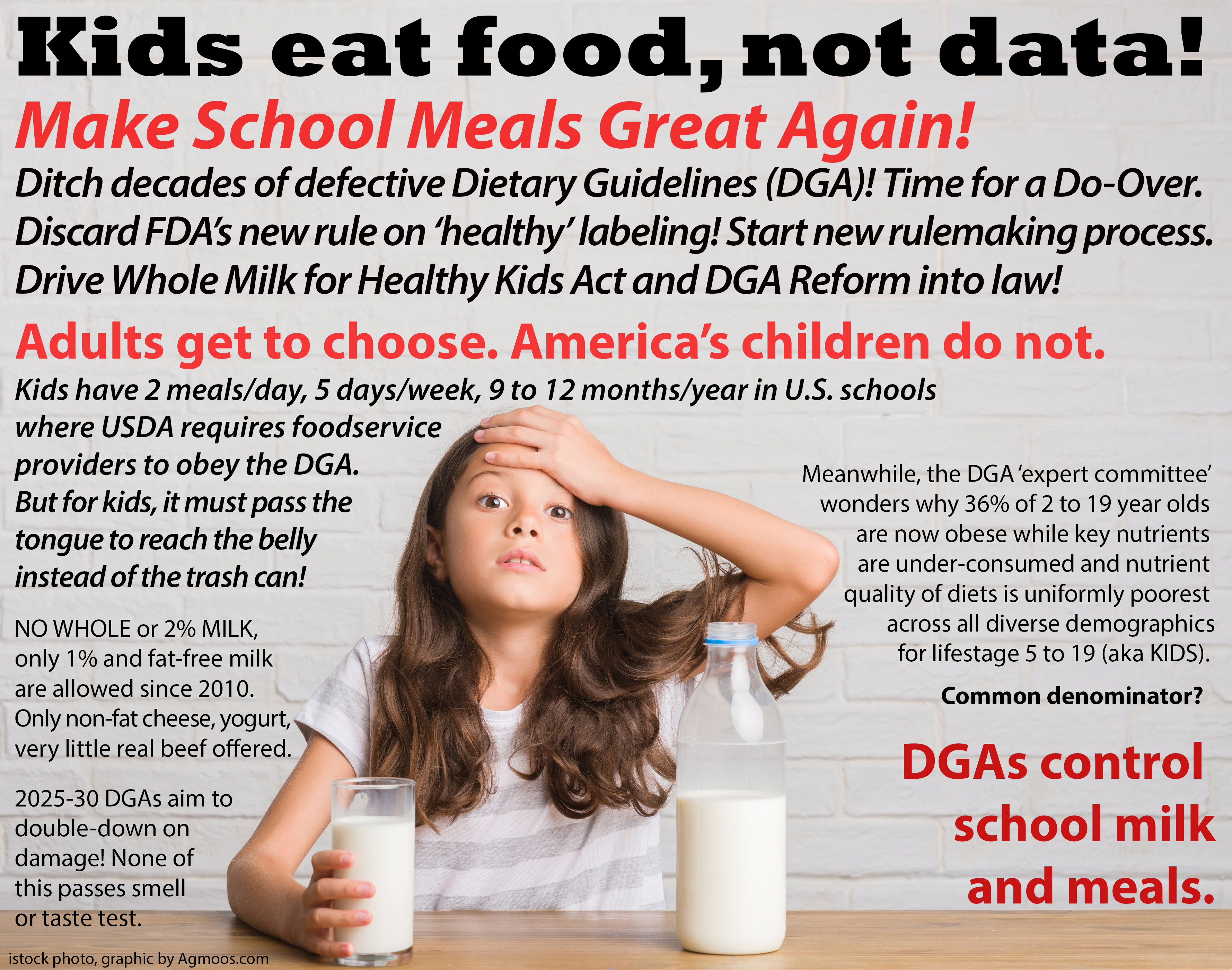
As the whole milk choice remains hung up in the Senate, let’s pause to think about how ridiculous it is that we adults get to choose, but our growing children do not. For them, whole milk is banned at two meals a day, five days a week, three-quarters of the year at school. (The federal government, via USDA school lunch rules, only allows fat-free and 1% milk to be offered with the meal or even a la carte.)

Maybe the Harris ticket would like to ban food choice behaviors for adults as well.

We have Republicans and Democrats supporting whole milk choice in schools. Both parties say they care about our nation’s farmers and ranchers who feed us and are the backbone of our national security.

Let’s take that and run with it.

-30-

Thompson pushes effective, transformational farm bill. Whole Milk for Healthy Kids Act included!

Representative GT Thompson of Pennsylvania once told a group of farmers gathered for a 97 Milk meeting that he has gone by a lot of titles and been called a lot of things over the years, and while it’s an honor to be the Chairman of the House Agriculture Committee, his favorite title is ‘Representative’ because, he said “that’s what we do. We are representing The People.” True to form, GT led the House 2023-24 farm bill process with representation in mind by making the bipartisan endeavor ‘tripartisan’ — going to great lengths to bring grassroots farmers into the process. One thing he heard repeatedly at the 85 listening sessions in 40 states was ‘bring whole milk choice back to schools,’ even though school meal rules fall under the childhood nutrition reauthorization led by the Education Committee, not the farm bill. But now he’s done that too. Bolstered by the overwhelmingly bipartisan 330 to 99 passage of H.R. 1147 on Dec. 13, 2023, he found a way to make Whole Milk for Healthy Kids part of his proposed farm bill that heads to House Ag Committee markup next week. He says he is intent on getting the whole milk legislation through the Senate blockade and “over the finish line.” File photo by Sherry Bunting

By Sherry Bunting, Farmshine, May 17, 2024

WASHINGTON – House Ag Committee Chairman Glenn ‘GT’ Thompson (R-Pa.) says the bipartisan farm bill has reached a milestone and holds the potential for being transformational.

The chairman’s mark, released ahead of committee markup set for May 23, demonstrates the listening that went on in his busy schedule traveling to 40 states and one territory for 85 listening sessions over the past two years.

“We are hopeful that the House Ag Committee markup of this chairman’s mark legislation helps feed the momentum to get this farm bill done,” said Chairman Thompson in a May 14 Farmshine phone interview.

There are important highlights here, including reforms to the Dietary Guidelines process for greater transparency and accountability with new checks and balances, as well as language to expand the reach, funding and impact of the dairy incentive and school meal programs by including full fat fluid milk, flavored and unflavored, as seen in H.R. 5099 and H.R. 1147 (Whole Milk for Healthy Kids Act).

“I was able to work with Dr. Virginia Foxx (chair of the House Education and Workforce Committee), and they will be providing a waiver after we mark this bill up, so we will be able to include Whole Milk for Healthy Kids in the farm bill,” Thompson shared.

He has previously stressed that, “This is about our kids and the outdated and harmful demonization of milkfat.”

“When we get to conference (with the Senate), it could be an issue, but Whole Milk for Healthy Kids passed the House by a 330 vote. I am intent on getting this provision over the finish line. 

“It may be the most important thing we do out of many things in this farm bill for dairy farmers,” he said.

Other dairy subtitle provisions

The dairy subtitle includes language to return the Class I ‘mover’ price to the ‘higher of’ calculation instead of the ‘average plus 74 cents’ that was implemented in May 2019.

“We obviously recognize that USDA has now gone through an extensive hearing process, and will honor what USDA comes up with, which will supersede what we’re doing,” Thompson reported. “But it was the Ag Committees in the Congress through the 2018 farm bill that eliminated the ‘higher of’ language, which has been followed by significant unanticipated losses.”

Language has also been included to mandate biennial cost of processing surveys. This also appears in the Senate farm bill.

Processors making products used in Federal Milk Marketing Order (FMMO) formulas would participate in processing cost surveys every two years. In addition to reporting costs for those products, the Dairy Pricing Opportunities Act language that is rolled into the farm bill proposal states that the cost and yield information for all products processed in the same facility be included. (Note: This would ensure accurate allocation of plant costs that apply just to the products that are actually used in the FMMO pricing formulas so that the costs to process other value-added products that are not included in FMMO pricing, but are made in the same plant, do not influence future ‘make allowance’ hearings.)

These cost surveys would be published for the purposes of informing the regulatory or administrative (hearing) process for the establishment of pricing rules (such as determining how to use that published information to set ‘make allowance’ levels that are embedded in FMMO pricing formulas).

The dairy subtitle also expands the Dairy Margin Coverage (DMC) tier one cap on annual milk production history from 5 million pounds to 6 million pounds, similar to the Senate bill.

It also includes language for updating DMC production history and provides a 25% discount in premium costs for any producer signing up for all five years of DMC coverage.

“That’s quite a savings,” Thompson observed.

IRA funds included without ‘climate sideboards’

In the Conservation Title, the chairman’s mark brings Inflation Reduction Act (IRA) conservation funds into the farm bill baseline without the ‘climate sideboards’ and arbitrary measures that ride along in the Senate version.

“All conservation programs, as long as they are locally-led and voluntary, contribute to climate and carbon sequestration. What the IRA legislation did is make it overly prescriptive with a lot of practices we know are successful not being eligible for these conservation dollars.

“We believe that the principles of locally-led and voluntary are a huge part of what has made conservation programs so successful. Agriculture sequesters 6.1 gigatons of carbon annually, over 10% more than we emit,” said Thompson.

Timelines matter

There are a couple reasons timelines matter in getting this farm bill done. The IRA funding is one of them.

“Number one is the American farmer is struggling right now. The chairman’s mark, as we prepared it in the House Committee, will be of great service to them as producers of food, and to struggling families as consumers of food, quite frankly,” said Thompson.

“The other reason timelines matter is these IRA dollars. As the Secretary of Agriculture continues to push those dollars forward, the original $19 billion – between what he already spent and what the CBO projects he will not be able to spend – that number is now down to $14 billion,” Thompson explained. “That’s opportunity lost for the future, unless and until we pass and reauthorize the farm bill and roll those dollars into its baseline.”

Thompson continued, explaining that, “Every dollar in IRA conservation funds spent between now and the passage of the farm bill is a dollar lost to the baseline for the future. One of the flaws of the IRA is these conservation dollars expire in 2031. Whatever we bring into the farm bill – into the baseline – is there for perpetuity. It will be there for the 2050 and 2055 farm bills. That’s smart, and it’s good for agriculture and great for conservation.”

The Senate proposal also brings IRA conservation funds into the farm bill baseline, but puts climate requirements on these funds, especially in regard to methane.

Tripartisan effort produces nutrition cost-savings, not cuts

“My chairman’s mark is built on solid tripartisan input from Republicans and Democrats and the hardworking people of American agriculture,” Thompson affirmed. “The Senate proposal is a partisan proposal. They did not bring Senate Republicans to the table.”

In his May 10 open letter, Chairman Thompson stated that his door is always open.

“There exists a few, loud armchair critics that want to divide the Committee and break the process. A farm bill has long been an example of consensus, where both sides must take a step off the soapbox and have tough conversations,” he wrote. “The 2024 farm bill was written for these precarious times and is reflective of the diverse constituency and narrow margins of the 118th Congress. Each title takes into consideration the varying opinions of all who produce as much as those who consume. It is not one-sided, it does not favor a fringe agenda, and it certainly does no harm to the programs and policies that feed, fuel, and clothe our nation.”

Case in point, the CBO has scored the House farm bill chairman’s mark to save $28 to $29 billion in the Nutrition Title.

“Some would have you believe we are cutting $28 to $29 billion from feeding struggling families, but we are not,” Thompson declared. “There are no cuts to individual SNAP benefits in this bill. My Democratic colleagues say we are cutting by that much, but the CBO score on my proposal reflects cost savings from increased efficiencies, reduced fraud, and things that better meet the needs of families struggling in poverty.”

Justifiably proud of the intense work he and his committee have done on the nutrition programs lightning rod that makes up more than 80% of the farm bill baseline, Thompson said his proposal actually “creates a fire wall so that a future right-leaning administration would not be able to arbitrarily cut benefits either. It exercises our Article I prerogative on how we do market basket analysis, keeps the variables and the cost of living. These things are significant factors.”

His proposal also expands access to a couple populations not eligible for SNAP in the past, including families with adult children in school up to age 21 (not 18). In the past, their part-time jobs affected family eligibility.

Putting the farm back in the farm bill

The Commodities and Crop Insurance Titles also engaged input from farmers, farm groups and industry. On reference prices, Thompson said the Senate bill picks three crops and puts in a 5% increase for base acreage.

“In our proposal, we’ve worked with the stakeholders. We’ve done the math, the financial and risk analysis on what is needed.”

This includes a more commodity-specific update to reference prices and granting the Secretary of Agriculture authority to expand base acres.

“We have been committed to putting the farmer back into the farm bill commodities title,” he said.

This scratches the surface of what is included in the farm bill chairman’s mark. An overview and title by title summary are available at https://agriculture.house.gov/farmbill/

When asked about what other dairy topics could come up during markup, Thompson said he wouldn’t be surprised to see other amendments in committee.

“There are some labeling issues that are not in our purview or jurisdiction but come under the Energy and Commerce Committee. We could get the ball rolling, but we would need them to get on board for that to go forward,” he said.

Reflecting on the milestone this week, Thompson answered our question about what he’s most proud of to this point.

“The fact that this farm bill was built using the input of American farmers, ranchers, and foresters, and it reflects what their priorities are and what their needs are, and the fact that as I look at the chairman’s mark and all 12 titles according to the goal placed early on, two years ago as I started my leadership of this process: 

“This will be not only a highly effective farm bill for our producers, processors and all of us who consume food, it will be transformational,” he said.

-30-

Whole milk sales surge as Senate bill for schools remains blocked

By Sherry Bunting, Farmshine, May 10, 2024

EAST EARL, Pa. — Year-to-date Whole Milk sales for the first two months of 2024 are up a whopping 5% year-over-year (YOY) at 2.57 million pounds. Even when adjusted for Leap Year, the average daily increase is a substantial 3% surge, compared with the past several years of steady 1% increases YOY.

Flavored whole milk sales, year-to-date (YTD) are up a whopping18.6% YOY. Adjusted for Leap Year, the increase is a substantial 14%.

As the number one volume category representing more than one-third of the fluid milk category since 2020, the recent surge in whole milk sales has been enough to reverse the decline in total packaged fluid milk sales in four of the past five months.

USDA tallied 2023’s total packaged fluid milk sales down by a smaller margin of 1.5% for the year compared with previous years of decline; however, October and November sales were up 1% and 0.3% YOY for the first time since the months of the Covid shutdown when families ate at home. December’s total packaged fluid milk sales trailed year-earlier, but January and February 2024 have come back strong.

USDA estimates total fluid milk sales were up 2.4% and 2.5% YOY for January and February, respectively. When adjusted for Leap Year, the February increase is a respectable 0.8%. Similarly, when we adjust the YTD total of 7.325 million pounds in total fluid milk sales to reflect the extra consumption day in February, this is also 0.8% higher on an average daily basis vs. year ago.

This is good news! Let’s keep this upward trend MOOVING in fluid milk sales, led by surging whole milk sales — thanks to volunteers spreading the good word.

Now, if we could just get the United States Senate off the sidelines and into cosponsoring S. 1957 Whole Milk for Healthy Kids, we could really gain some ground — and America’s kids would be free to choose milk they love at school where they receive 2 meals a day, 5 days a week, 3/4 of the year. 

Thanks to the U.S. House of Representatives and the leadership of Congressman G.T. Thompson of Pennsylvania, the Whole Milk for Healthy Kids Act (H.R. 1147) passed the House on December 13, 2023 by an overwhelming bipartisan majority 330 to 99. If the U.S. Senate doesn’t have the opportunity to vote it through by December 31, 2024, we must start all over again in the next legislative session 2025-26!

Check out the map above to see how S. 1957 remains stalled for the past 60 days at just 17 sponsors from 13 states. 

Where do your state’s U.S. Senators stand? Ask them! And think about their answers when going to the polls this fall. Elections have consequences. 

Also consider asking your state senators and representatives to follow Tennessee’s lead and get a whole milk bill passed in your state and signed by your Governor. 

Pennsylvania and New York State tried to be first, but leaders are afraid of USDA’s monetary penalties. Maybe the No. 8 and No. 5 milk producing states can be second and third in state whole milk bill passage.

Just think what would happen if more states passed bills that ALLOWED choice and sought creative language to let their schools choose to let children choose. Tennessee will make it available in bulk dispensers separate from the school lunch line. Pennsylvania sought to do it as a wholly in-state proposition. 

Meanwhile, DMI sent a press release on April 29 touting their “checkoff-led pilot in Cincinnati schools that offered lactose-free chocolate milk increased milk consumption…” Specifically, the pilot schools experienced a 16% increase in milk consumption and a 7% higher meal participation, according to DMI. 

(Of course, this lactose-free pilot was also fat-free per the USDA rules for milk at school built on the Dietary Guidelines that the dairy checkoff agreed to “advance” when the memorandum of understanding was signed between the USDA, National Dairy Council, GENYOUth and the NFL in 2010).

Remember, this reporter warned several years ago that checkoff and dairy industry leaders would wait until lactose-free shelf-stable milk was firmly entrenched in schools before pushing whole milk choice through. Senate Ag Chairwoman Debbie Stabenow is the main blockade this time around. She hails from the No. 6 milk producing state of Michigan, where the foundation fairlife plant is located, collecting milk from large producers in Michigan, Indiana and Ohio.

Wonder what consumption looks like when whole milk is offered as a choice. That’s right! A Grassroots PA Dairy Advisory Committee / 97 Milk trial in a school in northwestern Pennsylvania saw consumption grow 52% and waste decline 95%.

So, drink up Senators! Talk to your constituent Moms this Mother’s Day. Sales data and surveys both show what Moms think, and most don’t even realize the federal ban, the bait-and-switch their kids face at school where milk and dairy are concerned.

Then pour a tall cold glass of delicious, nutritious whole milk. It may just strengthen those political spines!

-30- 

Seeds of doubt being sown, Part III: Will it reduce butterfat supply and impact industry’s cheese-focused future?

By Sherry Bunting, Farmshine, March 1, 2024

EAST EARL, Pa. — As seeds of doubt are being sown internally within the dairy industry about whole milk in schools, we have discussed Confusion (will it help milk prices?) and Consternation (unfounded fear about what will processors do with ‘all that skim?’)

This week, we look at the third C: ‘Competition’: If schoolchildren are offered whole milk, will it significantly impact butterfat supplies, raise butter prices, and compete with the industry’s cheap milk cheese-focused future?

Every winter conference for the past few years has had at least one speaker telling dairy farmers that fluid milk sales are declining because Americans are eating more of their milk instead of drinking it. 

Fair enough. Cheese is the future, and the industry wants to make more of it. Lots more of it. So much more cheese, in fact, that inventory is growing. Analysts at conferences put up slides with the words “Export or perish!” in large font. 

Yes, U.S. Dairy wants to export more cheese, including mozzarella. U.S. Dairy wants to export more butter and cream products. U.S. Dairy wants to export more of the higher-value products. (And we want to sell more cream to the upscale coffee houses and downscale McCafe drinks we adults get to choose while junior sips a paltry half-pint of fat-free chocolate milk, sugar water, in the back seat. What’s wrong with us?)

This map shows the over $7 billion in new processing coming online between now and 2026. “There’s a lot of cheese on this map,” said IDFA CEO Michael Dykes, presenting at the Georgia Dairy Conference. This slide has also been popping up in other industry conference speaker powerpoint decks this meeting season. IDFA data

The industry also wants to take milk down to its molecular level – to turn the jug of milk into ingredients at the start — to make new function-targeted products for the beverage space outside of Class I parameters within an increasingly Class III dominated processing infrastructure.

Toward that end, new processing capacity won’t convert milk to traditional products, leaving elements to be marketed as ingredients. Instead, these new state-of-the-art cheese and ingredient plants start by taking milk apart to the ingredients-level to be used in making health beverages, bars, and other products, as well as to make cheese. 

At the Georgia Dairy Conference in January, IDFA CEO Michael Dykes mentioned IDFA’s support for the Whole Milk for Healthy Kids Act, giving attendees a QR code to weigh-in with their Senators. 

Later in his presentation, he noted that a shift to more fat in school milk would make a 3% impact on the butter supply.

“I’m a believer that the markets work, when you take it one place, you make a difference and change it someplace else. Those are the things we can work through,” said Dykes.

So, we reached out to Calvin Covington, a former cooperative CEO who is intimately familiar with component pricing as it became part of the Federal Milk Marketing Order (FMMO) system over 20 years ago. We asked his thoughts on how increasing fat in the school milk supply would impact butter. 

“Increased Cheddar cheese production has used millions and millions of pounds of butterfat. No one complains about this. Doesn’t the dairy industry want to increase demand for all milk components?” he replied and sent forth his own calculations, providing a spreadsheet showing his estimates of milk used in schools and the additional fat that would be needed for all of that milk to go completely to 3.25% (whole) milk.

Covington ran the numbers, moving methodically through assumptions on Table 1 to conclude the impact of shifting from a school milk fat percentage of 0.5% (half fat-free and half 1%) all the way to 3.25% (whole milk) would have a small impact on the butterfat supply — raising the school milk’s usage of butterfat from 0.25% of total butterfat production at the current national average fat test of 4.11% to being 1.47% of total butterfat production at the average 4.11% fat test.

Using the identified assumptions, Table 1 shows estimates on school milk volume and use of butterfat under today’s fat-free and 1% low-fat milk requirement compared with a scenario in which all school milk pounds were at 3.25% fat as standardized whole milk. Provided by Calvin Covington

He estimates public schools use 9.72% of all fluid milk, and for the purpose of the spreadsheet exercise, he assumed that half of those school milk sales are currently fat-free and half are 1%. If that is the case, then going to 3.25% (whole) milk for all pounds of school milk sales, the additional fat that would be needed is almost 114 million pounds, he reports.

“This should be a non-issue,” Covington concludes, using estimates that are based on all of those school milk pounds moving to 3.25% fat. 

The more likely scenario, however, is that schools would implement a more gradual increase in fat percentage. If it mirrored the national average for fluid milk sales at 2% fat, the increase would be smaller initially. Using Covington’s chart and assumptions, the additional fat that would be needed if school milk fat content averaged 2% is closer to 84 million pounds, going from using 0.25% of total fat production to 0.9% of total fat production.

Not all schools will choose to offer all milk at 3.25%. Some may offer 2% milk, which has also been banned since 2010 and would be given regulatory relief under the Whole Milk for Healthy Kids Act. 

Even if 3.25% fat milk is universally offered, some schoolchildren will continue to choose low-fat milk, as they did in the Pennsylvania trial, where the preference was 3 to 1 for whole 3.25% over low-fat 1%.

While a potentially higher fat content in school milk is being scrutinized for its impact on butter and butterfat, the impact of aggressive increases in cheese production is ignored. This speaks a bit to industry priorities.

“As butter and cheese consumption increase, processors do not argue against the increase because utilizing more fat would increase the fat price,” Covington observes, wondering why anyone would be concerned about the impact on butterfat supply if children get to choose whole milk while not being concerned about the impact on butterfat supply in any other sector.

“An increase in fluid milk sales, in schools, or anywhere, benefits all dairy farmers. With all things being equal, it would shift milk from Class III and IV to Class I, which is a (normally) higher milk price,” Covington explains. “If Class III or IV need more milk to replace the loss to Class I, more money would need to be paid by Class III and IV milk buyers, again, helping dairy farmers.”

So, what is the current status of butterfat production and usage? 

The national butterfat average is 4.11%. A decade ago, it was 3.69. From 2011 to 2022, total butterfat pounds produced on farms in the U.S. grew by 2 billion pounds from 7.3 billion to 9.3 billion. That’s a butterfat volume response to a price signaling demand.

Where’s it all going? Around 20% goes to butter production, 8% to ice cream and frozen desserts, 10% in fluid milk sales, and close to 50% is used in cheese production. And then there is this growing market for cream used in coffee drinks.

Meanwhile, dairy producers out West report receiving a letter from a large cheese plant, putting in a new base program at 1.5% over base. 

Another producer in an unregulated state in the West reported receiving a letter from his cheese plant stating they will reduce the butterfat multiple in their cheese milk payment, beginning April 1. The reason, according to the letter, is the farms are making too much butterfat, and the plant is having to buy condensed solids (skim) to pair with the additional fat or sell the extra fat as excess sweet cream at a loss.

During the FMMO hearing, fluid milk bottlers complained that the higher fat and component levels in milk today are more costly for them to deal with, that they must move the excess cream at a loss, and they have to clean the separator more often because of ‘sludge’ buildup. (I kid you not, one witness called it ‘sludge.’)

Processors have petitioned USDA with multiple proposals to get regulated minimum prices down to their definition of a ‘market clearing’ level that then allows them to add market premiums to attract new milk. Read that sentence again.

Who would be paying those premiums to grow milk supply? Not the processors. It would be revenue coming out of the regulated minimum price benchmarks for all farmers, including farmers that are not growing, to then get added back in by the processors wherever they want to direct growth.

Cheap milk is the name of the game, while at the same time, dairy farmers are being challenged to grow to meet the future ‘demand gap’ to fill $7 billion in new processing investments that will become operational over the next few years.

Dairy analysts tell how milk production expansion to meet this investment will not be as easy to do and will take longer than in the past because of the shortage in replacement heifers. 

We’re at a standoff, so to speak. 

Dairy producers have bred beef-on-dairy to bring margin back to their farms after 10 years of dairy margin compression. This strategy has been a good hedge against overproduction of milk in the era of sexed-semen, and it has helped protect farm balance sheets by reinforcing the value of the cattle as collateral.

So, what tool will be used now to drive consolidation and growth in dairy? Dykes told Georgia producers that, “Sustainability will be one of the biggest drivers of consolidation we’ve seen in a generation. Why? Because it’s going to take investment, and it’s going to take scale. We need to figure it out, to measure it, verify it, account for it, not double count it. We’re going to need investments to make sure we have the infrastructure.”

He said sustainability will become the gateway for exports where countries have mandates and carbon taxes for purchased ag products.

So, here we are back at the question about milk supply, butterfat supply, skim supply and school milk. Wouldn’t whole milk sales to schools offer a much-needed tug on the demand side to help shift some milk away from this runaway, market-depressing, buildup of excess cheese production that elicits the powerpoint headline: ‘Export or perish?’ 

Just think, if the fluid milk sales to schools increased as they did in the Pennsylvania trial by 52%, or even half that, by 25% as more kids choose milk instead of refusing it, market principles could work — gaining something in one place to affect it someplace else. 

Meanwhile, the industry can do some soul-searching and adapting amid the double-speak. If more milk, fat and components are needed, then farmers need to be able to make a living milking cows and producing fat and components.

Is the problem not enough milk? Or too much milk? Not enough fat? Or too much fat? Not enough skim? Or too much skim? Or is the problem rooted in making sure milk can be bought cheap and that farmers are forced to find revenue in other ways, such as carbon monitoring?

Let’s get it straight please.

On the horizon, we see: Checkoff-funded fluid milk innovations for new beverages that identify and separate specific milk molecules for specific benefits (sleep drinks, energy drinks, immune function drinks, specific protein type drinks)? More on that in Milk Molecules Initiative Part I and Part II

-30-

Seeds of doubt being sown, Part II: ‘What will processors do with all that skim?’ Oh my!

By Sherry Bunting, Farmshine, Feb. 23, 2024

EAST EARL, Pa. — The status of the Whole Milk for Healthy Kids Act, S. 1957, has 17 Senate sponsors from 13 states, including 12 Republicans, 4 Democrats, and 1 Independent. 

Even though both NMPF and IDFA have shown support for the measure, a bit of resignation can be sensed — riding the overwhelming House vote as enough progress for one legislative session. After taking bows for the performance of the bill in the House, representatives of both NMPF and IDFA – while speaking at winter meetings – have indicated a prevailing view that Senate opposition to S. 1957, is a big barrier. 

They say they are working to get the science in front of the Dietary Guidelines Committee, which has been tried before – over and over.

The DGA committee operates under a USDA that does not want whole milk options in schools or SNAP or WIC. This same USDA is proposing to remove chocolate milk options from schools, except for senior high students, and is proposing to reduce WIC milk by 3 gallons per recipient per month. This same USDA projects 20 billion more pounds of milk will be produced in the U.S. by 2030, according to IDFA CEO Michael Dykes, presenting future trends at the Georgia Dairy Conference in Savannah.

Seeds of doubt about the whole milk bill are being sown among farmers. Some asked me recently if their co-ops will lose money on the deal.

Last week, we discussed ‘Confusion’ — the first of 3 C’s that are facing the whole milk bill within the dairy industry. 

This week we look at the second C: ‘Consternation’ — a fancy word for fear.

“What will they do with all of our skim?” farmers asked me at a recent event. Is this something they are hearing from a milk buyer or inspector?

Here are some facts: Whole milk sales move the skim with the fat — leaving some of the fat through standardization, but not leaving any skim. Therefore, an increase in whole milk sales does not burden the skim milk market.

Surely, the practice of holding schoolchildren hostage to drinking the byproduct skim of butter and cream product manufacturing is a poor business model if we care about childhood nutrition, health, and future milk sales. 

Furthermore, the market for skim milk powder and nonfat dry milk is running strong as inventories are at multi-year lows in the U.S. and globally.

Cheese production, on the other hand, is what is cranking up, and it has been the market dog for 18 months. Like whole milk sales, cheesemaking uses both fat and skim. But cheesemaking leaves byproduct lactose and whey, and it can leave some residual fat depending on the ratios per cheese type.

Things are pretty bad for farmers right now in cheesemilk country. Some tough discussions are being had around kitchen tables. The 2022 Ag Census released last week showed the dire straits for farmers nationwide over the last five years as the number of U.S. dairy farms declined below 25,000, down a whopping 40% since 2017.

Wouldn’t an increase in whole milk sales through the school milk channels help pull some milk away from rampant excess cheese production that is currently depressing the Class III milk price, leading to price divergence and market dysfunction?

While there is no one data source to specifically document the percentage of the milk supply that is sold to schools, the estimates run from 6 to 7% of total fluid milk sales (Jim Mulhern, NMPF, 2019), to 8% of the U.S. milk supply (Michael Dykes, IDFA, 2023), to 9.75% of total fluid milk sales (Calvin Covington, independent analysis, 2024). 

If even half of these sales became whole milk sales, it could modestly positively impact the amount of excess cheese being made even as processors say they plan to make more cheese because people eat more of their milk than are drinking it. (Fig. 1)

Meanwhile, the cheese price is under so much downward price pressure that there is a $2 to $4 divergence of Class IV over Class III causing farmers to lose money under the ‘averaging’ formula for Class I milk. In many parts of the country, farmers lose additional money when the milk that is used in Classes II and IV is depooled out of FMMOs.

Without the ‘higher of’ pricing mechanism that was in place from the year 2000 until May 2019, Class I can fall below the higher manufacturing price, removing incentive to pool, which leaves pooled producers with smaller payments for their milk and leaves the decision about what to pay depooled farmers up to the processors after they’ve succeeded in reducing the benchmark minimum by depooling.

Ultrafiltered (UF) milk represents 2.4% of fluid milk market share, having grown by more than 10% per year for four years with sales up 7.7% in 2023 vs. 2022, according to Circana-tracked market data shared by Dykes.

UF milk is also cheese-vat-ready-milk with capability to remove not just the lactose but also the whey as permeate at the front end for use in distilleries that are now funneling lactose into ethanol production in Michigan and whey into alcoholic beverages in Michigan and Minnesota.

Processors want farmers to do “a tradeoff” to decide how much revenue comes to their milk checks and how much goes to processing investments for the future. The future is being dictated by where we are in fluid milk consumption relative to cheese production.

This is one reason IDFA and Wisconsin Cheesemakers, as well as NMPF, had proposals asking USDA to increase the processor credits (make allowances) that are embedded in the dairy product price formulas. IDFA and Milk Innovation Group also put forward other proposals to further reduce regulated minimum prices.

We wonder with these new processing investments, how is it that the make allowances are too small? Only bulk butter, nonfat dry milk, dry whey, 40-lb block Cheddar and 500-lb barrel cheese (yellow not white) are surveyed for the circular class and component price formulas. Everything else that doesn’t meet CME spec for these specific product exchanges is excluded.

This means the costs to make innovative new products and even many bulk commodity-style products, such as bulk mozzarella, unsalted butter, whey protein concentrate and skim milk powder, can be passed on to consumers without being factored back into the FMMO regulated minimum prices paid to farmers.

If market principles are applied, processors wanting to encourage more milk production, to make more cheese, would pay more for the milk – not less. But when the margin can be assured with a make allowance that yields a return on investment, all bets are off. Cheese gets made for the ‘make’ not the market.

We saw processors petition USDA in the recent Federal Milk Marketing Order hearing to reduce the minimum prices in multiple ways so they can have the ability to pay market premiums to attract new milk. This would be value coming out of the regulated FMMO minimum price benchmark for all farmers to get added back in by the processors wherever they want to direct it.

Cheese is in demand globally, and the U.S. dairy industry is investing to meet this. Dykes told Georgia producers that processors want to grow and producers want to grow. He wasn’t wondering what to do with all of the skim when he asked: “Where will the milk come from for the over $7 billion in new processing investments that will be coming online in the next two to three years?”  

This is happening, said Dykes, “due to market changes from fluid milk to more cheese production (Fig. 1). There’s a lot of cheese in those plans. With over $7 billion in investment… These are going to be efficient plants. You’re going to see consolidation. If you are part of a co-op, you’re going to decide how much (revenue) comes in through your milk check and how much goes into investment in processing for the long-run, for the future. That’s the debate your boards of directors will have.” 

Even the planned new fluid milk processing capacity is largely ultra-filtered, aseptic and extended shelf life, according to Dykes.

“That’s the direction we are moving,” he said. “We are seeing that move because as we think about schools, are we still going to be able to send that truck driver 20 miles in any direction with 3 or 4 cases of milk 5 days a week? Or do we do that with aseptic so they can store it and put it in the refrigerator one night before, and get some economies of scale out of that, and maybe bring some margin back to the business?”

As the Class III milk price continues to be the market dog, we don’t see milk moving from Class III manufacturing to Class IV, perhaps because of the dairy processing shifts that have been led by reduced fluid milk consumption. 

Allowing schoolchildren to have the choice of whole milk at school is about nutrition, healthy choices, future milk consumers, and the relevance of fresh fluid milk produced by local family farms in communities across the country. Having a home for skim does not appear to be the primary factor affecting milk prices where Class III is dragging things down.

Bottomline, dairy farmers should have no consternation (fear) over what processors are going to do with “all of that skim” once they are (hopefully) allowed to offer schoolchildren milk with more fat.

Next time, we’ll address the third ‘C’ – Competition – If kids are offered whole milk in schools, will it reduce the butterfat supply and impact the industry’s cheese-centered future? 

A final note, just in case the question about ‘what to do with all that skim’ still bothers anyone… What’s wrong with animal feed markets for skim milk powder? Protein is valuable in animal health, there are livestock to feed, and people spend major bucks on their pets too. Did you know dog treats made with nonfat dry milk powder, flour and grated cheese are a thing?

That idea got a good laugh from those farmers when I suggested it.

However, Cornell dairy economist Dr. Chris Wolf noted recently how China’s purchases are what drive global skim milk powder and whey protein prices, and that much of that market for both is to feed… you guessed it… Pigs.