‘Dairy Carrie’ is on her way to the PA Farm Show

The Farm Show opens tomorrow and it’s snowing. If you live in PA, you don’t need the weathermen to tell you that! Below is a story in Friday’s Farmshine and at this writing, “Dairy Carrie” is dodging canceled flights to get here!

By Sherry Bunting, Special for Farmshine

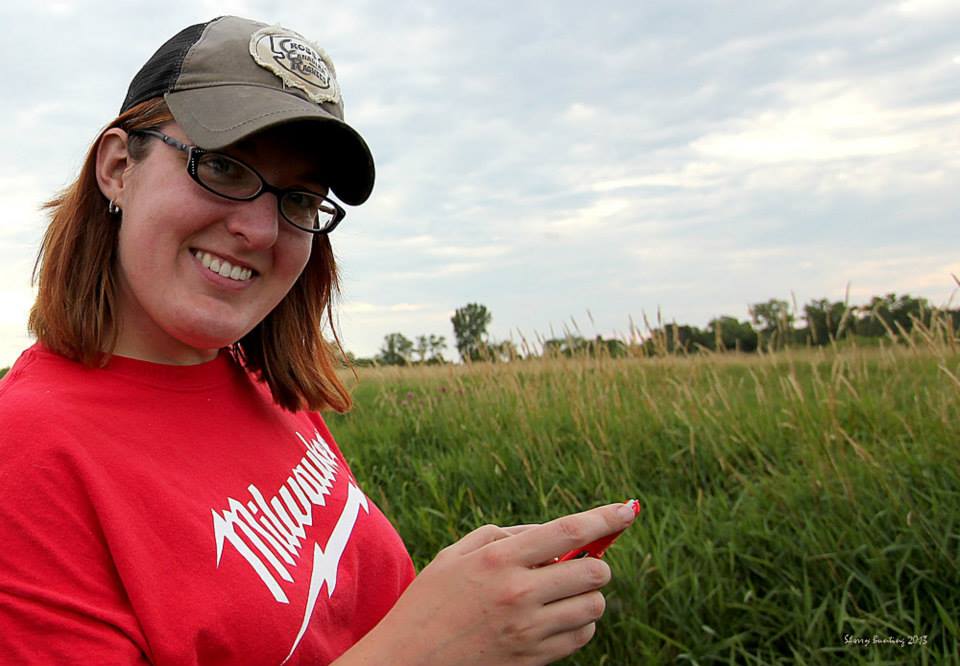
HARRISBURG, Pa. — While not precisely a red carpet, the “Meet Dairy Carrie” signs are ready for posting as the Pennsylvania Farm Bureau and Penn Ag Industries are putting Wisconsin dairywoman and internationally known agvocate and blogger Carrie Mess (a.k.a. Dairy Carrie) in the limelight during the first few days of the Pennsylvania Farm Show kicking off Friday, Jan. 3 in Harrisburg.

She will have a full itinerary here this weekend at one of the nation’s largest intersections for farm-to-city communication. Not only will she be hosting the “Mommy Bloggers” tour of the Today’s Agriculture exhibit, she will also spend time at PFB’s booth from 1:00 to 3:00 p.m. on Saturday and Sunday, Jan. 4 and 5.DairyCarrie6947web

“I’m really excited to meet the people and see how they interact with the real-life animal housing that is part of the Today’s Agriculture exhibit,” said Mess. “I remember seeing a story about it a few years ago, and I thought it was the neatest idea.”

She also loves rodeos and hopes to catch some of the High School rodeo action while she’s here.

Mess started blogging two years ago when she organized a hay drive from Wisconsin to drought-stricken Oklahoma.

Today, her “Adventures of Dairy Carrie” blog has 11,020 followers — many of them relying on her direct communications for their understanding of agriculture. She’s not afraid to tackle the tough issues and is known for a quick wit and tell-it-like-it-is style. In addition to the blog, thousands more keep up with her “very dairy life” via facebook and twitter.

1236709_669018869777199_41694483_n

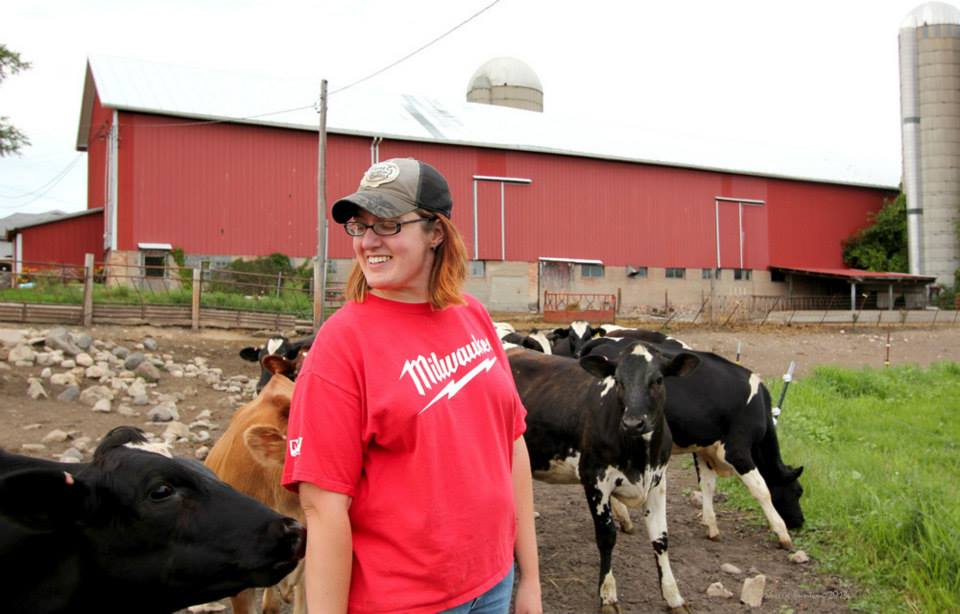
The rapid popularity of Dairy Carrie still amazes her husband Patrick. “It’s a little unbelievable the scope of people her blog reaches — and how quickly — and the good that has come out of it,” he said during my visit last August to Mesa Dairy near Milford, Wisconsin, where Carrie and Patrick are partners with his parents Clem and Cathy Mess — milking 100 cows, growing crops, and raising heifers on a rented farm nearby. Both generations have cattle in the herd comprised mainly of Holsteins and Holstein x Jersey x Normande crosses.

1236322_669018839777202_2039078906_n

While her posts address tough farm issues, she also uses social media to agvocate with other bloggers via AgChat. Her posts also tackle broader issues like the Panera Bread “EZ Chicken” campaign last summer. And she gives her followers a taste for the lighter side with recipes, “welcome to the world” photos of new calves on the the farm, and posts that simply extol the virtues of cheese.

Her post, which was a letter to Panera Bread, challenging them on their “EZ Chicken” campaign for its thoughtless portrayal of conventional farmers as “lazy” for using antibiotics when needed, became a movement that resulted in action by the company to remove portions of the campaign last summer.

More recently, her blog and video entitled “Sometimes we are mean to our cows” brought in her largest audience to-date with 370,000 views and untold hundreds of thousand more after The Guardian picked it up on their news feed.

1239590_669019409777145_965155517_n

That blog post was a realistic demonstration of the situations farmers face when being what appears to be “mean” is in the cow’s best interest to save her life.

“I am going to let you in on a secret, PETA and Mercy For Animals have shown you some truth in their undercover videos on dairy farms. The truth is sometimes as a dairy farmer I am mean to my cows,” she wrote. “I think it’s time we talk about “down” cows.”

And thus began her post that explained dealing with a down cow in the same matter-of-fact manner as an earlier post about what do cows eat.

Carrie dealt with the issue straight on, answering questions in an elementary fashion: What is a down cow? What causes a cow to go down? How do you get a down cow up?

She explained that “cows are big animals.”

She enlightened: “A down cow is a dead cow.”

She blurted out the simple truth: “When asking and gentle encouragement doesn’t work, I make myself scary to a cow. I yell and holler. I act aggressive. I smack harder. When that doesn’t work I know that things are going really bad and I have to try harder to get her up. The next step is for me to use the cattle prod.”

She ends with the heartfelt truth: “I love my cows and that means sometimes I have to be mean to them.”

Carrie’s blogging goes well beyond the periodic post… with so many followers following up with questions and comments, she devotes the time to answer the many questions that follow.

1002848_669019309777155_1104554756_n

“It can be draining,” she confesses. In addition, she works flexible hours “off the farm” and does all of the vet care and pre-vet work with the family’s Mesa Dairy herd.

That’s a tall order for a gal whose farm exposure growing up was horses and donkeys and the FFA. But Carrie is a fast learner.

How did she learn so much in the six years married to Patrick and the farm?

“I figure things out,” she says, and as her grin widened, she confessed: “I annoy our vets with lots of questions.”

That attitude sums up her blog: always asking questions and finding the answers to them — with the kind of zest that draws in the non-farm folk to gain a truer understanding and better appreciation of dairy and agriculture today.

1238181_669020736443679_829124616_n

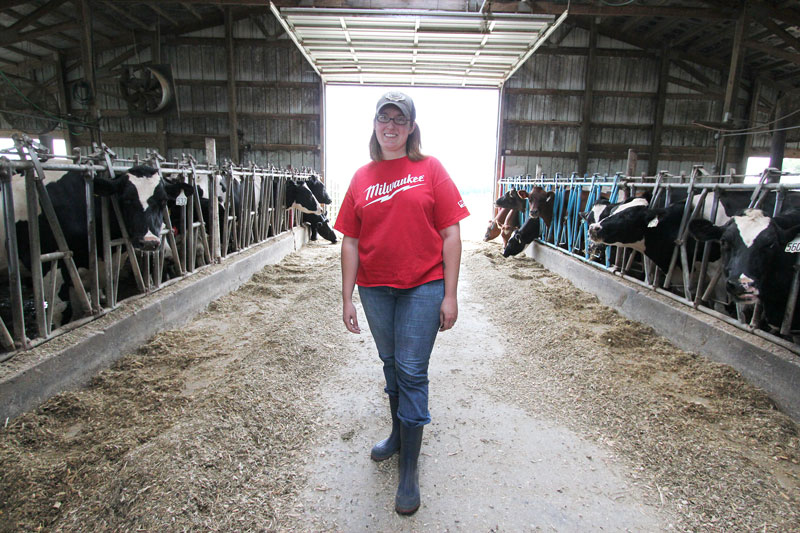
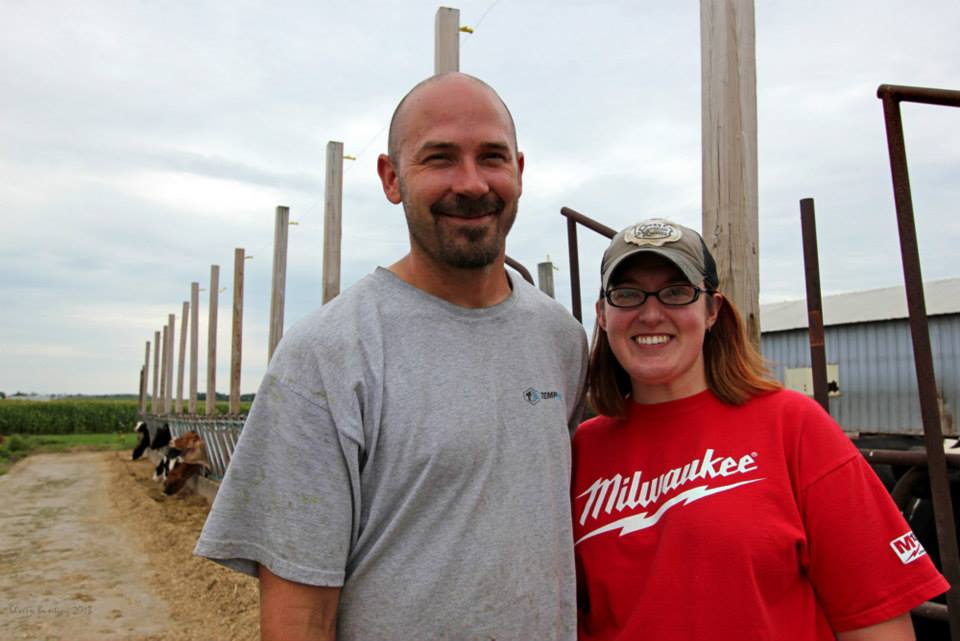
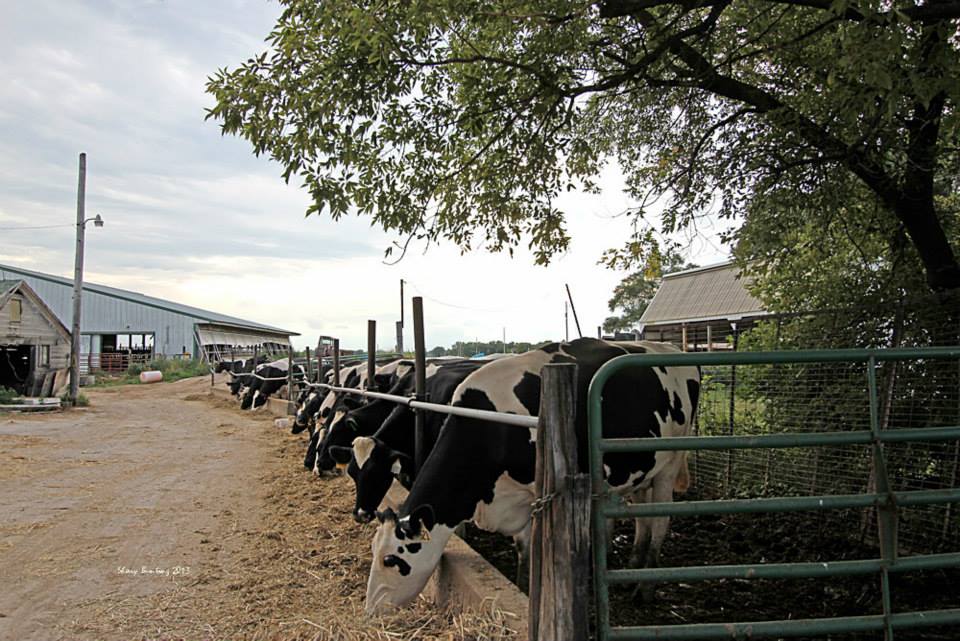
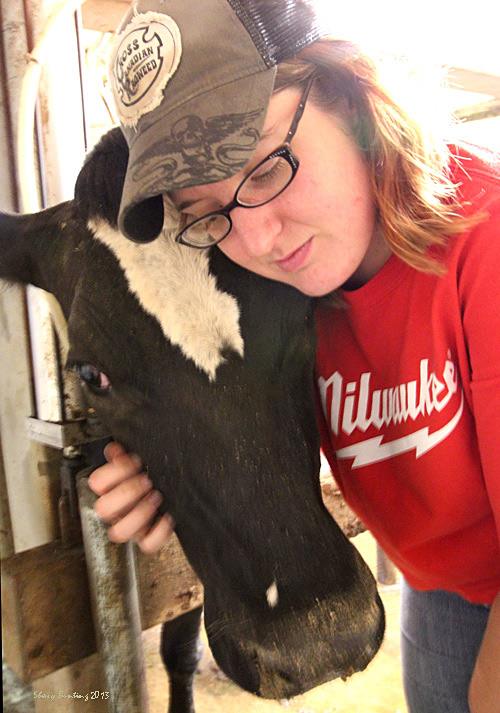
PHOTOS: These photos of Carrie Mess (aka ‘Dairy Carrie’) were taken last summer at Mesa Dairy in southern Wisconsin, where she and husband Patrick love pretty much everything about dairy farming. Carrie blogs about her “very dairy life” to over 11,000 followers at her blogsite “Adventures of Dairy Carrie” at http://www.dairycarrie.com. She will host the “Mommy Bloggers” tour of the Today’s Agriculture exhibit Friday and spend time at the PA Farm Bureau booth this weekend at the PA Farm Show in Harrisburg.  Photos by Sherry Bunting

View more photos at https://www.facebook.com/media/set/?set=a.669018806443872.1073741853.500073020005119&type=1

Triumph in 2013 trumps tragedy in 2012


Image

‘Amazing return’ for top type and production Jersey, now a 100,000 lb All-American nominee 

By Sherry Bunting, reprinted from Farmshine, Nov. 22, 2013

 MADISON, Wis. — Wendy Schmidt remembers the kindness of passersby a year when a distracted driver tipped her trailer not far down the road home to Bloomer, Wisconsin after the 2012 World Dairy Expo in Madison.

One animal died. The rest of the show string was traumatized.

“Jersey cows are like people,” says Wendy. She and her husband Jon own and operator Woodmohr Jerseys – home to 40 Jersey cows with a classification average of 91 points and four generations of Godiva.

“After the accident a year ago, it took all of us a while to get over the trauma. For weeks, the cows would follow me around in the pasture. I was their comfort and they were mine,” she recalls. “I got up every night to check on them, and found myself checking them constantly throughout the day.”

Especially ‘Jade Diva.’ She was positioned on the trailer right next to the one cow that died that night.

“Jade Diva had a lot of injuries after the trailer tipped. She had cuts all over and swelling. Her head was even swollen, and she wanted the other cows to keep away from her for days because her head hurt. Our vet prepared us to see issues later with all the animals that were traumatized, and we did see some pregnancy issues,” says Wendy, quite thankful a year later the cows are alive and pregnant or have calved.

Reflecting on that night, she is quick to add her gratefulness to the folks who stopped along the road to help with the cattle. “It was such a relief and we are so thankful,” she says.

Wisconsin dairywoman Carrie Mess, of ‘Dairy Carrie’ blogging fame, was one of the people who stopped that night.

“We just pitched in,” Carrie recalls. “It’s instinctive for any of us, you know? These cattle were pretty shook up. I had lots of Udder Comfort in my car from the Expo, and so once the animals were secured, we just started spraying legs and udders… right there.”

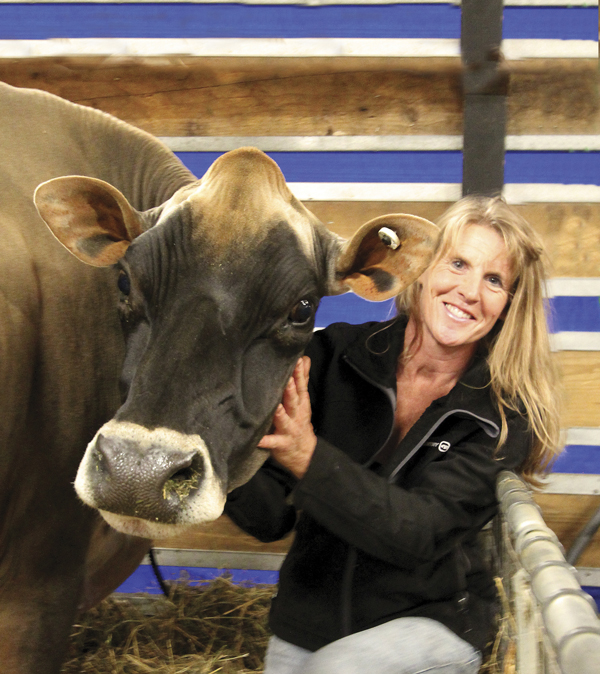
“That was the first thing we did. And if we had not done that for this cow in the accident, we don’t know what would have happened to her,” adds Wendy, referring to GB Jade Diva of Woodmohr — the EX-94 winner of the 2013 NASCO type and production award at the International Jersey Show during the 2013 World Dairy Expo last month.

Jade Diva was third place in the 100,000-lb class before going on to receive this high award in fine show condition just one year after the accident in which she sustained numerous injuries.

“It was amazing to bring her back to Expo this year to get third in production and win the NASCO type and production award,” Wendy says with a smile. “I love working with purebred cows and fell in love with the Jersey breed 20 years ago. These cows are my life.”

A thankful heart

 ChristmasBarn05Sept6691

Looking over the past year, and especially the past few months, the needs seem so great in the wake of weather events that have surpassed expectations. An early autumn blizzard in the Plains, a typhoon of immeasurable proportions in the Philippines, scores of tornadoes unleashed unseasonably in the Midwest — each event bringing its own form of devastation to a location, a people, a community.

And yet, folks in the midst of ruin are thankful. Reading the accounts or speaking with those affected personally, one common thread emerges… People who have survived a devastating event often have a more thankful heart than those of us going about our daily lives without having to face such immediate danger and loss.

As we celebrate Thanksgiving in a few days, we talk about what we are thankful for. We look around at family, friends, home, hearth, sustenance, and the Lord’s blessings in our lives.

But do we have a thankful heart? Are we full of gratitude? While giving thanks is an action we are reminded to engage in, a thankful heart, on the other hand, is a state of mind.

One example for me is the rancher in South Dakota who — when selected to receive heifers from the Heifers for South Dakota project — instead said no, let me give four of my best to someone who needs that spark of hope. In that case, the rancher had lost nearly half his herd in Storm Atlas October 4-5, but he said he would pull through. With a thankful heart, he gave four heifers to the project so that someone else in a similar situation could benefit.

After the tornadoes last weekend, farmers in some areas of the Midwest lost buildings, communities lost schools and homes. Within hours, neighboring communities and farm groups had mobilized cleanup efforts to help with the first step and most difficult step in rebuilding — grasping the devastation and sifting, sorting, cleaning up to regroup and move forward.

An ocean away in the Philippines, an even darker picture emerges, with a staggering death toll and untold survivors without food, water, shelter. As organized aid finally is able to flow to that region, stories of thankfulness follow.

We live in a world today with all the bells and whistles. We have so many distractions from the things that are most important. Each of us can be one moment away from a change or loss unexpected, which is all the more reason to not just give thanks for what we have but to embrace an attitude of thanksgiving, to have a thankful heart. 

The first Thanksgiving in 1621 was such an occasion. The celebration was of the first successful harvest, preceded by a winter of loss, disease, hunger, and fear and a spring and summer of drought but trusted still to be blessed with a harvest.

I am reminded of the Rose Kennedy quote: “Birds sing after a storm; why shouldn’t people feel as free to delight in whatever sunlight remains to them?”

A thankful heart then paves the way for optimism, faith, hope. A thankful heart allows us to see the new sunshine and sing instead of remaining quietly in the dark of the storm.

Happy Thanksgiving.birds-barn

Chillin’ with the Meck Bros… How two brothers are building their dairy business in volatile times.

Meck-Bros0016low

By Sherry Bunting, reprinted from Farmshine August 22, 2012

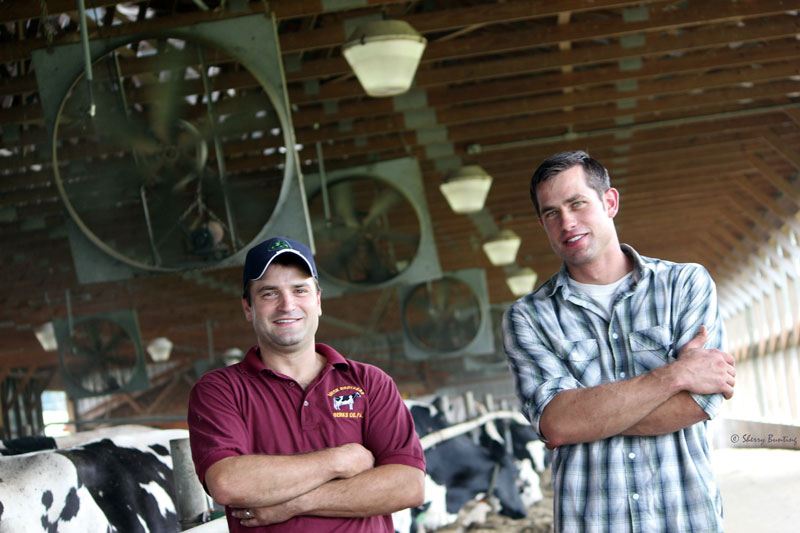
Zach and Jeremy lost their father last year just a couple months before this story was published. He would have been proud to read it, and they credit their father with giving them the tools to become first-generation dairymen with their own farm today. Their dad bought them a few project animals for 4-H and FFA and taught them to work hard on the family’s crop and poultry farm where the boys were raised. Here is their story of building a dairy business in volatile times.

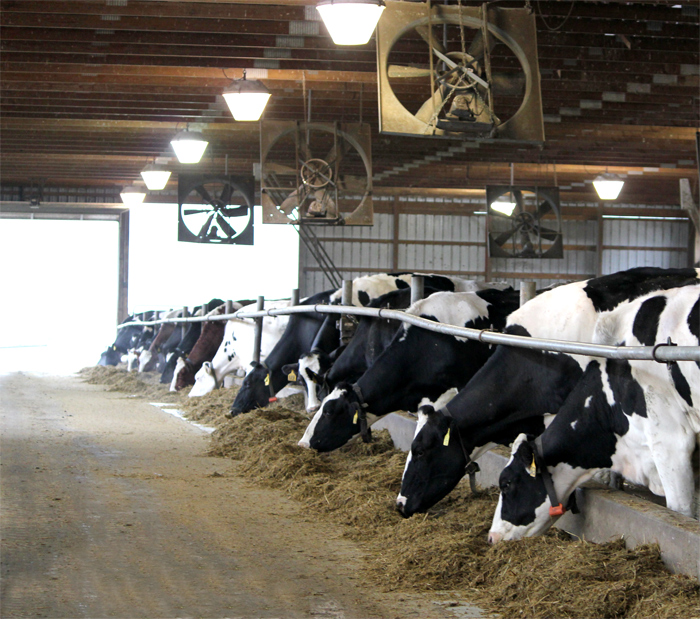
WOMELSDORF, Pa. — It was just shy of 100 degrees outside in the shade, but the cows in the barn didn’t mind. Standing in the 170-cow freestall barn at Meck Bros. Dairy near here, was actually comfortable on a visit during the August heat wave.

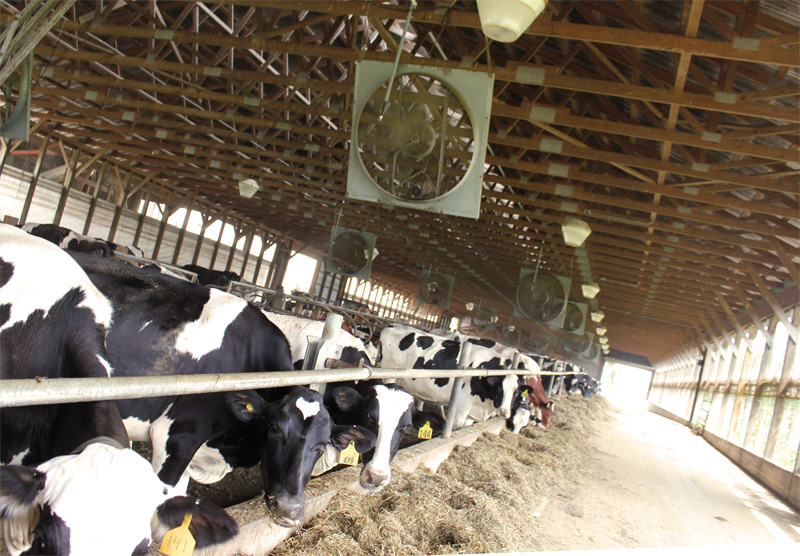
Despite the extreme temperatures that summer, the Meck brothers say their cows have done better than in previous summers. (Read more about their unique cooling system at the end of this story.)

The Meck Brothers have been farming in Berks County, Pa. since 2008 when they purchased a preserved farm and spent the past four years renovating it. They were attracted to this farm when it came up for sale in 2007 because much of the farmland around it is also preserved.

But their story really begins in Reinholds, Lancaster County, where they grew up on a crop and poultry farm operated by their parents Ronald and Joyce Meck until their father passed away this past spring. Today, they are cropping 340 acres at their own Berks County farm and the 400 acres in Lancaster County that belong to their family.

Why dairy? Zach and Jeremy started their dairy business on their own in a rather unconventional way, but they are quick to point out the impact of their father’s example, and the start he gave them when he bought their first 4-H starter animals.

“We were drawn to cattle in 4-H because of being able to grow the crops to feed the cows and being able to grow our own youngstock,” Jeremy explains.
meck06

In their late father’s poultry business, the pullets were raised off the farm and brought to the farm as layers. “We had a lot of land base for the poultry, so we started grazing our cattle there and growing feed to manage the manure nutrients from the poultry,” Zach notes.

They had been building their own dairy herd on rented farms for several years. They started out milking a small herd of 12 cows for the purpose of feeding veal calves they would buy from area dairy farms and auctions.

“During those years, we learned an awful lot about calf care and homeopathic remedies,” the brothers say with a smile as they mention the stinging nettles herbal tea they found helps young calves with scours.

meck10

Today, they raise all their own youngstock on area pastures, and are preparing to relocate them to one rented facility nearby. “That will cut down a lot on our run around time,” the brothers relate.

In 2007, they learned of this Berks County preserved farm going up for sale. They bought it and tore down the existing dairy barn, working with Franklin Builders to replace it with a small freestall barn. Zach and Jeremy built the parlor themselves by putting together two used milking systems and buying new stalls from the former Brandt’s Supply. And they did the stonework on the outside with the help of Kurtzcrete.
meck05

The manure pit and sand settling lane were also installed in stages with the help of a friend (Mark Landis), who works in excavating. They engineered a two-stage flush system for the sand-bedded freestall barn, and put in a sand settling lane that has a third “speed bump” for catching sand before the slurry goes into the pit. A second pit is available for future expansion.

The barn flushes from the center to the end while the cows are in the holding area for milking. Sand is pulled from the sand settling lane and reclaimed for reuse as bedding. The brothers estimate they recycle most all of their sand, and buy two loads of fresh sand a year in the winter.

The Meck Bros. Dairy herd has grown slowly. Before buying the Berks County farm, Zach and Jeremy grew the herd from 12 to 40 to 60 to 120 cows on a rented farm. They were intent on keeping their business as manageable as possible.

“We ran the numbers and realized we would have had to go to 600 cows to afford building everything all new,” Zach affirms. “So we would have needed more land base than what is on this farm. So, we built for 170 cows in this phase.”
meck08

They moved into the renovated facilities in 2008 with 120 milking cows, mainly Holsteins, including a few Red and Whites and Brown Swiss. (And the spring 2013 addition of those cute li’l Jerseys.) With high cattle prices that first year in business, they populated the barn by purchasing an economically priced crossbred grazing herd out of West Virginia to get their numbers up to 170.

“Those cows aren’t fancy but they do okay, and we are improving the herd as we breed them and bring in replacements,” Jeremy notes.

Moving the herd to the Berks County farm in 2008 was a welcome relief after the brothers had spent months milking and switching cows at the rented farm in Ephrata at the same time they were working on the new farm and facilities in Womelsdorf.

“We would work down there and then come up here and work some more,” Jeremy reflects. “We worked ahead to get crops in here to have feed here before we moved the cattle.”

Four years later, the brothers have come through some of the worst years in the dairy business. Looking at 2012-13, they have a corn silage crop that looks decent, and they had a terrific harvest of triticale forage this spring, along with hay and haylage. But the coming year will be difficult for them as for all dairy farmers with a moderate milk price trying to cover soaring input costs.

Zach does the nutrition work here, having previously worked for a nutritionist. They feed a high forage ration with 55 pounds of corn silage and 15 to 20 of haylage and five pound of triticale silage. The ration includes less than 12 pounds of total grain per day.  They grow the forages and some of the corn, and buy soybean meal and corn distillers, wheat midds and minerals.

“It’s basically a 65% forage diet,” he says. “We double crop a triticale/Italian rye mix that we harvest before planting the corn. We got six to eight tons per acre with excellent protein this spring, and will do that again this fall for next spring.”

For corn silage, they plant Pioneer hybrids, but keep an open mind and check out the trials. “We planted 30 to 40 acres in BMR to fill one bunk as a summer feed for high digestibility,” Zach explains. “The rest is planted to a mixture to keep our seed costs down.”

Today, the brothers farm over 700 acres and milk 170 cows. The herd produces 75 to 80 pounds of milk per cow per day, with somatic cell counts around 200,000. They share responsibilities on the farm, with Jeremy taking care of the breeding, herd health and the finances, while Zach leans more toward the facilities and crops.

They sit down once a month and go over everything together and talk daily as they go about the chores on the farm.

Meck08-7884

“We started small and just worked and worked,” Jeremy relates. “We could not have done it without the foundation laid by our Dad. He bought us our first animals and lent us the barn to do it, and then he stepped away and let us do it.”

“It has been an adventure,” says Zach, who recently married Suzanne (Perdue). She brought her dairy roots in Maryland to Berks County, Pa.

Jeremy, still single, continues to renovate the old farm house near the milking parlor while living in the house across the road on the other part of the farm. He acknowledges that dairy is a family lifestyle and that being single and tied to the farm has its drawbacks.

“That’s why we both do everything here,” Zach adds. “We both know each other’s jobs so either one of us can take time off. You need to do that.”

With 15 years under their belts dairying since they were teenagers, the adventure for these brothers continues as there is always more work to be done and plans to be made.
meck11

As members of the Land O’Lakes cooperative, Zach has been active as a delegate for a few years. He also served previously as a member of the Dairy Policy Action Coalition (DPAC) board and the Berks/Lebanon County Dairy Farmers Voice.

“It’s time to get the younger generation involved in the leadership of their cooperative,” Zach affirms. “Our futures are at stake in the outcome of the decisions that are made.

“There are no ifs, ands, or buts about it, when you get half or three-quarters of a milk check — whether you are buying feed or considering the value of the crops going in the cows — dairying has to be sustainable. Where am I at the end of the day in terms of gross profit, that’s the relevant question,” he adds.

If producers here have to reduce production under the proposed dairy market stabilization program, Zach believes it would be a hardship for young and beginning farmers like he and Jeremy. “If we make 80 pounds and are paid for 70, but have higher taxes and a higher basis on our corn and soybeans and a smaller land base, how do we make that work?”

He points to the opportunity in the region fueled by the growth of the yogurt industry and other outlets for milk and consumers along the eastern seaboard.

“Why aren’t we focusing on the mechanics of the market?” he asks. “That should be our focus. We should be looking out for our fellow dairy farmers around us… Large or small, we’re all important. We have to focus on creating opportunities and getting the mechanics of the market right.”

Their Unique Cooling System  – www.cowkuhlerz.com

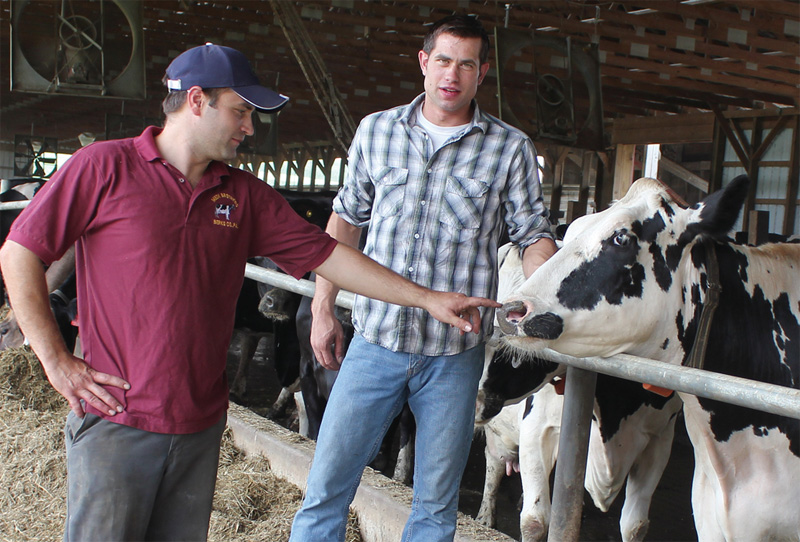
“We love this system,” brothers Zachary and Jeremy Meck agreed as they pointed out the elements of German cooling technology they have trialed in their freestall barn this summer. “It is simple, cost-effective, low-maintenance, and it does a great job of cooling with minimal water use.”

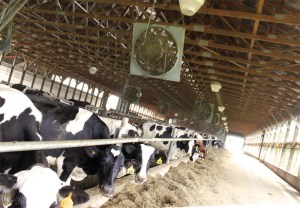
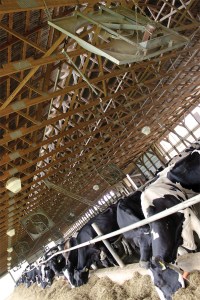
Instead of evaporative cooling by soaking the cow, these intermittent misters are placed in front of the circulation fans to cool the air.

Jeremy points out the conduit are kept high up in the trusses, and the nozzles drop down in front of the fans. This keeps the system out of reach of the cows and equipment so it doesn’t get bumped or broken. It’s also easy to put together and maintain, he says. “It’s a push together system.”
meck00

“Dan McFarland wanted us to try this for Hershey Ag before they start using them in dairy, hog, and poultry barns,” Zach explains. “We like the fact that it produces a light cooling mist to cool the air without getting the cows, feed, bedding, and concrete wet.”

“We put one in the milking parlor, too, for the employees, and they love it,” Zach adds. “It’s just like air conditioning.”

Despite the extreme temperatures this summer, the Meck brothers say their cows have done better than in previous summers. “We have seen heats in our cattle that we would not have seen before, and production did not drop off nearly as hard,” Zach explains. “The cows are up eating. Normally we would have high refusal rates in the summer, but no refusals this year. Dry matter intake has been steady.”

Trialing the Aroto-Asi cooler is just one example of how these two brothers continually look for simple and cost-effective solutions to manage their dairy farm.

Meck07-7991

MECK-BROS 0016

Zach (left) and Jeremy Meck love the new cooling system they’ve been trialing this summer in the 170-cow freestall barn at their Berks County, Pa. dairy farm. They’ve been dairying 15 years since they were teenagers and started out with 12 cows on their parents’ crop and poultry farm in Lancaster County.

MECK-BROS 9953

This is a long view of the conduit up in the rafters that brings water to the Arato-Asi cooler nozzles parked in front of each fan. This intermittent mist in front of the fans cools the air without getting the cows, feed, bedding, or concrete wet.

MECK-BROS 9980 or 9982 or 0001

The thermostatically controlled mist is barely visible (60 seconds on and 60 seconds off), but its cooling effect to the air in the barn and milking parlor is clearly felt by humans and animals, alike. The system uses very little water.

MECK-BROS 9965 or 9970

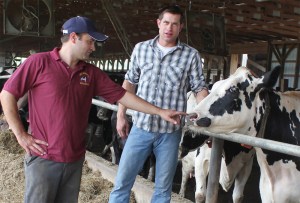
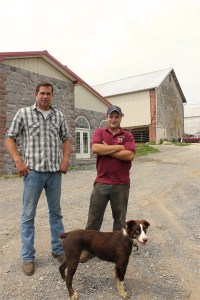
Zach (left) and Jeremy Meck own and operate Meck Bros. Dairy, milking 170 cows and farming 700 total acres in two counties with the help of three part-time employees at the dairy in Berks County where they bought and renovated a farm in 2008.

MECK-BROS 0053 or 0032

Jeremy (left) and Zach Meck recently completed the stonework, themselves, with the help of Kurtzcrete, on the milking parlor to match the existing bank barn and farmhouse.

###

Big message. Big impression. Ponderovey Dairy is real farm-city deal.

Image

 By Sherry Bunting, Farmshine feature

GLENDALE, Ariz. —  It’s been said that, “When you want something done, give it to a busy person.” And if that person is curious and likes to tinker, then so much the better.

Whoever coined the phrase must have met Paul Rovey.

The Watusi cattle horns gracing his office door are draped with dozens of lanyards holding meeting nametags as evidence of his participation on many boards, including chairmanship of Dairy Management, Inc. (DMI) for the past 11 years and service as president of United Dairymen of Arizona (UDA).

 Ponderovey13

At home on the farm, however, the conversation turns to the cattle at Ponderovey Dairy, which is located within the city limits of Glendale, Arizona, just three miles from Cardinal Stadium. Paul loves cattle and he takes every opportunity to be a good neighbor, to strengthen opportunities for future generations, and to tell the story of dairy and agriculture in ways that make a lasting impact on the public. His prized herd of Watusi cattle help him do that.

Ponderovey03

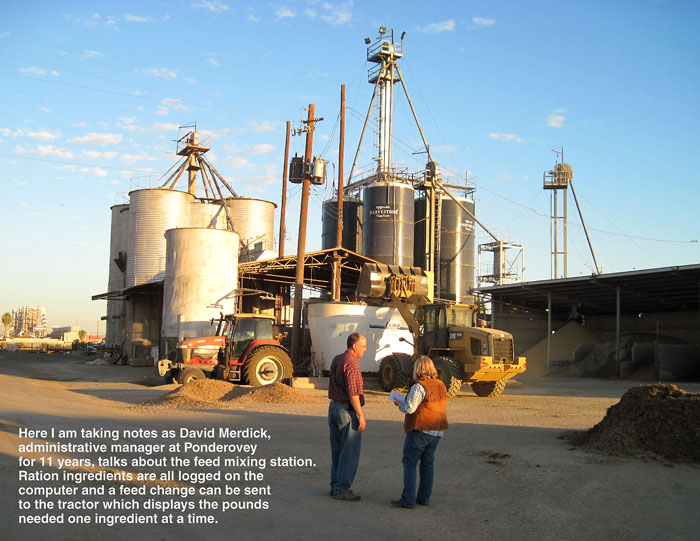
An impromptu visit in November started off touring the dairy with administrative manager David Merdick.

Ponderovey25

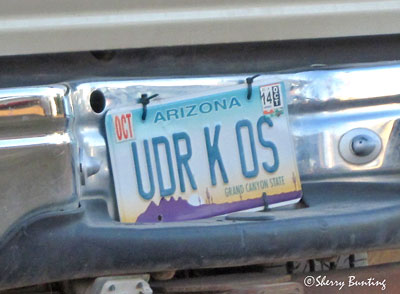
I quickly saw why Paul is an avid alumna of the livestock judging team at the University of Arizona. While a truck parked by the office trailer bore the license plate “UDR K OS”, the assortment of livestock here was remarkably organized.

Ponderovey24

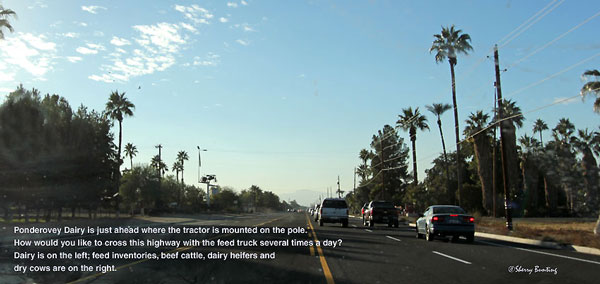
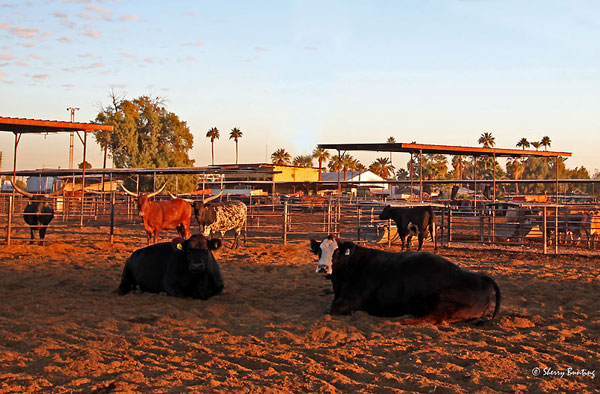
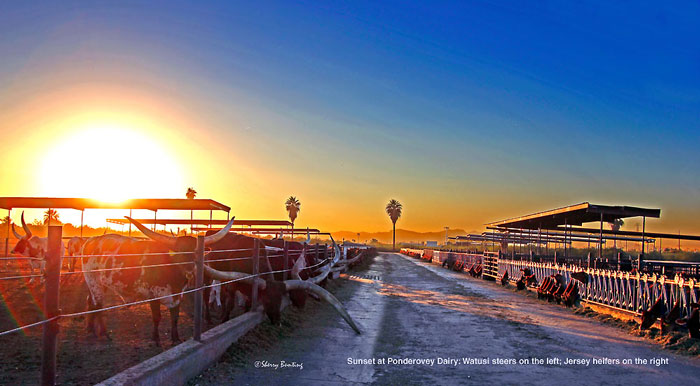
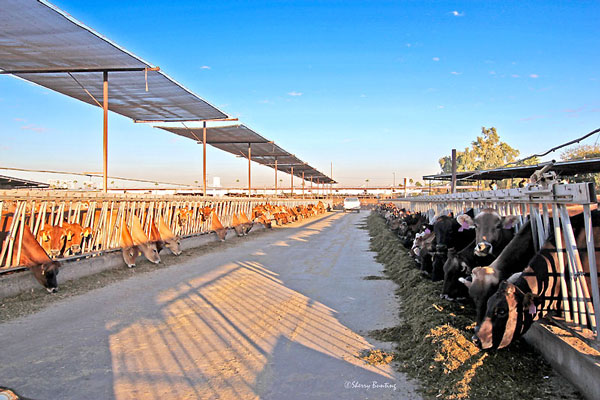
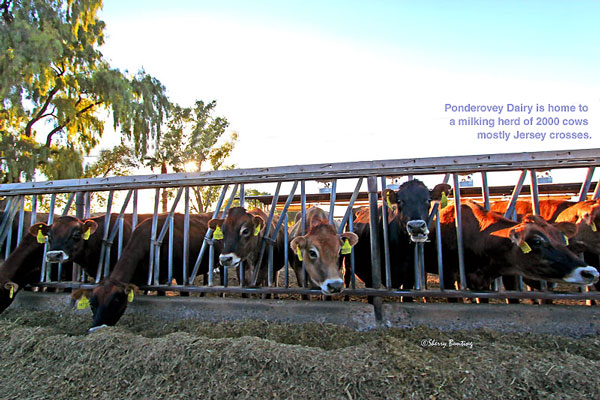
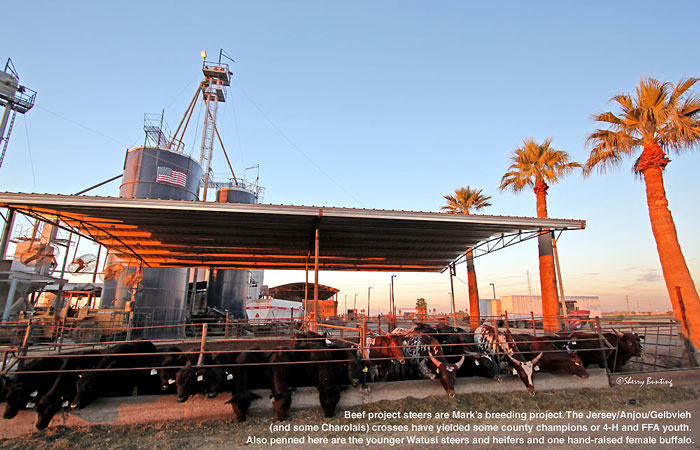
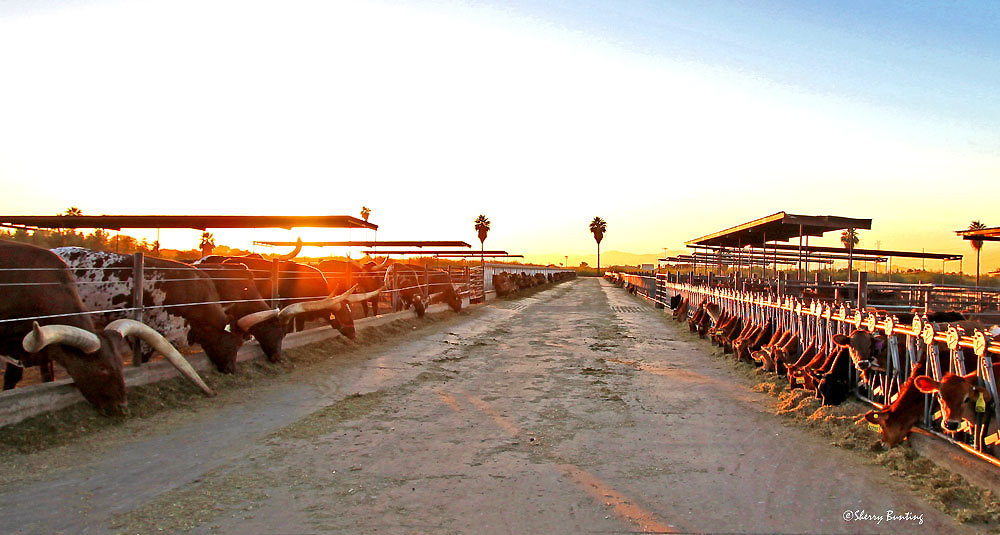
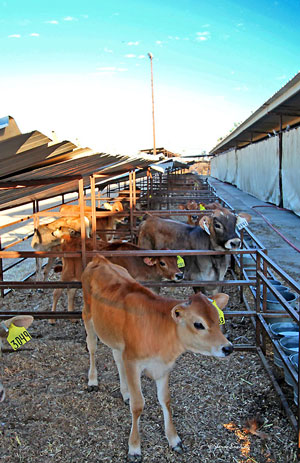
On one side of the busy road are the milking herd of just under 2000 Jersey crossbreds and the farm’s young calves. On the other side are the silos, commodity sheds, dry cows, some of the heifers, 30 head of beef cattle, and the prized herd of 90 Watusis.

A closer look revealed two Buffalo in the cattle corrals, and a flock of 300 ewes (with their seven guard-llamas) grazing pasture strips around them.

Ponderovey000

There’s a lot going on at Ponderovey. August 2012 marked 100 years for the Rovey family to be farming and dairying in the Grand Canyon State. Their greatest challenge, says Paul, has been “the encroachment of the city. We have to do a perfect job to maintain that equilibrium.” 

Ponderovey01

Ask what gives him the greatest satisfaction, and he smiles: “Seeing my kids getting into the business and seeing them build their interest and technical skills and opportunities.”

Ponderovey20

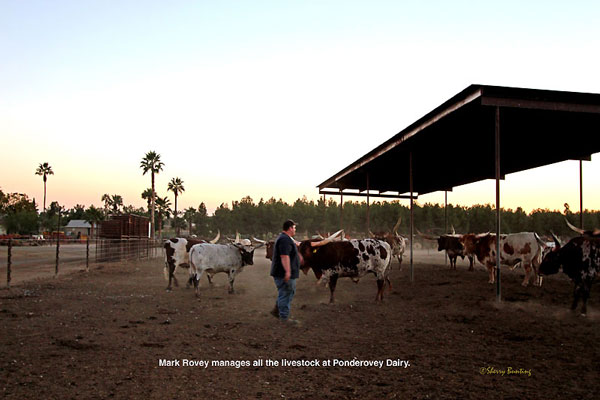
Paul and Deborah Rovey have five children. Traesa, Tamara, Eric, Mark and Brett are the fourth generation in Arizona, and the third generation on the farm started by Paul’s father.  Eric and Brett are involved in the 1500 acres of crops, mostly located west of Glendale.  Mark manages the cattle and sheep. And Tamara works in the farm office where one of her responsibilities is to source and purchase feed ingredients.

This year, the Roveys went back to farming the land belonging to other family members. The land had previously been leased to others to grow feed the Roveys then purchased for their livestock.

Ponderovey16

“One-third of those acres were being planted to cotton, but we were in need of feed,” Paul relates. “That didn’t make much sense when we owned the land and could be making feed for ourselves and our fellow dairymen.”

Today, they grow their own forages, including corn and sorghum for silage, as well as alfalfa and Bermuda grass. They bag barley, cottonseed and silage.

The dairy has certainly grown and changed since Paul’s grandparents — Albert and Minnie Rovey –settled in Phoenix in 1912 just after Minnie gave birth to twins back in Illinois. Doctors said she had tuberculosis and would not survive six months in the Midwest climate. So they headed southwest to start a new life in sunny Arizona. They farmed in what is now downtown Phoenix. Paul’s father, Emil, was born four years after the move to Arizona. Albert died when Emil was 12 but Minnie lived to be 96.

Ponderovey02

In 1943, when Emil Rovey returned from college, he bought the current dairy farm location and married Paul’s mother Helen. Paul is one of nine children. As he grew up on the Glendale farm — nine miles northwest of Phoenix — he developed a passion for the dairy and knew it’s what he wanted to do. He bought the dairy from his father after returning from the University of Arizona in 1978. That’s when the Ponderovey name came into use.

“When I was dating my wife, her mother would call us the ‘Cartwrights’ (from the television show ‘Ponderosa’),” said Rovey in response to a question about how the dairy got its name. Like that famous television family, the Roveys are involved in the farming and non-farming communities and have found various ways to ‘give back’ at the local, state, and national levels.

Ponderovey17

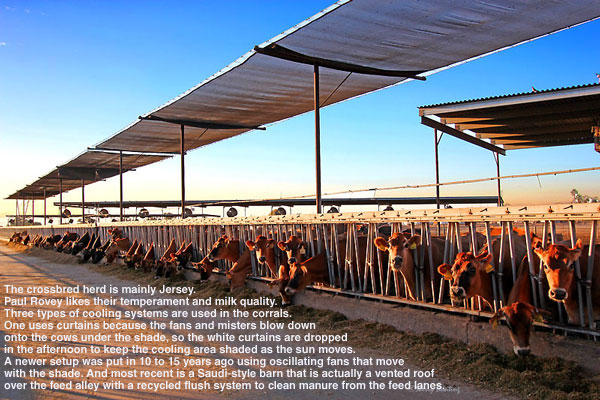
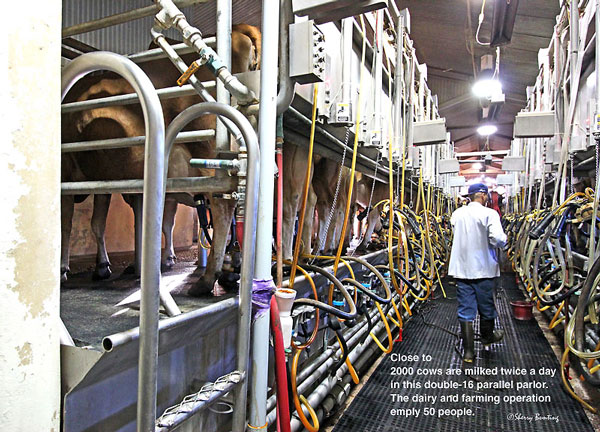
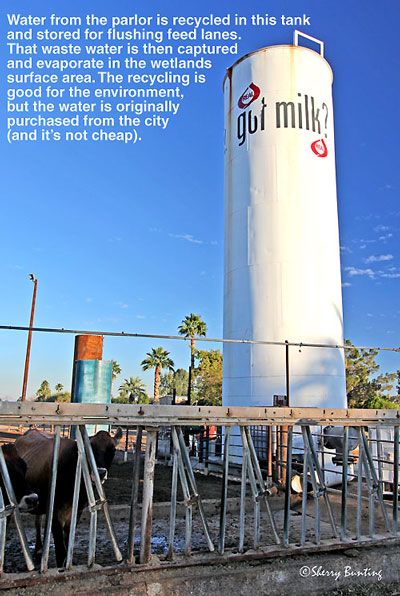
Ponderovey Dairy isn’t fancy, but it’s replete with purposeful innovations. Curtained and non-curtained cooling systems, as well as a Saudi-style barn, are three ways they provide shading and cooling to the Jersey dairy cattle in the corrals. Cow comfort is also important in the parlor, so the old double-16 parallel was upgraded with automatic detachers and rubber flooring.

Ponderovey04

While the Roveys grew their dairy herd over the past 30 years, the dairy infrastructure in Arizona was also growing at an even faster rate.

“Our strong infrastructure is UDA, which is an incredible cooperative,” says Paul. “We also have tremendous dairymen in this state. It’s hard to milk cows in Arizona, so our dairymen are some of the fittest around.”

In the past 20 years, dairies have sprung up to the south, and Arizona has become the state with the largest average herd size at 2000 head.  By comparison, California’s average herd size is around 850 head, and the U.S. average is 175. The largest herds in Arizona exceed 10,000 head. The state’s 90 dairies produces 2% of the nation’s total milk supply. In addition to cheese and innovative dairy proteins, UDA serves the fluid milk market in Phoenix.

Utilization is roughly one-third fluid milk, one-third cheese and one-third powder. If they have excess milk, it’s not easy to truck it anywhere else, according to Rovey, so UDA has created ways to balance their own market. Their percentage of total production going for export is “really high” because they chose to develop markets off shore. In 2010, the UDA cooperative was named Dairy Exporter of the Year.

“The swings in production from summer to winter are tremendous here,” says Paul. Summer temps can reach 115 to 118 degrees Fahrenheit, and there is humidity here in July and August.

Ponderovey09

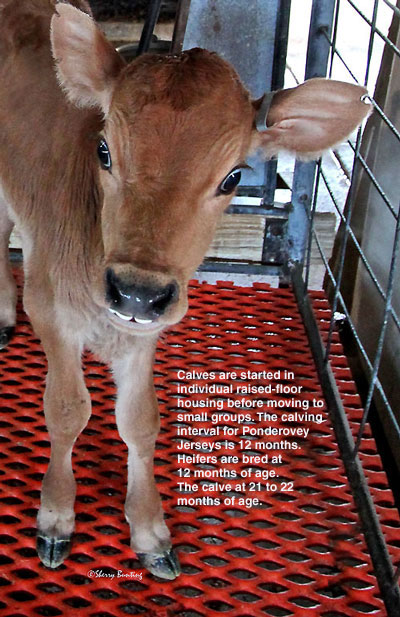
The Ponderovey dairy herd of close to 2000 cows is primarily Jersey and Jersey crosses, but only about 10% of the dairy cattle in Arizona are Jerseys.

“We were milking a little over 2200 cows at one time and then we sold 240 head,” notes Paul’s son Mark who manages the dairy herd and other livestock at Ponderovey. “The day after selling those cows, our milk volume was down, but two days after that, we shipped more milk than when those cows were here. We were making more milk with fewer cows, so now we make it a point to stay below 2000 to avoid overcrowding.”

Ponderovey23

This has enabled Ponderovey Dairy to sell 700 to 800 head of Jerseys for dairy replacements annually.

“Everyone wants Jerseys. They make good quality milk for cheese, and I like their temperament,” says Paul, noting they also have 250 Brown Swiss and a few Holsteins.

Ponderovey05

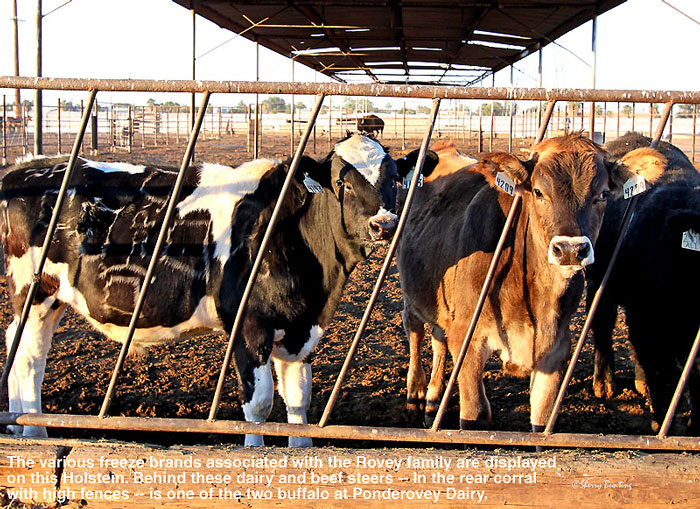
Breeding and herdsmanship are son Mark’s priority, and his commercial husbandry is top notch. All dairy and beef animals are bred A.I., and freeze branding is used for identification instead of hot brands.

Ponderovey19

The market steer project is something Mark has taken keen interest in. Using the Jersey cross as his base, he incorporated Maine Anjou and Gelbveih to produce some award-winning junior market beef at county fairs and the Arizona State Fair.

Ponderovey12

“We can grow steers for FFA and 4-H by using A.I. semen to improve our base of cows,” Paul explains. “Our focus is to provide affordable project calves and give kids the opportunity to show animals they can make money on, so they learn a lot and come away with a real positive animal experience.”

On the east side of the valley, for example, is Sunshine Acres, a boys’ home with an ag program. Paul explains how opportunities to show market steers and market lambs can change young lives and plant seeds of good will for animal agriculture.

In similar fashion, the flock of sheep developed when Paul started supporting the county fair auctions.  After buying and selling to the resale pen for years, Paul decided six years ago to be the resale buyer on the ewes. He started bringing ewes home to graze the odds-and-ends pastures of alfalfa and Bermuda grass that were too small to harvest efficiently with the big equipment used on larger fields.

Ponderovey11

The flock is mainly Suffolk and Hampshire, producing youth show lambs and also commercial market lambs that are in high demand for the ethnic market.

Being inquisitive by nature, Paul Rovey takes an obvious interest in everything going on around him. He prides himself on looking for better ways of doing things and admits he serves on boards largely because he “sticks (his) nose into things and asks questions about doing things better.”

Ponderovey08

He’s a fan of win-win solutions. One example at the farm is his decision many years ago to stop selling dairy bull calves off the farm. Instead, they are harvested at birth and the meat is frozen for the Condor project at the Vermillion Cliffs. For more than 12 years, Ponderovey Dairy has supplied food for the project that is bringing back the population of California Condors from near extinction with a clean and consistent food supply. Today, the number of bull calves born at Ponderovey Dairy is on the decline due to the use of sexed semen.

Through his milk promotion service chairing the board of DMI, Paul sees firsthand how important it is to tell dairy’s story and to show animal well-being on the farm.

Ponderovey10

Dehorning is another win-win example. The Roveys use lidocane to numb their dairy and beef cattle at the site of dehorning. “It’s so simple and cheap, and it just works beautifully,” states Paul, adding that the use of lidocane has “helped our bottom line.”

Ponderovey07

With proper restraint and the lidocane, he says the now pain-free procedure can be handled by one individual instead of multiple employees.

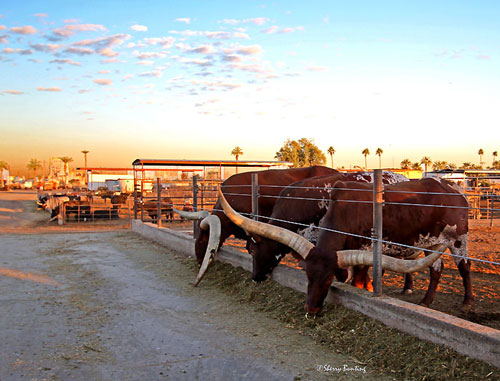
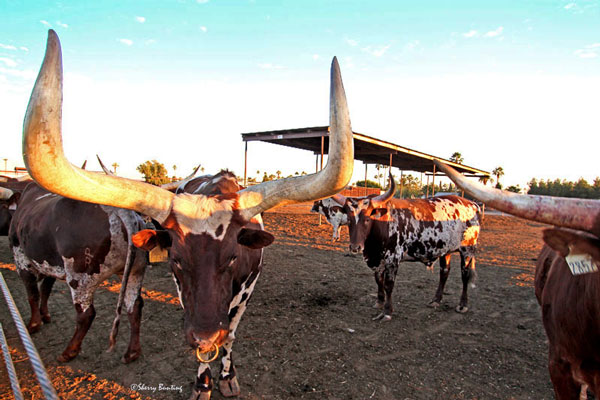
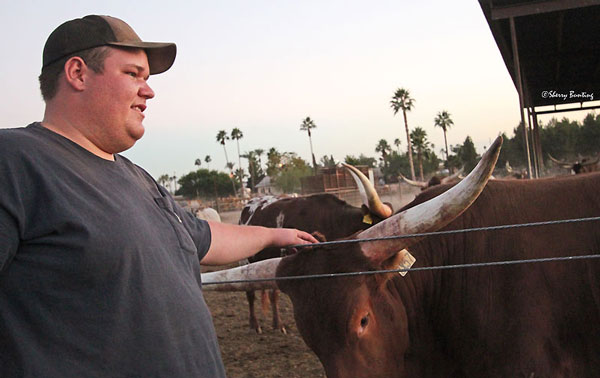
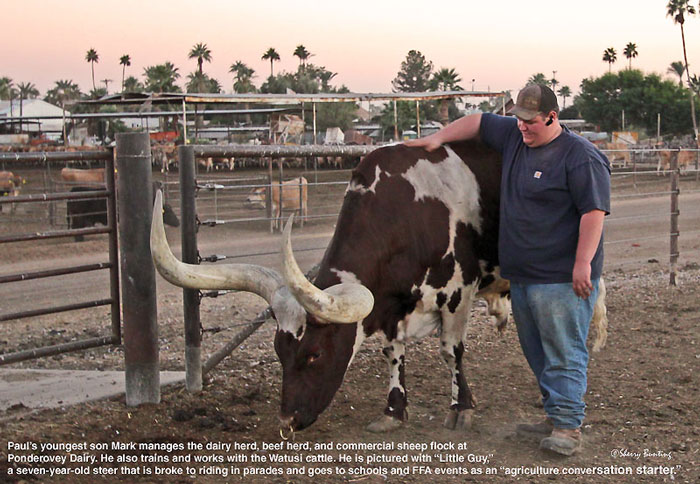
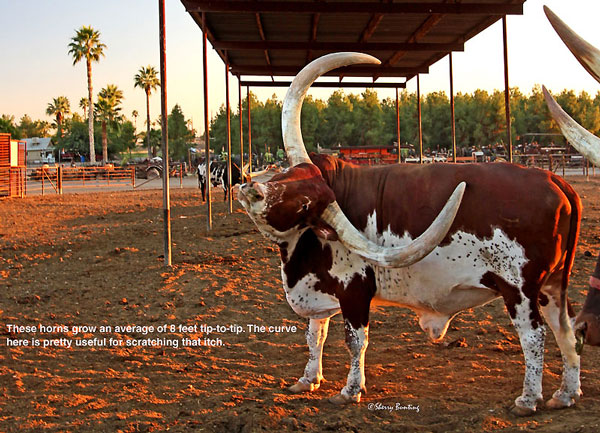
Perhaps the part of the farm that made the biggest impression was the Watusi herd. These grand bovines are prized for their large diameter horns. Their ancestry goes back 6000 years to Africa, and they are often referred to as the “cattle of kings.” At Ponderovey, however, the Watusi steers are named for Civil War Generals, except for “Little Guy,” the seven-year-old steer Mark Rovey has trained to ride in parades and FFA events.

Ponderovey21

“Once you have hold of their horns, you can pretty much do what you want,” Mark explains, noting the Watusis are born with a half-inch horn nub and can add about a foot of horn growth annually. While horn span (tip to tip) reaches an average 7 to 8 feet. Ponderovey has some that span 9 to 11 feet.

One of the Rovey herd originals — and a family favorite, the late Gen. Beauregard — had horns that spanned nine feet. He was trained to kneel so people could get on and ride. He was trained to stand on a pedestal and to walk into a modified top-off Cadillac where he would ride passenger-style with head and shoulders (and horns) exposed beside the driver in parades and other events. Mark said it took 20 minutes to train him to walk into the modified Cadillac.

“There have been none quite like him,” said Paul wistfully about the prized steer that lived to age 10. “He was golden.” General Buford was another well-trained crowd pleaser, and lived to 22.

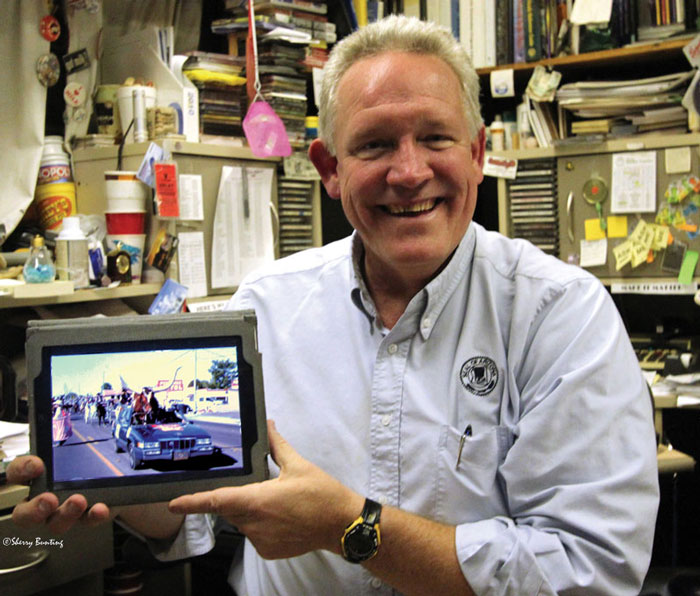
General Buford was another well-trained crowd pleaser, and lived to 22. At the farm office, Paul pulls up photos on his iPad of the late General Beauregard, one of the farm’s original Watusi cattle. The Roveys had trained him to be ridden and to stand in a modified open-top Cadillac for parades. Beau did 70 events a year for four years before he died, including visits to many schools throughout the region .

General Buford was another well-trained crowd pleaser, and lived to 22. At the farm office, Paul pulls up photos on his iPad of the late General Beauregard, one of the farm’s original Watusi cattle.  Beau did 70 events a year for four years before he died, including visits to many schools throughout the region .

Today, it’s General Longstreet and “Little Guy” that are the Ponderovey ambassadors for agriculture. The Watusis have been a fixture at the farm because Paul loves how their breeding program has produced offspring with different colors and markings and because the family enjoys training them and taking them to public events.

At elementary schools and FFA events. Mark says the Watusi cattle “are a good way to start a conversation about agriculture.”

“Whether we are talking about milk cows, or beef cattle, or anything about agriculture, these steers are big, and they make a big impression. People want to have their pictures taken with them,” Mark explains. “We roll that enthusiasm right into a conversation about agriculture and where their food comes from.”

Ponderovey06

Adds Paul: “When you can make a big impression, people remember what you said. The Watusis really capture that attention.”

The message Mark takes to town today, like his Dad before him, is also what he enjoys most about life on the farm… “the satisfaction of providing safe, affordable, nutritious food for America.”

Ponderovey18

The Indy-500 milkmen deliver ‘coolest trophy in sports’

Indy500-4078-2<

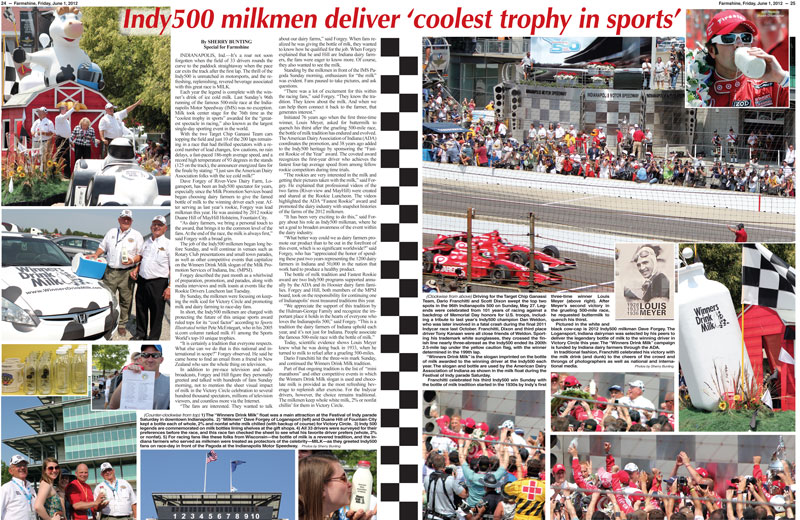
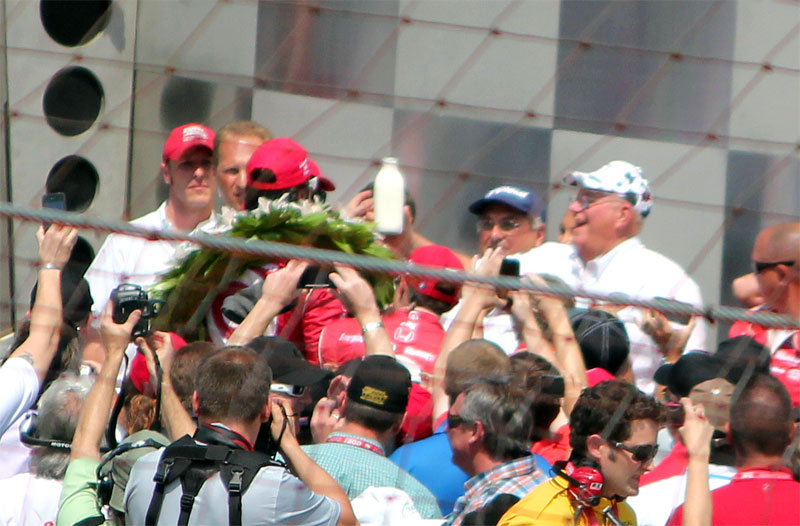
On Memorial Day weekend a year ago, I had the honor and privilege of being one of three agriculture journalists invited to cover the Indy-500 and the milkmen who present the famed glass of milk to the winner. This International motorsports tradition is also an Indiana dairy farm tradition and underpins events for dairy promotion all year. Below is the story I wrote and some of the centerfold photos from last year’s event as we look forward to tomorrow’s run!Indy-spread

By Sherry Bunting, reprinted from Farmshine, June 1, 2012
INDIANAPOLIS, Ind.–It’s a roar not soon forgotten when the field of 33 drivers rounds the curve to the paddock straightaway and the pace car exits the track. The thrill of the Indy500 is unmatched in motorsports, and the refreshing, replenishing, revered beverage associated with this great race is MILK.

Each year the legend is complete with the winner’s drink of ice cold milk. Last Sunday’s 96th running of the famous 500-mile race at the Indianapolis Motor Speedway (IMS) was no exception. Milk took center stage for the 76th time as the “coolest trophy in sports” awarded for the “greatest spectacle in racing,” also known as the largest single-day sporting event in the world.

With the two Target Chip Ganassi Team cars topping the field and just 10 of the 200 laps remaining in a race that had thrilled spectators with a record number of lead changes, few cautions, no rain delays, a fast-paced 186-mph average speed, and a record high temperature of 93 degrees in the stands (125 on the track), the announcer energized fans for the finale by stating: “I just saw the American Dairy Association folks with the ice cold milk!”

Indy5294
Dave Forgey of River-View Dairy Farm, Logansport, has been an Indy500 spectator for years, especially since the Milk Promotion Services board began choosing dairy farmers to give the famed bottle of milk to the winning driver each year. After serving as last year’s rookie, Forgey was lead milkman this year. He was assisted by 2012 rookie Duane Hill of MayHill Holsteins, Fountain City.

“As dairy farmers, we bring a personal touch to the award, that brings it to the common level of the fans. At the end of the race, the milk is always first,” said Forgey with a broad grin.

The job of the Indy500 milkmen began long before Sunday, and will continue in venues such as Rotary Club presentations and small town parades, as well as other competitive events that capitalize on the Winners Drink Milk slogan of the Milk Promotion Services of Indiana, Inc. (MPSI).

Forgey described the past month as a whirlwind of preparation, promotion, and parades, along with media interviews and milk toasts at events like the Rookie Drivers Luncheon last Tuesday.

By Sunday, the milkmen were focusing on keeping the milk iced for Victory Circle and promoting milk and dairy farming to race-day fans.

In short, the Indy500 milkmen are charged with protecting the future of this unique sports award ruled tops for its “cool factor” according to Sports Illustrated writer Pete McEntegart, who in his 2005 si.com column ranked milk #1 among the Sports World’s top-10 unique trophies.

“It is certainly a tradition that everyone respects. What else can we do that is this national and international in scope?” Forgey observed. He said he came home to find an email from a friend in New Zealand who saw the whole thing on television.

In addition to pre-race television and radio broadcasts, Forgey and Hill figure they personally greeted and talked with hundreds of fans Sunday morning, not to mention the sheer visual impact of milk in the Victory Circle celebration to several hundred thousand spectators, millions of television viewers, and countless more via the Internet.

“The fans are interested. They wanted to talk about our dairy farms,” said Forgey. When fans realized he was giving the bottle of mlk, they wanted to know how he qualified for the job. When Forgey explained that he and Hill are Indiana dairy farmers, the fans were eager to know more. Of course, they also wanted to see the milk.
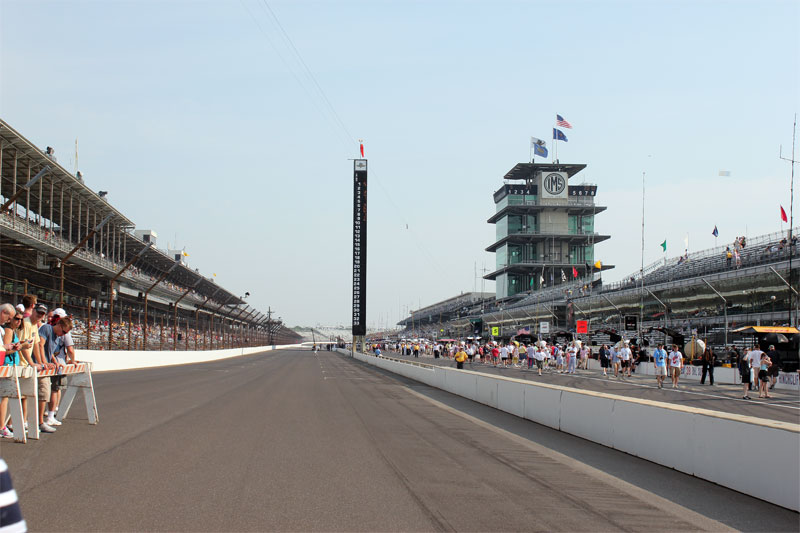
Standing by the milkmen in front of the IMS Pagoda Sunday morning, enthusiasm for “the milk” was evident. Fans paused to take pictures, and ask questions.

“There was a lot of excitement for this within the racing fans,” said Forgey. “They know the tradition. They know about the milk. And when we can help them connect it back to the farmer, that generates interest.”

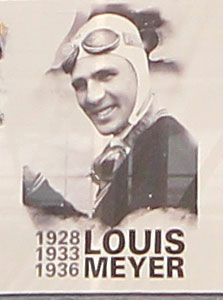
Initiated 76 years ago when the first three-time winner, Louis Meyer, asked for buttermilk to quench his thirst after the grueling 500-mile race, the bottle of milk tradition has endured and evolved. The American Dairy Association of Indiana (ADA) coordinates the promotion, and 38 years ago added to the Indy500 heritage by sponsoring the “Fastest Rookie of the Year” award. The coveted award recognizes the first-year driver who achieves the fastest four-lap average speed from among fellow rookie competitors during time trials.
Indy500-4137

“The rookies are very interested in the milk and getting their pictures taken with the milk,” said Forgey. He explained that professional videos of the two farms (River-view and MayHill) were created and shared at the Rookie Luncheon. The videos highlighted the ADA “Fastest Rookie” award and promoted the dairy industry with snapshot histories of the farms of the 2012 milkmen.

“It has been very exciting to do this,” said Forgey about his role as Indy500 milkman, where he set a goal to broaden awareness of the event within the dairy industry.

“What better way could we as dairy farmers promote our product than to be out in the forefront of this event, which is so significant worldwide?” said Forgey, who has “appreciated the honor of spending these past two years representing the 1200 dairy farmers in Indiana and 50,000 in the nation that work hard to produce a healthy product.

The bottle of milk tradition and Fastest Rookie award are two Indy500 programs supported annually by the ADA and its Hoosier dairy farm families. Forgey and Hill, both members of the MPSI board, took on the responsibility for continuing one of Indianapolis’ most treasured traditions this year.

“We appreciate the support of this tradition by the Hulman-George Family and recognize the important place it holds in the hearts of everyone who loves the Indianapolis 500,” said Forgey. “This is a tradition the dairy farmers of Indiana uphold each year, and it’s not just for Indiana. People associate the famous 500-mile race with the bottle of milk.”

Today, scientific evidence shows Louis Meyer knew what he was doing back in 1933, when he turned to milk to refuel after a grueling 500-miles.

Dario Franchitti hit the three-win mark Sunday, and continued the Winners Drink Milk tradition.
Indy500-5261-2

Part of that ongoing tradition is the list of “mini marathons” and other competitive events in which the Winners Drink Milk slogan is used and chocolate milk is provided as the most refreshing beverage to replenish after exercise. For the Indycar drivers, however, the choice remains traditional. The milkmen keep whole white milk, 2% or nonfat chillin’ for them in Victory Circle.
Indy054809

Indy4071
CAPTION INFORMATION:
Driving for the Target Chip Ganassi Team, Dario Franchitti and Scott Dixon swept the top two spots in the 96th Indianapolis 500 on Sunday, May 27. Legends were celebrated from 101 years of racing against a backdrop of Memorial Day honors for U.S. troops, including a tribute to last year’s Indy500 champion Dan Weldon, who was later involved in a fatal crash during the final 2011 Indycar race last October. Franchitti, Dixon and third place driver Tony Kanaan were all close friends of Weldon. Sporting his trademark white sunglasses, they crossed the finish line nearly three-abreast as the Indy500 ended its 200th 2.5-mile lap under the yellow caution flag, with the winner determined in the 199th lap.

“Winners Drink Milk” is the slogan imprinted on the bottle of milk awarded to the winning driver at the Indy500 each year. The slogan and bottle are used by the American Dairy Association of Indiana as shown in the milk float during the Festival of Indy parade Saturday.

Franchitti celebrated his third Indy500 win Sunday with the bottle of milk tradition started in the 1930s by Indy’s first three-time winner Louis Meyer (above right). After Meyer’s second victory in the grueling 500-mile race, he requested buttermilk to quench his thirst.

Pictured in the white and black cow-cap is 2012 Indy500 milkman Dave Forgey. The Logansport, Indiana dairyman was selected by his peers to deliver the legendary bottle of milk to the winning driver in Victory Circle this year. The “Winners Drink Milk” campaign is funded by Indiana dairy farmers through the ADA.

In traditional fashion, Franchitti celebrated his victory with the milk drink (and dunk) to the cheers of the crowd and throngs of photographers as well as national and international media.

Indy5221

Indy500-5275

Indy4201
MORE CAPTION INFORMATION:
The “Winners Drink Milk” float was a main attraction at the Festival of Indy parade Saturday in downtown Indianapolis.
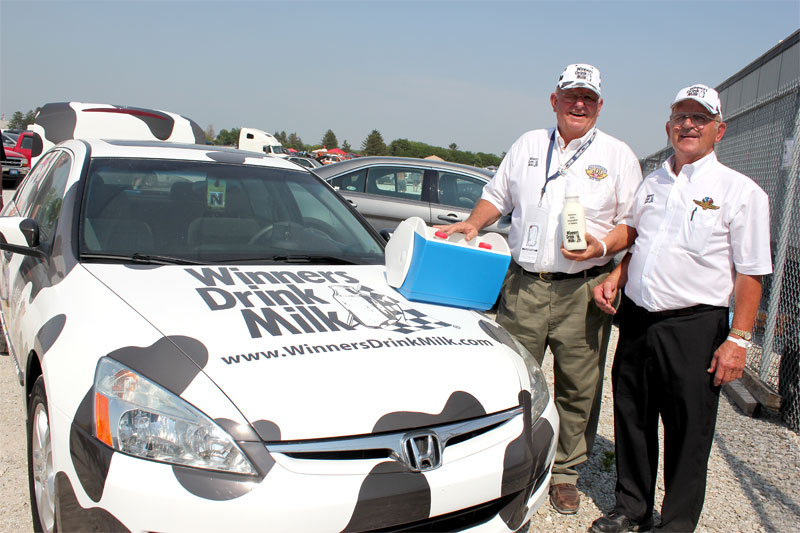
“Milkmen” Dave Forgey of Logansport (left) and Duane Hill of Fountain City kept a bottle each of whole, 2% and nonfat white milk chilled (with backup of course) for Victory Circle.
Indy 500 legends are commemorated on milk bottles lining shelves at the gift shops.
All 33 drivers were surveyed for their preferences before the race, and this race fan checked the sheet to see what his favorite driver prefers (whole, 2% or nonfat).
For racing fans like these folks from Wisconsin-the bottle of milk is a revered tradition, and the Indiana farmers who served as milkmen were treated as protectors of the celebrity-MILK-as they greeted Indy500 fans on race-day in front of the Pagoda at the Indianapolis Motor Speedway.

Dawn renewed

Sunrise8591

“It will never be the same,” said a Boston athletic association representative in the dawn following yesterday’s tragedy.

He might well have been talking about all of us because those are the words a nation grieved with after innocent lives were lost on 9/11. 

“It will never be the same” is that sickening punch to the gut each time our freedom and security are attacked in broad daylight and when we might least expect it.

Young Martin Richards was just eight years old welcoming his father across the finish line even as God welcomed this young soul home at the hands of unspeakable evil.

Yesterday was not only the running of the iconic 26-mile marathon, it was also “Patriot’s Day” in the city that fathered the Sons of Liberty, Paul Revere and the Mechanics, the Boston Tea Party — the birth of a free nation.

Our hearts are heavy as a nation. This tragic act of terror is the work of coward(s). We must remember that.

And in the face of events that shatter our security, we must remember we are America: Land of the Free and Home of the Brave.

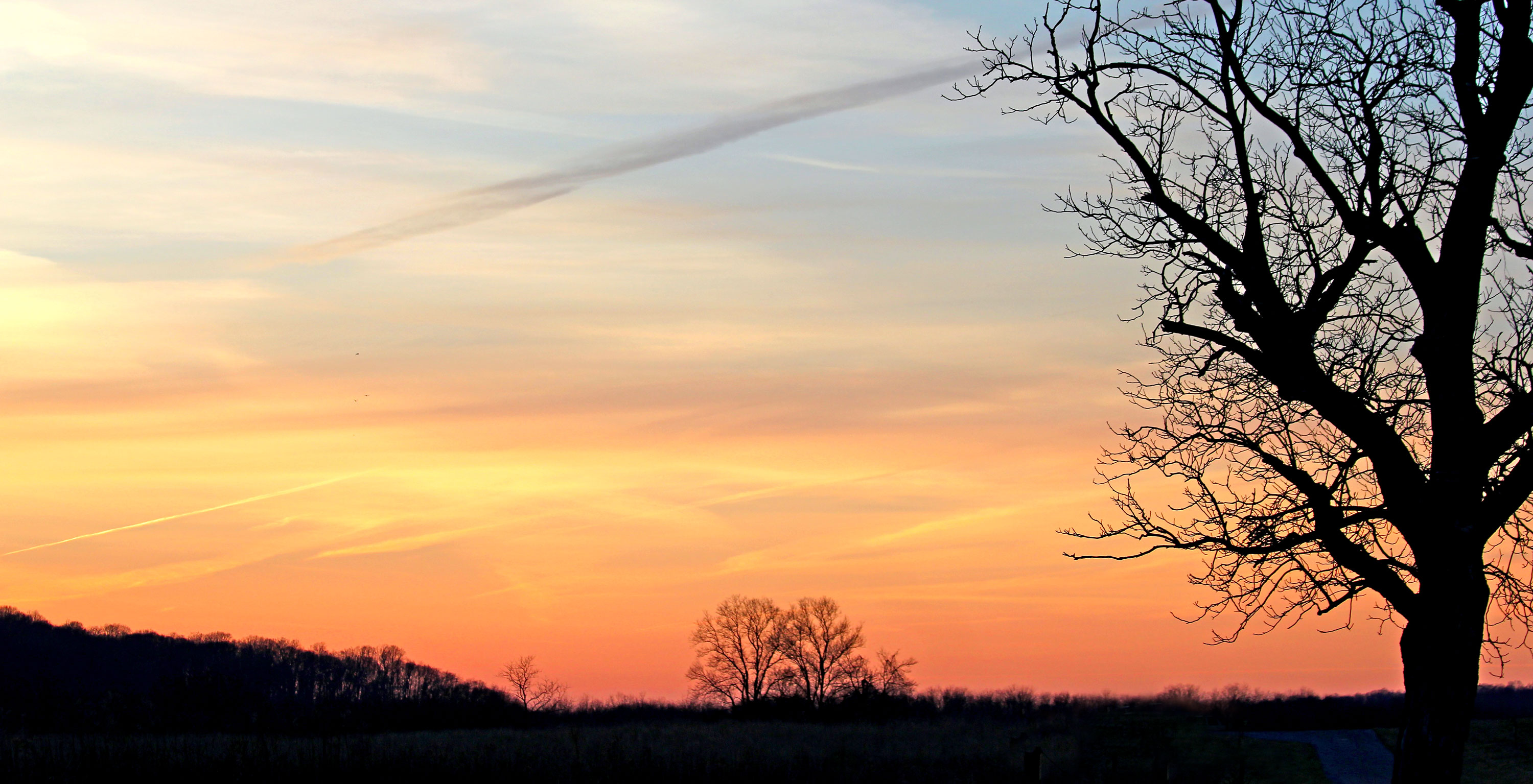
Though the violence of evil may seek to extinguish it, America’s light is not of fear, but of faith and of freedom and — Godspeed — will continue to shine in a dark world in the same way God’s hand renews from dark the dawn each day.

KEEP AMERICA BEAUTIFUL! please

Image

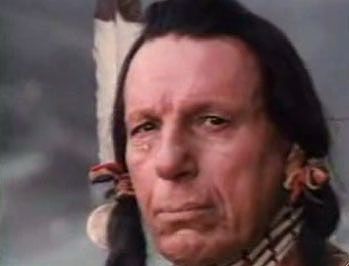
APRIL IS KEEP AMERICA BEAUTIFUL month. Bet you didn’t know that. Remember the old commercials and the Native American with a tear in his eye?

http://www.youtube.com/watch?v=j7OHG7tHrNM

We just don’t see the emphasis on this anymore.

While photographing this eagle in flight at Middle Creek Wildlife Management Area this recently, I was disheartened to see roadside trash and rubbish along our driving and walking route.

Farmers also deal with the effects of littering when they harvest hay or silage as feed for their cattle and other livestock and find it has roadside rubbish, bottles, cans and plastic mixed in, causing costly machinery repairs and animal health problems if ingested.

Trash in any area attracts rodents and pathogenic activity as well. Broken glass and other sharp objects are also dangerous to people and animals.
Did you know that plastics and styrofoam can not only cause birds, wildlife and farm animals to choke, it can also lay undigested for a long time in the digestive tract causing illness and even death?
When I see dirty diapers, bottles, cans, fast food bags, cups, old furniture, old appliances, and even full garbage bags of trash strewn alongside a road or walking path, I feel as though this can’t be some poor soul who has no other way to dispose of his/her trash, but just chooses to be thoughtless.
I feel that Indian’s teardrop for the careless, thoughtless, cruel, and ugly act to care so little about the world around you…

crying-indian_349

NY-FARM-TO-CITY FIRST! Telling Milk’s Story at “Just Food”

Image

My friend TAMMY GRAVES wrote the guest post for my FOODOGRAPHY blog today. It also made the cover of today’s Farmshine newspaper, telling how she and dairywomen Deb Windecker and Lorraine Lewandrowski of Herkimer County NY had the rare opportunity to present a 75-minute workshop telling milk’s story at the JUST FOOD CONFERENCE in New York City. Great Job Ladies!

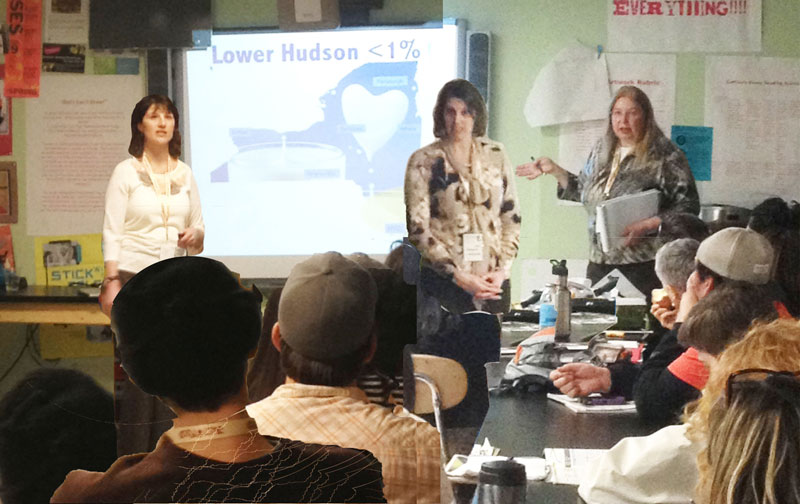
NEW YORK, N.Y. – For the first time, New York State dairy farmers were on the workshop list at the Just Food Conference March 29-30 in New York City. A 75-minute presentation entitled “Introduction to the New York Milk Shed” was prepared and offered by Herkimer County dairy farmers Lorraine Lewandrowski and Deb Windecker of Newport and Schuyler, respectively. Tammy Graves, a dairy farmer advocate from Otsego County also contributed by explaining the mutually dependent relationship between consumers and dairy farmers.

“We provided faces and stories about our milk for attendees. Many more conversations still need to occur, but it was a huge step in bridging the gap,” Deb Windecker reported. “So many people think there are antibiotics in our milk. We are pleased to report that we dispelled that myth by explaining the penalties and protocols that are in place at the farm, at the processing plant, and with our regulators, to ensure that never occurs.”

The presentation provided answers in four parts: 1) Where is dairy farming in New York State? 2) Why should you care about a Milk Shed and/or dairy farmers? 3) What does a dairy farmer do?  4) Why should you eat real dairy products?

Our message was “Milk is clean and safe. Milk is water. Milk means healthy cows. Milk is Local. Milk is a life’s work.”

Part One of the workshop for Just Food consumer advocates summarized the facts and included a visual overview of the NY Milk Shed: 5100 dairy farms, 610,000 cows, 113-cow average herd size. A pictorial tour of the milk regions (Lower Hudson, Upper Hudson, North Country, Mohawk Valley and Western New York) was the background for discussion. The discussion included a look at the diversity among NY dairy farms in terms of cow breeds, farm size by acreage, herd sizes and strengths and prominent resources by region.

Part Two illustrated the long-standing connection New York City has had with dairy farmers, highlighting the 1939 milk strike. As a result of the milk strike, then NYC Mayor Laguardia was an advocate and influencer for achieving adequate farm milk pricing at that time. Cheese pack boats, milk trains and today’s tractor trailers carrying 150,000 glasses of milk were mentioned. 

Additionally, Lewandrowski emphasized why the average New Yorker should be concerned about the state’s dairy farms.  A series of photos accompanied her points regarding economic development, food security, open space, watershed protection, floodplains, biodiversity, rural tradition, and the diversity of people working in New York’s dairy industry.

Part Three of the presentation evoked the most questions from attendees as it gave a micro-view of the cycle involving a dairy cow, a dairy farmer and soil. Growing seasons, equipment costs, feed storage were discussed, in addition to milking procedures and newborn calf care. 

Part Four explained that buying real dairy products translates to eating food that most closely mirrors the clean and safe milk that dairy farmers put into the milk truck. Attendees were very appreciative to learn that not all brands or types of cheese and Greek yogurt are created equal. 

“The experience provided us with invaluable insight to perspectives and beliefs of individuals that are keen on food topics,” the presenters reflected after the event. New York City residents who attended left with a better understanding.  One member of the audience approached the presenters about the possibility of chartering a bus to bring New York City food and farm-interested people to visit dairy farms upstate and to spend a day at the Fair.