Cattle herd continues to shrink; Milk cows flat, dairy heifers down 1%

Editorial AnalysisTumultuous 2024 spills over into 2025 – Part Three

By Sherry Bunting, Farmshine, February 7, 2025 (updated with additional information after print edition published)

EAST EARL, Pa. – A tumultuous dairy and beef market in 2024 is bound to be even more so in 2025. The long-awaited Jan. 1 Cattle Inventory Report is in, and we all saw the kerfuffle about tariffs and trade this week.

The bottom lines are…

— The U.S. beef cow herd continues to shrink, while both the beef and dairy heifer replacement numbers are notably smaller, signaling less domestic beef production and stable, if not reduced milk production in the face of strong domestic demand for beef and dairy products.

— U.S. import volumes of live feeder cattle as well as beef and dairy products have climbed over the past five years.

— Uncertainty prevails about U.S. trade policy, but export volumes of beef and dairy have leveled off already in the past several years. Dairy exports are bound to get a boost in the short-term as U.S. prices are mostly trailing current global prices. Tariffs on Canada and Mexico and potential retaliations are paused.

— Will the dairy herd continue maintaining itself at these shrinking heifer ratios now that we are five years out from the time of plentiful heifers.

Report highlights include…

Milk cow inventory has remained relatively stable over the past five years, ranging from 9.34 million head on Jan. 1, 2020 to the 5-year high of 9.45 million head on Jan. 1, 2021, then back down to just shy of 9.35 million head on Jan. 1, 2024 and Jan. 1, 2025. However, the number of dairy replacement heifers has dropped by 16% over the past five years from 4.61 million head on Jan. 1, 2020 to 3.91 million head on Jan. 1, 2025. This number is down almost 20% — or nearly 1 million head — from the record high 4.81 million dairy replacement heifers recorded on Jan. 1, 2016.

Are milk cows milking longer? Is the average dairy cow getting 16 to 20% more productive life (an additional half lactation)? Is the age at first calving continuing to decline, and are herd culling rates also declining significantly enough to maintain the current cowherd size on 16 to 20% fewer heifers expected to calve vs. 5 and 10 years ago?

According to the Jan. 1, 2025 Cattle Inventory Report, there are not quite 27 heifers expected to calve this year for every 100 cows in the current U.S. dairy herd, and a national cull rate of 29% based on January through December 2024 dairy cow slaughter totals. Five years ago, there were just over 31 heifers expected to calve for every 100 milk cows in the similarly-sized U.S. dairy herd.

Will these trends collide at the 5-year mark this year, given the average productive life of a dairy cow based on the most recent data (2020) is not quite three lactations or roughly 5 years of age? How will the $5 to $10 billion in new processing capacity be filled, or will we see existing plant closures in their stead? Are the investor dairies that put up 10, 20, and 30,000 cow facilities each year filling new barns with milking animals raised on their own calf ranches coming in under the reporting-radar of USDA NASS? Or is the pace of dairies exiting the business on one end mirroring the growth on the other end?

One inescapable conclusion is that the milk cow herd remains relatively stable, while the dairy replacement heifer numbers have shrunk by 16% vs. five years ago and by 20% vs. 10 years ago, and the record-high prices paid for dairy replacements is proof of tight supplies.

This is part three in a four-part series. Part one was published Jan. 3, 2025; Part two on Jan. 17, 2025.
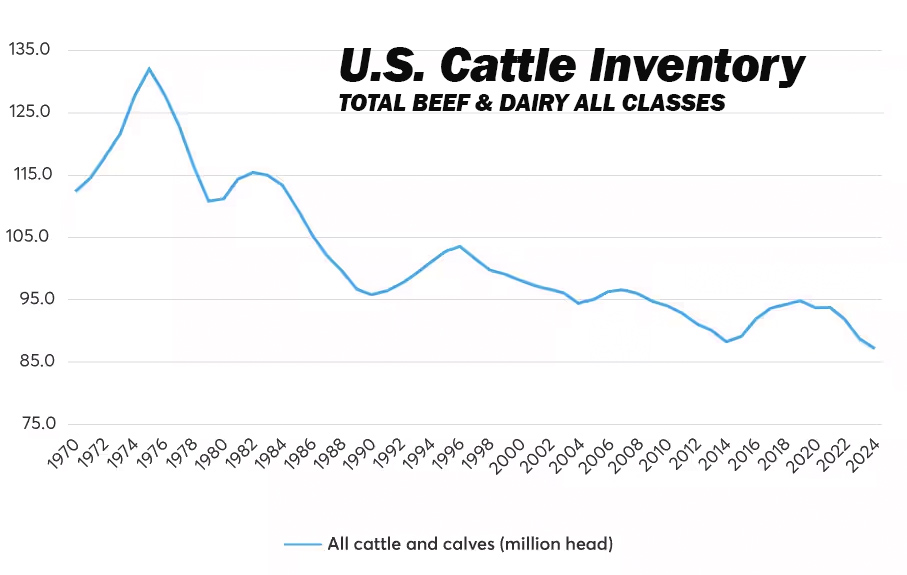
CME graph using USDA NASS Inventory data

U.S. cattle herd down… again

U.S. total cattle numbers on Jan. 1, 2025 are down 1% year-over-year (YOY), according to the All Cattle and Calf Inventory Report released by USDA on Fri., Jan. 31st.

At 86.66 million, the report counted 500,000 fewer head than last year’s total, which was already the smallest in 74 years (Jan. 1, 1951).

The total number of all cows and heifers that calved is down 0.4% YOY at 37.21 million head. That is 147,000 fewer beef and dairy cows on farms as compared with the revised-lower totals a year ago, which were already the smallest in 84 years (Jan. 1, 1941).

The total number of all heifers over 500 pounds on Jan. 1, 2025 (including heifers destined to become beef) was down 1% YOY at 18.18 million head. That’s 140,000 fewer head counted than on Jan. 1, 2024, which was already the smallest total heifer number in 34 years (Jan. 1, 1991).

In the Jan. 1, 2025 report, USDA NASS revised-lower its Jan. 1, 2024 and July 1, 2023 estimates of total animals that had calved, as well as the calf crop in those 12 to 18 month prior Inventory Reports. Statisticians went back and compared the prior estimates to the official slaughter data, the import and export data, and the relationship of this new survey information to the prior surveys.

This means the Jan. 1, 2025 numbers are now estimated at levels below the revised-lower prior reports that had already set records! (A mid-year 2024 inventory would have been helpful, but was canceled by former Ag Secretary Tom Vilsack, claiming insufficient USDA funds).

Chart compiled by S. Bunting with USDA NASS Inventory data

Milk cows flat, heifers shrink

The number of milk cows on Jan. 1, 2025 was essentially unchanged vs. year earlier, up only 2,500 to just shy of 9.35 million head.

However, the dairy replacement heifer total is down 1% YOY at 3.91 million head. At this rate, the number of heifers heading to careers as milk cows is 16% below the 5-year comparison on Jan. 1, 2020.

At 3.91 million head, there are 37,000 fewer dairy replacement heifers than a year ago, which was already the smallest number of dairy replacement heifers in 47 years (Jan. 1, 1978). 

As the graph above illustrates, milk cow numbers have held relatively stable over the past five years, while the number of dairy replacement heifers has significantly declined. Are cows experiencing longer productive life? Or are the multi-site investor dairies filling their own expansion sites via their own calf ranches, and escaping the USDA reporting radar?

According to the most recent data (2020), average dairy cow productive life in the U.S. is just shy of three lactations, roughly five years of age. With the number of dairy replacement heifers declining 16% over the past five years, will these two trends collide in the next 12 to 24 months to reduce the U.S. milking herd while escalating the already record high dairy replacement cattle prices? And, what role might HPAI H5N1 play as longer term impacts emerge?

USDA NASS reports that the average auction value of ‘average’ milking cows has increased by nearly $800 per head to $2650 for 2024 vs. $1890 for 2023; $1100 per head higher vs. the $1720 average for 2022; and double (+$1300) the average value reported at $1350 and $1300 per head four and five years ago for 2021 and 2020, respectively.

The average cost to raise dairy replacements has been estimated at $1700 to $2400 per head, which means the value of ‘average’ replacement heifers at $1720 to $2660 from 2022 to 2024 is finally starting to mirror the cost to raise them — on average.

Many dairy producers continue producing only the heifers they need, which is reducing the availability of heifers in the marketplace for those wanting to expand.

Producers continue to respond to the lure of the 3-day-old dairy-on-beef crossbred calves offering substantial margins of $800 to $1000 per head — with no investment, no rearing, no revenue-wait, and no risk.

Basically, a dairy cow can produce $800 to $1000 in revenue for the dairy as soon as she drops a live crossbred calf, no matter what the milk price or margins are doing, and with her whole lactation in front of her.

The Jan. 1 Inventory Report shows the U.S. beef herd continues to shrink, suggesting beef-on-dairy crossbreds will continue to offer bigger per-head margins than growing extra dairy heifers to sell as herd replacements — unless they are premium dairy heifers.

Expanding dairies are having to really plan ahead to raise the animals they need for growth or scramble to get them. Additional upward price momentum may be seen on dairy replacements in the next 12 to 24 months as the more abundant heifers available five years ago ‘age-out’ of the system, statistically speaking, at five years old, which is the industry average age of a milking cow in the U.S.

With the Jan. 1, 2025 U.S. milking herd holding steady at a level that is 1.1% smaller than it was in 2021, the expanding dairies are buying up the herds of the exiting dairies at high prices that make dairy farmers think about selling the cows and hanging on to the heifers, for now, if they do not have a next generation to continue the dairy.

Turnover of existing Holstein herds to include other breeds is also occurring, along with genetic improvement within the Holstein breed, as producers work to raise heifers that calve into the milking herd at younger ages, produce more component yield per hundredweight of milk, have improved productive life traits and fewer days open for a tighter average calving interval.

With a 2024 national dairy herd of 9.35 million milk cows and a 2024 national dairy cow slaughter of 2.726 million, the national culling rate last year was 29%. At that rate, even if the average age at first calving is 22-months, the U.S. dairy industry would need 28 dairy heifers to calve successfully in the next 12 months for every 100 milk cows — just to maintain the current size of the U.S. dairy herd.

According to the Jan. 1 Inventory Report, there are 2.5 million dairy heifers expected to calve in 2025 (down 0.4% or -9000 head). This calculates to 27 (actually 26.75) dairy replacement heifers expected to calve in 2025 for every 100 cows in the U.S. dairy herd as of Jan. 1st.

In 2016, when dairy replacement heifer numbers reached their peak at 4.81 million head, 3.11 million head were expected to calve that year, and the total U.S. dairy cow inventory was 9.31 million head, meaning there were 31 heifers expected to calve for every 100 cows in 2016. This has steadily eroded in part because dairy producers have stopped spending the money to grow extra heifers that were worth less than the cost to grow them until this year. They also worked to reduce age at first-calving, days open across the herd, higher component levels in the milk, reduced death loss, longevity, and began gradually re-introducing beef crossbreeding, which has become a pretty big deal over the past five years.

Some parts of the country are down significantly in heifer replacements as of Jan. 1, 2025, while others are up. For example, Pennsylvania has 15% more dairy replacement heifers on farms vs. year ago.

These estimates indicate milk production will be flat to lower for the next 12 to 24 months.

What this does not account for is the increasing milk component levels generating more dairy products per 100 pounds of milk and the increasing volume of dairy imports, particularly cheese, butter, and whole milk powder. But those increases can only do so much in the face of $5 to $10 billion in new processing assets coming online in the next 6 to 18 months.
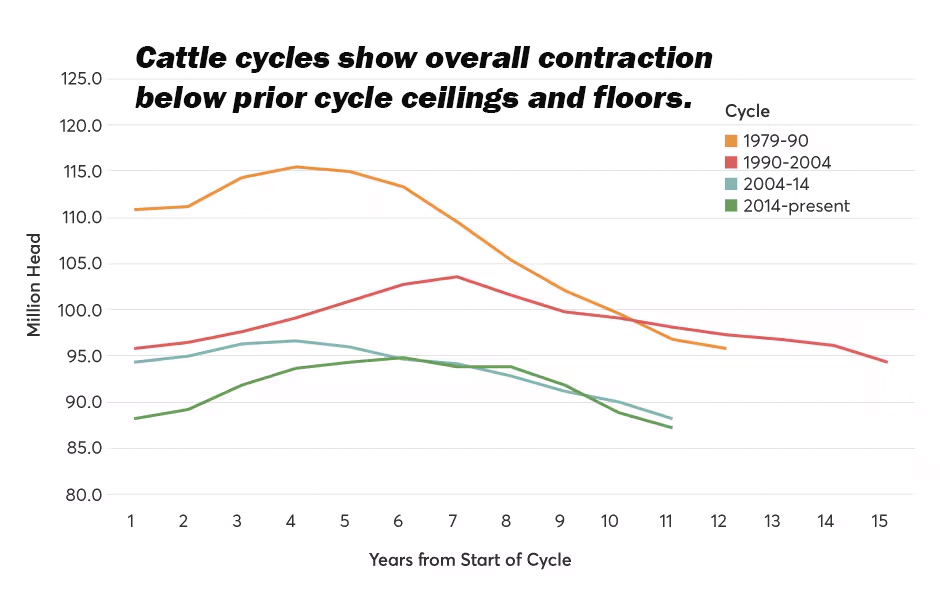
CME graph using USDA NASS Inventory data shows continued overall contraction of total cattle inventory as new cycles mostly fail to breach prior cycle ceilings, floors, and midpoints.

Beef herd shrinks more

The Jan. 1 Inventory shows the U.S. beef herd continues to shrink. At the national level, there are no signs of rebuilding, as the total number of heifers heading to careers as beef mama cows is down 1% YOY. However, in some parts of the country, such as Virginia, more heifers were retained as beef cow replacements and fewer were earmarked for feedlots.

At 4.67 million head, there are 46,000 fewer beef replacement heifers in the U.S. vs. year ago, setting another record low as the smallest number since 1948.

Even more striking is the beef replacement heifers that are expected to calve in 2025 are down a whopping 2% YOY (-50,000) nationally.

Meanwhile, the beef-on-dairy feedlot placements, while a growing segment of the beef industry, are not enough to reverse the downward beef production trend as evidenced by declines in the number of animals over 500 pounds on Jan. 1st heading to feedlots: Steers and bulls are both down 1% (-157,000 and -21,000 head YOY, respectively). Heifers over 500 pounds heading to feedlots are down 0.6%, and the number of cattle on feed as of Jan. 1, 2025 is down 1% YOY at 14.3 million head (-130,000 head).

The Inventory Report came on the heels of the January Cattle on Feed Report, which showed 3% fewer feedlot placements as of Jan. 1, perhaps because of the Mexican border closure to the live cattle imports, due to concerns about transmission of the screw-worm parasite.

Even the total number of all calves (heifers, bulls and steers) weighing under 500 pounds dropped 1% lower YOY at 13.46 million head (-30,000).

These estimates suggest domestic beef production will decline for at least the next 12 to 24 months, maybe longer.

What this does not account for are the number of live cattle crossing the border into U.S. feedlots from Mexico and Canada and the increasing amounts of beef the U.S. imports from other countries, including from Canada, Mexico and South America.
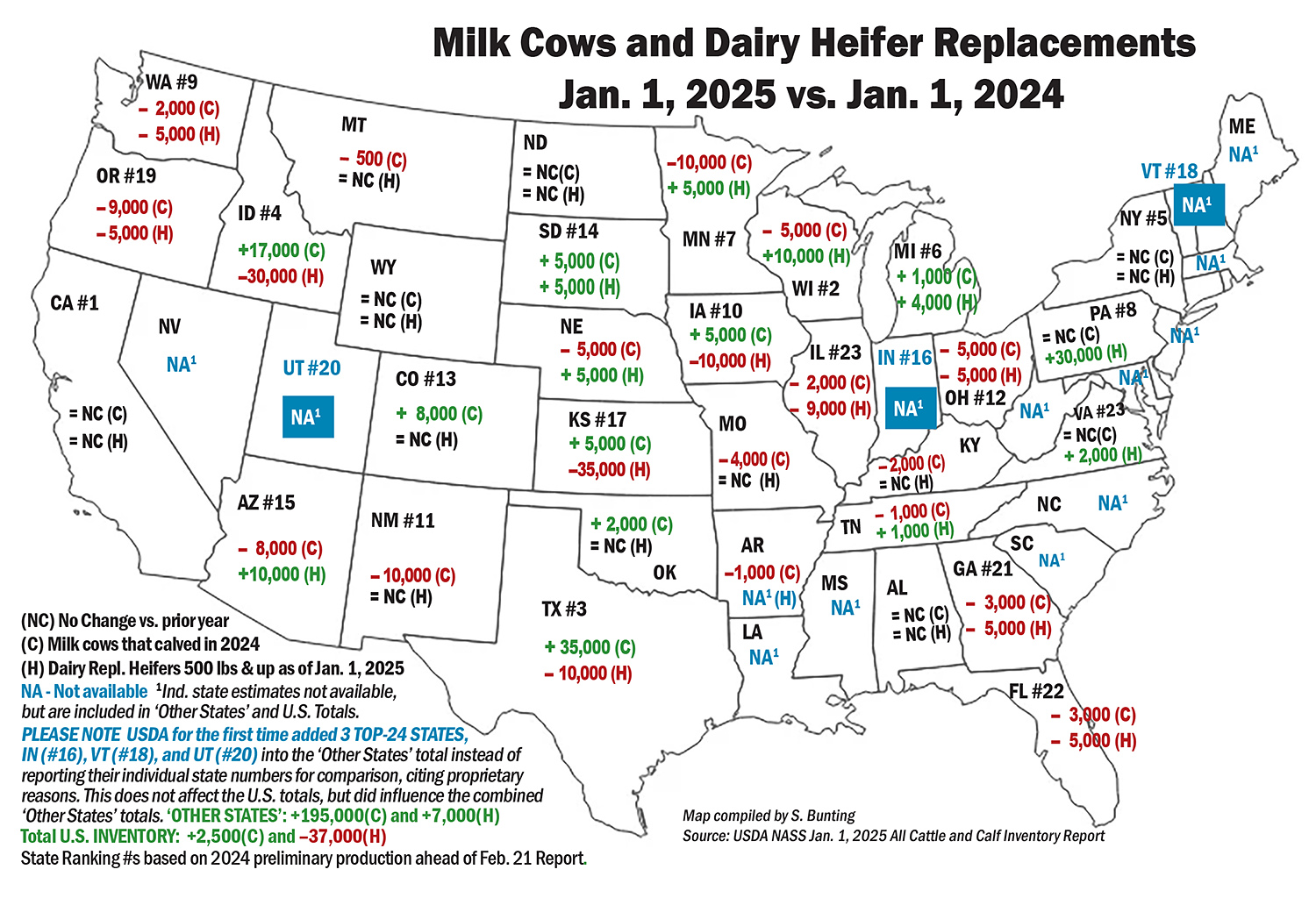
Map compiled by S. Bunting with USDA NASS Inventory data

Significant geographic dairy shifts

Breaking the dairy inventory numbers apart, we see big geographic shifts.

The West added 78,000 more milk cows in 2024 vs. 2023, except for California’s numbers being unchanged. On the other hand, the East and Upper Midwest had equal or fewer milk cows, down collectively more than 75,000 head YOY, except Michigan was up just 1000 head.

The biggest 2024 gains were tallied in Texas, up 35,000 head, and Idaho, up 17,000 head. Colorado grew by 8,000 head; Iowa, Kansas and South Dakota by 5,000 each; and Oklahoma by 2,000.

The biggest milk cow declines were in Minnesota and New Mexico, down by 10,000 head each; Oregon down by 9,000; Arizona by 8,000. Wisconsin, Ohio, and Nebraska by 5,000 each; Missouri by 4,000; Florida and Georgia by 3,000 each; Illinois, Kentucky, and Washington by 2,000 each; and Tennessee by 1,000. Smaller unranked states collectively accounted for the remainder of milk cow losses.

Interestingly, USDA pulled three Top-24 Milk Production States into the ‘Other States’ category, choosing not to report their cow and heifer numbers for proprietary reasons. They are Indiana (#16), Vermont (#18) and Utah (#20). Thus the ‘Other States’ category saw an increase of 195,000 cows simply because these three Top-24 states were included anonymously in the total.

The geographic breakdown is interesting when it comes to dairy replacement heifers as the growth is noted in the areas where the cow numbers have declined and vice versa. These shifts could reflect changes in the way heifers have tended to move across state lines for rearing, especially in light of the dairy-adapted B3.13 strain of HPAI H5N1.

Pennsylvania is the biggest outlier as the cow numbers are unchanged YOY, but farmers reported 30,000 more dairy heifers in the Commonwealth on Jan. 1, 2025 vs. year ago.

Elsewhere in the East, Virginia dairy heifer replacements are up 2,000 head; Tennessee up 1,000 head; New York and Kentucky unchanged; Georgia and Florida down 5,000 head each. Again, the ranked states of Indiana, Vermont and Utah had their replacement heifer numbers lumped into the ‘Other States’ category, which consequently showed a gain of 7,000 heifers vs. year earlier when those states were not included in that category.

Beef replacement heifers and feedlot heifers are down a combined 10,000 head in Pennsylvania, while Virginia showed signs of beef herd rebuilding, reporting 4,000 more beef replacement heifers and 4,000 fewer heifers heading to feedyards.

Looking at the Mideast, Michigan had 5,000 more dairy heifer replacements, while Indiana’s numbers were unreported. Ohio is down in dairy heifers by 5,000 head. Beef replacement heifers in that region are up by 7,000 head and feedlot heifers are up by 3,000 head.

The Upper Midwest grew their dairy replacement heifer numbers, while the West significantly decreased them. Wisconsin is up by 10,000 head YOY; while Minnesota and South Dakota grew by 5,000 head each.

In the West, the following states with significant growth in milk cow numbers had significant losses in dairy replacement heifer numbers: Kansas down a whopping 35,000 head in dairy replacement heifers; Idaho down by 30,000 head; Texas, Pacific Northwest and Iowa down 10,000 each. Dairies in Kansas, Idaho, Texas, and Iowa contended with avian influenza in 2024.

Meanwhile, in California, New Mexico, and Colorado (all three having dealt with H5N1) the number of dairy replacement heifers was reported as unchanged YOY, but Arizona, which has not had H5N1, grew its dairy heifer numbers by 10,000 head.
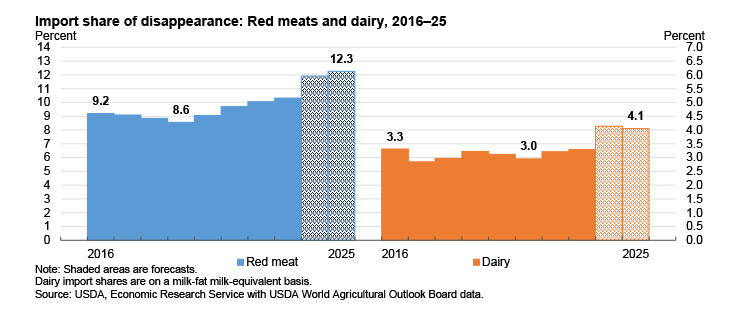
USDA Economic Research Service graph

Trade is uncertain (Imports up, Exports leveling off)

Dairy and beef imports are growing, and the industry is responding to ‘tariff talk’ with statements showing fear of trade wars harming farmers or possibly gaining concessions in the context of Agriculture’s current annual trade deficit of $45.5 billion. 

On Friday, Jan. 31, the spot cheese and Class III milk futures markets plunged lower in response to U.S. tariff announcements of 25% on goods from Canada and Mexico and 10% on goods from China.

This fear was short-lived, however, because the planned tariffs on goods from Canada and Mexico were promptly paused three days later on Monday, Feb. 3, when leaders agreed to support and combine efforts on U.S. border security, while putting teams together with the pledge to work through U.S. trade issues over the next 30 days.

The announced 10% tariffs on China went into effect Feb. 4, but discussions between the U.S. and China are said to be resuming for phase one of the trade deal struck in the prior Trump Administration just before the Covid pandemic hit globally.

Meanwhile, the total volume (not value) of dairy exports has leveled off on a total solids basis in the past two to three years as the U.S. exports more cheese and less skim milk powder and much less whey – the latter because we domestically produced less commodity SMP and far less commodity dry whey in 2024. Inventories are down for both, meaning domestic demand is using what is produced. 

On the flip-side, the U.S. imported more cheese, butterfat, and whole milk powder during the first 11 months of 2024 YOY.

We will take a closer look at the trends in U.S. dairy farm numbers, production, and trade after final 2024 trade and production data are released in late February, and with more information, perhaps, on how U.S. agricultural trade policy may be shaping up for 2025.

-30-
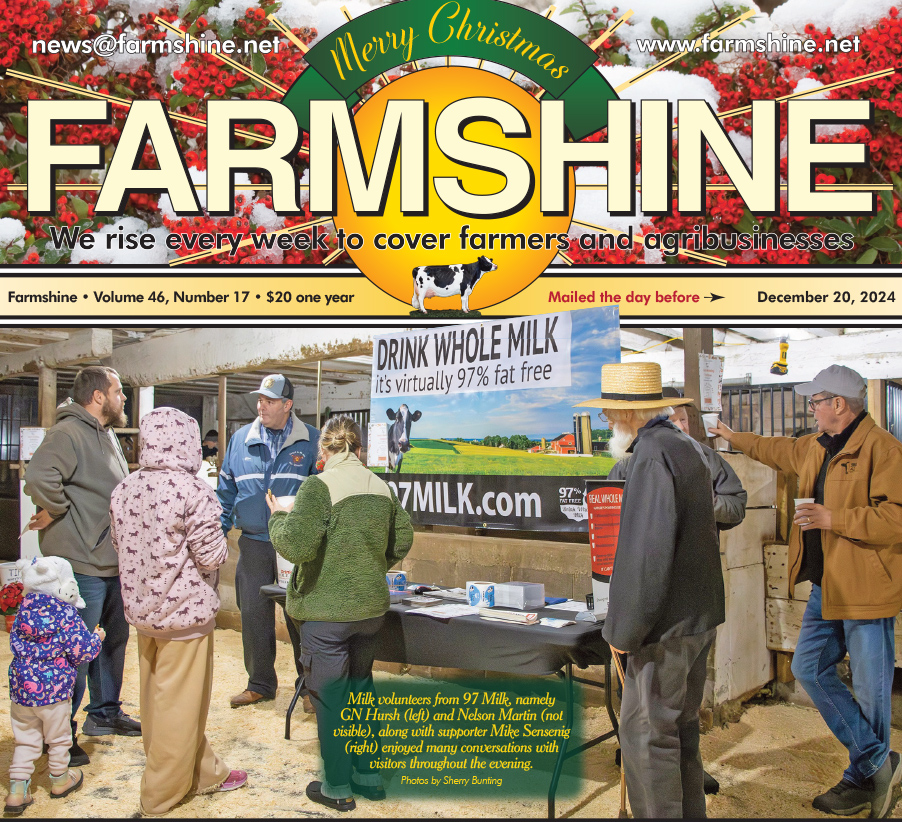
Christmas with cows shared with the public at milking time

‘It’s not about us, it’s about the cows’

By Sherry Bunting, Farmshine, December 20, 2024

RONKS, Pa. – What better place to be on a chilly evening 12 days before Christmas than in a stable with cows as a family goes about their evening milking and feeding? How fitting to remind the public not just about where their milk comes from, but also the way the Lord Jesus entered this world as a baby, wrapped in a manger, in a stable, with cattle lowing His lullaby.

The second annual Christmas with the Cows at the Melvin Stoltzfoos farm was a big hit, drawing double the attendance of 380 people from six states to the 50-cow dairy in Ronks, Pennsylvania.

While many visitors came from all around Lancaster and nearby counties, many also came from other parts of the state as well as New Jersey; Long Island, New York; a few from Delaware and Maine; and an over-the-road trucker brought his family from Houston, Texas after seeing the signs.

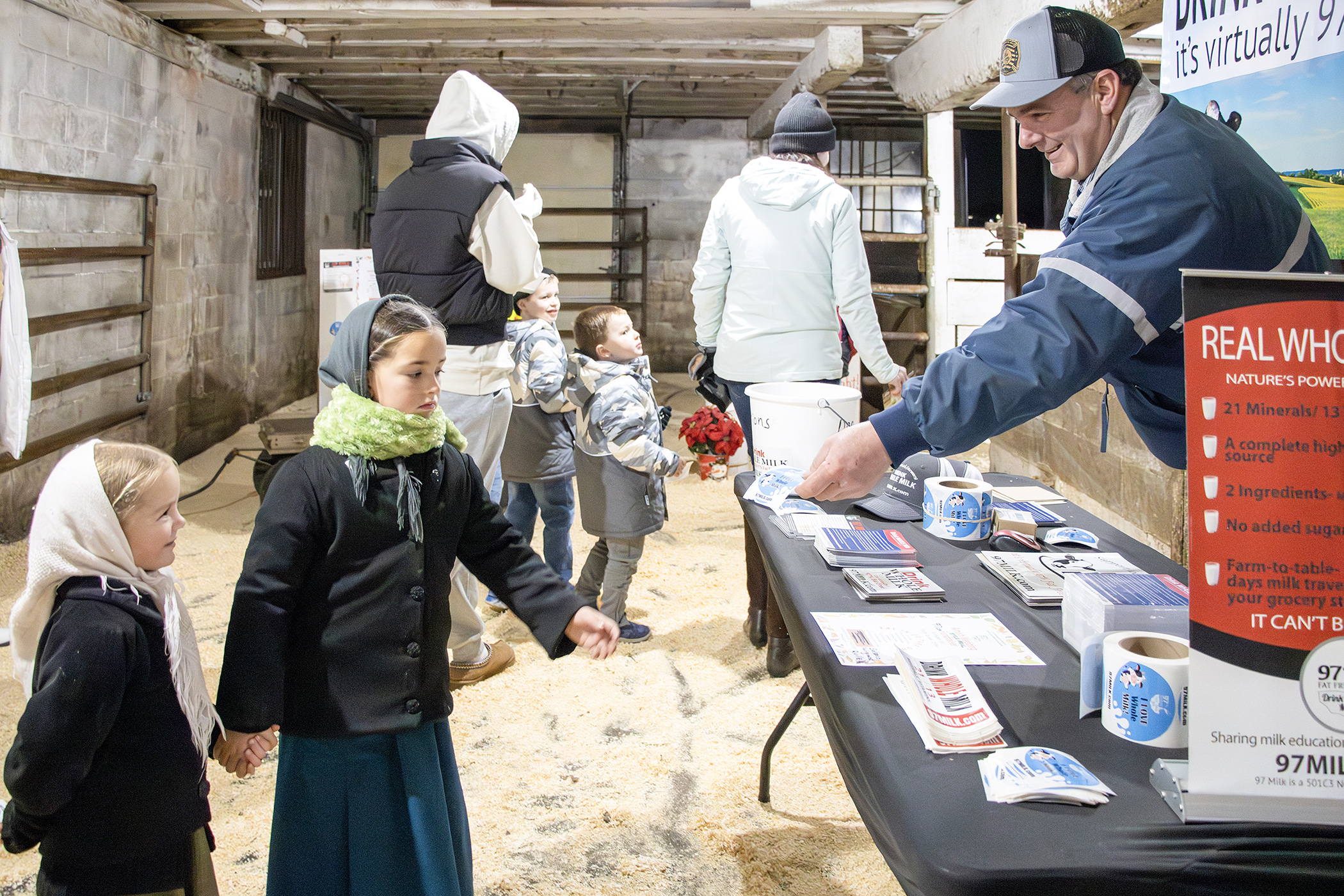
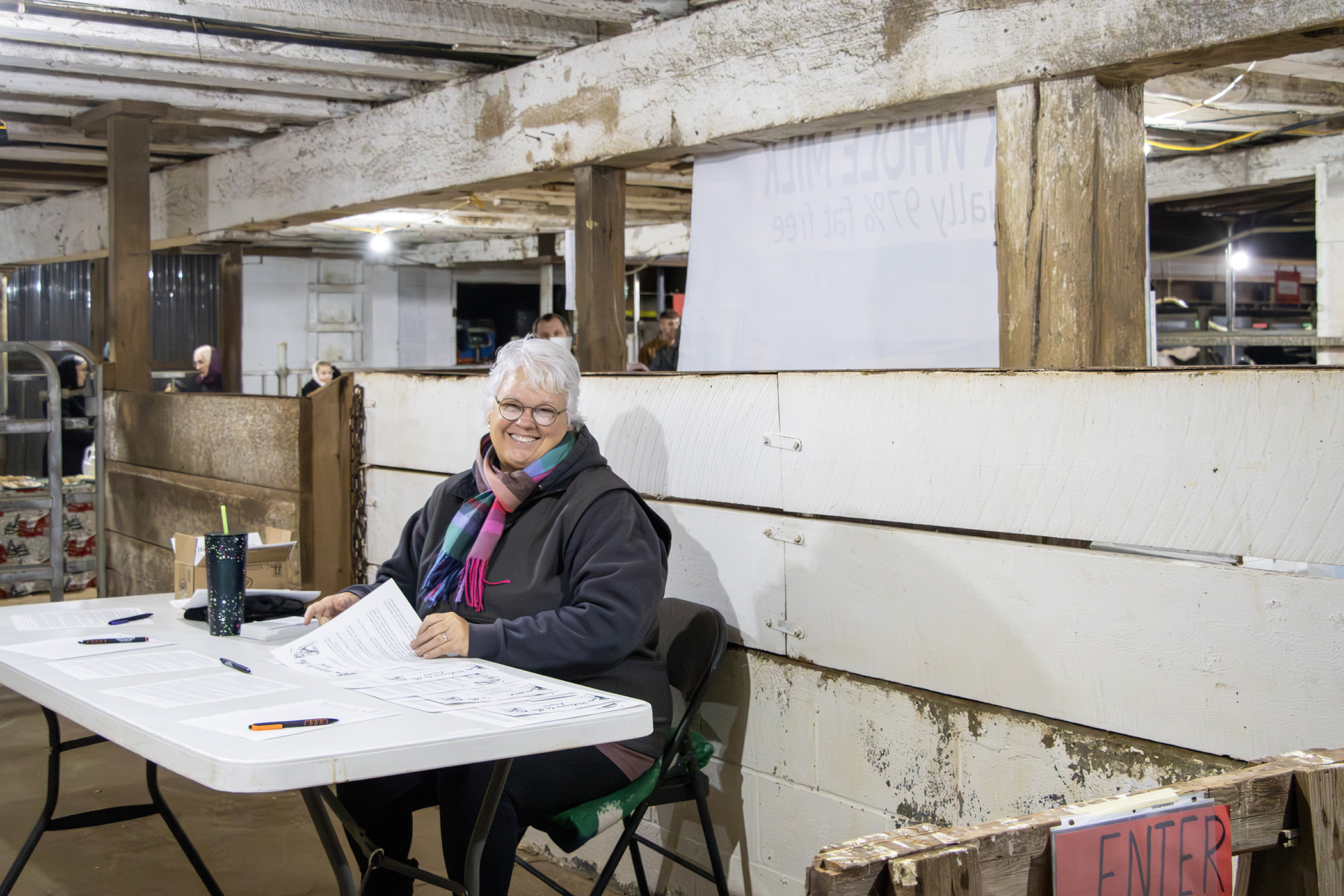
Local attendees like Bridgette Zell of Nottingham said they saw the event posted on Facebook. She brought her two young boys to see what it was all about. Bridgette had the quote of the night as she stopped by the 97 Milk table, where GN Hursh of Ephrata and Nelson Martin of Robesonia were the volunteers handing out stickers, 6×6 cards, small magnets, and other informative goodies.

“I get so tired of people saying milk is not for humans,” she said. “When I was growing up, if any of us didn’t feel well or had something wrong, my mother would tell us: ‘Drink a glass of milk see how you feel!’”

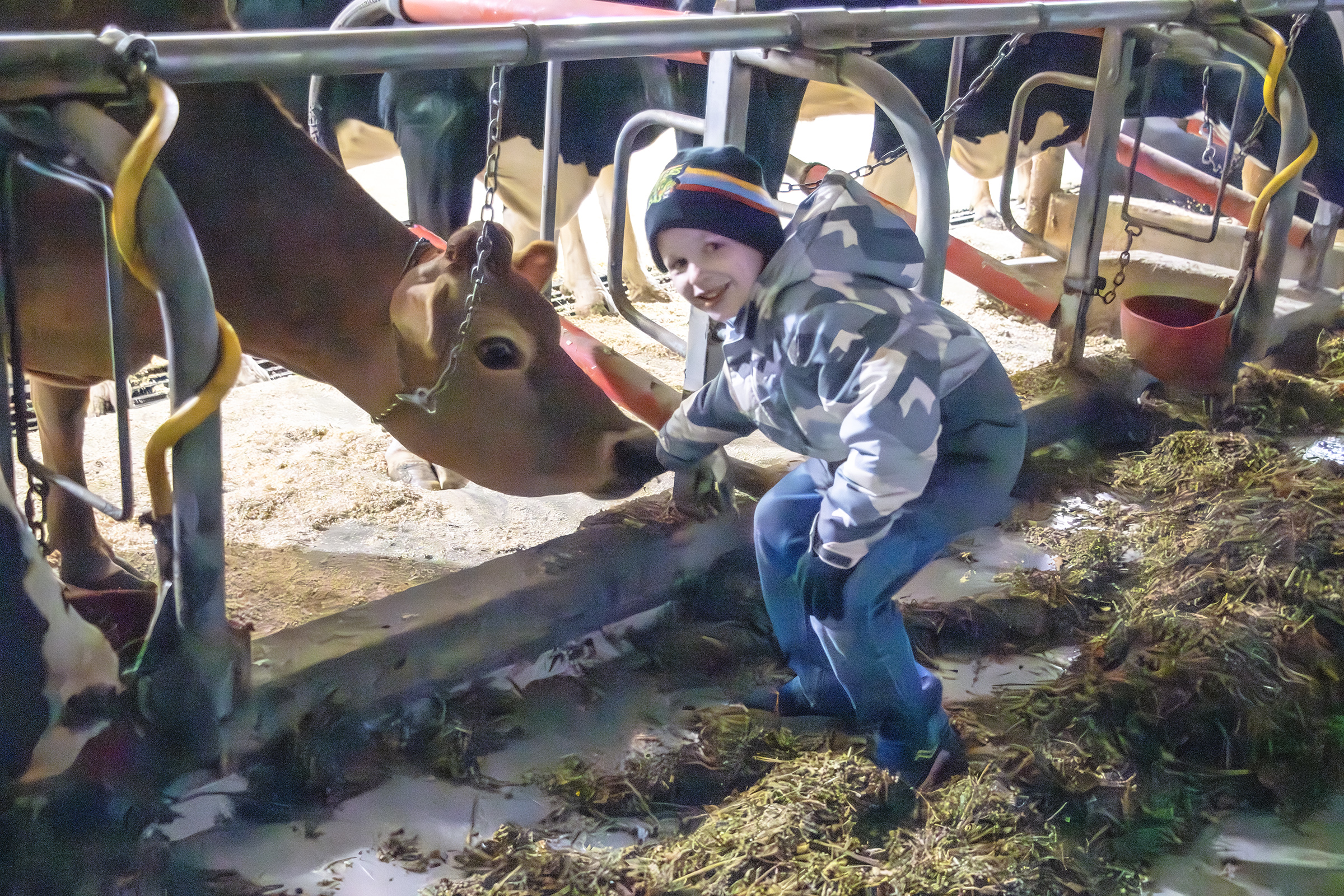
One of her boys, Dylan, was thrilled to pet his first cow. He quickly learned the Jerseys were more curious to bring their noses right up to his hand. “This one must give chocolate milk!” he said about the brown cows, flashing a great big smile.

“Well, they are more curious than their black and white herd mates,” I responded while capturing his photo, “and their milk is richer in fat and protein, but we still have to add the chocolate.”

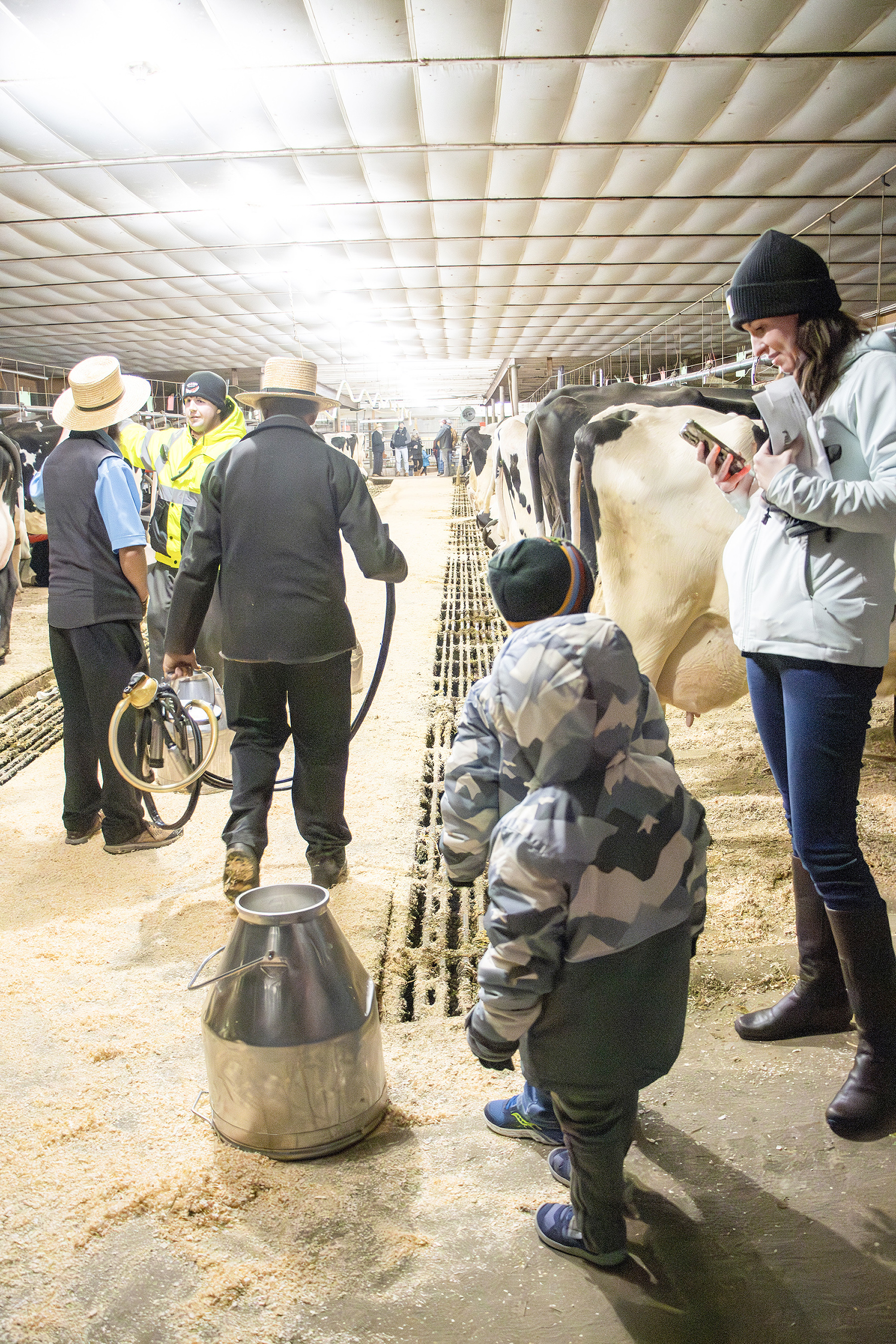
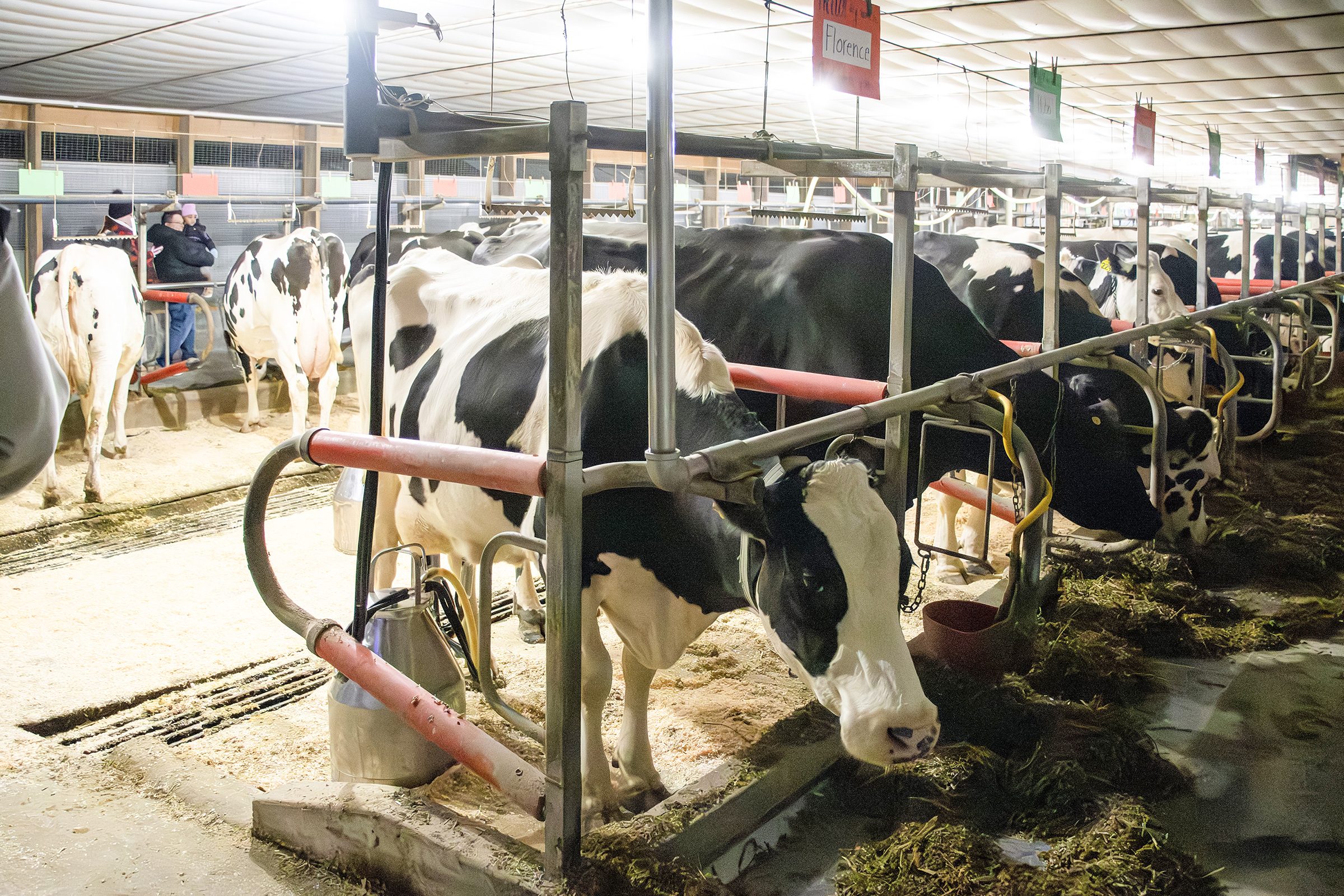
The whole event is a leisurely walk around the barn during chore time, culminating at a table with whole milk, chocolate milk and homemade Christmas cookies.

This was not a fancy event, but rather a time to simply take in the serenity while the Stoltzfoos family — from the littles on up — shared the blessing of their stable routines with the public.

“People ask me what do we get out of it? It’s really just seeing people have fun. Seeing people have fun with the cows is what we get out of it. Everyone I talked to was happy and in a good mood. People were tickled to have the opportunity to just be in a barn,” says Melvin.

And along the way, they learn something too. Upon entering, visitors are given a paper with fun facts about Agriculture and the nutrition of delicious whole milk, along with a welcome note with facts about the farm — names of the draft horses, facts about Holsteins and Jerseys in the herd, fun facts about cows and what they eat. Visitors also receive a thank you card with the Christmas story as told in Luke 2:11-16 and the Reason for the season as told in John 3:16-17.

Melvin and his family truly love doing this. They are already thinking about next year’s Christmas with the Cows, marked on the calendar for Dec. 12, 2025.

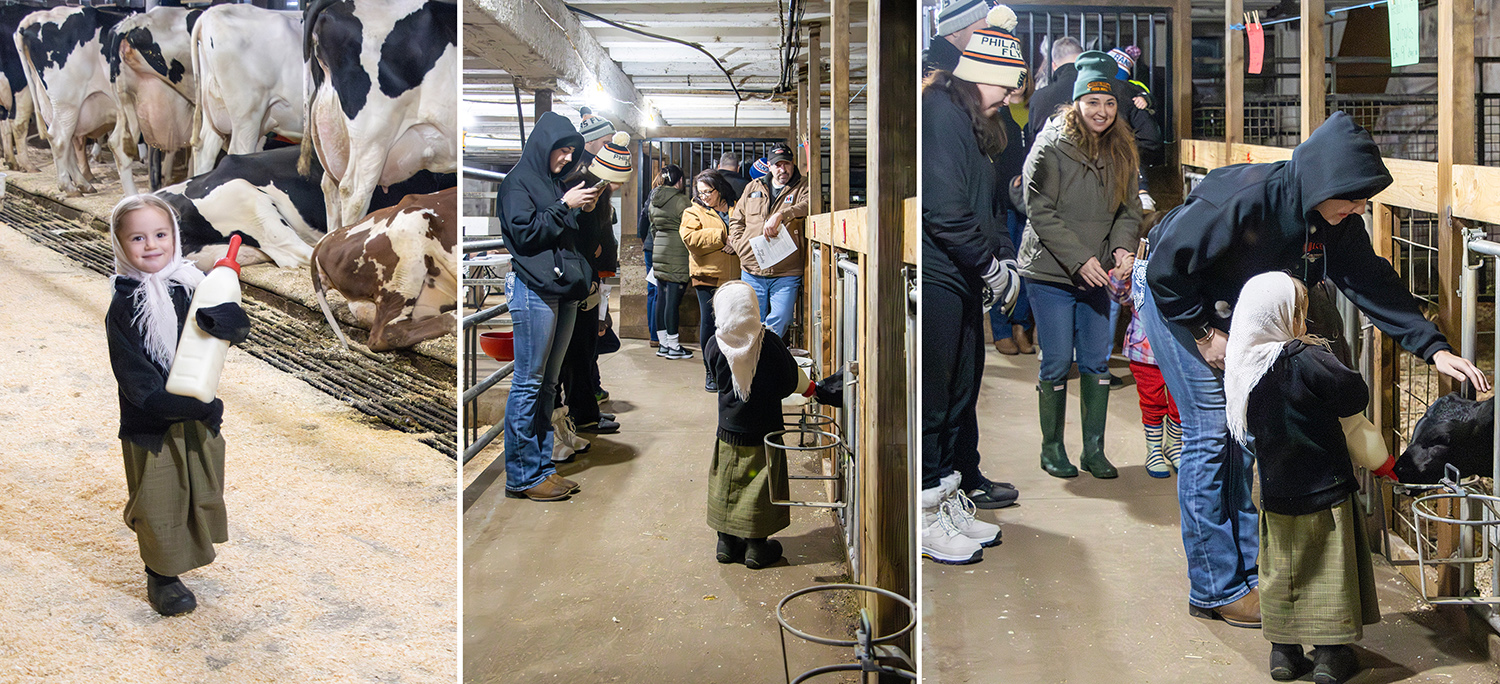
The host family’s youngest daughter is pleased to have the calf feeding responsibility.

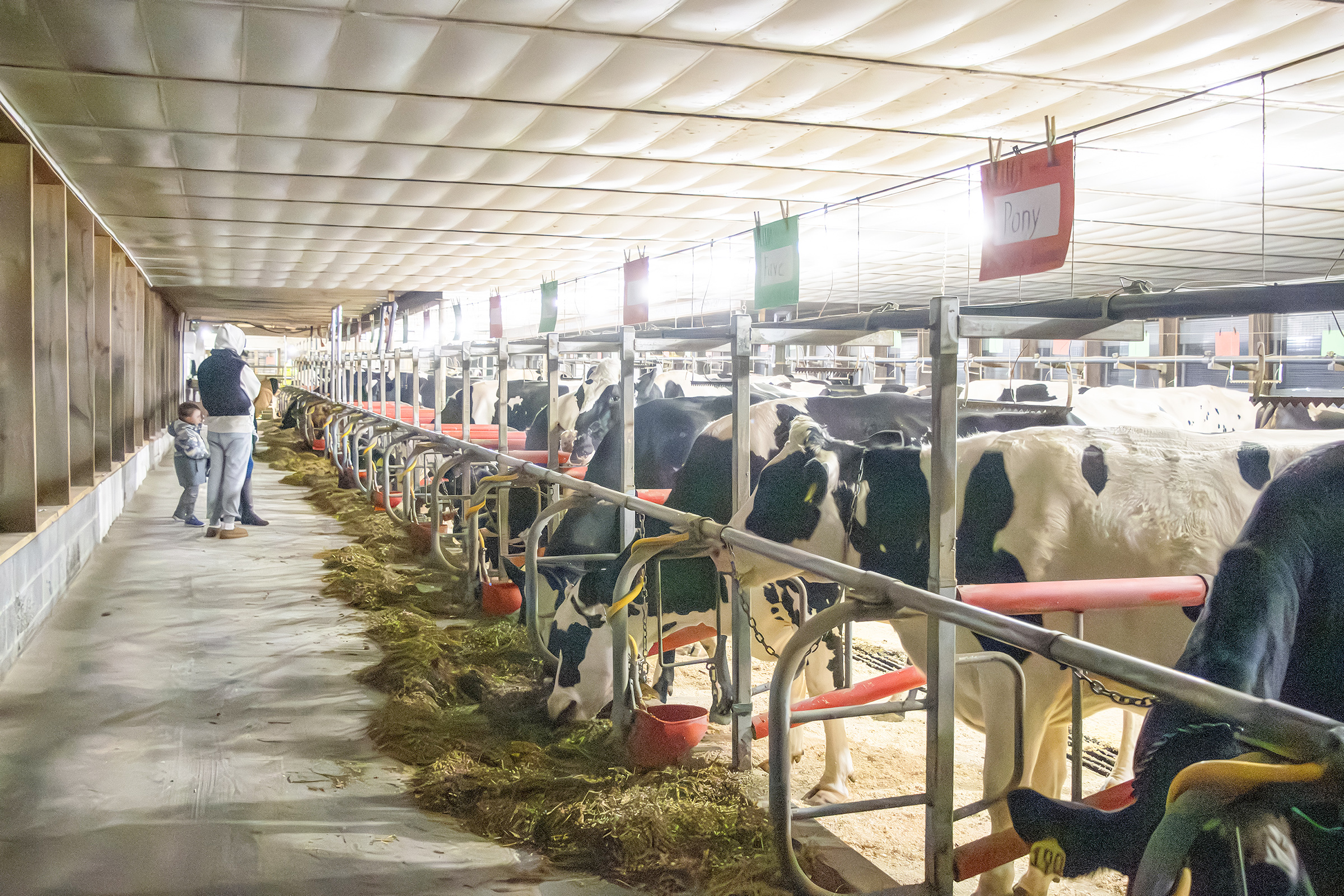
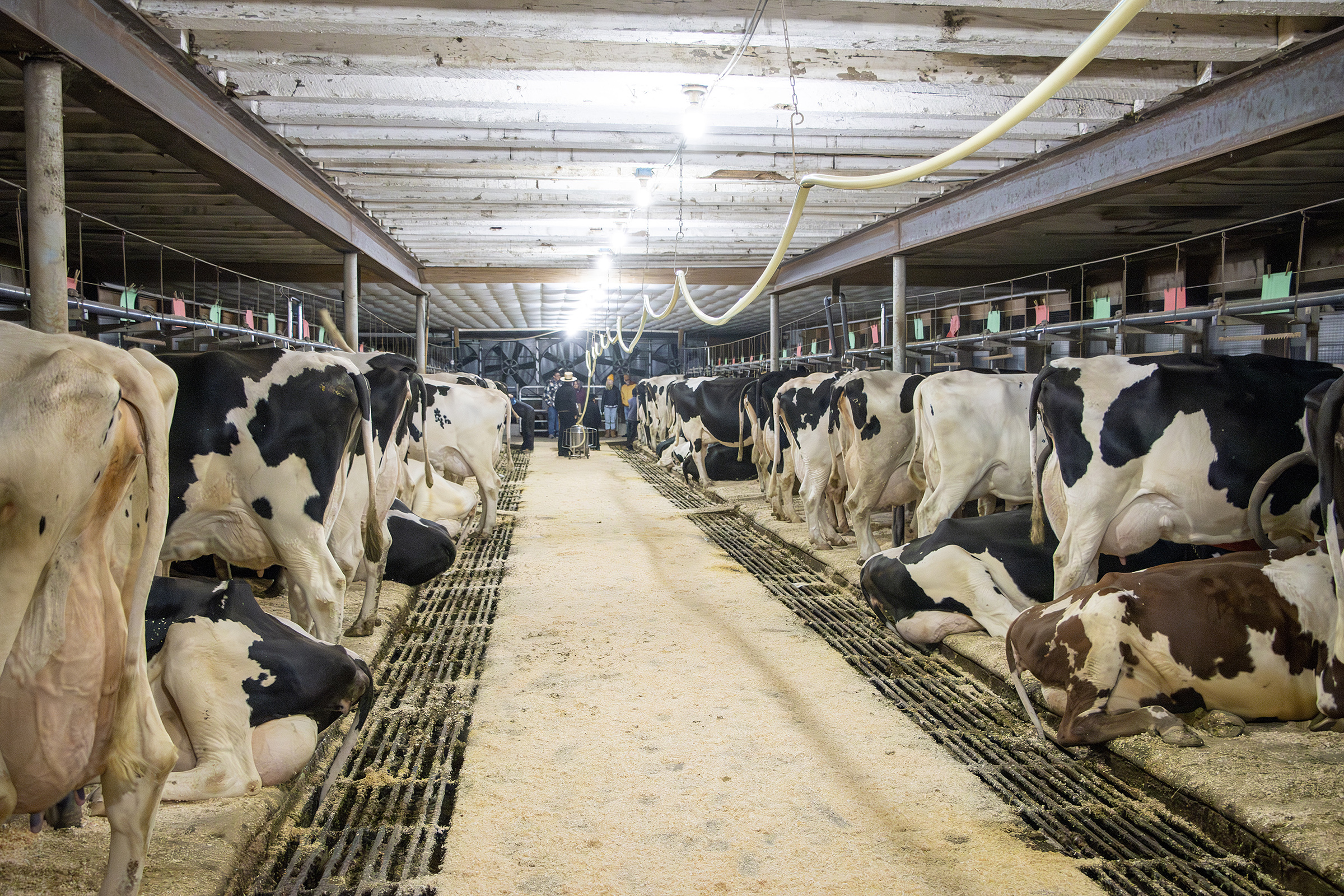
Feeling blessed to be dairying, Melvin and his family want to share this gift with others — the quiet rhythms of milkers pulsating and cows munching, the soft sounds of their lowing, the nickers from the horse stalls, the rustling of calves at feeding time, the sight of clean, contented, cows in their stalls, placidly chewing their cuds as the family moves the milkers down the row, amid casual conversations answering any questions the visitors may have.

“It’s not about us,” says Melvin. “It’s about the cows. It’s about people having the opportunity to see the cows.”

The largest crowd came early, lined up right at the start of the evening milking at 4:30 p.m. Visitors continued to flow in steadily right up until the advertised ending time of 7:30 p.m. The family rented portable toilets and tower lights, placed outside. They cleaned and emptied the loafing pen to make way for the 97 Milk table and refreshments.

Half a dozen people from Sensenig’s Feed Mill in New Holland volunteered their time too. Nancy Sensenig manned the registration table, drawing people in with her ready smile and outgoing nature, while dairy nutritionists Kyle Sensenig, Steve Morris and Justin Brenneman answered questions about dairy cows and what they eat.

Other volunteers guided traffic to parking, and Mike Sensenig was encourager in chief – walking around all smiles throughout the evening, talking with visitors.

“Melvin does a really good job here, and we support this because it’s grassroots,” says Kyle. “We like to get behind grassroots efforts that are an outreach to our community and consumers.”

He observed a few repeat families who came out last year, but mostly, he shares: “We saw a lot of new faces tonight.”

When asked what tough questions he may have encountered, he says it was really a relaxed evening, people were here out of genuine curiosity to experience something new that dairy farmers see and do every day.

He did get questions about grass-fed dairies and took the opportunity to broaden that discussion to recognize not all feeding systems are the same. He shared that these cows were getting grasses in their feedstuffs, and that cows are superheroes, able to utilize a wide variety of feedstuffs to make nutrient dense milk.

“The important thing is we want to have healthy and content cows, and that’s really what drives every dairy farmer,” he relates.

As I walked through with a group of visitors from southern Lancaster and Chester counties, the conversation turned to A2 milk. Melvin talked about his own progress toward a herd now 75% A2 through the bulls he selects for breeding. In his quiet manner, he demonstrated the reassuring message about how dairy farmers are always looking to improve and put their best quality forward.

-30-

How these dairies manage with innovation, diversity

By Sherry Bunting, Farmshine, November 15, 2024

HARRISBURG, Pa. – Innovation on the dairy farm isn’t just the big investments that come to mind, but a mix of changes and a mindset to improve. Three distinctly different Pennsylvania dairy farms were showcased in a producer panel during the 2024 Dairy Financial and Risk Management Conference hosted by the Center for Dairy Excellence recently.

The audience of mainly ag lenders and industry representatives along with some fellow dairy farmers, had the opportunity to see how producers think through the challenges, progress, and investments, and how they manage their risk in areas such as herd health, feed and nutrition, as well as adversities they can’t control like weather, markets, and labor.

Automation at Oakleigh

For Matt Brake of Oakleigh Farm, Mercersburg, the five-year plan was accelerated in a different direction after a barn fire in December of 2019 forced the family to ask the question whether they would even continue in dairy. No animals were lost, and the 1950s parlor was saved, but they had big decisions to make about the future without a facility.

“We did a lot of praying and had a lot of difficult conversations,” he recalls.

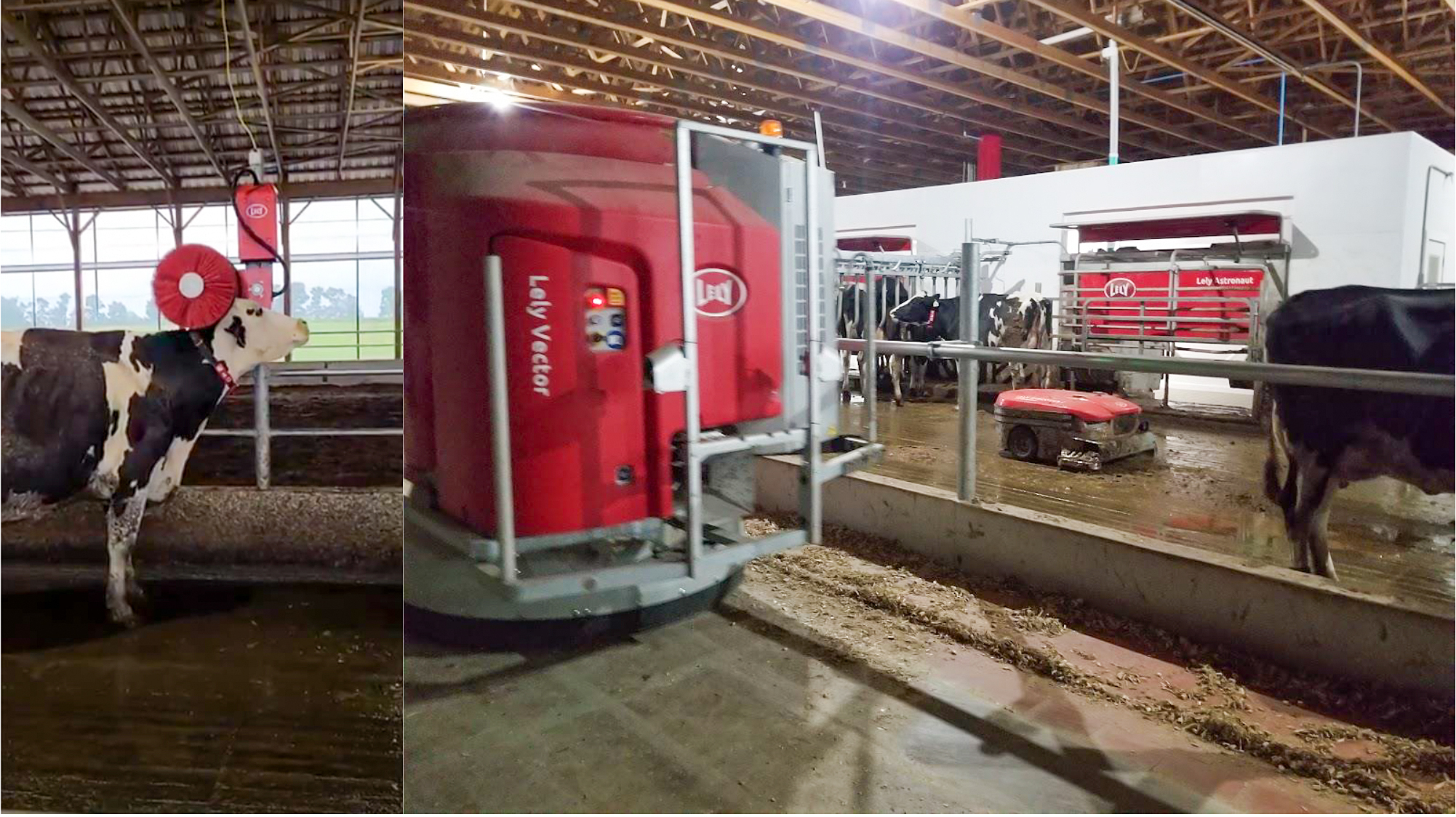
By July 2020, they were milking 120 registered Holsteins with two Lely robots, automated feeding, automated bedding, and retained their preference for a bedded pack barn rebuilt within the existing footprint.

“We really appreciate the cow comfort we get from a bedded pack, and the longevity, which is something we are really seeing now, more than ever,” Brake explains.

They didn’t know — at first – that they would go robotic, but they did know the Lely Vector feeding system would be used for feeding in place of buying a new tractor and mixer and firing it up twice a day.

“It’s amazing to see how all these different pieces of technology play together,” says Brake.

The curtains and fans are all automated and integrated. All data points for the herd are displayed on every single milking. The system ranks cows from zero to 100 on percentage chance of illness, and the automatic sorting for individual attention is based on things like activity, rumination, production, and intakes.

“Everything just plays together in real time, without guessing. We’re still involved as managers, but the data and automation are the tools we didn’t have before. We saw an increase in production, but farming is still farming,” Brake relates, giving examples of ration changes that had to be made with a forage quality issue, and how data systems helped with early detection.

Overall, the animals are doing better in this system, and they are treating fewer cows because they are getting to them earlier.

“It’s really true that an ounce of protection is better than a pound of cure. The quicker we can give those cows the attention, the less likely they are to really nosedive on us,” he says.

Brake sees how automation saves labor in some respects, but it’s more accurate to say that, “With automation, we are better utilizing our skills. We’re able to spend our time better with the cows or focusing on priorities – like chopping corn or getting the alfalfa harvested at the right time.

“We don’t have to stop those activities two times a day or worry about if we have enough help in the parlor, and do we trust that person to stand in the parlor. The robot might ‘call in sick’ temporarily here and there, but in general, compared with some of the employees we’ve had, it’s reliable.”

Moving from just the paper DHIA to incorporating this into the electronic records, changes how they manage culling to be more voluntary than involuntary.

“We can look at space and overcrowding and begin to evaluate cows not just on milk but how efficient they are in the robots looking at deviation from the average with rankings on everything from performance in the robot to reproductive performance and past treatments and other metrics,” he explains.

Better management of the culling decisions also gives them the ability to plan how many heifers to raise. “One of the things we are doing is using more beef semen and using the system to decide who to use it on,” he says.

Renovation at Mount Rock

For Alan Waybright, innovation was the focus when he purchased Mount Rock Dairy from the Mains five years ago near Newville.

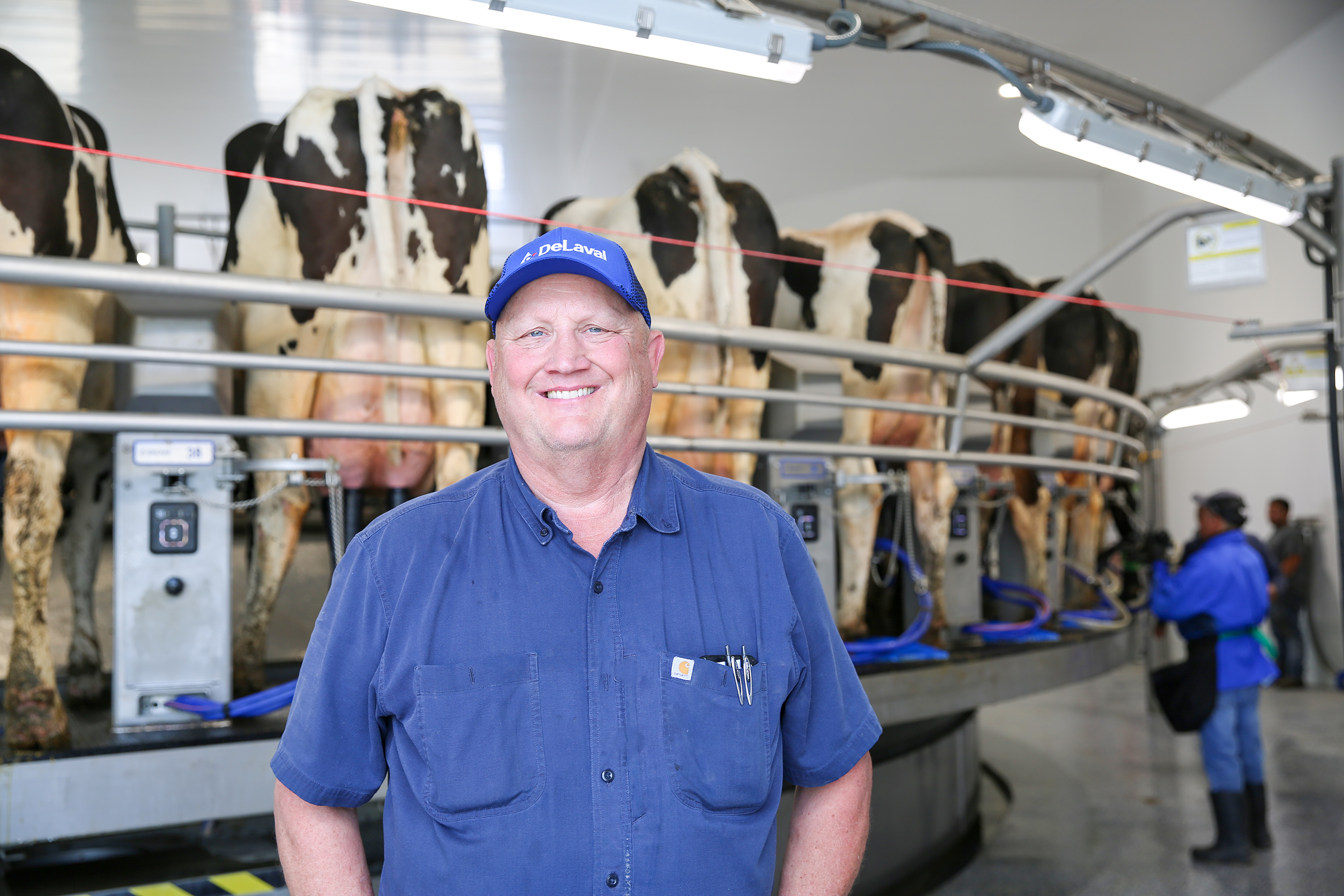
A building project was in order to update the over 30-year-old milking systems. About a year ago, they began milking in a 50-stall rotary, which changed the milking time on 2.5 times a day with each milking in a double-12 taking 9 hours, to now milking 4 times a day with each milking taking 3 hours and 45 minutes.

Waybright has been expanding from the 650 cows and 150 bred heifers he brought to Mount Rock from his prior home farm involvement at Mason Dixon, to milking 940 cows today with a 92-pound average, 4.2F and 3.3P.

Automation features were part of the rotary to reduce labor, and the calf barns include the wet barn to get them started before grouping for automatic feeders where they receive four to five feedings a day, resulting in healthier, better growing calves.

With the automated pre- and post-dipper, Waybright says the milking procedure in the DeLaval 50-stall rotary is very consistent, requiring just two employees, the first to wipe and forestrip and the second to dry and attach.

“This is a labor savings, yes, but there have been other benefits for udder health too,” Waybright reports. “When we went from the double-12 where we were hand dipping to the sprayer, a 50-gallon drum used to last seven days, now it’s three days.”

One of the innovative things he has worked on is the use of manure solids for bedding while keeping somatic cell counts low. His system uses two screw-presses dropping manure into the drum, leaving about two days’ worth of bedding at the other end with moisture levels around 50%.

They bed stalls every day during the week to use the solids as they come right out of the separator drum, adding acidifying ag lime to control mastitis.

Diversity key at Slate Ridge

“For us the secret weapon is diversity,” says Ben Peckman of Slate Ridge Dairy, Thomasville. He and his wife and high-school aged children milk 150 cows and raise 100 heifers, also feeding out all bull calves as steers.

He says there’s not one multi-million-dollar investment here, just the things that altogether add up to make a large impact.

At the dairy, he looks for ways to streamline, like ovsynch for repro. “It’s the little pieces here and there, he says, mentioning the machine with a smart phone app he purchased to do daily dry matter analysis on feedstuffs before mixing.

“Instead of always looking at the past for those adjustments, I can go out and see what the DM is right now,” says Peckman.

He fills the small sampler with three samples to get an average. “I have feed charts on my phone, pop in that number, and it changes out what I put in the mixer to get the same DM pounds,” he explains.

With feed stored in drive over piles, this is even more important to get the accurate measures each day, according to Peckman, who sees how it changes daily, firsthand.

“On a rainy day, it goes up, and on a dry, hot day, it goes down,” he says. “When changes happen day to day, testing every two weeks is not enough. My spreadsheet smooths out the changes by using the average of the past three days. When we started doing this we saw better production and components.”

A robotic feed pusher is another feed technology that’s made a difference. “We see higher intakes, fresher feed, labor savings and the ability to do this when I’m not there,” Peckman relates.

Bankers asked what ‘calculus’ goes into making such investments. For Peckman, the answer was blunt. “It’s something that improves how my herd performs but the robotic pusher does something I’m not willing to do. I’m not getting out of bed at 2:30 a.m. to push up feed.”

Other barn updates include ventilation controls and ceiling fans above bed pack areas. It’s better for cow comfort but there’s also a cost savings. “We use half as much straw and bedding with the new fans drying the air.”

His wife’s mobile milk pasteurizer is another innovation. They always fed whole milk and had a few problems when they fed it unpasteurized.

With the mobile pasteurizer, it’s two-fold: “the milk is better, but also the temperature is much better. It keeps the milk warmer, and we have healthier, better growing calves.”

Peckman really enjoys the cropping side, farming 1100 acres of diversified crops to feed the cowherd and take advantage of other markets.

“Diversity is how I mitigate risk. It’s my key technology. Diversity can’t be bought, but it pays. It helps me combat weather, combat markets, and combat other adversities in general,” he says, adding that it’s “not rocket science,” just looking at things other farmers are doing and adapting.

He does use GPS guidance for his tractors for planting and spraying, which saves seed and inputs and work off field monitoring with yield maps.

In addition to traditional corn for grain and silage and alfalfa haylage, they grows high oleic soybeans at Slate Ridge Dairy. “We saw a drastic increase in butterfat percentage,” Peckman reports.  

On his silage ground, small grains are grown — triticale, wheat, and barley. The barley he harvests after it gets the head, two weeks before it would be a grain harvest, as silage for feeding heifers.

One “big new innovation” he’s excited about is male sterile forage sorghum.

“It puts a head on without developing grain in the head,” Peckman explains. “This allows the plant to concentrate on putting energy into a plant that is a high sugar crop not a high starch crop. It’s very comparable to corn silage. I take a pound of corn silage out of the ration and put a pound of this stuff right in.”

He has replaced up to 40% of his corn silage with this particular sorghum silage and would like to get to 50% because “it’s a very economical feed to grow, the seed is cheap and inputs are less. It’s working well for me, but you have to have a way to harvest it as the BMR forage sorghums don’t ‘stand’ all the way to harvest.

“We started feeding this two years ago, and our components are up.”

Another newer crop in Peckman’s diversified portfolio is milo, or grain sorghum. He says it’s economical to grow and drought resistant, and they have a market for bird seed.

The wheat is grown as a cash crop but it has been fed too. The barley he harvests is a supplement for dry corn, depending on the year. He likes to grow these crops because they make good straw to bed the cows.

Peckman is a big believer in keeping his soil covered at all times, so some of the decisions and rotations are tweaked with weather and calendar. Over the past couple years, he has added a few acres of sunflowers to the crop rotations.

“We can double crop sunflowers after wheat, and there is a viable bird seed market for those,” he says.

“Mainly, they are beautiful, and I see people enjoying them. Nobody is paying me for that part of it, but it warms my heart to see neighbors stopping with the families, taking pictures and looking at my flowers. With everything going on in the world today, if I can see someone go out and smile a little, it’s worth it.”

Editorial: ‘Wouldn’t it be great if we could unite the country with whole milk?”

By Sherry Bunting, Farmshine July 26, 2024

‘Wouldn’t it be great if we could unite the country with whole milk?”

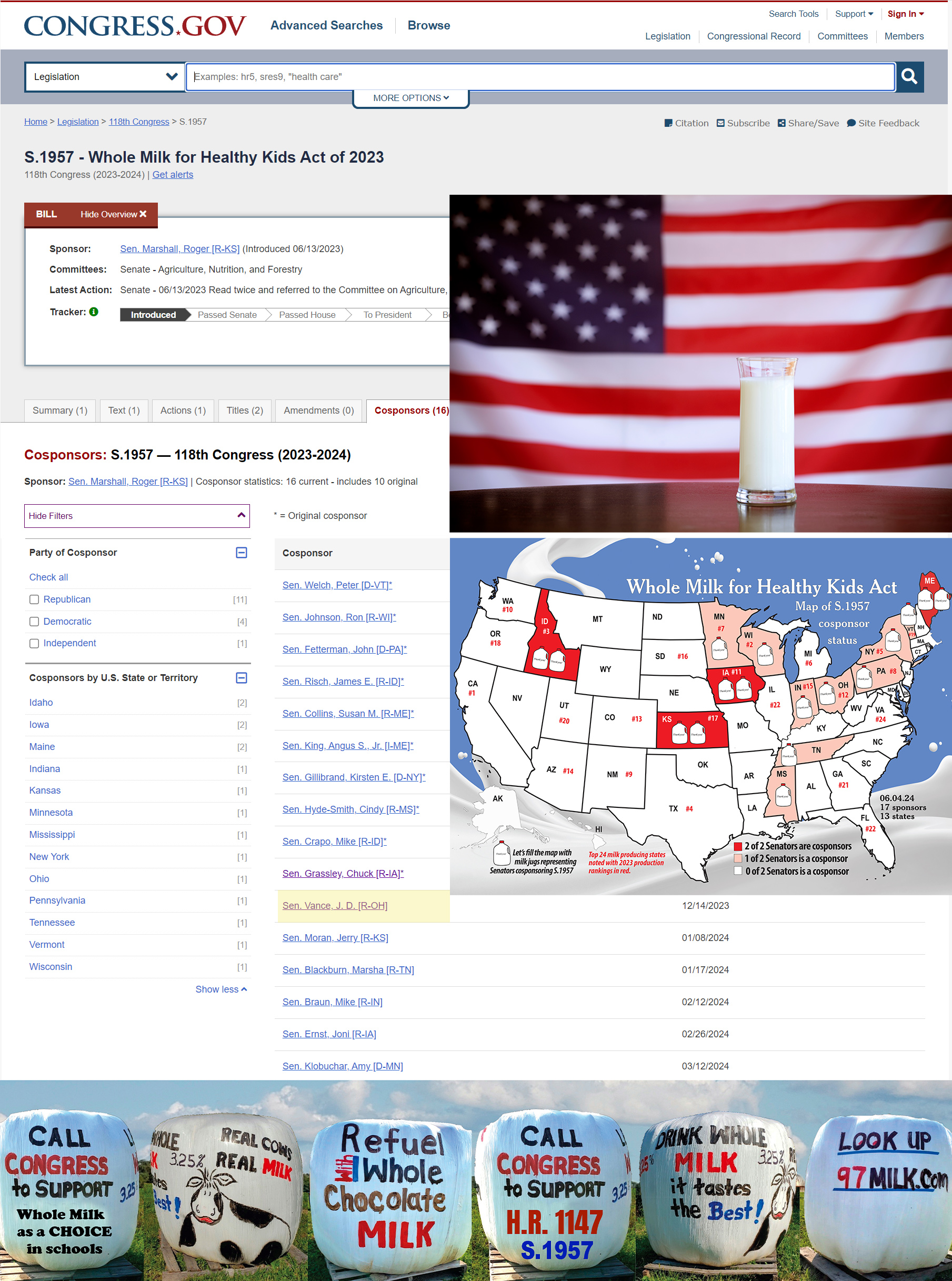
Those words were messaged to me by a friend and colleague a year ago, right after the Whole Milk for Healthy Kids Act had passed the House Education Committee in bipartisan fashion before the overwhelming passage on the House floor Dec. 13, 2023 and before Senate Ag Chair Debbie Stabenow (D-Mich.) blocked it the next day, Dec. 14, 2023.

This was my first thought, when former President Donald Trump announced Senator J.D. Vance of Ohio as his running mate in the Republican campaign. (Vance is an early cosponsor of S. 1957, the Senate’s whole milk bill.)

Like others, I’ve been involved in the effort to bring the choice of whole milk back to schools for more than a decade. It’s about natural, simple goodness — to simply strip away the federal ban and allow hungry, learning children to be nourished by milk they will love. 

Looking back at the years of this long fight, I realize that if it’s so painstakingly hard to get something so simple and so right accomplished for America’s children and farmers, we’ve got problems in this country.

With President Joe Biden now withdrawing from the campaign for a second term, and Vice President Kamala Harris as presumptive nominee launching her campaign this week in the Dairyland State, I’m reminded of where she stands on such things.

Harris is no friend to livestock agriculture. She was an original cosponsor of the Senate version of “The Green New Deal.” She has strong positions on climate change that may lead to harsher rules on methane emissions and water consumption in the dairy industry, while perhaps promoting methane digesters, which are not an equitable nor necessary solution. Cows are NOT the problem!

Some in the dairy industry are on record stating that this would be good for dairy because the DMI Net Zero goals fall in-line and tout some of the same objectives. But no matter how you slice and dice all the fancy offsets, insets, innovations, grants, projects and the billions of dollars, the bottom line leaves cattle holding the bag. 

Cattle are in the crosshairs of a very long game set to control land, food and people.

Harris has already indicated she would use the Dietary Guidelines to reduce red meat consumption on the basis of this erroneous climate impact claim about cattle that we are all being brainwashed to quite literally buy into.

As a presidential candidate in 2019, in a CNN town hall, she was specifically asked: “Would you support changing the Dietary Guidelines to reduce red meat specifically to reduce emissions?”

“Yes, I would,” Harris replied, with a burst of laughter.

It’s not funny.

Earlier, she had said she “enjoys a cheeseburger from time to time,” but the balance to be struck is “what government can and should do around creating incentives, and then banning certain behaviors… that we will eat in a healthy way, and that we will be educated about the effect of our eating habits on our environment. We have to do a much better job at that, and the government has to do a much better job at that.”

Read those words again: “creating incentives and then banning certain behaviors.” In plain English, that means dangling the carrot and then showing us the stick.

Harris joins Senators like Ag Chair Stabenow, as well as Bob Casey from Pennsylvania, as card-carrying members of perennial Ag Secretary Vilsack’s food and climate police.

Not only is Ag Chair Stabenow blocking the whole milk bill in her Committee, she is dragging her feet on the critical farm bill. 

As President Biden’s approval ratings fell, there were indications she would bring her side of the aisle to the table to negotiate a compromise to get the farm bill done this year.

Now that Biden has withdrawn from the race, and the pundits, media, and party organizers are breathless with excitement over Harris as presumptive nominee, it appears that the farm bill negotiations between the Committee-passed House version, the Republican Senate version and the Democrat Senate version have fallen apart.

House Ag Chair G.T. Thompson (R-Pa.) has called upon his colleagues to get to the table and do the work because a perfect storm is brewing in Rural America as net farm income is forecast to fall by 27% this year on top of the 19% decline last year. 

Meanwhile, there is political upheaval everywhere we look. Seeing Vance picked as Trump’s running mate and knowing he was among the early cosponsors of Senate Bill 1957 – The Whole Milk for Healthy Kids Act – offers some hope.

That bill — in true bipartisan spirit — was introduced in the U.S.Senate in June 2023 by Senator Dr. Roger Marshall (R-Kan.) with prime cosponsors Peter Welch (D-Vt.), Ron Johnson (R-Wis.), Kirsten Gillibrand (D-N.Y.), Chuck Grassley (R-Iowa), John Fetterman (D-Penna.), Mike Crapo and James Risch (R-Idaho), Susan Collins (R-Maine), Angus King (I-Maine), and Cindy Hyde-Smith (R-Miss.). The bill eventually earned cosponsorship from other Senators, including the influential Democrat from Minnesota, Amy Klobuchar.

Vance signed on as cosponsor on December 14, 2023, one day after the U.S. House of Representatives had passed their version of the bill by an overwhelming bipartisan majority of 330 to 99.

The Senate bill 1957 is identical to the successful House whole milk bill H.R. 1147, which was authored by Pennsylvania’s own Representative GT Thompson.

GT is a man of courage, conviction, compassion, of humility and humanity. I’ve heard him say more than once: “God gave us two ears and only one mouth for a reason.”

He is a determined man, doing the work. He included whole milk bill in the House Committee-passed farm bill. He’s standing firm on his pledge to put the farm back in the farm bill. He is concerned about the financial crisis in agriculture on the horizon, and held a hearing July 23 with witnesses from agriculture and banking giving stark warnings.

Even though whole milk choice in schools seems like a minor issue in the grand scheme of things today, it is really a linchpin. If we could just get something with broad bipartisan support accomplished, this could lead to other steps on common ground. 

Cows are not the climate problem. Cows are a solution. Cows are part of a carbon cycle, they don’t take carbon out of the ground and put new carbon into the air. 

Carbon is essential to life. It seems that those seeking full control of land, food, and people, are starting with carbon. 

As the whole milk choice remains hung up in the Senate, let’s pause to think about how ridiculous it is that we adults get to choose, but our growing children do not. For them, whole milk is banned at two meals a day, five days a week, three-quarters of the year at school. (The federal government, via USDA school lunch rules, only allows fat-free and 1% milk to be offered with the meal or even a la carte.)

Maybe the Harris ticket would like to ban food choice behaviors for adults as well.

We have Republicans and Democrats supporting whole milk choice in schools. Both parties say they care about our nation’s farmers and ranchers who feed us and are the backbone of our national security.

Let’s take that and run with it.

-30-

New Year, New Hope: 2024 will be year of reckoning, Part One

From whole milk in schools to farm bill to climate-warped food transformation, scientists and lawmakers are getting busy, farmers need to get busy too


In the global anti-animal assault, real science must lock horns with political science and defend American farmers — the climate superheroes that form the basis of our national security. Photo by Sherry Bunting

By Sherry Bunting, Farmshine, Jan. 5, 2024

EAST EARL, Pa. – It’s a New Year, and we have new hope on several fronts that are all linked together, in my analysis.

Top 2023 headlines for dairy farmers revolved around dairy markets that underperformed, successes and challenges in the quest to get Whole Milk choice back in schools, a plethora of draft USDA and FDA proposals that dilute real dairy, farm losses and governmental hearings on federal milk pricing, negotiations and extensions for the farm bill, and acceleration of ‘climate-smart’ positives and negatives buckling down for business in an area where political science is trumping real science on the rollercoaster ride ahead.

All of these headlines are inextricably linked. There is a global anti-animal assault underway, but people are wising up to the not-so-hidden agenda that is grounded in climate transitions and food transformation that give more power and control over food to global corporations while diminishing what little power farmers have in Rural America where our national security is at risk.

Real science locks horns with political science

As we head into 2024, a bit of good news is emerging as scientists are mobilizing to defend the nutritional, environmental and social honor of livestock — especially the much-maligned cow.

After an international summit of scientists in October 2022, work has been underway to bring together an international pact.

Dubbed the Dublin Declaration of Scientists, experts around the world have authored and are getting colleagues to sign-on to this document that calls for governments, companies, and NGOs to stop ignoring important scientific arguments when pushing their anti-animal agendas in the name of climate, transformation, and the Global Methane Pledge.

To date, nearly 1200 scientists have signed the Dublin Declaration, aimed foremost at the Irish government’s proposal to slaughter cows to meet methane targets. The Dublin Declaration represents the work of scientists across the globe for a global audience beyond Ireland.

Here in the U.S., we are sitting on the cusp of Scope 3 emissions targets of global milk buyers that have been hastily formulated based on the science of greed, not the science of greenhouse gas emissions. It’s time for the dairy organizations and land grant universities that represent, serve and rely on farmers to drink up on their milk and strengthen their spines.

Farmshine has brought readers the news about what has been happening in Europe, such as in the Netherlands and Ireland, regarding proposed farm seizures and cow slaughter, and the response of farmers there has been to challenge the political establishment.

The U.S. is not far behind. At COP28 recently, American cattle industries were criticized, and even Congressional Ag Leaders are miffed by what they heard. 

Still, some of our dairy organizations brag about being at COP26, 27, 28 and taking part. Even the dairy farmers’ own checkoff program is caught flat-footed. They’ve already caved to the Danone’s, the Nestles, the Unilevers, and such.

In fact, DMI’s yearend review touted its increase in U.S. Dairy Stewardship Commitment adopters to 39 companies representing 75% of the milk supply with membership in the Dairy Sustainability Alliance standing at 200 member companies and organizations. But what are they doing with those relationships to STAND UP ON SCIENCE FOR THE COWS?

The Stewardship Commitment includes DMI’s Net-Zero Initiative, where the cyclical short-lived nature of methane and the role of cattle in the carbon cycle is still not appropriately accounted for and is one of the points made in the Dublin Declaration of Scientists.

In the U.S. dairy industry, the trend on GHG revolves around DMI’s Innovation Center for U.S. Dairy, which placates large multinational corporations in the development of voluntary programs, telling farmers they are in control with their organizations as a sort of gatekeeper. That is, until those programs become mandatorily enforced by those milk buying corporations, while the science on methane and the cow’s role in the carbon cycle as well as U.S. data vs. global data continue to be ignored when they are sitting in the midst of UN Food Transformation Summits, COP26, 27 and 28, and the WEF at Davos.

In fact, during the annual meeting webinar of American Dairy Coalition in December, U.S. House Ag Chairman G.T. Thompson of Pennsylvania was asked his thoughts on some of the statements that came out of COP28 recently criticizing American dairy and livestock consumption.

“My first response was to find it laughable because it really shows you the difference between political science and real science,” he said. “It’s sad when people are so illiterate about the industry that provides food and fiber that they don’t understand how livestock contribute to carbon sequestration.

“We have a real battle,” Thompson said, adding that those putting out such statements criticizing American livestock “don’t even know which end the methane comes from. The world needs more U.S. farmers and less UN if we want a better world. The facts and the science are on our side. Let’s not let the other side control the narrative.”

Bottomline for Thompson is this: “The American farmers are climate heroes sequestering 10% more carbon that we emit. No one does it better anywhere in the world. Let’s be speaking up and speaking out. We can push it back with the facts and the science. I would encourage each of us to do that and become effective just telling that story,”

In the same ADC webinar in December, Trey Forsythe, professional staff for Senate Ag Committee Ranking Member John Boozman of Arkansas agreed.

“The language coming out of COP28, a likely European-led effort, shows what we are up against from people with no background on the role of dairy and livestock. We have to keep beating that drum on the efficiency of U.S. dairy and livestock farms,” he said.

In the same accord, scientists are getting busy, and we all need to get more involved.

In a dynamic white paper released last year, scientists made 10 critical arguments on this topic of livestock greenhouse gas emissions (GHG). Here’s what the scientists behind the Dublin Declaration are saying and why it’s so important for our land grant university scientists to sign on.

“Livestock agriculture creates GHG emissions, which is a serious challenge for future food systems. However, arguing that climate change mitigation requires a radical dietary transition to either veganism or vegetarianism, or the restriction of meat and dairy consumption to very small amounts is overly simplistic and possibly counterproductive,” the scientists wrote in a recent description of the Dublin Declaration.

“Such reasoning overlooks that dietary change has only a modest impact on fossil fuel-intensive lifestyle budgets, that enteric methane is part of a natural carbon cycle and has different global warming kinetics than CO2, that the rewilding of agricultural land would generate its own emissions and that afforestation comes with many limitations, that global data should not be generalized to evaluate local contexts, that there are still ample opportunities to improve livestock efficiency, that livestock not only emit but also sequester carbon, and that foods should be compared based on nutritional value. Such calls for nuance are often ignored by those arguing for a shift to plant-based diets,” they continued, listing these 10 Arguments with scientific explanations for each one.

Here is how the growing number of international scientists, including Dr. Frank Mitloehner of UC-Davis, situate the problem:

Argument 1 – Global data should not be used to evaluate local contexts

Argument 2 – Further mitigation is possible and ongoing

Argument 3 – Only a relatively small gain can be obtained from restricting animal source foods

Argument 4 – Dietary focus distracts from more impactful interventions

Argument 5 – Nutritional quality should not be overlooked when comparing foods

Argument 6 – Co-product benefits of livestock agriculture should be accounted for

Argument 7 – Livestock farming also sequesters carbon, partially offsetting its emissions

Argument 8 – Rewilding comes with its own climate impact

Argument 9 – Large-scale afforestation of grasslands is not a panacea

Argument 10 – Methane should be evaluated differently than CO2  

These arguments take nothing away from the technologies that are being developed to help dairy and livestock producers further reduce emissions and sequester carbon. Technology has a role in amplifying the cow’s position as a solution, not to cure a problem she does not have! And farmers deserve to get credit for what they’ve already achieved.

Farm, food, and national security interdependent

The 2018 Farm Bill was extended for another year at the end of 2023, but the urgency to complete a new one continues as a big priority for House Ag Committee Chairman G.T. Thompson. In the recent ADC annual meeting webinar, he said: “You don’t want us writing farm bill legislation — or any legislation — just listening to voices inside the Beltway in Washington. It would not work out well.”

He thanked and encouraged farmers for being part of the process, saying there’s more to do.

“We’re building this farm bill listening to your voices, the voices of those who produce, those who process, and those who consume — all around the country,” said Thompson, noting nearly 40 states were visited for nearly 80 listening sessions over 2.5 years on the House side.

“This farm bill is about farm security. It’s about food security. And it’s about national security – all three of those are interdependent,” he added.

The extension and funding of the current farm bill for another year — while Congress works on the new one — means programs like Dairy Margin Coverage will continue for 2024, but the enrollment announcement has not yet been made by USDA.

In past years, the enrollment began in October of the previous year and ended at the end of January for that program year. When DMC first replaced the precursor MPP, enrollment was announced late and continued into March of the first program year (2019). At that time, farms could sign up for five years through 2023 or do it annually.

In 2023, DMC paid out a total of $1.27 billion in DMC payments for the first 10 months of the year.

Chairman Thompson noted that effective farm policy is the key, and the extension means no disruptions, he said: “We attached good data for dairy with policy changes, including for DMC, and some positive changes for the nutrition title within the debt ceiling discussion.”

On DMC, the supplemental production history was added in the legislation extending the current farm bill that was signed by the President at the end of November.

“It provides our dairy farmers the certainty that their additional production will be covered moving forward,” Thompson confirmed, adding that they are looking at moving up the tier one cap to be more reflective of the industry.

The farm bill is also being crafted to use no new tax dollars by reworking priorities, looking at the Inflation Reduction Act (IRA) funds, administrative funds and shoring up funds from the Commodity Credit Corporation (CCC) priorities to secure the farm bill baseline for the future.

The $20 billion in IRA funds being thrown about for conservation and environmental programs as well as ‘climate-smart’ grants is already down to $15 billion without spending a dime because of how it is designed to phase down and go away in 2031 and the fact that USDA is believed to not have the authority to keep these funds outside of the farm bill, Thompson explained. Negotiations are considering bringing this into the farm bill baseline so that it is there – and used for farmers – now and in the future.

“(The IRA) is not a victory if agriculture does not get the full benefit of these dollars. We can make that happen in this farm bill,” said Thompson. “Reinvesting the IRA dollars into the farm bill baseline will allow us to perpetually fund conservation in the future.”

Conservation programs are historically oversubscribed and underfunded.

Thompson expects crafting and advancing of the next farm bill to continue in earnest. He hopes to have a chairman’s mark of the bill released by the end of January and have it before the House by the end of February. Much of this timeline depends on House leadership, and the Senate has its own time frame, said Thompson.

He urged dairy farmers to spread the word to their members of Congress that farm security and food security are national security.

He also noted that the nutrition title had some of its toughest elements ironed out during the continuing resolution process in which the farm bill was extended. 

“I’ve managed this in such a way that we’ve accomplished already the hard things in that title,” said Thompson.

Deploying dairy farmers on legislative efforts

“Passage of the Whole Milk for Healthy Kids Act is good for kids good for the dairy industry, and good for the economy. It simply restores the option, the choice, of whole milk and flavored whole milk, and holds harmless our hardworking school cafeteria folks by making sure the milkfat does not count toward the meal recipe limitations,” Thompson reported.

He wanted well over 300 votes for H.R. 1147 in the House to send a strong message to the Senate. On Dec. 13, the House gave him 330 ‘yes’ votes for Whole Milk for Healthy Kids.

“I would like to deploy you now on the Senate. The bill in the Senate (S. 1957) has the same language and it is tri-partisan with Republican Senator Roger Marshall, a medical doctor, Democrat Peter Welch and Independent Angus King as original sponsors,” said Thompson to dairy farmers gathered virtually for the ADC annual meeting webinar.

“There are other co-sponsors as well (12), and from my state of Pennsylvania, Senator John Fetterman is a cosponsor. Our other Senator (Bob Casey, Jr.) has not cosponsored and seems to be in opposition to it,” he said. “We need you to weigh in with your senators that this is about nutrition and health of our kids and the health of our rural communities. You are in a good position to tell the story of what happened in 2010 when fat was taken out of the milk in schools.”

Thompson noted that, “As you are doing that, you are developing relationships that will help us in the farm bill also. On the farm bill, talk about return on investment, the number of jobs and economic activity and taxes from agribusinesses, about the food security and national security and environmental benefits, science, technology and innovation in agriculture,” he said. 

“Less than 1.75% of what we spend nationally is the farm bill. That’s a big return on investment, again, for food security and national security.”

Questioned about the milk labeling bill of Pennsylvania Congressman John Joyce, a doctor, Thompson said it is a strong bill. He confessed his dismay with USDA caving on this question and called FDA “a problem child” on milk labeling. 

“This bill is not self-serving for dairy. This is about consumers having the information to make proper decisions on their nutrition,” he said.

To be continued

FDA admits almonds don’t lactate, but here’s the rest of the story…

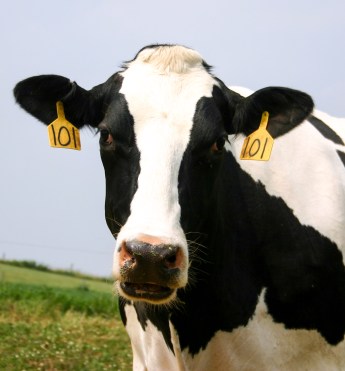
CowFace.jpg

They’re even taking her ‘moo!’ Investor-heavy high-tech startup companies are (with USDA’s help) taking her DNA to give food-grade yeast her protein-producing ability in a fermentation process to make “animal-free milk and dairy.” They’re editing her cells to grow muscle blobs in bioreactors for “animal-free boneless beef” and using her unborn bovine fetal serum as the culture media for the so-called ‘clean’ ‘animal-free’ cell-cultured meat growth. And they are taking her “moo” with website invitations to “join the ‘Moo’-vement or to get ‘moo-ving’ for all the dairy you love with none of the cows.” Meanwhile, FDA is poised — in a multi-year nutrition innovation strategy — to expand standards of identity for milk/dairy and meat/beef to accomplish nutrition innovation goals that, themselves, are being questioned and in the end may give these companies the license to steal. Photo by Sherry Bunting

FDA nutrition innovation strategy poised to ‘modernize’ how milk, beef defined as high-tech labs make cow-less versions of both

By Sherry Bunting for Farmshine, July 27, 2018

WASHINGTON, D.C. — As President Ronald Reagan famously said: “The nine most terrifying words in the English language are: I’m from the government and I’m here to help.”

Last week’s news that the Food and Drug Administration (FDA) will “help” the situation of imitation milk labels was followed by specifics from FDA Commissioner Scott Gottlieb.

He revealed in a live interview with Politico: “An almond doesn’t lactate, I will confess.”

Now there’s the sound bite everyone wants to hear, and the media and social media worlds went wild. But what does it really mean? Here’s the rest of the story and how to get involved.

Gottlieb said publicly that FDA plans to start gathering public comments before taking next steps in “redefining the rules for milk products”.

What he didn’t say in the Politico Pro Summit on July 17 is that FDA has already published a hearing and comment notice in the June 27, 2018 Federal Register for a July 26 hearing that covers three topics related to “modernizing” standards of identity, and the comment period ending August 27, 2018.

Will the government’s offer to ‘help’, in this case, result in more dishonesty and skulduggery, tricking consumers into eating what they may not otherwise choose and allowing investor-heavy startup companies to steal from farmers and ranchers, not only the identity of the products they produce, but also the very commodity-promoting checkoff dollars the government mandates they pay?

FDA already has a standard of identity for milk, and almost 100 dairy products, that it has chosen to ignore for more than a decade on any product except actual dairy milk.

Here’s the rub… If real dairy milk does not have added Vitamin D (when fat is removed Vit D is added to bring it back to full-fat levels of Vit. D), it can be deemed “mislabeled” by FDA and unable to call itself MILK.

But, if there are almonds and soybeans in your milking parlor — by all means, have at it,  label it milk — with or without Vit. D — not to mention without real milk’s levels of protein, quality amino acid profile and 9 essential nutrients.

You see, the standard of identity for milk is enforced when it comes from a cow, but not when it comes from a plant. And yet, because there is a standard of identity for milk — a nutritional and functional expectation — the plant-based knock-offs get to hijack that profile without being held to it and can selectively market from it with ‘more xxx’ or ‘free of xxx’ statements without stipulating what they are deficient in. (Example: Almond milk labels should say “88% less protein” if they are going to differentiate from the standard of identity they are hijacking).

By its own admission, FDA has maintained a non-enforcement posture on plant-based imitation beverages. Described as “enforcement discretion,” FDA has looked the other way and the dairy foods industry was either asleep at the wheel or developing imitations on the side, while these imposters were flooding the dairy case.

Meanwhile the companies investing in the imitations were free to do their market development and consumer confusion while securing space in the dairy case.

The timing of Gottlieb’s comments last week is even worse, given FDA’s launch of a multi-year nutrition innovation review as part of the agency’s nutrition innovation strategy revealed in March that seeks to expand standards of identity for products like milk and meat.

FDA meetings are happening quickly and quietly in various areas of imitation animal protein labeling and regulation. Yes, they are public meetings, but no one really knows about them.

Milk and dairy products have already been on the receiving end of identity-theft for more than a decade, and now that griddle is heating up to pancake both dairy farmers and ranchers (cattle are the target) with new plant-based mixtures, but even more horrifying are the genetically-edited cellular protein blobs or white-substance-exuding yeast grown in bioreactors yearning to be beef and milk.

There are new identity-thieves lurking about and guess what? USDA — the government — is the source of the bovine gene-edited cells and bovine gene-sequenced yeast in the heavily-investor-funded tech food startup companies that are the real focus of FDA’s recent moves.

With patents in hand — and funding from their big investors to scale up manufacturing — they seeking regulatory and labeling authority under FDA to be meat/beef and milk/dairy — without the cows.

FDA had a hearing on cell-cultured proteins July 12, and comments on regulation and labeling for this are due September 25.

A hearing on standards of identity was held by FDA on July 26 (after Farmshine press time), and comments are due August 27. (Look for more on this in next week’s Farmshine).

Dairy and beef producers need to become actively engaged in these moves by FDA because the main organizations that represent them — National Milk Producers Federation and National Cattlemen’s Beef Association — are on record stating these cell-cultured products should be subject to regulation under USDA like real meat and dairy. They are mainly seeking a level playing field in the marketplace, not opposing their classification as meat, milk, dairy.

(NMPF is vigorously defending milk’s standard of identity against plant-based imitations on nutritional grounds, but seeking a level playing field on the cell-cultured proteins).

Trust me, food and dairy manufacturing companies and investors have already hired the best and the brightest and are already involved in this FDA process — cheering for the other team.

Here’s an example: Perfect Day ‘animal-free milk’ is on the market after receiving its patent in February and raising $24.7 million in first-round startup funding from investors to scale-up manufacturing.

This company has a business-to-business (B2B) model, according to an interview with Reuters, and is already working with some of the world’s largest dairy food and beverage manufacturers. Its website states that the product is just like milk in terms of proteins, but without the cholesterol, saturated fats, lactose, and environmental impact of cattle. Just think what this portends for the dumping of even more fat-free real milk from the market.

In fact, a primary foreign investor indicated support for the Perfect Day (fake milk) startup because it aligns with United Nations Sustainability Goals for 2030. (There’s that S-word again. I hope we are paying attention to how the S-word and cattle are getting along these days). Continental Grain is a big investor in both the Memphis Meats (fake meat) and Perfect Day (fake milk) startups, while Cargill and Tyson are investors in the Memphis Meats startup.

These high-tech food sciences are attracting big high-tech investors at a rapid rate because they are viewed as “disruptor technologies,” and their websites and promotional materials hold nothing back. Milk, meat, beef, dairy – no words are off limits in their branding and marketing.

In effect, while the government forces dairy and beef producers to pay a checkoff tax for promotion of their commodities, beef and dairy — and the names of products associated with those commodities — the government is looking the other way or now potentially encouraging more identity-theft as techies enter the food space to market proteins using the dairy and beef profiles and images, without paying one dime.

As for Perfect Day, this fake-milk is made by genetically altering food-grade yeast, taking DNA from a cow and sharing its protein-producing qualities with the yeast. (Sourced from the USDA, the genetically-altered yeast are cultivated to produce ‘dairy’ protein).

This process results in a microbe that is combined with a sugar substrate (food for the microbe) to feed, grow and exude in a fermentation process the company says is like “craft-beer-style-brewing,” producing protein “building blocks” for making dairy milk, yogurt and cheese. Perfect Day’s website says: “Dairy reinvented: Sustainable. Kind. Delicious.”

The end game is to provide a ‘base dairy’ protein that looks and tastes like milk, for inclusion in manufactured dairy products like cheese, ice cream, pizza, yogurt, and to work “synergistically” with the dairy foods industry as — according to the website — “a complement to cow-based milk that takes some of the stress away from the factory-farming system, rather than replace dairy cows entirely.”

fake-meat.jpg

Enter a caption

Memphis Meats and other companies on the fake meat side are doing similar things with cell-culturing to grow cellular protein blobs in laboratory bioreactors.

In each case, the ultimate goal is to decrease the need for cattle — be they dairy or beef bovines.

Think about this for a moment. Even at a 1 to 3% inclusion rate in common dairy foods or ground beef, these lab-cultured proteins and genetically-altered yeast give processors even more control over supply, demand and pricing of milk as well as boneless beef, and if standards of identity allow this, or if FDA enforcement discretion looks the other way – consumers will never know the integrity of their food has been changed.

If FDA modernizes its standards of identity to accomplish the goals as outlined by Commissioner Gottlieb — including a reduction in saturated fat consumption despite revelations that saturated fats are healthful not harmful — it is entirely possible that FDA’s new guidance could allow these protein “innovations” in standardized dairy and meat products, without being considered mislabeled and with no indication to consumers.

Gottlieb has already established FDA’s desire to accomplish certain nutritional goals by spurring innovation with more “flexible” standards of identity.

Ahead of the July 26 hearing, FDA published its intention to cover three aspects in the standards of identity discussion: 1) Protecting consumers against economic adulteration; 2) Maintaining the basic nature, essential characteristics, and nutritional integrity of food; and 3) Promoting industry innovation and providing flexibility to encourage manufacturers to produce more healthful foods.

FDA’s Federal Register notice also says the following: “Our intent is that modernizing standards of identity to improve the nutrition and healthfulness of standardized foods will promote honest and fair dealing in the interest of consumers and achieve the goals of the Nutrition Innovation Strategy.”

How can FDA pursue this course in the face of what has been revealed in the past three to four years? It appears that bringing these B2B products to market, along with the FDA nutritional innovation strategy, are happening ahead of the battleground brewing for the next round of Dietary Guidelines.

It appears they want to modernize standards of identity for dairy within less than one year, to get them in place before the current flawed dietary guidelines are challenged in the 2020 cycle, which begins in earnest in 2019.

Numerous investigations and scientific reports and studies show that the saturated fat avoidance of more than 30 years was not only never proven to be healthful, it is now shown to be harmful. And the rhetoric from the United Nations and various Sustainability projects continues to focus on cattle as being bad for the planet, despite evidence to the contrary.

FDA wants comments that specifically talk about how the agency can use standards of identity to encourage the production of more healthful foods, to take into consideration technology, nutrition science and marketing trends, and to assess what consumers expect these standards to tell them.

Is FDA about to help the food industry blur the lines of food integrity to trick people into eating according to USDA/HHS flawed set of dietary guidelines (and UN environmental sustainability assumptions)?

That would be the ultimate dishonesty, and much worse than the 10-plus years of ignoring dairy identity theft already happening daily in the supermarket dairy case. Expanding the standard of identity, depending upon how it is accomplished, would give large, powerful, multinational food corporations a true license to steal.

Last week, the American Dairy Coalition (ADC) launched a “Protecting Milk Integrity Initiative” to advocate for the proper use of federally standardized terms established for the word “milk” on product labels. ADC is a coalition of dairy, ag and livestock producers, and they are devoting a branch of their organization to work specifically on “providing clarity and consistency for consumers across the nation,” the organization said in a July 17 news release.

ADC is getting the word out that it believes the dairy industry must speak up to ensure the FDA understands how important it is, not only for the current standard of identity for milk and dairy products to be upheld, but for it to be fully enforced — restricting the use of the word “milk” on all future plant-based or alternative product labels.

They point out that the price of milk continues to decline while sales of plant-based alternatives are up 61% over the past five years with projections of more market share gains in the future.

Don’t be fooled by FDA’s admission that almonds don’t lactate. Instead of the enforcement of milk’s standard of identity that dairy farmers have been waiting for, FDA has already quietly launched its process for modernizing standards of identity to achieve specific (and flawed) nutritional goals.

To comment on Docket No. FDA-2018-N-2381 for “FDA’s Comprehensive, Multi-Year Nutrition Innovation Strategy,” due August 27, 2018, use the docket portal at https://www.regulations.gov/docket?D=FDA-2018-N-2381.

To comment on Docket No. FDA-2018-N-2155 for “Foods Produced Using Animal Cell Culture Technology, due September 25, 2018, use the docket portal at https://www.regulations.gov/docket?D=FDA-2018-N-2155 .

To mail comments for either one, reference the appropriate docket name and number in your letter and mail to: Dockets Management Staff (HFA-305), Food and Drug Administration, 5630 Fishers Lane, Rm. 1061, Rockville, MD 20852

In addition to commenting, a petition has been developed by the American Dairy Coalition’s Protecting Milk Integrity Initiative, and signatures are being collected to submit with public comments. ADC is also taking donations to raise funds to fight this cause.

More information about Protecting Milk Integrity Initiative, visit American Dairy Coalition

To learn more about the July 12 FDA cellular protein hearing (fake meat) and July 26 standards of identity hearing (fake milk), stay tuned to future editions of Farmshine for full reports ahead of the deadlines for commenting to FDA on both.

-30-

CAPTIONS

FAKE MEAT and FAKE MILK

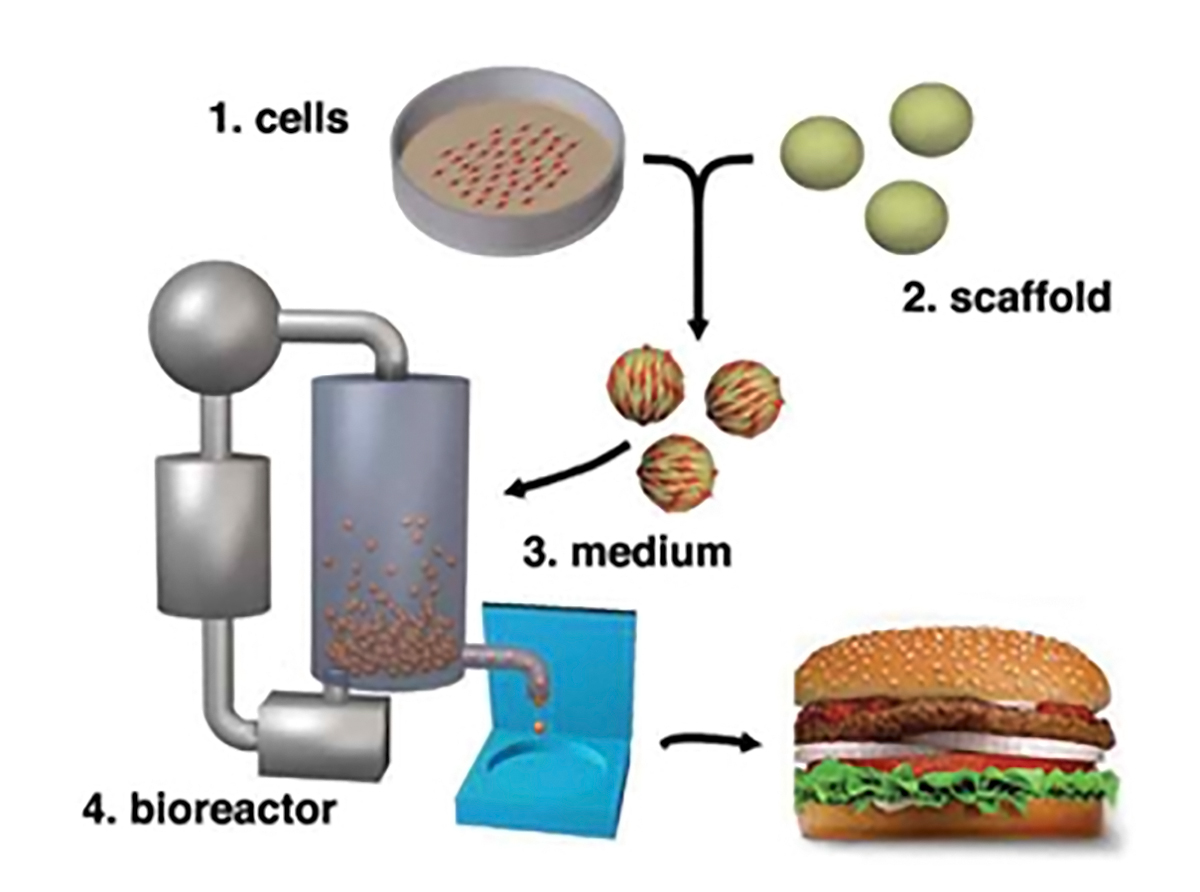
New Harvest and Memphis Meats testifed to FDA on July 12 that cell-cultured ‘meats’ are inevitable. They showed diagrams of how gene-edited bovine DNA and culture media are combined in bioreactors to make cellular blobs they want to call ‘boneless beef’ — without the cow. Similar diagrams can be found for Perfect Day and their phrase: ‘all the dairy you love with none of the cows’ at their website perfectdayfoods.com. Screenshot of materials displayed during FDA hearing by Sherry Bunting

Gift of life, keeps giving

Status

Agmoos's avatar

Burdettes_Dec2017(SherryPhoto)vertical.jpg

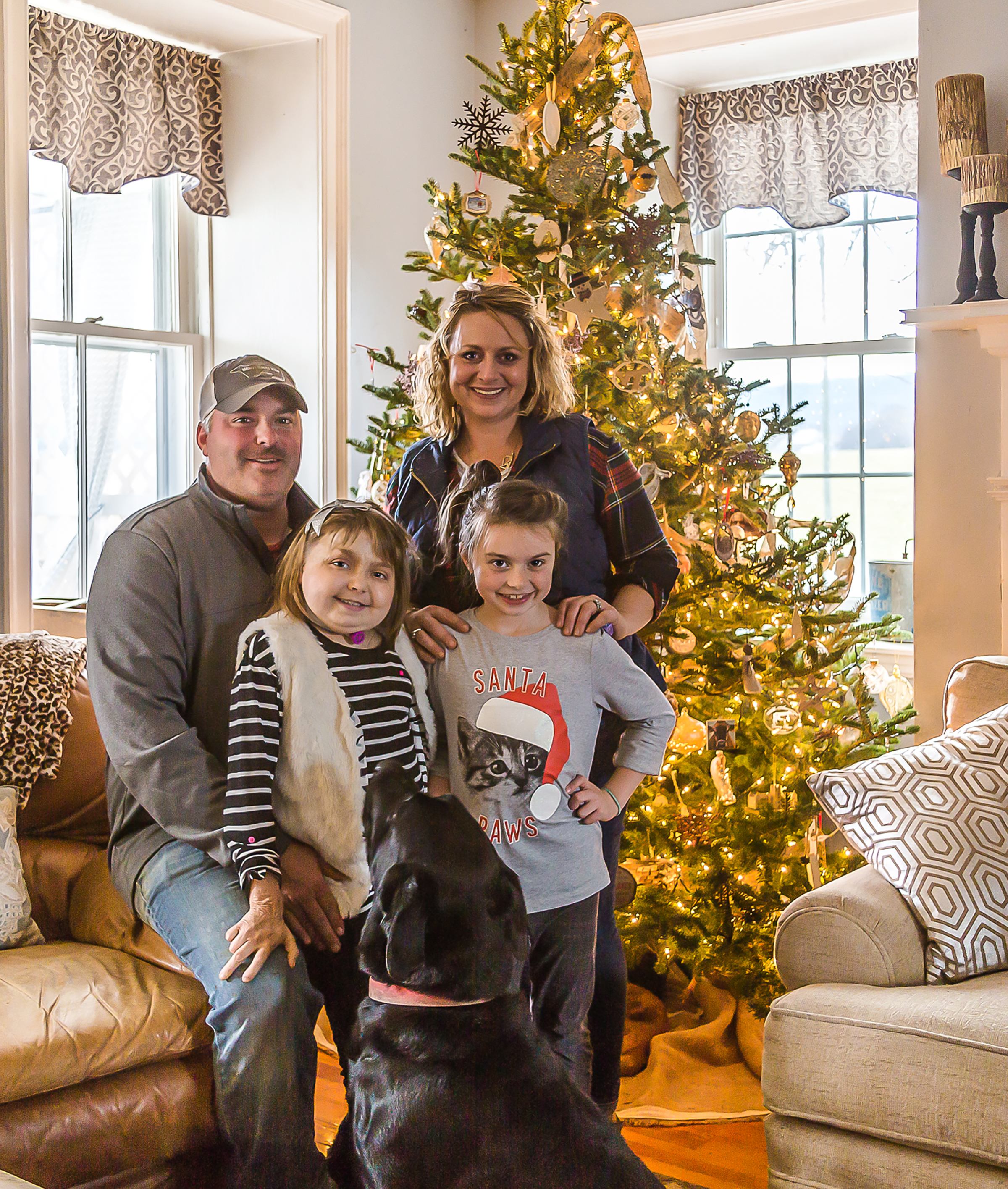
Justin, Claire, Reese, 10, Brinkley, 8, and Tripp, the dog, by the Christmas tree on a December afternoon just 3 weeks after the kidney transplant that gives Reese a new lease on life. Tucked in under the tree is Reese’s beloved cat Jack. Reese is quite enthusiastic about her four-legged friends, be they Holstein dairy cattle or house pets. Photo by Sherry Bunting 


‘Reese shows us you can have tragedy in your life and still move on and be full of life and hope for the future.’

 By Sherry Bunting, reprinted from Farmshine, Friday, December 15, 2017

MERCERSBURG, Pa. — Cheese ball is back on the menu this Christmas at the Burdette house on Corner Road outside of Mercersburg, Pennsylvania. It’s among the favorite foods that Reese Burdette has had to forgo for nearly four years to be easy on her damaged kidneys as she recovered from the May 2014 house fire.

That, along with hash brown casserole and all the yummy goodness of dairy foods, potatoes, orange juice and bananas — essentially nutritious foods high in vitamins such as potassium. In fact, so happy is Reese about bananas, Claire believes she’s eaten a tree full already.

Not only is Reese happy to be eating these foods again, “I hope to start growing again too!” the smiling 10-year-old said during my visit to Windy-Knoll View farm last Thursday.

While she has forged ahead on this journey on every front, it was the kidney transplant everyone knew Reese would eventually need that was hanging out there on the horizon. Justin and Claire Burdette learned in September that their daughter was in renal failure. She had been doing so well, so the timing was a bit of a shock.

Many people had already been tested as live donors — from friends and family members to colleagues in the dairy industry. But who would think that the “angel” sent into Reese’s life would be a friend of a cousin by marriage who had met Reese one time, a young, single woman with a heart of gold and willing to go through the surgery to donate a kidney to give Reese the vitality of life this ‘tuff girl’ has been fighting for.

Reese&Alyssa

Ahead of the kidney transplant surgery, Reese’s aunt Laura Jackson updated on social media describing Alyssa as selfless, inspirational, courageous and beautiful with a giving spirit that is truly admirable. “Her love of children and animals led her right to us because right now, Reese does need some extra help,” wrote Laura. What many may not realize is that this gift of a new kidney comes from a woman “who loves her family and just wants to make a difference in this crazy world we live in… What this beautiful soul has offered up is a very different kind of life for Reese… the chance to be a normal 10-year-old with a chance to grow.”  Photo credit Bre Bogert Photography

Through the selfless generosity of Alyssa Hussey, 32, of Winchester, Virginia, a special education teacher with the Loudoun County Public Schools, the successful kidney transplant took place at Johns Hopkins on November 20. Not only are they both home and doing well, Reese was released just five days after the surgery, getting her home just after Thanksgiving and far sooner than imagined.

The two were expecting to have a visit at the farm this week, and Reese said she is anxious to show her hero around to see her growing little herd of 12 Holsteins, not to mention the five calves her sister Brinkley has accumulated among the Windy-Knoll View herd of top registered Holsteins.

Ahead of the transplant surgery, Reese’s aunt Laura Jackson updated on social media to say:

“What many may not realize is what this beautiful soul has offered up is a very different kind of life for Reese, a chance at a life with more quality and abundance, of water parks, river swimming, better health and the chance to be a normal 10-year-old with a chance to grow.”

Alyssa has given Reese the ultimate gift — the gift of life.

“We are relieved to have faced this. We knew it was coming. We just didn’t think it would be now. But what a blessing,” Justin reflects. “This kidney transplant would not be possible without someone like Alyssa. It’s proof that living donors are out there and we found one that we had ties to and never knew.”

Claire says that, “It’s hard to fathom someone willing to give our child their kidney and we barely knew her. But she didn’t think twice. We are beyond grateful.”

Burdettes_Dec2017-14 (1)It was a regular day on the farm when I arrived just as Reese was finishing school via the virtual robot — a necessity as she avoids large indoor crowds for the next 100 days since the transplant. Her younger sister Brinkley was just getting off the school bus. We had an hour to talk before Justin headed out to milk, driving down Brinkley and Reese Way, the dirt roads across the field between their house and the farm. The late afternoon sun, as the farm’s name suggests, broke through cold windswept clouds in the gap of the south mountains.
 

Reese-Brinkley-Jim-Nina(FacebookPhotoProvided).jpg

Three weeks after her kidney transplant, Reese looked forward to the annual sleigh ride in Greencastle last Friday evening with grandparents Jim and Nina Burdette. While she must avoid indoor crowds for 100 days, the outdoor Christmas festivity was high on her list of things to look forward to. Facebook photo.

At the kitchen table, the topic of conversation centered on the many things Reese was already reintroducing into her life since the transplant, the goals she and her mother Claire have set, and the activities she is looking forward to – not the least of which was a trip to Greencastle Friday evening for the annual horse-drawn sleigh ride with her Momo and Papap (Jim and Nina Burdette).

What is it about Reese’s story that has inspired such a far-reaching interest and impact? People write and call and follow her progress from near and far. It’s a story of faith, hope and the determination to live life to the fullest, to overcome challenges and setbacks, to never give up, never let go of the rope and to keep moving forward in a matter-of-fact way with fierce strength, raw honesty, family love and accountability filtered by the wisdom of a 10-year-old’s keen sense of humor.

Justin notes that they had a visit not long ago from a Canadian couple who keep in touch often to see how Reese is doing. They traveled to Pennsylvania just to visit her, amazed by her journey after nearly two years at Johns Hopkins recovering from the fire. This dairy farming couple had been through a barn fire and had dealt with animal losses that were depressing. Knowing Reese, seeing her, has made a difference in their world.

They are but one example of hearts Reese has helped to heal through her own example.

They are among the many who have written the Burdettes about what Reese’s story means to them, and what her journey has done for them in their own circumstances. Claire explains that, at first, these responses were hard to realize and digest because so many have done so much for Reese and their family that they felt they were leaning on others only to learn that others were finding support also in them.

Reese-Brinkley-Sleigh(FacebookPhotoProvided)“I think what Reese shows us is that you can have tragedy in your life and still move on and be full of life and hope for the future. I think that is what Reese has done for people,” Claire explains.
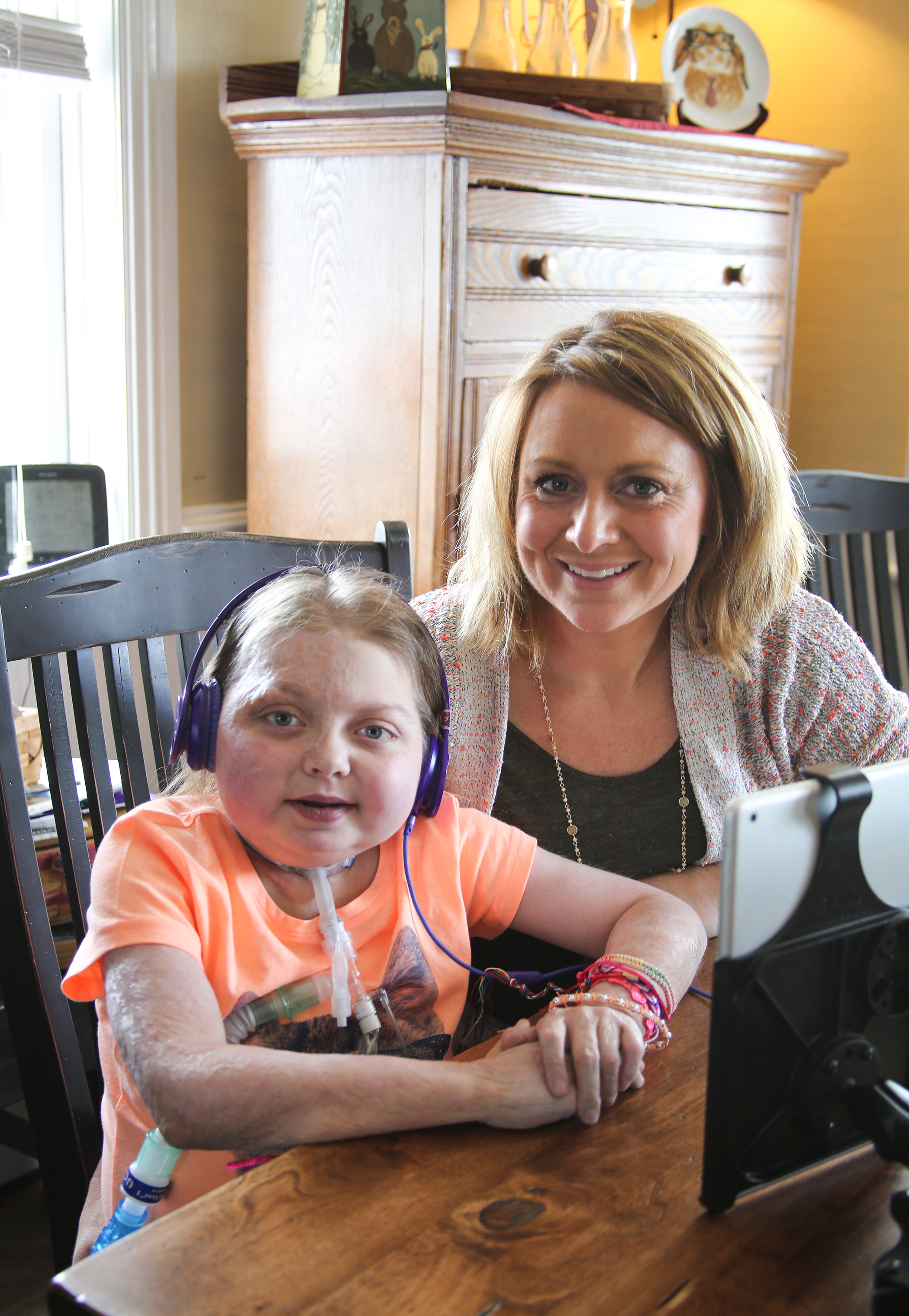
Healing and support going both ways – a lifeline — gifts that keep giving.

In like manner, the kidney donated by Alyssa Hussey is new hope transplanted, a gift that keeps giving in a young girl with a second chance.

Justin and Claire also had high praise for their summer intern who came back to help at the farm so they could be with Reese, worry-free, in the hospital for the transplant. Mikey Barton is the grandson of Ken Main of Elite Dairy and Cutting-Edge Genetics in Copake, New York. He had served as an intern last summer at Windy-Knoll View, and when he heard about the upcoming kidney transplant for Reese, he came down to help take care of things.

“We are so blessed,” the Burdettes said, describing the bond Mikey has made with their family. “Blessed that he comes back to see us and that he would take his time off to come down here so we could focus on Reese.”


Justin was quick to point out that he got back to the farm Wednesday to be sure to have Mikey home with his family for Thanksgiving, and that Mikey made time to drive the two hours south to see Reese in the hospital before heading north back to New York.

“We felt we have learned as much from Mikey as he has learned from us through this internship experience,” said Claire. “It has been a neat connection. He knows our routine and we didn’t have to worry about things at home for those few days.”

The Burdettes also credit the support of their local community and the dairy community from the beginning. Flannery’s Tavern on the Square in Mercersburg hosted a Team Reese fundraiser a week before the kidney transplant to help with medical and related expenses with the restaurant donating 15% of the days sales and providing a room for 75 silent-auction items donated and bid on by the greater community.

For the Burdettes, it has been the physical outpouring that accompanies the financial support of others that has lifted them up. To see a Team Reese fundraiser pack the local restaurant from open to close shows how much Reese has lived up to her nickname as “Mercersburg’s daughter.” When she and Brinkley walk into Flannerys, as they do once a week, people cheer. No price can be put on that physical show of support.

Every effort to this point has come together toward a life that will be much different for Reese now. No lines to tether her. No long trips for dialysis.

Clair confirms the doctors are very happy with her progress and her bloodwork looks good. Her main job in the next 100 days is to stay healthy and drink lots of fluids for that new kidney.

High on Reese’s list of “new” is fewer shots, fewer medicines, and working on giving up the tracheotomy for supplemental oxygen.

She is pretty excited about her Dad’s promise of a trip to Great Wolf Lodge where a waterpark is in her future.

“I can’t wait to bathe in that waterpark and get Brinkley soaked!” she says with a laugh.

But first she needs to reach the point in her journey where the trach is no longer needed. Now that the kidney transplant has occurred, there will be sleep studies and trials to be sure the timing is right to close the trach, and then the watersports and other activities will beckon. Reese already gave up the constant companion of traveling oxygen last Easter when she wanted to be outside with the other kids for a longer period of time, and decided on her own, she didn’t need it.

Reese has set a goal to attend the Pennsylvania Junior Holstein Convention in Lancaster in February. Mom’s goal is to get her through the next three months away from crowds to be strong and healthy into this next chapter of her journey.

Because we all know what comes next. There are calves to work with and cows to care for and in addition to a new calf Cream Cheese from her Carrie cow, named after the child life specialist who has been inspirational on this journey, there are the new gals from her Pantene line, like Potato Chip and Pretzel.

Reese and Brinkley talk excitedly about their cattle as they rattle off names and pedigrees.

But the cow work will have to wait, except for drive-throughs this winter. Instead, Reese is happy to be making and eating some of her favorite dishes. This week she made sticky buns with her Momo and a repeat favorite meal – sloppy joes.

She says, “No more driving to dialysis and getting home late at night!” That all ended on November 21 along with the line in her belly and the constant hemoglobin shots.

The people who have stuck with Reese from the beginning continue to be there in large ways and small. A woman in town still sends Reese a card every week, just as she has since May 2014.

As for the Christmas celebration, her second at home since the fire, Reese has big plans. She shared her small, but typical 10-year-old’s list for Santa and the family traditions she looks forward to. To avoid contact with crowds, she’s shopping by internet, and she’s pretty excited that on Christmas Eve, she will be helping her Momo prepare the dinner.

For Claire and Justin, having their daughter home with her new kidney for Christmas is the greatest gift of all.

“There is so much good in this world,” Justin affirms. “We just have to look for it.”

One place to look is the inspiration of little Reese Burdette.

Correspondence can be sent to Reese Burdette, 8656 Corner Road, Mercersburg, PA 17236. Financial contributions or fundraisers for Reese and her family, can be sent to “We Love Reese” First Community Bank, 12 S. Main St., Mercersburg, PA 17236.

-30-

Determination defined.

By Sherry Bunting, Farmshine, Sept. 23, 2016

HARRISBURG, Pa. — Before the March homecoming, Reese Burdette told the medical staff “I’ve got to get home to my cows.”

And so she did. Her cow Pantene, in fact, had just had a heifer calf she named Pardi-Gras. It was Mardi-Gras time of year and she was looking forward to a homecoming party.

When Reese Burdette did come home to Windy-Knoll-View farm after those 662 days at Johns Hopkins Children’s Center Pediatric Intensive Care Unit (PICU), she was so anxious to get back to her cows and the dairy industry she loves that she wanted to get right out on the gator with her papap to look them over.

Reese03That didn’t happen immediately, but not long after she was home, she sure did.
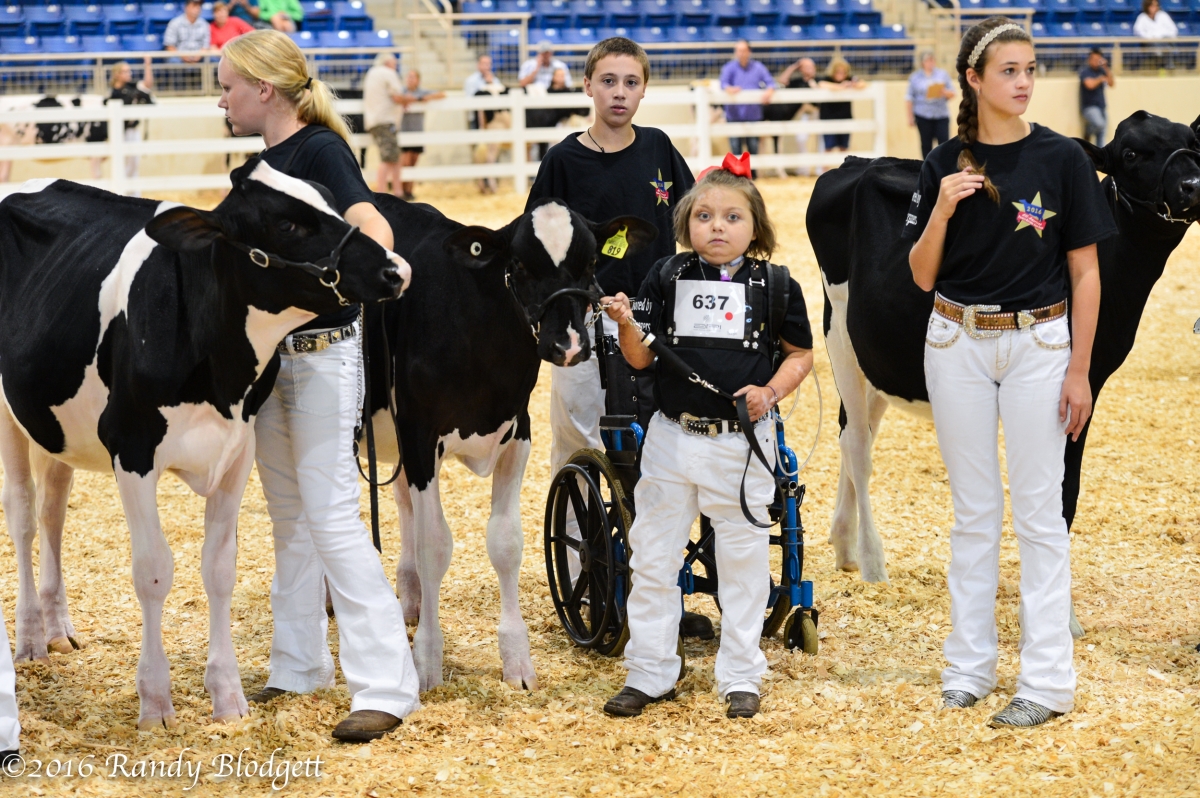
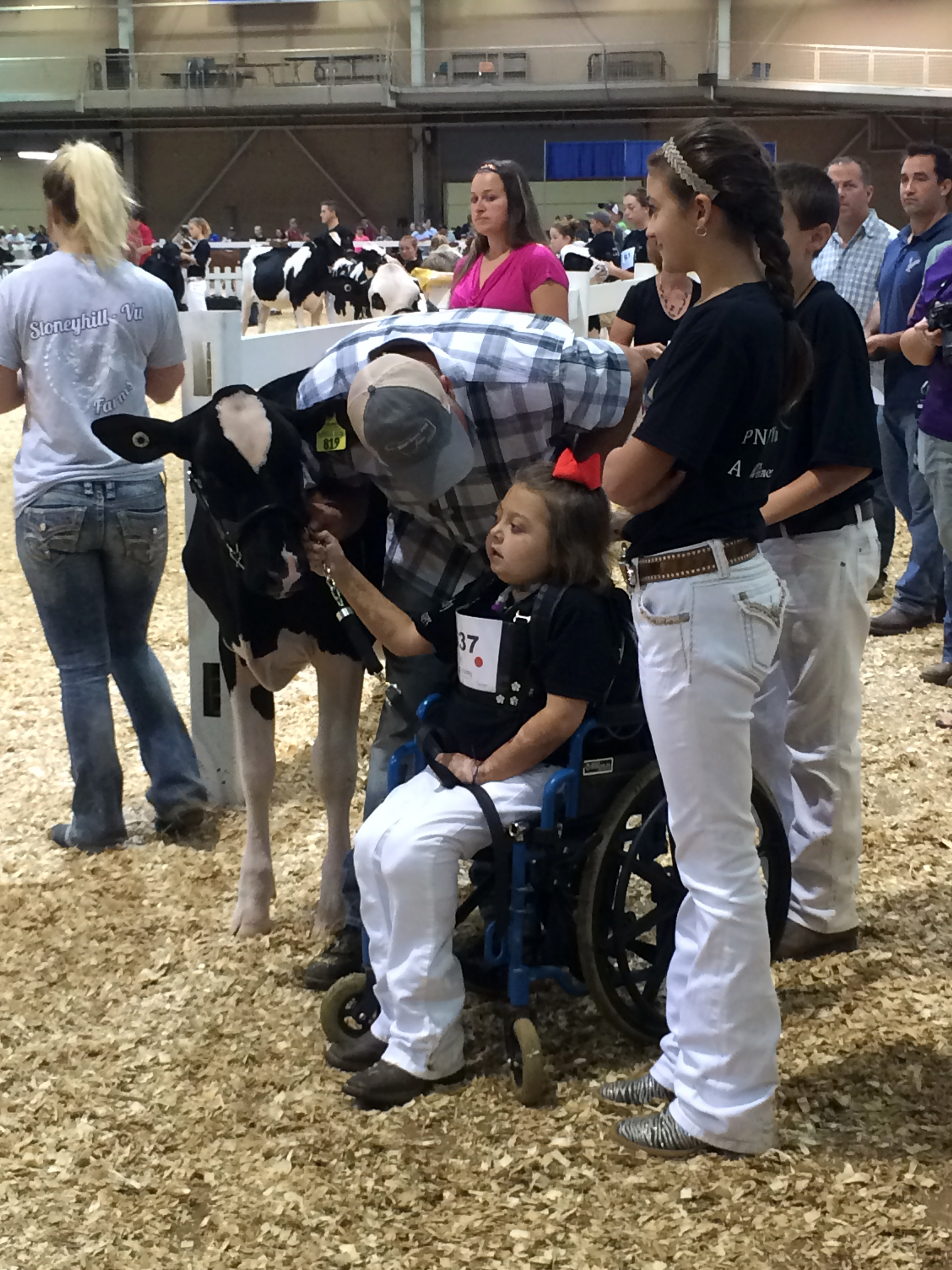
A few days after her March homecoming. Reese was already setting new goals for herself.

Sitting at the kitchen table on the day of our visit in mid-March, taking a break from “virtually” attending school, Reese said, matter-of-factly, and with a radiant smile (as her mother and momo exchanged glances):

“I want to be walking good enough to lead Pardi-Gras in Harrisburg in September.”

And so she did. She sure did.dsc_1142

reesepeptalkdadIt was something she had worked for daily with the support of her family, friends, therapists… and a last minute pep talk from dad, Justin Burdette.
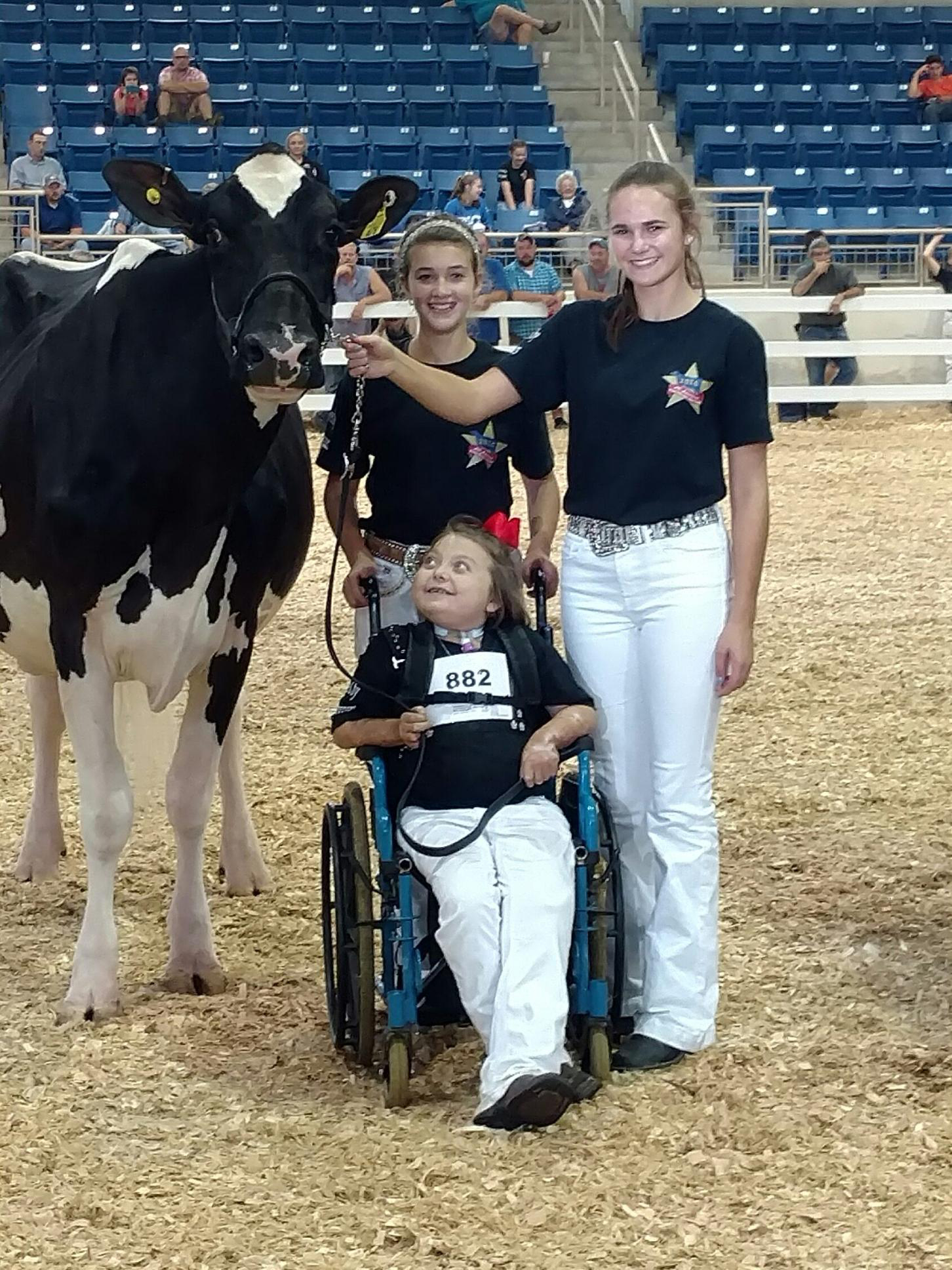
In fact, not only did she lead Pardi-Gras to a 4th place finish in her class Monday, Sept. 19 during the All-American Dairy Show at the Farm Show Complex in Harrisburg, Pa., she also led Pardi-Gras’ dam, Reese’s prize 4-year-old cow Pantene to a 1st place finish in her class… and the honors that followed as Reserve Grand Champion Holstein of the Premier National Junior Show.

Perhaps Pa. Holstein Association executive director Ken Raney put it best in a post acknowledging all of the great people and families the association works with across Pennsylvania. “It’s been my goal to share the accomplishments and recognize many people for what they do for the dairy industry, but today was different,” he wrote. “Today, we got to witness a young lady who has shown great determination and a will to not only survive but return to the industry and cows she loves. Congratulations and thank you Reese Burdette for showing us what true determination is all about.”

reesepantenereschampReese was surrounded Monday by her support team of friends and family, including friends from Johns Hopkins, who came to Harrisburg to witness how much Reese loves the dairy industry and how this dairy industry family continues to support her and her family. Her ever-faithful cousin Regan Jackson and friend Lane Kummer helped make it possible to also lead her cow Pantene.
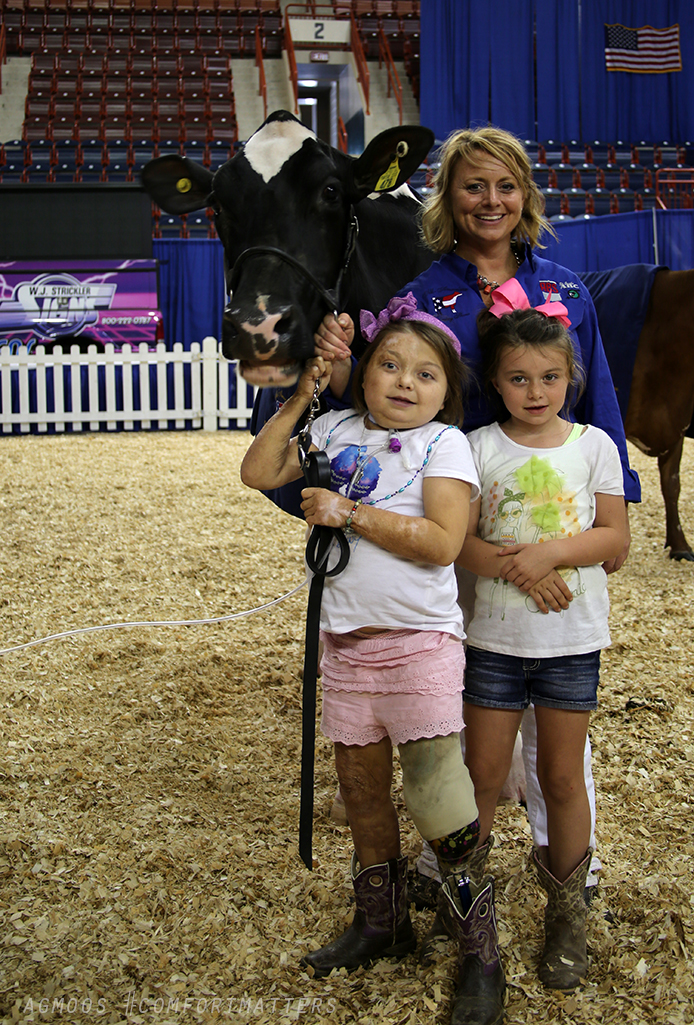
In a video interview with The Bullvine, Reese’s mother Claire Burdette said that people wonder how they can be so strong through this journey of over two years. She said, “It’s people surrounding us that make us strong.” She described Reese’s sense of humor and tenacity that stayed with her throughout this journey.

00aareese0022As for Reese, her family, favored cow Pantene, and all who continue to support and love her… the joy of the day and its milestones was plain to see.
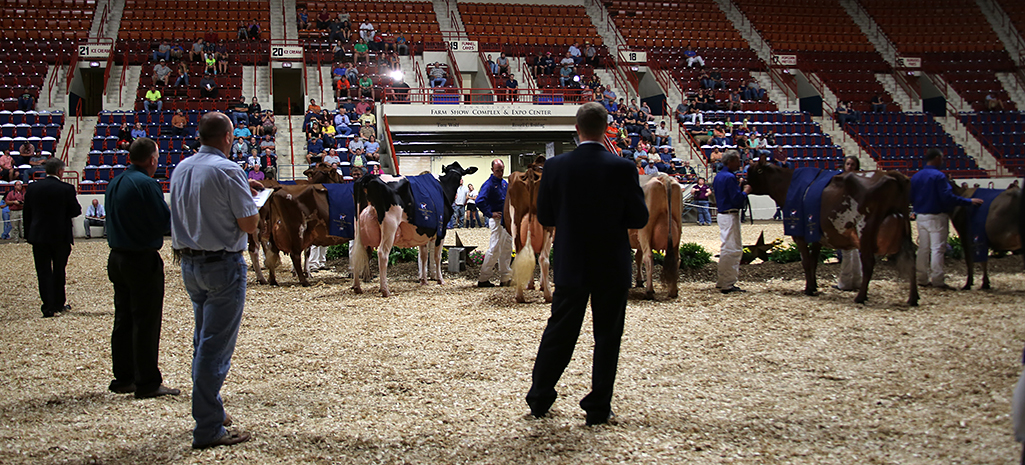
As expected, this tenacious 10-year-old has already set the next goal for herself (and loves to think in timelines): To attend school without the part-time assistance of the wheelchair by the end of the year.

We continue to root for this amazing and inspirational young lady and agree wholeheartedly with Ken Raney’s comment: “You made us all proud ‘Miss Tuff Girl!’” as she is affectionately known these days.

***

Thank you to Laura Jackson, Jean Kummer and Randy Blodgett for some of the photos above. Below, Reese’s Pantene also made the Supreme parade lineup Thursday as Grand Champion Holstein in the open competition, shown by her mom Claire Burdette.00aaPantene9930.jpg


00aachampionudders9953.jpg


00aajudges9973.jpg


00aaReese0024.jpg

00aachampsbo0042


‘I’ve got to get home to my cows’

With courage and grace, Reese comes home after 22 months

By Sherry Bunting, reprinted from FARMSHINE March 25, 2016
Reese03Author’s Note: It has been almost a month since Reese’s homecoming and she is getting back to the precious rhythms of life on the farm: Greeting her little sister off the bus on sunny afternoons, feeding her prize cow’s new calf, riding the gator with her grandfather, having tea parties with sister and cousins on Sunday afternoons, getting together with school friends, still attending school virtually via “Double,” her robot, even going to the dentist! Her journey continues to inspire. I am grateful for the opportunity to interview Reese and her mother and grandmother on the quiet first Monday after her arrival home Friday, March 18, 2016. Get ready to be inspired by this young lady, and by her family and the local farming community and worldwide dairy community who continue to think of her. Thank you to Jean Kummer, Laura Jackson and Jennifer DiDio for providing some of the photos here.


MERCERSBURG, Pa. — Nina Burdette tells the story of granddaughter Reese teaching her cow Pantene to lead when she was a calf five years ago. Reese was four at the time, and Nina told her “Don’t let go.”

“That calf pulled her around, and at one point she was flat on her back holding on, until that calf wrapped itself around a post,” Nina recalls she had rope burns on her hands.

Reese never let go.

So it was two years later, on May 26, 2014, when Reese arrived at Johns Hopkins Children’s Center, where she would spend the next 662 days in the Pediatric Intensive Care Unit (PICU) recovering from burns over 35 percent of her body and smoke damage to her heart and lungs after a fire at the home of her grandmother Patricia Stiles, who also recovered from significant trauma carrying her from the burning room.

Reese never let go.

Reese01

Today, she is back home at Windy-Knoll View farm in rural Franklin County, Pa., with her sister Brinkley and their parents Justin and Claire Burdette, and of course her cow Pantene and her three heifers Pretzel, Panzee and Pardi Gras.

Over and over, Reese told her doctors: “I’ve got to get home to my cows.”

Words spoken from the heart of a true dairy farmer. “Oh she has her mind set on that, just like her mom and dad,” says Nina. “We call her the junior manager.”

Driving through Mercersburg to the Burdette home on Monday, purple still proclaimed Reese’s homecoming parade from the preceding Friday. Purple and white cows stood in yards and driveways, purple balloons, welcoming TeamReese banners, home-made signs of love and support, purple bows tied to trees, poles and fence posts all along the route of young Reese Burdette’s drive home from Baltimore to Mercersburg — the 200-mile trek her family has traversed between the home farm and their second home at Johns Hopkins for nearly two years.

Reese had set a goal to be home for her 9th birthday, which she celebrated with family and friends — at home — on Sunday, March 20.

“Friday was surreal,” said Mom, Claire, during Monday’s Farmshine interview as Reese sat in the next room attending school via her robot, screen and headphones. Brinkley, 5, had also gone off to school that morning, and Reese was eager to be on the porch in a couple hours to see her little sister get off the bus — something she had envisioned for months.

A return to the ordinary rhythms of life on the farm is just what this child has longed for as she recovered from that fateful day.

Friday had dawned brisk and sunny as Claire and Justin and Brinkley waited with Reese for morning rounds. “When the doctor said ‘you’re free to go,’ it felt so good to hear those words we had waited and prayed to hear for so long,” Claire recalls.

A sendoff party was attended by hundreds the night before at Johns Hopkins where Reese has become quite the celebrity in what everyone referred to as “the sunshine room” where there was no room for worry. She shared her games, was known for her aim in shooting foam darts at a deer on the doorway, and had a machine for making snowballs and popcorn for sale with lines out the door to her room some days. Her PICU room had been transformed into a rehab that looked as much like home as possible for the past year. Toward the end of her stay, Reese surprised her family with a video of her journey.

“She’s not afraid to talk about the fire,” said Claire, noting that the hospital has learned from Reese as they tried processes for the first time with her burns. Jim tells of the time she consoled a grandmother whose granddaughter was getting a tracheotomy, explaining to her there is nothing to fear. She had become quite the advocate for her own care, face-timing Dr. Kristen Nelson about medicines and earning the name “Dr. Reese” among the residents in training (RTs).

In fact, Dr. Kristen, as she is known, is quick to point out that, “Reese has surprised me in so many ways about perseverance and strength and hope and grace and bravery, and I am forever a part of her life.”

On Friday morning, an entourage of 25 doctors, nurses, RTs, and custodians, escorted her to the white SUV sporting the large purple bow.

And so, they began their journey back home to a new normal.

Claire said the sight was “amazing. There are no words to describe riding up and seeing people after people after people.”

A sea of purple lined the streets. “There was so much joy… and tears. People were waving and hugging each other,” she said.

This slideshow requires JavaScript.

The local fire company brought every piece of equipment for the homecoming escort. They drove through the high school, where the band played, and then through the middle school and through two elementary schools where children and adults lined the streets and filled the parking lots and rooftops with banners and balloons and smiles and waves.

In town, the First National Bank closed for 15 minutes as every employee, donning purple, came out to cheer Reese homeward as the Burdette family drove by. The John Deere dealership, car dealerships, and other businesses decorated profusely in purple to welcome their hometown hero.

“I thought she was going to jump out of the car, she was so excited. Of course, we had to stop at the barn first,” Claire said with a smile. “She wanted to see her cow Pantene, and the new heifer calf she had on Tuesday.”

Reese had already named the calf Pardi-Gras because she was born during Mardi-Gras, and last week was a ‘Pardi-Gras,’ of sorts, for the two dairy families of Waverly Farms and Windy-Knoll-View… Reese was finally coming home.

“Only Reese would get another heifer calf,” her mother noted. That’s three heifers in a row for Pantene. Reese smiled at the thought. “Ha! My dad’s been getting bulls!”

Her Momo and Papap — Jim and Nina Burdette — had spent much of the past two years at the hospital. Jim says he had envisioned Reese’s homecoming a thousand times.

“It is such a great relief to have her home. We went up to the parade in town, and then beat it back home quick,” Jim said. “I wanted to be here on that porch looking down and seeing her pull in.” After which, he says, “I promptly beat it down the stairs to see her.”

He had spent some time getting Pantene all cleaned up. “We knew that’s who she’d want to see first,” Jim said. “It was too cold to take Reese into the barn, so Justin brought Pantene out to the car.”

It was a poignant moment for Justin as a father to see his young daughter greet her special cow — the cow she had shared with hundreds of Johns Hopkins staff through a photo book Nina made and through a visit by Pantene, along with coolers full of chocolate milk, at the hospital last year during June Dairy Month.

Having seen Pantene and her calf, it was time to get home. Within minutes, she was sitting proudly in her purple chair, reading with her sister, talking of everything she wanted to do.

“She fell right back into life here, as though she never left,” Claire observes.

Having ‘face-timed’ from the hospital during milking, Reese knows her cows and fought to come home to them.

“I spoiled Pantene,” a smiling Reese admits. “She leads good for me, but not so good for anybody else. You know, once a cow gets to know you, she really likes you.”

The purple sign proclaiming “Keep calm and love cows,” that hung in her hospital room, now hangs at home, next to the words from a song the medical staff would hum before every surgery: “Every little thing gonna be alright.”

The dairy community, local community, faith community and the medical staff that have become like family, have all rallied to support Reese not just because her injuries were so severe, but to celebrate the inspiration of the toughness and grace with which she has persevered, and the way God has worked in her life and through her to help others.

“It feels really good that maybe we have given something that people want to give back,” Jim says with emotion. “So many people have done so many things to help this family. We knew Justin and Claire needed to be with Reese and we would do whatever was necessary to keep the farm going for Reese to come home to.”

Their part-time employee went full-time, they hired another helper, and Nina got back into milking again, sore knees and all, but they would never have made it these past two years, says Jim, without the help of others.

“We are part of a good and kind dairy industry and the best small-town America you can find,” Nina adds. “People taking care of people.”

Claire tells of the thousands of letters and messages her daughter Reese has received. Letters that told stories of how Reese’s battle back from the fire inspired others to face their own battles. She tells of three women in the tri-state region who each sent a card to Reese faithfully every week for nearly 100 weeks. In fact, Reese asked the nurse to check her mail before departing Friday. Claire said every piece of mail has been saved, and as Reese faces new goals and challenges, the letters will be read and re-read.

And the way people rallied to help with medical bills through selling and re-selling cattle, and the various groups and clubs and fund drives too numerous to list here.

The challenges will continue. “We’ve closed one chapter and opened another,” says Claire of her daughter’s journey which continues now at home.

Getting her completely off the ventilator will be the next challenge. But she is home and off to a good start. By her second day home, she was already pestering her Papap to get her back out on the Kubota to pick up her driving lessons right where she left off two years ago. She wanted to ride through the fields and tell him every weed she saw. She wanted to walk through the cattle, and tell her Dad and Papap what they should do with this one or that one.

Her next goal? “I want to be walking good enough to lead Pardi-Gras in the All-American at Harrisburg in September,” she said with a radiant smile.

Asked what she would want to say to readers more than anything, she replied: “Thank you so much for thinking of me.”

-30-

Reese01

All smiles, Justin and Claire Burdette bring their daughter Reese to the front door of home after 662 days of surgeries and recoveries at Johns Hopkins. Photo by Jean Kummer

Reese02 or 04

First stop before stepping over the home threshold, was the barn to see Pantene. It was a bit cold Friday, so Justin brought his daughter’s cow right to the car window. Photo by Jean Kummer

Reese03

Getting back to the rhythms of daily life at home, Reese takes a break from the screen that transports her to school via robot every day for a picture with her mother Claire Burdette. Photo by Sherry Bunting

Reese05

The families of Windy-Knoll View, Mercersburg, Pa. and Waverly Farms, Clear Brook, Va., join the crowds of hometown folk lining the streets of Mercersburg for Reese’s homecoming parade. Photo by Laura Jackson

Reese06

Jim Burdette envisioned this day thousands of times over the past 22 months. He knew he wanted to be on the second story porch watching his granddaughter come home. But then he beat it down the stairs for a hug. Photo by Laura Jackson

Reese07

Reese’s cow Pantene had a sign of her own for Reese’s homecoming. Photo by Laura Jackson

Reese08

Pantene’s third heifer calf Pardi-Gras was born just three days before Reese came home. Photo by Jean Kummer

Reese09

At the one end of Reese Way (left), put in between the two home farms when she was born, is Reese’s home. At the other end of the lane (right) is the entrance to Windy-Knoll View. When the Fast Signs company that made all the TeamReese signs came to put this one up, Jim Burdette told them, “Don’t cover the farm sign, Reese will love seeing Pledge, Pala, and Promise here to greet her.” Photo by Sherry Bunting

Reese10 and/or 12 and/or 14

The land is awakening. Cattle are out grazing. A special cow has a new heifer calf. And a special young lady — ReeseBurdette — has returned home to the joy of her farm and everyday life after 22 months of recovery at Johns Hopkins. Photo by Sherry Bunting

Reese11

Reese and Brinkley share a special moment at the hospital on the morning of Reese’s homecoming. Photo by Jean Kummer

Reese13

Justin and Claire Burdette with daughters Reese and Brinkley before Reese’s most recent surgery before Christmas. Photo courtesy Jennifer DiDio Photography


Community out ‘full force’ helping farmers rescue cattle

By Sherry Bunting, from March 6, 2015 Farmshine

Accumulated snow on rooftops soaked up Tuesday’s icy rain like a sponge. This heavy, wet snow, that turns to ice and doesn’t move, was blamed Wednesday (March 4) for a string of dairy barn roof collapses in the Northeast and Mid-Atlantic region, ahead of the Nor’easter that followed to hit the region Thursday. At least two such collapses, one in Pennsylvania and the other in New York, trapped large numbers of cattle and resulted in animal losses, but thankfully no people were injured. Communities worked with farmers to rescue trapped cattle and veterinarians worked tirelessly to treat and evaluate the injured.

  IN PENNSYLVANIA: Colpetzers at Xanadu Jerseys thankful for ‘full force’ of community help rescuing cattle

GREENVILLE, Pa. — The Colpetzer family was 15 minutes from chore-time, when the roof collapsed on their 9-year-old drive-through bedded-pack barn housing 150 young heifers, bred heifers and dry cows at Xanadu Jerseys around 5:00 p.m. Tuesday evening (March 4).

“The kids heard the loud boom,” Amy Colpetzer said in a Farmshine phone interview Wednesday. “We have employees who live in the house at the heifer barn. They called and told us the roof had collapsed.”

By 5:30, rescue teams from over a half dozen Mercer County emergency departments were arriving, including a structure-collapse team whose role it was to secure the building for the rescue of cattle trapped inside as more than half of the barn roof had collapsed. Meanwhile rescue crews — along with volunteers, friends and neighbors — worked through the night to reach cows that were trapped in the debris. Cows were methodically led out of the other half of the building as well, to protect them from further collapse.

Photo courtesy of WFMJ - 21 news

Photo courtesy of WFMJ – 21 news

“All that weight on a tin structure, that we’re looking at, would definitely weigh it down,” said Sheakleyville Fire Department representative Jim Tuchek, according to the local reporting of 21-WFMJ news on Tuesday night. “We have probably 20 Amish men in there shoveling snow off of the tin that fell, which has all the snow on top of it, and all the trusses are also involved.”

By 9:30 p.m., most of the animals had been removed, but there are still areas under the snow topped roof debris that have not been cleared as of Wednesday late afternoon.

Photo courtesy of WFMJ - 21 news

Photo courtesy of WFMJ – 21 news

The family reported Wednesday that 10 cattle had perished, and another 14 were “in a hospital state,” including four that are still down. One that was due to calve 10 weeks from now began calving early.

As of Wednesday afternoon, cattle were still being evaluated and the building is estimated to be a near-total loss. “That’s the way it is. We are still facing decision time on some of these cattle,” said Amy, explaining that they were still working on relocating the cows that were transported to Mercer Livestock Tuesday night.

How are Amy and Tom and children Sam, Angela and George Colpetzer coping?

“The community,” said Amy, and after a long pause: “The community came out in full force. People came here from two to three hours away last night. Our veterinarian Dr. Vanessa Philson Uber and her assistant were wonderful. I have never seen anyone in action like that tiny woman. You got out of her way and she was going to save whatever she could. She was here until 1:30 a.m. and she’s back again this afternoon re-dressing wounds.”

Amy noted that over 100 people with 20 to 30 cattle trailers moved animals as they were removed from the debris and triaged by the veterinarian. “The folks from Mercer Livestock came and said ‘our barn is your barn,’ so we moved cattle there so they could have a dry bedded pen, a roof over their heads and hay to eat.”

The Colpetzers prepared for some of those cattle to come back home Thursday, while relocating other animals to another farm.

“We can’t thank everyone enough for everything being done,” Amy said, noting that a woman she’d met only once stopped Wednesday with 40 bagged lunches for the family and volunteers.

Of the cattle that perished, one was a special cow “Diva,” which George, Sam and Angela had invested in. Another was the first offspring of their own homebred bull that had sired a top placing senior in milk at Louisville last fall. And they lost “a recently purchased dry cow the kids were pretty excited about,” Amy said.

She is thankful for her children. “Last night George hugged me and said: ‘We’re going to make this mom. Don’t ask me for the details yet, but we’re going to make it,’” Amy related.

George also posted a special note on Facebook in response to the outpouring of friends. Expressing the family’s gratitude for those who responded in a time of need, he wrote: “It was a humbling experience to see the numerous folks, firemen and truckers, who came to our aid. Above all let us thank Dr. Vanessa Philson Uber. This lady is dedicated to her job and assisted in helping with cows and making decisions at a time when they are so crucial.

“The thought now is where do we go from here, what do we do now?” he asked. “We are trying to recuperate, clean up, and see how many cattle made it and did not. Some of our better cows are gone, but many are still here at this hour. To the cows that are gone, thanks for what you have done for us, it was a great pleasure to work with you. To those that made it, we are optimistic that this will enable us to envision our future and what it contains. Optimism is hard to have right now, it is not a picnic by any means, but we must make a plan on how to move forward with Providence’s guidance. Thank you for the support and God bless.”

Asked what folks can do to help, Amy said simply: “Pray. We are thankful no one was hurt. I’ve got my kids here and my husband here. Just pray for the strength to keep on trucking.”

IN NEW YORK, community rallies to help Whey Street Dairy 

CUYLER, N.Y. —  A second dairy barn roof collapse in the Northeast and Mid-Atlantic region was at Whey Street Dairy in Central New York’s Cortland County — also resulting in animal losses, but no people were hurt.

Roof collapses are not common on Pennsylvania and New York dairy farms, but the past few winters of continual snow followed by rain followed by snow — along with volatile temperature extremes creating moist air and freezing surfaces — have led to seeing more of them.

At Whey Street Dairy, 25 miles south of Syracuse, five animals perished and at least 10 more were injured when a third of the roof over their freestall barn partially collapsed, trapping 75 to 100 of the 500 cattle inside.

According to local news reports Wednesday at Syracuse.com, eight fire departments from three counties arrived at the dairy, but Marty said “it was his friends and neighbors who came to lend support that overwhelmed him.”

After the firefighters left, the local community kept working as a dozen of friends, neighbors and fellow farmers were still at the farm Wednesday afternoon clearing debris and heavy, wet snow.

Marty told local news outlets that he learned of the roof collapse when an employee came down the road to his house after midnight. He had just finished milking in the separate parlor and was thankfully not in the freestall barn at the time of the collapse.

In some parts of the Northeast and Mid-Atlantic region, snow has not been able to thaw since Christmas, so the problem of roof snowloads increases. The Syracuse news report indicated that the region has seen almost a dozen roof collapse incidents this winter.

Back to back years of increased risk… Last winter, a similar stretch of volatile winter temperatures coupled with the frequent snow / ice / rain events resulted in a major barn roof collapse at Ar-Joy Farms, Cochranville, Chester County, Pa. The Hershey family lost more than two dozen cows among the 600 in that barn and spoke of their profound gratitude for the get’r done spirit of fellow farmers and a supportive community. no roof