NUTRITION POLITICS: Kids and cattle caught in the crossfire

GROWING THE LAND: Nutrition Politics: Let them eat cake!

April 2, 2015 Hudson Valley Register-Star

Seems like an April Fools’ joke, but I am sorry to say it is not. Like the ill-fated Marie
Antoinette in her final words, the federal government lacks understanding for the nutritional realities of the masses as it turns the simple act of providing a nutritious lunch to schoolchildren into an exercise in frustration.

Kids buy Twinkies instead of lunch. Or they pack. Some go hungry.

For 40-plus years, the concept of a “heart healthy diet” has been unchallenged even though it was implemented based on a set of hypotheses created from epidemiological studies on middle-aged men. No study of impacts on women and children. No clinical trials on anyone.

As noted in this column on Jan. 27, schoolchildren have been eating the equivalent of a heart patient’s diet since the mid-1990s as the fat percentage was tightly controlled even though the sugar was not. Then, the government cut the calorie totals realizing the fat that was removed was replaced with sugar to meet the calorie requirements of a growing child.

What have we to show for it? Rising levels of obesity and diabetes, particularly among children.

It is about to get worse, but there is still time to be heard. The Dietary Guidelines Advisory Committee — charged with making recommendations every five years — has now
stepped beyond its nutritional realm to consider the “environmental impacts” of foods.

From the frying pan into the fire we go.1538850_10203867018139998_98482634260761802_n
In this column on Feb. 8, we looked at the National School Lunch Program and the Dietary Guidelines just as the five-year Advisory Committee submitted its Advisory Report to the Secretaries of the U.S. Department of Health and Human Services and the U.S. Department of Agriculture.

The Committee states that “The purpose of the Advisory Report is to inform the federal government of current scientific evidence on topics related to diet, nutrition and health. It provides the federal government with a foundation for developing national nutrition policy.”

However, the Advisory Report constructs and reinforces further reductions in its guidelines on the consumption of red meat and whole dairy fat such as butter and whole milk by using these so-called “sustainability factors.”

This area of science is even more subjective than the past four decades of nutrition science have proved to be. Just when the truth is coming out that decades of nutrition policies are based on hypotheses steering unwary consumers away from healthy fat and into the arms of carbohydrates, suddenly “sustainability” emerges to perpetuate the lie.

New York Times bestseller “The Big Fat Surprise” delves deeply into this subject. Author Nina Teicholz, an investigative food reporter, compiled nine years of research covering thousands of studies and many interviews with nutrition scientists to discover this April Fools’ joke has already had too-long a run and with unintended consequences for Americans.

As noted by Anne Burkholder, a rancher and blogger (Feedyard Foodie), who wrotGL 1847 (1)
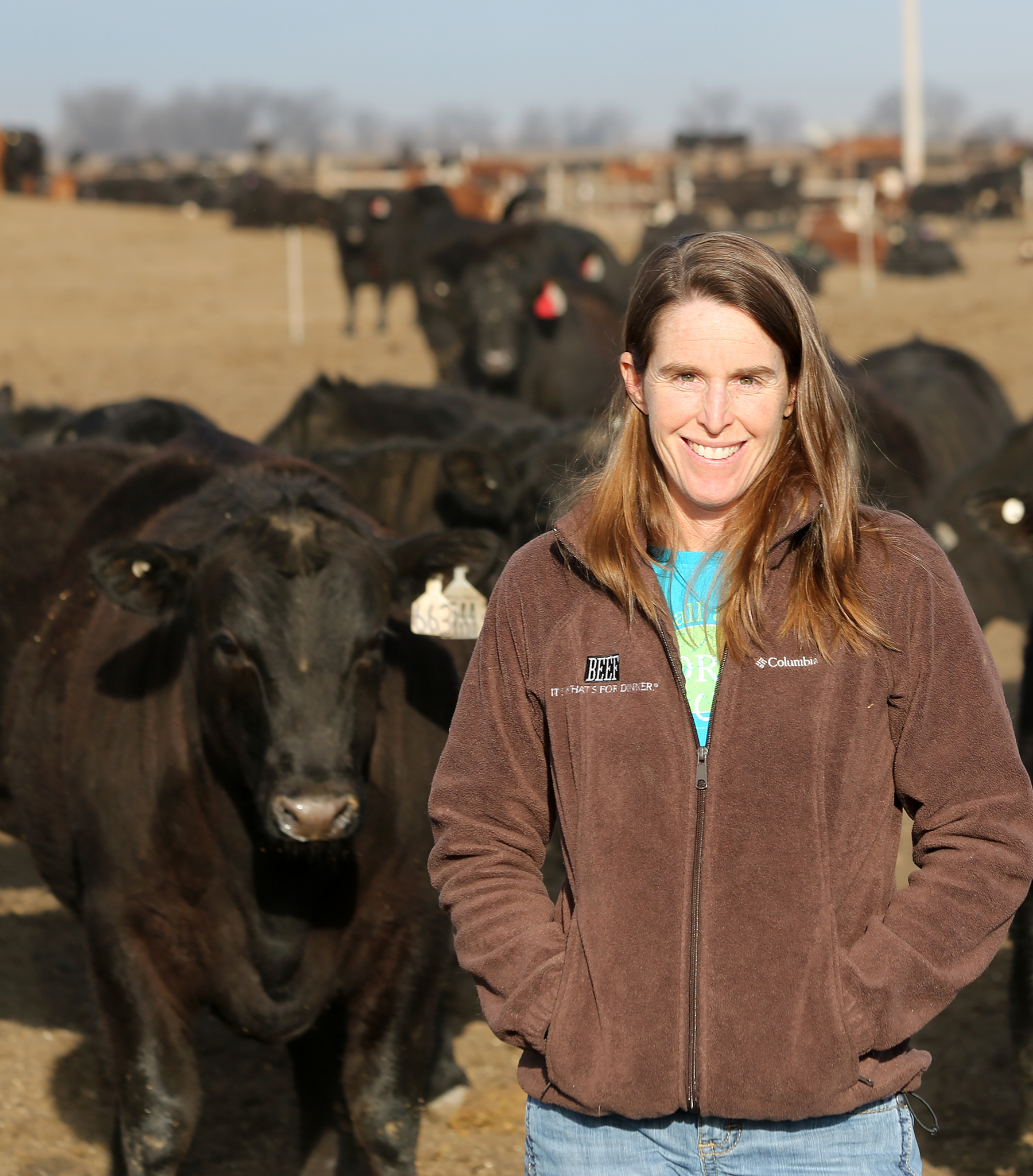
e after reading Teicholz’s book: “The diet-heart hypothesis (coined by a biologist Ancel Keys in the early 1960s) proclaimed that a low fat and high carbohydrate diet provided the basis for good health. Although not proved through clinical trials, the hypothesis gained support from the federal government and provided the basis for mainstream dietary advice during the ensuing decades.

“…The culture of the American diet has shifted dramatically. According to USDA, the consumption of grains (41 percent), vegetables (23 percent) and fruits (13 percent) rose significantly from 1970-2005 while red meat (-22 percent), milk (-33 percent) and eggs (-17 percent) fell dramatically. Overall carbohydrate intake for Americans rose with low fat starches and vegetable oil took the place of animal protein and fat in the diet. Animal protein lovers shifted from beef to chicken and many traded whole fat dairy for skim milk and margarine thereby forsaking nutrition density for lower saturated fat options,” Burkholder writes. “All of this occurred during a time in the United States when obesity rates more than doubled (15-32 percent), the prevalence of heart failure, cancer and stroke all increased and the rate of diabetes increased from less than 1 percent to 11 percent.”

Here are just some of the conclusions Teicholz highlights in “The Big Fat Surprise” after nearly a decade of research:

1. Causal associations between red meat consumption and heart disease are minimal.

2. The HDL (good cholesterol) is increased by the saturated fat found in animal protein.

3. Animal fat is nutrient dense, packing protein, energy and essential vitamins and minerals — plus helping the vitamins and minerals of other foods eaten together to be better absorbed by the human body.

4. There are no health studies to learn the effect on health of liquid vegetable oils. We do know that the process of solidifying vegetable oils creates the very unhealthy transfats. Butter and red meat do not contain these transfats.

5. Insulin levels are elevated by constant carb consumption, not by animal fat and protein. Furthermore, as insulin levels are raised, the body is less able to digest its own stored fat created by — you guessed it — carbs!

Our children have been and will apparently continue to be test subjects for nutrition GL kids-cowspolitics. The simple act of providing a nutritious school lunch will become even more
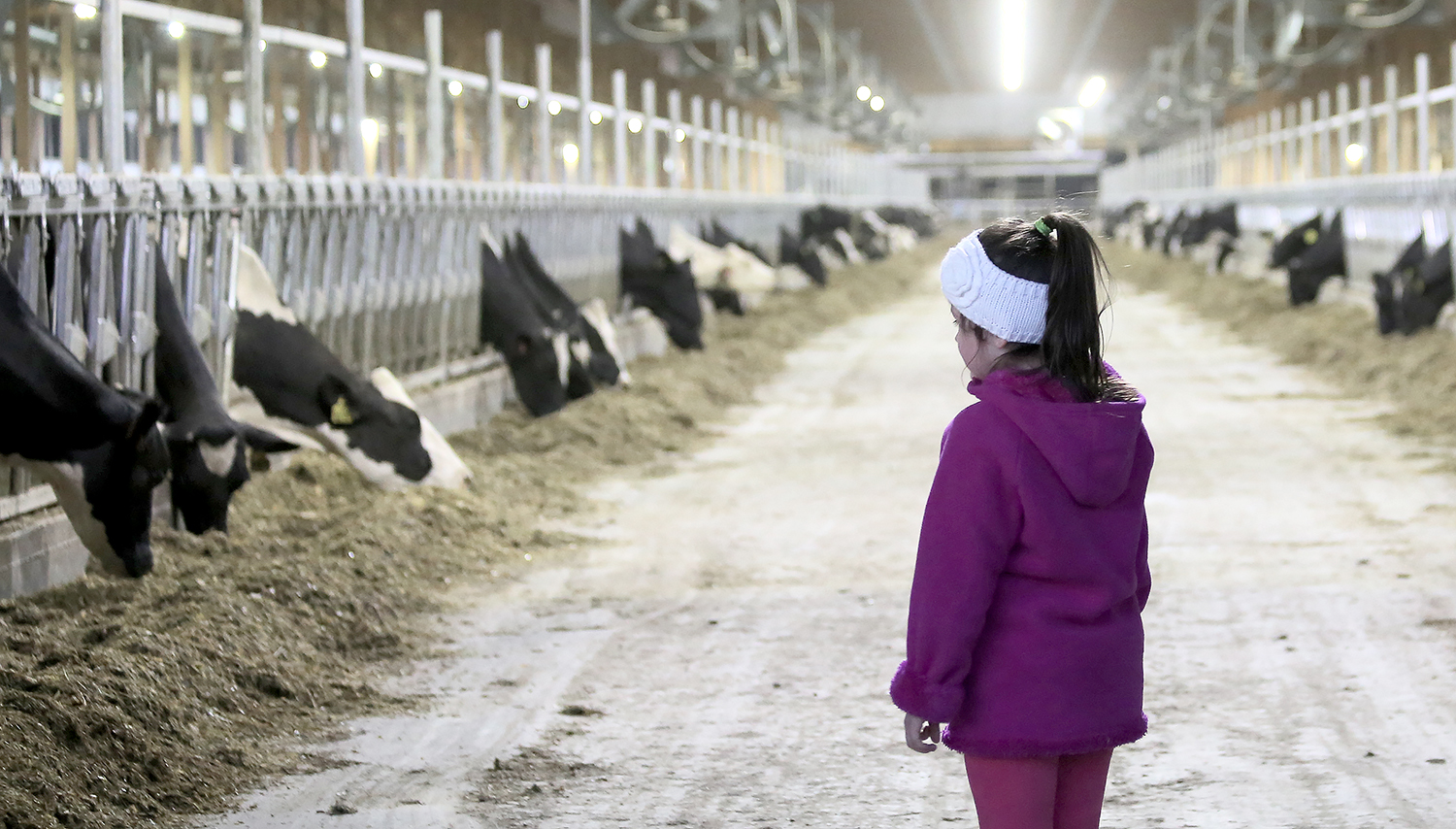
complicated if the Advisory Report is accepted and used by the U.S. Department of Health and Human Services and U.S. Department of Agriculture secretaries in the food programs they administer.

Published in the Federal Register (Vol. 80, No. 35) on Feb. 23, the public comment period was recently extended to May 8. After that, the secretaries will jointly release the official Dietary Guidelines for Americans 2015.

A quick perusal of comments already logged shows that two parts of the Report are garnering attention:

1. There is an overwhelming support for the recommendation to reduce the amount of added sugar in the diet. My only question is: What took them so long?

2. There is an overwhelming lack of support for the recommendation to reduce even more the role of saturated fats — red meat and whole dairy fat — in the diet.

Some children may forego the school lunch and pack a nutritious replacement. But what about the child in poverty? Their options are limited to taking what the federal government dishes out, literally.

To comment on proposed Dietary Guidelines by May 8, visit www.health.gov/dietaryguidelines/dga2015/comments/. It is easy to do electronically.


GROWING THE LAND: Kids and cattle caught in the crossfire 

Feb. 8, 2015  Hudson Valley Register Star

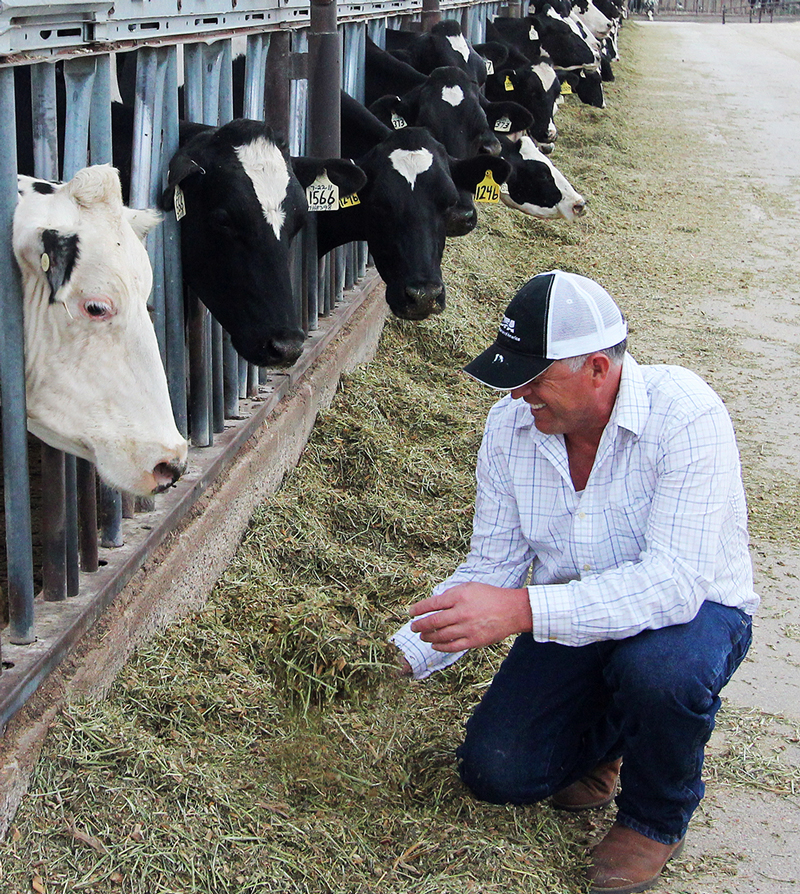
Kids and cattle are caught in the crossfire of nutrition politics, and it may get worse. GL 0263Two weeks ago we talked about the changes over the years in the federal Dietary Guidelines for Americans and their direct influence on the National School Lunch Prog
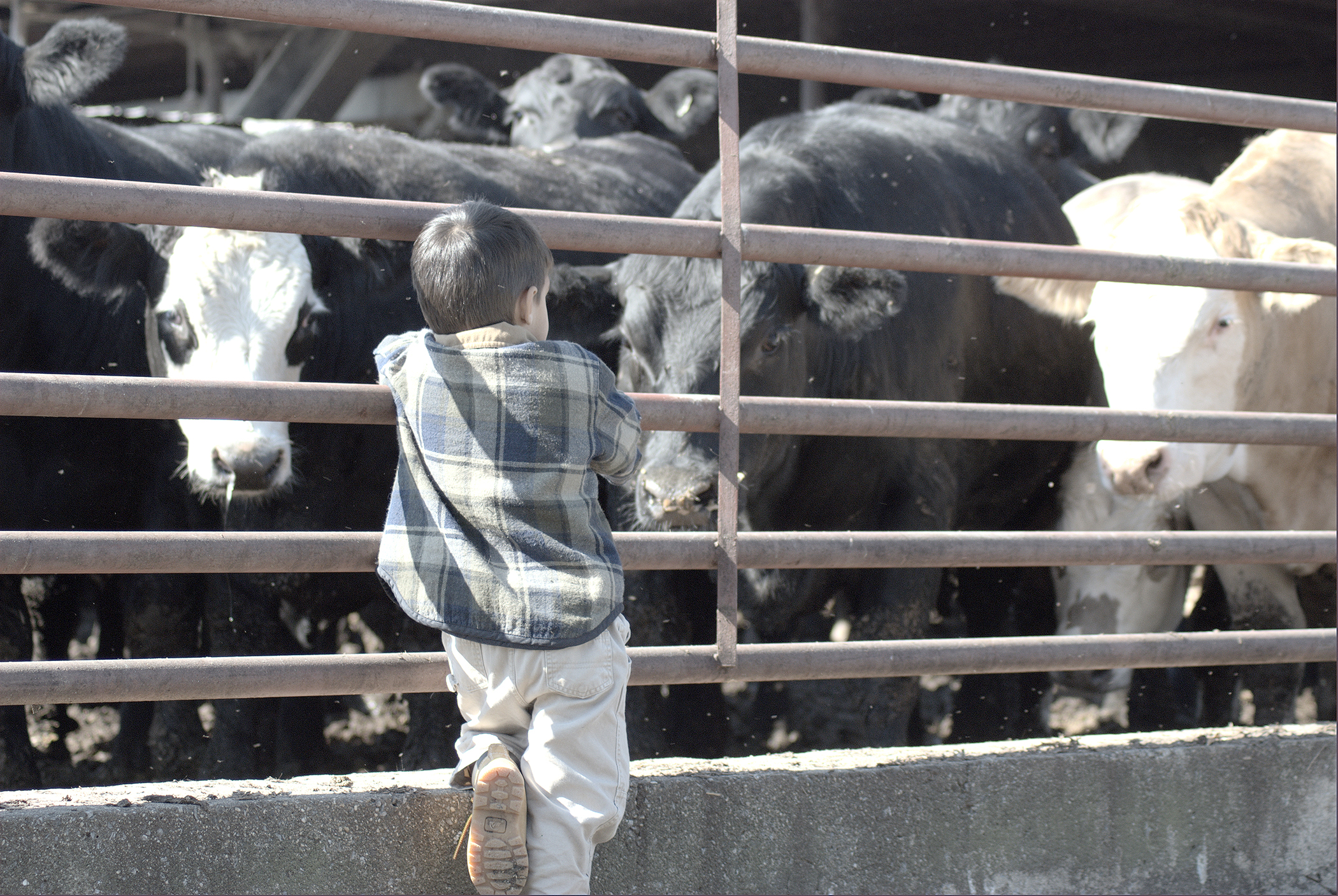
ram. This week we look at how the simple act of providing a nutritious school lunch could become even more complicated.

What I have gleaned from reader comments is a high level of frustration about the current status of the National School Lunch Program limiting the caloric intake and food choices of growing children. Now, the next twist in the nutrition-noodle may not even be nutrition-based.

The Department of Health and Human Services (HHS) is the deciding agency for new “Dietary Guidelines for Americans” expected to be released soon. The HHS Secretaries are deliberating the recent report from their Dietary Guidelines Advisory Committee, which held meetings for months.

When the new Guidelines are officially published in the Federal Register, a second round of comments will open. I’ll let you know when and how to comment when the time comes.

For now, let’s look at a few concerns with the committee’s report.

1) It is worth noting that back when we had a Food Pyramid, physical exercise was Boilermaker6929visually highlighted, where today it is notably absent from the MyPlate diagram.
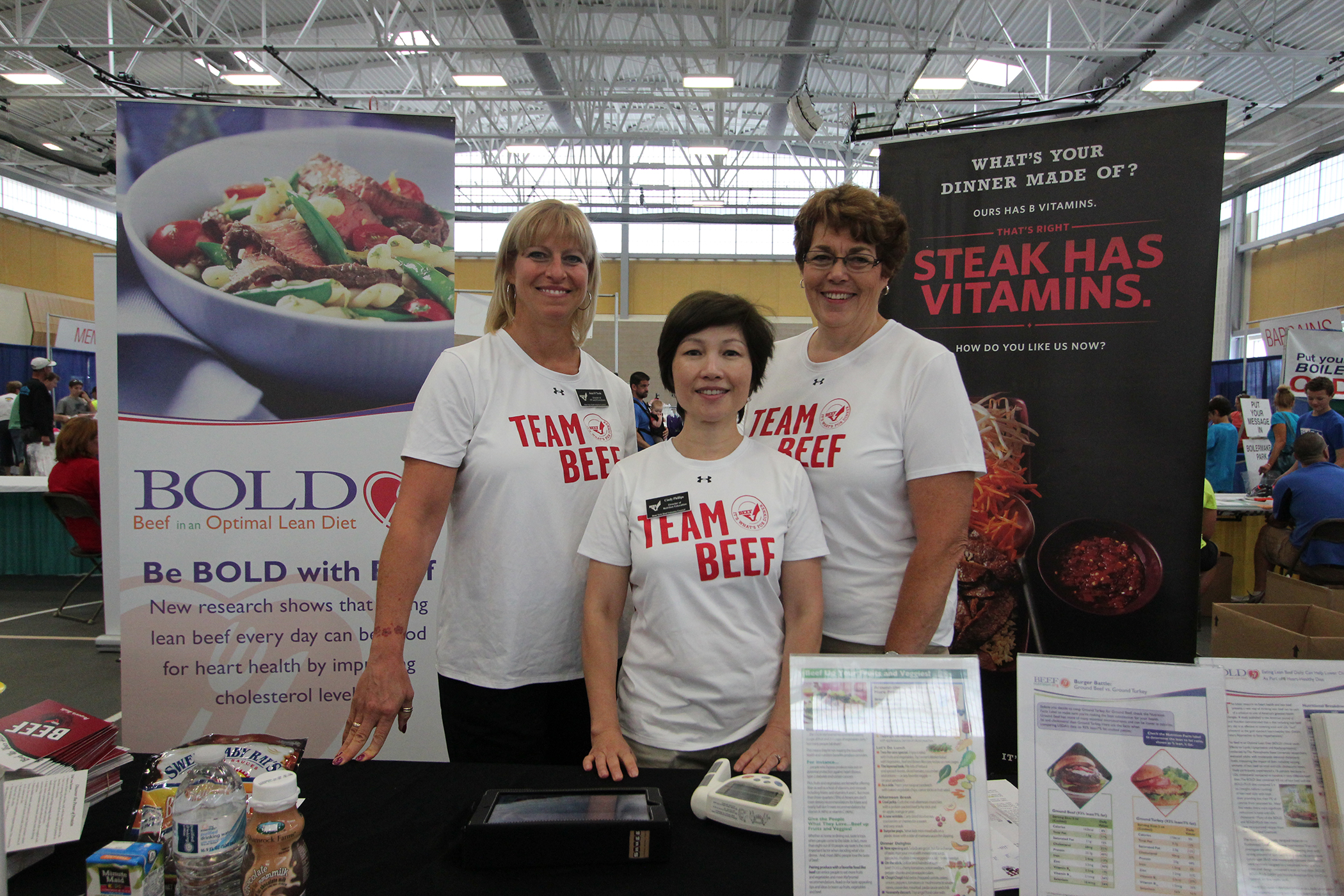
2) More troubling this time around, is the fact that the committee is not just focusing on new information about healthful eating, they have incorporated so-called “sustainability”
factors or environmental impacts of various foods — namely lean meats. This opens a whole can of worms that — quite frankly — have nothing to do with nutrition!

3) Furthermore, some of the science the committee used to come up with thewWill-Feed3983 idea of eliminating lean meat from its so-called “healthy eating pattern” is quite controversial and involves a United Nations study that has since been refuted.That study had suggested meat production contributes more to climate change than transportation.
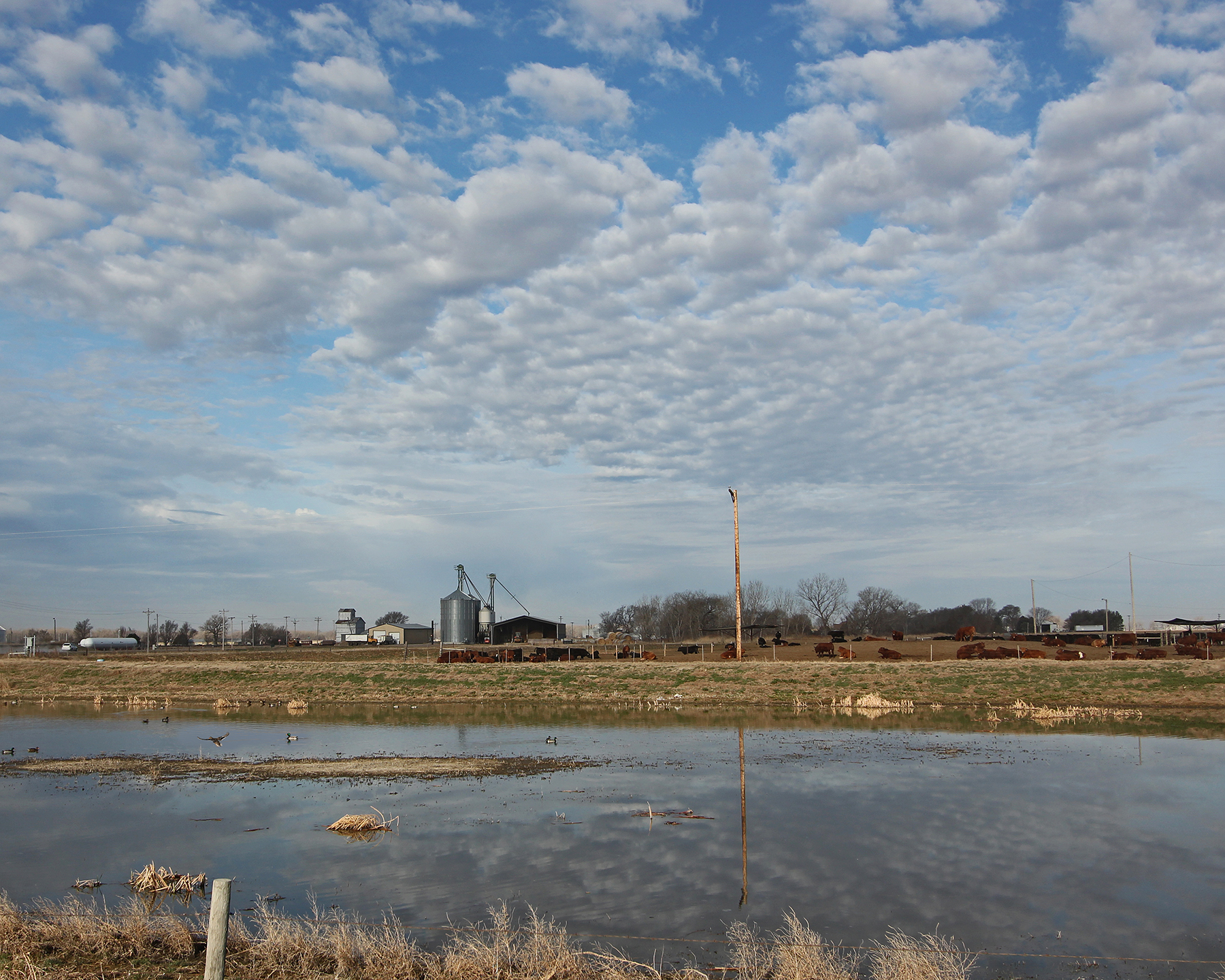
Scientists have come forward in droves with counter-studies showing the greatly reduced carbon footprint of agriculture, particularly animal agriculture. The whole lifecycle of beef and dairy cattle needs to be considered when formulating environmental impacts.

While the dietary gurus in Washington debate the merits of meat and whole-fat milk, let’s look at this term “sustainability” and what dairy and livestock producers actually care about and accomplish for their land, animals — and us!

Regarding potential replacement of a “healthy eating pattern” in favor of a “sustainable eating pattern,” there are several concerns.

1. If red meat and full-fat dairy are not considered a component in a healthy eating pattern, students will increasingly see this nutrient dense protein source removed from their diets and replaced with foods that are less nutrient dense.

2. Since these guidelines affect the most nutritionally at-risk children through their effects on the school lunch program, WIC and food stamps, the impact of the dietary guidelines would fall mostly on those children who are already on the hunger-side of the nutrition equation.

3. How can the committee recommend a “sustainable dietary pattern” when mothers, doctors, scientists, and all manner of experts can’t even agree on what “sustainable” actually means? Let’s stick to nutrition. Defining that is a tall-enough order.

Scientist, cancer survivor and new mom Dr. Jude Capper covers this topic best. She points out that, “With the world population officially hitting 7 billion people earlier this year and projected to reach 9.5 billion by 2050, farmers and ranchers must continue to find ways to sustainably feed a growing world population using fewer natural resources.”

She notes the many improvements to the way cattle are raised and fed in the United States between 1977 and 2007 that have yielded 13 percent more total beef from 30 percent fewer animals. More beef from fewer animals maximizes resources like land and water while providing essential nutrients for the human diet. U.S. cattlemen raise 20 percent of the world’s beef with 7 percent of the world’s cattle.

Capper’s research in the Journal of Animal Science shows that beef’s environmental footprint is shrinking. Each pound of beef raised in 2007 (compared to 1977) used 19 percent less feed; 33 percent less land; 12 percent less water; and 9 percent less fossil fuel energy. Significant gains have been made in the seven years since the data was collected for this report.IMG_2657
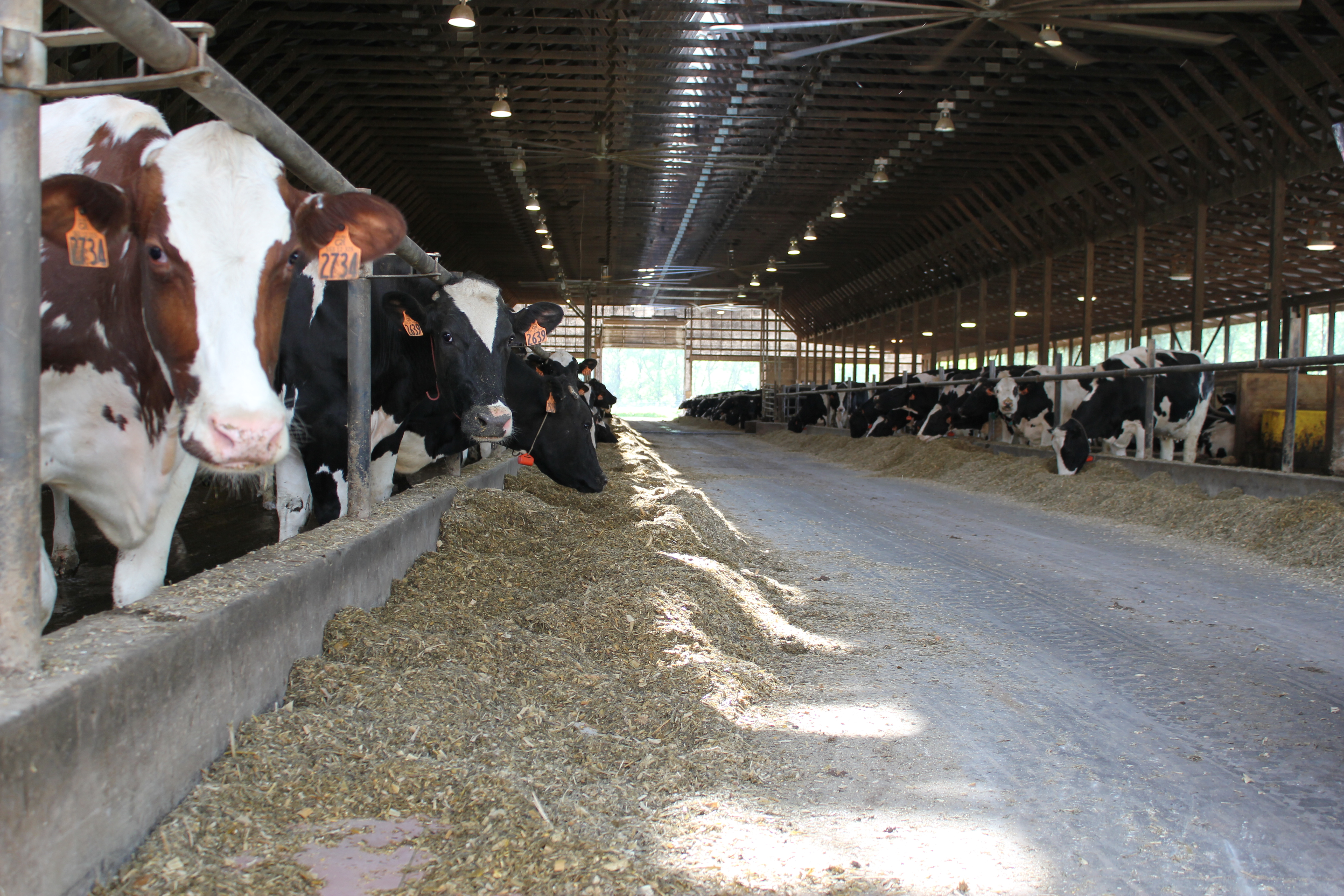
What is discouraging to cattle producers — be they beef or dairy — is the lack of understanding for how cattle are raised and fed. They utilize feedstuffs we humans cannot digest and turn that into meat and milk, which are nutrient-dense sources of proteins, minerals and vitamins.

Some of their lifecycle is spent on grass or eating a mostly grass / hay diet and some of their lifecycle is spent eating a more concentrated diet at certain stages. Feedlot beef wky3327
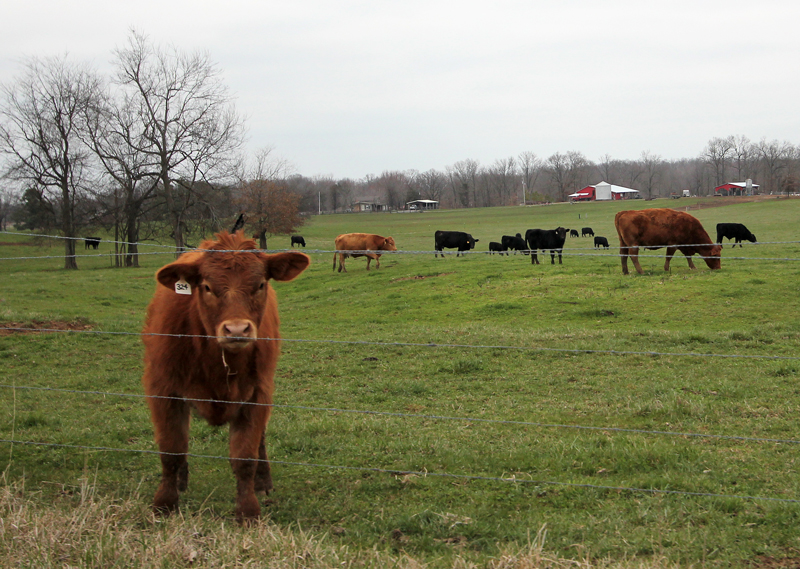
cattle start out as calves on grass. Even in the feedlot, today’s rations — especially in the east and near food processing centers — utilize bakery waste, over cooked potato chips, wilted produce and the like that would otherwise end up in a landfill. Incorporated into cattle diets along with traditional feedstuffs, these foods provide protein and energy for the animals without sole reliance on corn. In addition, when corn is fed, the whole plant is used.

Farmers are thrifty. They don’t like to waste a thing. They understand the balance of working with nature because it is not just the vocation, but also the very life they have chosen working with their animals and the land.

I can’t think of any other reason why someone would work this hard and put their entire livelihood and all of their capital at risk to the swings of the marketplace other than they are passionate about producing food and using science and ingenuity to work with

Mother Nature in preserving a sustainable balance for all of God’s creatures — the 2-legged and the 4-legged.

Send me your questions and look for part three when the official new guidelines are posted in the Federal Register for public comment. Email agrite@ptd.net.10256404_10204082794934283_4627952695489572277_o

GROWING THE LAND: How did school lunch get so complicated        

Jan. 27, 2015 Hudson Valley Register-Star

Are you satisfied with your school lunches? Do your children eat them? Do they come home so hungry they binge out of the snack drawer?

The National School Lunch Program and the Dietary Guidelines for Americans are lightning rods for the latest nutritional ideas — none of which seem to be working particularly well because we’ve gotten so far from the basics, and yet both childhood hunger and childhood obesity are on the rise.

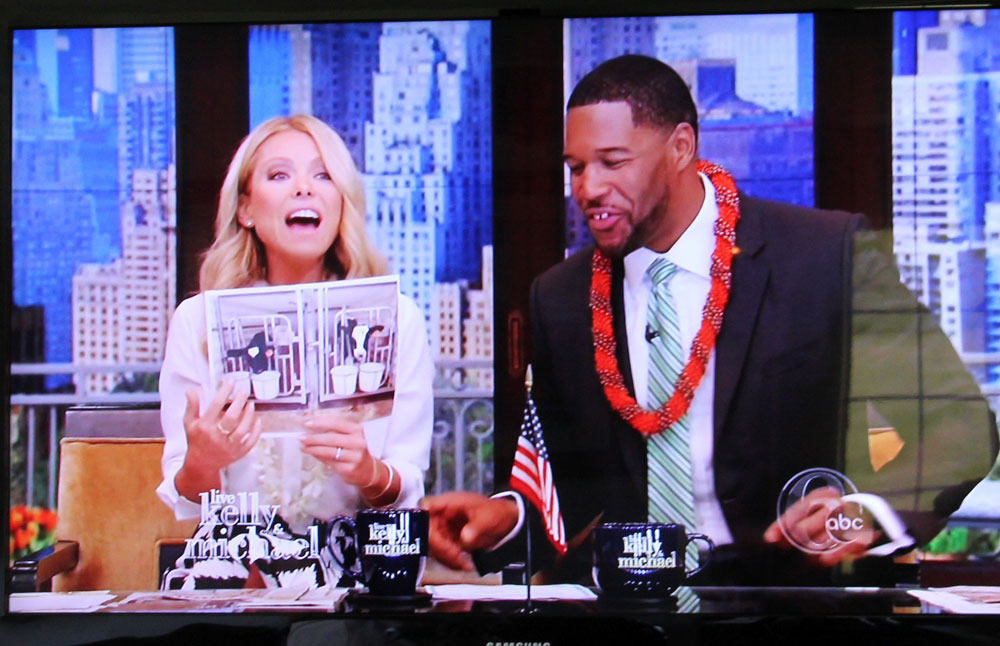
Now it seems there will be another twist in the nutrition-noodle. Recent food studies and “The Big Fat Surprise,” a best seller by Nina Teicholz, reveals the truth about the healthfulness of natural fats in whole milk, butter, beef, ice cream, etc. Teicholz was profiled on “Live! with Kelly and Michael” last week, where she described the “nasty nutrition politics” that continually shape these programs.

In response to these animal-protein-friendly nutritional revelations, the environmental webfeed9297nail-biters (under the influence of refuted studies) are “concerned” about what they see as the effect of dairy and beef production on climate change. According to news reports last week, these groups would like the government to take their version of the facts and tweak new-again the nutrition guidelines. This means yet another lunchroom brawl will soon be coming to a school cafeteria near you where the already burdensome and counterproductive rules for lunch menu planning have lunch ladies and foodservice directors — not to mention kids and parents — tearing their hair out.
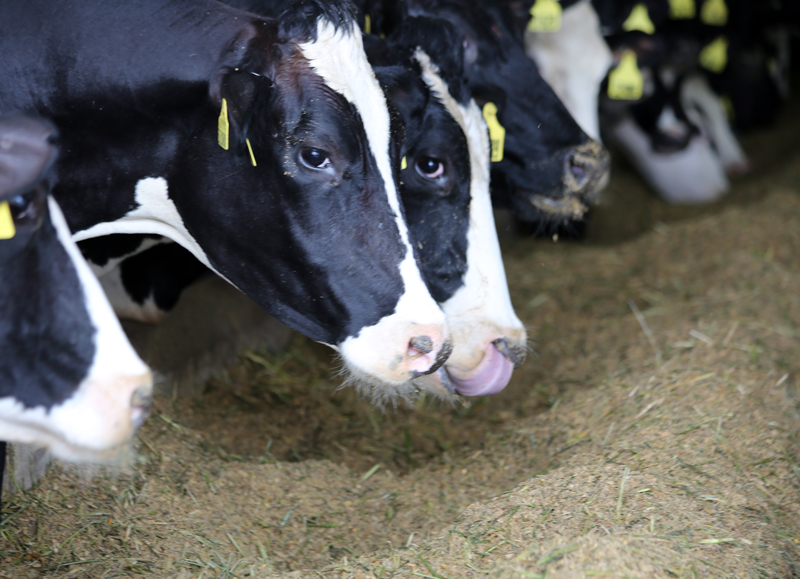
How did we let serving a decent healthy meal to schoolchildren become so complicated? Why don’t schools take their cafeterias back? One reason is the federal government ties its financial support for literacy programs (extra teachers and tutors) in schools to the number of students enrolled in the free and reduced lunch program as monitored by — you guessed it — the federal government. Oh what a complex web we weave when all we set out to do is healthfully eat!

The government’s interest in the school lunch program got its first foothold during World War II when more women joined the workforce as part of the war effort. The emphasis at that time was to provide a hot meal with plenty of protein, calories for energy and the healthy fat necessary for brain development and satiety — a fancy word for no hunger pains during the end of the day math class!

My generation grew up with the “eat all things in moderation” mantra. Lunches were a bit repetitive, but they were good, honest meals and we ate them. We learned about the four food groups, and we ran and played and worked outside ‘til dusk.

My children’s generation grew up in the “food pyramid” days, spelling out the servings deal differently. Then, in the 1990s, the school lunch program went through a major metamorphosis that paralleled the “low fat” offerings in nearly every product category at the supermarket. What the 90s gave us was less fat and more carbs, and a lot of guilt. I would say those three things are actually ingredients for obesity.

By the late 1990s, the government came out with the nutrient standards for menu planning, and school districts across the country bought the software and began to submit their menus for approval. I was editor of a farm publication at the time and served as an elected director on a local school board. I interviewed not only our own district’s foodservice director but others as well, and I visited one of the schools that had piloted the program for USDA.

“Schoolchildren were being relegated to the equivalent of a heart patient’s diet,” explained the foodservice director who was piloting the program in 1997. The calorie thresholds were unchanged, but the government began regulating the percentage of those calories that could come from fat. There were no regulations yet for sugar or carbohydrates. And yes, as always, the goal was to get kids to eat more veggies and fruits and fiber. We might take a lesson from France in that department. They require lunches to be made from fresh ingredients, but they aren’t afraid to deep-fry some broccoli or soak a healthy vegetable dish in yummy cheese — real, of course.

The new fat rules forced foodservice folks to put imitation cheese product on their once delicious pizza. Ground turkey replaced beef in spaghetti and tacos. Rolls were served without butter. All milk was reduced to nonfat or 1 percent so the amount of chocolate milk consumed increased. (Whole milk is much more flavorful than nonfat, and it is just 3.25 to 3.5 percent fat!

As fat was reduced, so were calories and flavor. To get back up to the number of calories required, “we just served a bigger brownie, for example,” that foodservice director recounted. Of course, they used applesauce to replace the shortening in making such desserts. But still, no requirement on sugar and carbs.

“Two elements give food flavor: fats and sugars. When you pull one out, chances are the other is added,” the wise foodservice director observed. Whether natural or added, sugars and fats provide flavor, but what most people don’t think about is: The fat in real foods — such as beef and butter and cheese — is accompanied by a nutrient dense protein source that naturally supplies vitamins and minerals and helps kids feel satiated, not hungry or hyper, so they can concentrate and learn. Healthy fats are known to be good for brain development.

Fast forward to the decade of the 2010’s. More tinkering! The food pyramid became the plate showing portions of different food types, and we are now in a time when school menus are regulated in the number of calories that can be served using arbitrary, across the board calculations.

Caught in the crossfire are kids and cattle. We’ll continue this topic in the next edition of “Growing the Land,” so send me your questions about nutrition standards, new information on healthy fats, school lunch programs, and the real-deal on the carbon footprint and environmental contributions of today’s dairy and beef cattle. Email agrite@ptd.net.
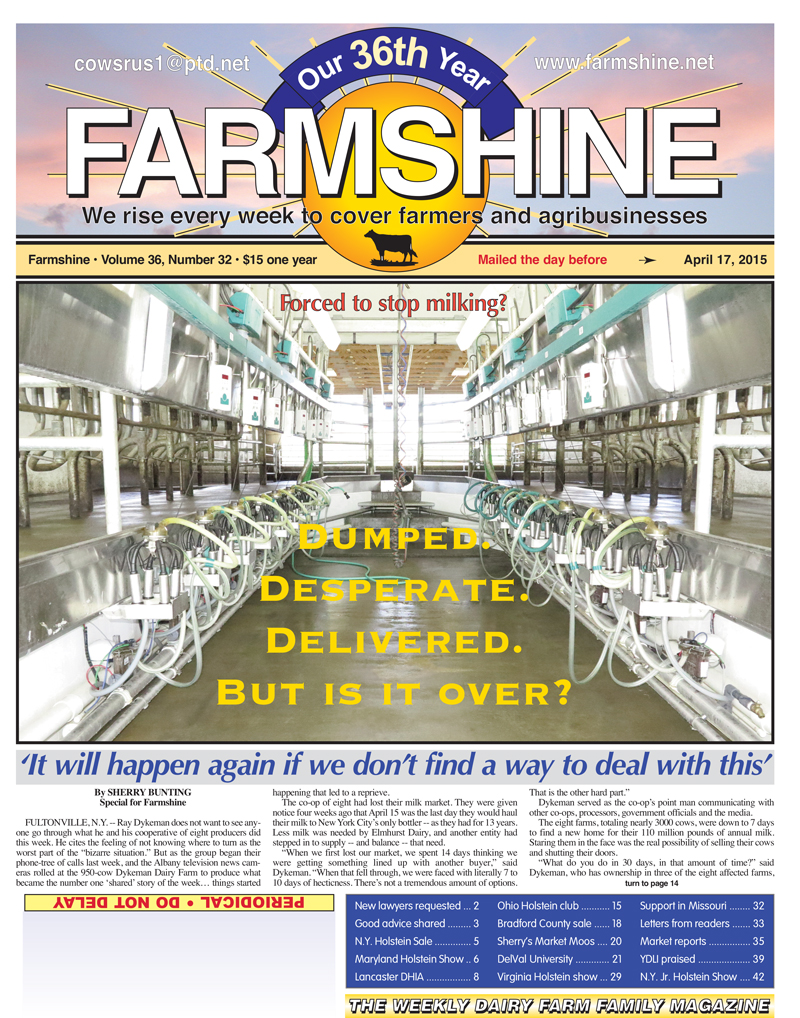
Dumped. Desperate. Delivered. But is it over?

‘It will happen again if we don’t find a way to deal with this.’

By Sherry Bunting, Farmshine, April 17, 2015 Cover-041715

FULTONVILLE, N.Y. — Ray Dykeman does not want to see anyone go through what he and his cooperative of 8 producers did this week. He cites the feeling of not knowing where to turn as the worst part of the “bizarre situation.” But as the group began their phone-tree of calls last week, and the Albany television news cameras rolled at the 950-cow Dykeman Dairy Farm to produce what became the number one ‘shared’ story of the week… things started happening that led to a reprieve.

The co-op of 8 had lost their milk market. They were given notice 4 weeks ago that April 15 was the last day they would haul their milk to New York City’s only bottler — as they had for 13 years. Less milk was needed by Elmhurst Dairy, and another entity had stepped in to supply — and balance — that need.

“When we first lost our market, we spent 14 days thinking we were getting something lined up with another buyer,” said Dykeman. “When that fell through, we were faced with literally 7 to 10 days of hecticness. There’s not a tremendous amount of options. That is the other hard part.”

Dykeman served as the co-op’s point man communicating with other co-ops, processors, government officials and the media.

The 8 farms, totaling near 3000 cows, were down to 7 days to find a new home for their 110 million pounds of annual milk. Staring them in the face was the real possibility of selling their cows and shutting their doors.

“What do you do in 30 days, in that amount of time?” said Dykeman, who has ownership in 3 of the 8 affected farms, including the 500-cow Envision Dairy, Amsterdam, owned by a consortium of 23 people with expertise in different aspects of dairying and forage, along with young dairy startups from Cornell. Envision Dairy was accepted by another co-op 10 days before cutoff. That lightened the load a bit, but the rest of the milk was still a long way from home.

“Even today, our 42 employees are looking at me saying what are we doing Thursday?” said Dykeman in a Farmshine phone interview late Tuesday afternoon. “We are 24 hours away from having no home for our milk, and I still am not sure how to answer them.”

Hope and support…

But he had hope. Fellow dairy producers and community members were calling and emailing. People were reaching out. He had had countless meetings and secured two buyers to each take a little of the milk. On Tuesday afternoon, he was waiting for an answer from a third processor considering taking half.

By late that evening, that contract was signed for a 3-month reprieve in time to make the nightly television news.

“Trucking our milk to 3 different places will be new for us, but we are able to use the same hauler and we are accustomed to high trucking costs — having hauled milk into New York City for 13 years — so we are very happy,” said Dykeman with an audible sigh of relief.

“I hope, going forward, we don’t let this experience go by the wayside because I honestly believe if we do not come up with a plan for this area, it will happen again and be potentially devastating,” he quickly added. “Just look at the investment farmers have. All that we have put at risk.

“I would much rather have someone say to me: ‘We really need you to go out of business. You are not needed in New York anymore, and you have a year to get out,’ than to be told all of a sudden there’s no place to send my milk,” he said.

Dykeman stressed that they have “no animosity toward any of the companies.” This is business to business, they realize. But what amazed them was the amount of public support.

“Everyone worked so hard to find a home for this milk: Our representatives and senators, the Governor’s office, the New York Ag Commissioner, other co-ops and processors. Local people wanted to take the local milk. It was a very difficult situation in which to find a solution, but the people we have dealt with in this were very helpful.”

Dykeman could not say enough about Sen. Chuck Schumer. “He was kind enough without a scheduled meeting to meet with a couple farmers while in Johnstown for another reason,” he explained. “He and the Commissioner both called this morning to express their relief in how things turned out.”

No easy solutions…

The 3-month reprieve gives the co-op of now 7 farms the breathing time to secure an annual contract. And Dykeman feels certain there will be more discussion in the industry on how to handle these things better in the future.

“Farmers generally want to go back to being farmers,” Dykeman shared. “This is not what we do. This is one of the reasons we farm. We grew up on farms and this is what we want to do — not doing the kinds of things I’ve been doing for the past few weeks.”

Dykeman said the silver lining is “seeing your community respond and be very helpful. I can’t even calculate the number of emails and phone calls I’ve had. In fact, I’ve had 5 calls try to buzz through while on the phone with you today,” he said Tuesday. “People want to help. But there are no easy solutions and it will happen again if we don’t find a way to deal with this.”

One of the ideas being tossed around is to pair extra milk with efforts to supply food banks, or to ask the government how to use the “demand buying” in the Farm Bill to alleviate the supply pressure coming to roost on a region despite the fact that the “national average milk margin” is not even close yet to triggering the national government purchases for feeding programs.

Players and perspective…

In contacting the New York Department of Ag and Markets on their role and perspective, emailed questions were requested, and Dave Bullard, assistant public information officer provided this statement in response: “Ag and Markets is working with local elected officials, including Congressman Tonko and Assemblyman Santabarbara, to assist the farmers in finding alternative processors and manufacturers for the cooperative.  There is currently a surplus of milk due to strong production combined with lower sales as a result of reduced exports and a few other factors.  This supply/demand imbalance has created a very challenging situation for all producers and processors.”

Similarly, a request for an interview with DFA was met with a request for emailed questions. In asking what DFA would like to report in terms of taking on one of the farms in the Pennsylvania situation a few weeks ago and the New York situation currently while also gaining additional outlet for member milk in the process, the emailed response from DFA’s spokesperson was, that “Every milk marketing organization handles regional market dynamics differently.  One of the advantages of our cooperative system is that we work diligently to provide a secure market for our members’ milk.  Our goal is to market our members’ milk in the most efficient and cost-effective way as possible.  As we look to the future, the Northeast dairy industry is in an excellent position because of our proximity to major population hubs and our access to natural resources.”

Asked to define some of the biggest reasons for the oversupply of milk in the Northeast given that the Northeast has not grown by as wide a margin as the national average, DFA’s emailed response was: “For most of 2014 and into 2015, the Northeast marketplace has been in a challenging milk supply situation. Overall a generally weak demand and increased milk supply resulted in the need for additional milk movements around and beyond the Northeast. With plant closures (Farmland Dairies) and an overall weakening in demand from Class I and Class II customers, more milk than normal was placed in balancing facilities throughout our system and outside our geography. In the Northeast the loss of capacity in conjunction with the increase in supply resulted in the extra milk movements.”

Welcome to the squeeze chute…

When reviewing the larger decline in Northeast Class I utilizations versus the decline nationally — and seeing the effect as Eastern mailbox milk prices fall further behind their respective all-milk price while national average mailbox milk prices have atypically become higher than the all-milk price — it is obvious that the Northeast market is the new squeeze-chute when milk supplies nationally burgeon.

The yogurt-magnet that strengthened the confidence of Northeast dairy farmers over the past few years has led to small but steady increases in production, and then in 2014, New York increased by more than 2% to re-take from Idaho its former position as the #3 milk-producing state. Meanwhile the Northeast milkshed, as a whole, was up just under 2% in 2014 compared with the national increase of 2.7%, and has backed off in early 2015.

No reason to sour on yogurt…

Yogurt production is one of the primary fall-guys for the current supply/demand situation reversal of fortunes in the Northeast. But further analysis is less clear on that pointed finger. Yogurt production was 741 million pounds in New York State in 2013 and 692 million pounds in 2012. The 2014 figures for the state will not be available until late May. The 2012 and 2013 totals, however, show New York yogurt production used around 12% of New York’s growing milk supply in both years as both the yogurt and the milk production grew simultaneously.

On a national basis, however, the total U.S. yogurt production figures are available at this time, and yogurt production grew from 4.42 billion pounds nationally in 2012 to 4.65 bil. lbs in 2013 to 4.74 bil. lbs. in 2014.

Furthermore, the April 2 Dairy Products report indicated that nationwide plain and flavored fresh (not frozen) yogurt production was up in February by 7.2% over year ago and nearly 12% higher than for January.

Context and common denominators…

The yogurt industry is known to be highly secretive and competitive.

Interestingly, 2009 is the last year in which the USDA reported monthly yogurt production on a state-by-state basis. Since 2010, those monthly yogurt production figures are only available on a national basis. This reporting change coincides with the timing of when yogurt production began to rise in New York State; so now, when it counts, there are no free and public records of production by state until 6 months after a year ends. It’s not that way for other substantial dairy products, and prior to 2010, those figures were available monthly without having to pay hundreds of dollars for an insider yogurt market publication to read insider industry estimates and trends.

In April’s central New York situation, like western Pennsylvania in February, rumors fly about reasons for farms to be cut from the shipping rolls of processors and small co-ops. Some folks wonder about the milk quality of those producers, or they may believe producers were expecting to be paid more money. But that’s the thing with rumors, there is but a shred of quasi-truth.

While some producers may find themselves in this situation through nitpicking on an inspection report or somatic cell counts that are a little too far north of 200,000, others may find themselves in this situation for merely asking a higher pay price when milk is short, but then staying with their processor on a handshake without the requested pay increase during the short-milk times only to find themselves on the other side of that equation — losing their processor when milk becomes long.

The bottom line in talking to various folks who’ve been through this in Pennsylvania and New York, the common denominators are: 1) the lack of warning, 2) the inability to prepare or negotiate or help problem-solve in advance of being flatly cut off, and 3) the loss being driven, at least in part, by the independents and small co-ops’ lack of reliable access to balancing assets — either owned or simply a standby buyer that will take a little milk for cheese or butter or yogurt or powder as producers balance the diminished and diluted Class I demand.

Looking ahead…

“Everyone in the industry was helpful to us, and we want to continue to work with them on solutions for the future,” said Dykeman reflectively.

Running in the background is some loss of confidence as producers deal with permanent and temporary loss of markets. One of the producers who survived the western Pennsylvania cutoff in March said in a phone interview this week, “crazy things are happening and people are being let go. Everyone is afraid to invest. Some of us already invested in our operations and are on our toes about losing our markets, and then we go to a local meeting where the speaker from Elanco tells us we need to increase production with rbST even though we are clearly in a region where more processors are requiring affidavits not to use it and people are losing their markets because of too much milk.”

At the end of the day, from the outside looking in, it seems the good beef price and current status of processors wanting to label products rbST-free are two strong signals folks could pay attention to in stabilizing demand. It’s also important to gauge the market direction in planning phases of growth. That growth is necessary here to sustain the dairy infrastructure and make farms that are not quite as surrounded by other farms attractive as a pickup. However, the two market loss situations in Pennsylvania and New York illustrate vividly that size does not matter.

As long as the Federal Orders put all the marbles of high value, pooling and provisions into Class I while that is the milk class that is dwindling in sales, size won’t matter. When milk is long, the milk guns will continue to point East and all size farms are vulnerable in the business of dealing with the push of supply through the squeeze chute.

Look for more on the Northeast market situation in next week’s Farmshine.

-30-

PENNSYLVANIA – Feb. 2015

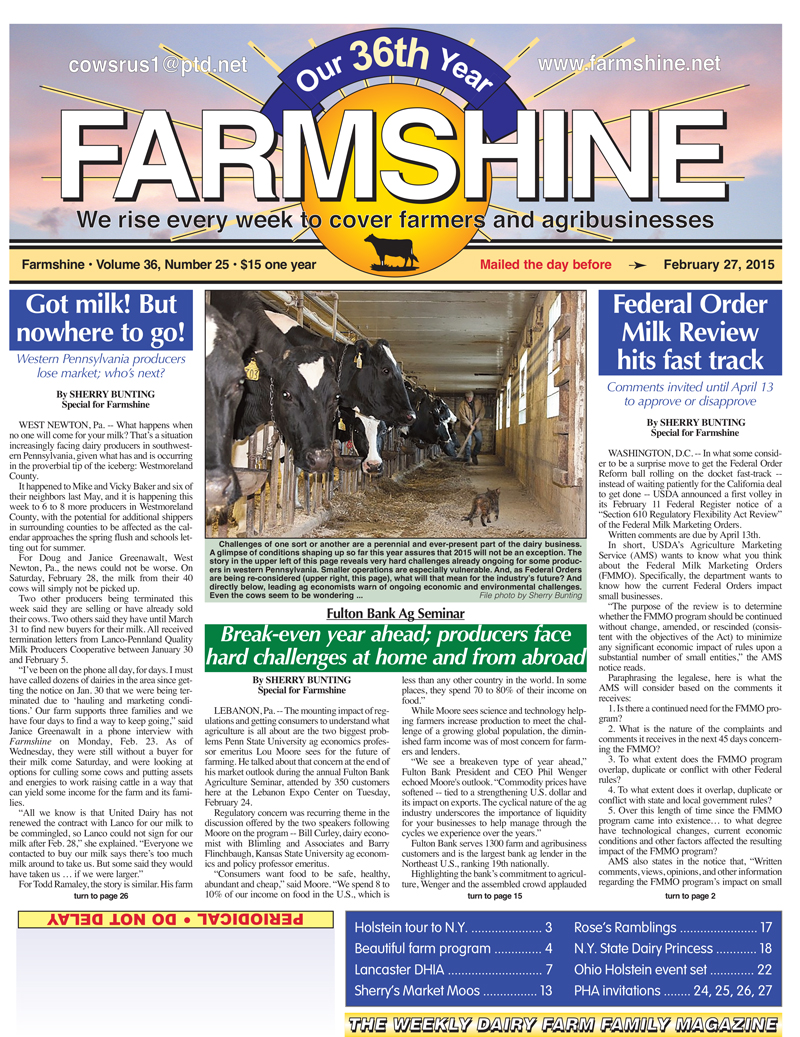
Got Milk! But nowhere to go…Cover-022715

By Sherry Bunting, Farmshine, Feb. 27, 2015

WEST NEWTON, Pa. — What happens when no one will come for your milk? That’s a situation increasingly facing dairy producers in southwest Pennsylvania, given what has and is occurring in the proverbial tip of the iceberg: Westmoreland County.

It happened to Mike and Vicky Baker and six of their neighbors last May, and it is happening this week to 6 to 8 more producers in Westmoreland County, with the potential for additional shippers in surrounding counties to be affected as the calendar approaches the spring flush and schools letting out for summer.

For Doug and Janice Greenawalt, West Newton, Pa., the news could not be worse. On Saturday, February 28, the milk from their 40 cows will simply not be picked up.

Two other producers being terminated this week said they are selling or have already sold their cows. Two others said they have until March 31 to find new buyers for their milk. All received termination letters from Lanco-Pennland Quality Milk Producers Cooperative between January 30 and February 5.

“I’ve been on the phone all day, for days. I must have called dozens of dairies in the area since getting the notice on Jan. 30 that we were being terminated due to ‘hauling and marketing conditions.’ Our farm supports 3 families and we have 4 days to find a way to keep going,” said Janice Greenawalt in a phone interview with Farmshine Monday. As of Wednesday, they were still without a buyer for their milk come Saturday, and were looking at options for culling some cows and putting assets and energies to work raising cattle in a way that can yield some income for the farm and its families.

“All we know is that United Dairy has not renewed the contract with Lanco for our milk to be commingled, so Lanco could not sign for our milk after Feb. 28,” she explained. “Everyone we contacted to buy our milk says there’s too much milk around to take us. But some said they would have taken us … if we were larger.”

For Todd Ramaley, the story is similar. His farm is almost into Indiana County and about a 35 minutes’ drive (in a car not a milk truck) from the nearest Lanco shipper still shipping to Lanco. As of Tuesday, he said DFA was still looking at the possibility of taking the milk from his 40 cows “because it is really clean milk with SCC of 150,000.”

If his milk went to DFA, it would actually still go, physically, to the United Dairy, Inc. plant in Uniontown, several sources indicated, because United has a “swapping deal” with DFA, under which some of United’s milk goes to DFA’s plant in New Wilmington and some of DFA’s milk goes to United’s Uniontown plant.

When asked about the letters sent to six of its producers in Pennsylvania’s southwest corner, Lanco’s director of dairy operations Robert Morris explained how originally all the milk hauled by that hauler served Saputo Cheese in Hancock, Maryland.

“That plant closed in July,” he said. “But before that, those shippers ended up in our world when Saputo bought Jefferson Cheese. At that time, we were able to work an arrangement with United in Uniontown and hauler Wayne Harmon to commingle that milk on United’s independent routes. They were in charge of the Uniontown, Pa., Martins Ferry, Ohio and Charleston, West Virginia plants and would commingle some of our milk on the nearest truck.”

Morris noted the total milk of their six terminated farms is “roughly 250 to 275,000 pounds a month.”

According to Morris, United had apprised Lanco about losing a sizeable bottling contract through its system in January, and before cutting its own producers, would first stop receiving milk from outside sources. United set Feb. 28 as the last day they could commingle that milk. Lanco also received word through the St. Louis, Missouri milk broker that ran the commingling that United’s sizeable loss of sales would prohibit further commingling of Lanco milk in that region on their trucks.

Morris noted that Lanco is “still taking on new producers in areas where we have haulers close to our customer base,” and he noted the six producers they’ve let go are “small farms and out of our orbit, especially since Saputo closed the Hancock plant in July.

“Those farms were never charged the real cost of hauling their milk because United had picked up the trucking subsidy,” Morris stated. “With us losing the ability to commingle that milk, there is no way for us to haul it, or any market for us to send it to, where the hauling doesn’t eat up all the income.”

Requests from the affected producers to find a way to haul their milk for Lanco were denied.

Morris further explained that their milk from south of Williamsport, including Cambria County, Indiana County and Somerset County as well as Garrett County, Maryland — that had all flowed to Saputo in Hancock — is now going East to the Land O’Lakes plant in Carlisle. Some of it goes to Dairy Maid in Frederick, Md., and to HP Hood in Winchester, Va.

In areas where Lanco has hauling, they do commingle with the Maryland/Virginia co-op, but these fringe areas — like Westmoreland County — are an issue now without the Saputo cheese plant and considering the cut in volume needed by United at its Uniontown plant. Both Lanco and Maryland/Virginia have milk into Somerset County, plus Maryland/Virginia has milk in the Sugarcreek, Ohio region. The producers affected by the latest termination fall into a void — a pocket of milk between two higher-density dairy areas.

“We simply had too much milk at the Uniontown plant,” said Tom McCombs, milk procurement manager for United. “We had to cut back on the co-op milk, so we gave Lanco the notice.”

When probed further about the loss of Class I milk contracts, McCombs said that what United actually lost was its volume of sales that Save-A-Lot trucks would pick up at its Uniontown plant for their Pennsylvania warehouse “just down the road.”

“They did some redistricting with their stores, and that milk volume is now going to other warehouses,” he noted. This would include the warehouses served by United’s bottling plants in Ohio and West Virginia.

McCombs said the loss of volume going to the Save-A-Lot warehouse served by United’s Uniontown, Pa. plant leaves the company with the difficult task of deciding when and how to cut some of its own independent shippers that serve that plant as well.

“We have to make that decision in the next few days,” he said Monday. “It will be a tough situation to pick a load in an area that is not as flexible to get to our plants or other cheese plants.”

When asked about the milk swapping arrangement still ongoing with DFA, McCombs noted that, “We would not be accepting DFA milk, either, if we did not have the swapping agreement with DFA.”

He added that he expected the lost volume from the Save-A-Lot warehouse served by the Pennsylvania plant to come back in the fall “if things change.”

According to McCombs, United’s current 340 farms produce 36 million pounds of milk per month, and this total had increased by 850,000 pounds from December to January. “Our farms have not added cows, but they are producing a lot more milk per cow. It must be the good feed,” he said.

“Not only do we have more milk, but the Class I consumption is down. We have got to get milk back to consumers. The schools used to serve lowfat. Now they serve no-fat. They take the fat out of the milk, which takes the taste out of the milk, and people don’t want to drink it,” McCombs stressed, adding that the snow and low temperatures this winter are causing school closures. “We had five loads of school milk canceled and the balancing plants were all full. That snowballs on you.”

The Pennsylvania Department of Agriculture has received the quality records of the terminated farms, but not one of the producers has heard anything in terms of options from the state.

For shippers in Federal Orders 1 or 33, there are provisions for the market administrator to direct a cooperative to pick up the milk but be allowed to pass the full cost of marketing on to the producers. However, the shippers regulated under the Pa. Milk Marketing Board do not have those protections if their Class I market collapses.

That is what happened to Mike and Vicky Baker’s dairy and six others in the Westmoreland County region last May.

“We have a lot of independent processors in this western region,” she said in a phone interview Tuesday. She recounted her experience of losing their milk market last spring. In fact, her dairy and the others let go at that time were in the top seven for milk quality at the plant, and they lost their market anyway.

“We were able to get a good load of milk together at that time, so five of us are now with Land O’Lakes. It’s not cheap. We are paying $1.43/cwt in trucking costs,” she said.

The overarching problem, says Morris at Lanco, is that the Northeast and Mid-Atlantic market is “losing raw silo space” for weekends, holidays, and times of the year when Class I utilization is lowest. Add to this the 4% national decline in Class I sales to begin with, along with the reluctance of cheese plants to run at full capacity to build inventory, and the situation becomes one that producers throughout the region should be watching.

While some truckers report wait times at plants of 2 and 4 hours over the holidays, coop dispatchers note that was accomplished by dumping milk or just separating the cream and dumping the skim so that the trucks would not be waiting and so their turnaround times could be maximized on multiple routes.

Estimates of milk dumpage since last summer runs in the hundreds, but is anyone’s guess. DFA’s response to the question is to say it balances its member milk as it sees fit. Only certain types of milk dumping are reported to the Market Administrator, and that’s a story for another day.

For Todd Frescura, another of the six Lanco-terminated producers, the path forward will be different. He has talked with Horizon because there is demand for Organic milk that is reportedly in short supply. He is confident his fields will certify for three years of organic treatment due to the way his farm is operated for rotational grazing. But he will still have to wait one year for the herd to be certified.

“I guess I’ll cull the herd real hard, dry the cows I can, and maybe just milk 10 cows to feed calves for the neighbors and raise my heifers to be ready to produce organic milk in the future,” said Frescura.

But “going organic” is not an easy answer for most of the dairies affected now and in the future.

With the milk dumping last spring and summer and over the holidays, the concern is the independent bottlers will have a balancing problem once the spring flush hits and the schools let out in June.

Part of the problem is the reportedly large shipments of milk into Pennsylvania balancing plants from Michigan. DFA member-milk from Michigan takes precedence over non-coop milk, here, and DFA’s plants are full to the point where the cooperative is charging a 50-cent/cwt marketing fee. Land O’Lake’s fee also increased recently from 15 to 40 cents/cwt.

“My fear is that the producers losing a market this month are just the tip of the iceburg for what could happen in June,” Baker explains. “DFA has their own milk to fill their own plants.”

What will happen to the shippers for plants that are relying on 60 to 80% of their market in Class I? The verbal agreements bottlers have with DFA may not be good enough to carry their shippers through the loss of fluid sales at a time when balancing plants are full, production per cow is high and the schools are closed.

Baker notes that the annual Southwest Regional Dairy Days in Blairsville, Pa. next Thursday, March 5 will include a producer panel on this topic.

“We had already planned this on the agenda to talk about positioning our milk for the future,” said Baker. “But now we’re going to really talk about having good quality milk and how it may or may not matter in long run. Producers in that 40 to 50-cow and 100 to 130-cow range need to be aware of what they might have to do to make themselves more attractive.”

She said it matters beyond the farmgate because of the domino effect. “I am fearful for what this means for our infrastructure. As dairies leave, the service providers will have trouble staying for those that remain,” Baker noted. “Other pockets of milk in this state have more options than we have here because, here, we have an independent market, and DFA is the only balancer for that market, and DFA has more than enough of its own milk (from here and from beyond) to fill their plants.”

-30=

Something different: My public comment on milk marketing rules

My great grandmother grew up milking cows in East Berlin, Adams County, Pennsylvania, not far from the battle of Gettysburg. She loved to cook. She always smiled. She was seldom cross, but you knew she meant business when she said: “Now, mind!” She was practical and daring. She wore pants before it was fashionable for ladies to do so and pierced her ears when the younger generations were still wearing clip-ons.

Growing up, I heard Sadie Phillips say more than once: “Trust your gut and Be bold!” Today, I have decided to do just that. I am using my blog to carry the public comments I will submit to USDA on the due date Monday, April 13 regarding the FEDERAL MILK MARKETING ORDERS and how they are (or are not) fulfilling their purpose and the effect on small businesses (A Section 610 Review). I’ll get knocked around for this in some circles, I am quite sure. And this is certainly very long for anyone to read. But here it is. Have at it. Or, if you are so inclined after reading it, shoot me a message, note, or thumbs up if you want your name added before I submit officially to USDA on Monday. 

April 11, 2015    

RE: Comments on the Federal Milk Marketing Order Program

Dear Mr. Rex A. Barnes, Associate Administrator of Agricultural Marketing Service: 

As a freelance ag journalist and market reporter for the past 30-plus years — as well as having as clients multiple small businesses and dairy farmer organizations for whom I do writing and photography — I get around the country and see firsthand what is happening to milk movement and dairy markets and the effects on dairy farm small businesses — as well as the small businesses that serve the dairy farms and the combination of jobs and revenue they provide to sustain rural economies.

Small businesses in the dairy industry — from the farm, to the service and supplies, to the processing, to the retailing — are in trouble. National Big-Business retailers and processors as well as national Big-Business cooperatives employ stables of milk accountants, attorneys and others in a centralized management model to re-shape the grid of milk movement within and between Federal Milk Marketing Orders (FMMO). Why would any small-business want to innovate in the fluid milk category when the two national Big-Business cooperatives (who work together through regional “marketing arms”) can come in and swoop the earnings away using FMMO rules to do so?

Yes, it has become increasingly difficult for the Northeast and Southeast milksheds to hold on to their Class I utilization in their respective blend prices. It is becoming more difficult to supply local milk beverage needs with a local supply of farm milk as the FMMO program of marketwide pooling actually facilitates the move to centralized models that displace milk from the local small businesses, local farms, local communities.

In effect, national Big-Business cooperatives are locking up regional balancing assets. By owning or controlling with full supply contracts most, if not all, of the dairy manufacturing in a region, independent bottlers and small co-ops find fewer options for selling extra loads to self-balance their local-to-local fluid market.

As a result, we are seeing individuals and small co-ops lose longstanding contracts with local bottlers in pockets all over the Northeast — especially in western Pennsylvania and central New York. In some cases, farms have been forced to sell their cows because they are now without a market at all.

These devastating effects have played out in other regions where small co-ops lost their markets to the Big-Business bottler and national Big-Business cooperative, and now this same effect is playing out in the Northeast — this time facilitated in part by complex FMMO rules.

The current FMMOs provide a needed structure and accountability in the buying and selling of milk. They also have the purpose of stabilizing prices through marketwide pooling. But opinions and analyses differ on whether the classification system — as it exists today — is stabilizing or instead contributes to price volatility. It also seems to detract from a competitive value being paid for manufacturing milk.

None of the above points are the actual defined purpose of the FMMOs. According to USDA, here are the 3 purposes of the FMMOs:

  • To provide for orderly marketing
  • To assure reasonable prices to both dairy farmers and to consumers
  • To assure an adequate supply of wholesome beverage milk to consumers

These 3 purposes (above) are not being realized in the current FMMO system.

  • A signal of DIS-orderly marketing is the fact that dairy farms within the Eastern markets are losing their access to milk marketing.

Milk produced in Georgia — that used to go to Florida — is moving North, while milk from Texas moves into Florida. Milk in Pennsylvania and New York is being displaced from its own milkshed by milk from Michigan. Milk from Illinois moves into Order 5 while milk from Kentucky has recently been trucked all the way to Texas, and vice versa. Truckers talk (more than tongue-in-cheek) about loads passing each other on the highways.

Both the Northeast and the Southeast are being chastised for having dared to increase their production. Farmers in Pennsylvania and New York are blamed for creating their own bottlenecks of surplus milk forcing tankerloads of milk to be dumped. Those ‘bad boy’ Eastern producers should not be growing their dairies. After all, that growth is throwing a monkey wrench into the planning of other regions to grow rapidly with eyes on filling the Eastern milk market deficit, using Class 1 sales in the East to sweeten the blend price paid to dairies that locate or relocate near huge dairy manufacturing plants in the West so those plants can enjoy the cheaper price paid for the milk they use to make dairy products.

  • The fight is on for the shrinking Class I piece of the milk market pie, when in reality other manufacturing uses have more value! In the process, consumers pay MORE for their beverage milk and farmers receive LESS. Farmers receive a shrinking percentage of the consumer retail dollar and a shrinking percentage of Class 1 sales. And yet…. the milk is all the same standard whether it goes in a bottle, in a cheese vat, a butter churn or a yogurt process. It’s all the same quality grade of milk!

As for current milk production growth. The truth is that the Northeast milkshed and the Southeast milkshed are not out-growing the needs of their areas. They are located in close proximity to consumer population growth, and their own milk production growth reflects an attempt to merely gain back some of their own formerly lost production that has weakened their infrastructure over the past 14 years for the farms that remain.

  • The Northeast milkshed and the Southeast milkshed are both deficit if just the milk within their borders is considered. My home state of Pennsylvania, for example, has lost 55,000 cows since 2002 and 100 million pounds of production.

Furthermore, leaders of states in the Northeast and Southeast milksheds — Pennsylvania, New York, Georgia, Kentucky for example — have implemented programs and incentives aimed at GROWING their respective states’ dairy small businesses.

The Governors and State Assemblies in these states have — in effect — said: “Our ag infrastructure of small businesses can’t stay in business here providing local jobs and revenue if you the local small business dairy farms don’t grow back to where you were!”

Now, the very dairy farms these incentives were implemented to uphold are cast aside as the milk is displaced from elsewhere.

The implementation of the Federal Orders has become short-sighted in the quest to simply “Assure an adequate supply of milk to consumers.” But what about the future when the small-business farms and infrastructure here in the East are so diminished they implode?

And look at the cost! Fluid milk consumption is down and we keep jacking up the price with all of these maneuverings. Maybe if a more localized model was respected and cMilkTruck#1onsidered, farmers and consumers would both benefit.
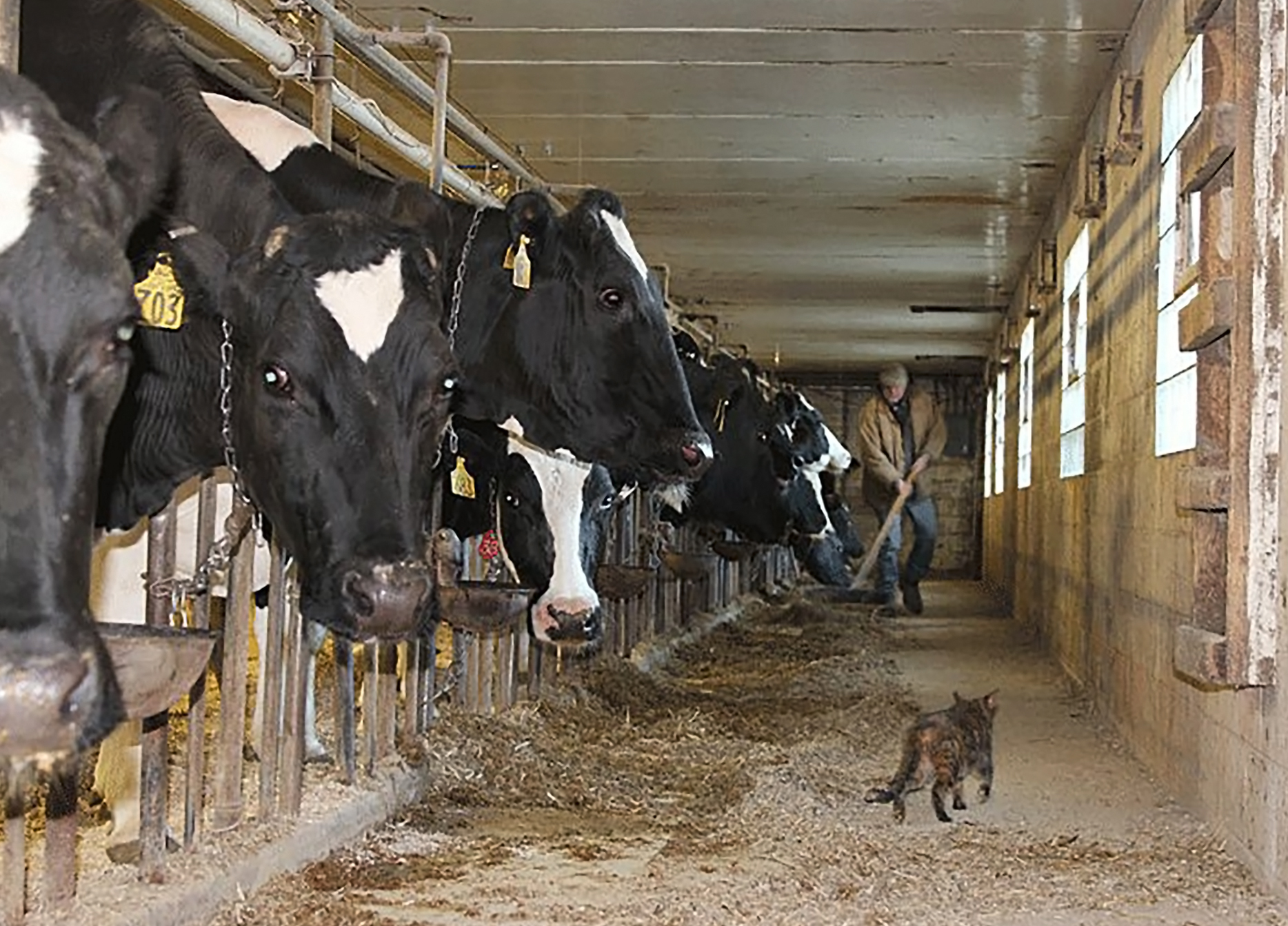
The purpose of the Federal Orders needs to be more considerate of the long term. It should not be declaring the winners and losers, but instead provide a level playing field where the real costs of transportation are factored into the value of local milk to local markets.

The large and powerful market movers take over the grid and push regional suppliers — mainly small businesses that are central to their own communities — to the side. These entities bring milk into the community and then drain local dollars out of the community.

As a result, small dairy businesses are going out of business at an alarming rate. Independent dairy farmers, small and mid-sized, as well as small cooperatives, are getting notices that they are being dropped by local bottlers in my home state of Pennsylvania and north into New York and in Ohio. Young Plain-Sect farmers are finding out in the Southeast they can’t just start milking cows like their fathers did before them. There is no market, they are told, even though the Southeast is a milk deficit area. The Northeast is as well.

The small regional bottlers are being squeezed by the large national co-ops who own or control the balancing assets (through both ownership and contracts) within the Northeast, and Southeast.

So, when milk from members of the national Big-Business co-op is produced in the rapid (double-digit) growth areas of Michigan and Texas, for example, that milk takes precedence at the national co-op-owned and controlled balancing assets in the Northeast and Southeast — effectively pushing the local small business independent shippers and small regional co-ops out of the bottling plants and into situations where they don’t have a market for their milk.

The Walmartization of food retailing has infiltrated its way to the farm-level because local small businesses have limited access to the dairy product processing plants where they once sold extra loads at a discount in order to balance the fluctuations of the fluid milk market. The set make allowance that is built into the manufacturing class milk prices also encourages large single-product plants versus a market-savvy and nimble processing class that makes for the market.

In Pennsylvania, some bottlers are working together with local food banks to balance the ups and downs of the fluid market so they can keep their longtime shippers instead of giving them up to the national Big-Business co-ops who in turn broker the milk back to the plants it went to in the first place.

TIE-STALL-FILE-PHOTO

What do the Federal Orders bring to this mix or — should I say — mess?

First, It is currently too easy to move milk and get paid more for moving it the farthest!

As a result, dairy manufacturing plants are being built where there are not many cows. “If you build it, they will come.” But then they will also send their milk back East to get that juicy Class I utilization to boost their blend price and keep the cost of milk down for the large new manufacturing plants.

The small businesses of the eastern region need a method by which to have the local-ness of their milk count for something in this equation!! If the government is going to be so involved, then it needs to look at the big picture.

Currently, not enough incentive is built into the FMMO structure to give local-supply-arrangements and advantage in the fresh fluid milk beverage market based on the fact that milk flows in smaller circles and does not have to move so far.

While I am not an expert on how all of the pieces of the FMMO came to be, I do know that some of the fixes have created new and worsening problems.

My ask of the USDA AMS — as a small business and as a consumer — is 3-fold:

1) Please extend the comment period to allow for more time to comment. Dairy producers are waking up to some disturbing activity in the Eastern markets. More is becoming known about the current failures of the Federal Orders to uphold their intended purpose! Dairy farms — in increments of half-dozen to a dozen at a time — are getting notices RIGHT NOW that they must find another market or sell out their cows, their investment, their vocation, their family-living, their heritage.

More and more of these producers losing their markets are the highest quality milk producers! Their only fault is they are small businesses (40 to 1000 cows) or part of a small co-op (8 to 12 producers). A large iron fist is coming down in the eastern markets and blaming the bloodbath of farms forced to shut down, dump milk, and go out of business on “too much milk” in the East.

All the while, milk from Michigan in the north and Texas in the south is displacing local eastern milk in the balancing assets of the two large national-and-centralized co-ops that work together. Members first, locals last.

2) Before considering the addition of California to the current FMMO system, please hold national hearings to first evaluate and devise a new pricing formula. Consider basing it on 2-classes of milk: fluid and manufacturing as well as component values based on an array of products — and evaluate removal of the “set” make allowance. This could facilitate competition among various entities buying milk for a variety of manufacturing uses — instead of declaring the winners and losers via set make allowances that encourage large single-product plants that are not nimble nor responsive to changing market conditions.

This could also cut down on some of the gaming we see among balancing assets and lead to more actual marketing of dairy milk products rather than large output of products the market may or may not want because the set make-allowance assures a margin where pure scale is the key to profit and efficiency.

An example of this is the difference between skim milk powder – a uniform product with a standardized protein content – vs. nonfat dry milk (on which the make allowance for powder is based) which is a lower quality product and not uniform in that the protein percentage falls into a 4-point range. If the market wants SMP for its repeatability in a recipe but the make allowance is based on NFDM, the response in a downtrending market is to make more of the latter because the margin is guaranteed by a set make allowance, which further depresses the market.

3) Re-evaluate the purpose, relationship and actual function of transportation credits, touch-base provisions, diversions and other aspects of how milk is supplied so that a premium resides wherever local milk supplies local markets and wherever the regional infrastructure of dairy farms and businesses is upheld in the movement of milk within a Federal Order. Perhaps instead of using such credits and rules to facilitate the bringing of milk from far away, the fund would be better used to get local milk to local markets.

Local small businesses are being forced out of business rapidly. The Department needs to move quickly to establish a fund where processors pay in what would have been spent to bring the distant milk so those dollars are used in the local community or within the Order to offset the balancing cost of keeping local dairy farms on the rolls.

In short, perhaps it is time to use the Federal Orders for their intended purpose and break up the centralized stranglehold of the two national Big-Business cooperatives working together (even sharing attorney and milk accountant assets) by forcing them to stop painting their milk movements with a centralized broad brush – forcing them to more aptly consider local to local, regional to regional.

It is also worth mentioning here that some shifts in the gap between the USDA “all-milk” price and the “mailbox” price released months later are becoming apparent as the national mailbox price has been higher than the all-milk price while the Southeast, Appalachia, Pennsylvania, and New York mailbox prices are falling further and further behind the all-milk price than ever before. This may have something to do with the 6% reduction in Class I utilization in the Southeast in 2014 and the 4% reduction in Class I utilization in the Northeast in 2014. The national reduction in Class I utilization is 3% by comparison.

This reflects not only the raw milk movement but also the infiltration of packaged milk coming from outside of the Northeast and Southeast milksheds directly onto the shelves of large buyers like Costco and Walmart.

On a personal note — as a former milking employee, 34-year veteran ag journalist in dairy and beef, and an eater of dairy products and drinker of dairy milk in the Northeast — I have this to say about “free markets”…

Some are calling for the abolition of the “archaic Federal Orders.” I would be on that bandwagon in a heartbeat — favoring open markets over the continued use and misuse of rules and structure to supress a region’s own supply of dairy farms, small businesses and infrastructure — if I didn’t think the Federal Orders still have a purpose of accountability and to be a running record for what is happening.

However, if the current problems are not fixed to give local milk, supplied by small businesses a fighting chance, then perhaps the FMMO system should go. We have seen the loss of too many small business in the dairy industry where nationalized Big Business processors and co-ops used FMMO rules to their advantage to take over markets. Without a change in FMMO rules, this will continue and accelerate, and we will see more losses of small dairy businesses that sustain rural communities.

If the current problems are not fixed, small businesses may find they are better off in a totally free market, unencumbered by the structure and rules that are increasingly designed by the national Big Business operators to effectively put them out of business as they increase their own centralized national footprint.

Please do not add California until after the current issues with the FMMOs are fixed to a point where local is rewarded in the formula and small business is respected. Once California is added, it will be much harder to make new changes that benefit local small businesses fighting for survival in the East. Thus, the current areas controlled by FMMOs should have a chance to improve the rules before adding the state that has wanted to be state-regulated for decades and represents almost one-fourth of the total milk production in the U.S.

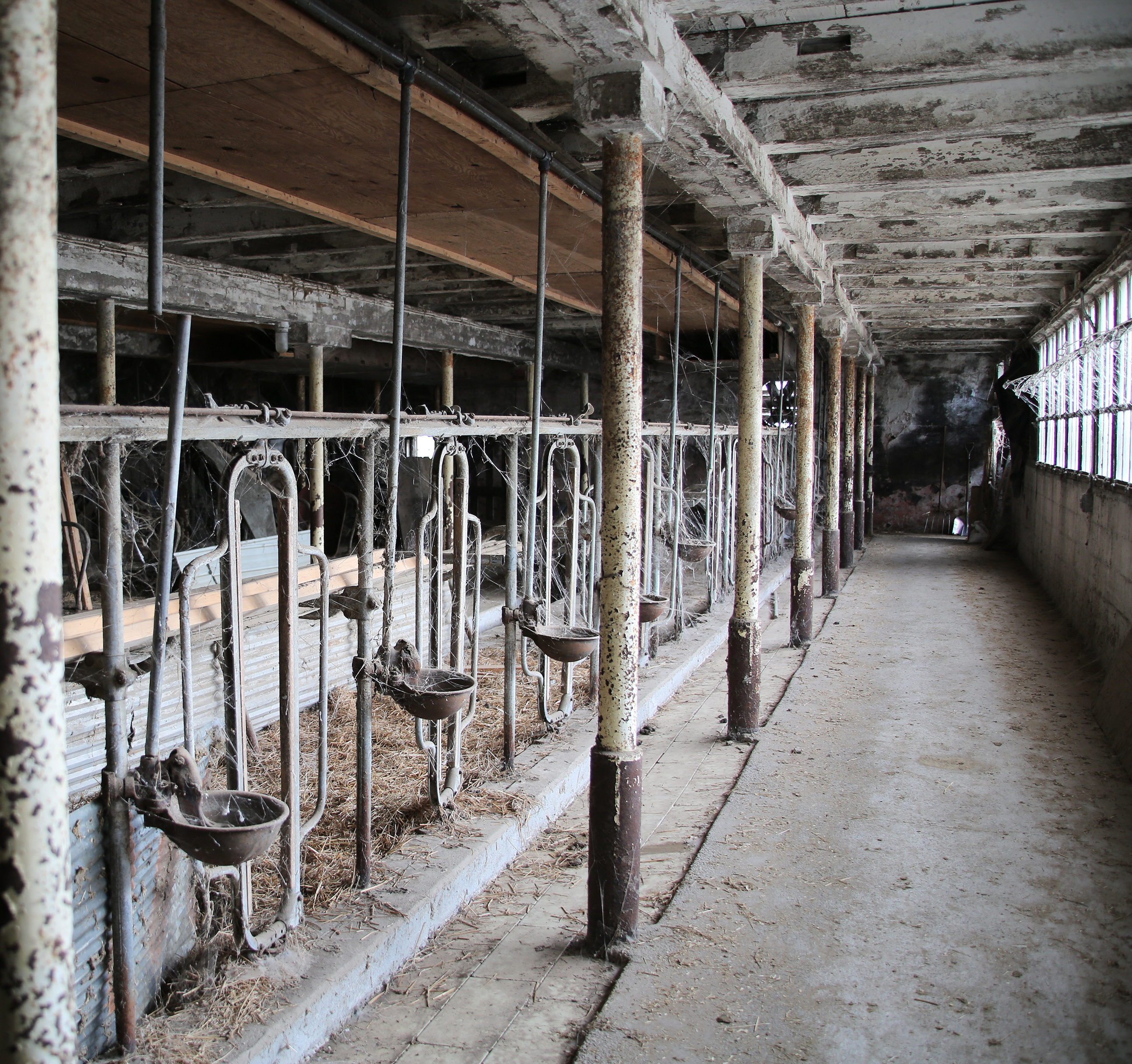
File-Photo-Abandoned-Tie-Stall

Thank you for your consideration,


Sincerely,

Sherry A. Bunting


To file your own comments with USDA, click here

No ‘snow days’ on the farm

cows6781By Sherry Bunting, columnist, Register-Star, Feb. 21, 2015

There are no ‘snow days’ on the farm. “When it is this cold, the simple every day protocols become enduring days of work,” notes Cody Williams of Wil-Roc Dairy, Kinderhook, where 1500 Holstein dairy cows are milked and cared for.

“We change our teat dip when it’s this cold, for extra moisturizing to the skin,” Cody explains. “We also adjust the cow diets to keep our cows in a positive energy balance as they burn more energy to maintain themselves during weather extremes.”

Operating a dairy or livestock farm in the extreme cold is not for the faint of heart. Veteran beef producer Phil Trowbridge of Ghent observes: “We know how to take care of ourselves. We dress in layers and give each other breaks.”

Frozen pipes, pumps, waterers, and manure — as well as difficulty in starting equipment — are commonly reported concerns. When the snow piles up and the temperatures plummet, concerns turn to keeping rooftops clear of a too-heavy burden and being vigilant about the increased risk of fires.

In closed group discussions throughout social media, farmers exchange ideas and seek support from each other.

When the Polar Vortex gripped the northern half of the country in 2014, farmers were up to the challenge.

Last week the mercury hit -14 at Trowbridge Angus Farm, where it is calving season January through March. The family, and their over 300 beef breeding cows, were navigating two to three feet of snow cover.

Twenty miles away near Schodack Landing, temps of -11 went virtually unnoticed by the over 700 Jersey dairy cows at Dutch Hollow Farm. They are tucked away in their barns with retractable sidewall curtains that stay open more often than not for natural light and ventilation but remain closed when the wind chills get this low.

Cattle are cold weather animals, but they do not like wind or drafts. The difference between beef and dairy breeds is the way their centuries-old partnership with man has adapted through specialized breeding and care.

IMG_1939x

Beef breed cattle are kept outside pretty much year-round, coming into the barn only at calving time. Dairy cattle, on the other hand, are typically housed in barns year-round. While beef breed cattle spend more time foraging for their food and seeking the natural and provided windbreaks to lay down, dairy cattle in freestall barns will amble short distances inside from feedbunks and waterers to the deep-bedded stalls that are groomed for them two or three times a day while they are milking.

Dairy cows are accustomed to constant human handling from the time they are calves. 10986660_10206244497857081_5937924373439440151_oThey have a different temperament about the whole calving deal.They aren’t worried about predators and trust the humans they work beside day in and day out to care for them and their offspring.

Beef breeding cows, on the other hand, are more self-sufficient and protective of their young. They raise their offspring for the more hands-off life as a non-milking breeding animal or to spend 80% of their life foraging on pasture with the last 20% of their life in the beef fattening phase.

One thing in common: Both beef and dairy producers focus on the newborns immediately at birth to make sure each calf gets a warm start and enough colostrum for the passive transfer of immunity from its dam.

“When we get real cold weather like we have seen this winter, we spend more time in the calving barn at night. We pretty much sleep here with them when it’s this cold,” says beef producer Phil Trowbridge, who has had 50 calves born since January 1. “The main thing is to get those calves dried off and warmed up as soon as they are born, and to make sure they get enough colostrum. In two or three days, they’re old enough and strong enough to go outside.”

Not only are they prepared for cold weather, they frolic in it. “I took a video with my cell phone of the calves the other day when it was minus-11. We were putting out bedding for the cows, and saw those calves were feeling so good, they were just running through the snow,” Phil relates. “I like seeing that.”

calves

Stockpiled pasture grasses make a nice winter forage as cattle can push off a few inches or a foot of snow to graze it, and they do well getting around in the snow outdoors. But with over two feet of snow cover this winter, the Trowbridge family cuts trails to help the cattle conserve energy. They also put down extra bedding, more often, in the areas with windbreaks and feed more outdoor hay and supplement.

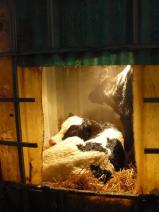
Meanwhile, on a dairy farm, the cows calve year-round. Calving pens are watched through video monitoring or by walk-throughs. The immediate newborn calf care continues through the first few weeks of life in the calf nursery or individual hutches. Newborns often get time in a heat box or wear calf jackets and sometimes earmuffs when it’s this cold, and they are fed more often for increased energy to maintain their temperature and to grow.

heated-box.jpg

Tricia Adams pictures one of the heated boxes for newborn calves at Hoffman Farms

“Taking care of the animals is pretty much routine. The feeding is very consistent day to day, and the freestalls are bedded twice a week,” says Paul Chittenden of Dutch Hollow
Farm.

“Clean and dry and plenty to eat are what we focus on — regardless of the weather,” he adds. “Cows always have dry sawdust with extra sawdust stored in the front of the stalls. This allows for plenty of dry bedding to stir around each time we groom the stalls when the cows go to the parlor for milking.”

webx073.jpg

Water is critical for drinking and cleaning, so lines are buried underground and drinking tubs are equipped with heaters.

“Cold weather management is really not too complicated,” explains bovine veterinarian and dairy farmer Dr. Tom Troxel. “Cows need to have plenty of feed and water, be out of the wind, and have a dry place to lay down. If they have these things, they can survive an awful lot.”

“No matter the weather, we have our jobs to do here,” notes Cody of Wil-Roc Dairy. “That is itself the reward. Getting our everyday tasks done and looking to see how the stressers of weather and other events can affect our system… That is how we keep improving how we do things all year long.”

Sherry Bunting is a member of North American Agriculture Journalists and has been covering beef and dairy production for 40 years. Before that, she milked cows and graded beef cattle for market reports. She can be reached at agrite2011@gmail.com

-30-

GL 022115-2

GL#23(photo-collage)

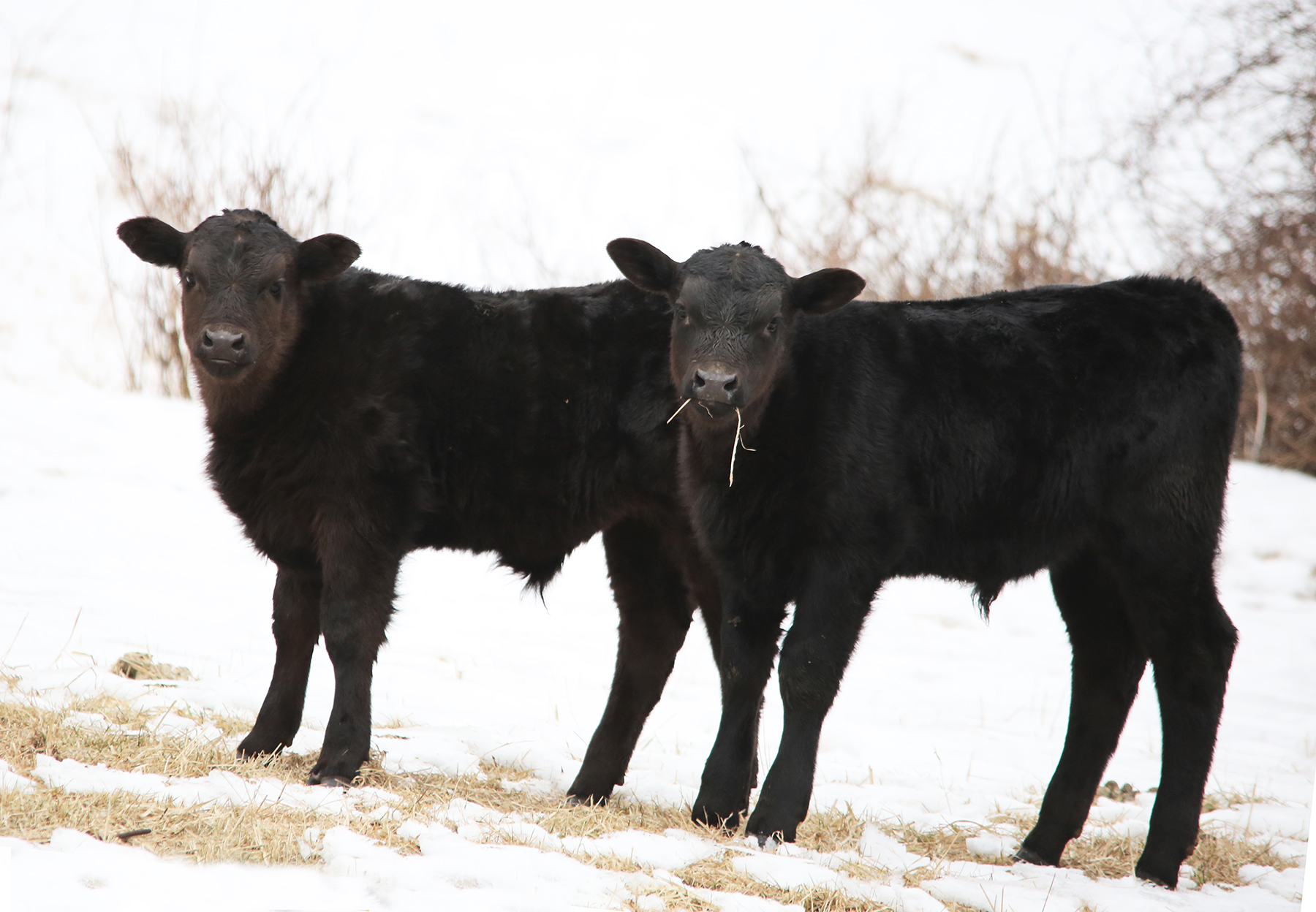
Dairy and beef cattle are adapted differently, but they all depend on their people for great care during the weather extremes we have seen here this winter. Farming is not for the faint of heart. Everyday tasks take longer to complete but it sure is rewarding to see cows thrive and calves frolic after a good start – regardless of the weather! Photos by Sherry Bunting, Tricia Adams and Evelyn Troutman.

‘Work hard. Save money. Be careful. Love the job.’

webR&J-190x

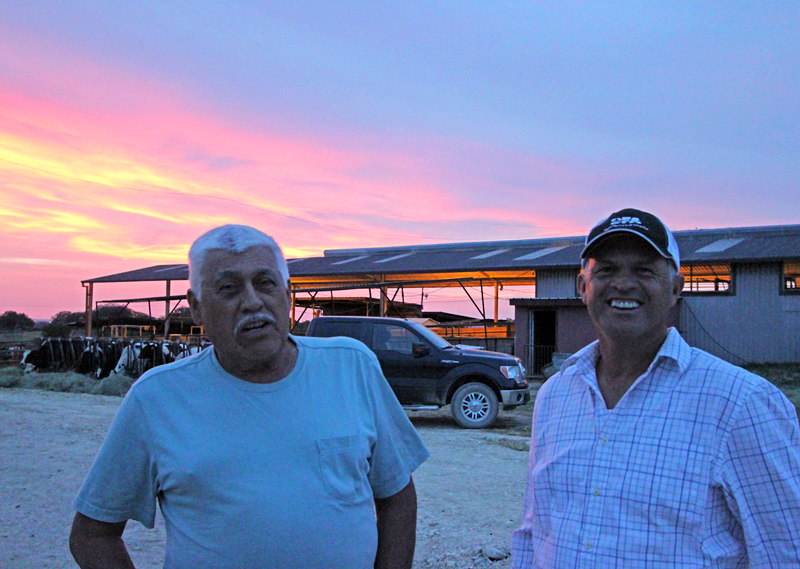
Hector Jimenez (right) and his uncle Arturo Rodriguez have been working together since the late 1970s. Two decades of saving as they worked on dairies in California led to them starting their own dairy near Dublin, Texas in 2004. In an interview last May at their R&J Dairy, they reflected on a decade of dairying on their own in Central Texas. Photo by Sherry Bunting

By Sherry Bunting, originally published in Farmshine and Texas Dairy & Ag Review during the summer of 2014

DUBLIN, Tex – The decade of 2004 to 2014 has been a volatile one for anyone starting out in the dairy business. For these two producers it took more than two decades of
work on other dairies in California to pave the way to be living their dream today in Central Texas. Hard work, disciplined saving, and hands-on management are the three keys Hector Jimenez and his uncle Arturo Rodriguez say brought them through 20-plus years of working for others and 10 years dairying on their own – including the 2009-13 era of tight to negative margins.webR&J-536

“We worked together since 1979 and always talked about one day having our own dairy,” Hector recalls. That day came in 2004 when Hector and Arturo bought a dairy near Dublin that had been vacant for a number of years after its previous owner moved west to where the dairy industry was expanding in the Panhandle.

They moved here from California with nothing, bought 110 cows and milked three months on a rented dairy, then partnered in their own R&J Dairy. They bought another 150 cows and took their time raising their own replacements to expand steadily through internal herd growth.

“WwebR&J-165e started with No. 1 and this calf, here, is No. 2869,” Hector smiles, pointing out a newborn heifer. Today their herd of 850 milking cows is 95% homebred. They produce an average of 75 pounds/cow/day and have achieve somatic cell counts at or below 200,000.

They are satisfied with the current size of their dairy as they build back their numbers after a few years of heavier culling rates while milk margins and feed costs were tight to negative. The recent memory of 2009-13 brings daily reminders of the importance of saving, working, and being cautious.

“We culled heavily because we needed that money to pay bills,” Hector relates. Today, the herd is 30% first-calf 2-year-olds.

Asked how they made it through those tough years, Hector’s wife Fabiola said: “We prayed.”

“And worked hard,” added Hector.

He and Arturo are hands-on managers. “My uncle is out here feeding cows at 4 a.m. and I start at 5 a.m.,” says Hector, who does all of the breeding. His day starts with cleaning the milk tank and the parlor, checking fresh cows, and starting the day’s breeding lineup.

“My husband is in love with what he does. He never complains. He and Arturo are always here – rain or shine, good or bad — that’s how we made it this far,” Fabiola adds.

She and Arturo’s wife Sylvia — and more recently Arturo’s daughter Christian — take care of all the calves at R&J Dairy.

webR&J-557x

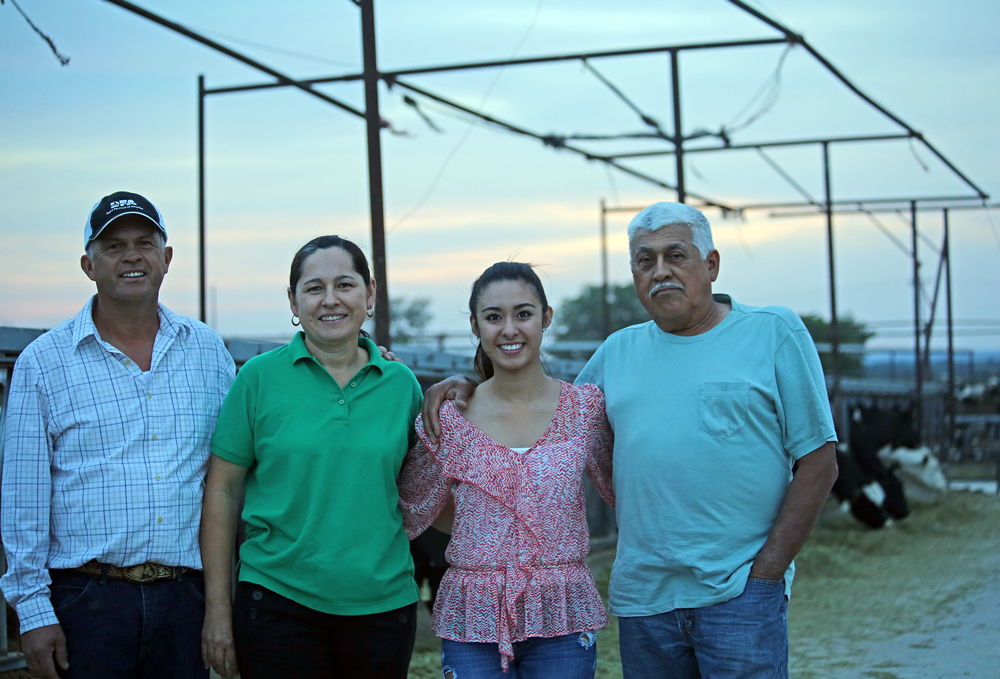
Hector and Fabiola Jimenez (left) and Arturo Rodriguez (right) with his daughter Christian. Missing from photo are Hector and Fabiola’s grown children Clemente, Abel and Joann and Arturo’s wife Sylvia and son Arturo Stephen. Photo by Sherry Bunting

They employ 10 people, mainly milkers. They feel a sense of satisfaction in coming to the U.S. from Mexico in the mid-to-late 1970s, working hard, starting a new life here, including their own dairy business, raising children who are either interested in the dairy or working good jobs in the community, and now providing jobs for others in the community.

Halfway through their first decade in business together, Hector and Arturo hit the 2009 milk market train wreck followed by years of drought and surging feed prices. Cutting expenses was a big part of that picture from 2009-12, and the partners aren’t so fast to spend money now that dairy margins are good.

They have 220 acres and rent some additional property for growing coastal hay. That, and working with their nutritionist in feeding commodities like corn gluten, canola and cottonseed along with purchased corn silage — helps them manage feed costs.

They feed a dry cow ration and move the close-up cows and first calvewebR&J-125xxrs close to the house for observation. They also use Udder Comfort after each milking for a few days post-calving to reduce edema and improve recovery time.

The breeding program involves synchronization, but only for those cattle that are not showing heats. Hector and Arturo pick the bulls. “We look for high components – fat and protein – as well as calving ease,” Hector explains.

High components and high milk quality are two keys to making the most of their milk check in both high and low market times.

“The dairy business can be a tough business,” Arturo observes. “You have to enjoy it. I enjoy everything about it, getting up early, being out here. It’s all I’ve known since 1975.”

For the next generation of dairy producers dreaming of having their own dairies, Arturo has this advice: “Work hard, and sooner or later you will be rewarded,” he says. “Save money and invest in cows, but above all work hard. If it is work that you love, that won’t be hard.”

Those two-plus decades of hard work for other dairies have rewarded Hector and Arturo with more of the work they love, but now they do the work for their own dairy investment.

As these two partners have experienced over the past 10 years dairying on their own – “Even when you have your own business, the work doesn’t stop and in some ways you work even harder. You have to be here, work here, live here,” Arturo explains.

Hector agrees. “Even when I’m at the house, I’m thinking about the cows and wanting to see that they are okay. You have to like this job to do it well, and you have to like it even when you are losing money.”webR&J-151

It can be done, they say, “but you have to be careful. We had to spend money carefully,” Arturo noted. “We started this dairy during the good times in 2004. We’re still here, I think, because we were careful in the good times and the bad times. We watch every day how we feed, and when the times are tough, we cut out what is too expensive. When the going gets really tough, we shift our focus into survival mode, not to how much milk we can make.”

Cost of production at R&J Dairy runs almost $20.00/cwt at the moment (spring 2014), which includes all costs — everything. “It gets scary when milk prices fall to $16,” Arturo relates. “In 2009, the price fell below $12, and our cost of production at that time was $18. At one point we were losing $2000 per day here and borrowing to pay bills.”

He explains that they were fortunate to have built up some equity they could borrow on, and he estimates that another three months of milk prices as high as April’s may finally pay back what they lost in 2009.

“We try to stay ready for the next downturn,” the two men agree.

Arturo sees the new Margin Protection Program in the Farm Bill as something that will help dairy producers during future downturns. “It’s better insurance, better than the MILC program. When it gets tough in the dairy business, any help is nice to have.”

As for forward contracting, Hector and Arturo prefer to take on the risk. They believe that while the new insurance program will help and some folks have benefitted with forward contracting… nothing substitutes for hard work, saving during the good times, and close management and caution all the time.

The two partners worked day and night through the worst of 2009-10, and believe that is webR&J-572what got them through it. “We looked for those small daily victories,” Arturo reflects. “That’s what kept us going. We just kept thinking we would be okay — that if we worked hard, we would be rewarded for the years of suffering, and I guess we are seeing that right now.”

Moving forward… ‘We take care of their families and they take care of ours’

By Sherry Bunting, reprinted from Farmshine, November 21, 2014

NEW LONDON, Wis. — November is a many-faced month for agriculture. It’s the month we recognize women in agriculture. It’s the month we bring the sewebTank7962ason’s harvest to a close. It’s the month we are reminded to be thankful for God’s blessings.
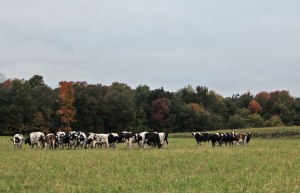
In September, I met a truly inspirational dairywoman who is quietly and methodically moving forward in the face of difficult odds. She and her two daughters exemplify a thankful heart as they care for their cows, which in turn care for them.

It was a downright cold, rainy central Wisconsin day as I was visiting farms ahead of the World Dairy Expo at the end of September. My lastwebTank8066 stop of the day was Milk-Flo Holsteins, New London, where Cathy Tank still does the 3 a.m. milking of her 150-cow dairy herd, and then works off the farm until supper time; so the appointed time to meet was toward evening. Her daughters were home from school and the hired man was busy pushing up feed for the cows.
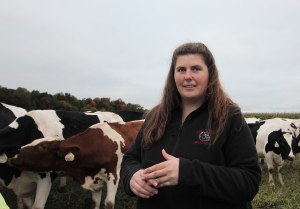
What started as a typical family farm interview, soon turned into much more. By the time I left a few hours later, it was dark and one of the two ladies employed to milk the other two of the 3x milkings had arrived as Cathy’s daughters fed the chickens befowebTank8046re heading inside to do homework.

A former dairy queen of Wayne County, Wisconsin, Cathy Tank is a woman who not only works hard, she believes in working smart and using the right tool for a job.

She and her daughters Elizabeth, 15, and Rebecca, 11, love the dairy farm they are keeping going — and progressing — after losing husband and father Bob Tank to melanoma in 2009. It has been a journey, to say the least, and Cathy is quick to point out the way communities and extended family work together during harvest and in times of need.

“That’s what makes farm folk different,” she says. “A farmer can be having the worst day, ever, and would still stop and help pull another out of the ditch.”

“I am fortunate to have good help,” she adds. Working smart, means picking the jobs she can and can’t do. While she harvests her own haylage and works the ground to get it ready for planting, Cathy uses custom manure hauling and custom choppers for the corn silage harvest.

“They can do in a few hours what would take me weeks,” she says, adding that her brother helps her do most of the planting. That is something her father, Keith Knapp, helped her with over the past few years, but this spring she lost her Dad, too, in an accident.

Getting on the tractor is therapeutic, she says matter-of-factly. “It is refreshing work, and it reminds me to be thankful. I think about all of the things my Dad taught me how to do.”

While fieldwork is refreshing, what Cathy really loves is the cows. The dairy herd was her domain until six years ago. One year before Bob’s illness, they decided she would take a job off the farm. Today, she continues onward with both the job and the farm, and she’s set some pretty high goals for her cows with the focus on paying down debt. She would like to see her cows get over that 90 lbs/cow/day mark into 100-lb territory. “That’s a hard goal,” she says. But she’s already reached a few toughies.

She started 3x milking in February, and over the past two years, she made a focused effort to reduce somatic cell counts. Today, the herd averages 87 pounds/cow/day with 3.5 fat and 3.9 protein and SCC ranging 100 to 150,000.

The herd cleared $1 million in milk sales last year, which was a goal, reached, and Cathy says she has been able to reduce the farm’s debt by almost half. The milk from Milk-Flo goes to a cheese plant, and so the premiums for reducing SCC have really helped the bottom line.

While shifting the farm from pasture-based to more conventional in order to increase production and pay down debt, Cathy muses that maybe one day in the future, it webTank8077could return to more of a pasture-based system. She has already diversified a bit, adding pastured poultry and home-raised pork, beef and chicken. She and the girls sell their eggs at a local farmers’ market. The few steers on the farm are fed refusals from the milking herd and the chickens help keep some of the lawn areas mowed.

“We do what we can to not waste anything here. We are learning how to be more self-sufficient. You learn to be resourceful when you are on your own,” she says.

“We also try to do as much as we can without antibiotics,” explains Cathy, who grew up milking cows and has an Ag Education degree from the University of Wisconsin-River Falls. “We don’t sell the milk at the farmers’ market, but people who buy our eggs know we have cows, and we get those questions. We are trying to pay attention and be more preventive in how we manage the cows, so we don’t have as much need for treatments during lactation. This approach has helped us qualify for quality premiums and have a healthier herd.”

Cows are milked in a step-up parlor and housed in an open-front barn in freestalls. The farm includes 310 acres of forages for the 150-cow milking herd and young stock. Dry cows and older heifers are on pasture.

“I like color and variety,” says Cathy about the composition of the herd today, which is mainly Holstein but includes Brown Swiss crosses, Red & Whites, Linebacks,webTank8013 and Ayrshire crosses. She has hired a breeder but picks the bulls. The two biggest things she looks at are feet-and-legs and protein.

After two years in a row of poor forage in parts of the Upper Midwest, Cathy is thankful for this year’s good hay crop and the “jumbo corn” crop yielding over 23 tons of corn silage per acre, much of which was still ‘ripening’ in the field as the calendar headed into October.

She has put some thought into positioning the farm for alternate plans should the need arise. A few years ago, she installed a scrape alley and simple manure storage for the parlor holding area. This and the open-faced barn make the property suited to substantial heifer-raising if milking cows would ever get to be too much.

Elizabeth and Rebecca are the fourth generation on the farm. Cathy explained that Bob’s family has farmed here 100 years as of 2008, which was the year before he died.

“I’m just a steward,” she said. “I’m pretty interested in staying in this industry. I can’t imagine the farm without the cows.”

While she focuses on the areas of the farm where her efforts are most productive, she still enjoys the 3 a.m. milking. “I like getting up when it’s calm and you can see the stars,” she says as she looks around at the herd, noting her oldest cow is 15 years old. “It’s a good feeling to have dams, grand-dams and daughters in the barn here. We take care of their families and they take care of ours.”webTank8005

-30-

They prayed for direction… and found each other

By Sherry BuntingMeck-Hershey4576, Farmshine,     Oct. 31, 2014 – farmshine.net

 WOMELSDORF, Pa. — Some stories just have to be told, and this is one of them.

For Jeremy Meck and Kacie Hershey, engaged to be married November 7th, 2014, their chance meeting happened at a time of loss and uncertainty in the midst of one of the harshest winters southeast Pennsylvania has ever endured.

For Jeremy, it was a season of profound loss. Not only had he lost his brother to cancer in February, in Zach he had lost his best friend and business partner. Meck Brothers Dairy here in Berks County was the dream they had built up from scratch — a dream they had worked on together ever since grade school in Lancaster County when their late father Ronald, a poultry farmer, bought them a heifer calf for 4-H, igniting a passion for cattle that morphed from raising calves to milking cows, to buying and renovating their own dairy farm.

“It was a rough winter at the farm, with one thing after another, and it was hard to stay focused as Zach became more ill,” Jeremy related during a summer visit to the farm.

What he described was like a dark fog that threatened to settle-in around him. “I was praying for God’s guidance, for direction, for clarity… and I found myself praying for joy,” he recalls.

Goosebumps come with the next words from Kacie, as she confirmed her middle name is, you guessed it: Joy.

“God had a big part in us meeting,” she said about the chance meeting that was not so much by chance after all.

Kacie was facing her own need for clarity. She graduated with a teaching degree and was substituting here and there while working for her parents, Duane and Marilyn Hershey, at their Ar-Joy Farms near Cochranville, Chester County.

With Marilyn on the DMI board and Duane on the Land O’Lakes board, Kacie’s parents travel a lot. “I started picking up more responsibility at the farm and I needed to make some decisions,” she recalls. Seeking a teaching job, and feeling conflicted about the future, she, too, was praying for direction. What Kacie didn’t know was that her grandmother Anna Stoltzfus had started that week praying for God to bring someone into her granddaughter’s life.

Meanwhile, Kacie’s father, Duane, was one of several dairy farmers who kept intermittent contact with Jeremy during Zach’s illness and after his passing. Farmers in the community of Berks and Lebanon counties were especially helpful, reaching out in so many ways to mentor the brothers and to pitch in with fieldwork, and fundraisers, when the need arose.

From two neighboring counties in the same Land O’Lakes region, Duane and Zach had run against each other for the Land O’Lakes board seat a year earlier. The 3-way race had come down to a tie, and the differences could not have been more stark: Duane, a seasoned third generation dairyman whose father served as a representative in the Pennsylvania General Assembly versus Zach, the young, energetic, first-generation upstart dairyman always running full-tilt, wanting his generation to have a say.

The special tie-breaker election had occurred the previous January, with Duane winning the seat. The two continued their chiding camaraderie after the election, and Duane checked in from time to time to see how things were going on the farm after Zach’s cancer diagnosis the following September.

Newlywed to Suzanne Perdue, Zach’s illness came at a time when he was just settling into the future he thought lay before him. Being connected to a loss like this will test the strongest faith. Looking back on it, Jeremy says he learned a lot about commitment watching how Suzanne traveled that journey with Zach.

He recalls Zach’s advice to him: “Find a girl with quality values and a farming background, who understands what you are passionate about.”

But mostly, he recalls the example of how Suzanne was there for Zach every step of the way.

“I didn’t fully realize how bad it was until he passed away,” Jeremy reflects. “During his illness, I dug down deep and just kept focusing on doing everything around the farm, doing for two, wanting to keep it going for him, wanting to see our plans through, wanting to keep our dream alive, and hoping he could come back to the farm.”

With Zach gone, it was difficult for Jeremy to make that dream — their dream — his own.

The winter wore-on the way it does daily on a dairy farm. Sub-zero temperatures brought daily challenges from power outages and frozen pipes to difficulty starting equipment and the sheer effort of getting through the growing mountain of snow to tend cattle and feed calves and make a path for the milk truck to get up the hill.

Then the unexpected: The day-after-day snows and frigid temperatures took their toll at the Hershey family’s Ar-Joy Farms with the midnight collapse of the roof on their main barn housing over 500 milk cows. Thankfully, the milking employees were all at the parlor, not in the barn. Cattle were lost, but the majority of the herd survived.

The next 72 hours brought a whirlwind of moving cattle, cleaning up, and a community effort to come in with the builder to put up a new roof. A work day was organized by fellow farmers in that community and the word of it spread.

“I had so much happening here, I wasn’t going out or going anywhere,” Jeremy recalls. It was just two weeks after losing Zach when he heard from a neighbor about the Hersheys’ roof collapse. Duane had called to check in a few days before and so Jeremy returned the favor. He called to see if they needed help or equipment, but he never reached Duane by phone, so he headed to Cochranville figuring to lend a hand in the cleanup.

Had he reached Duane by phone, Duane would have emphatically told him to stay put, knowing Jeremy had enough on his plate at his own farm. But with no word from the wise to deter him Jeremy showed up and spent the day working on someone else’s problem instead of dwelling on his own.

“It felt good to be busy somewhere else,” he recalls. “Never did I imagine that day I’d meet the woman I’m going to marry.”

Jeremy and Kacie met as she brought water to her Dad and the crew. Kacie recalls thinking to herself: “Who is this guy, and why have I never seen him before?” Followed, of course, by making sure to procure another round of water for that crew.

Both were intrigued and struck up a friendship, after first looking each other up on Facebook (of course) and realizing they had friends in common. Jeremy’s best man is herd vet Nathan Kapp of Gap Vets, whose wife works with a friend of Kacie’s at Pioneer. A first date led to a second, and things took off from there.

“When I told my Dad we were dating, I just got this big smile and some comment about tractors,” Kacie laughs.

Spring came, and Kacie continued working at the home farm, then driving to Jeremy’s to help with whatever needed doing — from the cattle to the corn planting.

“What I fell in love with first is Jeremy’s faith,” Kacie recalls.

Windows of light open doors, through faith. Both Jeremy and Kacie were individually going through difficulties and seeking direction for their lives. They both had questions about their own futures, and God’s answer was an unexpected ‘chance’ meeting. “We would not have met any other way,” they agree.

-30-


Gratitude and honor

“For our country, for us all,” read the Marines billboard as I drove through the nation’s heartland over Memorial Day weekend.

I turned the phrase over in my mind, thinking just what kind of courage, heart, and love of country it takes to serve in our nation’s military. A rush of thankfulness flooded over me as the tires of my Jeep Patriot ate the miles to the next destination, and farmland stretched endlessly on either side of the highway.

I whispered ‘thank you.’

flagrainbow2

Today, our nation commemorates Memorial Day, which began as Decoration Day, when the grave decorating custom became more prevalent during and after the Civil War, honoring soldiers who died — both Union and Confederate.

Since then, the final Monday in May has become a special time to honor all of the men and women — the patriots who have served and died — paying the ultimate price for our freedom and our country… “for us all.”

cropped-flag18

I am struck by the diverse beauty of America. American soldiers come from all walks of life and all regions of the country, and a high percentage come from farms, ranches and rural life.

flag64782 (1)

As I drove past that billboard along a highway near Lubbock, Texas, I also thought about the mothers and the fathers, families and communities, who have raised, and then lost, men and women who have paid the ultimate price so that we may be free.

custer-116

This Memorial Day, as always, we solemnly remember with honor, with gratitude the supreme sacrifice of our heroes, that freedom and liberty may live and that we as Americans may have the rights and responsibilities to protect it and pass it on to future generations.

887478_10208642209516798_3834399691121394933_o (1).jpg

Busy defines the life of a farm mom

My second blog post for Mother’s Day 2014 is the reprint of a feature story in the May 9, 2014 Farmshine. It is inspired by my very busy friend on their farm in northwestern Indiana. LuAnn is not alone as a busy mom and grandmom, and what I love about her is she is always ready to show people around and to talk about dairy farming to visitors — or on camera — at a moment’s notice. She stresses how their place is not fancy, and in her humility, declares that she is not perfect and can “drop the ball…” I get that. We all drop the ball, but what’s important is that we keep on rolling. 

Image

By Sherry Bunting, reprinted from Farmshine, May 9, 2014

HANNA, Ind. — Mothers — and grandmothers — all have those days when they wonder how they will ever get everything done. The long span of hours from pre-sunrise to long after sunset are filled all too easily on a dairy farm. Those hours can simply fly by when your ‘office’ keeps changing from the house to the barn to the feed store to the industry meeting you are trying to get to and back again.

When I feel stressed by all the “to-do’s” on my list, all I have to think of is LuAnn Troxel – a dairywoman, calf feeder, farm and veterinary book keeper, immediate past president of the Indiana Dairy Producers (IDP) and the organization’s current business manager, IDP newsletter editor, at-the-ready communicator, and — most importantly — mother and grandmother.

Anyone who has met LuAnn Troxel instantly feels at home. A more welcoming friend is hard to find. LuAnn is an easy going and knowledgeable dairy “agvocate.” It’s not that she doesn’t get worked up over the dairy farm myths circulating on social media – it’s that she doesn’t let them get to her. She is happy and confident in her responses, and breaks the topic down to its most basic element with consumers.

Those in the farming community wouldn’t believe she wasn’t raised on a dairy farm. But that is the case. What is second nature to her today was learned when she married Dr. Tom. Not only do Tom and LuAnn Troxel operate (now with their son Rudy) a 150-cow dairy farm in northwestern Indiana, they also tag-team Dr. Tom’s solo practice: South County Veterinary.

On the morning of an IDP event, I marvel at the day she puts in before her other day begins. Morning coffee, breakfast casserole in the skillet, phone ringing as folks call for Dr. Tom or to order supplies…. In between preparing breakfast and answering the phone, the animal health supply truck rolls in, and she takes a quick break to meet the new rep who will be bringing things by.

It’s end of month and she has invoice work percolating on her computer, as well as running through the inventory to put together customer supply orders and to give the animal health rep an idea of what they need today and by the next time he stops by.

By 7 a.m., she’s walking two full mugs of coffee out to the barn and it’s time to pick up the waste milk at the parlor to start feeding the calves in hutches that line the side drive in view of the large country kitchen.

A phone call interrupts her flow. She jots down a note, and with phone still balanced in the crook of her neck, heads off to the sand pile to find Dr. Tom bedding stalls. They confer. She hands him the phone and the note. Waits a few moments, then phone in hand heads back to calf-row.

Image

Back inside after the calves are fed, breakfast is served, and a list of “morning calls” is prepared for Tom. A peck on the cheek and quick farewell and she’s loading the van with name tags and registration materials for an IDP meeting that starts at 9 a.m. an hour from home.

Not an atypical day really for someone who is in leadership positions for Indiana Dairy Producers, sits on a Purdue University task force, and several other industry groups while still making time for leadership in the local Master Gardeners club.

Whew!

It’s not that LuAnn is the only dairywoman or mother / grandmother with a full schedule – day-in and day-out. It’s that she so well represents what so many dairywomen juggle. They have their own work on the farm. They support their husbands, including a quick hop in the tractor or running to town for a part at a moment’s notice. They mother their children, and when the time comes, take joy in the grandchildren — especially watching them take on responsibilities and passion for the dairy farm or a career path that could take them away from it.

From the off-farm world, hearing a dairywoman like LuAnn is a breath of fresh air cutting its path through the stale and lingering smog. There are so many “fear-mongers” creating anxiety for young mothers shopping for food for their families. They breed a distrust of a perfectly safe and wholesome and affordable food supply — pushing families to fear anything that doesn’t say “no-this” or “without-that”.

Listening to LuAnn do the spots for DairyGood.org, there is a certain ease of which she speaks. It instills confidence that dairy farms are DairyGood places where DairyGood products come from. It helps young mothers forget their fears and shop with confidence.

Image

Why does she do it? “I always knew Tom and his family because we grew up going to the same church, and back then I didn’t have a true appreciation for the work and the lifestyle of dairy farming,” she says. “After having lived this with Tom for all of these years, and raising four sons here, I just know that if people can see how hard we work and how much love we have for what we do and our passion for the cows… maybe they will keep that trust in us that we are producing for other families the food that we feed our own families.”

She and Tom are grateful to work on their family’s dairy farm in northwestern Indiana to provide food for people every day. “We have always felt that opening our farm’s doors to the public is the best way to educate people on what it takes to produce milk,” she says. “We love that visitors see the care and respect we have for our cows and the environment.”

Dairy farmers have a real story to tell, and we’ll see a lot of that next month when June brings National Dairy Month. But for today, I wanted to remind us all that it’s the moms and grandmoms on the farm who have the power to make the true dairy story real for other mothers shopping for food for their families — one thought, photo, idea, conversation, smile at a time.

Happy Mother’s Day to Dairywomen everywhere! Be encouraged by every little thing you do to shine your light in the world.

Image

-30-

Troxel8475

LuAnn Troxel is an encouragement to others as she goes about her busy day. It’s sundown and she’s got the waste milk from the parlor to feed the calves in hutches. Photo by Sherry Bunting

Troxel0047 and 8502

As if the farm and her husband’s veterinary practice weren’t enough, LuAnn Troxel makes time for her passion — flower gardens. She proclaims: “We aren’t fancy.” And yet the layers of perennials and annuals around the property soften the edges and add color to the freestall areas. Photo by Sherry Bunting

Troxel6976

A phone call interrupts her flow. She jots down a note, and with phone still balanced in the crook of her neck, LuAnn heads off to the sand pile to find Dr. Tom bedding stalls. Photo by Sherry Bunting

Troxel6998

Feeding the calves morning and evening bookend the busy days on the farm and in the industry. Photo by Sherry Bunting

Troxel7042 or 7045

“There’s nothing like a dairy farm to raise a family,” says LuAnn with a smile. She is pictured here with one of her and Tom’s grandchildren. Photo by Sherry Bunting

‘Unstoppable Mom’ shared faith, family, farming with millions of TV viewers

Mother’s Day is around the corner and I have 3 posts in store for you. Here is the first — an oldie but goodie and one of the most requested reprints of one of my stories in Farmshine, which ran as last year’s Mother’s Dairy feature.

By Sherry Bunting, reprinted from Farmshine May 10, 2013

Image

COCHRANVILLE, Pa. – When Kelly King Stoltzfus wrote a letter about her mom to ABC’s “Live! with Kelly and Michael show,” she didn’t tell her mom about it because she didn’t expect her letter to get picked for the semi-finals and finals of Live’s “Search for the Unstoppable Mom” contest. After all, the show received over 20,000 letters written by children about moms nationwide!

But Mary Lou King not only made it to the final-four — which meant the show’s producers and video crew visited for two days to chronicle her life on the farm — she was ultimately voted “The Unstoppable Mom” by “Live” viewers across the country during the first week of March.

“This should really be the ‘unstoppable family’ award,” a humble Mary Lou said during a Farmshine visit to the family’s 150-cow dairy farm here in Chester County, Pennsylvania last Friday.

Along with a trophy, Neal and Mary Lou King received $100,000 for winning the contest. “We paid our taxes, gave our tithes, and the rest went to the kids,” she said.

Kelly, 22 and the oldest of the four children, is married to Kyle Stoltzfus and works as a nurse at Tel Hai in Honeybrook. Colton is out of school and works full-time on the farm. He does all the feeding for the King family’s dairy cows and youngstock, helps with milking, and crops 300 acres with his father. Kristy graduates from Octorara High School next month and starts nursing school in the fall. And Kandy, 14, was born with a mental handicap, having the brain development of a three month old child.

“We decided early-on that she would be raised here like a regular child,” Mary Lou explains.

“I think something stood out to those television producers when they read Kelly’s letter,” she adds. “They were curious about the farm when they came to do the filming and literally everything they saw here was something they had never seen before… right down to enjoying a cold glass of raw milk from the bulk tank. They swished it in their glass like they were savoring a fine wine. And they loved the peacefulness here and the wide open spaces.”

The television producers and film crew were also surprised at how much science is involved in dairy farming. Mary Lou recalls explaining what she was doing with the breeding wheel and in the pen checking tail paint. Their eyes would glaze over. “They never knew there were so many different jobs to do on a farm.”

Many portions of the letter stood out as being unique to the New York City television producers. The words “My mom has been milking the cows at 4:00 a.m. and 4:00 p.m. every day with my dad ever since they were married back in 1988,” certainly got their attention.

That, and Kelly’s description of her mother’s daily commitment to 14-year-old Kandy, who alternately dozed, then smiled a sweet and contented smile during our interview Friday at the kitchen table.

“I’m just a farm mom,” said Mary Lou, who came to represent farm moms everywhere during “Live” voting in early March. But she also struck chords with parents of children with special needs and with members of the nursing profession.

Pretty much everyone who viewed the video of life at the King farm was moved by the passion Mary Lou exudes for taking care of the cows and her family.

While Neal loves most the tractors and the fields, Mary Lou enjoys the animals. She manages the reproduction, including the breeding wheel, picking bulls, and buying semen. While son Colton now does all the breeding, Mary Lou checks cows for heat daily, and she does the herd check and ultrasounds with the veterinarian.

She doesn’t view milking as a chore. “It’s relaxing to me,” says Mary Lou. “It’s where I do my thinking.”

It’s also where she has done her listening as the children grew up. “Neal and I both appreciate our upbringing of being raised on dairy farms,” she explains. “If I’m not out there milking, I feel like I’m missing out. I’ll ask Neal what the kids talked about.”

Mary Lou’s sisters all married farmers and her brother has the home farm in Lampeter. “I look at my mom who milked until she was 50 years old. That’s my inspiration,” she said. “I saw her example and the example of Neal’s mom who passed away over a year ago, and I say to myself: ‘If they can do it, I can do it.’”

And do it, she does. After milking at 4 a.m., she cooks breakfast for the family and gets Kandy ready for the day. She’ll do herd work, book work, house work, and get dinner started before milking again at 4 p.m.  Then it’s back to the house, dinner on the table, Kandy’s needs to tend to, and leftover book work to take care of. She may get to bed by midnight and be back up at 4 a.m.

Asked what she hopes to have taught her children through she and Neal’s example on the farm? “Faith,” she said without pausing. “and the value of hard work. But what I really see them learning is to put Jesus (faith) first, family second and the farm third. I really don’t think we could farm without faith.”

“My mom and Neal’s mom both set great examples. I loved seeing their support of their husbands in working together on the farm, and at the same time I believe women can bring incomes to the family also,” she explains. “I hope I have been able to instill that love for family and for knowing that our daughter Kandy is important – just the way she is.”

Mary Lou sees the faith in farming as two-fold. On the one hand, the blessings of raising a family on the farm give opportunities to learn an abiding love for God’s creation. On the other hand, the challenges of farm life require faith as well to see things through.

“Neal and I really hope we’ve instilled in our children the values of farming, the hard work and work ethic,” she says. “We never wanted them to feel tied down, so they played sports, did 4-H and FFA, and had choices.”

In fact, the family names their registered Holsteins for what’s going on in their lives at the time. Being soccer and field hockey enthusiasts, they have cows in the herd named PIAA and Griffin. They also have cows named for other schools their school’s team has beaten or rivaled in playoffs. They have cows named for a favorite movie, actor, actress, or singer — including Pickler (as in country singer Kelly Pickler) and Pitt (as in actor Brad Pitt).

And last week, Mary Lou informed the “Live” producers that two calves were named after the Live hosts Kelly Ripa and Michael Strahan. The heifer calf, Ripa, is out of the herd cow Rushmore; and the bull calf Strahan, is out of the herd cow Storm. “We’ll keep him as long as he performs,” Mary Lou said with a smile.

Image

She had emailed a photo of the two calves side-by-side in the calf barn and they made the show last Wednesday as the real Ripa and Strahan read Mary Lou’s email and held up pictures of the calf, giving “Live” audiences yet another exposure to life on a family dairy farm.

As spring unfurls throughout the Chester County countryside, Neal and Colton were getting their equipment ready last week for first cutting alfalfa just around the corner. They have a high producing herd, making 95 pounds/cow/day, which they attribute to their focus on harvesting high quality forages and working with their independent Agri-Basics nutritionist Robert Davis.

Image

“I like milking full udders,” says Mary Lou as Neal explained they feed a total mixed ration and that the ration forages are about 50/50 corn silage and alfalfa haylage. They also bale hay and grow their own soybeans for toasting.

Image

In addition to their parents’ example, Kristy says their involvement in 4-H and showing cows at the Solanco fair “made you really love the cow because when you own them, you really learn to care for them.” Sister Kelly enjoyed showing for the clipping and grooming “and making the cows really look good.”

Everyone here has a job to do. Kristy is still in school, but he helps with the afternoon milking as the designated “prepper.”

“What’s nice about living and working on a family farm is that the whole family is involved,” says Mary Lou.

“Everyone cares,” her children finish the sentence, adding that they haven’t lost a calf in three years since building the calf barn. “If any of us hears a calf cough or notices something, we’re right here to notice and we do something about it.”

Faith is also a big part of the equation in the family’s relationship and care of youngest daughter Kandy. “God has a reason for her here, a purpose. I don’t question that,” Mary Lou relates. “I know ABC had to remove some of Kelly’s references to faith and to Jesus in her original letter, but I think they could still see that what holds our family together… is faith.”

Image

Image

PHOTO CAPTION:

KingFamily6455 or 6456 or 6463:

Neal and Mary Lou King with their children Kandy, 14; Kristy, 18; Kelly, 22 with husband Kyle Stoltzfus; and Colton, 20. Winning the 2013 Unstoppable Mom award from ABC’s morning show — “Live with Kelly and Michael” — left Mary Lou wanting to thank everyone from the producers of the show to the viewers who voted for her in March. But what has meant more than the grand prize is that her daughter appreciated her upbringing enough to write a letter about it. Mothers’ Day is Sunday, May 12 and this week of May 6 — 11 was National Nursing Professionals Week. Mary Lou was inspired by her own mother Evelyn Rohrer and her late mother-in-law Jeanette King to want to milk cows with her children as they grew. Milking time is family “together time.” It’s where farm moms and dads stay in touch with what’s going on in their children’s lives. Her example in the barn and as a trained nurse with daughter Kandy also inspired daughters Kelly and Kristy to go to nursing school like their mom. Photos by Sherry Bunting

KingFamily6433:

ABC television personality Kelly Ripa reads a thank you email the “Live” show received from Mary Lou King on Wednesday, May 1 — pointing out the photo Mary Lou sent along of the little heifer calf the King family named “Ripa” and the bull calf (right) named for Ripa’s co-host and hall-of-fame football player Michael Strahan.

KingFamily6368:

Mary Lou reports the television producers of ABC’s “Live” enjoyed farm life for two days, right down to the flavor of the raw milk from the bulk tank. She sent an email of thanks last week and included a photo of the King farm’s new calves: “Ripa” and “Strahan.”

KingFamily6403:

Mary Lou introduces the heifer calf “Ripa” (left) out of Rushmore and bull calf “Strahan” out of Storm. The family tends to name their registered Holsteins after the people, places and events of their lives. The calves were born soon after Mary Lou was voted The Unstoppable Mom by viewers of “Live” co-hosted by actress Kelly Ripa and hall-of-fame football player Michael Strahan.

KingFamily6373:

The back porch view of dry cows grazing at the King family dairy farm. The farm, founded by Neal’s grandparents Valentine and Naomi King, and then operated by Neal’s parents Merle and Jeanette, has been in the King family for three generations. Son Colton is the fourth generation now working full-time on the farm.

KingFamily6381:

Neal King took a quick break from fieldwork last Friday for a quick photo with Mary Lou. They’ve been milking cows together at the third-generation dairy farm in Chester County since 1988, and moved to the farm in 1995.

KingFamily6415:

Everyone cares about the youngstock at the King family dairy farm near Cochranville, and feeding is Colton’s job. He feeds all the calves, heifers, and cows on the farm.

KingFamily6419 or 6493:

Mary Lou loves the cow-side of the dairy farm. She picks the bulls and manages herd health and repro. Son Colton does the actual breeding.

KingFamily6482:

The Kings milk 120 cows, and base their rolling herd average on 150 cows, including dry cows. They watch the bulk tank production, which averages 95 pounds/cow/day.