Even in worst of times, milk stayed true

Let’s work to put some pressure on our elected representatives to stop this immoral travesty of sub-par nutrition to our children. — Renee Troutman

This letter, which ran on the cover of Farmshine, February 15, 2019, is republished here with permission.

By Renee Troutman, Myerstown, Pennsylvania

Recently in my children’s history lessons about World War I we were learning specifically about war efforts on the home front to ration and save food so there would be enough for our soldiers and European countries ravaged by war. Americans were asked to save on wheat, meat, fats, and sugar. They selflessly sacrificed things like beef, pork, and candy. They ate more vegetables and used fruit preserves to sweeten their desserts. Not a crumb of bread was wasted.

In each history lesson we also read some form of original history, whether it be a speech, newspaper article, songs, or letters. This time we read excerpts from a popular 1918 publication called Foods That Will Win the War and How to Cook Them that gave recipes and tips to help with the rationing efforts. There was a section about using milk and I thought it was very interesting. Here’s what it says:

“To Save Milk: Use it all. Buy whole milk and let the cream rise. Use this cream, and you secure your milk without cost. Economize on milk and cream except for children. The children must have milk whole. Serve buttermilk. Serve cottage cheese regularly in varying forms. It is especially nutritious. Use cheese generally.”

Is anyone else as intrigued as I am that even during times when rationing food was a necessity, the thought of giving remnants of milk to children wasn’t even a consideration? Conventional wisdom and common sense knew that children going through the most critical growth periods of their lives needed whole milk for proper development. In no way was anyone going to suggest that children be deprived of nutritious, dietary fat. Many vitamins in milk are fat soluble and calcium absorption is aided with the fat so giving children anything less made that nutrition null and void. Nobody was going to do that to children and nobody did.

But yet, 100 years later, while we’re supposedly drowning in surplus milk, here we are giving our children nutritional remnants of milk because the government tells us to. Whole milk has somehow been villainized even though milk has been heralded as a sacred nutritional staple for millennia. Our national security is now being compromised as we lose farms daily to financial ruin as milk drinkers are dismayed at the blah of skim milk. And, to add insult to injury, farmers are shooting themselves in their own foot as promotion money forcibly taxed off of their meager milk checks is used to push this erroneous and devastating no-fat/low-fat message.

Our children deserve so much better. We produce an abundance of wholesome, nutritious, and delicious milk in this country. I’d really like to know why we are mandated by the government to only give ourselves measly remnants. The tide needs to turn, and fortunately, I think it is.

Let’s work to put some pressure on our elected representatives to stop this immoral travesty of sub-par nutrition to our children. Call your U.S. Congressman to make HR 832 Whole Milk for Healthy Kids Act of 2019 to happen and fast. Do whatever you can yourself to educate the public about the truth and goodness of whole milk and let’s make the consumers we provide for confident and excited about using our whole product again and not just the measly remnants of it. 

-30- 

Thompson, Peterson introduce Whole Milk for Healthy Kids Act of 2019

schoolmilkiStock-510657195web.jpgBipartisan bill would allow whole milk as option in school cafeterias

WASHINGTON – Making good on a promise to introduce legislation to bring whole milk back to schools, U.S. Representative Glenn ‘GT’ Thompson (R-PA) has joined forces with House Agriculture Committee Chairman Collin Peterson (D-MN) to introduce a bipartisan bill to allow for unflavored and flavored whole milk to be offered in school cafeterias.

H.R. 832, the Whole Milk for Healthy Kids Act of 2019 recognizes the importance of milk to the health and well-being of growing children.

Last year, the U.S. Department of Agriculture Secretary Sonny Perdue directed USDA to allow schools to serve 1% low-fat flavored milk in school meal programs that had been restricted previously to fat-free flavored milk.

H.R. 832 would take this further to allow whole milk to be included as well.


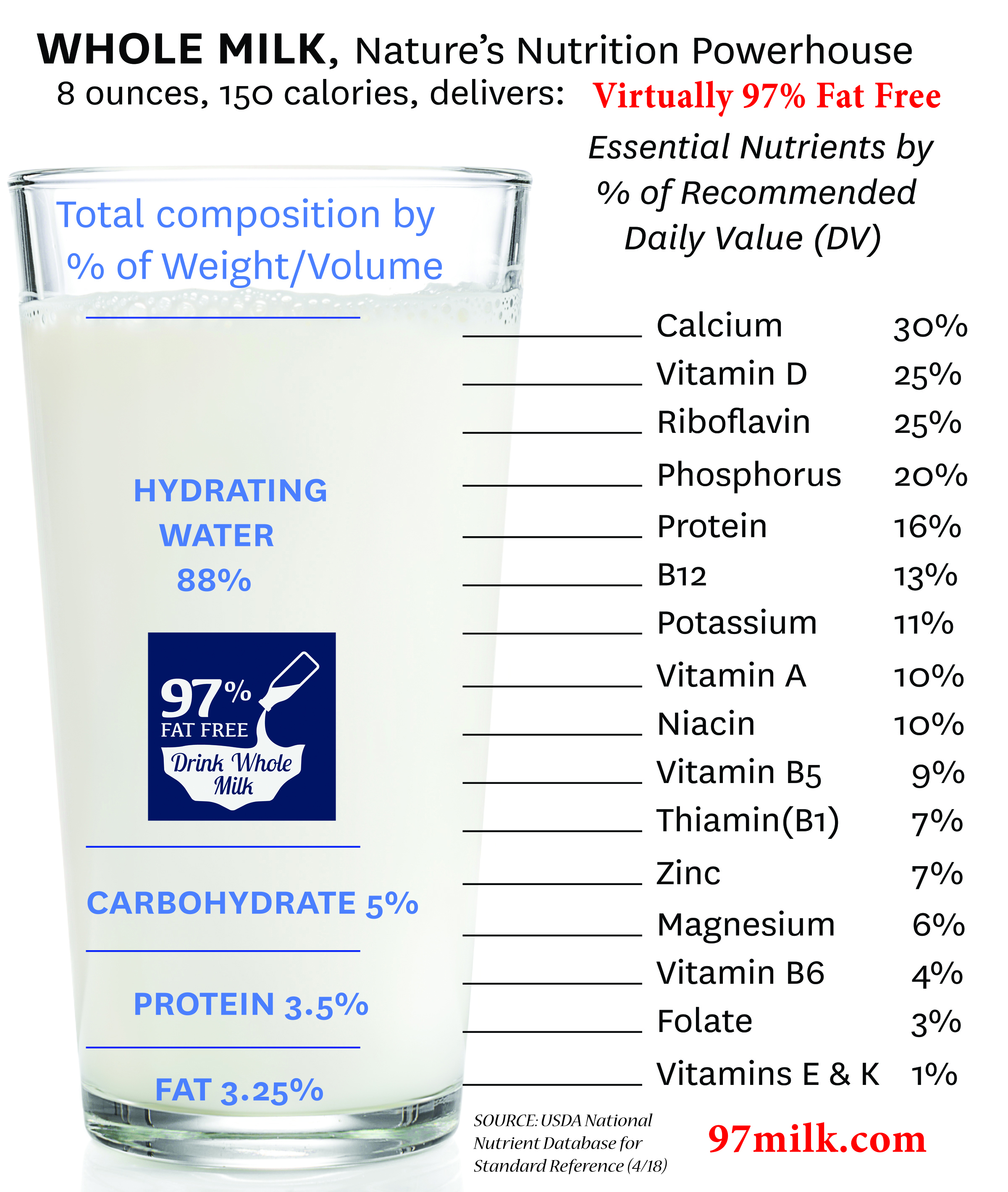
“Milk is the No. 1 source of nine essential nutrients in the diets of our students, but if they don’t drink it these health benefits are lost,” Rep. Thompson said in a press release Wednesday (Jan. 30). “Milk consumption has been declining in schools throughout the nation because kids are not consuming the varieties of milk being made available to them. It is my hope that the Whole Milk for Healthy Kids Act will bring a wider range of milk options to American lunchrooms so students can choose the kind they love best.”

“I’m proud to join Congressman Thompson in this effort that will provide more choices for nutritious and healthy milk to kids in schools, and a valuable market for dairy farmers in Minnesota, Pennsylvania and nationwide at a time when they’re continuing to face extremely difficult market conditions,” Chairman Peterson said in a statement.

Rep. Peterson is Chairman of the House Ag Committee and Rep. Thompson is a member of the House Ag Committee.

Thompson is also a member of the House Committee on Education and Workforce to which the bill was referred after its introduction on Jan. 29.

The nine original co-sponsors of the bill include Agriculture Committee Republican Leader Mike Conaway (R-TX) and three members of the Committee on Education and Workforce to which the bill was referred — Rep. Lloyd Smucker (R-PA), Rep. Dan Meuser (R-PA) and Rep. Elise Stefanik (R-NY).

Additional co-sponsors are Rep. Chris Collins (R-NY), Rep. Rodney Davis (R-IL), Rep. John Joyce (R-PA), and Rep. Mike Kelly(R-PA).

In a press release late last week, Thompson gave some background on this bill. He noted that in 2010, Congress passed the Healthy, Hunger-Free Kids Act which amended nutrition standards in the School Lunch Program.  Among the changes, the law mandated that flavored milk must be fat-free within the program.

This 2010 law, along with lower participation in the program, led to an alarming decline in milk consumption in schools since 2010. Declining milk consumption in schools not only impacts students, but also dairy farm families and rural communities across the nation.

Two years ago, to help encourage nutritious options in the School Lunch Program and increase consumption, Rep. Thompson introduced legislation – H.R. 4101, the School Milk Nutrition Act of 2017 – which provided schools the option to serve 1% low-fat flavored milk varieties.

In May of 2017, the USDA announced a rule that allowed schools to receive waivers for low-fat (1%) flavored milk, rather than only fat-free, which is the essence of H.R. 4101.

On January 29, 2019, Rep. Thompson introduced this bipartisan bill — H.R. 832, the Whole Milk for Healthy Kids Act of 2019. This legislation builds on the previous bill and USDA’s rule by allowing whole milk (both unflavored and flavored) to be offered within the School Lunch Program.

Producers and consumers are urged to contact their representatives to support this bill. Key members of Congress to reach out to on the Committee on Education and Workforce, which will be the committee to consider the bill, include Rep. Joe Courtney (D-CT), Chairman Bobby Scott (D-VA), Rep. Marsha Fudge (D-OH). View all Congressmen and women serving on this committee here

Follow the progress of H.R. 832, the Whole Milk for Healthy Kids Act of 2019 here.

-30-

Are dairy farmers funding their demise? USDA ‘straight-jackets’ promotion; GENYOUth alliances suspicious

AUTHOR’S NOTE: This is Part 2 of an investigative report on GENYOUth, which began with USDA contacting National Dairy Council in Sept. 2009, National Dairy Council contacting National Football League in 2009/10 and an official signing of a memorandum of understanding (MOU) between NDC and NFL with USDA in February 2011. 

By Sherry Bunting, from Farmshine, Friday, January 18, 2019

They call it “the dairy farmers’ youth wellness program,” but GENYOUth is under the thumb of USDA with some questionable corporate alliances and trends underway.

This multi-part series looks at GENYOUth’s founding, its alliances, its mixed-messages, intended and unintended consequences, its partners and the new alternative products they are and will be introducing into the nutritional vacuum paved by low-fat and fat-free promotion, the winners and losers, and the impact on our dairy farms, and our children.

Let’s pick up where we left off from last week’s Part One.

Helping America’s youth lead better and healthier lives is a worthy pursuit, and there is no intention here to blame good-hearted people trying to do good within the straight-jacket of USDA control. What is being questioned is the direction. What is being exposed is the roots of the oak tree and its impact on our dairy farms and our children.

The problem with the GENYOUth model is that it is primarily funded by mandatory dairy check-off dollars and the government control of it.

The anti-animal and environmental NGO’s (non-governmental organizations) are driving decisions by Big Food, Big Ag, Big Government (and the World Health Organization). And there are new billionaire corporate “sustainability” alliances poised to profit on this main course, while dairy farmer GENYOUth “founders” hope for crumbs.

GENYOUth began in 2010 as a memorandum of understanding (MOU) between National Dairy Council and National Football League with the U.S. Departments of Agriculture, Education, and Health and Human Services. This six-way MOU was officially signed on Feb. 4, 2011 during the Superbowl that year (below).

GENYOUth-MOU(2011).jpg

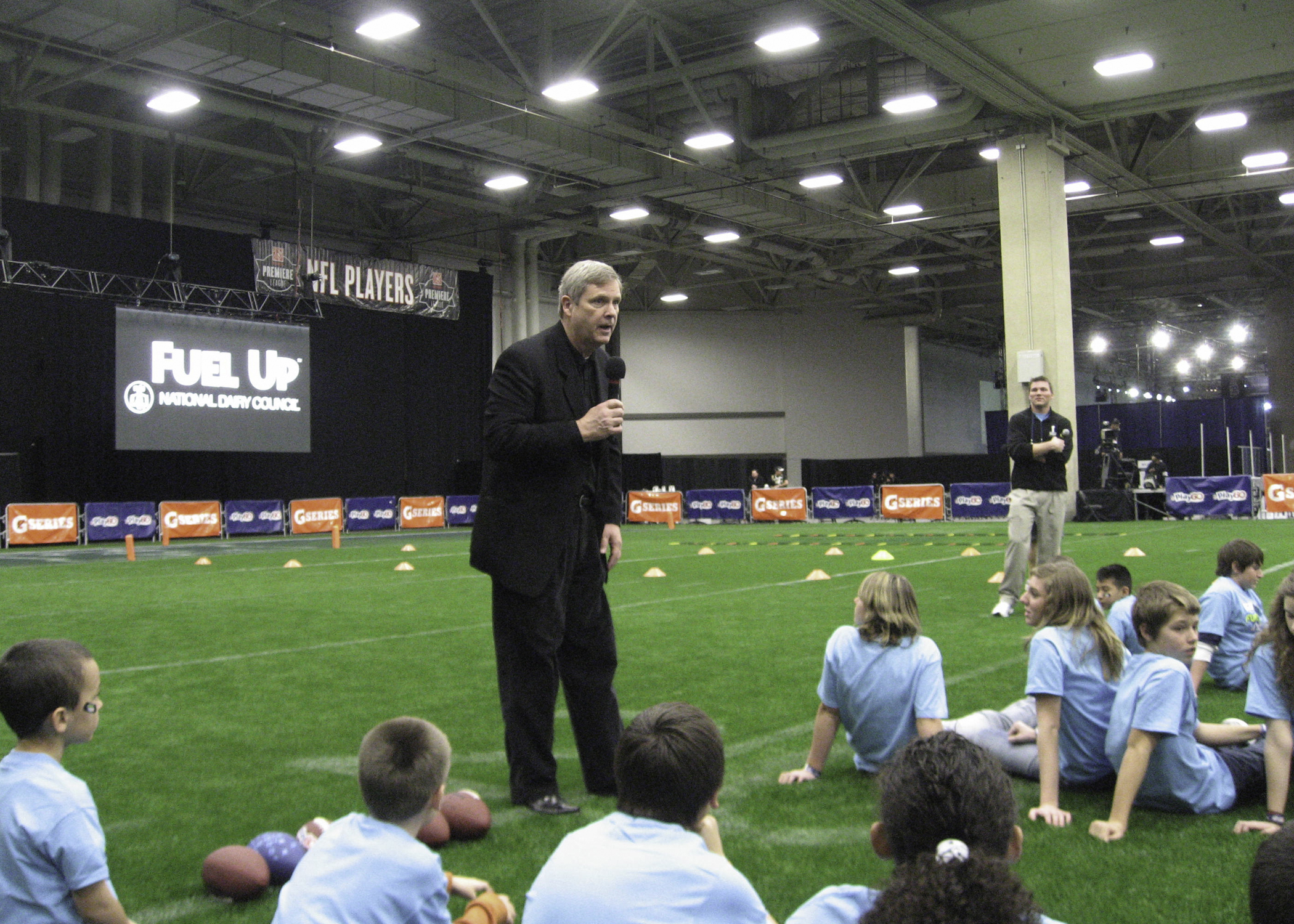
This 2011 USDA photo found on a USDA flickr stream shows lots of cameras, but few, if any, dairy farming publications were notified. The Memorandum of Understanding (MOU) was signed Fri., Feb. 4, 2011 during Superbowl week in Dallas Texas. It had been under development since Sept. 2009. The MOU outlined the joint commitment of the NFL, USDA, National Dairy Council, GENYOUth Foundation, to end childhood obesity. Signing from left were NDC President Jean Regalie, Ag Secretary Tom Vilsack, NFL Commissioner Roger Goodell, GENYOUth CEO Alexis Glick.

According to Guidestar, the non-profit is listed under the name Youth Improved Incorporated (aka GENYOUth) with the tagline ‘exercise your influence.’ It refers to itself as an NGO. (NGO is defined as “a nonprofit organization that operates independently of any government, typically one whose purpose is to address a social or political issue.”)

GENYOUth was launched to increase physical activity among schoolchildren as well as to encourage healthy eating with emphasis on school breakfast and then mobile breakfast carts. The 2014 (most recent) progress report noted that 73,000 schools and 38 million children had been reached by Fuel Up to Play 60 (FUTP60), affecting the health and wellness of an estimated 14 million students’.

The only reference to dairy in the FUTP60 message pounded home about fruits, vegetables and whole grains is the inclusion of low-fat and fat-free dairy.

A year ago at a bank meeting in front of 500 farmers, then U.S. House Ag Committee vice chair G.T. Thompson of Pennsylvania said he wanted his healthy school milk bill to bring the standard up to 2% or whole milk, but, he said “producers and processors came to me and told me to go slow, to keep it at 1% and take baby-steps.”

Who were the “producers” and “processors” coming to him with that request? National Milk Producers Federation (NMPF), International Dairy Foods Association (IDFA) and the check-off MOU under the thumb of USDA.

Those same entities then turn around and tell grassroots farmers that they are forced to work within the confines of what USDA will allow. And so, the circular argument continues. Round and round we go.

Which brings us back to the Nov. 27, 2018 GENYOUth Gala in New York City and the Vanguard Award to PepsiCo.

PepsiCo has been a GENYOUth partner for seven years. In 2018, PepsiCo not only paid its “hero” sponsorship of $150,000 for the event, they gave an additional $1 million for the purchase of 45 additional mobile breakfast carts and the Espanol version of FUTP60.

According to the only piece of the 2011 MOU that can be found, the NFL, NDC, and GENYOUth have agreed not to use FUTP60 “as a vehicle to sell or promote products or services.” But it is clear that the NFL and other corporate partners, like Pepsi, have brand recognition.

How is dairy’s brand recognized? Hats are tipped at the Gala to “America’s dairy farmers” as the founders who launched the platform. But they are hog-tied by generic promotion and exclusion of the full nutritional value of their product — whole milk, real butter and real cheese — within the government straight-jacket.

GENYOUth was created while Tom Vilsack was Secretary of Agriculture (below). According to cross-posted blog entries between DMI and USDA near the end of 2009: “The USDA discussed in September (2009) a plan to develop the Memorandum of Understanding (MOU) between USDA, the NFL and DMI to allow USDA programs and Fuel Up to Play 60 to collaborate and collectively tackle the critical issue of children’s health.”

VILSACK-FUTP60(2011).jpg

Former Secretary of Agriculture Tom Vilsack, who is currently CEO of the check-off funded U.S. Dairy Export Council (USDEC), is photographed in 2011 with young people during Superbowl week in Dallas, Texas, after the signing of the 2011 GENYOUth MOU — 18 months after USDA first discussed the plan for the MOU with the National Dairy Council and a year after NFL commissioner Roger Goodell says Tom Gallagher of DMI approached him. 2011 USDA photo

When former President Bill Clinton was invited to speak about Vilsack at the 2017 Gala where Vilsack was presented with the 2017 Vanguard Award, Clinton, a vegan, talked about every entity in the “diverse partnership” that he was celebrating — except for America’s dairy farmers.

He talked about how children receive 40 to 60% of their calories from drinks in school. He talked about turning the obesity epidemic around by everyone taking responsibility in that area. He talked about how Vilsack’s leadership with Michelle Obama, made beverages and snacks abide by the fat-free rules, including school vending machines. He talked about how Vilsack was instrumental “under the radar… working for a healthier generation of kids before coming to USDA and before the launch of GENYOUth.”

Meanwhile, the more the government’s direction squeezes healthy fat from the diet, the more the obesity figures in children continue to grow.

This year, at the 2018 Gala, GENYOUth CEO Alexis Glick thanked each partner. “We give a heartfelt thank you to our founding partners America’s dairy farmers and the National Football League and the players association,” said Glick in a YouTube video of the November Gala. She had previously thanked longtime partners Land O’Lakes and Domino’s while also acknowledging Mike and Sue McCloskey (fairlife) as well as Leprino and Schreiber.

“I say to our farmers: You had a dream. And we have been blessed to be part of that dream. You gave us life. You believed in us. And can you believe we are standing here today on the cusp of the 10-year anniversary of FUTP60?” she said.

“And we extend an extra special thank you to PepsiCo,” Glick continued. “The generosity of your vision, your resources, your team, time and talent have changed our organization.”

In accepting the Vanguard Award on behalf of PepsiCo, CEO Albert Carey said: “We’ve had a wonderful partnership with the NFL over the years… doing things together like the Pepsi half-time show and Gatorade sidelines. We have had ads and retail programs for both of our brands,” he said.

“But the one NFL program our team noticed probably 10 years ago, or maybe 9 years ago, is one we have admired and wanted to be part of and that was Play 60,” said Carey, careful not to include the Fuel Up (dairy) part of the Play 60 tagline.

Carey said “you guys are doing a fantastic job inspiring kids… using football role models.”

He went on to say that PepsiCo wanted to be part of the program because of the importance of kids being active.

“But we also believe at PepsiCo that we need to provide healthy products for our consumers,” said Carey. “Some of you may be familiar with our mission ‘performance with purpose.’”

He described this as “getting great business performance while also serving others… on the part of the environment… or many other ways, but this one particular way is about providing healthier foods for our consumers.”

Carey said he thought PepsiCo had done a pretty good job at this over the past several years, “but we haven’t talked about it much. You see some obvious things like Pepsi zero sugar, Gatorade Zero,” he said. “But you don’t hear much about Bubbly Sparkling Water, Life Water, Quaker oat milk, and we just bought a company called Bare Snacks and our Kevita Kombucha products (probiotic drinks).”

He mentioned that the Quaker oat beverage, which he personally called “oat milk” but in reality this product is labeled “oat beverage for cereal, smoothies, coffee and more”. It is being launched this month and will be in stores by March.

The PepsiCo website mentions these products as part of the company’s commitment to further the World Health Organization goals of alternative products to reduce saturated fat consumption and reduce greenhouse gas emissions, thereby improving global environmental and nutritional sustainability.

Carey said the “oat milk” and bare snacks and probiotic drinks are part of PepsiCo goal of “converting its portfolio to healthier foods for the future.”

In fact, PepsiCo is also in development of so-called non-dairy ‘cheese’ and ‘yogurt’ snacks through its “Nutrition Greenhouse Accelerator program, including the purchase of Health Warrior, which PepsiCo said in an October 2018 Food and Beverage article “is a nutrition-forward trailblazer that can provide great insight into high value categories and consumers while benefiting from our expertise and resources to bring plant-based nutrition to more people.”

Meanwhile, the GENYOUth program bestowed the 2018 GENYOUth Vanguard Award on PepsiCo for its seven years of partnership and its commitment to give an additional $1 million, which PepsiCo’s Carey said would fund Play 60 in Espanol as well as 45 new mobile school breakfast carts, bringing PepsiCo’s cart total to 100.

It will be interesting to see what may appear on these carts in the future, given the new oat beverage, plant-based probiotic drinks, and other “Nutrition Greenhouse” products emerging in the PepsiCo portfolio.

-30-

Rep. Marino introduces Whole Milk Act

Seeks to make school milk great again by making it whole again

By Sherry Bunting, reprinted from Farmshine May 4, 2018

d3938-1 (1).jpg

Peggy Greb, USDA ARS

WASHINGTON, D.C. — It has been talked about for years, and the evidence has been put before USDA and the Dietary Guidelines Advisory Committee even before the 2015 cycle began, but while the caps on cholesterol were removed, freeing the egg industry to promote the healthiness of eggs, the caps on saturated fat were left where they are, despite the same body of research and investigation showing just how flawed the 30-plus years of deteriorating dietary advice were from the beginning.

Meanwhile, schoolchildren continue to be served only fat-free and lowfat milk, and this means a huge lost opportunity to serve children the best tasting best nutrition available while improving the loss of milk markets and value affecting dairy farmers across the nation.

Tom-Marino.jpg

Congressman Tom Marino (PA-10th)

In fact, by at least one estimate, the move by the Obama administration to reduce flavored milk from lowfat (1%) to fat-free, alone, resulted in lost sales of 288 million cartons of milk since 2014 — not to mention milk on the school lunch tray ending up in the trash.

Congressman Tom Marino, representing Pennsylvania’s 10th legislative district seeks to put an end to this loss of dairy nutrition and markets. Last Thursday, April 26, he introduced The Whole Milk Act, H.R. 5640, which was referred to the Committee on Education and Workforce. Rep. Virginia Foxx of North Carolina chairs this committee, and G.T. Thompson of Pennsylvania, who serves as vice chair of the Ag Committee, also is a member of the Education and Workforce Committee.

In fact, Rep. Thompson later signed on to become an original cosponsor of Marino’s Whole Milk Act.

Rep. Thompson has a separate bill as well, which was introduced last year to codify the small administrative step taken by Secretary Sonny Perdue last fall, allowing 1% lowfat flavored milk to be served in schools instead of the previous rule of fat-free-only. Choices for white milk were already at 1%. Not much forward movement has been seen in the School Milk bill introduced by Thompson.

Marino’s H.R. 5640 affects the unflavored milk offered by schools. It seeks to amend the Richard B. Russell National School Lunch Act to allow schools that participate in the National School Lunch Program to serve unflavored whole milk.

Rep. Marino also sent a letter to Secretary Perdue last week, asking USDA to update guidelines to the National School Lunch Program to allow schools to sell unflavored whole milk during lunch.

“Under the Obama Administration, schools participating in the National School Lunch Program were barred from selling unflavored whole milk and could only sell 1% unflavored milk,” said Rep. Marino in a statement.

“When the Obama Administration changed the National School Lunch Program to allow only 1% unflavored milk to be sold during school lunches, they claimed to be doing a service for our school children,” Marino’s statement indicated. “We saw the complete opposite, children stopped drinking milk in school, and food waste went up.”

Marino referenced the “Numerous studies that have shown consuming unflavored whole milk to be a good way to prevent childhood obesity and help your body absorb more vitamins. This bill will not only help our children get the proper nutrition they need to lead a healthy lifestyle, but will also help America’s dairy farmers who have been struggling with stagnant milk prices.  I strongly urge my colleagues in the House to support this bill.”

While this bill will not, by itself, correct the issues with milk and dairy in the National School Lunch Program, with its questionable rules on the percentage of lunch calories that are allowed to come from fat, the truth is that if this bill is taken up by the committee and is voted on, passed and signed by the President, it does send a strong message that the needle must move on this issue sooner, rather than later.

Early this week, Nina Teicholz, author of The Big Fat Surprise and founder of the Nutrition Coalition, tweeted her support for H.R. 5640.

“This bill is supported by the science!” writes Teicholz. “Never was there any science (to begin with) to show that kids should restrict their consumption of saturated fats; fats, nutrients are needed for growth.”

The Nutrition Coalition echoed, stating that H.R. 5640, The Whole Milk Act, “is supported by peer-reviewed science showing whole-fat milk is equal to or better for kids than skim.”

In fact, at issue is that while both skim and whole milk contain the 9 essential vitamins found in milk, those 9 essential vitamins do no child any good in their school lunch or breakfast if they don’t make their way from the carton to the belly and end up instead in the trash.

One thing is for sure. Whole milk tastes better. Giving schools this choice allows whole milk, at just 3.25 to 3.5% fat, or even 2% to be the more nourishing choice because it is more likely to be consumed. With better tasting milk at school and the satiety of these healthy fats, children can think better, and this would be a positive step toward turning around the epidemic of childhood obesity and diabetes.

Nina Teicholz-27

With this graph showing the rise in obesity as the Dietary Guidelines worsened from the McGovern food pyramid through today, Big Fat Surprise author Nina Teicholz told PA Dairy Summit attendees in February that this graph, itself, does not show causation, but she revealed the growing number of studies that have proved it as well.

A growing number of cardiologists are already making this recommendation to patients as the veil has been lifted to reveal that consuming fats is not what is making us fat. (See Chart 1).

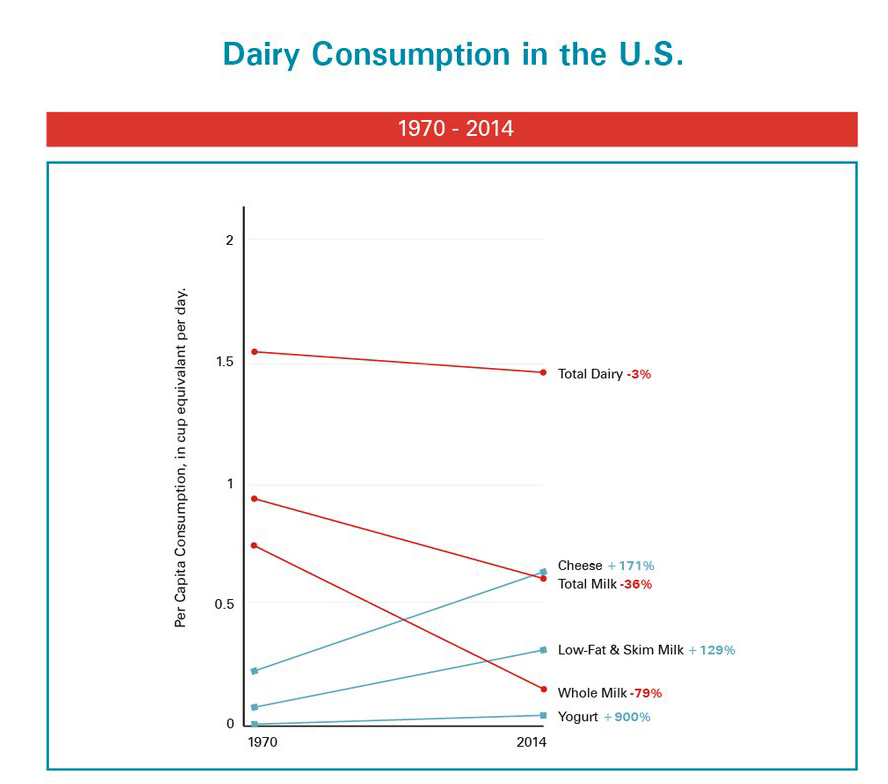
Chart 2Meanwhile, Teicholz shows that, “The introduction of skim milk is arguably what turned kids away from milk altogether (because it tastes bad); then kids turn to sugar-filled options instead,” she writes on Twitter. “The drop in milk consumption is driven by the decline in whole milk.” (See Chart 2).

In a separate letter to Agriculture Secretary Sonny Perdue, Rep. Marino notes that “The Healthy, Hunger-Free Kids Act of 2010 required USDA to update federal nutrition standards for school meals. This update included schools only being able to offer one cup of fat-free or I% milk. These changes have led to a decrease in milk consumption and a significant increase in food waste in schools. Additionally, these guidelines have negatively impacted America’s dairy farmers who have been suffering from low milk prices and a significant decrease in the purchase of fluid milk.”

He notes that not only is milk the number one source of 9 essential nutrients, “it also provides  significant health benefits. For instance, Conjugated Linoleic Acid (CLA), a fatty acid found in milk, has been shown to reduce the risk of cancer and is a great source of protein,” writes Marino. “Furthemore, if children do not drink milk, it is very difficult for them to get sufficient amounts of three of the four major nutrients lacking in most children’s diets: calcium, potassium, and Vitamin D.”

Marino notes that the bonus is that “increased milk sales would help America’s dairy farmers who have been impacted by stagnant milk prices.

There are several ways we can all help support Rep. Marino’s Whole Milk Act.

First, contact your cooperative board members and ask them to let National Milk Producers Federation know that the dairy producers they represent want this bill supported. Contact organizations you are a member of, including your state Farm Bureau and the American Farm Bureau Federation and state and national breed associations, for example.

Most importantly, contact your representative in the U.S. House and ask them to cosponsor and support H.R. 5640 The Whole Milk Act. If you don’t know who to call, enter your zipcode here to find out who represents you

Also, call the U.S. House of Representatives at 202-225-3121 and let them know that H.R. 5640 is important for the health and well-being of our schoolchildren.

In addition, check this link to the Education and Workforce Committee and look for members who may be from your state, contact them, and the Committee chairwoman as well. Ask them to put this bill on the committee’s agenda. Its passage must begin in this committee.

Also, write to Agriculture Secretary Sonny Perdue or contact the USDA with your support for the letter Rep. Marino has sent in conjunction with introducing H.R. 5640 The Whole Milk Act. USDA is key to making school milk great again by making it whole again.

Finally, contact Rep. Marino’s office and thank him 202-225-3731.

Follow H.R. 5640, The Whole Milk Act, at this link.


-30-

Caption

TomMarino

At the Farm Bill hearing during the Pa. Farm Show in Harrisburg in January, Rep. Tom Marino was part of the panel. While he does not serve on the Ag Committee, he has attended this hearing the past two years it was held. He spoke from the heart and admitted he is not the most well-versed in agriculture and since he does not sit on the ag committee, has less influence on these things, but he said he comes home late at night from Washington and sees the lights on at the dairy farms in his district, sees the activity going on on the farms, sees what people put into producing a quality product and hears from constituents on these issues of school milk — brought up at Farm Show hearings also. He said at the 2018 hearing that he is tired of seeing things that don’t make sense and he said if the government is involved in these things, they better be getting it right or they should not be involved. Last week, Rep. Marino introduced The Whole Milk Act, H.R. 5640, to bring whole milk back to the National School Lunch Program. Photo by Sherry Bunting


There’s a war to win for our health and our dairy producers

NinaTeicholz0181Learn, then comment! Deadline: March 30!

By Sherry Bunting, Farmshine March 2, 2018

STATE COLLEGE, Pa. – Never did Nina Teicholz envision herself talking about nutrition to groups of dairy and livestock producers and hearing how important it was to them to hear that the work they care deeply about and the product they produce is good, great, healthy, in its full-fat form after decades of being maligned by flawed advice for a low fat or fat free diet.

Nina Teicholz-27“Not only has this advice been bad for people, it is especially bad for children,” said Teicholz as she told her story of a decade of investigation met by intimidation uncovering stories of a scientist who bullied others who had alternative hypotheses and a powerful nutrition elite still controlling the food supply through their grip on Dietary Guidelines.

The author of New York Times best seller The Big Fat Surprise has not only challenged but also disproved the anti-fat dogma of 40 years and revealed the politics that have overshadowed the science in the confusing world of diets and nutrition.

In fact, she says, the power of an elite class of experts who control nutrition guidelines that in turn control the food supply is still strong and very tough to overcome – even when the evidence is not on their side.
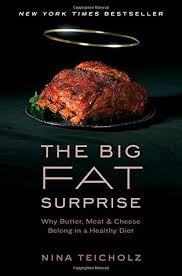
imagesTeicholz’s Big Fat Surprise has had a ripple effect in the food industry among consumers since 2014,but the dietary elites have challenged her each step of the way.

And there’s a lot of war left to be fought for what is right.

This is especially true when it comes to the milk the USDA prohibits from being served in the National School Lunch program or through Women, Infants and Children (WIC) programs.

The intimidation that Teicholz and others have endured shows just how much is at stake and just how tough the politics are in trumping the science. With a steady drumbeat of proof, one would think the bad advice could be easily overturned, but the work is hard and it needs to continue, Teicholz indicates.

(Not only are the flawed guidelines affecting health, but also reverberating in their economic effects on family farms across the country, in part aided by the dairy industry accepting a role in working alongside former first lady Michelle Obama when it came to school meals, allowing her to deal the final blow to milk in school, while accepted yogurt on the plate as a compromise.)

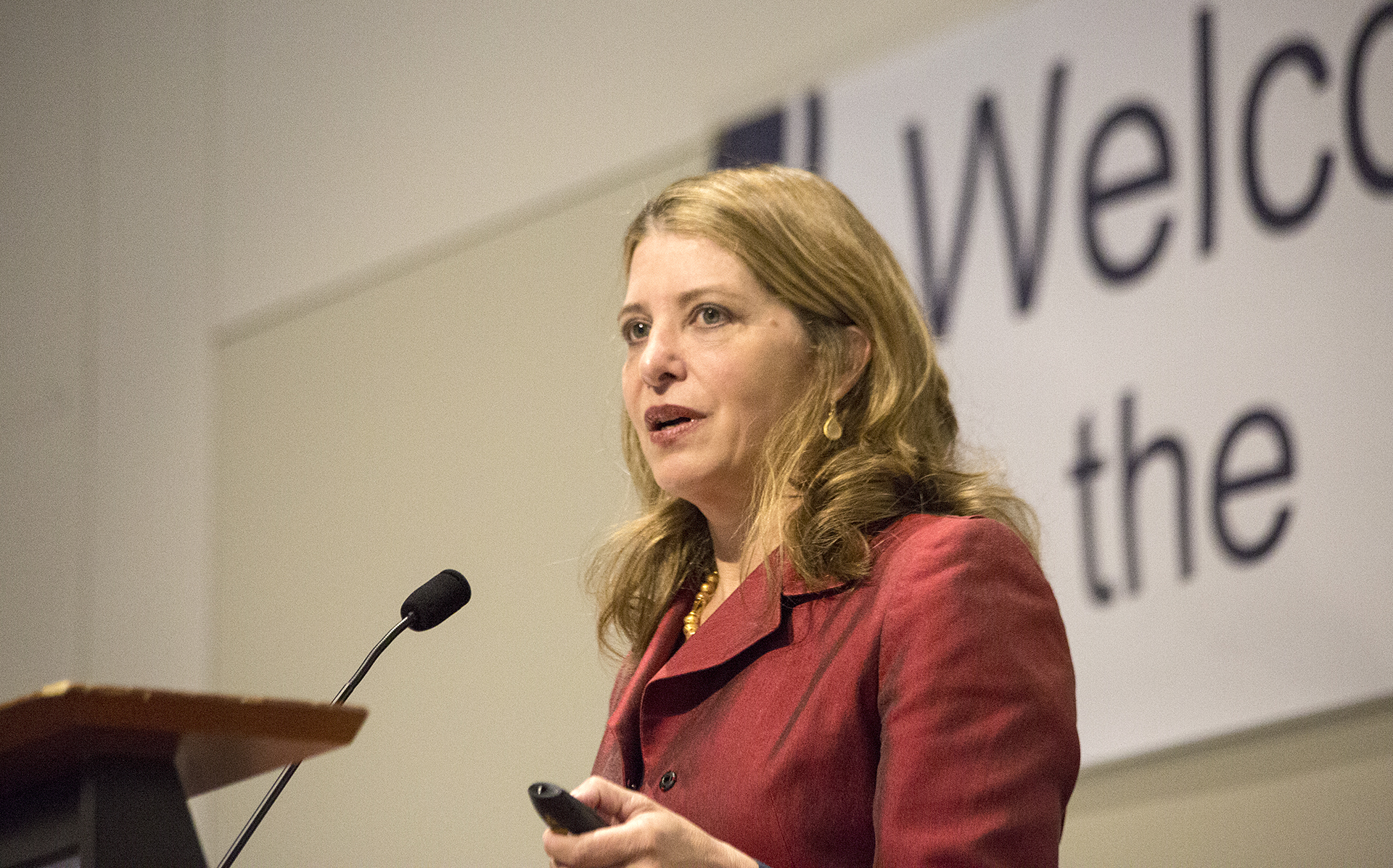
Nina Teicholz kicked off the 2018 Pennsylvania Dairy Summit last Wednesday, Feb. 21 here in State College, treating nearly 500 dairy producers and industry representatives to an inside look at her 10 years of investigative journalism on this topic that began when her editor assigned her a piece on defining trans fats.

Little did she know then where this would lead her today. Who would have thought that the former vegetarian from Berkley, California and New York City would end up uncovering what may be the biggest nutritional tragedy done to consumers and dairy and livestock producers, worldwide.

She told Summit attendees that she began to suspect a problem when her initial inquiries started revealing a pattern of resistance.

“That’s where my deep dive into the world of fats began,” said Teicholz. “The fats we obsess about that have made us all crazy over what kind to eat and how much.”

She started hearing about scientists getting “visits” and papers being yanked from scientific journals. She started feeling the intimidation, herself, as she widened her investigative scope, reading scientific papers and seeking interviews with scientific experts at some of America’s most trusted universities and institutions.

“I would be interviewing scientists at top universities and they would hang up on me,” Teicholz revealed. “I thought, am I investigating the mob? What’s going on?”

Her deep dive into fats took her through a decade of work reading thousands of scientific papers and doing hundreds of interviews to write a book investigating the research on all fats in the diet.

“Every idea has a beginning, like an acorn to a tree,” said Teicholz, “and this had its beginning when President Eisenhower had a heart attack. This is when the concern about heart disease rose out of nowhere to be labeled the nation’s leading killer.”

Many ideas of causes were initially looked at, and then University of Minnesota physiology scientist Ancel Keys posited the cholesterol theory, that like hot oil down a cold stove pipe, would clog arteries and cause heart attacks.

Through her research, Teicholz discovered that so in love was Keys with his own theory that colleagues described his approach to the work of others as “bullying.”

“They described him as very charismatic and able to debate an idea to death. And, yes, a bully,” she said. “Once he was able to get his idea implemented into the American Heart Association, it was on.”

By 1960 he was on the nutrition committee and by 1961, “that acorn had grown into a giant oak tree of the advice leading to what we have today. The world transitioned from saturated to unsaturated fats,” said Teicholz. “But rarely do checks for common sense happen in the world of nutrition. Keys became ‘Mr. Cholesterol’ on the cover of Time Magazine with just one study.”

This study was not a randomized controlled study, but rather a series of contacts in seven countries relating diets to disease in middle-aged men.

Teicholz spent six months studying the Keys’ study. While it involved seven countries, the study looked only at the diets of middle-aged men and created this “big bang” theory. His study had been funded by the National Institutes of Health (NIH).

“But what happened is that Keys already had his idea. He loved his idea, and he set out to find what he found,” said Teicholz.

She outlined the numerous problems with the Keys study. It did not include countries with high consumption of fats and low rates of heart disease, which would have destroyed his hypothesis. He went to countries that were ravaged by war, not the countries that were eating well.

“And his star subjects were on the island of Crete, mainly hard-working peasants he worked with for three months one of which was during Lent, where he clearly undercounted the amount of fat these people ate,” Teicholz observed.

What was mind-boggling for Teicholz as she went through the record is that absolutely none of this theory — or the 40 years of advice that followed — is based on randomized controlled clinical trials.

“The government and the American Heart Association understood the evidence was weak, so the NIH funded a study to follow people through their death to set out to prove Keys’ theory this way,” she said.

Meanwhile it was being treated as gospel.

After more than a decade and following 75,655 men and women for one to 12 years, some of them with controlled in-patient diets, “The results showed no effect of saturated fats on cardiac mortality or total mortality!”

In fact, there was no effect whether subjects consumed 18% of their dietary calories in fat or 6%.

At the same time, Teicholz reports that people in the study, who had replaced fats with soy and margarine, had higher rates of cancer.

So, by this time in the presentation, it’s hard to keep the hair from standing up on your neck, and Teicholz asks the question: Why is this advice still around? Why is it still controlling food programs and markets?

“The politics explain so much more than the science,” she said. There is a small group of nutrition aristocrats controlling who they invite to lead panels or grant appearances, and they sit on editorial boards of medical journals and control these institutions.

“This is still true today,” said Teicholz, noting how an invitation for her to join a panel at an international conference was later withdrawn because the other people on the panel were key members of the U.S. Dietary Guidelines committee.

“This relative small (but obviously powerful) group does not include critics. They are the reason why we still have these ideas even if they are wrong,” said Teicholz.

An educated writer and scientist herself, Teicholz understands that scientists are trained to discover for themselves, but selective bias crept into nutrition the moment Ancel Keys at the University of Minnesota, fell in love with his own hypothesis.
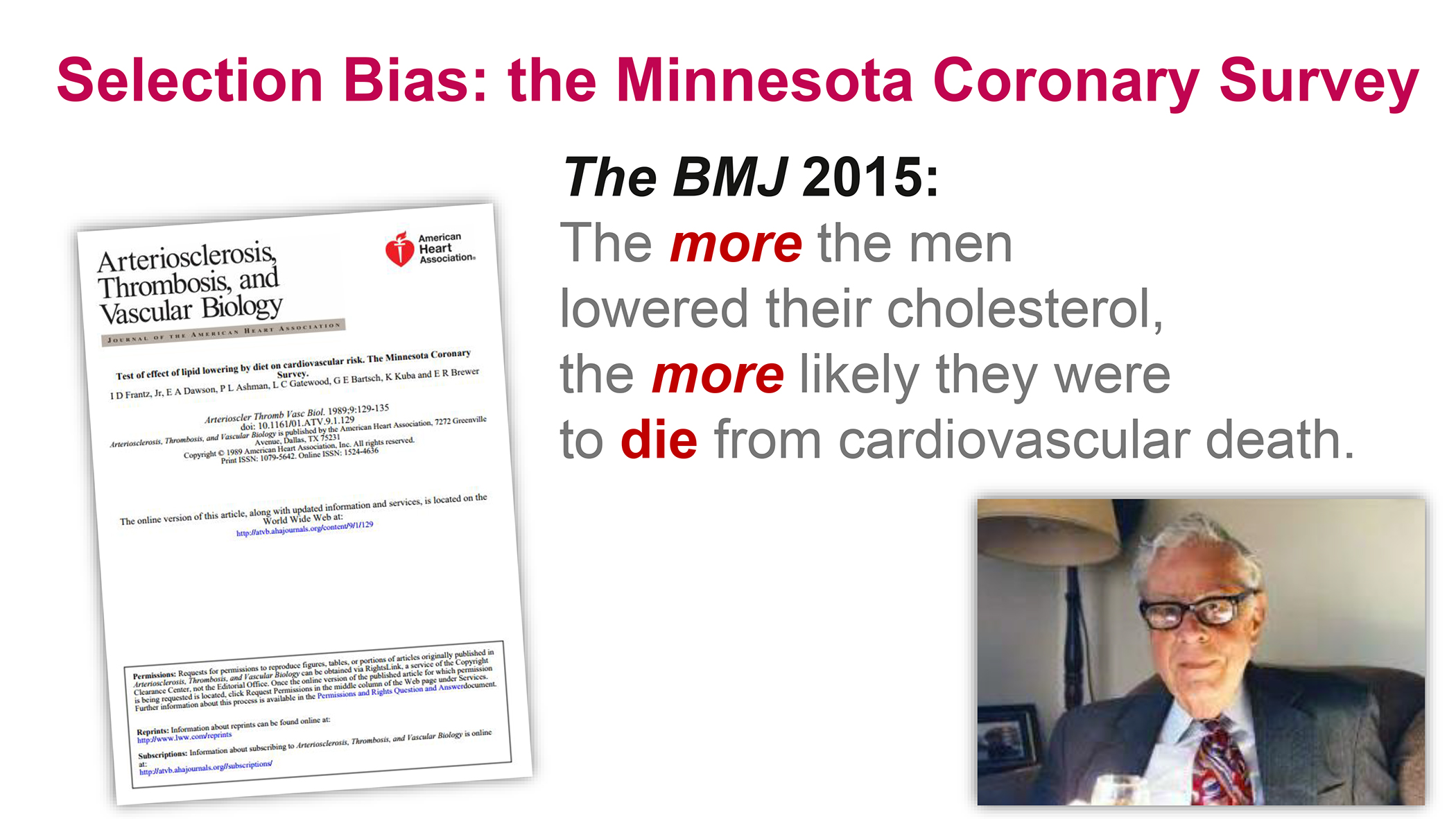
Nina Teicholz-25A colleague of Keys had done research with 5000 people around the same time, but it didn’t see the light of day. This Minnesota Coronary Survey found no difference from fat in the diet between treatment and control. It is the biggest and most well controlled study of its time but was not published for 16 years!

Teicholz explained further that when the competing research was ultimately published, long after the Keys hyposthesis had grown into an oak with roots, it was only published in an out-of-the-way journal.

Meanwhile, it was the 1980s and Senator George McGovern initiated the Dietary Goals report, written by staffers with no background in nutrition, some of them vegans. This formed the basis for the food pyramid.

From that point forward, Teicholz showed graphs of the increase in obesity and diabetes. But as a science-minded journalist, she reminded her audience that the graph, by itself, didn’t show causation. However, other studies have proved causation, and she shared those as well.

In fact, studies have been showing that Americans really have been following the flawed dietary guidelines and that while consumption of full fat dairy is down, and pounds of fruits and vegetables up 20 and 30%, along with grains and cereals up 30%, obesity and diabetes has risen exponentially.
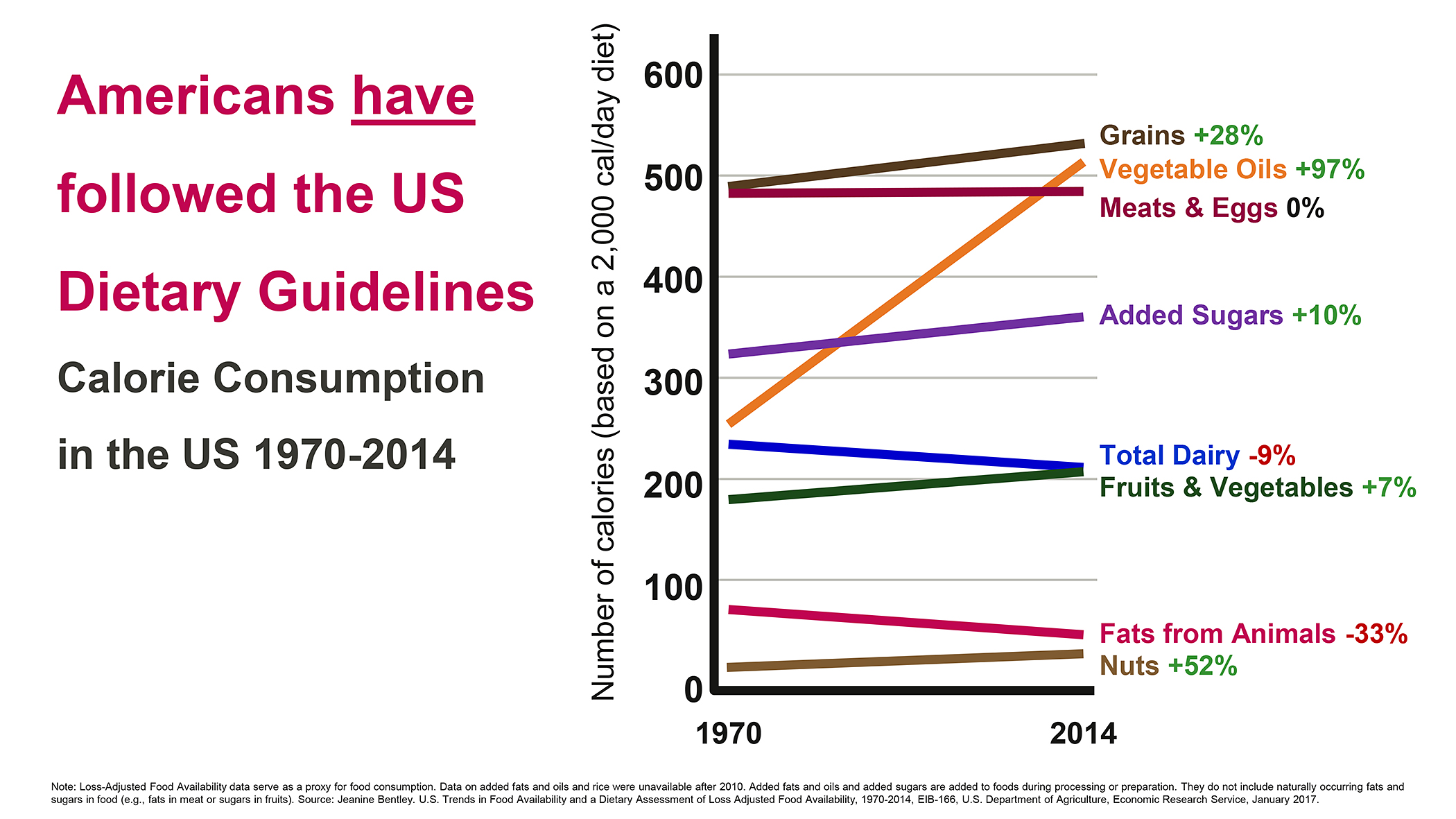
Nina Teicholz-29“We follow the guidelines and eat more calories, but all of those extra calories are coming from the increase in carbs,” said Teicholz.

So the third rail some say we dare not touch is that the hallmark recommendation of 60 minutes of exercise — meant to accompany the promotion of a low fat diet – was touched by Teicholz during her presentation.

The kicker is that Americans are not getting fat because they don’t exercise enough, she said. Not one study could show where this 60-minutes of exercise and a lowfat diet actually helped.
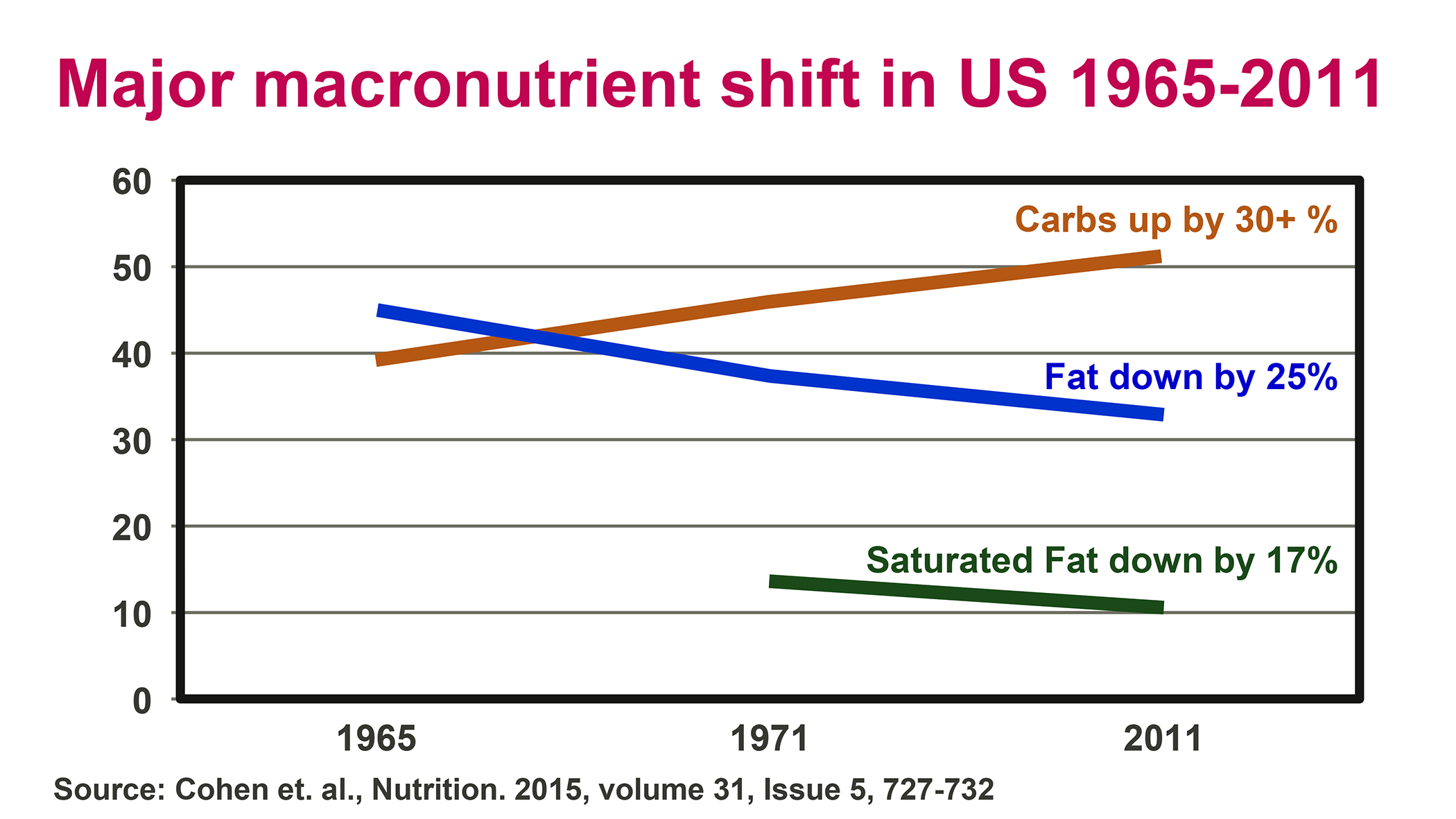
Nina Teicholz-30“We cannot exercise ourselves out of a bad diet,” said Teicholz. “Is it our own fault or is it the advice we have been given? I’m here to tell you that saturated fats do not cause cardiovascular death, and Canada is already working to remove the percent of fat requirement from their guidelines.”

In fact, Teicholz cited the work of Salin Ysuf, a leading cardiology specialist. His work showed that patients who ate the least amounts of fat had the highest risk of stroke and those who ate more, lived longer.

“We are in the midst of a paradigm change,” she said. “Cholesterol in the diet has not been proven to increase blood cholesterol. Eating egg whites instead of eggs has accomplished nothing.”

In a small step in 2013, the American Heart Association dropped its caps on cholesterol and this also occurred in the 2015 Dietary Guidelines. However, the recognition that a low fat diet doesn’t work has not made it to the dietary guidelines elite, and the next cycle to change them doesn’t happen until 2020.

“Fat is not making you fat,” said Teicholz. “It’s like a tragic horror movie. The truth is the fat we eat is not the fat we get.”

So what does cause disease? Teicholz explained the carb insulin hypothesis, where carbs become like glue in the bloodstream, and the body has to secrete insulin, a hormone, so the body socks this away as fat. She explained that not all carbs have the same effect and that gaining and losing weight also has a hormonal aspect being found as a key culprit in obesity and diabetes.

“There is a growing drumbeat of positive research coming out showing that whole dairy, full fat dairy, is good for cardio risk factors and that there should be no caps on cholesterol in the diet; however, the caps on saturated fat remain,” she said.

The reason the Dietary Guidelines are so powerful is that they control so much of what we think about what we are eating, according to Teicholz. She noted that soy milk has been allowed as a replacement for dairy milk in the Dietary Guidelines.

This is huge because these guidelines dictate what schools can serve, the WIC program and so many other aspects of nutrition where the government is involved.

“The Dietary Guidelines for Americans have huge control over the food supply, and trying to change them is so difficult because those in charge are so incredibly powerful,” said Teicholz.

This is why she has initiated the Nutrition Coalition to fight for our diets. Her aim is to have evidence-based Dietary Guidelines, and to see an end to the promotion of 60 minutes of exercise and a low fat, low sodium diet as what’s good for our children.

“This advice has not worked for people, and especially not for kids,” said Teicholz. At best, the 60 minutes of exercise is disingenuous when accompanied by low fat, high carb dietary advice, and at worst, the promotion of low fat and fat free is harmful.

Alas, her attempts so far, including a piece in a British medical journal about changing the flawed Dietary Guidelines was met with a petition signed by 180 nutrition aristocrats on the Dietary Guidelines committee, who demanded a retraction of Teicholz’s paper.

“It took them a year to put it out, but the BMC did their review and stood up strong for my paper,” she said. “This shows us just how much is at stake and how tough the politics are in this field of nutrition.”

Learn more about Teicholz’s work and the Nutrition Coalition she founded as well as how to comment by March 30, 2018 on issues to review in the Dietary Guidelines Advisory Committee’s next 5-year review for the 2020-2025 guidelines.
-30-

To read other agmoos articles / columns authored by Sherry Bunting on the School lunch program and dietary guidelines from the past several years, here is a link: https://agmoos.com/2015/04/24/nutrition-politics-kids-and-cattle-caught-in-the-crossfire/

About Nina Teicholz: Nina is an investigative journalist and author of the International (and New York Times) bestseller, The Big Fat Surprise (Simon & Schuster). The Economist named it No. 1 science book of 2014, and it was also named a 2014 *Best Book* by the Wall Street Journal, Forbes, Mother Jones, and Library Journal. The Big Fat Surprise has upended the conventional wisdom on dietary fat and challenged the very core of our nutrition policy. A review of the book in the American Journal of Clinical Nutrition said, “This book should be read by every nutritional science professional.”

Before taking a deep dive into researching nutrition science for nearly a decade, Teicholz was a reporter for National Public Radio and also contributed to many publications, including the Wall Street Journal, New York Times, Washington Post, The New Yorker, and The Economist. She attended Yale and Stanford where she studied biology and majored in American Studies. She has a master’s degree from Oxford University and resides in New York City.