Redner’s Markets lead with grassroots 97 Milk education

Dairy category sales are up, Whole milk is the star, up 14.5%
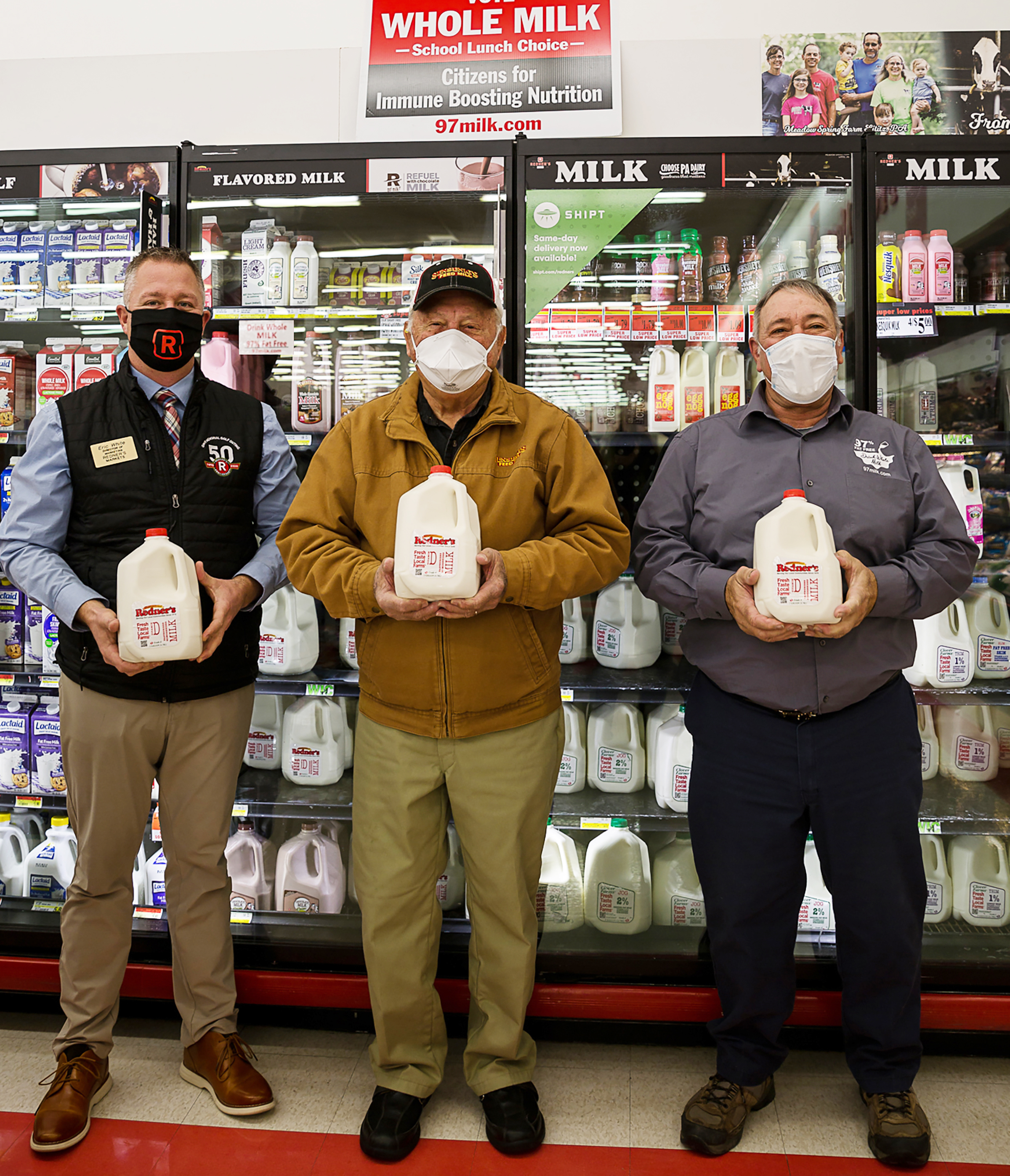
The Drink Whole Milk (virtually) 97% Fat Free dairy case stickers are up, and the “Whole Milk – School Lunch Choice – Citizens for Immune Boosting Nutrition” yard signs are being displayed at Redner’s Markets store locations. Bernie Morrissey (center) and Nelson Troutman (right) appreciate the way Redner’s and marketing director Eric White (left) are out in front as leaders in whole milk education.

By Sherry Bunting, Farmshine, December 18, 2020

SINKING SPRING, Pa. — “This is an easy message to sell, and sales of whole milk are way up,” said Eric White about the Drink Whole Milk (virtually) 97% Fat Free” grassroots milk education campaign.

White is director of marketing and communications for Redner’s Markets, headquartered in Reading, Pa. with 44 stores, 35 of them in central Pennsylvania, the balance in Maryland and Delaware.

He was not surprised by the grassroots marketing campaign for whole milk: The painted round bales started by Berks County dairy farmer Nelson Troutman, the banners promoted by retired agribusinessman Bernie Morrissey, and the social media and website promotion by 97 Milk. 

When Morrissey visited him some months ago, White was eager to join in.

The “Drink Whole Milk (virtually) 97% Fat Free stickers” are up on dairy cases at Redner’s Markets locations, White had them made with the signature red type on white background. Clover Farms Dairy, the milk bottler in Reading that supplies milk to all Redner’s stores, indicates they will be changing the case strips to promote whole milk too.

White is also putting up the “Whole Milk – School Lunch Choice – Citizens for Immune Boosting Nutrition” yard signs in the store above the dairy case and on the grounds as well.

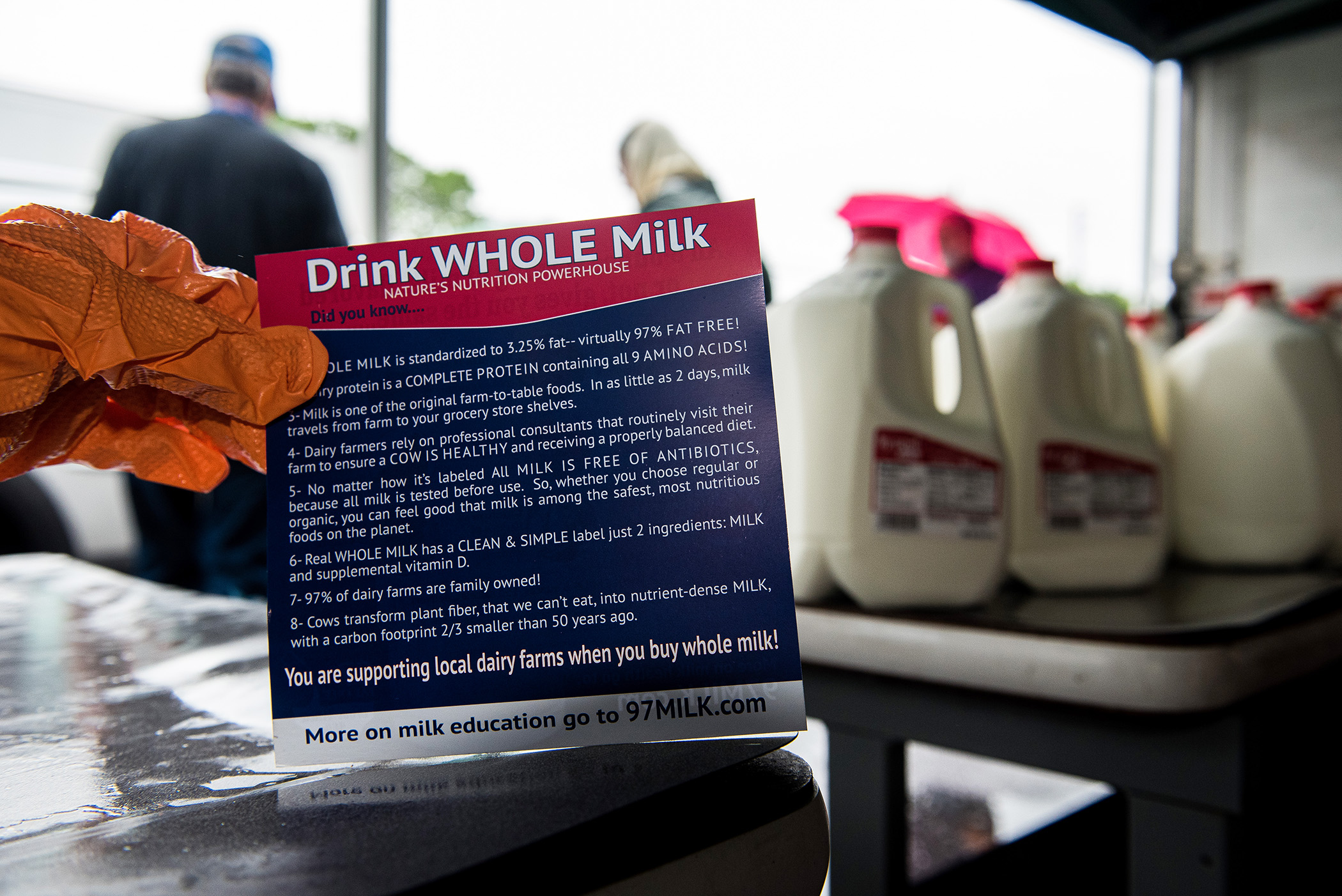
Both the grassroots stickers and the signs include the 97milk.com website where shoppers can get more information and milk education. The Redner’s Dairy cases also include the Choose PA Dairy signs, featuring photos of local farms, and the chocolate milk refuel signage from the national and regional checkoff programs.

During an interview at the dairy case in the Redner’s Sinking Spring store this week, the impact was clear: Whole milk in the jug is very much the star of the show.

In fact, the Redner’s brand, bottled by Clover, has always been whole milk. Whole milk is the only milk that gets the Redner’s name. It has always been that way, says White.

He confirmed their whole milk sales have increased dramatically. Yes, the Coronavirus pandemic has had some impact, he said: “But when I look at January through March numbers, that is how it was tracking even before the pandemic.

“I pulled the numbers, and we have seen a 14.5% increase in whole milk sales, alone, which is tremendous,” White confirmed. “The consumer message has changed, and we see people coming back to whole milk, knowing that they don’t need to drink the lower fat milk. We give our own kids whole milk at home now. It’s better for isotonic replenishment.”
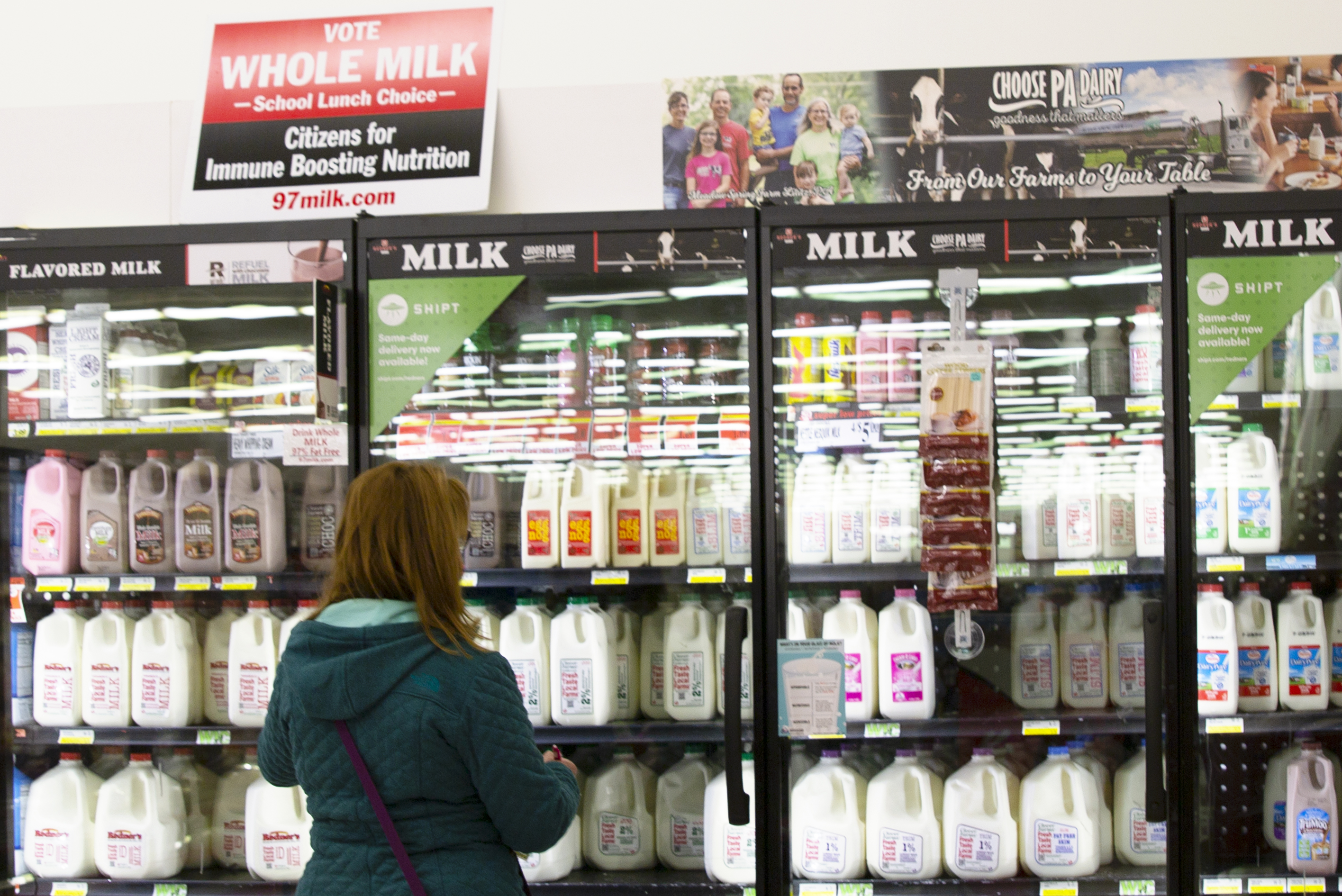
Sales of whole milk at Redner’s 44 stores are up 14.5%. The entire dairy category sales are up and milk is the star, especially whole milk.

White also reported that sales for the entire dairy case are up. 

“The whole dairy category is higher, with milk being the number one product selling from the dairy category, and whole milk the number one type of milk being sold,” he said.

White also sees how whole milk sales benefit local dairy farms. “There is a confluence in how these sales benefit local agriculture that we need to support more than ever. We are seeing the messages in the media. With digital and social media, the message spreads.”

“We want to thank Redner’s for being a leader,” said Morrissey. “They are pro-farmer, pro-education and pro-consumer. They are completely on the 97 Milk page of educating consumers about whole milk as immune boosting, like our sign says. Eric has been tremendous to work with. If every supermarket chain would start educating consumers about whole milk, we would see even more benefits for consumers and farmers. The secret is education, and Redner’s is the store that is out there in front of the pack, doing it.”
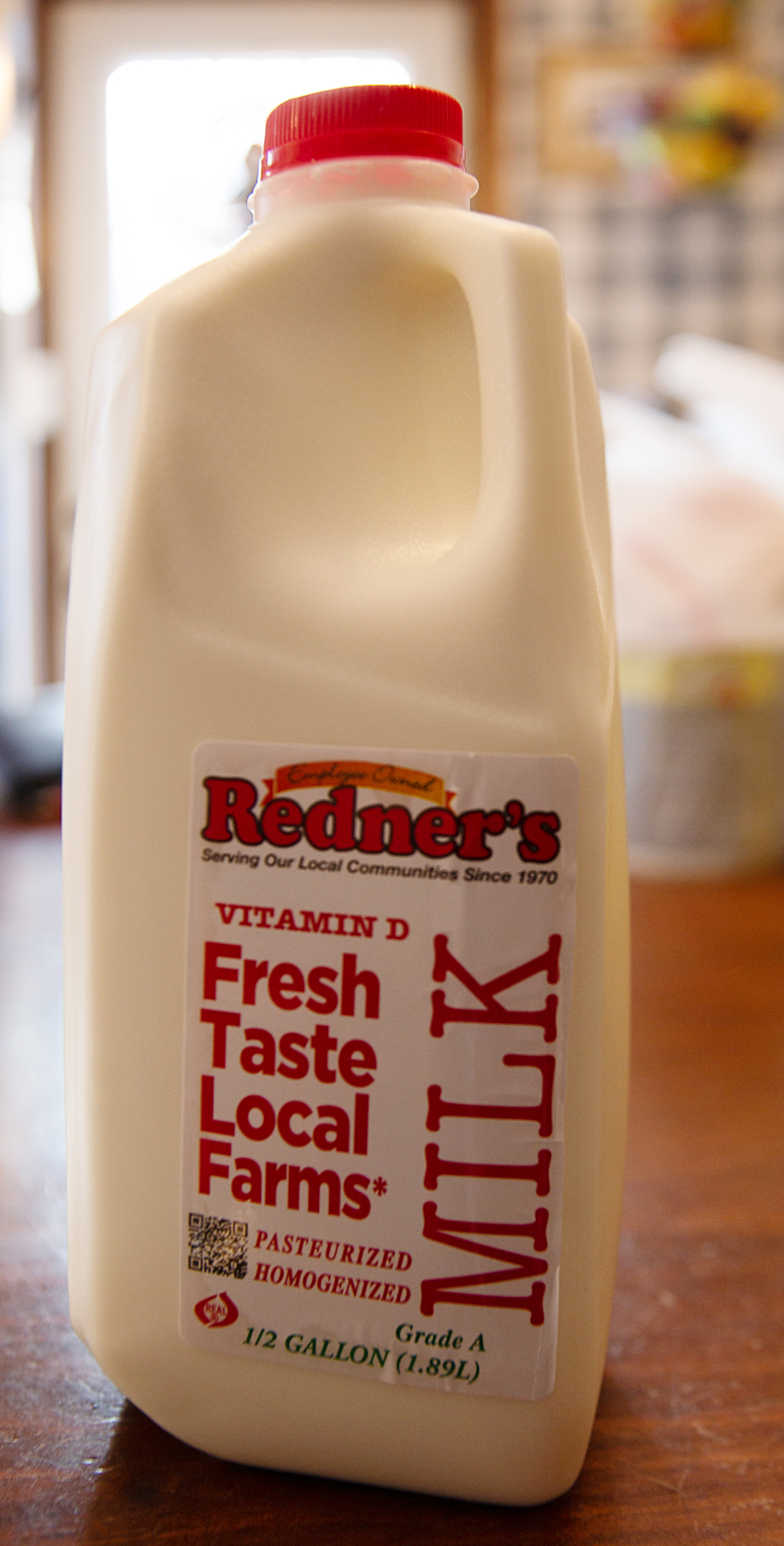
The Redner’s store brand, bottled by Clover Farms Dairy in Reading, Pa., has always been whole milk. 

Eric White has been with Redner’s for 22 years. He notes that they have long partnered with Clover Farms Dairy for their milk. They feature Clover milk in all of their stores, along with other local name brands, and of course, the Redner’s brand — whole milk — is bottled by Clover.

“It’s not that hard to do this,” said White. “We are a local family-owned company, and supporting this message brings it full circle back to the local dairy farms that are the backbone.

“We can underestimate why we are in business, and it is only because of the farms producing the food,” he observed. “Dairy and agriculture are the backbone of everything here in central Pennsylvania. A lot of businesses are here because of dairy. We are here selling food and feeding people because of the farms.”

White notes that as Redner’s expands, they are also expanding the reach of the farms shipping to Clover. More distant store locations also feature brands local to those sites as well. In fact, it is Redner’s practice to work with local farms on in-season vegetables and fruits as well as year-round products like yogurt.

Morrissey agrees, he notes that the Morrissey Insurance business he founded in the 1980s is in multiple states and appreciates grocers with stores in multiple states supporting their local and regional farms. He stresses that one of the best ways to do that is to educate consumers about whole milk.

When Troutman started painting round bales with the “Drink Whole Milk (virtually) 97% Fat Free” message in December 2018, he said he never thought it would go so far.

“This is a dream come true to know all that has happened in the past two years — from the stores to the signs to the website and social media — and how the message has gone to other states and around the world,” said Troutman.

He added that, “When people work with you and work together, that’s the key.”

Troutman recalled a Pa. Milk Marketing Board listening session in Lebanon in December 2018. “I went home frustrated,” he reflected. “I looked around at what I had, and thought, I’ll paint a round bale with the message and put it out.”

The rest, as they say, is history — and it’s a history still in the making.

Morrissey recalls the first time he stopped in at Redner’s main office. “I didn’t know Eric at the time, and I didn’t have an appointment. He saw the banner I brought with me and was eager to talk with me.”

White had seen the message on round bales popping up around the area, and he was seeing the impact on Redner’s whole milk sales.

“The 97 Milk message was not much of a revelation to me because I always knew it. I drank whole milk growing up and through college. But my wife was convinced on fat-free. Now that we know drinking whole milk does not condemn us to a life of Lipitor — especially for our kids — she is buying whole milk for our family,” he says, adding that even their pediatrician recommended whole milk.

White points out that in today’s age of marketing and new products (not to mention government edicts for schools), there are a lot of opportunities for people to get off track in healthy eating — especially for children.

Morrissey, Troutman and White all agree that the beauty of the 97 Milk effort is how it has spread, and the beauty of social media is when the truth gets out, it spreads fast.

While not present for the interview, Gn Hursh, president of 97 Milk LLC, added his voice of appreciation for Redner’s.  “Milk education is a win-win for everyone involved. The biggest winner is the consumer. Thanks to Redner’s for being part of the milk education team,” said Hursh.

“Without Redner’s, without Eric, we could not accomplish this,” added Morrissey. “Redner’s is the leader in educating the public and being very transparent about why whole milk sales are good for consumers and for farmers.”

The importance of whole milk to consumers is evident. During the height of the pandemic last spring, White said consumers showed how much it is a staple they rely on. Even during our interview Tuesday, Dec. 15, with the forecast calling for a record December snowstorm in the area for the next day, the dairy case was very busy with shoppers and constant re-stocking of milk, especially re-stocking the shelves with Redner’s Farm Fresh Vitamin D whole milk – in demand!

-30-
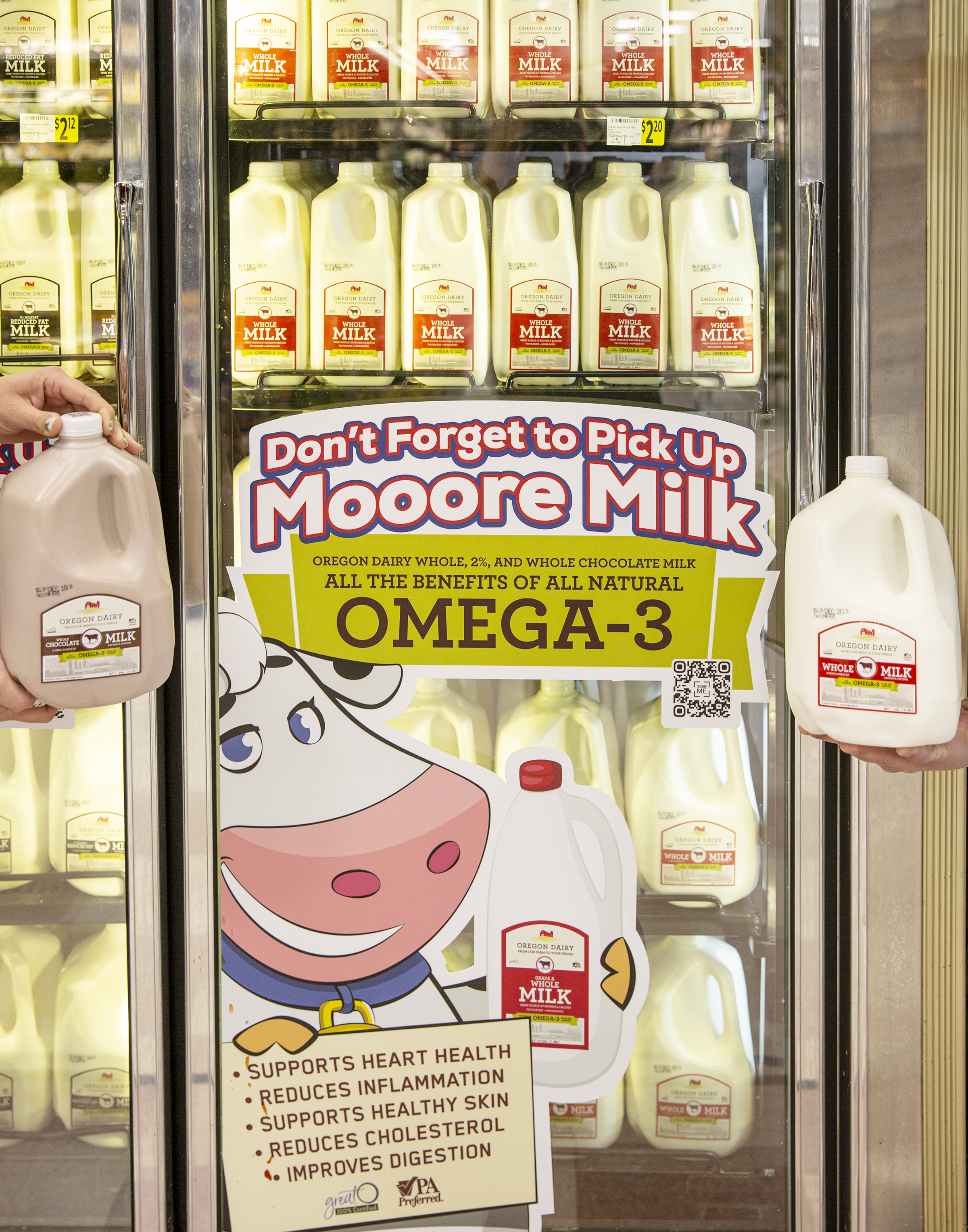
PA herd first in nation to make ‘Naturally Better Omega-3’ milk

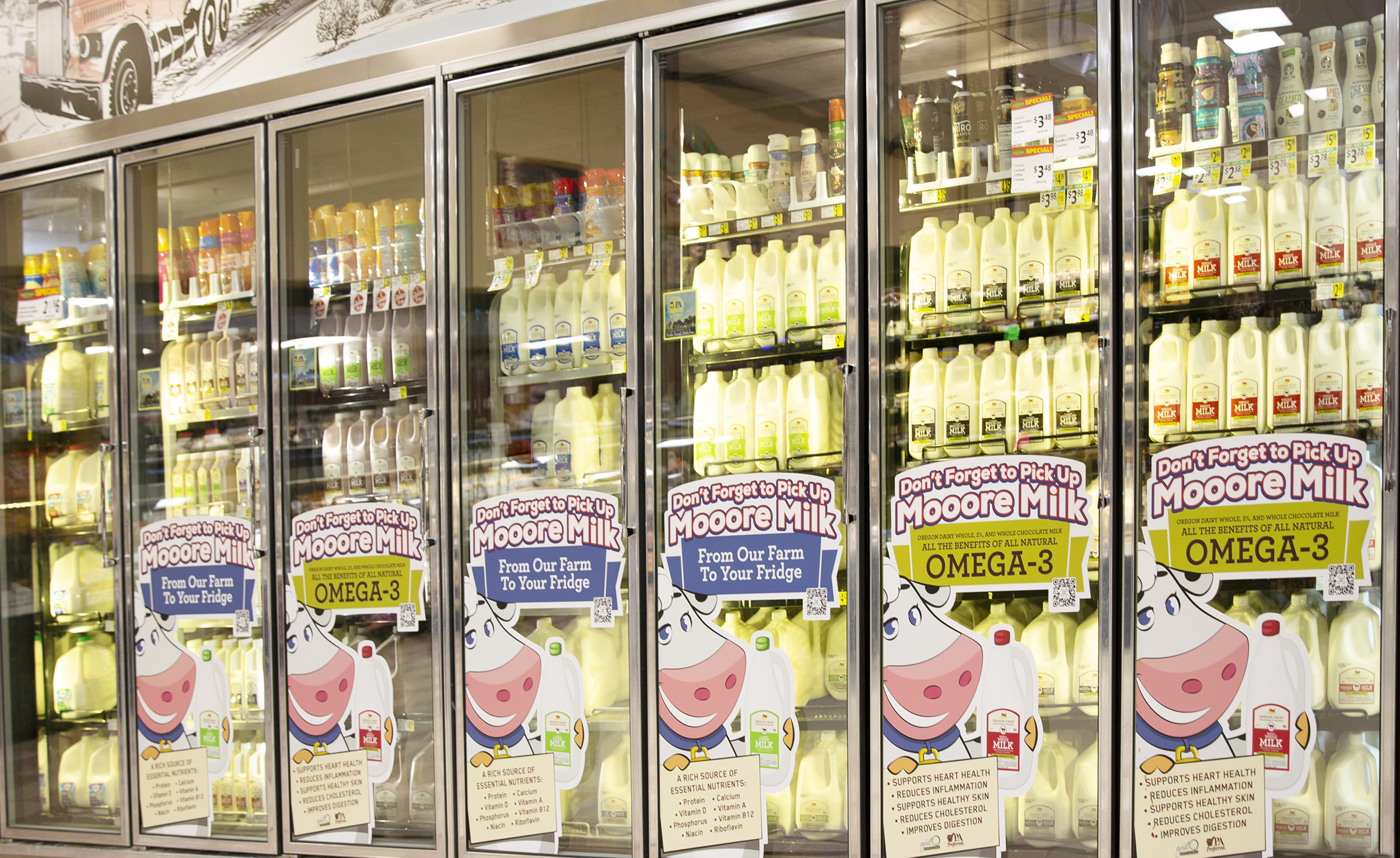
New labels are on, and new signage is up in the dairy case at the Oregon Dairy family-owned grocery store. While other brands of milk are sold here, like in any grocery store, the buzz is all about the milk with “mooore” — Naturally Better Omega 3 Oregon Dairy Milk. Since omega-3 is a healthy fat, the benefits are only available in milk products containing fat — whole milk, whole chocolate milk, 2% milk and cream.

By Sherry Bunting, Farmshine, December 11, 2020

LITITZ, Pa. — Whole milk sales are rising. Consumers are returning to fat, and they are looking for healthy, local foods. These trends were underway well before Covid-19 and have only accelerated since. At the same time, dairy farms look for growth in diversification or getting closer to the consumer, rather than expanding cow numbers.

For Oregon Dairy, Lititz, Pennsylvania, those paths intersected. They downsized the dairy herd from milking 500 cows to 60 in July 2019, which was the first step to becoming first in the nation (likely first in the world) to produce and market milk with “mooore omega 3” – naturally. The marketing began recently in November 2020.

“We are very proud of our milk. We have always been tied to the story of our milk from the farm to the store. But we are also looking to go to the next level in differentiating it,” says Jon Hurst, center store manager. “Now we have a story to tell about our Naturally Better Omega 3 Oregon Dairy Milk.”

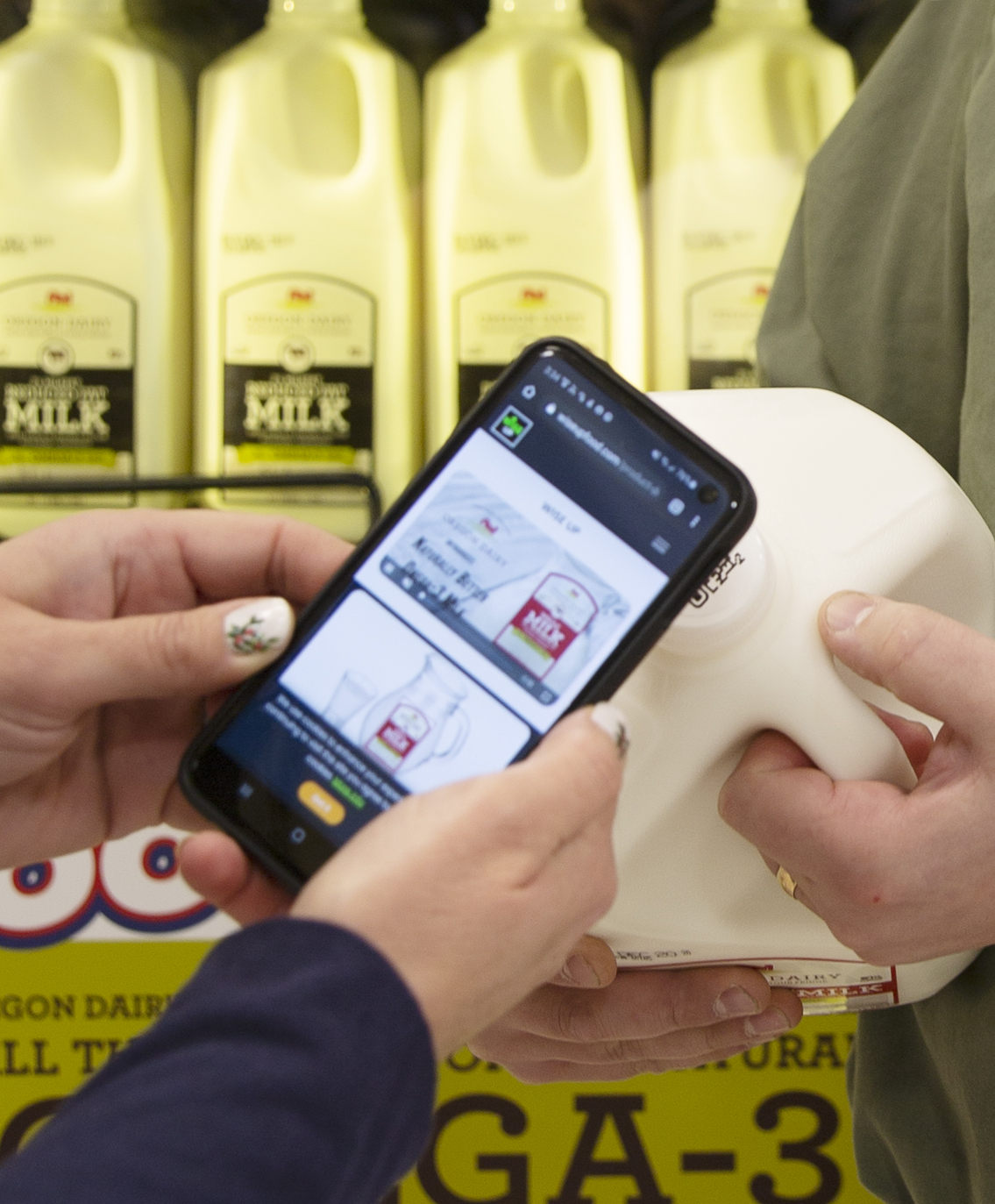
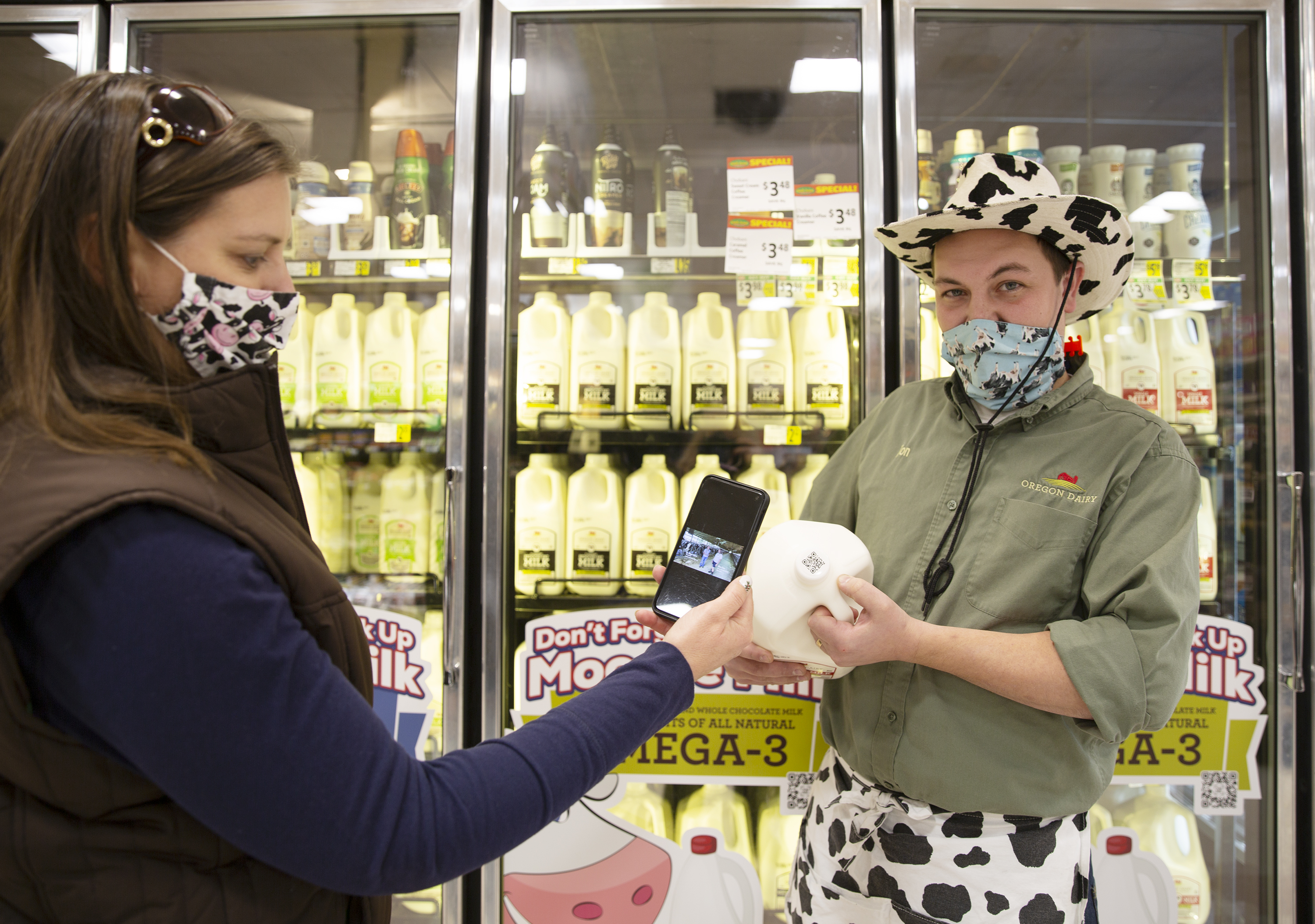
In fact, shoppers at the family-owned grocery store can scan a QR code on the cap of the milk jug that takes them directly to a video about how the cows are fed to naturally produce milk with more omega 3.

The video talks about healthy omega-3 fat found in dairy foods (and fatty fish).

Therefore (as noted on the dairy case signs below), the higher omega-3 levels pertain to the whole milk (57 mg), whole chocolate milk (53 mg), 2% milk (28 mg) and cream.

While there are other milk brands that increase omega-3 by adding fish oil or algae derivatives directly to the milk in the form of additives, what Oregon Dairy has done is to feed the cows a supplement that balances the ratio between omega 3 and 6, so the cows naturally produce milk with consistently higher levels of omega-3 – and do it within a conventional dairy setting.

The distinct businesses of Oregon Dairy near Lititz, Pennsylvania include the farm, bottling at the grocery store, restaurant, ice cream shoppe and agri-tainment with four brothers, George, Willie, Curvin and Vic, owning different segments. As they partner with the next generation of siblings and cousins, communication has grown closer on a farm-to-table vision that has always had the dairy cow front and center.

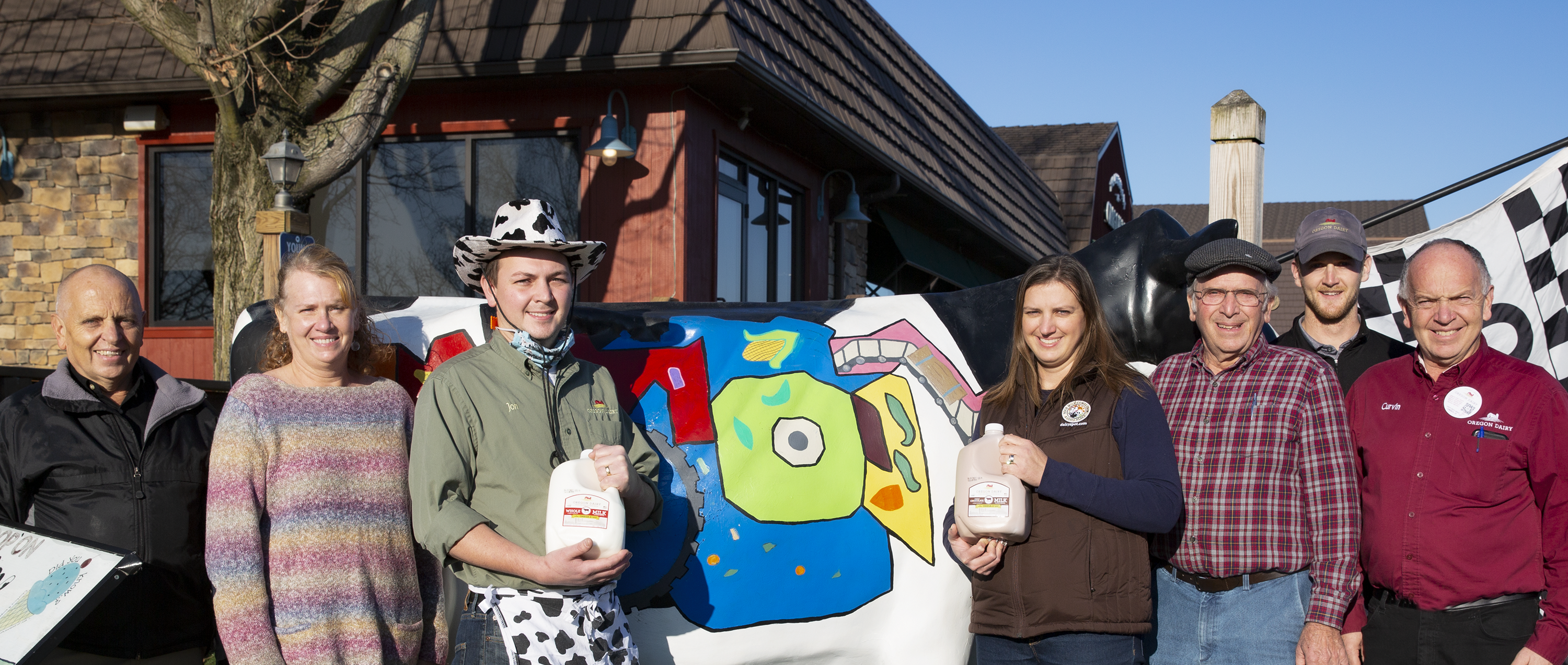
Celebrating the ‘Naturally Better Omega 3 Oregon Dairy Milk’ in front of the model cow painted to show her unique digestive capabilities are family members involved in the distinct businesses of Oregon Dairy (l-r), Willie Hurst, Krista Martin, Jon Hurst, Maria Forry, George, Brent and Curvin Hurst. Absent from photo are Vic and Chad Hurst.

Like any grocery store, other big-name brands are sold, but the focus is to continue highlighting local through what they do at the farm and other enterprises under the Oregon Dairy umbrella, as well as partnering with other local farms and businesses in the community.

Before downsizing, the farm — co-owned by George Hurst and his son Chad and daughter Maria and her husband Tim Forry — sold 90% of their milk through a cooperative in the commodity market and just 10% was purchased by the store and restaurant as needed.

Now, the various branches of the Hurst family and sector managers must communicate more directly about milk supply and marketing — putting them in the position to tailor what they do at the farm level to differentiate the milk at the store level.

With 18,000 followers on Oregon Dairy’s social media platforms, Jon has become a promotion powerhouse with the “farm fresh family fun” tagline, producing videos and contests and in-store partnerships that began before the Coronavirus disruptions and have given shoppers something to look forward to — with humor and sincerity — during this Covid-19 era.

For generations, they’ve been just bottling milk at the store and having their cream turned into ice cream by another manufacturer. But Jon and his cousin Maria, see a future of possibilities.

The Naturally Better Omega 3 (NBO3) Oregon Dairy Milk opens opportunities, but it really starts at the basic cow level, where the total mixed ration is balanced for omegas by feeding greatOPlus, an omega-3 nutrient supplement in the TMR mineral pack from Sporting Valley Feeds.

Their longtime nutritionist and veterinarian Dr. Robert Stoltzfus of Lancaster Vet Associates suggested the product last fall — a few months after the cow herd was downsized.

Across species, feeding flaxseed is nothing new, but it is the supplement’s algae derivatives that add additional properties for animal performance and transfer a more optimal omega balance to the meat, milk and eggs the animals produce.

“The benefits are on two levels,” says Paul Rosenberger, a consultant with NBO3, maker of greatOPlus and the largest algae producer in the country. We spoke with him by phone this week to understand the process.

“By balancing the ratios of omega 3 and 6, we get the benefit of omega-3, and in bypassing the rumen, we improve the conversion of that balance to the milk,” he explains about the natural feed nutrient.

Omega-3 has attracted attention as a healthy fat in the human diet, including reducing stress and inflammation, as well as heart health and other benefits the long chain fatty acids provide.

Oregon Dairy is one of a couple dairies Rosenberger is working with to introduce the product and acquire data.

Through Kansas State University, the Manhattan, Kansas-based NBO3 company has already received over 8000 data points from beef herds, poultry (eggs), swine, and now milk from dairy cows.

“In beef cattle, our data show improved marbling and color of the meat. In dairy cattle, there are performance benefits, but what we’re looking at with Oregon Dairy are the ratios of omega 3 and 6 in the milk,” he explains. “They are a natural for us with their retail connection providing so many attractive possibilities.”

Jon and Maria confirm the milk looks and tastes the same. (We took some home and agree, the milk is delicious as always with no difference in taste.) The difference is on the label in the milligrams of omega-3. Getting to that point took nine months of testing.

Maria explains: “We started feeding (the supplement) to our cows at a half a pound per cow in the ration, then tested, then increased our feeding rate until our tests showed we reached the omega-3 levels in the milk and were holding at those levels for months.”

Today the TMR inclusion rate is at about one and a half pounds, and the testing through NBO3 incorporates three prongs: the K-State university system, their own company labs and a third-party verifying lab.

“Once we got to the level of omega-3 in the milk and could sustain it, that’s when we got involved in the marketing and telling the story,” says Jon.

George explains that some producers are feeding the omega-balancing product to improve cow health, fertility and performance. He says they weren’t looking for specific herd improvements, but rather to improve the milk the cows produce.

Tim says the performance of the cows has been quite good in production, SCC and fertility, but again, their goal is what transfers to the milk.

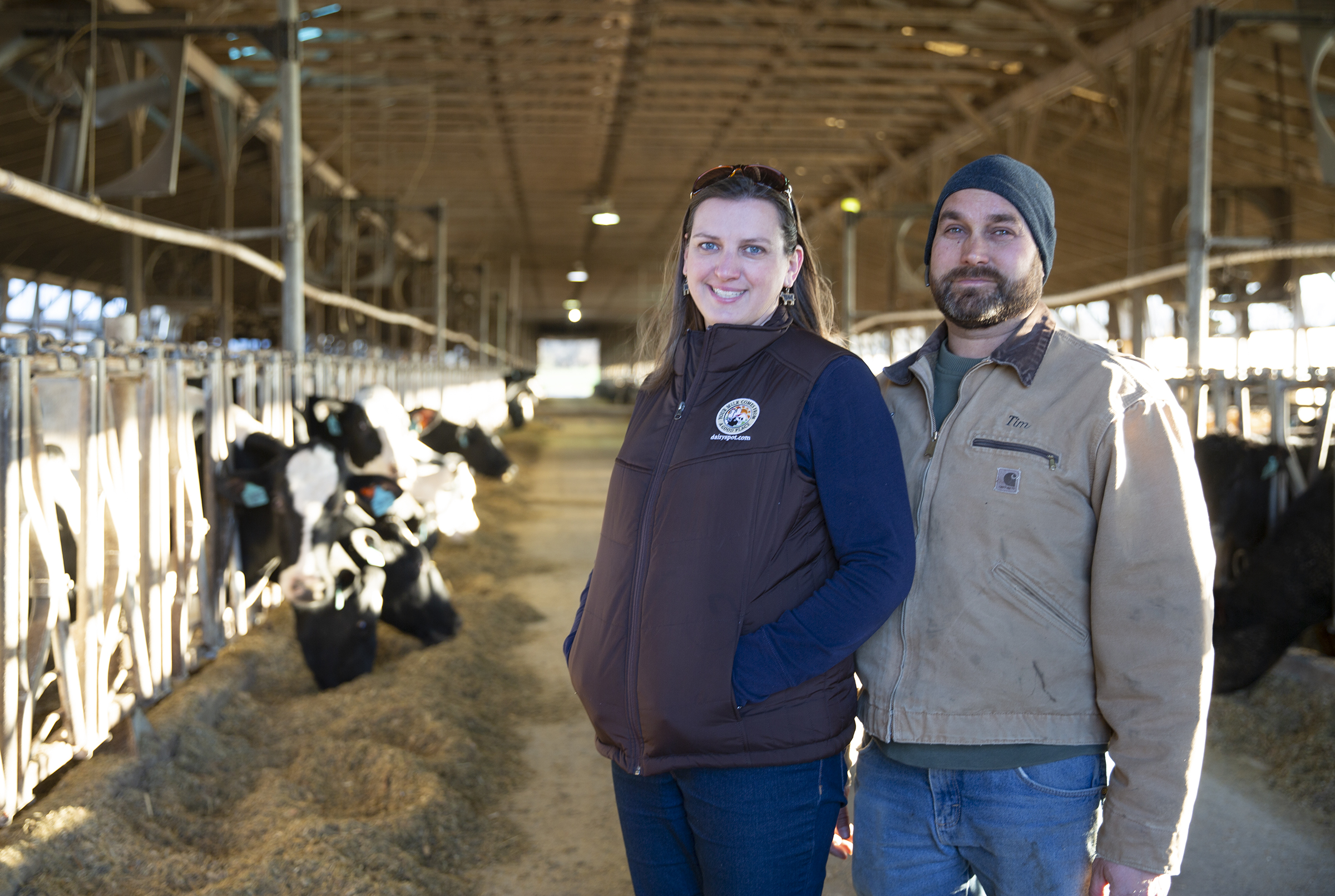
Tim and Maria Forry are flanked on the left by the downsized dairy herd of 60 milk cows and on the right by the new group of 180 beef heifers being fattened for market next spring.

“We want to niche our milk,” George relates. “Downsizing the herd was never a question of not producing milk. It was a business decision on the farm side because of the dynamics of the milk market and dairy pricing. We chose to downsize and diversify.”

The farm has gotten into custom work and a seed dealership. “We went from being 40% overcrowded to having less than 50% of our freestall capacity used, that changes a lot of things,” says Tim.

One thing it changed is feeding the methane digester that has been integral on the farm since the 1980s, so they’re fattening 180 beef heifers that go to commercial markets, along with a small number of pasture-raised Angus cattle, owned by the store, that are finished at the farm. 

The beef cattle help keep the digester fed and stable to receive the other waste, to generate electricity and be part of the composting business they started over a decade ago.

Meanwhile, the store was also looking to diversify and capitalize on direct relationships with consumers.

“I go back to the concept of doing what you are good at, and this is what we are good at,” says Jon. As part of the next generation bringing their perspectives to the business, he sees local, natural, family and fun as what Oregon Dairy is good at. This omega 3 niche allows them to envision more about the future. 

“We want to be thinking outside the box of how to handle the amount of milk produced and needed,” Jon observes. 

“It all ties back to the consumer and the cows. Through our agri-tainment and corn maze and events, we hear consumers talk about health, we talk to consumers about milk and health. I talk to my own friends and family about cows and milk, but it always comes back to a health discussion,” Jon explains. “People in my generation want natural and local, and this is natural and local. Those two words capture carbon footprint and health, and it’s part of our story.”

“I think what is encouraging for other farms to take from this is to look for opportunities to diversify and differentiate within your sphere — to pursue and collaborate with others even in a small way, to find the opportunities whether producing milk, meat or eggs,” George reflects, adding that the beef industry seems to have a better handle on dealing with plant-based competitors where the dairy industry is playing catch up.

Differentiating Oregon Dairy’s milk with “mooore omega 3”, provides new ways to reach consumers with positive messages about the benefits of milk — things you just can’t get from plant-based lookalikes.

For Oregon Dairy, the bottom line in this first-ever product is to provide the same great milk from the same great cows at the same great price with the same local story, the same great health information – but now with a little more to show and tell.

The marketing is so fresh, Jon and Curvin Hurst don’t have a handle yet on how much their sales have increased, except that the omega 3 message dovetails with the trend they already see of consumers buying the higher fat milks.

“Whole milk sales, in general, are higher,” says Jon. “We have seen that shift increase in the last two years. Whole milk is number one now.”

That trend made this possible, because without the fat, there’s no omega 3. 

Cousins Maria Forry and Jon Hurst demonstrate how shoppers can instantly pull up the video about Naturally Better Omega 3 Oregon Dairy Milk when scanning the QR code on the bottle cap with a smart phone.

At the store, the staff is trained to answer questions, the QR codes are on the bottle caps, the omega 3 milligrams are on the new labels, the ‘Don’t forget mooore milk’ signage is up with information about omega 3 health benefits, and free milk giveaway contests have been done on facebook, along with celebratory videos launching the message.

Much planning went into the launch, which they never dreamed would happen during a pandemic.

But that really doesn’t matter.

“We are already hyper-local, and now we have this extra step to further differentiate our milk,” says Jon. “As always, our story, even this new story, starts with the cows. Yes, we are proud of our milk.”

-30-

‘Vote’ Whole Milk School Lunch Choice: Comment to USDA by Dec. 28, 2020

EPHRATA, Pa. –  Want whole milk choice in school? Become a citizen for immune-boosting nutrition and comment at this link by Dec. 28, 2020: https://www.regulations.gov/comment?D=FNS-2020-0038-0001

Below is a sample comment, you can personalize in the official public comment section at this link  https://www.regulations.gov/comment?D=FNS-2020-0038-0001 by Dec. 28, 2020:

Dear USDA,

We appreciate the flexibilities rule, but it does not go far enough to benefit the healthy choices of our school children. WHOLE MILK should be offered as a choice at school meals because children and teens in trials preferred whole milk 3 to 1 over low-fat milk, meaning they drank it and consumed the nutrients instead of discarding! Store sales of whole milk during the pandemic are up 14% (while other classes are down). Parents are choosing whole milk for their families because it is nutritious and offers better absorption of important fat-soluble vitamins and other immune-supporting advantages. 

Research shows whole milk consumption among healthy children was associated with higher (immune-boosting) Vitamin D stores and lower body mass index, a 40% reduction in risk of becoming overweight! Children and teens love whole milk so they will drink it instead of throwing it away. 

In fact, a high school/middle school trial in Pennsylvania last year showed that when all fat percentages of milk were offered, milk consumption grew by 65% and the volume of milk being wasted / discarded declined 95%! 

Current rules and “flexibilities” don’t even allow schools to offer whole milk or 2% reduced fat milk a la carte. We want to see flexibility that allows children to choose 2% milk and whole milk, which is standardized to 3.25% fat, so they can benefit from the healthy nutrition they love instead of being limited to fat-free and 1% low-fat milks that they throw away. Students discard the fat-free and low-fat milk then buy drinks devoid of nutrition and sweetened with a combination of high fructose corn syrup and artificial sweeteners! At middle and high school levels, USDA rules allow the choice of caffeinated energy drinks — but not whole milk! That’s a win for big beverage and foodservice companies, but not for our children. Let the health of our children win with whole milk choice.

BACKGROUND: USDA Food Nutrition Services (FNS) published a proposed rule in the Federal Register Nov. 27 that would ‘maintain’ the flexibility for school meals related to milk, grains, and sodium. 

For the milk portion, the proposed rule would make permanent the choice of flavored low-fat 1% milk in child nutrition programs — without waivers. Back in 2010, low-fat flavored milk was eliminated along with whole and 2% reduced-fat white milk. This rule is a small step to solidify the change made by USDA Secretary Sonny Perdue to at least provide schools with flexibility to allow the choice of 1% low-fat flavored milk in 2017. At that time, flavored milk in schools was required to be fat-free.

The recent new rule up for comment was issued as an administrative step to insure that USDA is complying with a 2018 court ruling that challenged these flexibilities. The ruling required a comment period for the rule. Schools currently have this flexibility temporarily in all USDA child nutrition programs through June 30, 2021, in response to the COVID-19 national emergency.

USDA says it is “committed to listening to and collaborating with customers, partners, and stakeholders to make these reforms as effective as possible, and encourages all those who are interested in school meals to share their comments and recommendations for improvement through regulations.gov.”

This is an opportunity for communities to respond and ask USDA for better flexibilities.

The Grassroots PA Dairy Advisory Committee and 97 Milk will post to Regulations.gov docket — again — the 30,000-name petition with hundreds of comments supporting the choice of whole milk in schools. As customers, partners and stakeholders in child nutrition programs, parents, teachers, school foodservice staff, farmers and community in general have a stake in what USDA allows and doesn’t allow as beverage choices in schools.

Here is the link to the full docket regarding the USDA school lunch flexibility rule https://www.regulations.gov/docketBrowser?rpp=25&so=DESC&sb=commentDueDate&po=0&dct=PS&D=FNS-2020-0038

-30-

DMI-led, DFA-made: ‘siips’ is new ‘teen milk’, but…

But… when given the opportunity, teens choose regular fresh whole milk

siips: Siimply Perfect. Real Milk. Real Good. You Be You. These are the descriptive taglines for SIIPS, a shelf-stable, aseptically-packaged, ultrapasteurized, lowfat milk packaged by DFA in an 8-oz. aluminum can as a new “teen milk” based on DMI’s research of what it takes to make milk relevant to teens again. And DMI says more ‘innovations’ or ‘reinventions’ or ‘relevant products’ are on the way from other partners. All of this money and time spent to answer a question teens and pre-teens and elementary-aged students could have told us quickly, cheaply and easily, given the opportunity to choose whole milk – without the fancy packaging and processing that puts it neatly into a global supply chain instead of a local or regional fresh food system.

By Sherry Bunting (Farmshine, Nov. 13, 2020)

HARRISBURG, Pa. – On one hand they say they are not involved in reinventing school milk and then, well, they say they are.

Siips is the new low-fat, shelf-stable grab-and-go “teen milk” from Dairy Farmers of America (DFA). According to Dairy Management Inc (DMI), checkoff led the way on the innovation and test launch in selected locations over summer.  

Siips is a result of DMI’s fluid milk revitalization efforts and is targeted to improving the youth milk experience with relevant packaging and flavors,” according to a recent edition of Your Checkoff News.

During last week’s Center for Dairy Excellence industry conference call, a portion of the hour was devoted to questions and answers with DMI leaders, and we learned more about revitalization, innovation, and reinvention.

According to Paul Ziemnisky, executive vice president for global innovation partnerships at Dairy Management Inc. (DMI), DMI has been working since last summer to “understand perceptions of milk in schools.”

He said products like siips represent what DMI has learned from students in a variety of demographics so that milk can compete again.

Siips is grab-and-go milk in an aluminum 8-oz. can in the flavors of caramel, mocha and chocolate,” he explained. “Products like this will make milk competitive in the school ala carte area, and we are working with other partners for other ala carte grab and go products.”

Ziemnisky noted that DMI is also working with processors and technology companies to develop dispensers like those used in foodservice where students can choose their milk ‘formula’ or ‘flavors’. He said Covid set the test launch back for those, but they are coming.

The bottom line is, he said: “We are looking at new packaging systems… aseptic sustainable packaging, all in the process of starting up. We are working with the industry to line up 6 to 7 tests in key systems to create a catalytic effect across the whole industry.”

A dairy producer submitted this question: “We are seeing grants from checkoff to develop a ‘kids milk’ at Cornell. We already have a ‘kids milk.’ It is called whole milk. We are frustrated. Why would our checkoff spend money on this rather than spending money to get whole milk back in schools?”

DMI president Barb O’Brien replied that she is “not familiar with the ‘kids milk’ project. We are not involved in specialized formulation for school milk,” she said. “But we can tell you about the research programs we have invested in.”

Ziemnisky picked up from there to explain that, “Everything we do has to start with consumers to make sure what we do is relevant.”

He said DMI’s partners, including MilkPEP, are the experts in marketing and advertising while DMI is the expert on consumer research and insights.

O’Brien and Ziemnisky explained that what DMI does is “back-end strategy with brands to advance U.S. Dairy’s priorities.”

They said the brand partners spend “10 to 20 times our investment in bringing to market these innovations.”

“Three years ago, the milk revitalization alliance was formed,” said Ziemnisky. “By partnering with brands, we unlock new platforms and then leverage that to access their customers.”

O’Brien said that’s how DMI has managed what is essentially a $300 million state and national budget to become the equivalent of $3 billion in consumer access and increased per capita dairy sales.

Ziemnisky reported that whole milk sales grew by $1.8 billion on a value basis over the past five years to 41% of net sales at retail. He owed this to what he said were DMI’s “57 whole milk studies.”

(We can’t find any whole milk studies on the list of 57 studies, just a few studies related to full-fat cheese.)

The problem with 40 years of declining overall fluid milk sales, said Ziemnisky is that “the sector has gone 40 years without innovation.”

(The sector has also gone 40 years under what have become increasingly fat-restrictive USDA enforcement of its Dietary Guidelines, but that wasn’t mentioned.)

Ziemnisky pointed out that the gains made in whole milk sales have come at the expense of fat-free milk sales.

“We have a fix for that too,” he said. “Our goal is to make milk relevant again with high protein, low carb, portability, as well as reinvention at schools, foodservice and e-commerce to fit changing consumer lifestyles.”

As for the simple choice of whole milk in schools? DMI leaders were asked if they would fund and support a research trial like the one done last year at one middle/high school in Pennsylvania showing 65% gains in milk sales and sustainable reductions in waste of 95%.

O’Brien was “thrilled” to hear about that study and said exceptions can be granted for research, but quickly turned the conversation over to Ziemnisky to talk about the research and innovation of school milk DMI is already investing in.

Look for more in the next edition on DMI’s partnership with DFA on plant-based blends – why and how and other topics.

-30-

‘Kids Milk’ project receives checkoff funding, researchers look to remove lactose and whey, add sugar

Does milk need reinventing for kids? USDA and dairy checkoff say yes. Meanwhile kids, parents and experts who’ve studied the issue say… not so fast… just allow the schools to provide whole milk as a choice. Istock photo by Aaron Amat

By Sherry Bunting, Farmshine, October 16, 2020

ALBANY, N.Y. – As part of the 2021 checkoff funds for Cornell dairy research approved recently by the New York State Dairy Promotion Advisory Board is the first phase (2021-22) of a two-year project to develop and build a “Kids Milk” for schools, foodservice and retail. The first phase is to complete the successful multi-step innovation process (remove lactose and add sugar), and the second phase will be to implement the “future view” (remove whey to improve shelf-stable flavor and reduce transportation cost and refrigeration).

The project was one of 12 presented by Cornell, which is one of five universities that are part of DMI’s Dairy Research Institute (DRI). The DRI was formed as a 501 c 3 non-profit by DMI’s Innovation Center for U.S. Dairy a decade ago in August of 2010.

Reading through this project’s innovation process and vision, in essence, by year two, ‘Kids Milk’ (aka ‘school milk’) could be compositionally the same as the ultrafiltered / microfiltered cheese starter milk that has the lactose and whey removed. In essence large-scale-cheese-vat-ready-milk would be positioned as ‘Kids Milk’ tested and touted as beneficial for children’s taste, tolerance and nutritional reasons, of course. (Think about this within the context of the large-scale cheese processing shifts now occurring in the dairy industry.)

According to the researchers’ slides presented to the NY Board in September, the ‘Kids Milk’ will be stripped of lactose, but then have sucrose (sugar) added in order to “achieve a higher sweetness intensity and achieve higher liking scores without increasing calories from carbohydrates in 1% fat chocolate milk,” for example. A copy of the Cornell researchers’ presentation is available online with the NY Board’s minutes at https://agriculture.ny.gov/dairy/dairy-promotion-order

The ‘Kids Milk’ would also be a high-heat pasteurized, extended shelf-life product, and the second phase talks about making it shelf-stable. In concert with this, another NY checkoff-funded Cornell project, in its second year of research, is determining how to solve off-flavors in extended shelf-life and aseptically-packaged shelf-stable milk products by removing the ‘offending’ whey — with an eye to the school foodservice applications in terms of transport and refrigeration.

The ‘Kids Milk’ research project is jointly sponsored by the NY State Dairy Promotion Advisory Board (checkoff) approving $76,269 per year for the portion conducted at Cornell, along with H.P. Hood and Dairy Management Inc. (DMI) funding the portion being conducted at North Carolina State University’s dairy research center. Hood’s contribution is $50,000 per year and DMI’s checkoff contribution is $20,000 to $30,000 per year.

In their presentation of the two-year research and innovation phase (2021-22), the Cornell researchers explained that they have proof of concept as of August 2020 for the first step in the two-step process of removing lactose and adding sugar to replace it. They explain in a power point slide that once they achieve success in the innovation research, they will move to the “view into the future” for ‘Kids Milk,’ using the microfiltration whey-removal research being done simultaneously at North Carolina State.

The “view of the future” for ‘Kids Milk’ is revealing and was described by researchers as follows:

Step 3 – “Increase the protein content by ultrafiltration to have 1% fat and 6 to 7% protein to build mouthfeel, achieve a calcium and protein per serving higher than regular milk, and bring the product to a milk solids-not-fat that would allow it to comply with standard of identity for milk and to be labeled lactose-free ultrafiltered milk.”

Step 4 – “Increase the protein content by ultrafiltration by a combination of ultrafiltration and microfiltration. Microfiltration removes milk derived whey proteins from milk. The milk derived whey proteins have been identified in our research as the ones that cause the objectionable cooked sulfur flavors in the UHT (extended shelf-life) milks. Our goal is to remove these proteins to build a milk that will taste good to children and meet nutrition guidelines while being shelf-stable. This will reduce shipping and distribution costs for milk by reducing the number of deliveries and the need to separate refrigerated delivery to schools.”

Back on August 5, 2020, DMI CEO Tom Gallagher in an ‘open mic’ call addressed the grassroots push to get whole milk back as a choice in U.S. schools. He stated to the farmers, board members and media on that Aug. 5 call that, “Farmers are great, and our product is great… but even if whole milk is eventually recommended for kids, we still need innovation to get it to the kids in a style that they like.”

Voila: ‘Kids Milk.’

Meanwhile, as reported in the August 7, 2020 edition of Farmshine, a simple trial at a middle and high school in Pennsylvania was conducted without fanfare — and anonymously due to USDA ‘milk rules’. It found that teenagers like milk the way it is, without the reinvention. 

In fact, this anonymous 2019-20 trial simply offered all fat percentages of milk, and within the first month, found students choosing whole milk 3 to 1 over the lower fat options. Five months later, students responded favorably to the surveys.

But what was really significant was this: the trial resulted in middle and high school aged students – teenagers! – choosing milk over less healthful competing beverages as revealed by a 65% increase in milk consumption and a 95% decrease in the amount of milk being discarded. Instead of taking the ‘served’ low-fat and fat-free milk (per USDA), throwing it away and buying something else, the students were choosing milk and drinking it!

Whole milk is also shown to be tolerated by many who claim to be lactose-intolerant as the amount of lactose is slightly less when more of the fat is retained, and the fat slows the rate of absorption of the lactose carbohydrate. This finding is both anecdotal and referenced in an official USDA Dietary Guidelines comment by Dr. Richard Theurer, adjunct professor in the Dept. of Nutrition Sciences at North Carolina State University. In his comment (2018 and 2020-25) to the Dietary Guidelines Advisory Committee, he supports a reversal of the DGA’s misguided recommendation that children over age 2 be offered only fat-free and low-fat milk (now required at schools and daycares) instead of the healthy choice of whole milk.

Does milk need to be reinvented with farmer checkoff funds in order to “get it to the kids in a style that they like” as DMI CEO Gallagher suggested during the Aug. 5 open mic call?

Or do students simply need the option of whole milk at school so they can choose what tastes good and is good for them?

Looking at year two of the checkoff-funded Cornell ‘Kids Milk’ project, the presenters own words offer a clue. They described a successful outcome “will reduce shipping and distribution costs for milk by reducing the number of deliveries and the need to separate refrigerated delivery to schools.” 

This look into the ‘Kids Milk’ future reveals the bottom line is the disassembly and extrusion of milk at finer and finer molecular levels to reinvent and build a beverage that fits the increasingly concentrated globalized supply chain of food transformation.

It’s really not about the kids, at all.

Author’s postscript: Think about this in the context of Coca Cola now owning 100% of the fairlife ultrafiltered milk brand and the potential for reducing school milk (‘kids milk’) to the equivalent of milk protein concentrate (MPC) added to sucrose or high fructose corn syrup (HFCS) for shelf-stable concentrate reconstituted in soda-style — ‘just add water’ — beverage dispensers. Get the picture?

-30-

‘Vote Whole Milk’ yard signs aim to mooove school lunch milk bills forward, here’s how to help!

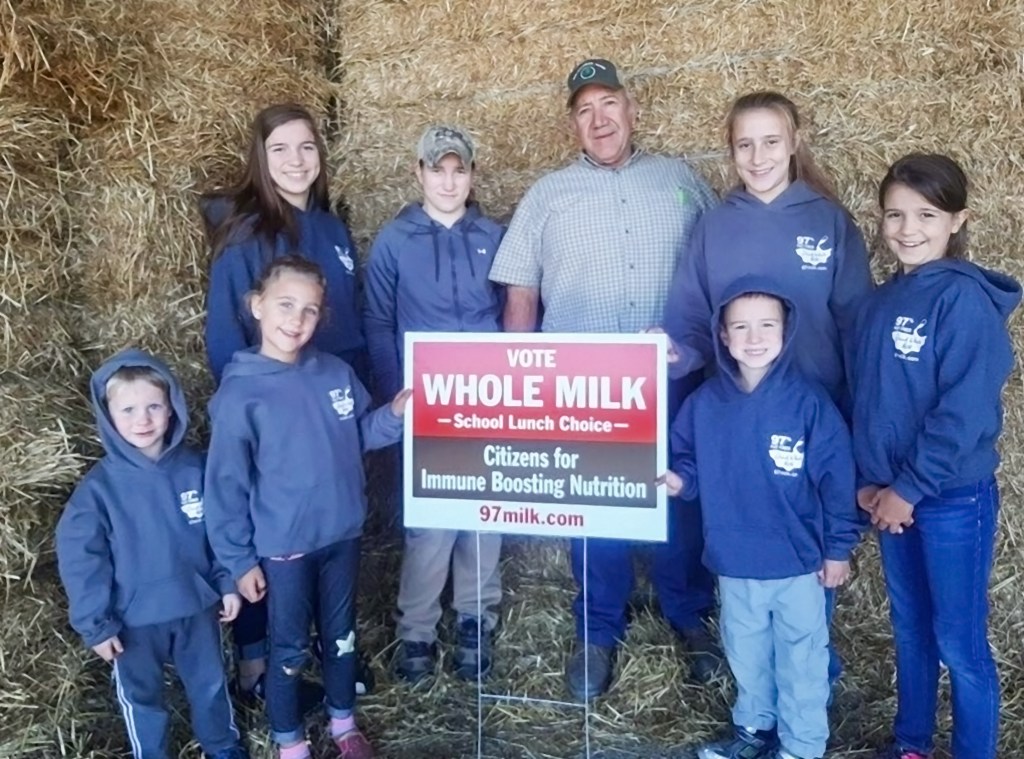
Nelson Troutman, a dairy farmer in Berks County who started the “Drink Whole Milk 97% Fat Free” round bale painting in January 2019 that led to the 97 whole milk education effort, was the first to get a “Vote Whole Milk — School Lunch Choice” yard sign. He’s pictured here with grandchildren (l-r) Jase, Emma, Evelyn, Carolyn, Jocelyn, Nolan, Madalyn. Photo submitted

By Sherry Bunting, Farmshine, Sept. 25, 2020

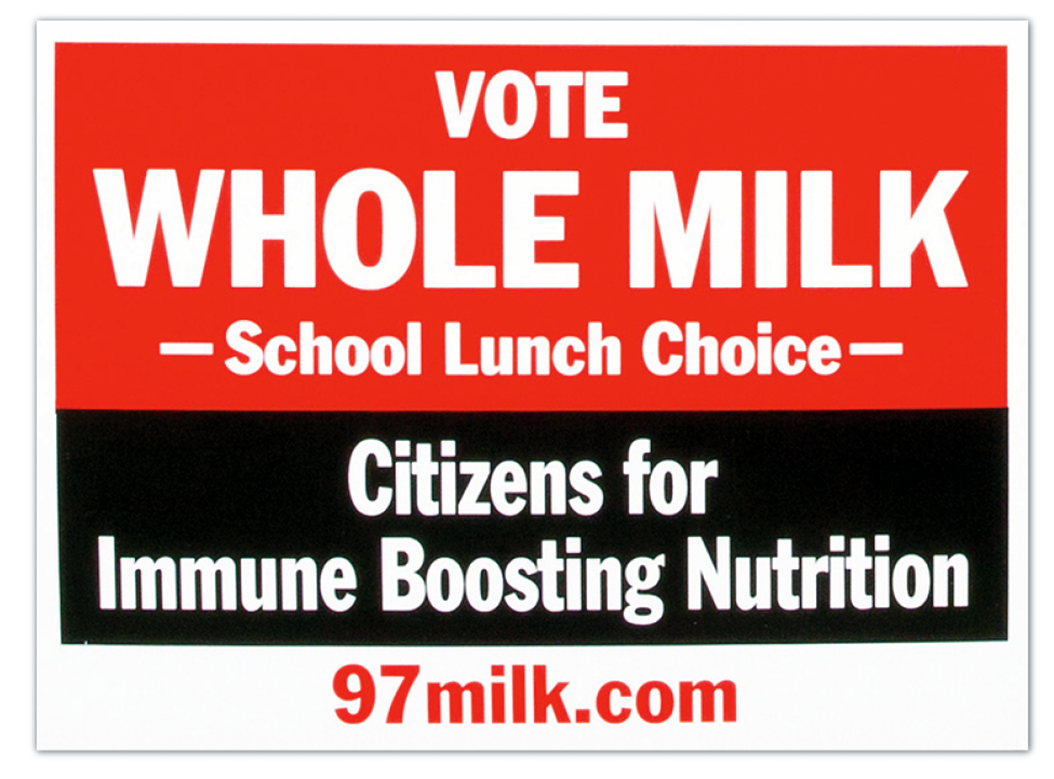
EPHRATA, Pa. — It’s campaign season, and here’s a campaign everyone should be able to get behind: “Vote WHOLE MILK — School Lunch Choice — Citizens for Immune Boosting Nutrition.”

The Grassroots PA Dairy Advisory Committee and 97 Milk LLC are urging citizens to contact their local school boards and other community leaders about adopting resolutions to show federal and state governments they support the right to offer the simple choice of whole milk at school. 

Campaign-style yard signs are now available to help communities show their support for the immune-boosting nutrition children love.

Retired agribusinessman Bernie Morrissey of Morrissey Insurance, Ephrata, Pa. and Nelson Troutman, the Berks County dairy farmer who painted the first “Drink Whole Milk 97% Fat Free” round bale, are working together to print yard signs (pictured with this article) and gain sponsorships from additional agribusinesses to make them available to customers and the public.

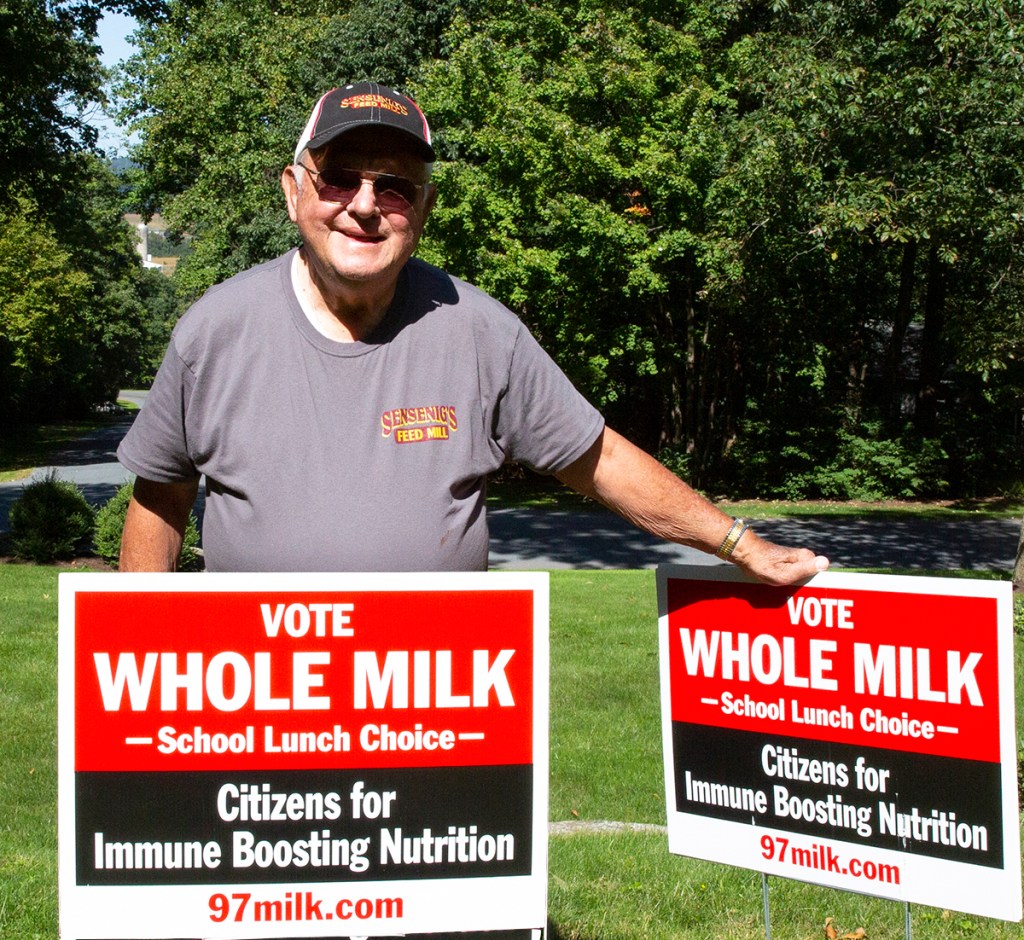
The first print-run of 300 were supported by and are available from these PA businesses: Wenger’s Equipment of Myerstown, Sensenig’s Feed Mill of New Holland, K&K Feeds of Richland, Triple M Feeds of Lebanon, and Morrissey Insurance of Ephrata and Troy. 

“We are continuing to work on this issue of whole milk choice in schools and are concerned about children having this choice. The signs are professional campaign-style 24-inch by 18-inch yard signs, and it is important that we get them placed as soon as possible,” said Morrissey. “We are looking for others to join us as concerned citizens for children’s immune boosting nutrition, to get a sign, or several signs, and get them placed. They catch attention and show support.”

Morrissey just ordered a second round of 300 signs, so there will be more available shortly for more businesses to get involved in sponsorship and distribution. Companies that want a supply to give out to customers and/or the public can call Bernie at 610.693.6471 to acquire them at cost.

Bernie Morrissey doesn’t quit. At age 84, he is a powerhouse for dairy. On a beautiful sunny day this week, he was delivering “Vote Whole Milk — School Lunch Choice” yard signs. Requests have come in from Wisconsin, New York and Virginia to do a bulk supply of signs and Bernie is having a second-run of 300 signs printed for a total of 600 in PA. The first 300 signs popping up in southeast and southcentral Pennsylvania are sponsored and available from Morrissey Insurance, Sensenig’s Feed Mill, Wenger’s of Myerstown, K&K Feeds and Triple M Farms. The second 300 are up for grabs to businesses that want to make them available to customers and the public. If so, contact Bernie at 610.693.6471 to acquire a supply of signs at the printing cost of $6 each (plus shipping if they can’t be picked up). Or to find out how to simply have one for your yard, visit the businesses sponsoring them or call Bernie. 

These yard signs include the 97milk.com website where people can go for information about the issue and the effort to bring whole milk choice back to schools.

A “Take Action” tab at the 97milk.com website provides online visitors with information about the issue and how school boards can adopt supportive resolutions. There, they also learn about the Dietary Guidelines process, as well as two bills in Congress and how to send a message to Senators and Representatives asking them to cosponsor and support the bills that would simply allow schools to offer a choice of milks, including whole milk (3.25%) and reduced-fat milk (2%), which are currently banned.

In January 2019, Rep. Glenn G.T. Thompson of Pennsylvania introduced the bipartisan House Bill 832 Whole Milk for Healthy Kids with co-sponsor Rep. Collin Peterson of Minnesota. Today, it has 42 cosponsors but has not been considered by the House Education and Labor Committee. Senate Bill 1810 Milk in Lunches for Kids was introduced by Pennsylvania Senator Pat Toomey and Wisconsin Senator Ron Johnson in June 2019 and has only 3 cosponsors.

Having publicized the “Vote Whole Milk – School Lunch Choice” effort on social media, 97 Milk received hundreds of shares, likes and comments and a few emails with additional questions. After one school asked for a sample resolution, such a template was developed. 

To-date, one school in Wisconsin reports formally adopting the resolution, while two other schools report they are looking at it.

The resolution sample here is also available online on the second page of the “Take Action” document at https://www.97milk.com/wp-content/uploads/TakeAction_092820.pdf

Asking school boards to show support for whole milk choice is one way to help the legislative efforts that are currently stalled in Congress. As schools adopt resolutions, this sends a message to USDA. 

An earlier effort consisted of submitting a 30,000-plus-signature petition to members of Congress, USDA Food and Nutrition Service, USDA Secretary of Agriculture Sonny Perdue, legislative committee chairs, the Dietary Guidelines Advisory Committee, the DGA Federal Register Docket for Comment, and others.

The petition brought awareness but failed to increase the number of cosponsors for the two bills. This means members of Congress are un-moved on this issue despite over 30,000 signatures from across the country requesting the choice of whole milk in schools.

Over the past year, a few representatives of dairy checkoff, dairy industry organizations and a couple dairy processors have indicated in conversation that schools do not support whole milk choice because they can’t afford whole milk.

The idea behind the “Vote Whole Milk — School Lunch Choice” yard signs — and the sample school board resolutions — is to get parents and communities involved and to give schools the opportunity to show their tangible support for children’s immune boosting nutrition. This is a way for schools and communities to send a signal to state and federal policymakers that they want children to simply have the right to choose whole milk at school instead of being restricted to fat-free and 1% low-fat milk. Enough is enough.

This effort also seeks to make more parents aware that the federal government indeed currently restricts school milk offerings to be only fat-free or 1% low-fat milk. This is something many parents, teachers and even individual school board members are not fully aware of.

School Boards and other groups adopting resolutions are urged to contact their representatives in Congress and their state agriculture and education departments, as well as USDA Food Nutrition Services Deputy Undersecretary Brandon Lipp to let them know of their action. 

They are also urged to email 97wholemilk@gmail.com in order to be added to a public list of resolution adopters.

Those who are interested in talking with their school boards about adopting a resolution can use the sample, which can then be customized by their board. This sample is also great for state legislatures, town boards, county commissioners, even civic, educational, health, nutrition, agricultural, and parent-teacher organizations to consider adopting. The more the merrier!

Even in this uncertain time of Covid-19, when schools are doing a combination of on-site and virtual learning, the breakfasts and lunches provided to students learning from home must also align to the same USDA Food Nutrition Services regulations that are dominated by the Dietary Guidelines.

Even the school meal “flexibilities” announced by USDA for bulk meal pickups during the pandemic require schools to obtain waivers and fill out paperwork explaining why low-fat and fat-free are not available — before they can offer the whole milk (3.25% fat) or reduced-fat (2%) milk.

With supermarket sales of whole milk rising 6.5% January through July, and fat-free milk sales falling 22% compared with a year ago, it’s obvious more parents choose whole milk for their families at home. Therefore, children should be able to choose the milk they love – the milk they have shown they will drink and not discard – at school.

It’s time to remove the federal government’s heavy hand on school meals and allow schools to simply offer the choice of whole milk for children’s immune boosting nutrition.

Congress and USDA and the Dietary Guidelines process are all dragging heels on this simple change despite the overwhelming evidence of the benefits. 

Our schools and community leaders can help get Washington’s attention by adopting resolutions. 

Our citizens can help show community support by placing yard signs and talking to their school boards. 

And our businesses can help by sponsoring and distributing more yard signs and even talking with the civic and community organizations they may belong to.

We can do this!

-30-

WHOLE Milk gets results too important to ignore!

By Sherry Bunting, Republished from Farmshine, Friday, August 7, 2020

BROWNSTOWN, Pa. —  One school in Pennsylvania had the courage to just do it.

For the 2019-20 school year beginning in September, they conducted a trial that simply offered the choice of whole milk and 2% next to the required fat-free and 1% to middle and high school students daily for breakfast and lunch. They did not promote the trial or call attention to it, just waited to see how students would react and what their responses would be.

The results are too important to ignore!

Within a short time of expanding the milk choices last September, students were choosing whole milk 3 to 1 over low-fat milk.

In January, four months into the trial, they found that allowing students to choose from all varieties of milk fat levels increased overall milk consumption by 50% and reduced milk waste by 95%.

Just before schools closed in March due to the pandemic, students were surveyed to learn what they had to say about their milk consumption behavior. Here’s a sampling: 60% said they had thrown away milk in the past before the trial, but only 31% said they had thrown away milk AFTER the whole milk trial.

Only half the students said they were aware of the restrictions on what type of milk could be offered at school.

Incredibly, the percentage of teens at this school who said they were choosing milk at breakfast before the trial was 67%, after expanding milk choices to include whole milk, 80% were choosing milk at breakfast.

All of this data and more in just seven months at a middle school and high school in Pennsylvania. We are withholding the name of the district and its foodservice director to shield their identity from potential backlash due to the USDA rules on fat content of purchased ala-carte “competing” beverages.

The foodservice director who set up the trial, with the support of the school board, states that students have now tasted the difference. Now that the school is using the intermediate unit as the vendor for packaged pickup meals and can only make 1% milk available, the kids are asking: “Where’s the Whole milk?”

“I am 100% convinced that most parents do not know about all that is going on with the school meals programs,” the Pennsylvania school foodservice director said. She is letting them know about the Dietary Guidelines and school nutrition rules so they can become aware and perhaps be led to be involved.

The official public comment period on the 2020-25 Dietary Guidelines Advisory Committee’s Scientific Report has ended. USDA and HHS are using the DGA Report to finalize the next five years of Dietary Guidelines.

To bring the choice of whole milk back to schools, contact your representatives in Congress to cosponsor House Bill 832 Whole Milk for Healthy Kids and Senate Bill 1810 Milk in Lunches for Kids. Also, contact school boards and other governmental and non governmental organizations and ask them to consider adopting resolutions in support of this choice.

Learn more about how to take action at this link. A sample board resolution is on the second page. Schools that adopt resolutions should email 97wholemilk@gmail.com to be added to the list and also let their Congressional delegations in Washington know they support HR 832 and S. 1810. https://www.97milk.com/wp-content/uploads/TakeAction_092820.pdf

-30-

Industry, government follow grassroots donations lead, CFAP adds to dairy demand driving markets higher

By Sherry Bunting, Farmshine, June 26, 2020

WASHINGTON, D.C. – Government and industry dairy donations and record-setting CME cheese prices all got their starter fuel from grassroots dairy producers in what has become one of the good news stories of the COVID-19 era.

Today, USDA has systemized the donating through the Coronavirus Food Assistance Program (CFAP), and dairy processors, cooperatives and checkoff organizations have partnered with food banks and non-profits to extend the reach of efforts begun originally by generous dairy producers and their agribusiness partners supplying grateful consumers.

In April, when milk dumping was at its height, and stores had purchase-limits or sparse supplies of milk and dairy products, farmers and their agribusiness partners and communities went into immediate action. Examples of milk donation drive-through events began popping up in succession – just a fraction of them featured in the pages of Farmshine.

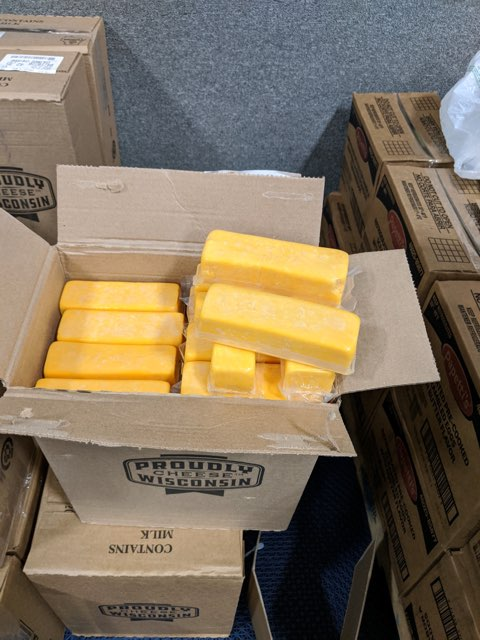
Also in April, farmer-funded Dairy Pricing Association (DPA) purchased 228,000 pounds of block cheddar, immediately moving the CME block cheese price from its $1/lb plummet to $1.20 (adding $1.00 to Class III milk values at the same time).

This DPA move, working with charities for distribution and a Midwest processor to turn their CME-style bulk purchase into consumer-packaged goods for donation, gave a green light to other cheese market participants. Within a week of that purchase and the initial 20-cent gain in blocks that followed, block cheese continued its climb to $1.80/lb, and the upward momentum has not stopped — fueled now by huge government purchases and food-service pipeline re-stocking.

On the heels of these grassroots efforts, dairy checkoff organizations began getting involved to work with their partners and “convene” the industry to do big donations in May.

Meanwhile, the U.S. Congress had passed the Coronavirus Food Assistance Program (CFAP) in April, with $3 billion of the $19 billion set aside for the Farmers to Families Food box purchases. But it was mid-May before USDA announced those first-round contract awards totaling $1.2 billion in fresh food — $317 million of it for fluid milk and dairy products – for distribution May 15 through June 30.

This week, USDA Secretary Sonny Perdue called the food box program a “trifecta, win-win-win”, pointing out how the program is getting farmers, processors and non-profits together to directly provide fresh food to people without burdening food banks with refrigerated inventory they aren’t prepared to handle.

DPA_CHEESE (1)

In April, when block cheddar was plummeting to $1.00/lb, the farmer-funded Dairy Pricing Association based in Wisconsin with member-contributors nationwide, purchased 228,000 pounds of block cheese to be cut-down for distribution by several charities. DPA Facebook photo

This was the model of grassroots groups and individuals on their own dime and time doing dairy donation drive-throughs, milk-drops, and whole milk gallon challenges from late March to the present. It was also the model of DPA, funded by voluntary dairy farmer milk check deductions, when DPA purchased the block cheese in April for cut-down and donation. Also in April, we saw the partnership initiated in Pennsylvania between 97 Milk and Blessings of Hope. They raised funds to buy local milk for donation to families in need.

As these grassroots efforts began having an impact, Midwest Dairy got approval from USDA in May to use checkoff funds to donate cheese, and UDIA of Michigan was allowed to provide minimal funding to food banks for “handling costs” associated with receiving cheese donated in May by DFA.

Now, with USDA systemizing that smart approach — started by grassroots efforts — the department stated in a news release that as of June 23, its CFAP Farmers to Families Food Box Program had delivered more than 20 million boxes of fresh food, including milk and dairy products, to families impacted by COVID-19.

The initial round of USDA CFAP contracts ends on June 30. But this week, USDA announced it will extend “well-performing” first-round contracts for similar amounts in a second-round from July 1 through August 31 to total an additional $1.16 billion.

The share of this second-round to be devoted to fluid milk and dairy purchases was not specified in the USDA announcement. One thing USDA did note is that even though most of the second-round dollars will be spent with “selected” current contract awardees, a few new contracts may be awarded to previous applicants that had been passed over due to technical errors or to provide boxes in areas identified as “underserved.”

Throughout the USDA CFAP food box delivery process, regional dairy checkoff organizations have been involved as “facilitators.”

Week after week, Farmshine has received press releases from dairy checkoff organizations, and there have been numerous social media posts, about the CFAP milk and dairy box donations. Regional checkoff organizations say they are working with processors, cooperatives and non-profits — in conjunction with the USDA CFAP food box program — and that area dairy farmers are involved as volunteers to hand out the boxes.

According to National Dairy Council president Barb O’Brien, dairy checkoff organizations began “convening the industry” before CFAP.

“We have leveraged the checkoff’s unique ability to convene companies from across the value chain to identify a number of ways to redistribute excess milk and other dairy products to families facing food insecurity,” writes O’Brien in an email response to Farmshine recently.

In a specific cheese example she had mentioned in a media call described as block cheese being purchased and cut into consumer size portions, our inquiry for details was met with this response:

“In response to lost food-service markets and dairy farmers being asked to dispose of milk, we’ve worked to connect coops to partners that donated processing capacity for any excess milk available for food banks,” O’Brien wrote. “Many other dairy companies — such as the example I gave from DFA of cheese donations in Michigan — provided massive quantities of dairy products to food banks before the USDA Farmers to Families Food Box Program was even put into place. Moving forward, it will be important that we continue working together as an industry to target the greatest needs and find long-term solutions to our nation’s hunger crisis.”

O’Brien cites DMI’s “long-time partner” Feeding America and other relationships with local food banks and pantries. Former Ag Secretary Tom Vilsack, now a top dairy checkoff executive with DMI, sits on the Feeding America board of directors.

O’Brien also noted in her response that dairy checkoff “counseled industry partners and others on how to direct dairy products toward the greatest needs.”

She reports that, “This widescale approach enabled us to pinpoint some of the biggest barriers in getting excess dairy products to hungry families during the pandemic” and to “rapidly initiate an industry response.”

As communities began doing their own grassroots efforts through the generosity of dairy farmers, agribusiness and individuals purchasing milk or contributing milk for dairy donations in the early days of the COVID-19 ‘stay-at-home’ orders, checkoff organizations took note and began to look at what they could do in terms of refrigeration equipment and setting up refrigeration trucks for industry and governmental efforts.

LancMilkGiveaway_5378

Grassroots whole milk donation events like this one just outside of Lancaster, Pa. in May, have been providing whole nutrition to families across the state and region since the height of COVID-19 ‘stay-at-home’ orders in April.  Photo by Michelle Kunjappu

While many of the grassroots-organized milk donations were comprised of whole milk purchases vs. low-fat milk, this week marked the first time a checkoff news release showed red-cap whole milk gallons or even referenced whole milk in their facilitation of USDA CFAP box deliveries. This is another win led by early grassroots efforts.

ADA Northeast (ADANE), for example, indicated in a press release this week that 200,000 gallons of milk will have been handed out in the Northeast / Mid-Atlantic region by the time June Dairy Month ends. The release stated that 20,000 gallons would be donated this week, alone, from DFA, Upstate Niagara and Schneider’s Dairy to be given out in New York and Pennsylvania through the Nourish New York state funds and CFAP food box federal funds.

ADANE_wholemilk (1)

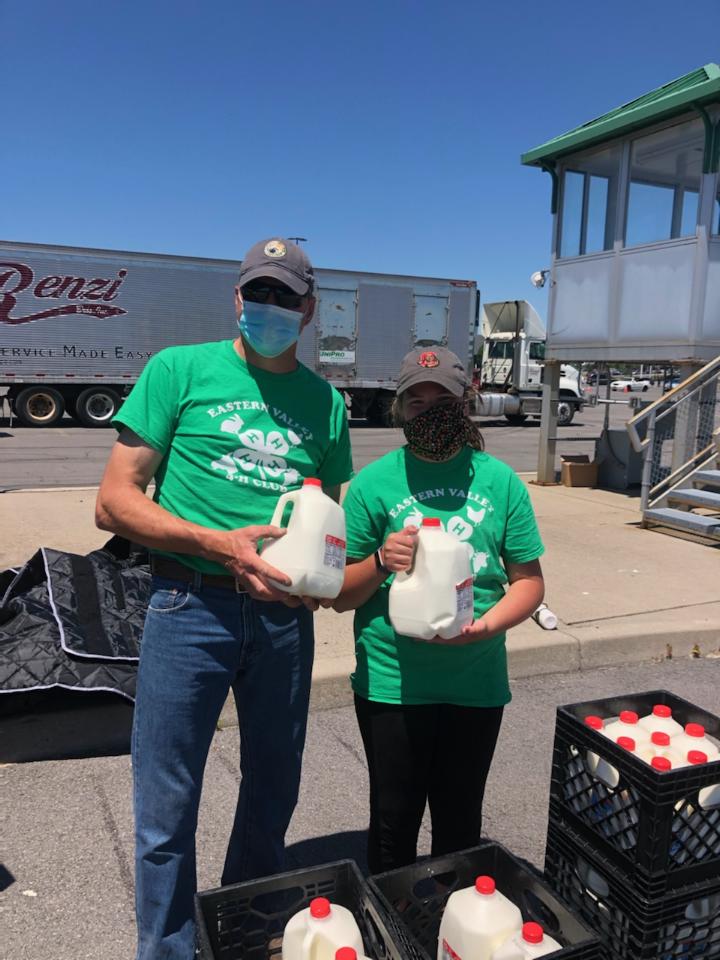
For the first time among the many news releases sent by ADA Northeast (ADANE) touting checkoff ‘facilitation’ of fluid milk and dairy donations, whole milk is in the box! Here, dairy farmer Joel Riehlman of Fabius, N.Y., and a 4-H member, hand out whole milk in mid-June at a Nourish New York and USDA CFAP Farmers to Families Food Box donation drop in Syracuse. Photo provided by ADANE

In a recent Watertown, New York drop point for these donations, ADANE board member Peggy Murray of Murcrest Farm, Copenhagen, N.Y. volunteered, and she noted in the ADANE press release that, “It was heartwarming to see their gratitude – especially for the whole milk — and to know that people really want the products that we produce on the farm.”

This has been the experience of so many farmers and ag community members involved in the grassroots distributions, as well as the industry and governmental distributions, because each event affirms that consumers love milk and dairy products, especially whole milk, and that they want to support local farms — as evidenced by their comments and long car-lines of families eager to receive these products. In some cases, recipients gave money asking it be put toward more drive-through dairy events.

In the Southeast and Midwest, CFAP contract recipients Borden and Prairie Farms have also been visible this month with Dairy Alliance and Midwest Dairy checkoff organizations often as partners, along with several state dairy producer group members joining in as volunteers and location coordinators.

Overall, the CFAP food boxes have been well-received. The program was designed by USDA to give farmers and food providers a presence within their communities, working with local food banks and non-profits without creating inventory hardships. In this way, USDA has taken what local communities were doing at the grassroots level — on their own dime and time — and systemized it with federal funds and contracts.

While dairy’s share has not been specified in USDA’s announcement of the second round of $1.16 billion in fresh food purchases in the contract extensions through August 31, it is believed fluid milk and dairy purchases will be similar to the first-round total of $317 million because several non-profits indicate they will be supplied with all their milk and dairy needs through the USDA until at least August 31.

This includes Blessings of Hope, which had partnered with 97 Milk in April, and raised over $50,000 for purchasing and/or processing local milk for families they serve in Pennsylvania.

Farms in southeast and southcentral Pennsylvania that were wanting to donate “over-base” milk for this 97 Milk / Blessings of Hope program will have to wait until after August 31, when the USDA CFAP food box program is set to end. It is possible that the CFAP program may again be extended until all $3 billion in food box funds are exhausted.

DPA_graph (1)

When Dairy Pricing Association (DPA) first ran an ad in the Cheese Reporter in early April looking for 200,000 pounds of USDA-graded cheddar cheese less than 30 days of age, the calls they received could not fill the order. By requesting USDA-graded cheese, the delay in their eventual purchase of 228,000 pounds showed a void in supplies that led to the initial turnaround in the plummeting block cheese price on the CME, which fueled the advances in manufacturing milk value. CME cheese prices drive Class III milk futures, which have risen rapidly since the DPA purchase bridged the gap in April. Current market strength has been extended through the large USDA food box program demand occurring at the same time as the re-opening of the food-service sector. DPA Facebook image

A positive outcome for farmers from all of these efforts — now extended by these large government purchases — is the real impact they are having in helping drive dairy markets higher since that first farmer-funded DPA purchase of block cheddar in April turned the CME away from its $1.00/lb record-low plummet.

Block cheese is traded every day around noon on the CME spot auction, and the price has set several new record-highs in June, including the most recent record-highs of $2.70/lb on Monday, June 22 and $2.81/lb on Tuesday, June 23.

This rally has pushed Class III milk futures into new contract highs for June, July, and August, while adding strength across the board.

In CME futures trading Monday (June 22) the June Class III milk contract hit $21, up $9 from the USDA-announced May Class III price of $12.14. July’s contract topped at $22.19, and August edged into the $20s. Monday’s Class III milk futures averaged $17.98 for the next 12 months, and Tuesday’s futures trading held most of that level, even adding to the July contract.

There is a supply side to this scenario also. See the related article on USDA milk statistics, pooling, production and dumping.

Trade sentiment is mixed on how long the upward momentum in dairy markets can last.

On the one hand, cheese prices are being driven by the combination of USDA CFAP purchases now continuing through August, re-stocking of food-service pipelines as the country re-opens, and the USDA Dairy Market News reports of consumer buying strength shown in strong pizza sales throughout the Covid period, and stable to strong retail sales meeting tighter supplies of milk and cream.

On the other hand, some experts warn of weakness ahead as these record-setting prices may prompt milk production expansion by fall when demand may wane after the USDA CFAP food box purchases end and food-service pipelines are re-stocked.

Much of the future will depend on how the re-opening of America goes for families, the food-service sector, schools, sports, and the economy at-large.

-30-

Dairy farmers prompt Franklin County, Pa. Milk Drop

Over 2000 families blessed with 3600 gallons of whole milk

Franklin_Milk_Drop03

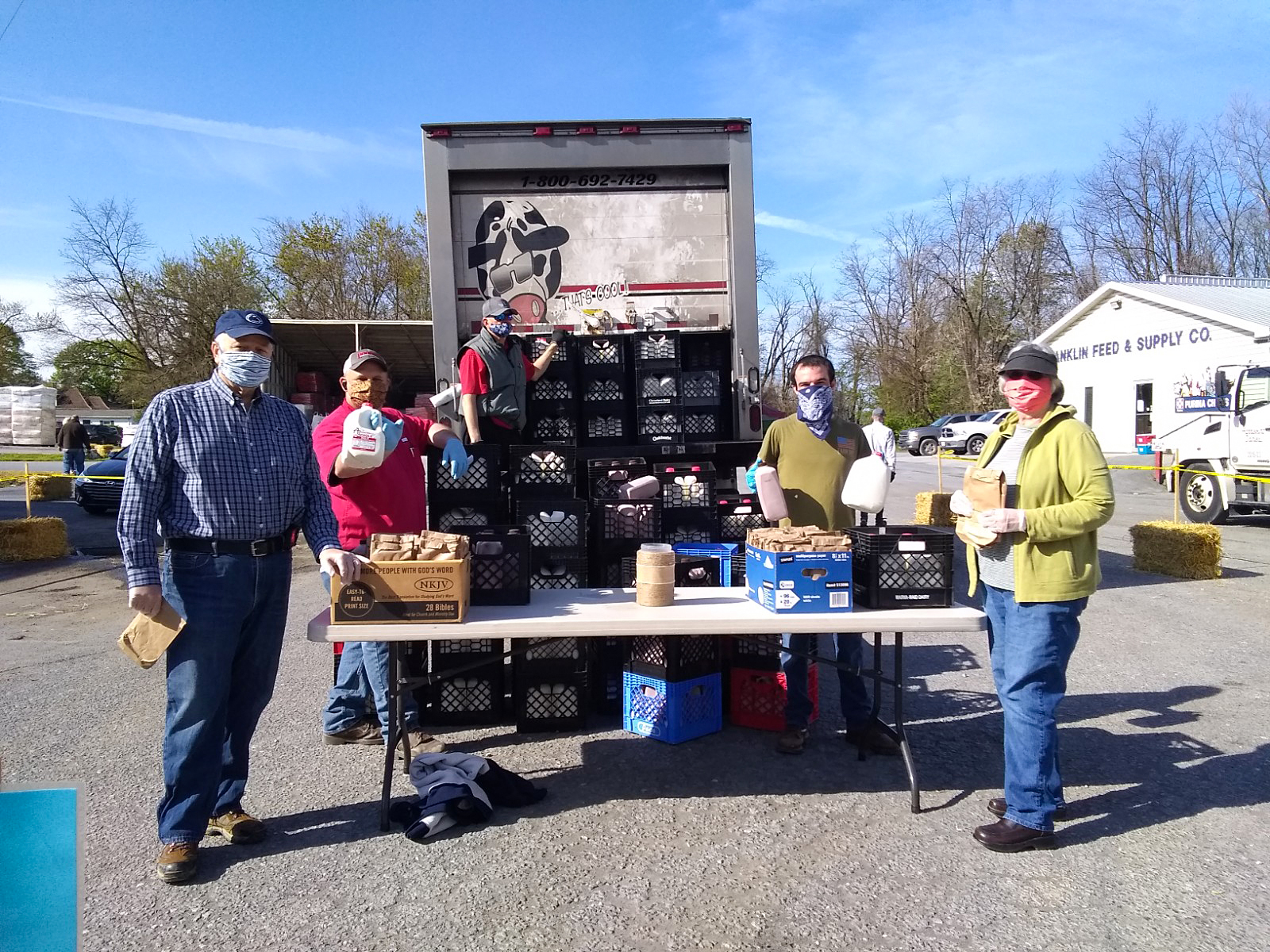
Zach Meyers (center), Franklin County Farm Bureau president among the volunteers ready with gallons of whole milk and half gallons of whole chocolate milk

By Sherry Bunting, Farmshine, May 15, 2020

CHAMBERSBURG, Pa. — “Watching Franklin County help Franklin County is the best way I can summarize this. Seeing the community come together was a blessing to witness,” says Lucy Leese who helped organize the 3600-gallon Milk Drop at Franklin Feed and Supply, Chambersburg, Pa. on Saturday, May 2. Leese is the office manager for the Franklin County Farm Bureau, and she works part-time on a local dairy farm.

The idea came from dairy farmers in the county seeing other such events in Lancaster and Tioga counties. Franklin County Farm Bureau president Zach Meyers, an area feed nutritionist, was contacted about it by one of his dairy clients.

“They knew Farm Bureau could reach more people to make this work, so we helped organize it,” says Meyers. “But the farmers get the credit. They made most of the donations. With this event, they basically sent a personal message to the entire community — that dairy farmers love you and care for you.”

May 1st dawned sunny, and people were itching to get out. They came in droves for the Milk Drop, some even breaking out their restored cars for the lineup.

Organizers say some people came because of true need in these hard times, others simply to show support for the dairy industry, and others just wanting something to do — to take a drive and be part of something. Whatever the reason or season – sunshine or rain – these Whole Milk Donation Drops, Drive-throughs, Challenges, call them what you will, are really catching on and spreading all over.

Franklin_Milk_Drop01

Lucy Leese works for a local dairy farm and as office manager for Franklin County Farm Bureau. Along with the whole milk, they gave out goodie bags with dairy facts, recipe and coloring books from county dairy promotion. Photos submitted

From idea to event, a whirlwind eight days transpired. Leese communicated with county Farm Bureau members and others by email and social media about the plan, and she quickly saw the high level of community interest through donation pledges as well as people expressing interest in coming out.

“We also reached out to others who have done this. Mike Sensenig (New Holland) had a lot of insight and gave us some things to think about ahead of time,” she said.

“Our biggest thought was that we wanted to be sure to use Pennsylvania milk, so we worked with Harrisburg Dairies,” Meyers relates in a Farmshine interview. “Most of the dairy farmers here are already producing milk at a significant income loss, and yet they still gave money to buy milk for the Milk Drop.”

According to Meyers, the vast majority of funds were donated by dairy farmers and supportive agribusinesses. A few donations also came from individuals and businesses with no connection.

“We wanted it to be whole milk,” said Meyers. “What is better than giving a gallon of whole milk and a half gallon of whole chocolate milk and having our community actually taste something good?”

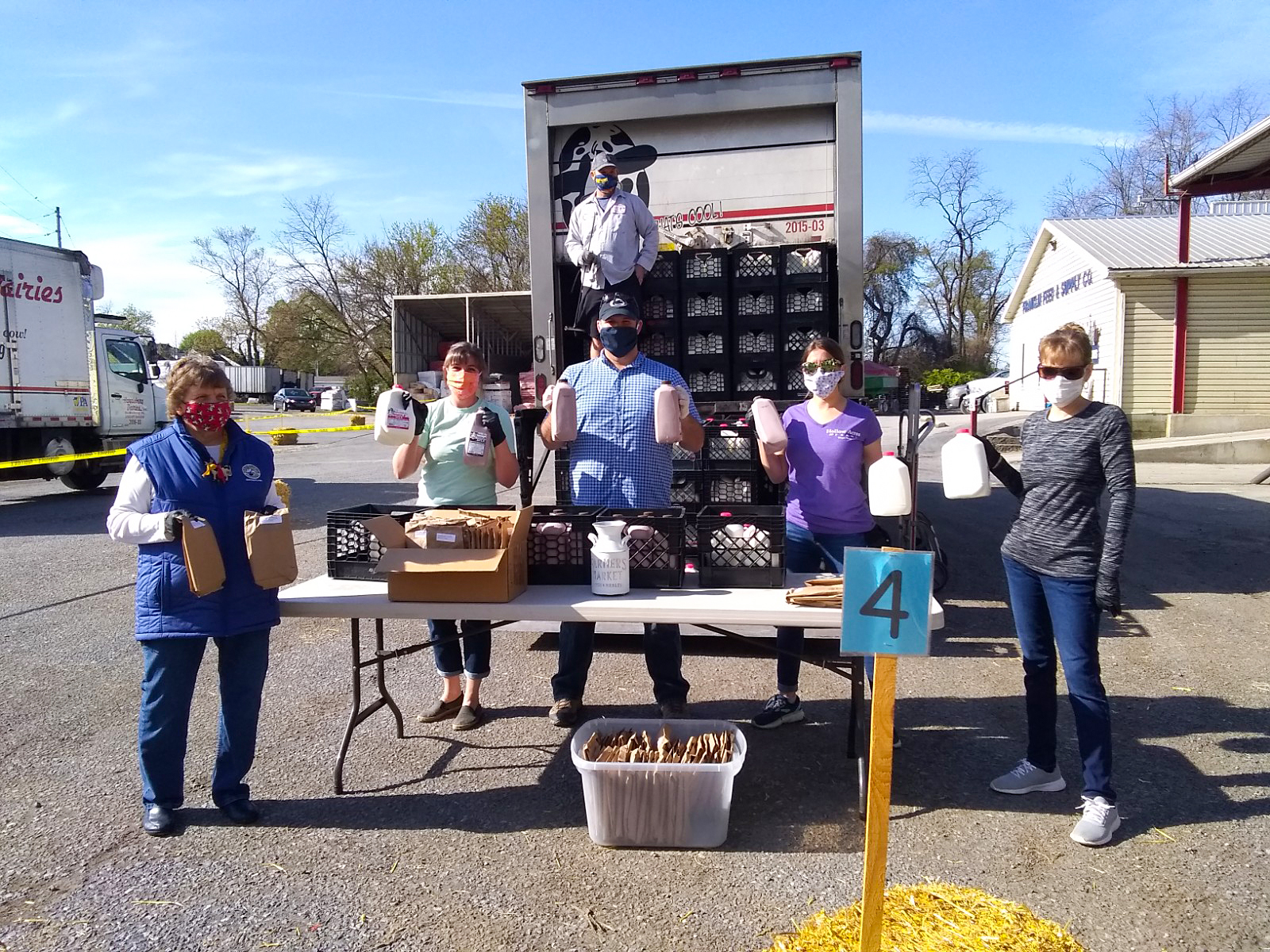
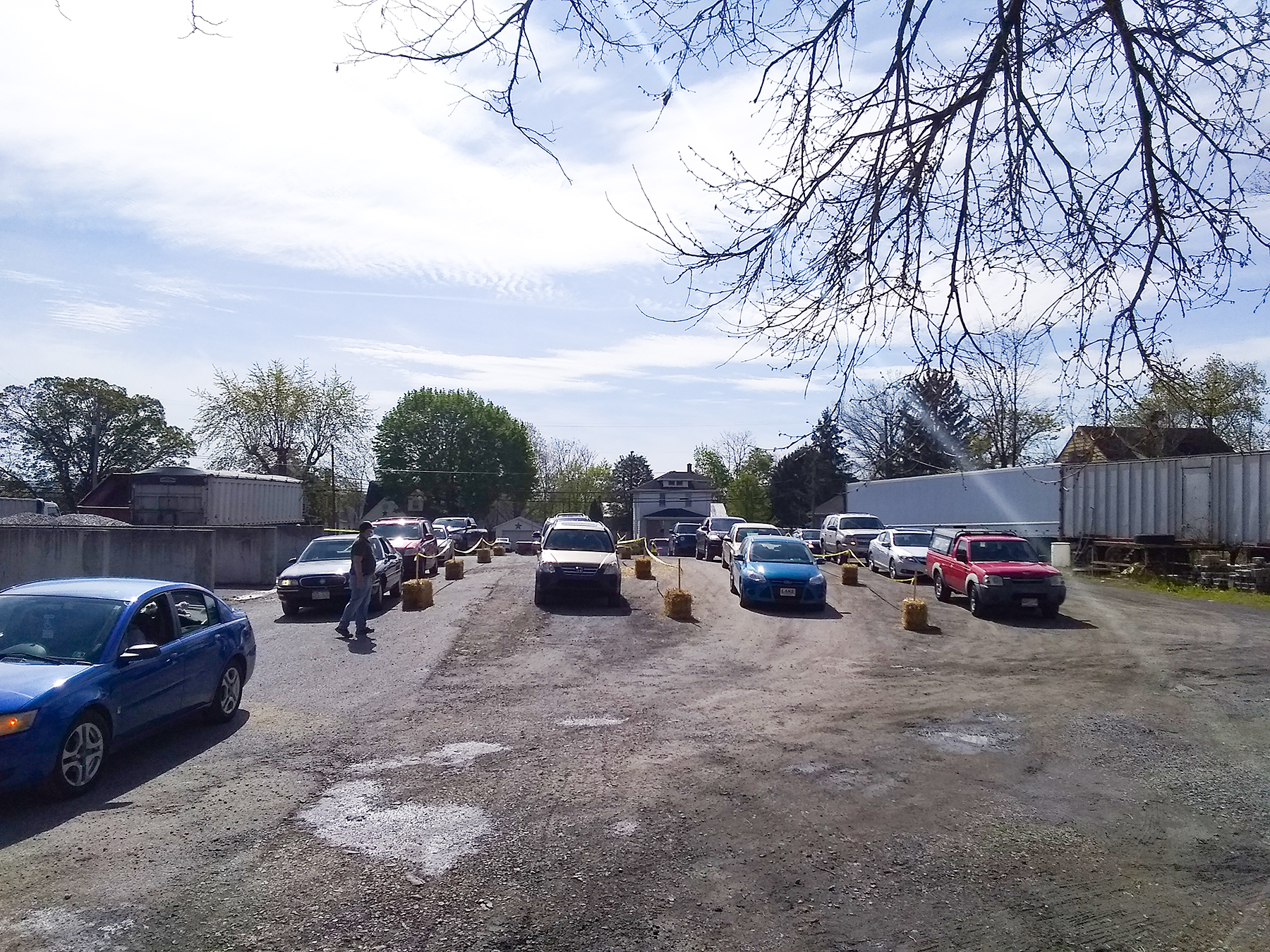
Over 2000 vehicles, in about a five-hour time frame, snaked through the Franklin Feed property off Rte 11 into four lines on either side of two Harrisburg Dairies trucks with 30 volunteers handing out milk and a goodie bag with a dairy fact sheet, recipe book and coloring pad courtesy of Franklin County dairy promotion.

The size of the event exceeded early expectations. They initially had money pledged for 500 gallons on Sat., April 25. By Monday evening, when they had their video chat to organize the event, they had funds to buy more than 2000 gallons. By Wednesday, April 29, three days before the event, they had pledges and paypal funds for seven times the original amount and confirmed their final count with Harrisburg Dairies for Saturday morning.

Franklin_Milk_Drop05

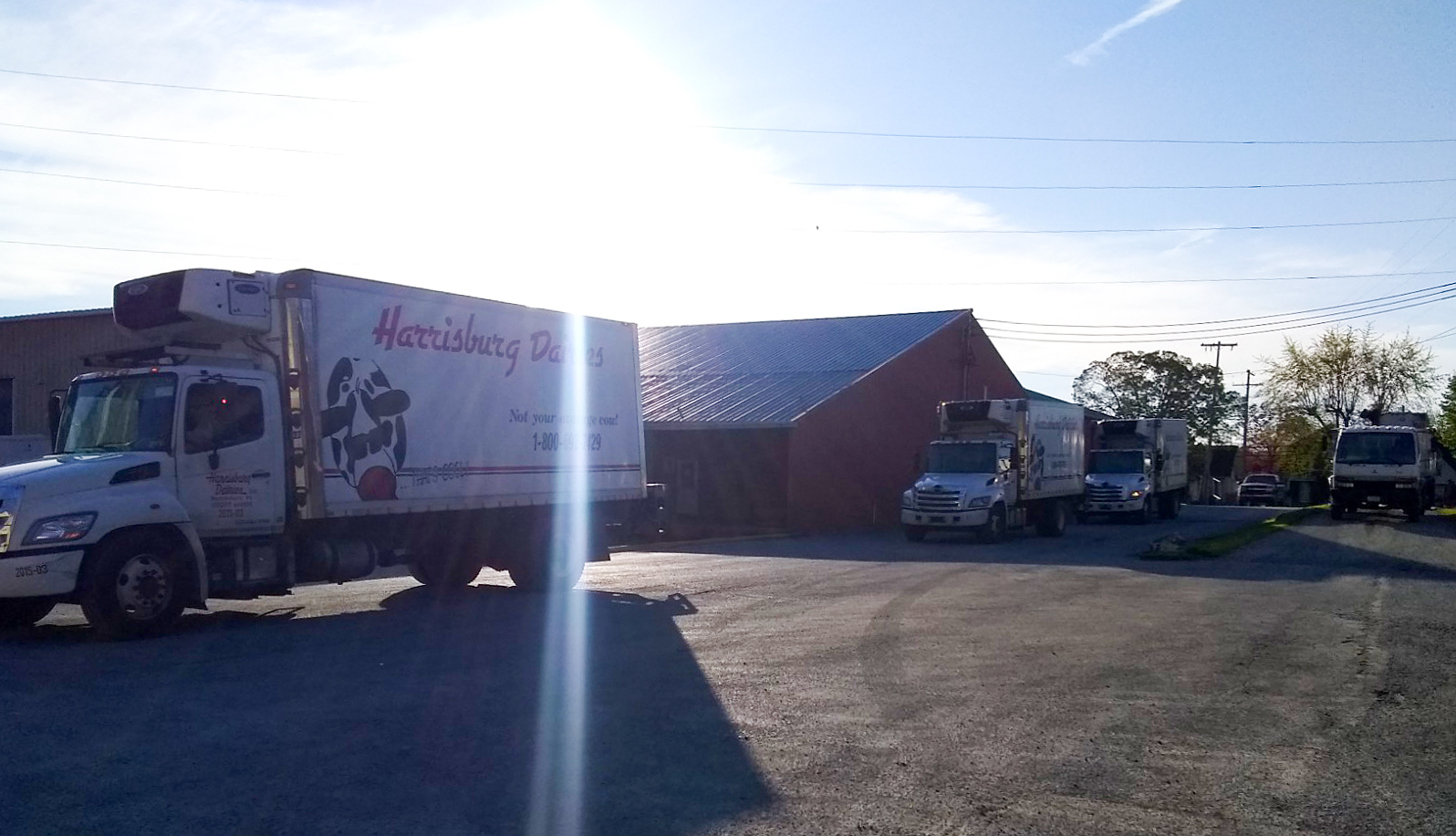
Pretty cool to see 15 tons of milk come in on three box trucks. Harrisburg Dairies sent employees to man the lifts and keep the milk moving to the distribution tables between four lines of cars. 

“It was pretty cool to see 15 tons of milk come in on three box trucks,” says Leese. “Harrisburg Dairies sent their own guys to man the lifts and keep the milk moving to the distribution tables.”

The community was eager. “We had cars coming in at 7:45 a.m. right behind the trucks, so we started letting them through at 9 instead of 10,” says Leese, describing the initial rush of cars that gave way to a steady flow into the early afternoon.

In the end, Shippensburg Food Pantry sent a refrigerated truck for the 150 gallons that were left at 2:15. Earlier in the day, folks from a nursing home in Waynesboro had come through for 40 gallons. “They said they weren’t able to get whole milk, and their folks needed milk,” Leese reports.

Hearing the emotion in Leese’s voice as she described the experience in a Farmshine phone interview, it’s obvious that an event like this truly touches the givers and the receivers.

“Several times people asked for additional milk for their neighbors or grandparents. We said from the beginning all are welcome, no questions asked, because we are all in a tough situation right now,” Leese explains.

Franklin_Milk_Drop06

Two teams of volunteers kept milk moving from three trucks. Throughout the 5 hours, area dairy producers took shifts. For them, it was personal, to show love for their community.

“It was encouraging for us as volunteers to be able to serve and give back to the community here at a time that we have felt helpless for so many weeks. This was an opportunity to be active and to serve,” she adds. “The folks coming through were just so grateful with words of thanks and blessings, and if they could, they gave money to pay forward for other Milk Drops.”

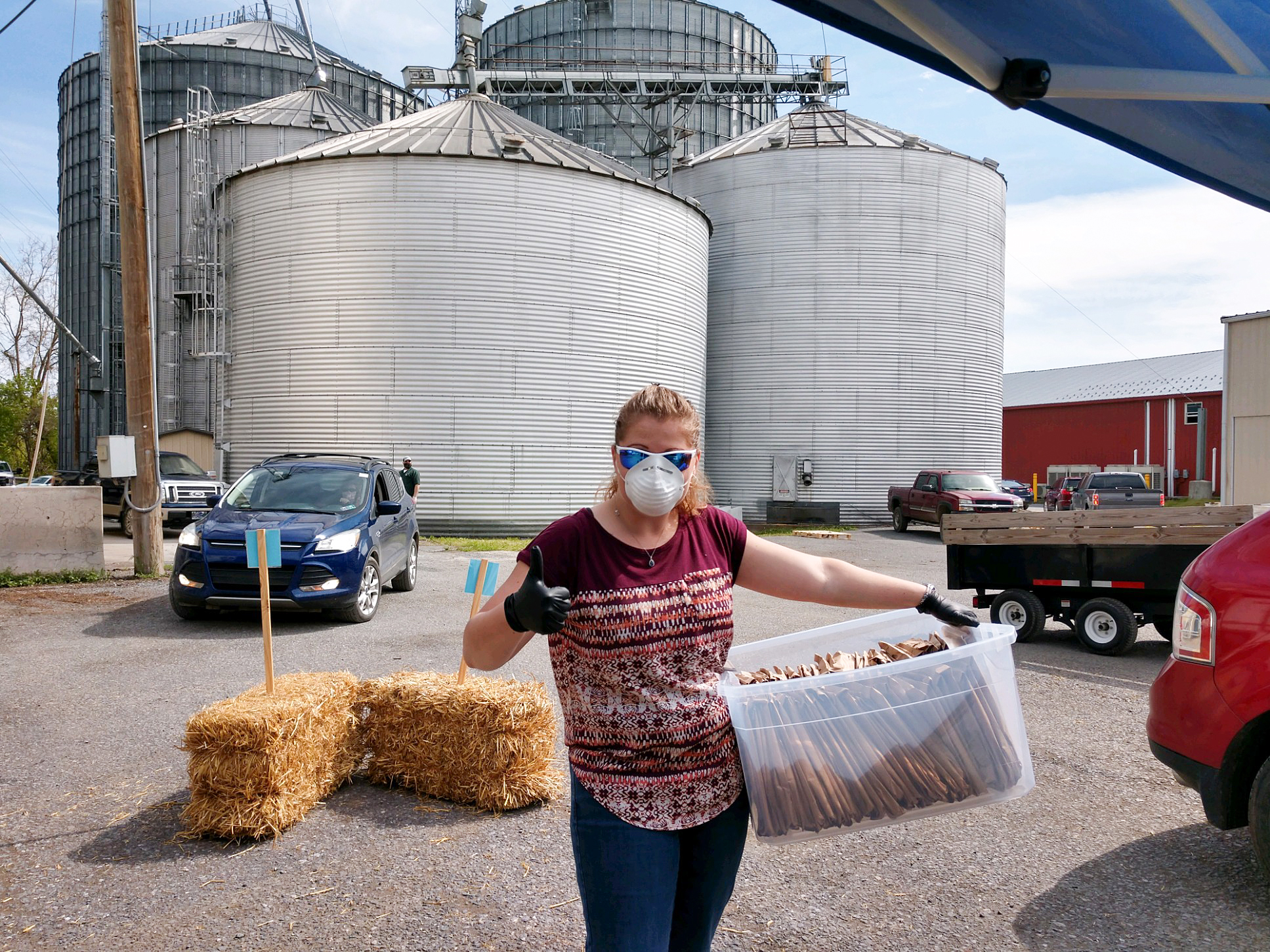
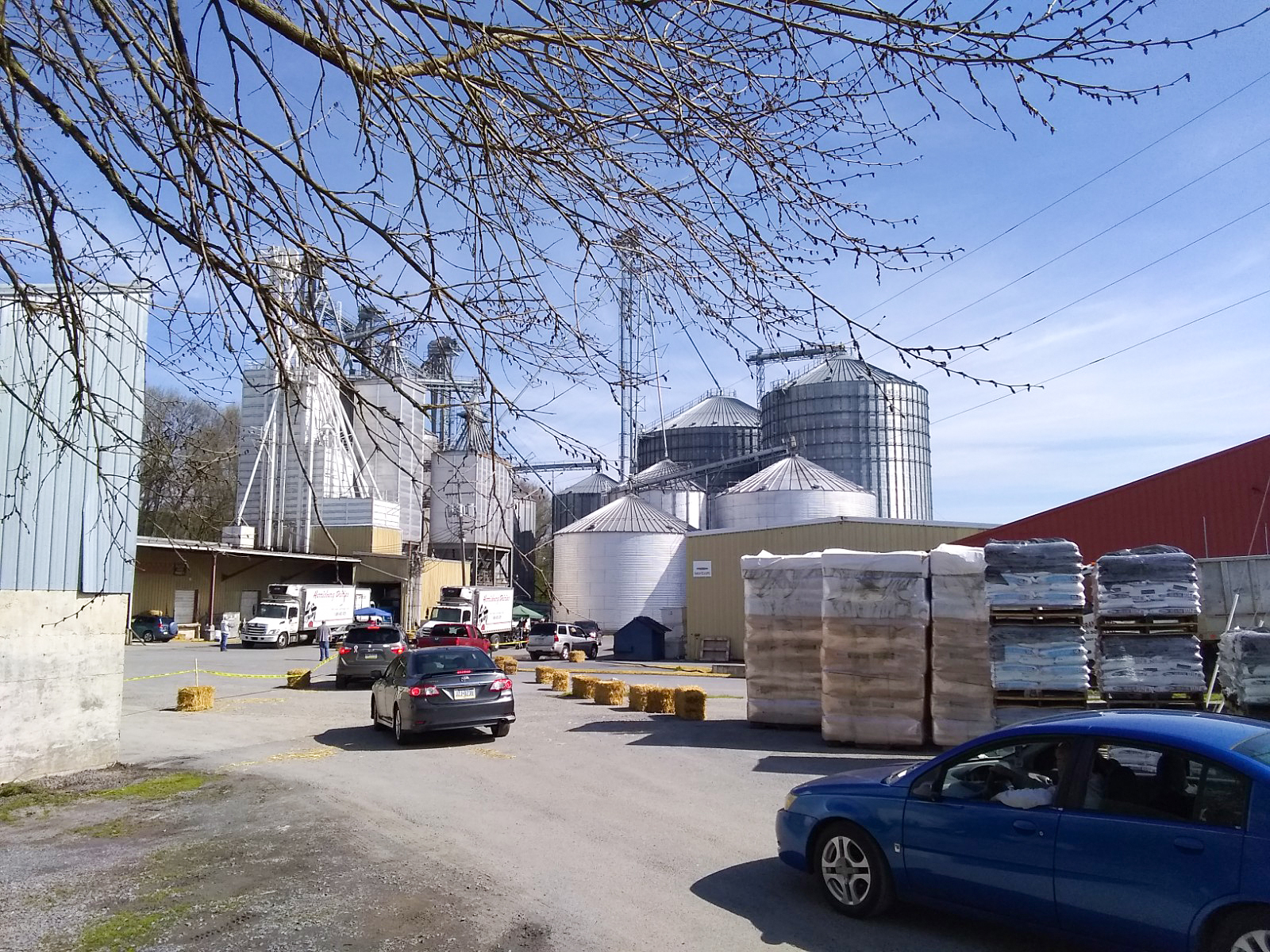
The way the lines flowed into Franklin Feed from Rte 11 gave the event a special touch for homebound families getting out. Wide-eyed children looked around at the sights of grain bins and feed equipment and then the milk trucks as they lined up between them.

Franklin_Milk_Drop02

Over 2000 vehicles, in the space of five hours, filed off route 11 in Chambersburg, snaking around the grain bins at Franklin Feed and Supply before breaking into four lines on each side of two Harrisburg Dairies trucks.

“People actually thanked us for the tour,” Leese said. “We needed to move quickly so the line wouldn’t back up to route 11, so we had four lines, and the volunteers came in shifts.”

While the Franklin County Farm Bureau is not planning another, others in the community are talking about more milk drops.

“As people are seeing and recognizing the need and the positive response, the idea is really taking off,” Leese observes, adding that they’ve been contacted by their peers in Centre County wanting to do one. Also, Harrisburg Dairies has been involved in other events like this, but this was likely their largest one-day, one-location event.

“We learned that people will give whatever they can to support something like this,” she says.

Leese’s advice for others includes: Overplan your volunteers, have popup tents for shade, wear gloves and masks.

“When you are standing there giving something to people, you can still smile with your eyes and be pleasant — even wearing a mask,” says Leese.

“People have been missing interactions, so we wanted to be cheery and welcoming, and people noticed. It helps raise everyone’s spirits,” she reflects.

Leese is grateful to the dairy farmers who had the idea, the many volunteers, and to Franklin Feed and Supply for providing the accommodations and being so helpful.

Franklin_Milk_Drop04

Ron Wenger, county Farm Bureau vice president, directed traffic into four lines to keep traffic from backing up onto rte. 11.

She says Farm Bureau first vice-president Ron Wenger, a dairy farmer from Pleasant Hall, was instrumental in figuring out the traffic patterns to make sure they had things flowing well.

“Coming from a farm background, working for a farm and the Farm Bureau, I know what farmers are going through, what they are facing, and it’s not pretty. Yet a portion of the donations came directly from dairy farmers, and they were out here to share and to give and to protect people. To see the community respond in such a positive way to this outpouring from the dairy farmers was gratifying.

“People understood that they were getting something good for them from farmers who care for them, so we got some kind of understanding happening here,” she observes.

“Now the question is how to hold on to that, and make it flourish.”

-30-

Whole Milk Gallon Challenge: Titusville couple uses ‘stimulus’ payment to bless, educate, inspire

TitusvilleWholeMilkGallonChallenge01(cropped) (1)

Jake and Casey Jones wanted to bless and educate their community with a Whole Milk Gallon Challenge they hope will inspire others.

By Sherry Bunting, Farmshine, May 8, 2020

TITUSVILLE, Pa. – Whole Milk Gallon Challenge? It’s not a milk-chugging contest. It’s a way to bless the community, support local farms, educate the public, involve the school district, and get people talking about the choice of whole milk for healthy kids, healthy families, healthy communities.

Jake and Casey Jones of Titusville, Pennsylvania held their first Whole Milk 500 Gallon Challenge at the local middle school last Friday, May 1. They purchased 500 gallons of whole milk from a local bottler and 500 educational handouts through 97 Milk and worked with the Titusville Area School District to set up a drive-through in a parking lot adjacent to where families pick up school meals on Fridays.

The response was overwhelming and the gratitude from the community, humbling.

It all began when the CARES Act passed by Congress resulted in COVID-19 ‘stimulus’ payments to Americans last month. Jake, a territory manager for Mycogen, was still working full time in agriculture and had not been asked to take a pay cut. As the ‘stimulus’ credit showed up in their bank account, they were seeing farms forced to dump milk.

They decided to use the ‘stimulus’ funds to do something that would have an impact on their community and local dairy farms.

Both Jake’s and Casey’s parents have dairy farms, and they are involved in Jake’s parents’ farm. They saw the level of losses, revenue down 30% in a month and down potentially 60% by June. They had previously contacted Farmshine about the whole milk choice in schools petition  and they were seeing schools provide meals during COVID-19 closures.

At first, they thought they could donate whole milk for the school to give out with meals. However, the USDA waivers for that were only in force for the month of April, and the process was complicated. Schools had to prove the fat-free or 1% milk was not available.

“We were frustrated — always hearing reasons why you can’t do this or that, when it comes to milk. We were tired of seeing and accepting roadblocks,” Jake related in a Farmshine phone interview this week. “We decided to find a way to do what we could to impact the situation. We feel incredibly blessed, and this felt like the right thing to do — putting the ‘stimulus’ money to something bigger to hand out a gallon of whole milk separately, but in conjunction with the school lunch system.”

Now they are hoping to inspire others to keep do the same.

TitusvilleWholeMilkGallonChallenge02 (1)

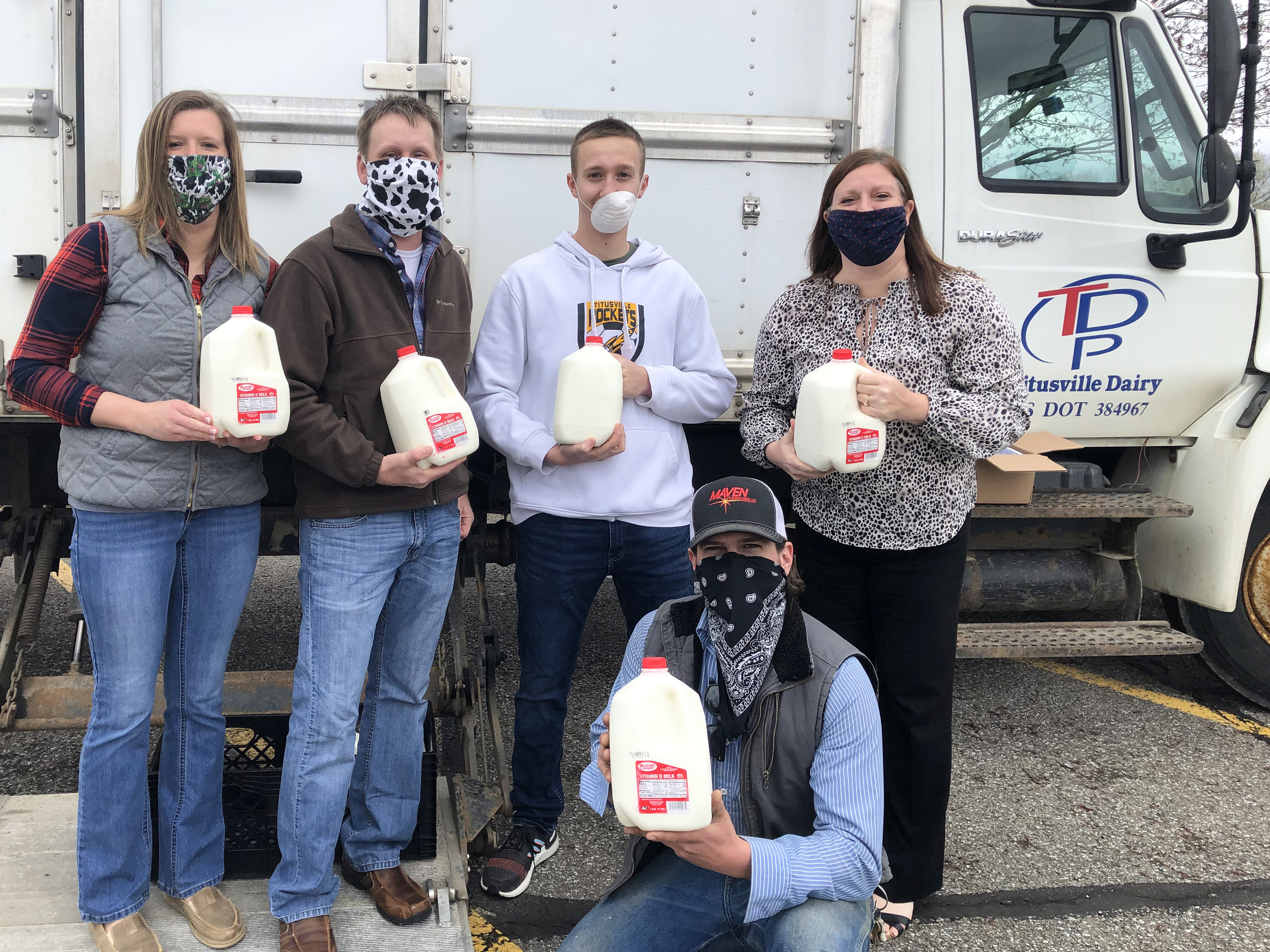
Jake and Casey Jones (left), along with (l-r) student volunteer Joey Banner, Titusville Area School District superintendent Stephanie Keebler, school maintenance manager Garret Rose (front), and Ralph Kerr (not pictured) from Titusville Dairy helped make the Whole Milk Gallon Challenge successful.

In April, one of the first contacts they made was to the Titusville Area School District superintendent Dr. Stephanie Keebler. “We told her our idea, and she immediately jumped on board as one of our biggest supporters,” the couple confirmed.

“Jake reached out to me by email, and it was just amazing, very generous,” said Keebler in a phone interview. “They worked collaboratively with their church (Pleasantville Presbyterian) and the milk board and with our local Titusville Dairy and the manager Ralph Kerr to acquire the milk.”

Keebler coordinated things on the school end to make sure they distributed the whole milk in a way that would not put their foodservice program at risk (low-fat rules) and got building maintenance, Garret Rose, involved to set up the traffic flow for safety.

The school has been serving 450 to 650 individual students’ two meals a day since the COVID-19 closures. Meals are grouped for pickup on Mondays, Wednesdays and Fridays at three locations.

“When you talk about the critical need we have within our community, our foodservice people have been fantastic. They have never taken a day off and there has been no lapse in service for our families,” Keebler indicated.

By Tuesday, April 28, the Joneses had the details set. Keebler used the district’s all-call technology to notify the families of the district’s 1,915 students to let them know about the milk distribution.

TitusvilleWholeMilkGallonChallenge03 (1)

A steady flow of cars came through the Titusville Area middle school parking lot Friday as the Whole Milk Gallon Challenge was set up at the front of the school as meals were picked up at the back.

“As families drove in the back through the bus loop for the meals, we reminded them to enter the front and follow the driving pattern to where they had the refrigerated truck with the milk,” Keebler related.

Jake and Casey, with two young children at home, were assisted by a student volunteer Joey Banner in handing out the gallons and information cards. He was enthused about the challenge too.

“We are extremely grateful they reached out with this idea. The ease of collaboration between the family and the district pulled off a very successful event. Developing relationships and connecting with the community is vital,” Keebler noted.

On the milk end, Ralph Kerr and the Titusville Dairy team were instrumental, according to Jake. They provided logistics, the refrigerated truck and put them in touch with Marburgers Dairy to arrange the purchase of the milk.

“Once we had the green light, setting up the logistics went fast. We wanted every gallon of whole milk to have a handout with information,” he added. “We wanted to bless and educate at the same time, while building some ground level support for the choice of whole milk in schools.”

Other than the school district’s automated call to student families, the Joneses did not advertise the event. Until Friday.

“We did a facebook post at 10:30 a.m. that morning, knowing the school lunch pickup was set for 11 a.m. By 10:35 a few vehicles were lining up,” Jake explained. “As the first few cars drove through, we told people to let their friends and neighbors know. By 11:00 a.m., we had a big rush, and then it was steady. People were excited and asking questions.”

After the school meal pickup ended at 12:30, traffic hit a lull. That’s when their facebook post and word-of-mouth drove visitors in from the community.

“Grandparents said their grandchildren told them to come see us. People drove through saying neighbors told them or that they saw it on facebook,” Jake reflected. “We had a massive second rush of people, and some asked for extra gallons so they could take to others.”

It was gratifying to see the blessing multiply.

By 3:30, they had given out 408 gallons of whole milk and contacted the local Associated Charities to receive the remaining 92 gallons.

“The director pulled in to pick those up as we were cleaning up. She told us ‘you have no idea how many people ask for dairy products — especially milk.’ She was also excited about the 97 Milk cards, to learn something new about whole milk and to give them out with their meal boxes,” said Jake.

“By the end of the day we were exhausted, but amazed,” said Casey, and by the evening, they heard from someone involved in agriculture who was inspired to provide funding for another Whole Milk Gallon Challenge if Jake and Casey would help with logistics.

“That’s phase two of our mindset, that anyone can do this,” said Jake. “Whether it’s 500 gallons or 200 gallons or 100, or maybe it’s 200 ice cream cones — to be creative and give not just based on financial need, but as something positive, uplifting and informative for the community.”

While they were distributing, parents were already posting their appreciation on social media. Jake and Casey updated everyone with a post later that day, and it spread through over 200 shares, nearly 500 likes and over 100 comments in short order. Local families contacted them with thanks, and children sent cards.

“Seeing the gratitude, that’s when it hit us,” Casey observed. “This was impactful, and it touched people.”

“It was based on the spirit of things, not the money or financial need, but something positive that everyone could be excited about and thankful for, because it was cool and different,” Jake added. “Handing out the 97 Milk cards (item #400 at the download area at 97milk.com) with each gallon of whole milk was pretty powerful. We saw people mesmerized, looking at them.”

All printable items at 97milk.com have the cost and printer contact information noted. The Joneses ordered on a Friday and had them by mail that Tuesday.

The printer even included some extra cards they made available to local stores interested in putting them out.

“What started as a gesture, opened up a ‘conversation’ with the education piece,” Jake related. “If the public is not educated about whole milk, then all the pushing in the world won’t make the choice of whole milk in schools happen.”

“We want to keep things happening in this town, and it can happen elsewhere,” Casey suggested.

“That’s the challenge,” Jake added. “If someone picks up the idea into other towns, states, with heavier population. Maybe a few families, a business, a group, take on the Whole Milk Gallon Challenge together and build some interest to get schools and families talking.”

Most important, said Jake: “If you are feeling you want to do something but think you can’t do enough, just do what you can. If a handful of people each do a little something – together — in a lot of different places, a lot can be accomplished.”

His advice? First, contact a local bottler. “Google to find a plant in your area or region. Start there. It was very easy once we talked to the people at Titusville Dairy and Marburgers,” Jake advised. “By using a local bottler, the local community gains more bang for your buck in supporting local farms.

“If you are not involved in agriculture and want to do this in your community, ask a local farm where they ship their milk,” Jake suggested.

“Many farms have facebook pages, look for one in your area and contact them that way about milk bottlers in the area,” Casey added.

Other advice: Call an area food bank or charity ahead of time to have a place for remaining milk. Pre-set the hours to a tighter window, like 11 to 2. Start publicizing 4 to 5 days in advance. And work with your local school district.

“Schools have big parking lots with traffic patterns already in place, and they can help you set up a safe flow of traffic and a way of communicating it to families in the district,” Jake said. “Plus, getting the school involved — superintendent, building manager, foodservice — increases awareness and gets them thinking and talking about whole milk.”

“It has to be whole milk with the educational component for the long-term impact,” said Casey. “Our mindset was to buy the milk and give it away, along with the information.”

“Let people know this is as much a gift as an educational thing, and that all are welcome to receive,” Jake concluded. “Don’t be intimidated by a number, just do what you can.

“We would challenge all of us to do what we can because we can all be doing more.”

To contact Jake and Casey Jones for information and advice to do a Whole Milk Gallon Challenge, email them at Jake.t.jones46@gmail.com

WholeMilkGallonChallenge04

May 1, 2020 was ‘food heroes’ day — a national day to honor school nutrition personnel. In Titusville, Pa., cars had brightly colored signs of thanks for their every day food heroes at the school preparing meals for pickup, and for the milk heroes providing gallons of whole milk to their community.