‘Hearts full.’ Whole Milk Donation Drive-through tops 7400 gallons in New Holland

As stores raise prices and limit sales, while farmers are forced to dump milk and see their prices fall to historic lows, many respond with dairy purchases for donation drive-throughs. This example in New Holland provided whole milk from farm to table with love. It was a beautiful blessing to see…

This slideshow requires JavaScript.

By Sherry Bunting, preview of Farmshine cover story for May 1, 2020

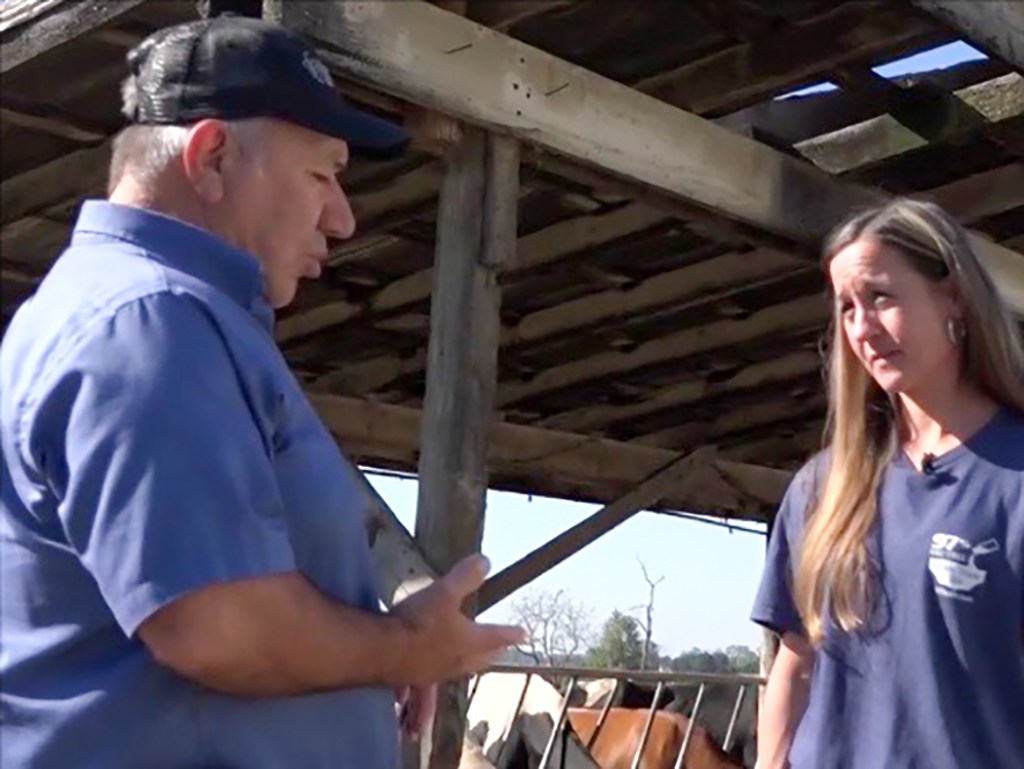
NEW HOLLAND, Pa. — At a time like this, we all need good news. Brothers Mike and Karl Sensenig of Sensenig’s Feed Mill, New Holland, Pennsylvania started thinking about the concerns of farmers and people in their communities during this Coronavirus pandemic. They couldn’t understand why farmers were having to dump milk with nowhere for it to go, while stores had limits on purchases or empty shelves and higher prices.

So, they did the one thing they could do… They gave.

We wanted to give back to our community — and the shelters and missions and food pantries — while helping support our family farm customers at the same time,” the brothers said.Sensenig-4851The idea started coming together two weeks ago. Many of the feed mill’s dairy farm customers in eastern Lancaster County ship their milk to Clover Farms Dairy, a bottling plant in Reading. The Sensenigs spoke with Brian Ohlinger at Clover and put together a purchase order for a tractor trailer load of over 4000 gallons of whole milk for donation.
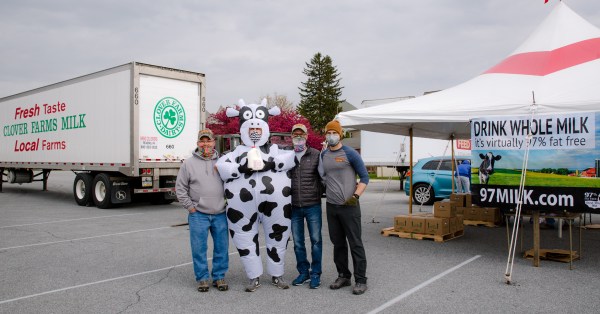
That number quickly grew to 5200 gallons as word of the plans for a Whole Milk Donation Drive-Through “From Farm to Table with Love” quickly spread through phone calls and social media.

Mike’s wife Nancy fielded over 150 calls with groups and individuals wanting to pre-order for families in need. The entire company — all of the employees — were involved. They amassed a list of over 25 outreach organizations pre-ordering hundreds of gallons to distribute from New Holland to Lancaster to Reading and Allentown, including notables like Water Street Mission, Blessings of Hope, Crossnet, Crossfire, Petra, Safehouse, Good Samaritan and other ministries, churches, shelters, town and company food banks, fire companies, nursing homes, youth centers — so many organizations.

The Sensenigs saw the need and desire for whole milk growing, and they quickly realized even this would not be enough. So, they worked with Clover to get a second single-axle truck of 1152 gallons.

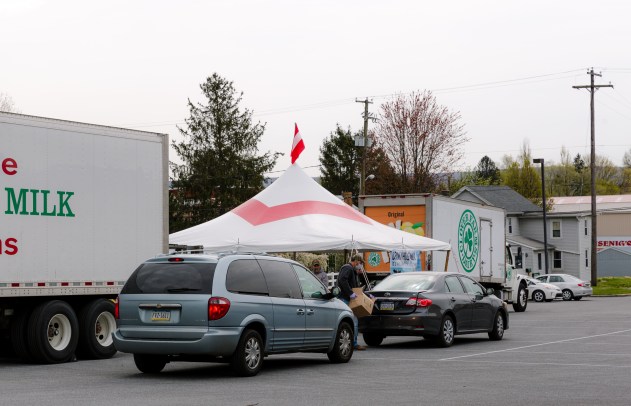
Cars lined up early on the first day of the Whole Milk Donation Drive-through (Apr. 23), while trucks were loaded with bulk orders for charities. The drive-through lines were opened ahead of schedule, and within the first 30 minutes, they had already served around 100 cars.

If this pace kept up, the Sensenigs feared they would run out. So, they called Clover again, and within two hours, a third truck arrived on the premises with another 1100 to 1200 gallons. 

All told, Sensenig’s Feed Mill had purchased 7,476 gallons of milk for donation so supplies would last through both days of drive-through times.

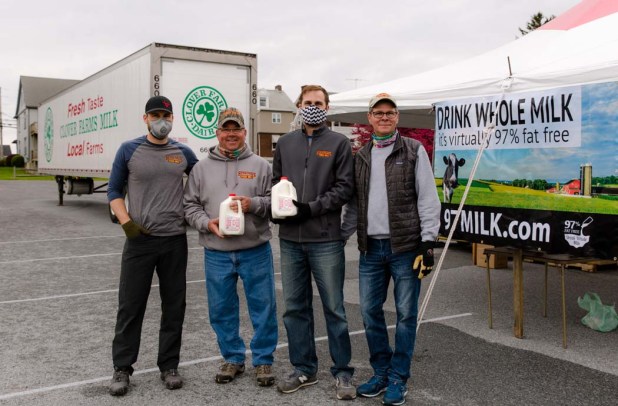
Two generations of the family — Karl, Mike, and Mike’s sons Kyle and Kurt, along with employees Devin Shirk, Steve Morris, Greg Hill, Curtis Hershey, and Lee Stoltzfus loaded vans, trucks, and cars with fresh gallons of whole milk, while Mike’s wife Nancy and employee Dawn Wright directed cars through the M&T Bank parking lot into two lines on either side of the truck and tent.

Even Karl and Mike’s parents Ken and Sandy drove over to watch.
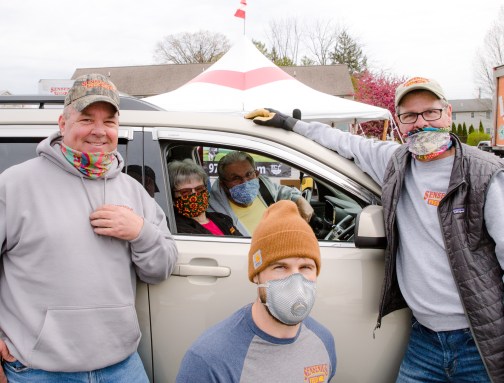
Sensenig-4914They are quick to point out that this would not have been possible without their employees. “This isn’t just us,” he said. “Everyone was excited to do this and to be involved.” The family’s feed mill is celebrating its 75th year in New Holland.

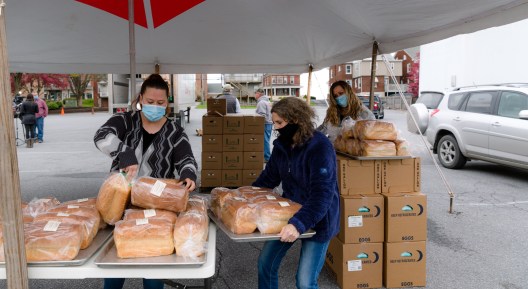
Also wanting to make an impact, a group of concerned citizens affiliated with M&T Bank joined their neighbors in the parking lot — bringing 150 dozen eggs and 50 fresh-baked loaves of bread from Achenbach’s Bakery, Leola.
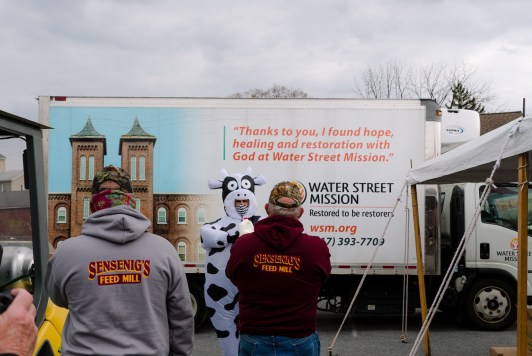
Sensenig-4786Kurt Sensenig even donned an inflatable cow costume at the start, before he was called back to the feed mill.
Sensenig-4845

“We have been overwhelmed by the response since we first started taking pre-orders to gauge how much milk we would need. Then the steady stream of people just driving through was amazing. There is so much emotion,” said Mike.

Sensenig-4939

“This brings home the reality of how many people are struggling right now. And it shows how many people LOVE WHOLE MILK!” said Karl. “Some who drove through the line had tears in their eyes. It seems like something so little. Then you realize how it helps so much, and it shows us how much we can take for granted.”

He tells of a grandmother who drove through with her two grandchildren she is raising. She tentatively asked if she could have two gallons. “I said, ‘you can have more if you need it,’” Karl reflected. “She wondered if it’s not too much trouble, she would use four gallons. I said, ‘sure!’ What she said next really got to me: ‘Now my grandkids can have milk with their cereal.’”

Cereal is a popular item for food bank distribution, but milk is hard to come by, especially whole milk.

One person drove through, saying they had stopped at their usual store to buy milk, but found no whole milk, so they came to Whole Milk Donation Drive-Through and took home four gallons.

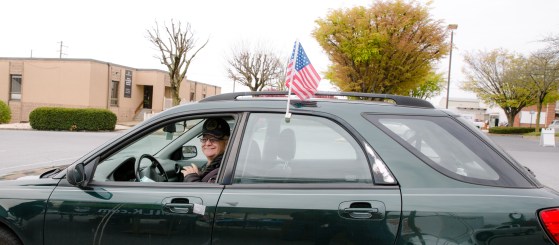
Many veterans in the area came through and were grateful for the whole milk they accepted with smiles. Drive-through crews, in turn, thanked them for their service.
Sensenig-4903The bottom line for the Sensenigs and their employees was to bless others even as they believe they are blessed; to do something positive for their community; to help dairy farmers by connecting dots to get whole milk to missions, food banks and families; to bring smiles to young and old during uncertain times that have changed life as we know it.

“We have many dairy farm families as our customers, and we see the milk they have been forced to dump in the past few weeks due to supply chain disruptions while at the same time stores limiting purchases of milk or having little or no whole milk on the shelves,” said Mike. “Clover gave us a price for just the milk, and they packed the first two orders in boxes for us and provided the refrigerated trucks to stay here two days.”

“It takes teamwork,” said Karl. As part of the loading crew, he and his brother were busy all day in constant motion, unloading skids, opening boxes, loading trucks and trunks, and handing out gallons to appreciative people as they drove through.

“I’ll sleep good tonight,” said Karl.

Mike agreed: “Our minds and bodies are exhausted, but our hearts are full.”

The community of farmers and citizens thank all involved! This scene being repeated in other communities is a beautiful thing to see.
Sensenig-4869Others have stepped up doing similar milk donations. Some businesses have bought 500 gallons to give to employees and food banks; one couple in western Pennsylvania feeling blessed to still be working in agriculture are using their stimulus check to buy 500 gallons of whole milk to donate in a drive-through next week at their school; young farmer clubs and other organizations are working with milk cooperatives and processors to donate and raise funds for dairy donation drive-throughs in other parts of Pennsylvania, New York, the Southeast and elsewhere. Some are set up weekly, with people giving donations as they pick up milk and dairy products that are then used the next week to purchase more for donation.

Meanwhile, many store chains are raising prices and limiting purchases to shoppers for milk and dairy products on their sparsely stocked shelves, claiming a shortage, even as farmers are receiving letters that they must cut production because their product “has no demand,” and they are seeing the price they are paid for their milk fall by more than 35% in just four weeks.

The COVID-19 pandemic is revealing how the centralized supply chain is broken — not making the shift from foodservice to retail. Drive-through donation deals like this one, connect the dots at a more localized level so families get access to the milk and dairy products — especially whole milk — that they need want, while helping outreach organizations distribute to the growing number of families facing unemployment and business closures.

On Friday, April 24th, as the New Holland Whole Milk Donation Drive-Through came to a close, 97 Milk LLC — a grassroots volunteer milk education effort — announced on facebook a fundraising collaboration with Blessings of Hope food pantry mission. The new campaign specifically raises funds to purchase whole milk gallons for the ongoing blessing boxes to families in a 200-mile radius of the Blessings of Hope warehouse in Leola, Pa.

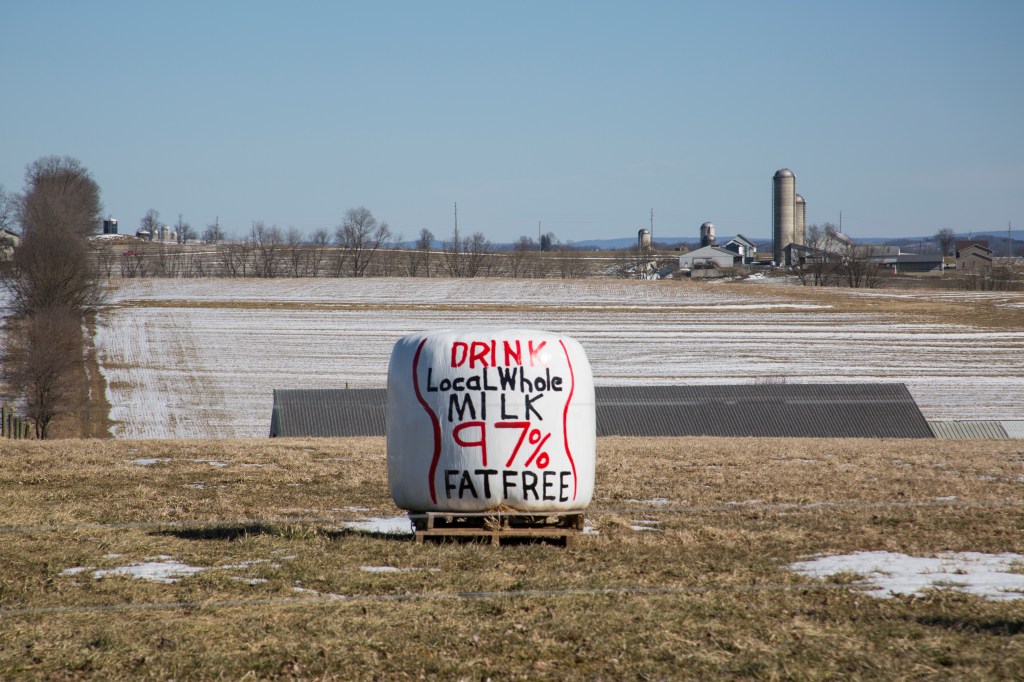
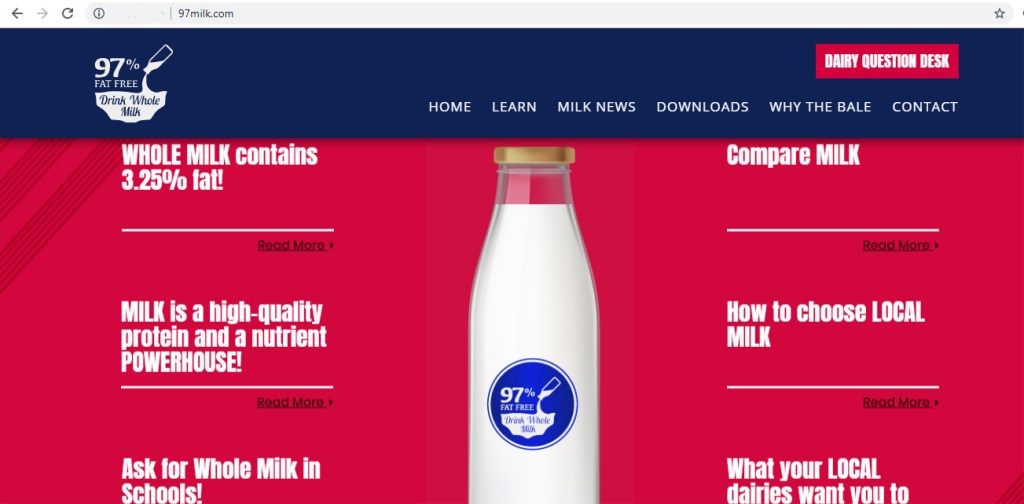
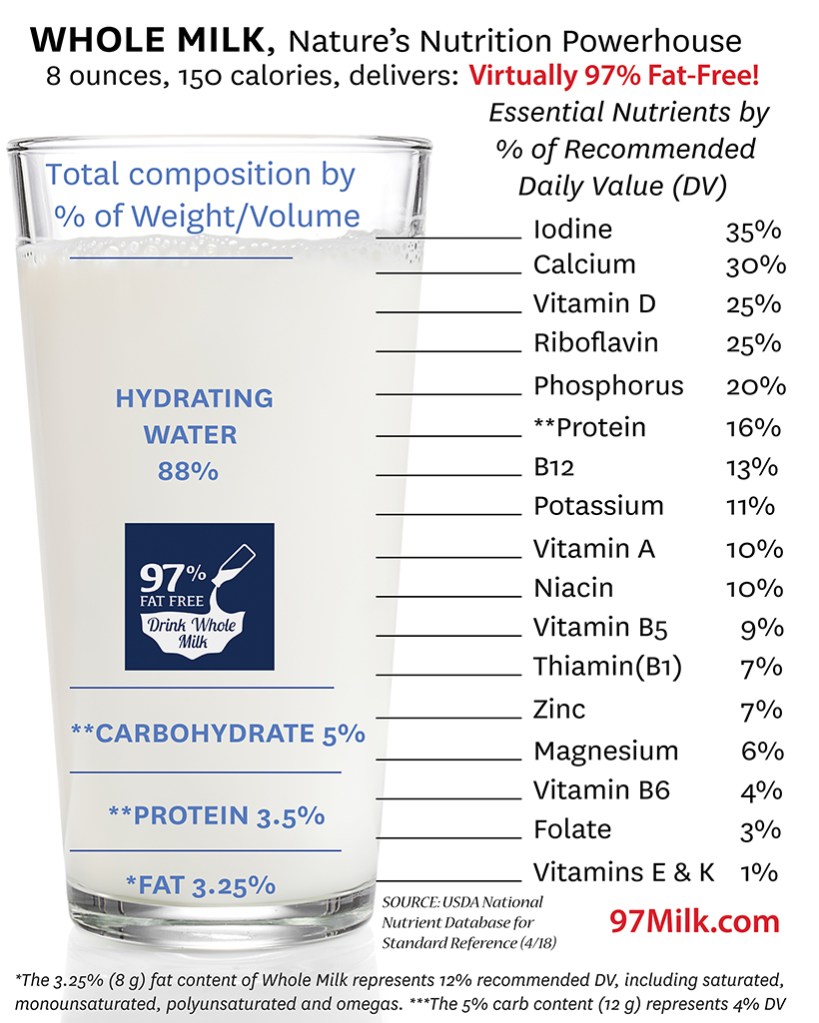
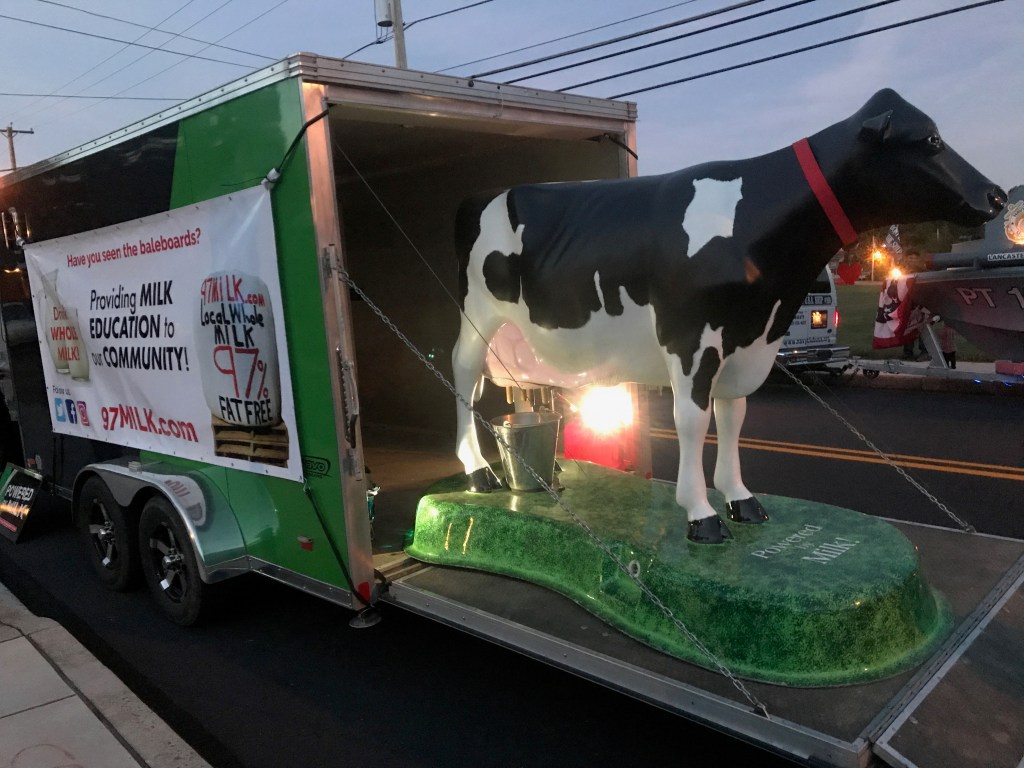
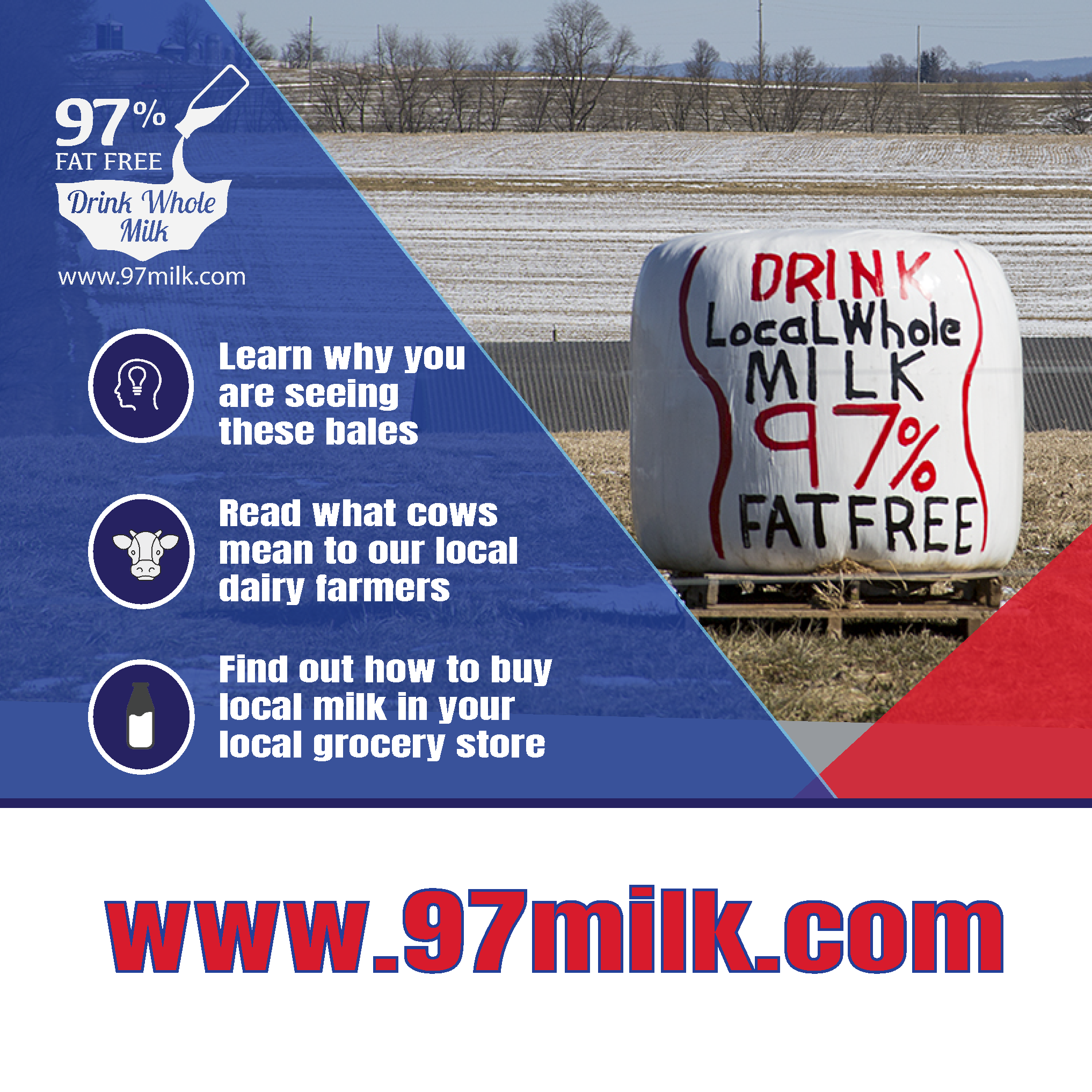
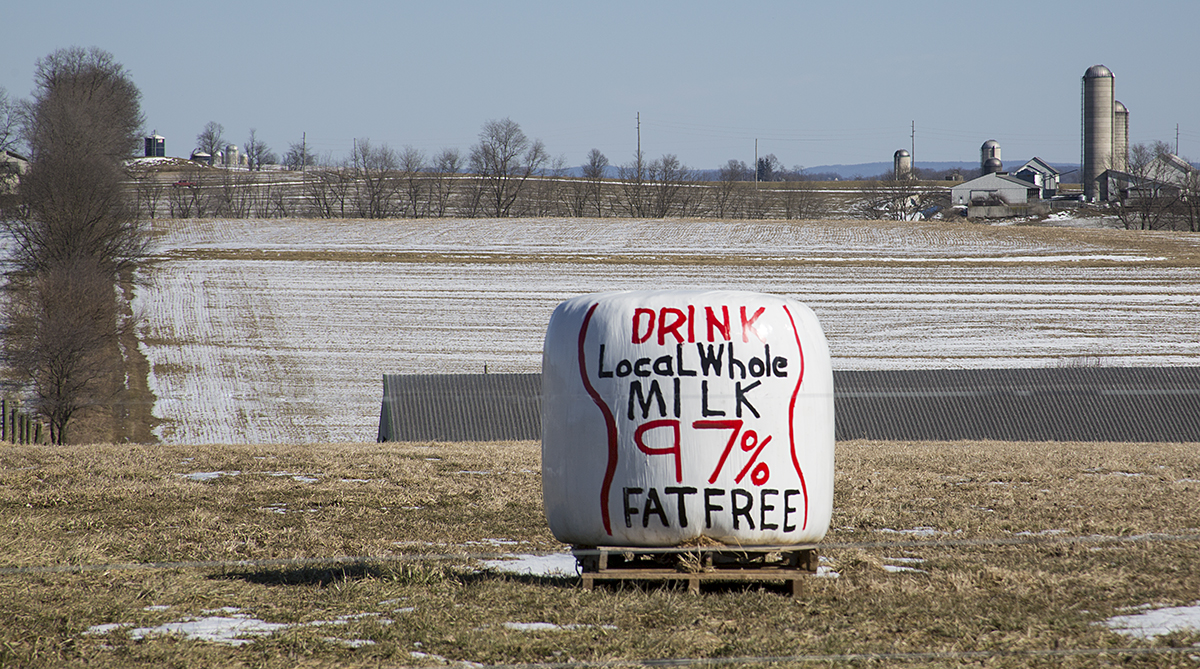
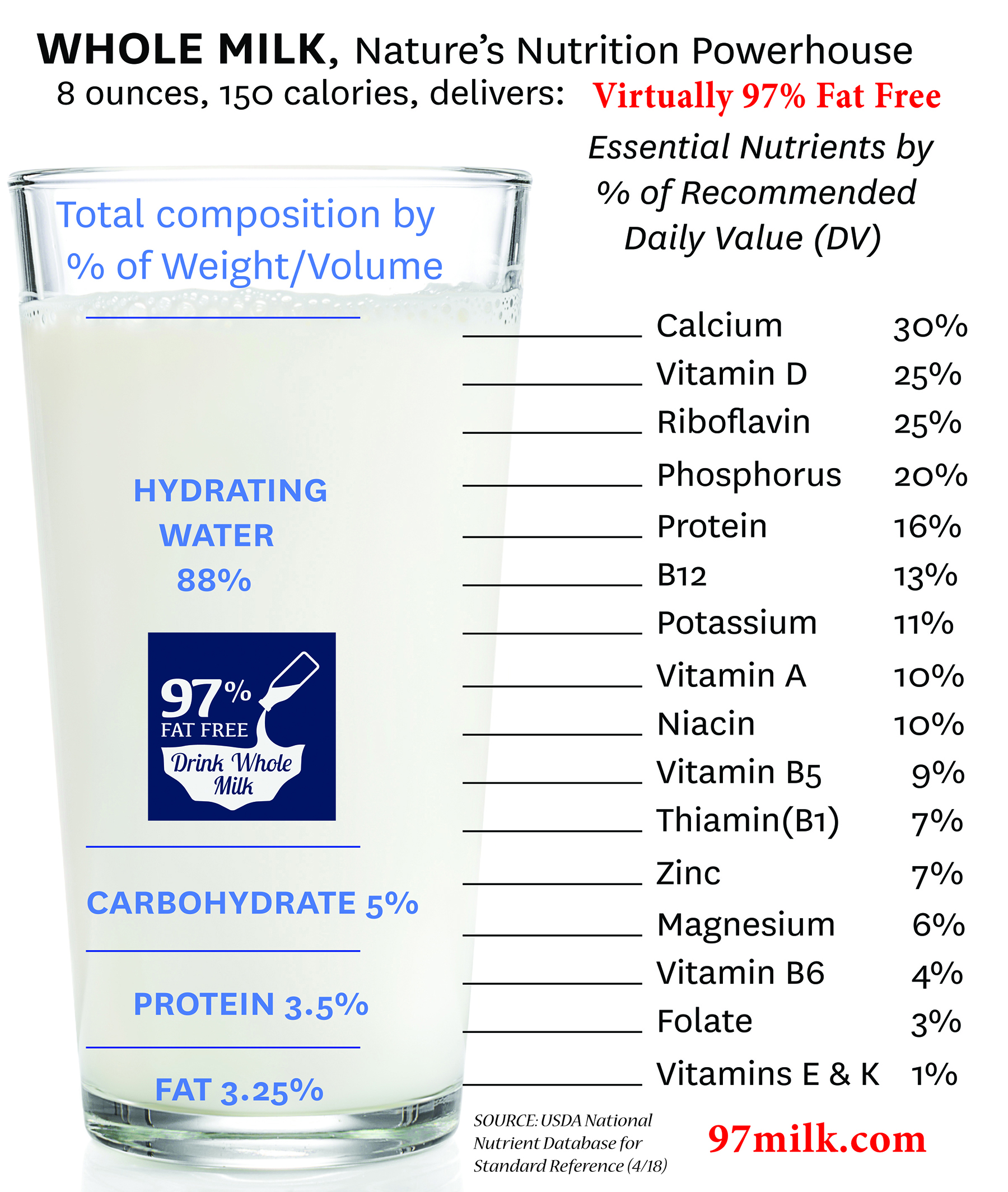
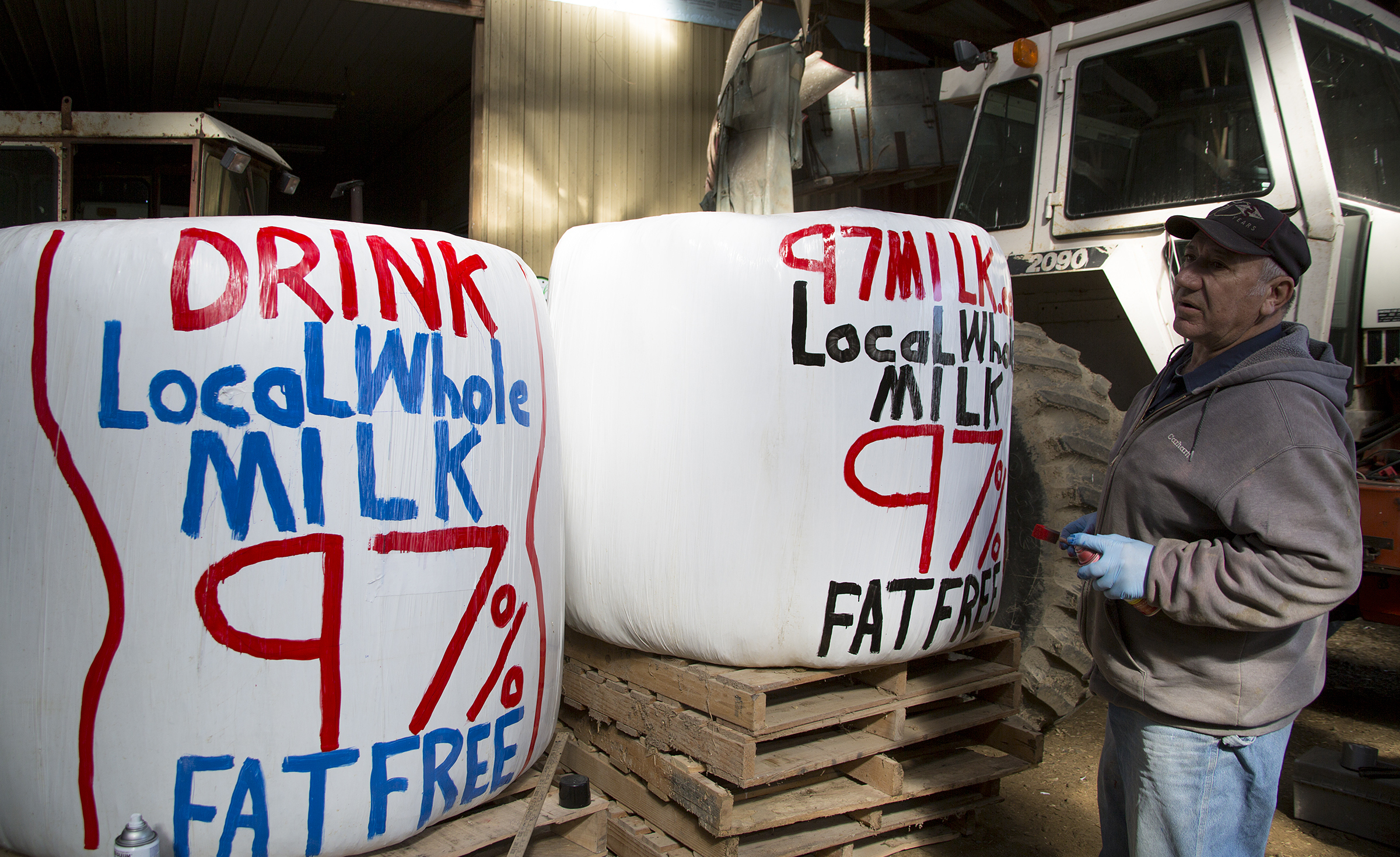
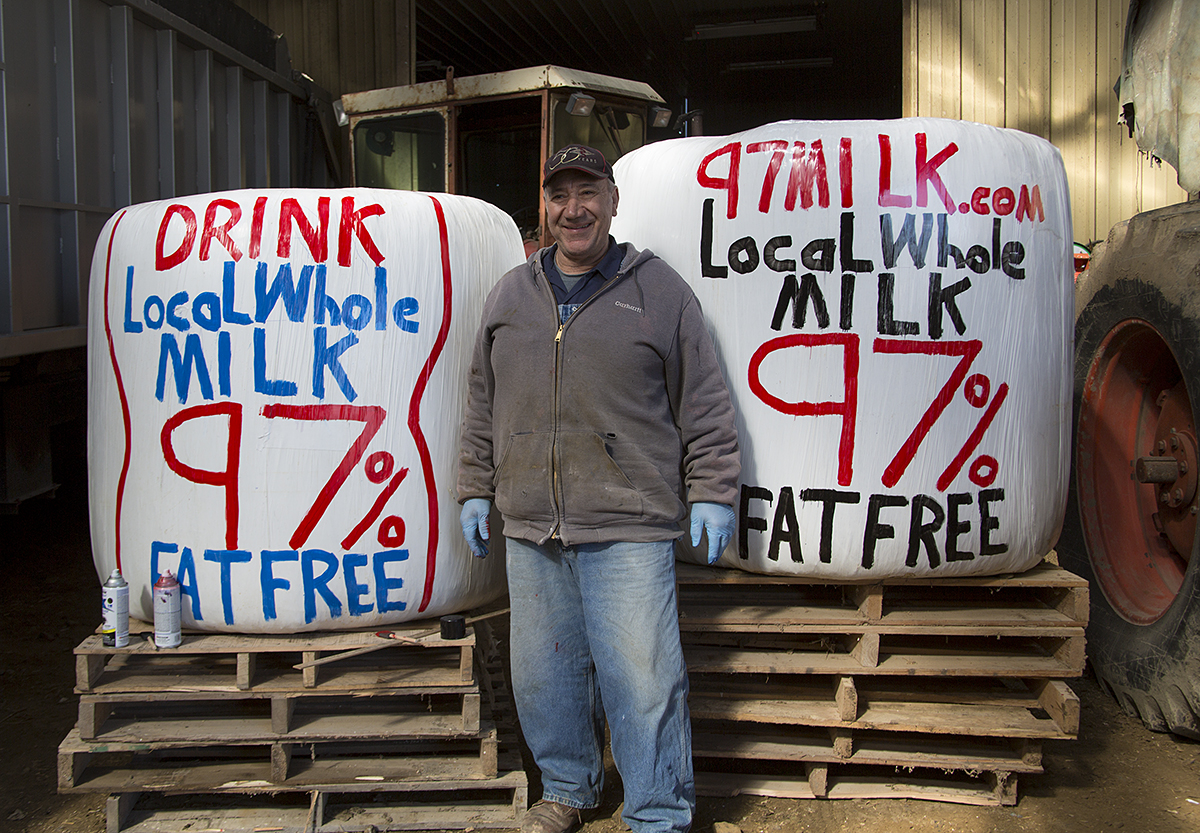
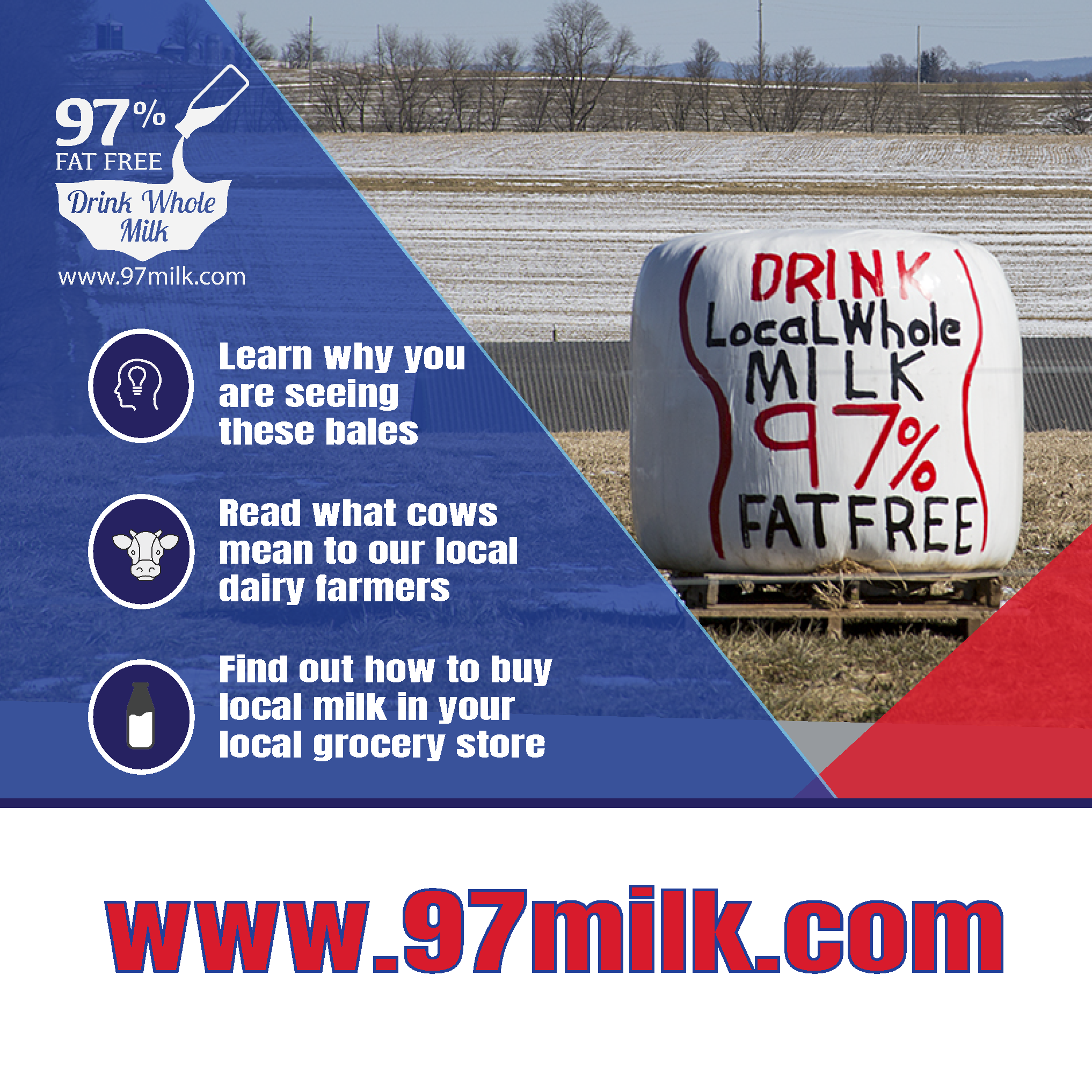
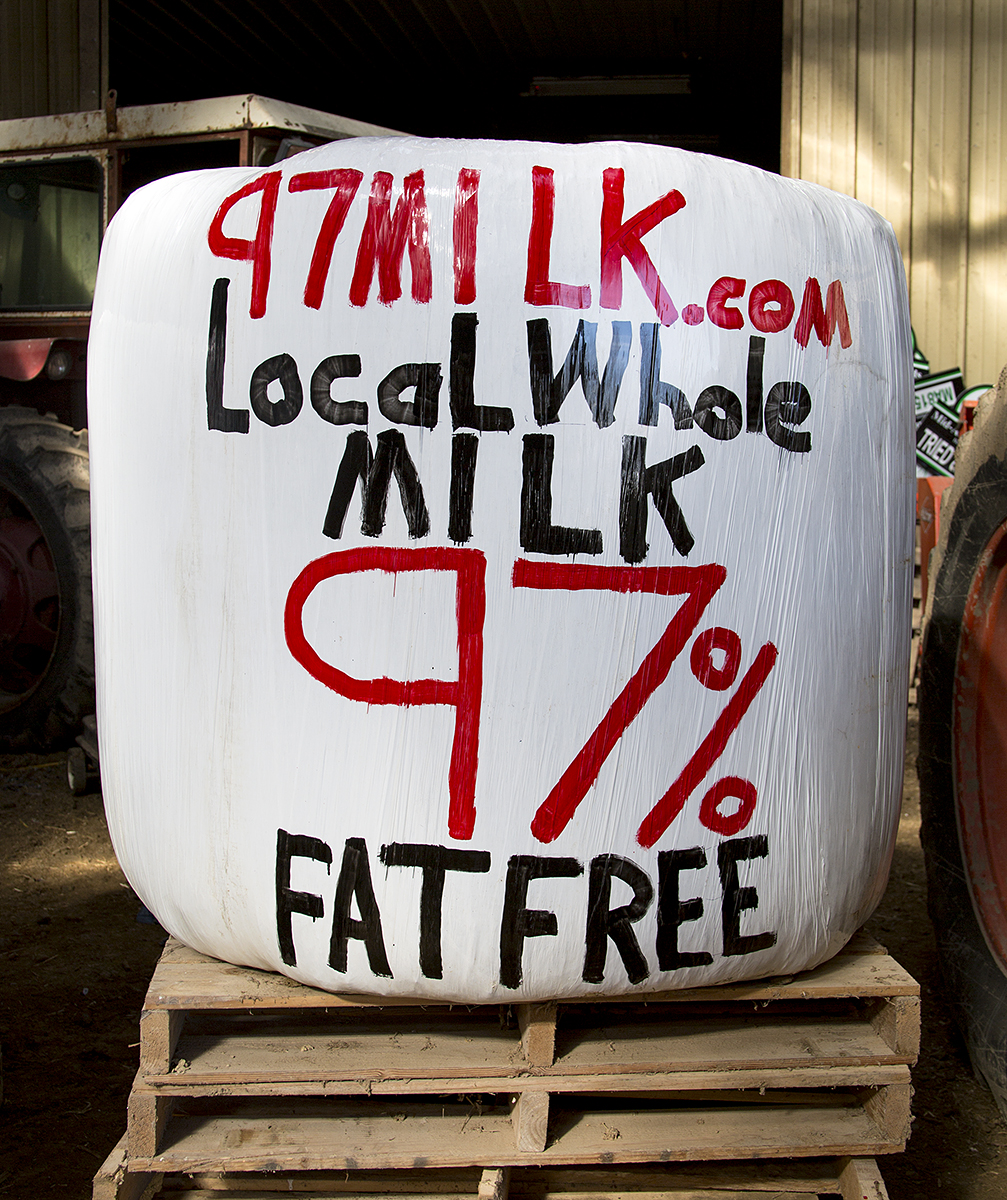
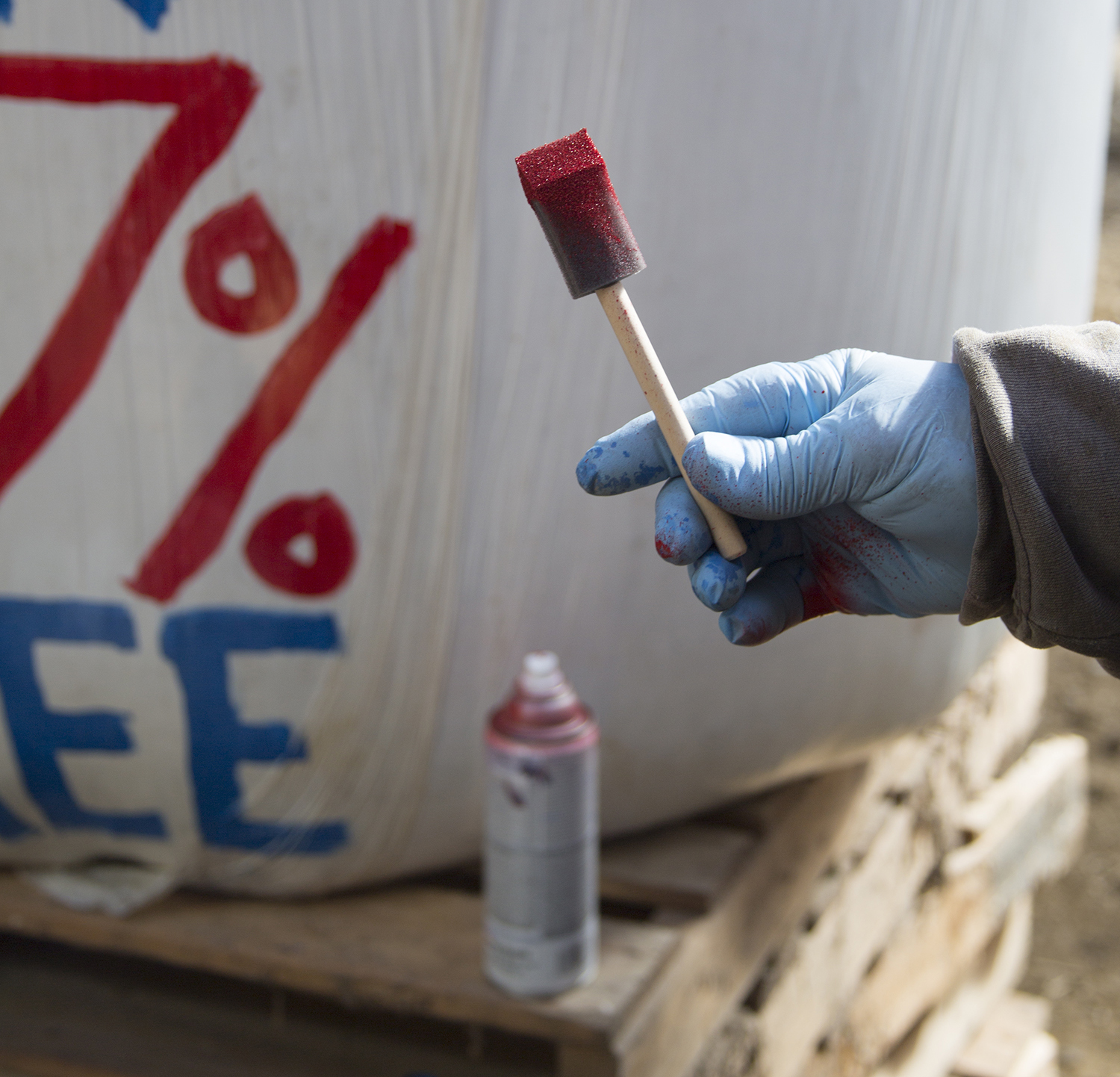
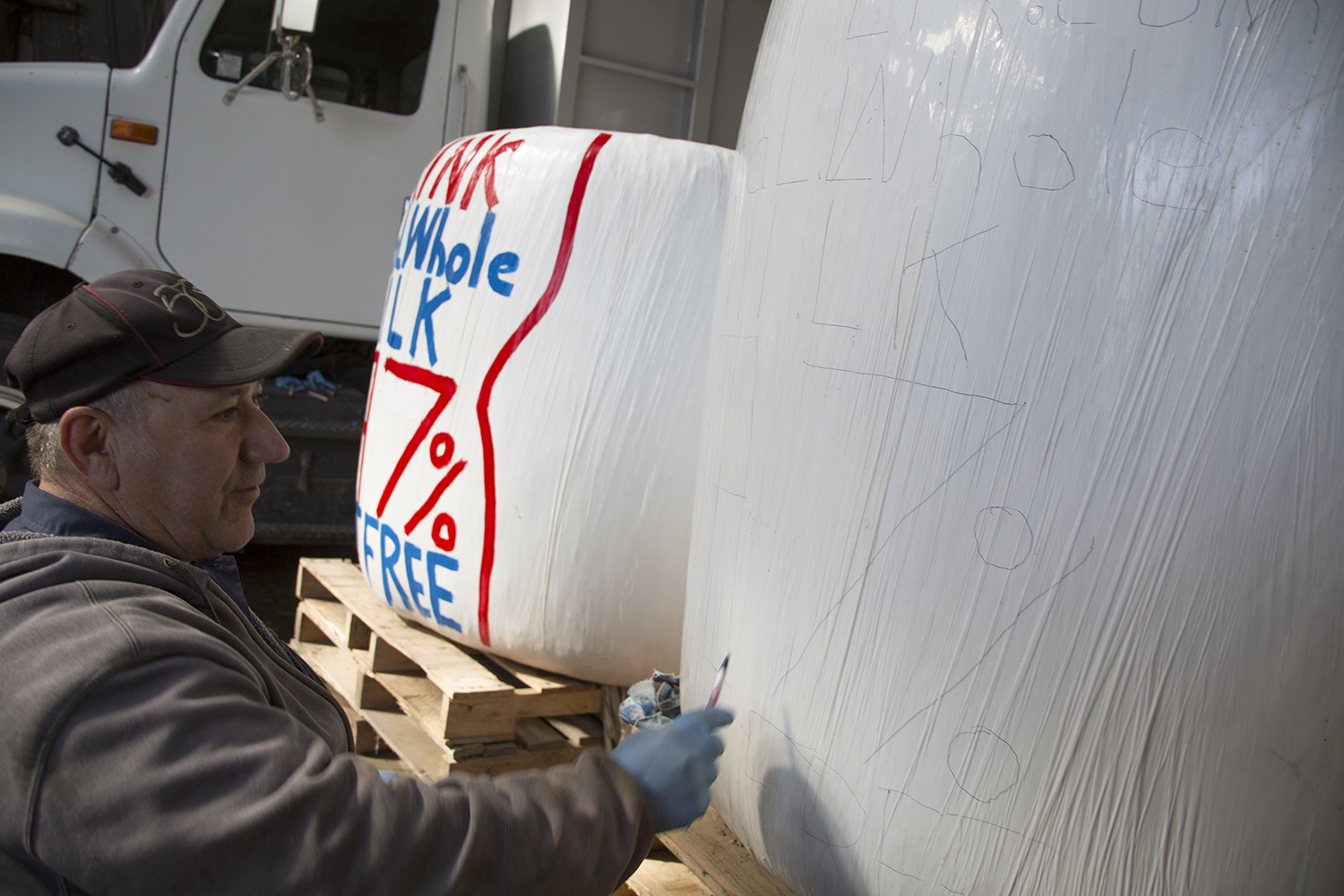
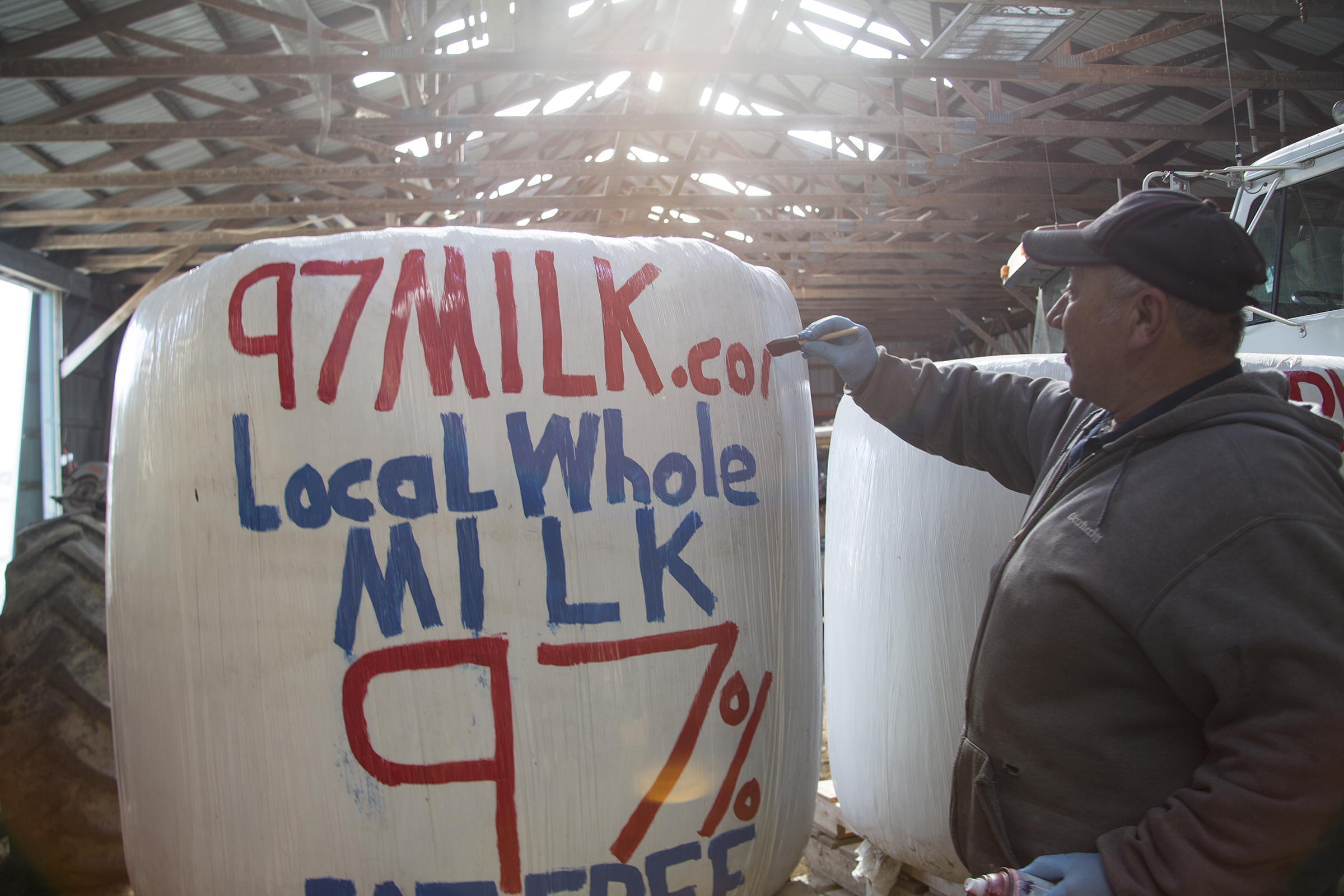
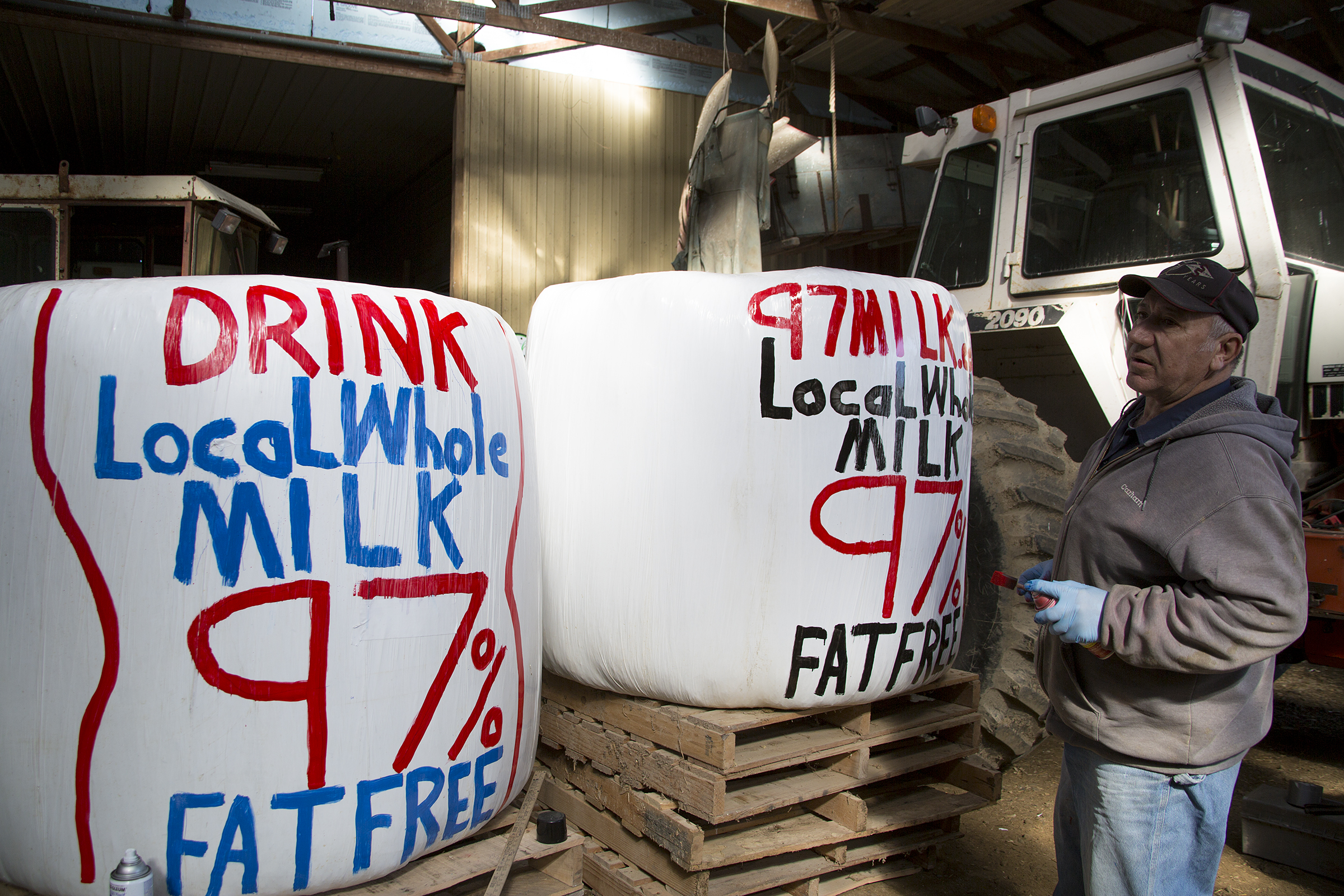
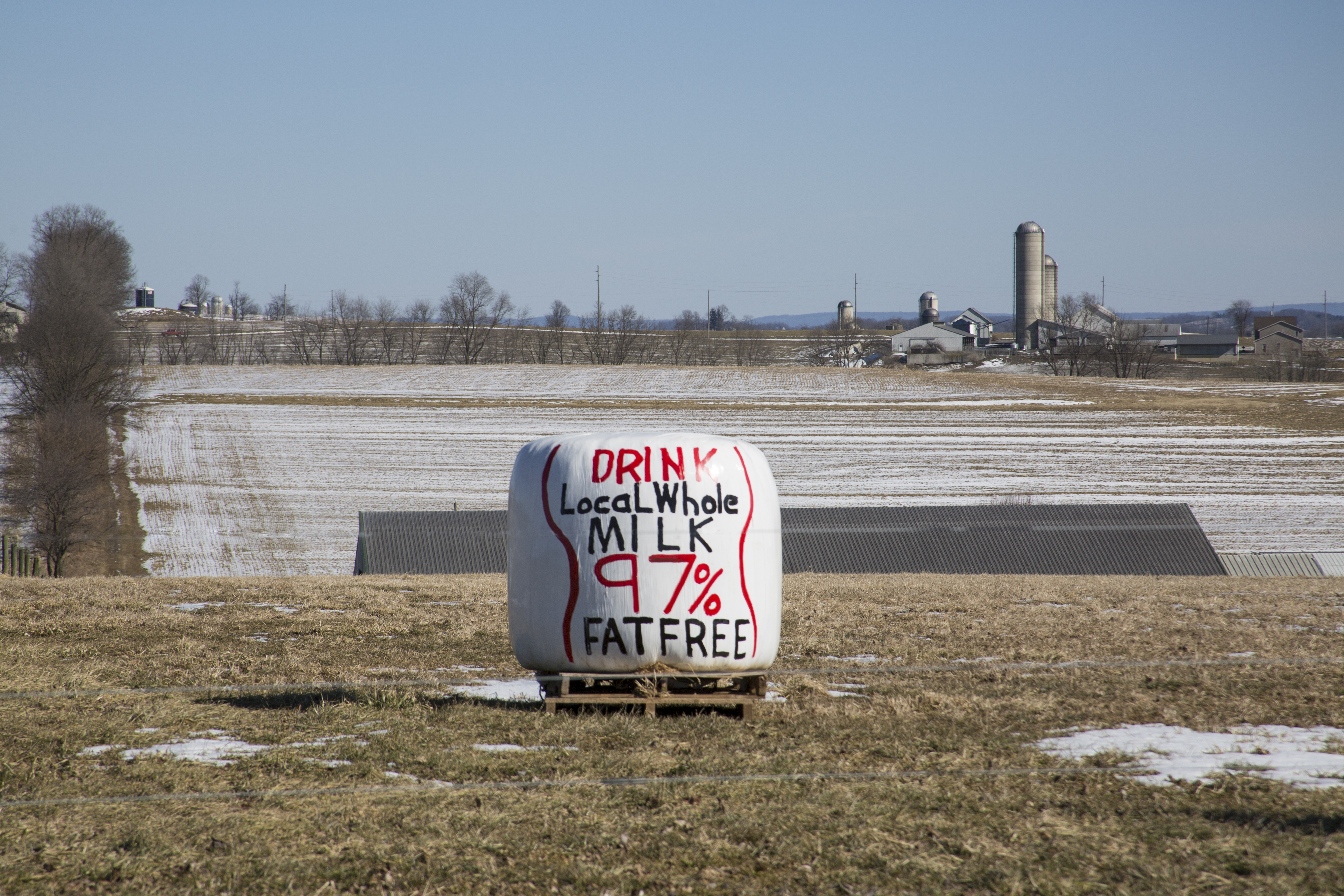
Dozens of dairy-related agribusinesses already sponsor the grassroots farmers’ 97 Milk education effort, which began a little over a year ago with a round bale painted by Berks County, Pa. farmer Nelson Troutman with the words Drink Whole Milk (virtually) 97% Fat Free.  (Whole milk is standardized to 3.25% fat). Such ‘baleboards’ now dot the countryside, along with banners, vehicle signs, a website, facebook page and other social media platforms (97milk.com and @97milk on facebook and instagram; @97milk1 on twitter).

As for the new 97 Milk / Blessings of Hope Whole Milk fundraiser, the response has been immediate. Within the first hour of announcing it on facebook Friday — $4100 had already been raised to keep purchasing whole milk for blessing boxes. Check it out here.

WholeMilkDonationDriveThrough4834Postcript: Karl and Mike Sensenig wish to recognize the mill’s entire team of employees for making the April 23-24 Whole Milk Donation Drive-Through possible: In addition to Karl, Mike, Kurt, Kyle, Scott, Emily and Nancy Sensenig, employees Calvin Buckwalter, Dale Clymer Jr., Ryan Crowther, Raymond Geiter III, Ashley Gesswein, Jared Grosh, Tim Hall, Curtis Hershey, Greg Hill, Dr. Don Jaquette, Joshua Kenderdine, Gerald Martin, Lawrence Martin, Nathan Martin, Steve Morris, Todd Morris, Steven Oberholtzer, Ron Phippen Jr., Devin Shirk, Eugene Shirk, David Stauffer, Allen Steffy, Terry Tshudy, Dwayne Weaver, Elmer Weaver, John Weaver, Logan Weaver, Nelson Weaver, Thomas Weaver and Dawn Wright were all involved. Even the previous generation to run the feed mill — Ken and Sandy Sensenig — came out to watch.
wSensenig-4724

The Sensenigs and their employees are happy to be part of something that blesses others, to see it multiplied, to see people appreciate whole milk, and to know what their customer dairy farm families produce is in demand. These efforts are uplifting and make a difference.
More links to stories on this and other efforts:


Call to action: Feds ignore science on saturated fats, poised to tighten restrictions in 2020-25 guidelines

Where is our dairy industry? No time to waste!

dga2

By Sherry Bunting, Farmshine, April 3, 2020

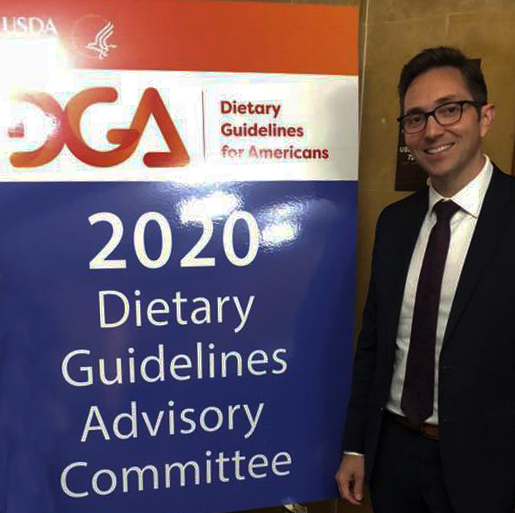
 WASHINGTON, D.C. — While Congress, USDA and HHS are all consumed by the health concerns of the COVID-19 pandemic, the Dietary Guidelines Advisory Committee is moving forward full-steam-ahead with what looks like more restrictions on saturated fats to be announced in May. Meanwhile, dairy leadership organizations sit on the sidelines, just letting it happen.

According to the Nutrition Coalition, and this reporter’s own following of the DGA Committee process, the process has been flawed from beginning and has reached a critical juncture. There is an urgent need for the public to pay attention and get involved.

Many had hoped the Committee would review and include the sound science and revelations about the flaws in the saturated fat limits in the current dietary guidelines to remove those restrictions or improve them in the 2020-25 guidelines. But the opposite is occurring.

As reported previously in Farmshine, some of the very best and most rigorous science on saturated fats and in relation to dairy fats vs. cardiovascular disease have been excluded from the review process from the very beginning.

Unfortunately, the process that began in 2019 is poised to move Americans even further down the wrong road with even more restrictive fat rules that will govern and inform all institutional feeding and which heavily influence the foodservice industry. Even worse, farmer checkoff funds are forced, by USDA, to help promote these unhealthy guidelines.

While National Milk Producers Federation, International Dairy Foods Association, Dairy Management Inc., and other industry organizations are silent, the Nutrition Coalition, founded by Nina Teicholz, author of The Big Fat Surprise, is sounding the alarm.

“We need your help to ensure that the federal government not continue to ignore large, government-funded rigorous clinical trials — the “gold standard” of evidence — that could reverse decades of misguided nutrition policy on the subject of saturated fats,” writes Teicholz in a recent communication.

She’s right. From the beginning, the DGA Committee was formed, and the research pre-screened by USDA, in such a way that many of the best studies and minds have been excluded.

Processed With Darkroom

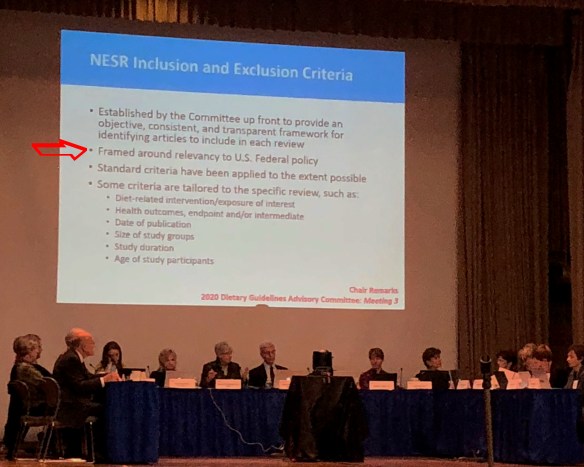
Part of the screening process used by USDA for science that will be included or excluded from Dietary Guidelines Advisory Committee consideration is this curious item shown above: “Framed around relevancy to U.S. Federal  Policy”. Committee members in October asked for more information on this research screening criteria. USDA explained it to them and those watching that this refers to including only the research that “aligns with current federal policy.”

Interestingly, one of the criteria for screening the research the Committee can consider is that it must “align with current federal policy.”

This dooms the entire process to a slanted view that is entrenched in the flawed bureacracy right from the start!

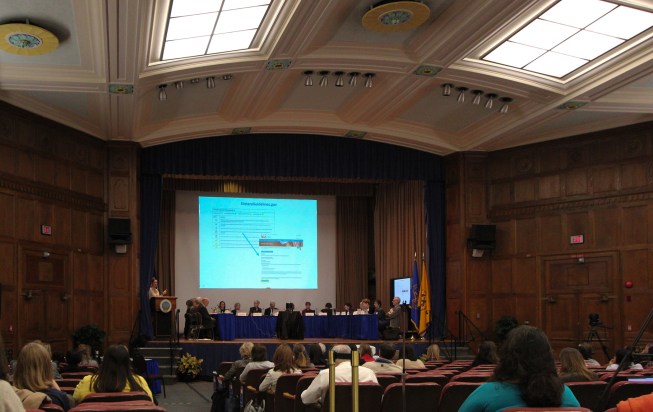
During the recent meeting of the DGA Committee in March — the last such meeting before release of the 2020 Dietary Guidelines for Americans (DGA) in May or June 2020 — the Committee failed to consider any of this evidence on saturated fat.

Instead, the committee announced it had found the link between saturated-fats consumption and cardiovascular disease to be “strong,” for both children and adults.

In fact, the committee recently proposed lowering the caps on saturated fat even further, from the current 10% of calories down to 7%!

“These conclusions ignore the entire last decade of science, during which a growing number of scientists have concluded that the caps on saturated fats are not supported by the science,” Teicholz points out.

She cites the work of a group of leading scientists who have reviewed the research on saturated-fats and released a consensus statement.

“Scientists are concluding that the most rigorous and current science fails to support a continuation of caps on saturated fats,” writes Teicholz. “So, why is the current DGA Committee — yet again — simply rubber-stamping the status quo and ignoring the science?”

The Nutrition Coalition is working fervently to expose the flaws in the process the DGA Committee is using under the USDA Food Nutrition Services umbrella. This in turn is what is used by USDA and HHS to govern what Americans eat.

These are not just “guidelines”, these are edicts to which everything from school lunches to military provisions are tied.

In fact, even farmers are tied to these guidelines as the dairy checkoff program leaders maintain they cannot promote whole milk because they are governed by USDA to stick to the guidelines, forcing farmers to mandatorily fund this completely flawed and unscientific “government speech.”

Americans deserve a recommendation on dietary saturated fat that is based on the most current and rigorous science available, and the Nutrition Coalition is issuing a call to action for Americans to join them in calling on the 2020 DGA Committee to critically review the most up-to-date evidence and modify its position on saturated fats accordingly.

“When we refer to “rigorous science,” we mean the data from well-controlled, randomized, clinical trials—the type of evidence that can demonstrate cause and effect,” writes Teicholz. “These trials were conducted on some 75,000 people addressing the question: do saturated fats cause heart disease? The results are that fats have no effect on cardiovascular or total mortality. This evidence has never been directly reviewed by any DGA committee.

“Ignoring evidence in order to preserve the status-quo is not acceptable,” she continues. “It’s not good policy, and it has not been good for the health of the American people. With the next iteration of the guidelines, your help is more crucial than ever to ensure that the USDA critically review the most up-to-date evidence and modify the government’s position on saturated fats to reflect the science accurately.”

Meanwhile, the dairy industry leaders continue to drag their collective feet.

As reported in Farmshine over the past few years, the call to action and support for healthy recommendations that consider the science on saturated fats and the goodness of whole milk, for example, has been largely pursued by grassroots efforts while industry organizations either fall in lockstep with the guidelines or stay neutral on the sidelines.

Once again, it will be up to the grassroots to get involved, for the public to be aware and get involved, for the Congress to be contacted, informed and involved.

How many times have we heard industry leaders shrug their shoulders and say “it all hinges on the Dietary Guidelines”?

dga1

When presented at the October DGA meeting with the first 12,000 names on the “Bring the choice of Whole Milk Back to Schools” petition (now numbering close to 30,000 online and by mail), Brandon Lipps, USDA Deputy Under Secretary of Food Nutrition Services, gave this response: “We have to see the science start coming together and be sure to bring everyone in… into the process.” Now it appears the Dietary Guidelines that control food at school, daycare, work settings, military, and many other foodservice and institutional feeding settings will be even MORE restrictive allowing even LESS of the healthy fat we — especially our children — need. The fat we eat is not the fat we get! Why is USDA moving us further in the wrong direction and excluding the science on this?! Act now. There are links in this article to speak out. Sign the Whole Milk in Schools petition also!

If there is even a chance that our children can have whole milk and healthy meals at school, that farmers can use their mandatory checkoff to promote the true healthfulness of whole milk and full-fat dairy foods, this biased process of DGA Committee guidelines has got to be challenged in a big way.

Here’s how you can help.

Contact your Senators and Representatives in Congress with a simple message. Ask them to please ensure that USDA is not ignoring the science on saturated fats.

Below is a message that the Nutrition Coalition suggests, which you or your organization can adapt and share with others in communicating with members of Congress:

Please urge the agencies in charge of the Dietary Guidelines for Americans (DGA), the USDA and HHS, to stop ignoring large clinical trials-the “gold standard” of evidence – that could reverse decades of misguided caps on saturated fats.

Shockingly, none of this evidence has ever been reviewed by any expert committee overseeing the science for the Guidelines. In fact, the current committee is pushing to lower the caps even further.

This is extremely alarming given that a growing number of prominent nutrition scientists have concluded the evidence shows that saturated fats have no effect on cardiovascular or total mortality. In fact, a recent panel of leading scientists reviewed the data and in a groundbreaking consensus statement, soon to be published in a medical journal, found that the science fails to support a continuation limits on saturated fats.

The current DGA committee appears to be one-sided and biased on this issue.

Please urge the USDA to stop ignoring the science and give serious consideration to lifting the caps on saturated fat for the upcoming 2020 DGA.

An easy way to do this online is available at this “take action” link https://www.nutritioncoalition.us/take-action

Or find the name and contact information for your Senators and Representative at this link and contact them that way https://www.govtrack.us/congress/members

Also, comment at the Federal Register docket for the DGA Committee by May 15, 2020. The sooner, the better, because the committee is expected to make its recommendations in May. Submit a comment to the Dietary Guidelines Advisory Committee here https://www.regulations.gov/docket?D=FNS-2019-0001

Also take this opportunity to sign this petition to “Bring the Choice of Whole Milk Back to Schools” at https://www.change.org/p/bring-whole-milk-back-to-schools

-30-

When freed from institutional food-police, what are consumers choosing?

_DSC0830Bad news meets dairy good news as industry navigates COVID-19 pandemic
By Sherry Bunting, Farmshine, Friday, March 27, 2020

BROWNSTOWN, Pa. — We will get to the good news, but first, the bad news…

These are tough times for Americans, and dairy farmers are hearing from their cooperatives and industry in such a way as to put a black cloud of doom over 2020.

Farmers are getting letters and phone calls stating milk base penalties will be strictly enforced beginning this week, in the case of Land O’Lakes, MDVA, DFA — for example — which ask for “voluntary milk reductions” and make plans for dumping milk on farms and at plants as “potential plant closures” meet spring flush.

They indicate that the ability of plants to process milk could “worsen,” giving folks the sense that the ability to process all the milk is already bad. And the dairy industry is preparing its farmers for the possibility of no compensation for displaced / dumped milk.

National Milk Producers Federation’s bulletin and press releases this week state they are seeking three things from the federal government — asking to reopen 2020 Dairy Margin Coverage enrollment, to purchase additional dairy products for humanitarian feeding programs, and to compensate them for “milk disposal” they deem to be “a real possibility as logistical challenges on the farm and at manufacturing plants may create severe disruptions.”

In fact, just 11 days into the COVID-19 national emergency declaration, NMPF came out with an estimate that the dairy industry’s losses “may exceed $2.85 billion”. Analyst after analyst is coming out with new forecasts — projecting milk prices paid to farmers could fall well below pre-COVID-19 forecasts and conjuring up images of 2008-09.

While the pessimistic psychology in these letters, phone calls and industry proclamations is peppered with platitudes such as “we’re in this together” and “we’ll rise to the challenge”…  dairy farmers are already rising to the challenge all day every day producing the milk that consumers are turning to in their time of grave health concern.

The psychology in the letters and phone calls received by farmers stands in stark contrast to the good news.

Now for the good news…

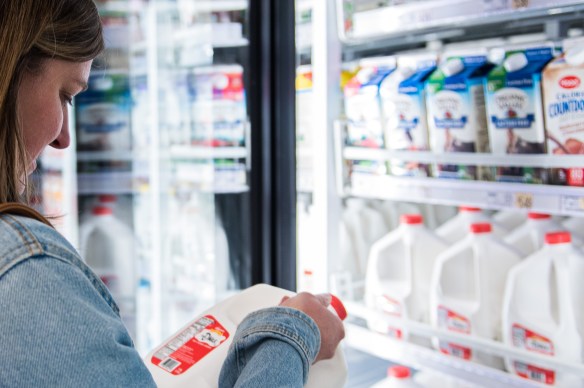
A silver lining became obvious last week and is continuing this week. Consumers are reaching for the jug! In fact, they are reaching for so many jugs that some stores are reportedly limiting milk purchases to one gallon per shopper.

They are also reaching for cheese, butter, yogurt and other dairy products as stores and plants scramble to restock.

While the Dietary Guidelines Advisory Committee is poised to further clamp-down on the allowable percentage of calories from saturated fat (sources say new guidelines might drop to 7% instead of the current 10%!), what are consumers doing?

Consumers are currently free from the government’s flawed and unhealthy “food police” nonsense that the Dietary Guidelines foist upon us by dictating our nation’s institutional feeding and foodservice in schools, daycares, workplaces — even restaurants.

Those dairy farmers attending the dairy checkoff question and answer session in Chester County, Pa. on March 5 heard firsthand from DMI leaders that dairy checkoff foodservice “partners” — like McDonalds – “want to meet the dietary guidelines on saturated fat and calories,” which is why their meals, especially for children, only offer fat free or 1% milk and it’s why the cheeseburger is not on the Happy Meal board. (But you can get a slice of cheese on that kid’s burger if you ask for it, and you can get whole milk in your hot chocolate, they say, if you ask for it.)

In our collective American lives — pre-COVID-19 —  stealth-health according to government rules has been in effect more than we realized.

The point here is this: Supermarkets are where consumers get to choose what they want to feed their families when the menu is theirs to create. And consumers are learning that saturated fat is not to be so-feared, that Whole milk has less fat than they thought, and that Whole milk and dairy products provide more healthy benefits than they ever thought — including immune-building benefits.

Yes, milk education works. As soon as consumers get to choose freely, what are they choosing? They are choosing milk and dairy, and they are choosing whole milk over all other forms — when it is available.

While DMI leaders talk about “consumer insights” and “moving to where the consumers are” and “moving them away from the habit of reaching for the jug to try innovative new products”… what are we seeing when all the stealth-health controls are lifted and people are home choosing what they will feed their families during COVID-19 “social distancing” and “sheltering in place”?

We see them choosing the truly healthy comfort foods. They are choosing whole milk and 2% gallons and half-gallons, butter, full-fat cheeses and red meat for their families.

These items are quite literally “flying off the shelves.” This phrase is used in report after report this week about the demand pattern that is unfolding.

This supply-chain shift is something the dairy industry is wholly unprepared for, as the path charted for dairy processing and promotion has been so heavily linked to flawed dietary guidelines, institutional feeding, foodservice chain partners and new, more expensive, innovative products — that the concept of filling so many jugs with healthy, affordable, delicious milk is a bit off the charted path.

Even USDA Dairy Market News observed in its weekly report on Friday, March 20th what we also reported to you from our sources in Farmshine last week — that the surging demand at the retail level is more than overcoming reductions in sales to schools and foodservice. In fact, USDA DMN reports that retail milk demand is “overtaking inventories” and that retail orders are “heading into new territory.”

Pictures of empty dairy cases populate social media posts. And yes, USDA DMN confirms that Class I milk demand is ranging mostly from “strong” and “surging” in the West and Midwest, to “extraordinary” in the Northeast, to going “haywire” in the Southeast.

Given that the spring flush has begun, the current surge in fluid milk demand means less of this extra milk will go into manufacturing — as long as consumers continue the current level of fluid milk buying and as long as the milk is in the stores for them to buy.

This pattern should help the surplus butter situation, which was revealed again in last week’s February Cold Storage Report. Last year ended with inventories of butter up 18% compared with the end of 2018. The February report showed butter storage was still bursting at the seams.

But earlier this week, at a local grocery store, only a very local brand of butter was available. Zero Land O’Lakes butter could be found in the case.

USDA DMN in its March 20 weekly report stated that cream is widely available, which seemed to contradict the agency’s description of whole milk sales and its notation in the report that butter churns have strong orders from retailers for what they call “print” butter – butter for retail sale, not bulk inventory.

So what do the numbers look like?

It’s more difficult than ever to get timely information from USDA AMS about packaged fluid milk sales, but here’s what virtually every dairy analyst is reporting this week. They cite the Nielson supermarket data showing fluid milk sales were up 32% last week, that sales of whole and 2% are dominating, when available, and that retail sales of other dairy product classes were up double digits.

Milk and dairy products are a centerpiece of “comfort food” and in-home meals. Families are enjoying milk again. Will they keep enjoying it after they return to school and work? Or will they be back in rush zone of packaged carbs instead of cereal and milk, and back in the government’s “stealth-health” or “fake health” zone where fat is restricted and carbs are unlimited?

It will take some time to sort out the buying patterns that linger after the initial surge in dairy demand currently experienced at retail, but here’s some additional positive news to think about.

When consumers are educated and get the opportunity to seriously whet their appetite. When they tune-out the frivolous ‘sustainability’ banter about cows and climate and can ignore the rules about saturated fat… When they focus-in on their families, turn to milk for health, flavor and comfort, and remember or realize for the first time what they were missing… Who knows what they will choose going forward – when they are allowed to choose?

Even when families return to work and school, they may remember coming to dairy for immune-building properties, for comfort, for health.

Nielson has a chart at its public website tracking key consumer behavior thresholds in six quadrants: Reactive health management, pantry preparation, quarantine preparation, restricted living, and living a new normal. It shows their consumer insights on how buying patterns evolve during a health emergency of the scale of COVID-19, and how this peels away some of the frivolous drivel and constraints that influence consumer behavior in ordinary times.

In the sixth phase, “living a new normal,” Nielson describes how “people return to daily routines of work and school, but operate with a renewed cautiousness about health.” It goes on to state that this creates “permanent shifts in the supply chain.”

Citing the use of e-commerce and hygiene practices as examples, this sixth phase of “living a new normal” when returning to daily routines could also apply to food and beverage purchases as consumers returning to true health and comfort during the first five phases may continue to prioritize true health and comfort after those phases have passed.

What do consumers really want? Where are consumers moving when they are free to move?

Without institutional control of daily diets and promotion, we are seeing a glimpse of the answer to that question within the context of COVID-19 pandemic buying patterns. Real whole nutrition, foods that build immunity, awareness of Vitamin D deficiencies in our population affecting immune system response, the role of other elements in milk for immune-building, preference for local food that doesn’t travel so far, and a revitalized awareness of how regional food systems are critical to our food security — these are perspectives that could prevail to influence buying patterns into the foreseeable future.

Uncertainty prevails right now, but hope is alive, and the good news is that milk and dairy have much to offer.

-30-

WWF school milk waste report ignores the one small step that changes the WHOLE story!

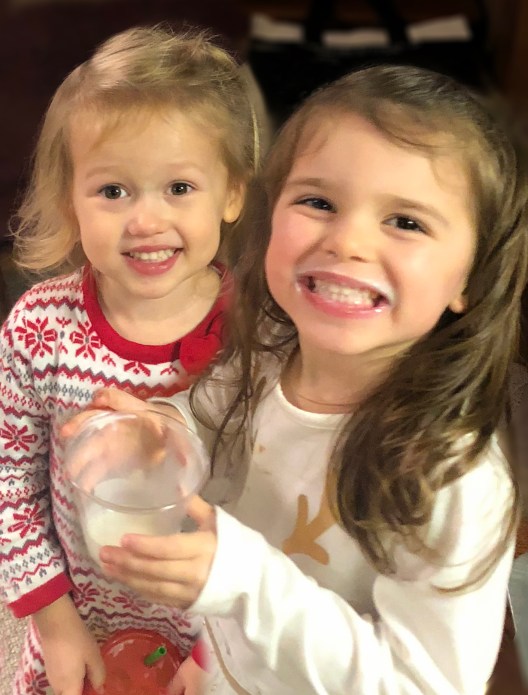
WholeMilkKidsBy the time these two little girls are in school, their happy smiles and enjoyment of milk will be but a memory as the low-fat and fat-free brain-washing will begin and the full-fat brain-building they get at home will come to an end. Milk will become yucky to them, and the one they get with their school lunch and/or breakfast will likely go into the trash. Such is the plight for millions of children in our schools every day over the nine years of government prohibition against whole milk. Meanwhile the weights and waste at U.S. schools are ballooning out of control. 
But never fear, the government (and its NGOs) are here! Dairy checkoff’s “sustainability” partner, the World Wildlife Fund (WWF) — in cooperation with the U.S. Environmental Protection Agency (EPA) — estimates 45 million gallons of milk are discarded at U.S. schools annually. Here’s the unbelievable part: They recommend schools reduce the size of milk containers, use self-serve dispensers and end the practice of ‘serving’ milk with every meal. Yes, the dairy checkoff’s sustainability partner is recommending less milk as the solution to more waste.

Meanwhile, one school is offering whole milk on a trial basis and gathering data showing how this one small step is changing the whole story — for healthy kids and a healthy planet. We are protecting the identity of this school from the USDA school milk police because if “caught” for doing what’s right, they could lose eligibility for state and federal education funds that are tied to participation in USDA’s low-fat school lunch rules.

By Sherry Bunting

Dairy Checkoff’s “sustainability” partner — the World Wildlife Fund (WWF) — released a 2019 “Food Waste Warriors” student-led audit report a few weeks ago indicating that U.S. schools discard an average of 28.7 containers of milk per student per year.

This amounts to an estimated 45 million gallons of milk discarded from schools annually, the report said.

Of the totals, elementary students discarded 37.6 cartons per student per year while middle schools discarded 19.4 cartons per student per year. The difference is middle and high school students have more alternative beverage options.

A gallon of skimmed milk weighs 8.63 pounds, so 45 million gallons amounts to over 388 million pounds per year and a cumulative estimated 3.5 billion pounds of discarded school lunch skimmed milk over the past nine years since USDA removed whole and 2% milk as choices in the 100,000 schools participating in the National School Lunch Program (95% of U.S. schools).

WWF funded the study, with support from Kroger Co. Foundation and the EPA, analyzing food waste in 46 schools in nine cities across eight states.

The objectives of the WWF project were to engage students in the act of measuring waste, foster an understanding of connections between food and its environmental impacts, and “formalize how we might gather more streamlined data on cafeteria food waste,” the report explained.

In its report, WWF identifies the National School Lunch Program as “one of the most influential programs for educating youth on conservation opportunities linked to our food system.”

Waste-reducing milk strategies used, compared and suggested in the WWF report are: 1) serve smaller containers of milk, 2) educate schools to realize they are actually not required by USDA to force students to take a milk with their lunch or breakfast in the first place, and 3) invest in bulk milk dispensers so students can take only the amount of milk they will drink.

So here we go. Let the WWF / USDA / EPA / DMI ‘sustainability’ propaganda begin. The idea of milk dispensers is a good one. But, what matters more is the fat content of the milk IN the dispensers, bottles or cartons!

Of course, the report does not identify the simplest, tastiest, most nutritious and ‘sustainable’ solution: Waste could be reduced overnight if USDA would simply allow the 100,000 schools enrolled in the National School Lunch Program to put whole milk on the menu! 

That’s right folks: 95% of U.S. schools are ruled by the iron-hand of the USDA milk police.

Not only are school nurses beginning to report to Farmshine that their annual student weight averages have climbed 7 to 9% in the 9 years that whole milk has been forcibly removed from school menus, one school reports it is doing its own study of student preferences and milk waste reduction this year.

We are keeping the names of the reporting schools anonymous to protect their identities from the USDA milk police.

Since September, one anonymous school’s study shows students are choosing whole milk 3 to 1 over 1% low-fat milk at the middle school and high school where the trial is being conducted.

Imagine that! Middle and high school students CHOOSING milk, and actually drinking it!

Oh, and by the way, when whole milk is used to make chocolate milk instead of using skimmed (1% or fat free) milk, less sugar is added!!

And, by the way, the data from this particular anonymous school shows that not only are their secondary students CHOOSING whole milk 3 to 1 over skimmed, the school has reduced its milk waste by 94%… in one year!

They report that their “milk not consumed” totals now average 32 ounces per day as compared with 4 gallons, or 512 ounces, per day the previous year!

Where school lunch is concerned, USDA’s rules are neither practical, nor are they logical, nor are they healthy for our kids or our planet. At the same time, WWF’s suggestions miss the mark completely!

Join in with those farmers and consumers asking Congress and USDA to bring back the choice of whole milk in schools. Sign the petition for choice and be part of the WHOLE solution. If you haven’t signed, you have until February 15 to do so online at this link: https://www.change.org/p/bring-whole-milk-back-to-schools

Also, to get signatures in your community, download the printable version of the petition at this link: WHOLE-MILK-IN-SCHOOL_PETITION_011520_


-30-

Surprise. Surprise. Whole Milk is on the rise!

… Even in the face of massive opposition by USDA, DMI and others

Editor’s note: Farmshine contributor Sherry Bunting continues her opinion and analysis on where the milk bus is heading and some thoughts on what to do about it.

editorialgraphic (1)

By Sherry Bunting, Farmshine, Friday, January 17, 2020

BROWNSTOWN, Pa. — Activist non-governmental organizations (NGOs) are increasingly driving the milk bus as dairy industry organizations, checkoff organizations and government agencies partner with entities such as World Wildlife Fund (WWF) on dietary and sustainability goals.

The leaders who are working with NGOs and government agendas long enough might think they speak for us as consumers, as society. They don’t. But through our organizations partnering with them, they ultimately and incrementally not only speak for us, they are driving the bus.

If we are listening, we’ve heard the model described by industry experts and thought-leaders in articles, at conferences, and in roundtable discussions: Build huge cheese and protein ingredient plants at designated growth locations. Innovate with ultrafiltration and reverse osmosis technologies. And begin to balance the export-driven dairy industry focus and consolidation by transporting ultrafiltered solids “more sustainably” – minus the 88% water portion – and do the reconstitution, extended shelf-life and aseptic packaging on location in the regions that are currently fluid-milk-centered markets, such as the Southeast, Mid-Atlantic and Northeast.

Rampant supermarket loss-leading on fluid milk by the nation’s largest retailers on one hand, with USDA-regulated farm-level price enforcement on fluid milk on the other hand, has produced the vice-grip in which the fluid milk sector has found itself over the past four to five years in particular.

Dairy producers were in the grip the past five years, but now that farm-level prices have ticked a bit higher the past five months, fluid milk bottlers suddenly find themselves unable to weather the margin compression, as we see in the recent high profile bankruptcy proceedings of Dean Foods and Borden, not to mention the smaller companies along the way.

As long as producers were the ones receiving the ugly side of the stick, the conversation could be generally centered on “too much milk” or “market forces” or “trade and tariffs.”

Now that farm-level milk prices have moved up (even though export volume was down), the unsustainable, low-margin, commodity treatment of fresh fluid milk is being seen as a primary factor fueling fluid milk processor bankruptcies – for those looking into these issues more deeply. In fact, checkoff leaders cite the milk bottler bankruptcies as proof that milk should be reinvented. Some have gone so far as to say — in presentations to industry groups — that the goal of innovation is to “move consumers away from the habit of reaching for the jug and toward these new and innovative products.”

While per-capita milk sales have been declining for 45 years, the past 10 years have seen faster rates of decline. This has been no accident. From dietary guidelines, to checkoff’s government speech requirements, to memorandums of understanding, to sustainability objectives, dairy’s own national checkoff organization has partnered with USDA, WWF, and others to move milk in a different direction – yes, intentionally.

Meanwhile, consumers are showing a thirst to know more about milk nutrition, and they are responding by buying more whole milk even in the face of this extreme neglect and alternative direction.

Case in point. While Coca-Cola, now 100% owner of fairlife, cites double-digit growth of the its 3% market share, the USDA Class I packaged milk sales show a different perspective.

The most recent report for October shows that the “other fluid products” category had year-to-date volume growth of over 300% but amounts to just 269 million pounds (10 months) — less than one percent (0.7%) of market share.

Meanwhile, whole milk’s growth for year-to-date volume of 12.5 billion pounds comes in at just under 1% (0.9%) on 33% of market share, which makes fresh whole milk the top VOLUME gainer this year, and it has surpassed sales of 2% reduced-fat milk.

Flavored whole milk is also growing by double-digits some months, with year-to-date sales through October of 629 million pounds – up 8.9% on 1.7% market share.

Under Organic brands, whole milk sales are up 4.4% year-to-date, with 412 million pounds representing 43% of organic milk market share.

Consider this: While whole milk is prohibited in schools and daycare centers, and it goes virtually un-promoted and is often poorly stocked in the dairy case, those sales still manage to be the largest volume growth category under all of these constraints.

Innovation can be good, but the fact remains that whole milk naturally meets many of the desires consumers have even though labeling makes its fat percentage a mystery, and even though it has to overcome a low-fat and fat-free promotion campaign pitted directly against it… In the face of all of that, whole milk’s growth is not too shabby.

In short, fresh whole fluid milk has the potential to solve many of the problems it was previously blamed for in diet and health trends, and it has a ‘clean’ label and local sourcing and flavor and nutrition going for it.

Whole milk checks all the boxes.

Trouble is, if whole milk sales grow faster, then the best laid plans for using innovation and sustainability and dietary edicts to lead farmers and consumers into dairy industry structural transformation would be in jeopardy.

What can be done? What can be accomplished?

Get USDA’s attention. Get the attention of the Administration and Congress and hold industry leaders accountable for the following steps:

Federal Order price reform has never been more needed. The regulated value center is mostly on the diminishing Class I fluid milk sector. That’s a big weight to carry. Many of the innovations and reinventions of fluid milk beverages are not even Class I. Small regional entities wanting to get into the fresh fluid Class I milk market have difficulty doing so because they must – in effect — pay the cartel. Now the recent bankruptcy and potential sale of Dean Foods’ assets to DFA, suggest we could see an even bigger cartel.

In that scenario, an even larger national footprint entity would run the table, deciding how fluid milk markets will be supplied, with what product mix, and from what plants. DFA CEO Rick Smith has already indicated some Dean plants should be shut down. DFA president Randy Mooney in his address at the DMI / NMPF convention a week before the Dean bankruptcy was announced said dairy resources should be consolidated to focus on plants that “make what consumers want”, instead of having “plants on top of plants” in a region.

Add to this the push to normalize ultrafiltration in FDA standards of identity for all sectors of dairy beverage and product development and production, and we see the stage being set for meeting “sustainability” objectives by removing water from the transportation scenario and moving more milk from designated export-growth areas into the markets with higher Class I utilization at a lower cost.

In effect, this trend would use the fluid milk markets to physically and financially ‘balance’ the designated growth regions and huge protein export plants more freely — weakening the position of farms operating in those Class I utilization markets.

Transportation cost is already diluted to where it is not the equalizer it should be for regional milksheds to take local milk first. Ultrafiltration and reinvention of milk in the name of innovation is all coming from the Sustainability Council of DMI’s Innovation Center for U.S. Dairy. At a certain point, the trend – especially with the help of the world’s largest players in ultrafiltration including Coca-Cola – make location and transport even less relevant with milk’s 88% ratio of water taken out of the transport equation. These trends need full and transparent discussion instead of creeping along quietly under the mantra of “innovation” and “sustainability.”

Uphold standards of identity, not just the plant-based deal on the left hand that we are all watching so intently. While the industry talks about FDA’s milk standard vs. the imitations, the right hand is busy behind the scenes working on other dairy identity standards to make changes.

One such change is getting FDA to overlook reconstitution of milk solids with water on long-haul transport. This is a step that could enable Class I fluid milk markets to become the balancer for the huge commodity export plants that are being built in designated growth centers, and which get the make allowances built into manufacturing class prices.

Cheaper transport of excess milk – without the water — into Class I FMMOs would, and potentially is, allowing those suppliers to use eastern fluid markets as the export plant balancers.

Draw a line in the sand with a retail minimum on fluid milk. This step is necessary, at least as an interim step until the larger pricing issues have a full airing. A simple $2/gallon line in the sand certainly allows for capitalistic free markets while stopping the supermarket insanity that makes milk the Cinderella-sister that all other dairy case beverages, dairy and non-dairy, market off the back of and are free to make and keep the profit at milk’s expense.

Unless Walmart and Amazon and Kroger and others want to eat their own loss-leading decisions, themselves, they should not have the ability to price milk at $1.50, $1.15, 99 cents, 67 cents per gallon. This is crushing the supply chain and further diminishing milk’s stature.

Stop dumping skimmed milk on our kids. We’ve already lost at least one generation of milk drinkers, simply allow whole milk at schools for all the reasons that have been written about over and over in Farmshine. It’s also what is right for our kids.

Stop forcing producers to pay a checkoff tax that promotes government speech, and aligns with NGO-influenced government agendas on the future of food. At the very least, allow regions and local entities to keep and target all of their checkoff funds to promote what is made with their milk and to promote sustainable regional supply chains and food security.

Ask checkoff leaders to start promoting all milk instead of using the qualifiers “low-fat / fat-free.” Stop beating everyone over the head with the familiar “fat-free and low-fat” refrain. It’s not helping farmers, and it’s certainly not helping the health and obesity crisis, and it clouds the healthy choices consumers are able to make – once they learn the truth.

This is just a start.


Milk education ‘heroes’: How 97 Milk came to be

AUTHOR’S NOTE: With proof of concept in place, the support of farmers and community running strong (see graphic), and the public response rewarding these efforts, there is something powerful here with the 97 Milk effort, and it is just the beginning. 

By Sherry Bunting from Farmshine, October 23, 2019

RICHLAND, Pa. — One farmer. One roundbale. And six painted words — Drink Whole Milk 97% Fat Free.

The excitement of the 97 Milk effort is contagious. What started with Nelson Troutman’s first painted roundbale in Richland, Pa., has rapidly multiplied into community-wide and nation-wide milk education efforts aimed at consumers on one hand and policymakers on the other.

Nelson Troutman placed his first “Milk Baleboard” in a pasture by an intersection.

By February, retired agribusinessman Bernie Morrissey of Robesonia found five businesses to pay for the first 1000 magnetic 12” x 12” vehicle signs with the same message. Since then, more companies have joined in and some of the original businesses have printed more.

As legislators began to take notice, Morrissey and Troutman assembled a grassroots Pa. Dairy Advisory Committee of 10 farmers that meet monthly in person or by teleconference and interact with lawmakers, including the petition effort to bring whole milk back to schools. More agribusinesses joined in to help fund their expenses.

Then, 4’ x 6’ banners were created for places of high visibility and an effort to place them at stores is underway. A September Farmshine cover story helped spread the word. Morrissey reports the banners “are going like hotcakes” with additional businesses joining in to print more.

Another effort was underway simultaneously, when Rick Stehr invited a diverse group of farmers to a February meeting in Lancaster County to talk about milk education beyond the bale. Today, the joint efforts work together like two well-oiled machines comprised solely of volunteers.

Stehr recalls getting questions back in January. He invited Morrissey to talk about the milk baleboards at R&J Dairy Consulting’s winter dairy meeting. Noted expert Calvin Covington was the keynote speaker that day, and he told the 300 dairy farmers that promotion needs to focus on domestic demand, and that “we in the dairy industry need to talk about milkfat and not hide behind it not wanting things to change. Consumers want that taste, and we’re not talking about it,” he said.

Morrissey then told the crowd about Troutman’s “Drink Whole Milk 97% Fat Free” roundbales that were just starting to multiply at farms and businesses after a cover story appeared in Farmshine.

“As I talked with non-ag people, I realized many of them didn’t know quite what it meant,” says Stehr. “I thought the missing link is education. We needed to educate the public.”

Nelson Troutman and Jackie Behr prepare for a television interview about 97 Milk.

Stehr’s daughter Jackie Behr has long believed milk sales suffer because milk education is missing. She has a marketing degree from Penn State and experience in non-ag positions before becoming R&J’s marketing manager.

Even Behr was surprised by her February focus group interviews with non-ag friends. “I was blown away by the obvious gap between dairy farms, milk nutrition and consumer perception,” she reports.

Behr shared the focus group responses at a February meeting of farmers that included Troutman. “It was an obvious eye-opener for everyone. These were educated women responding to my questions. How did we miss so much milk education all of these years?” Behr wondered.

They not only had zero knowledge of milk’s nutrition — other than calcium — their minds were full of information that was just plain false.

They said they drank organic milk because they ‘didn’t want to drink all those hormones.’ Or they chose almond beverage ‘because there are no antibiotics in it.’

“The biggest misconception is how much fat they thought was in whole milk. Just like Nelson’s been saying. And when you tell them whole milk is standardized to 3.25% fat, their response is ‘Oh, wow!’ That alone is big,” says Behr.

Her marketing savvy kicked in. Ideas for a website were kicked around with obvious choices already taken.

Then one attendee said: “How about 97 Milk?”

It fit. And it captured attention. By the second meeting, they were ready to establish 97 Milk LLC and chose a volunteer board of Lancaster County farmers Mahlon Stoltzfus, Lois Beyer, Jordan Zimmerman and Behr, with GN Hursh serving as chairman.

The website was up and running by the end of February with a Facebook page (@97Milk) that has gained more than 8,500 followers in less than eight months and a weekly average reach of over 150,000. Individual posts have reached up to 1.2 million through thousands of shares and hundreds of interactions. Twitter (@97Milk1) and Instagram (@97Milk) are also active.

Behr says it all stems from what Troutman started, and he was happy to add 97milk.com to the bales with Morrissey making sure the website appears on signs and banners.

“To get someone to change their mind, you have to get the facts in front of them,” Behr observes. “We’ve got three seconds in front of their eyes to leave information that plants a seed.”

With some content help from others, Behr comes up with ideas, designs and coordinates Facebook posts six days a week.

The result? “People are shocked and come back and say, ‘I had no idea,’” Behr explains. “I am in the industry, and even I have learned so much about milk that I didn’t know before.”

“Now that 97 Milk has become a tool used by dairy farmers to educate the public about our product, the conversations that are happening are only the beginning,” Stehr observes. “We could have 97 Milk boards across the nation.”

As interest builds, 97 Milk LLC is looking into how different geographies could have their own chapters, with the website and materials providing some continuity.

“That’s where the power is, with the producers in each community or state,” says Stehr.

He credits Troutman and Morrissey for getting everyone’s attention and believes what they are doing creates the opportunity for the ‘beyond-the-bale’ education piece carried by 97 Milk LLC.

“The word milk has been used liberally, and the understanding of what it is has been diluted,” says Stehr. “We let that happen over the past 30 years and did nothing about it. We let them bash our product. Now we are educating people that the fat in milk is not bad, that there’s not 10% or 50% fat in whole milk, but 3.25%, that there is complete protein in milk and all of these other good things.”

From the baleboards, vehicle signs, banners and communications of the grassroots Pa. Dairy Advisory Committee, to the website, social media and educational events of 97 Milk LLC, a common bond unites these efforts — Troutman’s practical courage when he painted the first roundbale because he was frustrated and had had enough.

“We have lost market share, why? Because people don’t know what milk is and they don’t know what it tastes like,” says Troutman. “By promoting whole milk, we are opening their eyes and their tastebuds.”

While national co-ops think it’s “innovative” to develop a low-fat milk and nut juice blend, those involved in 97 Milk believe the response they see from diverse consumers tells a different story.

“People want to feel good about the products they are buying. The goal of 97 Milk is to share education, to share the dairy farmers’ stories,” says Behr. “You don’t pick up health magazines and see the benefits of milk. People need to see that positive information because they don’t know what milk provides.”

The Dairy Question Desk at the website fields a steady stream of five questions per week and when social media is included, 97 Milk fields 5 to 20 questions a day.

Every one of Behr’s original focus group have switched to whole dairy milk. The experience so far shows her consumers know very little about milk and have a real willingness to learn.

“All of our messages are simple. One fact. An infographic that’s simple to understand and that people can relate to,” says Behr. “Even if we have their eyes for just three seconds scrolling through, that little seed is huge.”

The posts fill other gaps. Behr believes people want to see that dairy farmers love their cows, that they care. The baleboard sightings and “cow kisses” have poured in for posting from several states.

The posts also help consumers fulfill a desire to be connected to their food, to buy local, and to support family-owned small businesses. “The simple fact that 97% of dairy farms are family-owned is a post that generated a lot of activity,” says Behr.

While she sees the environmental discussion as being big right now, she attributes this to the vegan activists driving it. By contrast, the 97 Milk facebook data and demographics reveal that 90% of consumers really want to hear about the health benefits, according to Behr.

She gives the example of the popular “yummy yogurt” infographic posted last week. It was visually attractive and simply listed a few health benefits.

“We get a few facts out on an infographic, and if you’re kind of hungry — or a mother like me trying to find healthy snacks for my kids — it hits,” says Behr. “It’s the simple things that get milk back in and help people feel good about buying milk products.”

The support from the agriculture community, and others, has been overwhelming.

“When someone calls, who you’re not even working with, to complement the work Jackie is doing, that’s rewarding,” says Stehr.

“When you see the response of a person in your community finding out they can drink whole milk and they really like it, that’s rewarding,” says Troutman.

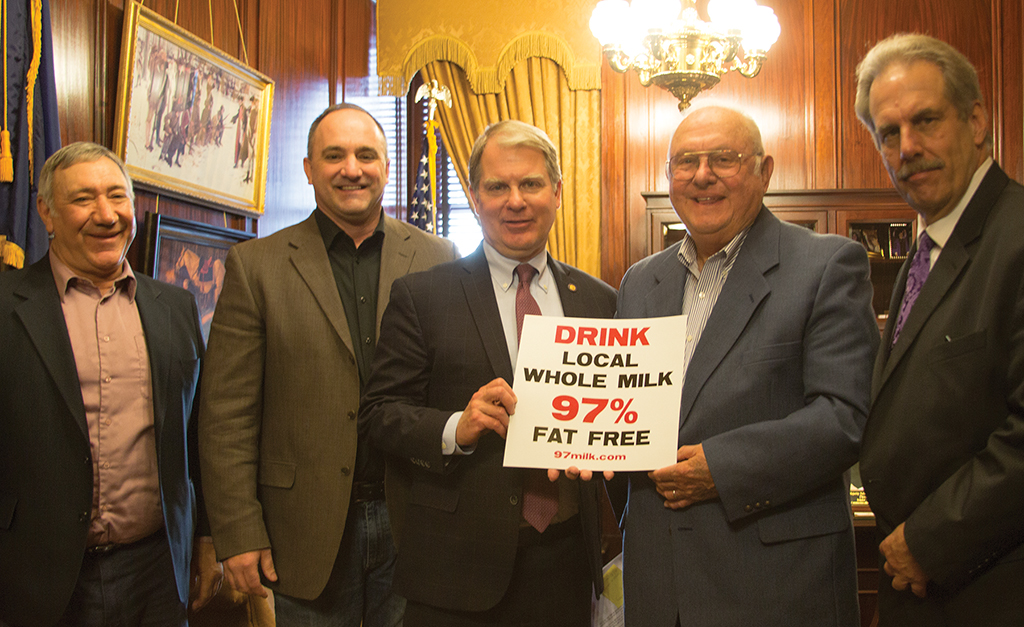
“When legislators hold up a sign, or want their picture taken with a baleboard and say ‘this is the best thing going in dairy right now’, that’s rewarding,” says Morrissey.

“When people write into the Dairy Desk and we can answer their questions, that’s rewarding,” says Behr. “But most rewarding is hearing the excitement, seeing dairy farmers wanting to be involved, understanding the importance of marketing and seeing the results of getting involved. Receiving a simple note thanking us for positive messages, that’s rewarding.”

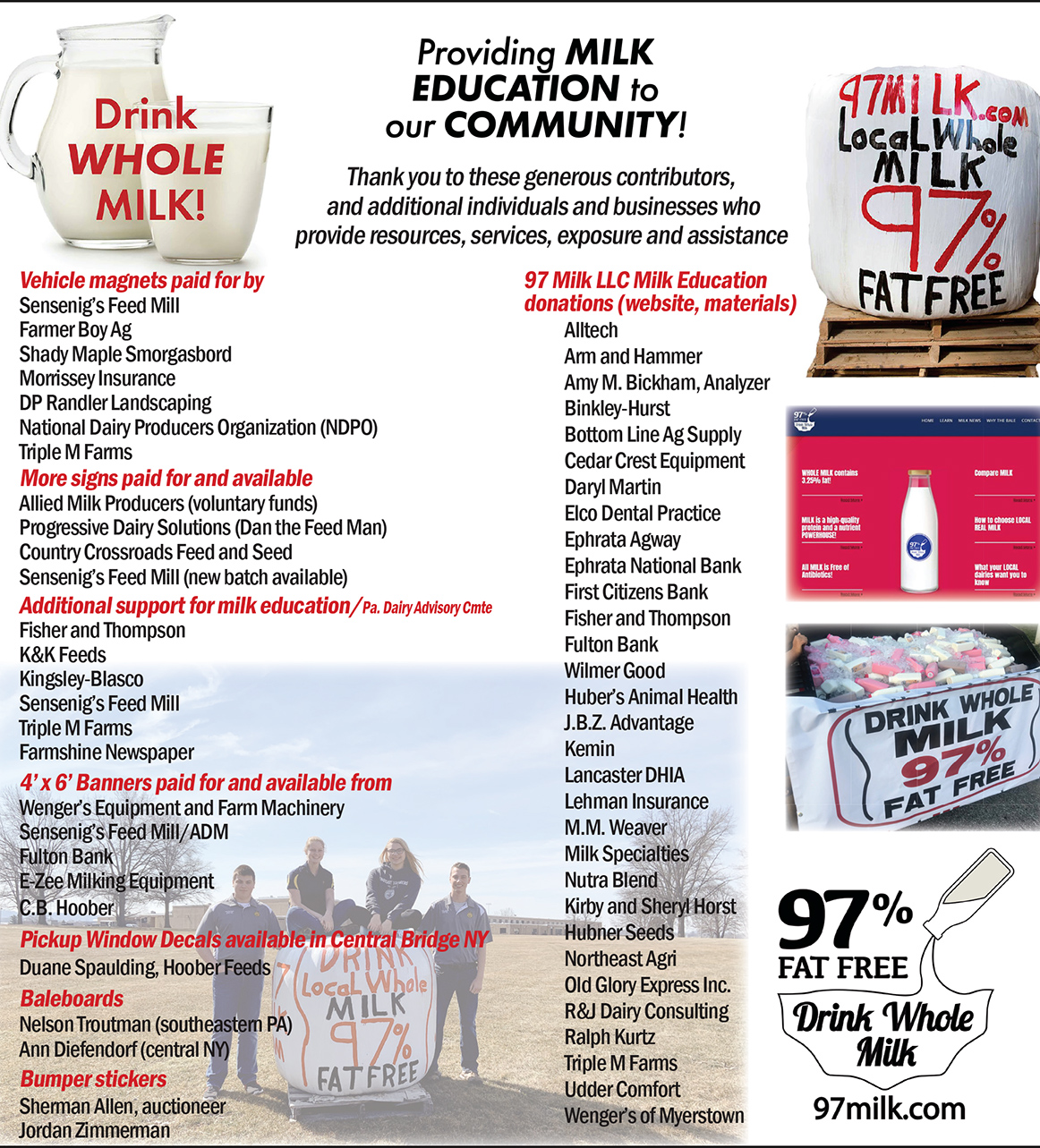
97 Milk LLC raised funds from more than 20 local and national businesses (see graphic) to cover expenses for the website and printed materials, and they’ve worked with Allied Milk Producers to have milk and dairy products available for parades, corn mazes, and other venues.

Meanwhile, individuals and communities take it upon themselves to paint bales, print bumper stickers, make signs, incorporate the message into corn maze designs, hometown parades, create farm tour handouts, initiate milk tents at athletic events, and more.

Young people are enthusiastic: FFA chapters, 4-H clubs and county dairy maids are printing their own banners and carrying the message at diverse public events. They love participating because it is real milk education, sharing the truth about milk and the life and work of America’s dairy farming families.

Morrissey and Troutman get calls from other states for banners and car magnets, and they’ve sent to these states at cost. Locally, the businesses paying for printing these items are giving them away (see graphic).

Behr has also designed items with the 97 Milk website logo, cows and farm scenes. These files are on the download area at 97milk.com and can be used to make banners, yard signs, license plates, bumper stickers, educational handouts, and more.

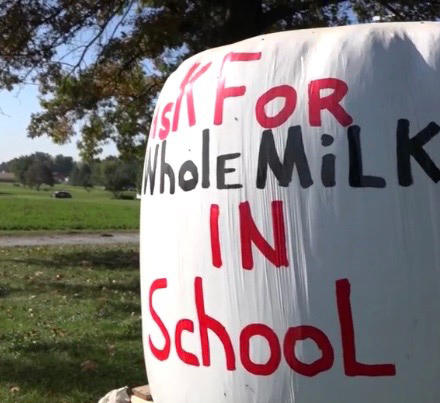
Troutman has added new baleboards for community events, including one that reads: Ask for Whole Milk in School. He and Behr recently did a television interview with a local PBS station.

Both the grassroots Pa. Dairy Advisory Committee and the 97 Milk LLC are running on shoestring budgets from donations (see graphic) with all volunteer effort, and the grassroots are blooming where planted to multiply the impact in ways too numerous to mention.

As a glimmer of hope, fluid milk sales nationally were up 0.2% in July, the first year-over-year increase in decades, with whole milk up 3.6% and flavored whole up 10.4%. Stores surveyed in southeastern Pennsylvania, where 97 Milk began, say whole milk sales are up significantly since January. It is also notable that many stores don’t seem to be able to keep enough whole milk on the shelves — a nationally obvious phenomenon.

Also being promoted is the petition to bring whole milk back to schools. This week, the online petition ( https://www.change.org/p/bring-whole-milk-back-to-schools ) topped 8000 signatures, plus 4000 were mailed in envelopes for a first-batch delivery in Washington Oct. 24, with a second batch goal to double that by January.

Reflecting on the past 10 months, Troutman says, “I thought if they’re not going to do it, someone has to, and here I am.”

And he’s happy. “Really, I’m thankful, thankful for so many who are helping make this work.” 

To contact the grassroots Pa. Dairy Advisory Committee about banners, magnetic vehicle signs and baleboards, call Bernie Morrissey at 610.693.6471 or Nelson Troutman at 717.821.1484.

To contact 97 Milk LLC about spreading the milk education to other communities, email 97wholemilk@gmail.com or call Jackie Behr at 717.203.6777 or write to 97 Milk LLC, PO Box 87, Bird in Hand, PA 17505, and visit www.97milk.com, of course.

 -30-

Congressman to dairy farmers: ‘Government is between you and the consumer’

Dairy Advisory Committee formed, meets with federal, state lawmakers

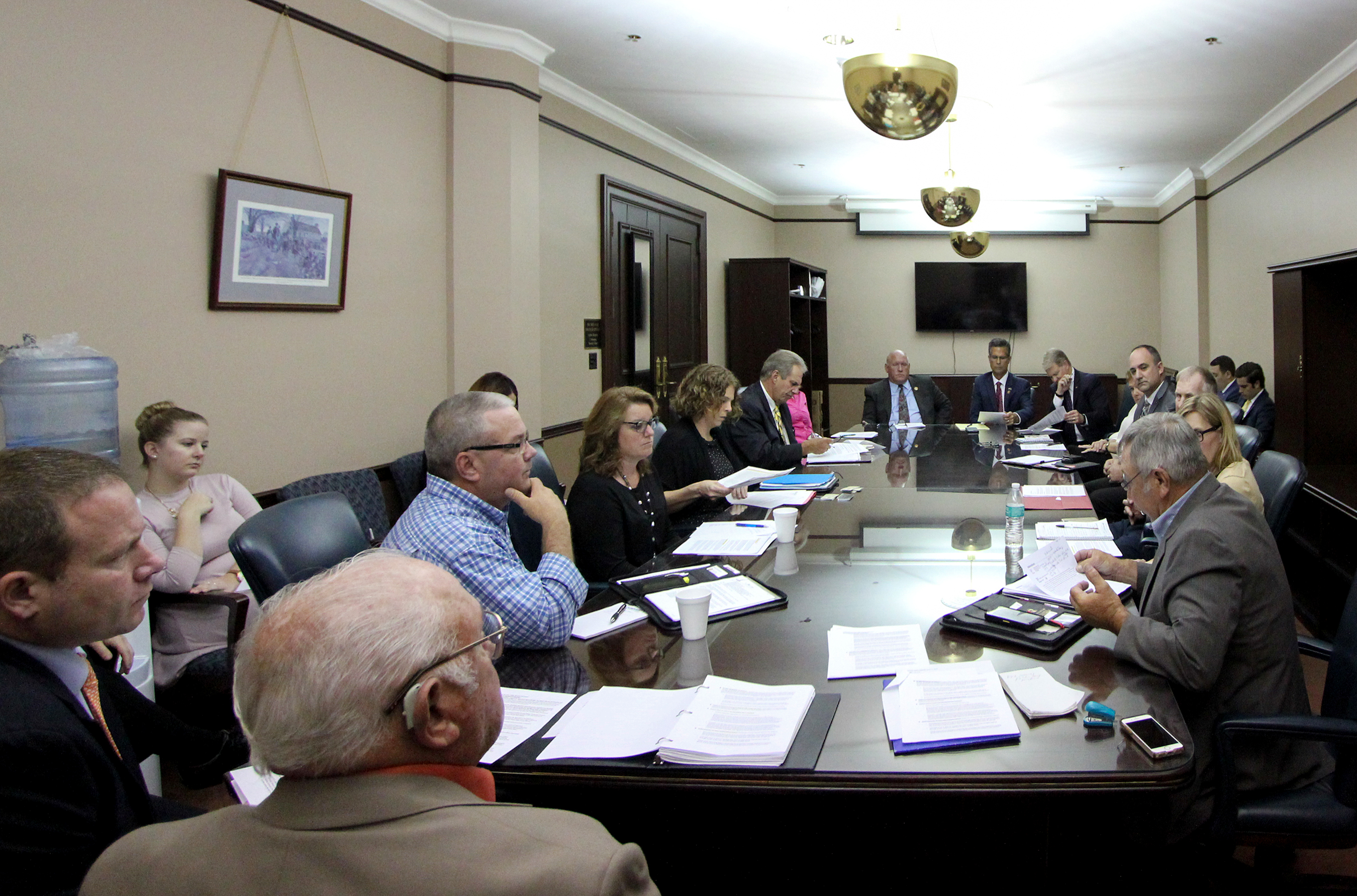
During a June 3 roundtable discussion between dairy stakeholders and Pennsylvania state and federal lawmakers, Nelson Troutman (right) said Pennsylvania is a fluid milk island with milk and consumers right here, but pressure pushing in from all sides. He said the state is losing its ability to compete as federal dietary rules suppress fluid milk sales while the state’s antiquated milk marketing law incentivizes more milk-swaps along the four borders as fluid milk sales decline. Clockwise from top left are U.S. Congressmen G.T. Thompson (R-15th) and Dan Meuser (R-9th), State Senator David Argall, Lolly Lesher, Mike Eby, Dale Hoffman, Tricia Adams, Nelson Troutman, Bernie Morrissey, State Senator Scott Martin, Karl Sensenig, Bonnie Wenger, Krista Byler, Craig Lutz for Sen. Argall’s office, and Katie Sattazahn. Also present were various legislative staff. Attendees shared USDA data showing that in the past 12 months, Pennsylvania lost more cows (29,000 head) and more production (66 mil. monthly pounds) than any other state in the nation, with the potential see even greater losses in the next 12 months without substantial change.

By Sherry Bunting, Farmshine, June 14, 2019

HARRISBURG, Pa. — “What I’m hearing here is that the government is between you and the consumer. You would have no problem marketing milk if you could get your message and product to the people,” said U.S. Congressman G.T. Thompson, representing Pennsylvania’s 15th legislative district over a swath of central and northcentral and northwest Pennsylvania.

That summed up the concerns related to school milk, dairy checkoff, fake milk labeling and other issues during a meeting between 11 dairy stakeholders and a dozen state and federal lawmakers and staff in Harrisburg on June 3.

It was a listening session that was followed by a productive work session as the grassroots group will continue to meet and correspond as a Dairy Advisory Committee.

(l-r) Nelson Troutman, Mike Eby, Pa. State Senator David Argall, Bernie Morrissey, Craig Lutz.

Retired agribusinessman Bernie Morrissey and 97 Milk Baleboard initiator Nelson Troutman worked with Pa. State Senator David Argall of Berks and Schuykill counties to set up the meeting.

They pulled together an advisory committee of 11 people, including Troutman and Morrissey, along with Dale Hoffman and his daughter Tricia Adams of Hoffman Farms, Potter County; Mike Eby, a Lancaster County farmer and president of National Dairy Producers Organization; Lolly Lesher of Way-Har Farms, Berks County; Katie Sattazahn of Zahncroft Farms, Womelsdorf; Krista Byler, foodservice director for Union City School District in Crawford and Erie counties, whose husband operates a crop and dairy farm in Spartansburg; Bonnie Wenger of Wen-Crest Farms, doing custom cropping and heifer raising for dairies in Lebanon and Berks counties; and Karl Sensenig of Sensenig Feed Mill, New Holland. 

I was privileged to moderate the discussion, for which an outline was provided in advance.

Congressman Thompson was joined by Congressman Dan Meuser, who represents Pennsylvania’s 9th district covering Carbon, Columbia, Lebanon, Montour and Schuykill counties along with portions of Berks, Luzerne and Northumberland.

In addition to State Senator David Argall, State Senator Scott Martin of Lancaster County attended, as ded legislative aids for Senators Ryan Aument, Elder Vogel, and Mike Folmer with additional interest from State Representatives John Lawrence and David Zimmerman.

Lawmakers said they left the discussion with “more work to do” and an “elevated awareness.” Their message to dairy farmers was: “Keep it up. Keep doing what you’re doing (a nod to the 97 Milk campaign and the planned rally for the Whole Milk for Healthy Kids Act on June 18 at the state Capitol). They said raising public awareness is crucial.

“Every few days, the bill gets another cosponsor,” said Rep. Thompson of HR 832 introduced in late January. “It will take public support and momentum to reverse this. It’s a challenging task.”

Even with evidence that bad science led to the federal school lunch milkfat restrictions, Thompson said the House Committee on Education and Labor must take up the bill in order for it to move forward. He noted that current leadership of that committee is the same as in 2010 when The Healthy Hunger Free Kids Act tightened the vice grip on milk fat. (Learn more about the school lunch changes over the past 10 to 20 years here.)

The 2010 legislation with the blessing of former Ag Secretary Tom Vilsack not only prohibited whole milk in the National School Lunch Program, it also reduced total calories, required less than 10% calories from saturated fat and made the milk part of the meal’s nutrient analysis.

With a nod to Krista Byler, Thompson said he understands more is needed beyond HR 832. “We need to eliminate the beverage information from the nutrient standards limitations,” said Thompson.

Discussion followed about the current Childhood Nutrition Reauthorization process currently underway in the Senate and what opportunities might exist for a regulatory change there.

Byler noted that while every child gets a milk, many students throw the milk away and buy sugary drinks that don’t offer milk’s nutrition.

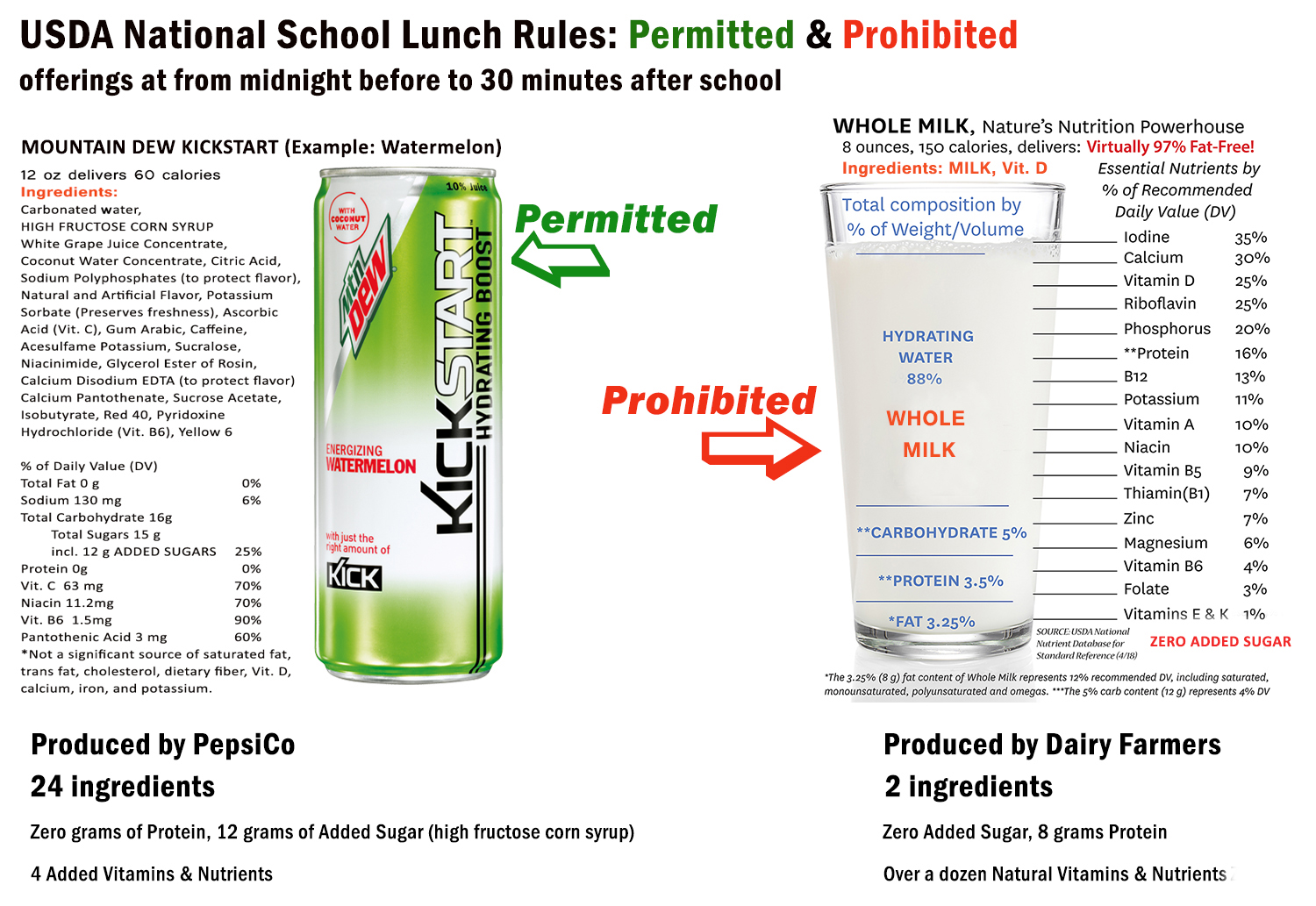
Legislators were surprised to learn that high school students can’t buy whole milk but they can buy Mountain Dew Kickstart at school. This 80-calorie beverage made by PepsiCo — the company that also created a Smart Snacks website for school foodservice directors and received the GENYOUth Vanguard Award last November — is deemed “okay” by the current USDA Dietary Guidelines because it has fewer calories than milk, zero fat and a list of added, not natural, vitamins and minerals. But it also has 20 grams of carbohydrate, 19 grams of sugar in the form of high fructose corn syrup and zero protein, whereas whole milk has 12 grams of natural carbohydrate and 8 grams of protein.

In addition to Mountain Dew Kickstart, students in high schools and middle schools across the U.S. can buy other sweetened drinks like PepsiCo’s Gatorade as well as iced tea coolers. In addition, high schools are also permitted to have coffee bars.

Yet schools are prohibited from offering whole milk (3.25% fat) or reduced-fat (2%) with its high-quality protein and long list of natural nutrients – unless a child has a medical note from a physician.

On the flip side, schools must provide non-dairy substitutes like soy and almond beverage if a parent, not a physician, writes a note. And no notes are needed for students to throw away the milk and grab a sweetened high-carb beverage from PepsiCo.

“My purpose in coming here, after speaking with other foodservice directors across the state, is the changes that were made to allow 1% flavored milk last spring are having disheartening results. Schools have been doing the fat-free flavored milk as a requirement for so long, they don’t all understand the new rule,” Byler explained.

Part of the issue, she said, is they have their cycle menus done far in advance, and the changes to the milk — even if whole milk were suddenly allowed — do not fit into the nutrient analysis of the meal.

Before 2010, the milk was not included in the nutrient analysis of the school lunch or breakfast.

“It’s a breath of fresh air to hear members of Congress talk about this,” said Byler. “This bill (HR 832) is amazing, but it doesn’t have legs to stand on without the regulatory change to exclude milk from the nutrient analysis of the meal. For schools to have this choice, this bill needs to pass, and the milk needs to be a standalone component of the meal, otherwise schools won’t be able to make it work.”

She said the same goes for the Smart Snacks program. An exception to regulations is needed so schools can offer whole milk, just as they can offer PepsiCo’s energy drinks.

At the federal level, Rep. Thompson said the Pennsylvania Congressional delegation is working on getting a companion bill for HR 832 in the U.S. Senate. (This actually did happene a day after this report was filed for press — Senators Pat Toomey (R-Pa.) and Ron Johnson (R-Wis.) introduced the Milk In Lunch for Kids (MILK) Act this week. Bill number and text have not yet been posted)

“The biggest thing we need is to generate enough public support,” said Thompson.

The Dairy Advisory Committee urged Pa. State Senators to support a resolution on the federal bills.

On The Dairy Pride Act, Thompson was more optimistic. He believes FDA is giving an indication that the public has been misled by competing alternative beverages that infer by the name “milk” to have the nutritional attributes of milk.

Tricia Adams spoke of the many school tours she conducts at Hoffman Farms in the spring and summer, and what the kids tell them about school milk.

She says the kids are “brutally honest. They tell us, ‘This is the good milk!’ But just to get whole milk for a tour, I have to special order weeks in advance,” she says. “It’s a struggle to get enough of it at one time. It’s just not available.”

 Her father Dale Hoffman observed that farmers are so busy, it’s tough to be involved in these things. He said it is scary how fast Pennsylvania is dropping in cow numbers and production.

“Somewhere, we need to get our foot in the door. This has got to be done if Pennsylvania is going to compete. We have the milk and the consumers right here,” said Hoffman. “We need your help. We hear it’s tough to get done, but it’s time to get whole milk back in the schools.”

Mike Eby said he sold his cows three years ago, but producers selling today “are getting half of what I got.” He said the dairy situation is increasingly difficult for farm families to manage whether they are staying in, or getting out, as the value of their assets shrink along with income.

“Where is our milk going to be coming from when we all go out?” he asked.

Eby describe the power of whole milk. He has been part of an effort to give out whole milk that is standardized to 3.5% fat instead of 3.25% to meet the California standards. 

“We give the milk away at four parades a year,” he said, and the math adds up to over 10,000 individual servings. “We could give more! They love it. People are screaming for that milk.”

Circling back to Rep. Thompson’s point. The problem isn’t the product, the problem is the government getting between the farmer and the consumer when it comes to marketing the high value, nutritious and delicious product they produce.

State issues were also discussed, including needed reforms to the Pennsylvania Milk Marketing Law. Each participant also gave a fast view of the long dairy situation.

“The average dairy farmer we serve is under 150 cows, and our feed mill has 107 years in the business. We’ve seen a lot, but nothing as bad as this,” said Karl Sensenig. “We are greatly concerned about what is the future for the generations to come in our business and on the farms. We have become their bank. The situation is beyond dire, and I’m afraid we haven’t begun to see the true loss of farms. Even if the price gets a little better, many are so far gone that there’s no way out.”

Katie Sattazahn also questioned the future. She is integral to the farm operated by her husband and his brother, and she works off the farm. They upgraded their facility three years ago, never expecting a downturn of this duration and magnitude.

“The biggest thing is, we are supposed to be glad when we have a breakeven year, but that has to change. As dairy farmers, we need to be profitable to put something back into our operations,” she said. “Every dollar we spend is spent locally. Our farms provide open space and benefits for the environment, and the money we spend in our business helps the economy.”

With two young children, Sattazahn says, “If it stays the way it is, why would we encourage them to do this?”

Bonnie Wenger explained the conditions she sees in the community of dairy farmers. She explained to lawmakers the added difficulty of this year’s prevented plantings, a struggle that will get worse this fall in terms of feeding cows.

Byler also talked about the dire situation in her county. “The dairy farms support our communities. They support other businesses and bring in revenues for our school districts,” she said. “What will be left for our small rural communities?”

On the school front, she showed examples of the marketing foodservice directors see, pushing them away from animal protein. This included visuals from Fuel Up To Play 60 and its focus on fat-free and low-fat. She wonders why they can’t just talk about milk, why they have to pound home the fat-free, low-fat with every caption, every sentence, over and over. She has trouble seeing the value in it from the side of the dairy farmer or the school program.

Lawmakers and staff were taking notes, writing in the margins and circling things on the outline provided. By the end of the session, Sen. Argall said, “You’ve created a lot of work for us.”

Congressman Meuser noted this is now an even higher priority for him.

Sen. Martin said this is on the Pennsylvania Assembly’s radar, and he mentioned a package of bills coming that are “just a start.” He mentioned the dairy commission being put together to advise the legislature on dairy. 

They reminded the group to urge others to attend the rally on June 18 at 11:00 a.m. at the Capitol Rotunda in Harrisburg to support the federal dairy bills on whole milk in schools and mislabeling of non-dairy beverages. The media will be there, and this is a chance to get the public involvement that is necessary.

Here is another link to 8 ways you can help. (Swipe to read second page of this pdf).

-30-

Truth and thoughts: A tragedy the government won’t accept

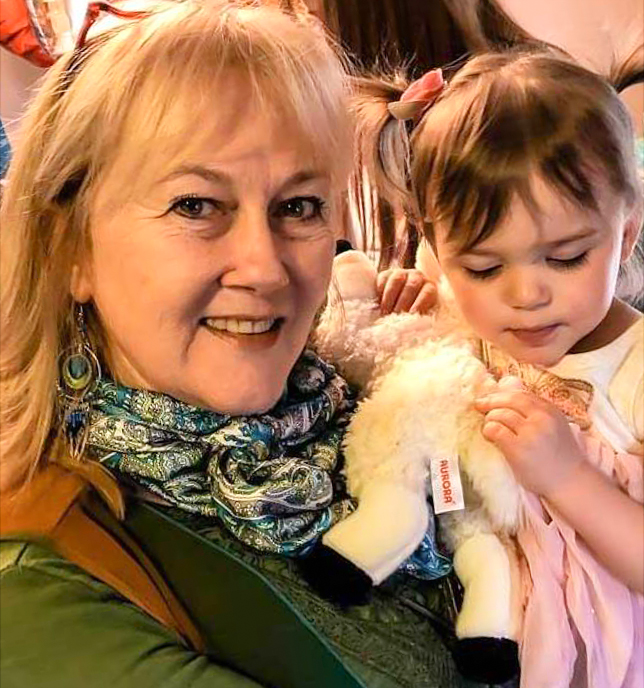
As a mother and a grandmother, Sherry Bunting has followed childhood nutrition legislation and government guidelines for 25 years. She is pictured here recently with Bella, one of her five grandchildren.

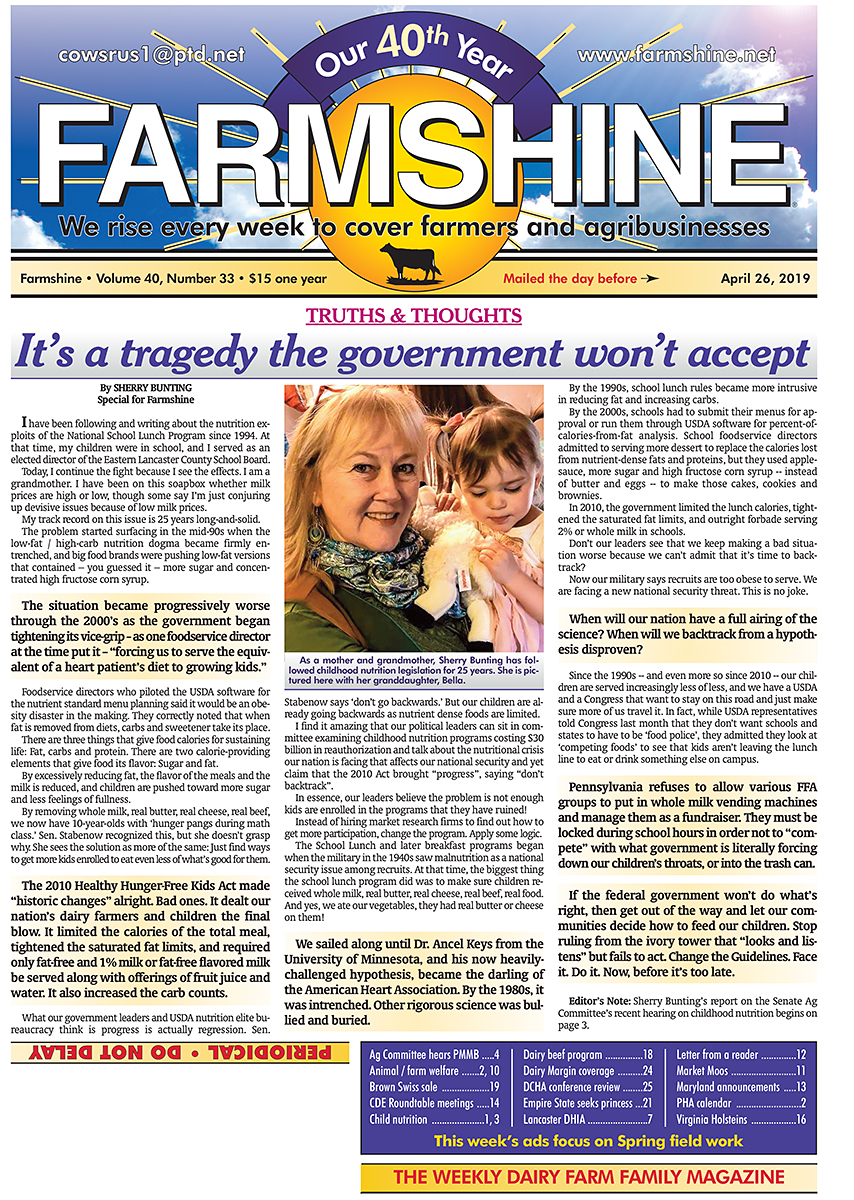
By Sherry Bunting, Farmshine Cover Commentary, April 26, 2019

I have been following and writing about the nutrition exploits of the National School Lunch Program since 1994. At that time, my children were in school, and I served as an elected director of the Eastern Lancaster County School Board.

Today, I continue the fight because I see the effects. I am a grandmother. I have been on this soapbox whether milk prices are high or low, though some say I’m just conjuring up devisive issue because of low milk prices.

My track record on this issue is 25-years-long-and-solid.

The problem started surfacing in the mid-90s when the low-fat / high-carb nutrition dogma became firmly entrenched, and big food brands were pushing low-fat versions that contained – you guessed it – more sugar and concentrated high fructose corn syrup.

The situation became progressively worse through the 2000’s as the government began tightening its vice-grip — as one foodservice director at the time put it — “forcing us to serve the equivalent of a heart patient’s diet to growing kids.”

Foodservice directors who piloted the USDA software for the nutrient standard menu planning said it would be an obesity disaster in the making. They correctly noted that when fat is removed from diets, carbs and sweetener take its place.

There are three things that give food calories for sustaining life: Fat, carbs and protein. There are two calorie-providing elements that give food its flavor: Sugar and fat.

By excessively reducing fat, the flavor of the meals and the milk is reduced, and children are pushed toward more sugar and less feelings of fullness.

By removing whole milk, real butter, real cheese, real beef, we now have 10-year-olds with ‘hunger pangs during math class.’ Sen. Stabenow recognized this, but she doesn’t grasp why. She sees the solution as more of the same: Just find ways to get more kids enrolled to eat even less of what’s good for them.

The 2010 Healthy Hunger-Free Kids Act made “historic changes” alright. Bad ones. It dealt our nation’s dairy farmers and children the final blow. It limited the calories of the total meal, tightened the saturated fat limits, and required only fat-free and 1% milk or fat-free flavored milk be served along with offerings of fruit juice and water. It also increased the carb counts.

What our government leaders and USDA nutrition elite bureaucracy think is progress is actually regression. Sen. Stabenow says ‘don’t go backwards.’ But our children are already going backwards as nutrient dense foods are limited.

I find it amazing that our political leaders can sit in committee examining childhood nutrition programs costing $30 billion in reauthorization and talk about the nutritional crisis our nation is facing that affects our national security and yet claim that the 2010 Act brought “progress”, saying “don’t backtrack”.

In essence, our leaders believe the problem is not enough kids are enrolled in the programs that they have ruined!

Instead of hiring market research firms to find out how to get more participation, change the program. Apply some logic.

The School Lunch and later breakfast programs began when the military in the 1940s saw malnutrition as a national security issue among recruits. At that time, the biggest thing the school lunch program did was to make sure children received whole milk, real butter, real cheese, real beef, real food. And yes, we ate our vegetables, they had real butter or cheese on them!

We sailed along until Dr. Ancel Keys from the University of Minnesota, and his now heavily-challenged hypothesis, became the darling of the American Heart Association. By the 1980s, it was intrenched. Other rigorous science was bullied and buried.

By the 1990s, school lunch rules became more intrusive in reducing fat and increasing carbs.

By the 2000s, schools had to submit their menus for approval or run them through USDA software for percent-of-calories-from-fat analysis. School foodservice directors admitted to serving more dessert to replace the calories lost from nutrient-dense fats and proteins, but they used applesauce, more sugar and high fructose corn syrup — instead of butter and eggs — to make those cakes, cookies and brownies.

In 2010, the government limited the lunch calories, tightened the saturated fat limits, and outright forbade serving 2% or whole milk in schools.

Don’t our leaders see that we keep making a bad situation worse because we can’t admit that it’s time to backtrack?

Now our military says recruits are too obese to serve. We are facing a new national security threat. This is no joke.

When will our nation have a full airing of the science? When will we backtrack from a hypothesis disproven?

Since the 1990s — and even moreso since 2010 — our children are served increasingly less of less, and we have a USDA and a Congress that want to stay on this road and just make sure more of us travel it. In fact, while USDA representatives told Congress last week that they don’t want schools and states to have to be ‘food police’, they admitted they look at ‘competing foods’ to see that kids aren’t leaving the lunch line to eat or drink something else on campus.

Pennsylvania and other states will not allow various FFA groups to put in whole milk vending machines and manage them as a fundraiser, or they must be locked during school hours in order not to “compete” with what government is literally forcing down our children’s throats, or into the trash can.

If the federal government won’t do what’s right, then get out of the way and let our communities decide how to feed our children. Stop ruling from the ivory tower that “looks and listens” but fails to act. Change the Guidelines. Face it. Do it. Now, before it’s too late.

Good news about milk is spreading rapidly

Milk Baleboard message reaches over 1 million people in first 7 days online (www.97milk.com, @97milk on facebook, @97milk1 on twitter)

By Sherry Bunting, Farmshine, March 1, 2019

RICHLAND, Pa. – It has taken off with overwhelming response on social media, and consumers reading and sharing the posts from “97 Milk” are expressing their surprise at how much they are learning about the goodness of milk while farmers are enthused to have a vehicle of grassroots promotion that sticks to the basics — promoting the healthy wholesomeness of dairy and helping consumers make informed choices about milk.

The big news this week is that the 97milk.com website and its corresponding facebook (@97milk) and twitter (@97milk1) accounts, have been very active, very quickly since launching last Friday evening, Feb. 22. Facebook, alone, had reached 1.2 million people by midnight Wednesday, just six days after launching.

What is 97 Milk, you ask?

Last week’s Farmshine had a feature story on page 19 about the launch of the website www.97milk.com as a grassroots offshoot of the Milk Baleboards that are popping up on farms and business properties across the countryside.

Those round bales painted with the message: Drink Local Whole Milk – 97% Fat Free were the idea of Richland, Pennsylvania dairy farmer Nelson Troutman. We have been following the development of his idea in the pages of Farmshine since Nelson made his first Milk Baleboard, pictured on our January 4, 2019 cover.

In fact, Nelson reports as of Wednesday morning, nearly two months after he made his first Milk Baleboard, he has made 26 — including one that was delivered to Farmshine on Feb. 27. He has delivered to many farms and businesses.

In addition, Dale Zimmerman of Zimhaven Holsteins in East Earl, made Milk Baleboards for his farm as well as for Shady Maple Smorgasbord just down the road. And other farmers are joining in.

Nelson continues to receive phone calls and has become somewhat famous in his community, attracting shoppers when he visits the grocery store in his home town.

“No one. Not one person, has said to me that, yes, they knew milk is virtually 97% fat free. No one, not young, nor old, nor in between,” Nelson stated in a follow up email with Farmshine early Wednesday morning, Feb. 27. “Since the bales and the website, I had people say to me that when their kids were small, the doctor told them to drink 2% milk, and now the kids are grown, and they were still drinking 2% milk — until this information came out. Now, they tell me they are drinking whole milk.

“This is all 100% education,” Nelson relates.

This overwhelming response has gone to the next level with the online presence that began Feb. 22 through a website, facebook page, instagram and twitter account for 97 Milk as the educational effort of grassroots dairy farmers. Through social media, the good news is spreading well beyond the Lebanon, Lancaster and Berks County region of Pennsylvania where the first Milk Baleboards were made and placed by Nelson on farms and businesses in the area.

How can this be?

Judging by the facebook page, there is an obvious consumer thirst for milk knowledge and an obvious farmer passion to deliver knowledge simply — without the dietary politics.

Within the first 72 hours, the @97milk facebook page had over 1000 likes and had reached over 100,000 people with the good news that whole milk is virtually 97% fat free.

Over the next 36 hours by mid-morning on Wed., Feb. 27 — not quite five days after launch — the facebook page had nearly 1,650 likes and follows, and the informational posts had reached a whopping 700,000 people. (By Thursday, Feb. 28, less than 7 days after launch, the page had over 2000 likes and had reached 1.2 million people.)

Even more important, these posts had — in less than 7 days — “engaged” nearly 100,000 people via likes, comments and shares of the educational information posted on the page. This does not include those who downloaded the informational images and shared them without sharing directly from the facebook page!

A post over the weekend (see image) illustrated the essential nutrients in milk and its composition as a hydrating beverage made up of 88% water, 5% carbohydrate, 3.5% protein and 3.25% fat, showing the long list of essential nutrients by their percentages of daily recommended values. This illustrative glass of milk reached nearly 100,000 facebook users by Wednesday morning and had engaged over 7,000 in likes, comments and shares.


Consumers are thirsty for knowledge about milk. Here is one simple example of how 97 Milk keeps the good news going. This visual facebook message was posted Wed., Feb. 27, reaching 3,300 people with nearly 300 interactions within its first three hours. Facebook image from @97milk

Another post that explained the fat percentages of milk had reached 45,000 people with 3200 interactions.

Another post giving comparisons of Real Whole Milk, 1% Real Milk, Soy, Almond and Coconut beverage reached over 17,000 people with over 1700 interactions within 24 hours.

And another post sharing the good news that all milk is tested free of antibiotics reached a whopping 608,000 facebook users and resulted in over 44,000 interactions, including over 9,000 direct shares!

Meanwhile, the posts have brought in questions and discussion in the form of public comments on the facebook page and in the form of questions sent by private message. In fact, these interactions are coming from far and wide — local, national, even international.

On Tuesday morning, the 97 Milk facebook page posted this explanation of why the Milk Baleboards have expanded to online 97 Milk communications:

“97 Milk was created to be a voice for our local dairy farmers. This is a place where people can get information on nutritious dairy products. It’s a place where farmers can tell their story, a place where our community can get information on how to support local dairy farms. There is so much confusing information regarding dairy, and there are always two sides to every story. 97 Milk tells the story of the many farms that love and care for their cows, the passion that many dairy farmers have, the many proven research-based facts on milk nutrition. This is our side that our community deserves to hear.”

The website is mentioned on every post, and it is a simple place to direct people who see the Milk Baleboards and the social media posts and want to learn more of the basics about Real Whole Milk.

Planned in the coming weeks are posts for social media that continue to provide bite-sized fact nuggets about milk, including how to learn where milk was bottled, why milk protein is called a complete protein, quotes from farmers about why they love what they do, and other inspirations. Check it out.

If you have a Milk Baleboard on your property, or have seen one displayed, please let us know the location (agrite@ptd.net) in order to help create a map of how the good news is spreading by these grassroots efforts.

If you would like a Milk Baleboard, check out last week’s page 19 feature story giving tips from Nelson on how to make one, and contact Nelson at 717. 821.1484 or Bernie Morrissey at 717.951.1774.

Jordan Zimmerman of East Earl is making and selling bumper stickers through the Lancaster County Holstein Association, and Morrissey has ordered magnetic signs.

To learn more about the online efforts, and to help spread the good news, check out the website at 97milk.com, facebook page @97milk and twitter account @97milk1.


Nelson Troutman of Richland, Pa. has made 26 Milk Baleboards for other farms and businesses in the area. Two weeks ago, he began painting them in his shop with the 97milk.com website! Photo by Sherry Bunting

‘Milk Baleboards’ are a ‘thing’, with a website!

Producers unite to send clear message to policymakers and consumers, website takes it to the next level.

Nelson Troutman (above) is a dairy farmer. He has made 20 Milk Baleboards and offers these DIY Tips with illustrations at the end of this story.

By Sherry Bunting, from Farmshine, Friday, Feb. 22, 2019

RICHLAND, Pa. — Nelson Troutman has been making the ‘Milk Baleboards’ since January. The Berks/Lebanon County dairy farmer came up with the idea after the Pennsylvania Milk Marketing Board listening session in December.

“It’s very important that the bales all have the same message: ‘Drink Local Whole MILK — 97% FAT-FREE.’ Don’t try to get funny with it. You could take the ‘local’ off and just focus on the ‘whole milk,’ but mainly to have impact, we want the bales to have the same message,” he said while painting bales in his shop during my visit last Saturday morning to the farm where he and his wife Mary live and which is now rented to a young couple for their dairy herd.

He still farms the land he has lived on his entire life, and he makes the feed for that herd and his son’s herd nearby. (In fact his daughter in law Renee wrote about whole milk recently, with a historical twist!)

Nelson has made 20 Milk Baleboards so far (check out his DIY tips at the end of this story). And he has seen new ones pop up from others following suit.

He has had 10 phone calls from fellow farmers as far away as New York, and has talked to so many more at meetings — out and about. He tells them: “Put a bale out… unless you are satisfied with your milk price.”

Did he think it would take off like it has? “No I didn’t,” he says. But he’s glad to see others joining in and hopes to see it catch on even more.

Retired agribusinessman Bernie Morrissey of Robesonia has been doing all he can to get other agribusinesses to put them out. In addition to Morrissey Insurance having one on their property along Rte 272 north of Ephrata, the Milk Baleboards are popping up along other main routes like 23, 322, and 422, to name a few.

“Our advertising checkoff dollars just didn’t seem to be doing a very good job these past 10 years. They have been promoting fat free and low-fat 1% milk and the fat free yogurt — not much whole milk,” Nelson relates.

“After the listening session with the PMMB, some of us were talking. We thought it was time to do something different, something like letting consumers know whole milk is 97% fat free,” he said further. “We didn’t come up with a plan that day. We were thinking about a billboard, but that was far too expensive. We thought about portable signs.”

Then over the weekend after that December meeting, he looked around. “I thought to myself that I already have the perfect thing: A wrapped hay bale! So, I painted one. I set it in the pasture at our crossroad. We farmers have silos, wagons, barns and sheds we can paint signs on.”

Lots of feedback has come in, and it seemed no one knew whole milk was 97% fat free. Some said “why are we drinking 2% milk, when whole milk tastes so much better?”

Nelson observes that young and older people said they never thought about how much fat or nutrition is in milk. “It seems so sad how people are misled by our checkoff dollars, our doctors and medical people — and our federal dietary guidelines committee.”

He admits that people are easily confused. To be sure, the bales are attracting attention, leading to questions.

While it started out as a way to send a clear and unified message to consumers and especially policymakers, Nelson said the information is so surprising to people that it offers educational opportunities.

That’s why R&J Dairy Consulting invited Nelson and Bernie to a meeting of dairy farmers last Friday to see what could be done to use this teachable moment.

The group decided to purchase a website domain — 97MILK.com, and direct people there to learn more: What is whole milk? How does it compare? What is Real Milk, Local Milk?

The website can help unite these efforts, and bring additional excitement to the project. For example, at the meeting organized by R&J Consulting, their marketing manager Jackie Behr said when she asked peers what questions they have about milk, she ended up with a whole list.

“Let’s use this opportunity to educate consumers and help them make a good choice,” she said. The group decided to start out with key simple answers to frequent questions. Many businesses and people are pulling together in various ways that it is impossible to name them all here. That will come in a future Milk Baleboard update.

Jackie at R&J, with some help from others, got the website 97milk.com up and running within seven days. This includes a facebook page @97Milk, so check it all out!

Want to make a Milk Baleboard? Here are Nelson’s DIY tips:


1) Keep the message the same: Drink Local Whole MILK — 97% FAT FREE (or now that there is a website, omit ‘Drink’ on a Round Bale and put the website 97MILK.com top or bottom.)

2) Get the right paint! Rustoleum Ultra Cover 2X paint and primer.

3) Use the small foam brushes and buy extra. This paint doesn’t wash out, so they can’t be re-used. Foam brushes can be turned for thick or thin letters.

4) Wear gloves, this paint will be with you a while if you don’t.

5) Before painting, sketch out a guide with a pen.

6) 97% is the largest and in making the percent-sign, put the circles parallel to each other and the slanted line in between to keep it straight.

7) Find the middle and that’s where the “I” in Milk goes, then build on that.

8) Letters are placed every 2.5 inches for “Local Whole,” and adjust others accordingly.

9) Spray paint onto foam brush, then apply to bale in strokes from the bottom to the top of each letter.

10) Alternate between colors (Blue/Red or Black/Red).

11) Make the letters broader and thicker for the word MILK, in all capital letters.

12) Follow your guide and use paint to even things out as you go.

13) Paint will dry faster and better, with fewer runs (in winter) if painting in sunshine or with a heater running in the shop.

14) Sit them on a pallet for better visibility on property you have along roads and set back from intersections.