New risk management challenges (Part 2); DRP questions raised in divergent market

By Sherry Bunting, Farmshine, August 14, 2020

BROWNSTOWN, Pa. — For dairy producers managing their market risk, current divergent dairy classes are a problem. Those with Dairy Revenue Protection (DRP) policies in the second quarter of 2020 (April through June) saw the sudden, singular and dramatic rise in Class III — and the negative PPD’s that showed how much of that higher price did not make it into their milk checks — evaporate their DRP claims just the same.

Professionals speaking off the record explain that when Class III milk dropped down to $12 to $13 in April and May, it looked like Class III DRP policies would have “enormous losses” and corresponding claims. But then June hit, and those coverages were wiped out because the policy price, in this case the higher Class III, was averaged over the three months of the policy quarter – even if the policyholder never saw that Class III price in their actual milk check.

DRP policies are purchased to protect a milk price floor on a quarterly, not monthly, basis.

For those producers locking in a price floor with Class IV DRP policies, or a combination of III and IV, high payouts on Class IV policies were realized. In those cases, the DRP offered some coverage and even helped some producers cover at least a portion of big losses in their Class III futures market hedges.

Digging into the complexities, the real crux of the problem is that the movement of the Class III futures market and the USDA-announced Class III price do not reflect the milk check realities of most producers who purchased these risk management policies. That’s a problem.

We’ve all heard the line: “You don’t buy insurance hoping your house will burn down.” This analogy does not apply today. There was a fire, but the market indicators on most types of policies do not recognize the damage.

Professionals who sell DRP indicate they have looked at milk settlement sheets from clients. They have seen all the PPDs for June, and they understand the shortfall projections that could be made worse by massive de-pooling for July milk. They have seen the market realities for their customers.

“What kind of risk management is this if it doesn’t account for how their milk is actually priced?” asks one professional. 

In fact, several noted their belief that the USDA and Farm Bureau should look at these disparities, that if PPD is part of the mailbox milk price — as it is actually paid to farmers — then it should be accounted for in the DRP.

One concern shared in several Farmshine interviews is that ag lenders and some feed companies are urging customers to manage risk with DRP to protect their cash flow.

This is hard to do right now as the premiums to purchase DRP have skyrocketed due to the current level of volatility. This is further complicated, say insurers, by the way the Federal Order Milk Marketing system has failed to facilitate the transfer of “value in the marketplace” (according to USDA) to farmers who produced the milk.

In the very time when risk management is most essential, seeing coverages evaporate because the market did not translate value to reality is a double-whammy for those who paid to manage their risk.

Outcomes were also negatively affected for producers who based their DRP policies on components because those PPD levels are reflective of the significant discount between what farmers were paid for their components as compared with how the market valued those components — what USDA states is “value in the marketplace.”

American Farm Bureau Federation’s John Newton explains that, “In multiple component pricing Orders, proceeds from the pool are based on the difference between the classified value of the milk and the component value of the milk — which is effectively the Class III price. When the component value exceeds the classified value, the proceeds from the pool are negative and result in a negative producer price differential (PPD).”

The loss reflected by these PPDs was evident in the performance of second quarter DRP policies based on components. At one point in time, producers saw they had an indemnity coming to cover their milk check losses, the money they expected not to be paid for components because of the market downturn. But then that indemnity evaporated as June components settled higher, wiping out market losses in April and May and simply ignoring milk check losses for June when “the market” failed to pass along the higher component values to most producers in most of the U.S.

Results also varied from farm to farm, depending upon what point in time they purchased their component-based policies. Some component policies for second quarter 2020 paid something. Others did not pay much, if anything, based almost entirely upon what day a producer purchased the policy. In short, these policies did not perform as expected because the cash price paid to producers did not perform according to the “market”. 

Another concern shared is farms facing sudden quotas, with little advance planning. Some cooperatives paid their co-op blend price only on 85% of a producer member’s March 2020 level of production for May, June, July, and until further notice. While DRP allows production to be 85% of the insured amount, a producer’s coverage, in many cases, can be negatively affected by what USDA reports as production change for a state or region.

In first quarter 2020 (January through March), for example, Pennsylvania’s higher production almost wiped out some claims.

In figuring milk production by state, USDA NASS looks at Federal Milk Marketing Order pool summaries as part of the production calculation, along with farm surveys. This can be problematic in a time when milk moves farther and more erratically due to supply-chain impacts, volatile futures markets and incentive to de-pool.

If production shows a decline for a producer’s state or region, it can help a claim, and if it shows an increase, this can reduce or eliminate a claim — even if that producer with that policy actually made less milk, not more.

Livestock Gross Margin (LGM), another risk management tool that is available through USDA Risk Management Agency, is seldom used today due to limits on available funding. This product is also affected by the difference between Class III and Class IV in how LGM policies reflect the settlement price, the actual milk income losses.

Newton at Farm Bureau writes that the price risk associated with PPD can only be managed through the terms of a forward contract. The PPD is not “exchange traded” so the risk in this portion of milk pricing is not covered. 

Furthermore, according to Newton, DRP and LGM are federal crop insurance policies based on the announced USDA prices, which does not include the PPD because this difference between class and component value and the de-pooling risk that affects it is not a publicly-traded instrument.

While producers report some coverage from DRP by locking in a milk price floor using Class IV, especially at a point in time when Class IV was higher than Class III, this has not been the case when III is higher than IV.

Since DRP is a program that changes each year with some new elements having been implemented to it so far, those working with the program have a variety of suggestions for USDA and Farm Bureau to look at making it a better and more usable product for dairy producers:

1)      Address the PPD risk – something should be done about this if it is part of how mailbox milk prices are calculated to producers.

2)      Look at making the policies monthly instead of quarterly to reduce the risk of uncovered losses to policyholders and to get them paid sooner.

3)      Increase the highest level of coverage to 98 or 99% instead of 95%. A 5% deductible in this market makes DRP unaffordable. For example, at current premium levels, a Class III price of $17.09, insured at 95%, comes out to $16.24 floor. Already this means there is an 85-cent deduction, on average. At a much higher current premium cost of 43 cents, that’s $1.28 to $1.30 before the producer collects anything on a 3-month average. So the combination of production percentage and higher premiums makes for a large deductibl

In short, the problem right now with dairy risk management through federal crop insurance tools and futures markets is the policies and programs and “markets” have so many nuances that are juxtaposed with a Federal Milk Marketing Order system that is inconsistent, not transparent and full of loopholes.

Simplifying both would be helpful, some say. For example, what if insurance products had one sales period and one price discovery period each month to set the deal instead of so many chances to pick the wrong times?

As one professional explained, “If part of the problem is the pricing model, then we can’t throw risk management at that problem… We need to fix the root of the problem. This is not like home-owner’s insurance. There are a lot of factors that go into this.”

When producers pay for risk management, then suffer a loss, but have no or little indemnity because the market indicators say the milk was worth more than what was paid… it’s like having home owner’s insurance when a tornado hits. Your agent looks at your flattened house (milk price settlement sheet), but then has to say he or she is sorry, the adjuster looked at your neighbor’s house as the indicator for tornado damage to your house and his house is still standing.

Dairy farmers are encouraged to learn about DRP, understand it, and decide what application it has to their business in a multi-faceted approach to risk management. Some agents handling the product are not even advertising it because of the current premium cost and these unreconciled “market” issues.

As with any risk management tool, there are critical factors to consider:

1)      Know your cost of production,

2)      Know your operation’s risk tolerance,

3)      Work with an advisor you trust, who understands the tools and communicates with you about them,

4)      Consider a blended approach, don’t look at Class III as ‘the market’,

5)      Have others in the business to talk to as a sounding board,

6)      Take a long-term approach, don’t look just at the short-term,

7)      Learn all you can to understand how these tools perform in relation to how your milk price is calculated in your milk market.

-30-
How data analytics, supply chain ‘ecosystems’ fit DMI’s global strategy for U.S. Dairy

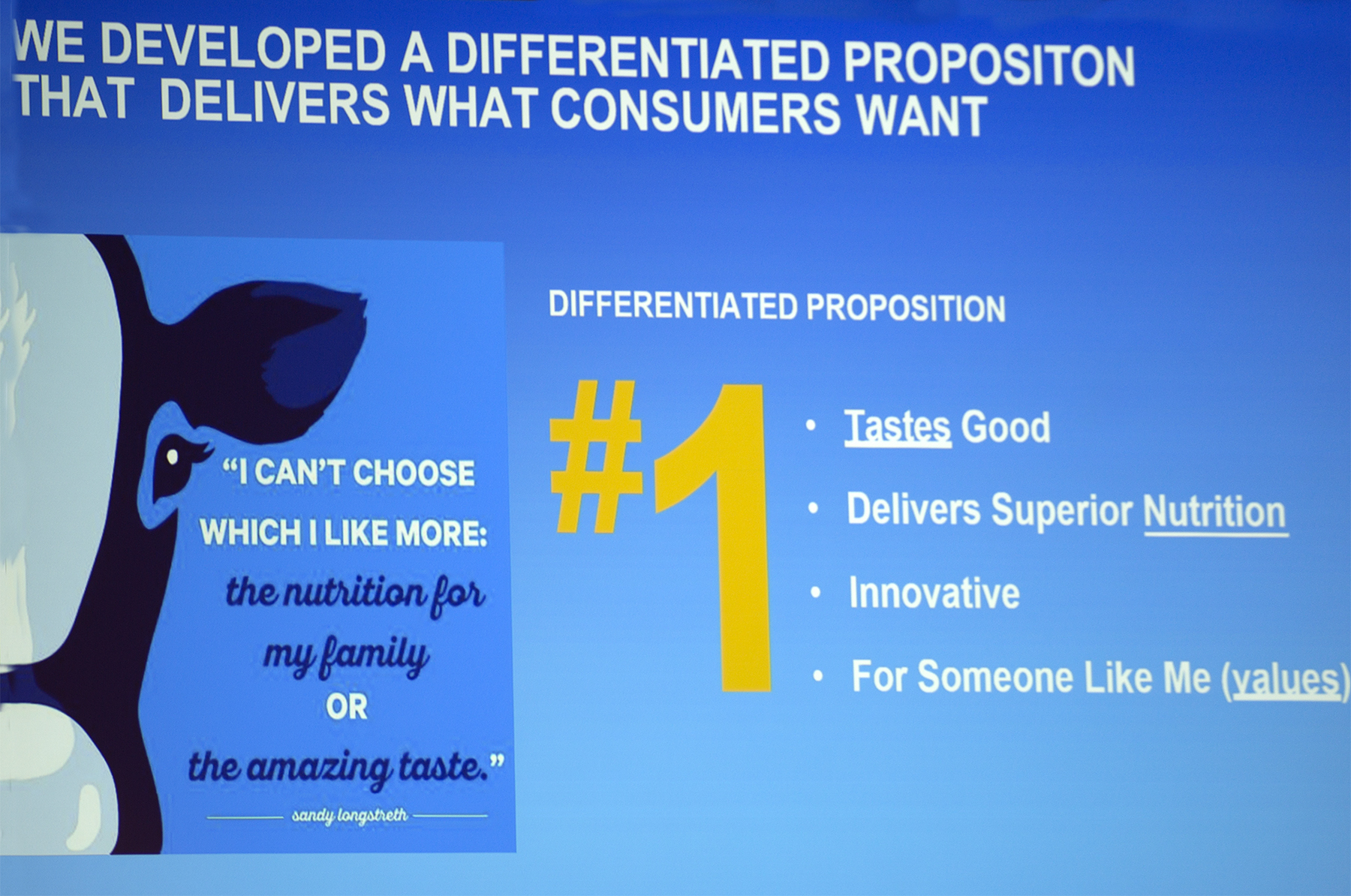
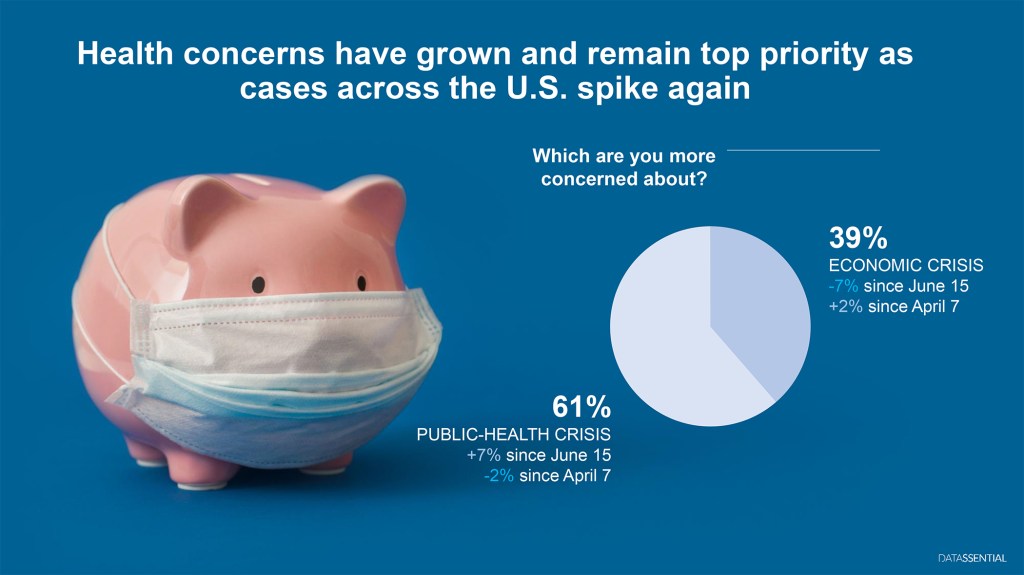
DMI CEO Tom Gallagher shared this slide with August ‘open mic’ call participants as consumer data confirm a current focuse on health and economics — even though global supply chain transformation is pursued on an accelerating scale.

By Sherry Bunting, excerpts summarized from Farmshine, August 21 and 28, 2020

CHICAGO, Ill. — Early in the pandemic, consumers were initially focused on health drivers in food purchases and then began moving toward economics. But with the resurgence of Covid cases across the country, data insights show “consumers are now back to a focus on health again,” said Tom Gallagher, CEO of Dairy Management Inc. (DMI).

Consumer insights and purchasing patterns pre- and post-Covid were discussed in an early August DMI ‘open mic’ call with Gallagher, as well as DMI president Barb O’Brien, board chair Marilyn Hershey and Inmar Intelligence CEO David Mounts.

Health and value were expressed as big opportunities for dairy. But the underlying message of food transformation was also clear in the discussion of how consumer data analytics and supply chain ‘ecosystems’ are integrated and streamlined to fit the dairy checkoff’s global strategy for the future of ‘U.S. Dairy’ — including new product innovation and the relationship DMI now has as Amazon’s dairy ‘category captain’.

Gallagher sent graphs indicating the percentage of change in fluid milk sales rising during the Coronavirus pandemic corresponds with increased sales of cereal.

“We think this is important, showing there are multiple reasons — no one reason why — during ‘panic buying’ consumers bought what they bought,” he said. “Cereal and milk have historically been tied. Cereal has been on a decline for years.”

Gallagher noted that as more people eat breakfast at home, new opportunities are presented beyond cereal and milk.

“This is an opportunity for us for innovation and marketing,” said Gallagher. “One of the reasons we lost fluid milk consumers is that their spending away from home was a big percentage on breakfast, and the white gallon is not suited to that.”

He said new breakfast ideas are coming out. For example, Kraft is getting into the breakfast game with new “breakfast mac and cheese.”

Gallagher also stressed a statistic he looks at, which is the “velocity” of money.

“This is simply the rate of spending and saving. Americans are at the lowest rate of spending since the 1950s and 60s,” he said, explaining that savings rates show a second reason for opportunity as Americans are on more of a savings trend since the pandemic.

“If we can get into the ‘right product’ and the ‘right positioning’ and the ‘right marketing’, people will want our product, and we’ve got that, but innovation needs to be done too,” said Gallagher. “As the unemployment rates ease, the money will be there for people to pay a little more (for innovative products).”

Dairy positioning for in-home meals is something the industry has not seen for decades, said Gallagher. He explained that before Covid, 10% of consumers were eating at home 90% of the time. After Covid, 50% of consumers were eating at home 90% of the time. More people eating at home — even after Covid — presents “huge new opportunities for us,” he said.

E-commerce was highlighted as one of those opportunities.

“Change is happening in an ‘omnichanneled’ world,” said David Mounts of Inmar Intelligence. He described media networks, digital networks for in-store, curbside, delivery and online, and how Amazon is integrating all of these as not just a retailer, but also a merchant, a media company and data company in the ‘strike zone’ of everyday business.

“We saw this opportunity a few years back and did a program on home delivery that was extremely successful,” Gallagher reported.

O’Brien noted that this gave DMI the experience to work with Amazon.

“E-commerce will change the supply chain,” she said. “As of June 14, internet purchasing surged 70%, so we are pleased we anticipated that growth, and now we see Covid has accelerated it.”

DMI has been working with Amazon for two years. Then, a year ago, Amazon named DMI as dairy “category captain.” Since then, DMI has been helping Amazon “navigate the whole dairy category with dairy 101 for their entire grocery leadership team,” O’Brien explained. “From the beginning, we were able to position ourselves as category experts and brand agnostic. We gave them a deep dive into each sector, and in the end, demonstrated the dairy category as a driver.”

As category captain, DMI will work deeper into Amazon’s e-commerce business across 31 sales regions to identify sources and tie consumer shopping experiences online through a promotion portal that puts it right at the internet point of purchase and can measure consumer response.

DMI will work with MilkPEP and other partners on this, she said.

“It was important to first prove the size and value of dairy to Amazon, where placing their investments,” said O’Brien. “Because competition is stiff in plant-based allocation, we now have been able to come back with data, with proof of what dairy can do for their business, so we think opportunities will continue.”

Mounts also highlighted e-commerce.

“This is a time for digital transformation to accelerate in the retail environment,” he said. “The entire retail industry got caught under-invested in digital readiness for what happened in this pandemic. Now massive resources across the retail industry are in catch-up mode.”

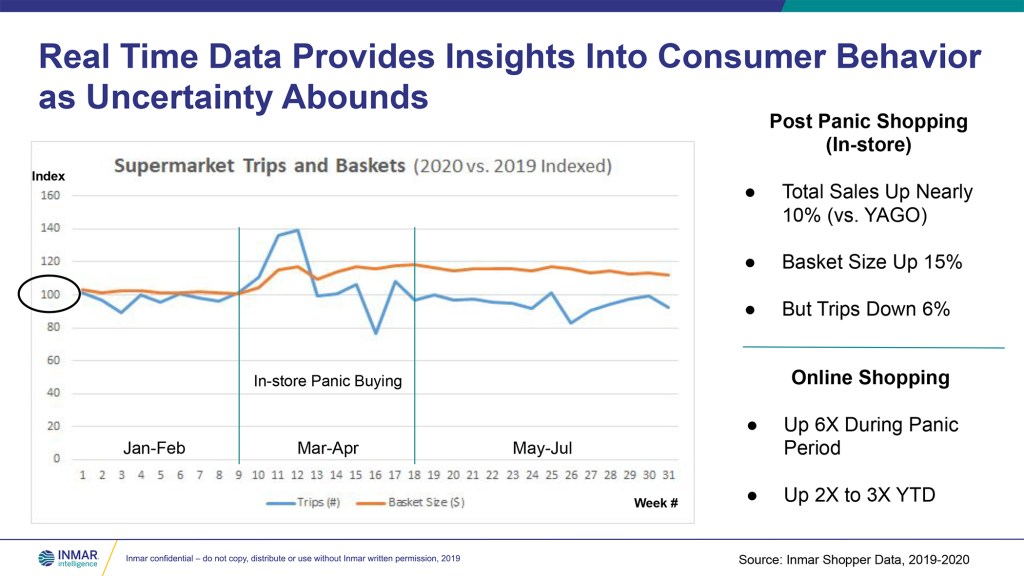
‘Real time’ consumer shopping data during the pandemic was also shared by David Mounts of InMar Analytics during the recent ‘open mic’ call. Slide from presentation

Inmar’s analytics show consumer behavior has changed to fewer trips to the store, buying more at each trip with total retail sales up 10% over year ago and some dairy categories up by more than that. Retail sales of fluid milk have settled in at 4 to 5% over year ago and butter up 46%, for example.

Total supermarket baskets are up 15% per trip, and the number of trips are down 6% right through end of July, “so this is real time data,” said Mounts.

Online shopping spiked 6 times higher than year ago in March and is up 2 to 3 times over year ago for the year to date.

Mounts said the number of people who have registered to be online grocery shoppers is increasing at rates of 100%, with the majority seeking value and savings as priorities.

“Consumers are also thinking about in-home health and wellness, ways to boost immunity and stay healthy,” said Mounts.

“Dairy is such a positive for consumers in retail. It is a core part of strong at-home food sales,” Mounts observed. “Dairy is an anchor for at-home meal planning and stock-up trips, and its always part of every shopping list.

“That’s where we think the opportunity exists — right now — as consumers shift from list-buying to ‘solutioning,’ and the occasion now is one that requires planning and thoughtfulness to have more value,” he explained.

Meanwhile, as retailers have been transitioning through their supply issues, “they are understanding new in-home categories and assortments to be more dynamic,” he said. They are being more data-driven to be more agile.”

At the same time, he said “manufacturers are focusing on their core — their most productive products — and are streamlining and trimming.”

These trends set the stage for a more centralized, streamlined and globalized dairy supply chain at a time when consumers are showing they want to be more – not less – connected to where their food comes from and to know more about the nutritional benefits.

“Consumers will deal with fewer players,” said Mounts, emphasizing the point that, “The mindset of the consumer, retailer and manufacturer must adapt to set the right priorities.”

Those priorities are being set within the tools of technology. According to Mounts, investment in technology and data tools support the strategic pillars of DMI and its partners, which Gallagher said are geared for dairy to be “viewed as an industry leader setting the gold standard on environment and animal treatment, and fitting into the efficient and healthy lifestyles of consumers.”

Searchable apps for phones, in-home voice activation systems tied to marketing outlets, namely Amazon, these tools “bring consumer preferences and marketing targets together for effective campaigns that demonstrate super strong value to consumers,” Mounts explained. “By connecting data into such platforms, the advantage for advertisers is they see it generate sales.”

But the conversations will change, and the level of personalization will increase in the food sector around the data, according to Mounts. “The digital assets are more efficient, and you talk directly to people you want to speak with and are going where the buying audience is to capture them.”

“That’s where we need to be,” said Gallagher. “This is the information the industry looks to DMI to share and will be used to create partnerships with industry.

“We won’t get the drinker or eater back if we do not do these things,” he asserts. “Farmers are great and we have a great product, but it still requires innovation. Until whole milk is recommended for kids, and even when it is, we still need innovation to get it to the kids in a style that they like.”

Mounts said innovation is a “team sport, and the key to speeding it up is to create the ecosystem, the environment, that inspires others to come in and bring solutions.”

Where dairy farmers are most familiar with the production playing field, Gallagher sees DMI as the entity that expands the dairy supply chain ecosystem to bring in other resources globally. In short, DMI has identified itself as U.S. Dairy’s supply-chain integrator and expander. Gallagher said checkoff partnerships are regional, national and international — along with the industry and National Milk Producers Federation.

“Working together as one is our hope for the future,” Gallagher insisted. “If we do not have that unity, then we are small players in a big marketplace.”

-30-

Better late than never: Dairy industry makes last-minute pitch for whole fat dairy, but….

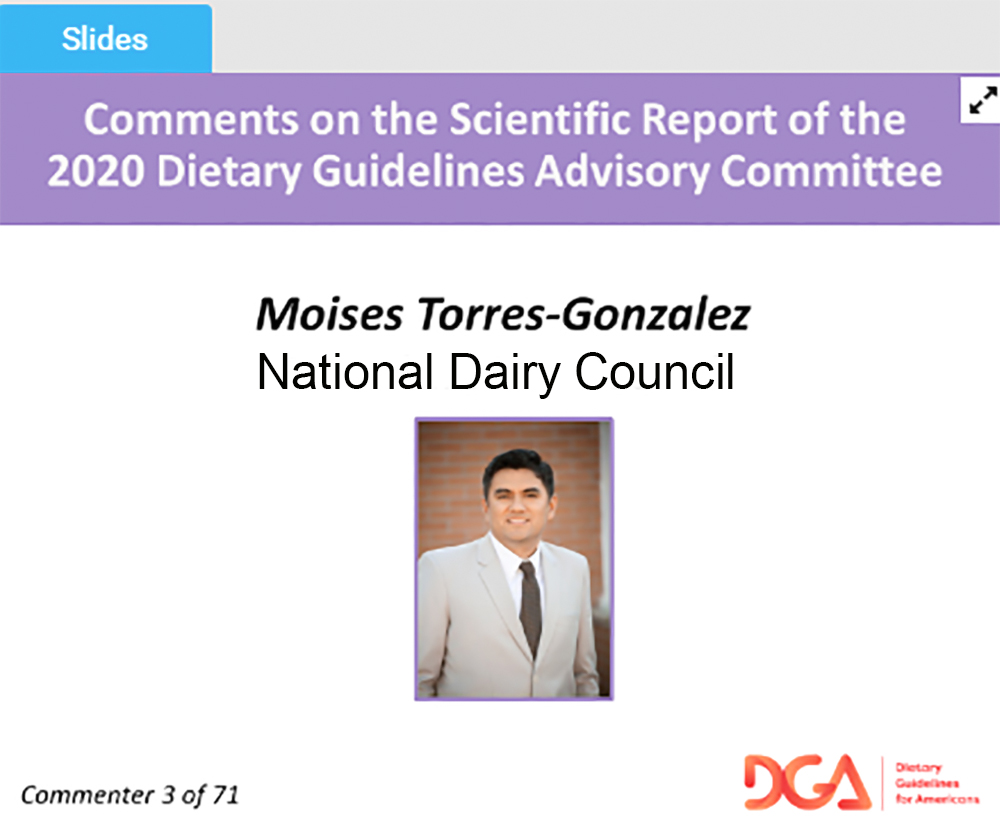
“I have been drinking whole fat dairy since I was a kid. A glass of whole milk was the first thing my mother used to feed me in the morning, and I continue doing so. She was dedicated to nourishing her children,” said Moises Torres-Gonzalez, vice president of nutrition research for National Dairy Council in his oral comment during Tuesday’s webcast hearing on the 2020-25 Dietary Guidelines Advisory Committee Scientific Report. Photo is a webcast screenshot

By Sherry Bunting, Farmshine, August 14, 2020

WASHINGTON, D.C. — The highlight of this week’s webcast oral public comment hearing on the 2020-25 Dietary Guidelines was the last-minute pitch for whole milk by the National Dairy Council, National Milk Producers Federation and International Dairy Foods Association.

All three pointed to the benefits of dairy – regardless of fat percentage – and cited positive research about milkfat. However, they stopped short of asking for a relaxation on saturated fat limits, seeking instead for USDA to “fit” one serving of whole fat dairy into daily guidelines for healthy eating patterns, saying dairy fat is “complex” and “unique.”

Meanwhile, other organizations as well as private citizens asked for a review of the evidence on saturated fats, seeking relaxation of those limits to include more animal foods in the government’s recommended healthy eating patterns.

Interestingly, ADA Northeast was the very first of nearly 80 commenters accepted onto the public hearing style agenda but made no mention of whole milk or full-fat dairy. In fact, ADA Northeast’s oral comment did not mention anything about the Guidelines. Instead, their comment set the stage for future dairy products by focusing exclusively on food insecurity and how fresh milk and dairy products present nutrition-access issues due to refrigeration and transportation.

At the outset of the five-hour webcast, USDA Deputy Under Secretary for Food Nutrition and Consumer Services, Brandon Lipps, said the DGA Committee’s Scientific Report is the first step in developing the official Guidelines. His department “co-develops” the Guidelines with the Committee and with Health and Human Services Office of Disease Prevention.

Lipps described their work as being focused on ending both hunger and obesity through guidelines administered via programs like WIC, SNAP and school lunches.

He thanked the DGA Committee for their “16 months of robust, rigorous and thorough review of the science,” and he noted the public comments numbered over 62,000 throughout those 16 months — a 6000% increase compared with the 970 comments received in the 2015-20 DGA cycle.

When the DGA Scientific Report was published July 15 online, there were 10,000 downloads of the document within the first four hours. The final public comment period underway until August 13 already has thousands of comments in this final phase, according to Lipps, who said public participation was “a key part of the process,” with “increased transparency and new steps for public involvement from the beginning.”

“The Dietary Guidelines are the cornerstone of all federal nutrition policy, including WIC, school lunch and breakfast, SNAP and our food distribution programs,” said Lipps. “We take our work on these Guidelines very seriously.”

A new communications page will be developed for this next and final phase of the 2020-25 Dietary Guidelines process as USDA and HHS pick up the reins.

Also offering eye-opening comments from USDA was Dr. Scott Hutchinson, Deputy Under Secretary for USDA Research, Education and Economics. This mission area of USDA is comprised of the Ag Research Service, Economic Research Service, National Ag Statistics Service and the National Institute of Food and Agriculture.

He mentioned the current pandemic exposing the urgency of improving the nutrition of Americans because obesity and diabetes are co-morbidities with Coronavirus.  

Hutchinson referenced a recent USDA “core component food and nutrition report” that focuses on reducing obesity and diabetes.

He said USDA research is moving toward a “personalized approach to nutrition from a genetic perspective.”

This comment confirms the direction of the federal government through USDA, FDA and HHS in the ‘designer’ or ‘digital’ food frontier, and he said the most important work will be how to “translate” Dietary Guidelines to the public.

“We as humans have the unique ability to choose our dietary path based on our values,” said Hutchinson. “These Guidelines are important so we can make sure all Americans have the opportunity to choose a dietary path with knowledge.”

During the comments presented by 78 members of the public, most representing organizations, the battle lines were clearly drawn between those wanting to reduce consumption of protein, fat and animal foods and those wanting to see healthy eating patterns that include more of the science on dietary animal fat and protein.

Several presenters noted simply that the Guidelines process is not up to par as the number of Americans with chronic health conditions, including diabetes and obesity, has grown to a substantial majority since the 1980s when the DGA process began.

Representing checkoff-funded National Dairy Council was scientific Moises Torres-Gonzalez, vice president of nutrition research. He thanked the Committee for continuing to recommend the consumption of dairy foods at all life stages, for the nutrients of concern they deliver. But he also observed that the Report mentions how limits on fat could depend on the fatty acid profile of the food.

“I have been drinking whole fat dairy since I was a kid,” he said. “A glass of whole milk was the first thing my mother used to feed me in the morning, and I continue doing so. She was dedicated to nourishing her children.”

Specifically, Torres-Gonzalez, representing National Dairy Council, asked for Guidelines that allow one daily serving of whole fat dairy (as part of the 3-a-day dairy), stating that this can still fit within the DGA Committee’s calories and saturated fat limits.

As a scientist, he said, “emerging evidence indicates that consuming whole dairy fat in a healthy eating pattern is not negatively linked to cardiovascular disease, diabetes or weight gain.”

In fact, the research shows beneficial associations for dairy fat in managing or preventing chronic health conditions, he said.

Torres-Gonzalez explained that dairy fat is the most complex fat occurring in a food, and that this complexity might help explain the neutral to beneficial findings regarding milk fat. He confirmed that NDC’s written comment showcases the body of research on this topic.

“Allowing the option to offer both whole and reduced-fat dairy foods in healthy eating patterns would give Americans more chance to meet the nutrient recommendations, which most Americans are not going to meet. The health effect can rely on absorption,” he said. “Dairy foods – regardless of fat levels – are an important source of nutrients in the American diet, and whole fat (3.25%) and reduced-fat (2%) milk can fit within the calorie package of a healthy eating pattern.”

For its part, dairy checkoff-funded American Dairy Association Northeast focused their comments completely on food insecurity and accessibility.

LaChell Miller, nutrition specialist for ADA Northeast, kicked things off by highlighting the dairy checkoff’s 2012 partnership with Feeding America, and the refrigeration, distribution and transportation challenges fresh dairy foods pose for hunger relief organizations.

While offering no comments on the nutritional role of dairy, or the benefits of whole milk in a healthy eating pattern, Miller’s entire statement on behalf of ADA Northeast was about the concern that Dietary Guidelines are often not achievable for all Americans because fresh milk and dairy are hard to distribute.

“Keep food access in mind as you develop these guidelines for 2020-25,” she said.

Representing the nation’s milk cooperatives, National Milk Producers Federation (NMPF) applauded the DGA Committee for maintaining low-fat and non-fat dairy in meal patterns and maintaining dairy as an essential food group. NMPF’s comment also noted that, “The Committee fell short in recognizing the newer science on the matrix of fat in dairy foods. NMPF urged the USDA to review the scientific literature, and just last week, pushed out an online method for using their talking points to comment on the Dietary Guidelines docket.

National Milk joined ADA Northeast in highlighting the concern about food insecurity and access to healthy, affordable food, stating that “dairy foods are the most nutrient-rich and budget-friendly source of essential nutrition.”

While not making it onto the restricted number of “oral commenters” permitted on the Aug. 11 USDA / HHS hearing agenda, the Grassroots PA Dairy Advisory Committee and 97 Milk LLC have gathered comments from hundreds of people along with the 25,000+ Whole Milk in Schools Petition signatures. They posted an 1,125-page packet to the Federal Register Docket by the August 13, 2020 deadline. These two Whole Milk 97% Fat Free education and advocacy efforts have been commenting and pushing forward the petition at every interval over the past 16 months of the Dietary Guidelines Advisory Committee process, including sending letters to members of Congress in leadership positions as well as the Secretaries of USDA and HHS, and issuing calls to action on social media for others to do the same.

To be continued

-30-

WHOLE Milk gets results too important to ignore!

By Sherry Bunting, Republished from Farmshine, Friday, August 7, 2020

BROWNSTOWN, Pa. —  One school in Pennsylvania had the courage to just do it.

For the 2019-20 school year beginning in September, they conducted a trial that simply offered the choice of whole milk and 2% next to the required fat-free and 1% to middle and high school students daily for breakfast and lunch. They did not promote the trial or call attention to it, just waited to see how students would react and what their responses would be.

The results are too important to ignore!

Within a short time of expanding the milk choices last September, students were choosing whole milk 3 to 1 over low-fat milk.

In January, four months into the trial, they found that allowing students to choose from all varieties of milk fat levels increased overall milk consumption by 50% and reduced milk waste by 95%.

Just before schools closed in March due to the pandemic, students were surveyed to learn what they had to say about their milk consumption behavior. Here’s a sampling: 60% said they had thrown away milk in the past before the trial, but only 31% said they had thrown away milk AFTER the whole milk trial.

Only half the students said they were aware of the restrictions on what type of milk could be offered at school.

Incredibly, the percentage of teens at this school who said they were choosing milk at breakfast before the trial was 67%, after expanding milk choices to include whole milk, 80% were choosing milk at breakfast.

All of this data and more in just seven months at a middle school and high school in Pennsylvania. We are withholding the name of the district and its foodservice director to shield their identity from potential backlash due to the USDA rules on fat content of purchased ala-carte “competing” beverages.

The foodservice director who set up the trial, with the support of the school board, states that students have now tasted the difference. Now that the school is using the intermediate unit as the vendor for packaged pickup meals and can only make 1% milk available, the kids are asking: “Where’s the Whole milk?”

“I am 100% convinced that most parents do not know about all that is going on with the school meals programs,” the Pennsylvania school foodservice director said. She is letting them know about the Dietary Guidelines and school nutrition rules so they can become aware and perhaps be led to be involved.

The official public comment period on the 2020-25 Dietary Guidelines Advisory Committee’s Scientific Report has ended. USDA and HHS are using the DGA Report to finalize the next five years of Dietary Guidelines.

To bring the choice of whole milk back to schools, contact your representatives in Congress to cosponsor House Bill 832 Whole Milk for Healthy Kids and Senate Bill 1810 Milk in Lunches for Kids. Also, contact school boards and other governmental and non governmental organizations and ask them to consider adopting resolutions in support of this choice.

Learn more about how to take action at this link. A sample board resolution is on the second page. Schools that adopt resolutions should email 97wholemilk@gmail.com to be added to the list and also let their Congressional delegations in Washington know they support HR 832 and S. 1810. https://www.97milk.com/wp-content/uploads/TakeAction_092820.pdf

-30-

DMI circles wagons around new ‘Net-Zero’ hire

By Sherry Bunting, Farmshine, Friday, August 7, 2020

BROWNSTOWN, Pa. – After last week’s Farmshine cover story, dairy producers across the country have been reaching out to DMI board members and staff seeking answers to questions posed about the Net Zero Initiative, direction of sustainability goals, and the newly hired Executive Director of Dairy Scale for Good, Caleb Harper. He was tapped in May to lead the effort to ‘scale up’ technologies for “U.S. Dairy” to meet its commitment, despite his history of involvement in cellular agriculture and other concerns.

DMI has not yet responded to the questions posed by Farmshine. However, producers are getting some responses. During Wednesday’s “open mic” call with DMI CEO Tom Gallagher, the topic was addressed at the top of the hour to indicate a future “open mic” would be devoted to this topic.

“We’ve been getting questions,” said DMI chairwoman Marilyn Hershey as she opened the call Wednesday. She referred the 350 people on the line — including 50 board members, 80 dairy farmers, along with media and staff — to her blog post at usdairy.com.

“The Net Zero Initiative has pathways for all size farms to be able to stand behind our sustainability goals,” she said.

“Our next ‘open mic’ will focus on sustainability because there is a lot going on in that arena. There is misinformation and good information, and we want to get the details and have National Milk and Newtrient — a company of dairy co-ops and people from the Innovation Center — on where we are going and why,” said Gallagher.

“The industry is focused on being net-zero, but profitable net-zero. That is something that will take time and hard work to get to. We are focused on all size farms — not just large, medium, or small — and on all regions,” he stated. “We know each region has different challenges.

“Most of the small farms are probably net-zero already,” he said.

Gallagher explained that DMI recently added several people in different parts of the organization. “One (new person) is Caleb Harper, and we are really glad to be able to attract him,” said Gallagher.

“We know Caleb is completely a dairy guy. Let’s face it,” said Gallagher. “Cell ag and other competitors are getting well-funded. Caleb is a smart guy, a guy who is pro dairy. He understands the playbook of the other team, so we are miles ahead.”

In the blog post callers were asked to read for answers, Hershey writes: “Caleb Harper joined our team in May to lead Dairy Scale for Good. Caleb is a former principal research scientist at Massachusetts Institute of Technology (MIT) and director of the Open Agriculture Initiative at the MIT Media Lab. He has a tremendous background of leading engineers, scientists and educators in the exploration and development of future food systems and technology.”

Hershey goes on to describe his responsibilities as “directing best practice and technology adoption and implementation on a handful of pilot farms. Harper will also develop third-party strategies to generate investments, partners and technologies that will keep farmers from bearing the entire commitment of this endeavor.”

Harper has already been visiting dairy farms in the Southwest and Upper Midwest after his first-ever dairy farm visit to Fair Oaks Farm.

Both in the blog post, and in other responses made in writing to producers from DMI staff, Harper is described as “coming from a family that raises horses and goats on a small ranch in Texas and crops and cows on a fifth-generation homestead in Kansas.”

What isn’t mentioned is that, according to a Sept. 2019  Chronicles of Higher Education story, Harper’s father, Steve Harper, was a grocery executive, actually Senior Vice-President of Marketing and Fresh Product Development, Procurement and Merchandising from 1993 to 2010 for the H-E-B supermarket chain in Texas and northern Mexico, among the largest supermarket chains in the U.S. in sales. He stayed on part-time through 2012 before retiring in 2015.

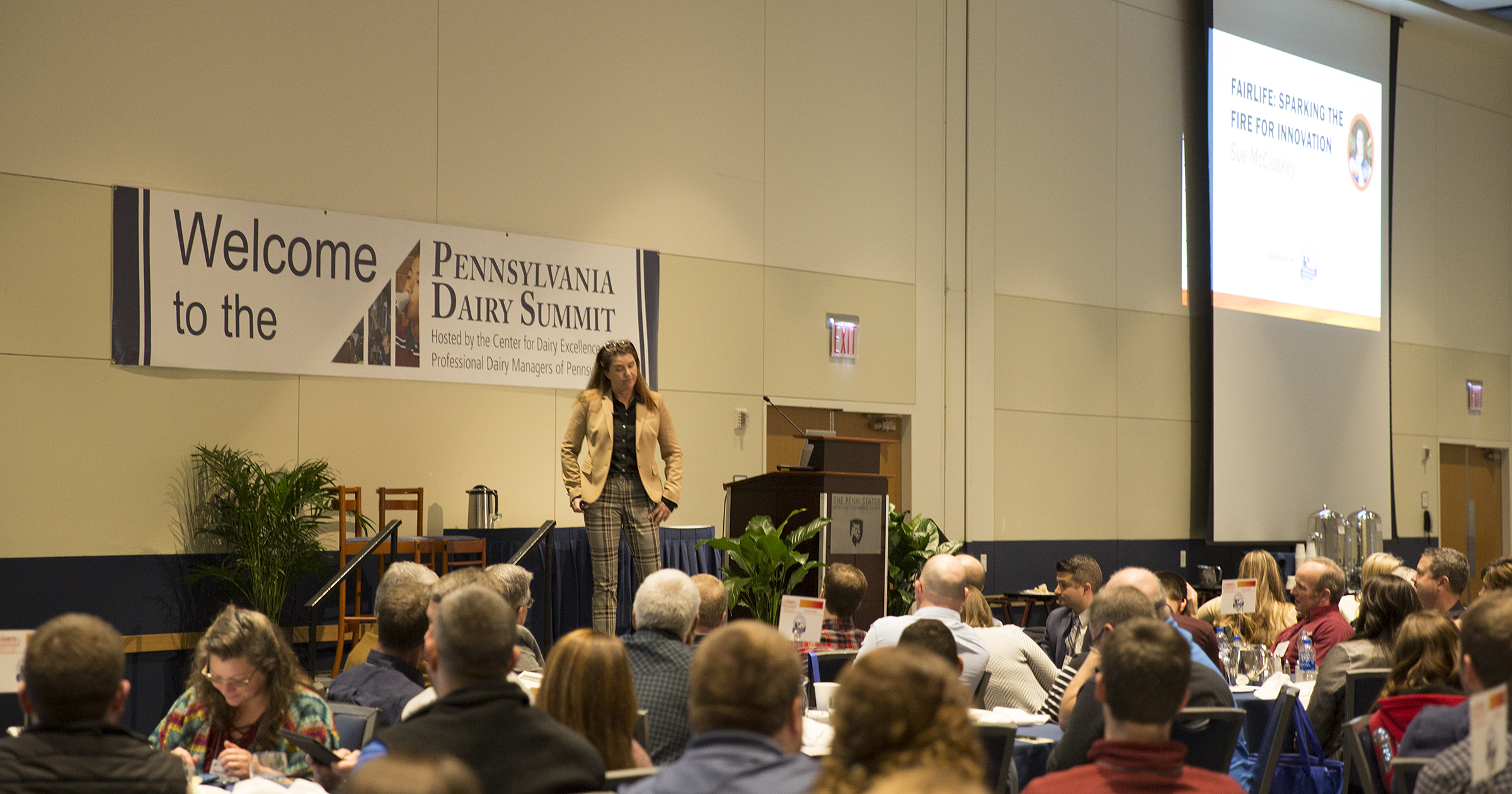
H-E-B was the first and longstanding partner of Mike and Sue McCloskey, when they were dairying in New Mexico and founded Select Milk Producers. They were working to get closer to the consumer, and the H-E-B alliance was instrumental, Sue explained in her presentation at the Pennsylvania Dairy Summit in February 2020, where she painted a picture of dairy’s future as seen by DMI’s Innovation Center for U.S. Dairy, and its food industry partners.

In fact, according to the Houston Chronicle, the McCloskeys worked with H-E-B, supplying their milk and in 1996 to produce Mootopia ultrafiltered milk, an H-E-B brand. This was the pre-cursor to fairlife, the ultrafiltered milk beverage line in which DMI partnered with the McCloskeys, Select, and Coca Cola to market and R&D. (On Jan. 3, 2020, the Coca-Cola Company announced it was sole owner of fairlife LLC after acquiring the remaining stake from its joint venture partner Select Milk Producers.)

Both Caleb Harper and Mike McCloskey currently serve on WWF’s “Markets Institute” Thought Leadership Group.

Hershey writes of Caleb Harper’s involvement in several non-profit organizations, including World Wildlife Fund (WWF), World Economic Forum, as an explorer for National Geographic, and at New Harvest (www.new-harvest.org), a cellular agriculture research institute, which has provided research funding to such startups as Perfect Day.

Meanwhile WWF — the DMI sustainability partner — will stop at nothing in its quest for food transformation away from animal use. WWF is currently using the Coronavirus pandemic and “threat of zoonotic diseases jumping from animals to humans” as the angle for pushing food transformation, with a “stop the next pandemic” campaign at the WWF website stating: “The conversion of land for unsustainable agricultural and livestock use drives wildlife, domestic animals, and humans in closer contact.”

Both New Harvest and WWF support and advocate for rewilding of lands as farms and ranches fold under the pressure of low prices, rapid consolidation, misinformation used to position new plant-based and cellular ag products as future of food replacements for meat, eggs and dairy, using climate change, sustainability and now pandemic fears to prepare people to accept these bio-engineered versions grown in fermentation vats and bio-reactors instead of farms and ranches.

“While (New Harvest) goes against the essence of who we are as farmers, and Caleb no longer serves on its board, his knowledge and insights in this area will be an asset,” writes Hershey. “I am very excited about Caleb’s ability to open new doors for dairy. He brings an astounding depth of relationships with other scientists, organizations and companies.”

New Harvest is more than a “cellular agriculture research institute.” It’s mission is to replace cattle and other livestock by growing portions of animals, separating protein excrement from yeast, and other ‘genetically altered and digitized” methods of displacing farmers and ranchers from the land. In 2017 and 2018, Harper was one of five board members for New Harvest. In fact, though canceled due to Covid, the New Harvest 2020 Conference was scheduled for the M.I.T. Lab in Cambridge, Mass., where Harper was a lead researcher until April 30, 2020.

In her blog post, Hershey writes that, “Earlier this year, the Innovation Center for U.S. Dairy set new environmental stewardship goals to further the progress and commitment that dairy farmers and the broader dairy community have to responsible production.”

She describes it as a “collective effort” expected to benefit all farms with a pathway for farms to voluntarily contribute. She writes that it will not be mandatory. Instead, she notes that it will provide opportunities for farms of all sizes to adopt technologies and practices and create revenue streams.

Stay tuned.

-30-

Fair Oaks, fairlife co-founder paints picture of dairy’s future as seen by partner DMI

Summit_McCloskey3096

By Sherry Bunting, Farmshine, February 14, 2020

STATE COLLEGE, Pa. — The big question Sue McCloskey gets about fairlife is “How did you think of it?”

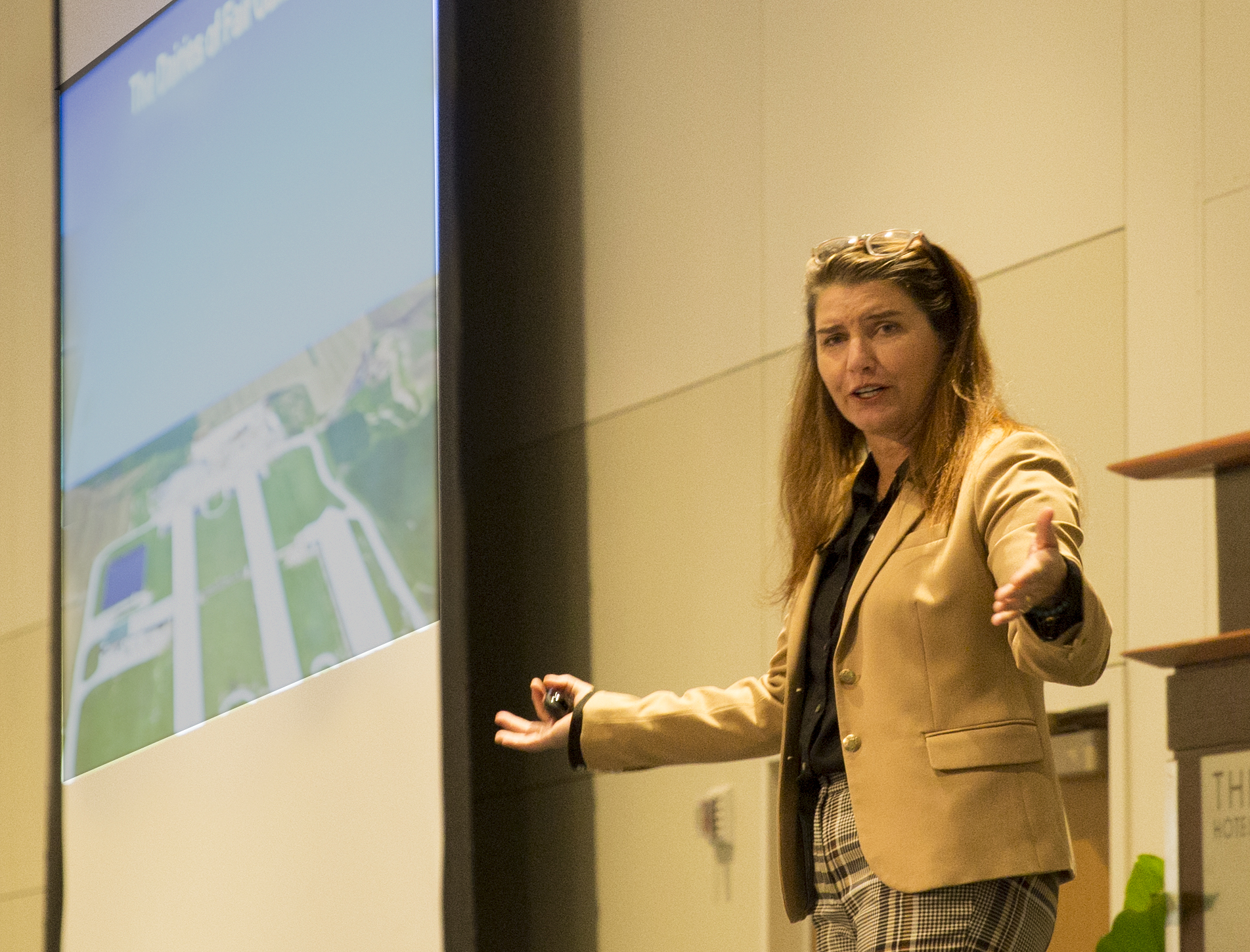
As co-founder with her husband Mike of Select Milk Producers, Fair Oaks Farms and the fairlife brand, McCloskey spoke about “the spark of innovation” to a crowd of over 500 at the 2020 Pennsylvania Dairy Summit in State College last Thursday, Feb. 6. She was among the featured speakers that were sponsored by ADA Northeast.

“We are all innovators in agriculture,” said McCloskey, telling how they learned of reverse osmosis when a well on their New Mexico dairy backed up 25 years ago, and RO membranes were used to separate solids to restore water quality. That experience introduced them to the concept of filtering solids by molecular size, but her larger message was about the concept of innovation in allowing companies to differentiate in a generic category like milk.

For example, she said, who would think, years ago, that water would become the multi-billion-dollar industry that it is today? And coffee? She cited Starbucks as a catalyst for the rise of coffee houses and coffee drinks and blends today.

As in these examples, someone was the first innovator to bring value to those generic categories. She said for milk, the parallel is fairlife.

“Innovation – thinking outside the box — that’s what grabs people,” she said.

McCloskey maintains that as consumers, “We are all waiting for the next new thing. We want more. We want new. That’s where we have seen success with fairlife.”

The journey

McCloskey talked about her husband’s journey from being a dairy veterinarian to a dairy producer and innovator. They started with 300 cows in California and a partner they still have today in Tim DenDulk. One by one they bought dairies, fixed them up and rolled them over.

Once they got to New Mexico with a 3000-cow dairy, that was the real beginning of it, she said. That’s where they founded Select Milk Producers 25 years ago, which is today the sixth largest cooperative on a milk volume basis with 99 members.

They formed to focus on high quality milk with low somatic cell counts and to sell that concept direct to retailers instead of being part of a co-op that commingled their milk to blend-down the somatic cell counts. That’s where they were introduced, she says, to the concept of what has become fairlife through the use of RO membranes to ultrafilter the milk. She explained that the milk going in must be very low in somatic cell counts because the process of ultrafiltration concentrates the solids – including somatic cells.

She pointed to the “incredible success” of building different plants and beginning to build the fairlife brand, which led them to their next opportunity in the Midwest – Fair Oaks Farms.

When the McCloskeys came to Indiana, DenDulk, their original partner in California, was already in Michigan.

McCloskey said the housing technology had developed by that time to where they felt they could do larger dairies in the Midwest climate. They built the first of the original four 2800-cow dairies in 1999. Today, there are 13 separate dairies totaling over 36,000 cows that are owned and managed by a few families on the roughly 30,000 acres, including the new 800-cow robotic dairy that opened at the end of 2019.

In fact, she spent part of her time talking about the innovations coming out of Fair Oaks to recycle and recover nutrients and to address greenhouse gas emissions to improve the “sustainability” and carbon footprint of dairy.

“There are cool things happening and things we are doing that we really need to embrace,” she said.

Summit_McCloskey3106

(Sue’s husband Mike, who spoke in March at the PDPW virtual business conference on U.S. Dairy’s goals for GHG emissions, was the first chairman of the Sustainability Initiative when it was launched under DMI’s Innovation Center for U.S. Dairy in 2009-10, and the checkoff’s research and development and marketing assistance for fairlife and Fair Oaks came from DMI through the Innovation Center where such partnerships are born.)

The process

Establishing fluid milk supply relationships with large retailers like H-E-B and Kroger, McCloskey said they have worked over two decades to move closer to consumers as they began using RO and ultrafiltration as early as 1995 to reduce the water moving loads of milk to cheese plants, while at the same time beginning the high protein, low sugar milk proposition partnering with H-E-B in Mootopia in 1996, before what is fairlife today.

They saw other protein drinks in the market they could compete with – by concentrating the protein in milk.

So began the process of building the brand from coast to coast as new products have been added continually. While most people are familiar with fairlife ultrafiltered milk, the CorePower fitness recovery drink was among the first that was created as a competitor for Muscle Milk.

Today, there are flavored Yup drinks, snack drinks that pair ultrafiltered milk with oats and honey, new coffee creamers, and a full line of weight management and healthy lifestyle products that are just emerging under the fairlife brand.

While Select Milk Producers sold its remaining half-interest in fairlife to its early partner Coca-Cola a few weeks ago, McCloskey remains a spokesperson for the brand. Also, the research and development teams remain intact and are still located in Chicago.

The spotlight

What Coca-Cola did for fairlife, said McCloskey, is to provide a nationwide distribution network that the Select co-op could not have achieved on its own.

“The hardest thing in consumer goods is to get a product in front of the people who want to buy it,” said McCloskey. “Our challenge was distribution. So, we formed a partnership with Coca-Cola. With Coca-Cola as 100% owner of fairlife, what happens now is that they are just going to run with it.”

This means that, “Milk is in the spotlight. While we hear the bad news from Dean’s and Borden, the good news is that the Coca-Cola, a top-five company, is involved in milk,” said McCloskey.

With an ultrafiltration plant producing fairlife in Michigan, she explained that the east coast and midwestern markets could be served and that the new Select plant in Arizona will serve the west coast market. A plant is also being built in Canada.

Answering a question about whether fairlife, or this direction of milk innovation, would ever “play ball” with the smaller average size farms in Pennsylvania, she replied that any milk supply for fairlife must be very low in somatic cell counts and will have to meet with flying colors all of the new levels of audits and animal welfare requirements that Select Milk Producers and Coca-Cola have implemented since the undercover animal abuse video at McCloskey’s original farm at Fair Oaks this past summer.

When asked how producers are compensated for these additional measures, she did not disclose proprietary information about how producers are paid.

The proposition

She said the fairlife story shows “there is still room for investment and innovation in milk, innovation that makes milk relevant to consumers.”

McCloskey explained how the ultrafiltration process raises the protein and calcium levels, removes the lactose and reduces the natural sugars in milk without adding anything.

Summit_McCloskey3121

“And it is still real milk… but better,” she says, explaining that fairlife is finding “amazing growth in differentiation,” that fairlife’s entire proposition to consumers is the concept of  “believe in better.”

“Our core tenets of the master brand are better taste, better nutrition, and better values,” she said.

“The brand is created around values, and these values are not new, but they are done in a way that is a little more creative to today’s consumers.”

She explained that Select Milk Producers sends milk that goes into a jug at Krogers and sends milk to fairlife, “but it’s the innovation and sharing the values that leads to growth.”

Sharing consumer surveys showing 90% of fairlife consumers are satisfied and 69% are repeat customers, McCloskey said this growth and innovation “mean bigger things for dairy than just fairlife.”

She said that 45% of the fairlife market share is coming from within the milk category and 55% of their consumers are coming over from outside of the milk category.

While fairlife’s ultrafiltration process is patented, McCloskey said a dozen new products have come on the market since fairlife that use similar technology or other means of delivering high protein, low sugar outcomes.

This allows these products to differentiate themselves next to the gallon of milk as a generic staple, she explained.

“If someone is on food stamps and can’t afford these new products, that’s okay,” McCloskey said. “They can buy milk. People will still buy milk.”

Summit_McCloskey3130 (2)

The next phase

McCloskey stressed the “tremendous value checkoff organizations bring to dairy farmers to promote how to innovate dairy and make it better.”

She explained the next phase, how DMI is sitting down with young urban-suburban consumers to “learn how they make food choices, to learn what they look for. This is leading us into sustainability and carbon footprint,” said McCloskey.

“We also sit down with the different NGO’s (like World Wildlife Fund for example). We all sit at the table and talk about the challenges that face dairy farmers,” said McCloskey. “The Net Zero Initiative coming out of that is one of the coolest things, and we are a collaborator on what is needed for dairy to get to net zero. It’s a big stake in the ground, but it’s got to be the place where we need to go.”

She explained the Net Zero Initiative under DMI’s Innovation Center for U.S. Dairy has a catalog of technologies to help producers deal with environmental issues.

“What if 37,000 dairy farmers could have net zero greenhouse gas emissions? This is what we have to chase,” she said. “The innovation can’t stop. The whole genome of the dairy cow has been mapped. Manure can be fractionated. There is innovation that is so exciting for us to think about what dairy can look like in the future.”

The forward-looking picture McCloskey painted for Summit attendees includes even more fractionization and extraction of milk’s elements, more use of specialized GMO crops and more consolidation of farms and processors with fewer cows producing more milk to meet new sustainability benchmarks.

McCloskey said the innovation from fluid milk to cheese to fractionating protein into “all kinds of other products” — while reducing the overall dairy carbon footprint — is the road to 2050.

Summit_McCloskey3132

The ‘perfect laboratory’

“We have only begun to know milk’s power and the different vitamins and elements we are just discovering how to use and extract,” she said.

“And it all happens in nature’s perfect laboratory – the dairy cow.”

On the flip side, McCloskey acknowledged that DMI has also learned consumer choices come back to this bottom line:

“It’s got to taste good and it’s got to do something for me,” she noted. “This is why dairy is not going away. Dairy is real and it tastes great and it makes you feel good.”

-30-

Deep discounts on All-Milk prices bring new risk management challenges

NOTE: In the first part of this three-part series, we’ll look at some of the factors contributing to the huge divergence between Class III and IV at the root of current losses in milk income, especially for risk-managers who were caught off guard with no good tools to manage the misalignment and especially the de-pooling. In the next two parts, we’ll look at some of the advice for managing basis risk in CME-based tools and revenue insurance.

IMG-9043

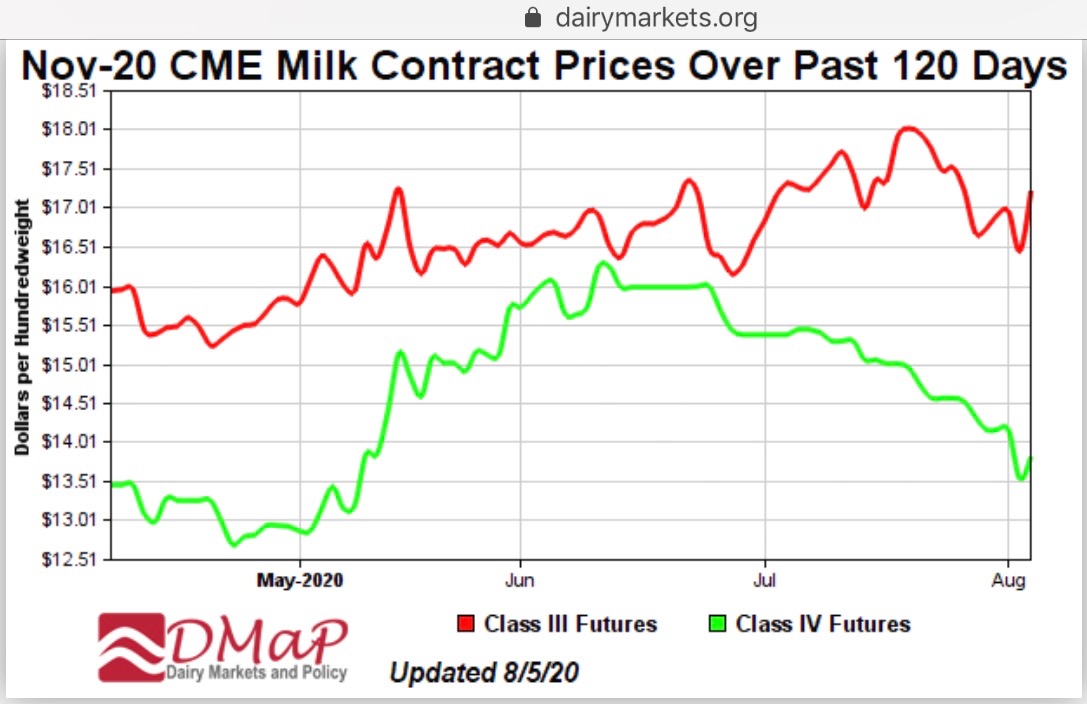
This graph at dairymarkets.org shows the divergence between Class III and IV milk futures at the root of deep discounts in All-Milk prices as compared with Class III.

By Sherry Bunting, Farmshine, Friday, August 7, 2020

BROWNSTOWN, Pa. — Dairy producers find themselves in uncharted territory, where a mixed bag of market factors, pricing structures, class price misalignments, Federal Milk Marketing Order (FMMO) provisions, product-in / product-out flows via imports and exports vs. inventory, as well as the government’s thumbprint on the scales in a pandemic shutdown of the economy and the dairy product purchases that followed. All have affected Class III and Class IV milk prices quite differently, creating deep discounts in blended farm milk prices vs. Class III.

“We’re seeing milk class wars,” said economist Dan Basse of AgResource Company, a domestic and international agricultural research firm located in Chicago, during a PDPW Dairy Signal webinar recently. Basse opined that the current four-class FMMO system is old and outdated with pitfalls creating new volatility issues for producers in the form of the $7 to $10 spread between Class III and Class IV in June / July.

He noted, as have others in the past, that a simpler pricing system with one manufacturing milk price and one fluid milk price is something that “dairy farmers could live within.”

Under the current four-class system, and the new way of calculating the Class I Mover via averaging, dairy farmers now find themselves “living on the edge, not knowing what the PPD (Producer Price Differential) will be,” said Basse.

“A $7.00 per hundredweight discount is a lot of capital, a lot of income and a lot of margin to lose with no way to hedge for it, no way to protect it, when the losses are not being made up at home (as reflected in) the PPD,” Basse related.

Previous Farmshine articles over the past few weeks have explained some of the FMMO factors reflected in the negative PPDs everyone is focused on because they are so large. While June’s PPD was primarily affected by lag-time, the next several months of negative PPDs are likely to occur based on the legislated change to the Class I Mover calculation in the last Farm Bill.

The significance of the PPD is that it indicates to the producer the value of the milk in FMMO-available pool dollars as compared to the announced Class III price. The PPD is how the FMMO pool revenue is balanced.

Normally, component values are paid by class, and the extra is divided by hundredweights in the pool to calculate a PPD reflected as the difference (usually positive) between the FMMO uniform price and the Class III price, according to Dr. Mark Stephenson, University of Wisconsin dairy economist in a recent PDPW Dairy Signal.

When higher-value Class III milk is de-pooled in this scenario, the dollars don’t stretch, so the pool has to be balanced by dividing the loss (negative PPD). Even in the southern FMMOs based on fat/skim the same shortfall occurs and shows up as milk being worth less than Class III, instead of more.

The problem faced right now is the Class III price does not represent the broader industry, and there are no straightforward tools for managing this type of risk, especially when the higher-value Class III milk is de-pooled or replaced with a lower class.

“It’s a terrible situation on the hedging side, with three material sources of the problem,” notes Bill Curley of Blimling and Associates in a Farmshine interview this week.

While he describes ways to manage some of these sources in building a risk management price or margin, such as using a mix of Class III and IV and other strategies that reflect a producer’s milk market blend of classes, “there’s no hedge for de-pooling,” he relates.

In fact, Stephenson illustrates this for the Upper Midwest FMMO 30, showing a difference of $7 between the level of negative PPD for July without de-pooling and the level of negative PPD with de-pooling.

While July de-pooling figures won’t be known until mid-August, the June de-pooling in the Northeast wasn’t as bad as in California, as an example. In California, so much milk is already sold outside the pool, that it is easy to replace virtually all of the Class III milk with lower-value Class IV in this divergent classified price scenario.

In the Upper Midwest, only so much de-pooling can occur due to qualifying criteria, so utilization that may normally be 75% Class III, was 50% in June. They don’t have enough Class IV to simply replace Class III and stay qualified on the Order.

Curley and others explain that this situation could leave producers unprotected, especially since they can’t control any of the sources of misalignment between their All-Milk price and Class III. The only factor they can control is whether or not to drop the hedges, which then leaves them unprotected for market risk at a volatile time in the midst of a pandemic as virus rates are reportedly re-surging.

Meanwhile, this week began with risk working its way back into markets as three consecutive days of steep losses in CME cheese and butter prices pushed both Class III and IV milk futures lower, but still with a $4 to $7 gap between them in the next few months.

For its part in balancing broader industry demand, USDA announced a third round of food box purchases for September and October, which will again include cheese, but this time will include more from Class II (sour cream, yogurt, cream cheese) as well as some butter from Class IV. All told, the government will have spent about $1 billion in three phases of dairy purchases for the Farmers to Families Food Box program.

Stephenson reminds producers of the silver lining in this cloud.

“Remember what the pandemic economy looked like just a little over two months ago,” he said. “It was absolutely devastating. Cheese was at $1.00/lb, and milk dumping was unprecedented.

“Now, as we look at things, it’s going to be better than we expected then,” he said showing the All-Milk price for 2020 is now forecast to come in at just under $18 for the year, but that many farms will net $20 per hundredweight for the year via the combination of Dairy Margin Coverage (DMC) and Coronavirus Food Assistance Program (CFAP) payments.

He estimates 2020 DMC payments at the $9.50 coverage level should net 66 cents across annual production for the year while CFAP payments have produced, so far, an impact equal to $1.55 per hundredweight across annual production.

For many producers, however, it won’t feel like $20. It might not even feel like $18.

Agricultural Prices 07/31/2020

USDA NASS reported June All-Milk prices last Friday, July 31. The range from high to low is $8, nearly double the normal range. At $18.10, the U.S. average All-Milk price did push the Dairy Margin Coverage milk margin above the highest payout level at $9.99.

Take June milk checks for example. USDA announced Friday, July 31 that the June U.S. All-Milk price was $18.10. That’s almost $3 below the Class III price of $21.04 for June, something we just don’t see.

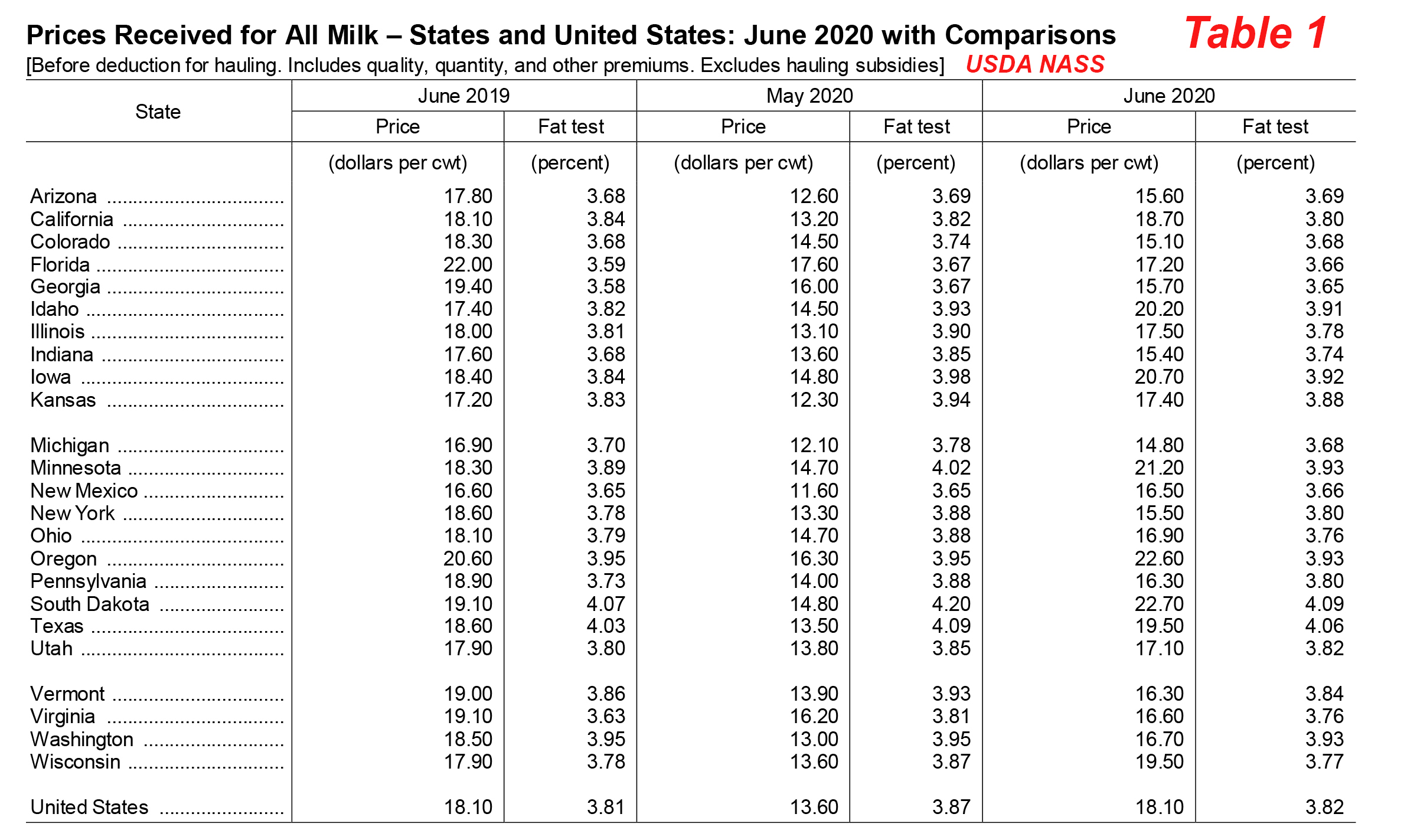
Worse, USDA’s own report showed an $8.00 per hundredweight spread between the lowest All-Milk price reported at $14.80 for Michigan and the highest reported at $22.70 for South Dakota. This unprecedented spread is almost double the normal range from top to bottom. (Table 1)

Also unprecedented is the Pennsylvania All-Milk price reported by USDA for June at $16.30. That’s a whopping $1.80 below the U.S. All-Milk price when normally the state’s All-Milk price is 30 to 60 cents above the U.S. average.

The same thing can be said for Southeast fluid markets and other regions where a mixed products, classes and de-pooling of higher-value milk left coffers lacking for producer payment in the pool, and results varied in how co-ops and handlers  compensated producers outside the pool.

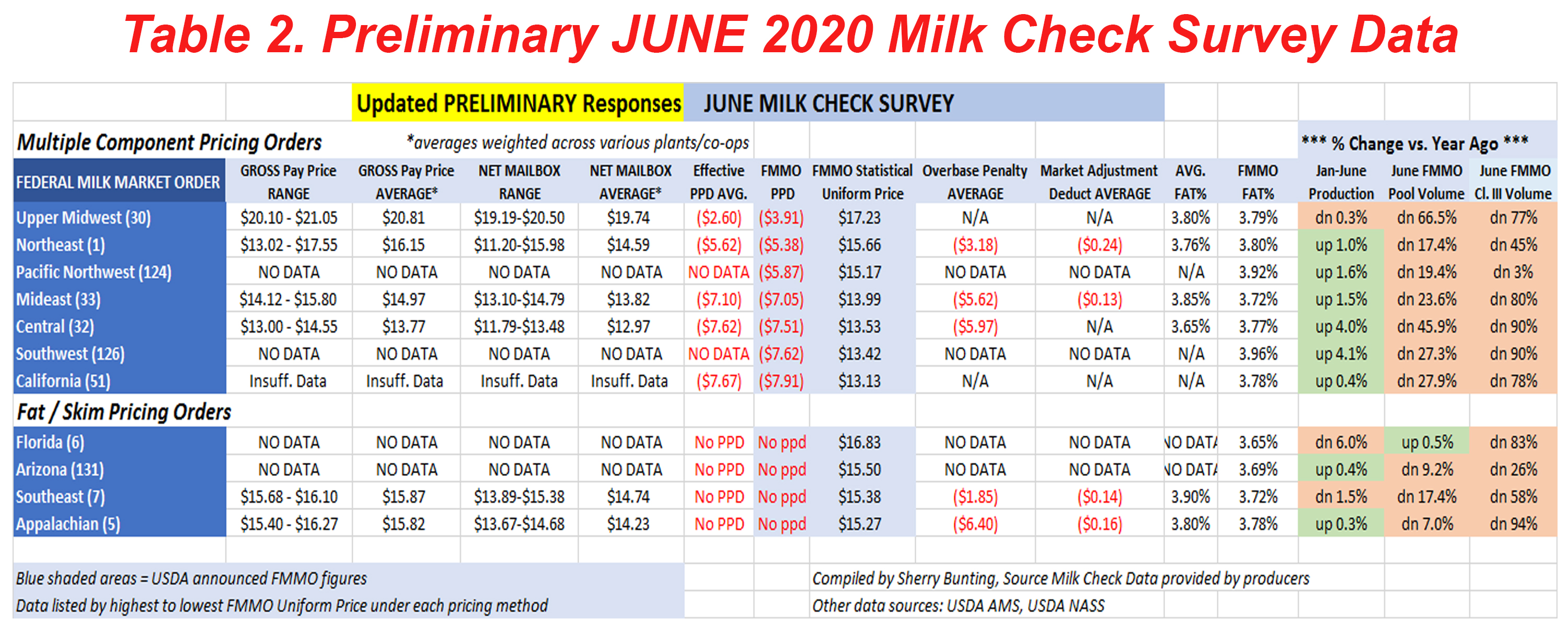
Dairy producers participating in the June milk check survey announced in Farmshine a few weeks ago, have reported gross pay prices that averaged fully $2 below the respective USDA All-Milk prices calculated for their state or region. Net prices, after deductions, averaged $4 below, and the same wide $8 spread from top to bottom averages was seen in this data from over 150 producers across six of the 11 Federal Orders. (Table 2)

This all creates an additional wrinkle in terms of the impact on the DMC margin, which was announced this week at $9.99 for June – 49 cents over the highest coverage level of $9.50 in the DMC program. This margin does not reflect anything close to reality on most farms in June and potentially July.

Large, unexpected and unprotected revenue gap

Normally the All Milk price is higher than Class III, and the cost of managing risk when the market moves higher is then covered by the performance of the cash price, or milk check, instead of the hedge, forward contract or revenue insurance. The inverse relationship in June and July between blend prices and Class III price, left a large, unexpected and unprotected revenue gap.

For its part, USDA AMS Dairy Programs defines the All Milk price in an email response recently as “a measurement of what plants paid the non-members and cooperatives for milk delivered to the plant before deduction for hauling, and this includes quality, quantity and other premiums and is at test. The NASS price should include the amount paid for the ‘not pooled milk.’”

USDA’s response to our query further confirmed that, “The Class III money still exists in the marketplace. It is just that manufacturing handlers are not required to share that money through the regulated pool.”

MilkCheckSurvey080320

By the looks of the milk check data from many areas (Table 2), most of this value was not shared back to producers, with a few notable exceptions. However, economists project the situation for July milk will be worse in this regard.

The factors depressing June and July FMMO uniform prices, USDA All-Milk prices and producer mailbox milk check prices are three-fold: the 6 to 8-week lag-time in advance-pricing of the Class I Mover, the new method of averaging to calculate the Class I Mover, and de-pooling of the higher-value Class III milk. All three factors are rooted in the $7 to $10 divergence between Class III and IV in June and July.

The part of the equation attributed to the new Class I Mover calculation is perhaps most discouraging because this is not money producers will eventually see. On the other hand, the lost value from the advance-pricing lag-time is eventually “caught up” in future milk checks. Most of the discount to come in July farm-level prices and negative PPDs in future months vs. Class III will be from the divergent factors that are not reconciled later.

Demand drivers differ for Class III vs. IV

Driving Class III $7 to $10 above Class IV was the abrupt turnaround in the cheese market, fed by strong retail demand, the resupply of foodservice channels, a significant May rebound in exports of cheese and whey, significant declines in cheese imports in the March through June period, and new government purchases of cheese for immediate distribution under CFAP.

On the flipside, Class IV value weakened at the same time as butter and powder did not have as many competing demand drivers. Additionally, butter stocks were overhanging the market, despite butter being the dairy product that saw the very highest increase in retail demand during the March through June Coronavirus shutdown period with retail butter sales up 46% over year ago.

Butter and powder production in the U.S. are mainly through co-op owned and managed facilities, while cheese production is a mix of co-op, private and mixed plant ownership.

When co-ops petitioned USDA for a temporary Class I floor hearing, most of the pushback came from the Midwest, and there were calls instead for government direct payments and cheese purchases for distribution to bring down what had been a growing cheese inventory. A stabilizer, or “snubber” on the Class I Mover calculation would have helped avoid much of this unrecouped discount on All-Milk price compared with Class III that affected most of the country.

While cheese moved to retail, foodservice, government purchases and export, butter was mainly relying on the surge in retail sales. Butter and milk powder were not draws in government CFAP purchases.

Overall, however, CFAP has not been the biggest driver in the cheese rally, according to Stephenson, although it added another demand driver to the Class III mix.

He notes that while the government CFAP purchases included a lot of cheese, those purchases accounted for 10% of the cheese price rally in June and July. The rest was fueled by retail demand staying strong and restaurants reopening and refilling supply chains, along with strong demand for other dairy products at retail, such as fluid milk. Producers were also pulling back to avoid overbase penalties. These factors combined to reduce cheese production in May and June, while demand drivers reduced inventory vs. demand.

Other dairy products also saw higher retail demand and were included to some degree in the USDA’s CFAP purchases, but without the same level of visible pull for the trade.

Import/export and inventory equation differs for Class III vs. IV

In taking a closer look at imports and exports relative to inventory to gauge differences between the product mix for Class III vs. Class IV, there are some key differences on both sides of that equation.

Exports of cheese in May were up 8%, and whey exports up 16% over year ago, according to U.S. Dairy Export Council.

Meanwhile butter and butterfat exports were down 7% in May, and down 21% below year ago year-to-date.

Powder exports did break records up 24% for May on skim milk powder. Whole milk powder exports were up 83% in May and 44% year-to-date.

On the import side of the equation, cheese imports were down 13% in the March through June period vs. year ago, according to USDA’s Dairy Import License Circular.

Non-cheese imports, on the other hand, were up 37% above year ago at the same time.

One factor hanging over Class IV markets is the butter inventory — up 11% over year ago — despite significant draw-down month-to-month and retail sales volume being almost 50% higher than a year ago throughout the Covid period.

While U.S. dairy imports are dwarfed in volume by U.S. exports, overall, it is notable that the 37% increase in non-cheese imports included 17% more butter and butter substitute imported compared with a year ago during the March through June period and up 28% year-to-date. Furthermore, whole milk powder imports were up by 25% in the March through June period.

Looking ahead

In a dairy market outlook recently, both Stephenson and professor emeritus Bob Cropp said these wide swings that are creating deep discounts are expected to begin moving toward more normal pricing relationships after August, with Class III and IV prices both forecast to be in the $16s by the end of the year, and in the $16s and $17s for 2021.

Already this week, CME cheese has slipped below the $2 mark, pushing August Class III futures under the $20 mark and September into the mid-to-high $16s. Spot butter tumbled to $1.50/lb, pushing Class IV futures down into the low $13s — keeping the divergence between Class III and IV in place.

Experts encourage producers to be thinking more holistically about the milk markets in planning risk management and not to look at Class III as the leading indicator of which direction the market will take.

This makes any discussion of “margin” based on a Class III milk price irrelevant to the reality under the present conditions. In short, risk management tools did what they were designed to do, but new challenges on the cash price, or milk check side, will change how producers implement and use these tools, or blends of tools, in the future.

“Class III might be a wonderful market for cheese, but it’s not reflecting the entire dairy industry. Risk managers are losing margin on contracts that were meant to protect them from market risk,” says Basse.

“We normally trade at an All-Milk premium to the CME Class III. Today, that has changed dramatically,” he adds. “We are at a significant discount to the CME. We just don’t see these discounts relative to the CME. It is unprecedented.”

-30-

New face, new position, ties ‘Undeniably Dairy’ to ‘milk without cows’

NEW HOLLAND 092206

By Sherry Bunting, Farmshine, July 31, 2020

CHICAGO, Ill. – A new face has “joined” Undeniably Dairy with direct ties to the effort to produce milk without cows.

Caleb Harper is the new hire for a new position via Dairy Checkoff. It was created within the DMI Innovation Center for U.S. Dairy’s Net-Zero project. His title as of May 1, 2020 is executive director of Dairy Scale for Good (DS4G).

On April 30, 2020, as reported last week in Farmshine, Harper left his position as the principle researcher at the M.I.T. Media Lab where he spearheaded the Open Agriculture Initiative, described as a “food computer” project. The lab came under scrutiny last fall for certain financial ties.

According to the May 13 New York Times, Harper’s OpenAg project “was quietly closed amid allegations that its results were exaggerated to sponsors and the public, the university confirmed. The Massachusetts Institute of Technology also announced that it would pay a $15,000 fine to the State Department of Environmental Protection because the project… improperly disposed chemicals into a well at a research center outside Boston where it conducted some experiments.”

For dairy farmers, that’s not even the worst of it. Harper has been a prolific writer and speaker touting cellular agriculture – milk, eggs and meat without animals.

Public Disclouser Copy for New Harvest.pdf

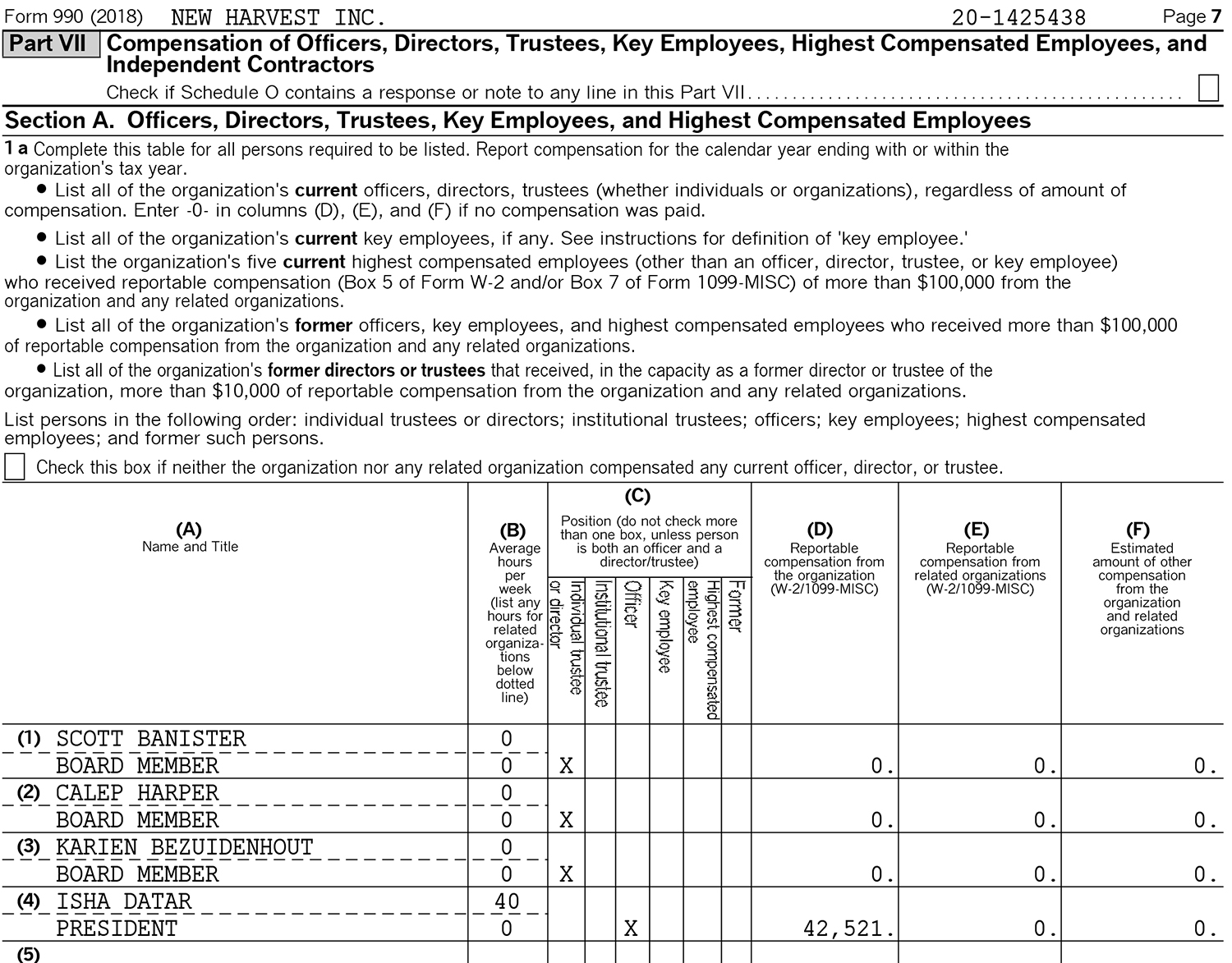
According to the most recent IRS 990s (2017 and 2018) for New Harvest Inc., Harper was a New Harvest board member during those two years.

This new DMI executive will head the work of scaling up the ‘climate-friendly’ practices dairy farms will implement in the future, when his past is rooted in cell ag to replace them. His direct association with New Harvest as part of their 5-member board is troubling.

New-Harvest-screenshot

New Harvest describes its purpose as “support for education and scientific research that advance technologies that make animal products (meat, eggs, milk, etc.) without the animals in order to reduce animal suffering, improve human health, and protect the environment.”

We reached out to DMI through Scott Wallin, vice president of industry media relations and issues management. We also sent questions to the DMI chair.

— We asked whether this newly created position filled by Harper had been advertised and if other candidates had been interviewed.

— We asked what are the responsibilities and qualifications for this “executive director of Dairy Scale for Good (DS4G)”? (For his part, Mr. Harper has the following description listed on his resume at Linked-In, that he is “part of an initiative working to help U.S. Dairies pilot and integrate new technology and management practices to reach net zero emissions or better while increasing farmer livelihood.”)

— We asked whether Harper had prior connections to DMI or any member of staff or leadership before getting this position.

— We asked for confirmation of how Mr. Harper’s salary is paid, through what sub-agency of DMI or partnership?

— We asked to know his starting salary, given his listing with a speakers agency showing he charges between $30,000 to $50,000 as a speaker – a speaker who frequents events side-by-side with the executive director of New Harvest, such conferences sponsored by the United Nations, World Government Summit, EAT Forum and other entities on planetary diets, “future of food” and cellular agriculture – milk without cows, eggs without hens, beef without cows.

— We also messaged Mr. Harper to ask him how a board member of New Harvest that funds research and supports technology specifically for milk without cows gets a job paid by mandatory checkoff funds from American dairy farmers who feed, care for and milk cows?

— We asked him what are his interests and qualifications in dairy?

— We asked if he was tapped for this position by someone within the DMI organization or one of DMI’s “partners” or did he simply respond to a job posting and interview for the position?

— We asked DMI how it came to be that a person who is an obvious supporter of technology to create milk without cows became the person hired by dairy checkoff — with dairy farmer money — to help develop, scale and implement environmental practices for real dairy farmers?

So far, the only response we have received was a brief general email from DMI’s Wallin, as follows: “Caleb Harper joined on May 1 to support U.S. dairy’s growing commitment to environmental stewardship and the development of new, scalable technologies and practices to support U.S. farmers.”

Harper, who goes by the handle @CalebGrowsFood on Twitter, has deep connections to cellular agriculture, a new sector populated with Silicon Valley “tech food” startups that the largest global dairy and meat integrators and food giants are now investing in to ramp up to scale. They use false science on human health and environment, especially climate change, as the angle to push these new product investments so they take root in retail and foodservice sectors across the nation, the world.

In fact, the continuation of status-quo low-fat and fat-free diets via the Dietary Guidelines Advisory Committee’s unscientific “Scientific Report,” July 15 is a key in the cell ag arsenal. A primary vegan on the saturated fats subcommittee alluded to “making way for new foods coming” that will deliver the nutrients the government-sanctioned meal patterns leave lacking.

New Harvest has funded and supported research with donations to companies making bovine DNA-altered yeast that excrete “dairy replacement” proteins that companies claim are “interchangeable” with real dairy protein in any food processing application. Companies like Perfect Day tout their B2B model of working with large dairy companies to scale, to provide replacement dairy protein that reduce the need for real dairy protein and thus reduce the need for cows and the “pressure” on the environment.

These “cell ag” companies and non-profits work together to seek from FDA the ability to label their creations as the dairy and meat they replace because they declare them to be biological replicas — achieved through gene-editing and modifying.

They seek the new “healthy” icon FDA is creating with its ongoing development of a Nutrition Innovation Strategy to meet dietary goals, such as low-fat. They say their replacements are superior because they reduce the impact of livestock on the planet and can be genetically customized to meet goals for the low-fat DGA recommendations.

Even the USDA bio-engineered (BE) labeling implemented in January is all set and ready for this, and guess what? Dairy producers helped lobby for it, thinking it applied to the crops they grow. Our industry leaders used producer reactions to non-GMO labeling to get grassroots support for label language that now does not require bio-engineered replacements to be labeled as such unless the engineered DNA is detectable within the final edible food.

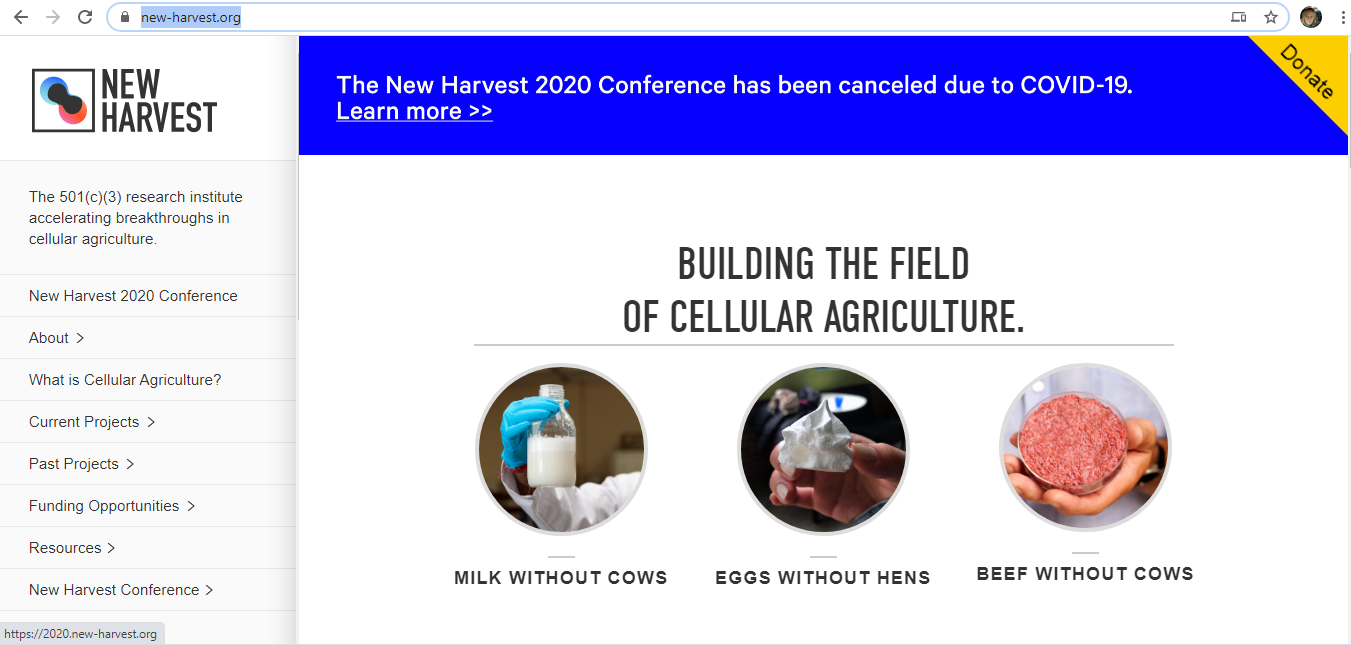
A visit to the New Harvest web page at new-harvest.org will make your hair stand on end. Seeing the motto so boldly proclaiming: “Milk without cows. Eggs without Hens. Beef without Cows,” offers the realization that their goal – in concert with World Wildlife Fund (WWF), DMI’s “sustainability partner” — is the end of animal agriculture through cell agriculture.

Don’t get angry and don’t be depressed. Have hope. Be bold.

If every Farmshine reader does some of the suggestions below, maybe the Titanic can be steered away from the iceberg:

1)      Send this article to your Congressional representatives with a short note stating that this is just one example of how your rights as an American dairy farmer are being violated by the 15-cent mandatory dairy checkoff. Ask for his or her help in getting you an exemption from paying the checkoff, or in allowing you to assign your checkoff “tax” to another promotion, research and education entity.

2)      Call, email, or write to the cooperative director who represents you and ask what your cooperative is doing to protect its members from even more FARM requirements, considering an obvious supporter of “milk without cows” will be implementing the “Undeniably Dairy” environmental piece as executive director of DS4G.

3)      Call your state or regional dairy promotion representative or CEO and ask them to keep all of your dime in regional promotion instead of sending those 2.5 to 3 extra cents to DMI’s Unified Marketing Plan. They have the nickel. That’s enough.

4)      Watch for opportunities to support a dairy checkoff referendum. The law states that when 10% or more of the dairy producers and importers subject to the checkoff request a referendum, the Secretary of Agriculture must oblige.

At best, DMI did not do its homework on this, and other decisions that have influence over the future of rank-and-file dairy producers footing the bill.

At worst, DMI’s “pre-competitive” alliances with global food giants and WWF are steering efforts toward dilution in order to meet some ethereal environmental goal.

Meanwhile hard working, conscientious dairy farmers have done and are already doing more good for health, climate, water and soil than the combined efforts of billionaire Silicon Valley ‘tech-food’ startup investors, multinational food corporations, gene-altering animal replacers, plant-based imitators, high-paid future food fast-talkers, sly and cunning dietary do-gooders, cows-and-climate catastrophe exaggerators, and so-called ‘sustainability’ WWFers.

In times like these, dairy checkoff unity could mean circling the wagons to protect dairy farmers with a locked-and-loaded promotion, education and research front that keeps the cunning wolves from getting in, but instead it gives them an opening and some leverage to devour.

Business is business. But dairy farmers should not be forced to fund their own dilution and demise.

-30-

DOJ files ‘Statement of Interest’ in DFA lawsuit, case goes to jury trial Sept. 30

By Sherry Bunting, Farmshine, July 31, 2020

BURLINGTON, Vt. – The U.S. Attorney General’s office and attorneys for the Department of Justice (DOJ) filed “Statement of Interest by the United States of America” Monday (July 27) in the civil lawsuit brought in October 2016 by Farmers United (Sitts, et. al.) alleging monopsony antitrust activity by Dairy Farmers of America (DFA) and Dairy Marketing Services (DMS).

The case is scheduled for a trial by jury beginning September 30, 2020 in the U.S. District Court of Vermont with Judge Christina Reiss presiding.

The plaintiffs are 116 dairy farmers who opted out of the earlier settlement by DFA of the Northeast class-action lawsuit approved by the U.S. District Court of Vermont.

In this Statement of Interest, the DOJ makes three main arguments: 1) The allegations against DFA in the case are not shielded by the Capper-Volstead Act from antitrust laws. 2) The Capper-Volstead Act does not insulate exclusionary acts from the antitrust laws prohibiting monopsonization. 3) The defendants (DFA) bear the burden of proof that they are protected by the Capper-Volstead Act.

According to the 15-page DOJ brief, the allegations in this case do not appear to have involved efforts to increase farmers’ bargaining power but rather efforts at monopsonization. Basically, the brief explains the “heartland protections” provided by the Capper-Volstead Act, and states the plaintiffs’ claims, if shown in Court, fall outside of those protections.

In fact, the DOJ brief notes that the claims at issue do not involve claims that farmer cooperatives acted anti-competitively against processors and other middlemen, but rather these are claims that farmer cooperatives – through agreements with processors, middlemen and other cooperatives – acted anti-competitively against farmers.

According to the Statement of Interest, “The United States is principally responsible for enforcing the federal antitrust laws… and has a strong interest in their correct application. In particular, the United States seeks to ensure that antitrust exemptions, including the Capper-Volstead Act, are not interpreted more broadly than necessary because antitrust law “is a central safeguard for the Nation’s free market structures.”

The full statement offers an analysis of the Capper-Volstead Act and the Sherman Antitrust Act as pertains to the claims made by the plaintiff dairy farmers should they be shown in Court. The Statement of Interest was filed as an aid to the Court in applying (Capper-Volstead) to this case.

“Congress enacted the Capper-Volstead Act to give farmers who produce food greater bargaining power with processors and other corporate handlers of food products. It would be inconsistent with the Act’s text and purpose to allow a defendant to use the Act as a shield when it acts as a food processor or exercises monopsony power to harm individual farmers,” the DOJ statement explains.

The brief goes on to state that Capper-Volstead “does not protect a cooperative’s agreements with non-cooperatives, and it should not protect agreements between cooperatives that have nothing to do with ‘processing, preparing for market, handling, and marketing’ the cooperatives’ products.”

On the monopsony claims, the DOJ brief indicates that the range of “predatory” conduct falling outside the scope of Capper-Volstead exemption “should be construed broadly… and the totality of the defendant’s predatory acts should be considered.”

The DOJ brief indicates that the Capper-Volstead Act “protects effort to increase farmers’ bargaining power against corporate food handlers and does not insulate monopsonies from the antitrust laws.”

Recounting the Court’s recognition in summary judgment that dairy cows produce milk seven days a week, and as a result, dairy farmers must find a processor that will take their milk regardless of demand, the DOJ brief states that this reality puts dairy farmers “at the mercy” of large milk processors seeking to buy raw milk at the cheapest price. In fact, the DOJ statement observes that farmers are potentially the main entities behind the passage of the Sherman Antitrust Act in the first place.

“The legislative history of the Sherman Act shows that its passage was motivated in large part by the harmful effect that agricultural trusts were thought to have had in reducing the prices paid to farmers,” the brief relates, describing a situation in the beef industry at that time, when members of Congress during passage of the Sherman Act condemned the beef trust for suppressing prices paid to cattle farmers.

When the Sherman and Clayton Acts did not sufficiently aid farmers, Congress sought a stronger statute in the 1920s, later passing the Capper-Volstead Act “to support the cooperative form of organization that would help equalize farmers’ bargaining power…”

The DOJ brief notes that Capper-Volstead allows cooperatives to have marketing agencies in common as long as “such associations are operated for the mutual benefit of the members thereof, as such producers, and conform to certain membership and organization requirements.”

In the statement, DOJ attorneys note that the Supreme Court recognized that the Capper-Volstead Act does not protect agreements that would be unlawful under Section 1 of the Sherman Act when they are between cooperatives and non-cooperatives, except perhaps when they are necessary to carry out the purpose of a cooperative as set forth in the Act.

For example, an exempt cooperative can lose its exemption if it conspires with nonexempt parties.

In other words, the case law cited in the DOJ brief indicate there is precedent set that cooperatives may not lawfully combine or conspire with non-cooperatives in the restraint of trade, nor may they use predatory or coercive practices to stifle competition.

“Such behavior remains subject to normal antitrust remedies,” the DOJ brief states.

In short, the Statement of Interest by the United States upholds that to the extent the plaintiff dairy farmers can show at trial that DFA violated the Sherman Act in reaping profits as a handler or processor from lower milk prices rather than for the mutual benefit of its members, “it would turn the (Capper-Volstead) Act on its head to allow DFA to use the Act as a legal shield,” according to the DOJ brief.

If at trial, the plaintiffs can show DFA had monopsony power and used it to injure other cooperatives or independent dairy farmers who actively – or potentially – compete with DFA, the DOJ statement is basically indicating that Capper-Volstead is not a shield for that.

“It would be inconsistent with the (Capper-Volstead) Act to allow a monopsony to use it as a shield when Congress had no intention to ‘vest cooperatives with unrestricted power to restrain trade or to achieve monopoly by preying on independent producers,’” the DOJ statement indicated.

Judge Reiss in her Opinion for the case to go to jury trial previously stated that, “a rational jury could conclude that DFA management favored growth of its commercial operations and empire building over the interests of its farmer-members.”

The jury trial is set to begin September 30. Stay tuned for more from the docket next week on a flurry of pre-trial activity occurring over the past week.

Note: The defendant in this civil suit, DFA, is the nation’s largest milk cooperative with 14,000 members (nearly half of all U.S. dairy farms), 42 dairy processing plants, plus joint ventures, and on May 1, consummated purchase of substantially all assets of the nation’s largest milk bottler Dean Foods — 44 of its 57 plants — in Chapter 11 bankruptcy sale. Previously in the U.S. District Court of Vermont, the Northeast Class Action Antitrust lawsuit alleged market control conspiracy by DFA and Dean Foods. Both settled for $50 and $30 million, respectively. The 116 dairy farmer plaintiffs in this current proceeding had previously opted out of the “class” when the class action settlement was approved by the Court.

-30-

What’s this? DMI hires ‘director of DS4G’, Resume looks impressive if the goal is to keep on diluting dairy

By Sherry Bunting, Farmshine, July 24, 2020

CHICAGO, Ill. – Dairy Management Inc (DMI) has a new hire at the Innovation Center for U.S. Dairy, under the leadership of Tom Vilsack and Mike McCloskey,  as part of the big push to make “sustainability” center of the plate. The definition could surprise us.

We know the goal on climate is to get “U.S. Dairy” to “net-zero” emissions across the supply chain by 2050 or sooner, but for me, this looks like a smoke screen to ramp up the rate at which the dairy food industry giants seek to scale dairy production and fill in the gaps with a little Perfect Day.

No announcement, but an occupation change and new Undeniably Dairy logo’d cover photo on his twitter feed signals that Caleb Harper — the former principle researcher and founder of the now closed Open Agriculture Initiative at M.I.T.’s embattled Media Lab — is the new DMI “Executive Director Dairy Scale for Good.”

Our initial inquiry for DMI’s vice president of media relations and issues management about the position and whether other candidates were interviewed — and other questions — was emailed earlier this week and not answered.

Harper has a long history of advocacy for urban food production in the sense of digitized, software-programmable, particalized and reconstituted food.  He wrote opinion pieces and did TED Talks about how the cutting edge of this movement is agri-‘culturing’ companies making lab-created dairy protein from DNA-engineered yeast and meat replacements from gene-edited muscle cells, stating that these are the food innovations needed to be sure the world does not go hungry.

In a National Geographic opinion piece in 2017, Harper even mentions and advocates for companies like Perfect Day and Modern Meadow, makers of replacement dairy protein from bovine-DNA-altered-yeast, as the future of food production because, according to Harper, people will move to cities and the rural lands will lose population.

Yes, he’s a guy who believes in true factory farms, the kind of factory farms where fermentation vats feed yeast and collect their excrement to separate out interchangeable dairy components, like protein, and where gene-edited muscle blobs grow in bioreactors instead of as animals on farms.

All part of the WWF (World Wildlife Fund) plan, I might add. They want to move everyone to the cities, re-wild the farms and rural lands, and they’ve already begun.

Harper, who goes by the handle “CalebGrowsFood” on Twitter, is part of the WWF “Thought Leadership Group.” In fact, Mike McCloskey of Fair Oaks, fairlife, and Select Milk Producers as well as a key leader in DMI’s Innovation Center for U.S. Dairy is also on the WWF Thought Leadership Group. Harper’s association with WWF goes back a long way.

For his part, Harper’s OpenAg Project at MIT set out to prove people in cities could grow their own food in LED boxes controlled by computers. Trouble is, it appears that despite the glowing reviews in 2016-18 when models were featured, the boxes never really worked. Some of the photos and demonstrations were allegedly fudged with plants purchased from local stores, according to Oct. 2019 and May 2020 articles in the New York Times, Propublica, WBUR public radio and several reports in science and technology publications.

On April 30, 2020, Caleb Harper left his position as the lead researcher for the OpenAg Project at MIT.

His departure coincides with the Institute’s investigation into the entire Media Lab at MIT amid the brewing scandal that first came to light last fall when the MIT Media Lab’s main director Joichi Ito was found to have financial ties to Jeffrey Epstein. Epstein is the international financier and socialite, who was a previously-convicted sex-offender and committed suicide last year in prison awaiting trial on new charges of human trafficking.

According to the New York Times, and other sources, the OpenAg project, led by Harper, was being used through various meetings between Ito and Epstein to get Epstein to invest more than the half million the MIT Media Lab was already receiving from him in “discretionary” funds — funds MIT was not aware of. As this became known, the work of the lab itself came under scrutiny, and that scrutiny is still in progress even though the lab shut down at the end of April with Harper’s departure.

Here’s the clincher. MIT began a thorough investigation of its Media Lab after firing the director over the Epstein financial ties, and along with that, is investigating Harper’s OpenAg project. Portions of the investigation were reported on in May of 2020 by various science journals and even the New York Times, indicating Harper’s OpenAg project released water from its “computerized plant boxes” with too much nitrogen, well beyond the levels they were permitted to release, and it went to an underground well. A researcher on-site blew the whistle with local authorities, resulting in a $25,000 fine. He was reprimanded in an email from Harper for jeopardizing the future of the project, the report indicated.

In addition, Harper’s computerized artificial intelligence plant boxes, that were showcased on 60 Minutes and National Geographic as well as other high profile outlets, never really worked, according to researchers in the lab, who were interviewed by ProPublica, a non-profit journalism entity judged high in their accuracy based on evidentiary reporting.

What we are learning is concerning. Harper, in this Undeniably Dairy Scale for Good position, may be the very person to work with Vilsack and McCloskey on what practices dairy farmers (most likely via the FARM program) must implement in order to remain part of “U.S. Dairy” by meeting their environmental benchmarks on soil, air, and water. That’s being funded with dairy producer checkoff funds, and there is a big question mark behind the name of the new hire on implementation. Does he really know anything about those three resources – and how to really produce real food while stewarding those resources?

To be continued in the July 31, 2020 edition of Farmshine

-30-