Signups begin May 26 for $16 bil. CFAP; dairies payments equate to Q1 milk x $6.20/cwt

Farmers and ranchers deemed essential to our nation’s future; bulk of payment totals under two calculations to be sent a week to 10 days after signup
unnamed (96)

By Sherry Bunting

WASHINGTON, D.C. – President Trump and USDA Secretary Sonny Perdue released the long-awaited details on the $16 billion Coronavirus Food Assistance Program (CFAP) direct payments to farmers this week, indicating that dairy farmers will be eligible for two payment rates across first and second quarter production — and those rates pencil out to be equal to $6.20 per hundredweight multiplied by first quarter production, including milk that was dumped.

Farms using USDA Dairy Margin Coverage (DMC), Dairy Revenue Protection (DRP) or Livestock Gross Margin (LGM) programs, or certain types of forward pricing through cooperatives or brokers based on futures markets, are eligible for CFAP direct payments on all pounds of milk production, even the pounds enrolled in these types of risk management tools. Participation in other forms of government aid through the Small Business Administration does not affect a farm’s eligibility for direct payments through CFAP.

Signups with USDA Farm Service Agencies began May 26, and USDA intends to send 80% of the total calculated Q1 and Q2 payment to farms within seven to 10 days of their signups. The remaining 20% will be paid later, pending the availability of funds in the $16 bil. package after all eligible commodity applicants receive first payments.
Screenshot (698)

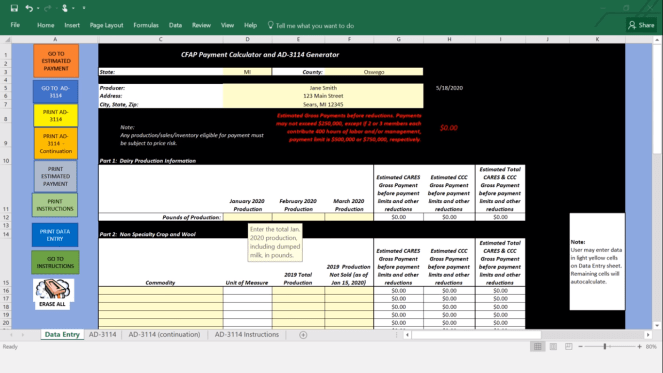
Screenshot of CFAP payment spreadsheet calculator across all eligible commodities. A preview video on how to use the calculator and fill out forms can be found at this link — Check back at www.farmers.gov/CFAP for the spreadsheet calculator or find it through your FSA portal.

Applications will be received until August 28, 2020. USDA has a video for signup, explaining how to use the online calculator spreadsheet, across commodities at this link.

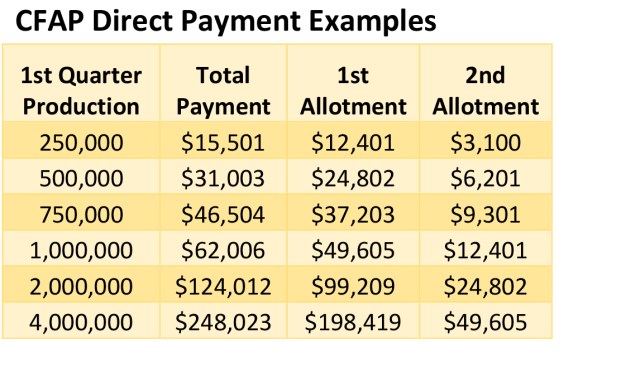
To calculate payments, USDA is using $4.71/cwt from the CARES Act applied to a dairy farm’s first quarter (Jan-Mar) “actual” milk production and $1.47/cwt from CCC funds for a second quarter (Apr-Jun) “calculated” production that is equivalent to the first quarter pounds multiplied by a factor of 1.014 to reflect seasonal production increase for Q2.

Those two payment rates with the second quarter calculation of production push the total payment to be equivalent to multiplying first quarter production by about $6.20/cwt.

With the 80 / 20 split in how this total payment will be sent, farms shipping 5 million annual pounds of milk with roughly 200 cows could expect a payment around $60,000 by early June if they sign up at the end of May, with the balance of roughly $15,000 in a later payment, pending availability of funds.

Responding to bipartisan support from members of Congress asking for payment limits to be increased so that larger multi-generation family farms can benefit, USDA expanded the payment limits to $250,000 per farm entity even with multiple eligible commodities. The previous limit was $125,000 per commodity and $250,000 per farm.

The payment limits were increased for larger farms with multiple ownership structure. Partnerships with two owner-operators would have a payment limit of $500,000, and the maximum limit for any farm structured as an LLC, LLP or corporation with three or more owner-operators is $750,000.

These payment limits apply to the total amount of money a farm can receive even if applying under more than one commodity, such as dairy and crop or dairy and beef.
graph 052220

Graphic by Center for Dairy Excellence risk management coordinator Zach Myers.

Doing the math on larger herds, it appears that a 1000-cow dairy would stand to receive around $325,000 total payment (split 80%, or $260,000, right away, and the remaining 20% later pending available funds). This puts a 1000-cow dairy over the single-owner limit but under the partnership two-owner limit.

The rough math on a 2000-cow dairy comes out to a total payment of around $650,000, which is getting close to the hard-cap of $750,000. A farm of this size or larger, with three or more owner-operators, would have a payment limit of $750,000.

Dairy economists Mark Stephenson and Andrew Novakovic at the Dairy Markets and Policy website have a more detailed paper on this that can be downloaded downloaded here.

Eligibility is limited to owner-operators who materially participated in the dairy (400 hours minimum). For those deriving 75% or more of their income from farming/ranching, there is no adjusted gross income limit for eligibility. For owners not in that category, the adjusted gross income limit to be eligible for CFAP payments is $900,000.

To be eligible for these payments, farms must also show “conservation compliance” regarding the highly erodible land and wetland conservation regulations.

The original USDA notice stated that milk priced on forward contracts would be ineligible for CFAP direct payments, and under ‘dairy eligibility’ was original language stating: “Any milk production that is not subject to price risk for any time during January, February or March is ineligible.” However, USDA removed this language about forward contracting in the final rule for May 21 Federal Register publication.

USDA has confirmed that milk pounds covered by USDA risk management programs like DMC, DRP and LGM, as well as some types of forward contracts based on futures markets through cooperatives and brokers, are eligible for the CFAP direct payments. 

Forward contracts are a gray area. An example of ineligibility could pertain to milk pounds that are specifically priced under a binding contract where pricing is determined ahead of time, such as cost-plus, and where no changes were made to reduce those contracts or charge marketing fees during COVID-19. These are not common contracts, but some larger farms have such contracts with certain processors outside of the Federal Milk Marketing Orders.

In short, the final rule as prepared for Federal Register publication on May 21 no longer contains language excluding risk-managed milk from being eligible, but a farmer applying for CFAP payments is still signing a statement that the pounds of milk certified had price losses of more than 5% and incurred other marketing and inventory costs or deductions during COVID-19.

Producers are encouraged to call their local FSA offices as soon as possible to set up phone appointments for application and to find out how to provide the information required for their applications and forms, such as tax ID number, ownership structure of the farm, adjusted gross income if applicable and pounds of first quarter milk production via milk check settlement statements Jan. through March, or other documentation for dairies doing on-farm processing.

Any milk that was dumped on farms in March due to COVID-19 supply chain disruptions that is not included in the milk check pounds can also be self-certified by a producer’s record of this dumping, according to USDA.

These CFAP payments help producers offset COVID-19-related declines in income by price loss and sales loss for dairy as well as livestock and identified specialty and non-specialty crops.

Secretary Perdue indicated that for livestock and poultry growers forced to euthanize animals due to supply chain disruptions, a different program will handle those losses once USDA has the data on these occurrences to review. These CFAP payments are only for animals sold in the first quarter and animals subject to price risk that are a part of a producer’s inventory on the date chosen in the second quarter.

Dairy producers are eligible for compensation for certain types of livestock and feed.

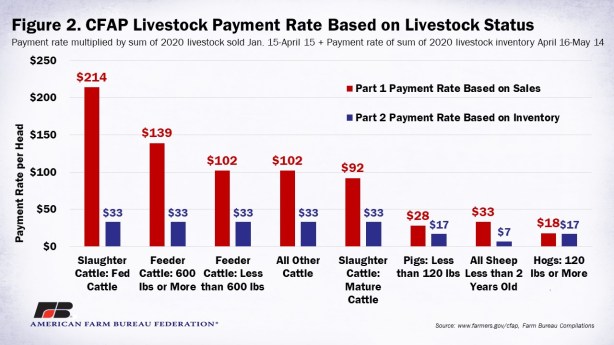
Included under livestock are payments per head for specified classes of cattle (excluding cattle intended for dairy production), hogs, sheep (lambs and yearlings only) and wool.
CFAP_Livestock_Payment_Rate_Figure_2

It is clear that cattle sales intended for dairy are not eligible for cattle payments. However, dairy producers feeding Holstein or Dairy-cross cattle for the beef market, or raising / backgrounding such calves for feedlots may apply for cattle payments.

Cull cows are also eligible under “Mature Slaughter Cattle” for Q1 actual sales, but the “inventory at risk” method is not appropriate for dairy cull cows since they are dairy production animals while they are in “inventory,” not beef animal inventory waiting for a slot at the packing yards. Youngstock sold for to beef or veal growers, not dairy replacements, can be entered under feeder cattle. Check with your FSA office.

Assistance to cattle producers has two components – cattle sold between January 15, 2020 to April 15, 2020 and cattle inventory subject to price risk on a date of the producers choosing between April 16, 2020, to May 14, 2020. Livestock payments are per-head are shown in the Farm Bureau chart above by the two rates used for Q1 and Q2.

USDA confirmed in a media call that payments will only go to producers with eligible cattle and livestock, including contract growers if their contract allows them to have price risk in the livestock. Processor-owned livestock are not eligible for these direct farm payments.
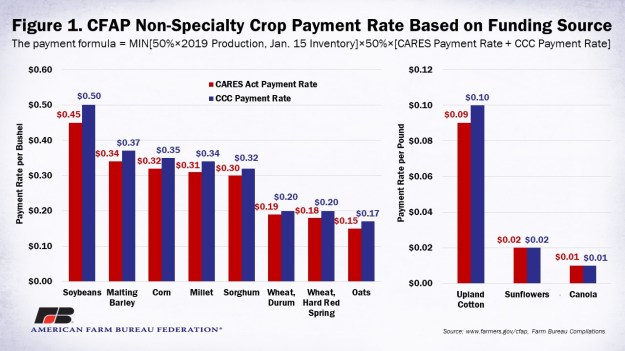
CFAP_Non_Specialty_Payment_Rate_Figure_1_CorrectedIncluded under non-specialty crops are payment rates for malting barley, canola, corn, upland cotton, millet, oats, soybeans, sorghum, sunflowers, durum wheat and hard red spring wheat. These crops grown on dairy farms are also eligible under inventory with conversions for silage to grain prices — as long as these crops were “subject to price risk” or incurred market costs due to COVID-19 disruptions.

Also, included under specialty crops are payment rates for a variety of fruits and vegetables as well as almonds, pecans and walnuts, beans and mushrooms.

USDA has a special webpage devoted to the CFAP program at https://www.farmers.gov/cfap

CFAP payments are not government “handouts” or “bailouts”, but rather the government’s recognition that our nation’s farmers and ranchers are essential to our nation’s future. Like other businesses receiving federal assistance during this worldwide COVID-19 pandemic and economic shut down, the losses farmers are suffering are monumental and totally outside of their control and outside of the disrupted supply chain’s ability to handle under these unprecedented conditions.

Throughout the past eight weeks of publicized empty shelves, purchase limits and dumping of milk — as well as euthanizing of livestock and plowing under of produce unable to be harvested – consumers are showing renewed appreciation for American farmers and ranchers. These much-needed funds will not make farmers whole but are a life boat in uncharted waters.

According to American Farm Bureau Federation, this program is considered “an important downpayment in helping farmers and ranchers deal with the unprecedented and unexpected economic fallout related to COVID-19.”

According to Jim Mulhern of National Milk Producers Federation, the details on the dairy payments are “more than we anticipated,” but at the same time “more is needed,” he said.

Both AFBF and NMPF – as well as other farm organizations – indicate they are working with lawmakers for additional assistance in the future as the full extent of the pandemic and crisis become known. USDA will be replenishing the CCC by $14 billion in July, and Congress is currently looking at what additional measures are necessary to assist producers of commodities not included in the CFAP package.

Mulhern noted in a PDPW Dairy Signal webinar Tuesday that the dairy industry stands to lose nearly $9 billion this year if the recently released World Agriculture Supply and Demand Estimates of 2020 milk price comes to fruition – or worsens.

He said that even with the expanded limits for CFAP, “This still leaves larger operations (over 2000 cows) without coverage for larger losses. I think there’s a good chance that additional legislation, like the House ‘HEROES’ bill, to have the payment limit issue removed.”

Mulhern also noted that one of the biggest CFAP benefits to all dairy farmers right now are the nearly $450 million in new dairy purchases that were recently announced through the $317 in dairy product awards for the new food box program May 15 through June 30 and the $120 million in additional Section 32 dairy purchases out for bid for delivery to food programs in July.

The good news is that cheese, butter, powder, and milk futures prices have been rallying over the past four weeks with near-term Class III milk contracts well into the $17s — more than $5/cwt higher than the current for May. Mulhern expects to see a volatile pattern in dairy product and futures markets for the rest of this year.

To stay up to date on information from USDA about the CFAP payments, including an FAQ, click here

The 40-page official rule on was published today, May 21, in the Federal Register. Read it here.

-30-
Consumer trends amid COVID-19 have DMI a bit perplexed

Gallagher skeptical about ‘comfort and nutrition’, wants data from partners, not opinions. O’Brien says ‘future of dairy’ may go fast-forward

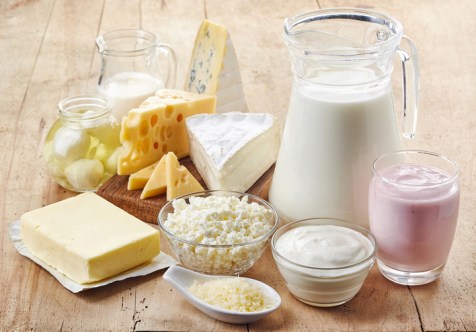
Various fresh dairy products
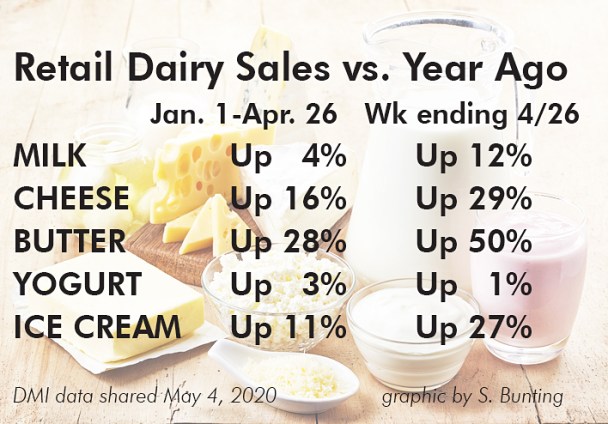
Data shared by DMI in the May 4, 2020 industry call shows all retail dairy sales categories are up significantly year over year. DMI CEO Tom Gallagher noted that the level of increased sales of fluid milk compared with a year ago are “still relatively consistent” as of the end of April.

By Sherry Bunting, Farmshine, May 15, 2020

CHICAGO, Ill. — Amid the supply chain disruptions brought on by COVID-19 restrictions, Dairy Management Inc. (DMI) and the National Dairy Board are having weekly conference calls. They say 100 to 150 farmers have been participating.

And they are scratching their heads a bit over what to make of the now ‘unleashed’ consumers.

‘Unleashed consumers’ is the phrase I have coined for describing consumers now in control over their food, beverage and dairy choices, now that they are not so completely influenced by away-from-home and institutional feeding that adhere more closely to the dietary guidelines.

This has emerged most notably in the huge increases in whole milk sales that have boosted the fluid milk category well over year ago levels to the first year-over-year increase last month in decades. It has also shown up in the demand for butter, full fat cheeses and other cream products that sell out quickly at retail and prompt spot shortages.

On the May 11 DMI call, Russell Weiner, Domino’s COO and president of the Americas, was a guest and he highlighted his company’s partnership with dairy checkoff since 2008. That is a separate and quite interesting story. One thing he referenced is that pizza sales have been strong through the pandemic, and that consumers historically spend 5% of their disposable income in the quick-serve-restaurant (QSR) sector through recessions and other crises. This appears to be holding true amid the pandemic.

DMI CEO Tom Gallagher and National Dairy Board president Barb O’Brien also gave updates about what DMI is doing about consumer buying patterns and future trends. It was evident in the discussion that DMI has a future of food concept for dairy based on prevailing insights from its partners and does not want to deviate from this framework unless data from partners points to a true shift in consumer purchasing and unless they have a “why” behind the shift.

Gallagher stressed that DMI, and the states and regions, are collecting every piece of information from every partner they can to “see what it will mean post-COVID or during COVID. There are a lot of opinions out there,” he said, “but it’s too early for us to put our stake in the ground as to this is what it will be.”

He talked about DMI’s data partner Inmar Analytics, which did the recent 2019 “Future of Food Retailing” report. “At no charge to us, they are looking at the buying patterns after the initial ‘panic buying,’” said Gallagher. “We know what people bought, but why did they buy it? Was it because they were interested in comfort food or nutrition? Or were they hoarding? Or were they baking more? I am a data guy. I want to see the data as to why they buy what they bought.”

In a skeptical tone, Gallagher went on about these so-called “opinions” on the buying patterns revealed by COVID-19 impacts.

“Some say, ‘Oh, it’s a return to nutrition.’ And some say, ‘Oh it’s a return to comfort food.’ But what really drove their behavior? And what strategies should really influence our thinking about the future? We don’t know. In the meantime, we will collect information,” Gallagher said. “We all have opinions, but we want to be informed with data, not opinions, to design how we move forward.”

Gallagher mentioned a study coming out this week on what food companies are thinking will be the patterns after COVID. When pressed later about how to hang on to the new-found bump in purchases of certain dairy products at retail (such as whole milk and butter), given that some of these purchases may be relatively new for some consumers, Gallagher was steadfast on not changing the future plan because of current “opinions.”

He stated — again — that Inmar Analytics will be able to tell DMI “exactly what shoppers put in their baskets and compare it to what they put in prior to COVID. They will be able to tell us what changed and through technology, why did that change occur, that’s the data I want,” he said.

One ‘why’ for ‘what changed’ (in this reporter’s opinion) may be too subtle for the Inmar Analytics surveys to detect — that is the nuances of just how much consumers have been controlled by the Dietary Guidelines pre-COVID, without even realizing it. There is rarely any talk from DMI about what those flawed guidelines — set by the government with very little opposition by the dairy industry — actually do to buying patterns when people are consuming 54% of their calories away from home and much of that in schools, workplaces, quick-serve-restaurants and other institutional settings where food choices are more “formulated.”

The COVID-19 pandemic has abruptly unleashed consumers nationwide from the fat-restrictive Dietary Guidelines. Now, consumers are able to use more of their own discretion and choice apart from institutional food settings, guidelines and formulas. Some experts ‘reading the tea leaves’, such as Nielson Global Insights, observe that after a significant event like a pandemic of this magnitude, consumers can be expected to stay with some of the choices that made them feel healthy and safe during the pandemic, once the world gets back to a new-normal. That could be significant for dairy — but it may not line up with the ‘future of dairy’ pathway set by DMI and its partners.

O’Brien explained that dairy checkoff teams are actively involved in both long-term and immediate efforts.

“We are looking at the future of dairy. COVID-19 may fast-forward some of that future to happen more quickly,” she said. “In the immediate term, our retail teams are working with MilkPEP, to keep stores stocked and address the concerns people have about value, and we’re doing things with e-commerce to offer recipes that extend the use of the dairy products they bought.”

DMI’s ‘future of dairy’, as we know, is built on partnerships, innovation, and promotion of dairy farmers and sustainability and animal welfare practices, not education and promotion about milk and dairy products. It is well known that the innovations over the past decade have been focused on consumers eating dairy, not drinking it; and in the fluid space, these innovations emphasized through DMI partnerships have focused on ultrafiltered, shelf stable, lower-fat dairy beverages and blends and away from the whole milk gallon jug.

But we also can see that in their time of freedom to choose for their families amid the pandemic, consumers are reaching for the whole milk gallon jug. In fact, prices are rising on whole milk by $1 to $2 per gallon, while other fat content milks have remained the same, and still sales of whole milk are strong.

A producer from Wisconsin on the call asked Gallagher to make sure to track convenience store purchases when gathering the data, not just grocery retail, noting that many consumers buy their milk at convenience stores. Gallagher responded that they may have to check with another data partner for that piece.

O’Brien also stressed that while they gather data about consumer patterns, DMI will continue to chart the path it has set. That is to “gain the trust of consumers and celebrate dairy’s role in sustainably nourishing families and communities,” she said, adding that a media segment is being prepared for Fox and Friends next Monday morning, May 18 that will feature Katie Pyle of Cow Comfort Inn Dairy in Maryland.

“That piece will help bring to life our dairy farmers’ commitment to sustainably producing nutritious food,” said O’Brien. An estimated 2.5 million viewers will see the spot, and it will be supplemented with “live-streaming” on two other network stations where farmers will be interviewed to “tell their story.”

“That piece is supported by a 30-second video drawing footage from many farms and will run this week to the end of the month in streaming venues,” said O’Brien. She also explained that DMI has been working extensively with MilkPEP (fluid milk processors promotion) and that MilkPEP’s ‘Love what’s real’ ads are on television right now during the COVID period (when everyone is at home). The ads review the essential role of dairy farmers, and others involved in the dairy supply chain, she said.

“We co-brand these ads using the Undeniably Dairy logo, and design ways to help them reach consumers with these interests,” said O’Brien. “That’s our runway into June Dairy Month.”

While Gallagher said he expected to have some data insights from Inmar Analytics as early as next week, he added that it will begin a process to use technology to interact with consumers to learn more of the why’s behind their choices so that DMI — and its partners — can “appeal” to those drivers.

Stay tuned.

-30-

Dairy farmers prompt Franklin County, Pa. Milk Drop

Over 2000 families blessed with 3600 gallons of whole milk

Franklin_Milk_Drop03

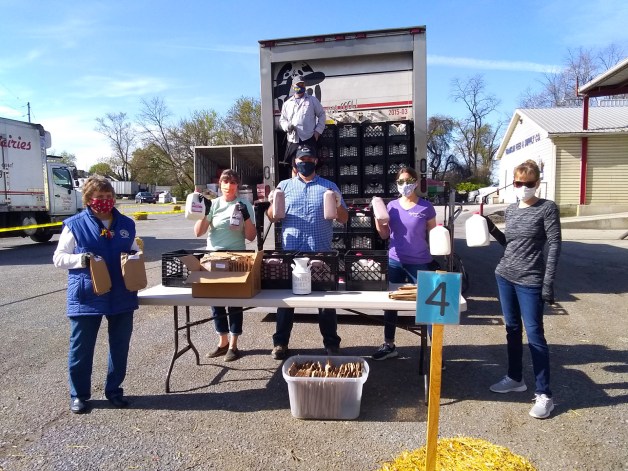
Zach Meyers (center), Franklin County Farm Bureau president among the volunteers ready with gallons of whole milk and half gallons of whole chocolate milk

By Sherry Bunting, Farmshine, May 15, 2020

CHAMBERSBURG, Pa. — “Watching Franklin County help Franklin County is the best way I can summarize this. Seeing the community come together was a blessing to witness,” says Lucy Leese who helped organize the 3600-gallon Milk Drop at Franklin Feed and Supply, Chambersburg, Pa. on Saturday, May 2. Leese is the office manager for the Franklin County Farm Bureau, and she works part-time on a local dairy farm.

The idea came from dairy farmers in the county seeing other such events in Lancaster and Tioga counties. Franklin County Farm Bureau president Zach Meyers, an area feed nutritionist, was contacted about it by one of his dairy clients.

“They knew Farm Bureau could reach more people to make this work, so we helped organize it,” says Meyers. “But the farmers get the credit. They made most of the donations. With this event, they basically sent a personal message to the entire community — that dairy farmers love you and care for you.”

May 1st dawned sunny, and people were itching to get out. They came in droves for the Milk Drop, some even breaking out their restored cars for the lineup.

Organizers say some people came because of true need in these hard times, others simply to show support for the dairy industry, and others just wanting something to do — to take a drive and be part of something. Whatever the reason or season – sunshine or rain – these Whole Milk Donation Drops, Drive-throughs, Challenges, call them what you will, are really catching on and spreading all over.

Franklin_Milk_Drop01

Lucy Leese works for a local dairy farm and as office manager for Franklin County Farm Bureau. Along with the whole milk, they gave out goodie bags with dairy facts, recipe and coloring books from county dairy promotion. Photos submitted

From idea to event, a whirlwind eight days transpired. Leese communicated with county Farm Bureau members and others by email and social media about the plan, and she quickly saw the high level of community interest through donation pledges as well as people expressing interest in coming out.

“We also reached out to others who have done this. Mike Sensenig (New Holland) had a lot of insight and gave us some things to think about ahead of time,” she said.

“Our biggest thought was that we wanted to be sure to use Pennsylvania milk, so we worked with Harrisburg Dairies,” Meyers relates in a Farmshine interview. “Most of the dairy farmers here are already producing milk at a significant income loss, and yet they still gave money to buy milk for the Milk Drop.”

According to Meyers, the vast majority of funds were donated by dairy farmers and supportive agribusinesses. A few donations also came from individuals and businesses with no connection.

“We wanted it to be whole milk,” said Meyers. “What is better than giving a gallon of whole milk and a half gallon of whole chocolate milk and having our community actually taste something good?”

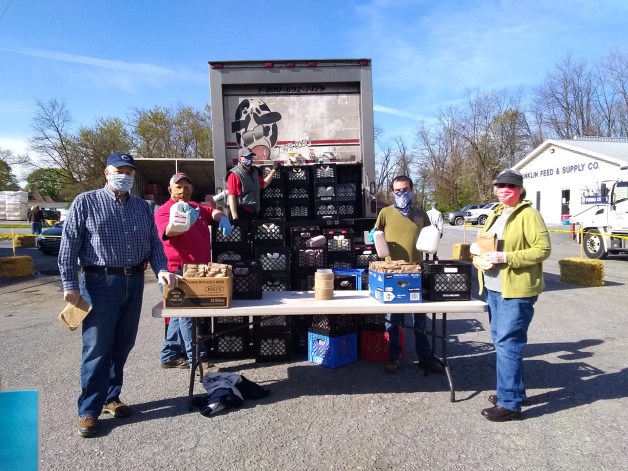
Over 2000 vehicles, in about a five-hour time frame, snaked through the Franklin Feed property off Rte 11 into four lines on either side of two Harrisburg Dairies trucks with 30 volunteers handing out milk and a goodie bag with a dairy fact sheet, recipe book and coloring pad courtesy of Franklin County dairy promotion.

The size of the event exceeded early expectations. They initially had money pledged for 500 gallons on Sat., April 25. By Monday evening, when they had their video chat to organize the event, they had funds to buy more than 2000 gallons. By Wednesday, April 29, three days before the event, they had pledges and paypal funds for seven times the original amount and confirmed their final count with Harrisburg Dairies for Saturday morning.

Franklin_Milk_Drop05

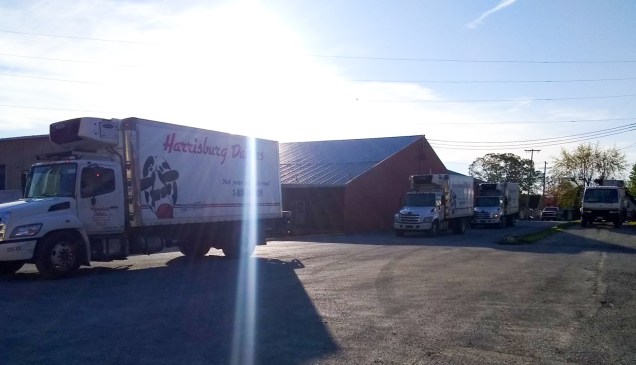
Pretty cool to see 15 tons of milk come in on three box trucks. Harrisburg Dairies sent employees to man the lifts and keep the milk moving to the distribution tables between four lines of cars. 

“It was pretty cool to see 15 tons of milk come in on three box trucks,” says Leese. “Harrisburg Dairies sent their own guys to man the lifts and keep the milk moving to the distribution tables.”

The community was eager. “We had cars coming in at 7:45 a.m. right behind the trucks, so we started letting them through at 9 instead of 10,” says Leese, describing the initial rush of cars that gave way to a steady flow into the early afternoon.

In the end, Shippensburg Food Pantry sent a refrigerated truck for the 150 gallons that were left at 2:15. Earlier in the day, folks from a nursing home in Waynesboro had come through for 40 gallons. “They said they weren’t able to get whole milk, and their folks needed milk,” Leese reports.

Hearing the emotion in Leese’s voice as she described the experience in a Farmshine phone interview, it’s obvious that an event like this truly touches the givers and the receivers.

“Several times people asked for additional milk for their neighbors or grandparents. We said from the beginning all are welcome, no questions asked, because we are all in a tough situation right now,” Leese explains.

Franklin_Milk_Drop06

Two teams of volunteers kept milk moving from three trucks. Throughout the 5 hours, area dairy producers took shifts. For them, it was personal, to show love for their community.

“It was encouraging for us as volunteers to be able to serve and give back to the community here at a time that we have felt helpless for so many weeks. This was an opportunity to be active and to serve,” she adds. “The folks coming through were just so grateful with words of thanks and blessings, and if they could, they gave money to pay forward for other Milk Drops.”

The way the lines flowed into Franklin Feed from Rte 11 gave the event a special touch for homebound families getting out. Wide-eyed children looked around at the sights of grain bins and feed equipment and then the milk trucks as they lined up between them.

Franklin_Milk_Drop02

Over 2000 vehicles, in the space of five hours, filed off route 11 in Chambersburg, snaking around the grain bins at Franklin Feed and Supply before breaking into four lines on each side of two Harrisburg Dairies trucks.

“People actually thanked us for the tour,” Leese said. “We needed to move quickly so the line wouldn’t back up to route 11, so we had four lines, and the volunteers came in shifts.”

While the Franklin County Farm Bureau is not planning another, others in the community are talking about more milk drops.

“As people are seeing and recognizing the need and the positive response, the idea is really taking off,” Leese observes, adding that they’ve been contacted by their peers in Centre County wanting to do one. Also, Harrisburg Dairies has been involved in other events like this, but this was likely their largest one-day, one-location event.

“We learned that people will give whatever they can to support something like this,” she says.

Leese’s advice for others includes: Overplan your volunteers, have popup tents for shade, wear gloves and masks.

“When you are standing there giving something to people, you can still smile with your eyes and be pleasant — even wearing a mask,” says Leese.

“People have been missing interactions, so we wanted to be cheery and welcoming, and people noticed. It helps raise everyone’s spirits,” she reflects.

Leese is grateful to the dairy farmers who had the idea, the many volunteers, and to Franklin Feed and Supply for providing the accommodations and being so helpful.

Franklin_Milk_Drop04

Ron Wenger, county Farm Bureau vice president, directed traffic into four lines to keep traffic from backing up onto rte. 11.

She says Farm Bureau first vice-president Ron Wenger, a dairy farmer from Pleasant Hall, was instrumental in figuring out the traffic patterns to make sure they had things flowing well.

“Coming from a farm background, working for a farm and the Farm Bureau, I know what farmers are going through, what they are facing, and it’s not pretty. Yet a portion of the donations came directly from dairy farmers, and they were out here to share and to give and to protect people. To see the community respond in such a positive way to this outpouring from the dairy farmers was gratifying.

“People understood that they were getting something good for them from farmers who care for them, so we got some kind of understanding happening here,” she observes.

“Now the question is how to hold on to that, and make it flourish.”

-30-

‘Forgotten Farms’ will be remembered in NYC

Over 100 food-thinkers and influencers attend Forgotten Farms film premier in New York City, bring questions and perspectives

Forgotten_Farms_02 (1)

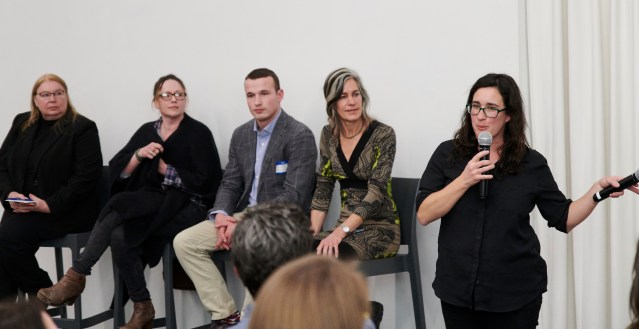
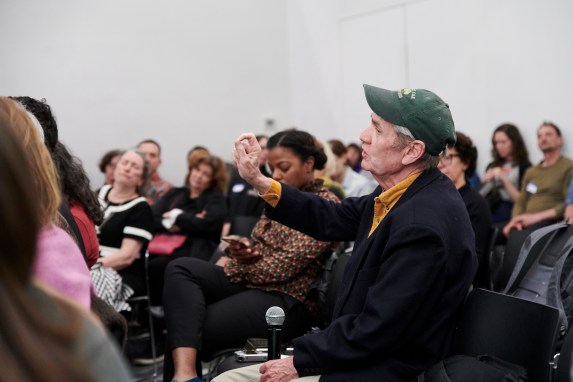
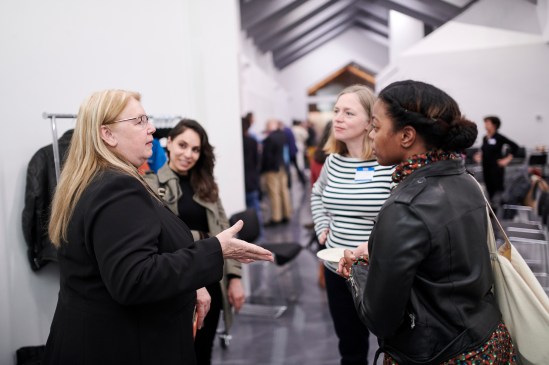
Lorraine Lewandrowski (left) and Forgotten Farms film creator Sarah Gardner (second from right) take questions from attendees after the premier showing at Project Farm House in Manhattan on March 9. Photo CADE / Zachary Schulman

By Sherry Bunting, Farmshine, May 8, 2020

MANHATTAN, N.Y. — While new farmers are celebrated by food-thinkers and thought-influencers, there’s another farmer mostly left out of the local food celebration. Traditional dairy farmers are underestimated and seen as declining, when in fact, they remain the backbone of rural communities and are integral to a renewal of regional food systems — their farms have served urban neighbors in some cases for a century.

Yet these essential farms have been essentially forgotten by the food movement as they fight for survival…

On March 9, they were remembered and celebrated thoughtfully during a premier showing of the acclaimed Forgotten Farms film in New York City. A group of upstate dairy farmers hosted the occasion. The documentary shows the cultural divide between the new food movement and traditional farming. It can be streamed at http://www.forgottenfarms.org or by purchasing a DVD.

After months of work and years of time invested in building relationships with food-thinkers in the metropolitan area, Herkimer County, N.Y. dairy producer and attorney Lorraine Lewandrowski — working closely with the Center For Agricultural Development and Entrepreneurship (CADE) — secured a beautiful Manhattan venue at Project Farmhouse to show the documentary film.

Lewandrowski is @NYFarmer on Twitter with near 33,000 followers and has tweeted nearly a quarter of a million times over the past decade spanning everything from issues of the day to simple photos of a day on the farm.

Always looking for ways to connect dairy farmers with food-interested people, Lewandrowski and other dairy producers tag-teamed as hosts for the Forgotten Farms film premier in Manhattan on March 9 and had a booth at the International Restaurant Show at the Javits Center on March 10.

Forgotten_Farms_19 (1)

Photo CADE / Zachary Schulman

For many of the 100 food-thinkers, food-writers, and food-influencers attending the film, it was their last congregating event before New York City began safe-at-home policies as the novel Coronavirus pandemic hit the region a few days after. In the throws of the pandemic’s impact on global and national food supply chains, the Forgotten Farms documentary brings a timely message — looking into the past and ahead at a vision for a future regional food system.

“This event was made possible by (CADE) in Oneonta, New York and event coordinator, Lauren Melodia of Brooklyn,” writes Lewandrowski in an email interview with Farmshine recently. “We had seating for 100 New York City food-thinkers, influencers, writers and students. In just over an hour, the film told the stories of Northeast dairy farmers. Actual dairy farmers, some of them ‘real unique characters,’ were the stars of this award winning film created by Sarah Gardner and David Simonds.”

forgottenfarmsproducers

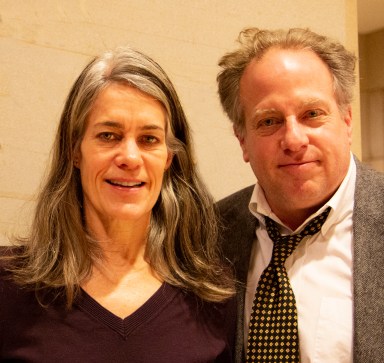
Sarah Gardner and David Simonds (Photo S.Bunting)

Gardner was also present to join Lewandrowski on a panel taking questions from attendees as they enjoyed the beautiful cinematography while learning about a few central themes: The challenges of farming, milk pricing, history of farm communities, abundant natural resources of the Northeast and the feeling in dairy farm communities that dairy farmers were forgotten by the popular urban food movement.

IMG_8026_forgottenfarms

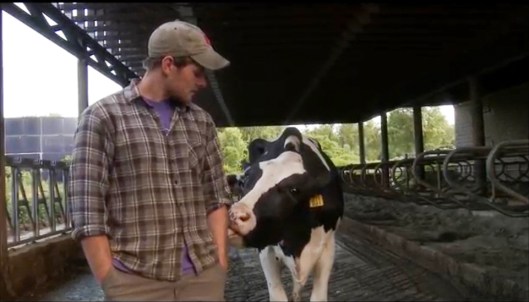
Photo capture from Forgotten Farms preview trailer

“The event was also a ‘deep listening’ session for us as farmers while attendees expressed their ideas, asked questions of us and gave us information from their perspectives,” Lewandrowski reflects. She notes that for the group of New York farmers the opportunity to really hear what is on the minds of city food-thinkers is essential to bridge the gaps and communicate about the future of food systems and dairy farming.

All the more telling in the eight weeks of COVID-19 impact to the national and global food supply chain, were the regional themes of the Forgotten Farms film showing the wealth of resources tended by farmers within a short drive of New York City.

Forgotten_Farms_18 (1)

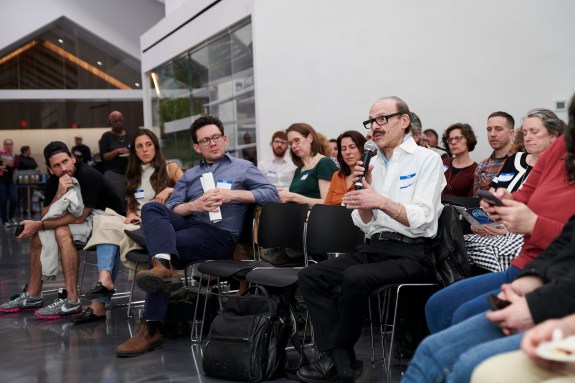
Dr. Keith Ayoob tells the audience his concerns about public belief that imitations are ‘equivalent’ to dairy milk. Photo CADE / Zachary Schulman

“A young coffee bar owner asked what she should say to the increasing number of consumers who ask for oat ‘milk.’ A pediatric nutritionist, Dr. Keith Ayoob, told the audience his concerns about public belief that imitations are ‘equivalent’ to dairy milk,” Lewandrowski relates. “Dr. Ayoob brought copies of a letter he had written in the March 7, 2020 New York Daily News rebutting Brooklyn Borough President, Eric Adams, who has called for ‘plant based’ milks and for dairy farmers to transition out of producing milk.”

Attendees asked the farmers if they knew which New York City officials are interested in regional food and who they should support politically.

Lewandrowski described these encounters:

One consumer asked how to respond to fellow environmentalists who disparage dairy milk while urging almond beverages as better for the environment.

A group of food studies students told how the film inspired them to question food “shockumentaries” they have seen in their programs and to seek trustworthy sources of information.

“Each of these questions and comments gave us ideas on other projects we as farmers can do during future trips into the City,” writes Lewandrowski.

forgottenFarmsCapture

Photo capture from Forgotten Farms preview trailer

“A high point of our Project Farmhouse event was the support shown for the Cobleskill Dairy Judging team by attendees, most of whom have never touched a cow,” she notes. “Our announcement that the students from SUNY Cobleskill had placed first in the nation in junior college dairy judging was met with a big round of applause. We sold raffle tickets for a gift basket of New York food products to benefit these students, and the atendees gave generously to support the dairy students that they saw as their “home team.”

In speaking with guests after the film, Lewandrowski reports they were invited to do more showings in Queens, Brooklyn, Manhattan and Westchester County.

“We also met New York City food policy leaders and some of the people who have quietly worked behind the scenes as the ‘guardian angels’ of the farmers and NYC food security,” she writes. “It is the work of these unsung people that has built an extensive network of farmers markets in NYC and who are now connecting with more rural dairy farmers who sell into commodity networks.

Forgotten_Farms_60
Photo CADE / Zachary Schulman

“Now is the time that the work of these people will be recognized and respected as city planners think about regional food in the years following the Coronavirus impact,” she adds. “Young urban supporters of farmers showed us the seaport area of southern Manhattan and invited us to return to host a NYC Dairy Festival. They urged that the public would love to see and sample cheeses, ice creams, and other products of our rich dairy region. How could such an event be accomplished?”

On the following day, Jacob Javits Center hosted the combined International Restaurant Show, the Natural Foods Show and the Coffee Festival. The dairy presence was very thin, while imitation “milks” had several booths, Lewandrowski reported. CADE organized a booth for dairy farmers where they proudly handed out fresh whole milk bottled by Clark Farm in Delhi, New York.

“Although the dairy and beef checkoffs were absent, we were happy to see booths from Belgioioso Cheese and Tillamook Creamery, both of whom drew enthusiastic cheese sampling,” Lewandrowski explains. “The Government of Quebec had multiple booths showcasing their dairy, cheeses, beef, bison and specialty lamb. Irish beef also had a presence, catering to specialty marketing in New York City.”

To be continued

Whole Milk Gallon Challenge: Titusville couple uses ‘stimulus’ payment to bless, educate, inspire

TitusvilleWholeMilkGallonChallenge01(cropped) (1)

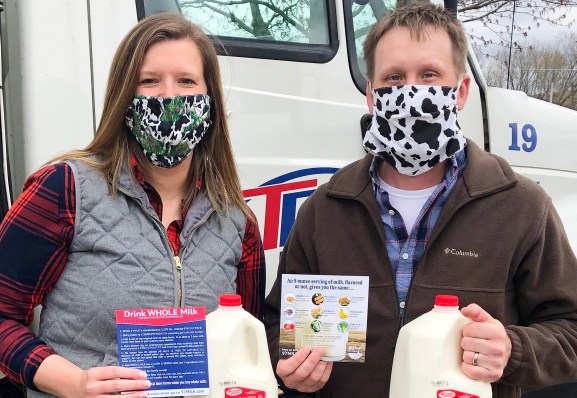
Jake and Casey Jones wanted to bless and educate their community with a Whole Milk Gallon Challenge they hope will inspire others.

By Sherry Bunting, Farmshine, May 8, 2020

TITUSVILLE, Pa. – Whole Milk Gallon Challenge? It’s not a milk-chugging contest. It’s a way to bless the community, support local farms, educate the public, involve the school district, and get people talking about the choice of whole milk for healthy kids, healthy families, healthy communities.

Jake and Casey Jones of Titusville, Pennsylvania held their first Whole Milk 500 Gallon Challenge at the local middle school last Friday, May 1. They purchased 500 gallons of whole milk from a local bottler and 500 educational handouts through 97 Milk and worked with the Titusville Area School District to set up a drive-through in a parking lot adjacent to where families pick up school meals on Fridays.

The response was overwhelming and the gratitude from the community, humbling.

It all began when the CARES Act passed by Congress resulted in COVID-19 ‘stimulus’ payments to Americans last month. Jake, a territory manager for Mycogen, was still working full time in agriculture and had not been asked to take a pay cut. As the ‘stimulus’ credit showed up in their bank account, they were seeing farms forced to dump milk.

They decided to use the ‘stimulus’ funds to do something that would have an impact on their community and local dairy farms.

Both Jake’s and Casey’s parents have dairy farms, and they are involved in Jake’s parents’ farm. They saw the level of losses, revenue down 30% in a month and down potentially 60% by June. They had previously contacted Farmshine about the whole milk choice in schools petition  and they were seeing schools provide meals during COVID-19 closures.

At first, they thought they could donate whole milk for the school to give out with meals. However, the USDA waivers for that were only in force for the month of April, and the process was complicated. Schools had to prove the fat-free or 1% milk was not available.

“We were frustrated — always hearing reasons why you can’t do this or that, when it comes to milk. We were tired of seeing and accepting roadblocks,” Jake related in a Farmshine phone interview this week. “We decided to find a way to do what we could to impact the situation. We feel incredibly blessed, and this felt like the right thing to do — putting the ‘stimulus’ money to something bigger to hand out a gallon of whole milk separately, but in conjunction with the school lunch system.”

Now they are hoping to inspire others to keep do the same.

TitusvilleWholeMilkGallonChallenge02 (1)

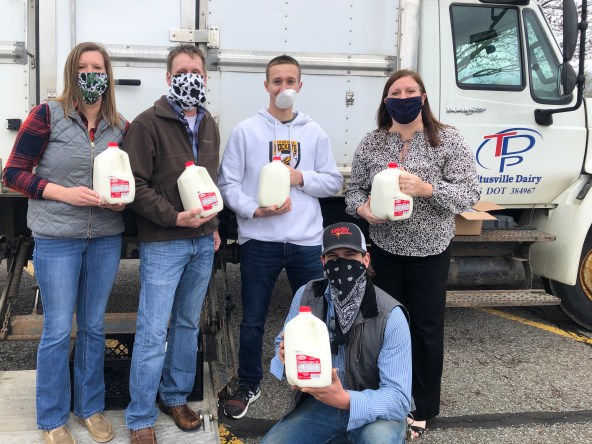
Jake and Casey Jones (left), along with (l-r) student volunteer Joey Banner, Titusville Area School District superintendent Stephanie Keebler, school maintenance manager Garret Rose (front), and Ralph Kerr (not pictured) from Titusville Dairy helped make the Whole Milk Gallon Challenge successful.

In April, one of the first contacts they made was to the Titusville Area School District superintendent Dr. Stephanie Keebler. “We told her our idea, and she immediately jumped on board as one of our biggest supporters,” the couple confirmed.

“Jake reached out to me by email, and it was just amazing, very generous,” said Keebler in a phone interview. “They worked collaboratively with their church (Pleasantville Presbyterian) and the milk board and with our local Titusville Dairy and the manager Ralph Kerr to acquire the milk.”

Keebler coordinated things on the school end to make sure they distributed the whole milk in a way that would not put their foodservice program at risk (low-fat rules) and got building maintenance, Garret Rose, involved to set up the traffic flow for safety.

The school has been serving 450 to 650 individual students’ two meals a day since the COVID-19 closures. Meals are grouped for pickup on Mondays, Wednesdays and Fridays at three locations.

“When you talk about the critical need we have within our community, our foodservice people have been fantastic. They have never taken a day off and there has been no lapse in service for our families,” Keebler indicated.

By Tuesday, April 28, the Joneses had the details set. Keebler used the district’s all-call technology to notify the families of the district’s 1,915 students to let them know about the milk distribution.

TitusvilleWholeMilkGallonChallenge03 (1)

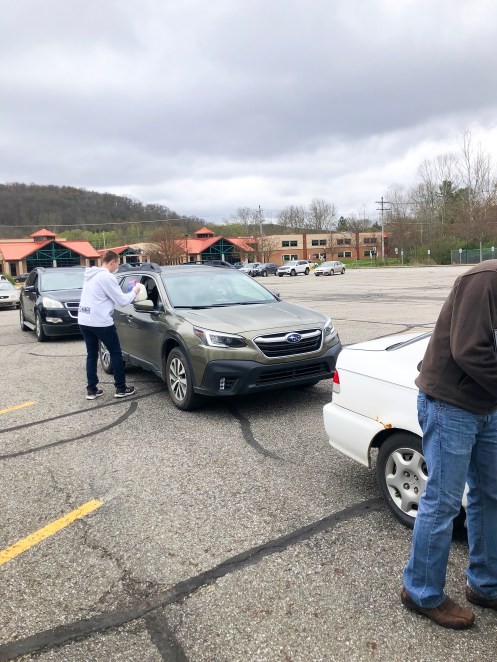
A steady flow of cars came through the Titusville Area middle school parking lot Friday as the Whole Milk Gallon Challenge was set up at the front of the school as meals were picked up at the back.

“As families drove in the back through the bus loop for the meals, we reminded them to enter the front and follow the driving pattern to where they had the refrigerated truck with the milk,” Keebler related.

Jake and Casey, with two young children at home, were assisted by a student volunteer Joey Banner in handing out the gallons and information cards. He was enthused about the challenge too.

“We are extremely grateful they reached out with this idea. The ease of collaboration between the family and the district pulled off a very successful event. Developing relationships and connecting with the community is vital,” Keebler noted.

On the milk end, Ralph Kerr and the Titusville Dairy team were instrumental, according to Jake. They provided logistics, the refrigerated truck and put them in touch with Marburgers Dairy to arrange the purchase of the milk.

“Once we had the green light, setting up the logistics went fast. We wanted every gallon of whole milk to have a handout with information,” he added. “We wanted to bless and educate at the same time, while building some ground level support for the choice of whole milk in schools.”

Other than the school district’s automated call to student families, the Joneses did not advertise the event. Until Friday.

“We did a facebook post at 10:30 a.m. that morning, knowing the school lunch pickup was set for 11 a.m. By 10:35 a few vehicles were lining up,” Jake explained. “As the first few cars drove through, we told people to let their friends and neighbors know. By 11:00 a.m., we had a big rush, and then it was steady. People were excited and asking questions.”

After the school meal pickup ended at 12:30, traffic hit a lull. That’s when their facebook post and word-of-mouth drove visitors in from the community.

“Grandparents said their grandchildren told them to come see us. People drove through saying neighbors told them or that they saw it on facebook,” Jake reflected. “We had a massive second rush of people, and some asked for extra gallons so they could take to others.”

It was gratifying to see the blessing multiply.

By 3:30, they had given out 408 gallons of whole milk and contacted the local Associated Charities to receive the remaining 92 gallons.

“The director pulled in to pick those up as we were cleaning up. She told us ‘you have no idea how many people ask for dairy products — especially milk.’ She was also excited about the 97 Milk cards, to learn something new about whole milk and to give them out with their meal boxes,” said Jake.

“By the end of the day we were exhausted, but amazed,” said Casey, and by the evening, they heard from someone involved in agriculture who was inspired to provide funding for another Whole Milk Gallon Challenge if Jake and Casey would help with logistics.

“That’s phase two of our mindset, that anyone can do this,” said Jake. “Whether it’s 500 gallons or 200 gallons or 100, or maybe it’s 200 ice cream cones — to be creative and give not just based on financial need, but as something positive, uplifting and informative for the community.”

While they were distributing, parents were already posting their appreciation on social media. Jake and Casey updated everyone with a post later that day, and it spread through over 200 shares, nearly 500 likes and over 100 comments in short order. Local families contacted them with thanks, and children sent cards.

“Seeing the gratitude, that’s when it hit us,” Casey observed. “This was impactful, and it touched people.”

“It was based on the spirit of things, not the money or financial need, but something positive that everyone could be excited about and thankful for, because it was cool and different,” Jake added. “Handing out the 97 Milk cards (item #400 at the download area at 97milk.com) with each gallon of whole milk was pretty powerful. We saw people mesmerized, looking at them.”

All printable items at 97milk.com have the cost and printer contact information noted. The Joneses ordered on a Friday and had them by mail that Tuesday.

The printer even included some extra cards they made available to local stores interested in putting them out.

“What started as a gesture, opened up a ‘conversation’ with the education piece,” Jake related. “If the public is not educated about whole milk, then all the pushing in the world won’t make the choice of whole milk in schools happen.”

“We want to keep things happening in this town, and it can happen elsewhere,” Casey suggested.

“That’s the challenge,” Jake added. “If someone picks up the idea into other towns, states, with heavier population. Maybe a few families, a business, a group, take on the Whole Milk Gallon Challenge together and build some interest to get schools and families talking.”

Most important, said Jake: “If you are feeling you want to do something but think you can’t do enough, just do what you can. If a handful of people each do a little something – together — in a lot of different places, a lot can be accomplished.”

His advice? First, contact a local bottler. “Google to find a plant in your area or region. Start there. It was very easy once we talked to the people at Titusville Dairy and Marburgers,” Jake advised. “By using a local bottler, the local community gains more bang for your buck in supporting local farms.

“If you are not involved in agriculture and want to do this in your community, ask a local farm where they ship their milk,” Jake suggested.

“Many farms have facebook pages, look for one in your area and contact them that way about milk bottlers in the area,” Casey added.

Other advice: Call an area food bank or charity ahead of time to have a place for remaining milk. Pre-set the hours to a tighter window, like 11 to 2. Start publicizing 4 to 5 days in advance. And work with your local school district.

“Schools have big parking lots with traffic patterns already in place, and they can help you set up a safe flow of traffic and a way of communicating it to families in the district,” Jake said. “Plus, getting the school involved — superintendent, building manager, foodservice — increases awareness and gets them thinking and talking about whole milk.”

“It has to be whole milk with the educational component for the long-term impact,” said Casey. “Our mindset was to buy the milk and give it away, along with the information.”

“Let people know this is as much a gift as an educational thing, and that all are welcome to receive,” Jake concluded. “Don’t be intimidated by a number, just do what you can.

“We would challenge all of us to do what we can because we can all be doing more.”

To contact Jake and Casey Jones for information and advice to do a Whole Milk Gallon Challenge, email them at Jake.t.jones46@gmail.com

WholeMilkGallonChallenge04

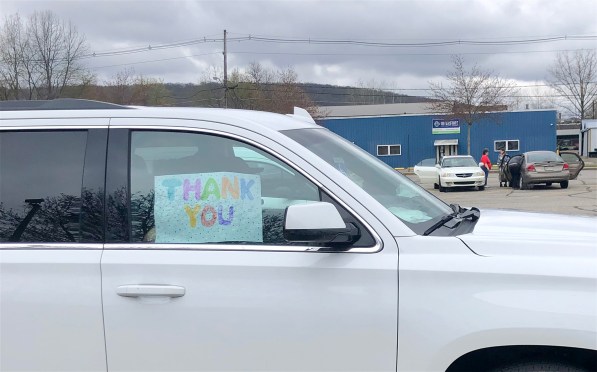
May 1, 2020 was ‘food heroes’ day — a national day to honor school nutrition personnel. In Titusville, Pa., cars had brightly colored signs of thanks for their every day food heroes at the school preparing meals for pickup, and for the milk heroes providing gallons of whole milk to their community.

USDA’s $19 bil. aid package announced, awaiting details

WASHINGTON, D.C. — Two days after describing the “bare shelves” in supermarkets as a “demand issue not a supply issue,” and stating that, “Our food supply chain is sophisticated, efficient, integrated and synchronized, and it’s taken us a few days to relocate the misalignment between institutional settings and grocery settings,” USDA Secretary Sonny Perdue announced a $19 billion Coronavirus Aid package for farmers and food banks that he says will support farmers and help relocate the food misalignment.

Later that evening, during a call with reporters, he provided a few details. The $19 billion consists of $16 billion in direct payments to farmers across commodities and $3 billion for immediate food purchases — prioritizing meat, milk, and produce.

Food assistance purchases – $3 billion

The $3 billion in food purchases will be done in conjunction with private entities, food banks and faith based partners, said the Secretary, and it will use regional and local distributors as well as large foodservice wholesalers like Sysco and PepsiCo. He said USDA is looking to get agriculture surpluses off the market and into the hands of food banks quickly as their needs are accelerating, and he kept coming back to the institutional foodservice companies, mentioning Sysco.

“This is an out-of-the-box example of what we are trying to do – something we have never done before — in realigning the supply,” Perdue said explaining the food-in-a-box concept.

“We are having these conversations about milk dumping, which has much to do with the dual-processing in this country with half of the calories consumed outside the home and with a supply chain of processing for institutional and a supply chain for groceries. That’s where misalignment needs to relocate,” said Perdue. “We’re working with our private providers like Sysco and other foodservice providers to help put meat protein and produce and dairy into those boxes to deliver prepackaged, pre-approved boxes to food banks to make it as easy as possible, so the food banks do not need a workforce to do that.”

As to what specifically goes in the box, that question was not answered, except that procurement will start with $100 million a month for dairy products, and the same amount per month each for meat and fresh fruits and vegetables.

“Distributors and wholesalers will provide a pre-approved box of these packaged items to food banks, community and faith based organizations, and other non-profits serving Americans in need,” the Secretary said.

“We have a very synchronized food system and we can’t afford for it to be offline for very long,” Perdue told reporters, stressing that USDA will use traditional and non-traditional channels of food purchasing to “relocate the dislocated supply chain to get food to where it is needed.

“We can use both the private system purchases through reimbursements, along with the normal bid procurement process,” he said, calling the “relocation of misalignment” a puzzle to solve “like Rubik’s Cube.”

In addition, USDA has up to an additional $873.3 million available in Section 32 funding to purchase a variety of agricultural products for distribution to food banks through the normal AMS bid procurement process, and $850 million from the CARES Act for food bank administrative costs, which includes $600 million designated for food purchases

Direct payments to farmers – $16 billion

Of the $16 billion, $9.6 billion goes to animal agriculture, with dairy to receive $2.9 billion, cattlemen $5.1 billion and pork producers $1.6 billion.

The remaining $6.4 billion would be divided as $3.9 billion to row-crop producers, $2.1 billion to fruit and vegetable specialty crop producers, and $500 million in the “other crop” category.

The $16 billion in direct payments to farmers will use economic analysis by USDA economists, including University of Missouri FAPRI, to determine the commodities that have a 5% or greater loss between Jan. 1, 2020 and April 15, 2020 and from April 15 through October 2020.

FAPRI recently estimated that traditional crop, livestock and dairy industries have experienced cash receipts losses exceeding 32% across commodities.

On the media call, Sec. Perdue explained that the $16 billion in direct payments for farmers and ranches will be funded with the $9.5 billion in emergency funds previously authorized by Congress in the CARES Act and the $6.5 billion remaining in the Commodity Credit Corporation (CCC) fund from unused trade mitigation funds.

The CCC will be replenished when the next fiscal year begins in July with and additional $14 billion that was earmarked for the fund in the recent CARES Act.

While USDA has not officially released details for the direct payments, and no congressional action is required to do them, several members of Congress did release detailed descriptions based on communications they had received from the department.

Sec. Perdue stated that the rulemaking process on these funds is being expedited to get checks in the mail by the end of May or beginning of June. Producers will receive one check that is determined according to two different formulas:

— Price losses Jan. 1-Apr. 15, 2020 – compensating for 85% of the price loss during this period.

— Expected losses Apr. 15, 2020 through the next two quarters, covering 30% of expected losses.

Payments are capped at $125,000 per individual or entity with one commodity and at $250,000 for individuals and entities with multiple commodities.

Sources indicate that recipients must derive at least 75% of their income from agriculture to receive these payments and have an adjusted gross income below $900,000.

Sign ups for these direct payments are expected to begin in early May through USDA Farm Service Agency.

Farm organizations have expressed gratitude for the aid package, but generally indicate it will not go far enough.

“Agriculture has been hit hard like other sectors,” said Sec. Perdue, explaining that the President had indicated earlier this year that another round of trade mitigation payments would not be necessary with the signing of trade agreements, but that was before COVID-19.

“Things have changed for our farmers with this pandemic. The President told me to do what it takes,” said Perdue.

— By Sherry Bunting, Farmshine, April 24, 2020

-30-


Monitor, document, reassess, reach out

12961237_1198446523501095_5878110278640463464_o

On the financial side of handling the plummeting prices and disruptions to what was previously expected to be a better year for dairy, Dr. David Kohl, Virginia Tech, talked about the Coronavirus pandemic’s impact and how to manage it during a Center for Dairy Excellence industry call last week.

“What is different about this is that it hit everyone in the world and how sudden it was. It created demand destruction, and it has affected consumer behavior.”

Kohl said 70% of the U.S. economy is driven by consumption, and 40% of that consumption economy is tied to airlines, hotels, restaurants, recreation and the sports world. “Now that 70% of the U.S. economy has been knocked down to 30%,” he said. “We are not going to just flip that switch.”

He sees the “consumption economy” coming back to just 75% of its prior strength in the restaurant, hospitality and foodservice sectors, “because people are changing their behavior.

“We also export a lot of dairy, but we will see a move from globalization to ‘selective’ globalization,” said Kohl. “This black swan will turn into an angry bird with agriculture as the point dog for extreme volatility.”

Dr.Kohl(headshot)

Dr. David Kohl

Kohl stressed three entities need to work together: producers, government, and agribusinesses/lenders. “Lenders will have to think about interest-only and principle deferments because producers will need good sound financials to get through this.”

Kohl said it is too early to tell what effect COVID-19 will truly have on exports. “The value of the dollar vs. other currencies is still strong. The economic health of countries we export to is important, watch for how the middle class is doing in those countries.”

Overall, Kohl sees the economic recovery being more of a Nike-shaped swoosh than a v-shaped bounce-back. As recovery takes shape, the foodservice and export demand will come back but not in a big way, he said, and not immediately.

He gave this advice as a financial expert, ag economist and part owner of a creamery:

  • Monitor cash-flow month-to-month and compare actual to projected to see where you stand.
  • Document losses so we can send a message about them to congressional delegations about what we need.
  • Meet with lender and accountant and go over the financials.
  • Communicate, be flexible and adapt.
  • Be real careful of knee-jerk reactions — that goes for farmers, lenders, and the government.
  • Follow protocols for the virus and know what your protocols are.
  • Never equate self-worth to net-worth.
  • Keep re-assessing your goals.
  • Reach out. Remember, you are not in this alone.

Kohl also sees opportunities for the future. “I have been outspoken on this. There is too much consolidation and concentration in our industry — whether it is dairy or beef,” said Dr. David Kohl, Virginia Tech professor emeritus as a Center for Dairy Excellence industry call guest last Thursday, April 23.

“We have to look at our supply chains and the vulnerability of them, the vulnerability of having too much power in the control of two few in the food and agriculture industry.

“America was built on small business and entrepreneurship. Even as small processors, we can go bankrupt very quickly, but this is where we also have great opportunity in the future,” Kohl suggested.

Participating on industry teleconferences and webinars over the past few weeks of the Coronavirus pandemic, Dr. Kohl has voiced his observations about how COVID-19 is changing consumer behavior and exposing food supply-chain vulnerabilities.

Some of his insights offer a systemic reality-check, but also present some forward-looking opportunities.

“We had a run-up in demand the first couple weeks of this thing. In general, it is still stronger, but we are also seeing people want local, and they want transparency,” Kohl reported. “People want to know where it comes from, how it is processed and to know the producer.”

He described the supply chain disruptions in dairy over the past several weeks as being attributed to large processing entities built on serving restaurants, universities, schools and other institutional foodservice, and catering to a segment of the international market – bulk products or tiny table sample products — not retail family-sized.

On the other side of that spectrum… “We are feeling this movement back to local, and it’s getting stronger,” said Kohl, adding that creamery home-delivery, for example, is taking off. “People want delivery.”

The other thing Kohl sees in consumer behavior is a return to “emotional food,” something some would call “comfort food.”

Consumers are not only following the science and realizing the healthfulness of dairy fat, they are gravitating toward natural, local and emotional food that brings comfort. Dairy can fit that mode very well if the consolidated supply chain can loosen the grip, open up, and welcome opportunities for local and regional models of processing and marketing.

Kohl said he sees it in the big trends and at the creamery — demand is growing for products like whole milk and ice cream — emotional comfort food.

Various fresh dairy products

— By Sherry Bunting, Farmshine, May 1, 2020

-30-

If you have to divert milk, here’s some advice

feed-milk

By Sherry Bunting

Production reduction and milk disposal were top-of-mind in a Center for Dairy Excellence industry call last week. Dr. Mike Van Amburgh of Cornell had advice for those dairy producers facing this impact of COVID-19 market disruptions.

Dr. Van Amburgh stressed avoidance of knee-jerk reactions based on hearsay. He urged producers to know, calculate, evaluate, prioritize, monitor, manage and review.

First and foremost, know what your cooperative is actually requiring and what the penalties are and the time frame. Producers should not assume a production cut of 10 to 15% in the next two to four months unless they have received a letter from the buyer of their milk.

Do the math for your herd. “What is the actual penalty for milk shipped over the new base? Figure out how much milk you have to divert. Calculate the pounds and the deduction and spread that over all the milk produced. What does this do to the income average?” The math is important because, he said, “you don’t want to do things that damage the herd’s ability to make milk in the future.”

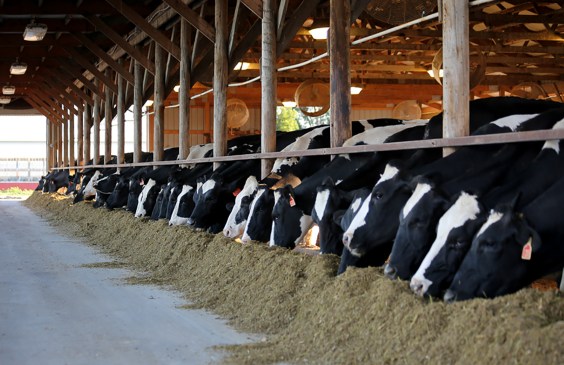
UdderComfort_FreshCowflipPrioritize cow health, and “avoid strategies that truly damage the ability of your cows to produce milk,” he said. “You don’t want to make decisions that cost you more in the end.”
Go through your records, Van Amburgh advised. If a 10 to 15% reduction is specifically required for your market, set priorities.

Be methodical, not abrupt, he stressed.

Mike_VanAmburgh

Dr. Mike Van Amburgh

Once you determine pounds of reduction to target, Van Amburgh gave these recommendations in order of priority:

1) Dry off cows: “Look first at which cows could be dried off earlier, and do the math on those pounds and percentages.”

2) Cull cows that are not paying their way. “Don’t cull too hard, be methodical,” said Van Amburgh. Even if the beef market doesn’t pay well with plant closures and disruptions, cull the cows that are costing you money and will cost you even more money when over-base penalties kick-in for those producers who have received letters.

He advised culling cows not bred and longer in milk and cows that have a history of milk quality and udder health issues.

Cull the cows that will leave your herd in a better position to bounce back in the future, and cull the problem animals that require more time and labor or have issues with health and quality.  Refine the herd for high quality milk and to have fewer health problems that drain labor resources. High quality milk is an insurance policy in a selective market.

3) Pen cows over 200 DIM separately and adjust. These are the cows to make adjustments with to slow down by feeding differently or milking 2x instead of 3x.

Check your forage inventory to be sure you have enough to do this: Van Amburgh suggests raising NDF levels on later lactation cows. Go back to the basics — 34 to 38% NDF diets are the best way to back off production, he said. To keep the rumen and the cow healthy, bring forage up to 45 to 50%, then 65 to 70%, and pull starch accordingly to slow those later lactation cows down.

By making a group of later lactation cows and pulling back toward earlier dry-off over the next 120 days — load more forage, balance protein and amino acids and pull back on starch, “you can titrate some of that milk down,” said Van Amburgh.

The key, he said, is good NDF management because it is important to manage this strategy so these later lactation cows do not get fat to avoid metabolic issues when they calve back in.

LINGEN834) Focus on health when evaluating strategies and additives. Don’t just take a lot of the extras out, but do it in a way that makes feeding a less expensive but keeps them in good health, said Van Amburgh.
5) When lowering production, keep the butterfat. This helps keep the income from deflating.

6) Feed saleable milk. “One easy way to divert milk is to feed all the calves some of the salable milk,” he said. “Feeding milk to cows or heifers is also a strategy, and we have some Cornell Pro Dairy bulletins on that.”

Van Amburgh reminded producers that feeding milk to older animals creates a little more work than feeding whey. Work with your nutritionist to see if it it’s doable.

7) Add more forage and pull back starch. “It is crucial to focus on maintaining rumen health,” he said. “It’s important to compare how much this pullback will cost you vs. what the penalties are if you don’t divert all the milk you are being asked to divert. Weigh those dollars and consider the longer-term impacts. As the market adjusts, will your herd be positioned to be healthy and productive for future cash-flow opportunities?

Van Amburgh said the Cornell Pro Dairy team is providing diet and management considerations in an effort to help dairy producers and their advisors meet the request, while maintaining cow health and working to ensure capacity to resume normal milk production relatively quickly once the situation stabilizes.

A question asked on the call was: If dairy farmers reduce their milk production with nutritional measures now, what steps can they take to come back four months from now as conditions change?

This question shows the importance of thinking through how you are going to reduce production and weigh into that decision what the market conditions might be four months from now.

“The key to the answer is the four months,” said Van Amburgh. “That’s 120 days. If you are looking at a 365 or 305 day lactation, you aren’t going to be ramping back up that part of the herd in late lactation four months from now.”

“It’s algebra and biology,” said Van Amburgh. “Yes it is possible, but first sit down and really look at these cows. The last thing you want to do is damage high production cows up front.”

He noted that Cornell is working with herds in New York that if they can’t afford to send that extra milk at a severe discount, take a step by step process for reducing it instead of the knee-jerk reaction of pulling everything out of the program.

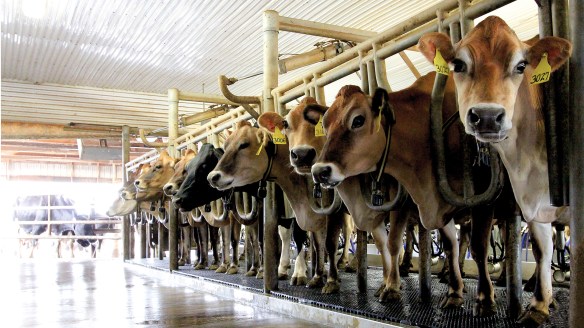
UdderComfort_MilkingParlor_18) Going from 3x to 2x milking is the last thing to consider, according to Van Amburgh. That is, unless there are acute labor considerations in the mix. Either way, Van Amburgh advised doing this strategically.
“Weigh this carefully,” he said. “Don’t do it at peak milk. If you are a 3x herd, a smarter strategy is to go to 2x on tail-enders, especially as you move them toward being candidates for an earlier dry-off.”

He said the other group to potentially target for 2x is fresh cows up to 21 days.

These considerations may fit management for some but not all dairies. Every operation will have to determine what might work best for them under their current management conditions. More on this can be found here.

Producers also wondered what they can do privately with milk needing diverted. The answer to this question varies. Robert Barley from the Pa. Milk Marketing Board was on the call, and he said there are no government entities requiring producers to cut production. This means that a producer’s cooperative is best to answer the question about other uses for diverted milk, and the answers may vary.

Producers can also talk with their cooperatives about appropriate donation channels.

On the regulatory side, selling raw milk to consumers is prohibited by most cooperatives, but where it is allowed, producers would have to obtain a raw milk license from their state department of agriculture, and only some states allow the sale of raw milk with a license.

Excess milk can be fed to other livestock on your own farm without a permit. But if it goes into commerce to another operation, it probably needs a permit as it would be identified as commercial feed. Check with your state’s ag department or bureau of plant industry.

-30-

‘Hearts full.’ Whole Milk Donation Drive-through tops 7400 gallons in New Holland

As stores raise prices and limit sales, while farmers are forced to dump milk and see their prices fall to historic lows, many respond with dairy purchases for donation drive-throughs. This example in New Holland provided whole milk from farm to table with love. It was a beautiful blessing to see…

This slideshow requires JavaScript.

By Sherry Bunting, preview of Farmshine cover story for May 1, 2020

NEW HOLLAND, Pa. — At a time like this, we all need good news. Brothers Mike and Karl Sensenig of Sensenig’s Feed Mill, New Holland, Pennsylvania started thinking about the concerns of farmers and people in their communities during this Coronavirus pandemic. They couldn’t understand why farmers were having to dump milk with nowhere for it to go, while stores had limits on purchases or empty shelves and higher prices.

So, they did the one thing they could do… They gave.

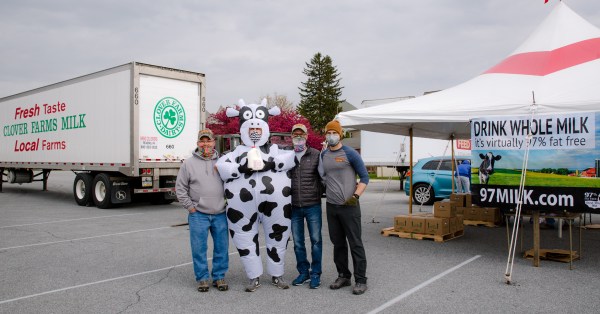
We wanted to give back to our community — and the shelters and missions and food pantries — while helping support our family farm customers at the same time,” the brothers said.Sensenig-4851The idea started coming together two weeks ago. Many of the feed mill’s dairy farm customers in eastern Lancaster County ship their milk to Clover Farms Dairy, a bottling plant in Reading. The Sensenigs spoke with Brian Ohlinger at Clover and put together a purchase order for a tractor trailer load of over 4000 gallons of whole milk for donation.

That number quickly grew to 5200 gallons as word of the plans for a Whole Milk Donation Drive-Through “From Farm to Table with Love” quickly spread through phone calls and social media.

Mike’s wife Nancy fielded over 150 calls with groups and individuals wanting to pre-order for families in need. The entire company — all of the employees — were involved. They amassed a list of over 25 outreach organizations pre-ordering hundreds of gallons to distribute from New Holland to Lancaster to Reading and Allentown, including notables like Water Street Mission, Blessings of Hope, Crossnet, Crossfire, Petra, Safehouse, Good Samaritan and other ministries, churches, shelters, town and company food banks, fire companies, nursing homes, youth centers — so many organizations.

The Sensenigs saw the need and desire for whole milk growing, and they quickly realized even this would not be enough. So, they worked with Clover to get a second single-axle truck of 1152 gallons.

Cars lined up early on the first day of the Whole Milk Donation Drive-through (Apr. 23), while trucks were loaded with bulk orders for charities. The drive-through lines were opened ahead of schedule, and within the first 30 minutes, they had already served around 100 cars.

If this pace kept up, the Sensenigs feared they would run out. So, they called Clover again, and within two hours, a third truck arrived on the premises with another 1100 to 1200 gallons. 

All told, Sensenig’s Feed Mill had purchased 7,476 gallons of milk for donation so supplies would last through both days of drive-through times.

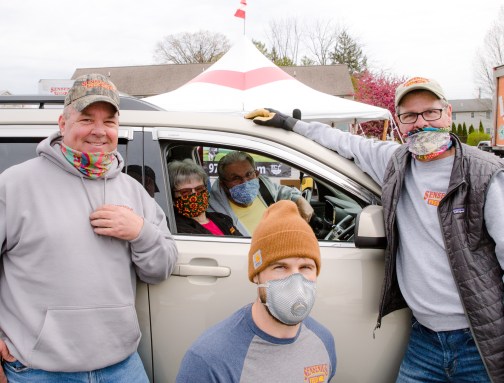
Two generations of the family — Karl, Mike, and Mike’s sons Kyle and Kurt, along with employees Devin Shirk, Steve Morris, Greg Hill, Curtis Hershey, and Lee Stoltzfus loaded vans, trucks, and cars with fresh gallons of whole milk, while Mike’s wife Nancy and employee Dawn Wright directed cars through the M&T Bank parking lot into two lines on either side of the truck and tent.

Even Karl and Mike’s parents Ken and Sandy drove over to watch.

Sensenig-4914They are quick to point out that this would not have been possible without their employees. “This isn’t just us,” he said. “Everyone was excited to do this and to be involved.” The family’s feed mill is celebrating its 75th year in New Holland.
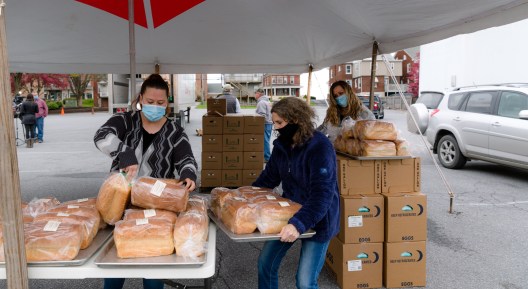
Also wanting to make an impact, a group of concerned citizens affiliated with M&T Bank joined their neighbors in the parking lot — bringing 150 dozen eggs and 50 fresh-baked loaves of bread from Achenbach’s Bakery, Leola.

Sensenig-4786Kurt Sensenig even donned an inflatable cow costume at the start, before he was called back to the feed mill.
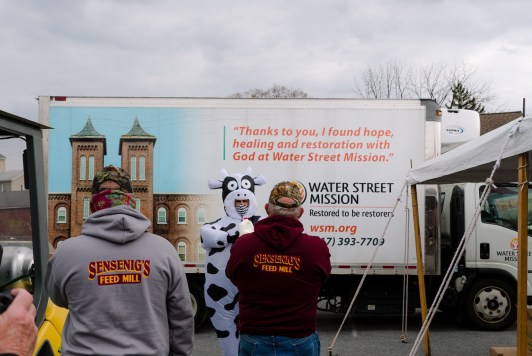
Sensenig-4845

“We have been overwhelmed by the response since we first started taking pre-orders to gauge how much milk we would need. Then the steady stream of people just driving through was amazing. There is so much emotion,” said Mike.

Sensenig-4939

“This brings home the reality of how many people are struggling right now. And it shows how many people LOVE WHOLE MILK!” said Karl. “Some who drove through the line had tears in their eyes. It seems like something so little. Then you realize how it helps so much, and it shows us how much we can take for granted.”

He tells of a grandmother who drove through with her two grandchildren she is raising. She tentatively asked if she could have two gallons. “I said, ‘you can have more if you need it,’” Karl reflected. “She wondered if it’s not too much trouble, she would use four gallons. I said, ‘sure!’ What she said next really got to me: ‘Now my grandkids can have milk with their cereal.’”

Cereal is a popular item for food bank distribution, but milk is hard to come by, especially whole milk.

One person drove through, saying they had stopped at their usual store to buy milk, but found no whole milk, so they came to Whole Milk Donation Drive-Through and took home four gallons.

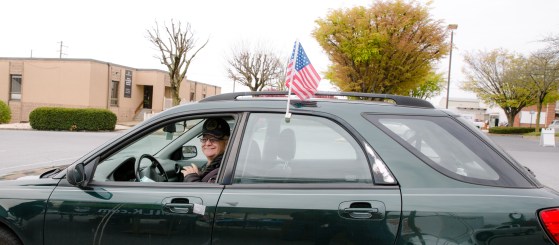
Many veterans in the area came through and were grateful for the whole milk they accepted with smiles. Drive-through crews, in turn, thanked them for their service.

Sensenig-4903The bottom line for the Sensenigs and their employees was to bless others even as they believe they are blessed; to do something positive for their community; to help dairy farmers by connecting dots to get whole milk to missions, food banks and families; to bring smiles to young and old during uncertain times that have changed life as we know it.

“We have many dairy farm families as our customers, and we see the milk they have been forced to dump in the past few weeks due to supply chain disruptions while at the same time stores limiting purchases of milk or having little or no whole milk on the shelves,” said Mike. “Clover gave us a price for just the milk, and they packed the first two orders in boxes for us and provided the refrigerated trucks to stay here two days.”

“It takes teamwork,” said Karl. As part of the loading crew, he and his brother were busy all day in constant motion, unloading skids, opening boxes, loading trucks and trunks, and handing out gallons to appreciative people as they drove through.

“I’ll sleep good tonight,” said Karl.

Mike agreed: “Our minds and bodies are exhausted, but our hearts are full.”

The community of farmers and citizens thank all involved! This scene being repeated in other communities is a beautiful thing to see.

Sensenig-4869Others have stepped up doing similar milk donations. Some businesses have bought 500 gallons to give to employees and food banks; one couple in western Pennsylvania feeling blessed to still be working in agriculture are using their stimulus check to buy 500 gallons of whole milk to donate in a drive-through next week at their school; young farmer clubs and other organizations are working with milk cooperatives and processors to donate and raise funds for dairy donation drive-throughs in other parts of Pennsylvania, New York, the Southeast and elsewhere. Some are set up weekly, with people giving donations as they pick up milk and dairy products that are then used the next week to purchase more for donation.

Meanwhile, many store chains are raising prices and limiting purchases to shoppers for milk and dairy products on their sparsely stocked shelves, claiming a shortage, even as farmers are receiving letters that they must cut production because their product “has no demand,” and they are seeing the price they are paid for their milk fall by more than 35% in just four weeks.

The COVID-19 pandemic is revealing how the centralized supply chain is broken — not making the shift from foodservice to retail. Drive-through donation deals like this one, connect the dots at a more localized level so families get access to the milk and dairy products — especially whole milk — that they need want, while helping outreach organizations distribute to the growing number of families facing unemployment and business closures.

On Friday, April 24th, as the New Holland Whole Milk Donation Drive-Through came to a close, 97 Milk LLC — a grassroots volunteer milk education effort — announced on facebook a fundraising collaboration with Blessings of Hope food pantry mission. The new campaign specifically raises funds to purchase whole milk gallons for the ongoing blessing boxes to families in a 200-mile radius of the Blessings of Hope warehouse in Leola, Pa.

Dozens of dairy-related agribusinesses already sponsor the grassroots farmers’ 97 Milk education effort, which began a little over a year ago with a round bale painted by Berks County, Pa. farmer Nelson Troutman with the words Drink Whole Milk (virtually) 97% Fat Free.  (Whole milk is standardized to 3.25% fat). Such ‘baleboards’ now dot the countryside, along with banners, vehicle signs, a website, facebook page and other social media platforms (97milk.com and @97milk on facebook and instagram; @97milk1 on twitter).

As for the new 97 Milk / Blessings of Hope Whole Milk fundraiser, the response has been immediate. Within the first hour of announcing it on facebook Friday — $4100 had already been raised to keep purchasing whole milk for blessing boxes. Check it out here.

WholeMilkDonationDriveThrough4834Postcript: Karl and Mike Sensenig wish to recognize the mill’s entire team of employees for making the April 23-24 Whole Milk Donation Drive-Through possible: In addition to Karl, Mike, Kurt, Kyle, Scott, Emily and Nancy Sensenig, employees Calvin Buckwalter, Dale Clymer Jr., Ryan Crowther, Raymond Geiter III, Ashley Gesswein, Jared Grosh, Tim Hall, Curtis Hershey, Greg Hill, Dr. Don Jaquette, Joshua Kenderdine, Gerald Martin, Lawrence Martin, Nathan Martin, Steve Morris, Todd Morris, Steven Oberholtzer, Ron Phippen Jr., Devin Shirk, Eugene Shirk, David Stauffer, Allen Steffy, Terry Tshudy, Dwayne Weaver, Elmer Weaver, John Weaver, Logan Weaver, Nelson Weaver, Thomas Weaver and Dawn Wright were all involved. Even the previous generation to run the feed mill — Ken and Sandy Sensenig — came out to watch.
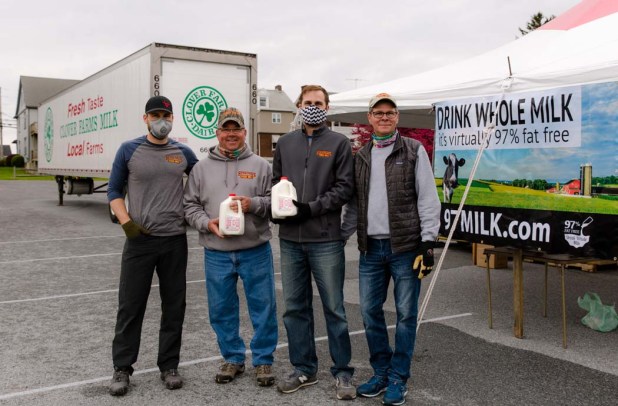
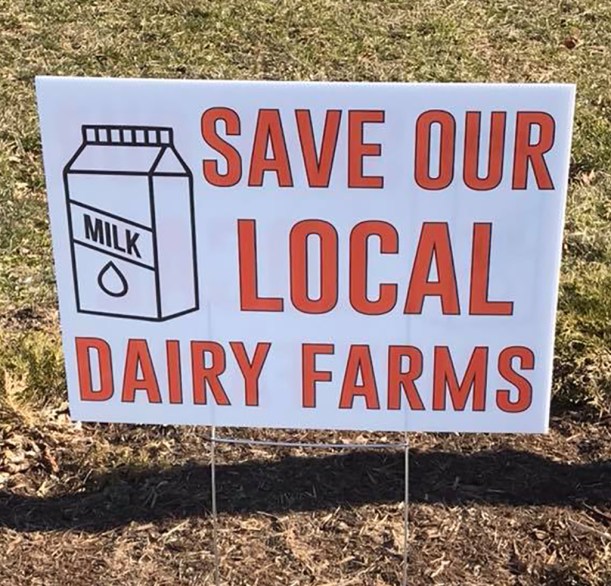
wSensenig-4724

The Sensenigs and their employees are happy to be part of something that blesses others, to see it multiplied, to see people appreciate whole milk, and to know what their customer dairy farm families produce is in demand. These efforts are uplifting and make a difference.
More links to stories on this and other efforts:


Call to action: Grassroots dairy group seeks PA Senate leadership action to move House-passed bills forward

Lebanon9495(Signs)

By Sherry Bunting

HARRISBURG, Pa.  — The Pennsylvania House of Representatives passed two dairy bills virtually unanimously last December, but the Senate Ag Committee has failed to act.

On April 7, the Grassroots PA Dairy Advisory Committee sent a LETTER to Senate President Pro Tempore Joseph Scarnati asking to bring new leadership to the Senate Ag Committee to move these bills forward.

The Grassroots group is now asking fellow dairy farmers and citizens to help by contacting Senate President Pro Tem Scarnati’s office at jscarnati@pasen.gov and/or 717.787.7084. Simply email or leave a message asking for new leadership in the Senate Ag Committee to move H.B. 1223 and 1224 forward for Senate consideration.

“Now, there is an opportunity of a lifetime for you to save our dairy industry from complete failure. With the COVID-19 pandemic, displacement and dumping of local Pennsylvania milk and a 35% milk income loss across our farms in one month and expected to continue for the next three, at least, you have an opportunity to get these bills out of committee and onto the floor,” the letter to Scarnati explained.

“The Pennsylvania dairy industry is at risk to losing it all — given our small and numerous herd size — the heart of rural PA. Rural Pennsylvanians are counting on this industry to survive COVID-19,” the letter continues. “Now is your time to act.”

“These two bills were overwhelmingly passed by the House, so why is the Senate Ag Committee stalling? For five months they have ignored these bills,” said Nelson Troutman, a Berks County farmer. “Pennsylvania dairy farmers put their income right back into their communities, but they get no help from the Senate on these issues that are critical for our farms to stay in business.”

“How does this happen? How can the House pass two dairy bills 196-0 and 194-2 while the Senate keeps them in a drawer? It doesn’t make sense. We can’t continue down this road,” said Potter County dairy farmer Dale Hoffman.

His daughter Tricia Adams and her brothers are all partners in the farm with a third generation now involved also. Like other dairies, Hoffman Farms is economically important in their community while providing wholesome nutritious milk and hosting farm tours for nearby schools.

“People in our community ask me all the time, what can I do to help? They want to know the milk they are buying is as local as possible, and they want to know they are supporting the farms in their community who provide it,” said Adams. “There is a point when we have to stand behind something and take action. Is it too much to ask that the premiums be returned to farmers as intended? Is it too much to ask for the Senate to consider these bills that the House passed in a bipartisan way?”

The two bills — H.B. 1223 and 1224 — were introduced early last year by Rep. John Lawrence (R-13th).

H.B. 1223 passed by a vote of 194-2. According to Rep. Lawrence, this legislation would establish Keystone Opportunity Dairy Zones (KODZ) to incentivize expanded dairy processing facilities in Pennsylvania to expand markets for milk from Pennsylvania farms. It is modeled after the long-standing Keystone Opportunity Zone (KOZ) program. To qualify, applicants would have to use private capital, create new jobs, and use primarily milk from Pennsylvania farms.

H.B. 1224 passed by a House vote of 196-0. According to Rep. Lawrence, the legislation would give the Pennsylvania Milk Marketing Board (PMMB) the ability to coordinate the collection and distribution of state-mandated milk premiums with the Department of Revenue, ensuring the premiums reach struggling dairy farmers.

“Pennsylvania’s family dairy farmers are struggling due to historically low prices and foreign competition. Taken together, these bills will positively impact every dairy farmer in Pennsylvania,” Rep. Lawrence observes. “I appreciate the bipartisan support these bills received in committee and on the House floor.”

According to Rep. Lawrence’s press release, both bills also received support from family dairy farmers across the state, the Pennsylvania Farm Bureau, the Pennsylvania Association of Milk Dealers, the Pennsylvania Association of Dairy Cooperatives, and the Pennsylvania Milk Marketing Board.

“We are at a crossroads in Pennsylvania, where agriculture is our number one driver of our state’s economy, and dairy is the linchpin. We are losing farms every day, hundreds of them every year, and with them, we stand to lose other businesses, jobs and the economic vitality of our rural communities,” said Karl Sensenig of Sensenig’s Feed Mill, New Holland.

“Our farm families are being pressured from all sides by five years of economic stress and market losses as rapid consolidation accelerates production in other regions. Now the coronavirus pandemic is revealing how the system is starting to collapse and how easily these state-mandated premiums disappear in the system between the consumer and the farm,” said Mike Eby, a Lancaster County farmer and chairman of National Dairy Producers Organization. “These bills are following the same pattern we saw in three previous sessions where other transparency bills were passed by the House only to die in the Senate without consideration. What is Senate Ag Committee Chairman Elder Vogel afraid of?”

“The current pandemic shows how important it is for our state to have strong farms and vital processing for our citizens to be food secure. We see our farms being forced to dump milk, losing access to markets, and at the same time scarce supplies of milk and dairy products at stores and limits on purchasing,” notes Krista Byler, a farmer in Crawford County. “These bills help connect some of those dots between farms and consumers.”

For Katie Sattazahn, a dairy producer in Womelsdorf, these bills “offer hope as the dairy situation in Pennsylvania is deteriorating. We have the land, climate and young producers who have grown up on the farm, pursued degrees, and come back with knowledge, passion and talents to move family farms forward, but wonder if they’ll have the opportunity,” said Sattazahn.

Over the past decade, Rep. John Lawrence has introduced other bills aimed at improving PMMB over-order premium transparency. Previous bills also passed the House but were ignored by the Senate Ag Committee.

Now, this pattern continues as H.B. 1223 and 1224 languish without consideration by the Senate Ag Committee under the leadership of Chairman Elder Vogel Jr., representing Pennsylvania’s 47th district.

“This has gone on for too long,” said retired agribusinessman Bernie Morrissey of Robesonia. “Our farmers have been patient. They have been involved in working on these issues for more than 10 years. Our consumers pay a higher price for milk that includes these premiums that the law requires be paid to farmers. It’s time for the Senate to act on this legislation that helps make sure these funds get to our Pennsylvania farms.

“It’s time for Senate President Joe Scarnati to bring a leadership change to the Pennsylvania Senate Ag Committee,” Morrissey added.

The Grassroots PA Dairy Advisory Committee is chaired by Morrissey and is comprised of dairy producers and related agribusiness representatives from diverse regions of the state.

Their letter was also sent to Senate Ag Committee Chairman Elder Vogel and all members of the Senate Agriculture and Rural Affairs Committee on Tuesday, April 7, 2020.

To support action and leadership on these bills, farmers and citizens of Pennsylvania are asked to contact PA Senate President Scarnati at jscarnati@pasen.gov and 717.787.7084. Simply email or leave a message asking for new leadership in the Senate Ag Committee to move H.B. 1223 and 1224 forward in the Senate.

Copy_of_LETTER_040720

DairyBills_PMMB_Backgrounder_041720

-30-