Producers seek checkoff vote and transparency as fake food transformation ramps up

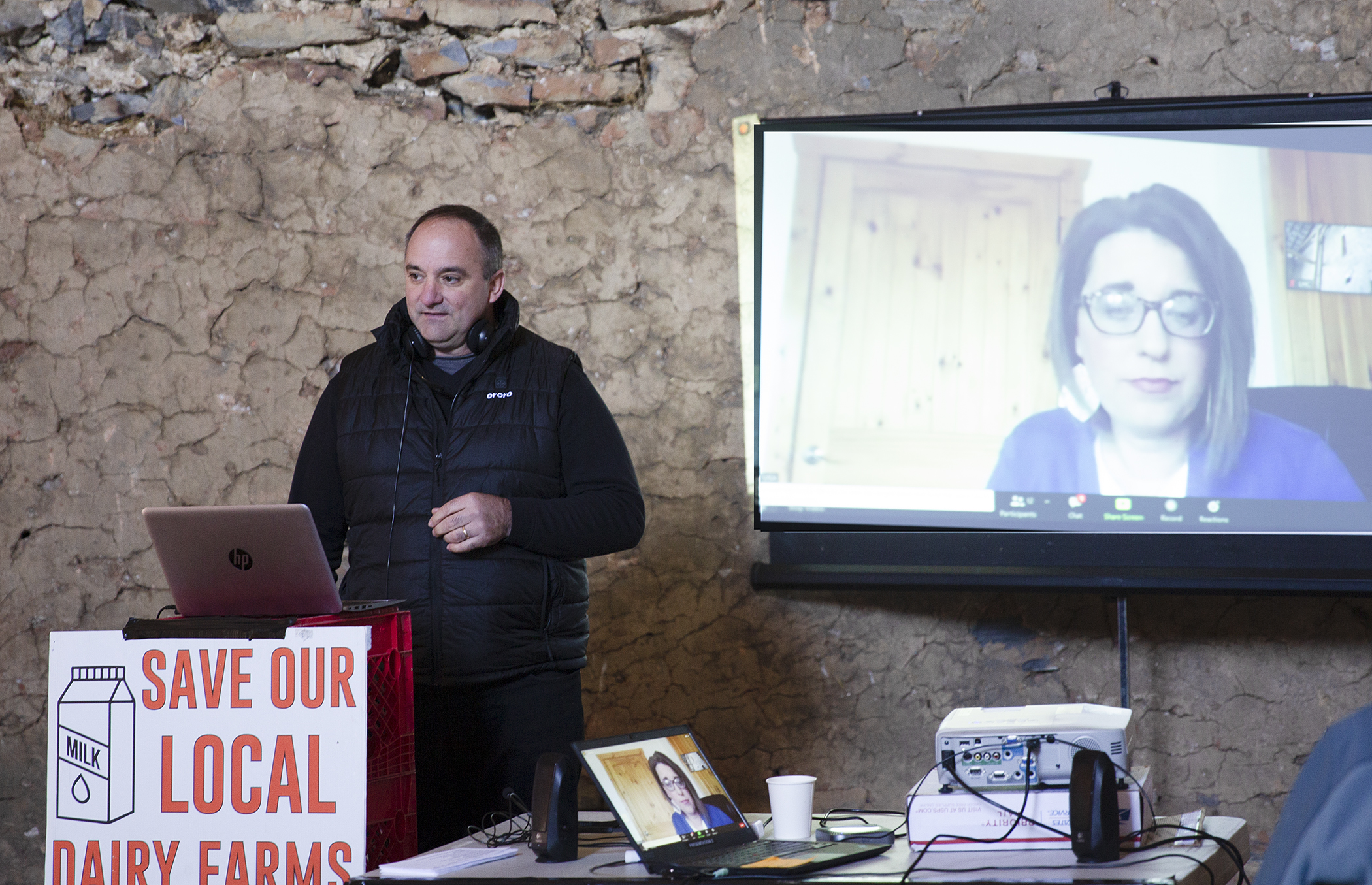
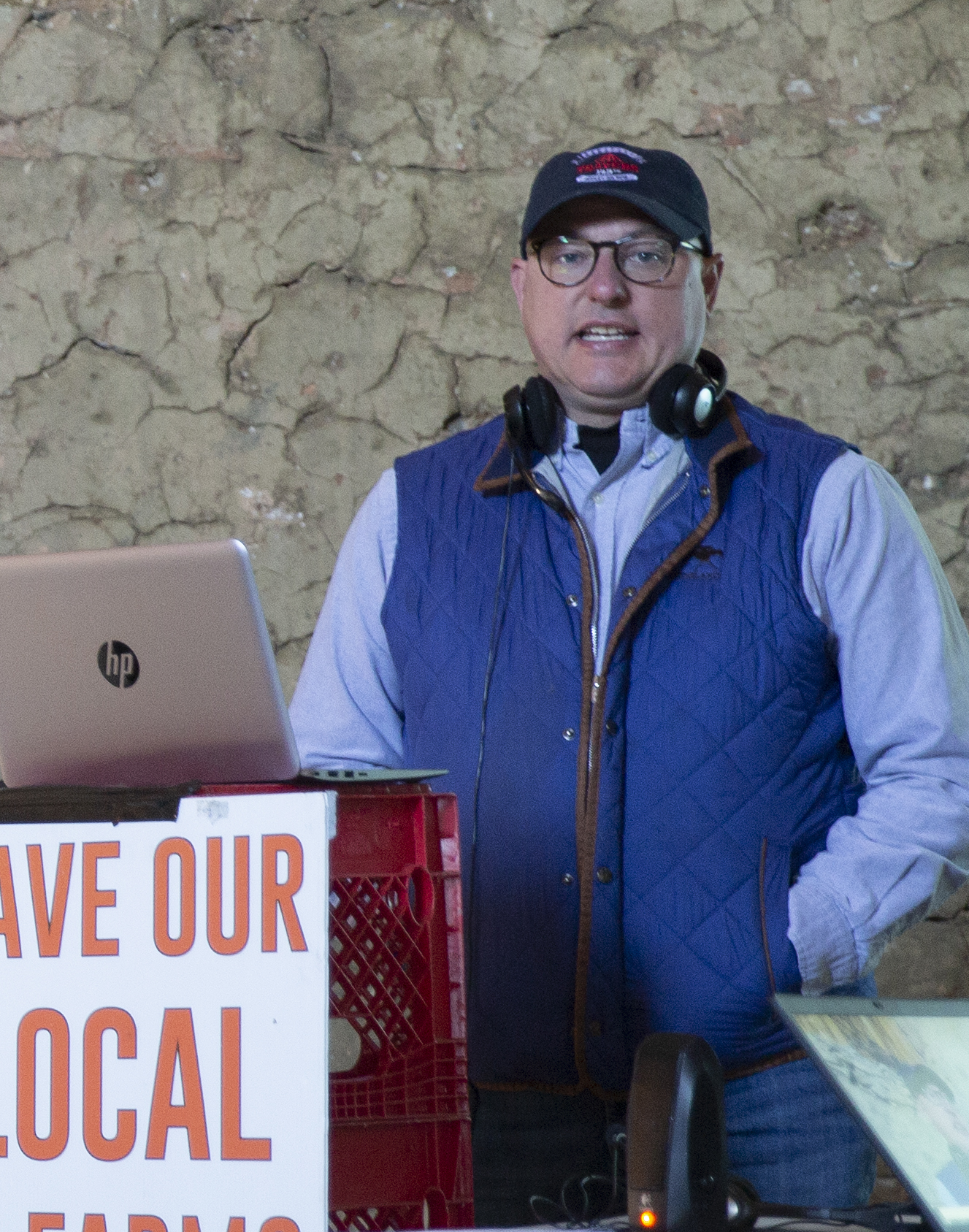
Mike Eby introduces Karina Jones who spoke to attendees live and virtually about the beef checkoff referendum petition. Jones was part of a panel of speakers on various topics during the daylong “Empowering Dairy Farmers” barn meeting at Eby’s farm in Lancaster County, PA on April 23. 

By Sherry Bunting, Farmshine, May 14, 2021

GORDONVILLE, Pa. – “Beef it’s what’s for dinner.” Remember that line?

For school kids, it could soon be Impossible Meat for lunch. USDA just approved a nutrition label for K-12 schools to substitute beef with the billionaire-invested Impossible Meat. Never mind that a May 2020 Newsweek article reported Beyond Meat, Impossible Meat and their competitors source most of their concentrated pea- and soy-protein from extrusion factories in China, even if the crops were grown in North America.

School foodservice directors report a barrage of supply-chain influencers touting fake meat meal options to reduce carbon emissions on the heels of the USDA nutrition label approval.

A local restaurant discovered last month that their wholesale food vendor added textured vegetable protein (concentrated soy and other additives) to the wholesale ‘Classic Beef Burger’ without warning. It is apparently part of a ‘cutting edge’ menu remake at the wholesale level – not the restaurant’s choice. (This particular restaurant switched promptly to Certified Angus burgers guaranteed to remain 100% beef).

Children came home from school this week with Junior Scholastics declaring “This meat could help save the planet!” accompanied by a photo of fake-beef in grocery packaging.

Junior Scholastic Weekly Reader came out with this story urging kids to eat less beef, just a week before USDA’s announcement this month (May 2021) of approval for the ‘Impossible Meat’ school lunch nutrition label, ushering in the barrage of global foodservice companies hounding school foodservice directors about reducing climate change with this stuff (cha-ching, cha-ching). Companies like Cargill and Tyson that are among the big 4 in BEEF processing — with strong ties to the lobbying side of the separate NCBA / CBB — are also going big into FAKE beef. The beef and dairy checkoff programs also have strong ties to World Wildlife Fund and collect checkoff money on imported beef and dairy so this clouds their ability to use the funds they mandatorily collect from U.S. farmers to promote U.S.-produced REAL beef and dairy.

These are just a few examples in the past three weeks of how rapidly the wheels set in motion a decade ago are hitting the pavement.

How did we get here? For 12 to 13 years, the World Economic Forum (WEF), World Wildlife Fund (WWF), Big Food, Big Tech and Big Ag have been coalescing around this idea of supply-chain “sustainability” leverage to steer global food transformation with cattle clearly in the crosshairs – especially for developed nations in Europe as well as the United States.

By partnering officially and unofficially with national dairy and beef checkoff boards on “precompetitive sustainability and innovation”, for example, WWF has — in effect — been channeling government-mandated producer checkoff dollars toward implementing WWF’s supply-chain strategy for impacting commodities WWF believes need intervention to improve biodiversity, water and climate. The global corporations behind ‘food transformation’ are laughing all the way to the bank while grassroots producers essentially fund their own demise.
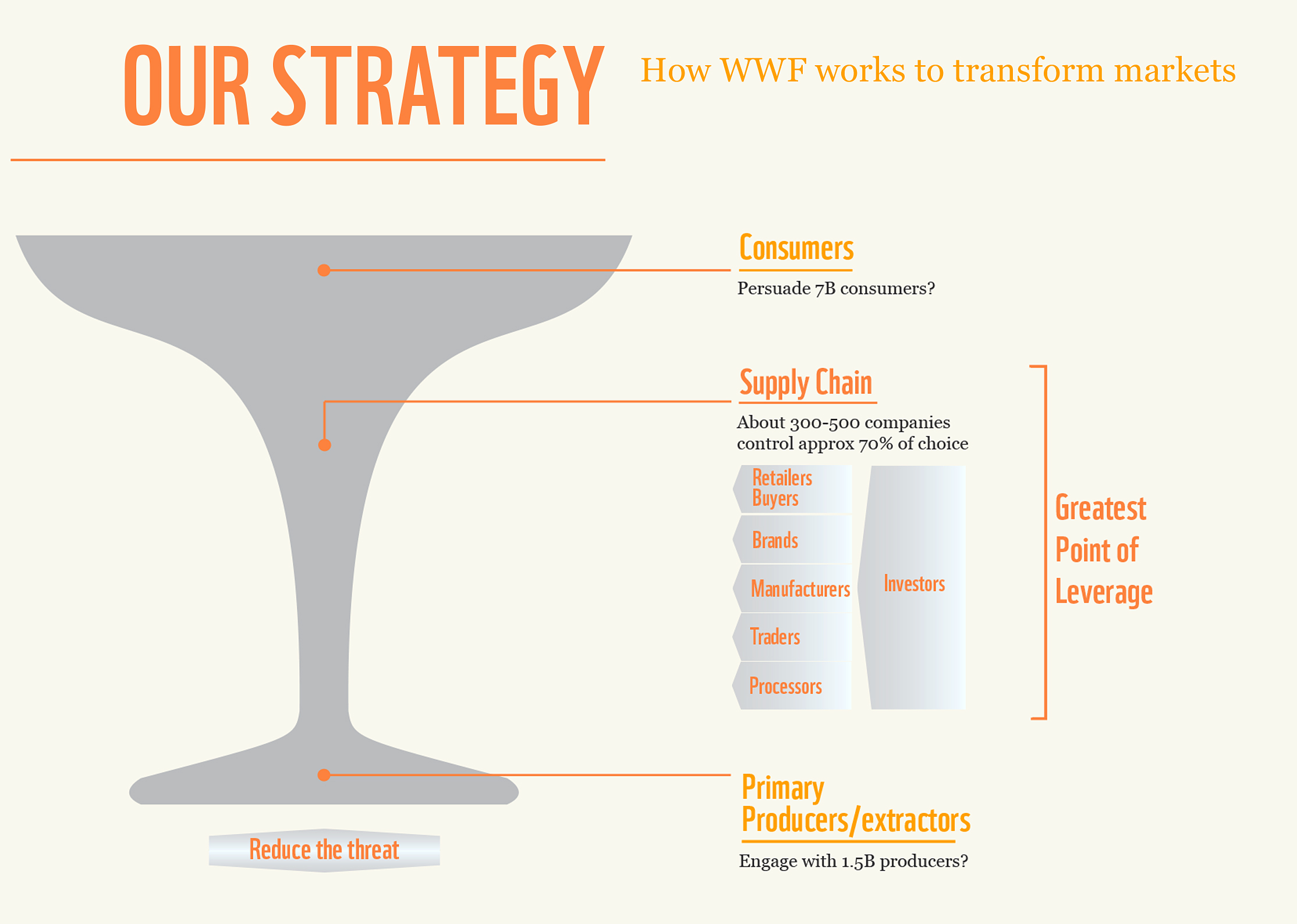
By partnering with dairy and beef checkoff national boards in a ‘pre-competitive’ arrangement, WWF implements its “supply-chain” leverage strategy, WWF has essentially used producer funds to implement their message and priorities both to consumers through supply chain decisions and to producers through checkoff-funded programs validating farm practices. The World Wildlife Fund in its 2012 Report “Better Production for a Living Planet” identifies this strategy to accomplish its priorities for 15 identified commodities, including dairy and beef, related to biodiversity, water and climate. Instead of trying to change the habits of 7 billion consumers or working directly with 1.5 billion producers, worldwide, WWF states that this “practical solution” is to leverage about 300 to 500 companies that control 70% of food choices. Image from 2012 WWF Report

In the 44-page 2012 paper “Better Production for a Living Planet,” the WWF Market Transformation Initiative identified dairy and beef as two of the prime commodities they target through supply-chain companies controlling 70% of food choices.

The checkoff-funded sustainability materials coming out of the National Cattlemen’s Beef Board and Dairy Management Inc (DMI) show firsthand this relationship with WWF, by the use of the WWF logo, and in the case of dairy, the acknowledgment that a decade-long memorandum of understanding existed.

Add to this the government policies emerging that align directly with this global food, agriculture and land transformation, and the use of the vehicle of checkoff-funded “government speech,” becomes a bit clearer. It’s a clever way to leverage the supply chain and promote a message to consumers while pushing producers to align.

The WWF 2012 paper explains that in 2010, “WWF convened some of the biggest players in the beef industry to form the Global Roundtable for Sustainable Beef (GRSB). They included the world’s biggest beef buyer, McDonald’s; the biggest beef retailer, Walmart; and two of the largest beef traders, JBS and Cargill.”

While dairy and beef checkoff programs use government-mandated funds collected from producers for valuable local and state promotion programs linking producers to consumers, it is the direction of national checkoff programs – engaged with WWF and the largest processors and retailers in this way — that has producers like Karina Jones, a fifth generation Nebraska cattlewoman concerned.

Jones heads up the petition drive for a producer referendum on the $1/head beef checkoff. The effort began in South Dakota and is spreading nationwide via R-CALF and other national and state organizations.

During the farmer empowerment barn meeting hosted by Mike Eby of National Dairy Producers Organization (NDPO) and Organization for Competitive Markets (OCM) at his farm in Gordonville, Pennsylvania recently, two of the day’s speakers talked about the need for transparency and accountability in mandatory checkoff programs.
Marty Irby of Organization for Competitive Markets (OCM) talked about bipartisan legislation seeking more transparency and accountability for all mandatory producer checkoff programs during the Empowering Dairy Farmers meeting last month.

Marty Irby of OCM talked about the OFF Act, which is bipartisan legislation seeking to amend the checkoff laws to reaffirm that these programs may not contract with organizations that engage in policy advocacy, conflicts of interest, or anticompetitive activities. It would require publication of all budgets and disbursement of funds for the purpose of public inspection and submit to periodic audits by the USDA Inspector General.

“It’s not about taking those promotion dollars away, but to have a just system of checks and balances,” said Irby about the proposed legislation.

But others are taking a grassroots vote approach  — concerned about government oversight of what is already determined to be ‘government speech’ funded by producer checkoff.

Jones talked at the barn meeting about the massive effort to gather over 100,000 signatures by July 2021 asking USDA to conduct a nationwide Beef Checkoff Referendum. A vote on the beef checkoff has not been conducted in 35 years. (See checkoffvote.com and the paper insert in the May 14, 2021 edition of Farmshine)

“It’s time to re-check the checkoff,” said Jones about the beef petition. “We want to signal to USDA that as cattle producers we are ready to vote again.”

She explained that in order for the Secretary of Agriculture to consider a referendum request, 10% of producers must sign the petition. This includes anyone who sold a beef animal and paid the $1/head checkoff, in the 12 months from July 2020 through July 2021, including beef cow-calf producers, seedstock producers, backgrounders, cattle feeders, dairy producers, and youth showing and selling livestock.

According to the 2017 Census, 10% of the beef producers would mean 89,000 signatures needed.

“But we don’t know the vetting process the Secretary will use to approve or deny the petition request, so we want to reach over 100,000 signatures by July 2021,” said Jones.

“The cattle landscape today is much different from 35 years ago,” she said. “Our checkoff does not support promotion of American-born-and-raised beef. We want to equalize the power for the grassroots U.S. cattle producer… the power and the dollars are falling into the hands of the few.”

According to Jones, the checkoff referendum petition seeks a return to balance as well as increased transparency and accountability, through the voting process. Proponents of the right to vote believe producers should be able to fund education and promotion that takes a stand for real, USA-produced beef, something the trends and supply chain partnerships emerging today – along with “government speech” rules — make difficult.

She talked about “mavericks” who were elected to the beef board in the past and tried to change the power structure of the lobbying groups and processing industry involvement. Jones said the current structure has gone on so long — uninterrupted — that a referendum petition is the only avenue many beef producers see today as a way to bring accountability back.

“This is a call to action. Many producers are still not aware of this beef checkoff referendum petition,” said Jones as she urged producers to be bold and harness the opportunities to set a direction that changes the balance of power.

To be continued

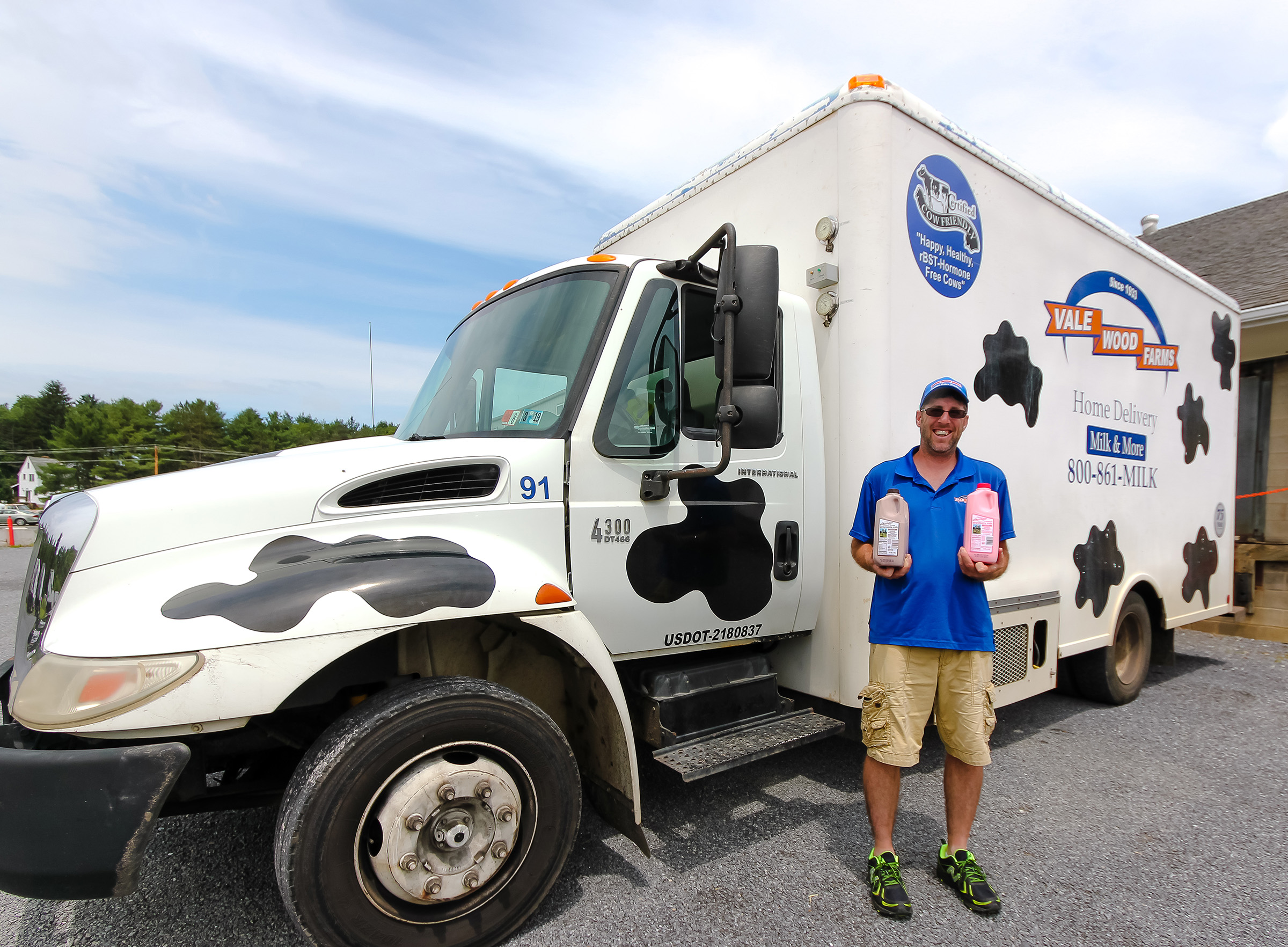
Vale Wood Farms stays steady, but nimble, delivering ‘moo to you’ since 1933

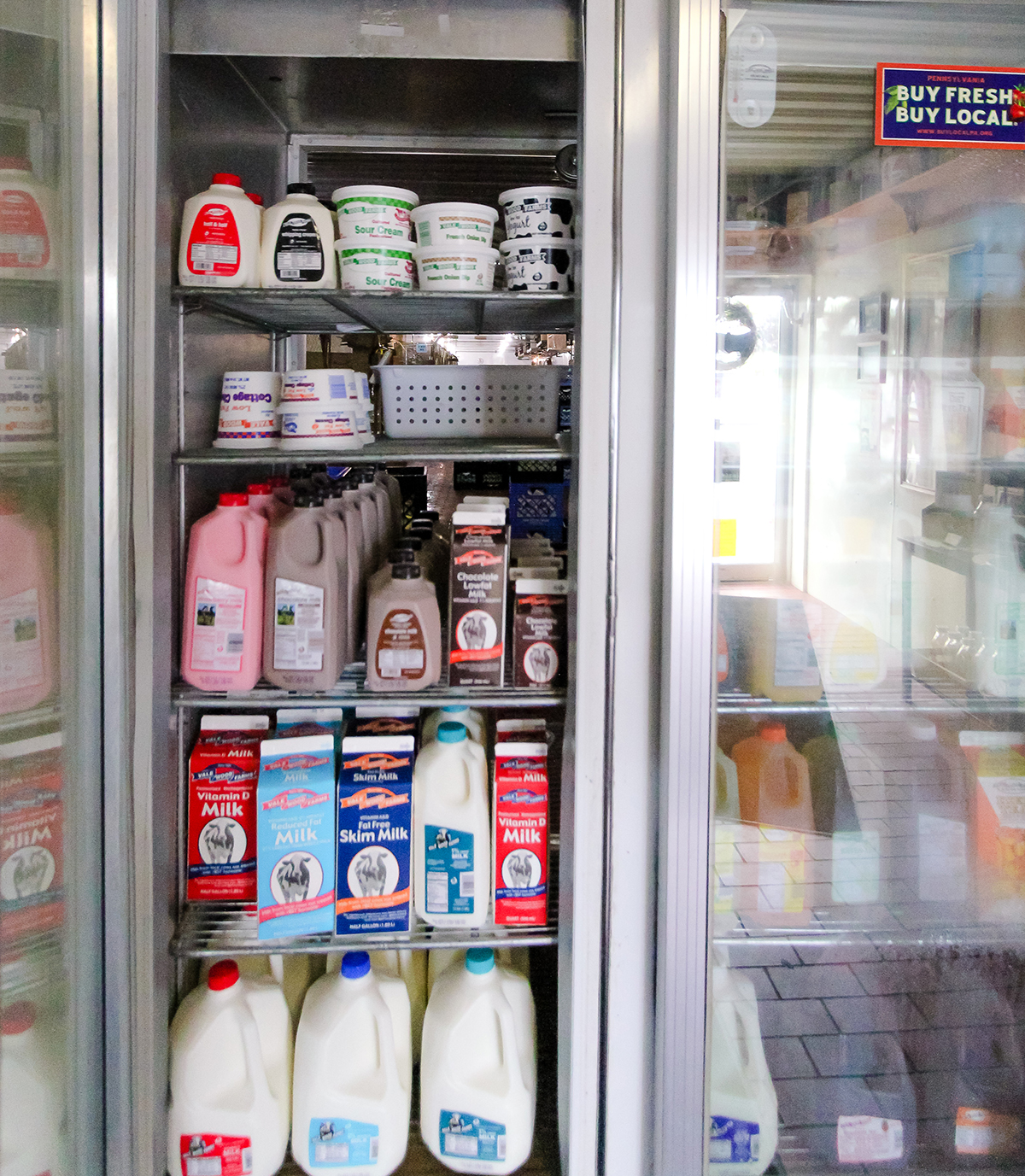
Carissa Itle Westrick enjoys working every day with her father, Bill Itle. They see whole milk, local connections and home delivery as big trends for dairy — even before the pandemic — that are key parts of their farm and processing for decades. They also share concerns about consumer confusion with the onslaught of imitation beverages in the dairy case.
 

By Sherry Bunting (updated since originally published in Farmshine in 2018)

LORETTO, Pa. — Take a step back to a simpler time. A time when dairy farmers were looked up to, not questioned. A time when the milkman delivered fresh dairy milk to the metal ice box on the doorstep. A time when milk’s good name was upheld. When milk was milk.

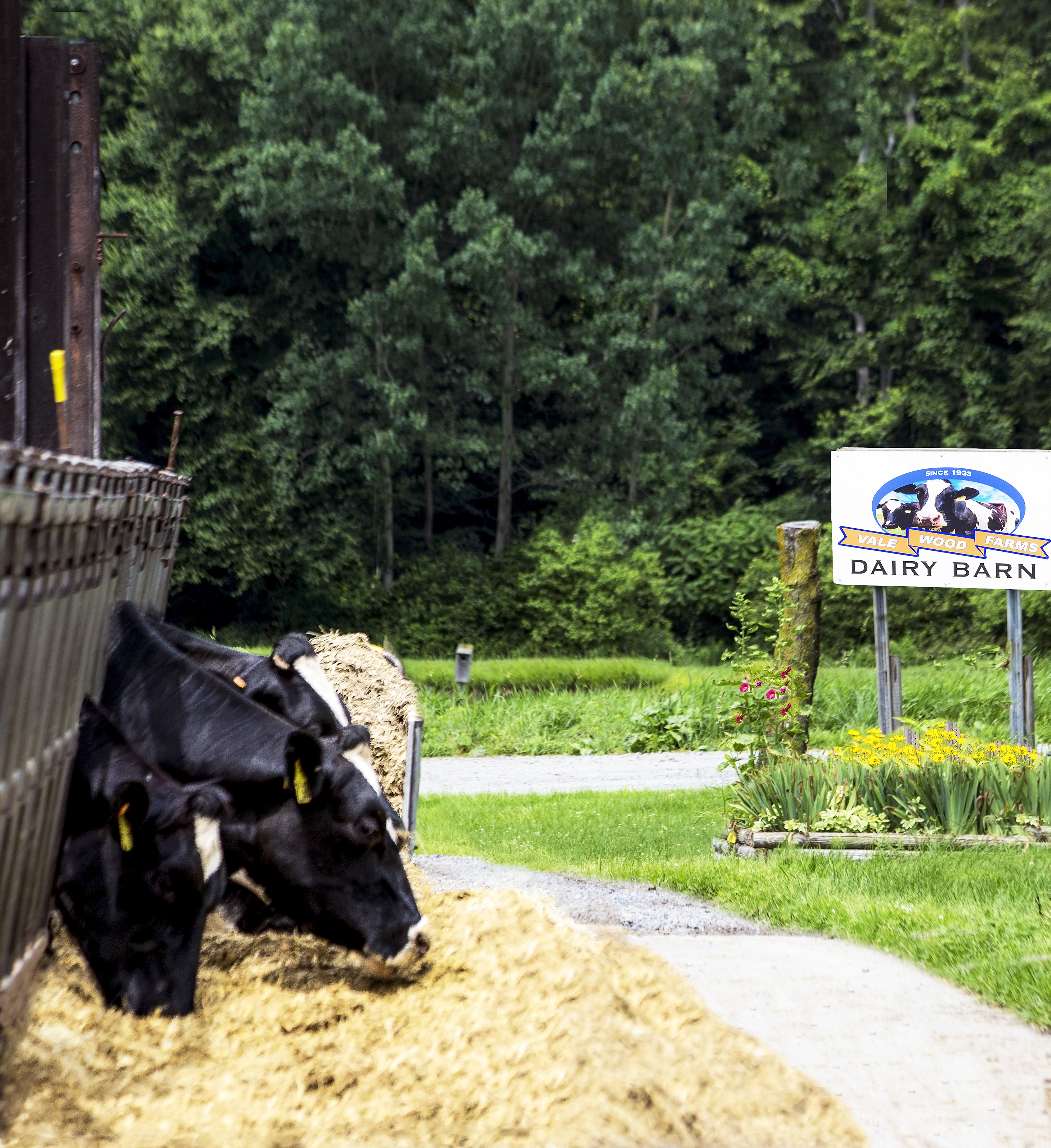
A visit to Vale Wood Farms, Loretto, Cambria County, Pennsylvania, is in some ways a step back in time, but it is also a bold look into the future — one that delivers fresh, local, real milk and dairy to consumers. One that develops farm-to-consumer relationships as everything old becomes new again.

It’s not easy to corral a few of the third and fourth generations of the Itle family as they go about their work here. Getting them to drop what they’re doing for a group photo? Forget about it. Everyone’s busy with three separate businesses under one sign. And they’re not keen on drawing attention to themselves, but rather draw attention to milk and dairy.

Converging trends shape their market, and consumer connections are critical. (For example, today, two years since this article was first published, people have rediscovered whole milk and cream and since the Coronavirus pandemic, local foods and home delivery are a trend.)

But in the overall dairy industry, there is a growing number of competing beverages marketing outside the lines of real milk’s FDA standard of identity — introducing a growing surge of competing imitations into the dairy case.

In these challenging times, many dairy farmers consider on-farm processing. Carissa Itle Westrick, director of business development at Vale Wood Farms, acknowledges the risk and insecurity of this business that relies on building consumer and community relationships.

She points out that in some of their sales – wholesale and institutional – they, too, are price takers.

“My great great grandfather (C.A. Itle) was grappling with difficult economic choices in 1933 when he hitched up his horse and wagon and went to town,” Carissa relates.

Today, the Itles have a window into seeing how milk production levels in excess of demand impact profits throughout the supply-chain.

In the dairy sector, we often hear the experts and consultants drive home the point that ‘the next pound of milk is the most profitable milk on the farm.’

Is it?

“Our economics are different,” Carissa points out. “That next pound of milk is not necessarily the most profitable. If we can’t sell that next pound of milk, then making it means we just made less profit on all the milk. For us, that approach doesn’t make sense.”

What does make sense is adding processing efficiencies and capitalizing on consumer trends, while helping to shape them.

“We have to make sure what we do fits today’s families,” Carissa notes. “We are small enough to be fairly nimble, which is so important to our business model.” For example, customers can sign up and manage their home-delivery online.

Technology-driven, home-delivery — Valewood-style — still comes with a personal touch. Of their 50 employees, five are drivers. 

“Our drivers cater to our customers. They might even be asked to let the cat out or pet the dog or put the product right in the fridge,” she says with a smile. “We are hyper-local, and it’s not just a selling point for us. We shake hands with whose buying our milk.”

Meanwhile, connecting consumer dots is very much a family affair as events like the mid-July Pasture Party draw in large numbers from the community and those members of the Itle family not involved daily in the business. They bring their friends and tell their neighbors.

“When people come to an event here and go on the crazy hay wagon ride, it’s us on that wagon. It’s my uncle Dan on that wagon,” she says. “That’s our one-on-one time to tell about our cows and how they are cared for. We focus our education on how much attention we pay to the cows. They are our livelihood, and we depend on them. The effort, time, energy and emotion we put into keeping them healthy and comfortable – that’s what we want people to understand.”

The nearby schools also bring classes to connect with the farm providing their milk. In fact, Carissa’s aunt, Jan Itle, developed the “Moo to You” formal school tour program that began with five teachers and today works with nearly 75 teachers and reaches up to 5000 students annually, in addition to the other community events hosted at the farm.

Jan was recognized as 2017 Pennsylvania Dairy Innovator of the Year. Her good-natured humor is evident when she talks about working with seven brothers. And she is enthusiastic about hosting school tours.

“Give back to the community at all times,” is something Jan says they learned from their parents.

For her generation growing up, the Itle house was the gathering place, Jan recalls. “Our house was like a train station, and we still extend that invitation to the community today — to come and see what we do and share our passion.”

As the public becomes more generations removed from farm life, and the dairy disconnect grows, the Itles are doing all they can to reconnect. That helps their business model and the dairy industry as a whole.

The Itle family has seen it all in their farm-to-consumer business at Vale Wood Farms. The land on which the farm and processing plant sit today has been in the family since 1841, and while they’ve been processing and home-delivering milk and dairy products since 1933, “we are still addicted to our cow habit,” says Carissa.

Carissa is one of six fourth-generation family members working full-time here. Her father Bill is one of eight third-generation siblings involved full-time, plus another involved to some degree with a career as a veterinarian.

As company president, Bill manages the processing side. His brother Pat manages the 500 acres of crops. His sister Jan is the herd manager with her nephew Zach as assistant herd manager.

Being one of the oldest of the 18 members of her generation, ranging from adults to infants, Carissa describes the overlap. It’s easy to see how her role serves as a bridge between generations.

All told, Vale Wood Farms employs 55 people, including family members. In fact, Carissa confirms that some of their employees are also multi-generational. In fact, even the many family members with careers outside of Vale Wood Farms, come back to help with events and such. “We were all raised to jump in and do, when we see something needing done,” says Carissa.

When Bill Itle looks at the future, he notes the confusion about what is real dairy is an issue.

“We feel the pain when farmers feel the pain, because we’re part of that, and it’s not always the processor making the money,” he says. While he has seen an increase in whole milk consumption, the overall drag on total fluid sales, says Bill, is confusion in the dairy case.

“It’s tough to get our name back and away from imitation products. They’ve been doing it a long time. They aren’t hiding in the woodwork,” Bill relates.

Carissa agrees, noting that some consumers don’t really know that almond milk isn’t milk.

“I have friends who ask why we don’t make it,” she says. “They think it’s a milk flavor.”

For all of its challenges and opportunities, this is a family that loves what they do.

“We appreciate how lucky we are to have this tradition here, and we also have a responsibility to keep it alive,” says Carissa, noting that for multiple generations to run three separate businesses together takes flexibility.

She recalls her grandmother often saying, “you can disagree without being disagreeable.”

“Balancing the generation with one foot out the door with the generation gaining life experience can be tricky,” says Carissa, admitting sometimes her role is more “cat herder” and interpreter. 

“In a family business, we learn that there will be differing opinions, but at the end of the day, we make decisions and everyone supports the decisions. In a family business, you learn to have good healthy debate and to strongly support your point of view, but then to compromise and accept a decision once it’s made, and that’s how you thrive.”

As the industry changes around them, the Itle family jumps in to make key consumer connections. As a result, they maintain a steady market for their steady milk supply, growing home-delivery sales in the face of increased competition and consolidation being the new reality in supermarket dairy case sales.

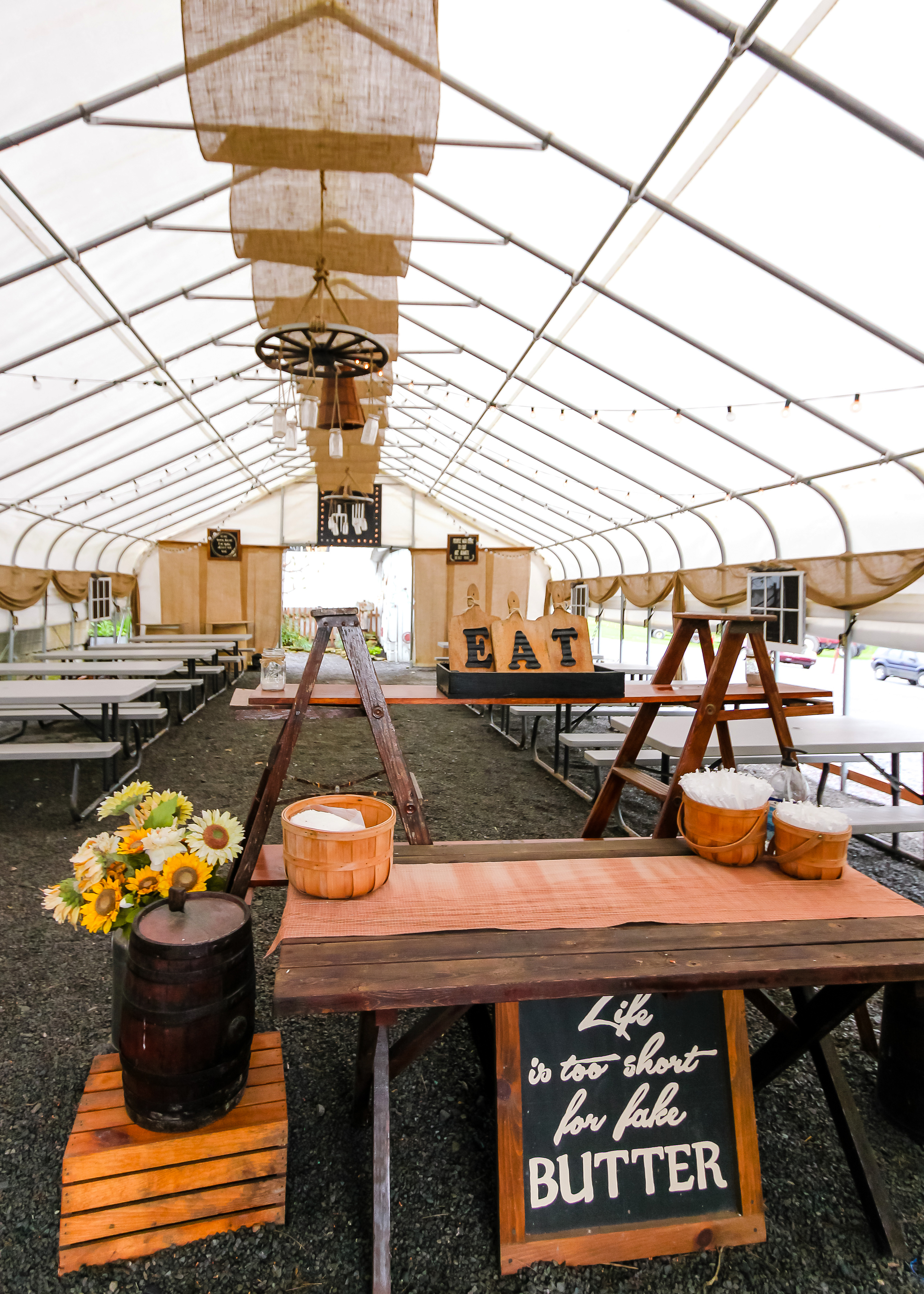
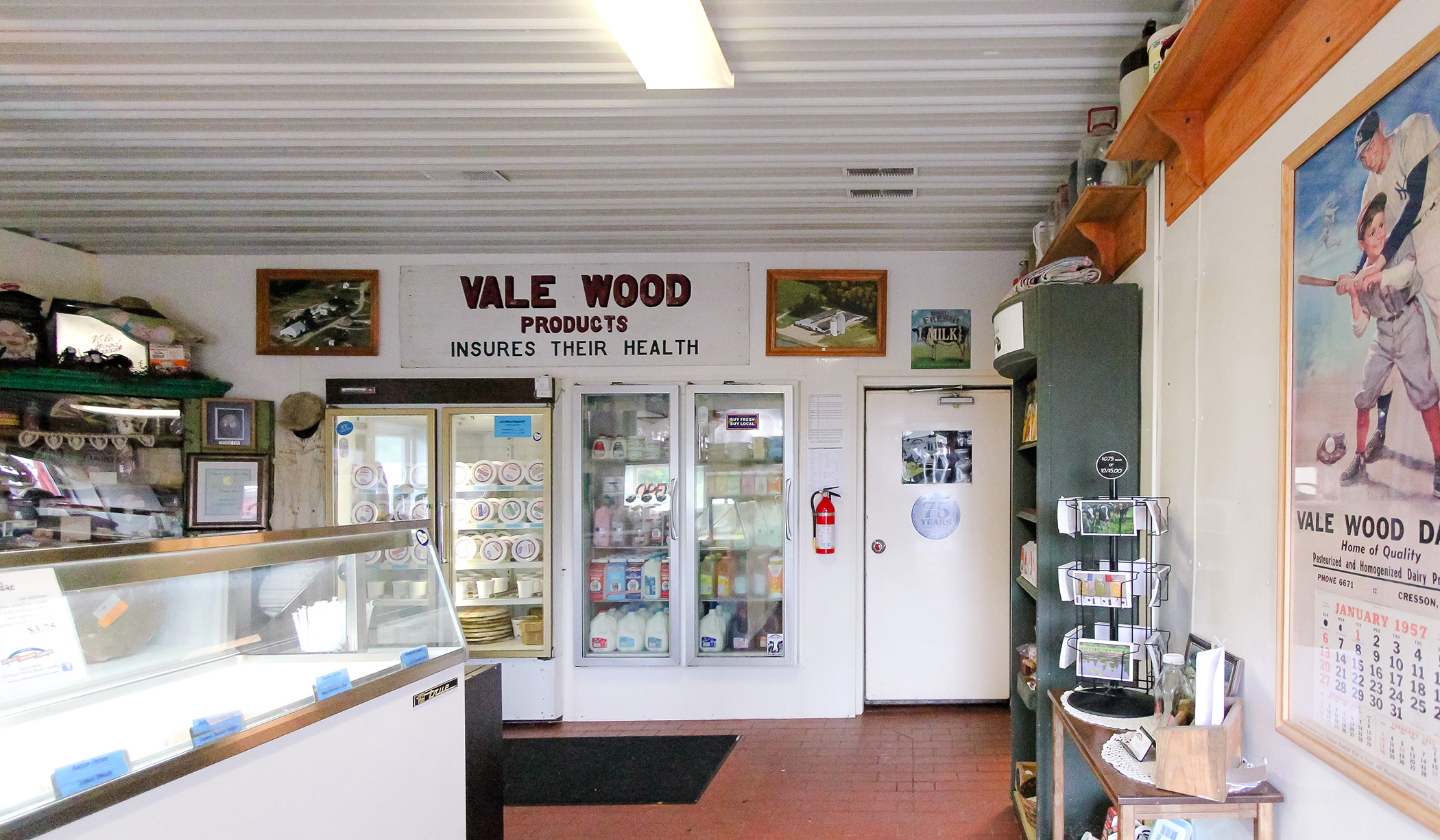
They have an on-site dairy store, but it is off the beaten track and represents just 2% of their sales. As we sit in the pavilion that Carissa’s sister Jen has decorated for the following week’s Pasture Party, Carissa explains the evolution of dairy trends coming full-circle.

She gives four examples: The resurgence of fresh, real and local foods; the ‘new’ idea of home delivery; how ‘old’ products like whole milk, butter, and cottage cheese, are making a comeback; and how those old paper cartons are making a comeback too.

(In fact, take a look at the dairy case the next time you go to the supermarket. Most ‘new’ plant-based non-dairy beverages and ‘new’ dairy case items like iced coffees are packaged in paper cartons.)

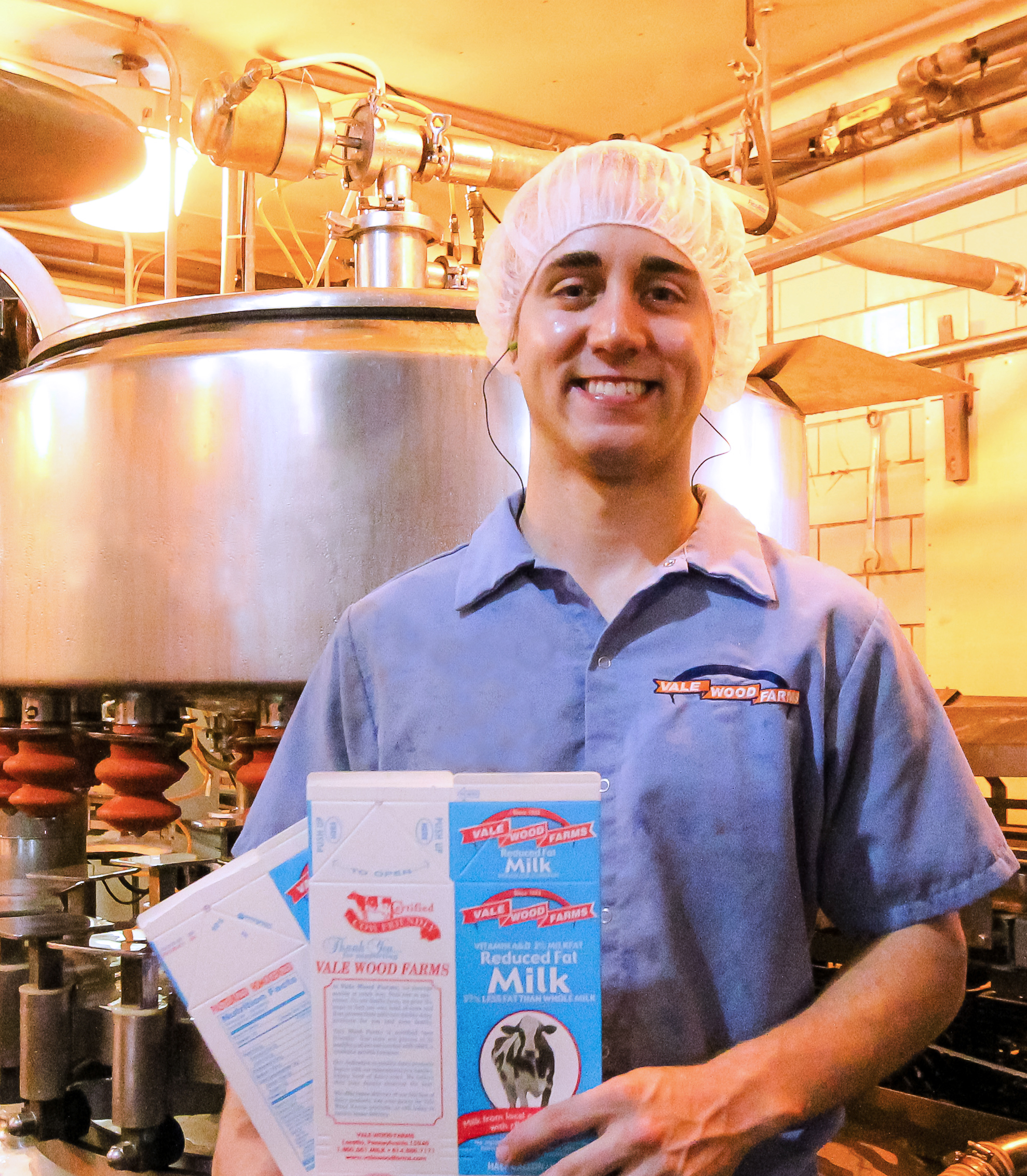
“Consumers are gravitating back to the carton,” says Carissa. While Vale Wood bottles a variety of sizes in plastic bottles, paper half-gallon cartons are also available “because our customers see this as a great thing, from an environmental standpoint, and we like it because it protects the milk from light.”

We talk about the growing number of consumers seeking food delivery services and how the meal kit companies have really taken off. In fact, the three biggest food retailers – Walmart, Kroger and Amazon/Whole Foods — have either bought or created meal kit or food box delivery services.

Even as total consumption of dairy milk continues to erode, the large chain supermarkets and big-box stores are getting into the game because their checkout scanners confirm that milk — real dairy milk — is still the most frequently found item in grocery baskets.

So the future will either be a competition for shrinking market share – or an all-out effort to expand the fluid market. Vale Wood pays attention to those trends to steady their market while opening eyes of consumers expand it.

The upheaval in the industry reveals the trend toward the nation’s larger retail chains wanting a bigger piece of the shrinking fluid market. Small processors, like Vale Wood, on the other hand, seek to appeal to consumers and increase product demand.

The direct competition for supermarket shelf space is becoming intense because milk, though consumption is down, is still a store’s gateway to win customer loyalty.

As all processors navigate the competitive pressures, it is the home delivery service that is steadying the ship for Vale Wood. That part of their business brings them back to that key: connecting with consumers. A big part of that connection is the cows at the farm.

“It’s unique that we still milk cows,” says Carissa. “The cows are central to our farm history and heritage and our sense of identity.”

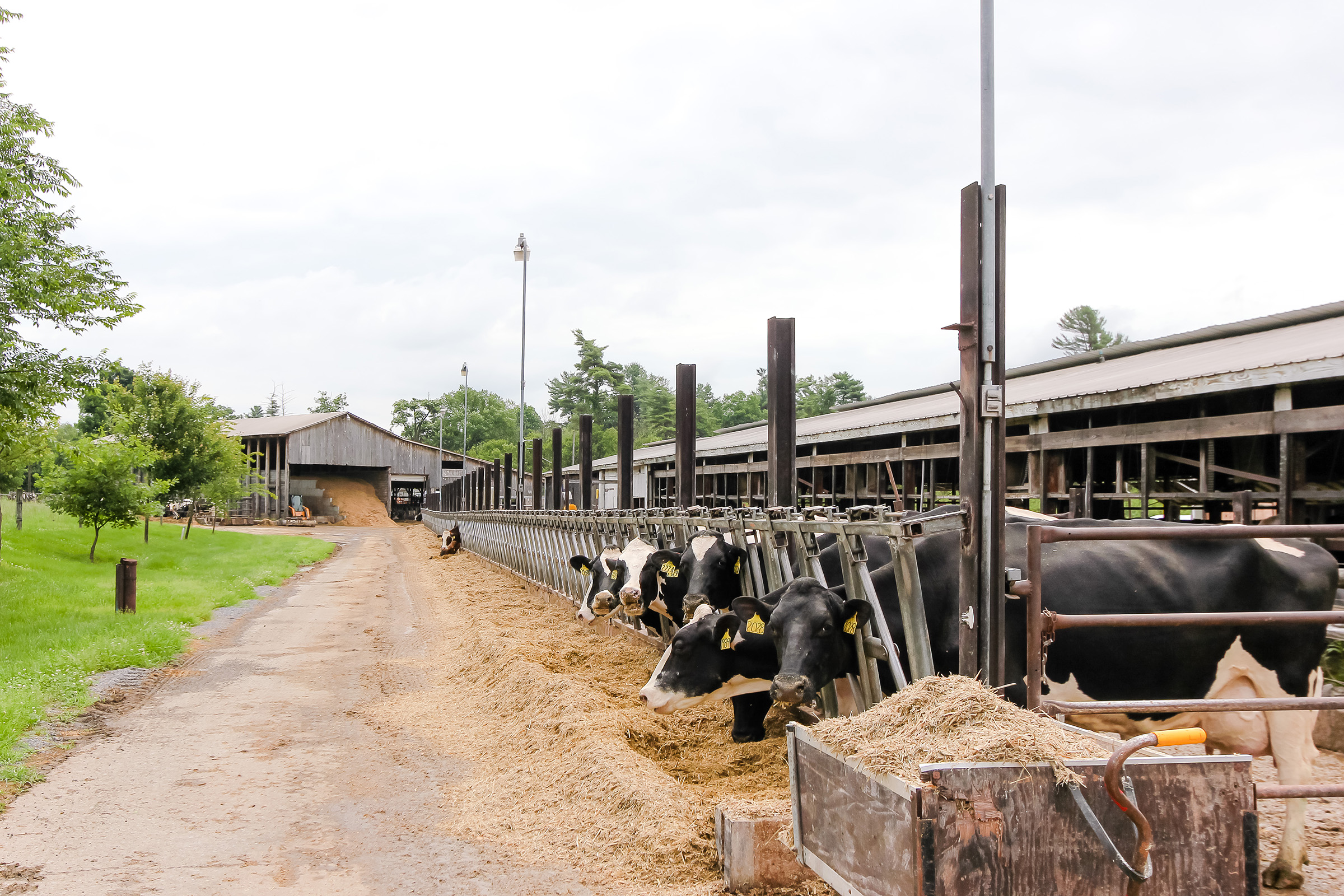
The Itle family milks 200 cows. Their processing covers 400 cows, as they purchase milk from three neighboring dairy farms instead of expanding their own.

In addition to bottling milk and flavored milk and making ice cream, they do soft products like dips and cottage cheese, and are now doing flavored butters. They do “a little bit of everything” to capitalize on trends. This helps them deal with increased competition for fewer milk drinkers.

“We can never underestimate the effort required to get into (or keep) a market,” Carissa says. And those barriers to entry are becoming more challenging as store brand private label market share increases at the same time that non-dairy beverage alternatives compete for space in the dairy case.

Still, 95% of Vale Wood’s milk utilization is Class I, thanks in large part to their consumer connections and education that lead to product awareness and loyalty.

Change is needed, declares Rep. G.T. Thompson

Decline of Pennsylvania’s dairy industry noted

By Sherry Bunting, Farmshine, February 19, 2021

EAST EARL, Pa. – “We cannot continue to do what we are doing from a dairy pricing perspective and expect better results,” said Rep. G.T. Thompson (R-Pa.), named ranking member of the U.S. House Agriculture Committee in December. 

Known as an advocate for dairy farmers, Thompson cited the decline in dairy farms and Pennsylvania’s position in rankings, noting that in 2009, when he was first elected to serve central and northern Pennsylvania in the U.S. Congress, Pennsylvania ranked 5th in the nation for dairy production with 545,000 cows. 

A decade later, at the end of 2020, Pennsylvania slipped to eighth in production and has lost 67,000 cows since 2009. USDA reported 478,000 milk cows in the Keystone State at the end of last year with production in Michigan, Texas and now Minnesota leapfrogging Pennsylvania over the past decade.

In 2019, alone, Thompson took note of the 370 dairy farms that exited in Pennsylvania, with a huge impact on rural communities. He also observed the more than 10% loss in cows and production over 10 years during a telephone conference with members of the Grassroots Pa. Dairy Advisory Committee and 97 Milk, whom he thanked for all of their hard work on dairy issues.

He stressed that the decade of decline in Pennsylvania underscores how important it is to address the loss of milk check value at the farm level.

“Everyone in the dairy supply chain clearly can’t do what has always been done and expect different results,” he said, adding that a change is needed to benefit dairy farmers and that “the rest of the supply chain will have to adjust. We can’t sustain these decade long trends without further disruption. We have seen the impact already.”

Thompson said his dairy pricing initiative is straight forward, to look for “actionable measures that allow hardworking dairy farmers to earn a respectful living. Doing that will stabilize the economic circumstances so the other parts of the supply chain will adapt. If dairy farmers keep going down, we lose our industry, so serious steps must be taken toward economic stability.”

He talked about working as Ag ranking member to have Federal Milk Marketing Order pricing hearings, and he noted that the next Farm Bill offers an opportunity to modernize milk pricing, but it will take industrywide consensus, he said.

To get even a short-term fix for the losses due to negative PPDs before the next Farm Bill will be tough and will require action and agreement by NMPF and IDFA.

“Our best hope in the short term is to get the milk classes back into alignment (in regard to PPD), and work on building consensus for long term resiliency heading into the next Farm Bill,” said Thompson.

As for school milk, Thompson said he planned to restructure his whole milk for healthy kids legislation for reintroduction this session, with some tweaks that make it more workable for schools.

This is an important signature piece of legislation for Thompson because of the triple-impact he believes it will have on the health of children, the economics of dairy farming and the sustenance of rural communities.

Since the Senate ag committee has jurisdiction in school meals, where in the House, the jurisdiction lies with the education and labor committee, Thompson said he has already discussed the measure with the Republican leader in the Senate Ag Committee, Sen. John Boozman of Arkansas.

Thompson also believes there are members of the House Ag Committee who want to elevate this issue, which could include congressional hearings on the Dietary Guidelines. He said that process would start out with briefings to returning and incoming members about the DGAs so they have background on the issue.

With former Ag Secretary Tom Vilsack picked to return to the USDA post in the Biden administration, Thompson said he will be weighing in with Vilsack to encourage maintaining the 1% flavored milk waivers and about further school milk reform. He said he is hopeful about Vilsack’s support for a whole milk measure.

Thompson noted that reforms to milk offerings in schools could also come from the Senate side if Ag Committee Chairwoman Debbie Stabenow opens the door with childhood nutrition reauthorization, but that, “Nothing will move out of the Senate that is not strongly bipartisan, so spending time on the Senate side building bipartisan support will be important,” he said.

While incoming House Ag Committee chairman David Scott (D-Ga.) has priorities and a history of bipartisan action, dairy is not among his biggest focal points, which leaves room for Thompson, as ranking member, to advance dairy as his priority working with the chairman.

Bottom line, the Grassroots Pa. Dairy Advisory Committee will be working to help build consensus for milk pricing reform, and many of the Farm Bureau ideas look promising. The challenge will be getting NMPF and IDFA to come together around shared priorities to benefit dairy farmers in the pricing system, but that effort has begun.

One thing is clear, the House Ag ranking member G.T. Thompson sees the farmer’s position in the current pricing equation as inadequate.

-30-

Dairy milk: The rest of the story on milk fat and fraud

Dairy milk consumption has two faces: nutrition and sustainability. Aside from a small percentage of healthy fat and more protein than the knock-offs, dairy milk is fresher than soy, almond, coconut, oat and other counterfeit ‘milks.’ In fact, it is so locally produced and bottled that it is also much better for the health of local economies and environment. Have you seen any almond, coconut or cashew trees on the East Coast and Midwest of the U.S.? As for oat beverage, most of the oats are harvested in Canada and processed in Asia. Here in the Northeast U.S., there are millions of acres of grasslands and croplands that provide habitat for wildlife, filter rainwater, hold soil in place, maintain open spaces, photosynthesize carbon from the air, keep something growing on the land year-round as cover crop and forage, and create jobs and economic stimulus that all begin with land being managed by dairy farmers. A dairy cow can eat grass, hay, whole corn plant silage, and other roughage grown on marginal lands. These forage crops are 50 to 70 percent of the dairy cow’s diet, and she will turn them into nutrients we can use in the form of nutrient-dense milk and dairy products we love. How cool is that?

By Sherry Bunting

We read about and see the growing number of choices in the dairy aisle that make a simple trip to the store for milk, one that can be quite confusing. There’s the thing about fat (all those different percentages) and the thing about fraud (all those plant, nut, and bean drink products calling themselves ‘milk.’)

First, the different “percentage milks” we know as skim, 1 percent, 2 percent and whole milk. The latter is confusing, is it 100 percent milk? Do some people think it is 100% fat?

Well, all dairy milk is 100 percent milk, no mater what the fat percentage… But, No: Whole milk is not 100 percent fat. It is not even 10 percent fat. It is standardized to 3.25 percent fat, and if you drank it straight from the cow it would be anywhere from 3 to 5 percent fat depending on breed of cow, time of year, and type of roughage fed.

And then there is protein. Did you know dairy milk provides a little over 8 grams of protein per 8 oz. serving? It packs quite a bit more protein-punch than almond ‘milk’ at a little over 1 gram of protein per 8 oz. serving.

Made like coffee, the crushed almonds are filtered with water. In fact, an 8 oz. serving of almond milk may be more like eating an almond and drinking a glass of water with sugar and thickeners added and a handful of other ingredients.

A common almondmilk brand label lists these ingredients the first being almondmilk defined as almond-filtered water: Almondmilk (Filtered Water, Almonds), Cane Sugar, Sea Salt, Natural Flavor, Locust Bean Gum, Sunflower Lecithin, Gellan Gum, Calcium Carbonate, Vitamine E Acetate, Zinc Gloconate, Vitamin A Palmitate, Riboflavin (B2), Vitamin B12, Vitamin D2.

A typical dairy milk label lists these ingredients: Milk, Vitamin D3. Pretty simple to see that the calcium and vitamins on the milk label are already in the milk and that zero sugar is added and zero thickeners.

The freshness of REAL dairy milk can’t be beat going from farm to table in 24 to 48 hours. It comes naturally from the cow providing the natural proteins and calcium and small amounts of healthy fat that our bodies readily absorb and utilize.

In fact, the carb-to-protein ratio of chocolate milk is now shown to be one of the best sports-recovery drinks on the market today. Yes, plain ‘ole chocolate milk. Maybe if farmers call it by another name, consumers will take notice to what has been in front of them all along.

Still, for many consumers, the perception persists that whole milk is a high-fat beverage, when in reality it is practically 97 percent fat free!

At the bottling plant, milk is pasteurized and standardized. Cream is skimmed to package whole milk at 3.25 precent fat. The skimmed cream—along with additional cream skimmed to bottle the 1% and 2% and non-fat milks—is then used to make other products like butter, ice cream, yogurt, cream cheese, sour cream and dips.

The “standard of identity” for yogurt states it also contain a minimum of 3.25% fat—just like whole milk.

Even ice cream is not 100 percent fat. The FDA standard of identity is that it contain a minimum of 10 percent fat. Some of the richer, higher-end ice creams contain up to 14 percent fat. But along with that fat, comes some nutritional benefits. These are not empty calories.

Butter is high in fat because it is, after all, a fat. Even it ranges 82 to 84 percent fat. A tablespoon of butter in the pan or on your veggies is a smaller quantity serving than an 8 oz. glass of milk; so even though the fat content is much more concentrated at a higher percentage, no one sits down and eats a cup of butter (2 sticks)!

Furthermore, we have learned that the saturated fat in milk and meat are not bad for us and that when part of a healthy integrated diet may actually provide heart healthy ‘good’ cholesterol.

The fears ingrained over 50 years of low-fat dogma are being abandoned as a nutritional experiment that has failed miserably, even though the federal government continues to hang on to the failed lowfat experiment in the recent 202-25 Dietary Guidelines.

What a growing number of scientists have found is that we need not have blamed whole milk, butter—or beef for that matter—all of these years. In fact, the recent rise in obesity and diabetes is linked more to overconsumption of carbohydrates that have filled the energy-void after we collectively sucked healthy fat out of our diets.

Saturated fats are not the enemy, the “new” science shows. However, the science is really not new. Long-time observers, investigative reporters, and scientists note that the very science supporting the health benefits of saturated fats found in milk and meat has been around for decades, but was ignored — even buried.

Meanwhile, U.S. consumer demand for butter has been expanding, and worldwide demand for U.S.-produced ice cream and yogurt has grown as well. Dairy foods and snacks that offer an energy boost with a healthy protein-to-energy ratio—such as yogurt, whole milk, and even ice cream—will be particularly in demand in nations where busy, on-the-go consumers look for reviving options.

Healthy, natural fat and protein from milk and meat keep food cravings at bay to prevent binge-eating on empty-carb snacks. Enjoyed as part of a healthy integrated diet, dairy products—even ice cream—are satisfying, nutrient-dense, carb-moderating foods that can even be the dieter’s best friend.

Go real, go natural. There’s no reason to fear real milk, dairy and beef products from cattle. Contrary to what the activists say and contrary to government ‘guidelines’ that refused again to consider all the science, nutrient-dense full-fat dairy foods and meat are good for us, and yes, good for the planet.

-30-

Pandemic economics, concerns on the radar, and valuable business insights shared as Dr. Kohl kicks off PA Dairy Summit

Dr. Kohl covered the gamut of what’s on his dairy and agriculture radar at home and abroad. Then he encouraged producers to separate the controllables from the uncontrollables to focus on the business. One tool he highlighted evaluates business management IQ using 15 critical questions for crucial conversations because it gets people thinking.

China, fake meat and dairy, propaganda seeking to eliminate the dairy cow, and much more concern him. But Dr. Kohl encourages farmers to seek opportunities, be flexible, innovative and adaptive, and to follow a process for their business and sharpen their business focus. Be sure to check out the navigation points on Dr. Kohl’s compass at the end of this article.

By Sherry Bunting

HARRISBURG, Pa. – The disruptions and challenges of the past year also create opportunities, said Dr. David Kohl, Virginia Tech professor emeritus and co-owner of Homestead Creamery for the past 20 years.

He was the keynote speaker kicking off the 2021 Pennsylvania Dairy Summit held virtually this week through an online convention format that had much of the signature Summit feel.

In his characteristic style, Dr. Kohl stepped the virtual audience through a broad global and domestic view of events and evolution down to the impacts at the dairy farm level with motivational thoughts on how to navigate.

He urged farmers to navigate rocky roads of change by adopting two key management elements. First, be flexible, innovative and adaptable. Second, follow a process for the business with a business focus.

Kohl also encouraged producers to manage around the things they can’t control like election results, pandemics and the strategies of China’s Xi Jinping.

 “A good marketing and risk management plan is critical. In this environment, we have to separate the controllables and uncontrollables… and look for the opportunities,” he said.

As he has in past seminars since the pandemic, Kohl highlighted the ‘buy local’ movement is picking up steam post-Covid. “Many of you are in that footprint. One-third of the U.S. population is in your area, so this movement might be sustainable,” he said.

That’s good news. The bad news is the acceleration of economic divide, said Kohl. He sees this affecting agriculture, other businesses and households, which will add to the economic volatility and extremes in the big three: milk prices, feed costs and interest rates.

Market supercycle

“We are in another supercycle that is really impacting the grain sector,” said Kohl. He cited the stimulus checks as “dangerous one-off income” leading to printing more money, which devalues the dollar. This fuels more exports, especially when coupled with the ‘China-effect’ as they rebuild their protein sector and livestock industry.

This, along with weather concerns in South America and investor speculation have “shot those grain prices higher, especially on corn, beans, and we see it in cotton, all up.”

He sees this grain market supercycle abating through 2021 and 2022. The grain price rally is not sustainable, in his view, unless weather problems in South America persist and unless weather affects North American crops this coming season.

Globalization

Kohl noted that globalization started six decades ago, and he marked 1995 through 2015 as the period of “hyper-globalization, but in recent years, we’ve moved away from this. Dairy is right in the crosshairs of this shift because exports have become a much bigger share of milk production,” he said. “If de-globalization continues, this will impact agriculture in the U.S.”

He warned that the dairy industry would be well advised to not shape itself with China’s market in mind.

“Don’t bet your dairy expansion on trade with China,” said Kohl. He gave the example that 300 million people in China were without power a month ago because China would not allow Australian coal in to fuel plants.

Kohl observes that while the U.S. and Europe are bickering about everything, China has been pursuing world power. China has invested a trillion dollars in 68 countries – the agriculture ‘hot-spots’ around the world.

“Their initiatives will impact our competitiveness,” said Kohl, noting that China is also moving ahead on building a world supply chain for vaccines made at sites they have cultivated in developing countries.

“China could be the leading power by 2040, even 2027. They are going to move forward very fast if we don’t get our act together,” he said, explaining the recent “regional” trade pact China made that makes China the central focus in Asia.

Market Concentration

The flipside of globalization is the domestic U.S. food supply and marketing chain.

“That’s our Achilles heel,” said Kohl. “We have too much concentration with too few firms, and I’m being very blunt about this. We saw what happened when plants shut down. Now we see more nations saying they want to become more self-reliant. This is something to watch closely over the next five years.”

Kohl said the industries that are linked to dairy are in 50 to 75% recovery while at the same time Amazon, Walmart, Target are operating at 125%.

“They are getting too much power here in the U.S. and around the world,” he said, noting that on one hand the buy-local movement is accelerating, but on the other hand, the pandemic environment has moved even more market power to these large global entities.

Expressing agricultural ‘serfdom’ concerns, Kohl responded to a question about China purchasing agricultural land and assets in the U.S. This also hit upon the recent news in business journals that Microsoft founder Bill Gates has been buying up farmland and is now the single largest owner of U.S. farmland (not total land but good arable farmland).

“I am worried about this one,” said Kohl. “Some of this big investment money creates serfdom. We need to do some due diligence, and we don’t have enough political forces looking at this. Canada put the kabash on China buying their land.” He noted that his research shows the land purchased by Gates through Cascade Investments is fertile land next to rivers and near international ports, as well as land with mineral rights.

’They want to eliminate the dairy cow’

Kohl’s Summit keynote discussion came the morning after the Super Bowl. And yes, he noticed the Oatly (oat beverage) ad that ran before halftime.

“Did you see the guy last night singing in the field talking about eliminating the dairy cow?” he asked, quoting other CEOs of brands like Beyond Meat also stating their goals to replace cows entirely.

On fake dairy and meat alternatives, Kohl was emphatic about how closely this needs to be watched.

“They’ve got the money. They’ve got the power. And they think they are saving the environment,” he said, explaining that these products are going to become more competitive with real dairy and meat as large investors and large companies in the traditional dairy and meat supply chain ecosystem get involved to drive the alternative product prices down and change the packaging. He gave the example that Beyond Meat is already closing that gap at $6.79 to $6.99 per pound compared with ground beef at $5.49 per pound.

“They are coming after traditional agriculture. That much is loud and clear,” said Kohl. “Big Ag has to look themselves in the face — that they allowed this to happen — with too much market power. This is me speaking, and I’m being blunt.”

During the chat session that followed, Kohl noted that even their Homestead Creamery based in Blacksburg, Virginia is seeing competition from non-dairy alternatives where they sell their fresh local dairy products.

“It is interesting that we are getting more questions on the non-meat and non-dairy products out there. Our customers are asking our sales team,” said Kohl. “We try to go into it with more education, and we are going A2A2 as a differentiator for our milk and ice cream.”

Minimum wage impact

Current legislation being considered in Congress includes a four-year phase-in to raise the minimum wage to $15 per hour. That’s more than double the current federal minimum wage.

“This will be bad for small business. The big guys can handle it,” Kohl observes. “This creates more business consolidation. We’re seeing a little push back on this now, but there needs to be a lot of push back. America was built on small business and entrepreneurs. We don’t want to create a serfdom where we just work for big business.”

Stimulus, taxes, regulation

With $2 billion a day in stimulus checks being written by governments worldwide, Kohl said this ‘black swan (pandemic event) can turn into an angry bird.

When government writes check, what comes next is encroachment, said Kohl. He sees federal, state and local taxes increasing and “regulators are going to have more swagger. This makes it imperative, to surround the farm business with your best advisors and have a good tax accountant who understands agriculture.”

Regulations in the environmental, labor, banking and financial service sectors are likely to increase, said Kohl. “Regulators have a lot of pent up energy from the past four to five years, and they’ll likely be coming out with a full-court press.”

Energy independence

Noting that the U.S. had its longest economic expansion until February of last year (pandemic), Kohl said a key reason is that the U.S. became the number-one energy-supplier in the world.

The effort to become energy independent began after the tragic attack of 9-11 in 2001. Today, the U.S. is number one energy producer, Canada is number four and Mexico is number eight. This means three of the top 10 energy producers are in North America.

“Now we are seeing a rollback of this playing right into the hands of Opec,” said Kohl, noting that the advertising and policy points about moving to electric vehicles can all sound good. “But we’re not thinking of the unintended consequences, where 74% of the components (for EV vehicles) are produced in China.”

How energy plays out policy-wise is important for agriculture, according to Kohl, because “$8 out of every $10 we spend is linked to energy.”

Kohl sees a “fine balance” to be had on sustainability and climate action.

“Some things we are doing for water, air and soil health are important, but there are contributors other than fossil fuels. I see a need to think about unintended consequences. If components for new sources come all out of China, and we get locked down, that creates a problem. Also, a lot of people seem to forget: when gas goes to $5 to $7 per gallon, it shuts a consumer and a farm down very quickly.”

Navigation points on Dr. Kohl’s compass:

— Surround yourself with good advisors and a good tax accountant.

— Be careful with one-off income from government support. Are you using that money to build efficiencies or pay down debt? Don’t make long-term expansion decisions based on this one-off income.

— Watch the value of the U.S. dollar relative to other currencies, but land value should hold.

— Expect to see acceleration of ‘carbon payments’ replacing direct farm program payments.

— Keep the non-dairy and meat alternatives on the radar screen, especially if you are involved in dairy leadership.

— Healthy soil, water and air quality are important focuses as agriculture deals with weather extremes.

— See the positives that have come out of the pandemic: farms labeled essential, local food movement acceleration, time with family, time to re-evaluate priorities.

— Be flexible, innovative and adaptive.

— Have a risk management plan and realize you are going to leave money on the table when you follow a plan that works for you 8 out of 10 years.

— Keep working capital available as your shock absorber and so you will be ready for emergent circumstances and unexpected opportunities. The recommended ‘war chest’ is to have greater than 25% of the farm’s expenses (not including interest and depreciation) as working capital reserve.

— Have a written farm budget and compare periodically (monthly) to actual expenses.

— Have a separate family living budget and compare periodically to actual expenses.

— Use advisory teams. They are the fastest growing trend, and they work.

— Be proactive on a plan to transition the business and to merge older and younger views of the future.

— Evaluate your business management IQ with 15 questions to ask yourself about your business and have each member of the family in management fill it out separately. This is a great way to measure business management progress, “and it gets you to think,” said Kohl. (See chart.)

— Do your baseline cash flow projections for the farm business, but also do financial sensitivity analysis. Work through the numbers in a best-case scenario to the aspiring goals of the business, but also run worst case scenarios. Look at the analysis if interest rates go up 1 to 2% — or with changes in the input and output values — to see how those changes affect the bottom line. “This gives you the parameters to keep you out of the ditches as you move forward,” said Kohl. “If those values experience extreme change, you can fall back on that working capital reserve.”

— Monitor those cash flows monthly against projections.

— Work with ag lenders to lock in interest rates where you can.

— Re-examine your vision and your goals and make sure expansion or investments line up with these goals; keep your working capital cushion. 

— Look for your “three’s” – 3 things you want to continue, 3 things you want to improve. When isolating goals and actions, limit to three to intensify your focus.

Published in Farmshine, February 12, 2021

PA herd first in nation to make ‘Naturally Better Omega-3’ milk

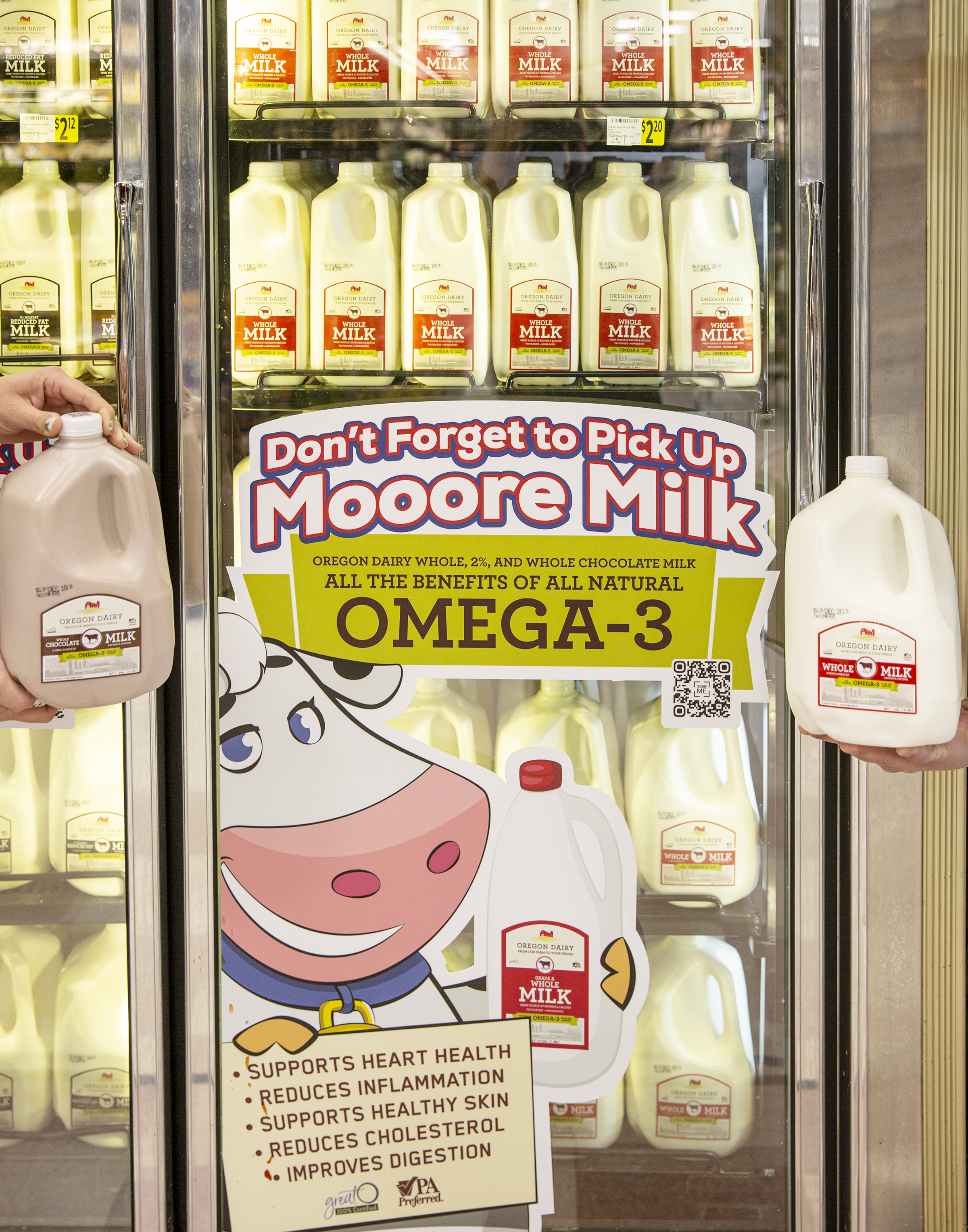
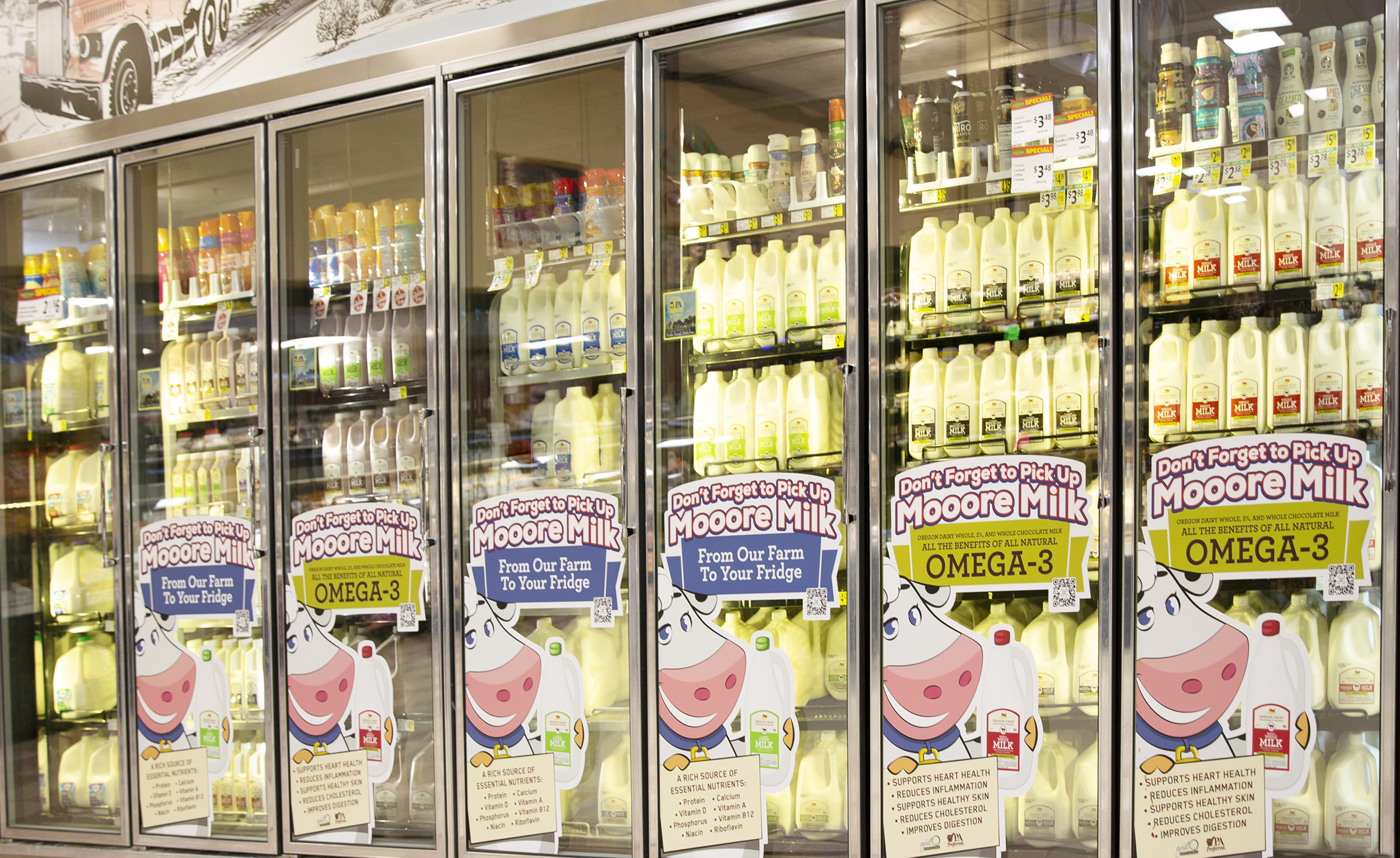
New labels are on, and new signage is up in the dairy case at the Oregon Dairy family-owned grocery store. While other brands of milk are sold here, like in any grocery store, the buzz is all about the milk with “mooore” — Naturally Better Omega 3 Oregon Dairy Milk. Since omega-3 is a healthy fat, the benefits are only available in milk products containing fat — whole milk, whole chocolate milk, 2% milk and cream.

By Sherry Bunting, Farmshine, December 11, 2020

LITITZ, Pa. — Whole milk sales are rising. Consumers are returning to fat, and they are looking for healthy, local foods. These trends were underway well before Covid-19 and have only accelerated since. At the same time, dairy farms look for growth in diversification or getting closer to the consumer, rather than expanding cow numbers.

For Oregon Dairy, Lititz, Pennsylvania, those paths intersected. They downsized the dairy herd from milking 500 cows to 60 in July 2019, which was the first step to becoming first in the nation (likely first in the world) to produce and market milk with “mooore omega 3” – naturally. The marketing began recently in November 2020.

“We are very proud of our milk. We have always been tied to the story of our milk from the farm to the store. But we are also looking to go to the next level in differentiating it,” says Jon Hurst, center store manager. “Now we have a story to tell about our Naturally Better Omega 3 Oregon Dairy Milk.”

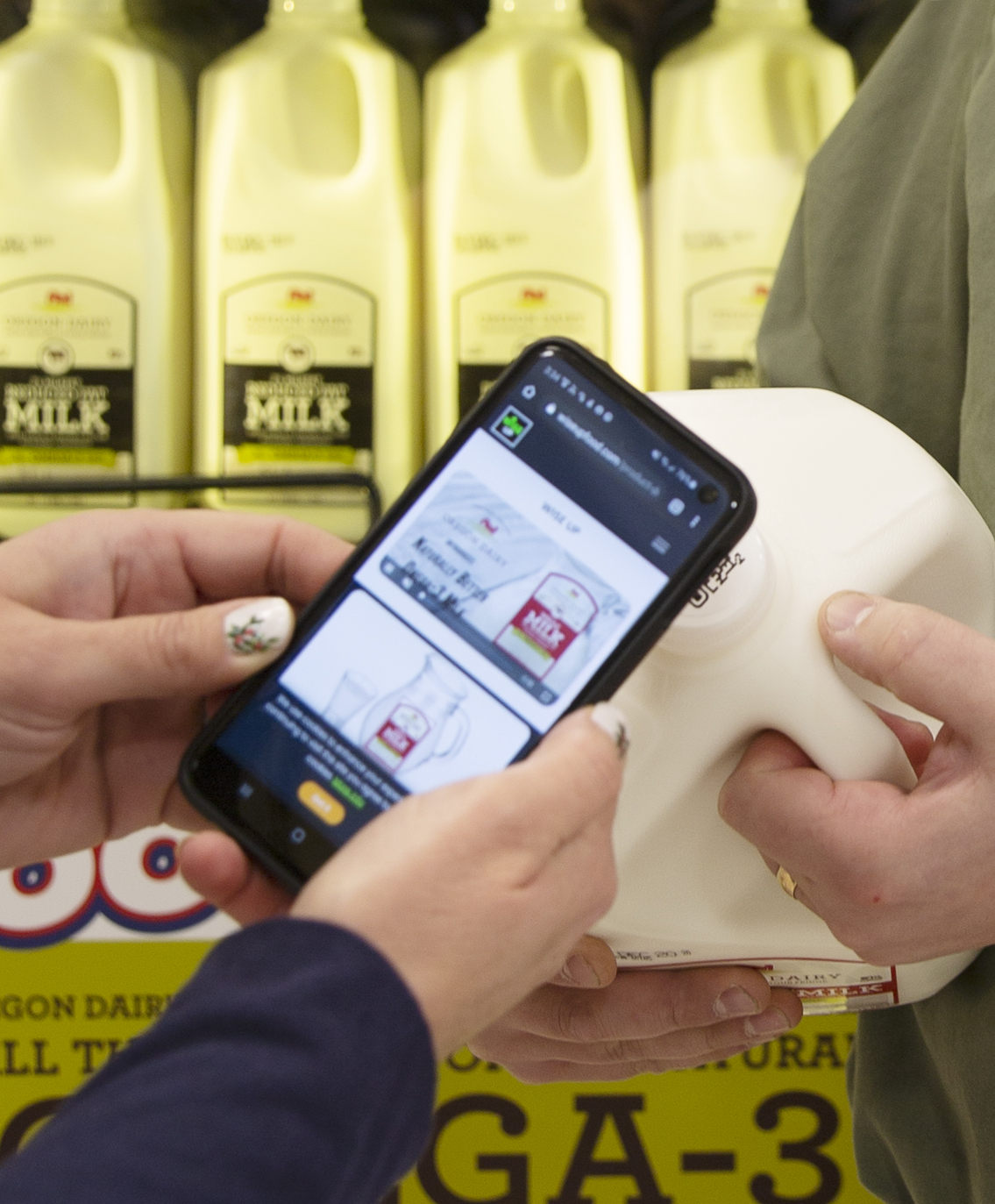
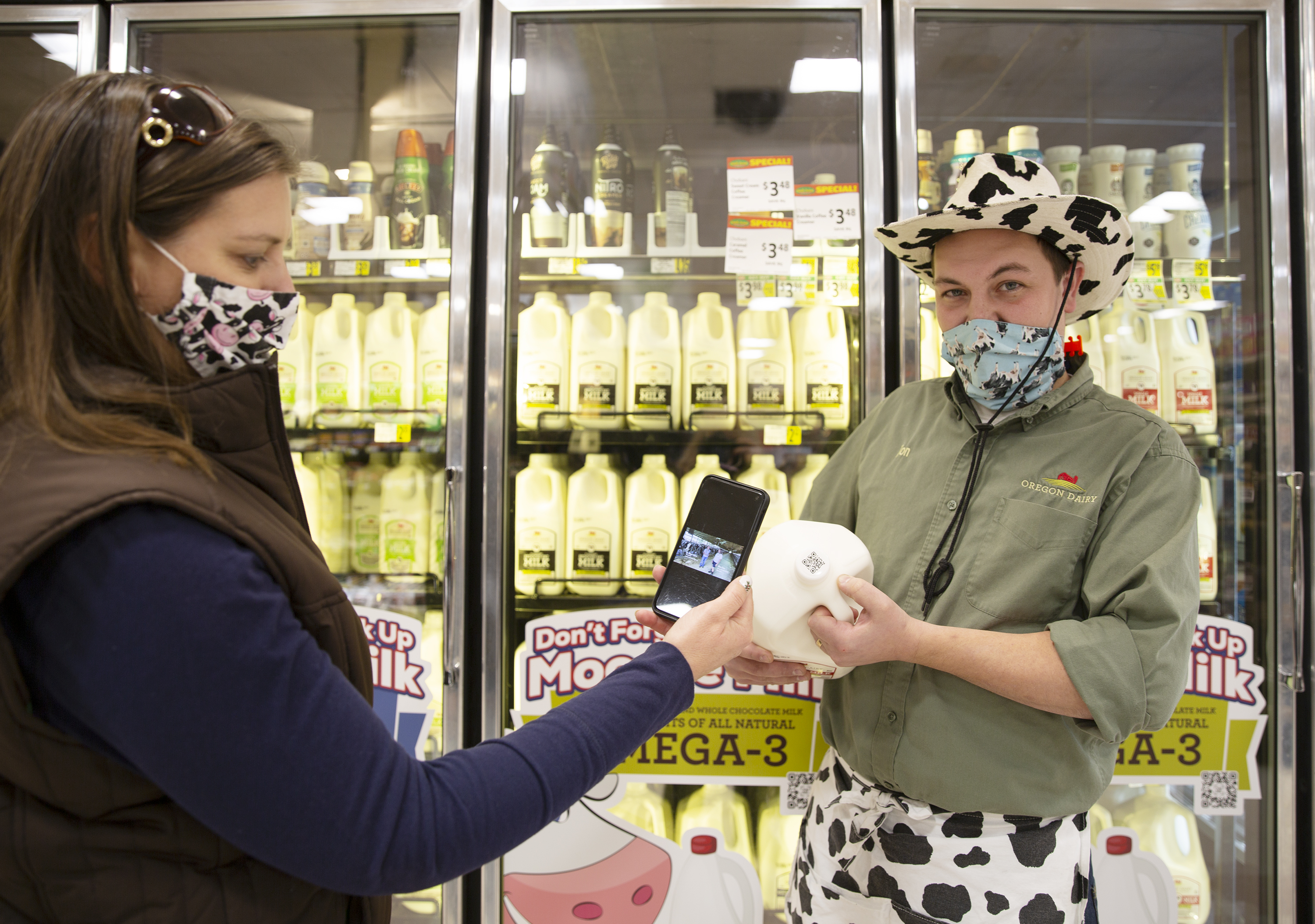
In fact, shoppers at the family-owned grocery store can scan a QR code on the cap of the milk jug that takes them directly to a video about how the cows are fed to naturally produce milk with more omega 3.

The video talks about healthy omega-3 fat found in dairy foods (and fatty fish).

Therefore (as noted on the dairy case signs below), the higher omega-3 levels pertain to the whole milk (57 mg), whole chocolate milk (53 mg), 2% milk (28 mg) and cream.

While there are other milk brands that increase omega-3 by adding fish oil or algae derivatives directly to the milk in the form of additives, what Oregon Dairy has done is to feed the cows a supplement that balances the ratio between omega 3 and 6, so the cows naturally produce milk with consistently higher levels of omega-3 – and do it within a conventional dairy setting.

The distinct businesses of Oregon Dairy near Lititz, Pennsylvania include the farm, bottling at the grocery store, restaurant, ice cream shoppe and agri-tainment with four brothers, George, Willie, Curvin and Vic, owning different segments. As they partner with the next generation of siblings and cousins, communication has grown closer on a farm-to-table vision that has always had the dairy cow front and center.

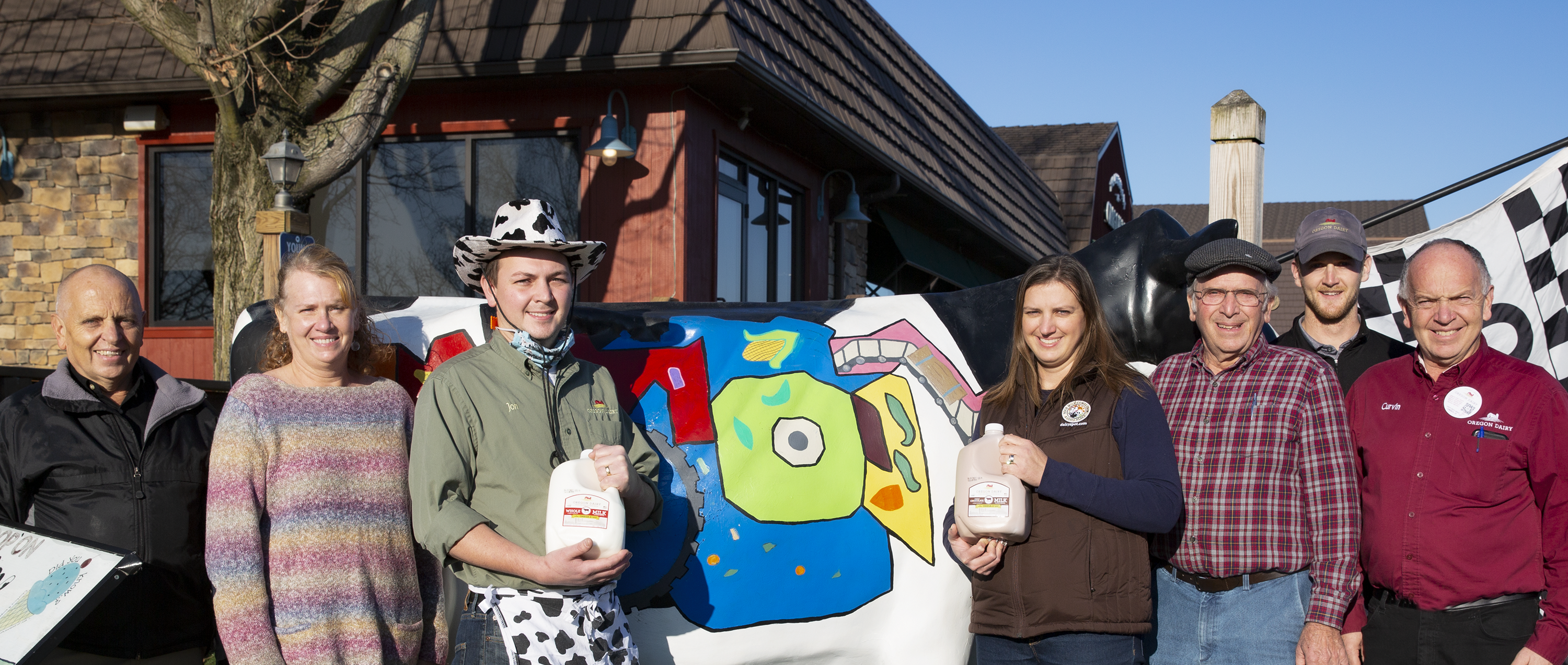
Celebrating the ‘Naturally Better Omega 3 Oregon Dairy Milk’ in front of the model cow painted to show her unique digestive capabilities are family members involved in the distinct businesses of Oregon Dairy (l-r), Willie Hurst, Krista Martin, Jon Hurst, Maria Forry, George, Brent and Curvin Hurst. Absent from photo are Vic and Chad Hurst.

Like any grocery store, other big-name brands are sold, but the focus is to continue highlighting local through what they do at the farm and other enterprises under the Oregon Dairy umbrella, as well as partnering with other local farms and businesses in the community.

Before downsizing, the farm — co-owned by George Hurst and his son Chad and daughter Maria and her husband Tim Forry — sold 90% of their milk through a cooperative in the commodity market and just 10% was purchased by the store and restaurant as needed.

Now, the various branches of the Hurst family and sector managers must communicate more directly about milk supply and marketing — putting them in the position to tailor what they do at the farm level to differentiate the milk at the store level.

With 18,000 followers on Oregon Dairy’s social media platforms, Jon has become a promotion powerhouse with the “farm fresh family fun” tagline, producing videos and contests and in-store partnerships that began before the Coronavirus disruptions and have given shoppers something to look forward to — with humor and sincerity — during this Covid-19 era.

For generations, they’ve been just bottling milk at the store and having their cream turned into ice cream by another manufacturer. But Jon and his cousin Maria, see a future of possibilities.

The Naturally Better Omega 3 (NBO3) Oregon Dairy Milk opens opportunities, but it really starts at the basic cow level, where the total mixed ration is balanced for omegas by feeding greatOPlus, an omega-3 nutrient supplement in the TMR mineral pack from Sporting Valley Feeds.

Their longtime nutritionist and veterinarian Dr. Robert Stoltzfus of Lancaster Vet Associates suggested the product last fall — a few months after the cow herd was downsized.

Across species, feeding flaxseed is nothing new, but it is the supplement’s algae derivatives that add additional properties for animal performance and transfer a more optimal omega balance to the meat, milk and eggs the animals produce.

“The benefits are on two levels,” says Paul Rosenberger, a consultant with NBO3, maker of greatOPlus and the largest algae producer in the country. We spoke with him by phone this week to understand the process.

“By balancing the ratios of omega 3 and 6, we get the benefit of omega-3, and in bypassing the rumen, we improve the conversion of that balance to the milk,” he explains about the natural feed nutrient.

Omega-3 has attracted attention as a healthy fat in the human diet, including reducing stress and inflammation, as well as heart health and other benefits the long chain fatty acids provide.

Oregon Dairy is one of a couple dairies Rosenberger is working with to introduce the product and acquire data.

Through Kansas State University, the Manhattan, Kansas-based NBO3 company has already received over 8000 data points from beef herds, poultry (eggs), swine, and now milk from dairy cows.

“In beef cattle, our data show improved marbling and color of the meat. In dairy cattle, there are performance benefits, but what we’re looking at with Oregon Dairy are the ratios of omega 3 and 6 in the milk,” he explains. “They are a natural for us with their retail connection providing so many attractive possibilities.”

Jon and Maria confirm the milk looks and tastes the same. (We took some home and agree, the milk is delicious as always with no difference in taste.) The difference is on the label in the milligrams of omega-3. Getting to that point took nine months of testing.

Maria explains: “We started feeding (the supplement) to our cows at a half a pound per cow in the ration, then tested, then increased our feeding rate until our tests showed we reached the omega-3 levels in the milk and were holding at those levels for months.”

Today the TMR inclusion rate is at about one and a half pounds, and the testing through NBO3 incorporates three prongs: the K-State university system, their own company labs and a third-party verifying lab.

“Once we got to the level of omega-3 in the milk and could sustain it, that’s when we got involved in the marketing and telling the story,” says Jon.

George explains that some producers are feeding the omega-balancing product to improve cow health, fertility and performance. He says they weren’t looking for specific herd improvements, but rather to improve the milk the cows produce.

Tim says the performance of the cows has been quite good in production, SCC and fertility, but again, their goal is what transfers to the milk.

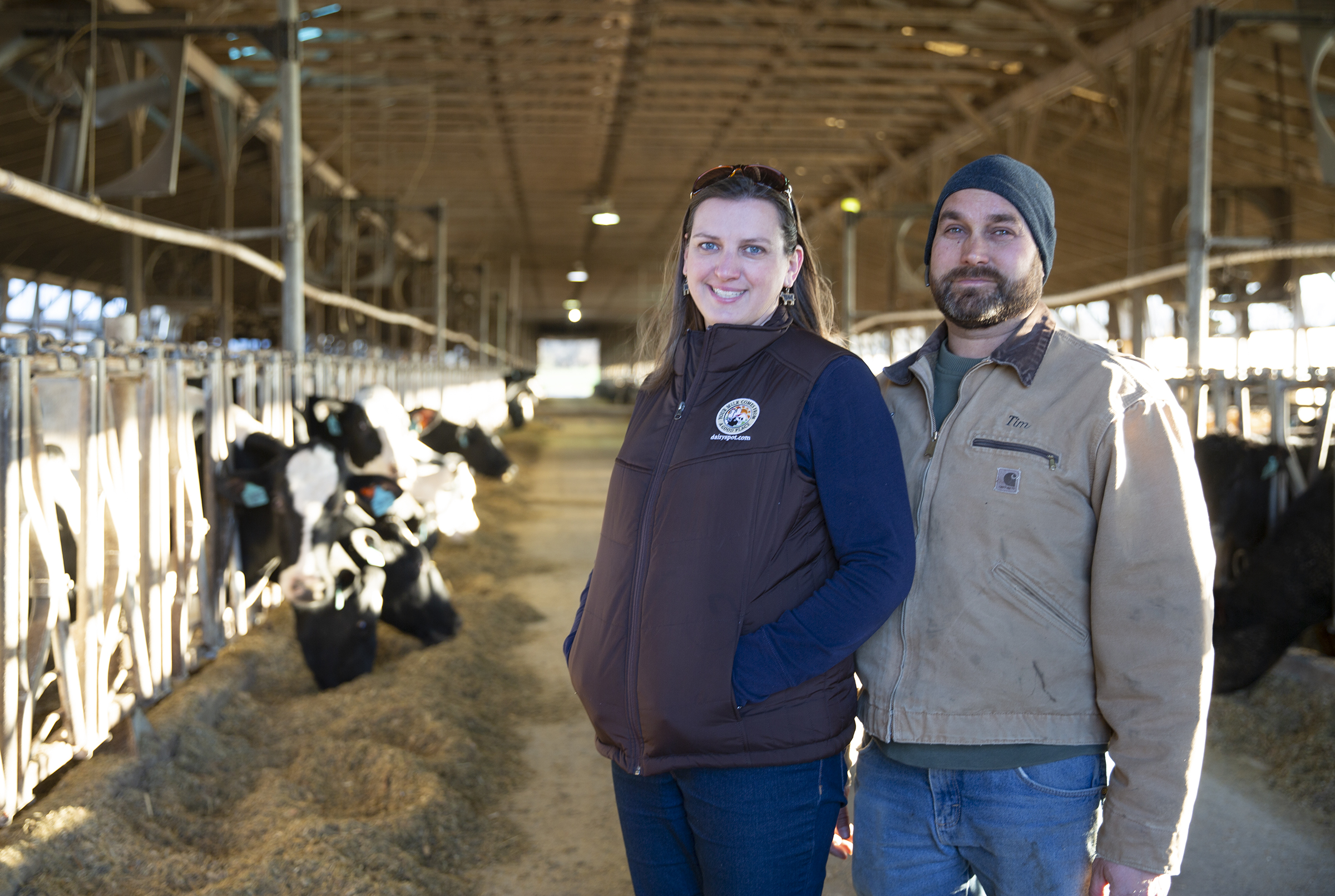
Tim and Maria Forry are flanked on the left by the downsized dairy herd of 60 milk cows and on the right by the new group of 180 beef heifers being fattened for market next spring.

“We want to niche our milk,” George relates. “Downsizing the herd was never a question of not producing milk. It was a business decision on the farm side because of the dynamics of the milk market and dairy pricing. We chose to downsize and diversify.”

The farm has gotten into custom work and a seed dealership. “We went from being 40% overcrowded to having less than 50% of our freestall capacity used, that changes a lot of things,” says Tim.

One thing it changed is feeding the methane digester that has been integral on the farm since the 1980s, so they’re fattening 180 beef heifers that go to commercial markets, along with a small number of pasture-raised Angus cattle, owned by the store, that are finished at the farm. 

The beef cattle help keep the digester fed and stable to receive the other waste, to generate electricity and be part of the composting business they started over a decade ago.

Meanwhile, the store was also looking to diversify and capitalize on direct relationships with consumers.

“I go back to the concept of doing what you are good at, and this is what we are good at,” says Jon. As part of the next generation bringing their perspectives to the business, he sees local, natural, family and fun as what Oregon Dairy is good at. This omega 3 niche allows them to envision more about the future. 

“We want to be thinking outside the box of how to handle the amount of milk produced and needed,” Jon observes. 

“It all ties back to the consumer and the cows. Through our agri-tainment and corn maze and events, we hear consumers talk about health, we talk to consumers about milk and health. I talk to my own friends and family about cows and milk, but it always comes back to a health discussion,” Jon explains. “People in my generation want natural and local, and this is natural and local. Those two words capture carbon footprint and health, and it’s part of our story.”

“I think what is encouraging for other farms to take from this is to look for opportunities to diversify and differentiate within your sphere — to pursue and collaborate with others even in a small way, to find the opportunities whether producing milk, meat or eggs,” George reflects, adding that the beef industry seems to have a better handle on dealing with plant-based competitors where the dairy industry is playing catch up.

Differentiating Oregon Dairy’s milk with “mooore omega 3”, provides new ways to reach consumers with positive messages about the benefits of milk — things you just can’t get from plant-based lookalikes.

For Oregon Dairy, the bottom line in this first-ever product is to provide the same great milk from the same great cows at the same great price with the same local story, the same great health information – but now with a little more to show and tell.

The marketing is so fresh, Jon and Curvin Hurst don’t have a handle yet on how much their sales have increased, except that the omega 3 message dovetails with the trend they already see of consumers buying the higher fat milks.

“Whole milk sales, in general, are higher,” says Jon. “We have seen that shift increase in the last two years. Whole milk is number one now.”

That trend made this possible, because without the fat, there’s no omega 3. 

Cousins Maria Forry and Jon Hurst demonstrate how shoppers can instantly pull up the video about Naturally Better Omega 3 Oregon Dairy Milk when scanning the QR code on the bottle cap with a smart phone.

At the store, the staff is trained to answer questions, the QR codes are on the bottle caps, the omega 3 milligrams are on the new labels, the ‘Don’t forget mooore milk’ signage is up with information about omega 3 health benefits, and free milk giveaway contests have been done on facebook, along with celebratory videos launching the message.

Much planning went into the launch, which they never dreamed would happen during a pandemic.

But that really doesn’t matter.

“We are already hyper-local, and now we have this extra step to further differentiate our milk,” says Jon. “As always, our story, even this new story, starts with the cows. Yes, we are proud of our milk.”

-30-

New Cl. I milk price formula puts $403 mil. in processor pockets since May 2019, $436 mil. ‘pulled’ from ‘pools’ in May-Oct 2020 period

By Sherry Bunting, Farmshine, October 9, 2020

BROWNSTOWN, Pa. — The bottom line is the Federal Milk Marketing Orders are not functioning as farm-level pricing can be easily manipulated.

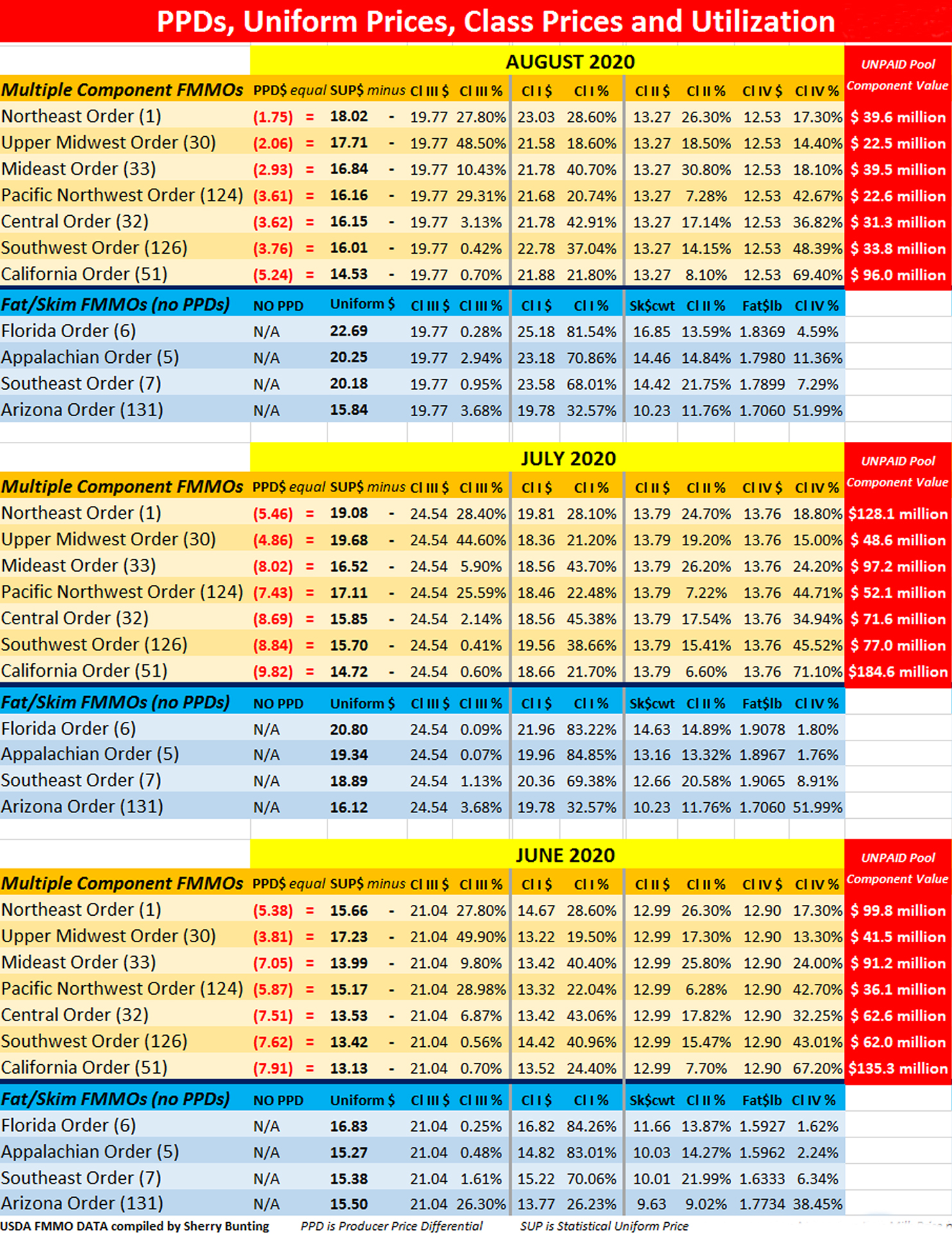
Negative PPDs continue to persist, and all indications are this could be the case through yearend. Several stories in Farmshine since May have covered the Producer Price Differential (PPD) situation and what it means to producer milk checks.

Now, even the American Farm Bureau Federation (AFBF) is on record evaluating the fallout from the new way of calculating the Class I advance base price as implemented May 2019 after passage of the change was made part of the 2018 Farm Bill.

In terms of the money subtracted from Federal Milk Marketing Order (FMMO) pools, Farmshine first reported the $1.48 billion in FMMO revenue gap across 7 of the 11 FMMOs that are multiple component pricing orders. The article and above chart were published in the September 18 edition. September losses will be reflected in FMMO reports in mid-October, and so far PPDs for September milk are mixed, some positive and some negative, but all are well below what would be the case under the old Class I pricing method.

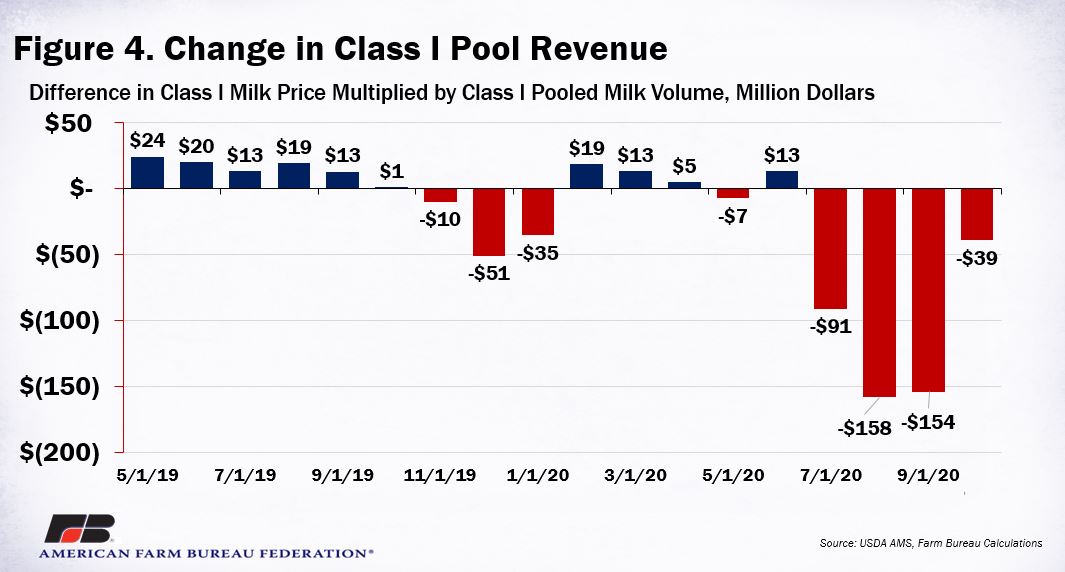
This week, AFBF dairy economist John Newton pegged the cumulative loss to Class I value, alone, at $2.00 per hundredweight or $403 million to-date, across all FMMOs just on Class I milk — money unpaid to farmers that stayed in processor pockets. That figure is about 28% of the $1.48 billion component loss figure shown in FMMO negative balance and it correlates to Class I utilization being roughly 28% of total U.S. milk volume.

The Farm Bureau summary also shows the concentrated loss of $436 million in Class I value for May through October 2020. (Interesting coincidence: DFA is today the largest Class I milk bottler with the May 2020 acquisition of 44 of Dean Foods’ 57 milk bottling plants at a bankruptcy auction price of $433 million.)

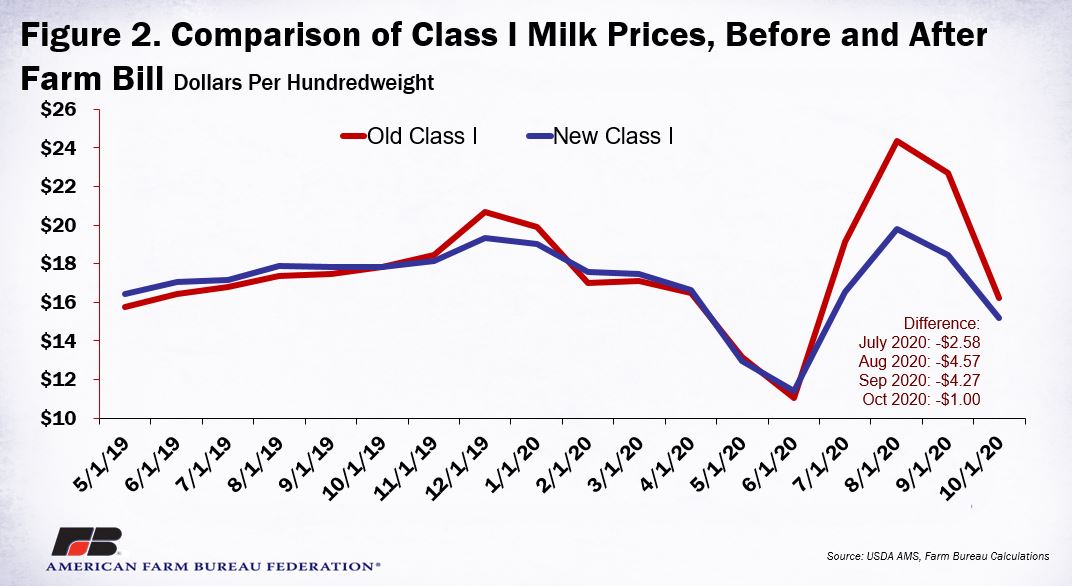
“Due to the rapid rise in Class III prices and a modest increase in Class IV prices, the spread between the two was $6.83 per hundredweight in July, $10.96 per hundredweight in August, $10.30 per hundredweight in September and (will be) $3.56 per hundredweight in October,” writes Newton this week in the Farm Bureau analysis.

“As a direct result of no longer including the higher-of in the milk price formula, the Class I milk price never fully captured the rally in Class III milk prices. Instead, the new Class I milk price was as much as $4.57 per hundredweight below the higher-of formula price in August and $4.26 lower in September,” he continues. 

“As identified in Figure 2 (above), had the higher-of formula still been in place, the Class I mover would have exceeded $24 per hundredweight in August,” states Newton.

Newton cites a Class I minimum example for the Southeast, stating that these losses are “before Class I location adjustments are added. In South Florida, for example, with the $6 per hundredweight location adjustment, the Class I milk price would have been more than $30 per hundredweight in August 2020.”

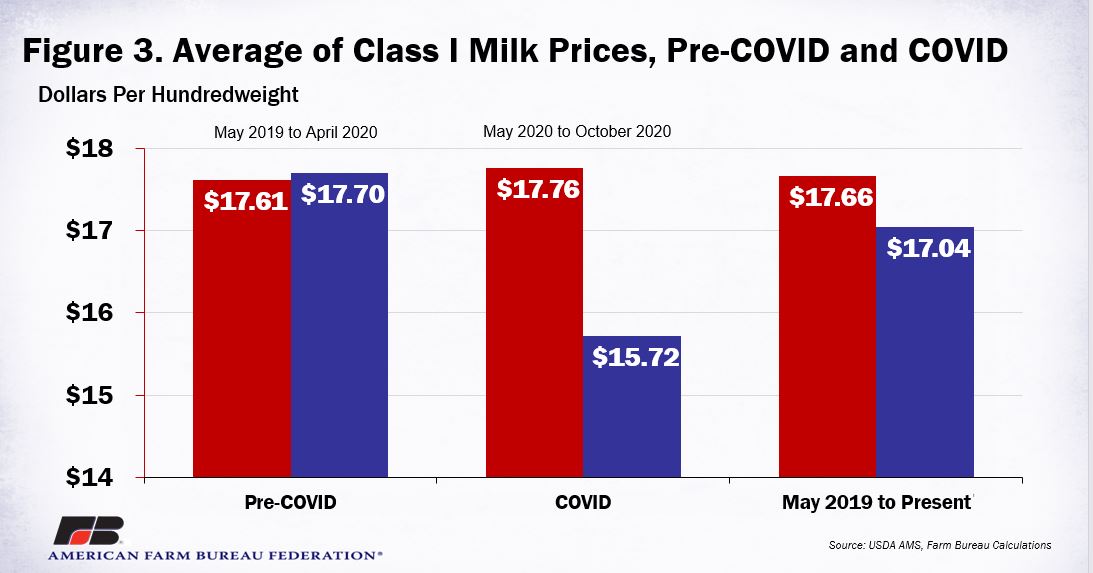
Newton notes that from May 2020 to October 2020, the average difference between the old and new Class I milk price formulas was $2.04 per hundredweight in favor of the beverage milk processor. This means that the regulated minimum prices fluid milk processors had to pay dairy farmers from May through October 2020 were an average of $2.04 lower than what they would have been if the higher-of was still in place.

Going back to May 2019 when the new Class I formula was implemented, Newton notes that the Class I milk price was 62 cents per hundredweight lower on average for the past 19 months compared with the pre-farm bill higher-of formula. (Fig. 3 above)

When looking just at the 12 months pre-Covid from May 2019 to May 2020, the new Class I calculation added 9 cents per hundredweight to Class I pooled volume.

Newton writes that the Class I volume, alone, saw a $32 million benefit in the new Class I pricing in the first 12 months May 2019 through April 2020. Post-Covid, the new Class I pricing method is reflected as a $436 million loss May to October 2020, so the cumulative loss is estimated at $403 million over 19 months of implementation.

This analysis, says Newton, was based on actual Class I pool volume as determined pre-Covid, and does not account for the impact on all milk in and out of the pool for which producers were paid at or near FMMO blend price, before deductions.

The bottom line in looking at the Farm Bureau analysis, along with our own past four months of analysis, the new way of calculating Class I – per the 2018 Farm Bill – would be a relatively benign factor in a ho-hum market if dairy product and component values were at least somewhat accurately reflected across multiple manufacturing classes.

On the other hand, it works poorly in a lopsided market where markets are disrupted, huge government purchases occur on some products and not others, and where huge imports of some products (butter) and not others (cheese) impact accumulating inventory differently for the different milk classes.

While magnified in a severe market disruption like Covid-19 has created, the dairy “market” complex has had lopsided markets in the past and will again in the future at some level. The fact that this pricing change was made without a national hearing and without a dairy producer vote and without an FMMO administrative hearing is concerning.

Some members of Congress have stated that National Milk Producers Federation (NMPF) and International Dairy Foods Association (IDFA) — together — agreed on and requested this Class I pricing change and that Farm Bureau took a non-position, making the change a “no-brainer” for Congress to include in the Farm Bill. 

Farm Bureau had done analysis before the change was implemented showing the average over time was neutral. But neutral over time does not reflect month to month cash flow impacts and messed up risk management tools when markets diverge.

What we see in this so-called “neutral” change is the capacity for processors to manipulate the transfer of market value by playing one class against others and essentially removing ‘market value’ from producer milk checks.

Congress needs to hear the story of how dairy farms are impacted in their cash flow and use of risk management tools when a minimum of $1.48 billion in component value is simply sucked out of milk checks over a 4-month period. 

Yes, CFAP payments help dairy farmers. But government payments lead dairy even farther away from establishing market value to become more reliant on government payments that, quite frankly, come with more and more strings attached.

Remember, USDA Dairy Programs responded in a Farmshine interview in August to explain that the value missing from pools is “still in the marketplace” even if it doesn’t show up in the FMMO blend prices.

Specifically, USDA stated in that August 3 email that, “The blend price (SUP) is a weighted average of the uses of milk that was pooled for the marketing period (month). If some ‘higher value’ use milk is not in the ‘pool’ then the weighted average price will be lower. It is important to note that the Class III money still exists in the marketplace. It is just that manufacturing handlers are not required to share that money through the regulated pool. 

From the looks of milk checks shared in Farmshine’s Market Moos survey in June and July — and looking at the All-Milk prices reported by USDA through August — this ‘money that still exists in the marketplace’ has been largely unshared with producers.

The Class I pricing change was made, according to NMPF / IDFA to so that Class I processors could manage their price risk with forward contracting.

However, CME market brokers and analysts who were questioned about the use of forward contracting by Class I milk bottlers say that few, if any, are doing it. Part of the NMPF / IDFA push for this change was their statements that Class I bottlers would use risk management to stabilize their milk costs if the higher-of method was abandoned in favor of “averaging”.

In fact, some analysts we spoke with report there’s no incentive – even with the new formula – for processors to forward contract a perishable, quick-turnaround product like gallon jug milk. It doesn’t sit in a warehouse like cheese or butter or powder.

… Unless it is shelf-stable ultrafiltered milk — like Coca Cola’s Fairlife products. Coca Cola purchased the remaining shares of Fairlife from the Select Milk Producers cooperative on Jan. 3, 2020 — just 9 months after the new Class I pricing method was implemented.

The industry said this Class I pricing change was needed so that fluid milk processors could stabilize prices and in turn be positioned to invest in fluid milk processing and innovation, which would help dairy producers in the end by providing more Class I markets.

But what happened? Just 6 months after the new Class I pricing method was implemented, the largest fluid milk bottler, Dean Foods, filed for bankruptcy protection and sale in November 2019 with DFA waiting in the wings to buy. Then, 3 months after that, Borden filed bankruptcy and ended up selling to a consortium headed by former Dean CEO Gregg Engles.

Farm Bureau’s analysis this week estimates the impact on dairy farmer revenue from a purely Class I perspective. It does not quantify the full extent of component value removed from FMMOs in the process. Thus, the $403 million cumulative loss impact declared by Farm Bureau represents about 28% of the total loss – which is equivalent to the current nationwide Class I utilization.

This is a Class I pricing calculation change, but its impact on FMMO blend prices and farm-level mailbox prices is pervasive.

In addition, it is important to be aware in this discussion of loss impacts that there is absolutely zero method of calculating the market value of fresh fluid milk. It is not possible to determine what fresh fluid milk is worth because it is:

1)      Regulated by federal and state milk marketing orders and boards,

2)      Used as a loss-leader by supermarkets selling it far below its cost – especially the largest milk bottling retailers like Walmart and Kroger, and

3)      Federal government restrictions on the fat level of milk children are “allowed” to consume at school or daycare.

In short, the federal government controls fluid milk through USDA in lockstep with NMPF / IDFA — and don’t forget, DMI. Dairy checkoff figures prominently in this equation with the same heavyweights at the same table — pushing fat-free, low-fat, ultrafiltered, shelf-stable products, even 50/50 plant-based blends. 

Even DMI CEO Tom Gallagher is on record stating that the white gallon isn’t the future because even if children can have whole milk “innovation” is needed and admitting that his job is to “get processors to do stuff with your milk”. 

For processors to “do stuff with your milk”, they have to be promised a bigger margin. This could explain why the forward-looking focus of farmer-funded checkoff efforts is on innovation (processing partner margin), not on promoting and educating consumers about fresh fluid milk. And, it might explain why this new Class I formula was needed to average the only so-called market value left in the so-called dairy market.

CFAP payments are salve on some wounds, but the larger issue is still clear: Dairy producers need a voice — apart from the organizations that claim to represent them.

-30-

Fair Oaks, fairlife co-founder paints picture of dairy’s future as seen by partner DMI

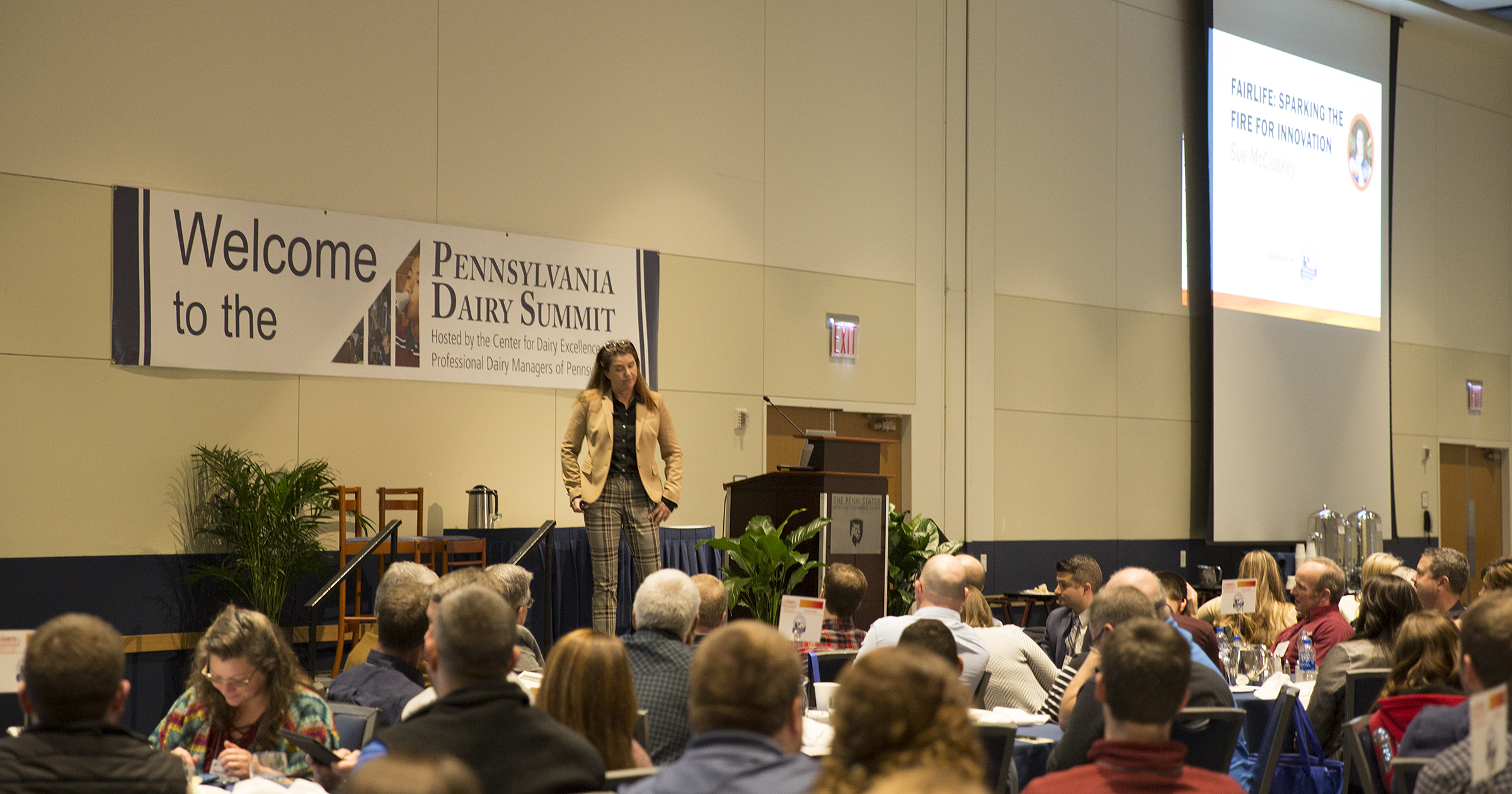
Summit_McCloskey3096

By Sherry Bunting, Farmshine, February 14, 2020

STATE COLLEGE, Pa. — The big question Sue McCloskey gets about fairlife is “How did you think of it?”

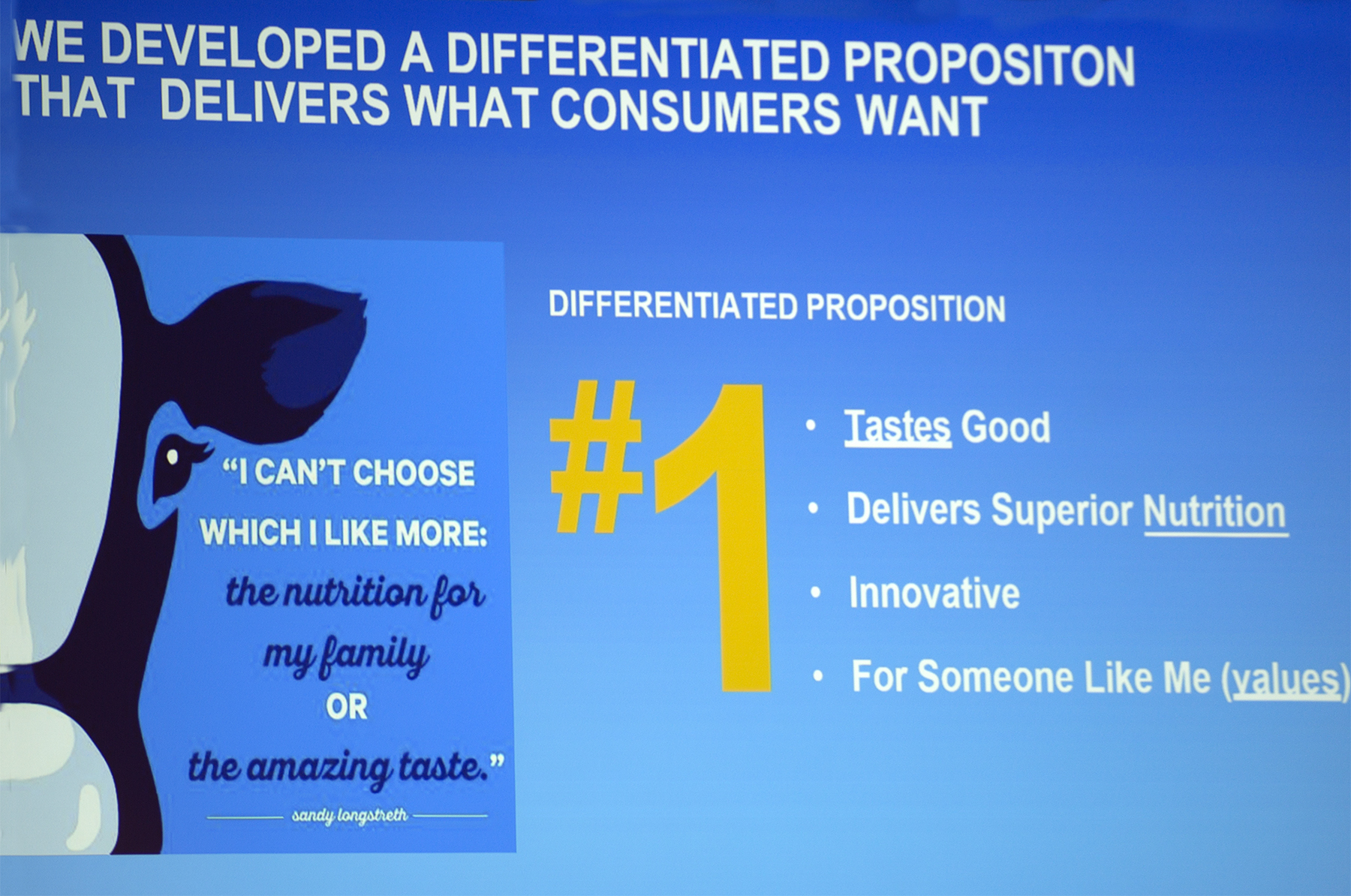
As co-founder with her husband Mike of Select Milk Producers, Fair Oaks Farms and the fairlife brand, McCloskey spoke about “the spark of innovation” to a crowd of over 500 at the 2020 Pennsylvania Dairy Summit in State College last Thursday, Feb. 6. She was among the featured speakers that were sponsored by ADA Northeast.

“We are all innovators in agriculture,” said McCloskey, telling how they learned of reverse osmosis when a well on their New Mexico dairy backed up 25 years ago, and RO membranes were used to separate solids to restore water quality. That experience introduced them to the concept of filtering solids by molecular size, but her larger message was about the concept of innovation in allowing companies to differentiate in a generic category like milk.

For example, she said, who would think, years ago, that water would become the multi-billion-dollar industry that it is today? And coffee? She cited Starbucks as a catalyst for the rise of coffee houses and coffee drinks and blends today.

As in these examples, someone was the first innovator to bring value to those generic categories. She said for milk, the parallel is fairlife.

“Innovation – thinking outside the box — that’s what grabs people,” she said.

McCloskey maintains that as consumers, “We are all waiting for the next new thing. We want more. We want new. That’s where we have seen success with fairlife.”

The journey

McCloskey talked about her husband’s journey from being a dairy veterinarian to a dairy producer and innovator. They started with 300 cows in California and a partner they still have today in Tim DenDulk. One by one they bought dairies, fixed them up and rolled them over.

Once they got to New Mexico with a 3000-cow dairy, that was the real beginning of it, she said. That’s where they founded Select Milk Producers 25 years ago, which is today the sixth largest cooperative on a milk volume basis with 99 members.

They formed to focus on high quality milk with low somatic cell counts and to sell that concept direct to retailers instead of being part of a co-op that commingled their milk to blend-down the somatic cell counts. That’s where they were introduced, she says, to the concept of what has become fairlife through the use of RO membranes to ultrafilter the milk. She explained that the milk going in must be very low in somatic cell counts because the process of ultrafiltration concentrates the solids – including somatic cells.

She pointed to the “incredible success” of building different plants and beginning to build the fairlife brand, which led them to their next opportunity in the Midwest – Fair Oaks Farms.

When the McCloskeys came to Indiana, DenDulk, their original partner in California, was already in Michigan.

McCloskey said the housing technology had developed by that time to where they felt they could do larger dairies in the Midwest climate. They built the first of the original four 2800-cow dairies in 1999. Today, there are 13 separate dairies totaling over 36,000 cows that are owned and managed by a few families on the roughly 30,000 acres, including the new 800-cow robotic dairy that opened at the end of 2019.

In fact, she spent part of her time talking about the innovations coming out of Fair Oaks to recycle and recover nutrients and to address greenhouse gas emissions to improve the “sustainability” and carbon footprint of dairy.

“There are cool things happening and things we are doing that we really need to embrace,” she said.

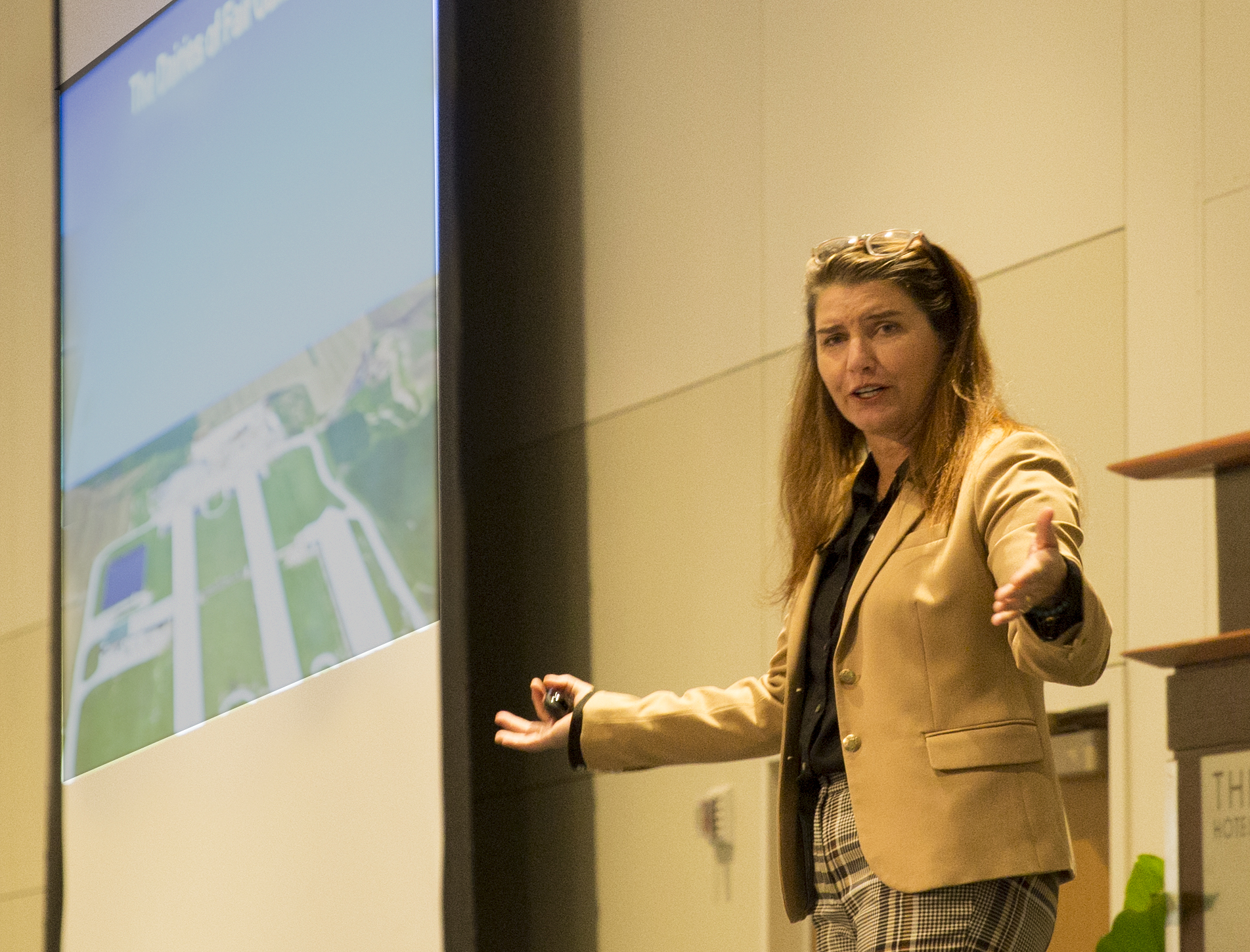
Summit_McCloskey3106

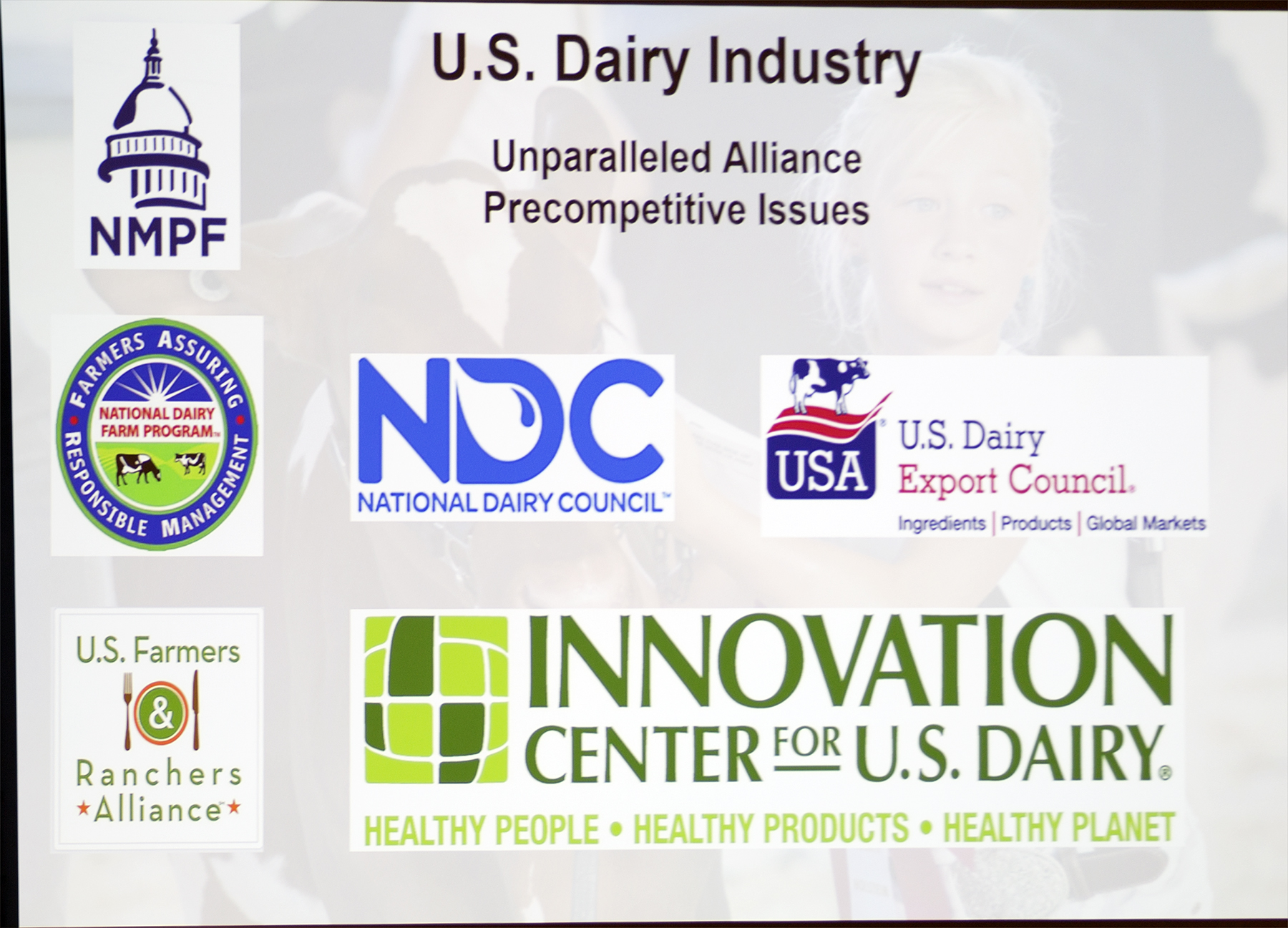
(Sue’s husband Mike, who spoke in March at the PDPW virtual business conference on U.S. Dairy’s goals for GHG emissions, was the first chairman of the Sustainability Initiative when it was launched under DMI’s Innovation Center for U.S. Dairy in 2009-10, and the checkoff’s research and development and marketing assistance for fairlife and Fair Oaks came from DMI through the Innovation Center where such partnerships are born.)

The process

Establishing fluid milk supply relationships with large retailers like H-E-B and Kroger, McCloskey said they have worked over two decades to move closer to consumers as they began using RO and ultrafiltration as early as 1995 to reduce the water moving loads of milk to cheese plants, while at the same time beginning the high protein, low sugar milk proposition partnering with H-E-B in Mootopia in 1996, before what is fairlife today.

They saw other protein drinks in the market they could compete with – by concentrating the protein in milk.

So began the process of building the brand from coast to coast as new products have been added continually. While most people are familiar with fairlife ultrafiltered milk, the CorePower fitness recovery drink was among the first that was created as a competitor for Muscle Milk.

Today, there are flavored Yup drinks, snack drinks that pair ultrafiltered milk with oats and honey, new coffee creamers, and a full line of weight management and healthy lifestyle products that are just emerging under the fairlife brand.

While Select Milk Producers sold its remaining half-interest in fairlife to its early partner Coca-Cola a few weeks ago, McCloskey remains a spokesperson for the brand. Also, the research and development teams remain intact and are still located in Chicago.

The spotlight

What Coca-Cola did for fairlife, said McCloskey, is to provide a nationwide distribution network that the Select co-op could not have achieved on its own.

“The hardest thing in consumer goods is to get a product in front of the people who want to buy it,” said McCloskey. “Our challenge was distribution. So, we formed a partnership with Coca-Cola. With Coca-Cola as 100% owner of fairlife, what happens now is that they are just going to run with it.”

This means that, “Milk is in the spotlight. While we hear the bad news from Dean’s and Borden, the good news is that the Coca-Cola, a top-five company, is involved in milk,” said McCloskey.

With an ultrafiltration plant producing fairlife in Michigan, she explained that the east coast and midwestern markets could be served and that the new Select plant in Arizona will serve the west coast market. A plant is also being built in Canada.

Answering a question about whether fairlife, or this direction of milk innovation, would ever “play ball” with the smaller average size farms in Pennsylvania, she replied that any milk supply for fairlife must be very low in somatic cell counts and will have to meet with flying colors all of the new levels of audits and animal welfare requirements that Select Milk Producers and Coca-Cola have implemented since the undercover animal abuse video at McCloskey’s original farm at Fair Oaks this past summer.

When asked how producers are compensated for these additional measures, she did not disclose proprietary information about how producers are paid.

The proposition

She said the fairlife story shows “there is still room for investment and innovation in milk, innovation that makes milk relevant to consumers.”

McCloskey explained how the ultrafiltration process raises the protein and calcium levels, removes the lactose and reduces the natural sugars in milk without adding anything.

Summit_McCloskey3121

“And it is still real milk… but better,” she says, explaining that fairlife is finding “amazing growth in differentiation,” that fairlife’s entire proposition to consumers is the concept of  “believe in better.”

“Our core tenets of the master brand are better taste, better nutrition, and better values,” she said.

“The brand is created around values, and these values are not new, but they are done in a way that is a little more creative to today’s consumers.”

She explained that Select Milk Producers sends milk that goes into a jug at Krogers and sends milk to fairlife, “but it’s the innovation and sharing the values that leads to growth.”

Sharing consumer surveys showing 90% of fairlife consumers are satisfied and 69% are repeat customers, McCloskey said this growth and innovation “mean bigger things for dairy than just fairlife.”

She said that 45% of the fairlife market share is coming from within the milk category and 55% of their consumers are coming over from outside of the milk category.

While fairlife’s ultrafiltration process is patented, McCloskey said a dozen new products have come on the market since fairlife that use similar technology or other means of delivering high protein, low sugar outcomes.

This allows these products to differentiate themselves next to the gallon of milk as a generic staple, she explained.

“If someone is on food stamps and can’t afford these new products, that’s okay,” McCloskey said. “They can buy milk. People will still buy milk.”

Summit_McCloskey3130 (2)

The next phase

McCloskey stressed the “tremendous value checkoff organizations bring to dairy farmers to promote how to innovate dairy and make it better.”

She explained the next phase, how DMI is sitting down with young urban-suburban consumers to “learn how they make food choices, to learn what they look for. This is leading us into sustainability and carbon footprint,” said McCloskey.

“We also sit down with the different NGO’s (like World Wildlife Fund for example). We all sit at the table and talk about the challenges that face dairy farmers,” said McCloskey. “The Net Zero Initiative coming out of that is one of the coolest things, and we are a collaborator on what is needed for dairy to get to net zero. It’s a big stake in the ground, but it’s got to be the place where we need to go.”

She explained the Net Zero Initiative under DMI’s Innovation Center for U.S. Dairy has a catalog of technologies to help producers deal with environmental issues.

“What if 37,000 dairy farmers could have net zero greenhouse gas emissions? This is what we have to chase,” she said. “The innovation can’t stop. The whole genome of the dairy cow has been mapped. Manure can be fractionated. There is innovation that is so exciting for us to think about what dairy can look like in the future.”

The forward-looking picture McCloskey painted for Summit attendees includes even more fractionization and extraction of milk’s elements, more use of specialized GMO crops and more consolidation of farms and processors with fewer cows producing more milk to meet new sustainability benchmarks.

McCloskey said the innovation from fluid milk to cheese to fractionating protein into “all kinds of other products” — while reducing the overall dairy carbon footprint — is the road to 2050.

Summit_McCloskey3132

The ‘perfect laboratory’

“We have only begun to know milk’s power and the different vitamins and elements we are just discovering how to use and extract,” she said.

“And it all happens in nature’s perfect laboratory – the dairy cow.”

On the flip side, McCloskey acknowledged that DMI has also learned consumer choices come back to this bottom line:

“It’s got to taste good and it’s got to do something for me,” she noted. “This is why dairy is not going away. Dairy is real and it tastes great and it makes you feel good.”

-30-

Round bale art gets noticed at Thiele Dairy Farm: ‘I enjoy putting a smile on someone’s face.’

THIELE_MUST_StatueOfLiberty (1)

Lorraine Thiele went with the Statue of Liberty theme this week for the farm’s patriotic round bale art display ahead of July 4th. It’s attracting a lot of attention on state route 356 at the end of the farm lane just outside of Cabot, Pa. Photo by Lorraine Thiele

Round bale art gets noticed at Thiele Dairy Farm

By Sherry Bunting, Farmshine, July 3, 2020

CABOT, Pa. — The flag-draped Statue of Liberty round bale artwork at the end of the long lane leading to Thiele Dairy Farm in Butler County, Pennsylvania is attracting attention. The Thiele family placed it on their farm alongside state route 356 just outside of Cabot this week ahead of Independence Day.

“Everybody just loves it, especially in a time like this with what our country is going through, with the turmoil we are in,” says Lorraine Thiele when asked in a Farmshine interview about the community’s response. A photo of it has also created a lot of activity on the farm’s facebook page.

“We get a kick out of seeing people drive by, stop, back-up, and take their pictures with it,” she adds. “I enjoy putting a smile on someone’s face, to have something that can make people smile on their way to work or wherever they are going.”

THIELE_Family(MarburgerPic) (1)

James, William, Lorraine and Edward Thiele at their sixth-generation dairy farm in Butler County, Pa. Photo courtesy Marburger’s Dairy

Edward and Lorraine Thiele and their twin sons William and James farm 300 acres of corn, soybeans, hay and oats and milk 40 cows at the sixth-generation Dairy of Distinction, established in 1868. Lorraine does the bookkeeping and all the feeding. She hops on the tractor and helps with other things when needed, although she doesn’t milk much anymore.

Lorraine is also the artist behind the series of round bale portraits that have been created over the past several years. She credits her husband and sons for helping with some of the technical strategy and by providing custom-sized round bales when she asks for them.

“When Ed sees me with the skid loader stacking and piling round bales, he’ll get involved and we’ll draw it out. He likes to help with the more technical side,” she adds.

Her Statue of Liberty this year was painted on three large round bales. Last year she did just the American Flag on six. She’s been doing the round bale art projects for several years now – ranging from turkeys and pilgrims at Thanksgiving, to cows and milk jugs for June Dairy Month, and from tractors with wagons full of pumpkins in the fall, to Santa Claus, reindeer, Christmas trees (with lights) and a Nativity last Christmas.

“I try to do something different every year,” she says, explaining how she “googled” for some patriotic ideas to see what struck her fancy for the 2020 July 4th rendition. She came up with the Statue of Liberty.

“I can’t do faces, so I found a silhouette for the design. I also found a ceramic statue with the flag draped over and figured I would try that.

“I’m not an artist,” Lorraine states humbly. To guide what she calls her ‘graffiti style’ spray painting, she used big baler twine pinned to the stacked bales. If her design gets too big, she tailors it down with a background color.

She admits she has been surprised by how relatively easy it is to paint round bales. Their straw bales are not plastic wrapped, so they take a lot more paint than one would imagine.

“Always buy more spray paint than you think you need,” she suggests, adding that painting it on the net-wrapped side holds the paint better than painting the face of the bale of hay or straw, which “really sucks up the paint.”

She also likes to get creative, using items that are laying around. One year, Lorraine painted wood planks in different colors for the feathers on the Thanksgiving turkey.

One year, for June Dairy Month, she used black drain tile pipe and painted the tip white for the cow tail after Ed drilled-in a rod to hold it.

Once she gets an idea in her head, and thinks about it for a while, it comes together.

“It’s fun, and something different to do. It looks harder than it really is.

“Don’t be afraid to try something,” Lorraine encourages. “The nice thing is, if it doesn’t work out, throw it in for bedding and no one will ever know!”

While the Independence Day Statue of Liberty is creating the buzz right now. It was the reaction to the June Dairy Month art that really surprised Lorraine.

THIELE_JuneDairyMonthArt (1)

For June Dairy Month, the painted milk pints had many people turning into the farm lane to buy milk, but the Thiele family explained that all of their raw milk goes to the Marburger Farm Dairy plant in Evans City — a great local brand.  Photo by Lorraine Thiele

“I painted milk chugs — chocolate and strawberry milk pints — to put beside the bale-painted cow,” she explains. “You would not believe how many people turned in the lane and came up to the farm wanting to buy milk. I never would have thought just a straw bale done up as a milk pint would do that!”

In fact, the response was so great, Lorraine had to put a post on the Thiele Dairy Farm facebook page (and a sign by the artwork), explaining that the family does not sell milk right off the farm and that their raw milk all goes to Marburger Farm Dairy in Evans City — a great local brand.

The Statue of Liberty took about a week to finish, but she only works on round bale art when she has the time. After a painting is complete, they haul it down the lane to position it by the main road.

THIELE_Farm02 (1)

Faith, family and farming are alive and well on the Thiele family’s dairy farm.

The Thiele Dairy Farm facebook page is also something Lorraine enjoys. She started it almost 10 years ago through her love of photography and her desire to promote agriculture in a positive light.

“There’s a lot of negative out there,” she says. “Our son (William) has a drone, and he videos the baling, mowing, and planting. The average person doesn’t have a clue what we are talking about or how it is done or what is involved, so our sons love to show it, to do things like that to educate people about what we do.”

Each family member is a steadfast advocate for agriculture, and they are active in Butler County Farm Bureau and Dairy Promotion Committee. They participated in the Butler County milk donation drive-through back in April before the CFAP program. It was coordinated by Community Action Partnership with Farm Bureau, the Butler County Dairy Promotion Committee, Marburger Farm Dairy, AgCoice Farm Credit, and others, where 1200 gallons of milk were distributed along with a bag of groceries and a box of frozen products.

Lorraine is a positive person, and that was demonstrated in this interview and throughout her connections to the community in person and through social media. People appreciate it, even putting gifts or thank you notes to the family by the round bale Christmas tree at holiday time.

As difficult as things can be in the dairy business at times, Lorraine loves the farm and the cows and is thankful her family is farming together — where everyone in the family does everything on the farm.

As for the round bale art? If she can make someone else smile for even just a second. It is worth it.

THIELE_Farm (1)

Summer sunset this week at Thiele Dairy Farm in Butler County, Pennsylvania. 
Lorraine loves taking photos on the dairy farm and the Thiele Dairy Farm facebook page is full of her photos as well as drone videos by her son William.  Photo by Lorraine Thiele

-30-

U.S. milk production falls 1% in May, FMMOs pool 13% less milk

OtherUsePooledMilk_Table_I(withMay2020) (1)

Table 1 showing “other use / milk dumpage” totals by Federal Order includes data for May 2020. The month of May saw 13% less milk pooled on Federal Orders compared with a year ago, and 13% less milk in the “other use / dumpage” category compared with a year ago — down dramatically from the enormous 350 million pounds of “other use” milk pooled in April 2020.

States east of Mississippi cut production, west mainly grow

By Sherry Bunting, Farmshine, June 26, 2020

WASHINGTON, D.C. — As April’s dismal Covid-impacted dairy market spilled into May milk checks, the supply-side of the ship turned in May at the same time as demand was strengthened by dairy donations, retail demand and food-service re-stocking.

USDA Dairy Market News reports each week have signaled progressively tighter milk supplies heading into summer vs. stable to strong demand pushing spot loads to sell above class price in some areas.

In April, cooperatives across the country set base limits on member milk production for May until further notice. Some severely discounted any milk provided that was above 80 to 90% of a member farm’s March marketings. Many producers chose to leave this penalty milk out of the tank.

As these co-op ‘base’ programs went into effect in May, the impact is demonstrated in the USDA May Milk Production report, estimating  U.S. output at 18.8 billion pounds, which is 1.1% below year ago for May.

Cow numbers were down 11,000 compared with April, according to USDA, but still 37,000 more milk cows were estimated on farms compared with a year ago.

Nationally, milk output per cow dropped by one pound/cow/day in May compared with a year ago, the report stated.

In addition, Federal Order milk pooling totals and “other use / dumpage” data provided to Farmshine by USDA AMS by request, showed the total volume of milk pooled across all Federal Orders in May dropped like a rock to levels 13% below year ago.

Similarly, the volume pooled as “other use / dumpage” across all Federal Orders fell to levels 13% below year ago nationwide — from the enormous 350 million pounds recorded in April to 36 million pounds in May. (See Table 1.)

What is eyebrow-raising is how the numbers in these reports geographically arrange themselves.

In last Thursday’s Monthly Milk Production Report, the national drop in total output for May masks the fact that among the 24 top milk producing states listed individually in the report, those east of the Mississippi accounted for all of the production decline – plus balancing the accelerated western growth to get the U.S. total a significant 1% below year ago.

States east of the Mississippi saw large decreases in production, while in contrast, the growth states of Texas, Colorado, Idaho, Kansas, Arizona, South Dakota saw increases in production ranging from 1.4 to 9.7% above year ago.

East of the Mississippi, the Northeast milkshed really clamped down on production with Pennsylvania 3% below year ago, New York down 3.7%, and Vermont down 6.4% vs. year ago in May.

Further south, Virginia and Florida were unchanged from a year ago, while Georgia’s production fell 1.4%.

In the Mideast and Midwest, Michigan was off a fraction (0.4%), Minnesota down 1.9% and Wisconsin’s production fell by 3.1% vs. year ago. Indiana, Illinois and Iowa were down 1.7 to 2%. Ohio was the outlier, gaining 0.4% in production over year ago.

In the West, May production was larger than a year ago with South Dakota leading on a percentage basis producing a whopping 9.7% more milk compared with a year ago. Number five Texas grew by 1.9%. Number three Idaho grew by 4.6%, and Colorado grew by 4.8%. Arizona grew by 1.4%, and Kansas by 2.4%.

Three western states were key outliers as California dropped production 1.5% below year ago, Utah was down 3%, and New Mexico fell a whopping 7.2% below year ago. The Pacific Northwest had generally steady production with Oregon unchanged from a year ago and Washington down fractionally.

In Federal Order pooling, the volume pooled nationwide was down a whopping 13% from 15.1 billion pounds in May of 2019 to 13.2 billion pounds this May of 2020.

In the Northeast, total pooled pounds on Federal Order One for April and May of 2020 were essentially equal at 2.3 billion pounds each, but relative to year ago, this was a decline of 1.7% while production on farms in the region fell a whopping 4%, collectively. The difference likely came from elsewhere.

Meanwhile, the amount pooled as “other use / dumpage” in the Northeast Order One dropped abruptly from the enormous 131 million pounds in April to 12.3 million pounds in May, representing a 35% drop in “other use / dumpage” compared with a year ago.

Pooled milk classified as “other use / dumpage” in the Appalachian, Florida and Southeast Orders 5, 6 and 7, also dropped significantly in May compared with April’s large records. In fact “other use” milk in those three Orders fell to levels that were 19% (Appalachian), 9% (Florida) and 32% (Southeast) below year ago. At the same time, total pooled pounds for these three Orders – 5, 6 and 7 – were calculate below year ago in May by 1% in Order 5 (Appalachian), 2.5% less in Order 6 (Florida) and a significant drop of 11.7% less milk pooled compared with a year ago in Order 7 (Southeast).

In a sense, the pull back in production in the Northeast, Mid-Atlantic and Southeast regions, where April’s dumping had been so extreme, helped bring down total pooled pounds in those areas to rein-in the “other use” pounds as well.

Growth areas of the nation showed significantly less “other use / dumpage” pounds in May vs. April. However, in some of the Orders, such as the Southwest (Order 126) and Upper Midwest (Order 30), the “other use / dumpage” category was still above year ago levels by a modest margin, according to the USDA AMS figures.

As the dairy industry right-sizes itself after COVID-19 supply-disruptions that abruptly cut 30 to 40% from producer milk checks, it remains to be seen how states east of the Mississippi can regain their footing as western growth areas kept shipping more milk right on through — without missing a beat.

-30-