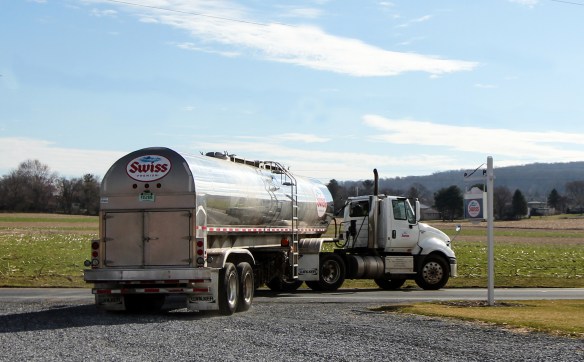
Seismic shifts in milk supply chain ahead: New Walmart plant triggers Dean’s cut of over 100 dairy farms in 8 states

SwissDeanStory9468

By Sherry Bunting, from Farmshine, March 9, 2018

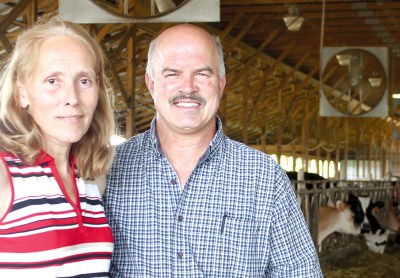
LEBANON, Pa. — He saw the mailman drive up and linger in the driveway, wondering if they were expecting a package. Moments later, his wife was standing there, holding a letter she had signed for.

The certified letter informed this Lancaster County dairy farm family that after 13 years of sending their milk to the Swiss Premium plant in Lebanon – along with decades of the farm’s milk in generations before them — the agreement with Dean Dairy Direct would end May 31, 2018.

The same story played out Friday among neighboring farms on the same hauling route to the same plant. And it was the same scene in driveways for approximately 120 dairy farms in eight states, including 42 in eastern and western Pennsylvania — around half of the Dean Dairy Direct shippers to three plants in the state.

Reace Smith, director of corporate communications for the Dallas, Texas-based Dean Foods, confirmed in a phone call Monday that against the backdrop of expanding raw milk production, and companies “asserting and expanding their presence in a market where consumers are drinking less milk (namely the Fort Wayne, Indiana Walmart plant where bottling begins this month) over 100 dairy farms in eight states received 90-day termination notices” from Dean Dairy Direct on Friday and Saturday, March 2 and 3 stating that their agreements will end May 31, 2018.

Smith confirmed that the over 100 affected dairy farms are in the states of Indiana, Ohio, Pennsylvania, New York, Kentucky, Tennessee, North Carolina and South Carolina.

“This affects all size herds and is not a large or small farm thing,” said Smith. While she was unable to supply specific information about the farms that were terminated, she said the widespread volume adjustments at multiple plants across four Federal Orders was necessary due to the new Class I plant (Walmart) coming online this month and the loss of a contract through a competitive bidding process (Food Lion).

Both market losses for Dean indicating structural change to the dairy industry as more retailers move into milk bottling in more centralized distribution models.

Sources in the various states confirm the affected farms range in size from less than 100 cows to over 1000 cows.

“This was an incredibly difficult decision. We tried very hard to avoid it and regret this decision had to be made,” said Smith. She indicated that Dean Dairy Direct field representatives are serving as resources to these producers and can provide a list of contacts for potential milk buyers. They are also offering counseling.
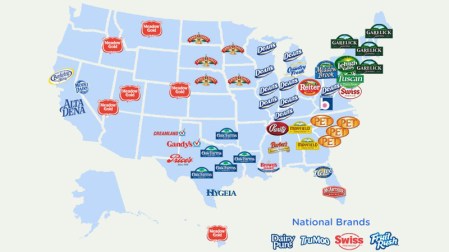
DeanFoodsMap.jpgWhile the company will not provide a list of affected plants or a state by state break down in the number of farms or volume of milk affected, they have indicated that the state that may be hardest hit on a volume basis is Indiana.

In fact, the volume of displaced milk in Indiana, alone, has been estimated at over 20 million pounds per month, representing the under 100 to over 1000 cow size range but most of them milking 300 to 1000.

The affected Indiana farms shipped milk to the Dean plant in Louisville, Kentucky, which also terminated 22 Kentucky dairy producers, ranging from 50 cows to 250, according to Maury Cox, executive director of the Kentucky Dairy Development Council.

In Tennessee, Julie Walker of Agri-Voice near Knoxville has confirmed nine (now 10 confirmed) affected producers ranging 60 cows to 300, and numbers in the Carolinas are unknown at this time.

From the standpoint of the farms affected, Pennsylvania is hardest hit, and while the number of New York farms is unknown at this time, some may have shipped to Dean plants in Pennsylvania.

According to Jayne Sebright, executive director of the Center for Dairy Excellence, 42 Pennsylvania dairy farms shipping to three Dean plants in eastern and western Pennsylvania received notices Friday – representing half of the Dean Dairy Direct shippers in the state. This includes 26 producers in eastern Pennsylvania, including Lebanon and Lancaster Counties, as well as 16 in western Pennsylvania, where the Dean plants in Sharpsville and Erie also ended agreements with Ohio farms. The number of Ohio farms affected is unknown at this time.

“The (Agriculture) Department and the Center have been reaching out to other markets to see what capacity is available, but at this point we do not know of any with available capacity,” said Sebright. “We are working to support the affected farms as best we can. We are very concerned both about the future of the farms and the well-being of the farm families.”

Sebright noted that the Center is making additional resources available and recommending use of their Dairy Decision Consultants Program to evaluate options — both within and outside of the dairy industry. “This is a difficult situation to be in and we are concerned.”
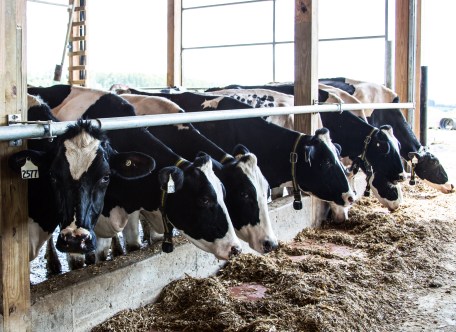
Dean-Cows.jpgIn fact, the farm this reporter visited in Lancaster County Tuesday was already working to call every available market and neighbors who also lost their contracts were looking at everything they could think of. Four or five trucks go through the county picking up milk every day so they wonder if each one can find a market or if they are better off pulling their milk together to find a single-haul market.

The producer was thankful, at least, for being part of a dairy producer discussion group and thankful for folks like Dr. Charlie Gardner with the Center who leads the group.

Not only were the Pennsylvania dairy farms shocked to receive the letters, veterinarians, nutritionists, feed company and equipment maintenance folks are facing this loss with their farm customers as the news spread this week throughout farm communities and the greater dairy community.

In Indiana, where estimates are that over 20 million pounds of milk per month has been displaced, producers had already been on edge as the Walmart plant took shape in their state and they contemplated its milk sourcing.

“We are working with producers and contacting cooperatives and potential markets to try to work together to get through this thing,” said Doug Leman, executive director of the Indiana Dairy Producers. He has been in contact with affected producers, the Indiana Department of Agriculture, and the plants and cooperatives that provide markets for milk in the region.

“I’ve had calls not just from the affected producers, but from many other Indiana dairy producers sharing their concern and asking if there is anything they can do,” said Leman. “I’m encouraged by that, and I am encouraging our producers to keep their chins up through this difficult time in their lives, families and businesses in the hopes that we can work through this together.”

Leman said he does not want to blame Walmart because, wherever the first Walmart plant would have been located, this was coming. Indeed, Walmart has entered a trend among retailers to move toward bottling their own private label store brands (Great Value and Sam’s Club Member’s Mark) rather than contracting with Dean Foods.

“Walmart was coming to Ohio, Michigan or Indiana, and I still believe it is better to have the plant in Indiana because it offers opportunities,” said Leman.

While fluid milk consumption is on the decline for 15 years — although stabilizing with more consumption of whole milk last year — retailers notice that nearly every shopping basket going through their stores includes milk. They seek their own store brand loyalty as loyalty to their store and some of the retail price wars happening in states without loss-leader protection are evidence of this. As is the ability to pull premiums away from states that have loss-leader protection or a minimum retail price as in Pennsylvania, to “fund” price wars in other surrounding states without any loss-leader protection.

The dichotomy points to a need, perhaps, for a federal loss-leader threshold versus random state programs that can fuel the picking of winners and losers in today’s times of seismic structural change to the dairy industry from retail all the way through the supply-chain.

In short, the region would likely have been affected by Walmart’s decision to vertically integrate its Great Value and Member’s Mark milk brand for its stores in the region — no matter which state the plant had been located.

In fact, sources indicate potential sites to the south are being eyed for a second Walmart plant in the future, revealing a corridor strategy to this vertical integration of single-source, full-traceability, each-truck-one-farm model.

The Dean Dairy Direct letters of termination to dairy producers in the region were dated February 26, 2018, which was the same day as Dean’s 2017 earnings call where the company projected its strategy in brand and private label supply and to “right size” its milk volume and consolidate its supply chain to achieve a “flatter, leaner and more agile” company into 2019.

According to Smith, there are no official announcements of any plant closures at this time and none of the plants involved have released all of their shippers. Still, there remains concern that some of the plants that have released a larger portion of their farms are vulnerable.

“We still have a commitment to local milk,” said Smith about the volume adjustments. “There are many factors that impacted this decision. We are seeing surplus raw milk when the public is consuming less fluid milk, and we see companies asserting and expanding their presence in a market where consumers are drinking three gallons less annually, per capita, since 2010 while the U.S. dairy industry is producing 350 million gallons more milk annually than the year before.”

In addition to the overall imbalance Smith said that, “The introduction of new plants when there is an industrywide surplus forced us into the position of further adjusting our milk supply according to demand.”

As vertical integration of milk at the retail level leads to consolidation by the nation’s largest milk bottler – Dean Foods – the company has diversified into soft dairy product brands that are just starting out of the gate and were discussed in the Dean earnings call as well.

Specifically, the letter received by Indiana and Kentucky dairy producers shipping to the Louisville plant stated “two indisputable dynamics led to this difficult decision. First and foremost, a retailer’s new Class I fluid processing plant is coming online in the region, significantly decreasing our production as milk volume is moved away from our facility to this new plant.

“The second reason is bigger than all of us. The steady increase of raw milk production combined with the decrease of Class I fluid dairy consumption…” the letter stated.

Letters received by producers in the southern market as well as eastern Pennsylvania did not specifically reference the new Class I fluid processing plant built by a retailer (Walmart) as had the letter to Kentucky and Indiana producers serving the Louisville plant and western Pennsylvania and Ohio producers serving the Sharpsville plant.

Those letters received by farms further to the east and the south indicated the plants had “lost a portion of customer fluid milk volume to a competitor through a customer-bid process.” Sources indicate this may include both the Food Lion private label store brand and the Walmart Great Value private label in these areas as well.

The letters received by producers said further that Dean was “unable to lock-in enough new customer volume to offset this loss.” This is a function of the overall decline in fluid milk consumption and the new milk via large multi-owner, multi-site farms in surplus regions of the Mideast and Midwest.

One thing is also clear in speaking with producers, veterinarians, organizations and others in the industry, the farms that are facing this difficulty are largely well-managed and producing high quality milk. Many of them are young families representing the next generation. Many are progressive, with updated facilities and technologies as well as utilizing the resources available to them for continued improvement in all that they do to supply their communities with milk.

In these states affected, whole transportation routes were terminated, presenting both challenges and opportunities for a collective effort in dealing with these market losses.

Walmart will not reveal the farms they have secured to supply the plant, but it is widely known that some of the milk will come from the north, some from within Indiana, and that a processor in Wisconsin is handling contracts and in a position to balance the Walmart plant’s fluid needs that may or may not have involvement by cooperatives.

As in Indiana and other states, Cox said of Kentucky: “We, are contacting other potential markets for our producers and would like to meet with Dean Foods to see what more we can do for these producers and to have a better understanding about the future of the Louisville plant” (where both the affected Kentucky and Indiana producers shipped their milk.)

Some state dairy organizations, state departments of agriculture and other industry leaders indicate they want to let the dust settle and allow options to emerge as they adopt a patient mindset to look at potential options for their respective state’s producers.

In the meantime, all are reaching out to producers and urging producers to reach out to them, and to each other. In fact, right now, more than ever, the dairy community needs to be reaching out and talking about its future to higher levels of relationships beyond what has occurred in the past.

“We want to survive,” said the dairyman this reporter visited 15 minutes from my home in Lancaster County, Pennsylvania, just four days after receiving the letter.

Like others this reporter has spoken to, they have done everything the industry suggests to make their farm competitive. While a small farm whose milk shipped for generations to the Lebanon Swiss plant serving local stores and consumers, this young farm family had invested in the latest technology, produces milk with very high components and very low somatic cell counts.

But here they are, facing what 120 of all sizes face throughout eight states as vertical integration from Walmart and other retailers sends a ripple effect and seismic shifts throughout the supply chain.

-30-
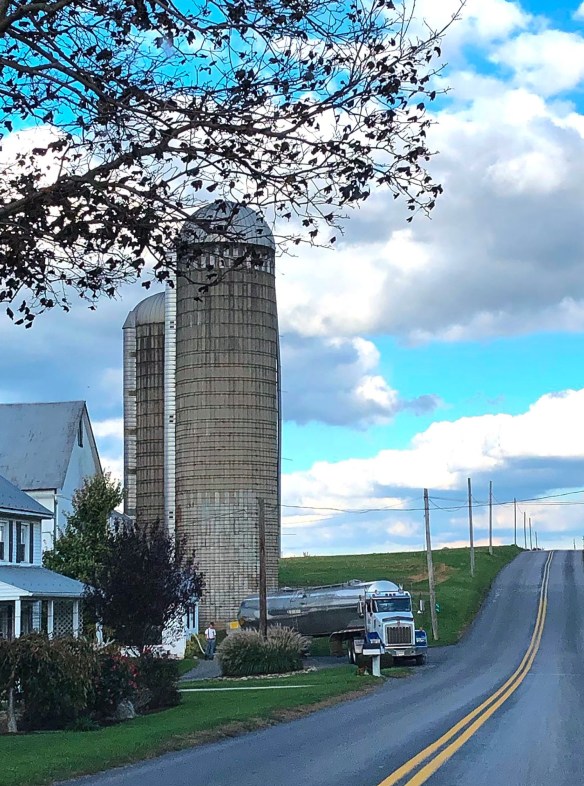
 

Dairy at a Crossroads Part I: 2018 Turning point?

dairycrossroadssherry4-e1519953486606.jpg

Number of farms, robust infrastructure are interdependent. The ripple spreads wide and the pain in rural communities, deep.

 By Sherry Bunting, reprinted from Farmshine, February 23, 2018

BROWNSTOWN, Pa. — Dr. David Kohl recently said he is still bullish on the small farms that populate the eastern dairy industry, that there will always be a place for them, but they will change their focus.

Still, lenders and industry participants confide they are concerned about a large number of dairy exits in 2018. They are encouraging producers to work with advisors, and urging the industry to work together in the embattled eastern U.S., because the whole infrastructure depends on the number of farms as much as — if not more than — the number of cows and amount of milk produced.

While lenders like Dale Hershey, director of ag lending for Univest Bank and Trust, say they have already seen many diversify and change how they operate, others are in the process of re-thinking their futures.

The biggest concern for Hershey is when farms decide to sell the cows, seldom do the cows come back to the farm.

“Some of those farms will stay empty. That, I do see,” he asserts. “Occasionally they’ll come back in and milk, but mostly they will go into something else, or if the farm is sold, we’ll see most of them stay dark in terms of dairy production.

“I think we’ll look back 10 years from now and see 2018 as a turning point.”

Mike Peachey of Acuity Advisors and CPAs agrees. He sees dairy at a crossroads similar to the hog industry in the 1990s: “My concern is that we will see a dairy industry 10 years from now that looks very different from how it looks today, and we are helping our dairy customers take stock of that.”

Peachey observes that as the number of farms decreases, “This puts a lot of pressure on the dairy infrastructure and the ag businesses that support the dairy farms. One of Pennsylvania’s competitive advantages is that there is a lot of infrastructure and support in the whole supply chain that is very beneficial for competitive pricing for our dairy farmers.”

He cites the region’s multiple feed companies, multiple points of expertise, nutritional perspectives and a bidding process, multiple veterinarians, the strong ag lending infrastructure, equipment dealers, and expertise in different specialties.

“My concern is that if the number of dairy farms decreases, and if the infrastructure goes away, then it changes that competitive advantage,” he says, observing that the number of cows or the amount of milk produced does not necessarily make up for what is lost when the quantity of individual farms is reduced by consolidation.

Yes, the dairy industry is at a crossroads, and no where is this perhaps more evident than in eastern states, like Pennsylvania.

The Northeast was a fluid milk market in the past, close to 50% of utilization. Today it is less than 30%. As more milk is produced — even if per capita fluid milk consumption stayed the same — not enough other products are made here, so mailbox prices are falling under the coinciding weight of increased hauling costs and losses in competitive and quality premiums.

Meanwhile, the Class IV utilization has increased as a percentage in the blend price, leading many to believe the Northeast model of dairy pricing may be broken.

In fact, so concerned are states and dairy organizations that state-wide analyses are being conducted in top tier “notably fluid” states like Pennsylvania and New York in the Northeast as well as in Georgia, in the Southeast. The states of Michigan and Wisconsin are also looking at their state’s production, processing and infrastructure to improve their future competitiveness.

In Wisconsin, milk prices are driven off the cheese market — a growing market that has been cultivated to generate variety, demand and competitive premiums — whereas the Northeast model is built off Class I, which is not competitive, nor is it growing. And, unlike cheese with its diverse growth in specialties and brands, the Class I milk at the store is treated like a base commodity against which all newcomers and imitations are compared and premium-priced.

Dairy producers and industry participants also say they are concerned about the Pennsylvania Milk Marketing Board’s role in terms of the costs associated with milk assembly vs. where the state premiums are going.

Meanwhile, store inventories are kept close to the bone. If they throw a gallon of milk away, the margin on every other gallon is affected, and so stocking depth is being reduced.

These are the kinds of issues that states like Pennsylvania, Georgia, New York and Michigan, among others, are actively looking at as they study capacity and market needs and trends.

Producers don’t control these decisions, but their input is vital.

From farm to table, technology and workforce are two other big pieces with immigration reform being a double-edged sword.

If the Congress and the Trump administration are able to legalize immigrant worker status, what will that really do for the dairy workforce? A National Milk Producers Federation study with Texas A&M reveals that 80% of the nation’s milk was harvested by immigrant workers — up from 60% in 2009.

With general unemployment now falling below 5%, which many economists consider to be full employment, a legalized immigrant workforce may be lost to jobs in industries with better margins.

Workforce issues are also affecting trucking and other infrastructure employment.

Labor is fast replacing environmental as the number one issue facing the dairy industry, and against that background, farms will do things differently over the next 10 years to systemize their production, say various experts.

Builders, lenders and others are seeing the emphasis for this in three areas: wet calves, dry cows and post fresh, as well as through investments in technologies that improve management, specifically by their impacts on cost of production because this is the criteria that will drive farm-level investments into the future.

Technologies may help solve it, but this requires investment. The right answer, policy-wise, is elusive, but for individual farms, the right answer comes, again, from knowing cost of production from which to weigh out the options and run projections and scenarios based on where the farm is now and where it wants to be in the future.

While some see opportunities to drive milk output per cow higher with more cow comfort and better heifer programs, pointing out that Pennsylvania lags behind other states in its milk output per cow, others in the industry point to imposed restraints pushing the focus toward managing risk.

Complicating the marginal milk model for improvement in Pennsylvania is the Land O’Lakes base program. When producers are over base — because they’ve improved their management — they take a penalty when the base is enforced, depending on the eastern region’s total production.

Learning to manage through this intermittent penalty seems to be affecting mainly the producers in the East, despite more substantial growth in the West. In addition, DFA has started a base program for portions of its membership in parts of the Southeast U.S., where milk is already regionally deficit.

How will this push-pull play out at the farm level?

Some producers will carry a lunch. Hershey is seeing a trend toward small farm operators finding seasonal off-farm employment to keep their dairy farms running.

Others have and will become diversified, which can reveal two pathways: Getting successful in another area and exiting the dairy, or seeing the dairy as a lifestyle to keep, and using other income streams to weather the storm.

In addition to diversifying, lenders note niche processing will be a path for some. There are a number of niche producers in this part of the country. Some have been doing this a long time, others are just getting in.

“The good economy has really helped those operations. Tourists are traveling, coming to our county, dining out, and packing the places we deal with,” Hershey observes about Lancaster County, Pennsylvania. Some of our cheesemaking stores are flourishing right now, but that business is not for the faint of heart. It requires deep pockets to get into.”

Connecting dots for consumers is essential for eastern states, like Pennsylvania. For example, in Lancaster County, Pennsylvania, there is this dichotomy. The county — like other parts of the eastern U.S. — has grown in produce and other specialty crops to become a great hub of food. To some degree this includes dairy, but more stimulation is needed.

As will be further discussed in part two of this dairy-at-a-crossroads series, knowing the cost of production for the farm business and knowing where lie the passions, strengths and weaknesses of the farm family are keys to finding each farm’s own path — whether that means keeping the cows and diversifying, investing in niche marketing, getting more competitive on cost of production or giving the cows up and channeling that valuable positive experience and energy to new pursuits.

This industry is about the milk and the cows, but even moreso, it is about the people.

“We can do it here,” says Peachey. “When we know our farm’s cost of production, we know the weak spot in our model and can figure out how to compensate for that and find where our opportunities are.”

As these changing tides and issues sort themselves out, Peachey observes how dairymen are making these “tremendous strides to improve their operations,” and he believes the next wave of improvement is figuring out how to do risk management well, how to capture margins when they are available, and how to protect operations from downside risk.

“We can take an operation so far and continue to improve, but the next wave of significant profitability and improvement is in managing the top line price and the input costs and locking in those good margins when they are there,” says Peachey.

“A generation ago, with price supports, dairy farmers could work hard and do okay or very well. Now it is a business requiring an approach to management for the long run,” he adds.

In part two of this series, we’ll examine the map for navigating the dairy crossroads.


-30-

Dairy market fluidity

041213FarmshinePage4.inddDairy market fluidity

By Sherry Bunting, Milk Market Moos, Farmshine, February 2, 2018

Picking up from the previous dairy export ‘Jeckyll and Hyde’ discussion… Let’s look at what has happened to the fluid milk market in the U.S.

There is a difference between Class I utilization declining and actual packaged milk sales declines. For example, the 2017 year figures are not yet in, but for the last reported month of November, USDA reports that packaged conventional fluid milk sales for January through November 2017 are down 2.1% from year ago and organic fluid milk sales are off by 0.2%.

While consumers are drinking less dairy milk on a per capita basis, Class I — as a percentage of all milk sold — is declining faster because the processing of milk into other growing dairy product sectors is increasing.

Some of the increase in these product sales reflects domestic growth, but the kicker is that as exports increase as a percentage of total milk production, Class I utilization as a percentage of total raw milk sales is pushed lower — even if consumers drink more milk.

Let’s identify how the markets are changing and how to value them back to the raw milk producer rather than laying blame for over production that leaves the farmers in the position of “deserving the price they get.”

Supply management is not the answer, nor is it at this point really possible. It is a distraction. We need to be looking at the dairy trade in a way that both prepares farmers for the future and prepares the industry for dealing fairly with producers.

Case in point. How concerned has the National Dairy Council and the dairy industry  been about the fraudulent use of the word ‘milk’ on plant juice labels? NMPF’s efforts to right this wrong came only within the past two years — and 15 years after these sales of fake milk started eating into the fluid dairy milk sales.

How serious have they been about the milk that our children drink in school? It is interesting that GENYOUth was “founded in 2010 as a partnership between the National Football League and National Dairy Council, convening leaders in a movement to empower America’s youth to create a healthier future.”

One example given at the GENYOUth website recognizes U.S. Dairy Export Council CEO Tom Vilsack for his accomplishments for dairy farmers while serving as Secretary of Agriculture under President Obama. In his current role, Vilsack’s salary is paid by DAIRY FARMERS via the mandatory promotion checkoff.

Specifically a December GENYOUth gala recognized Vilsack for having “legislated to improve the health of America’s kids. Under Sec. Vilsack, USDA partnered with First Lady Michelle Obama’s Let’s Move! initiative alongside GENYOUth to improve the health of America’s children. Sec. Vilsack helped pass and implement the Healthy, Hunger-Free Kids Act to help combat child hunger and obesity by making the most significant improvements to U.S. school meals in 30 years.”

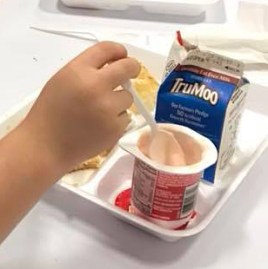
school lunchThat is certainly a mouthful, considering that something else occurred in 2010-11. This was the very same year that schools were forced to offer only 1% or fat-free white milk and flavored milk could only be offered as fat-free!
Unfortunately, this did not improve school lunch meal nutrition, and it has cost dairy farmers plenty in lost milk sales.

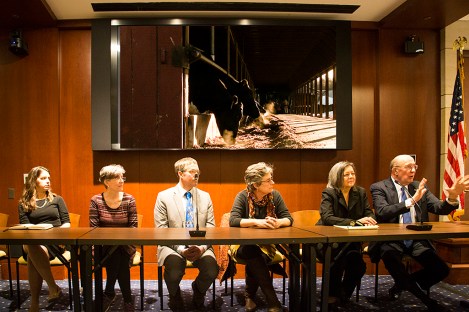
In fact, Bob Gray for the Northeast Association of Farm Cooperatives stated recently — during a panel of dairy producers and policy folks at a Congressional viewing of the New England documentary Forgotten Farms I attended in Washington D.C. earlier this month — stated the impact of the school milk issue on milk sales, surpluses and pricing.

ForgottenFarms2web.jpg“For the past six years, we have not been able to sell even 1% (fat) milk in the schools,” said Gray about being forced to sell flavored milk only as fat-free. “In the first four years, alone, we lost 288 million half pints of milk sales that were not consumed by schoolchildren (2012-15) because of this move, alone.”
But maybe this is the point.

If fluid milk consumption erodes as a percentage of milk production, the cost of milk to processors becomes less for the many other products that need to be more competitive globally.

Technology is driving some of these trends. New opportunities and new knowledge are improving efficiencies throughout the supply chain. But marketing direction often leaves more questions than answers when it comes to spending money dairy farmers are forced to pay for it.

Meanwhile, as Dr. David Kohl, Virginia Tech professor emeritus, pointed out as a speaker last week in Lancaster County, Pa., the advances in technology are driving production from an efficiency standpoint. What these advances do for agriculture is to help less productive farms improve yields. “Technology improves the bottom end and that creates surplus, said Kohl. “And that is why we need export markets.”

To my thinking, exports are to be keenly pursued, but pursued with a strategy that does not ignore the market profile of dairy sales here at home, especially when the highest valued product classification under federal price regulation for dairy — fluid milk — is being treated like the Cinderella sister with odds against her, while her sisters get ready for the Prince’s ball.

There are plenty of great innovations in dairy products and distribution — including export markets — that deserve our attention. However, while Cinderella is ignored in plain clothes in the increasingly cluttered dairy case full of fake substitutes, she deserves an invitation to the ball. And a glass slipper or two sure wouldn’t hurt.

Whole milk up, fat-free way down

USDA’s January estimated fluid milk sales report indicates that whole milk sales for the first 11 months of 2017 were up by 2.5% over year ago and November, alone was up 3.5%. Meanwhile lowfat and fat-free losses drove the entire category lower as nearly 12% less fat-free milk was sold compared with year ago, 6.7% less 1% and 2.8% less 2% milk. Similar patterns were revealed among organic milk drinkers with fat-free down almost 20% Jan. through Nov. while whole milk was up 6.2%.

Author’s Note: Re-inventing this Ag Moos blog for the times….  Milk Market Moos is a column I’ve been writing in Farmshine since 2003. Find some of it here, at Ag Moos, along with other dairy and beef market related stories, agriculture news, and, in between, the stories and images of the inspirational people of agriculture… but you can get it first, and you can get it all, in Farmshine Newspaper, just $15/year. Farmshine is a weekly newspaper published in Brownstown, Pennsylvania — now in its 39th year of publishing all-dairy, all-the-time.

Blessings counted in Irma’s wake, challenges ahead

Damage to dairy buildings, but people safe, livestock losses minimal. Processing and distribution channels challenged. Biggest issues: Power. Fuel. Communications. 

wFlorida2812(Dakin)

By Sherry Bunting, Farmshine, Friday, Sept. 15, 2017 (Photos courtesy of the dairies)

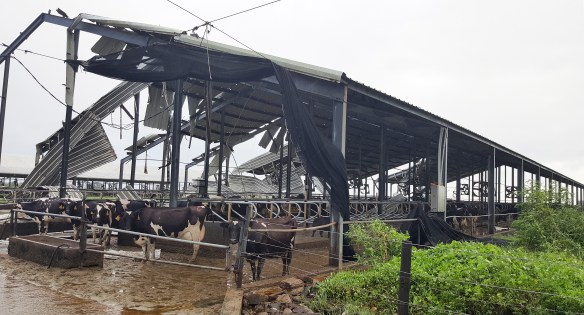
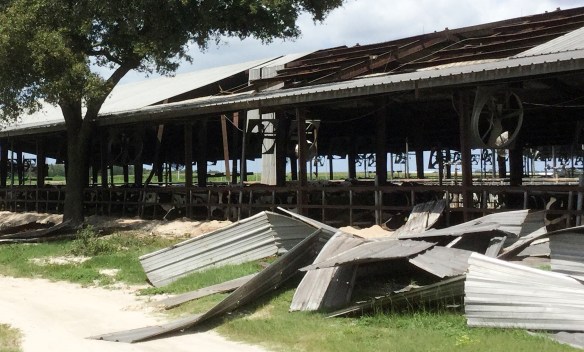
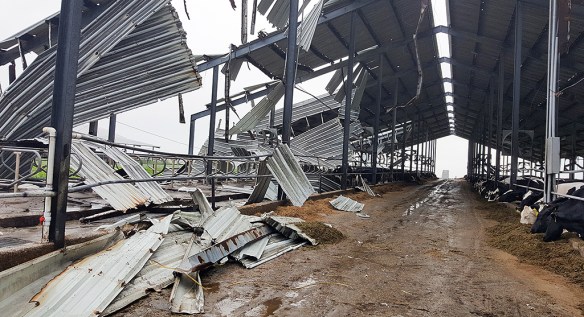
FLORIDA – “Four freestall barns are damaged, one completely collapsed, but amazingly not one cow was hurt. God had his hands on us,” said Jerry Dakin in a Farmshine phone interview Tuesday morning, 36 hours after Hurricane Irma hit Dakin Dairy, Myakka City, Florida, just 20 miles east of Sarasota as the eye wall nudged inland after traveling up the west coast of Florida to continue its trek up the center of the state. The more than 300-mile-wide hurricane — packing winds in excess of 100 mph — produced widespread damage as well as loss of power to over 5 million homes and businesses across the entire state of Florida and into Georgia and South Carolina.

The reports are still rolling in and the stories we heard are similar in the South — from the Rucks family of the Milking R in Okeechobee and Dakin Dairy in Manatee County, east to the Wrights in Hardee County — and north — at Alliance Dairies and North Florida Holsteins in Gilchrist County — all the way to Hillcrest Farms Inc. near Augusta, Georgia.

Dairy producers were in high gear preparing for Hurricane Irma last week, and while it appears that dairy buildings have sustained substantial damage throughout the Sunshine State and beyond, producers are counting their blessings in Irma’s wake: People are okay, livestock losses are minimal, second crop corn silage largely held its ground.

The most pressing concern in rural areas is the same as in urban — no power, limited supplies of fuel, spotty communication capabilities and a breakdown in the normal processing and distribution channels for food and other necessities, which means, for dairy farmers, where to go with the milk?

Of the four dairies interviewed early this week across a 250-mile stretch from South Florida to North ranging 1200 to 10,000 cattle and representing over 25,000 cows, just four animals were lost — a milk cow euthanized for injuries at one farm and three young heifers at another were found quite possibly hit by lightning or electrical shock. Among the social media posts of additional farms throughout the region were similar stories and responses of appreciation for the prayers and encouragement of others while focusing the first 24 to 36 hours post-Irma on getting generators going and getting cattle fed and milked and watered and then settling in to sort, evaluate and prioritize additional special needs.

Perhaps most important, however, are the stories of encouragement. Dakin said he spoke with fellow dairymen in a show of support before the storm and that it has been the encouragement of others “even folks from up north texting us and letting us know they are praying for us” that has gotten them through it.

“I have an unbelievable team of employees,” said Dakins of the over 60 employees who work for the dairy he built in 2001 and the dairy plant and store that were added in 2009.  “I am only one man, but it is this team of family and employees that is getting things done.”

Florida0609(Dakin-CavalryArrives).jpg

Dakin was feeling fortunate Tuesday morning after the cavalry arrived Monday night — five utility trucks got the dairy, and its milk plant and store, back on the power grid. Since then, the plant has worked overtime separating and pasteurizing milk for multiple cooperatives. In some cases, the skim is being dumped because milk channels are backed up due to plant, supermarket and school closures and other infrastructure issues.

“It’s a big deal to have our plant processing because we are able to unload tankers and get them back to farms,” he explains that they are processing 20 more loads than normal since the storm. “When it comes to a disaster like this, we’re all in this together.”

IMG_4589 (1).JPG


They milked their own 2200 cows at 6 p.m. Sunday evening ahead of the storm, and then shut everything down, planning ahead to skip the night milking. They had boarded things up, pushed 1200 dry cows and heifers two miles away from buildings into pastures with wooded windbreaks, and parked large equipment all around the house where 25 family and crew hunkered down “like we were going to war.”

“We were so boarded up that we didn’t feel the true impact, until we opened a door, and it was wild. I decided not to walk outside, to stay calm, pray and rest because I knew there was nothing I could do during the storm and there would be a lot to do when the storm was over,” Dakin recounted.

The storm hit with all its fury at 10 p.m. Sunday evening. By 3:00 a.m. Monday morning, the winds were still blowing, but the core, or eye wall, had passed.

“I didn’t want to walk out of the house, scared about what I was going to see, but I knew I had to face it,” Dakin recounted. “I went straight for the barns, and I saw the buildings down and the cattle out where the gates were knocked down by the collapsed building. Cows were standing in the holding pen bellowing.”

Florida2718(Dakin).jpg

He cranked up the generator and got help and got to milking. He had already pulled grain concentrates from the ration in the days leading up to the storm to slow milk production, but even so, the pumps could not keep up with the initial milk flow after missing the night milking. “We couldn’t milk them fast enough,” Dakin related, adding that this is the first hurricane his farm has ever seen and that his brothers’ farms in the county were having similar experiences for the first time.

Northeast of Dakin, about 50 miles as the crow flies, Joe Wright was hunkered down at his dairy in Zolfo Springs. He was in the same closet in the same concrete building he took refuge in at the dairy during Hurricane Charley 13 years ago. Of the four hurricanes his farm has weathered, three were in 2004. Irma, the fourth, was second only to Charley in terms of its impact on Wright’s dairy, but he says Irma is the worst in its broad impact on his state and the region’s dairy industry.

Wright looked at the Weather Channel “spaghetti models” ahead of the storm and had a feeling it would track up the nearby Peace River, like Charley, so he didn’t let his guard down when he heard it was heading in a northwesterly direction. True enough. Once the eye wall got close to St. Petersburg, it’s northwest track bent east, putting the edge of the eye wall near Wright’s dairy. The structural damage to buildings tells the tale.

“Right now we are just milking and feeding and trying to return to some normalcy to begin evaluating cows,” he said, explaining that in 2004, they lost cows. The barn fell in on them when Charley came through. Since then, they have converted to modified grazing and so one of the things they did ahead of Irma was to intentionally push the cows out of the barns and lock them out and away from the buildings.

“We thought they would be better off in pasture, and it appears so because the roofs and ends of our freestall barns were just ripped off by Irma,” Wright said Tuesday from his son’s cell phone as they drove 100 miles for a backup generator after their primary generator sustained voltage issues that were impacting pumps and motors on the farm. Fielding a call from a roofer on his own phone, Wright said another pressing concern is getting a roof over the milking parlor, and if possible, the cattle working areas. “The rest of it will wait for winter.”

Confessing he hasn’t slept, really, since Friday or Saturday night and hasn’t been to his home 10 miles from the dairy, Wright shared that, three big oak trees were down at home that he couldn’t deal with. “My neighbors in town know what we’re up against with the dairy,” he said. “They came and cut them up and hauled them away. It’s hard for me to explain what that means. It’s uplifting.”

At Dakin Dairy, the milk cows had remained in the freestall barns, and survived. Dakin observed how difficult it had been to move 2200 cows from the barn to the milking parlor as the storm was within four hours of reaching them. They milked quickly and cows literally wanted to run back to their barns.

Florida5602(Dakin-MovingToPastureAheadOfStorm)

Like Wright, Dakin did make the decision to move his pasture cattle away from buildings, and apart from clearing sheet metal and removing safety hazards around the collapsed areas of the barns, rebuilding will be put off until winter.

“We’ve got a month and a half yet of the real hot weather,” said Dakin. “If anyone is looking for construction work in sunny Florida this winter, we’ll have it.”

Another 180 miles north in Trenton and Bell, the Sunshine State’s two largest herds – Alliance Dairies and North Florida Holsteins – were also in line for hurricane force winds. By the time the eye had traveled inland those nearly 200 miles, Irma had been downgraded to a Category 1 hurricane but still packed high winds, spin-off tornadoes and significant rainfall on the back edge.

“We survived it pretty well and have enough generator power to milk cows, cool milk and pump water. We’ve been able to keep enough manpower to get things done,” said Don Bennink of North Florida Holsteins in a phone interview Monday night from the darkness of his home without power. He was thankful to be just four hours behind in the milking schedule after hearing of others being as much as a full day behind and said all of the generator power is devoted to the dairy. His home can do without power for now.

“We got hit, but south Florida got nailed,” said Bennink. He had spent the days leading up to the storm making sure the generators were backed up and operable, having extra feed and fuel delivered and double checking everything he could think of.

“The worst of the storm, for us, was from 1:00 a.m. to 6:00 a.m. Monday morning,” he said. “We shut down when it got bad and restarted Monday afternoon. We had a crew here because we provided shelter for a lot of our people.”

The dairy’s office, where the former milking parlor had previously stood, was sturdy, and 50 people, including employees and their families, weathered the storm there with provisions while the winds blew roofs and debris.

NorthFlaHolsteins-Calves

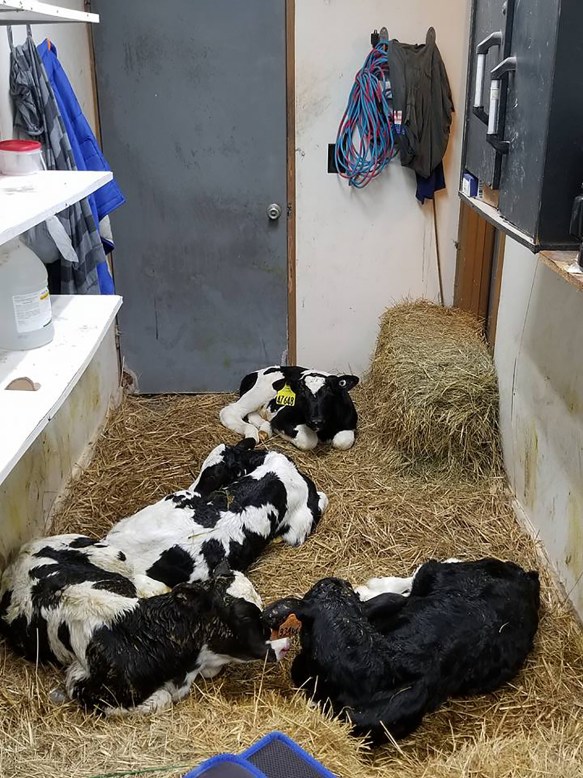
Newborn calves at the time of the storm were stowed safely in the herdsman’s office near the calving area.


The storm had its impact. While the tunnel-ventilated barns for the milk cows are intact, the large tunnel fans were ripped apart. The estimated 20 inches of rain that fell in a short time at North Florida Holsteins created substantial flooding in the heifer yards.

“We expected this much wind, or more,” said Bennink, “But we did not expect this much water.”

Like the incidental reports from other dairies on social media that had found a few individual animal losses, Bennink said of the 10,000 head of cattle at North Florida Holsteins, three calves were lost.

He was counting his blessings Monday evening, and thankful for his “reliable people.”

Just west of Bell in Trenton, Florida, Jan Henderson at Alliance Dairies had spent the days leading up to the storm pleading with fuel suppliers to get fuel to them. “We wanted our tanks full for gasoline and diesel, and we even filled our choppers so we could siphon if needed,” she said in a phone interview Tuesday. Being responsible for over 10,000 cattle between the main dairy and two grazing operations at other locations, Henderson relied on her managers, quarterbacked plays they had run through and filled in hands-on wherever she was needed.

“We tested our generators to operate under load and made sure our mobile generators were working. We had multiple meetings with our managers on the course of action to make sure cows get milked and fed and youngstock get watered and fed,” she explained.

Before the storm, Henderson was in people prep mode, bringing in plenty of food and energy drinks for employees. Once the storm hit, she was communicating with managers and filling in the gaps on shifts bringing cows to the parlor.

“We are very blessed that Irma weakened from its earlier strength, and we had already determined we would go to 2x milking the day of the storm. We kept going until 6 p.m. when everyone needed to be wherever they were going to shelter,” she said, noting that Saturday’s crew was smaller than normal, and managers from all areas of the farming enterprise helped cover milking shifts — hunkering down at the dairy.

Two days after the storm, one of their grazing dairies has power and the other is still waiting. Alliance Dairies, where 5200 cows are milked, is expected to be without power until next week.

Florida0407(Alliance).jpg

“We are able to milk and cool milk, and we can provide water, but we are not able to operate our fans,” said Henderson. “It was cool and comfortable the day after the storm, but the heat and humidity is returning.”

“We have very committed people here, and I am awestruck by what our people have been able to do,” said Henderson.

Florida0402(Alliance).jpg

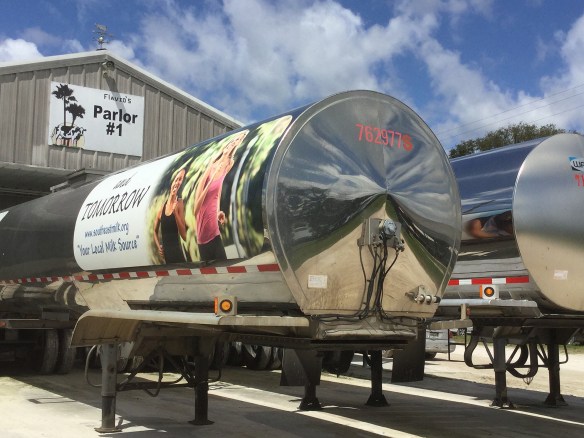
Like most dairies in Florida right now, they have milk accumulating on trailers with 10 full trailers sitting as of Tuesday morning. One of the grazing dairies was completely full when two milk trucks pulled in, one without a trailer and the other with an empty trailer just in time on Tuesday morning.

While most of the plants are closed and reopening on differing schedules, Henderson notes the power outages and evacuations mean that, “There are 6 million fewer people drinking milk right now, so processors are not feeling the need to process milk.”

Bennink also noted that as processors have been closed with two to three days of milk in silos, milk is also backing up on farms with no place to go.

“It will go from one extreme to the other. When they start needing milk again, they won’t be able to get it fast enough, but we can’t just hold it for them. They will want fresh milk,” he explained, adding that while the coop management is doing a “fantastic job” handling this difficult situation, there will be milk dumped in Florida.

“There’s a lot of milk out there (nationally), and we don’t have the over-order premiums we used to have here, so we’re not going to get sympathy from our customers over the costs our cooperative has to bear to deal with the situation,” Wright observes, adding that in addition to fuel shortages, milk transportation is also hampered by availability of trailers and the ability to wash them down.

More will be known in the coming week, but the Southeast dairy producers will bear the brunt of the costs of handling these issues and it’s unclear what insurances may or may not cover such market conditions that are exacerbated by a natural disaster.

Fuel shortages, plant closures, power outages and evacuations have changed the dynamics in the region.”

Dakin’s plant and a Dean’s plant are currently operating. Some plants are flooded, others have generator problems and some are light on staff to operate. Supermarkets are also having refrigeration and power generation issues.

Restoration of power and fuel to the area will go a long way to immediate needs in this recovery.

Notes Henderson: “You prepare for the worst and hope for the best, and we certainly got a little of both. It was bad enough, but if it had not weakened from earlier forecasts, I don’t want to think about what we might be seeing.”

Wright observes the basics: “If we have feed, fuel and a generator, we can get through this. If we get power, we can do a lot of this cleanup. But without power, it wears on you, and it’s tough on the equipment with the voltages.”

Bennink said it will be a long while for the state of Florida to pick up the pieces, and yet he was feeling fortunate to have his people around and to be able to provide food and shelter during the storm. “One hand washes the other,” he said.

Adds Dakin: “Prayers lifted us up. It is amazing to hear from people in so many other states and to know they have been praying for us down here.”

-30-


Thanking the Milkshake Man for his heart of gold

SmithGoldenMilkshake6657w2.jpg

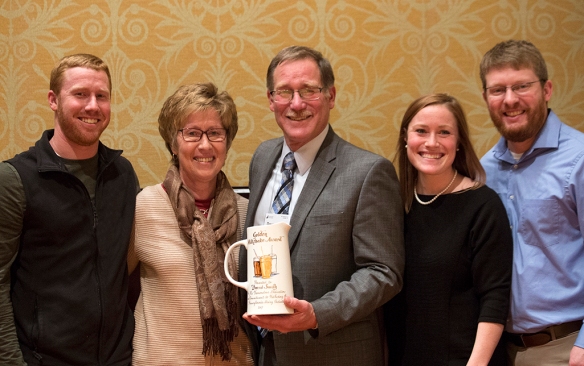
Waiting in the wings so as not to spoil the surprise, Dave Smith’s family was on hand to celebrate the ‘milkshake man’s passion, dedication and commitment to Pennsylvania’s dairy farmers and the next generation, which earned him the unanimous appreciation of his peers in the form a special Golden Milkshake award. Not only have the milkshake sales helped get fresh milk into the hands less fortunate but also helped the Dairymen’s Assn give $1 million in grants over the last 15 years for programs geared for the next generation of dairy farmers. Dave and wife Sharon are flanked by son Joel (left) and daughter Erin and her husband Aaron Wachter. 

By Sherry Bunting, Farmshine, February 17, 2017

LANCASTER, Pa. — Leaders of the Center for Dairy Excellence (CDE), Pennsylvania Dairymen’s Association and Professional Dairy Managers of Pennsylvania (PDMP) pulled off a surprise honorary service award during the 2017 Pennsylvania Dairy Summit here at the Lancaster Marriott last Wednesday evening, February 8.

Dave Smith, known practically everywhere as ‘the milkshake man’ was presented a special Golden Milkshake award for his dedication and commitment to Pennsylvania’s dairy industry.

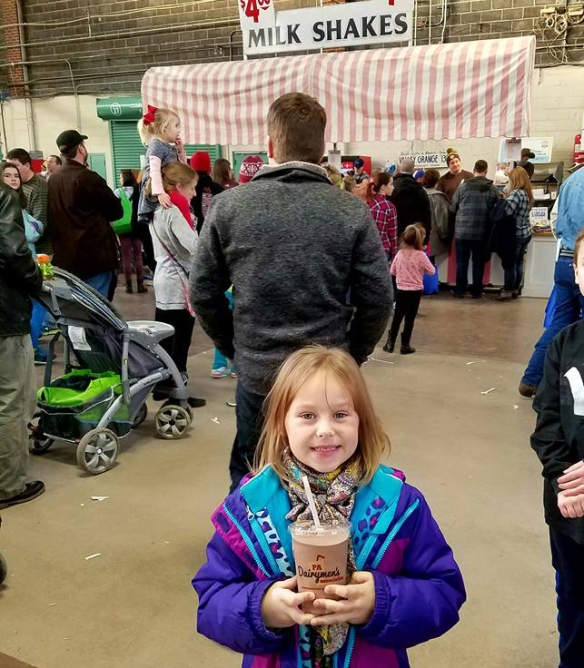
Not only has Dave been the driving force behind the ubiquitous Pennsylvania Dairymen’s milkshake sales, and more recently fried mozzarella cubes, at the Pennsylvania Farm Show and other venues, he was instrumental in the launch of the Fill a Glass with Hope campaign — facilitating dairy relationships with Central Pennsylvania Food Bank and Feeding Pennsylvania to raise money to put fresh milk in food banks across the state.

dave-smith6637A surprised and humbled Dave Smith was speechless at first, but quickly took the podium to say:
“You dairy farmers are truly the reason for the success of the milkshakes.

“This is your product. You work hard to make a quality product. Consumers want what you have.”

SmithGoldenMilkshake6648w.jpg

Dave (left) was lauded by his peers Don Risser (second left), president of the CDE Foundation, Doug Harbach (right), president of PDMP and Reid Hoover (second right), president of the Pa. Dairymen’s Association for his continual focus on improving the state’s dairy industry for future generations through promotion and combining this with avenues for getting dairy into the hands of those less fortunate.

In addition to serving as the Pennsylvania Dairymen’s Association executive director since 1995 and serving on the board for six additional years, Dave has been active in leadership with Young Farmer’s, 4-H dairy club and 4-H dairy judging as well as being an active member of Lebanon County Farm Bureau and the Pennsylvania Guernsey Breeders’ Association.

“Dave has given tirelessly to our organization and its mission for the past 22 years,” said Hoover, who credited his oversight with the Association’s success in selling milkshakes and dairy foods at the Farm Show. “Dave is continually looking ahead to find new markets for fluid milk and to put milk in the hands of those who need it most.”

381302_3132924326184_1096442989_n

Dave shows the mozzarella blocks bought and cut into cubes for Farm Show fried cheese cubes. In 2014, Dave estimated the Dairymen’s Assn moved 3 tons of mozzarella in 8 days in this delicious Farm Show treat that is only growing in popularity at Farm Show since then.

Through expansion and new product introduction, gross sales have been increased approximately 500% in 15 years, allowing for $1 million in grants to be distributed to dairy and agriculture programs focusing on next generation development.

“We appreciate Dave’s active promotion and advocacy for dairy youth,” said Risser. “We are incredibly grateful for his efforts that bring success to these programs.”

Recently, Dave has been working out the details for the Calving Corner, a cow birthing center that will be part of the 2018 Pennsylvania Farm Show.

The fourth generation of his dairy farm family, Dave grew up raising and caring for the Guernsey herd in Annville, received his B.S. in Dairy Science from Virginia Tech and co-managed the farm with his father for a number of years, including the former dairy store where Ja-Mar Dairy’s milk was processed, bagged and sold until the late 1980s.

Today, the milk cows are gone, but Dave and his son Joel raise 140 head of cattle and farm 400 acres of ground.

milkshake

403087_3132926006226_781277188_n

smithgoldenmilkshake6657w2

Fire extinguished. Help, hope ignited.

worden4042w

2013 Photo: Chuck and Vanessa Worden

By Sherry Bunting, Reprinted from Farmshine, Jan. 20, 2017

CASSVILLE, N.Y. — On Saturday evening, January 14, the entire Worden family was together at the dining room table celebrating Chuck and Vanessa’s birthdays, including daughter Lindsey who was home visiting from Vermont.

By daybreak Sunday, the family was facing an uncertain future, but was lifted forward by friends and neighbors showing up when news spread quickly of the fire at Wormont Dairy, Cassville, New York.

“I had just walked through the cows and done a little clipping that night, so proud of how the whole herd looked and how well they were responding to the changes we had been making in the ration and fresh cow protocols,” Lindsey Worden reflected. “Less than four hours later, I was calling 911.”

Worden1.jpg

Photo from Kate Worden

Wayne and Mark Worden, who live off the farm but nearby, were throwing on clothes to come down and join their father Chuck and brother Eric in rescuing calves and heifers penned in the box stall barn adjoining their parlor/holding area and office, which was totally engulfed in flames.

Their mother Vanessa had gotten up in the middle of the night and saw the flames from the window.

“Just as Eric was carrying out the last calf, the fire trucks arrived and the barn was totally filled with smoke and starting to catch fire as well,” Lindsey reported. “Volunteer firefighters, friends and neighbors were pouring in. We managed to wrangle all the baby calves and young heifers into a bay of our machine shed, and got the older show heifers into our heifer freestall, while dad and the boys were helping the firefighters.”

Amazingly, the wind was blowing in the opposite direction of its usual course – sparing the main freestall barn and Wormont Dairy’s 270 milking cows from damage.

By 4:00 a.m. Sunday morning, “It was quiet,” Lindsey shares. “At daybreak we met to try and figure out a game plan for how to get 275 cows milked on a farm with no milking equipment.”

16143230_10106250973416047_629635797440443966_n.jpg

Photo provided by Lindsey Worden

Not one person or animal was harmed, and the family was so thankful, but reality was sinking in. Now what?

“It was amazing,” said Vanessa. “There are no words for the way people just showed up and lifted us up.”

Chuck said a neighbor started the ball rolling to place the cows, and people came with trucks and trailers lining the farm lane. “I didn’t make one call, people just came,” he said.

As Wayne and Mark noted, “It was humbling.”

Worden4.jpg

Photo provided by Lindsey Worden

Before long, with the help of some awesome neighbors, the Wordens had figured out two farms that could take the majority of their milking cows (heifers and dry cows are staying), and a short while later, cattle trailers started showing up, as did more friends and neighbors to help get them loaded.

“At one point, we had at least 10 cattle trailers lined up out the driveway, and we got animals relocated more efficiently than I would have ever imagined possible,” Lindsey reflects. “We are so thankful to the friends and first responders who showed up at 1:00 a.m. on Sunday morning to help get our immediate emergency under control.”

Friends and neighbors came from near and far – bringing trailers, helping to get cattle loaded and moved, helping to get scared cows milked off site.

“People brought enough food to feed an army for a week,” said Vanessa.

“At 7 a.m., my first thought is that we were probably just have to sell everything, but then as neighbors showed up, and connections were made, and trucks started moving cows, you start to feel how hope can change the whole outlook,” said Vanessa. “By 3:00 p.m., our friends and neighbors had given us hope that we can do this. I was actually happy yesterday. There is no way I could be sad after all that everyone has done, after all the hope they have given us.”

Each member of the family has so much gratitude for the dairies that opened their barns and took in cows. The 270 cows were moved to three locations by 3 p.m. Sunday.

“What an incredibly humbling day,” Wayne shared Sunday evening. “There are no words to describe the support we received and are still receiving with the cows. Thank you is not enough to say about what we were all able to accomplish today. What an incredible community the dairy industry is.”

chuck-and-sons.jpg

2013 photo Wayne, Mark, Eric and Chuck Worden

Electricians worked all day Sunday to restore power – light, heat and water. “And companies worked with us quickly to help us with things like restoring our DairyComp records on a new computer, getting basic medical and breeding supplies and all those little things that we need to keep the wheels on the bus this week,” Lindsey observes. “It is a really strange feeling to literally have none of those everyday supplies like calf bottles, navel dip, ear tags, IV kits, etc.

Everyone who reached out with suggestions for help or just kind words, prayers and encouragement, by call, text message, email, and facebook, or dropping by in person. We are so very grateful.”

Eric shared how “truly overwhelmed” he was by the amount of support received from farmers across the state following the fire. “Thank you for making the day go easier,” he said. “This is a tough blow for my family, but we will come back stronger than ever.”

Adds Lindsey, “By some miracle, not a single animal was lost, not even our lone barn cat!”

While there is no question, “we’ve got a tough road to hoe to get back on our feet over the next several months,” said Lindsey, “with some luck and the attitude everyone in the family has maintained over the last two days, I have no question we will come out on the other side.”

“Words cannot express how thankful we are,” Vanessa said. “The way people reached out to us in those early hours gave us hope. Hope is an important thing. It’s what we give each other, and it is amazing.”

As the family meets with insurance adjusters, lenders, builders, equipment specialists and others to chart a course for moving forward, the ready support of others in the darkest hour serves as a continual reminder of what the dairy community is made of – people who keep putting one foot in front of the other and helping their fellow producers get through times like this.

Even more importantly, the family notes that this dairy community is quick to give each other hope — that they’re not alone when confronted with a life-changing event — that when it seems everything is coming to a halt, it is the hope brought by others that carries everyone forward.

Crews from six fire departments responded to the fire at Wormont in the wee hours of Sunday morning, January 15, with others on standby.

Cleanup continues as the family pulls together to make decisions for the future – a future that they say reinforces how special the dairy industry is and how humbled they are to be part of it.

chuck-eric-lindsey.jpg

Aug. 2016 Eric, Lindsey and Chuck at county fair

wormont

2013 photo Wormont Dairy

Dec. 16 emergency herd dispersal follows tornado’s destruction; Tenn. recovering from wildfires/tornadoes


ATHENS, Tenn. — While the Governor of Tennessee seeks a presidential disaster declaration for five counties hit by fire and storm November 30th, communities continue to work through the daunting task of cleanup, assessments, recovery and rebuilding.

The Southeast drought that had persisted from summer through fall fueled fires across six states, most notably Tennessee’s Great Smokey Mountains.

In the overnight hours of November 30, the Smokey Mountain fires went rampant as 80 mph winds drove a firestorm that created eight new fires by the next morning.

The front of moisture that eventually carried enough rain to quell fires to 50% containment was preceded by a 40-mile line of tornadoes and high winds. Worst hit in these storms was the community of Athens, Tennessee, near the original Mayfield Dairy Farm.

That rain was the first substantial rain since mid-June, according to University of Tennessee extension reports. But it had its impact after the fires first engulfed Gatlinburg and Pigeon Forge.

Lives were lost, injuries sustained, and homes and businesses destroyed.

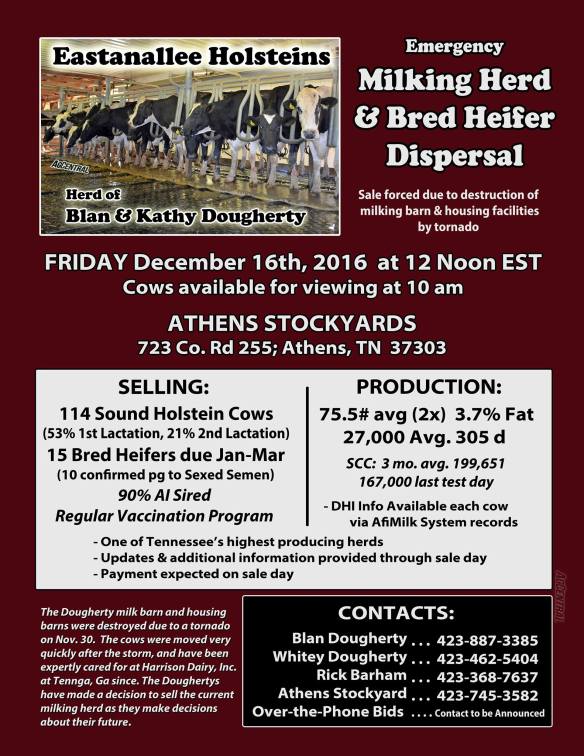
Among the losses, Eastanallee Dairy Farm, owned by Blan and Kathy Dougherty, sustained destruction of its barns and milking facilities. The local community came to their aid.

According to Julie Walker, AgriVoice, “a great group of folks with animal and farm experience got first things done first. It was obvious the milk barn, and housing and feeding facilities received the brunt of the hit, and cows were not going to be able to be milked. Unfortunately, six just-weaned calves were killed,” she explained in a e-news post. “Steve Harrison, a neighbor to the Doughertys, generously agreed to temporarily house the cows until some decisions about the herd’s future could be determined.”

Last week, the Doughertys decided to have an emergency milking herd and bred heifer dispersal sale set for tomorrow — Friday, December 16 at 12 Noon — at the Athens Stockyards with basically just time for word of mouth and digital/social media advertisement.

It is hard enough to contemplate a dispersal of a dairy herd, and even tougher to do so under these circumstances. The Eastanallee herd is among the highest producing herds in Tennessee. A total of 114 milk cows and 15 bred heifers due through March will be offered. They will keep the yearlings and young stock as they evaluate their future, which may or may not include milking once again.

15493820_1844285399186948_8629421123654211700_o.jpg

There was a massive amount of property damage on their farmstead, and while their home was damaged, the Doughertys are thankful to have not lost their home, as have many of their neighbors nearby.

Getting ready for the sale, some culling has already taken place:  cows with breeding problems, mobility problems, and low production have already been sold.  Animals selling will be sound.  A sale catalog has been created by Ag Central Co-op, click here to view it.

We wish the Doughertys well, and our thoughts and prayers remain with the Athens community and all affected in East Tennessee. Many are homeless and services are taxed after the wildfire / tornado disasters in the counties of Coffee, McMinn, Polk, Sequatchie and Sevier for which the Governor requested this week a presidential disaster declaration.

Below are some links to two of the wildfire and tornado relief efforts.


Tennessee 4-H Wildfire Relief

Tornado Relief through United Way