MILK MARKET MOOS – Bad news in this week’s mailbox, but better views ahead!

By Sherry Bunting, Portions reprinted from the May 10, 2024 column with a few preview notes for the May 17 weekly Milk Market Moos, available exclusively in Farmshine Newspaper

This week’s settlement checks for April milk are hard hit by the record-low protein price of $0.83/lb and the $4 to $5 spread of Class IV over III that continues to depress the Class I price via the ‘average of’ method — resulting in depooling of higher value manufacturing milk. But the good news is the cheese markets have sustained a 5-week rally that has been heating up, pushing Class III milk futures higher, while tight supplies of nonfat dry milk moved briskly at higher prices to keep Class IV forging ahead too.

First the bad news: April FO blend prices are mixed with component-pricing lower, Fat/skim-pricing generally higher

The record-low April protein price of 83 cents/lb and second lowest Class III price of the year pushed the Federal Order (FO) blend prices 25 to 45 cents lower in six of the seven FOs that use Multiple Component Pricing (MCP). The Northeast, was off just 9 cents, given the fact that processors still pooled some milk used for higher value Class II and IV products, although not as much. De-pooling of Class II and IV milk was heavier in other MCP FOs due to the whopping $5 spread between Class II and IV ($20.23 and $20.11) over Class III ($15.50) and the fact that Class II and IV were $1.00 higher than the Class I ‘mover.’

The wide spread pushed the Class I ‘mover’ price $1.00 lower using the ‘average of’ calculation than it would have been under the previous ‘higher of’ method. The May Class I mover price is even more disadvantaged — down $1.73 vs. ‘higher of’ — based on the advance pricing factors at the beginning of April before the CME cheese market rally begins filtering its way into USDA weekly surveys and FO formulas.

Three of the four fat/skim priced FOs — Florida, Southeast and Appalachian — have April blends that are mostly 20 cents higher than March. Fat/skim priced FOs benefitted from the butterfat price at $3.33/lb and a solids nonfat (skim) price at 97 cents/lb that was 14 cents higher than the protein price. This is the first time such an inversion has occurred.

Meanwhile, the fat/skim-priced Arizona FO (131) saw its April uniform price fall by 19 cents due to Class II and IV depooling, which increased the negative effect of a higher Class III utilization percentage.

The uniform price in the three southeastern region FOs (5, 6 and 7) would have netted an additional 70 to 80 cents per cwt — if Class I had been priced via the ‘higher of.’ The Mideast (FO 33) would have netted 40 cents per cwt more; the Northeast, Central, and Southwest (FOs 1, 32 and 126) 29 to 30 cents; California and Pacific Northwest (FOs 51 and 124) 20 cents; Upper Midwest (FO 30) 6 cents. All MCP FOs would have benefitted from better alignment keeping more of the higher-valued Class II and IV milk in the FO revenue sharing pools. It’s hard to say whether or how much of the windfall profits of depooling are consequently shared with dairy farmers shipping the milk.

Once again, the Upper Midwest (FO 30) had the rock-bottom uniform price of $15.95 at 3.5% butterfat, with over 92% of the utilization being Class III. If the ‘higher of’ had been used for pricing Class I, the pounds of Class II and IV utilization would likely be greater, which may have contributed to a more positive uniform blend price while yielding a little more than a nickel of additional Class I contribution. Instead, the blend price included less than 2% Class II and IV, and just over 6% Class I.

The FO 30 market administrator saw fit to send a reminder letter to handlers in March that they must show separately how milk payments were calculated for producers having both pooled and depooled milk to ensure the pooled milk was paid at the FO minimum price. Even 100% pooled producers have been seeing ‘milk check gymnastics’ such as underpayment of the FO minimum for ‘other solids’, and then using the producer’s protein premium to make up the difference in order to achieve the regulated gross minimum.

According to USDA AMS, Federal Milk Marketing Orders with multiple component pricing, use individual component values to determine the minimum gross value due to producers. The FMMOs’ primary function is to ensure that the gross payment to the producer is at least equal to the minimum payment for their pooled milk. Enforcement of individual component values may be pursued by FMMOs to prevent handler deception and maintain transparency. In FMMOs where it is common to pool only a portion of a producer’s milk, proprietary handlers are required to send statements to producers indicating the separate amounts paid for pooled and non-pooled milk.

The April 2024 uniform prices and PPDs were announced May 12 through 14 as follow (+/- change from month ago):

Now the good news! What’s UP with Class III?

For 18 months, Class III has been the underdog in milk pricing, especially rough for dairy producers in the Upper Midwest struggling under the brunt of FMMO 30 blend prices built mainly on Class III.

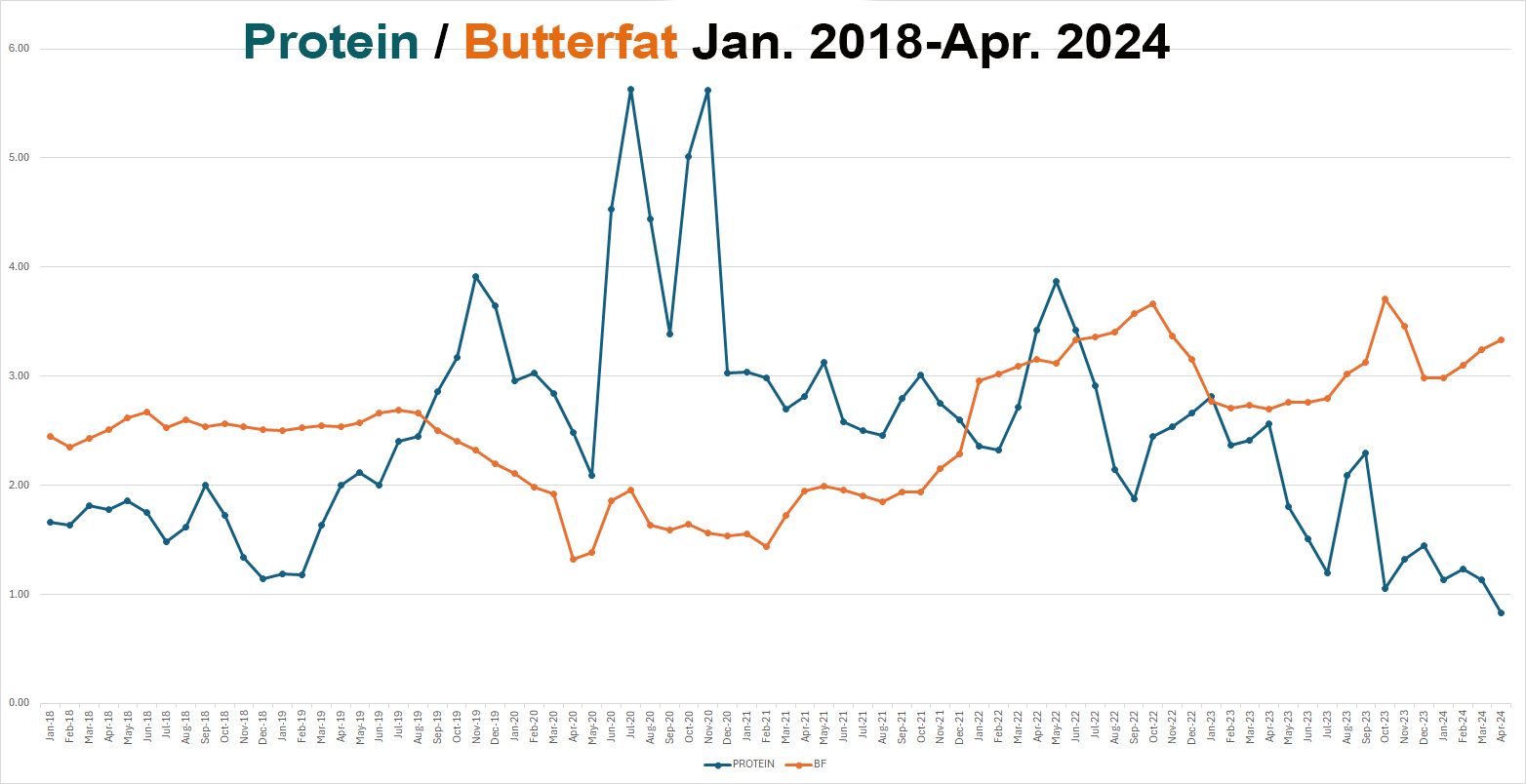
In fact, the April protein price hit a record low, announced May 1st at 83 cents/lb, which is 14 cents below the 97 cents/lb price for solids nonfat. This inversion has never happened before, according to our search of class and component pricing archives.

The butterfat price for April is quadruple the protein price at $3.33, creating additional divergence issues in multiple component pricing orders.
Meanwhile, the Class III milk futures haven’t offered much of a breakeven price to spend money protecting with hedges or DRP…

Until now…

Class III milk futures continued higher — skyrocketing limit-up for nearby contracts Wed., May 8, putting the exclamation point on five straight week of gains that have added $3 per hundredweight to the remaining 2024 contract months, going from the $16s and low $17s to the $19s and $20s, with 2025 contracts well into the $18s. This is the first time the Class III milk futures board has seen a $20 mark in over 18 months.

Class IV futures also made solid 20- to 30-cent gains charting over $20 and $21 across the board.

If the current Class III rally goes too far, too fast in the near-term, we could see negative PPDs in some Federal Orders in June for May’s milk because the May Class I advance base price mover was already announced in mid-April, and includes the much lower advance pricing factors of the (Class III) cheese and whey markets during the first two weeks of April.

The ‘average of’ method disadvantaged the May Class I mover by $1.73/cwt, which will undoubtedly be a factor for milk pooling / depooling decisions at the end of this month as Class I, at a base price of $18.46, will likely be rock-bottom lowest class for May, except where location differentials are high enough to boost it.

$20 finally appears on Class III futures board (June), Spot cheese hits highest price in over a year.

On Wed., May 8 the Class III milk futures for the next 12 months (May24 through Apr25) averaged $19.04, up 54 cents from the previous Wednesday. Class IV milk futures averaged $20.86, up 22 cents from the prior Wednesday.

The milk futures rally is driven by the upward momentum in CME daily spot cheese markets, reaching levels May 8 that are 50 to 55 cents per pound higher than six weeks ago.

The 40-lb block Cheddar price roared 11 1/2 cents higher to $1.95/lb in a single trading session Wed., May 8, gaining 20 cents/lb on the week, and hitting the highest level since last fall, with a single load trading. For 500-lb barrel cheese, at $1.90/lb, the gain was a dime on the week, and the highest price in over a year, with zero loads trading.

(Spoiler alert, the spot price for 500-lb barrel cheese skyrocketed well north of $2 on Tues., May 14 with a single load trading at $2.06. Conversely, Tuesday’s trading session on 40-lb block Cheddar started out moving a load as high as $2.00/lb, which would have been a 2-cent gain for the day. However, after the dust settled on the brisk trading session that moved a whopping 14 loads of blocks in a few short minutes, the market was pegged at the lowest load price of $1.93/lb — down 5 cents from the day before. A bid came in at $1.92 and was ignored after such an abnormally large clearance of blocks for a single session. More on this in the May 17 Farmshine.)

All other dairy commodity prices were higher Wed., May 8, with no trades changing hands. Dry whey gained a penny at 38 1/2 cents/lb (where it continued trading on Tues., May 14 with 2 loads changing hands). May 8th Butter was up 2 cents at $3.02/lb (but traded 16 loads at $3.00/lb Tues., May 14 and 1 load at $2.99/lb, which was a 3-cent loss since the low price is the peg for the day). Nonfat dry milk (NFDM) was up a penny at $1.13/lb on May 8 (and gained 3 1/2 cents more on May 14 at $1.1650/lb with an incredible 26 loads moving in a single session’s narrow $1.16 to $1.1650/lb range).

Dairy farmers will not see these gains in their milk checks until June, if the trend is sustained.

In the face of lower overall dairy exports, analysts tout the record volume of cheese exports in March, which were no-doubt prompted by the cut-rate January through April pricing that doesn’t pay bills on the dairy farm.

We have to go back to 2019 to find a 4-month Jan-April average Class III milk price that was lower than the first four months of 2024. We have to go back to the Covid shutdown in 2020 to find an April Class III milk price that was lower than April 2024. But even then, protein held up at $2.48/lb, not the 83 cents per pound that USDA announced for April settlement.

The difference this time is that fat is so much higher (quadruple the protein price at $3.33/lb for April). This essentially pulls a credit out of protein as an adjustment in fat values for cheese vs. butter. This is a seldom-discussed and little understood function of FMMO multiple component pricing, and another downfall of the many months of wide Class IV over III divergence.

Better views ahead… Higher Class I sales and record-high made-to-order fresh mozzarella production compete with stored product output for reduced milk supply

While the rear-view mirror shows the rough road traveled, the view ahead is improving for Class III milk and the beleaguered record-low protein price. Milk production is down. Packaged Class I fluid milk sales are UP. Processors are making record amounts of fresh (made to order) mozzarella cheese, causing Cheddar production to slow. Meanwhile, Class IV product supplies are tight. (One reason overall U.S. dairy exports were down is that inventories and production of milk powder is down!)

The most recent USDA Dairy Products Report showed Cheddar cheese production down 3.3% year-over-year (YOY) in March, with all American style cheeses down 2.9%. A positive this year that was missing last spring and summer is the draw for milk to make Italian cheeses.

Mozzarella production set records in March, up 6.8% YOY, but those products are not price-surveyed, nor are they included in the FMMO Class III pricing formula.

In addition to Cheddar cheese, the Class III price is also made up of dry whey sales via the ‘other solids’ component. Whey production for both human and animal use is accelerating as inventories of value-added whey protein concentrate (WPC) and whey protein isolates (WPI) were more than 40% below year ago at the end of March, despite March WPC production being up 1% for human use and up 40% for animal use; WPI up 73% YOY.

Dry whey is the commodity used in the FMMO Class III pricing formula with production up 2.4% for human use and 19.2% for animal use in March.

On the Class IV side, butter production was up 1.5% YOY in March with inventories up 2%.

As for powders: Whole milk powder (WMP) production was down 14.6% with inventory 36.3% lower YOY; Skim milk powder (SMP), typically made for export orders, was down 41.7%; and Nonfat dry milk (NFDM) output was down 7.9% YOY in March with inventories off 20.3%.

On the flip side, milk protein concentrate (MPC) production was the contrarian — up a whopping 38.5% YOY in March. MPCs are often used to bump cheese yields higher per hundredweight of raw milk.

These factors beg questions: Why were Class III milk prices for the first four months of 2024 at 5-year lows and protein at a record-low 83 cents per pound for April? Was it the plan to crush Q-1 2024 spot cheese and Class III milk prices to generate record cheese export volumes in March? Are cheesemakers using some of that big increase in MPC production to make more cheese from each cwt of raw milk? Are bioengineered fermentation yeast proteins that are marketed in trade publications as ‘dairy protein analogs’ diluting the supply and demand equation fractionally?

Global picture improving

The global picture is also improving. New Zealand tallied a lower output for the season, and recent reports show stable to lower milk output in EU countries.

In the Global Dairy Trade (GDT) biweekly internet auction Tues., May 7, the all products index was up 1.8% over the previous auction on April 16. This includes a whopping 8% increase in the GDT price index for bulk Cheddar sales contracted out through November, plus a 2.3% increase in bulk Mozzarella sales for July.

In fact, GDT Cheddar contracts for June were up 6.5% in Tuesday’s auction; July up 3.9%; August and September had no sales. October and November contracts were up 11.2 and 12.5%, respectively, compared with three weeks ago.

Understanding these negative PPDs, massive depooling; ‘New’ Class I calculation doubles the rub


Microsoft Word - DMAP IL20-3.docx

Large negative PPDs, Class III depooling and buyers reblending the milk price paid to farmers in June and July could be with us through August and even September because of how wide the divergence is between the Class III and Class IV prices, based on what the CME futures markets are showing. This divergence lowers all other classes in the pool (I, II and IV), especially now with the new “averaging” method of calculating each month’s Class I Mover in effect since May of 2019.

By Sherry Bunting, Farmshine, July 3, 2020

BROWNSTOWN, Pa. – Dairy producers seek to understand record-large negative PPDs (Producer Price Differentials) for June milk, meaning the the significant gains made in cheese markets and and Class III milk price are not making it to milk checks, especially for Federal Milk Marketing Orders (FMMOs) that are not predominantly cheese markets. (See FMMO data here

The extent of these negative PPDs – ranging from -$3.00 to -$8.00 per hundredweight (cwt) – has several factors, including the new way the Class I Mover is calculated since the 2018 Farm Bill changed it from the “higher of” Class III or IV pricing factors to an average of the two with an arbitrary 74-cent add-on. (See related July 28 story on revealing milk check data here)

“Expect historically large negative PPDs in Multiple Component markets for June and July,” writes Calvin Covington, retired breed association executive secretary and milk cooperative CEO, in an email interview with Farmshine this week.

He also estimates the volume of milk depooled in June will set a record (it did), further limiting how much of the past six weeks of higher dairy product prices will even make it into their milk checks.

Covington confirms Class III milk was already being depooled in May. As reported in last week’s Farmshine, we calculated the volume of milk pooled across all Federal Orders in May was already 13% below year ago levels.  For June, the depooling volume will be much more significant, in fact it is likely to be enormous.

“There is little economical reason to pool any Class III milk in June,” Covington asserts. “The only Class III milk that will be pooled in June is Class III milk going to a pool plant, and to meet any requirements to keep milk pooled in July.”

In fact, if buyers pooled Class III milk on Federal Orders in June, they would have to write a check to the settlement fund (instead of taking a draw from the fund as they do in normal conditions when the Class I bottlers are writing that check).

This is because the Class III price for June was announced this week at $21.04 – nearly $10 per cwt higher than the Class I Mover for June, which was set at $11.42 back in the beginning of May. The June Class I Mover is the lowest since the Great Recession while the June Class III price is the highest since 2014 — both now occurring in the same pooling month!

The reasons for the steep negative PPDs producers in Multiple Component Pricing (MCP) FMMOs will see for June milk, says Covington, are the high Class III price ($21.04) vs. Class IV ($12.90) and Class II ($12.99), the Class I Mover advanced pricing lag at $11.42, and the new method of calculating the Class I Mover, especially for July.

“In skim-butterfat priced markets – the Southeast Orders – blend prices will be lower than the Class III price,” Covington adds.

He explains that the PPD is paid on a hundredweight (cwt) basis, and it impacts all milk the same regardless of milk components.

“High component herds, especially in Multiple Component markets, see larger variation in milk prices,” Covington explains. “It is all due to arithmetic. Milk is paid on fat and protein. The more fat and protein in the milk, the greater the price change when fat and protein prices change.”

Covington spoke at World Dairy Expo last fall about the makeup of the milk check, and all of the factors that go into it. He reminds producers that only regulated plants are required to pay minimum class prices. Unregulated non-Class I plants choose to be associated with the pool so they can draw from it to pay a blend price to their farmers.

Now that the price for milk used to make cheese is so much higher than the price for milk used as a beverage or to make yogurt, ice cream, dips, butter, powder and all other products —  cheese plants are free to disassociate themselves from the FMMO pool, and there is no regulation stating they must pay their producers even the minimum announced Class III price for components.

Under the current system, when the Class III price rises quickly to overshadow the previously-set Class I Mover, there’s no reason for those Class III plants to pool the milk, unless they want to remain “qualified” to participate in the pool (draw) in the following month.

Covington observes that the upside-down pricing and negative PPDs will be with us at least through July. Dairy economists Mark Stephenson, University of Wisconsin and Andrew Novakovic, Cornell, noted in a recent Dairy Markets and Policy brief that this situation of negative PPDs, Class III depooling and buyers reblending the price paid to farmers could be with us through August and even September because of how wide the divergence is between the Class III and Class IV price via the CME futures markets.

This divergence lowers all other classes in the pool (I, II and IV), especially now with the new “averaging” method of calculating each month’s Class I Mover in effect since May of 2019.

Covington notes that it all boils down to math. The PPD is simply the difference between a Federal Order’s revenue available for producer payment (Class I, II, III and IV combined), minus the payment to producers at the Class III price based on components.

When Class III components are higher than the available revenue in the pool, the PPD is negative. When the Class III milk is depooled in that scenario, the funds aren’t there to pay the value.

“Factors impacting the size of the PPD, positive or negative,” he says, “are Class III price relative to the other class prices, volume of Class III milk pooled and an Order’s Class I price and usage.”

The primary factor in June’s negative PPDs is the extreme rapid increase in the Class III milk price. The rising cheese markets and Class III milk futures were mostly translated into the June Class III price because it was based on four weeks of June cheese sales.

The Class I Mover, on the other hand, was calculated six weeks earlier based on what the trade was doing at the end of April and beginning of May.

In the Covid-19 market-disrupted environment this is like two different world’s colliding based on timing and calculations.

Add to this the fact that Class IV and Class II prices saw muted increases during June compared to Class III’s large and abrupt increase, and what we are left with is the scenario where Class III beats all other classes by $7 to $10 in the same pooling month.

FMMOs with larger utilization of Classes I, II and IV will not see much boost from the uptrending cheese markets in their June blend price.

FMMO’s with large Class III utilization would see that boost. But depooling, reblending and assessments will all play further roles in how even those mailbox milk checks look once June milk is paid for.

Negative PPDs are not new. Dairy producers have experienced negative PPDs on milk checks in the past. Seeing a negative number in an uptrending milk market always brings questions and frustration. In fact, the November 2019 through January 2020 period in several of the past five years produced negative PPDs.

Last November, for example, the seven Multiple Component Pricing FMMOs saw a negative PPD averaging -$2 and ranging from just under -$1 to over -$3.

That pales in comparison to the negative PPDs producers will see for June, July and potentially August or September of 2020. Expect to see PPDs that are double, even triple, what was seen last November.

By now, most dairy farmers understand that a rapidly rising cheese market and corresponding Class III milk price presents the key factor putting PPDs into negative territory. When this happens, producers are reminded that a rising Class III milk price is still a positive development because it indicates milk markets are improving.

But in what some are calling a “whipsaw market” where prices turn abruptly in unexpected directions due to an unforeseen disruption like Covid-19, it’s useful to look at the other factors, for the long term.

First, when Class III milk’s component value is higher than the value of all the classes combined, the result is a negative PPD because after the Class III component values are paid, there is nothing left in the pool for the PPD draw. When the Class III milk is depooled, then that value is not available either.

When the blend price is higher than the Class III price, which is the norm, those Class III plants take a draw. When the reverse is true, they would technically owe the pool.

What sets this up against a huge market-disrupting event like Covid-19 is the lag-time between the calculation of the Class I Mover based on two weeks of trade and calculated six weeks in advance compared with the calculation of the manufacturing class prices based on the current month’s market conditions weighted over four weeks.

Even in those prices, there is a one to two week lag between what happens on the CME daily spot market and its translation to the weekly USDA National Dairy Product Sales Report, on which the class and component prices are based. There is no daily reporting of actual trade, actual sales of the four main dairy commodities, just weekly surveys that are published the following week.

On the flip-side, for April, the Class I Mover was set at $16.64 based on market conditions (advance pricing factors) during the first two weeks of March, before the Covid-shutdown. The Class III price came to $13.07 for April based on the economic shutdown affecting foodservice demand while retailers had a tough time keeping dairy products in stock.

With Class I sales rising dramatically in April, and the Class I Mover sitting $3.57 higher than Class III and $5.24 higher than Class IV – there was incentive to pool everything, even the displaced milk as the industry adjusted to an unforeseeable event and the Class I Mover stood well above all other classes, especially the dumped milk that was pooled at Class IV value.

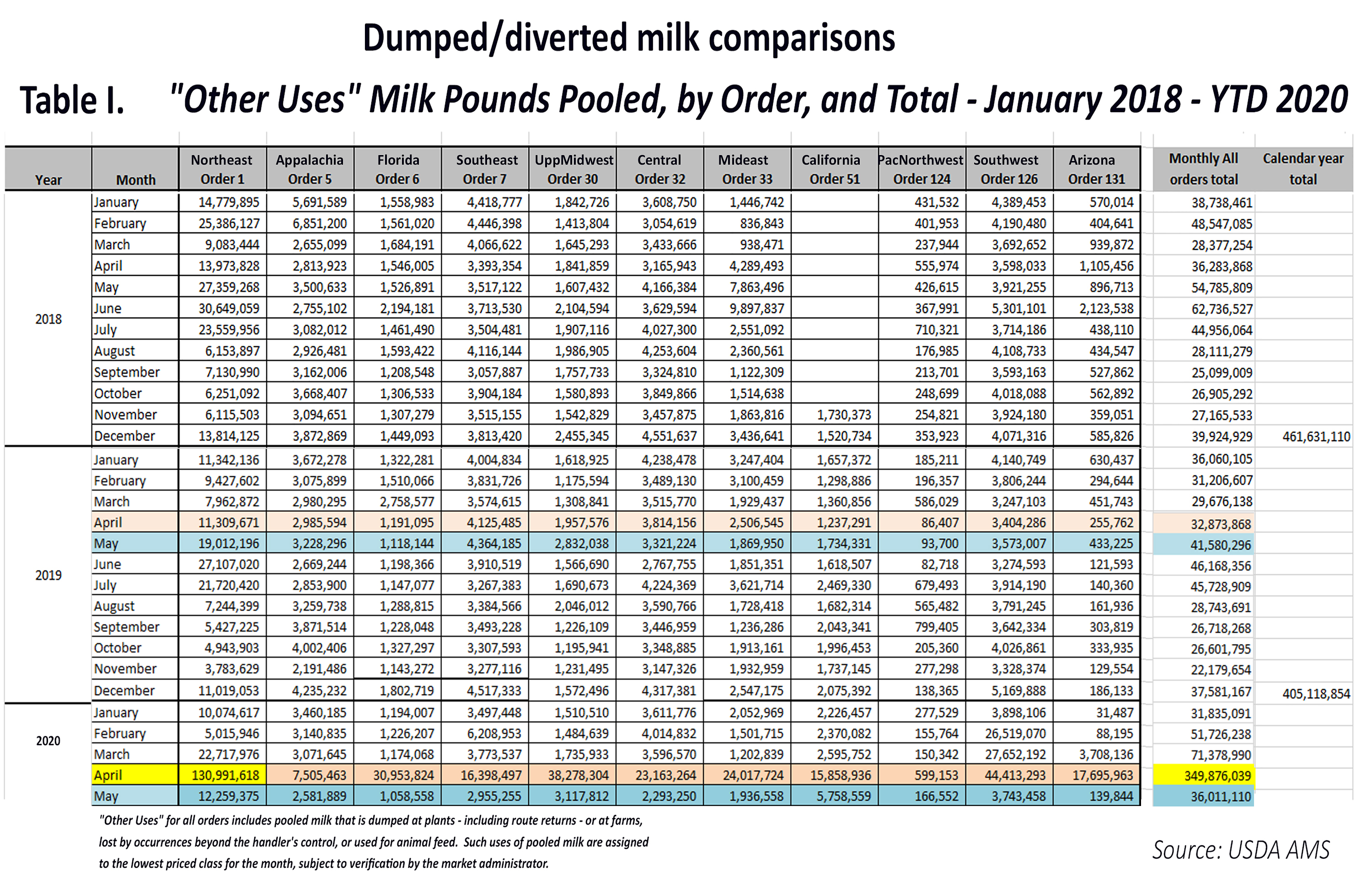
Thus, April set a record the amount of ‘other use / dumpage’ milk as 350 million pounds of displaced milk was pooled at the lowest class price across all FMMOs, nearly 10-times the amount that is normally pooled as ‘other use / dumpage’.

Now, that lag-time produces an opposite situation for June and July, and there is another wrinkle in the FMMO fabric – the new method for calculating the Class I Mover doubles the rub.

As a result of changes made in the 2018 Farm Bill, the Class I mover is now established by averaging Class III and Class IV and then adding 74 cents to that average. It used to be calculated using the higher of Class III or Class IV. In this case, that would have made a difference as Class III and IV have significantly diverged.

The calculation change for the Class I Mover was made to help processors hedge their future milk costs on the futures markets without having to guess which futures contract to use – Class III or IV. This was said to be something that would provide stability for Class I producers by stabilizing pricing for Class I processors. However, in these very unstable ‘whipsaw market’ times, the rub on producer milk checks will sting.

When it was proposed in 2017, American Farm Bureau Federation studied this method and documented little change to the net result for dairy producers when multiple years of pricing were averaged together and evaluated. In fact, when the new method went into place, there were several months where the average-plus-74-cents made the Class I Mover higher than it would have been under the old “higher of” method.

Not so in a volatile market with a time-lag involved.

These issues of negative PPD affect disproportionately the Federal Milk Marketing Orders (FMMOs) that have more Class I and IV utilization. FMMOs with small Class I utilization and large Class III utilization are relatively untouched as those blend prices would reflect mainly the much higher Class III cheese milk component value. But with depooling and reblending, those checks may also be impacted.

Looking ahead to July, the Class I Mover was already announced at $16.56, based on the advance pricing factors from the first two weeks of June. While July’s cheese trade is yet to be seen, the July Class III contract on the CME futures market stood at $22.85 at this writing on July 1st, which is $6.29 per cwt higher than the already set Class I Mover for July.

Even though the July Class I Mover stands $5.14 per cwt above the June Class I Mover, not even July’s Class I had the benefit of the full advance in June cheese trade because it was based on just the first two weeks of the June rally.

According to John Newton American Farm Bureau chief economist , there is currently, no mechanism to prevent negative PPDs. Newton writes in a recent ‘market intel’ piece:

“Historically, negative PPDs occur less than 15% of the time. Methods to prevent or mitigate negative PPDs  — such as eliminating the advanced pricing component, reconsidering the higher-of pricing formula (but with forward contracting of Class I milk), requiring mandatory pooling of milk in all Classes or consideration of decoupling the Class I milk from the price of manufactured milk products  – could be explored.”

UPDATE: Negative PPDs will be here for a while. Looking at these price spreads does not bode well for the continued inverted relationship between Class III and the Class I Mover — or what milk market analysts call “unorthodox pricing arrangements” — that will lead to continued negative PPDs and de-pooling of the higher Class III value milk from Federal Milk Marketing Order pools. In fact, the discussion of this issue has many twists and turns, a few questions have been forwarded to USDA Dairy Programs for some explanations, and June pooling data and blend price / PPD information is anticipated after the 14th.

Here’s the problem. Even when the ‘advanced pricing’ method gets caught up, the real problem is the way the Mover is now calculated. The 2018 Farm Bill made a huge change without a USDA administrative hearing and without a producer (bloc) vote.

Fluid milk processors wanted stability. They wanted to be able to forward-contract their milk costs and not have to deliberate over which futures contract to use — Class III or IV — since the Class I Mover used to be based on the “higher of” the two classes. Now, the futures markets are showing us that the spread between Class III and IV is going to be well above $1.48/cwt through November. That’s the significant number because the new Class I Mover method is calculated by averaging Class III and IV and adding 74 cents to that average. Once the III / IV spread hits $1.48/cwt, the 74 cents no
longer covers the difference.

Once we get to 2021, the spread narrows through those months, according to what the futures show now, but the Class III / IV spread looked reasonable and well within that $1.48/cwt for this current period back when viewed on the futures markets six months ago. If Congress can make a big change like this to Federal Order pricing formulas based on NMPF and IDFA agreeing on such while the Farm Bureau took a neutral position
— other than to review it and show it to be a wash when averaged over time — why can’t the Congress require a USDA National Hearing on milk pricing with Report to Congress?

Previous Farm Bills had such language, but the National Hearing “cost” was never funded. Now, the idea of a National Hearing on milk pricing, and a producer vote on Federal Orders, is seldom discussed. What we see from this Class I Mover example that a big changes can be made and implemented quite readily at the legislative level — no hearing or vote required — as long as the cooperative processors and proprietary processors agree on the change in advance. If milk is substantially depooled to keep higher end product values in hand, hopefully through the reblending process, plants and cooperatives will pay the marketplace value to dairy farmers, given the sacrifices producers have made to bring production into line with demand.

FYI: The Pennsylvania Milk Marketing Board (PMMB) successfully “decoupled” and stabilized the Class I milk price for two months by setting a Class I floor of $15 through the state’s over-order premium authority. The Federal Milk Marketing Orders were going to have a national hearing on this in April, but chose not to after economists and organizations in the Upper Midwest cheese region complained. The PMMB action was limited only to Pennsylvania, so for two months (the limit of the Order), when the Class I beverage milk price for milk produced, processed and sold in Pennsylvania fell below $15, the current over-order premium of around $1.00 per cwt was expanded automatically to bring the price back up to $15 for May-July 2020 for this very reason.

Trouble is, with the FMMOs not considering a similar move, this PA ‘premium’ only pertains to bottling plants paying milk suppliers for milk produced on PA farms (and they are free to take milk from other farms outside of PA). This price was built into the PA minimum retail milk price for May and June, but retailers, processors and cooperatives are not required to pass these state-mandated premium funds paid by PA consumers back to PA farms — unless the milk meets all three of these criteria: produced, processed and sold in Pennsylvania.

Author’s Opinion: There is one other thing worthy of consideration. A national hearing on milk pricing, period, to look at options, updates, simplification, transparency, daily reporting, producer voting, consolidation, transportation and deductions. Some grassroots groups have been asking for a national hearing with report to Congress for nearly 10 years as there is no other way for farmers to access the FMMO system run by market administrators, and they don’t even get a vote because cooperatives bloc-vote changes on behalf of their members. Previous Farm Bills included language for such a national hearing, but they were never conducted. At some point, the complexities at play here need to be evaluated from both regional and national perspectives in terms of “orderly marketing” and how farm viability and farm and food security in regions are affected and in terms of fulfilling the desire of many consumers wanting fresh, local milk.

-30-

Eye on markets as reined-in supply vs. strong demand drive dairy higher

img_1123rgb 3

By Sherry Bunting

Trade sentiment is mixed on how long the upward momentum in dairy markets can last as producers wait for these higher levels to land in their milk checks.

On one hand, USDA Dairy Market News reports strong pizza sales, stable to strong retail sales, and government purchases all stoking demand against reined-in supply. On the other hand, some analysts see weakness ahead as higher prices may prompt milk expansion by fall when demand may wane after CFAP food box purchases end and food-service pipelines are re-stocked. Much will depend on how the economic re-opening goes for families and food-service, as well as what happens with schools and sports. Experts suggest producers evaluate their risk management tools while markets present positive margins in a tumultuous time.

To-date, the USDA Coronavirus Food Assistance Program (CFAP) Farmers to Families Food Box Program has delivered 18.5 million boxes. The first round of May 15-June 30 fresh food purchases totaled $1.2 billion, including $317 million for milk and dairy products. Now USDA is poised to announce a second round of $1.16 billion for July 15-Aug. 30, of which dairy’s share has not yet been specified.

Also, as of June 22, USDA paid $895 million in CFAP dairy farm payments, and a total of 15,222 dairy producers (about half) have applied. The dairy payment formula equates to $6.20 per hundredweight on Q1 milk (including dumped milk). CFAP enrollment continues through August 28, 2020.

Meanwhile, milk futures continued their multi-week march higher on the heels of record-setting CME block-cheese prices through June, pegged at $2.70/lb Monday, June 22 and then $2.81/lb Tues., June 23. Barrels shared the advance, but were a record 44-cent spread behind the block trade at $2.37/lb.

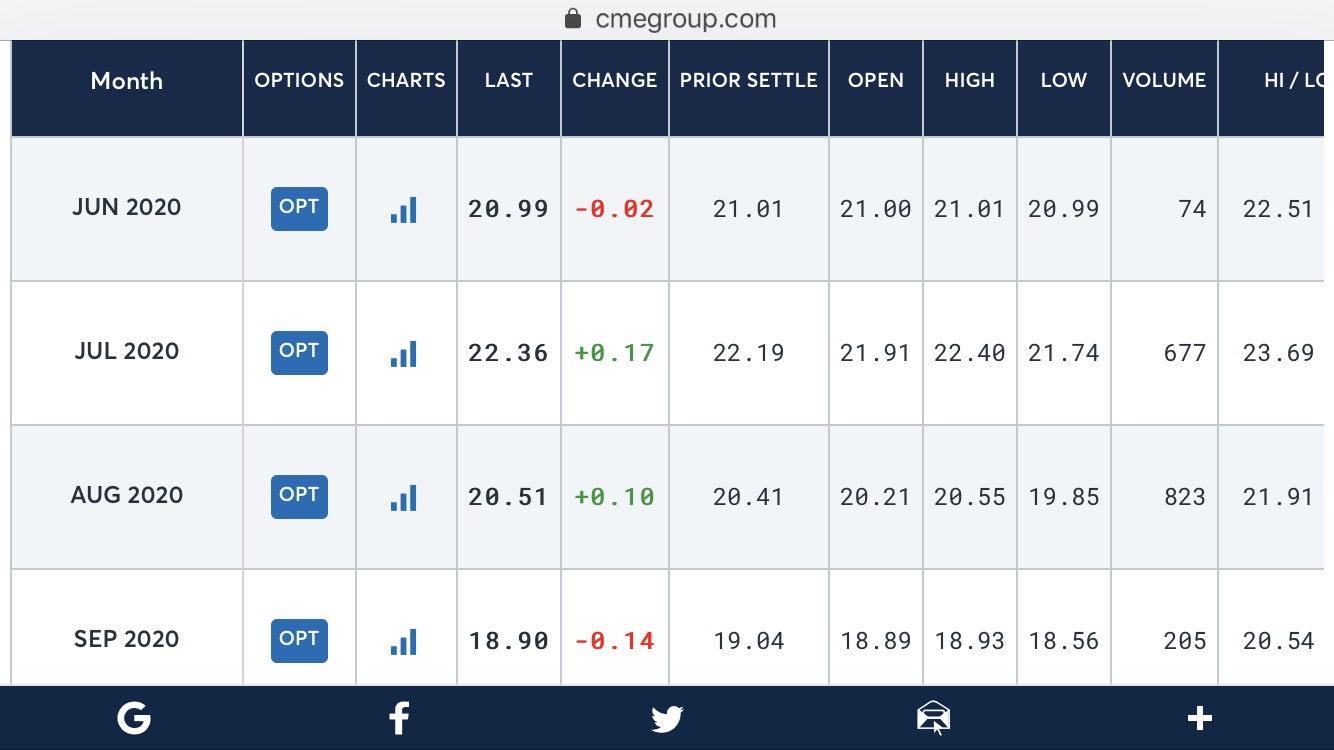
June’s Class III milk contract hit $21 Monday, up $9 from the USDA-announced May Class III price of $12.14. July’s contract topped at $22.19, and August edged into the $20s. Monday’s Class III milk futures averaged $17.98 for the next 12 months — up 69 cents from two weeks ago.

Part of the extent of Monday’s advance is attributed to new rules when higher trading surpasses the 75-cent limit, as happened Friday, the limit doubles for the next trading day, allowing more speculative activity up or down. But Monday’s spot cheese increase shored-up the gains, while after-hours trading hinted a 20-cent pull-back before another spot cheese market gain Tuesday noon narrowed the dip in fall milk futures. At mid-day Tuesday, summer 2020 front-months were another potential nickel or dime in the green, and penny to nickel gains were applied to 2021 Class III contracts.

IMG_8670

Screenshot of June-Sept. Class III milk futures trading at Noon CDT Tuesday, June 23 — just after the spot cheese auction on the CME in Chicago saw 40-lb block cheddar trade at yet another record high of $2.81/lb with 500-lb barrels also higher at $2.36/lb — behind blocks by a new record-setting 45-cent spread.

New block cheese futures at the CME were launched in 2020, helping processors manage the risk of the wide spreads between 40-lb block and 500-lb barrel cheddar that broke records in 2019, setting new record spreads again this week.

Class IV milk futures gains into this week have been less stellar as butter had melted off a previous advance, but firmed up late last week, then pegged a 2-penny loss at $1.81/lb Tuesday. Spot powder strengthened last week in active trade after the biweekly Global Dairy Trade auction index rose 1.9%. The first two days this week, the Grade A nonfat dry milk spot price remained pegged at $1.03/lb with just two loads changing hands on the CME.

The awaited June 22 USDA Cold Storage report confirmed that accumulating cheese moved to food-service with a seasonally-unusual and record-large natural cheese inventory pull-out for the month of May. Despite this inventory pull, cheese stocks remain 5% above year ago, and butter stocks are up 21% vs. year ago. Inventory is apparently not as negative to markets as it was pre-Covid due to the retail shortages experienced in April during the height of ‘stay-at-home’ orders. Some companies report wanting to keep more inventory instead of operating ‘hand-to-mouth.’

On the farm side, USDA confirmed 1.1% less milk was produced in May vs. year ago. USDA data also showed 13% less milk was pooled on Federal Orders vs. year ago — abruptly reducing the pooling of dumped and diverted milk. At 36 million pounds, the volume of milk pooled as “other use / dumpage” in May was a fraction of April’s 350 million pounds of “other use / dumpage” milk pooled.

DumpedMilk_Table(withMay2020)

Electronic trading brings anonymity. Understand how CME dairy spot markets function

By Sherry Bunting, Reprinted from Farmshine, February 9, 2018

CHICAGO, Ill. — The CME dairy spot markets have been evolving since arriving in Chicago after a tumultuous past on the Green Bay Cheese Exchange, writes Ronald K. O’Brien, II, a dairy market risk specialist and geostrategist. He is director of global derivatives for Interfood, multidimensional global dairy risk managers using physical and financial global dairy markets to offset internal sales and inventory risk.

CME(RonOBrien).jpgRecently, Farmshine interviewed O’Brien to better understand from a trader’s perspective how the dairy spot markets function since the transition from live floor trading to electronic trading in the second half of 2017. We also gained insights on some differences between the global and domestic trading platforms.

This conversation matters because the daily price at which those 15 minutes of CME trading close — whether bid, offer or trade — helps set pricing for the weekly USDA National Dairy Product Sales Report for cheese, whey, butter and nonfat dry milk (NFDM), which in turn sets the monthly commodity prices that are plugged into the Federal Order formulas that form the basis for how dairy farmers get paid for their milk.

O’Brien points out that markets are based on the “who” and the “what.” That’s as much true about CME dairy spot markets as it is about cattle auctions. People want to know, in the moment, where the auction is going in price, but also who is buying and who is selling, to infer a sense of market demand and resistance at those positions.

“Fundamentally, we have the same participants on the dairy spot markets, and it is still like coming to an auction,” says O’Brien of how bids, offers and trades occur on the electronic platform today, just like when it was live on the floor of the Chicago Mercantile Exchange (CME). “The difference, now, is the anonymity. This requires you to participate if you want to know what is going on. This brings a little more interest to those 15 minutes of spot trading.”

The anonymity also creates a situation where the largest market leaders know more because they know the buyer or seller once a trade is completed; whereas before, others outside of that transaction could observe and speculate based on which brokers were trading.

O’Brien observes that when the CME dairy spot markets traded live on the floor, analysts would not precisely know who was buying and selling; however, they knew the brokers and who they typically bid or cleared for.

CME(lastOpenOutcryDAIRY)For example, in past years, the largest physical producers and end users in the United States would regularly use the same clearing broker for their spot transactions, resulting in the majority of market participants acting on this inferred knowledge in real time. A single bid or offer from certain brokers would set distinct levels of support and resistance, and this was coveted as the most prolific dairy information of the day.

The electronic platform “made this all disappear,” says O’Brien. “Spot traders know who is trading when a transaction is complete, at the end of the auction, if they are involved in that transaction, but they have no clue about who else was involved during the session.”

Thus, he says, “it is now more difficult to sense how strong the support is or how heavy the resistance because (with electronic trading) you don’t know if the buyer in a session was the largest end user, or your grandmother taking a position.”

In fact, anyone with eligible product in a warehouse, a CME auction account and a funded futures account can sell on the CME dairy spot market.

This is different from the Global Dairy Trade (GDT), which is run by Fonterra of New Zealand. In the GDT biweekly internet auction, not just anyone can bring product to that exchange. “They have to be vetted and approved to offer product on the GDT, and selling is limited to processors,” O’Brien notes.

For this reason, the CME is more of a “natural and price transparent marketplace,” he explains.

He calculated the trade volume for the 12 months leading up to the change from floor trading to electronic trading, noting that 38,000 tons of 40-lb blocks and barrels were traded on the CME during the second half of 2016 and first half of 2017.

Trade volume on 40-lb Cheddar blocks has increased 16% and on barrels 38%. O’Brien points out that the amount is still relatively small considering that the U.S. produces 5.5 million tons of cheese annually, which is essentially priced off the CME session trades, bids or offers.

“We were trading 7/10ths of one percent of total cheese production on the CME spot market,” says O’Brien. Since the change to electronic trading, this has increased slightly to just shy of 1%.

The volume of CME spot butter trades, on the other hand, has increased 138%, while NFDM has been flat.

With more trades, one can argue that the CME spot markets have become a better price discovery mechanism via electronic trading, particularly for butter. For the 12 months prior to going electronic, the CME traded 1.44% of the total U.S. butter production, compared with trading 3.7% of total production in the past six months since going electronic.

“That is a dramatic jump in the price discovery for butter,” says O’Brien.

The CME spot market for cheese has some product specification differences from butter and powder. “It is a fresh cheese market,” O’Brien points out. “Sellers cannot bring product older than 30 days to the CME, so we can have 400 million pounds of cheddar in inventory, but if there are no sellers of fresh cheese, and if buyers have a need for fresh cheese, we get these massive short-squeezes.”

He notes that the CME could price fresh cheese at $1.60/lb on the spot market, but cheese that is 31 days old or older could be trading through normal distribution channels at discounts as great as 20 cents per pound.

In that sense, the CME gives dairy farmers hope — when they see Cheddar up 10 to 20 cents on the CME spot market — but then the rally erodes in real time as the “short-squeeze” on fresh product passes, and the CME spot market falls.

This volatility is often seen from week to week, and cheesemakers can get caught when their input cost for milk does not align with their output sales of cheese that is older than 30 days.

On NFDM, the product age window is 6 months, and for butter it is one year, making those spot markets more reflective of supply and demand in terms of stored product realities.

“We could have a better marketplace (for cheese), but at the moment, these are the boundaries that participants are forced to operate within, regardless of the increased volatility that results from them…volatility greases the track and gets things moving,” observes O’Brien.

His experience with dairy market risk over the past two decades gives him insights into many sectors of the dairy industry. He suggests that dairy farmers need to be aware of their options and be realistic about their cost of production.

“Everyone is in same boat (in terms of market risk), but for dairymen, it is different because they are mostly price takers, while physical trading houses and other market participants that have risk management departments can be price makers,” he says. “Physical traders incur risk when they can manage it, and if they cannot, they immediately offset it or avoid it altogether, whereas dairy producers make milk and work hard and do some things about risk on their inputs but neglect fixing the price of milk outputs.”

O’Brien notes that with the farm milk price based almost completely off the CME spot markets, this is also affected by delays. The CME spot market can be going up while the USDA weekly National Dairy Product Sales Report can be going down in the same window of time. Meanwhile, the CME spot dairy markets, especially on cheese, remain a “market of last resort” with limited participants on the processing side.

While there is increased activity of end-users coming to the spot market directly to buy — especially for butter — the spot market is mainly selling more product with the same participants. There are still a limited number of butter sellers — traders fulfilling contracts and a handful of processors that make butter.

The large processors and cooperatives focus on allocating the bulk of their sales for the year and make inventory based on those allocations. Global dairy traders, on the other hand, have ever-changing risk profiles, which forces them to buy, sell and arbitrage to survive.

“We don’t operate under the luxury of make allowances,” says O’Brien of the role of market participants such as themselves.

Meanwhile, market dynamics are changing in the cheese industry where cheese plants are being built as much for the cheese as for the whey stream valorization. This creates a supply of Cheddar barrels that can build up and are seldom exported.

U.S. processors continue to produce yellow Cheddar blocks and barrels, but few globally have the equipment to break down the barrels, so they are not exported. The industry makes what it wants — what milk is priced from — but is that reflective of the market?

There are certainly inefficiencies in the current commodity market pricing systems that underpin the Federal Order milk pricing. Can a case be built to improve this?

Could inclusion of more indexes built off more pricing points (products) bring better market transparency?

Meanwhile, the four basic commodities from CME to Federal Order set the allocation pricing barometer for dairy processing as well as both the spot milk and milk futures markets.

Looking overseas, O’Brien suggests that the countries of the EU “would love what we have in the ability to lock in a milk price for up to two years (via a mechanism like the CME futures markets). For the most part, farmers in Europe are paid on what milk-derived sales their co-op or processor can attain. Their pay price does not float with the market. But farmers in Europe have the intervention program — similar to the former dairy product price support program the U.S. eliminated in the 2014 farm bill,” O’Brien relates.

Volatility in the marketplace provides opportunities to manage risk, but it is easier said than done. For example, there must be access to funds to hold positions (through the margin calls when the market goes against their positions).

On the processing side, says O’Brien, “Deferred positions of just 5 months can move against you as much as 70% for products such as NFDM or Cheese and as much as 100% for butter.”

As for dairy farmers, he observes that there were opportunities during late 2008 to lock in $20 Class 3 milk prices during 2009.

“But most dairy farmers didn’t do this. A super majority operate without safeguards, eternally optimistic. Dairy production is not a pastime, and survivability is not certain,” he suggests. “The future is managing risk. The multinational companies do it, and traders do it. Successful farmers will have to do it also.”

Ron O’Brien can be followed @rko2milk on twitter and at milkfutures.com

Check out the final open outcry live CME dairy spot market auction from June 2017 here


check it out at https://www.youtube.com/watch?v=si2vVdOQemo&t=35s