Unknown's avatar

About Agmoos

I am a journalist writing primarily about agriculture for various newspapers over the past 30 years...and before that, I milked cows and tended calves and heifers. I am also a mother and grandmother with three grown children: A teacher, restaurateur and homemaker. Our two sons and one daughter all like to cook and they are food conscious... not paranoid. My "foodographic" Agmoos blog is a place to find stories and photos of the people and places behind the food we eat and for commentary and analysis on food, farm and marketing issues facing producers and consumers.

Covington: Class I change cost producers ‘real money’

Lack of vetting cited as impacts of negative PPDs continue

By Sherry Bunting, republished from Farmshine, April 16, 2021

EAST EARL, Pa. — Federal Milk Marketing Orders have been the subject of discussion at many intervals in Farm Bill history. The last time a major reform occurred was in the 1996 Farm Bill, which became effective in 2000 after going through a four-year period of administrative hearings, widespread opportunity for industry and public comment, a thorough vetting.

Back then, the USDA AMS Dairy Division cited concerns about negative differentials (today we call them PPDs) and massive depooling in 1995-98.

Using the ‘higher of’ Class III or IV advance pricing factors for the skim portion of the Class I ‘mover’ formula was decided to be the way to help mitigate this negative situation and fulfill the purpose of the Federal Orders.

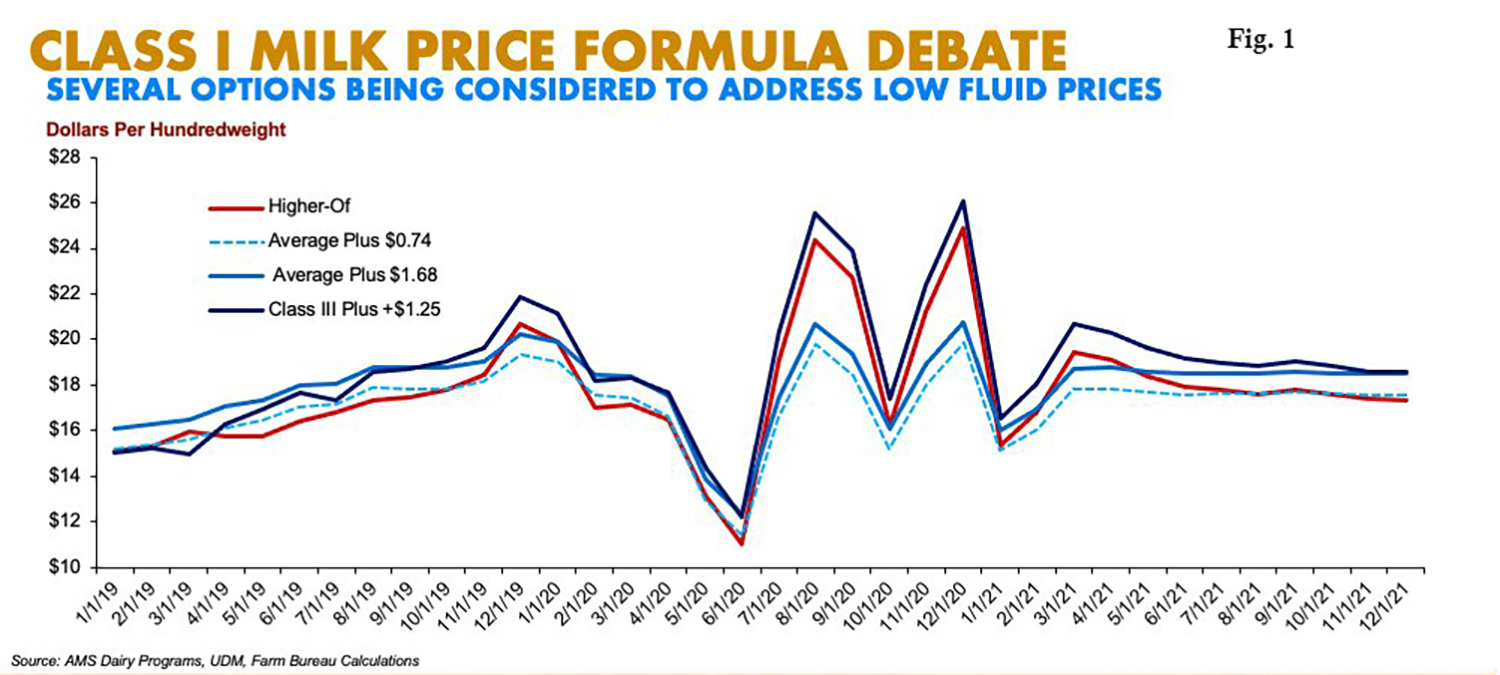
Fast forward to the 2018 Farm Bill: A new Class I pricing method was implemented in May 2019 using the average of Class III and IV advance pricing factors (plus 74 cents) — instead of the ‘higher of’ — as the starting point for the Class I ‘mover’ calculation. This was inserted into the 2018 Farm Bill without hearings, without public comment, with very little industry discussion, and no vetting process

The change was not stress-tested, and producers did not have a seat at the table when National Milk Producers Federation (NMPF) and International Dairy Foods Association (IDFA) agreed to ask Congress to legislatively make this change.

During 23 months of implementation, the result has been disastrous for dairy farmers, and the Farm Bill language calls for the opportunity to amend after the first two years of implementation. We are at that two-year mark right now, and discussions are rippling forward.

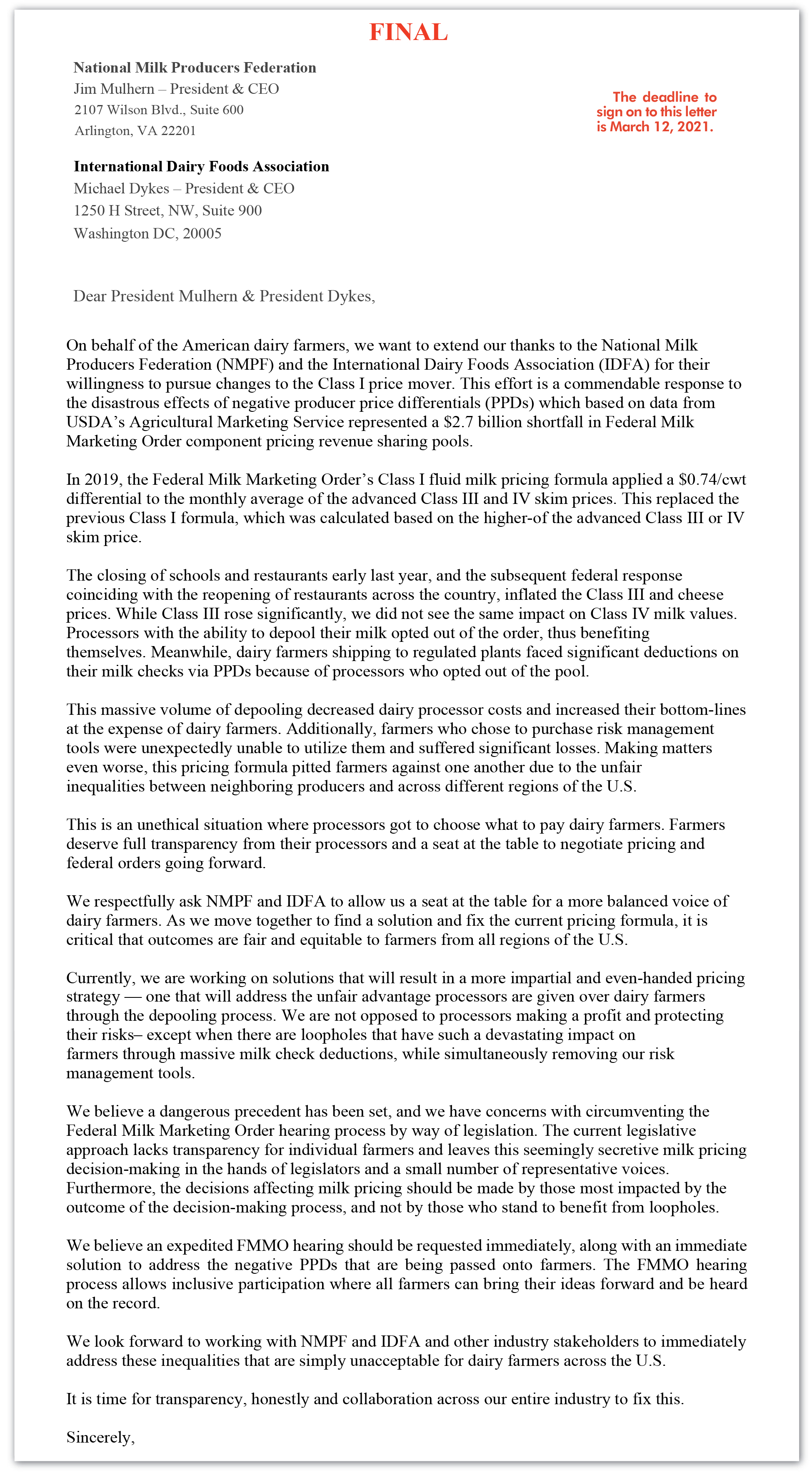
For example, a letter to NMPF and IDFA, organized by American Dairy Coalition (ADC) and signed by hundreds of producers and associations, points out the concerns and seeks a seat at the table for an immediate solution. It also identifies the hearing process as allowing inclusive participation.

In a phone conference call Monday (April 12), after months of discussion, the broad coalition of producers involved in the letter from coast to coast agreed. They are looking for an immediate temporary fix by going back to the vetted method — the ‘higher of’ — at least until a vetted decision can be made for the long-term. On Tuesday (April 13), the ADC board reportedly also took a formal position after listening to farmers from different regions across the U.S. to support an immediate temporary return to the ‘higher of’ while continuing to listen and participate in efforts to reach a vetted, viable solution for the dairy industry.

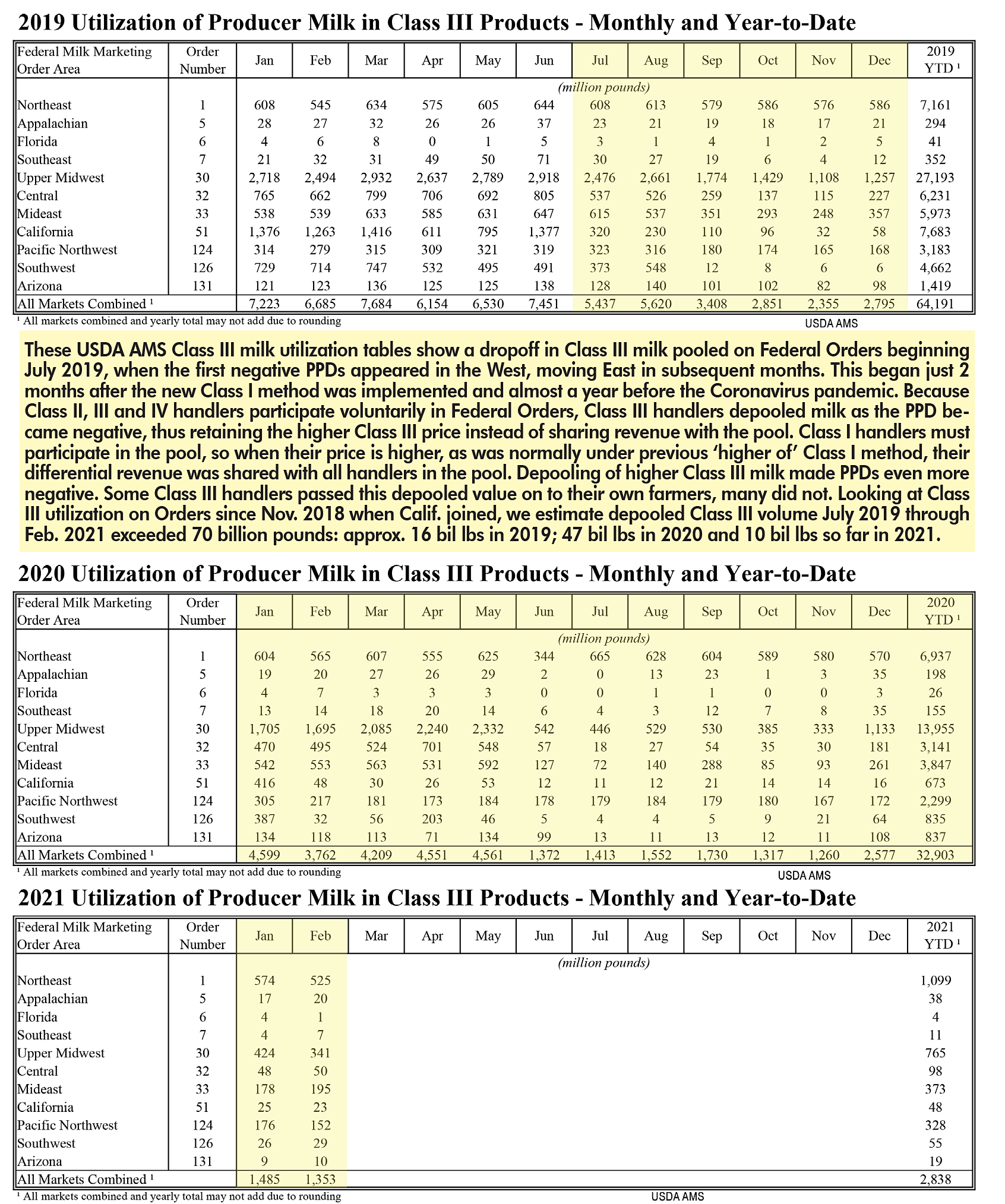
While the Class I change in the 2018 Farm Bill is one aspect contributing to the severely negative PPDs and massive depooling of milk leaving shorfalls in Federal Order revenue sharing in three months of 2019, seven months of 2020 and continuing in 2021, it is an important factor and the only factor that is the result of a change made legislatively without hearings.

Add to this the predominance of cheese in the government purchase programs throughout the pandemic, and the result has been a huge range in all-milk prices across the country and neighbor to neighbor of $8 to $10 from top to bottom.

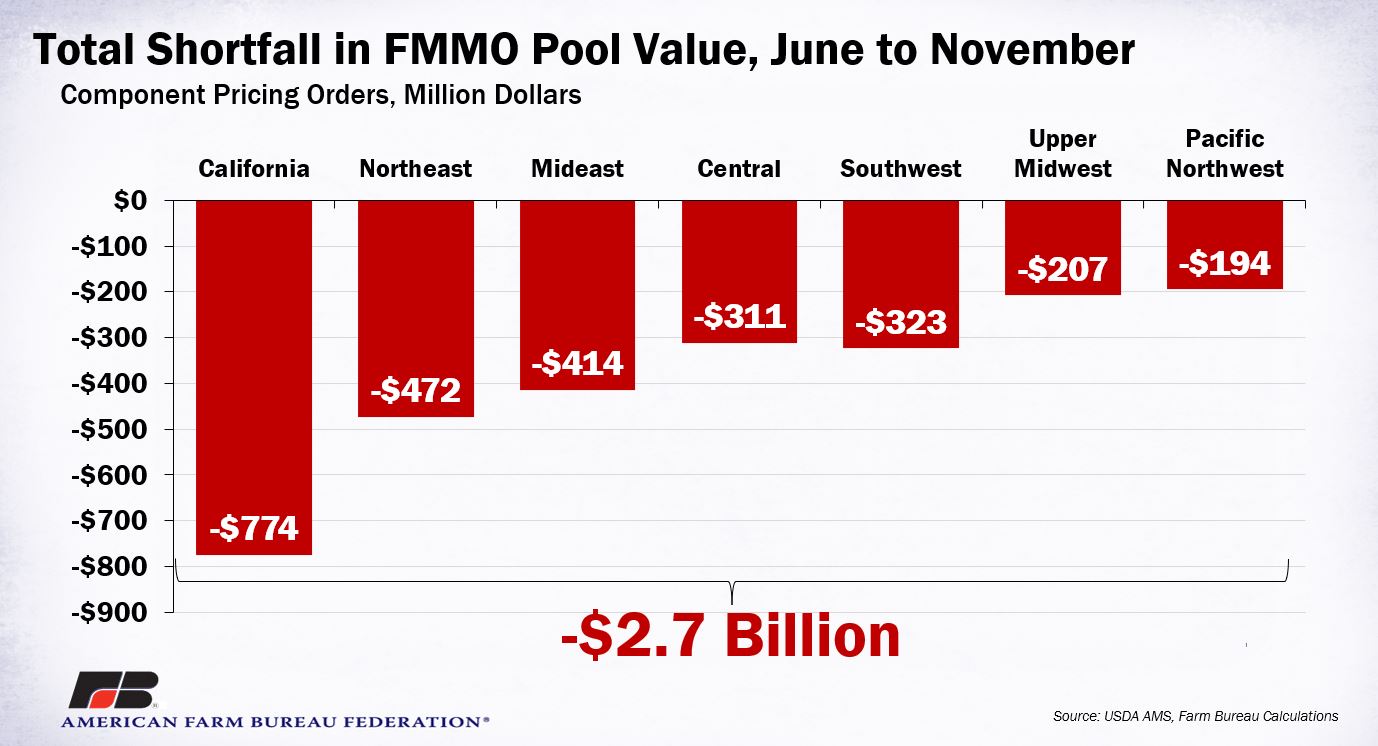
Add to this the negative PPDs and depooling creating poor performance of risk management tools and the DMC safety net that dairy farmers pay premiums for. These tools were not designed to function in the inverted pricing situation over 13 of the last 23 months that has led to a NET loss of nearly $750 million in Class I value and over $3 billion in FMMO losses to producers via negative PPDs and depooling.

Calvin Covington has a unique combination of experience and insight into the problem. He was CEO of American Jersey Cattle Association when component pricing was developed and used in the last major reform of Federal Orders. He also spent many years after that as the CEO of a milk cooperative in the fluid milk markets of the Southeast. Retired today, he continues writing dairy market columns and consulting.

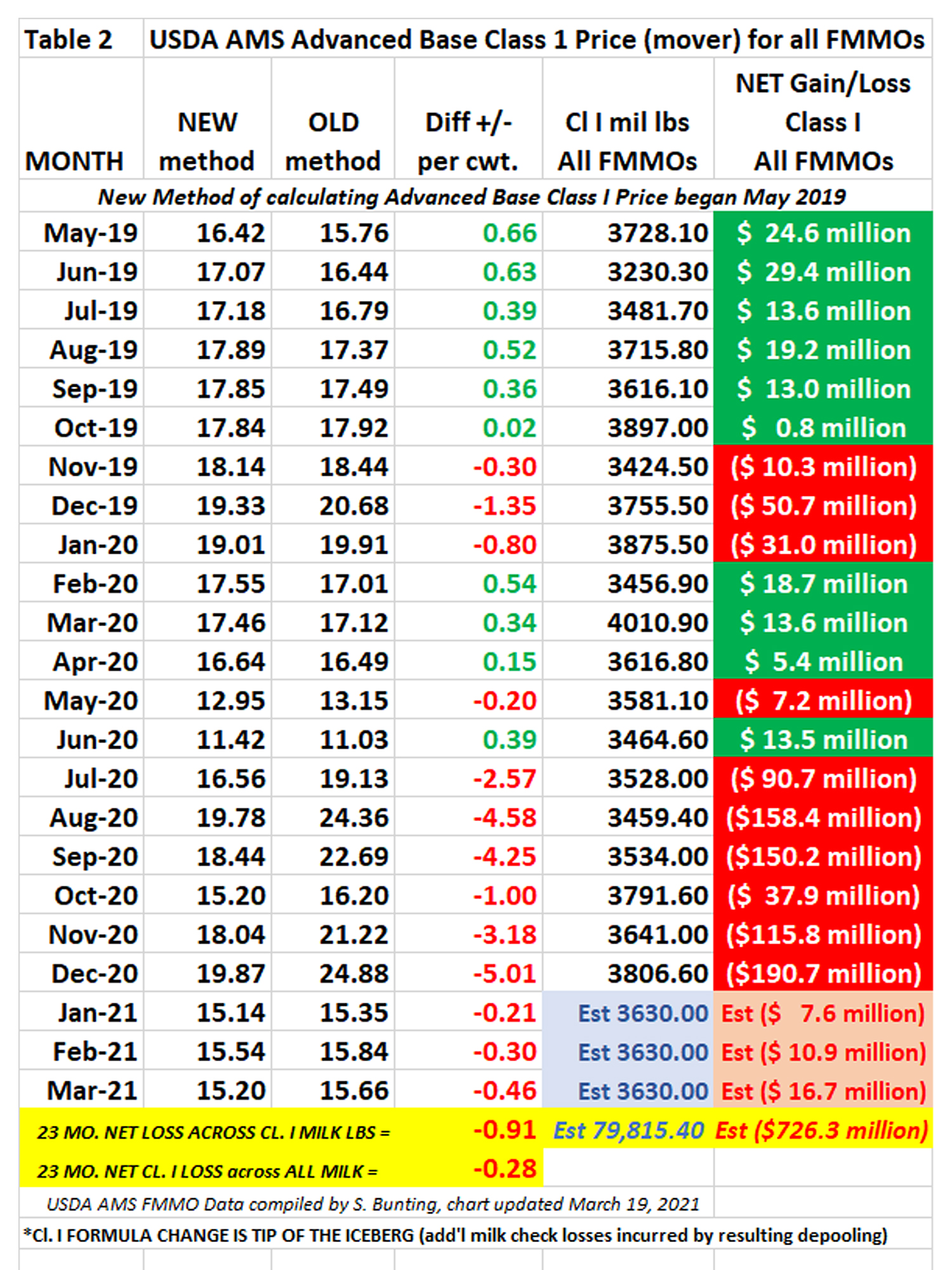
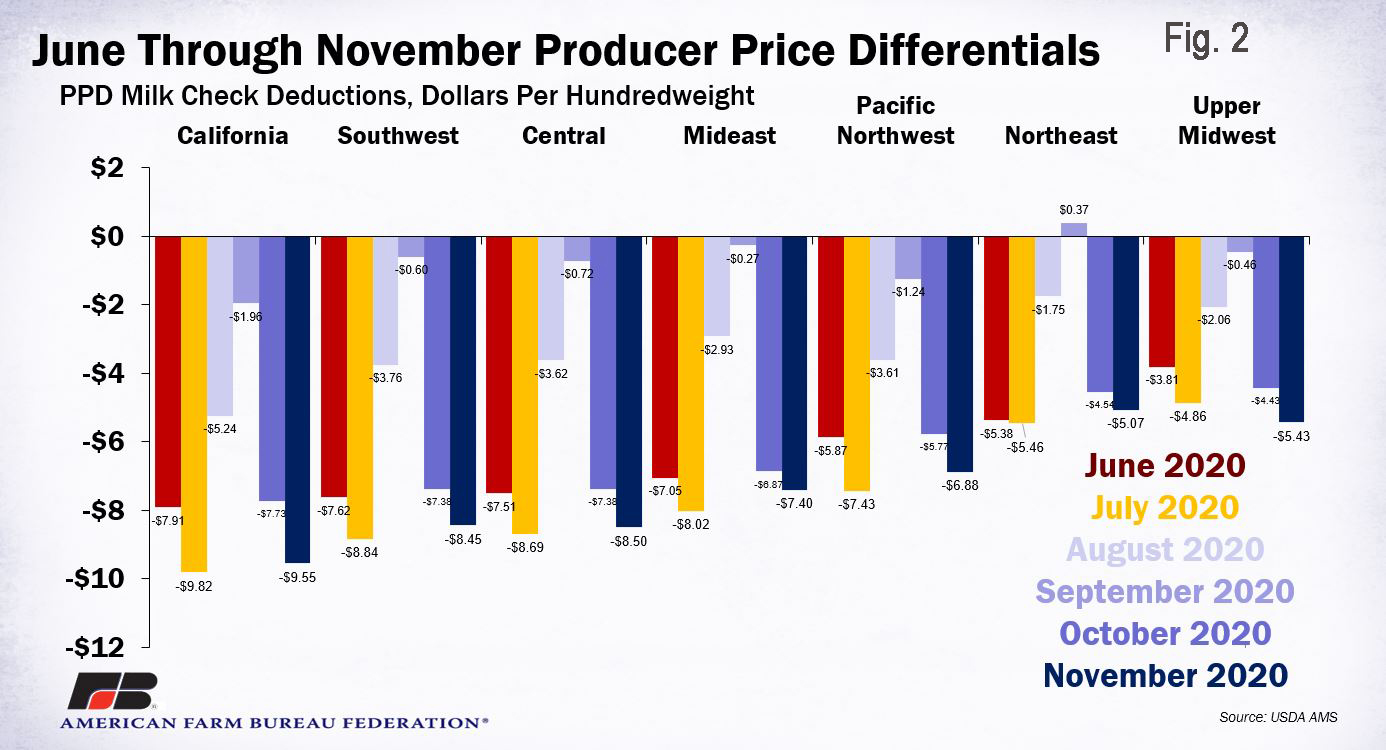
In a Farmshine interview last Friday, Covington shed some light on the Class I pricing change, negative PPDs (Table 2) and depooling.

“What I tell producers in the Southeast: If you took last year, for example, take the three Southeast Federal Orders (5, 6 and 7), this lowered the blend price about $1.00 per hundredweight. That’s real money,” said Covington. “That’s a dollar right out of producers’ pockets.”

That $1 blend price loss he is referring to is the NET loss across all pounds of milk in the Florida, Southeast and Appalachian FMMOs across the 23-month history of the new Class I pricing change.

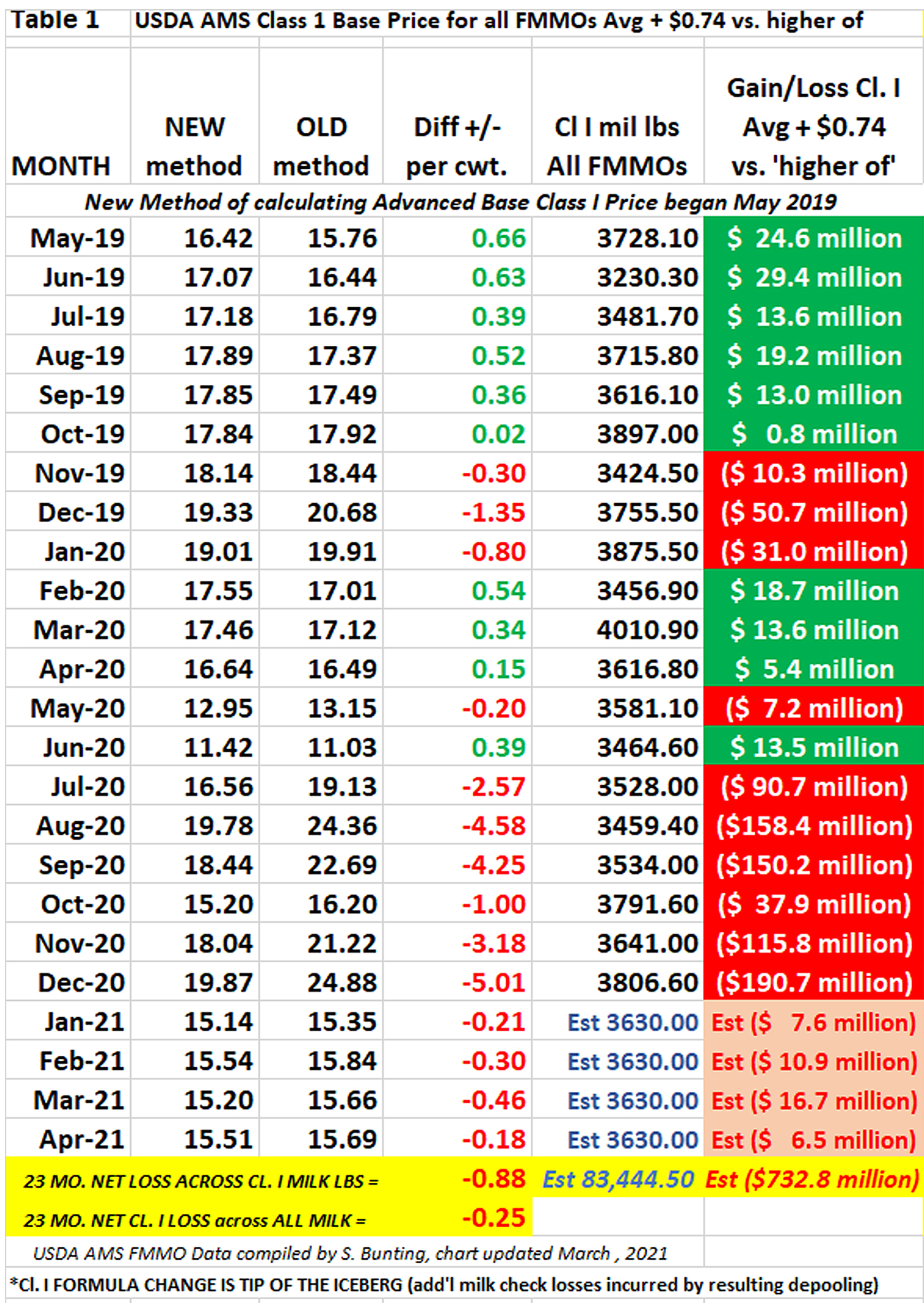
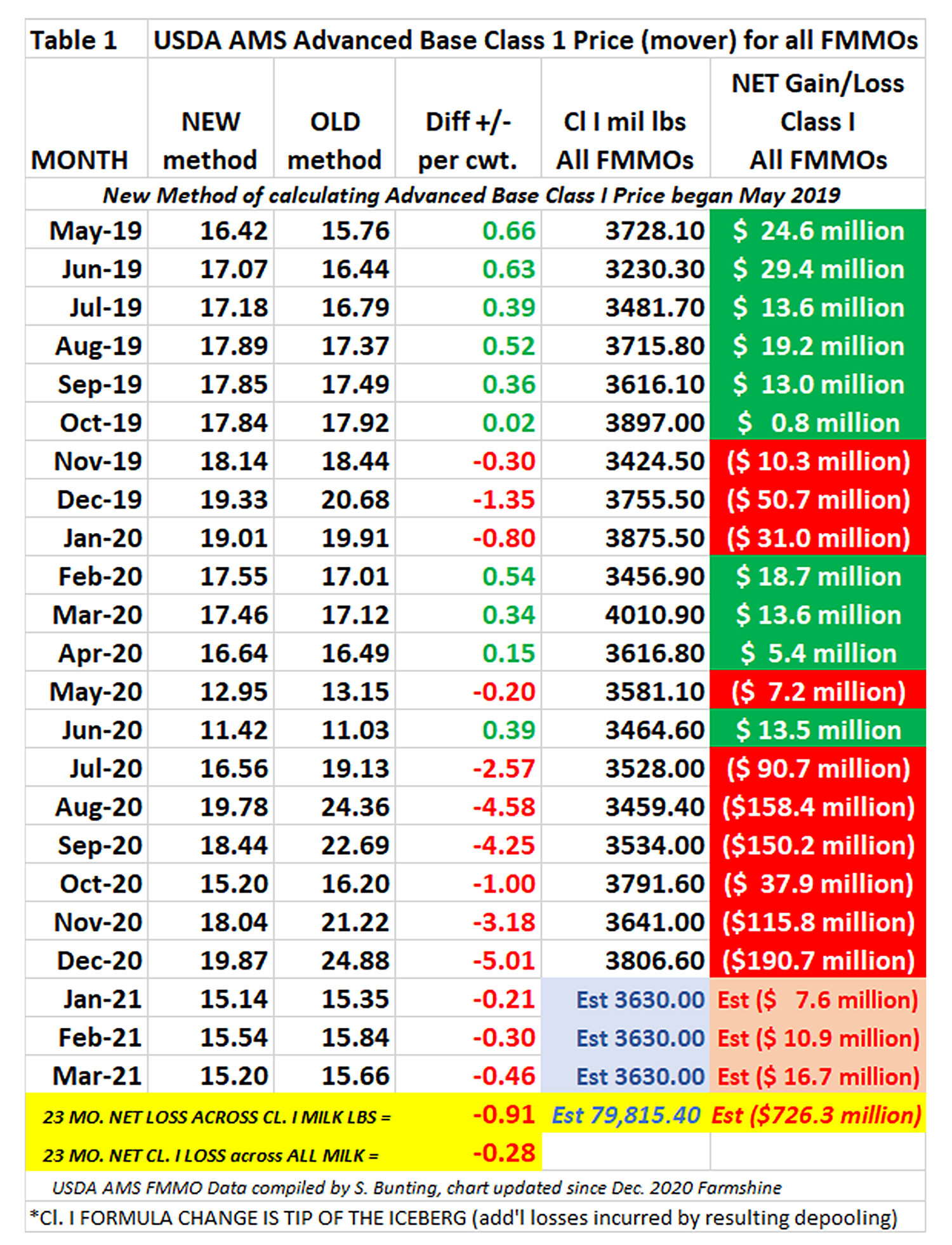
In fact, similar losses were sustained in other Federal Orders as well. Table 1 shows how the Class I change, alone, affected Class I price over the past 23 months, for a net loss of 86 cents per hundredweight on all Class I milk pounds nationwide.
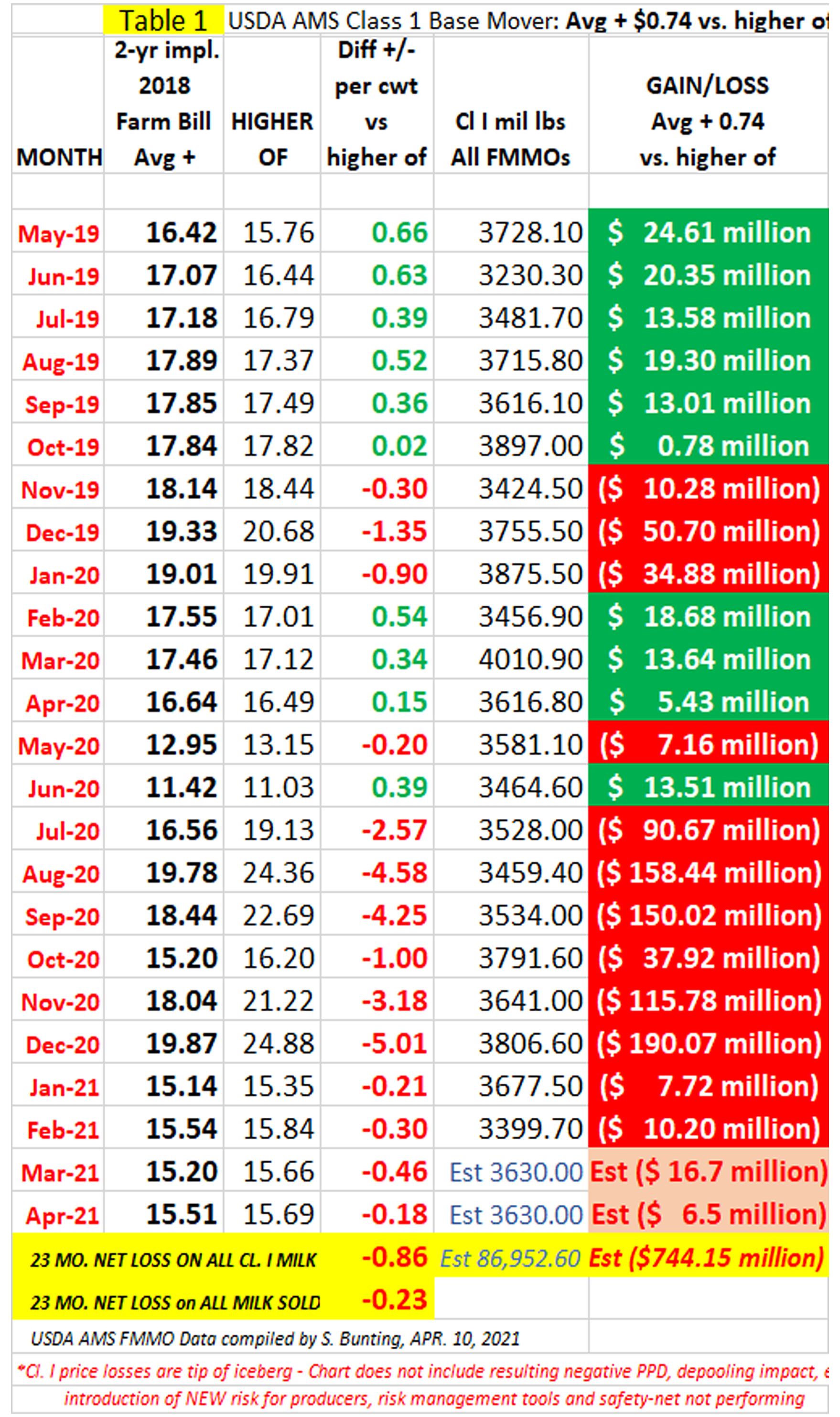
Difference in Class I ‘mover’ under old vetted and new unvetted Class I pricing method, gain/loss per hundredweight and total x volume of Class I milk (before PPDs, depooling impact added).

In fact, similar losses were sustained in other Federal Orders as well. Table 1 shows how the Class I change, alone, affected Class I price May 2019 through April 2021, for a net loss of 86 cents per hundredweight on all Class I milk pounds nationwide.

At 28% utilization, this translates to 23 cents per hundredweight across all milk pounds before depooling is factored in. Results vary between FMMOs depending on utilization and depooling. Either way, this net loss means the months where the new method provided any positive impact on the blend price were weighed against the many months where the impact was negative.

Covington and others point to the government cheese purchases as a primary reason for the “big divergence” between Class III and IV. He figures the government purchases during the pandemic represented the equivalent of 1.65% of all milk production in the U.S., and 70% of it, he says, was cheese.

When the divergence in Class III and IV advance pricing factors is larger than $1.48, the impact becomes progressively more negative on the Class I base price, or ‘mover,’ which then impacts the blend price. In the seven multiple component pricing Orders, this contributes to negative PPDs (producer price differentials) by lowering the blend price relative to Class III. If Class IV is already that much lower than Class III, and now the new Class I method averages-in that lower Class IV value, the Uniform Price (blend) minus Class III price becomes a negative number.
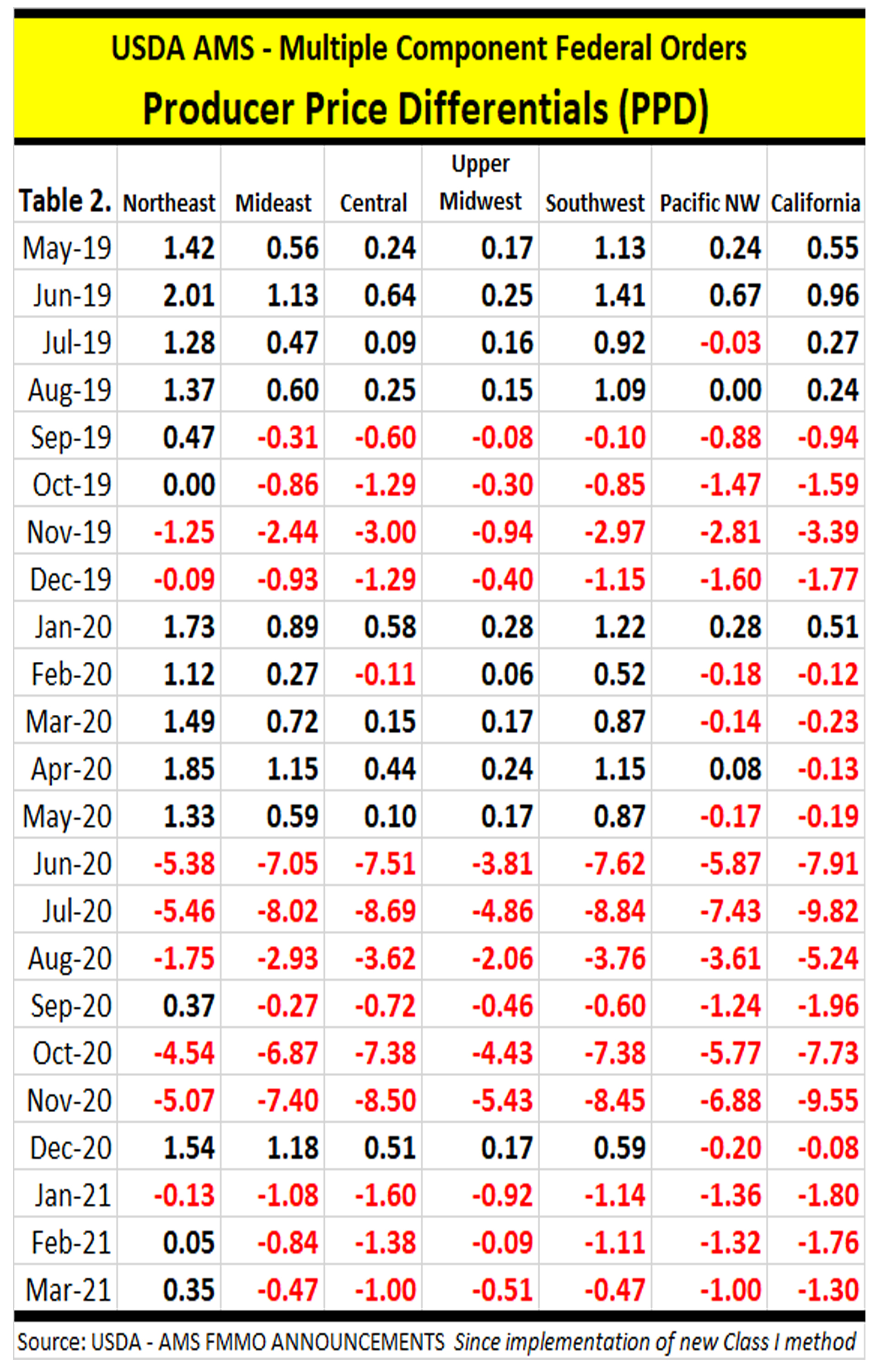
Table 2 shows the producer price differentials (PPD) for all 7 multiple component pricing Federal Orders during the 2-year implementation of the new “averaging” Class I pricing method from May 2019 to March 2021. PPD values are normally positive. According to the Northeast Market Administrator: “When the total
value of producer components exceeds the pool’s classified value, the result is a negative PPD since money out of the pool at producer component values plus the PPD must equal money in the pool’s classified value (pool revenue).

When we have basically 10 months of consecutive negative relationships, then Class III handlers have an easy decision: depool the milk to keep that higher price. Class III handlers are accustomed to receiving a check from the FMMO pool. They voluntarily participate in FMMOs to share in the Class I differential. But writing a check to the pool when Class III is higher? That’s a different story.

So, if Class IV represents largely exported, or clearing, product of nonfat dry milk on the skim side of the Class I averaging equation under this new averaging method, why not just make the Class III advance pricing factor the base skim price for the ‘mover’ formula?
“We’ve got to remember that we have had it the other way around, though not this extreme,” says Covington. (continued)

“In the last half of 2013 and into 2014, we had Class IV higher than Class III.”

Covington makes this observation: “With the kind of volatility we are in now… Exports can be going up or down, who knows. There is the possibility this could happen again (IV over III), and also the possibility if the bottom falls out on the powder exports while cheese is strong (III over IV).”

Either way you flip the what-ifs and wherefores, the point is clear: The USDA AMS Dairy Division vetted the ‘higher of’ to be the way to help assure the Federal Orders function for their primary intended purpose: 1) assuring an adequate supply of milk for Class I fluid use, and 2) orderly marketing.

“I am stubborn on the issue. I admit that right up front,” says Covington. “There is a reason we have the higher of. The Dairy Division did a real good job of explaining this (in 2000). The purpose of the Federal Orders is to get milk to fluid use to make sure consumers have an adequate supply. The ‘higher of’ accomplishes that. Now we are getting away from the purpose.”

So, things have changed, right? People are drinking less milk and eating more cheese than in 2000 when major FMMO reform last took place. That matters if all we are looking at is the revenue sharing function of the Federal Orders — the pouring of revenue from the Class I glass into the receipts of Class II, III and IV handlers.

Covington takes a deeper view into the more basic purpose of the Federal Orders that vets these things in hearings, usually, to play out the scenarios.

“Any time there’s less incentive to move milk to fluid use — and that happens when Class III price gets closer to the blend or Class I price, or like last year Class III was higher than the blend or Class I price — why should the milk move if it is going to receive less money?” he explains. “Likewise, if processors need that milk and go into an area of Class III, they pay a larger give-up number to get that milk (to Class I).”

In short, says Covington, the new ‘average + 74 cents’ method for determining the advance base skim price for the Class I mover “presents the opportunity for this to happen.” In other words, it presents the opportunity for the Federal Orders to become dysfunctional and not fulfill their identified purpose.

Going back to the 2000 decision during Federal Order Reform, the USDA AMS Dairy Division, in their own words, explained why the ‘higher of’ would be used.

Citing this about the situation in 1995-98, the AMS decision stated: “Recent increased volatility in the manufactured product markets has resulted in more instances in which the effective Class I differential has been negative, especially in markets with low minimum Class I differentials. In the past when price inversions have occurred, the industry has contended with them by taking a loss on the milk that had to be pooled because of commitments to the Class I market, and by choosing not to pool large volumes of milk that normally would have been associated with Federal milk order pools. When the effective Class I differential is negative, it places fluid milk processors and dairy farmers or cooperatives who service the Class I market at a competitive disadvantage relative to those who service the manufacturing milk market. Milk used in Class I in Federal order markets must be pooled, but milk for manufacturing is pooled voluntarily and will not be pooled if the returns from manufacturing exceed the blend price of the marketwide pool.”

The USDA AMS vetted decision in 2000 goes on to explain how the situation then was “inequitable … where milk for manufacturing is pooled only when associating it with a marketwide pool increases returns.”

AMS Dairy Division also wrote in the 2000 decision about how the class price inversions were made worse (1995-98) by depooling and cited the tens of billions of pounds of milk involved. The 2000 decision to use the ‘higher of’ was explained in a way that holds relevance for the 2019-21 situation.

USDA AMS stated in 2000: “Because handlers compete for the same milk for different uses, Class I prices should exceed Class III and Class IV prices to assure an adequate supply of milk for fluid use. Federal milk orders traditionally have viewed fluid use as having a higher value than manufacturing use. (This) Class I price mover reflects this philosophy by using the higher of the Class III or Class IV price for computing the Class I price. In some markets the use of a simple or even weighted average of the various manufacturing values may inhibit the ability of Class I handlers to procure milk supplies in competition with those plants that make the higher-valued of the manufactured products. Use of the higher of the Class III or Class IV price will make it more difficult to draw milk away from Class I uses for manufacturing.”

In essence, the new Class I pricing method has shown over the past 23 months that not only is the potential there for FMMOs to be in disarray, there is proof that it is happening.

Covington and others point to the hearing process — the normal vetting process for proposed FMMO changes. In this current situation, Congress made the decision to do what NMPF and IDFA asked, without hearings. Dairy farmers did not have a seat at the table. There was little industry discussion, and other organizations were assured that producers would be “held harmless” because the history showed the new method would be “revenue neutral.”

It became law without vetting, hearing, or comment, and has not been revenue neutral.

Covington is among those who strongly favor the hearing process and was concerned in 2018 that it was not being used to vet this Class I pricing method change.

“IThe administrative hearing avenue lets everyone have a seat at the table, to hear every side, put forth every possibility,” he says. “But this wasn’t done. It went through Congress. It was done quick. A hearing process gives time to study the outcome of a proposal. The things we are talking about now would have come out, and people would have said, ‘oh, we better think twice.’”

Not getting as much attention is what this change has done to risk management tools purchased by dairy farmers, which extension educators, consultants, government, everyone, have been urging producers to adopt.

The irony is that the change from ‘higher of’ to ‘average + 74 cents’ was done because NMPF and IDFA convinced Congress it was necessary so that milk buyers could manage their risk through forward contracting and hedging on the futures markets. But the result for dairy farmers — milk producers — is that their risk management has had a huge monkey wrench thrown into it and no good tools to address a new kind of risk in their blend price equation.

“Look what it did to risk management for dairy farmers,” Covington observes. “There is basically 25% of the milk sold in Class I. That’s 47 billion pounds last year. How much of that even participates in risk management? Is it 1%, 5%, 10%? My guess is a small amount. We need to look at the cost vs. benefit. Maybe some used it, but look at what it has done to dairy farmers and the incentive to move milk to Class I. What’s the trade-off?

“How many things are done to look at one small segment at risk of everyone else?” he asks. “It lowered the Class I price. That’s obvious. How much of that was passed on through at retail? When we look at retail, we get the highest retail milk price in Kansas City and the lowest in Wichita, and they are both in the same Federal Order. So, you can’t make rhyme or reason to it.”

Talking through some of the elements of how Class I sales to retail work, with most milk being sold private label, Covington’s involvement and experience is valued.

“It seems like the industry loses focus. We look at the newest thing out there, or the newest group, and forget about the majority. Most of the milk sold in this country is white milk in gallon jugs sold private label,” he observes.

Covington suggests that future Federal Order reform will come, and that even though the methodology of end-product pricing is sound, some of the factors going into it are at a point where evaluation is beneficial.

He weighs the difference between whether changes in Federal Orders are made through an administrative hearing process or through Congress, or a combination of the two, and suggests that the hearing process be included because it is how proposals are vetted.

“A good example is what is happening right now where the issue was not thoroughly heard and analyzed, and it happened so fast,” Covington relates. “How many people in Congress really knew what they did? If it can happen with something like this, what else can it happen to?” -30-

Market Moos – Apr. 7, 2021

By Sherry Bunting, republished from Farmshine, April 9, 2021

Class III futures gain big,
Cl. IV modest, spread widens

CME Class III and IV milk futures made a strong turnaround last week and continued to rally higher this week — especially on the Class III where $19s returned to the board for May through August and new contract highs were set all the way across the board.

The big gains on Class III vs. smaller gains on Class IV widened the Class III / IV spread that is currently averaged to determine the Class I base price, which affects PPDs and de-pooling.

The spread between the 12-month averages expanded to $1.75 over the next 12 months, with May through September contracts showing the potential for a $2 to $4 spread between Class III and IV.

On Wed., April 7, Class III milk futures for the next 12 months averaged $18.43 — up 32 cents from last week and almost $1.00 higher than two weeks ago. (Additional gains were made through Fri., Apr. 9.)

Class IV milk futures for the next 12 months, on the other hand, averaged $16.68 on Wednesday — up just 8 cents from last week and 75 cents higher than two weeks ago

CME cheese, powder higher,
whey firm, butter melts off early gain

On the spot dairy product markets via the CME this week, cheese had big gains, powder put on a penny, whey stayed firm at last week’s higher levels, and butter advanced early before erasing the advance at midweek to be a fraction of a penny lower than a week ago.

By Wed., April 7, the 40-lb block cheddar price was pegged at $1.80/lb, up 6 cents from a week ago with 4 loads trading; 500-lb barrel cheddar was at $1.58/lb, up a full dime from a week ago with 3 loads changing hands.

Dry whey on the CME spot market remained firm at last week’s advance, pegged at 66 cents/lb again Wed., Apr. 7 with zero loads changing hands.

Butter gained its way to $1.83 by Tuesday before losing almost 2 pennies Wed., April 7 when 9 loads traded, and the CME spot price was pegged at $1.8150/lb — a fraction of a penny lower than the previous Wednesday’s spot butter price.

Nonfat dry milk gained a penny this week. On Wed., April 7, the spot price for Grade A NFDM was pegged at $1.1925/lb with 2 loads changing hands.

March protein question answered

Last week in this column, the March Class and Component prices announced by USDA last Wed., March 31 were reported, and the protein price at $2.6954/lb — down about 30 cents from February — seemed to be a “head-scratcher” given the fact that all end-product prices were higher, and the Class III, IV and II prices also ended up higher.

Reaching out to USDA questioning whether this was correct or a typo, here’s how a USDA source explained the interaction of the fat and skim as a sort of ‘snubber’ or offset for protein vs. fat when butter gains are larger than cheese gains in value in the wholesale market as reflected by by end-product pricing, with fat and skim yields applied. (There’s a story to this phenomena, stay tuned for another edition explaining the how and why this ‘snubber’ came to be.)

Meanwhile, USDA referred me to this formula for the protein price calculation on page 5 of the monthly Class and Components announcement:

Protein Price = ((Cheese Price – 0.2003) x 1.383) + ((((Cheese Price – 0.2003) x 1.572) – Butterfat Price x 0.9) x 1.17).

The USDA source explained in an email as follows:

“The protein price is a function of both the cheese price and the butter price. If you look at page 5 of the report ‘Announcement of Class and Component Prices’ for March 31, 2021, you will find the formula for the protein price. In that formula, you will note the use of both the cheese price, which is the weighted average of both block and barrels, and the butter price. Please note that the use of the butter price has a negative sign, i.e. as the butter price goes up everything else held the same, the protein price goes down. So, while both the cheese price and butter price went up; the increase in the butter price for March compared with the February price was much larger than the (increase for the) cheese price, so the protein price declined.”

The USDA explanation continues:

“The Class III skim milk price is down in March about 60 cents per cwt ($0.0060 per pound) when compared with February, i.e. using the lower protein price of about 30 cents per pound times 3.1 pounds plus a small increase of about 5 cents in the in the other solids price times 5.9 pounds results in the decline of about 60 cents per cwt ($0.0060) for the Class III skim milk price. The Class IV skim milk price in March is about unchanged, up 1 cent per cwt ($0.0001 per pound) as the nonfat dry milk price was up only $0.0005 per pound.

“Both the Class III and Class IV prices are equal to 96.5 pounds of skim milk times the skim milk price for each class plus 3.5 pounds of butter times the same butterfat price. So, with the Class III skim down 60 cents per cwt ($0.0060 per pound) but the butterfat price up $0.28 per pound. The Class III and Class IV prices both increase. The gain in Class IV was $0.99 per cwt while the Class III price was up 40 cents per cwt.”

USDA reports Feb. All Milk price at $17.10, DMC margin $6.22

February’s All Milk price was announced last week at $17.10 and based on an national average butterfat of 4.10%. This was 40 cents lower than the January All Milk price at the same time that feed costs went higher.

The combined result was a Dairy Margin Coverage (DMC) margin for February announced this week at $6.22/cwt, the lowest since April and May 2020 when at the height of the Coronavirus pandemic shut down, the DMC margin was calculated at $6.03 and $5.37, respectively.

Letter signed by producers, groups, seeking remedy for failed Cl. I formula makes its way to NMPF / IDFA

On Federal Milk Market Order pricing — namely the failed change in how the base Class I price is formulated — National Milk Producers Federation (NMPF) and International Dairy Foods Association (IDFA) are at the table, according to U.S. House Ag Committee Ranking Member G.T. Thompson.

Sources indicate they are discussing various proposals and approaches. Meanwhile grassroots organizations representing dairy producers are continuing their almost weekly group conference calls and seeking a seat at that table.

Farmshine readers are aware that dairy producers from across the U.S., along with many state dairy associations and the American Dairy Coalition, came together in early March to compose a letter to NMPF and IDFA, addressing the impact of massive depooling in relation to large negative PPDs for dairy farmers across the U.S.

The letter specifically identifies the change in how the Class I base price is calculated, which NMPF and IDFA put forward, Congress passed in the 2018 Farm Bill, and USDA implemented in May 2019. The letter, signed by hundreds of producers and many producer organizations, will be officially sent to NMPF and IDFA by the end of this week (April 9), according to the ADC.

Specifically, the Farm Bill language states that the Class III / IV averaging method + 74 cents – instead of the previous “higher of” method – was to be implemented in 2-year periods. This suggests we are now at the point in time where something can be done to adjust this formula before the next 2-year period of implementation begins.

Meanwhile, dairy economists are being featured in webinars, zoom conferences and other venues to explain and ‘educate’ producers on PPDs, what impacts them, and how other aspects of Federal Milk Marketing Order pricing formulas, rules and provisions all work. All of it has become a hot topic since the new Class I formula implemented May 2019 leaves in its wake over $700 million in NET losses on Class I value, alone over 23 months, and upwards of $3 billion when negative PPDs and depooling are factored in.

While the change assisted in the idea of risk management for milk buyers, it has introduced significant and costly basis risk for milk producers, interfering with producer risk management tools, and has led to staggering net value losses by most dairy producers over 23 months since implementation, also undermining the purpose of the FMMOs with regard to the orderly marketing to assure milk moves to Class I fluid milk use.

Education is good. Solutions are better. Remember, the selling point to Congress for making the Class I formula change from ‘higher of’ to average + 74 cents in the 2018 Farm Bill was that dairy producers would be “held harmless”… Instead, they are being robbed. Stay tuned.

-30-

Transformative words, policies, what will they mean for farms, families?

By Sherry Bunting, Farmshine, April 9, 2021 (expanded)

Resilience and Equity are the two words of the year when it comes to almost every legislative policy discussion and presidential executive order, and filtering down through the briefings given to members of organizations by those who represent them, walking the halls of Congress.

Great words. Great ideals. But a little thin on definition.

That’s par for the course on many of the terms used in the USDA press release announcing the newly-named programs under USDA from stimulus legislation — Pandemic Assistance for Producers (PAP) — as well as details on the held funds for 2020’s CFAP 2.

It is difficult to make sense of much of the language in the press release because of terms thrown about and not defined. “Cooperative agreements” are mentioned as the way to grant nonprofits (yes, DMI would qualify), funds to help “support producer participation” in the assistance being offered. Broadened assistance for ‘socially-disadvantaged’ producers is mentioned, but no definition is given.

What will be attached in this approach within the context of transforming agriculture and food under the auspices of climate action, given the administration’s 30 x 30 plan, widely referred to as a “land grab”?

The 30 x 30 plan is part of a climate action executive order signed by the President within hours of inauguration. It aims to protect 30% of U.S. lands and oceans by 2030.

Specifically, Section 216 of the executive order states:

Sec. 216.  Conserving Our Nation’s Lands and Waters.  (a)  The Secretary of the Interior, in consultation with the Secretary of Agriculture, the Secretary of Commerce, the Chair of the Council on Environmental Quality, and the heads of other relevant agencies, shall submit a report to the Task Force within 90 days of the date of this order recommending steps that the United States should take, working with State, local, Tribal, and territorial governments, agricultural and forest landowners, fishermen, and other key stakeholders, to achieve the goal of conserving at least 30 percent of our lands and waters by 2030.

The Lincoln Sentinel in Nebraska reports that meetings are taking place in April in the western U.S. to explain to landowners what 30 x 30 entails.

According to the U.S. Geological Survey, currently the U.S. protects 12% of its land. “To reach the 30 x 30 goal, an additional area twice the size of Texas, more than 440 million acres, will need to be conserved within the next 10 years,” the Lincoln Sentinel reported this week.

A bill in the U.S. House would create new “wilderness” declarations, land that will not be managed or accessed — including a complete ban and removal of all agricultural use from these “conserved” land areas taken to meet the 30 x 30 goal.

A push is happening in Washington to incorporate 30×30 ‘land grab’ principles into the massive infrastructure bill and in the COVID-19 relief stimulus package that was passed.

The slippery slope toward larger and hotter wildfires and against private property and generations-old land use rights has begun. And the Nature Conservancy, already a large land owner / controller, is already looking ahead to the 2023 Farm Bill to include certain conservation provisions in the final product. They also look to the National Defense Authorization Act to include public land designations.

Tom Vilsack — whom President Joe Biden stated upon nomination to the post of Agriculture Secretary — helped develop the Biden rural plan for rural America and now has the job of implementing it, is on record pledging to use every opportunity within existing and new USDA programs to meet transformative sustainability goals.

This is all aligned and consistent with the Great Reset. Farmshine readers may recall several articles over the past year pointing out the ‘land grab’ goals of World Economic Forum’s Great Reset and with the United Nations’ sustainable development goals (SDGs) ahead of this summer’s UN Food System Transformation Summit. The UN documents use the same “resilience” and “equity” buzz words without much definition.

Remember the awkward moment at a Biden town hall meeting in Pennsylvania during the presidential campaign when a potato farmer and Farm Bureau member asked about his positions on environmental regulation, such as the Obama-era Waters of the U.S. (WOTUS) implementation.

Then candidate Biden’s telling response described “the transition”:

“We should provide for your ability to make a lot more money, as farmers, by dealing with you being able to put land in land banks and you get paid to do that to provide for more open space, and to provide for the ability of you to be able to be in a position so that we are going to pay you for planting certain crops that in fact absorb carbon from the air,” he said, also referencing manure and setting up industries in communities to pelletize it.

“That’s how you can continue to farm without worrying about if you are polluting and be in a position to make money by what you do in the transition,” then candidate Biden said.

Though Biden stated at that time that his climate policy was not the Green New Deal, the overlaps in language were hard to deny. The Green New Deal included such references to “land banks”, described as government purchasing land from “retiring farmers” and making it available “affordably to new farmers and cooperatives that pledge certain sustainability practices.” (The short way of saying the answer he gave above).

The $2.2 trillion infrastructure plan includes land use and protection provisions as well as the STEP Act to help pay for it. That’s a proposal to raise estate and capital gains taxes to begin taxing asset transfers between generations during the estate-planning ‘gifting’ process and lowering the amount exempted on land and assets of estates transferred before and after death. This could have a big impact on how the next generation in the farm business pays the taxes to continue farming.

As one producer put it in a conversation, the plan is tantamount to selling one-fourth or more of a farm in order to pay the ‘transfer tax.’ (But, of course, the government then has the perfect setup to come in and pay the farmer to land-bank it, and then give it to another entity that contractually agrees to grow what the government wants, or to re-wild it.

Think about this, as we reported in October, most of us don’t even know what’s being planned for our futures. Big tech, big finance, big billionaires, big NGO’s, big food, all the biggest global players are planning the Great Reset (complete with land grab and animal product imitation investments) in which globalization is the key, and climate change and ‘sustainability’ — now cleverly linked to pandemic fears — will turn the lock.

The mandatory farmer-funded dairy and beef checkoffs — and their overseer USDA and sustainability partner World Wildlife Fund (WWF) — have been at this global food system transformation table since at least 2008 when DMI’s Innovation Center for U.S. Dairy was formed and Tom Vilsack was starting his first eight years as Ag Secretary before spending four years as a top-paid dairy checkoff executive and is now again serving as Ag Secretary.

So much of the groundwork for this pattern is consistent with the work of DMI and its sustainability partner WWF toward the Net Zero Initiative, and key WEF Great Reset global companies have joined in with funds for NZI piloting.

Perhaps what brings it home for me is reading what National Milk Producers Federation’s lobbiest Paul Bleiberg includes and omits in his piece for Hoards online Monday, where he talks about how fast things are moving in Washington and how the Biden administration and the 117th Congress are advancing ambitious plans to stimulate the U.S. recovery that, “encompasses key dairy priorities, including agricultural labor reform, climate change, child nutrition, and trade.”

He notes that as Congress and the administration have begun to dive into climate and sustainability, NMPF has outilined a suite of climate policy recommendations. He writes that “primary among (NMPF’s) goals is for Congress to consider modernizing conservation programs and provide new incentives to dairy farmers to build on the significant sustainability work they are already doing.”

For those paying attention to the WEF Great Reset and WWF’s role in food transformation, it is obvious that the anti-fat Dietary Guidelines are a key cog in the food and agriculture transformation wheel.

Bleiberg mentions childhood nutrition as a key dairy priority, but puts all of his emphasis on “urging the Senate Ag Commitee to maintain the flexibility for schools to offer low-fat flavored milk.” No mention is made of expanding flexibility to include the simple choice of whole milk. This, despite citing the DGA Committee’s admission that school-aged children do not meet the recommended intake for dairy.

Giving schoolchildren the opportunity to choose satisfying whole milk would certainly help in this regard, but that choice would interfere with the long-planned food transformation goals of the global elite — the Great Reset.

We all need to be aware of the transformational elements within policy discussion, find out the definitions of terms and nuts and bolts of program changes, be aware of how our youth are being used as change-agents, and be prepared to speak up for farmers, families, and freedom.

-30-

Time is short for short-term fix of failed Class I pricing change

FMMOs in disarray

By Sherry Bunting, Farmshine, April 2, 2021

The efforts continue in hopes of addressing and rectifying the hundreds of millions of dollars in Class I value losses to dairy producers (net) over the last 23 months — due to the new Class I pricing method. But the window for a short-term fix is closing fast.

While the overall problem of severely negative PPDs has multiple reasons and resulted in well over $3 billion in milk payment shortfalls across 11 Federal Milk Marketing Orders (FMMOs), the loss attributed solely to the change in Class I pricing method is pegged at $732.8 million, NET, from May 2019 through April 2021, and looks to continue through most of 2021.

That is, unless a change is made – quickly – before the May Class I price is announced in a few weeks.

Farmshine readers are aware that dairy producers from across the U.S., along with many state dairy associations and the American Dairy Coalition, came together in early March to compose a letter to NMPF and IDFA, addressing the impact of massive depooling in relation to large negative PPDs for dairy farmers across the U.S. The letter specifically identifies the change in how the Class I base price is calculated, which NMPF and IDFA put forward, Congress passed in the 2018 Farm Bill, and USDA implemented in May 2019.

Specifically, the Farm Bill language states that the new Class III / IV averaging method + 74 cents – instead of the previous “higher of” method – was to be implemented in 2-year periods. This suggests we are now at the point in time where it can be amended to tweak the formula before the next 2-year period of implementation begins.

Recall that this change was legislated without hearings, was implemented without a regulatory comment period, and was put through with very little discussion under the auspices of giving processors a way to “manage risk” even as the result has grossly interfered with producer risk management tools.

Considering that this policy has been a complete failure under the stress test of a major event, Congress and USDA should be on notice to fix it before the next 2-year period commences. But time is short.

Producers — through this letter and other efforts — are asking NMPF and IDFA to put their proposals on the table officially for how to remedy this failed change before the next 2-year implementation period begins in just a few weeks.

Discussions among producers and organizations have ensued for weeks now — talking about averaging vs. higher of. In fact, those with greatest firsthand knowledge of the purpose and workings of FMMOs state that the higher of method fulfilled the lawful purpose of the FMMOs, the averaging method does not.

Put simply, the FMMOs are in disarray during this time of market stress that pushed Class III and IV widely apart. A $2 to $10 spread between Class III and IV – along with the new “averaging” method for Class I – have together disrupted the function and purpose of the FMMOs.

NMPF and IDFA told the U.S. Congress that producers would be “held harmless” by the change when it passed in the 2018 Farm Bill. But, in fact, producers have lost hundreds of millions, if not billions, of dollars in value out of their milk checks over 23 months. The averaging method was never “stress-tested.”

NMPF leaders have reportedly referenced the idea of adding $1.63 to the simple average, instead of 74 cents, but this reporter has not seen the proposal put forward as an official ‘ask’ of the USDA Secretary to be part of the next 2-year implementation that begins shortly. Probably NMPF and IDFA will have to agree on this as the Class I pricing change was their agreement in the first place at the time it was passed in the 2018 Farm Bill.

Dairy producers cannot afford to see the drive for a solution stall out until the next Farm Bill. They cannot afford to roll into the next 2-year implementation using the current average + 74 cents formula. Meanwhile, dairy farmers can contact their milk buyers or cooperatives and ask their leaders to encourage NMPF and IDFA leadership to bring the discussion forward for implementation of a short-term solution beginning with the May 2021 Class I price. If this doesn’t happen, producers will be stuck with a failed pricing policy for at least two more years.

A feature in the March 5 edition of Farmshine discussed the letter, the background, and included a copy of the letter, itself.

The deadline for dairy producers and/or their state, regional and national organizations to sign has been extended again until Mon., April 5, 2021. Visit this link to view and sign electronically through the automated short form.

In the letter, dairy producers ask NMPF and IDFA to work with them for a solution that is a fairer distribution of dairy dollars in the long term, but also want to support a short-term fix, now.

Time is running out for this to happen. Dairy farmers do not have two to three more years to wait for the 2023 Farm Bill as the formula losses add financial burden to their already distressed economic situation. They can’t afford to lose hundreds of millions, if not billions, over the next two years as has been their net loss over the past two years. Look for an update next week.

Check out this primer on understanding milk prices basics and PPD.

Hot topic: Understanding milk pricing basics and PPD

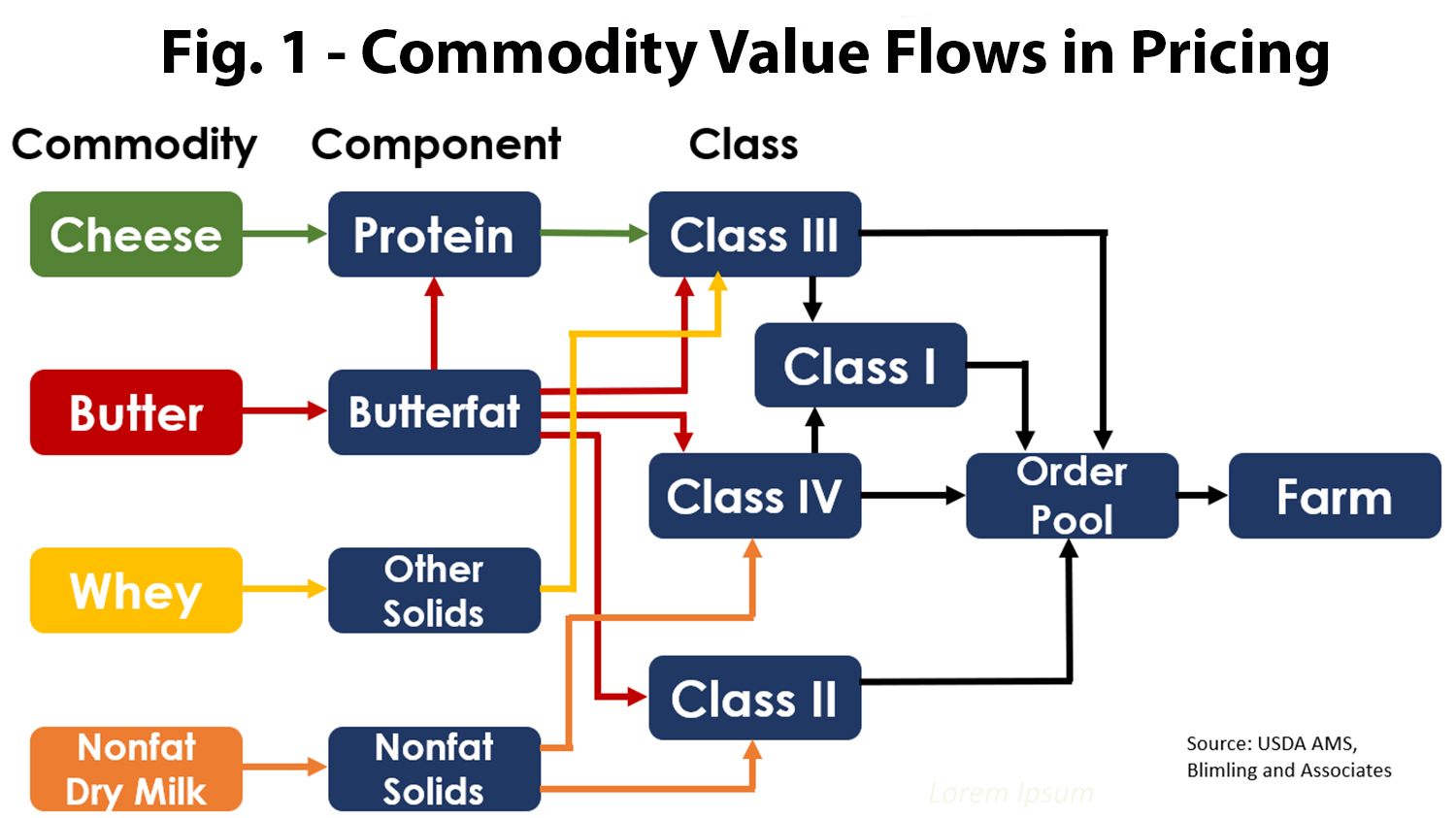
Gratitude to Blimling and Associates for this flow chart illustrating the complexity of USDA milk pricing

By Sherry Bunting, Farmshine, March 26, 2021

I challenge anyone to find a pricing system on anything in the universe as complicated as the pricing of a hundred pounds of milk (See Fig. 1).

The Federal Milk Marketing Order (FMMO) system goes back to the 1930s Ag Marketing Law.  In 2000, changes were made to use end-product pricing formulas for four base commodities – Cheese (block and barrel Cheddar average), Butter, Nonfat dry milk (NDFM) and Dry Whey.

Today, these four commodities trade daily on the spot cash market at the Chicago Mercantile Exchange (CME), where less than 1% of volume, closer to 2% on butter, is sold. Since 2018, this 10-minute daily spot auction is done completely as an electronic auction.

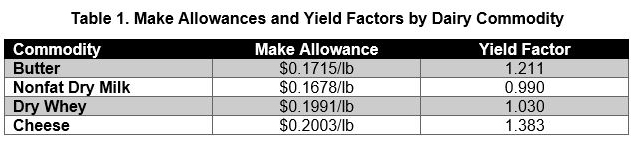
The CME spot market sets the pace for actual sales reported weekly to USDA by around 100 processors. From these weekly-reported prices, a weighted average for each of the four commodities is calculated by USDA. The weighted averages are used in formulas that account for yield and deduct specific “make allowances” (See Table 1) to then calculate Class and Component prices.

But first, these weighted price averages for just the first two weeks of each month are plugged into a multi-step formula to determine an Advanced Skim Pricing Factor for Class III (cheese/whey) and Class IV (butter, NFDM). The adjusted butter price is also used to calculate the Advanced Butterfat Pricing Factor.

Effective May 2019 — as a result of a change agreed to by National Milk Producers Federation and International Dairy Foods Association and then passed by Congress in the 2018 Farm Bill — the 2-week Class III and IV Advanced Skim Pricing Factors are averaged together, plus 74 cents to calculate the Base Skim Price.

Prior to May 2019, the Base Skim Price was simply the “higher of” either the Class III or the Class IV Advanced Skim Pricing Factor.

(Author’s Note #1: The previous ‘higher of’ method was the way the FMMOs could make sure Class I always brought the highest price to fulfill the purpose of the Federal Orders – assuring fresh milk supplies – and to keep other handlers invested in pooling their milk. We can’t lose sight of the fact that the fluid milk sales (Class I) have no market transparency as to their value – at all. In some states there are loss-leader laws or minimum pricing provisions, but in most states, Class I fluid milk sales are treated as a base commodity by large retailers like Walmart and Kroger. They loss-lead the retail consumer price of fluid milk to extreme low levels, even as low as $1 per gallon, to win shoppers. They do this because supermarket data show fresh fluid milk is in over 94% of consumer shopping carts! Because it is treated as a loss-leader in some states, and regulated with minimum pricing in other states, it’s impossible to know the real market value of Class I fluid milk apart from the value of its components in making other products.)

Next, the Base Skim Price is multiplied by a yield factor of 0.965 and the Advanced Butterfat Pricing Factor is multiplied by a yield factor of 3.5 and then added together to become the Base Class I Price. This price, known as the Class I ‘mover,’ is announced before the 23rd of each month but is used in the following month.

The various location differentials throughout the 11 FMMOs are next added to this Base Class I Price.

Whew! Now back to those weekly-reported commodity prices, yield factors and make allowances… Announced around the 5th of the next month, the other class prices are a function of the component values based on average weekly prices for the four commodities for four weeks: Component Value = Yield x (Commodity Price – Make Allowance).

In Multiple Component Pricing FMMOs like the Northeast (FMMO 1) and Mideast (FMMO 33), a Statistical Uniform Price (SUP) is calculated from these Class and Component prices according to how the milk in the FMMO was utilized. The SUP is announced around the 11th of the next month before settlement checks are paid for the previous month’s milk.

(Author’s Note#2: Another wrinkle… did you know that an uptrending cheese and butter price can leave producers with a lower protein price? It happened in March 2021. Every end-product — butter, cheddar, nonfat dry milk and dry whey — was higher in March than February, and Class III, IV and II pricing were also higher, but the uptrending butterfat portion of the cheese price creates a ‘snubbing’ effect on the ability of protein to rise within the skim portion. Yes, it’s complicated, and the answer from USDA is a story of its own in the future.)

The FMMO SUPs are based on a 3.5% Butterfat test, but the FMMOs also report for information purposes a uniform price based on the average actual fat test. Your price will differ in your milk check based on your fat, protein, and other factors. In general, producing protein and butterfat above the statistical level nets a higher price, under normal conditions. Lately this has not held out because of negative PPDs.

What are PPDs? Along with the SUP, the FMMO calculates a Producer Price Differential (PPD). This shows how money remaining in the producer settlement fund is divided across the qualified hundredweights of milk, after all components are paid. Sometimes this is a negative number, meaning there was not enough money in the producer settlement fund to pay all of the actual component value after the location differentials on Class I were paid. A negative PPD represents spreading the shortfall across qualified milk in the pool. Severely negative PPDs represent unpaid component value.

The PPD is calculated by subtracting the Class III price from the average of all classes together: PPD = SUP – Class III. In the Northeast and Mideast FMMOs, this PPD has typically been a positive number but has been shrinking in recent years and has been negative for 13 of the past 23 months.

Negative PPDs happen for any or all of four main reasons:

1) When a rapid rise in commodity price(s) is not captured in the 2-week Advanced Pricing Factors.

2) When Class II and IV are far below Class III.

3) When Class I price falls below Class III because of the new averaging method when the spread between III and IV is greater than $1.48/cwt. Half of the months from May 2019 through December 2020 had a lower Class I Base price under the new method, representing a net loss of over $700 million on Class I pounds across all FMMOs. (See Table 2)

4) When handlers de-pool Class III milk because it is higher — to avoid paying into the pool.

Only Class I handlers are required to pool all of their milk. Other handlers can choose what non-Class I milk to pool or not pool based on what is financially advantageous. De-pooling is more likely when multiple months have negative PPDs because of wait times to re-qualify milk for the pool. Some FMMO pool-qualifying requirements are more stringent than others, and the rules have been loosening in recent years because handlers say they need more flexibility to meet fluctuating fluid milk needs.

Occasionally, when cooperatives or plants de-pool Class III milk, some will pass the higher value they withheld from the pool directly to their own producers. In most cases, however, this did not happen in 2020. Additionally, the severity of negative PPDs across FMMOs varied and this created a wide range of milk check pricing of $8 to $10 from top to bottom, when normally this range is $2 to $3, maybe $4. USDA relates that the value is still in the marketplace, so even when the PPD goes negative, some of that value is attributed to the All Milk price used in Dairy Margin Coverage margins because the value is in the market even if it is not in the “pool.”

In addition, for Pennsylvania dairy producers, all Class I milk from Pennsylvania farms that is bottled in Pennsylvania and sold in Pennsylvania stores receives the Pa. Milk Marketing Board (PMMB) over-order premium, which currently stands at $1.00/cwt. Processors can reduce this obligation by selling and sourcing milk from in and out of state as well as other methods.

Cooperatives are producers under the Pennsylvania law, so they collectively receive this premium also, where applicable, and have the ability to disburse the premium to members as they see fit.

Every farm’s mailbox price is further affected by premiums, such as quality bonuses, and deductions, such as trucking cost and marketing fees, which all vary across cooperatives and milk buyers.

This ‘primer’ just scratches the surface of current milk pricing issues. A related topic affecting many producers since May 2019 is how the new Class I pricing method, and the negative PPDs and depooling that can result when Class III and IV are so divergent, affect the way price risk management tools work, creating additional losses in many cases.

(Author’s Note #3: This article has been updated since it was previously published in R&J Dairy Consulting’s customer newsletter.)

-30-

Bipartisan Whole Milk bill introduced in U.S. Congress

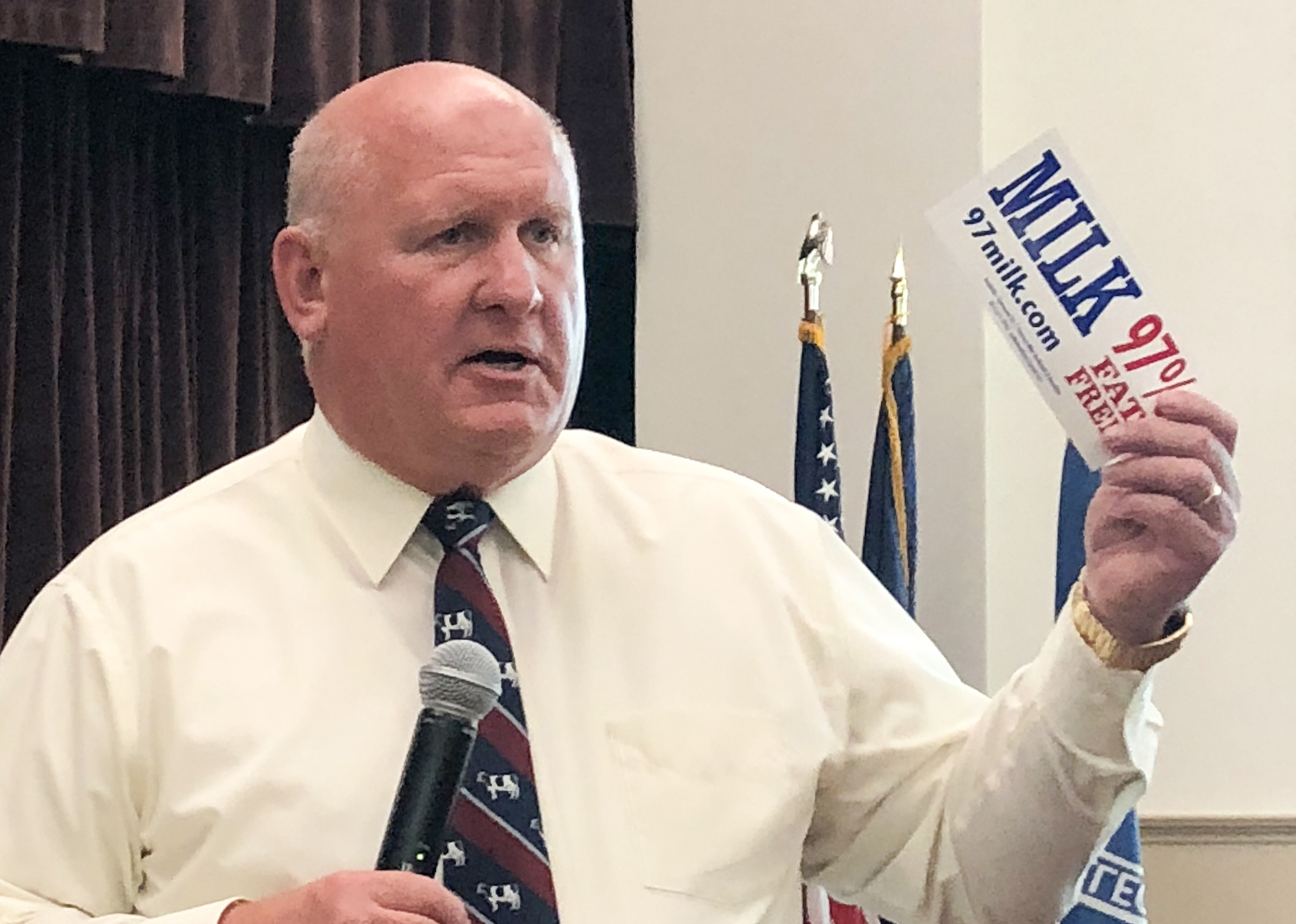
U.S. House Ag Committee ranking member G.T. Thompson (R-Pa.) is pictured here at a listening session in the summer of 2019. At that time, he mentioned the work of the Grassroots Pa. Dairy Advisory Committee and 97 Milk as one of the best things happening in dairy. Last week, he reintroduced his bipartisan Whole Milk for Healthy Kids Act of 2021, H.R. 1861.

Will third time be charm? Will Penna. and N.Y. consider state legislation?

By Sherry Bunting, Farmshine, March 19, 2021

WASHINGTON, D.C. — Congressman Glenn ‘GT’ Thompson (Pa.-15th) wasted no time reintroducing the Whole Milk for Healthy Kids Act in the 117th congressional session. Although the official text of the bill introduced last Thursday, March 11 is not yet available, Thompson noted in February it would include a few structural improvements over the earlier versions.

Thompson is now the Republican Leader of the House Agriculture Committee, and he cosponsored the bipartisan whole milk bill, H.R. 1861 with Congressman Antonio Delgado (NY-19th), a Democrat.

Essentially, the Whole Milk for Healthy Kids Act allows for unflavored and flavored whole milk to be offered in school cafeterias. This choice is currently prohibited under USDA rules of implementation from the 2010 Healthy Hunger Free Kids Act that Congress passed 11 years ago to tie school lunch and other USDA food nutrition services more closely to the low-fat and fat-free stipulations from decades of USDA-HHS Dietary Guidelines. These DGAs continue to ignore the science about milkfat and saturated fat – especially where children are concerned.

“Milk provides nine essential nutrients as well as a great deal of long-term health benefits. Due to the baseless demonization of milk over the years, we’ve lost nearly an entire generation of milk drinkers, and these young people are missing out on the benefits of whole milk,” said Rep. Thompson in a statement last Friday.

“It is my hope the Whole Milk for Healthy Kids Act will give children a wide variety of milk options and bolster milk consumption — a win-win for growing children and America’s dairy farmers,” Rep. Thompson stated.

Rep. Delgado added: “The Whole Milk for Healthy Kids Act will help young people maintain a healthy diet while supporting our upstate dairy farmers and processors. I am proud to lead this bipartisan effort to provide more choices for healthy and nutritious milk in schools. This legislation is good for young people and good for our dairy producers in today’s tough farm economy.”

The Grassroots PA Dairy Advisory Committee and 97 Milk are hoping the third time is the charm for this legislation. Last month, they met virtually last month with Rep. Thompson, and last fall on school milk and other dairy policy concerns. Congressman Thompson has made the Whole Milk for Healthy Kid Act a high priority over the past four years during the past two legislative sessions. Some members of the Grassroots PA Dairy Advisory Committee and 97 Milk have been working on the school milk issue for a decade or more, and on the issues surrounding the flawed DGAs for even longer. 

Arden Tewksbury of Progressive Agriculture Organization has been working on this issue for many years. In addition to dairy advocacy, the retired dairy farmer is also a decades-long school board director in northern Pennsylvania.

Rep. Thompson indicated last month that he would restructure the proposed legislation for reintroduction this session, with some tweaks that should make it more workable for school foodservice directors.

He explains that in 2010, Congress passed the Healthy, Hunger-Free Kids Act, which amended nutrition standards in the School Lunch Program. Among the changes, the law mandated that school lunches and other government-supported feeding programs be tied directly to the DGAs. The USDA at that time promulgated rules requiring flavored milk to be offered only as fat-free, and that unflavored milk could only be fat-free or 1% low-fat milk. 

Schools are audited by USDA for dietary compliance, and their compliance record affects not just their school food reimbursements, but also the educational funds a district receives for federal mandates.

USDA, in 2017, allowed schools to offer 1% low-fat flavored milk. This was a small positive change after statistics showed schools served 232 million fewer half-pints of milk from 2014 to 2016, and school milk was among the most discarded items in school waste studies conducted by USDA and EPA in conjunction with other organizations.

In fact, a Pennsylvania school — working with the Grassroots PA Dairy Advisory Committee and 97 Milk — offered milk at all fat levels to middle and high school students in a 2019-20 school year trial. Their findings showed students chose whole milk 3 to 1 over 1% low-fat milk. During the trial, the school’s milk sales grew by 65% while the volume of discarded milk declined by 95%. This meant more students were choosing to drink milk, and far fewer students were discarding their milk and buying something else.

Tricia Adams, a member of the Grassroots PA Dairy Advisory Committee, sees firsthand the response of children and teens when offered whole milk. “When we have school and community tours at the farm, we offer whole milk. The children call it ‘the good milk!’” said Adams of Hoffman Farms, Potter County, Pa. “We thank Congressman Thompson for his tireless efforts on this issue. As dairy farmers, we work hard to produce high quality, wholesome, nutritious milk, and as parents, we want kids to be able to choose the milk they love so they get the benefits milk has to offer.”

Jackie Behr, of 97 Milk, also sees the support for whole milk through the organization’s social media platforms. “We know how good whole milk is, especially for children,” said Behr. “We see the support in emails, comments and messages from the public. The science shows the benefits of whole milk, and today, more families are choosing whole milk to drink at home. Children should have the right to choose whole milk at school.”

Whole milk choice in schools has been an important signature piece of legislation for Rep. Thompson because of the triple-impact he said he believes it will have on the health of children, the economics of dairy farming and the sustenance of rural communities.

The bill’s predecessor in the 2019-20 legislative session garnered 43 cosponsors in the House.

Starting anew in the 2021-22 congressional session, the bill will need to amass cosponsors in the coming months. A companion bill in the Senate would also be helpful because the school lunch rules come legislatively through the Committee on Education and Labor in the House and through the Committee on Agriculture and Rural Affairs in the Senate.

What’s new this time is that the Johnstown Tribune-Democrat published a feature story Friday about the 2021 Whole Milk for Healthy Kids Act, and the School Nutrition Association made this the top story in their weekly newsletter to school foodservice director members this week. That’s good news.

Additional good news came with the official public support voiced by National Milk Producers Federation (NMPF) and International Dairy Foods Association (IDFA). In a press statement released by Rep. Thompson’s office last Friday, March 12, leaders of both organizations commented.

“The recently updated Dietary Guidelines for Americans reaffirmed dairy’s central role in providing essential nutrients, including those of public health concern. The Dietary Guidelines Advisory Committee found that 79% of 9-13-year-olds don’t meet the recommended intake for dairy,” stated NMPF president and CEO Jim Mulhern. “We commend Representatives Thompson and Delgado for introducing the bipartisan Whole Milk for Healthy Kids Act. Whole milk provides a valuable way for children to obtain dairy’s nutritional benefits as part of a healthy eating pattern. This bill will help provide our children the nutrition they need to lead healthy lives.”

On behalf of IDFA, CEO Michael Dykes DVM thanked the representatives for their leadership on this bill “to allow schools more flexibility in offering the wholesome milk varieties that children and teens enjoy at home. Expanding milk options in schools helps ensure students get the 11 essential nutrients daily that only milk provides, including protein, calcium, vitamin D, vitamin A, niacin, vitamin B12, riboflavin, and potassium,” Dykes said.

A petition organized and promoted by Grassroots PA Dairy Advisory Committee and 97 Milk — in direct support of the earlier versions of this legislation to ‘bring whole milk choice back to schools’ — garnered over 30,000 signatures in 2019-20 – over 24,000 electronically online as well as over 6,000 by mail through Farmshine.

In recent weeks, the online petition has picked up new life as it has been mentioned in hearings and informal conversations with state lawmakers — especially in Pennsylvania and New York — and has been mentioned recently by food, nutrition and agriculture advocates on social media.

The whole milk petition effort has also gathered over 5000 letters of support in addition to the 30,000-plus signatures in 2019-20. These letters and submitted comments, online and by mail, came from school boards, town boards, county commissioners, school nurses, doctors, dieticians, professors, veterinarians, teachers, coaches, athletes, school foodservice directors, parents, students, and citizens at large.

The entire bundle of signatures, comments and letters were previously digitized by the Grassroots PA Dairy Advisory Committee and 97 Milk and uploaded at each public comment opportunity during the 2020-25 Dietary Guidelines process. Petition packets were also provided digitally and in hard copy to key members of Congress as well as the USDA Food Nutrition Services Deputy Undersecretary in fall 2019 and spring 2020.

The Grassroots PA Dairy Advisory Committee and 97 Milk plan to revitalize the petition as an effort to amass even more public support for whole milk choice in schools. Interestingly, this is a difficult undertaking given that the majority of Americans do not even realize — and sometimes disbelieve — that their children and grandchildren currently do not have a choice and are forced to consume fat-free or 1% low-fat milk as their only milk options because whole milk cannot even be offered ‘a la carte’.

During a New York State Senate Ag Committee hearing last month, agricultural law attorney and dairy producer Lorraine Lewandrowski asked New York State Senators to consider state-level legislation to make it legal to offer whole milk in schools as a starting point vs. federal jurisdiction. Her request was met with dumbfounded shock that this was even an issue, and some indication that it was worth taking a look at.

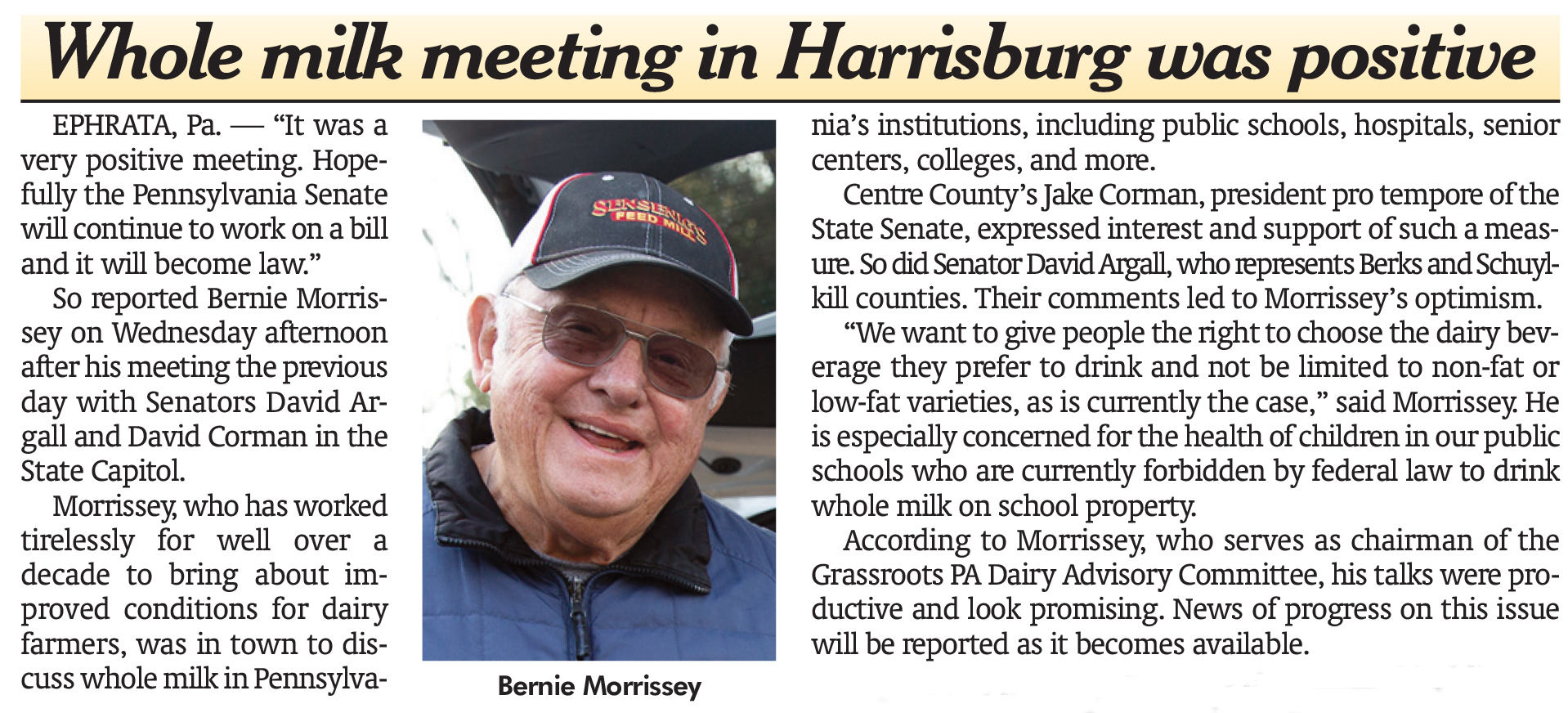
This week, retired agribusinessman Bernie Morrissey — chairman of the Grassroots PA Dairy Advisory Committee — met with leaders in the Pennsylvania State Senate. He reports that state legislation to allow whole milk in schools was a top priority in that discussion.

In fact, Nelson Troutman, originator of the Drink Whole Milk 97% Fat Free painted round bales has urged states to get involved on this issue from the beginning.

“We can’t fix everything at the national level, we have to save Pennsylvania,” said Troutman, a Berks County, Pennsylvania dairy farmer.

The 97 Milk education effort that became a grassroots groundswell after Troutman painted his original round bale initially focused on Pennsylvania. However, the online and social media presence of 97milk.com and @97Milk on facebook since February 2019 has become nationwide, even global, in reach and participation.

For two years, Morrissey has garnered agribusiness support for various banners, yard signs and other tangible signs of support for whole milk in schools. Requests have come in from other states. The 97 Milk group also operates solely on donations and offers several options for showing support at their online store, where purchase requests come in from across the country as well. In addition, farm photos and ideas have come into 97 Milk from producers across the Northeast, Southeast, Midwest and West.

In much the same way, the 30,000-plus petition supporting the choice of whole milk in schools has had heavy participation in Pennsylvania and New York. However, signatures, comments and letters have been received at various levels from all 50 states. (A small portion of signatures even came from Canada, Australia, Mexico, England, Japan, India and the continent of Africa. Those, of course, had to be removed from the packets provided to USDA. However, it is telling that the simple concept of children being able to choose whole milk is a global concern.)

Likewise, Tewksbury with Progressive Agriculture Organization has long supported the right of children to choose whole milk at school. Several petition drives by Pro Ag have also amassed the tangible support of citizens, and those petitions were provided to USDA in previous years — delivered physically in boxes.

In February, Thompson stated that there are members of the House Ag Committee who want to elevate this issue of whole milk choice in schools. Thus, now is the time for organizations to come together and issue strong position statements supporting H.R. 1861 Whole Milk for Healthy Kids Act and for citizens to contact their elected representatives and senators in the U.S. Congress asking for their support of the House bill and in support of a champion to come forward with a companion bill in the Senate.

The ‘bring whole milk choice back to schools’ online petition still references the earlier H.R. 832 and S. 1810 bills, and will be updated when official links to the reintroduced bill text for H.R.1861 become available.

Stay tuned for updates, and for those who have not previously signed this petition, go to https://www.change.org/p/bring-whole-milk-back-to-schools 

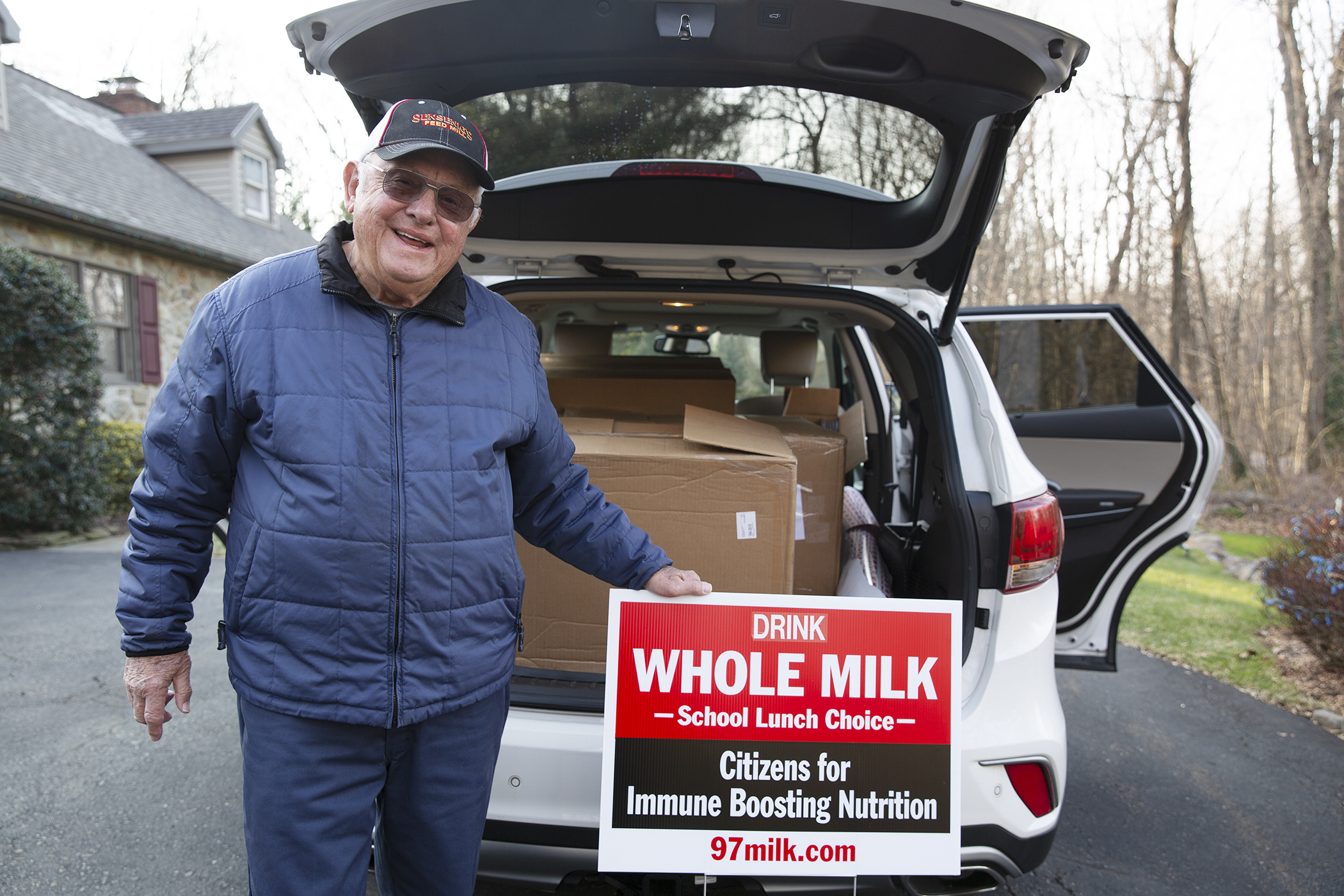
Bernie Morrissey continues working with producers and agribusinesses to print and distribute these yard signs of support for Whole Milk as a school lunch choice. To read more about the sign efforts taking root across PA with calls coming in from other states… click here.

Change is needed, declares Rep. G.T. Thompson

Decline of Pennsylvania’s dairy industry noted

By Sherry Bunting, Farmshine, February 19, 2021

EAST EARL, Pa. – “We cannot continue to do what we are doing from a dairy pricing perspective and expect better results,” said Rep. G.T. Thompson (R-Pa.), named ranking member of the U.S. House Agriculture Committee in December. 

Known as an advocate for dairy farmers, Thompson cited the decline in dairy farms and Pennsylvania’s position in rankings, noting that in 2009, when he was first elected to serve central and northern Pennsylvania in the U.S. Congress, Pennsylvania ranked 5th in the nation for dairy production with 545,000 cows. 

A decade later, at the end of 2020, Pennsylvania slipped to eighth in production and has lost 67,000 cows since 2009. USDA reported 478,000 milk cows in the Keystone State at the end of last year with production in Michigan, Texas and now Minnesota leapfrogging Pennsylvania over the past decade.

In 2019, alone, Thompson took note of the 370 dairy farms that exited in Pennsylvania, with a huge impact on rural communities. He also observed the more than 10% loss in cows and production over 10 years during a telephone conference with members of the Grassroots Pa. Dairy Advisory Committee and 97 Milk, whom he thanked for all of their hard work on dairy issues.

He stressed that the decade of decline in Pennsylvania underscores how important it is to address the loss of milk check value at the farm level.

“Everyone in the dairy supply chain clearly can’t do what has always been done and expect different results,” he said, adding that a change is needed to benefit dairy farmers and that “the rest of the supply chain will have to adjust. We can’t sustain these decade long trends without further disruption. We have seen the impact already.”

Thompson said his dairy pricing initiative is straight forward, to look for “actionable measures that allow hardworking dairy farmers to earn a respectful living. Doing that will stabilize the economic circumstances so the other parts of the supply chain will adapt. If dairy farmers keep going down, we lose our industry, so serious steps must be taken toward economic stability.”

He talked about working as Ag ranking member to have Federal Milk Marketing Order pricing hearings, and he noted that the next Farm Bill offers an opportunity to modernize milk pricing, but it will take industrywide consensus, he said.

To get even a short-term fix for the losses due to negative PPDs before the next Farm Bill will be tough and will require action and agreement by NMPF and IDFA.

“Our best hope in the short term is to get the milk classes back into alignment (in regard to PPD), and work on building consensus for long term resiliency heading into the next Farm Bill,” said Thompson.

As for school milk, Thompson said he planned to restructure his whole milk for healthy kids legislation for reintroduction this session, with some tweaks that make it more workable for schools.

This is an important signature piece of legislation for Thompson because of the triple-impact he believes it will have on the health of children, the economics of dairy farming and the sustenance of rural communities.

Since the Senate ag committee has jurisdiction in school meals, where in the House, the jurisdiction lies with the education and labor committee, Thompson said he has already discussed the measure with the Republican leader in the Senate Ag Committee, Sen. John Boozman of Arkansas.

Thompson also believes there are members of the House Ag Committee who want to elevate this issue, which could include congressional hearings on the Dietary Guidelines. He said that process would start out with briefings to returning and incoming members about the DGAs so they have background on the issue.

With former Ag Secretary Tom Vilsack picked to return to the USDA post in the Biden administration, Thompson said he will be weighing in with Vilsack to encourage maintaining the 1% flavored milk waivers and about further school milk reform. He said he is hopeful about Vilsack’s support for a whole milk measure.

Thompson noted that reforms to milk offerings in schools could also come from the Senate side if Ag Committee Chairwoman Debbie Stabenow opens the door with childhood nutrition reauthorization, but that, “Nothing will move out of the Senate that is not strongly bipartisan, so spending time on the Senate side building bipartisan support will be important,” he said.

While incoming House Ag Committee chairman David Scott (D-Ga.) has priorities and a history of bipartisan action, dairy is not among his biggest focal points, which leaves room for Thompson, as ranking member, to advance dairy as his priority working with the chairman.

Bottom line, the Grassroots Pa. Dairy Advisory Committee will be working to help build consensus for milk pricing reform, and many of the Farm Bureau ideas look promising. The challenge will be getting NMPF and IDFA to come together around shared priorities to benefit dairy farmers in the pricing system, but that effort has begun.

One thing is clear, the House Ag ranking member G.T. Thompson sees the farmer’s position in the current pricing equation as inadequate.

-30-

NY Senate Ag hearing: Ag law attorney (and farmer) shares her concerns for family dairy farms

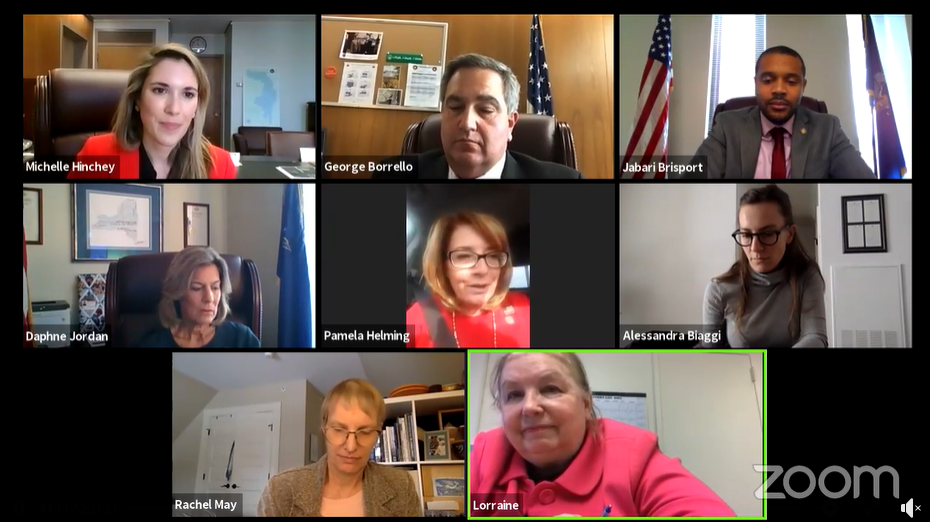
Session 2 of the February New York Senate Ag Committee listening tour via zoom found Lorraine Lewandrowski sharing her concerns for family farms and face-to-face, virtually, with Senator Jabari Brisport, who sits on the Ag Committee. “Rural New York has been viciously neglected,” she said. “Senator, I heard your words as you led a rally in New York City calling for New York’s dairy farms to die. Your exact words: ‘Let dairy die the death it needs to die’… I will not forget your cruel words directed to the working farmers of this state whom I know and love.”

By Sherry Bunting, Farmshine, March 12, 2021

ALBANY, N.Y. — “Danger knocked on New York’s doors when the World Trade Centers went down. Hunger knocked hard on our doors during Covid,” said Lorraine Lewandrowski, agricultural law attorney and dairy producer near Herkimer, N.Y., during one of New York State Senate Ag Committee’s recent hearings organized by Senator Michelle Hinchey, chairwoman.

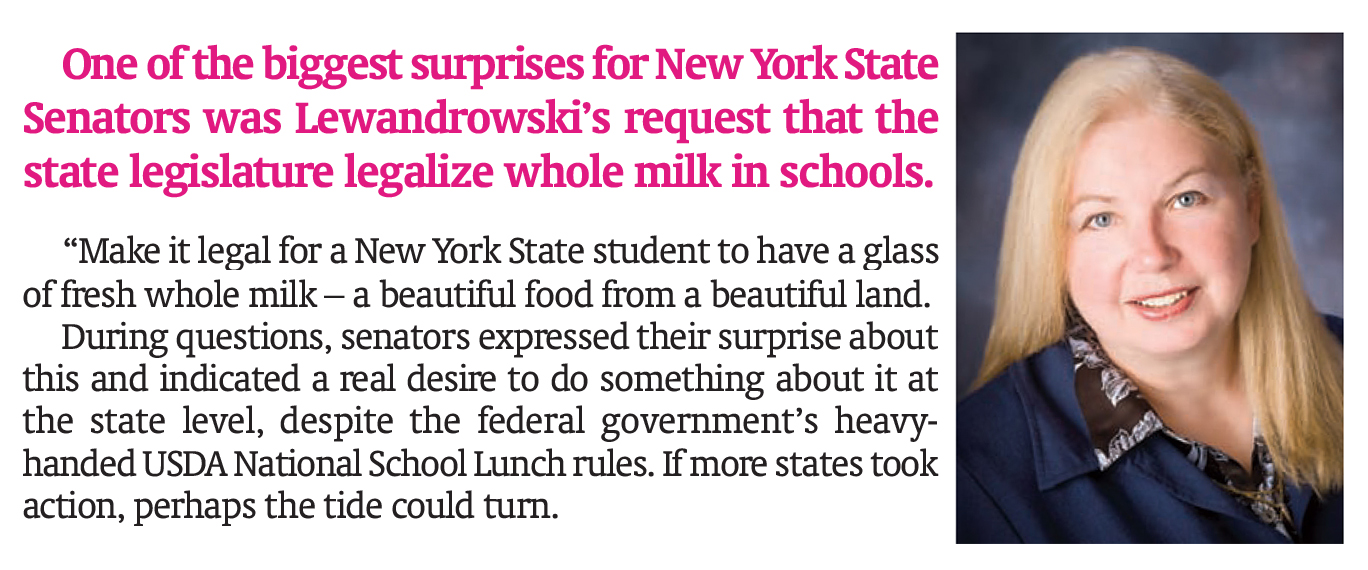
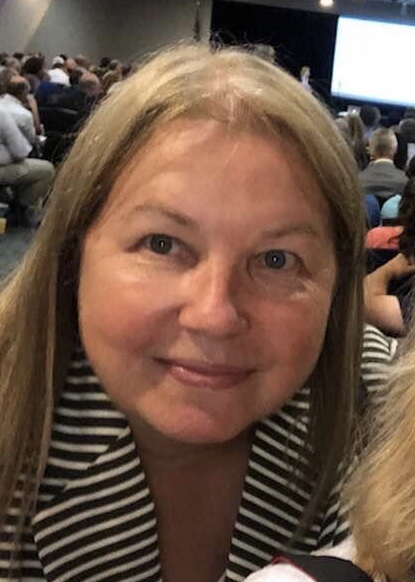
Lorraine Lewandrowski at a dairy summit in Albany in 2018 before Covid relegated such events to the virtual zone.

Lewandrowski has been a tireless advocate and activist for dairy and livestock agriculture, making connections in all sorts of ways for the people of her beloved farmscapes of New York and the greater Northeast.

“Our food model is based on faraway sources while we throw our rural communities away,” Lewandrowski told the New York senators. “Farmers here are asking for crumbs. The big money is in the port capacity being ramped up for imports.”

In her testimony, Lewandrowski detailed several key issues facing dairy farmers and rural communities in the Northeast. Other farmers and dairy producers, along with representatives of farm organizations, farm markets, Farm Credit, FFA, urban food programs, and academia, were also on the hearing docket.

Describing dairy farmers as ‘price takers’ without real bargaining power, Lewandrowski called the milk pricing formula “broken and antiquated and in need of investigation.”

One of the biggest surprises for New York State Senators was Lewandrowski’s request that the state legislature legalize whole milk in schools.

“Make it legal for a New York State student to have a glass of fresh whole milk – a beautiful food from a beautiful land,” she said.

During questions, senators expressed their surprise about this and indicated a real desire to do something about it at the state level, despite the federal government’s heavy-handed USDA National School Lunch rules. If more states took action, perhaps the tide could turn.

On the milk pricing system, Lewandrowski pointed out that since May of 2020, the current pricing formula “has extracted billions of dollars” from dairy farmers’ milk checks, and she urged the committee to investigate how this is impacting New York State dairy farmers. She urged them to look at Farm Bureau’s work on this topic.

With ongoing concerns about market transparency and competitiveness, she referenced a 2019 GAO report requested by U.S. Senator Kirsten Gillibrand, looking at dairy cooperative consolidation and what this means for New York.

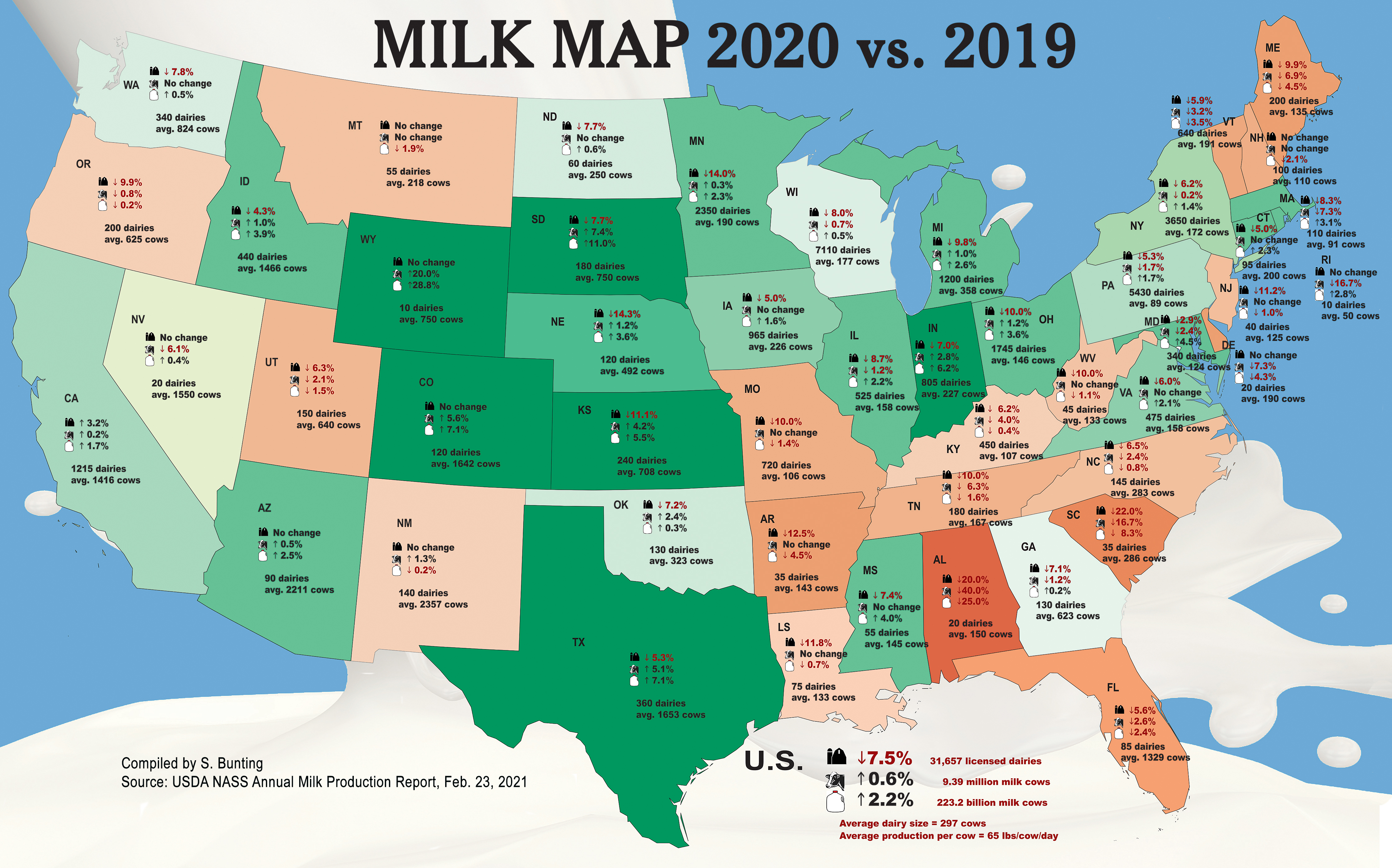
Referencing a ‘cow islands’ map produced a few years ago by Dr. Mark Stephenson, Lewandrowski said milk production is rapidly consolidating with more cows located on fewer and ever-larger farms in fewer regions.

“Thirty-thousand and 100,000 cow operations have arisen, some in dry regions. Contrast ‘cow islands’ with the emptied-out New York farmscapes,” she said, lamenting a Cornell report “Green Grass, Green Money” citing over 3 million acres of abandoned farms and former grazing lands in New York even though “New York equals powerful rainfed landscapes.”

Lewandrowski stressed that farmers need more lending and financing options and resources to understand new “ecosystem markets.” She indicated state legislatures can take the lead in helping prepare farmers for the future with allocation of informational and financial resources to navigate new ideas and income streams. Her fear, she indicated, is that a centralized approach will create winners and losers across regions and farm sizes.

In making her most impassioned point of the day on communications with New York City, Lewandrowski said: “We want to speak, as farmers, with the New York City Council and urban leaders. Why can’t we have a Jacob Javits Center Farm Show, a farm show like they have in Paris, or an office for New York’s farm groups in New York City or an online hub to connect farmers with urban groups looking for speakers?”

She talked about the screening of the dairy-focused Forgotten Farms film a year ago, just before the Covid pandemic. So many rural urban connections were made, but the linkages between rural New York and urban NYC need to continue and be constant.

Rural trauma was her final thought for the committee. As an agricultural law attorney, Lewandrowski sees so many concerning and desperate cases.

She bluntly addressed Senator Jabari Brisport of Brooklyn, who is a new member of the NY Senate Ag Committee, about his own comments as a vegan activist, and the damage such comments do to New York’s own rural farmers.

“Rural New York has been viciously neglected. When farmers come to my office and tell me they feel dead, I worry,” said Lewandrowski. “This is directed to Senator Brisport: Senator, I heard your words as you led a rally in New York City calling for New York’s dairy farms to die. Your exact words: ‘Let dairy die the death it needs to die.’ Two hundred miles away, I was dealing with a woman who found her son hanging dead in the barn, too ashamed to speak of his death.

“Senator Brisport, I will not forget your cruel words directed to the working farmers of this state whom I know and love,” Lewandrowski said candidly. Dairywoman Tammy Gendron of Willet also referenced concerns about Sen. Brisport’s activism against dairy and livestock production in her comments later in the session.

During questions, Senator Brisport apologized for his word choice of “death” when speaking about dairy at the vegan rally, but he stated that as a sitting Senator on the New York Senate Ag Committee: “I don’t believe dairy should exist, just as I don’t believe any animal agriculture should exist, so you can count me as a ‘no’ vote on any whole milk in schools…”

He also noted one of his focuses is farm workers and asked for more details on collective bargaining from Lewandrowski’s testimony. He was keying-in on worker bargaining and totally missing the point that farmer-owner-operators have little bargaining power as cooperatives they own are consolidating and joint-venturing as processing entities.

Lewandrowski provided information about antitrust interpretations and consolidation in the industry to massive corporations that prevent farmers from collectively setting a good price for their milk.

Basically, she said, “we should be looking at revitalization and re-regionalization of our food production and processing facilities, so we have smaller cheese plants or vegetable processing or meat processing, where the farmers have a choice with competition for their product. We have lost so much of the food processing in New York. This committee could really help with that by making financing available to revitalize regional processing and brands to serve our Big Apple and our other cities.”

Senator George Borrello thanked Lewandrowski for her comments and passion. “Dairy in NYS is a very different business… 90% or more of our farms are family run businesses. Therefore, you will see these animals treated much more humanely. If we lose our dairy farms that are handling animals in New York State, we are going to be relying on farms elsewhere. The demand is not going to go away, so why don’t we ensure it’s from our farms in New York State,” said Borrello.

Senator Alessandra Biaggi took hold of the issues of whole milk in schools and communication between rural and urban New York. Much back and forth brainstorming ensued.

“There’s a lot to action in what you have shared,” Biaggi pointed out, citing first the unbelievable fact that whole milk is prohibited in schools.

“I thought you were joking,” the Senator said.

Lewandrowski talked about the 30,000-signature petition (over 24,000 online and over 6,000 by mail) that had been submitted to USDA and members of Congress, and she gave some of the background in regard to the Dietary Guidelines for Americans (DGA).

“Whole milk is a really tremendous product, and it is our most local product, fresh and produced 365 days a year,” she said.

When asked about the fat, Lewandrowski noted that the DGAs don’t reflect the current science on milkfat and saturated fat, in general, and especially for children.

“The fat is not very high. In reality, it’s standardized to 3.25% fat. Skim milk and 1% and 2% are not much behind that, but dairy as a whole product provides better satiety… so children may eat less junk food, and it may be easier to digest,” Lewandrowski noted. “As farmers in the Northeast, our best aspect is that we are local and produce fresh whole milk.”

Biaggi also stressed that one of the best things about New York is the Upstate being “full of possibilities, if we invested in it.”

She asked: “How did we get to a place where we’ve essentially abandoned the farms, the Upstate?”

Identifying the issue as cultural, pointing out how the cities in France are so proud of their rural areas, Lewandrowski asked the NY Senate Ag Committee to help facilitate connections between rural farms and urban leaders.

“I think there’s a real desire in our urban areas to learn more, so we ask for the committee to help us tap into that,” said Lewandrowski, citing many of the farm-city events she has taken part in, but looking for structural connections that continue and have meaning at the policy level.

Biaggi said this is one of the most important areas for the future of New York State, bridging the Upstate / Downstate, especially where food and agriculture are concerned.

Regulatory issues, workforce and lending resources, as well as gaps in the food system and examples of how locally produced food was diverted to nonprofits for giving during Covid were other major topics highlighted during the hearing.

-30-

As depooling, negative PPDs and Cl. I formula change continue stealing value from milk checks, here’s what you can do

This table originally published in Farmshine last year, has been updated through March. It shows what the Class I formula change, alone, has collectively removed from all FMMO producer settlement funds and farmer milk checks in terms of Class I milk payment (NET loss of 91 cents / cwt net over Class I milk shipped from all FMMOs for all 23 months since the Class I formula change and 28 cents / cwt NET loss for ALL FMMO pounds of milk May 2019 through March 2021). The massive depooling that resulted has cost dairy producers more than three times this amount in negative PPDs.

Dairy producers and organizations are encouraging more to add names by March 12 to letter seeking equal seat at table for producers in regard to milk pricing policy

By Sherry Bunting, Farmshine, Friday, March 5, 2021

EAST EARL, Pa. — Dairy producers from across the U.S., along with many state dairy associations and the American Dairy Coalition, have come together to compose a letter to the National Milk Producers Federation (NMPF) and International Dairy Foods Association (IDFA). The letter addresses the impact of massive depooling in relation to large negative PPDs for dairy farmers across the U.S during the last three months in 2019, eight months in 2020, and is estimated to continue through at least the first four to seven months of 2021. 

Dairy producers and dairy advocacy trade associations are invited to add their names as signatories to this letter to the presidents of both NMPF and IDFA. Hundreds of producers and dairy trade associations have done so electronically within the first few days. 

The deadline to sign is March 12, 2021.

Farmshine has learned that allied industry persons can also sign and mention how they are affiliated — due to the many jobs, economic activity and livelihoods supported by dairy beyond the farmgate having a vested interest in seeing a price formula that is fairer to producers. Those signing who are not producers, but are affiliated with dairy production, will be listed separately as ‘allied industry’ when the letter is officially presented.

Multiple family members involved in a dairy farm operation may individually sign.

Click here or scroll to the end of the article to view the letter and sign electronically through the automated short form.

Or, read the letter as published in Farmshine. Then, email your name, phone number, city, state, and farm name or allied industry affiliation (veterinarian, nutritionist, lender, accountant, feed sales, custom harvester, heifer grower, etc.) to info@americandairycoalitioninc.com or text this information to 920-366-1880.

A photo example of the electronic form appears below.

Click here to open to add your name or organization name.

In the letter, dairy producers ask NMPF and IDFA to work with them to find a solution that can result in a fairer distribution of dairy dollars.

“Dairy farmers all across the U.S. were stunned to see the huge negative PPD deductions on their milk checks,” states the American Dairy Coalition (ADC) in an email about the letter. “We understand the need to better ensure that processors are able to utilize risk management. However, this came at a huge expense to dairy producers and eliminated their ability to utilize the risk management tools like DRP and DMC if they had already purchased them — leaving many producers with no way to shield themselves from significant financial loss.”

The new formula (average Class III and Class IV advance pricing factors + 74 cents), passed by Congress in the 2018 Farm Bill at the request of NMPF and IDFA, is not acceptable, says the ADC.

The goal of the letter to NMPF and IDFA is to ensure that dairy producers have the opportunity to truly be at the table to find workable solutions for milk pricing. 

Remember, NMPF and IDFA advocated the change in the Class I base price that is a key part of the problem — without any hearings. NMPF indicates in various press releases that they are working on this and have a plan to “fix it”, but their plan, as indicated so far, falls short according to available economic analysis. 

A recent Farm Bureau preliminary analysis of four Class I pricing scenarios (2019-2021), using USDA AMS data, shows this. Fig. 1 (above) compares the previous higher-of, the current average + 74 cents, the current average + $1.68 and Class III + $1.25. Dairy producers are looking to be part of evaluating the best solution using past and future pricing indicators, and it appears that Class III + $1.25 offers a fairer distribution of dairy dollars than the averaging method.

The central point of the letter, however, is to give dairy producers an equal seat at the table. While NMPF represents dairy cooperatives and IDFA represents dairy processors, there is inadequate representation of dairy farmers at the policy-making level on this issue.

The domino effect of the Class I formula change, negative PPDs and depooling, as well as impact on risk management tools, have been hardest on dairy producers in so-called “fringe” areas, and those supplying regional Class I markets. This tends to accelerate the consolidation trend toward ‘cow islands’.

In fact, dairy farm exits in 2020 represent a 7.5% loss in the average number of licensed dairies in the U.S. compared with a more typical attrition rate of 5% annually over the past decade. This, according to USDA’s annual milk production report released last Tuesday (Feb. 23).

Producers interviewed in multiple states recently indicated that while the USDA CFAP payments were helpful, they did not come close to covering losses incurred from negative PPDs and the cost of risk protection tools they chose to purchase but which did not protect against this depooling-negative PPD risk. In many cases, those producers using risk protection through futures markets, actually had additional costs in margin calls that were not recouped in the real milk check when the market went against the hedge.

In short, not only are milk checks not transferring equitable value, the risk management tools offered by USDA and privately, do not work as intended or expected.

Across all 11 FMMOs, the NET loss on Class I milk pounds, alone, due to the new Class I formula, amount to over $726 million. (Table 1). This translates to a 91-cent per hundredweight NET loss over 23 months (May 2019 through March 2021) on Class I utilized milk and a 28-cent per hundredweight NET loss over 23 months on all milk pooled across 11 FMMOs.

Normand St-Pierre, Ph.D., PAS, shows the losses in his 20-month chart May 2019 through December 2020. As director of research and technical services for Perdue Agribusiness, he broke down the amounts for each FMMO in his “Tiny change with unforeseen consequences” Perdue weekly dairy outlook recently.

“Cumulatively, since the new formula was implemented (May 2019), producers have suffered a (20-month net) loss of $714 million. If from here on the new formula would always produce a gain equal to the average gains that have occurred in the 10 winning months since May 2019 (i.e.,~ $0.40/cwt), it would take producers 50 months to recover the $714 million in lost income.”

In fact, with current futures markets projecting a continued divergence of Class III and IV advance pricing factors by more than the ‘magic’ $1.48 per hundredweight, this situation of negative PPDs, depooling and milk check value extraction will continue for at least another four months, digging the milk check hole even deeper for dairy producers.

Producers are often told that negative PPDs are ‘good’ because it means milk prices are going up. This used to be the case back when the ‘advanced pricing’ aspect of the Class I formula was the main reason for small negative PPDs occurring once in a while. 

The situation today is far different – largely due to the change in the Class I base price from ‘higher of’ to averaging Class III and IV pricing factors. The net losses over the past 23 months will not be ‘caught up’, and as St-Pierre points out, the situation is now at the point that it could take years to catch up or recoup even with a tweak.

St-Pierre also observed that producers in the Northeast FMMO suffered losses from the formula change that were the largest in total across all FMMOs, but nearly equal to the average loss per hundredweight across all FMMOs. The losses per hundredweight are largest in Florida’s high Class I milk marketing order, of course.

Now consider that the Class I shortfalls created by the lopsided Class III vs. Class I relationship prompted massive depooling. As previously reported in multiple Farmshine articles and Market Moos columns, only the milk directly associated with the Class I plants is truly regulated to be pooled. Handlers of Class III milk are accustomed to getting a check from the pool, not writing one to the pool.

This Class III over I situation creates collective shortfalls in Federal Milk Marketing Order producer settlement funds when massive depooling occurs. This has resulted in a collective net loss of well over $3 billion ($2.7 billion as of the end of November), as represented by negative PPDs across the 7 multiple component-priced FMMOs and the aforementioned Class I skim losses in the 4 fat/skim-priced FMMOs. 

Fig. 2 and 4, from American Farm Bureau based on USDA AMS data, shows the depooling / negative PPD losses just for June through November 2020, but the losses continue in the months since then for which data are available, and the futures markets suggest this will continue into at least July 2021.

In December, Farm Bureau economist John Newton wrote about the most severe negative PPD depooling losses as of the end of November — shown here for June-November 2020.

USDA AMS answered Farmshine’s question last year about these losses in relation to calculating the “All-Milk” price on which Dairy Margin Coverage is based. Their response indicated that some of this depooling / negative PPD loss is included as value in the All-Milk price. It is seen as value received by producers because the dollars are “in the marketplace” due to the FMMO end-product pricing formulas – even if these dollars are not passed on to producers after producer settlement funds are depleted by depooling.

Farm Bureau chief economist John Newton wrote in his December 2020 Market Intel analysis of the negative PPD impact June through November 2020: “To put this into a farm-level perspective, assuming a national average milk yield per cow of nearly 12,000 pounds of milk produced from June to November, a 200-cow dairy in western Pennsylvania would have experienced PPD milk check “deductions” of nearly $130,000. Similarly, for a 3,000-cow dairy operation in California, the negative PPDs would represent milk check deductions of more than $2.5 million.”

Newton goes on to explain in the article published in the December 25, 2020 edition of Farmshine: “What makes the situation even worse is public and private risk management tools such as Chicago Mercantile Exchange futures contracts, Dairy Margin Coverage and Dairy Revenue Protection were unable to protect against PPD price risk. Margin calls on Class III milk likely made the negative PPDs sting even more as milk prices rapidly rose.”

So back to what dairy producers can do! Read the letter and consider signing it. Share it with others. Talk to your local, state and regional dairy organizations and farm organizations. Ask them to sign as organizations. Both individuals and organizations can sign on.

The bottom line is that dairy producers need an equitable seat at the table where decisions are made that affect how dairy value is shared. NMPF and IDFA — as processors — wear multiple hats and do not wholly represent the on-farm producer interests. 

To view the letter (below) click here and look for instructions to electronically add your name, or the name of your organization. Or read the letter below and click here for the direct link to electronically add your name — or the name of your organization — to the letter.

U.S. 2020 milk production up 2.2%, but average number of dairies decline 7.5%

click to enlarge map

By Sherry Bunting, Farmshine, Friday, March 5, 2021

WASHINGTON, D.C. — The U.S. produced 2.2% more milk in 2020 compared with 2019 and did so with 51,000 more cows and 2550 fewer farms nationwide. The average number of milk cows for the year increased 0.6% over year ago and the average number of licensed dairies decreased 7.5% compared with 2019. 

While the number of dairy farms lost in 2018 and 2019 were larger, the percentage of decline in dairy farms for 2020 is the largest single year decline because the total number of farms from which to figure the percentage is smaller. 

The number of licensed dairies in the U.S. averaged barely above 30,000 in 2020 at 31,657. The rate of attrition has averaged 5% annually over the past decade with 2018 being 6.5%.

Some data of the data shown in last week’s USDA report raise questions about how milk production is counted and reliance on Federal Order pool information given all the massive depooling of milk we saw in 2020 (and continuing). When additional 2020 data come in, we’ll do some additional analysis.

To be clear, USDA’s annual milk production report, released last week, computes the average number of cows and the average number of licensed dairies for 2020 vs. 2019, so it is more like a rolling average for the year. These are not end-of-year numbers.

In looking over the data, it is interesting to see states in New England, like Massachusetts, Rhode Island and Connecticut, gain production while losing cows and farms even though the larger dairy producing New England state of Vermont saw production slip by 3.5% in 2020, cow numbers down 3.2% and farm numbers fell by 5.9% to 640. 

It is also intriguing to see production gains in the Mississippi data from USDA, despite cow and farm losses there, and despite being next to USDA-reported production declines throughout the rest of the Southeastern states, except for Georgia, where production was about steady, cow numbers were off by less than 1%, and dairy farm numbers were down 7.1% at 130. Florida’s production, cow numbers and dairy numbers all declined by 2.4, 2.6 and 5.6%, respectively.

Some of the states with the largest gains in milk production also had the highest percentage-loss of dairy farms.

Minnesota, for example, grew production by 2.3% despite the number of cows declining by 1000 head and the number of licensed dairies declining a whopping 14%. But the gain in milk production for Minnesota, at 10.15 billion pounds for 2020 has the state’s producers nipping at Pennsylvania’s heels for the 7th place ranking.

Pennsylvania’s 2020 milk production at 10.27 billion pounds was up 1.7% over year ago, although cow numbers were down 8,000 head (off 1.7%), and there were 300 fewer licensed dairies – a 5.3% decline from 2019. The average number of licensed dairies in the Keystone State during 2020 was 5430.

Just north, New York’s production grew 1.4% with roughly the same number of cows but 6.2% fewer dairy farms as the number of New York dairies fell by 240 (6.2%) to 3450 in 2020. Just south, production reportedly grew by 4.5% in Maryland (despite 2.4% fewer cows?). Production also grew 2.1% in Virginia with no change in cow numbers. The number of licensed dairies in Maryland fell by 2.9% to 340, while the number in Virginia fell by 6% to 475.

The Appalachian / Southeast states of Kentucky and Tennessee saw production ebb by 0.4 to 1.4% despite losing 4% and 6.3% of their cows, respectively. Tennessee had 10% fewer licensed dairies at 180, while Kentucky’s dairy numbers fell 6.2% to 450.

However, just north of those states, the Mideast states of Indiana, Ohio and Michigan added a lot more cows in 2020, especially in the third and fourth quarter ahead of the massive new cheese and ingredient plant getting into production at the end of 2020 in St. Johns, Michigan. Indiana grew production 6.2% with 2.8% more cows and 7% fewer dairy farms. Michigan had already been in growth phase for years, stabilized through 2018-19, and grew production 2.6% in 2020 with 1% more cows. However, Michigan lost almost 10% of its dairies in 2020. Ohio also lost 10% of its licensed dairies last year, but grew production 3.6% with 1.2% more cows.

Across to Iowa and Illinois, production grew 1.6 and 2.2%, respectively, but the number of dairy farms fell 5.0 and 8.7%, respectively.

Throughout the growth area of the Central Plains, South Dakota produced 11% more milk with 7% more cows but nearly 8% fewer dairies. Next door, Wyoming’s 10 dairy farms grew the state’s production by almost 29%. Colorado’s dairy numbers stayed the same, but with 5.6% more cows, they made 7.1% more milk. 

Rounding the bend in Kansas and Nebraska, the number of dairies fell 11.1 and 14.3%, while cow numbers grew 4.2 and 1.2% and production grew 5.5 and 3.6%, respectively.

Sandwiched between the rapid growth in the Plains and the Indiana-Ohio-Michigan triumvirate is Wisconsin – the Dairyland State – where 2020 production was just half of one percent (0.5%) above year ago. Cow numbers in Wisconsin fell by almost 1% and the number of dairy farms declined 8% to 7110, a loss of 610 dairies.

In the Southwest and West, Texas continued its multi-year rapid growth pattern as production increased 7.1% with 5% more cows, although the number of dairies fell 5.3%. In fact, Texas is nipping at New York’s heels for the 4th place ranking in milk output volume. In New Mexico, production was about steady, with 1% more cows, and the number of dairies was unchanged. Idaho grew production 3.9% with 1% more cows and 4.3% fewer dairies while Arizona grew production 2.2% with the same number of dairies and a few more cows.

California grew production 1.7% but lost over 3% of its dairies while the Pacific Northwest was generally steady on production and cow numbers but lost roughly 8% of the dairies.

The annual production report can be found here.

op 23 milk production rankings for 2020 milk production are as follows:

  1. California (41.3 bil lbs),
  2. Wisconsin (30.7 bil lbs),
  3. Idaho (16.2 bil lbs),
  4. New York (15.3 bil lbs),
  5. Texas (14.8 bil lbs),
  6. Michigan (11.7 bil lbs),
  7. Pennsylvania (10.3 bil lbs),
  8. Minnesota (10.1 bil lbs),
  9. New Mexico (8.2 bil lbs),
  10. Washington (6.8 bil lbs),
  11. Ohio (5.6 bil lbs),
  12. Iowa (5.4 bil lbs),
  13. Colorado (5.1 bil lbs),
  14. Arizona (4.9 bil lbs),
  15. Indiana (4.3 bil lbs),
  16. Kansas (4.0 bil lbs),
  17. South Dakota (3.1 bil lbs),
  18. Oregon (2.6 bil lbs),
  19. Vermont (2.6 bil lbs)
  20. Florida (2.3 bil lbs)
  21. Utah (2.2 bil lbs)
  22. Illinois (1.8 bil lbs)
  23. Georgia (1.8 bil lbs)

-30-