Global dairy thoughts Part 5: First half 2018 butter, milk, cream imports climbed!

Timelines show how domestic dietary guidelines, Obama/Vilsack school milk rules and ramped up low-fat and fat-free dairy promotion through GENYOUth and FUTP60 all laid the groundwork for declining Class I fluid milk sales to pave the way for flat pricing and increased exports (now coincidentally under the industry leadership of former Sec Vilsack). Then consumers learned the truth and began coming back to whole milk and butter and full-fat cheeses even while the government turns a deaf ear in regards to the rules about feeding our schoolchildren. So what did U.S. companies and cooperatives do to keep that milk price flat enough for the export market this year? They imported more butter, milk and cream in first half 2018!

By Sherry Bunting, originally published in Farmshine, September 7, 2018

BROWNSTOWN, Pa. — Let’s take a look at the overall global dairy trade balance of the U.S.

In gross numbers, the balance is positive, showing the U.S. is winning new market share on the side of exports over imports. But this tells only part of the story, ignoring the potential milk market impacts of substantial increases in imports of milkfat at this critical time during the first six months of 2018.

In June 2018, Global Dairy Thoughts Part 3 and Part 4 covered some of the Federal Order pricing impacts of rapidly expanding exports alongside a diminishing Class I utilization. While per-capita milk consumption has steadily declined since 1980, the total packaged milk sales held their own due to population growth.

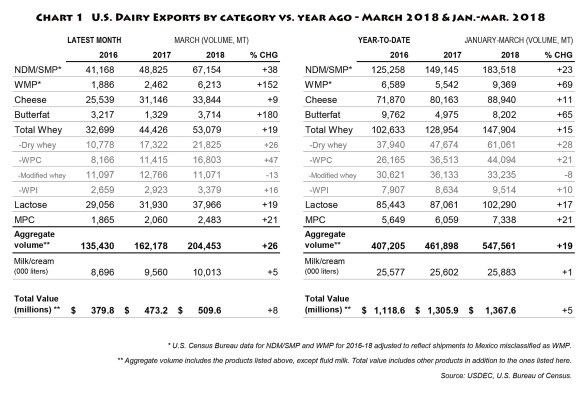
globalthoughtspartfive-chart1That is, until we hit 2009-10, when the third and fourth layers (see Chart 1 above) were added to the lowfat-push — that consequently pulled total fluid milk sales into the bucket at the same time that exports began their rapid ascent.

Expanding export utilization hits Class I utilization with a double-whammy: Smaller piece in a bigger pie, even if consumption losses are stabilized. We’ll revisit that in a future part of this series on dairy policy and logistics.

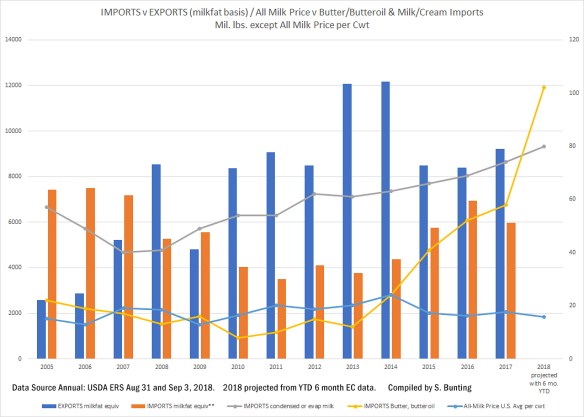
In looking at imports and doing trend comparisons for farm milk prices, fluid milk sales, total exports, total imports and the large increase so far this year in imports of butter and butteroil as well as steady increases in imports of milk and cream (condensed, non-condensed, liquid, powder, sweetened, unsweetened), there are some correlations. (Chart 2 below)

globalthoughtspartfive-chart-2

From 2005 forward, the national average all-milk price moved in patterns concave to the corresponding imports of butter/butteroil and milk/cream on the timeline. While the totals are not huge, we all know what “a little more” can mean on the supply side when it comes to milk prices.

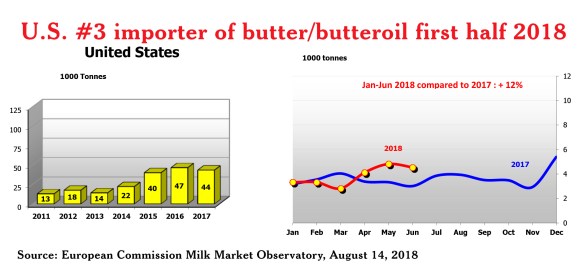
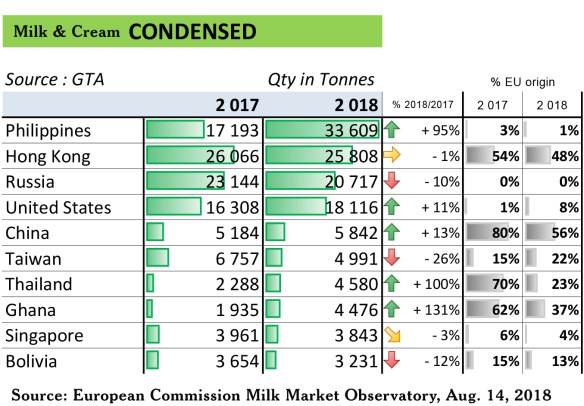
In the first-half of 2018, for example,  the U.S. imported 12% more butter and butteroil and 11% more condensed milk and cream, according to the European Commission’s Milk Market Observatory published August 14, 2018. (Charts 3 and 4 below)

globalthoughtspartfive-chart3

globalthoughtspartfive-chart4

While the U.S. Dairy Export Council (USDEC) reports that first half 2018 dairy exports of milk powders, cheese, butterfat, whey and lactose topped 1.14 mil. tons to set a new record-high – up 20% from year ago, some interesting things were also happening on the import side.

Even though the USDEC data dashboard continues to show total imports accounting for a flat line at 4% or less of the milk supply on a solids basis, while exports accounted for 16.8% in the first six months of 2018, there are some interesting aspects of the import picture related to ‘what’ and ‘when’.

According to the August 14 EC statistical report ranking top-10 importers and exporters of various dairy commodities, the U.S. ranked third in butter and butteroil imports, up 12% from year ago and not far behind China (1) and Russia (2) during the first half of 2018.

The U.S. also ranked fourth in imports of condensed milk and cream – up 11% compared with a year ago.

When butter substitutes, containing over 45% butterfat, are included in the butter and butteroil import total, as documented at the U.S. International Trade Commission (USITC) import monitoring website, the U.S. butter/butteroil total rises by more than 200% during the past three quarters (Sept. 2017 through June 2018) compared with the same nine months a year ago.

While half of the butter and butteroil imports came to the U.S. from EU countries, a majority of the other half came from Mexico, according to the USITC website listings under various Harmonized Tariff Schedule (HTS) codes.

In the condensed milk and cream category, 8% of U.S. imports came from the EU, according to the EC report.

Sifting through the tedious lists and multiple codes and combinations at the USITC website, it appears the U.S. imported quite a bit of condensed milk and cream from Mexico, a little from Canada (though less from Canada than a year ago), and the remainder from sources scattered around the globe — even China.

For the past nine months, Sept. 2017 through June 2018, the condensed milk and cream, unsweetened, category of imports was up 44% in powder or granular form compared with the same period a year ago, while milk and cream imports, unconcentrated, unsweetened, and still in liquid form, were up 22%.

Imports of sweetened condensed milk and cream were up 7% and mainly from Mexico.

Of course, the U.S. remains the top importer of casein and caseinates, even though those imports were down 15% from a year ago during the first half of 2018, according the EC report.

Doing the math on milk protein concentrate (MPC) imports for the nine months from September 2017 through June 2018 listed at the USITC site, MPC imports in both the 0404 and 3500 HTS codes, combined, were down 1.3% compared with the same period a year earlier.

On the other hand, imports of milk protein isolates (MPI) were up 31% from Sept. 2017 through June 2018 compared with the same three quarters a year ago.

Looking further into other categories, imports of “textured protein substance, including dairy” were up 40% for the past nine months compared with a year ago.

In the significant dairy-containing “food prep” categories — including infant formula and having various percentages of milk solids and butterfat — imports were up 7% during the past nine months compared with a year ago. In this particular category, including confectionary products containing significant milk solids, Canada was a primary source, along with EU countries as well as some of these imports coming from Chile and other South American countries.

Process cheese product imports were up 46% during the past nine months compared with a year earlier.

While U.S. imports of ice cream were down relative to year ago, the total when combined with import categories in other HTS codes for “edible ice containing dairy” tallied an import total that was up collectively by more than 200% over year ago during the past nine months.

To read Parts 1 through 4, click these links: Part 1, Part 2, Part 3, Part 4

And stay tuned for this series to continue as 2019 trends develop abroad and on the homefront.

-30-

Global thoughts Part 4: As exports grow, who benefits from ‘new math’?

GlobalThoughtsPart4_Chart#2 (1).jpgBy Sherry Bunting, originally published in Farmshine, June 7, 2018 and examines the utilization of domestic Class I fluid milk vs. exported commodities during the worst three months of pricing at the beginning of 2018, but the trends show how FMMO pricing no longer provides the value to farmers for their milk as exports increase. Read Global Thoughts Part One, Part Two, and Part Three.

BROWNSTOWN, Pa. — U.S. dairy exports posted record-high 2018 first-quarter volumes (see Chart 1), representing 17.3% of U.S. milk utilization on a milk equivalent basis, according to the U.S. Dairy Export Council (USDEC). (Note, the average Jan. through Oct. was 16.3%, still a record high.)

This, against the backdrop of Class I milk utilization falling to 29% of Federal Order pooled milk but just 18.9% of total milk production in the first quarter of 2018 (Chart 2).

In fact, Federal Order pool reports for first quarter 2018 showed Northeast marketings 1.8% below year ago as pool receipts fell due to reduced production. At the same time, other FMMO pools recorded declines in pool receipts, which USDA confirmed by email were largely due to shifts in pooling or strategic despoiling to prop up Class I utilization percentages. (For example the pooled first quarter receipts in the Appalachian Order were up 6% while down 5.5% in the adjacent Mideast Order.)

globalthoughtspart4_chart#1The total “official” U.S. Class I utilization for 2017 was 26.1%, down nearly 10% from 35.9% in 2009, according to USDA figures.

However, the Northeast Market Administrator’s most recent bulletin (April) observed that the real percentage of total U.S. milk production used for Class I fluid sales in 2017 was just 22.3%!

Bob Younkers, chief economist for the International Dairy Foods Association (IDFA), analyzed fluid milk trends, reporting in February that the 2017 fluid milk losses, alone, represented 20 million fewer pounds (2.3 million fewer gallons) of milk sold daily – nationwide – in 2017 vs. 2016. In addition to the blow dealt to producer milk checks, Younkers points to how the fixed costs of bottling increase when spread across fewer gallons of milk sold.

Coming into 2018, not only have first quarter Class I sales declined 1.5% compared with first quarter 2017, the Class I utilization percentage fell by even more — down 2.5% below year ago — in part because exports grew to this new first quarter record of 17.3%.

Left unchecked, the current math trend shows that as U.S. exports reach the goal of 20% set by the U.S. Dairy Export Council (USDEC), the percentage of milk utilized in export sales will very soon equal and surpass Class I utilization as a percent of total milk production.

Who benefits from this new math?

If the current classified pricing system — and its Class I regulation — must continue, perhaps the growing export utilization should have its own class formula tied directly to export pricing and representing growth milk in the U.S. system so that the other 80% of milk pricing can be more stable and reflective of serving that large anchor-base of domestic consumption?

Survey the experts on this idea and they’ll tell you an export class for U.S. milk pricing is a non-starter because of trade agreements and WTO. But trade agreements are being renegotiated and others in the global markets have mechanisms in play.

Perhaps instead of going after Canada’s export class implemented because of expanded production due to higher consumer demand for fat, the U.S. could learn from what’s being done north of the border with this pricing mechanism to match exports prices and products to growth milk that goes into products strictly for export?

This is not an idea that goes against free trade, but one that recognizes the U.S. as a free-trader in need of fair trade leverage for producer pricing.

The U.S. must be competitive enough to have its products arrive at other ports, so that it can remain competitive enough to keep other products from arriving at its ports — where a large market for dairy already exists. In Part Three, we looked at some of the product differences.

 But there’s another catch to this romance with export markets. They can be unstable and unpredictable, and while we make more of the globally significant products today than in 2008, our product mix and flexibilities are different than other successful exporting nations.

Would an export class allow pricing of growth milk — a percentage of the nation’s production or a percentage of production in high growth areas — to be aligned to the fluctuating global markets for globally-significant products with a margin to attract necessary investments in manufacturing flexibility and innovation? Such alignment could, at the same time, allow a more stable and profitable base price for milk going into dairy products for domestic consumption?

After all, we are increasing exports to levels that are approaching the falling Class I utilization percentages and yet NONE of the globally-significant products and/or prices are even used in the arbitrary U.S. Federal Order pricing formulas, to which location differentials are added to ensure the Class I price is always higher (more on this when we tackle logistics in a future part of this series).

As dairy exports become the new epicenter of U.S. marketing, a different light is cast on these regulatory pricing structures.

Let’s look at the differences between global and domestic pricing and trading platforms.

 For starters, price announcements to dairy producers in New Zealand are based on the actual value of global sales with producers buying shares of processing capacity for the quantity of milk they expect to produce. As milk falls short or exceeds those pegs, payout announcements are adjusted based on the relationship of the production to the sales.

In Europe, producers also see milk prices that reflect the value of what is sold not a formula like in the U.S. that leaves key products, prices and markets out of the math equation.

While Europe’s quota system has ended, the EU commission intervenes with purchases. Processors more nimbly shift between products to adapt to market changes. And if they miss in their projections — as they did in the shift to making more powder when the Russians stopped buying cheese and butter due to the economic sanctions — the EU commission intervened to buy and stockpile that powder to a degree that still is blamed for suppressing the global market for powder and holding back the U.S. milk price recovery.

In addition to differences in pricing, there are big differences between global and U.S. price discovery and trading platforms.

While the CME daily spot market in Chicago went electronic last year, the Global Dairy Trade (GDT) biweekly internet auction has always been an electronic platform.

The GDT engages more buyers and sellers, offers contract sales that are near-term and forward-looking to create what is essentially a 2-month ‘spot’ price, according to Bialkowski and Koeman’s November 2017 study at the University of Canterbury New Zealand of spot market design in relation to the success of futures markets.

They explain the GDT biweekly auction is a vehicle for Fonterra to market 30% of its production and to provide a global exchange for other sellers like Dairy Foods of the U.S. and Arla of Sweden.

The GDT auction includes many products and ingredients — from bulk cheese and butter to whole milk powder, skim milk powder, anhydrous milkfat powder, buttermilk powder, lactose powder, milk protein concentrate, rennet casein and occasionally sweet whey powder. Whey protein concentrate is another globally-significant product, which the U.S. makes and exports a lot of – but that price is never considered in the FMMO classified pricing scheme either.

By contrast, the CME futures markets provide a hedging opportunity for Class III and IV milk and futures markets for the four Federal Order pricing commodities: Cheddar, butter, nonfat dry milk and dry whey. The CME also operates a daily cash “spot” market primarily for three of the four Federal Order commodities – butter, Cheddar and nonfat dry milk.

The CME trades only those specific Federal Order commodities. It is thinly traded with few buyers and sellers, although volume has increased 1 to 3% in the past year since the change to an electronic trading platform.

As a spot market for hedging, Bialkowski’s analysis described the CME cash market as one that is less well-designed because daily ‘spot’ prices are market-clearing and used retroactively in government pricing formulas, with a pricing delay built in, while GDT auction contracts offer pricing points for delivery one to four months forward.

The biweekly GDT prices are always based on actual sales because all product offered is sold. And those sales are weighted to calculate a weighted average for each product as well as an overall weighted performance index for the dairy trade.

The CME spot market, on the other hand, pegs its daily spot prices on the activity occurring in the final moments of its 15-minute daily trading session.

As we saw on a few occasions earlier this year, a CME trading session had multiple loads change hands at specific prices, but the daily spot price was determined by a lower last-minute offer.

Access to the market is also different. CME traders must simply have product to sell and meet payment and delivery terms to buy. The GDT, on the other hand, has a more controlled process where buyers and sellers are vetted and approved by Fonterra of New Zealand because they run the platform.

How will the U.S. dairy industry adapt to competitively manage export growth and volatility? Are changes needed in the mix of commodity pricing and milk utilization formulas that govern the regulatory pricing structures?

If industry leaders want to focus on export market growth and bring home the message that dairy farmers must accept lower prices “because we are in a global market,” then why is the government involved in regulating prices on the shrinking piece of the expanding pie (Class I) and calculating component value from just four commodities while ignoring the globally significant products and their mostly higher prices?

This is new math and it is not adding up.

A national hearing with report to Congress would help examine new thinking and take a closer look at current regulatory pricing schemes. How is price regulation affecting milk movement and location? Do these schemes return enough component value to the farms? Are the arbitrary make allowances creating winners and losers? Would truly free market forces do a better job? Or if classified pricing is here to stay, should we be aligning milk growth in the U.S. with export market growth and price it accordingly?

In Part Five, we’ll look at U.S. dairy imports and why volume is not the only important factor.

-30-

Eastern dairy industry has value-add soul-searching to do

Forum4152.jpg

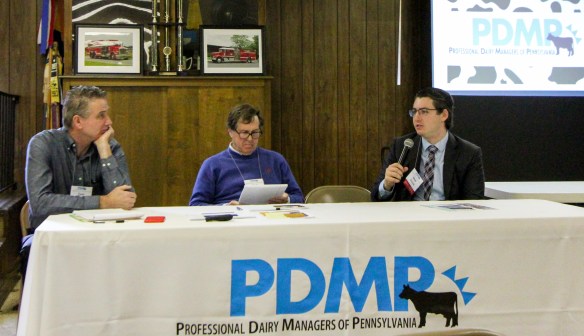
Talking candidly about dairy markets and trade were market experts (l-r) Tom Wegner, Land O’Lakes economist; Tom Roosevelt, founder and owner of West Chester-based Roosevelt Dairy Trade, Inc; and Matt Gould, owner of Philadelphia-based Dairy & Foods Market Analyst, LLC. Photos by Sherry Bunting

By Sherry Bunting, published previously in Farmshine, November 30, 2018

BAINBRIDGE, Pa. – “There is a long list of demands coming from consumers with unprecedented opportunities for milk,” said Matt Gould, owner of Dairy & Food Market Analyst LLC, based in Philadelphia. “Consumer demands are the key, and they are willing to pay for them.”

That was the good news. Gould said that Pennsylvania has an image to capitalize on, and part of that image is family farms working close to the land and animals — the iconic Lancaster County Amish-made image — for example.

But by the end of the forum, it was clear that how the state of Pennsylvania — and the eastern states in general — can tap into value-added dairy opportunities will require both individual and collective soul-searching.

The not-so-good news was the main substance of three hours with three dairy market experts at the annual Professional Dairy Managers of Pennsylvania (PDMP) Fall Issues Forum on November 14 at the Bainbridge Fire Hall in Lancaster County.

Each expert, in their own way, painted a changing and sobering portrait of the dairy market landscape. Producers in Pennsylvania, and the eastern U.S. in general, are not located where commodity processing growth is occurring to serve rapid growth for export and foodservice markets, but instead, exist in a market where declining fluid milk consumption is dictating the terms and leaving mainly the option of slow growth consumer niche markets that take time to develop and must be “continually fed.”

The experts noted that even though the Northeast is down to 30% Class I utilization, 87% of fluid milk sales is water that is expensive to ship, so, in a sense, the albatross around the neck of eastern dairy farmers is the fluid milk market needing farms nearby consumers, but at the same time declines in fluid milk sales are pressuring those farms.

In fact, the experts characterized the East as mainly a fluid and specialty market for dairy. Not the news many wanted to hear since a recent Pennsylvania Dairy Study suggested the Keystone State is a good location for a new cheese plant, and the Port of Philadelphia was tagged in the study as a vehicle to potentially capitalize on export growth markets.

Tom Roosevelt, founder of Roosevelt Dairy Trade, Inc., West Chester, said that commodity processing expansion is mainly associated with export growth and that is all being centered on the West and Midwest.

“A new cheese plant is not my first thought for Pennsylvania,” he said bluntly.

In fact, all three panelists agreed that the Keystone State’s hope is in building niche markets, and they offered these strategies: 1) branding the state’s image, 2) improving milk components, 3) marketing to consumers who have an emotional connection to where their food comes from and how it is produced, and 4) altering production practices — such as Organic, non-GMO and animal welfare labeling — to meet those niche demands.

They also preached the need for greater efficiency and market discipline, that producers here will increasingly see base/excess programs and will need to be using risk management tools and futures markets to get a ‘flat’ price because a ‘flat’ price is where the industry is headed in the midst of volatile global trade factors.

All three experts indicated that the deepening national and global dairy crisis won’t get better any time soon, and that Pennsylvania has some additional long-term challenges if it wants to retain and grow dairy.

Billed as a session to take dairy markets and trade ‘beyond the spin,’ the forum discussion was brutally honest. While disheartening, the information about what is happening here in the context of what is happening elsewhere is important for constructive ongoing discussions in Pennsylvania and other eastern states about the future of their dairy farms that are key to agriculture infrastructure and state and local economies.

When asked about the potential to change how milk is priced, Roosevelt said that there is no question the CME is thinly traded, but that electronic trading has brought in more activity. He said the USDA National Dairy Product Sales Report that provides the product prices for milk pricing formulas, is outdated.

He and Gould agreed that substantial changes to Federal Order milk pricing are not likely to happen because the investments of large companies (think Walmart, Leprino, etc.) rely on a “stable regulatory environment to protect their investments.”

Adding value

Gould challenged Pennsylvania’s dairy industry to instead focus on “value-added” processing and marketing instead of focusing on making more milk.

Tom Wegner, economist with Land O’Lakes said that, “Three years of tough markets would seem to be due for a price peak, but I don’t want to give any notion that it will get better soon. That is the impact of long milk. We are long on milk, and that will probably continue for a while.
Forum4136 (1).jpg

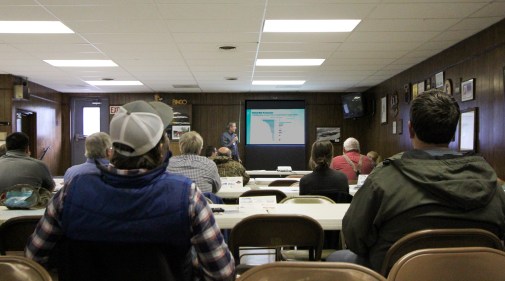
Tom Wegner, economist with Land O’Lakes, shows global milk production patterns during the PDMP forum on dairy markets.

“Your production of components here is more important to enhance milk checks than anything else,” Wegner said.

Roosevelt was particularly candid: “It’s tough to look at this part of the country and think you’ll have dairy exports. The real benefit you have here is in value-added.”

He gave the example of conventional nonfat dry milk selling for 85 cents a pound when organic powder is over $4.00/lb. (The flip-side of this proposition is the very high feed costs and other costs for organic production in which consolidation is also happening, so those producers also are having tough times.)

“It is hard for you to compete on a commodity level,” said Roosevelt from his experience trading dairy commodities at a ratio of 60% domestic use, including animal and pet feed makers, and 40% exports, noting the export trade really began in the past eight years.

“We do a lot of business with Land O’Lakes and Maryland-Virginia,” he said, “but we don’t move hardly anything into export markets out of the Northeast. The fluid market dictates things here in the East compared with the West and Midwest, where cheese is king.”

Roosevelt said the Midwest, Southwest and West are where dairy plants are doing line extensions, and new plants are being planned and breaking ground.

Global volatility

“These companies and cooperatives are going after the commodity big-volume markets to China and Mexico,” said Roosevelt. “If tariffs take those markets out, then it will affect you here because that milk moves down the line. When those markets move product out of the U.S., that means less competition for you here.”

The export markets are deemed the growth markets, said the experts, because domestic demand is declining in some sectors and offers only slow-growth opportunities in other sectors.

With the growth-focused U.S. dairy industry fueled mainly by exports, the volatility of the global market has forced more of the industry to use the CME futures markets to get the ‘flat price’ they want in their quarterly contracts, according to Roosevelt.

“As traders, we trade off the market price and use the futures to convert that to a flat price,” he said. “I would urge you to look at the futures to get a flat price. It’s a tool that will be increasingly important to all of you because, whether we like it or not, we are in a global market and futures are a way to reduce that volatility.”

Roosevelt’s bottom line was for producers to be as efficient as they can and look for the market that “gives you the value, whether it’s artisan or organic.”

Wegner echoed the advice on being efficient. He said the largest farms have the advantage of stretching their economies of scale and taking a longer view in this long period of long milk.

He gave a history of Land O’Lakes with its butter production dating back to 1921 and the eventual merger with Midatlantic here in the East.

“We aggregate demand also,” he said, a nod to Land O’Lakes’ Purina. “We want more of our members to buy more of our products, not just sell us milk.”

Explaining Land O’Lakes’ market-back philosophy, Wegner said the cooperative has put tools together that include traceability and are trying to put production discipline tools into that mix.

“We come to our customers with a farm-to-fork approach and send that back through milk production for an end-to-end view,” said Wegner. “Being farmer-owned is a great part of our background as we continue to grow markets.”

While Pennsylvania’s average herd size is 90 cows, most of the producers attending the forum represented farms with 300 to 1200 cows. Some of the questions lingering in their minds were: How many niches does a dairy market have? And what will it take to develop those in-roads to cover more milk and spread those opportunities beyond the small farm-store label at the end of the drive?

While niche-marketing connects producers and their location and practices with consumers who develop that emotional tie, Roosevelt said the dairy commodity supply-chain has been developing its own sets of practices and programs.

Supply-chain realities

“Traceability is a huge part of our business, and it is as important on the feed side as the food side working with customers like Cargill and ADM,” he explained, noting the huge increase in paperwork following every product delivery. Not only are there certified analyses, date processed, how processed and lot numbers, but in the case of whey, the buyer wants to know what type of cheese process produced the whey because each one has its own profile. He gave the example of whey from Swiss cheese being whiter and higher in protein.

He noted they are getting questions about organic and non-GMO whey, which will produce even more paperwork, and that the traceability aspect is moving back the supply chain to the farm level.

Wegner also talked about traceability. While he didn’t mention it specifically, both Land O’Lakes and DFA are trialing block-chain technology to follow product digitally through the supply chain. Walmart is driving full traceability and moving toward block-chain technology.

“Walmart is one of our biggest customers for butter,” said Wegner. “Just think of the traceability challenges of mixed loads with hundreds of producers.”

The National Milk Producers Federation FARM program was described as a way of consolidating groups of producers into blocks that are being evaluated to use approved practices.

“Members want to know ‘what’s in it for me?’’ said Wegner, “but the reality is that the FARM program contains a lot of the things we have to do to be part of the market.”

Not only are domestic commodity dairy sales being driven by large fast food chains that want to be sure a farm-level animal welfare issue, for example, doesn’t damage their name, the export markets have this concern as well where brands are involved.

Wegner noted that Pizza Hut is launching a new restaurant every 18 hours, globally, and the Yum brand, which includes Pizza Hut and Taco Bell, are opening new restaurants every 8 hours across the globe. He said that 80% of the menu items at these restaurants include dairy. They secure cheese from the U.S. and are concerned about capacity and traceability over the next three years.

For example, Leprino has 80% of the market share for U.S.-produced mozzarella, said Wegner, and their growth is more concentrated in states like Michigan, Colorado, New Mexico and California.

Trickle-down effect

With the commodity production for export and large chain foodservice sectors growing — and served mainly by the Midwest and West — Roosevelt maintained that this export growth is still very important to the East because “the benefit trickles down from the West.”

He said that, “The value of growing exports, for you, is that you will have less competition coming from the Midwest and West.”

What can alter that picture — overnight — is the impact of trade tariffs and trade wars with the top three countries for off-shore dairy trade, in order: Mexico, Canada and China.

He said the tariffs have had an incredible effect on lactose trade. Those customers can go to Europe. “There’s plenty of lactose in Europe and they are quick to fill the gap with a lower price,” said Roosevelt.

Another big trade item is permeate, which is 70 to 80% lactose with some protein left in. There are fewer global competitors in this market, but when the tariffs hit, product was “in the water” and fourth quarter contracts were being negotiated, resulting in buyers and sellers splitting the extra costs and new contract offers coming in on lower bids.

The bottom line on these two commodities, according to Roosevelt, is less market for U.S. lactose and a lower price on U.S. permeate.

As for nonfat dry milk powder, it goes all over, but primarily to Mexico, Canada and China, in that order. The “new NAFTA” and the trade war with China, combined, can have an impact on all three export destinations for nonfat dry milk.

Mainly, Roosevelt’s point was that trade uncertainty can create changes “overnight” that affect dairy, and that tariffs are bad for agriculture, in general, because they “create inefficiencies that stop the normal market dynamics from taking effect.”

Like every other economist at every other meeting, Wegner talked about how Europe “really put on milk” when the quotas were removed. He admitted that he was among those who didn’t believe it would happen. But it did. And this extra milk, said Wegner, resulted in stockpiled powder that drove prices down globally.

With some intervention and drought conditions affecting Europe, the EU’s growth this year was only 1.4% instead of 2.5%. But a 1.4% growth in Europe represents far more milk than the same percentage of increase in the U.S.

Growth challenges

Wegner explained that the U.S. is growing milk production at roughly 1% per year now, but that equates to 2 billion additional pounds of milk annually. At the same time 600 million fewer pounds are going into bottles for Class I sales.

“That is what is challenging our system,” he said. “We are seeing the cows come out of the system, but better cows are going back in. For things to get better, a lot more cows need to come out.”

With Land O’Lakes having a national footprint, Wegner observed the challenges of more milk coming on in some of the largest herds in the nation. While California is not growing year-on-year, Texas and the Southwest states are growing rapidly.

He noted that even though Michigan’s growth slowed this year, “Michigan is the poster-child for the hazard of growing ahead of the market,” said Wegner. “They doubled their production from 5 billion pounds in 2000 to over 10 billion pounds by 2018, and this drove their price $2 below everyone else because their milk has to move around.”

Wegner touched on the recent Pennsylvania Dairy Study and its finding that a new cheese plant or other new processing capacity could reduce hauling costs for producers and add value to farm level milk pricing.

“New processing is easy to do, but what do you do with the additional product?” he suggested. “We take a market-back approach at Land O’Lakes because if we don’t sell it or eat it, the product gets stored.”

Wegner called cold storage cheese stocks “very high” and he said that butter stocks were “a little higher than they need to be.” (Note that the USDA cold storage report the following week showed a record-high draw-down in butter stocks that may have improved the butter storage situation.)

Wegner also said that Mexico’s retaliatory tariffs, if they remain in place until a new trade agreement is signed, are already stagnating U.S. cheese production into storage – cheese that had been going to Mexico. (Cheese exports were down 9% compared with a year ago in September.)

The bright spots, he said, are the dairy ingredient markets. “But the Class III market, right now, is a dog.”

The Class IV market is improving as Europe works through its mountain of powder, bit by bit. That powder is getting close to two years old, and Wegner observed that the U.S. is selling fresh powder at a price advantage to buyers who want fresh.

Looking at some of the specific market impacts of the trade tariffs, Wegner stressed the “woefully underestimated” tariff-mitigation payments by USDA to dairy farmers, and all three experts agreed that these tariffs, and more that will potentially kick-in January 1st, are having very negative impacts on the U.S. dairy supply chain.

When asked how these impacts could be blamed for the lack of a price recovery when U.S. dairy exports have been record-high for January through September (most recent figures), the response was that producers should not expect higher export levels to improve farm-level prices because these export markets are largely “market-clearing” commodity markets.
Forum4148

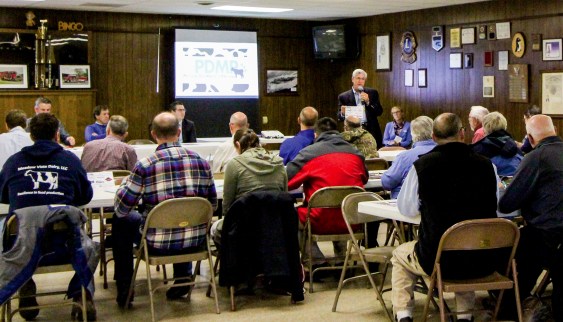
PDMP executive director Alan Novak opens the discussion to questions from the 60 dairy producers and industry representatives gathering at the Bainbridge Fire Hall on November 14 for the Professional Dairy Managers of Pennsylvania’s (PDMP) Fall Issues Forum focused on dairy markets and trade.

Also driving milk production and processing west are the incentives western states provide for new plants, new dairy operations, and growth of existing businesses. For example, the I-29 corridor of the Dakotas is an area that has lots of capacity, is building more, and has dairies, like Riverview, adding cows in a big way.

Indiana and Michigan are other examples of states becoming big dairy suppliers via Select Milk Producers and Fair Oaks. Colorado’s growth is fueled by Leprino, and Texas has multiple growth influencers, including line extensions by Hilmar.

Taken together, the U.S. has grown milk production by 17 to 18 billion pounds of annual production over the past five years, according to Wegner. That’s like adding another Pennsylvania and Minnesota to the nation’s milk load. Wegner said that boils down to 50 million more pounds of milk per day moving in the U.S. compared with five years ago.

Wegner also talked briefly about Land O’Lakes’ base/excess plans. “This is our way of putting some discipline into the discussion, which goes to our market-back approach,” he said. “We moved a lot of milk from our milkshed this year, and that long milk has a cost. At the same time, he noted that Land O’Lakes has been stripping and dumping milk here, that its producers are assessed to pay for that.

“We worked with DFA (Dairy Farmers of America) and DMS (Dairy Marketing Services) on this step to do cream salvage,” he added.

Land O’Lakes’ view of investing in processing is that the products have to be able to move along the value chain in order to produce more of them.

-30-

How will fake milk, fake meat be labeled and regulated?

Say, what? New twist on standards of identity: How will fake milk and fake meat be labeled and regulated?

cows.jpg

In a time when many people have lost their connection to the values and sustainability of the circle of life, cattle have been getting an undeserved bad rap on everything from diet to environment to compassion. On all three counts, the anti-animal agenda lies behind the false narrative that is leading us down a dishonest path to more fake concoctions of ill-fated science fueling profits at the expense of our physical and emotional health and the health of the planet. Fake meat and fake milk are funded by billionaires, genetically engineered by USDA, initiated as the brain children of Silicon Valley techies, with partnership from the biggest names in corporate agriculture. Noble goals of ending hunger are the defense, but it’s difficult to believe that when we have surplus dairy and meat protein produced naturally with the real problem of hunger coming down to distribution and waste. This so-called solution has the potential to quietly dictate food choices, markets and livelihoods.

By Sherry Bunting, updated since first published in Farmshine, November 21, 2018

WASHINGTON, D.C. –  “Dairy reinvented: Sustainable. Kind. Delicious,” is the tagline of Perfect Day’s website.

“Better meat, better world” are the words that jump from the Memphis Meats website.

To be more specific, Perfect Day’s mission is to “create a better way to make dairy protein, the same nutritious protein found in cow’s milk…without the help of a single cow.”

Meanwhile, at Memphis Meats, their mission is “To bring delicious and healthy meat to your table by harvesting it from cells instead of animals… feel good about how it’s made because we strive to make it better for you… and the world.”

On the fake meat side, Memphis Meats received Series A funding from four sources in August 2017: venture capitalist DFJ, billionaire investors Bill Gates and Richard Branson, and Cargill. In January of 2018, Tyson came on board as an investor.

On the fake dairy side, Perfect Day received its Series A funding from Singapore and Hong Kong venture capital and investment companies that have relationships with some of the largest food and beverage companies and brands in the world, according to a company news release. In addition, Continental Grain was part of the early investment, and in November 2018, Perfect Day announced a partnership with Archer Daniels Midland (ADM).

The big question, at present, is how will these proteins be regulated and labeled?

The discussion is converging with FDA’s nutrition innovation strategy and modernization of standards of identity (especially dairy standards of identity), along with parallel hearings and comment periods on how to regulate and label the ‘meat’ version of lab-created cellular proteins.

Make no mistake about it folks: Both of these processes involve genetic engineering start-to-finish.

Perfect Day (fake milk protein), for example, sources yeast from USDA research labs that has been “genetically-altered” to include bovine protein stimulators and synthesizers.

Memphis Meats (fake meat) uses animal cells, mainly bovine and poultry, from cell banks that have been edited to grow only desired muscle cells — separate from their whole-animal source.

The fake dairy protein would be the end-product of the fermentation of the genetically-altered yeast, while the fake meat protein would be the protein blobs that grow from the genetically-edited cells, using neonatal bovine serum — or a plant chemical substitute that is under development — as a growth “on” button.

Both systems would require energy feed sources, using a sugar and/or starch substrate to feed the growth.

Both processes would produce waste streams.

The dairy version are grown in fermentation vats. The meat version in bioreactor towers.

While opinions vary on how quickly these technologies can scale, it is clear that the technologies are well-funded, and that agriculture’s top-tier food supply-chain processors and distributors are partnering.

We must continue to let FDA and USDA know what farmers and consumers — the two ends of the supply chain that need to be talking to each other — feel about the potential of these technologies to create captive-supply market control using interchangeable proteins in common manufactured dairy products or as protein enhancements for plant-based beverages, as well as to stretch boneless beef and poultry products with fake counterparts, namely as ground beef, hamburger, meatballs and chicken tenders and nuggets.

In a press release Friday, November 16, the U.S. Food and Drug Administration (FDA) and U.S. Department of Agriculture (USDA) announced that they will “jointly oversee the production of cell-cultured food products derived from livestock and poultry.”

There has been no similar FDA PMO-regultory process established for the fake milk proteins.

USDA and FDA had a public meeting in July and October to discuss the use of bovine and poultry “cell lines” to develop these cell-cultured, lab-created foods.

In fact, meat industry stakeholders shared their perspectives on the regulation that is needed to “foster these innovative food products and maintain the highest standards of public health,” said FDA commissioner Scott Gottlieb in an official FDA statement in November.

USDA and FDA announced their “agreement on a joint regulatory framework wherein FDA oversees cell collection, cell banks and cell growth and differentiation. A transition from FDA to USDA oversight will occur during the cell harvest stage. USDA will then oversee the production and labeling of food products derived from the cells of livestock and poultry.”

As FDA and USDA are “actively refining the technical details of the framework,” some of the aspects of the framework are said to include robust collaboration and information-sharing between the two agencies to allow each to carry out our respective roles.

The well-funded startups and their lobbying organization Good Food Institute (a misnomer in this author’s opinion) had pushed for FDA to control labeling and inspection knowing that if USDA were in charge, their efforts to scale production would be slowed.

In view of this joint approach between FDA and USDA, the original public comment period about cell-cultured ‘meat’ had been extended to December 26, 2018. Comments can be seen at the FDA docket at https://www.regulations.gov/document?D=FSIS-2018-0036-0001  and there are thoughts that this comment period could be extended again as has the dairy standards of identity comment period.

Meanwhile, on the lab-created ‘dairy’ protein front, Perfect Day, a Silicon-Valley startup, announced in a press release in November that it has formed a partnership with ADM, an agricultural processor and food ingredient provider with a mission of plant-to-plate collaboration throughout the food industry.

In fact, ADM will provide facilities for scaling this technology as part of the deal.

This partnership is billed as “teaming up” to begin supplying “the world’s first animal-free dairy proteins to the food industry in 2019,” according to Perfect Day.

“Animal-free dairy proteins will not only offer consumers the option to have a lactose-free, animal-free alternative to conventional animal-based dairy, but also provide a portfolio of nutritious and functional, high-purity proteins with similar taste and nutrition profile of dairy proteins for a wide range of food and beverage applications,” Perfect Day said in their press release.

Meanwhile, the FDA has extended — yet again — its invitation for information specifically on “the use of names of dairy foods in the labeling of plant-based products.” So far, 10,043 comments (as of December 28, 2018) have been received on this docket. To comment by the new deadline of January 28, 2019, go to the docket online at https://www.regulations.gov/docket?D=FDA-2018-N-3522.

Dairy checkoff-funded DMI completed a survey of consumers recently showing that 73% are confused about the differences in nutrition between real dairy milk and plant-based alternatives calling themselves ‘milk.’

Other surveys show that more than half of U.S. consumers want healthy foods with ‘clean’ labels having few ingredients and limited or no processing.

It would seem that these findings, among others, would indicate clearly to FDA and USDA that consumers want no more monkey-business when it comes to their food, that they want to see clarity in the enforcement of milk and dairy standards of identity, and that they want to be informed about look-alike ingredients made in laboratories instead of in the time-honored land-and-animal care-taking profession of dairy and livestock farmers and ranchers.

One thing to keep in mind when commenting is to highlight the fact that over half of U.S. consumers want food that does not have a long list of additives and that is minimally processed.

That, on top of nutritional differences and new unproven processes, are enough reason to aggressively label any food containing either the fake dairy or fake meat protein because standards of identity are in place not just for health and safety but also to prevent fraudulent misleading of consumers.

Consumers should know what they are buying and be able to choose food based on their beliefs about what is a better world, not someone else defining what is kind and good and sustainable for them and not using the government’s currently flawed dietary guidelines to decide for consumers what is deemed “healthy.”

Let FDA and USDA know that we as consumers and farmers want clear labeling if these technologies are going to scale into our food system. We want the fake versions to have all of the inspection rigor that real dairy and meat proteins are subjected to.

Above all, we do not want the government quietly removing — via its one-size-fits-all nutrition innovation strategy — our ability to choose foods and production methods with which we want to nourish our bodies and on which we wish to spend our hard-earned money.

This may come down to a battle between fake animal protein ingredients funded by billionaires aligned with Silicon Valley startups and partnered by the biggest names in corporate agriculture vs. a collaboration between individual farmers and ranchers who are the backbone of our nation, the stewards of land and livestock, along with the public at-large, the consumers who are confused by the lines that are blurring.

Now, more than ever, both ends of the supply chain — farmers / ranchers and consumers — need to engage with each other directly — and not through the industry-scripted mouthpieces.

Stay tuned.

-30-

How do we unwind a trend that demonizes and suppresses a food group?

NESAWG(Philly)3890.jpg

A dairy panel with Mike Eby, Nina Teicholz (center), Lorraine Lewandrowski and John King (not pictured) was eye-opening to food-interested people at the 25th NESAWG conference in Philadelphia. Minds were opened as food policy influencers report weeks later some are reading Teicholz’s book The Big Fat Surprise, and it is changing their thinkingAllied Milk Producers helped sponsor this panel. Stay tuned. 

JUNK NUTRITION SCIENCE STILL RULES DIETARY GUIDELINES

25th NESAWG brings dairy to table in Philadelphia 

By Sherry Bunting, Farmshine, December 14, 2018

PHILADELPHIA, Pa. — Justice, power, influence… Balance. How do people unwind a trend that demonizes and suppresses a food group?

How do Americans have faith in an increasingly globalized food system that gives them choices, but behind the scenes, makes choices for them?

How do urban and rural people connect?

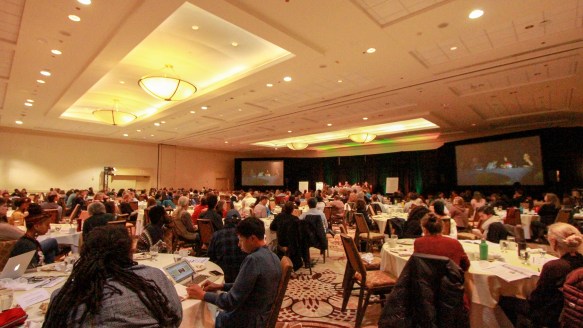
These questions and more were addressed as hundreds of food-interested people from all backgrounds and walks of life gathered for two days in center-city Philadelphia recently for the 25th Northeast Sustainable Agriculture Working Group (NESAWG) conference.

webNESAWG9725

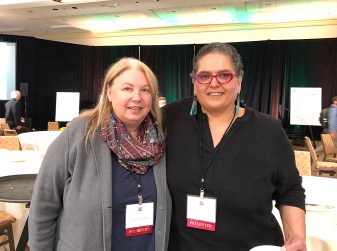
Lorraine Lewandrowski (left), a central New York dairy farmer and attorney, talks with Niaz Dorry of NFFC. Dorry spoke on the opening panel about her 67,000-mile tour of rural America, urging others to “meet the farmers where they are.” Lewandrowski spoke about the ecology of rainfed grasslands in the Northeast and the struggle of family dairy farms throughout this landscape.

For Niaz Dorry of the National Family Farm Coalition (NFFC), the answer is simple: “Get out into the countryside and meet the farmers — where they are,” she said, during the opening panel of the conference as she talked of her recently completed America the Bountiful tour, driving over 67,000 miles of countryside — coast to coast.

Dorry also touched on the dairy crisis. “Go and experience their grief with them. Be with them at milking on Tuesday and see them sell a portion of their cows on Wednesday — just to make payroll.”

Pennsylvania Secretary of Agriculture, Russell Redding echoed this theme during the lunch address as he said agriculture is “zipcode-neutral,” that we need to forge “a more perfect union in our food system” but that the future lies in “differentiating” agriculture here.

NESAWG(Philly)9757-Redding

“We see our future — and our long-term investments in Pennsylvania — driven by differentiation…” said Pennsylvania Ag Secretary Russ Redding.

“It’s nice to be with folks who understand the power of food to change lives,” said Redding as he mentioned rooftop gardens, urban brownfields and Pennsylvania’s rank as number two in the nation for organic sales.

“We see our future — and our long-term investments in Pennsylvania — driven by differentiation, by being able to grow and produce and market organic agriculture,” said Sec. Redding.

With the NESAWG goal to “cultivate a transformative food system,” panels and breakouts covered topics from building networks and insuring equity among sectors to understanding urban food trends and ways to position Northeast agriculture within the power grid that ordains the direction of mainstream food production, processing and distribution today.

A breakout session on building “farm-to-school” hubs, for example, gave attendees insight for getting more fresh, local foods into school meals. Presenters talked about obstacles, and how they are navigated, about martialing available resources, identifying networks, working in collaboration with others, piloting ideas and growing them. Farm-to-School began in 2007, and it is growing.

Another breakout brought a panel of dairy producers to share with urban neighbors the crisis on Northeast dairy farms. The panel featured the work of dairy producers Jonathan and Claudia Haar of West Edmeston, New York, who spoke about consolidation that has been underway for decades in dairy.

But it was an afternoon panel — Milk Economies, Ecology and Diet — that put dairy and livestock producers squarely in the realm of hope for a re-wind.

Keynoting this panel was Nina Teicholz, author of The Big Fat Surprise and founder of The Nutrition Coalition. She covered the history of current government Dietary Guidelines and how rigorous studies have been ignored for decades because they don’t “fit” the narrative on saturated fats and cholesterol.

She was joined by dairy farmer and attorney Lorraine Lewandrowski of Herkimer County, New York, who spoke on dairy ecology and how the rainfed grasslands and croplands of Northeast dairy farms are a haven to wildlife, especially important species of birds and butterflies and pollinators.

They were joined by Mike Eby and John King of Lancaster County, Pennsylvania, representing National Dairy Producers Organization and Allied Milk Producers. The two men spoke on the dairy economy and what is happening on family dairy farms, struggling to remain viable.

“The land is most important to us,” said Lewandrowski about her deep love of Honey Hill, where her family has farmed for four generations. While, she is an attorney in town with farmers among her clients, she also helps her brother with the farm and her sister with her large animal veterinary practice.

Lewandrowski is known as @NYFarmer to her over 26,000 followers on Twitter — generating over 75,000 interactions from nearly a quarter-million tweets in the past 10 years!

She described a reverence for the land and its wildlife — cohabitating with a rich agricultural heritage and sense of rural community that exists within an afternoon’s drive of New York City.

“We have land that is rich in water,” she said with a nod to a dairy industry consolidating into regions that rely on irrigation.

“Our lands are rainfed: 21 million gallons of water run through our farm with an inch of rainfall,” she said. “Our farms are diverse across this landscape. But our farmers are going out of business in this economy. So many of these farms are then turned into urban sprawl. What will become of the people, the land and its wildlife?”

Lewandrowski talked about identifying bird species on their farm, of the crops and pasture in dairy operations, and the economic hardships she sees firsthand. She shared her vision of Northeast rural lands and what they bring to urban tables and communities.

Introducing Teicholz to an audience primarily of urban people, Lewandrowski shared how dairy farmers feel — working hard to produce healthy food, and then contending with poor prices driven by regulations that suppress its value.

“I didn’t know why our food is not considered good and healthy. Nina’s book gave me hope,” she said. “We are fighting for our land, and yet the vegans are so mean. When our farmers go out of business, they cheer on social media. They cheer when our families lose everything. But the land and wildlife lose also, and the vegans cheer.”

Teicholz traced the history of her 10-year investigation that led to The Big Fat Surprise: Why Butter, Meat, and Cheese Belong in a Healthy Diet. It started with a newspaper assignment on dietary fat.

NESAWG(Philly)9769

Nina Teicholz explains the revelations of a decade of investigation leading to The Big Fat Surprise. In the 5 years since publishing, farmers seek her out to thank her. She says she never realized how it must feel to be a dairy or meat producer — producing a healthy product while being told it is not healthy and seeing your livelihood pushed down by faulty dietary controls.

“Before I knew it, I had taken this huge deep-dive into fats and realized we have gotten it all completely wrong,” said Teicholz, a former vegetarian for 25 years before her research.

“I’m here to speak today because I found Lorraine’s twitter account and fell in love with her photos and stories from the dairy farm,” said Teicholz. In the nearly five years since her book was published, awareness of ignored science has been raised.

A California native, living in New York City, Teicholz described herself as an urban person and how surprised she was to hear the stories from farmers about how her book and her work gives them hope.

“It breaks my heart to now realize that — after all this time — the dairy farmers and meat producers have been led to feel that there is something wrong with the food they are producing, and to see how vegans go after these farmers, and now after me too,” Teicholz related.

“How did we come to believe these things that led to the decline in foods like whole milk, and have pushed down the producer?” Teicholz traced the history of dietary caps to the theory of one researcher — Ancel Keys from the University of Minnesota.

“Concern about heart disease in the 1960s led to many theories. The diet-heart hypothesis of Ancel Keys was just one theory, but he was unshakably confident in his own beliefs, and he was considered arrogant, even by his friends,” said Tiecholz.

“When the American Heart Association nutrition committee first supported Keys’ recommendations — even though the scientific evidence was very weak — that was the little acorn that grew into the giant oak, and it’s why we are where we are today,” she explained.

Methodically, Teicholz took her audience through the science that was used to support Keys’ theory, as well as the many more rigorous studies that were buried for decades.

In fact, some of the very research by the National Institute of Health (NIH) that had set out to prove causation for Keys’ theory was buried in the NIH basement because “the results were so disappointing to that theory.”

The studies that did not validate Keys’ theory — that fat in the diet is the cause of heart disease, obesity and other diseases — were suppressed, along with the studies that outright refuted his theory. A steady drumbeat of science — both new and exposed from those earlier times — shows a reverse association and causation.

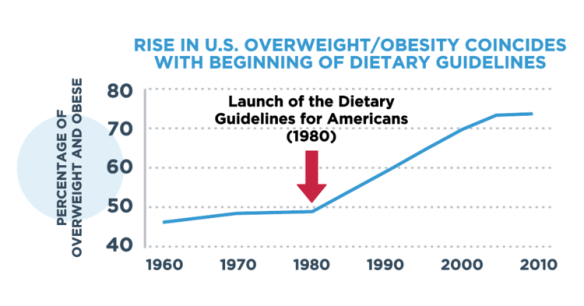
48329399_2290819234570553_8398919649542012928_n.pngIn fact, since the Dietary Guidelines capped saturated fat in the 1980s — becoming progressively more restrictive in requiring lowfat / high carb diets — the data show the association, that Americans have become more obese, with higher rates of diabetes and heart disease.
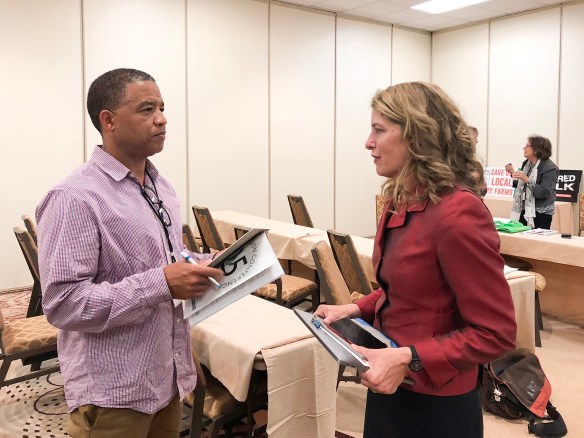
“It feels like the battle is endless,” John King said as he spoke of the real struggle on dairy farms and of selling his dairy herd in 2015. “But it is rewarding and encouraging to see what people are doing to expose the truth now.”

King posed the question: “Do urban communities really care about rural communities? If not, then we are done. Our food will come from somewhere else and the system will be globalized.

“As farmers, we care about what we produce, and we care about our animals,” he said. “What happens to us on our farms trickles down to the urban areas. It’s an uphill battle to try to go against the status quo, and we need urban communities to care if we are going to be successful. It comes down to whether urban and rural care about each other. Do we care about our neighbors?”

Teicholz sees the U.S. being in the midst of a paradigm shift. However, it is taking time for the Dietary Guidelines Advisory Committee to change and open up to the science. She noted that in the 2015-2020 guidelines, the caps were removed for cholesterol, but they were kept in place for saturated fat.

“The cholesterol we consume has nothing to do with blood cholesterol,” said Teicholz. “The body produces cholesterol, and if we eat fat, our body makes less of it. It is the science that remains buried that needs to continue to surface. People need to know that the fat you eat is not the fat you get.”

She cited studies showing the healthfulness of full-fat dairy, that drinking whole milk and consuming the healthy fats in butter, beef, bacon and cheese are the fastest ways to increase the HDL ‘good’ cholesterol in the bloodstream.

It is the saturated fat caps in the current guidelines that are the reason whole milk, real butter, beef, and 100% real cheese are not served in schools today, said Teicholz. She showed attendees how these recommendations drive the food supply.

“The recommendations are allowing children to have whole milk only for the first two years of life, after that, at age one or two, children on skim milk,” she said. “The recommendations drive what we eat whether we realize it or not.”

She showed how the current flawed Dietary Guidelines drive the diets of the military, school children, daycare centers, WIC programs, hospitals, prisons, retirement villages. And these recommendations are downloaded by foodservice and healthcare: physicians, dieticians, nutrition services, foodservice menu guides. They are driving how dairy and meat products are presented in restaurants, fast food chains and other menus of choice. They are driving the current FDA nutrition innovation strategy that is working on a symbol for “healthy” and looking at modernizing standards of identity to accomplish these nutritional goals that focus on lowfat / high carb diets.

“Meanwhile, it is the unsaturated fats, the new products in the food supply, that are negatively affecting us and those are all there… in the USDA feeding programs,” Teicholz pointed out.

Others in the panel discussion pointed to an anti-animal view, that cattle are bad for the planet in terms of climate change. These views perpetuate the current dietary guidelines. In fact, in 2015, the Dietary Guidelines Advisory Committee attempted to introduce “sustainability” guidelines on what they deemed “healthy” for the planet into these guidelines, officially.

This is the ecology side that Lewandrowski addressed, showing urban food influencers how the concept of sustainability is being overtaken and systemized and how Northeast dairy farmers have a great story to tell that is being ignored, drowned-out.

“We have to think about how the shifts are occurring in the food system and manage those shifts. We can work together and make change happen,” said Mike Eby, articulating the message of National Dairy Producers Organization (NDPO), seeking to work with the system to manage farmers’ interests.

Allied Milk Producers helped sponsor this dairy panel, and Eby said that whether it is milk promotion through Allied, membership in NDPO, or supporting the buying and donating of dairy products through Dairy Pricing Association (DPA), it is important for people to participate.

NESAWG(Philly)9741.jpg

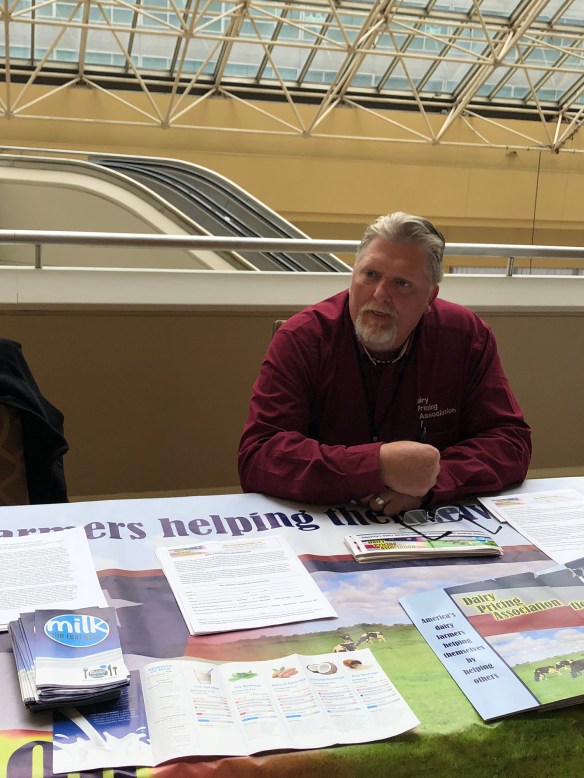
Mike Eby and John King brought Allied Milk Producers materials — and plenty of milk — to the NESAWG conference in Philadelphia. Amos Zimmerman also had a booth for Dairy Pricing Association.

He gave examples of how Allied and DPA — funded by farmers — are reaching out to consumers, schools, urban communities with donations of product and a positive message.

“We need more people to get involved to fix these issues, and to create a system that supports its producers and stabilizes prices,” said Eby.

“We need to reach out and work together as urban and rural communities,” added Lewandrowski.


NESAWG(Philly)3802.jpg

Hundreds of food-interested people from all backgrounds and walks of life attended the 25th Northeast Sustainable Agriculture Working Group conference in Philadelphia, where networking from urban to rural looked at regional solutions.

NESAWG9779

NESAWG9729

NESAWG9748.jpg

webNESAWG9759


Cutting costs, connecting consumers, striving to keep joy in dairying: Dairywomen share insights, Part Three

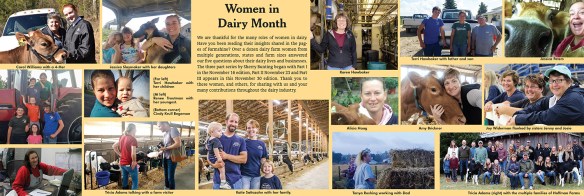
AUTHOR’S NOTE: It’s the last week of November, the month to celebrate women in dairy. A dozen women from multiple generations, states and farm sizes responded to the same five questions in this three-part series. Part One “Being Real” ran in the November 16 Farmshine, Part Two “Faith, friendships, fighting for each other’s survival” ran November 23 and this is Part Three, which ran in the November 30 Farmshine.

Bunting-0841

Even our animals know that no matter where or who is your support group, the important thing is that you have one. They, too, are counting on us to tell our story, we all have one.

By Sherry Bunting, Farmshine, November 30, 2018

BROWNSTOWN, Pa. — Communicating with dairywomen about the challenges and opportunities in dairy today continually circles back to the economics. On many large and small family dairy farms, there is some diversification, so the low prices right now for all commodities are trying. But these women also see opportunities for better pay prices in the future through communication with consumers, changes in dietary recommendations and reaching out into the world of specialty markets.

Answering questions while attending a Penn State cheesemaking course recently, Amy Brickner in south central Pennsylvania says she “feels strongly that the only way small farms are going to continue is through the processing and marketing of premium dairy products locally, which also ensures that people are invested personally in where their food comes from.”

She describes herself as a “slightly unconventional dairywoman.” She still acts as herd manager on her family’s 160-cow dairy while moving to her fiance’s 100-cow dairy farm in charge of herd management and records and looking to add a milking robot. Both farms are three and four generations in dairy farming, and like others, dairying is both a business and a heritage that brings a passion for cow care and quality milk to the table.

In south central Wisconsin, fourth generation dairy farmer Cindy Krull Begeman also cites the generational passion for dairy in families like hers. But, like others, she views the future with heavy doses of practicality.

“Low milk prices are making it very hard to want to pass the farm on to the kids,” says Cindy. “As a parent, we always want better for our kids. Even though we love our cows, it is pretty hard to want our kids to struggle like we are now.”

Pulling in a positive direction during difficult times is something Cindy is no stranger to. After the death of her husband eight years ago, she talked with her children about what to do with the farm and the cattle.

“This farm had been in Brian’s family for three generations. The kids were 17, 14 and 10 at the time and very involved in 4-H and FFA. They wanted to at least keep a few cows around to keep the cow family lines going after their father and I had worked so hard to breed them,” she recalls. They sold half the herd at that time and slowly started to rebuild with embryo transfers out of their favorite cow families. They milk 50 registered cows in a tie-stall barn and run 350 acres of crops along with some pasture.

While Cindy still owns and manages the farm, her daughters do the matings and are involved in the genetics and her son is working in the industry. Last year, she took a job as herd manager of a 300-cow robotic dairy in northeast Iowa where they bottle milk and make cheese and ice cream. Having remarried and relocated near Sioux Falls, her youngest daughter attending Iowa State and with her younger brother and his family helping with the cows and crops on the home farm in Wisconsin, the situation works, and her lifelong involvement in the dairy industry gives her both a broad and narrow view of the future.

Specifically, she says they have taken many practical steps in this down market — cutting back on everything extra that they can from the feed bill and the vet bill. They take extra jobs off the farm, sell extra equipment, clean out the closets and sell extra clothes to buy new.

Terri Hawbaker has also sharpened her pencil at Grazeway Dairy in central Michigan. Having worked full time on the farm as she and her late husband Rick purchased it from her parents in 2002, she also went through a transition when Rick passed away nearly three years ago. Her children will be the sixth generation on the farm and the third on the homestead. She and the children operate the farm, along with employees, and Terri’s parents manage the heifer ranch rented for youngstock and hay.

“This allows (my parents) some additional income in their retirement years, yet they can travel when they want,” says Terri, adding that her parents help when needed in hay making, parts running and food preparation.

“Each dairy will have its own unique challenges and different opportunities, depending on their goals and vision… and available markets,” she points out, noting their current ongoing challenge is “to be as efficient as possible with the resources available without taking all the joy out of dairy farming.”

Like Amy, Terri also observes that with markets being limited, “quality is a must in order not to lose the market you have. Opportunities for a dairy of our size include more out-of-the-box thinking, such as A2 genetics, suppliers for specialized products, agritourism, and educational and training opportunities for others.”

She also believes it’s important to do what is right for the individual farm, not necessarily what the recommendations are from others.

“Every farm went into this slump in a different financial situation, and that will determine, somewhat, their outcome,” she says as a matter of reality. While she has taken very specific actions in 2017, she says “it boils down to continuing to work on efficiency.”

She is quick to point out that what is efficient time-wise and what is efficient financially can be different. “At the end of the day, it’s money-in vs. money-out,” she says, and she weighs the money-in / money-out with the “comfort and convenience” before making a decision.

One example is her reduction of custom work costs by taking more of that on themselves. “For example, hauling the hay from our rented farm takes twice as long doing it ourselves, but remember, it’s money-in vs. money-out.”

Other advice she takes seriously is to challenge how things have always been done and rethinking things that don’t have a good “why.”

One area she is most open to is different ways to feed the cattle that may be more financially efficient. For her herd, it’s grazing, and simplifying the grazing system has been a key to it.

Terri is also set on “clearing the clutter.” She says it helps to simplify, to sell excess machinery, to clean up the scrap pile. “Clearing the clutter not only brings you down to the core of what you actually need, it creates a more clean and peaceful work environment.”

And when it came to replacing a full-time employee, she opted to split responsibilities and take more on for herself by rearranging her work day. “I don’t get paid by the hour, so I am driven to get the work done, yet gentle on equipment because repairs come out of my pocket, essentially.”

Along with that, she evaluates the skill of her employees working on equipment and believes in communicating not just the how, but also the why, when explaining the importance of being gentle on equipment. She explained to employees that a recent skid loader repair of $4777 leaves less “in the pot” for raises and bonuses.

For Jessica Slaymaker of northern Pennsylvania, the challenge is real after she and her husband built the freestall barn three years ago milking 150 cows. She works mainly on the cow side “a herdsman who knows how to run a skidsteer,” so to speak. Before marrying Dan, Jessica was herdwoman at her parent’s nearby 600-cow dairy.

“I don’t think anyone thought this downturn would last so long,” says Jessica. “It is making us try to think smarter and be more efficient, but it is mentally, physically and emotionally draining.”

But she sees the opportunities for the future, “When things finally do turn around, I think we have a lot of potential here. We have good genetics and can hopefully market extra replacements. We also breed the lower 25% of the herd to beef bulls and that boost in income is helping too.”

In Mississippi, Tanya Rushing sees the challenges in market access after plant closures. She partnered with her father in the 80-cow dairy until she bought him out in 2017. She’s the third generation to dairy there, and her husband works off the farm but helps with mechanical work and wherever else he can while their son now works part time on the farm with the intention of carrying the farm into a fourth generation once he’s out of school.

As sole owner and operator now, Tanya has two employees to help with milking and other labor. She, too, relies on good grass management and hay.

“To me, the challenges and opportunities facing the dairy industry go hand-in-hand,” says Tanya. “The difficulties are forcing many farmers to close their barn doors, and I hate to see it happen. But I also feel that a change in economic policies, as well as new dietary recommendations concerning butter and whole milk will improve on-farm pay prices in the future.”

She cites the need for positive agricultural and animal advocacy, which “forces farmers to stepout of their tractors and tell their farm stories to the public,” says Tanya. “Consumers want and need to know the voices behind where their food comes from. Advocacy is an integral part of the future of dairy, and we all must strive to educate people every chance we get.”

For Tricia Adams in northern Pennsylvania, it’s easy to identify the challenges in dairy right now, and she spends a lot of her time working on the solution side. “You feel helpless and disappointed to see milk sold as a core staple while watching so many other products like soy and margarine replace your product to where now we have to defend our product and can’t seem to backpeddle fast enough,” she says.

Tricia and her three brothers own and operate Hoffman Farms as the transition is in process from her parents Dale and Carol Hoffman who moved from Snyder to Potter County with 35 cows in the 1970s. Today, they are milking 800. In addition to her many roles feeding calves, managing employees and working in the office, Tricia helps educate consumers through the farm’s Facebook page and giving school and community tours for many years.

The questions come into the page and even to her personal facebook page. “Even my friends start questioning things that dairy farmers do that they don’t understand. I explain what we do and try to be upbeat.”

She also has worked on ideas to get better milk in the schools because when the school tours come to the farm, the kids always say “Oh, it’s the GOOD milk.” They always serve whole white and whole chocolate milk on their tours to put dairy’s best and most nutritious foot forward, and she finds that she has to order it ahead of time from the grocer to make sure there’s enough whole milk for her events.

“There has got to be better access to our products,” says Tricia. “I go to a restaurant or on college visits with my kids and look for the milk. I go to the store and find whole milk few and far between, but plenty of 1% milk. Our teachers in the schools want to change the milk also, but run into the red-tape.”

At Hoffman Farms, the second and third generations are starting to look deeper at what they can do to become more self-sufficient. They, too, are using beef bulls on some of the herd and recently began marketing custom beef, locally.

“As farmers, I think we have to take charge of our livelihoods again and come back full-circle to marketing our products,” Tricia observes, explaining their recent diversification into selling beef. “We have consumers. They want to buy from us as farmers. So we are thinking a lot about how to build even more relationships with consumers.”

The scariest part of the future, says Tricia, is “not knowing when to make the critical decision to stay in or exit. We’re in this so far. It’s our life and our livelihood, our family homestead. The time to retire out has come and gone, so we’re at a point where we will keep going. Our backs are against the wall, and that is forcing us to look at other ideas.”

She relates something her father always says. “Everybody has to eat, meaning farmers will always have a job, but sometimes it seems not to be the case. If we can’t have our products where they need to be and are losing future milk drinkers because the milk at school isn’t filling and yummy anymore, it makes things more difficult to shape that secure dairy future.”

Having middle-schoolers read The Omnivore’s Dilemma as part of the New York curriculum is another hurdle, but it also gave Tricia’s daughters the opportunity to speak up and invite the class to the farm to see how modern dairies really do take care of their cows.

In every aspect of life, Tricia sees opportunities to tell dairy’s good story, and she embraces that challenge. “It’s essential because the consumer is bombarded with so much misinformation and we have to be active in turning it around.”

Cindy sees this too. “One of the best things as a woman dairy farmer is that we get to tell our story to everyone, every chance we get. Whether it’s coffee hour at church, or some other opportunity, we can take milk and ask if anyone needs it, then bring up how important milk is and how bad things are for farmers across the county,” she relates. “We have to tell our story. We all have one.”

She also finds real value in networking with others. “We all need to learn, to get out and talk with other farmers,” she emphasizes, “because we are all in this together, and we all understand each other. We are not alone!”

Socializing with like-minded individuals is also important to Tanya. “It helps me to feel not so alone with the day-to-day challenges, to blow off steam with ladies who ‘get it,’ and discuss the fine lines between being a farmer, a business owner, a mom, wife and daughter.”

For Jessica, Dairy Girl Network has been “a Godsend. It is a lifeline to women who know what you are going through and deal with day-to-day,” she says. “Being involved so heavily in the daily activities on the farm can make a person feel isolated; however, with Facebook and the Dairy Girl Network page, I can go there while eating lunch, or milking a slow side of cows, and interact with women from all over the U.S. To me, that’s amazing. Everyone is there to answer questions, offer guidance, or just to listen and comfort. It’s an amazing group of women that I am proud to be a part of.”

Tricia also gets on the DGN page. “I love it because there is nothing negative on there,” she says. “We may complain, but it’s not a negative pointing of fingers.” She also wants to start a group of women meeting in her area because “we have other things in common too. It’s good to find the fun things, to share pictures of our kids on the farm, or a new ice cream recipe or collaborate on what kids can take to school for snacks or even inspiration for designing farm logos. It helps to be connected.”

For Amy, being part of the Dairy Moms facebook group has been one of her best support teams. “It is 100% the most positive group of women, and no matter what kind of day you are having, or what struggle or triumph any one in the group is having, we are all supportive and understanding, and ready with positive comments and help,” she notes.

Terri follows different networking groups through social media, as well, and she focuses on groups that cater to the grazing systems. “I view farming as a business, and just like other industries, there are males and females and the percentages vary,” she says, noting that the important thing for her has been having “a few very close friends that have gone through all the trials and celebrations with me… and a few mentors that I call upon.

“No matter where or who is in your support group, what matters is that you have one.”

-30-

CenterfoldCollageDairywomen.indd

Faith, focus, friendships, fighting for each other’s survival: Dairywomen share insights, Part Two

AUTHOR’S NOTE: A dozen women from multiple generations, states and farm sizes respond to the same questions. Part one and Part three also ran… here below is part two

By Sherry Bunting, Farmshine, November 23, 2018

BROWNSTOWN, Pa. — When asked what challenges and opportunities women see for dairy farming today into the future, “sustainability” comes to the forefront, but not in the way we often see this term used.

“The biggest challenge is, of course, sustainability… Can we survive!?” writes Joy Widerman, the youngest partner-owner of the second generation of the Hess family operating JoBo Holsteins, a 1075-cow dairy that grew to include multiple families and generations after her parents John and Bonnie relocated from Lancaster County to Adams County, Pennsylvania in the 1970s.

Joy is herdswoman and takes care of reproduction and genetic decisions, so she is continually looking ahead at the registered Holstein and Brown Swiss herd’s future.

“We are doing everything in our power to be profitable, but with so many unknowns in the dairy industry, it’s hard. From milk prices to feed prices, to weather — farming is one of riskiest jobs to have,” Joy relates.

She wonders how dairy farms will “make room for future generations to join.”

Profitability is the key to achieving that, and experts suggest diversification.

“But with the market as scary as it is,” writes Joy. “How do we do that? These are questions my family faces everyday… What’s next?”

Alicia Haag of Mohrsville, Pennsylvania also talks about the uncertainty. “We don’t know what tomorrow brings,” she says. “So we clamp down hard on our faith and try to feel the blessings of having this opportunity to grow up in America and be blessed with what we have at the moment.”

Alicia finds it difficult to see all the herd dispersals happening, and she tries “not to dwell on the bad” and to remain thankful to have children with a keen interest in the farm that has been in her husband’s family for seven generations.

She and her husband Mike milk 76 registered Holsteins in a tiestall barn. She takes care of the night milking with her daughter and occasional help from a neighbor. She is responsible for calf care and feeding, and helps anywhere else she is needed. She has also been working off the farm as a construction-zone flagger for a local contractor since 1999.

In the last year or two, Alicia has increased her off-farm hours, working two or three days a week, every week, to help bring income back to the farm. She often flags beside other local dairywoman on job sites all over.

“It’s hard for moms to find a job off the farm that provides good enough pay to make income after paying the help that replaces you at home,” Alicia notes. “There aren’t many jobs that also give the flexibility I need to be able to successfully be a mom and farm wife.”

She hopes other employers will consider flexibility the next time they consider employing a farm wife.

“If we want to help the farming industry remain here, having off-farm jobs that offer a little flexibility could be a key,” Alicia suggests. “Employers should know that when they hire a farmer’s wife, they are getting someone who is going to come in and give 100%.”

This year has been particularly stressful on farm families, she observes: “We are tired between the economic stress and the weather. It’s hard to get yourself out of the funk. Trying to get crops off when you know the income isn’t there with milk prices, so you’re trying to do the crops right to get by with the income you have.”

The Haags, like others, had extra expenses with replanting and not being able to get forages off the fields timely this season. In times of stress, she cites the special importance of family, friends and networking with others as a way to rejuvenate optimism — whether it’s getting together with friends, a hug from someone who understands, or the ideas and support gleaned in a network of other farm women.

While there isn’t much time for it, Alicia loves sitting on her front porch and talking with her kids. “Most of the corn is off, and the cover crops are just starting to peek through,” she describes the November scene as a metaphor. “This is life — looking out, everything looks dead, but I know that in this field there are seeds planted, and it will soon be green again.”

For Karen Hawbaker of Chambersburg, Pennsylvania, living in faith surrounded with people who share her values have been keys to getting through the toughest of times.

“We can’t do life alone,” she says, noting the good in getting away, mentally and physically, even if just for a few hours. She believes dairy farmers need this, and sometimes the ‘one more thing to do’ can be replaced with ‘it can be done tomorrow.’

Karen started dairy farming with her late husband Rodney in the 1980s. Eight years ago, she lost him in a farming accident. Today, she operates the 200-cow dairy on her own with a team of employees and trusted advisors.

“If God helps get us through something, that’s another confirmation that we are where we are meant to be. We can’t do any of this without faith. It changes the whole outlook,” Karen explains, reflecting on how she felt the prayers of others in her loss. “I look around and see that I would hate to try to do this by myself. When we set ourselves apart, it causes divisions. We have enough divisions out there.”

Carol Williams of Madison, Georgia also observes how bringing people together — within and beyond the farm gate — provides what is her true definition of opportunity: “A set of circumstances that makes it possible to do something.”

She has been farming 42 of the 43 years she and Everett have been married. She has milked, fed calves, raised replacements, planted, chopped, hauled and spread crops for silage, fed cows, hauled cows, pulled calves, built fences, finished concrete, changed tires, done minor mechanic work all while raising four kids and being a homemaker.

Dairywomen balance a lot of competing priorities!

Today, their two sons take care of day-to-day management of the 1700-cow WDairy, and their two daughters help in the office and with dairy promotion and youth events.

“Being part of networks helps people to understand that they are not alone. Women on farms can be isolated, and with today’s economic atmosphere, they can be discouraged,” Carol observes, explaining how seeing other women go through the same things, getting tips on how to do things, and hearing encouraging words helps.

“When I was young, all the other wives were teachers, and I had no one to relate to. I would have benefitted greatly from a friendly network,” she recalls.

Without exception, dairywomen see the importance of reaching out beyond the farm gate as the percentage of the population in farming continues to diminish.

“All farmers have the same challenges of weather, low prices, high input costs, and labor shortages,” Carol notes, citing one of the biggest challenges as the amount of misinformation that is publicized daily about agriculture.

“Most people have no idea what is really involved in producing the food and fiber that they use daily. They believe that dairy farmers abuse their animals, that farmers purposely pollute streams and rivers, that we have 9-to-5 jobs with weekends off, that we are getting wealthy, that meat and dairy products are unhealthy, and that nuts can give milk,” she relates. “Even worse, they have been so brainwashed that you cannot hold a reasonable conversation to try and educate them about reality.”

These are the shared frustrations of many dairywomen engaging daily on the front lines of communication with consumers, their non-farm peers, at community events, while grocery shopping, by giving tours and on social media.

“Tours at the dairy are a great opportunity to show people just how much our animals mean to us, how their comfort and well-being are our number one priority and how complicated, technologically-advanced and exhausting dairy farming is,” writes Carol.

She tells about the Commercial Dairy Heifer Show Program in Georgia and the opportunity it gives FFA and 4-H youth — 95% of them not from farms. “Dairy farmers loan calves to the kids to raise, train and show. At the end of the show season the heifers are returned to the dairy farmer, and they can get another one for the next season.

“Not only are we teaching these youth about animal care and responsibility, we are educating them about dairy farming. By being exposed to this, many are choosing careers in agriculture,” Carol explains how it leads to more sharing opportunities to the family and friends of these young people.

In Gettysburg, Pennsylvania, Joy Widerman agrees that public understanding is huge in the sustainability — the survival — of family dairy farms. As a mother of three, her quest for balance keeps her focused.

“I know that if I spend too much time worrying about the future of JoBo, then I start to forget what’s truly important — my kids and my family,” she writes, noting that the third generation shows interest in the farm. Some work on the farm after school or after clocking out of their jobs. “Our farm is the backbone of our family. I try not to sugar-coat it. My kids know how hard it is to survive… and that we need to work hard at being profitable.

“I do everything I can to educate the public, so they know what farmers are facing,” she explains. Joy gives tours at the farm, speaks at local meetings of civic organizations and stays in touch through the farm’s Facebook page.

She believes farmers need to stay connected to each other and to consumers.

“Any opportunity we have to talk to others about what we are facing, we should do it,” Joy suggests. “We all need to realize we aren’t in it alone. It’s key that we all lean on each other… to talk and let our voices be heard. We need to fight for each other’s survival.”

Look for more dairywomen wisdom as this Farmshine series continues next week.

-30-

‘It’s getting real, and we’re not alone’

Unsure of future, Nissley family’s faith, community fill gap as dairy chapter closes with sale of 400 cows

By Sherry Bunting, Farmshine, November 16, 2018

Nissley0051.jpgMOUNT JOY, Pa. — Another rainy day. Another family selling their dairy herd. Sale day unfolded November 9, 2018 for the Nissley family here in Lancaster County — not unlike hundreds of other families this year, a trend not expected to end any time soon.
After 25 years of building from nothing to 850 dairy animals — and with the next generation involved in the dairy — the Nissleys wrestled with and made their tough decisions, saying there’s no looking back, although the timetable was not as they planned because the milk price fell again, and some options for transitioning into poultry came off the table.

Nissley2005

The Cattle Exchange put up the tent, and the community came out in-force to support the Nissley family and their sale Friday. Throughout the weekend, they heard from people who bought their cows, telling them they’ll take good care of them. While many went to new dairy homes, a third of the cows at dispersals like this one have been going straight to beef, despite culling a good 10% of the herd in the weeks before the sale.

They began culling hard the past few weeks and on Friday, Nov. 9 offered 330 remaining milk cows and over 80 springing heifers. The Cattle Exchange put up the tent, and the community came out at 10 a.m. to support the family and — as Mike Nissley put it — “watch a life’s work sell for peanuts.”

Breeding age heifers are being offered for sale privately and the young calves, for now, are still being raised on another farm as they would sell for very little in these trying times.

Nissley-Edits-18

As we talk outside the sale tent in the cold November rain, the cell phones in the pockets of Mike, Nancy (left) and Audrey are sounding off with outpourings of support. Know that the smiles through brushed back tears are because of the loving care of others, the family’s faith in a loving God, and the knowledge that they took great care of their cows.

Mike and his wife Nancy aren’t sure what the future looks like, but they are surely feeling the prayers, calls and texts of their friends, family, and community getting them through it.

Both Mike and his daughter Audrey Breneman have loved working with the cows, saying the sale felt like a funeral — “the death of a dream” — standing in the light rain outside the sale tent while the auctioneer chanted prices dipping into the $500s and $600s, even struggling shy of $1000 on a cow making 90 pounds of milk with a 54,000 SCC.

Later, a smile crossed his face, hearing the auctioneer stretch for $1700. “That one’s good to hear,” he says, as they headed back into the tent to watch springing and bred heifers sell.

While Daniel Brandt announced their number-one heifers, bids of $1600 and $1700 could be heard on some.

Nissley2011“It was a privilege to make the announcements on those 425 head, and I was impressed with the turnout of buyers, friends and neighbors as the tent was packed,” said Brandt after the sale. “The cows were in great condition and you could tell management was excellent.”
Mike gave Audrey the credit.

Before the rattle of cattle gates and the pitch of the auctioneer began, Audrey addressed the crowd with words that make the current dairy situation real for all who were there to hear them:

“We would like to welcome you to the Riverview Farms herd dispersal and thank you each for coming. Today feels a bit like attending my own funeral where we bury a piece of me, a piece of my family, and a piece of history, where we say goodbye to a lifestyle, to a way of life, to a lot of good times and many hardships as well. But I stand before you today proud to present to you a herd of cows that will do well no matter where they go.

 “This isn’t the end for these ladies, nor is it the end for us. I’ve had the privilege of managing the herd for the last 15 years and though we may not have done everything perfectly, we’ve done a pretty darn good job of developing and managing a set of cows that can be an asset to your herd. Everything being sold here today is up to date on vaccines. Any cows called pregnant has been rechecked in the last 10 days, Feet have been regularly maintained and udder health was always top priority. We culled hard over the last few weeks and have only the cream puffs left as the auctioneer Dave Rama says.

 “Though it feels like the end, it’s only the beginning of the next chapter, and we’re excited to see where God leads us next. Our milk inspector said once: it’s not a right to milk cows, it’s a privilege, and that’s exactly what this herd of cows was, a privilege.”

Her sister Ashlie’s husband Ryan Cobb offered a poignant prayer. The youngest grandchildren not in school, watched until lunchtime as the selling went through the afternoon, and the cattle were loaded onto trucks in the deepening rain at dusk.

As the sale progressed, a solemn reflection could be seen in the eyes of neighbors and peers. To see a local family sell a sizeable herd leaves everyone wondering ‘who’s next’ if prices don’t soon recover.

Nissley-Edits-21.jpg“It’s getting real,” says Mike. “Everyone is focused on survival, but we can see others are shook, not just for us, but because they are living it too.”
He has spent the last two years fighting to protect everything, including his family, “but now I surrender,” he says. “It feels like failure.”

There’s where he’s wrong. There are no failures here, except that the system is failing our farmers — and has been for quite some time — leaving good farmers, good dairymen and women, to believe it is they who have failed, when, in fact, they have almost without exception succeeded in every aspect of what they do.

Nancy is quick to point out that without Mike’s efforts and the family’s faith, “we wouldn’t have gotten this far, but now it’s time to see where God leads us next.”

Nissley2075.jpg

The dairy chapter closed last Friday for the Nissley family in Mount Joy, Pennsylvania, but they are looking forward to where God leads them next. Mike and Nancy Nissley are flanked by daughter and herdswoman Audrey (left) and son-in-law and feed manager Matt Breneman and son Mason and daughter Ashlie (right) and son-in-law Ryan Cobb.

“Never have we felt the love and support like we have now from our community,” Audrey relates.

Nancy tells of a group of 20 who met at the farm for a meal the night before: “They prayed with us and rallied around us and supported us.”

Mike feels especially blessed. “We’ve had people just come over and sit in our kitchen with us,” he says. “People say ‘we’re here for you.’ People I never met are reaching out to tell me ‘you’re not alone, you’ll get through it, and there’s life after cows.’”

His bigger concern is that, “The public doesn’t fathom what the real struggles are out here. They have no idea where their food comes from and what it takes to produce it, the hours of work, of being tied to it 24/7/365. As farmers, we don’t have the resources or the time to correct all the misinformation when everyone believes what they see on social media.

“They go in a store and see milk still sold at $4.75/gal. The ice cream mix we buy for our ice cream machine costs the same as it did in 2014, when farm milk prices were much higher. DFA and Land O’Lakes report big annual profits. Where does the money go? Where did our basis go? It used to be $3.00 and now it’s barely 50 cents. There’s not one area to fix if the system is broken,” Mike says further.

“When you really look at this,” he says, “it’s amazing how little farms get for the service they provide, but if the public doesn’t know or understand that service, then they won’t expect the farmers to receive more and will actually make it harder for the farms to do with less.”

Nissley-Edits-25.jpgThe Riverview herd had good production and exceptional milk quality. Making around 25,000 pounds with SCC averaging below 80,000, Mike is “so proud of the great job Audrey has done. Without that quality, and what was left of the bonus, we would have had no basis at all,” he says, explaining that Audrey’s strict protocols and commitment to cow care, frequent bedding, and other cow comfort management — as well as a great team of employees — paid off in performance.
But at the same time, with all the extra hauling costs and marketing fees being deducted from the milk check, the quality bonus would add, but the subtractions would erode it.

He notes further that a milk surplus doesn’t seem to make sense when the bottom third — or more — of every herd that sells out is going straight to beef.

The Nissleys are emerging from the deepening uncertainty that all dairy farm families are living right now in a country where we have Federal Orders for milk marketing, and yet we are seeing an expedited disorderly death of dreams at kitchen tables where difficult decisions are being made.

Nissley2097Trying to stay afloat — and jockeying things around to make them work — “has been horrible,” said Nancy. She does the books for the farm and has a catering business.
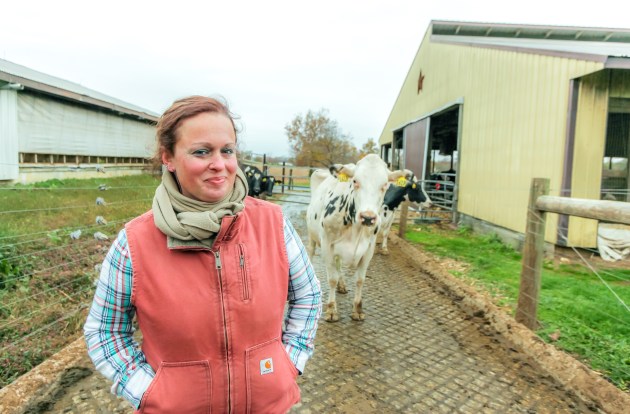
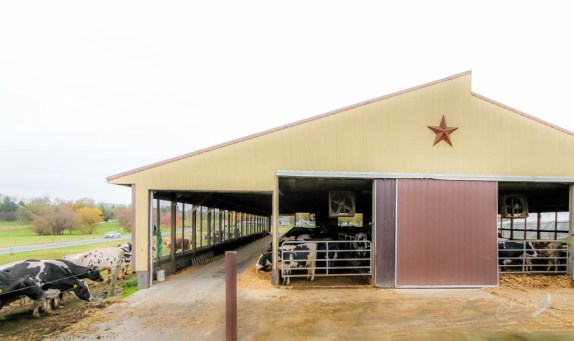
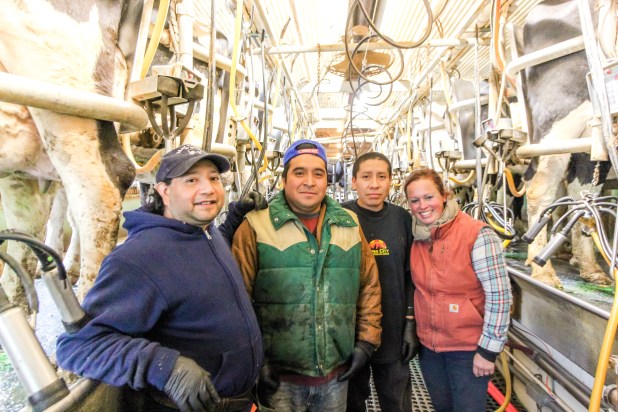
Financial and accounting consultants advised holding off the sale for the bit of recovery that was expected by now. But it never materialized, and in fact, prices went backward.

“The question for us became ‘how much longer do we keep losing money hoping that things will get better?” Audrey suggests. “We had to start figuring our timeline.”

She has been the full-time herd manager here for 15 years since graduating from Delaware Valley University with a dairy science degree. Husband Matt has been the full-time feed and equipment maintenance manager.

Nissley2062

Cows have been part of Audrey Breneman’s life as long as she can remember. “They are part of who I am,” she says. Graduating from Del Val with a dairy science degree in 2003 and working full-time for 15 years as herdswoman at then 400-cow dairy farm started from scratch by her parents Mike and Nancy Nissley, have given her options as she moves forward after the sale of the family’s dairy herd.

She loved the cows. Their care was her passion, and the herd record and condition reflected this. But even the strongest dairy passion has limits when tested in a four-to-five-year-fire of downcycled prices.

“It’s too much work to be doing this for nothing,” she says.

With two young children of her own, Audrey could not envision doing the physical work, the long hours, with no sign of a future return that would allow her and her husband to invest in facilities, equipment and labor. How many years into the future could they keep up this pace, continually improving the herd and their milk quality, but feeling as though they are backpeddling financially?

These are the tough questions that the next generation is asking even as their parents wonder how to retain something for retirement, especially for those like Mike and Nancy who are still a way off from that.

We hear the experts say that the dairy exits are those who are older and deemed this to be “time,” or that the farms selling cows are doing so because their facilities have not been updated, or because they don’t have a next generation interested.

These oversimplified answers seek to appease. The truth is that in many cases — like this one — there is a next generation with a passion and skills for dairy farming.

The problem is the math. It doesn’t add up.

How are next generation dairy skills and passions to take hold when the market has become a flat-line non-volatile price? There are no peaks to go with the valleys because the valley has now become the price that corresponds directly with the lowest cost of production touted by industry sources and policymakers when talking about the nation’s largest consolidation herds in the west — and how they are dropping the bar on breakevens.

How are the next generation’s dairy passions to take hold when mailbox milk checks fall short of even Class III levels in much of the Northeast where farms sit within an afternoon’s drive of the major population centers

In Audrey’s 15 years as herd manager, there have been other downcycles, but they were cycles that included an upside to replenish bank accounts and hope. The prolonged length of the current downcycle brings serious doubt in the minds of young dairy producers about a sustainable future, but are the industry’s influencers, power centers and policymakers paying attention?

wNissley-Edits-39

Cows congregate in the two freestall barns and in the meadow by the road as a holding area during the Nissley family’s sale of the dairy herd Friday while the milking team milks for the last time in the nearby parlor.

Like many of her peers transitioning into family dairy businesses, the past four years have been draining. Much depends upon how far into a transition a next generation is, what resources they have through other diversified income streams in order to have the capital to invest in modernizing dairy facilities and equipment.

Without those capital investments, these challenging dairy markets combine with frustrating daily tasks when there is insufficient return to reinvest and finding and securing sufficient good labor also becomes an issue.

Nissley-Edits-28.jpg

As difficult as it is for the Nissley family, they are also concerned for their family of employees. The herd’s production and excellent milk quality are very much a team effort, they say, and the team of milkers pictured with Audrey (l-r) Manuel, Willie and Anselmo were busy Friday with the last milking at Riverview as cows came through the parlor all day ahead of their sale and transport.

The Nissleys are quick to point out that as hard as this has been for their family, it is also hard on their family of employees. They, too, are hurting.

“This is what I wanted to do all my life. It was our dream when we were married. I had a love for it and Nancy had a love for it,” says Mike, whose dairy dream was ignited by visits to his grandfather’s farm. Nancy grew up on a farm too, but the cows were sold in the 1970s.

The couple worked on dairy farms in the early years and saved their money. In 1994 they started dairying on their own farm with 60 cows. In September 2007, they moved to the Mount Joy location and began renovating the facilities for their growing herd.

Cows have been part of Audrey’s life as long as she can remember. “They are part of who I am,” she says, adding that she is glad to have her dairy science degree, along with the dairy work ethic and experience. “Here we are selling the cows, and I have opportunities to consider that I may not otherwise have. That degree is a piece of paper no one can take away from me.”

As the Nissleys closed this chapter Friday, they turn to what’s next. Nancy says she looks forward to being able to do things together they couldn’t do before while being tied to the dairy farm. As to what they will do on the farm, she says “God has not steered us wrong yet. Yes, it’s scary, but we also have faith that He is in this.”

Nissley2016

Mike and Nancy Nissley aren’t sure what the future looks like, but they say they are feeling the prayers, calls, texts and support of friends, family and community. That’s what is getting them through these days.

Mike has also gained new perspective. He observes that for any dairy family that has a future generation with a long-term goal, it makes sense to stay in and try to ride this out. “But if you have any question about that long-term goal, have the tough conversations about your options.

“It’s easy to lose perspective. For the last two years, I lost my perspective because I was so focused on survival. That’s what I take away from this, the importance of getting perspective. We are first generation farmers. We started with no cows 25 years ago and have 850 animals today. It’s hard to see it all dismantled and be worth nothing. But we’re not second-guessing our decision.”

Talking and praying with friends and acquaintances, Mike believes that, “We go through things, and we can’t let it drag us down but use it for God’s glory.”

Under the milky white November sky spilling rain like tears, he says that while the sale “feels like the death of a dream, I know I’ve been blessed to have shared this dream with my wife and to work alongside our daughter and to see the great things she was able to do with this herd, for as long as we could. I’m thankful for that.”

The sale started at 10 a.m. Over 400 cattle were loaded in the deepening rain at dusk as the dairy chapter closed at Riverview Farm, Mount Joy, Pennsylvania, and two generations of the Nissley family said there’s no looking back, only forward to where God leads them next.


Being real: Dairywomen share insights, Part One

AUTHOR’S NOTE: It’s Women in Dairy month and the season of harvest and Thanksgiving, so I reached out to more than a dozen women across two generations and several states for their insights and wisdom. Each woman received the same five questions, and the feedback was both informative and inspirational. Here is part one.

By Sherry Bunting, Farmshine, November 16, 2018

BROWNSTOWN, Pa. — When asked what challenges and opportunities women see in dairying today, many of those interviewed pointed out the low milk prices and the difficulty in managing costs and juggling payments through the months when milk prices don’t stretch. But even more so, they identified consumer communication as a primary challenge.

“Conveying milk and dairy products as superior (because dairy is), conveying the economic struggle… and meeting consumer demand and desires with economic realities,” writes Katie Sattazahn of Womelsdorf, Pennsylvania describing the main challenges she sees for dairy.

Katie is part of Zahncroft Farms LLC with 250 Holstein and Brown Swiss cows in a conventional freestall and parlor facility. She manages the calves and does the farm financials and is part of the third generation of the farm owned and operated in partnership with her husband and brother-in-law.

She also shares snippets of life on the dairy — the basics with the hows and the whys — with her friends on her personal facebook page.

Other women, too, expressed their desire to have the general public understand more fully what dairy producers face and to know the clear nutritional benefits of dairy over other choices in the food and beverage marketplace.

An interesting observation by many dairywomen is that there seems to be a large gap of understanding between farmers who are struggling and the industry representatives who receive a paycheck, regardless.

This was touched upon by Jessica Peters of Meadville, Pennsylvania also. She farms in partnership with her brother and father as the fifth generation, milking 275 Jerseys through the parlor at Spruce Row Farm.

She does a column in Hoards, in which she touched on this topic.

Jessica also does the farm’s facebook page with over 5800 followers, and her “See Jess Farm” style has drawn consumers and other farmers into the discussions of all things dairy, including a lot of myth-busting. She has become known for her social media expressions, including videos where she is clear to be herself and to be real and to be entertaining.

Recently, she spoke to a group of industry representatives and warned them that her presentation would be unlike anything they’d ever seen.

“I talked about what I do online and why I do it,” says Jessica. “I touched on what they can do for us. I told them to understand life sucks for us right now, that it is difficult for us to answer the phone because you want money, and we don’t have any, and you are our friends, and it is awkward,” she explains in her very honest and direct manner.

She also produced a little video “Dear struggling farmer,” several months ago that has continued to fill her phone and inbox with others reaching out to talk or to thank her for putting into words what they are feeling and could not express.

After speaking to bankers and industry reps, Jessica says she couldn’t believe how many came up to her and said they did not realize how hard it is right now. The difficulties go beyond dollars and sense and what Peters describes is the reality of what people feel and how it affects relationships and every part of their lives and businesses.

“My dad always says we don’t want to be complainers, and I am not a Debbie-downer, but not speaking about what we feel is part of what got us here,” she says.

For Katie, the challenge of meeting consumer desires for small to mid-sized family-run farms in an environment where processors and agribusinesses are leaning toward wanting larger farms, is an example of the challenging gap in understanding.

“How do we give consumers what they want — quickly — so they don’t find another product to consume?” Katie asks. “We have a superior product that we don’t need to alter… We just need to educate consumers to understand that dairy packs a huge nutritional package per dollar of cost. As a younger farmer, I recognize everyone needs to eat … so the opportunity in 20-plus years is definitely there for our generation.”

Renee Troutman farms with her husband, milking 100 Holsteins in Berks County, Pennsylvania. She milks, raises calves, does the heat detection and bookkeeping.
Seeing the challenge of rapid consolidation of the dairy industry, Renee points out the impact of diminished market options, which was not the case when they started farming.

“The dairy gave us a great quality of life for our first decade in, and it was our plan and desire to continue that way. But things are changing in the industry and the feeling of becoming obsolete because of our size and structure is tangible. The last several years of low milk prices has all but eroded that first decade of progress,” says Renee.

She and others talk about looking ahead at ways to diversify and ways to get closer to consumers who seem to want that relationship with food producers.

In a broader way of relating to others, Jessica put some of the farming realities in the form of submitted photos into a recent “This is Farming” video for National Farmer’s Day in October, organized to an uplifting and inspiring song.

“I am very millennial. It has to be fun or emotional to catch my attention, and that’s what I try to do with my videos, catch their attention and just be myself,” she says.

The “This is Farming” video is something she had in her head for awhile after watching The Greatest Showman. She loves music and theater. It was Jessica Peters — along with Katie Dotterer-Pyle of Cow Comfort Inn Dairy, Maryland — who started the “dairy dance off” earlier this year where farmers, farm women, farm kids across the country caught on with little stress-relieving videos of themselves or others on the farm dancing karioke-style while doing chores.

For “This is Farming,” Jessica had the vague idea in her mind, but then decided to post a request for photos at the Dairy Girl Network facebook group. On-farm photos started pouring in from across the country. Within a half hour, she had 300 photos. It took 6 hours to edit the video together, and she posted it later that day on Facebook and YouTube. (Here’s a link to it again: This is Farming)

“I never expected such a good response,” Jessica says. “It is one of those videos that speaks to the heart for those in and out of the industry.”

She notes further that “everyone is feeling this concern right now.”

Jessica and others say they see the emotion in conversations and posts in networking groups and in the unspoken word.

“People need a place to go to connect,” she says.

“I guess one of the most important things I want people to know is that they are not personally failing,” says Jessica. “It’s almost like agriculture as a whole is falling hard right now, and that we need to talk to each other and realize that even though it feels personal, it’s not.”

She too is concerned about the public perception of agriculture, but takes it a step farther. She wants it to be real.

“People don’t seem to consider farmers as people. I just don’t think they realize we are people, the same as everyone else. We have done that by setting ourselves apart from the average consumer,” Jessica observes.

That’s changing through social media and dairywomen who give glimpses of life on the farm within the context of every day life their non-farm peers can relate to.

“Building relationships is important as a first step with the goal of getting others to trust you enough to come to you when they have that question,” says Jessica.

Look for more dairywomen wisdom as this series continues with Part 2 in the Nov. 23, 2018 edition of Farmshine and posted here online at Agmoos.

What will become of, us?

sunsetbarn.jpgGovernment’s cozy relationship with dairy lobby is problem no. 1
By Sherry Bunting, reprinted from Farmshine, October 19, 2018

These are tough times. The strain of a fourth year of flat-lined milk prices is wearing thin on dairy farmers and those who serve them.

And the folks inside the Beltway don’t get it.

Wait, maybe they do.

The Farm Bill has yet to be passed, the mid-term elections are over… and the question continues to be asked: What can be done about the fact that family dairy farms are dropping like flies?

This question has been asked and answered for the better part of three years and the whole decade before that… and still we find ourselves repeating the same words falling on the same deaf ears, pleasant nods, and ‘sincere’ handshakes.

Where does Washington go for the answers? The dairy lobby. In fact, members of Congress will say that nothing gets done without getting National Milk Producers Federation on board.

What’s the deal for the future? A better ‘welfare’ program for small farms to window-dress the rapid and deliberate consolidation that is running rough-shod over their markets and using the Federal Order and other regulated pricing mechanisms to do it.

For years, a decade or more, grassroots dairy farmers have told their legislators to please work on repairing the damage government has already done to dairy farming.

They’ve pleaded with those inside the Beltway to heed the truth on the decades of flawed dietary guidelines and to right the wrongs in our nation’s school lunch program and other institutional feeding programs that are forced to follow these flawed guidelines.

But alas, instead of real change, we get more of the same, while the dairy lobby cheers and applauds over a tiny change allowing schools to serve 1% lowfat flavored milk instead of the prior Obama-era mandate of fat-free.

Meanwhile, nothing changes for regular milk in schools. It’s been fat-free and 1% for a decade now, and we have lost a generation of milk drinkers and stand to lose even more, and all the while our school kids fight increased obesity and diabetes rates, and we wonder, why?

Heck, you can’t even sell whole milk as a fundraiser during school hours, and you can’t give it away to schoolchildren during school hours due to these dietary rules that –according to those who have done a decade of scientific investigation of the research –show are actually not healthy rules for our children in the first place.

Plus, we have the FDA, having looked the other way for more than 10 years, now talking about milk’s standard of identity within a greater framework of “modernizing” standards of identity to “accomplish nutritional goals” — goals that are guided by flawed government dietary guidelines.

Instead of acknowledging the past wrong and immediately setting it right, the FDA adds comment period after comment period to try to read the minds of consumers. They want to know if consumers understand what they are buying when they buy fake milk.

The short answer? survey after survey shows that an overwhelming majority of consumers are, in fact, confused about the nutritional differences between real milk and the imposters — some consumers even believe there is milk in the not-milk ‘milk’.

Meanwhile, more time passes. Farmers are asked to wait. Be patient, while more damage is done by counterfeit claims that steal market share from dairy milk’s rightful place.

And then there’s the regulated milk pricing. What are the odds that any member of Congress will heed the past 10 years of requests for a national hearing now that California has enthusiastically joined the Federal Orders? That was the death nell of more of the same.

“It’s a free market,” say the legislators, regulators and market pundits.

“It’s a global market,” they add further.

No folks. It is a regulated market, and believe me when I tell you, the USDA and the major national footprint cooperatives operate this regulated market in lockstep.

Processors can’t access the administrative hearing process, unless they are cooperative-owned processors.

Farmers can’t access the administrative hearing process, except through their cooperatives.

Ditto on the above when it comes to voting. Bloc voting on behalf of farmers by their cooperative leadership seals every deal.

At a meeting a few months ago in the Southeast with USDA administrators that was intended to talk about multiple component pricing, farmers brought forward their grievances about bloc voting and their concerns about how milk is qualified on their Orders to share in their pool dollars.

What was USDA’s official response? The same response we hear over and over from legislators. “You vote for your co-op boards and they vote for Federal Orders.”

The Federal Orders were implemented in the 1930’s to keep milk available to consumers, to keep producers from being run-over. Today, these Orders are used to move milk from expanding consolidation areas to regions that have small and mid-sized family and multi-generational dairy farms located near consumer populations and competitive markets.

This is not a size thing. This is not small vs. big thing. This is structural change thing that is happening in the dairy industry at an increasingly rapid rate while the lifeblood is sucked right out of our culture of dairy farming.

troxel-sale-2The storm is brewing. Since the beginning of this year, the financial experts have told us that one-third of producers are selling out or contemplating an exit from dairy, that another one-third are not sure where they even stand, and that another one-third are moving forward with plans for expansion within consolidating industry structures.
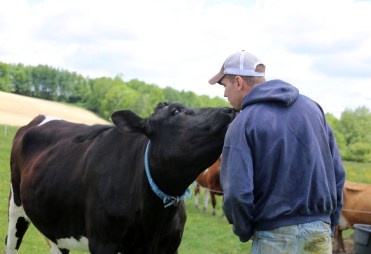
The thought occurs to me: When the other two-thirds of producers are gone, what will become of that one-third that is still moving forward expanding, undeterred? What will become of the fabric from which their progress emerged? What will become of the next generation with hands-on experience, passion and love of dairy? Who will be raised on a dairy farm in the future? What contributions will be lost when dairy becomes only a business and no longer a business that is also a lifestyle? Who will be the support businesses? How will our communities change? Will all of our dairies in the future be academically run? What will become of our cow sense, our deep roots, our sense of community?

What will become of, us?

GL 4736For years we have heard “there’s a place for every size dairy in this industry.” That phrase is how we get small and mid-sized farms to advocate with consumers about modern farming so they will accept a more consolidated dairy farming picture.
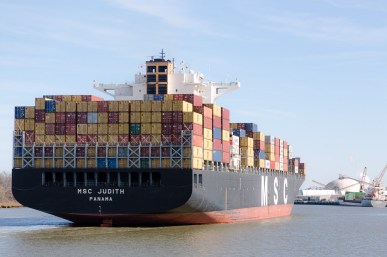
Now that we are reaching this point, will we hear the large consolidating integrators say the same in reverse? Will they slow down, push pause, and realize there IS a place for the diversity of farms that make this industry the shining star it is and could be?

While at World Dairy Expo in Madison, Wisconsin in October, the strain of now a fourth year of low prices was evident. Attendance “felt” lower even if the official numbers don’t totally reflect it.

Show entries were down. Traffic among trade show exhibitors was interesting and steady, but ‘off’ and ‘different.’

Dairy farmers are struggling. Large, small, and in between, these times are tough, and clear answers are elusive.

Dairy farmers remain paralyzed by three things:

1) the inability to have an effect on their circumstances or seat at the decision table;

2) lack of understanding of an incredibly complex regulated market; and

3) the innate desire to trust the establishment that handles their milk because they are too busy milking, managing and caring for cows, not to mention the land, to handle the milk marketing themselves.

Just think about this for a moment. In the past four years, National Milk Producers Federation has created and implemented the F.A.R.M. program where someone can come in and put you on a list for a subjective heifer bedding evaluation, where more is being not asked, but demanded, while at the same time, the pay price from which to do more is declining.

The milk checkoff programs continue to focus on partnerships. All kinds of efforts emerge to give away milk and dairy, and meanwhile supermarket wars by large integrating retailers push milk further into a commodity corner from which all imposters can brand their ‘more than’ and ‘less than’ marketing claims.

What we learned at some of the seminars at World Dairy Expo is that nothing will change in the milk pricing system, that it’s a free market, a global market, and that the best Congress can do is improve the margin protection program and other insurance options so farmers have the tools to deal with it.

I’m here to tell you that as long as this remains true, no farmer should be ashamed to use these tools even if it means receiving taxpayer dollars because it is the government’s actions and inaction over a decade or more that have created the problems in milk pricing and marketing today, and furthermore, the government shows no sign of wanting to let go of its stranglehold on dietary guidelines, how it enforces dairy’s standard of identity in fraudulent labeling, nor how it conspires with the dairy lobby — made up of the nation’s largest cooperatives — to regulate pricing in a way that further consolidates the dairy industry.

And by the way, all of the rhetoric on trade and NAFTA and Canada’s supply management system and Class 7 pricing has been nothing more than a smokescreen.

wGDC18-Day1-56Trade is important, but again, we have reached a point where 2018 is seeing the demise of dairy farms at rapid rates while exports continue to set new records. As of Oct. 5, 2018, U.S. dairy exports for the first 8 months of the year (Jan-Aug) accounted for a record-setting 16.6% of milk production on a solids basis. That’s the largest ever percentage of the largest ever milk production total – more of the more – in the history of the U.S. dairy industry’s recordkeeping.

In fact, traders will be the first to tell you that “more exports” don’t translate into “better farm milk prices” because the export markets are largely commodity clearing markets and they are fueling expansion of commodity processing in areas of the U.S. where it is easiest to export to Asia and Mexico. A global supply-chain is in the works.

The exports, in fact, are diluting the Federal Order pricing at the same rapid rate as declines in consumer fluid milk consumption, putting severe pressure on eastern markets in particular.

Meanwhile, the eastern milk markets are extremely tight on milk. This information is sourced to cooperative managers and the independent USDA Dairy Market News. Plants are seeking milk and not receiving it. Trucker shortages are complicating the problem. State regulated pricing mechanisms, such as in Pennsylvania, still interfere, making milk cheaper to bring in than to use what is here. In some Federal Orders to the south, this is also the case because of how their pools are administrated.

We are seeing the vicious circle of self-fulfilling prophecies. Producers who want to operate 50 cow, 100 cow, 300 cow, 500 cow, 1000 cow, 1500 cow dairy farms in the eastern U.S. within a day’s drive of the largest population are in jeopardy. They have lost their location advantage but continue to deal with the disadvantages. As milk tightens they are not seeing their premiums return, instead some farmers report getting docked by their co-ops for not making enough milk, or they are socked with incredible hauling rates because their milk was hauled out while other milk was hauled in.

What can Congress do? Hold that national hearing on milk pricing. Give farmers a seat at the table apart from the company-store. Learn what is happening. See government’s role in it.

Dear Congress, if you really want to know what to do, look in the mirror.

Before it’s too late, please right the fundamental wrongs government has done to our dairy consumers and dairy farmers as it controls what fat level of milk kids are permitted to drink at school, how milk is priced, how milk is marketed and how milk is allowed to be advertised and promoted with farmers’ own money – while at the same time still turning a blind eye and deaf ear to loss-leading supermarket wars that operate off the backs of farmers and the processing industry’s pillaging of milk’s market share with nondairy imposters.

-30-

ReplyForward