Good news about milk is spreading rapidly

Milk Baleboard message reaches over 1 million people in first 7 days online (www.97milk.com, @97milk on facebook, @97milk1 on twitter)
By Sherry Bunting, Farmshine, March 1, 2019

RICHLAND, Pa. – It has taken off with overwhelming response on social media, and consumers reading and sharing the posts from “97 Milk” are expressing their surprise at how much they are learning about the goodness of milk while farmers are enthused to have a vehicle of grassroots promotion that sticks to the basics — promoting the healthy wholesomeness of dairy and helping consumers make informed choices about milk.

The big news this week is that the 97milk.com website and its corresponding facebook (@97milk) and twitter (@97milk1) accounts, have been very active, very quickly since launching last Friday evening, Feb. 22. Facebook, alone, had reached 1.2 million people by midnight Wednesday, just six days after launching.

What is 97 Milk, you ask?

Last week’s Farmshine had a feature story on page 19 about the launch of the website www.97milk.com as a grassroots offshoot of the Milk Baleboards that are popping up on farms and business properties across the countryside.

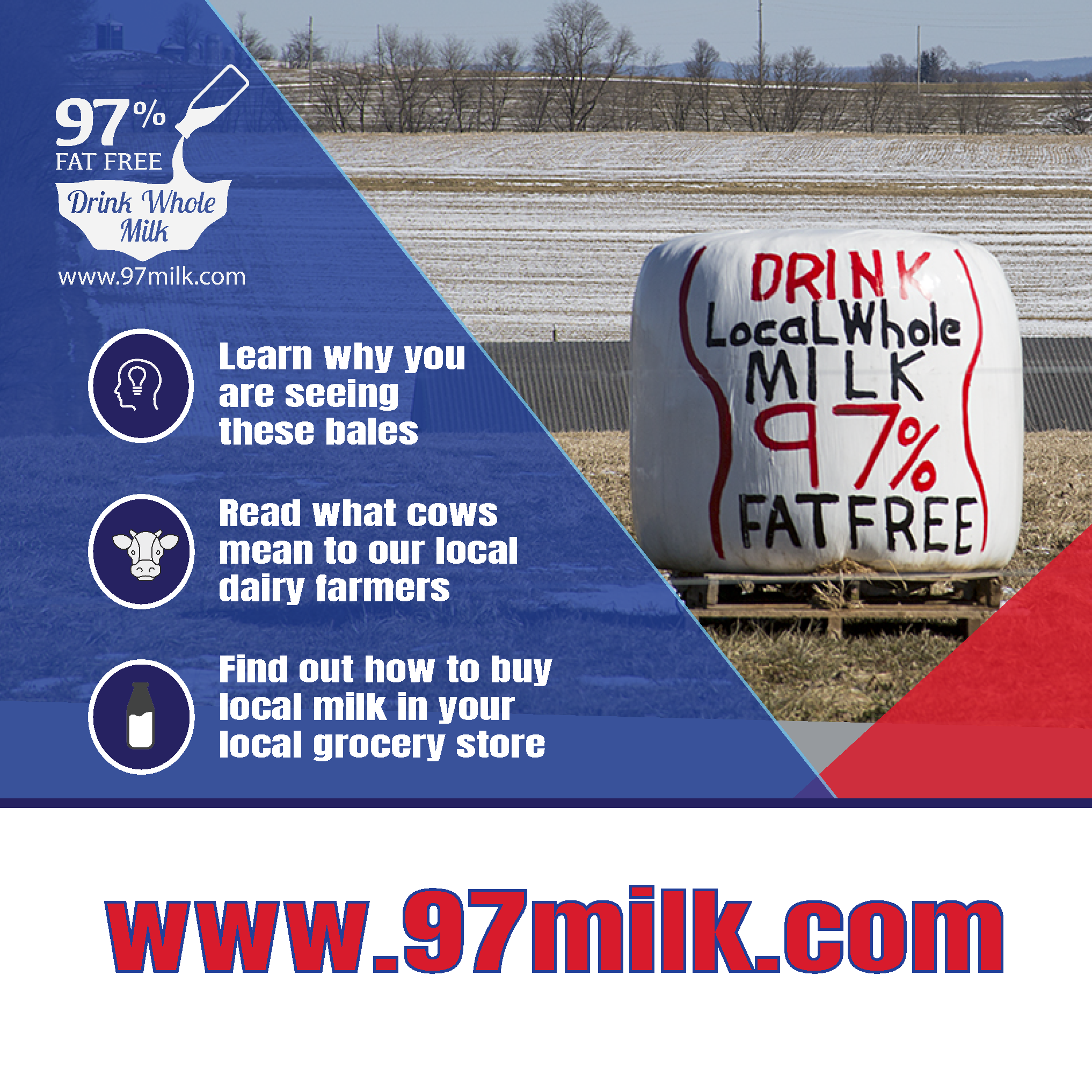
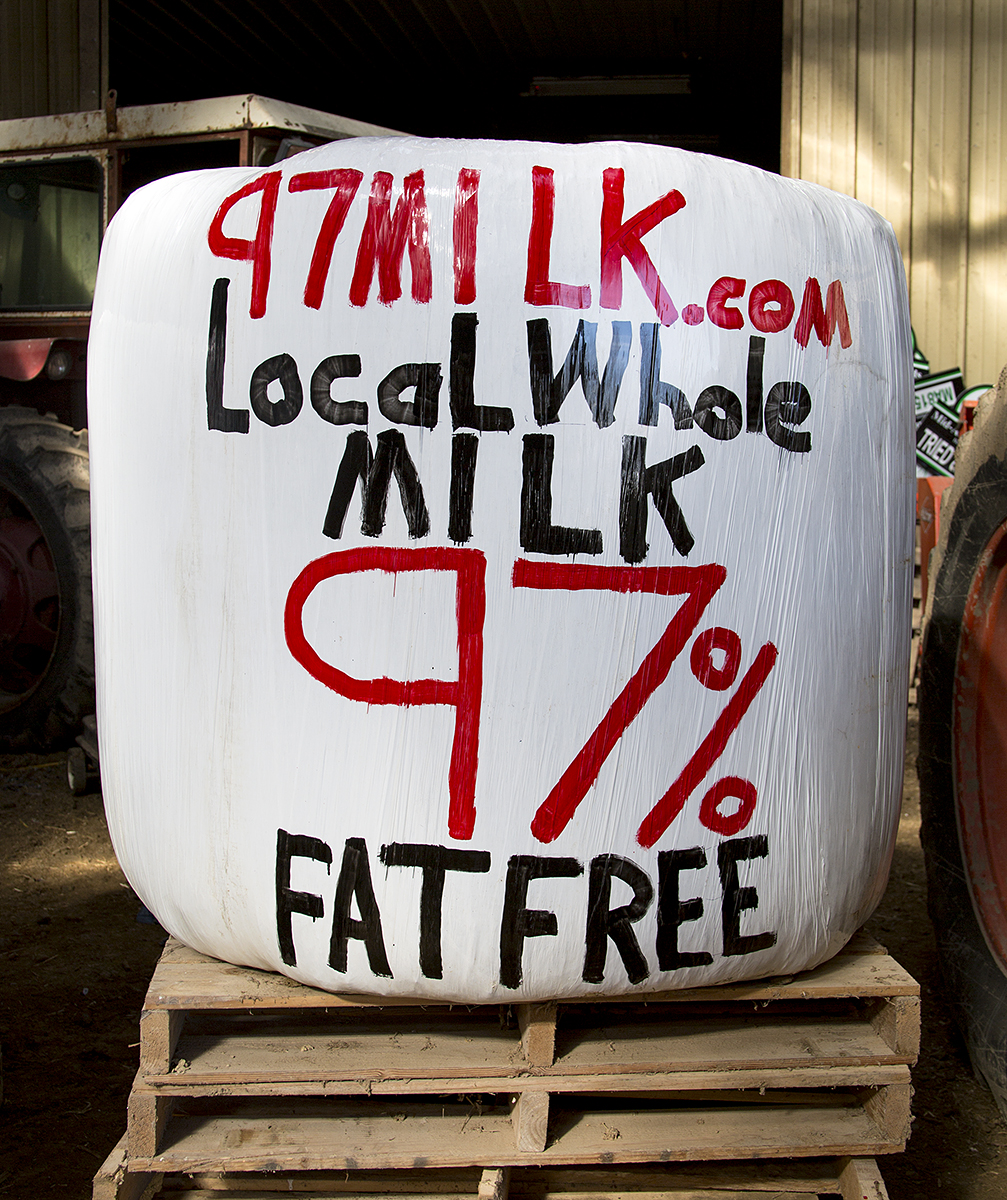
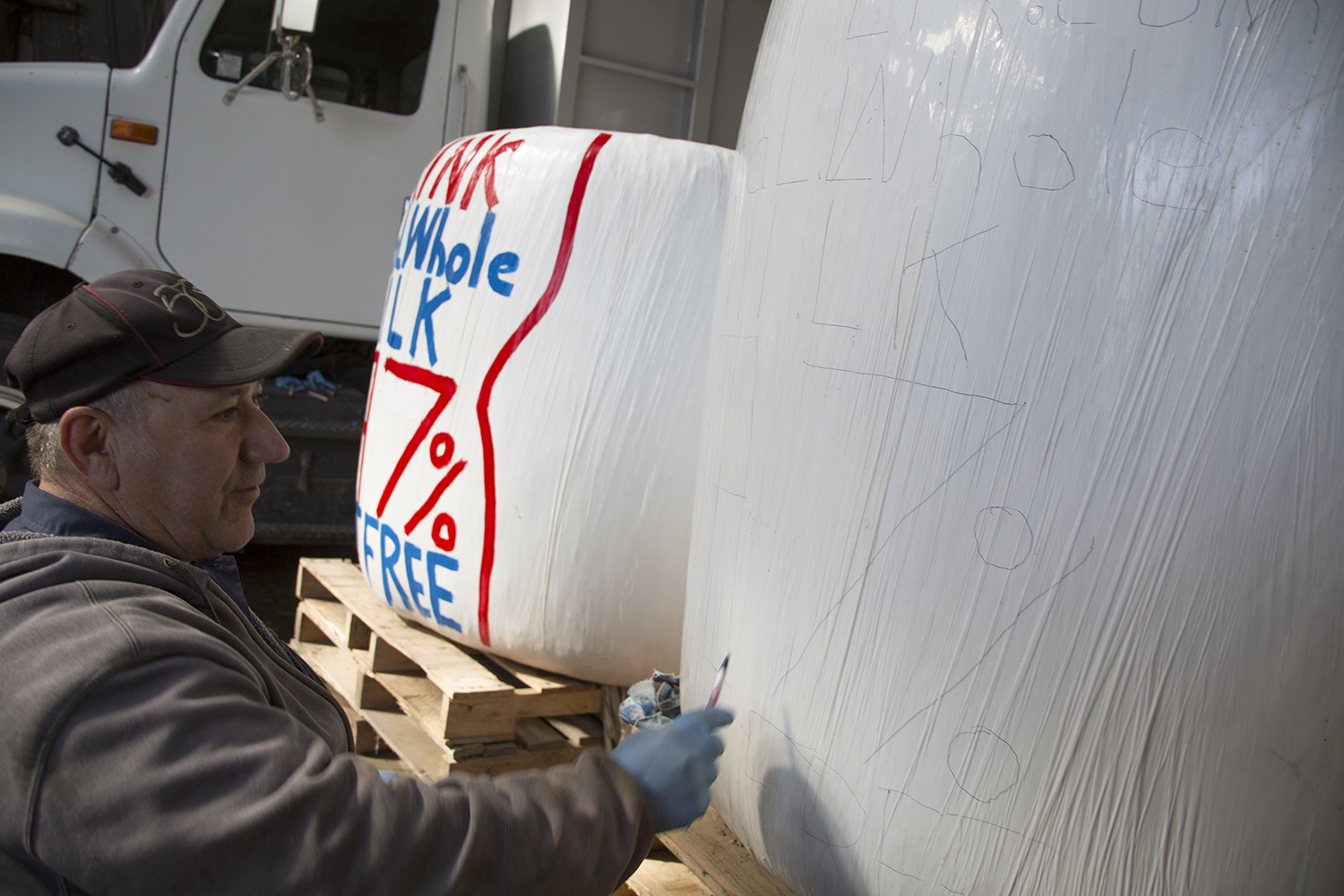
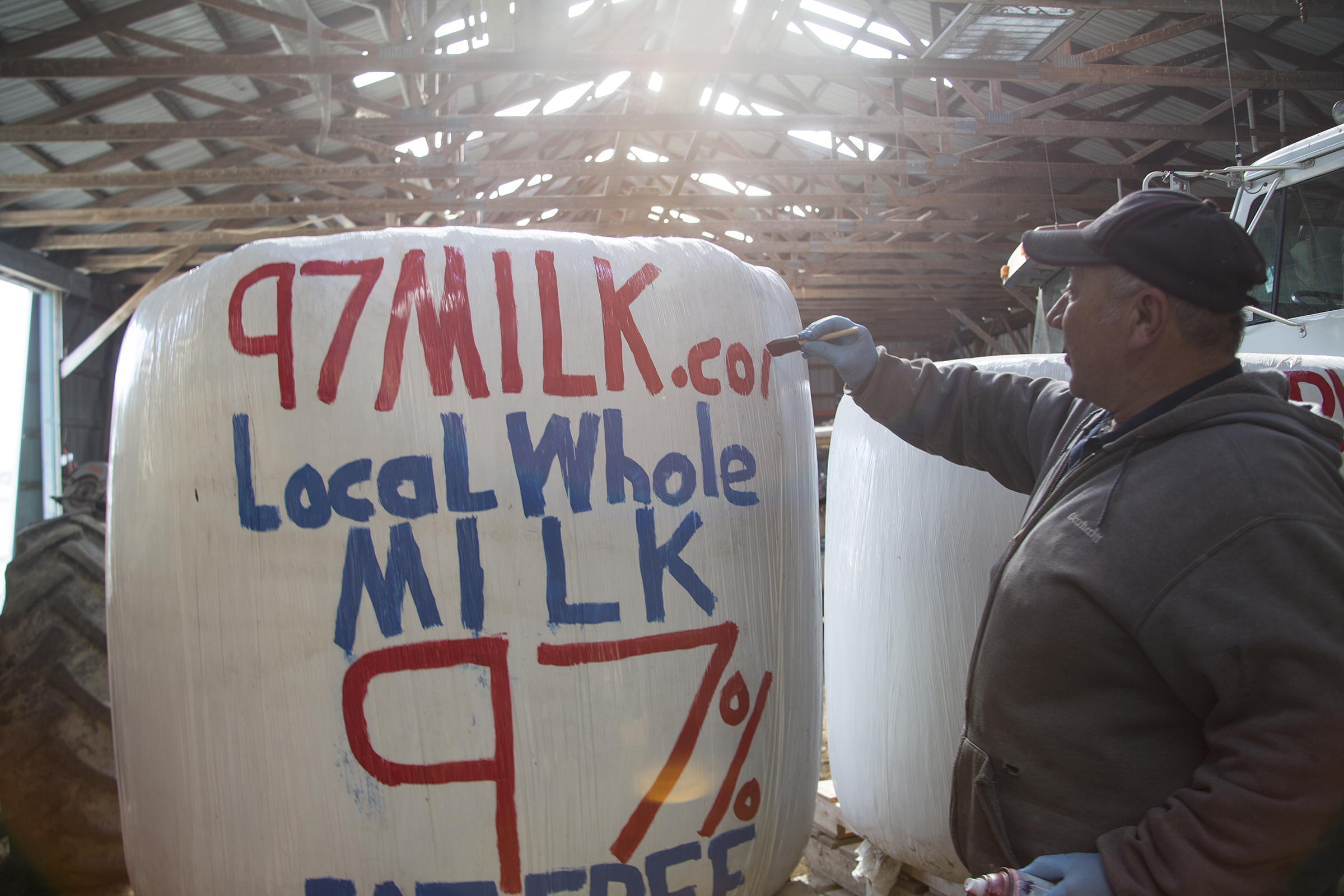
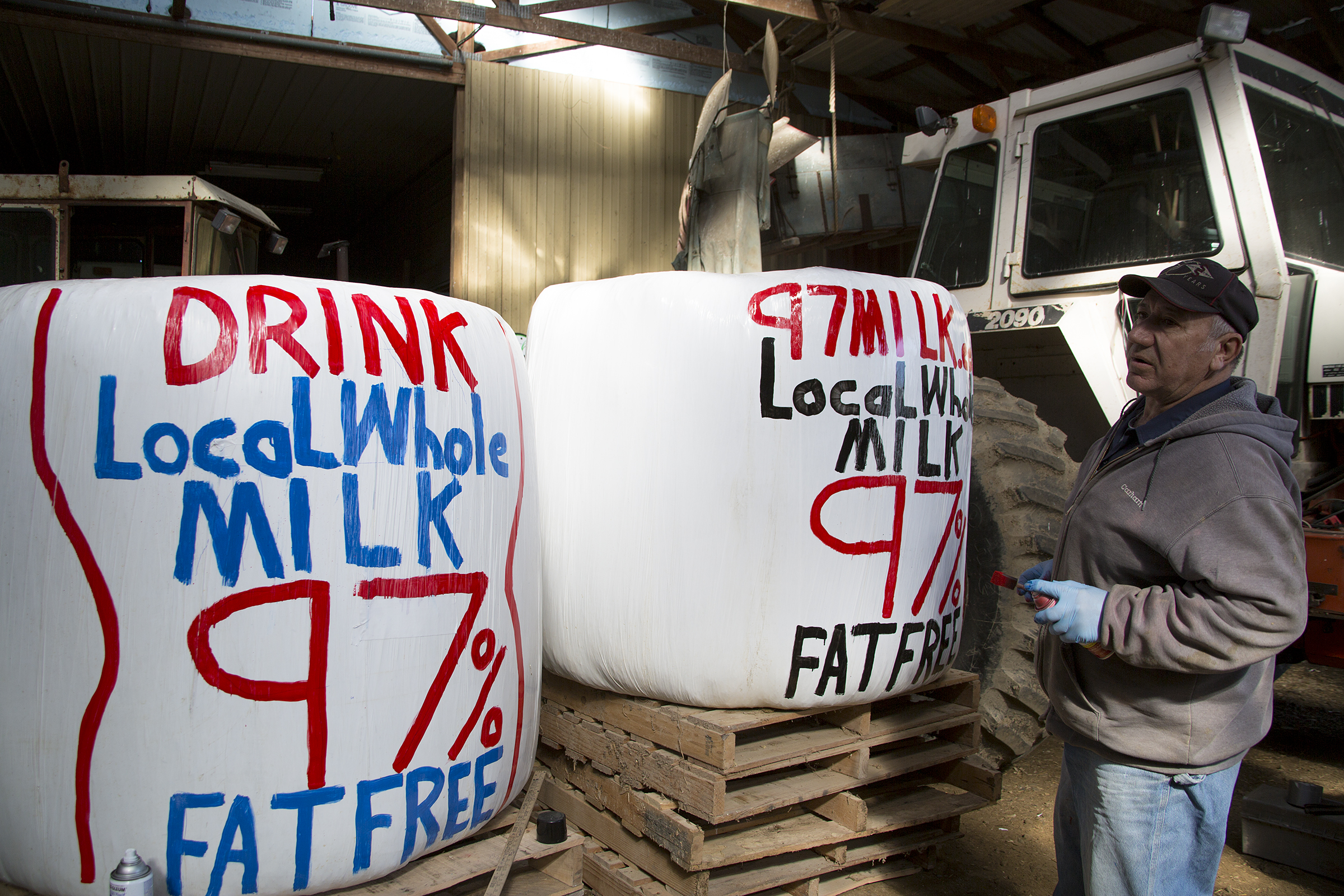
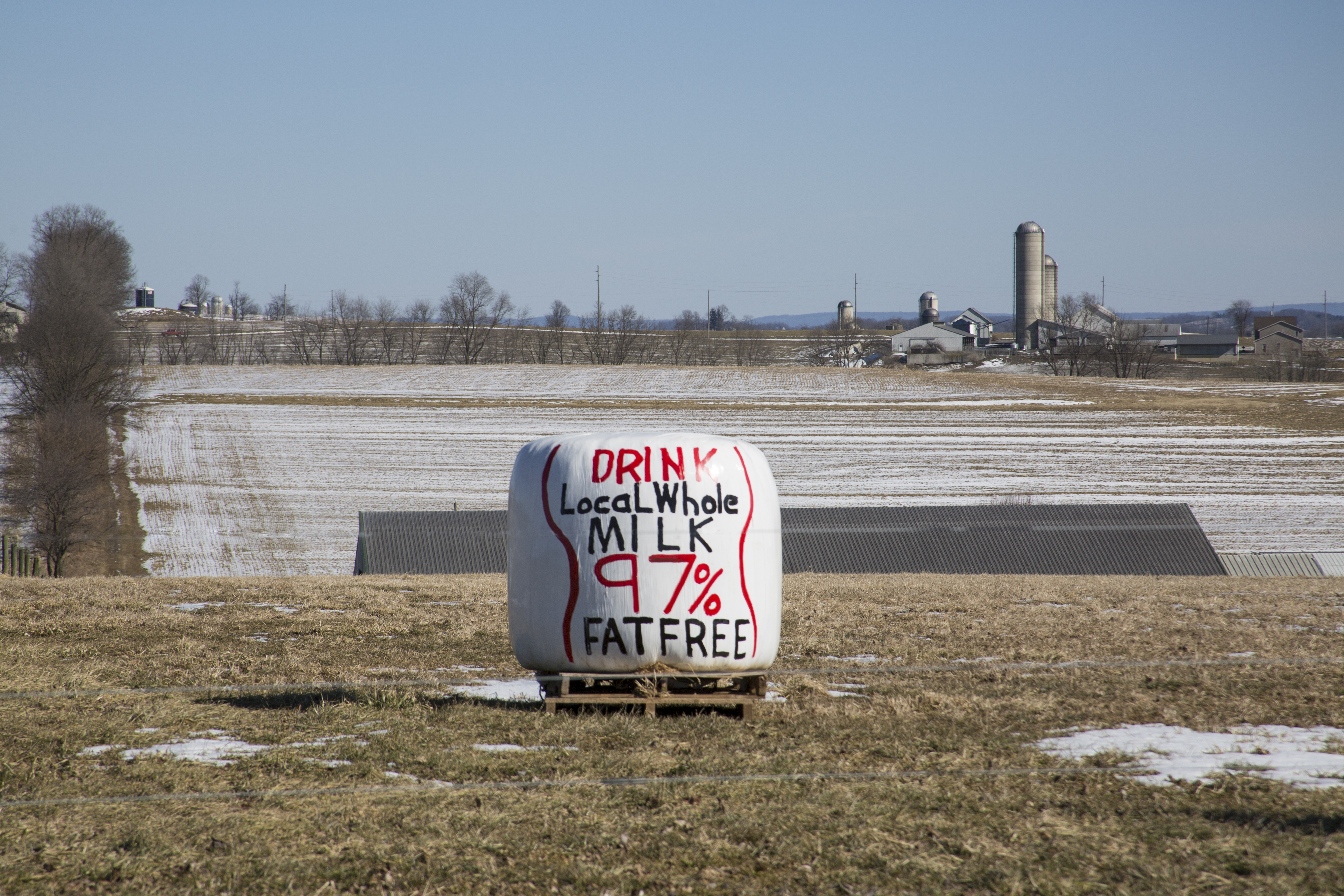
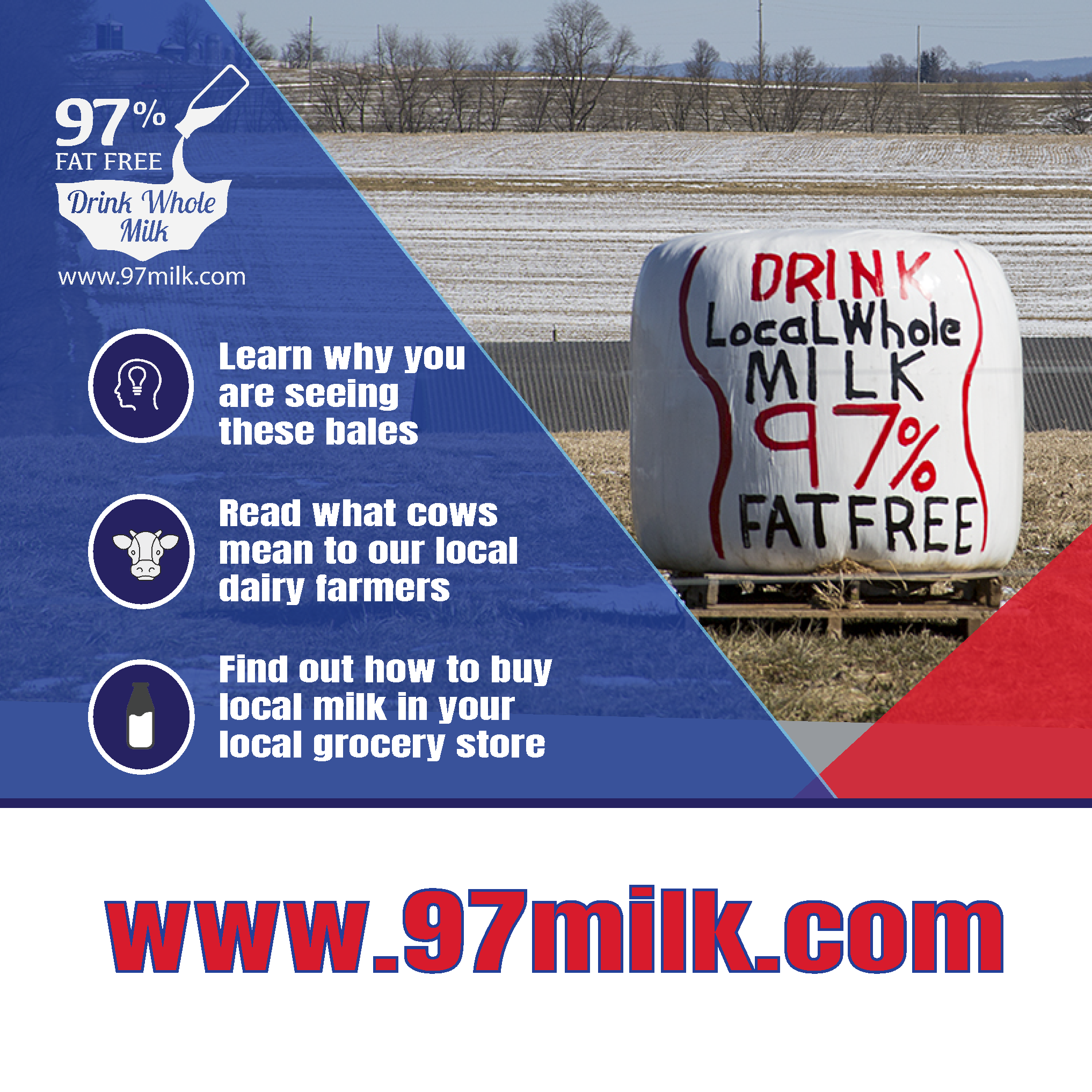
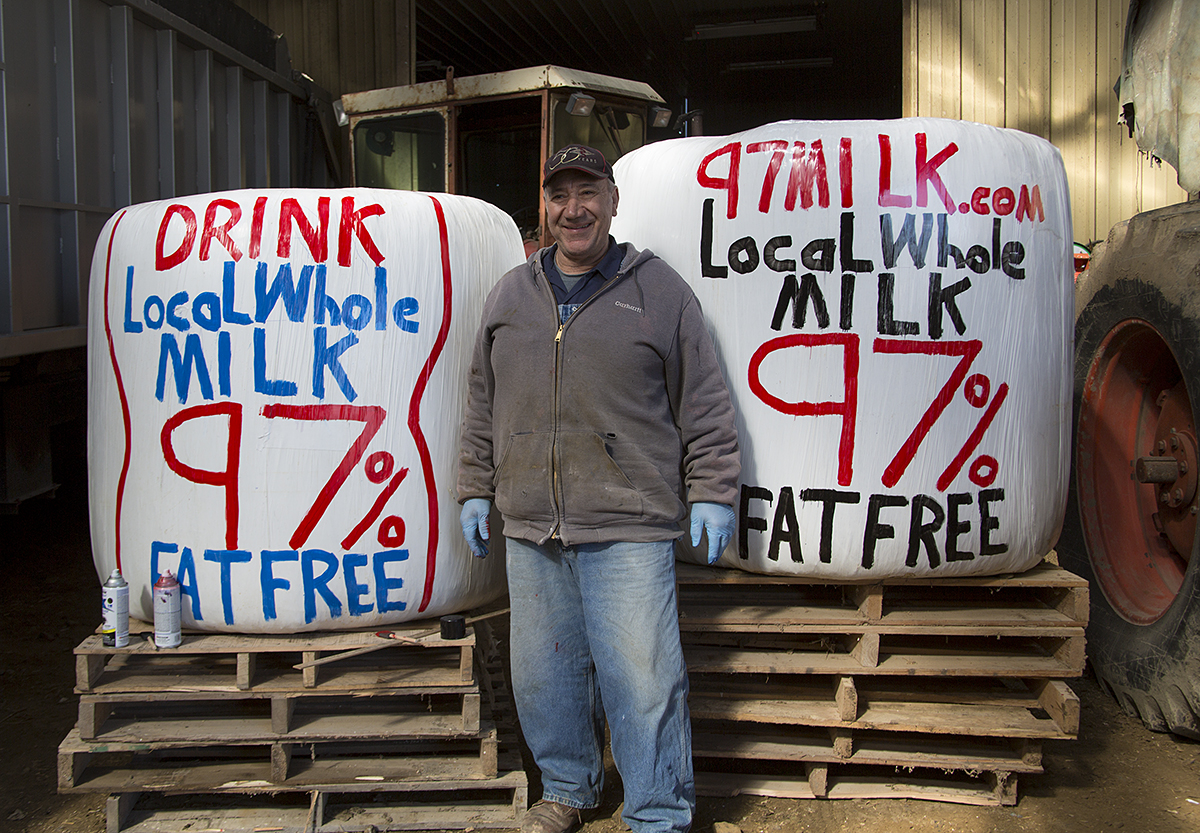
Those round bales painted with the message: Drink Local Whole Milk – 97% Fat Free were the idea of Richland, Pennsylvania dairy farmer Nelson Troutman. We have been following the development of his idea in the pages of Farmshine since Nelson made his first Milk Baleboard, pictured on our January 4, 2019 cover.
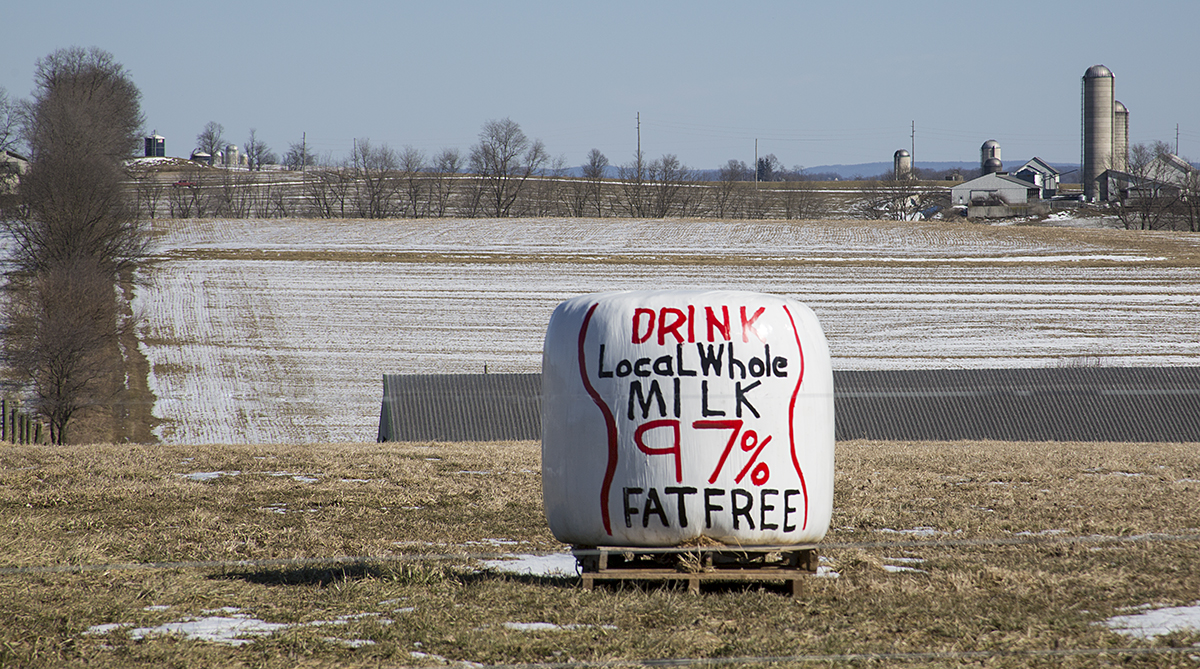
In fact, Nelson reports as of Wednesday morning, nearly two months after he made his first Milk Baleboard, he has made 26 — including one that was delivered to Farmshine on Feb. 27. He has delivered to many farms and businesses.

In addition, Dale Zimmerman of Zimhaven Holsteins in East Earl, made Milk Baleboards for his farm as well as for Shady Maple Smorgasbord just down the road. And other farmers are joining in.

Nelson continues to receive phone calls and has become somewhat famous in his community, attracting shoppers when he visits the grocery store in his home town.

“No one. Not one person, has said to me that, yes, they knew milk is virtually 97% fat free. No one, not young, nor old, nor in between,” Nelson stated in a follow up email with Farmshine early Wednesday morning, Feb. 27. “Since the bales and the website, I had people say to me that when their kids were small, the doctor told them to drink 2% milk, and now the kids are grown, and they were still drinking 2% milk — until this information came out. Now, they tell me they are drinking whole milk.

“This is all 100% education,” Nelson relates.

This overwhelming response has gone to the next level with the online presence that began Feb. 22 through a website, facebook page, instagram and twitter account for 97 Milk as the educational effort of grassroots dairy farmers. Through social media, the good news is spreading well beyond the Lebanon, Lancaster and Berks County region of Pennsylvania where the first Milk Baleboards were made and placed by Nelson on farms and businesses in the area.

How can this be?

Judging by the facebook page, there is an obvious consumer thirst for milk knowledge and an obvious farmer passion to deliver knowledge simply — without the dietary politics.

Within the first 72 hours, the @97milk facebook page had over 1000 likes and had reached over 100,000 people with the good news that whole milk is virtually 97% fat free.

Over the next 36 hours by mid-morning on Wed., Feb. 27 — not quite five days after launch — the facebook page had nearly 1,650 likes and follows, and the informational posts had reached a whopping 700,000 people. (By Thursday, Feb. 28, less than 7 days after launch, the page had over 2000 likes and had reached 1.2 million people.)

Even more important, these posts had — in less than 7 days — “engaged” nearly 100,000 people via likes, comments and shares of the educational information posted on the page. This does not include those who downloaded the informational images and shared them without sharing directly from the facebook page!

A post over the weekend (see image) illustrated the essential nutrients in milk and its composition as a hydrating beverage made up of 88% water, 5% carbohydrate, 3.5% protein and 3.25% fat, showing the long list of essential nutrients by their percentages of daily recommended values. This illustrative glass of milk reached nearly 100,000 facebook users by Wednesday morning and had engaged over 7,000 in likes, comments and shares.
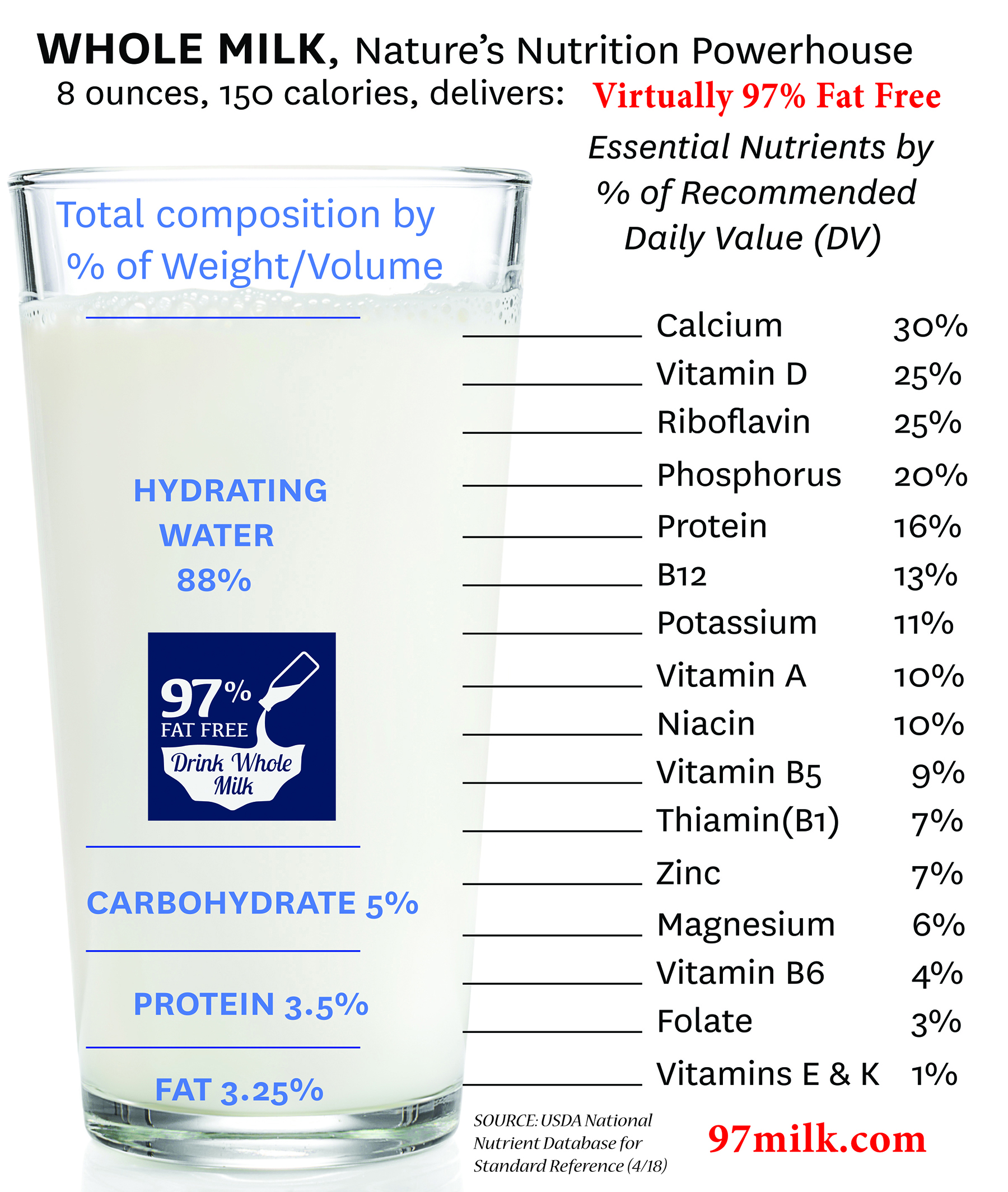

Consumers are thirsty for knowledge about milk. Here is one simple example of how 97 Milk keeps the good news going. This visual facebook message was posted Wed., Feb. 27, reaching 3,300 people with nearly 300 interactions within its first three hours. Facebook image from @97milk

Another post that explained the fat percentages of milk had reached 45,000 people with 3200 interactions.

Another post giving comparisons of Real Whole Milk, 1% Real Milk, Soy, Almond and Coconut beverage reached over 17,000 people with over 1700 interactions within 24 hours.

And another post sharing the good news that all milk is tested free of antibiotics reached a whopping 608,000 facebook users and resulted in over 44,000 interactions, including over 9,000 direct shares!

Meanwhile, the posts have brought in questions and discussion in the form of public comments on the facebook page and in the form of questions sent by private message. In fact, these interactions are coming from far and wide — local, national, even international.

On Tuesday morning, the 97 Milk facebook page posted this explanation of why the Milk Baleboards have expanded to online 97 Milk communications:

“97 Milk was created to be a voice for our local dairy farmers. This is a place where people can get information on nutritious dairy products. It’s a place where farmers can tell their story, a place where our community can get information on how to support local dairy farms. There is so much confusing information regarding dairy, and there are always two sides to every story. 97 Milk tells the story of the many farms that love and care for their cows, the passion that many dairy farmers have, the many proven research-based facts on milk nutrition. This is our side that our community deserves to hear.”

The website is mentioned on every post, and it is a simple place to direct people who see the Milk Baleboards and the social media posts and want to learn more of the basics about Real Whole Milk.

Planned in the coming weeks are posts for social media that continue to provide bite-sized fact nuggets about milk, including how to learn where milk was bottled, why milk protein is called a complete protein, quotes from farmers about why they love what they do, and other inspirations. Check it out.

If you have a Milk Baleboard on your property, or have seen one displayed, please let us know the location (agrite@ptd.net) in order to help create a map of how the good news is spreading by these grassroots efforts.

If you would like a Milk Baleboard, check out last week’s page 19 feature story giving tips from Nelson on how to make one, and contact Nelson at 717. 821.1484 or Bernie Morrissey at 717.951.1774.

Jordan Zimmerman of East Earl is making and selling bumper stickers through the Lancaster County Holstein Association, and Morrissey has ordered magnetic signs.

To learn more about the online efforts, and to help spread the good news, check out the website at 97milk.com, facebook page @97milk and twitter account @97milk1.
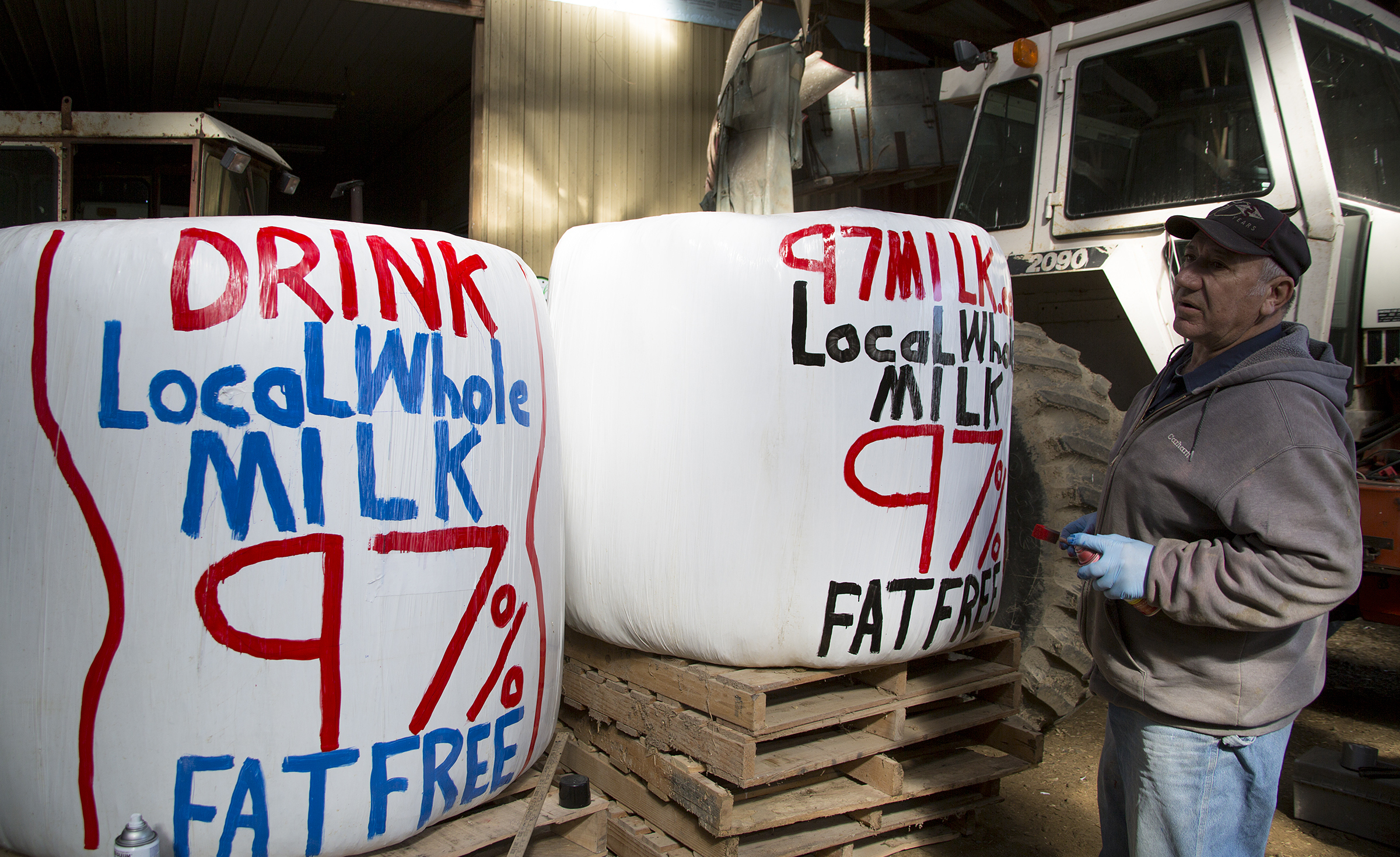

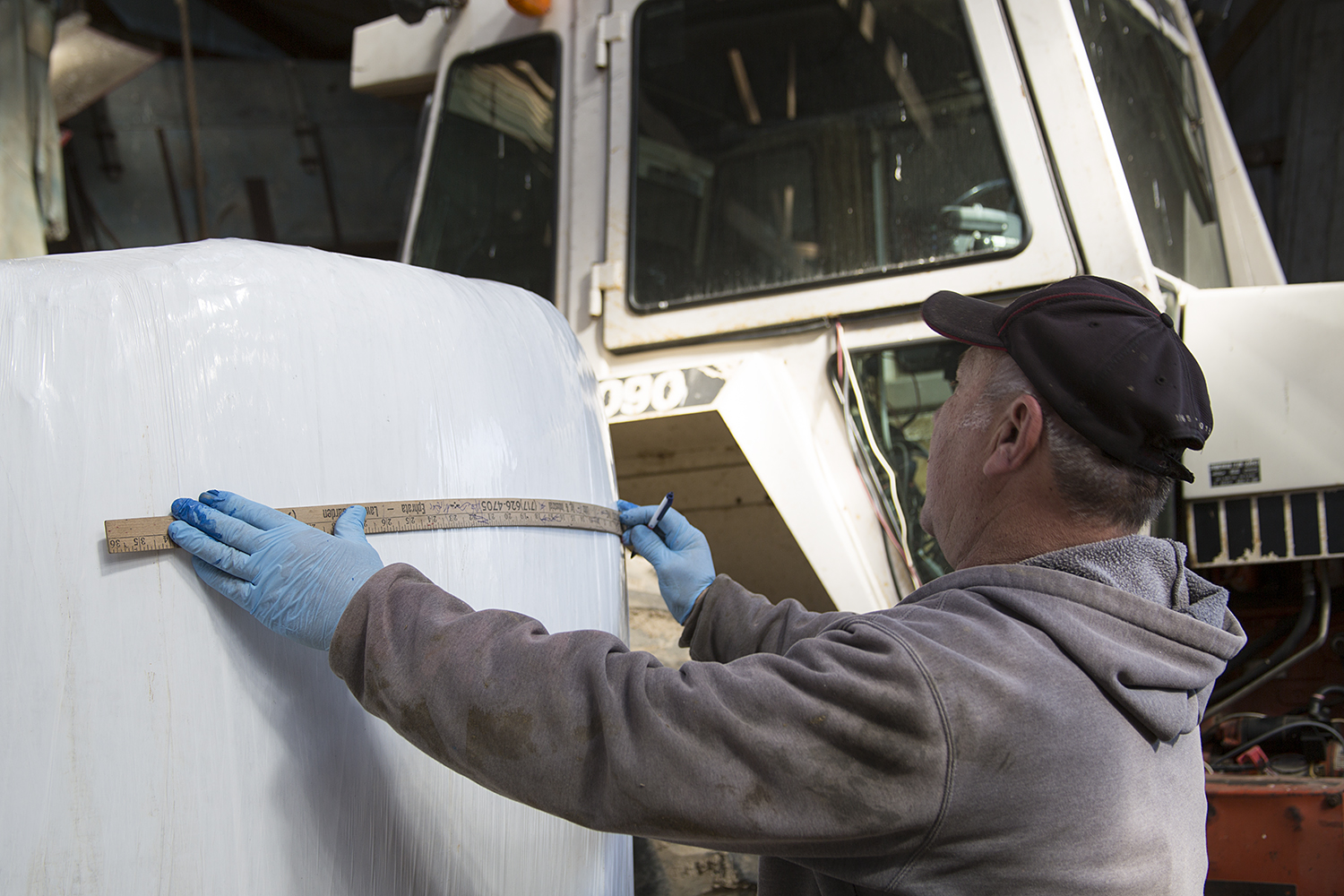
Nelson Troutman of Richland, Pa. has made 26 Milk Baleboards for other farms and businesses in the area. Two weeks ago, he began painting them in his shop with the 97milk.com website! Photo by Sherry Bunting
‘Milk Baleboards’ are a ‘thing’, with a website!

Producers unite to send clear message to policymakers and consumers, website takes it to the next level.

Nelson Troutman (above) is a dairy farmer. He has made 20 Milk Baleboards and offers these DIY Tips with illustrations at the end of this story.

By Sherry Bunting, from Farmshine, Friday, Feb. 22, 2019

RICHLAND, Pa. — Nelson Troutman has been making the ‘Milk Baleboards’ since January. The Berks/Lebanon County dairy farmer came up with the idea after the Pennsylvania Milk Marketing Board listening session in December.

“It’s very important that the bales all have the same message: ‘Drink Local Whole MILK — 97% FAT-FREE.’ Don’t try to get funny with it. You could take the ‘local’ off and just focus on the ‘whole milk,’ but mainly to have impact, we want the bales to have the same message,” he said while painting bales in his shop during my visit last Saturday morning to the farm where he and his wife Mary live and which is now rented to a young couple for their dairy herd.

He still farms the land he has lived on his entire life, and he makes the feed for that herd and his son’s herd nearby. (In fact his daughter in law Renee wrote about whole milk recently, with a historical twist!)

Nelson has made 20 Milk Baleboards so far (check out his DIY tips at the end of this story). And he has seen new ones pop up from others following suit.

He has had 10 phone calls from fellow farmers as far away as New York, and has talked to so many more at meetings — out and about. He tells them: “Put a bale out… unless you are satisfied with your milk price.”

Did he think it would take off like it has? “No I didn’t,” he says. But he’s glad to see others joining in and hopes to see it catch on even more.

Retired agribusinessman Bernie Morrissey of Robesonia has been doing all he can to get other agribusinesses to put them out. In addition to Morrissey Insurance having one on their property along Rte 272 north of Ephrata, the Milk Baleboards are popping up along other main routes like 23, 322, and 422, to name a few.

“Our advertising checkoff dollars just didn’t seem to be doing a very good job these past 10 years. They have been promoting fat free and low-fat 1% milk and the fat free yogurt — not much whole milk,” Nelson relates.

“After the listening session with the PMMB, some of us were talking. We thought it was time to do something different, something like letting consumers know whole milk is 97% fat free,” he said further. “We didn’t come up with a plan that day. We were thinking about a billboard, but that was far too expensive. We thought about portable signs.”

Then over the weekend after that December meeting, he looked around. “I thought to myself that I already have the perfect thing: A wrapped hay bale! So, I painted one. I set it in the pasture at our crossroad. We farmers have silos, wagons, barns and sheds we can paint signs on.”

Lots of feedback has come in, and it seemed no one knew whole milk was 97% fat free. Some said “why are we drinking 2% milk, when whole milk tastes so much better?”

Nelson observes that young and older people said they never thought about how much fat or nutrition is in milk. “It seems so sad how people are misled by our checkoff dollars, our doctors and medical people — and our federal dietary guidelines committee.”

He admits that people are easily confused. To be sure, the bales are attracting attention, leading to questions.

While it started out as a way to send a clear and unified message to consumers and especially policymakers, Nelson said the information is so surprising to people that it offers educational opportunities.

That’s why R&J Dairy Consulting invited Nelson and Bernie to a meeting of dairy farmers last Friday to see what could be done to use this teachable moment.

The group decided to purchase a website domain — 97MILK.com, and direct people there to learn more: What is whole milk? How does it compare? What is Real Milk, Local Milk?

The website can help unite these efforts, and bring additional excitement to the project. For example, at the meeting organized by R&J Consulting, their marketing manager Jackie Behr said when she asked peers what questions they have about milk, she ended up with a whole list.

“Let’s use this opportunity to educate consumers and help them make a good choice,” she said. The group decided to start out with key simple answers to frequent questions. Many businesses and people are pulling together in various ways that it is impossible to name them all here. That will come in a future Milk Baleboard update.

Jackie at R&J, with some help from others, got the website 97milk.com up and running within seven days. This includes a facebook page @97Milk, so check it all out!

Want to make a Milk Baleboard? Here are Nelson’s DIY tips:


1) Keep the message the same: Drink Local Whole MILK — 97% FAT FREE (or now that there is a website, omit ‘Drink’ on a Round Bale and put the website 97MILK.com top or bottom.)

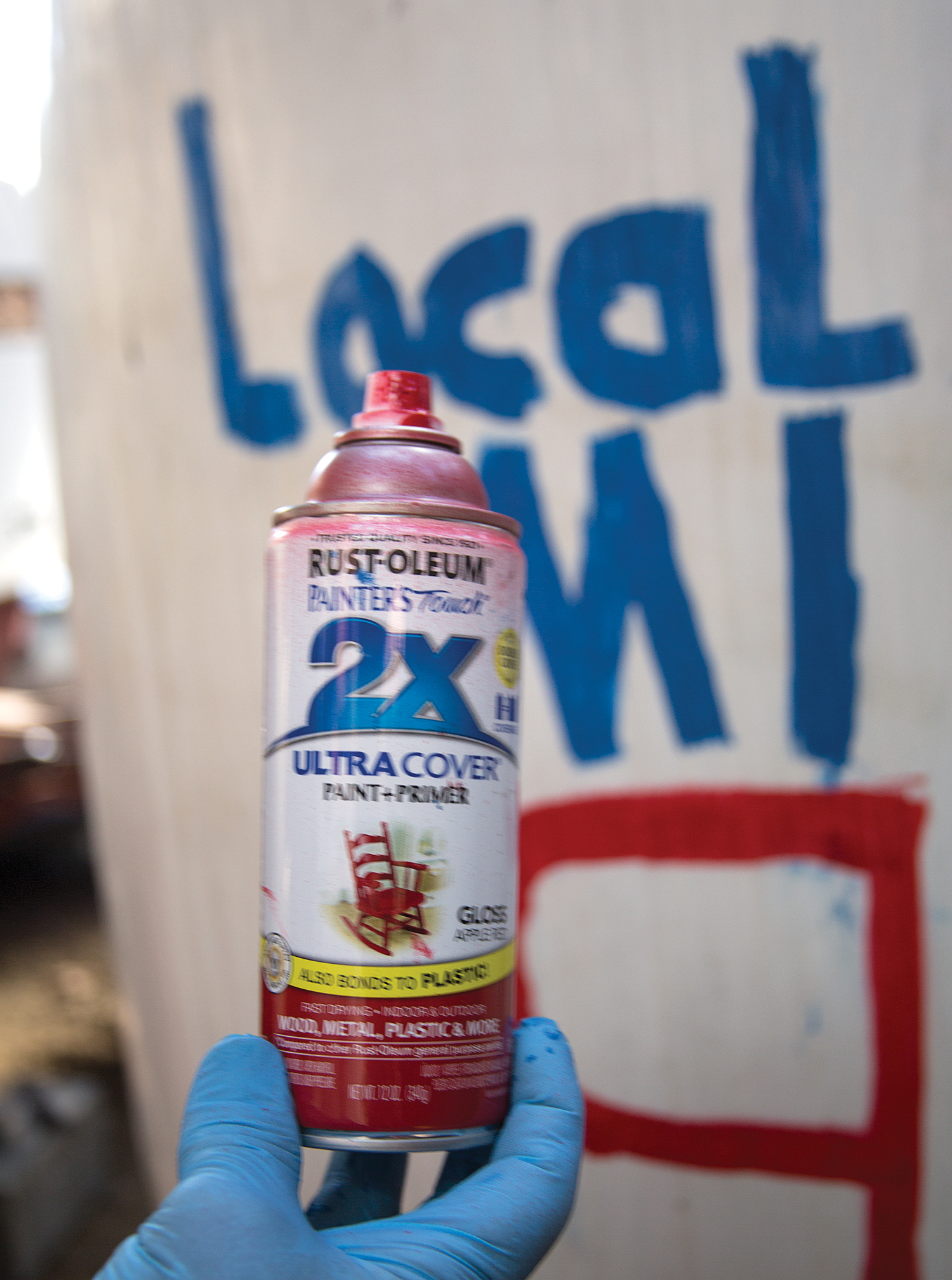
2) Get the right paint! Rustoleum Ultra Cover 2X paint and primer.

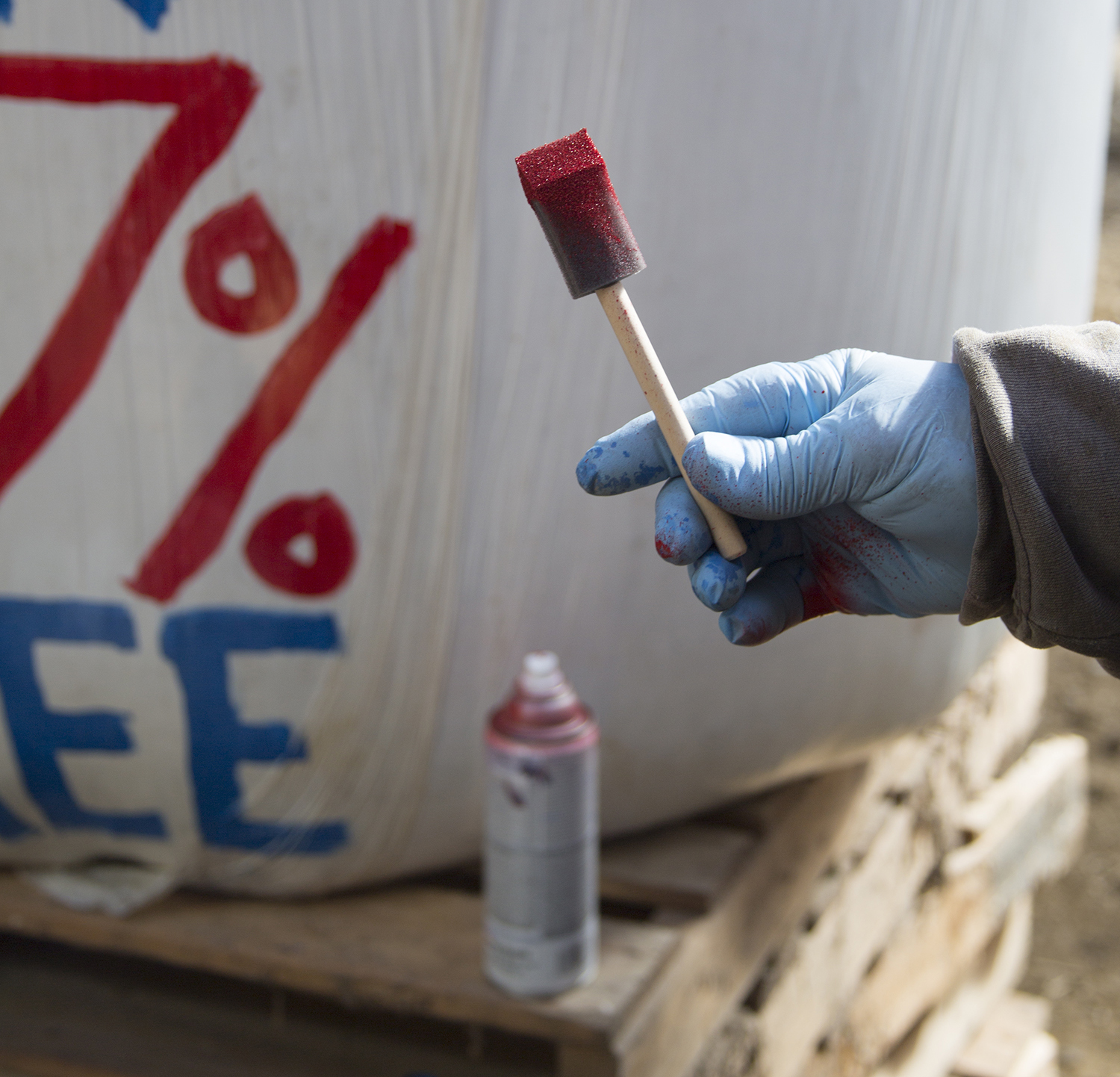
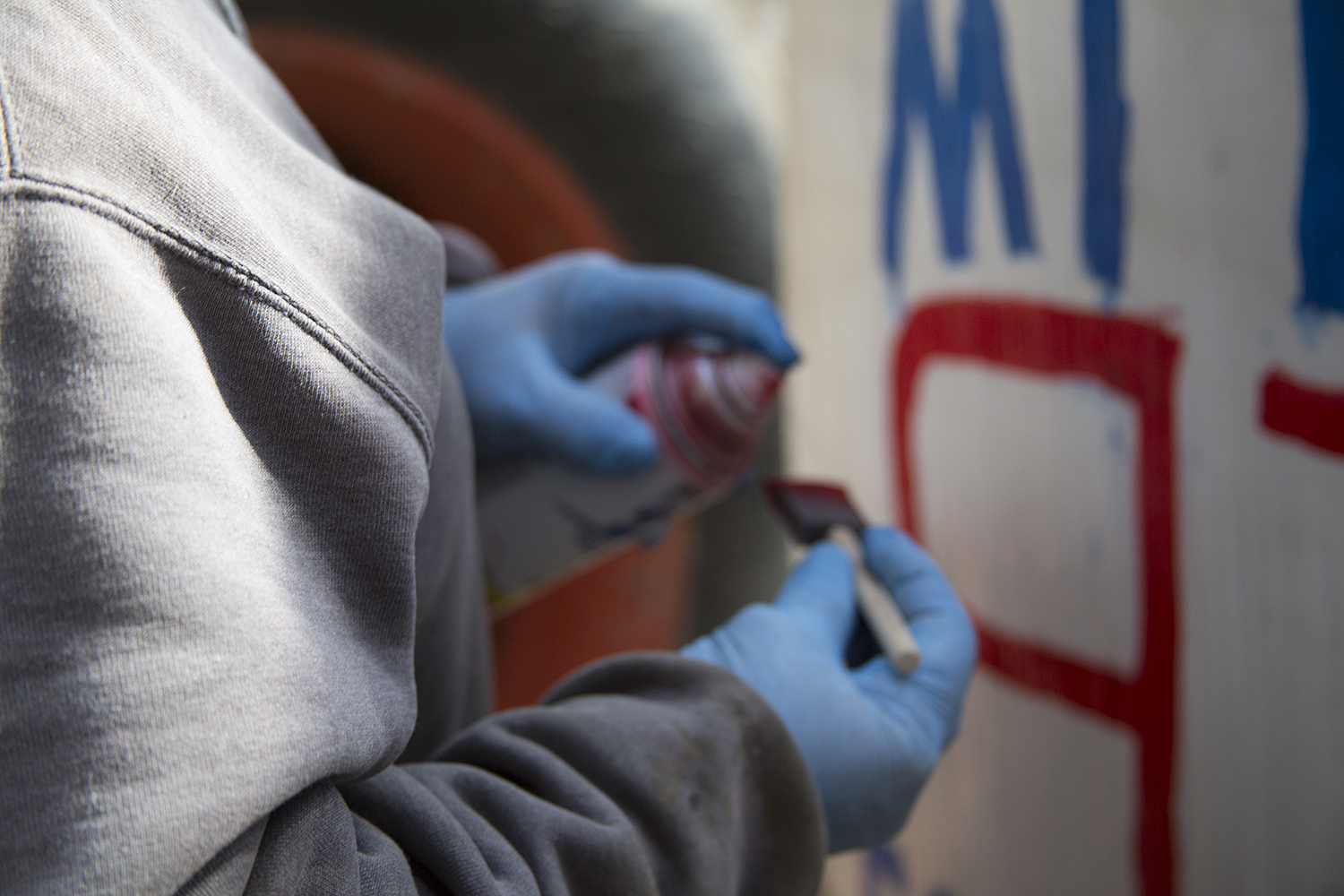
3) Use the small foam brushes and buy extra. This paint doesn’t wash out, so they can’t be re-used. Foam brushes can be turned for thick or thin letters.

4) Wear gloves, this paint will be with you a while if you don’t.

5) Before painting, sketch out a guide with a pen.

6) 97% is the largest and in making the percent-sign, put the circles parallel to each other and the slanted line in between to keep it straight.

7) Find the middle and that’s where the “I” in Milk goes, then build on that.

8) Letters are placed every 2.5 inches for “Local Whole,” and adjust others accordingly.

9) Spray paint onto foam brush, then apply to bale in strokes from the bottom to the top of each letter.

10) Alternate between colors (Blue/Red or Black/Red).

11) Make the letters broader and thicker for the word MILK, in all capital letters.

12) Follow your guide and use paint to even things out as you go.

13) Paint will dry faster and better, with fewer runs (in winter) if painting in sunshine or with a heater running in the shop.

14) Sit them on a pallet for better visibility on property you have along roads and set back from intersections.

‘Consumers are smarter than us, they are buying more fat.’

Covington more optimistic for dairy in 2019

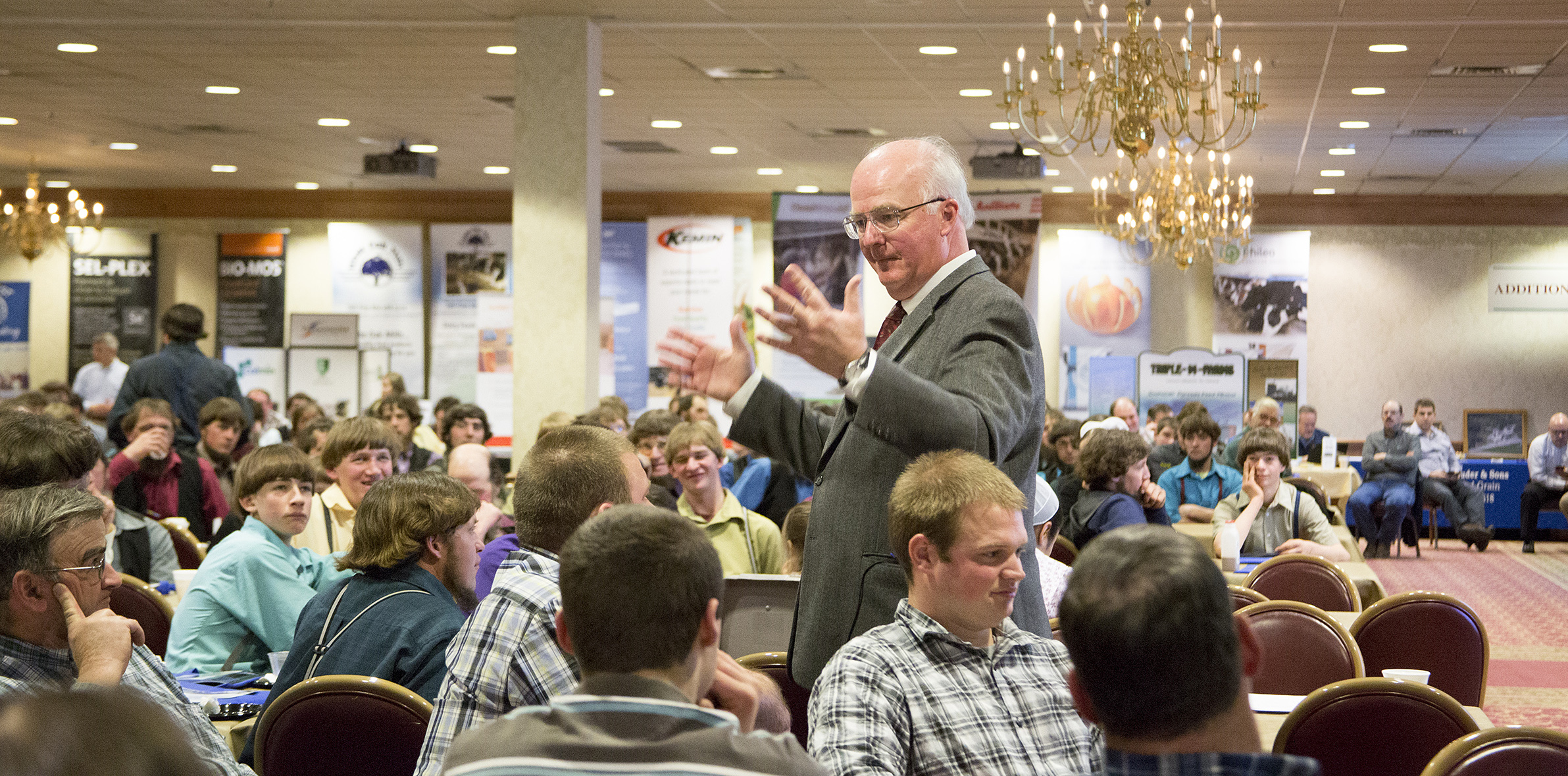
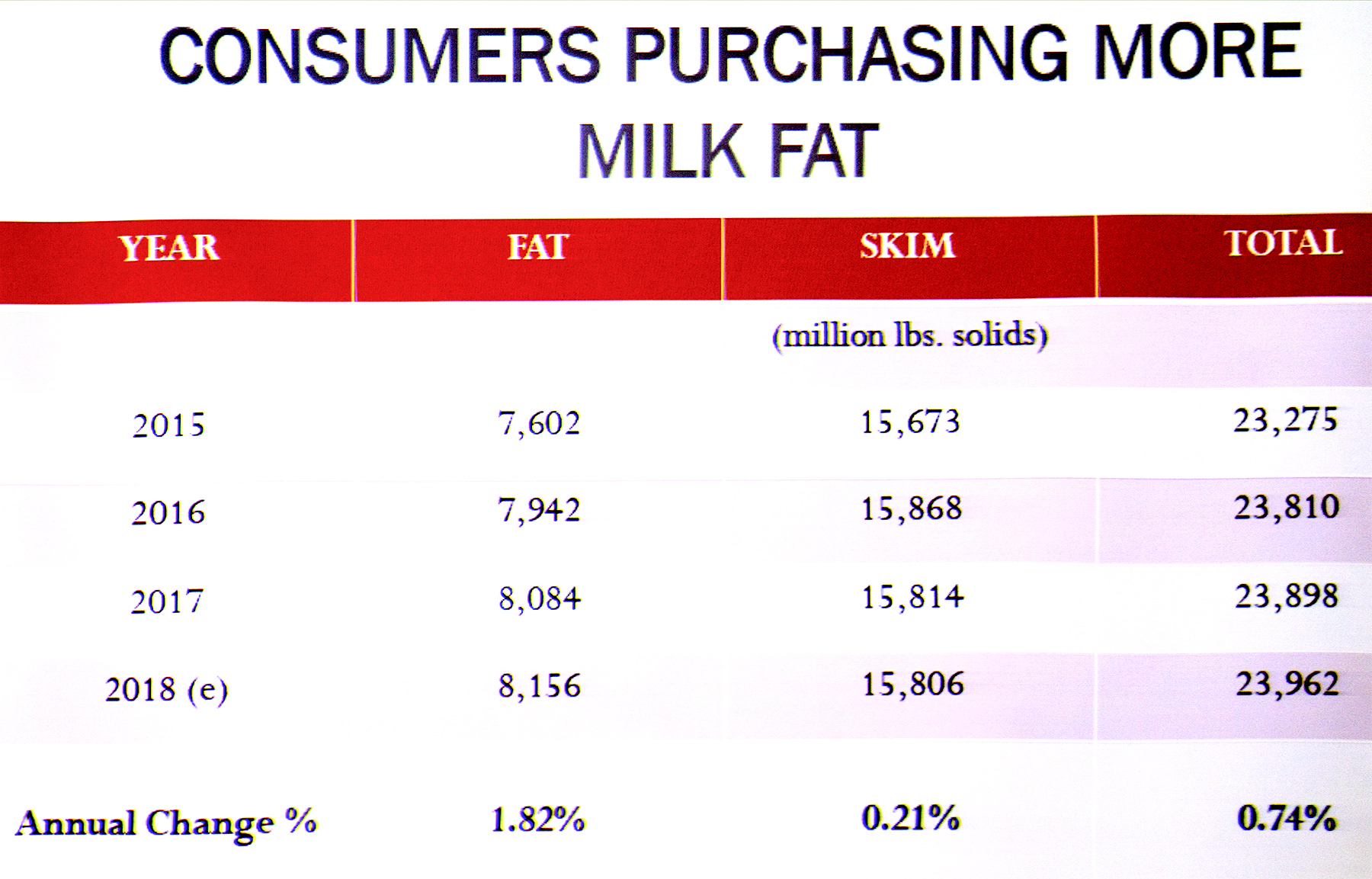
(Above) Calvin Covington is the retired CEO of Southeast Milk, Inc. and formerly with American Jersey Cattle Association and National All Jersey. He has published many articles in Hoards Dairyman and other publications and is respected for his insights on milk marketing. Covington came to Lancaster County, Pennsylvania from his home in North Carolina on Jan. 29 to talk about dairy markets — from the Northeast perspective — at the R&J Dairy Consulting winter dairy meeting. The previous week, Covington spoke at the Georgia Dairy Conference in Savannah, giving the Southeast outlook and perspective there. He also shared with producers that butterfat is driving milk check value because consumers are smart, they are choosing whole milk, butter and full-fat natural cheeses. He urged producers to hold their industry organizations accountable on selling and promoting fat and flavor. He encouraged farmers to focus on pounds of components to improve milk prices at the farm level.

By Sherry Bunting, from Farmshine, February 1, 2019

EAST EARL, Pa. — Bringing a bit of good news, along with good understanding, of dairy markets, Calvin Covington kicked off R&J Dairy Consulting’s winter dairy seminar Tuesday (Jan. 29) talking about what needs to happen for milk prices to improve.

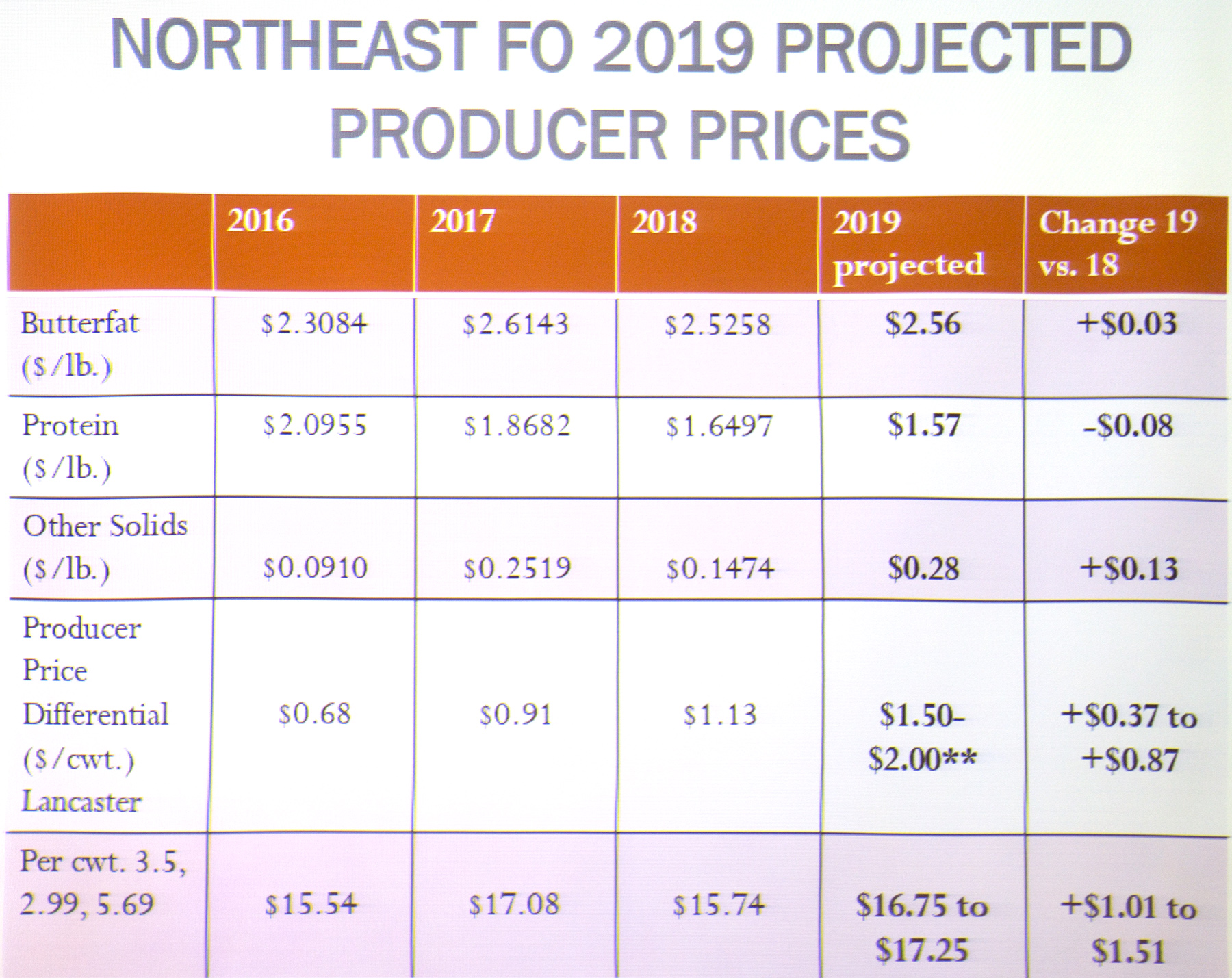
He had the full attention of the 300 dairy producers who gathered at Shady Maple Smorgasbord in East Earl for the meeting, where they learned that Covington anticipates 2019 Federal Order blend prices in the Northeast to improve by $1.00 to $1.50 in 2019 compared with 2018.

“But it’s going to be a walk, not a run. they will move up gradually,” he said. “Last year, I was pessimistic. This year, I am a lot more optimistic.”

Covington also talked about the “4 C’s” that need tochange as the major factors to improve farm level milk prices: Consumption, Cow numbers, Components and Cooperation.

“The most important is consumption,” said Covington. “What is the consumer telling us?”

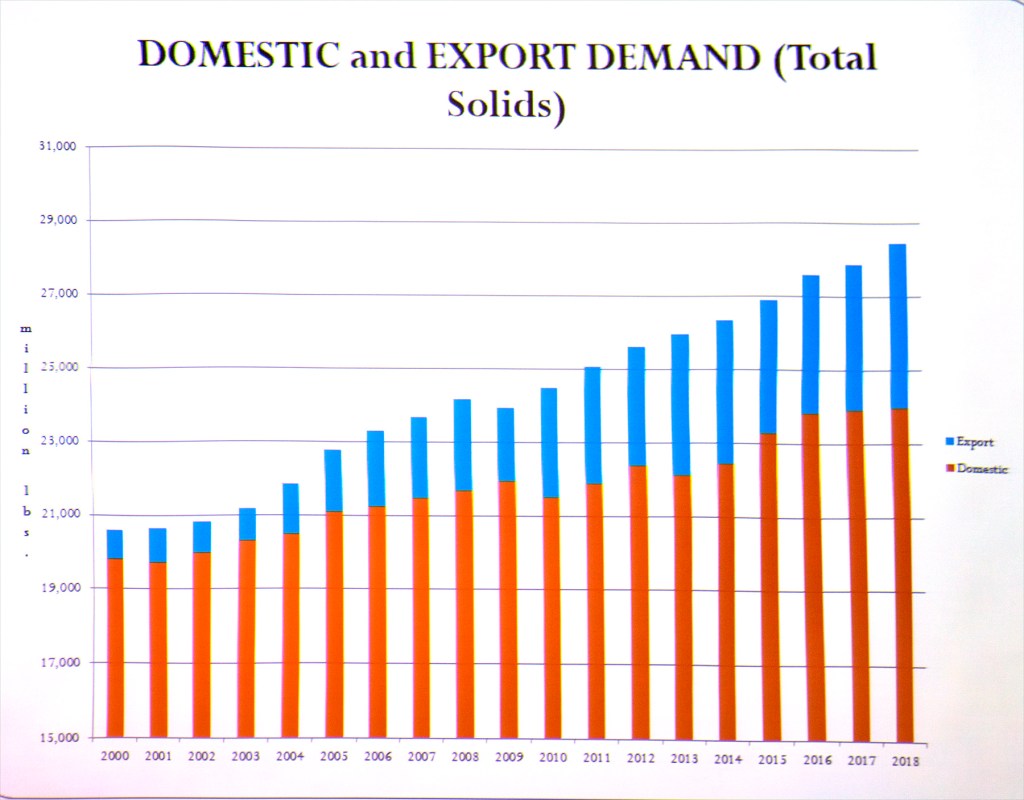
He showed a graph of how overall dairy consumption has steadily increased on a solids basis from 2000 though 2018, and he displayed a chart (above) showing that the consumer is telling us they want the milkfat — that it’s the solids in the milk — the bufferfat and protein — that give milk value.

“Exports are growing. That’s where most of our growth in demand has been coming from… but we export commodities — milk powder, whey, lactose,” he said. “We export very little butter and cheese.”

While he said exports are of course important to the milk check, he emphasized the need to focus on domestic demand, which has been overlooked and “presents real opportunity. What can we do to lift domestic demand and make that happen?”

In a word, said Covington: “Milkfat. That’s number one. We in the dairy industry need to talk about milkfat and not hide behind it not wanting things to change. Consumers are a whole lot smarter than we are. They are figuring it out. They are buying more fat… and we need to sell thatt.”

He said that the average fat content of all types of fluid milk sales from fat-free to whole milk — nationwide — is 2%.

“If that moved up by just 1/4 to 1/2 of 1 percent, the difference in farmer milk checks would be substantial. Fluid milk sales have been declining (in total), but whole milk sales are up three years in a row,” Covington explained.

“Consumers want that taste, and we’re not talking about it.”

He also pointed out how per capita butter consumption is at its highest point in over 10 years.

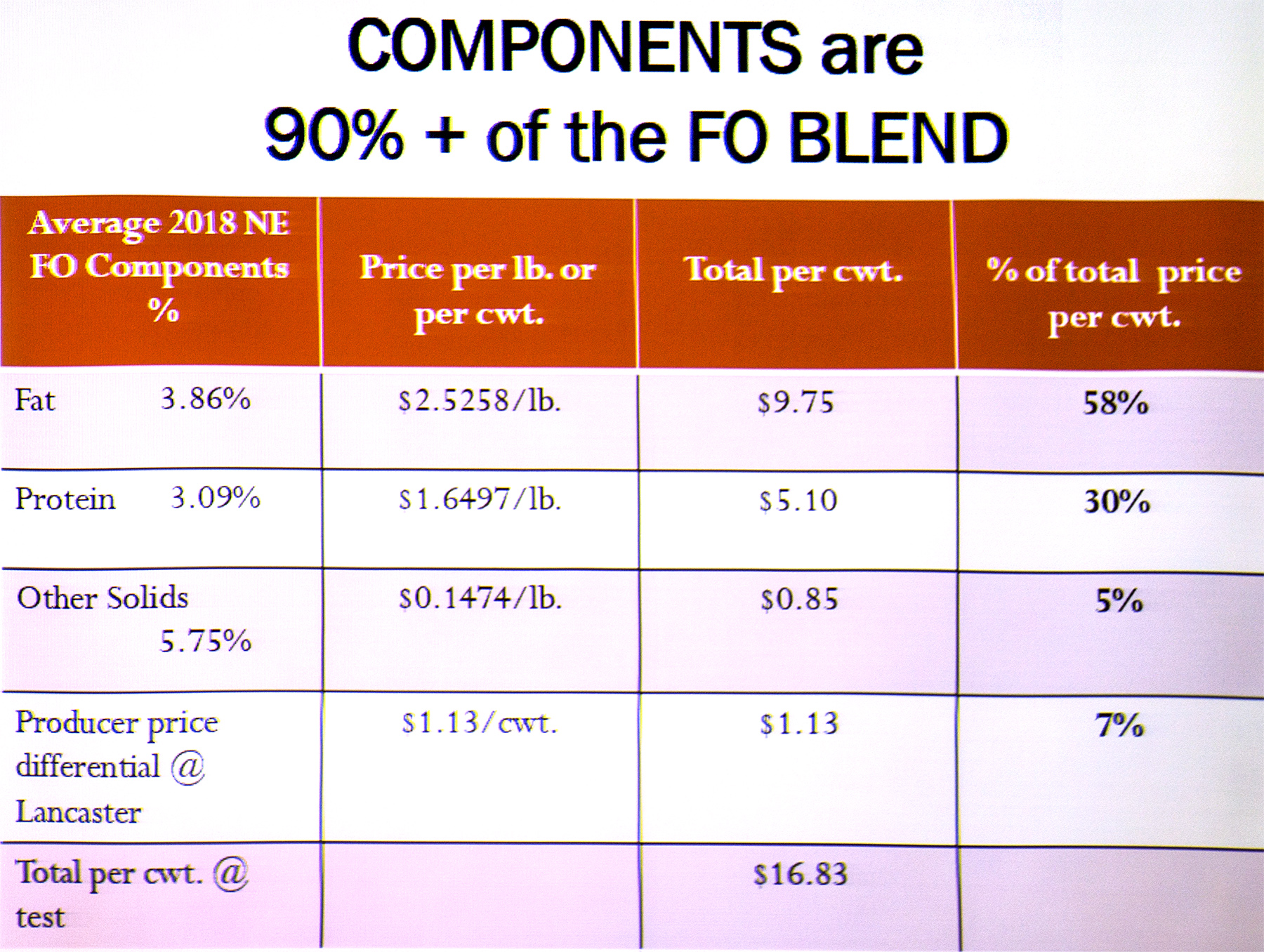
“That’s big, and that’s why the butterfat price in your milk check is double the protein price,” said Covington, explaining that in addition to butter, natural cheeses are one-third fat, that we forget about.

“Natural cheese consumption is higher, but it’s the processed cheeses, that contain less fat, that are moving lower,” he said.

He noted that for many years, the research said fat is bad for us.

“Now smart people are showing this to be false and we have books and articles about how butter, cheese and whole milk are good for us.”

Covington noted that what the industry needs to focus on is giving consumers more of what they want and not being afraid to “sell more fat. That will up your milk price,” he pointed out, encouraging producers to focus on pounds of components because this is the majority of how their milk price is determined.

He shared a story about meeting Queen Elizabeth in England with one of the oldest Jersey herds in the world. Those cows produce more than 6% fat, and that’s what she drinks and she’s 92 years old.

He also observed that the Queen knows as much about cows and agriculture as about anyone he’s met.

Look for more highlights and details from Covington’s fascinating discussions and his 2019 market outlook for the Northeast and the Southeast in a future Farmshine.

-30-

It’s 4th and 40 with 4 seconds on the clock, backed up to our own endzone…

Web-based FUTP60’s branding is long on NFL, short on dairy, while funding is long on dairy, short on NFL

By Sherry Bunting, Farmshine, Feb. 8, 2019

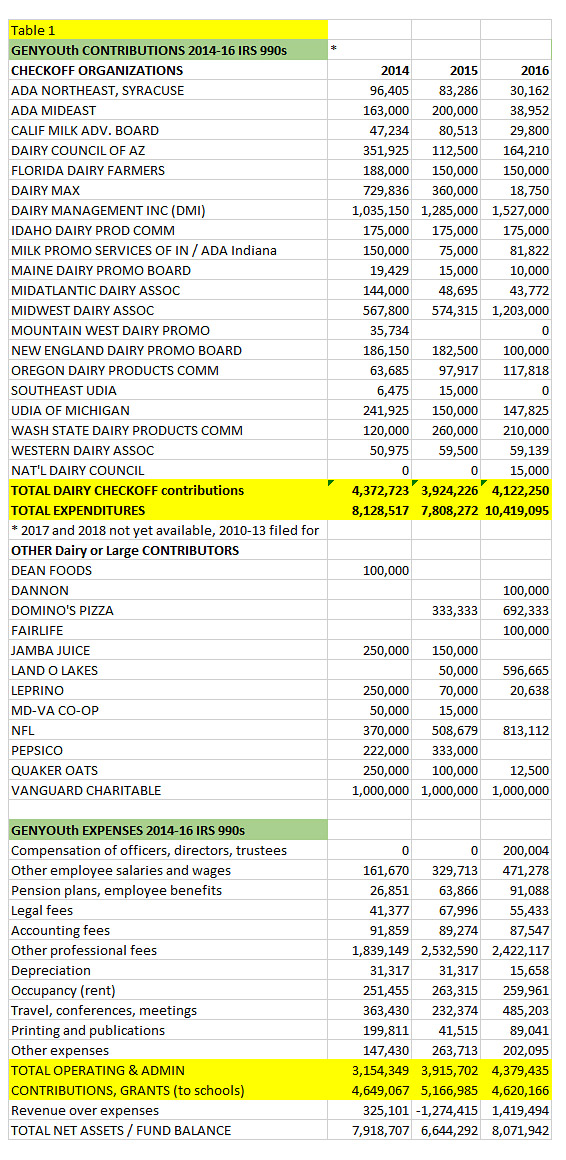
BROWNSTOWN, Pa. — Since 2010, Fuel Up to Play 60 (FUTP60) has been GENYOUth’s flagship program, a marriage between the NFL’s Play 60 initiative for students to participate in 60 minutes of exercise daily and the Fuel Up portion touted by DMI and underpinned by USDA, focusing on healthy eating, defined as whole grains, fruits and vegetables, including fat-free and low-fat dairy. This is a program where dairy checkoff outspends the NFL $4 to $1.

In its 2016-18 report “Building the Evidence Base for FUTP60,” published in January 2018 and available here, the FUTP60 program is called “the nation’s largest in-school wellness program with over 73,000 enrolled schools.” The report states further that, “FUTP60 aims to improve K-12 school nutrition and physical activity environments using a student-centered approach and social marketing tactics along with promising practices for creating positive, incremental environmental changes.”

The team regularly tracks key indicators of program reach, effectiveness, adoption, implementation and maintenance, according to the report.

An illustrative infographic documents progress through educator surveys, reporting in January 2018 that of the 38 million students in the 73,000 enrolled schools, 13 million were “actively engaged” in the program.

Under healthy eating, the report states that “because of FUTP60, 14 million students are eating healthier, consuming vegetables, fruits, whole grains, fat-free or low-fat dairy (milk, yogurt, cheese) and that 18 million students are more physically active.” 

But there are no surveys tracking actual food selections as the impact data are self-reported as “educator insights.”

In fact, all of these numbers are self-reported as the fine print states: “Data are based on a combination of annual FUTP60 Utilization Survey of almost 10,000 educators nationwide, funds for FUTP60 reporting and program enrollment data.”

So, just 10,000 educators are surveyed for the report, but 73,000 schools are said to be enrolled.

According to the Jan. 2018 report, the GENYOUth funding supported the following items in 2016-17: 2333 breakfast carts, 2,338 school kitchen equipment upgrades, 1833 projects to create active classrooms, 244 projects to improve physical education, 1984 school-wide walking clubs, and 741 cafeteria makeovers.”

The report describes the funding as “generously donated by America’s dairy farmers, U.S. corporations, non-profit organizations and philanthropies.” (Table 1).

FUTP60 was founded in 2009. GENYOUth was licensed as a non-profit in 2010, and a memorandum of understanding (MOU) was signed by the National Dairy Council, NFL and USDA in 2011. IRS 990 forms for 2014-16 available at guidestar.org show dairy farmer checkoff organizations are the single largest contributor to GENYOUth – outspending the NFL $4 to $1, while bound by the MOU signed with USDA to not use the platform to advertise. Meanwhile, the entire program is clothed in NFL branding and USDA dietary dogma. Table compiled by Sherry Bunting with available 990s for 2014, 2015 and 2016.
Peer-reviewed articles mostly studied the design of the program. However, a 4-year (2011-15) review of the impact of FUTP60 was published in the March 2017 edition of the American Journal of Preventive Medicine, available here.

The authors studied participants in schools within the 32 NFL franchise markets, including a range of 50,000 to 100,000 students from just 497 schools (not 10,000 nor 73,000 schools). These 497 schools completed FitnessGram assessments annually for 2011-2015. Program participation was not required, and its implementation was evaluated each year through self-reported school surveys. 

The study measured the main outcomes of aerobic capacity and Body Mass Index (BMI) of students. Results showed that about 19% of the 497 schools were “classified as FUTP60 programming schools.”

Annual improvements in aerobic capacity were “significantly greater in schools that participated in the programs for both girls (3%) and boys (2.9%) compared with non-program schools. The annual improvements in BMI Healthy Fitness Zone achievement were also higher in girls (1.3%) and in boys (1.2%) from schools that participated in the program vs. those that did not.”

The report stated that schools implementing the programs for the entire 4-year period tended to have better improvements in aerobic capacity than schools enrolled for only 2 or 3 years.

Still, the study authors concluded that, “The results … support the utility of the NFL Play 60 physical activity promotion programs for improving youth aerobic capacity and potentially helping to reverse the prevalence of overweight / obesity. However, the overall program adoption rate is low.”

Most of the FUTP60 program is web-based, with toolkits for lead educators at participating schools. In fact, IRS Form 990s for 2014-16 show that of the $7 to $10 million in funds received annually through checkoff and other organizations, roughly $3 to 4 million was used annually in the form of grants to qualifying schools and of the remaining $4 to $6 million, an average of just $109,000 (roughly 1%) from 2014 through 2016 was used for printing or publishing materials.


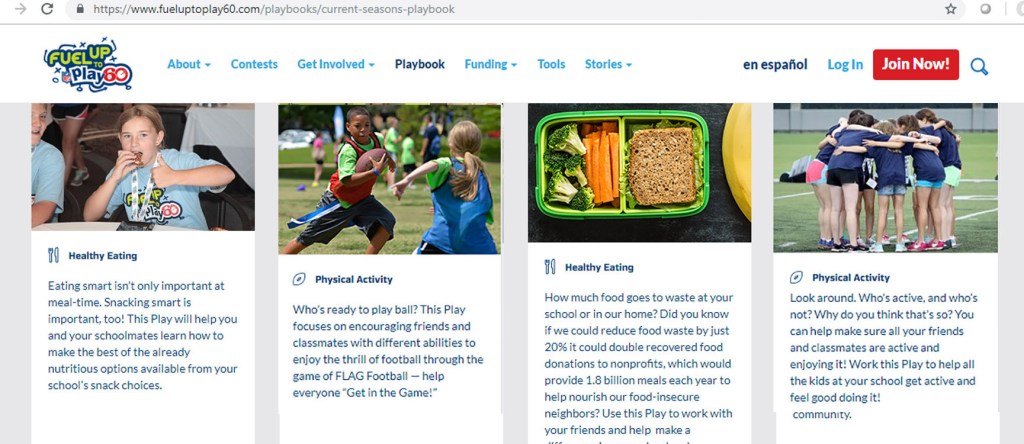
FUTP60 is mainly a web-based program where a playbook and toolkits are available for schools to choose one healthy eating play and one physical activity play to implement to qualify for up to $4000 a year for physical activity or foodservice equipment or projects. The playbook branding is long on NFL branding, short on dairy. DMI cites the mobile breakfast carts as a ‘prime mover’ for students to consume more fat-free and low-fat milk, yogurt and cheese that are among the breakfast options offered.

The detailed website is augmented by NFL ‘Play60’ apps that students can download and use on electronic devices to participate in ‘virtual challenges’ relating to movement and activity.

The less than $1 million contributed by the NFL and the larger number Commissioner Goodell articulates based on ‘services’ can be considered as furthering the advertising value for the NFL — attracting future generations to the game while attracting schools to participate in FUTP60. The FUTP60 infographic explains how the NFL “brings excitement to school wellness”… with these 2016-17 statistics: 2700 NFL players, mascots and cheerleaders visited schools, 4200 local events were held, 12,000 flag (football) kits were donated to schools to get over 6 million students moving more, and over $1 million in hometown grants were donated to schools.”

It is certainly true that there is plenty of NFL branding in this program under the auspices of “bringing NFL excitement to physical activity” — even though…

America’s dairy farmers — through their mandatory checkoff organizations — outspend the NFL $4 to $1, according to available 2014, 2015 and 2016 IRS 990s at guidestar.org

Even the video spots created by DMI for this year’s social media lead-up to the 53rd Super Bowl were long on NFL branding and short on dairy messaging. Read more about that, here.

Again, the Youth Improved Incorporated Foundation, doing business as GENYOUth, is short on dairy and long on NFL.

FUTP60 is largely a program focusing on physical activity, and there are other areas of youth wellness that are being added each year.

This year’s new foray for GENYOUth is sleep studies. The new big thing in weight-loss is getting enough sleep.

As it grows, GENYOUth’s founding and primary funding is by dairy farmers who see their message diluted – just like the flavor of their milk at the school lunch counter or mobile breakfast cart.

The thinking is that fat-free and low-fat dairy can be quietly positioned for the future within this overall youth wellness effort. Insiders put stock in the mobile breakfast carts that schools can earn using FUTP60 healthy eating and physical activity ‘plays’ to score ‘touchdowns’.

DMI staff point to these breakfast carts as opportunities for children to consume more fat-free and low-fat milk and yogurt and skim-processed cheese.

Should dairy farmers be investing in youth wellness? That feels like a good idea. But when there are so many questions about how ‘well’ kids are permitted to eat at school, one has to wonder where this is all going.

In terms of truly promoting dairy, this all has the feel of a hope-to-catch, hail-Mary-pass that is destined to be intercepted vs. a game plan that earns a win for the home-team that sits at 4th and 40 with 4 seconds on the clock — backed up to their own endzone.

-30-

My view: Money spent, points missed.

By Sherry Bunting, Farmshine, Feb. 8, 2019

Even the video spots created by DMI for this year’s social media lead-up to the 53rd Super Bowl were long on NFL branding and short on dairy messaging. After all, America’s dairy farmers have this relationship with the National Football League (NFL) via GENYOUth and Fuel Up to Play 60 (FUTP60), why not advertise it, right?

But DMI’s “Dairy Rules” videos leave the viewer wondering what the point is.

The “Dairy Rules” content series represents a $100,000 media buy, alone, with production costs on top, according to Edelman, the agency doing creative and public relations work for DMI over the past 20-plus years. They say the two videos prepared for play on social media sites Feb. 1-4, “apply football rules in the context of dairy products to humorous effect.”

Honestly, I found them to be more annoying than humorous, maybe I didn’t get the point?

DMI sources say the “dairy replay booth” videos were viewed 6 million times on social media platforms. You can view them for yourself here and here .

(The number of views logged at these YouTube links as of February 4 is more like 200 and 500. And the embedded Facebook version showed 6,200 views. The Twitter platform counts were around 600 each.)

While the tagline is a good one: “Real Dairy is always the right call,” the substance of the skits is rapid-fire, dairy-name-dropping clothed in football jargon.

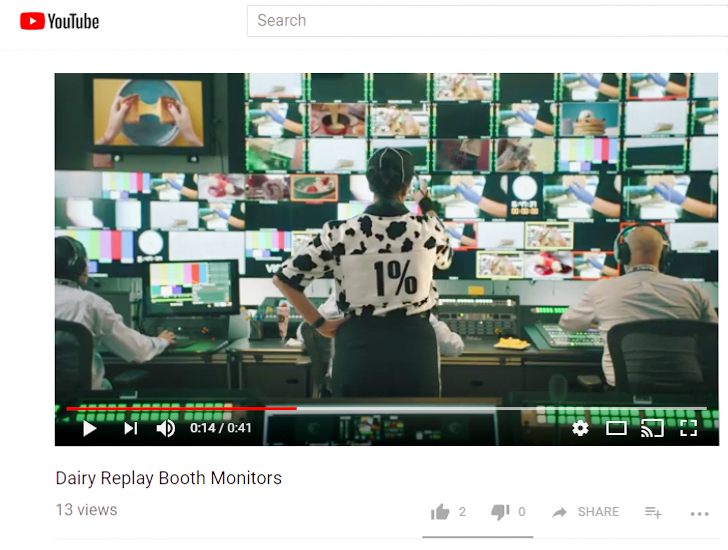
Except for this brief 1-second and chaotic glimpse at the “dairy replay” screens, the viewer is in the dark over why “Real Dairy is always the right call.”

In fact, “Grace under pressure,” the female referee in the first 30-second “dairy replay booth” video, reviews dairy-use fouls. Speaking rapidly and displaying a large 1% emblem on the back of her hybrid cow-print/referee-striped shirt, she points to screens the viewer can’t see saying: “That’s mom delaying ice cream night to answer a text. That’s parfait interference, too much fruit in the yogurt. That’s conduct unbecoming of an ice cream sandwich, inappropriate use of fondue forks, a butter block below the waffles… asiago more than 5 seconds on the floor and incomplete use of milk in the chicken tetrazini.”

From the front we see the “Undeniably Dairy” logo on her shirt. Cute. Funny, sort of. But what’s the message? 

The viewer is all set up for “Real Dairy is always the right call,” but no real substance emerges to sink their teeth into, even if the average person could understand half of the jargon.

The second video with a male referee takes the same approach. “All day, every day, dairy infractions are being committed. We’re here at the dairy replay booth to make the final call,” he says as the dramatic NFL-style intermission music plays.

He peruses a wall of screens. “The call is roughing the queso,” he nods, followed by a few more phrases that are hard to decipher — something about a ruling on the fontino? That’s a type of cheese.

And then, a perhaps redeeming line: “Okay Seattle, Dad’s drinking straight from the chocolate milk container, making it ineligible… again.”

Okay, that one at least creates a word picture of Dad swigging chocolate milk straight from the jug instead of taking time to pour a glass – because it’s that good. 

Disjointed and hard to follow, there’s plenty of NFL branding in these videos, and the creators for DMI made sure to display the 1% and 2% subliminal low-fat messages on uniforms and props.

But apart from a glimpse of the replay refs tapping the water cooler (containing milk instead of water with bright red lettering of 2%), there’s just no dairy visible in these Undeniably Dairy, Dairy Good spots.

Decision made, faith shared as his beautiful Lancaster County farm auction is set for Feb. 9

By Sherry Bunting, Farmshine, February 1, 2019

RustyHerr01

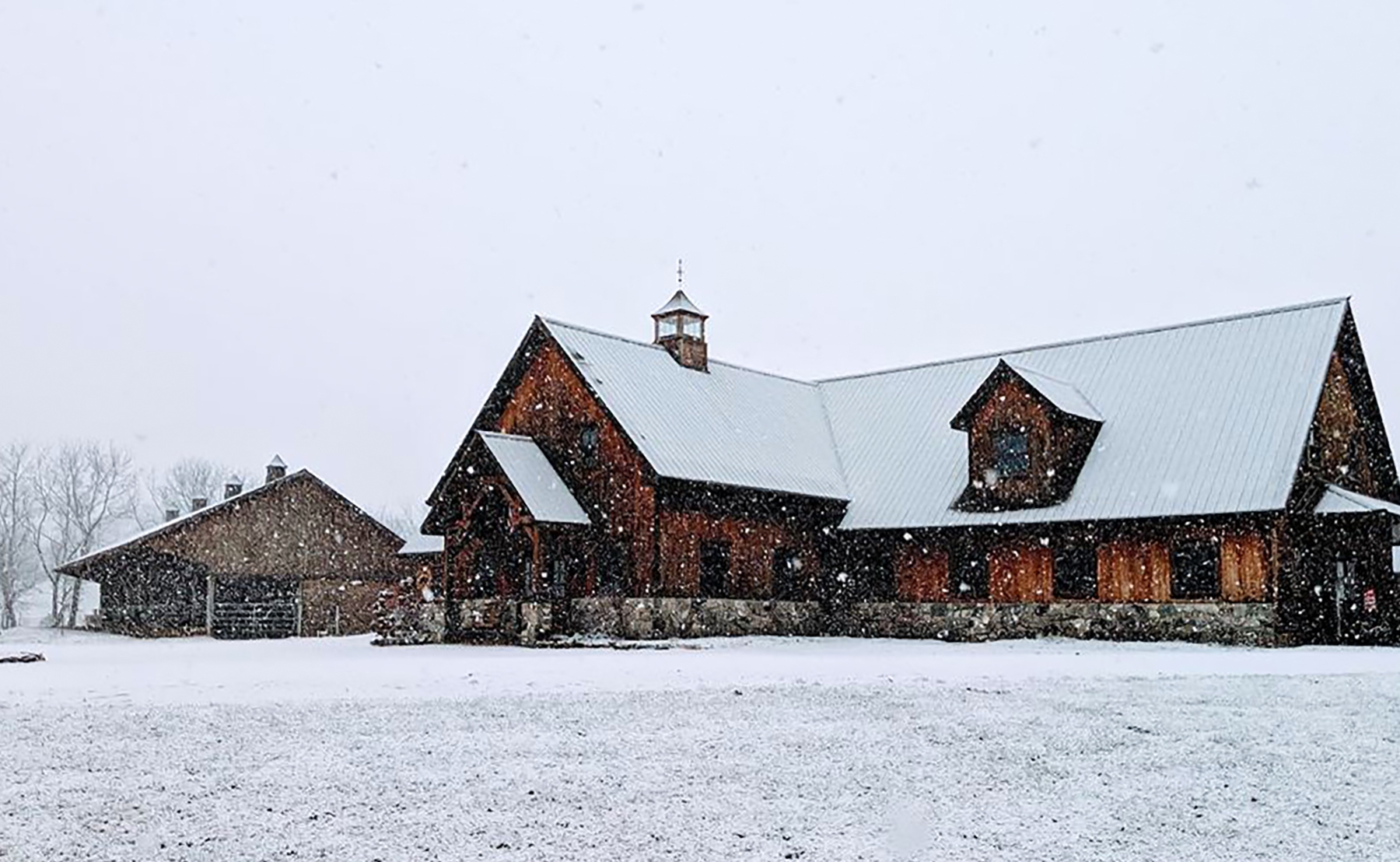
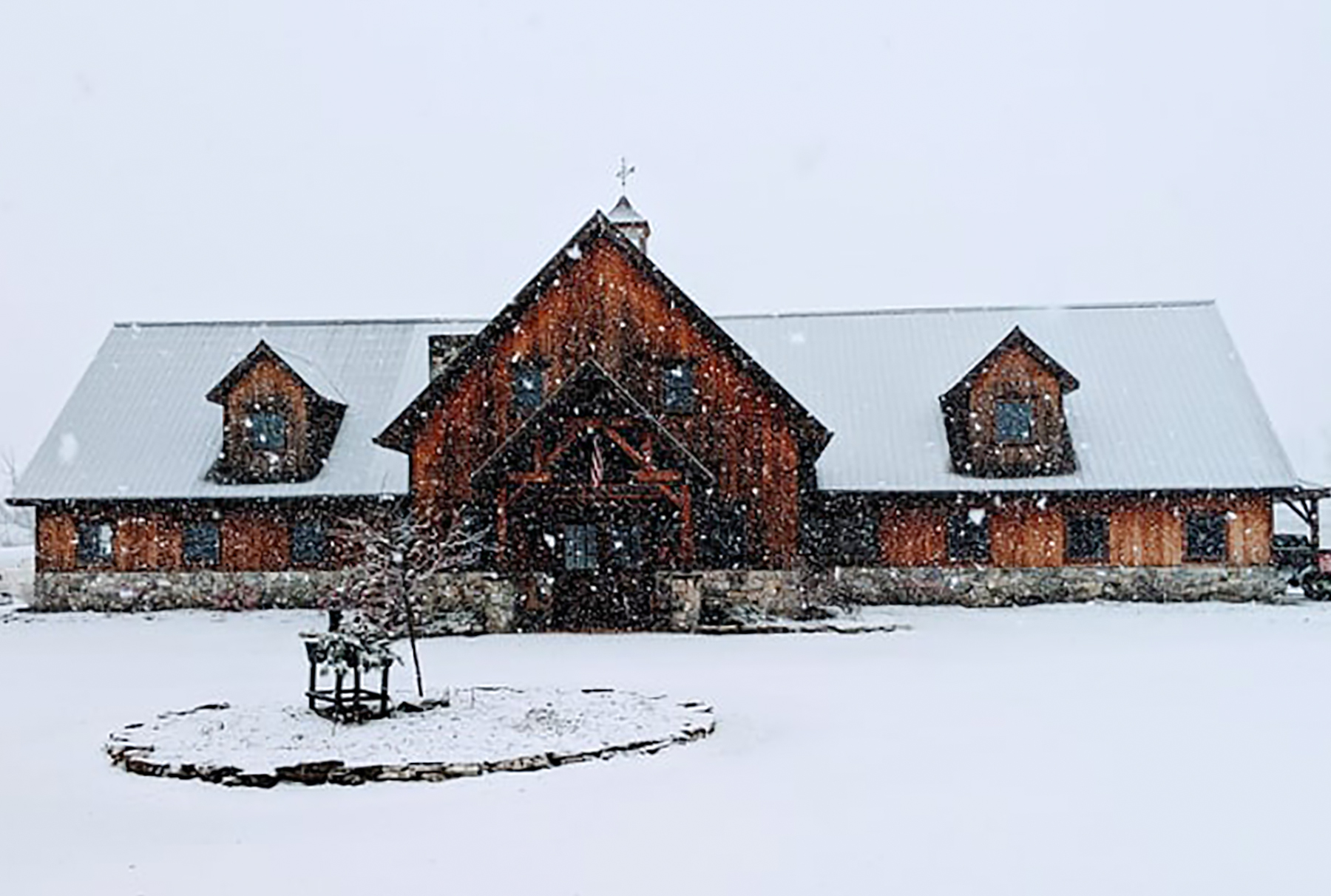
Picture postcard perfect in Tuesday afternoon’s snow, Rusty Herr’s 71-acre farm, including the all wood construction dairy and heifer barns (shown here), designed to showcase Golden Rose Genetics, as well as the restored historic home (not shown) in the Andrews Bridge historic district of southern Lancaster County will be auctioned by Beiler-Campbell on Feb. 9.

CHRISTIANA, Pa. – “It was a gut feeling, more than anything — an inner sense of knowing something had to happen,” says Rusty Herr about his November decision to auction the 71-acre farm and its most unique dairy facility that is home to Golden Rose Genetics and its elite herd of 40 cows, 25 of which are related to the Oakfield Pronto Ritzi cow he purchased as a yearling in 2009 at the New York Spring Sensation Sale.

Beiler-Campbell Auction Company will conduct the public auction at the 3 Sproul Road farm in the Andrews Bridge historic district of southern Lancaster County near Christiana, Pennsylvania next Saturday, February 9 at 1:00 p.m. In addition to the farm, and it’s not quite four-year-old dairy and heifer barns, the sale includes the family’s restored historic home.

RustyHerr00

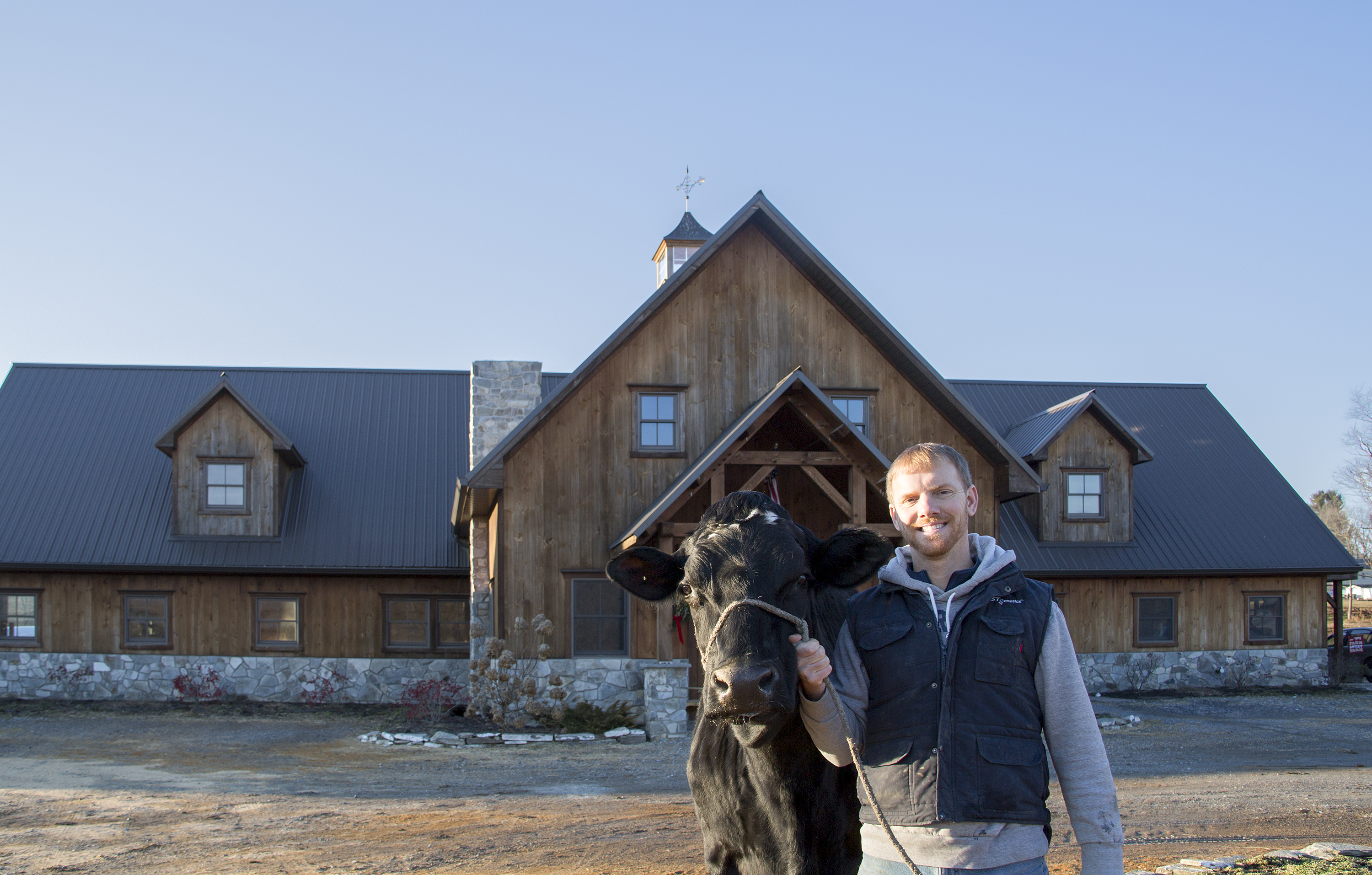
Rusty with his foundation cow Oakfield Pronto Ritzi EX93, in front of the dairy facility at Golden Rose Genetics. The facilities and renovated farm house are part of the auction Feb. 9 of the 71-acre farm. Pronto Ritzi’s is from a genetic line that is now 19 consecutive generations EX with the most recent four generations bred here at Golden Rose and a potential 20th generation EX — a red and polled first calf heifer — waiting in the wings to be scored.

Rusty will determine his options for the cattle and equipment after the sale of the farm. He’s hoping to be able to keep some of his best animals and some heifers for his children to show.

The beautiful all-wood construction Canadian-style barn, complete with indoor wash rooms and a show case entryway was built so that Rusty could give his small herd of high-scoring cows the individual attention and as a show place to merchandise the genetics he has been developing.

In fact, his Golden-Rose Ladd Glory-Red (below), both Red and Polled, has not yet been classified and has the potential to be a 20th generation EX in Oakfield Pronto Ritzi’s line.

RustyHerr-ProntoRitzi

Oakfield Pronto Ritzi EX93 is the foundation cow at Golden Rose

RustyHerr-Glory

Golden-Rose Ladd Glory-Red is a polled first-calf heifer that will be professionally photographed in February. She is not yet classified, and Rusty has high hopes for her as a potential 20th generation EX from the Oakfield Pronto Ritzi line. Rusty will make plans and choices for his cattle after the public auction of the farm.

Good cows and good genetics, along with a love of marketing and the training and skill-set for reproductive work — these are the things Rusty has learned and will continue to love – even if the path forward right now is like opening a book of blank pages.

While it was a gut feeling and months of deliberation that led to the decision to sell the farm, it all comes down to the financial strain he and other dairy producers are enduring.

“Each of us has to know how much longer we can tread water before losing everything,” he says. “We also have to look at how the financial strain may be impacting on other areas of our physical, emotional and family life. If the dairy industry was in a good place, financially, it is obvious we would not have all of these farms going out of business.”

In kitchen table discussions with other dairymen who’ve crossed this bridge over the past several months, one thing is apparent, our industry’s young farmers and transitioning families do not have the cash flow to finish transitions or move into later stages of having started as beginning farmers. They also don’t have the peace of mind that the markets will cycle high enough to pull them up from four years of losses. This is concerning for the future as we are not just seeing the older generation retiring out of the business, we are seeing unprecedented numbers of young people who have a passion for dairy in these tough decisions.

For Rusty, it means walking away from the farm and most unique dairy facility he had spent years dreaming, planning, preparing for and then in 2015 building for his Golden Rose Genetics.

He had been sharpening his skill-set in embryo transfers, ultrasounding and IVF work, building a line of Excellent cows from the Oakfield Corners yearling he had purchased. He methodically built up the genetics side of his business, ultimately downsizing his prior herd with a 2015 auction to fund the new barn and intimate setting for a smaller herd where he could specialize in genetics.

What he didn’t plan on — what nobody could have — is that the milk price would abandon its three-year cycle to tumble low for four straight years, beginning in 2015 when he moved his smaller herd into their new quarters at Golden Rose.

RustyHerr02.jpg

With a rough-cut pine exterior and the interior smooth pine tongue-and-groove construction, clear-coated to protect the wood against moisture, the 40 tie-stalls and four box stalls were designed for the individual care of high-scoring cows. They currently produce 75 pounds/cow/day of milk with 4.2 fat and 3.3 protein and somatic cell counts 160,000 and below. They are fed a forage-based TMR of mainly corn silage and double-cropped triticale, along with some dry hay.

“Without one good year in the dairy markets (since 2015), it’s been an uphill battle,” Rusty reflects. “We were treading water, but then the outlook sealed it. If it looked like markets would be a lot brighter going into 2019, maybe we could hunker down a bit longer, but we felt like we have already hunkered down and pushed it.

“Obviously it has not been an easy decision to make,” but he says that it is the right one for his family to move on from dairy farming as they have known it.

Looking back, he has no regrets.

RustyHerr-showcase

The entryway to the cow barn is part of what make this property a unique opportunity for many types of buyers. The location and beauty of the property and its wood-crafted dairy facilities designed for a small elite dairy herd could easily be converted for horses or for a farm to retail business.

“Life has a way of teaching us valuable lessons that we would have never learned if we didn’t go through certain things. When things get difficult, when the pressure is high and the pain is great, those are the times when we learn the most, when we figure out who we really are and come out better and more prepared to handle what is to come,” he describes the perspective that leaves him with peace about stepping towards whatever God has in store next for him and his family.

With the decision made, the marketer in him has Rusty feeling excited about the upcoming auction on February 9.

He and his wife Heather feel a sense of relief knowing the financial strain will ease, and he believes that any number of options could be in front of him.

He says the whole experience has taught him patience and to trust God for His perfect timing.

“This wasn’t how I would have planned it, having just purchased the farm and begun construction on the dairy less than four years ago, but it’s how the script is unfolding,” he notes.

“The dairy industry is changing in many ways, and to think that anyone could have predicted the markets would be moderately to severely depressed going on a fifth year in a row would have been unimaginable.”

But he adds that, “This is the reality of where we are with a high debt load, input costs from all angles and a very uncertain outlook. It’s just not sustainable to continue with the farm and small dairy herd.”

He and his wife Heather and their four children have put the future in God’s hands. He loves the work he has been doing both on and off the farm.

If a buyer wants to keep the dairy going and keep him working with it, he is open to that potential.

If the farm sells to a buyer completely unrelated to dairy, his path could change dramatically, and he’s ready for that.

RustyHerr-08.jpg

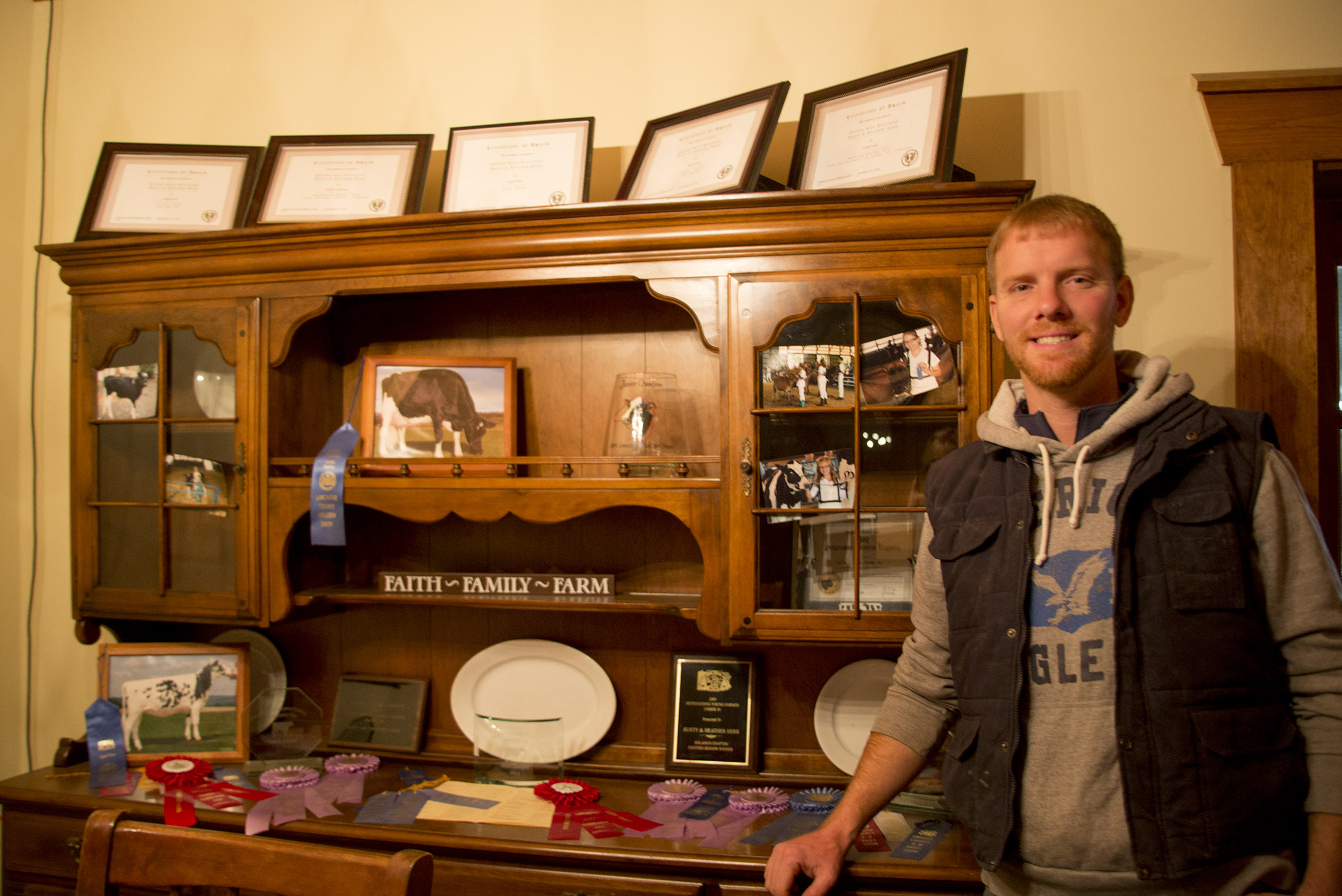
The foyer has a comfortable and historic sitting-room feel where milk quality certificates, pedigrees and ribbons and banners won by his daughters showing cattle at the local fairs are displayed. You can see the cows behind the double doors in the tiestalls. A visitor from the Netherlands surprised Rusty with a cow decal on the wall, a signature he leaves at every farm he visits, worldwide.

“We chose to auction the farm. This is not a forced auction,” Rusty affirms. “I have always loved cow auctions and after meeting with Beiler-Campbell, we decided this is how we would handle the farm sale.”

True to form, Rusty finds himself seizing the opportunity to learn about marketing real estate through this whole experience. Just another way to embrace circumstances and decisions even if they are completely opposite of earlier dreams and plans.

RustyHerr-AuctionSign.jpgIn fact, Rusty penned these words in a Facebook post 10 days before Christmas just after the auction signs went up, thanking their network of family, friends and church family and offering to others a glimpse of the hope and faith that remain strong – knowing so many farmers are wrestling with similar difficulties and decisions.

“Yes, it is sad to walk away from something I have worked my whole life to get to, but in other ways I can be so happy to have been given the opportunity to do it. So many people can never say that,” Rusty wrote, and reiterated during a Farmshine visit to Golden Rose Monday evening. During the visit, Rusty confided that the rollercoaster has not been the markets — they’ve been down with no relief. The rollercoaster he and other dairy producers deal with every day is an internal up-and-down in the mindset of whether they can move forward, or how.

“We can control a lot of things, but not the market,” he explains that they have done all they could to increase income and cash flow amid the perfect storm of lower prices for milk, cattle and beef. He stepped up his ET, IVF and other reproductive services to dairy producers in the region –pulling him away from the very farm he was bringing income back to keep going.

“What’s the family farm going to look like in the future?” Rusty wonders aloud. “That question, I think, is being answered. We are disappearing.”

“I don’t want sympathies and people feeling sorry for us…” he wrote in that mid-December post announcing the sale of the farm. “There are dairy farm families right now who are grieving over the loss of a loved one who thought that ending their life was the best way to cope with their overwhelming situation. They are the ones who need our prayers and support. There are others who have no idea how they are going to get through the coming months and years if things don’t dramatically improve. They might be retirement age and have just watched all of their net worth get eaten up while trying to ride out the storm. I would like this post to be about them.”

Rusty is grateful for family, friends and faith. He urges everyone in the dairy community to “Reach out to your neighbors and friends. Let them know that you care and are praying for them.”

In short, he says, “2018 has been the most difficult year in modern history to be a farmer. Farmers are strong people and can deal with more than most will ever have to, but we all have a breaking point. Pay attention, listen when someone just needs to be heard. Be a shoulder to cry on if needed. Be kind — you never know how much someone might be dealing with. People are good at hiding their struggles and pain.”

RustyHerr06.jpg

It’s milking time, and Daisy Herr, 13, gets started Monday evening at Golden Rose.

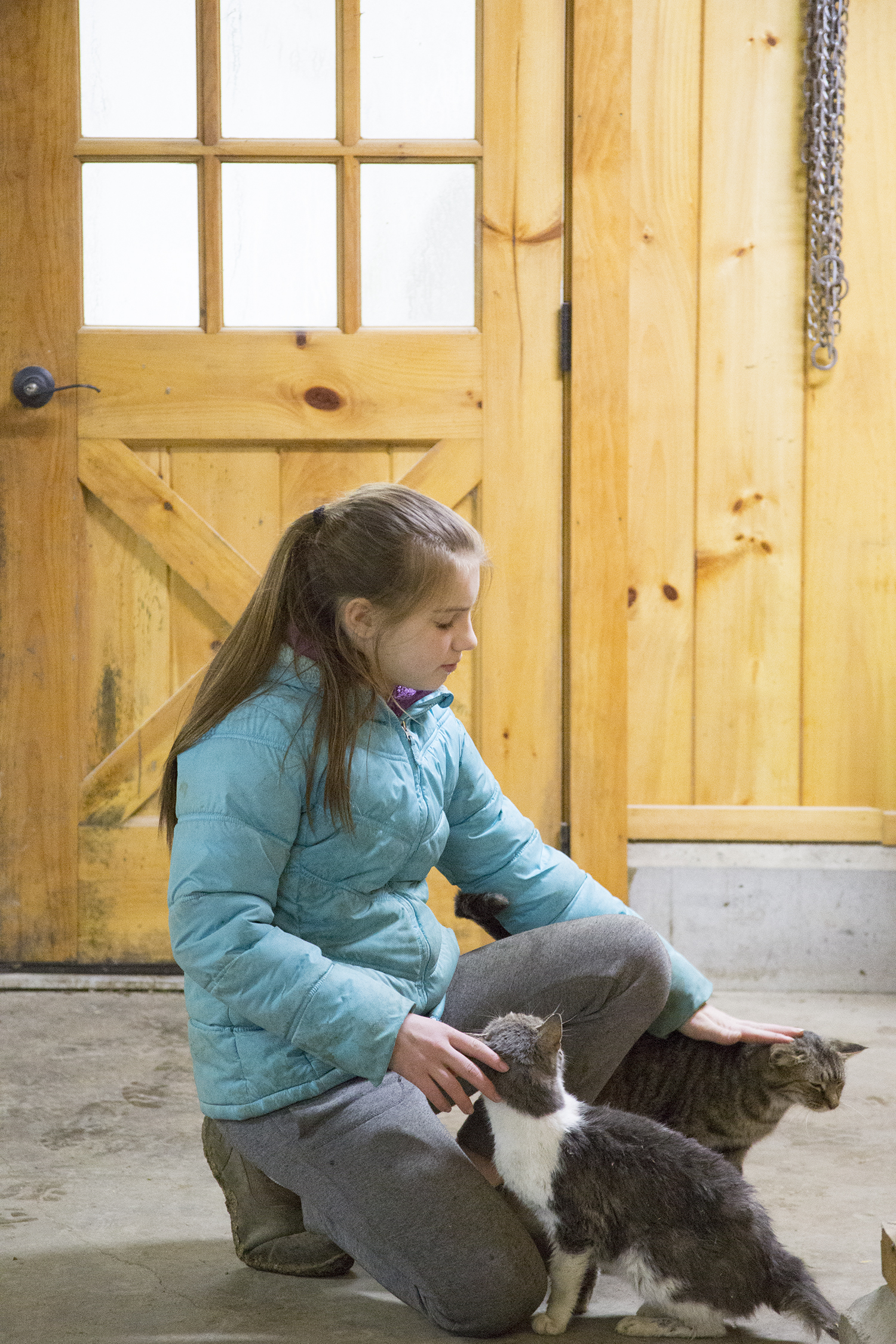
As Rusty and one of his daughters, Daisey, 13, began milking Monday evening, younger daughter Maddie, 12, fed the cats and prepared to join in. Their dad started a pot of coffee and prepared to feed.

“It’s a bittersweet thing,” he said as we concluded the interview as night fell. “The decision was difficult, but we’re all looking forward to what’s next, even if we don’t know what that looks like at the moment. For now, I’m focusing on the auction on Feb. 9, and trusting God has our back.”


“For I know the plans I have for you,” declares the Lord, “plans to prosper you and not to harm you, plans to give you hope and a future.”


Jeremiah 29:11

RustyHerr07

Rusty pushes up and gets ready to feed while daughter Daisy milks and daughter Maddie helps with other chores. He says Alli, 15, Daisy, 13, and Maddie, 12, have been taking turns with the milking. Son Jeremiah, 9, helps Heather’s mom with feeding calves.

RustyHerr-dronephoto.jpg

RustyHerr04

RustyHerr-HeiferBarn.jpg

RustyHerr-Maddie.jpg

Thompson, Peterson introduce Whole Milk for Healthy Kids Act of 2019

schoolmilkiStock-510657195web.jpgBipartisan bill would allow whole milk as option in school cafeterias

WASHINGTON – Making good on a promise to introduce legislation to bring whole milk back to schools, U.S. Representative Glenn ‘GT’ Thompson (R-PA) has joined forces with House Agriculture Committee Chairman Collin Peterson (D-MN) to introduce a bipartisan bill to allow for unflavored and flavored whole milk to be offered in school cafeterias.

H.R. 832, the Whole Milk for Healthy Kids Act of 2019 recognizes the importance of milk to the health and well-being of growing children.

Last year, the U.S. Department of Agriculture Secretary Sonny Perdue directed USDA to allow schools to serve 1% low-fat flavored milk in school meal programs that had been restricted previously to fat-free flavored milk.

H.R. 832 would take this further to allow whole milk to be included as well.


“Milk is the No. 1 source of nine essential nutrients in the diets of our students, but if they don’t drink it these health benefits are lost,” Rep. Thompson said in a press release Wednesday (Jan. 30). “Milk consumption has been declining in schools throughout the nation because kids are not consuming the varieties of milk being made available to them. It is my hope that the Whole Milk for Healthy Kids Act will bring a wider range of milk options to American lunchrooms so students can choose the kind they love best.”

“I’m proud to join Congressman Thompson in this effort that will provide more choices for nutritious and healthy milk to kids in schools, and a valuable market for dairy farmers in Minnesota, Pennsylvania and nationwide at a time when they’re continuing to face extremely difficult market conditions,” Chairman Peterson said in a statement.

Rep. Peterson is Chairman of the House Ag Committee and Rep. Thompson is a member of the House Ag Committee.

Thompson is also a member of the House Committee on Education and Workforce to which the bill was referred after its introduction on Jan. 29.

The nine original co-sponsors of the bill include Agriculture Committee Republican Leader Mike Conaway (R-TX) and three members of the Committee on Education and Workforce to which the bill was referred — Rep. Lloyd Smucker (R-PA), Rep. Dan Meuser (R-PA) and Rep. Elise Stefanik (R-NY).

Additional co-sponsors are Rep. Chris Collins (R-NY), Rep. Rodney Davis (R-IL), Rep. John Joyce (R-PA), and Rep. Mike Kelly(R-PA).

In a press release late last week, Thompson gave some background on this bill. He noted that in 2010, Congress passed the Healthy, Hunger-Free Kids Act which amended nutrition standards in the School Lunch Program.  Among the changes, the law mandated that flavored milk must be fat-free within the program.

This 2010 law, along with lower participation in the program, led to an alarming decline in milk consumption in schools since 2010. Declining milk consumption in schools not only impacts students, but also dairy farm families and rural communities across the nation.

Two years ago, to help encourage nutritious options in the School Lunch Program and increase consumption, Rep. Thompson introduced legislation – H.R. 4101, the School Milk Nutrition Act of 2017 – which provided schools the option to serve 1% low-fat flavored milk varieties.

In May of 2017, the USDA announced a rule that allowed schools to receive waivers for low-fat (1%) flavored milk, rather than only fat-free, which is the essence of H.R. 4101.

On January 29, 2019, Rep. Thompson introduced this bipartisan bill — H.R. 832, the Whole Milk for Healthy Kids Act of 2019. This legislation builds on the previous bill and USDA’s rule by allowing whole milk (both unflavored and flavored) to be offered within the School Lunch Program.

Producers and consumers are urged to contact their representatives to support this bill. Key members of Congress to reach out to on the Committee on Education and Workforce, which will be the committee to consider the bill, include Rep. Joe Courtney (D-CT), Chairman Bobby Scott (D-VA), Rep. Marsha Fudge (D-OH). View all Congressmen and women serving on this committee here

Follow the progress of H.R. 832, the Whole Milk for Healthy Kids Act of 2019 here.

-30-

Is this milk antibiotic-free? You bet!

Bunting3819.jpg

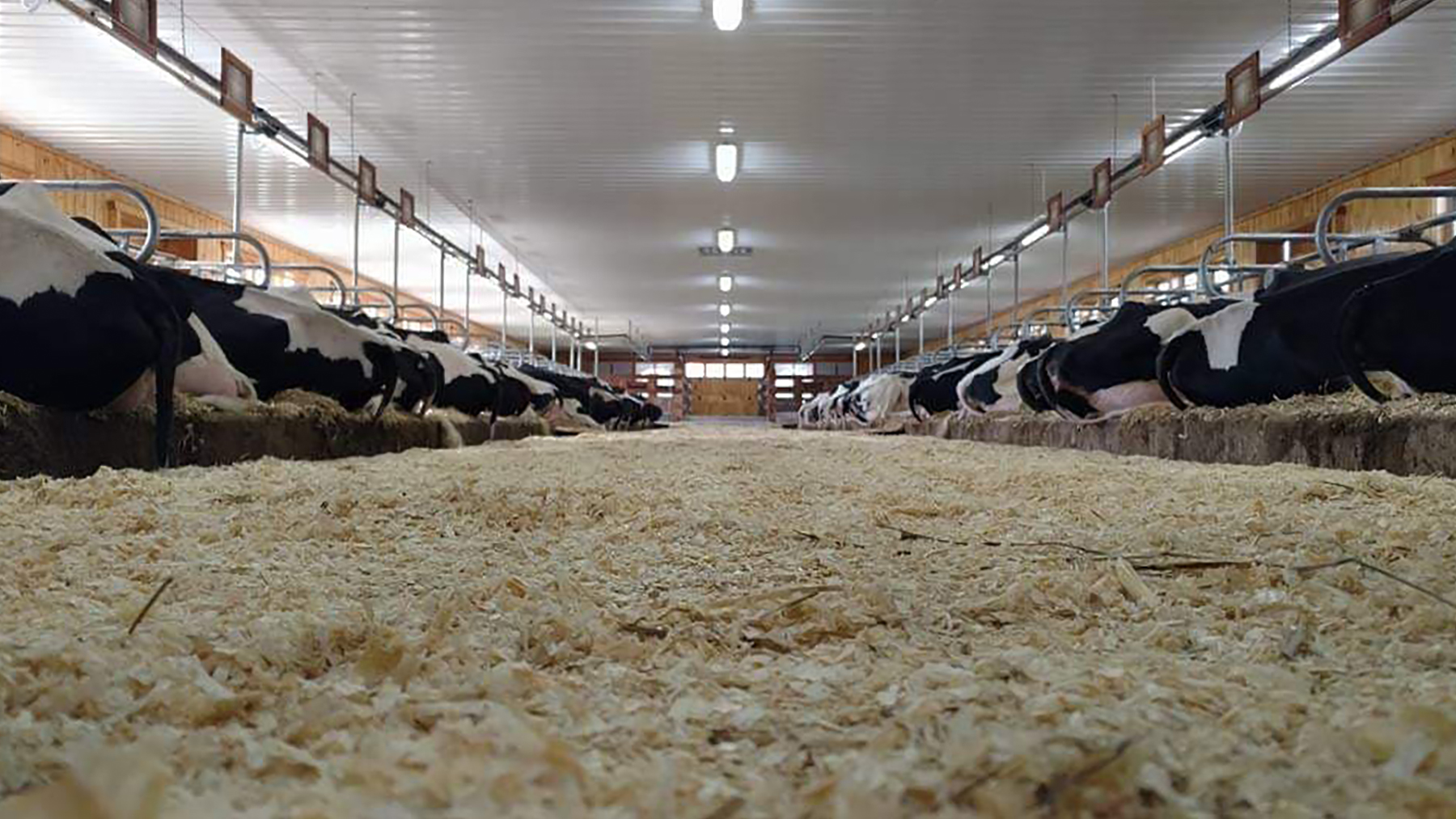
These Jersey cows are calmly chewing their cud while being milked in the parlor. Their milk will be tested before it is loaded on the truck and again at the processing plant because all milk – no matter what is on the label – is antibiotic-free. Any milk found to contain antibiotics is discarded. Protocols and penalties are in place from farm to consumer.

By Sherry Bunting
Author’s note: This 2014 column in the Hudson Valley Register Star brought in more email than any other column. I was amazed how many people shared it when it ran and how many reached out to say they did not know this! 

Organic. Natural. Antibiotic-Free. Are you confused by food labeling? Do you question what milk to bring home for your family? How is milk tested and regulated before it reaches the dairy case at my supermarket?

It’s important to break down these labels to understand what they mean — or don’t mean — in terms of the safe, healthful and nutritious qualities of milk and dairy products.

Let’s talk specifically about antibiotic-free milk. The good news is that all milk is indeed free of antibiotics! And all dairy milk is among the safest, most nutritious food and/or beverage on the planet, no matter what special label it does or doesn’t carry. In fact, milk, butter, natural cheeses and many other dairy products are among the cleanest labeled foods and beverages you can find. Unlike the fake stuff, milk is minimally processed, if at all, and no long list of ingredients. Dairy milk is just milk, straight from nature to your fridge. No mystery vats full of additives. Just a bunch of hard-working dedicated people loving what they do — taking care of cows making nutritious delicious natural milk!

Not only does milk contain protein (8 grams per 8 oz glass!), calcium and 9 essential vitamins and minerals, all dairy milk — no matter whether it is organic, conventional, labeled “antibiotic-free” or not — is heavily tested and truly antibiotic-free!

I often hear from consumers who believe organic-labeled milk is their only antibiotic-free choice. Let’s examine this.

“So many people think there are antibiotics in milk not labeled organic. We are pleased to report that we dispelled that myth at the Just Food conference in New York City,” reported Deb Windecker. She and her husband and their two children milk 100 cows near Utica in Herkimer County. She again recounted the steps that ensure all milk is antibiotic-free during an interview with staff writers for Farm Aid ahead of the concert at Saratoga Springs in September 2013. Today, the Windeckers are a certified organic dairy farm, which means they are not permitted to use antibiotics as treatments, but this is not to be confused with antibiotics in milk, because all milk, no matter the label, is tested multiple times to ensure it is free of antibiotic residues. The same goes for meat.

Farm Aid’s emphasis in recent years has gravitated toward organic as the symbol of family farms producing wholesome products, but the truth is that farm families operate farms of all sizes, organic and conventional. In fact, the most recent Ag Census shows that 98 percent of all farms in the U.S. are family owned. Furthermore, as unique as farms are in their management practices, there are certain things all dairies have in common — shipping antibiotic-free milk is one of them!

It’s important to know how highly-tested all dairy milk is at multiple intervals from the farm to the consumer, and how penalties and protocols are in place on the farm, at the processing plant and with regulators.

“These steps insure the milk you drink and the dairy products you eat are totally antibiotic-free,” Windecker explains.

On the farm, dairy producers sometimes use antibiotics when a cow or calf is sick — just like a mother would treat a sick child instead of watching that child suffer. On an organic farm, the producer may treat that animal also, but then the animal must be sold to a conventional farm because even after the treatment clears the animal’s body, she cannot be milked on the organic farm after she recovers. The owner must sell her to a non-organic farm even though all of her treatment is gone and no residues are left in milk, meat or even the filtering organs of the body!

So, what happens when cows are treated on a nonorganic, conventional farm? The treatment is recorded, and the cow’s milk is kept out of the milk tank not only during treatment, but for the prescribed time after treatment that it takes for the medication to totally clear the blood system.

Medications have “withdrawal” instructions on the label or per the veterinarian’s prescription, and farmers often do a quick-test or send samples with the milk hauler to be checked at the plant to be sure they’ve waited long enough BEFORE putting that cow’s milk in the tank.

Residue avoidance is of huge importance to dairy producers because they care about the quality of the milk they produce for consumers, and because if that milk were to be shipped, the sample tested would show the residue and the whole tank — or truckload — of milk would have to be dumped. In that case, the farmer would not be paid for his milk, and he would be liable for the value of other milk on that truck, because it would also be dumped.

When I worked on the dairy farm, we avoided treating cows unless absolutely necessary because withholding their milk during and after treatment is something farmers stay conscious of. This is why dairy farmers pay attention to details and take time to observe their cattle to adopt preventive protocols that help to avoid illness in the first place. Farmers certainly can’t afford to spend money on unnecessary medications or to lose a whole tank of milk, and the penalties that go with it, by accidentally milking a treated cow into the tank.

Good record keeping, identification methods, and employee communication are important at the farm level. But, rest assured, if mistakes happen, they are caught when the farm sample is tested at the milk processing plant.

After filling the tanker-truck, the milk hauler provides the processing plant with the test samples he has collected from each farm’s milk tank. Those samples are taken before the milk is loaded on the truck. Those samples are tested at the plant, and fresh samples are also taken of milk in the truck at the plant and again from storage units before processing. Packaged milk is also randomly tested in commerce to ensure further accountability.

Milk testing in the dairy industry is precise and covers a range of trace substances in addition to antibiotic residue and bacteria levels. Each testing interval from farm to store ensures milk’s safety, quality and goodness. Feel free to enjoy with confidence, and without fear.

-30-

Sherry Bunting is a veteran journalist writing on agriculture and food topics for 35 years.
Homemade ads about milk reveal and surprise community

By Sherry Bunting, published in Farmshine, Friday, January 4, 2019

“Everything helps… Anything helps,” said Nelson Troutman. The Pennsylvania dairy farmer gave consumers in his area an early Christmas gift, and this gift of knowledge keeps giving in the New Year.

Frustrated by the forced emphasis on low- and non-fat milk promotion and seeing the need to draw attention to the simple healthy truth about milk, while planting the seed that consumers can ask for local milk, Troutman came up with his own promotion idea.

On December 11, he painted a wrapped round bale with the words “Drink LOCAL Whole MILK 97% FAT FREE!”

Then he placed the round bale in his pasture, where it is visible at the intersection of Wintersville and Stouchsburg Road near Richland, in the Lebanon/Berks area of Pennsylvania.

After all, whole milk is standardized to 3.25% fat content, making it virtually 97% fat-free — a point on the minds of consumers that milk labels and checkoff promotion have not been able to tap into.

“It was the cheapest and easiest thing to do, and I’ve gotten a lot of very nice and interesting comments,” said Troutman in an interview with Farmshine. “Today, I saw two ladies walking down the street. They had just passed the bale. I had no idea who they were. They saw me coming out the farm lane and waved. I am sure they were talking about the bale.”

Nearly three weeks after his round bale billboard was placed for the community and those passing through to see, Troutman said the gift keeps giving with new and continuing conversations.

“I am amazed at talking to people about this educational bale,” Troutman said Monday (Dec. 31). “People say to me that they did not know any milk is 97% fat-free, much less that the whole milk is 97% fat-free!”

Troutman uses their surprise at this revelation as a teachable moment.

“I explain that fat-free milk is 100% fat-free, 1% milk is 99% fat-free, 2% milk is 98% fat-free and whole milk — at 3.25% fat — is basically 97% fat-free. They are astounded,” he affirms. “So, I ask them what they thought any milk is, and they tell me that they never thought about it. When I ask them what they think the fat percentage of whole milk is, most answers were 10% to 20% fat. I actually had one man say he thinks whole milk is 50% fat! His wife made him drink 2% milk for that reason.”

So what is being gained with this message? Troutman gives an example. He said the man who confessed that he thought whole milk was 50% fat — upon hearing the truth — said he will never again drink 2% milk and has switched to whole milk while also being made aware of the local ties and how to find local brands.

What does all the milk confusion tell us about the success — or failure — of mandatory checkoff promotions? People are confused about so many things where milk is concerned. But the fat content should not continue to be one of their confusions. It is standardized and easy to demystify with a simple message, a simple sign, that opens the door to conversations that matter.

Troutman said he knows that the dairy farmers’ mandatory checkoff promotion organizations of American Dairy Association Northeast (ADANE) and Dairy Management Inc (DMI) — and even Allied Milk Producers — cannot advertise milk as 97% fat-free. He says there are government rules about putting this on the label or in a checkoff-funded campaign.

But, he believes it is high time for a grassroots promotion.

“We farmers can do this! It’s real education, and it sure beats the price of the milk mustache. Advertising is expensive, but we farmers have an edge. We live along roads and highways where we can put up signs, use our bales, silage bags, silos, barns, and wagons,” says Troutman.

“We also have friends that have agribusinesses in town that could use a sign. And there is Facebook, which is very powerful to the consume. We need the consumers in Pennsylvania to ask for whole Pennsylvania-produced milk at our restaurants, schools and stores,” he adds.

Troutman is definitely on to something, as people across the state and in other regions as well have complained all year on social media and at meetings and with photos of supermarket dairy shelves that whole milk is often not stocked to the density of the fat-free, low-fat and reduced fat milks.

In fact, as one producer in northern Pennsylvania noted recently, she has to order whole milk on ahead at her local store if she wants more than three gallons for an event. When asking the store manager why whole milk is not made more available in the dairy case, the store owner told her the reason is because it isn’t as healthy and contains too much fat!

Nelson Troutman’s simple idea is borne of frustration but with education and truth at its core, and it is easy to implement.

He says that dairy farmers are fed up with decades of their product being thrown under the bus by dietary guidelines and promotion restrictions leading people to believe — over time — that whole milk is full of fat. The labels do not even say 3.25% fat! And this has led to people having all kinds of inflated ideas about how much fat is in whole milk to begin with.

It is no wonder that even well-educated pediatricians mindlessly follow blindly the lies of omission — telling mothers to put their children on lower fat milks at age two because they falsely believe whole milk is more than 10% fat!

Troutman made his round bale sign and placed it in his pasture by a busy intersection to educate his community and to encourage other farmers and agribusinesses to use his idea to educate their communities.

“Maybe they want to do something on a bale or a wagon or a silage bag,” he said. “Everything helps… anything helps.”

-30-


Global thoughts Part 4: As exports grow, who benefits from ‘new math’?

GlobalThoughtsPart4_Chart#2 (1).jpgBy Sherry Bunting, originally published in Farmshine, June 7, 2018 and examines the utilization of domestic Class I fluid milk vs. exported commodities during the worst three months of pricing at the beginning of 2018, but the trends show how FMMO pricing no longer provides the value to farmers for their milk as exports increase. Read Global Thoughts Part One, Part Two, and Part Three.
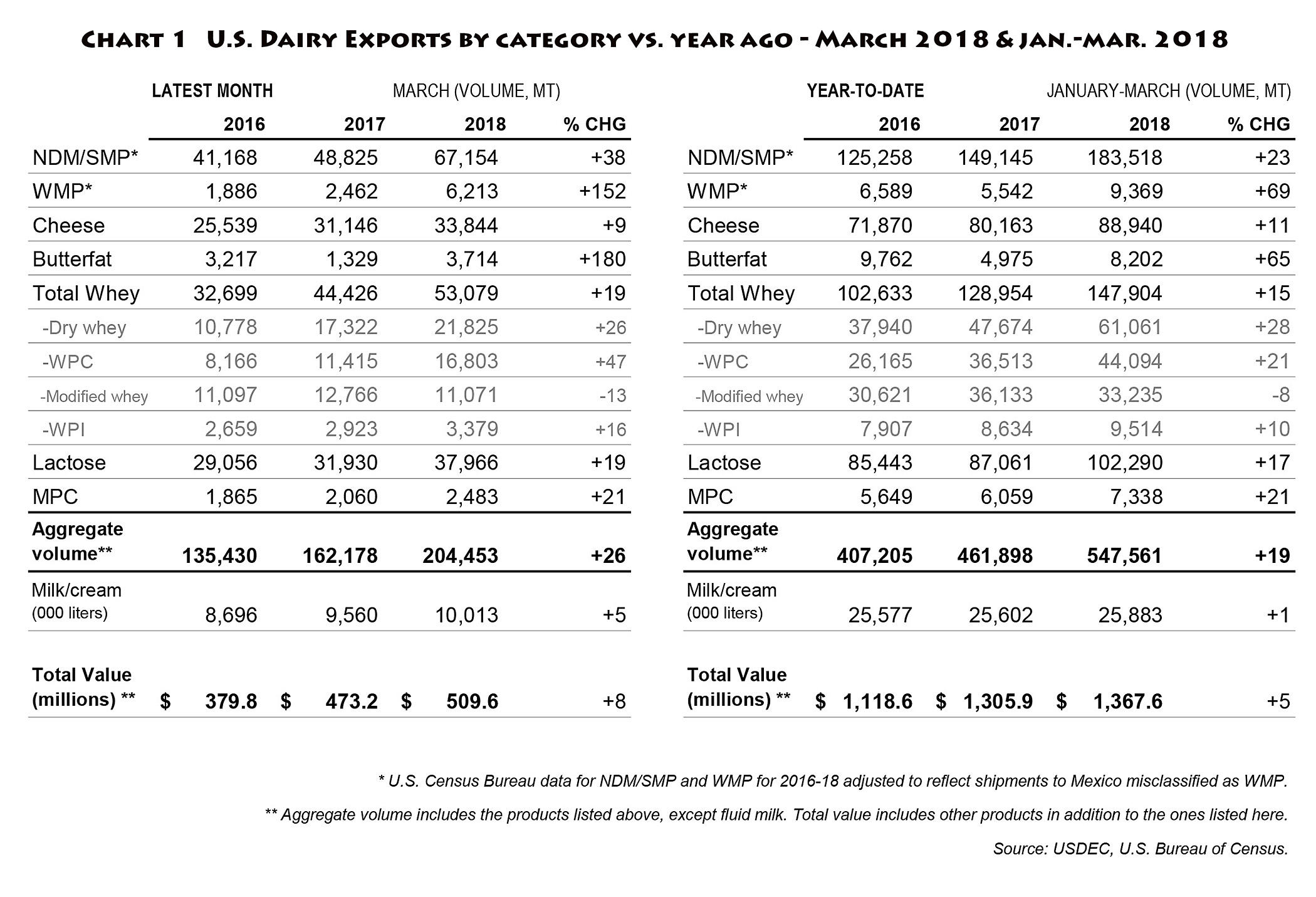
BROWNSTOWN, Pa. — U.S. dairy exports posted record-high 2018 first-quarter volumes (see Chart 1), representing 17.3% of U.S. milk utilization on a milk equivalent basis, according to the U.S. Dairy Export Council (USDEC). (Note, the average Jan. through Oct. was 16.3%, still a record high.)

This, against the backdrop of Class I milk utilization falling to 29% of Federal Order pooled milk but just 18.9% of total milk production in the first quarter of 2018 (Chart 2).

In fact, Federal Order pool reports for first quarter 2018 showed Northeast marketings 1.8% below year ago as pool receipts fell due to reduced production. At the same time, other FMMO pools recorded declines in pool receipts, which USDA confirmed by email were largely due to shifts in pooling or strategic despoiling to prop up Class I utilization percentages. (For example the pooled first quarter receipts in the Appalachian Order were up 6% while down 5.5% in the adjacent Mideast Order.)

globalthoughtspart4_chart#1The total “official” U.S. Class I utilization for 2017 was 26.1%, down nearly 10% from 35.9% in 2009, according to USDA figures.

However, the Northeast Market Administrator’s most recent bulletin (April) observed that the real percentage of total U.S. milk production used for Class I fluid sales in 2017 was just 22.3%!

Bob Younkers, chief economist for the International Dairy Foods Association (IDFA), analyzed fluid milk trends, reporting in February that the 2017 fluid milk losses, alone, represented 20 million fewer pounds (2.3 million fewer gallons) of milk sold daily – nationwide – in 2017 vs. 2016. In addition to the blow dealt to producer milk checks, Younkers points to how the fixed costs of bottling increase when spread across fewer gallons of milk sold.

Coming into 2018, not only have first quarter Class I sales declined 1.5% compared with first quarter 2017, the Class I utilization percentage fell by even more — down 2.5% below year ago — in part because exports grew to this new first quarter record of 17.3%.

Left unchecked, the current math trend shows that as U.S. exports reach the goal of 20% set by the U.S. Dairy Export Council (USDEC), the percentage of milk utilized in export sales will very soon equal and surpass Class I utilization as a percent of total milk production.

Who benefits from this new math?

If the current classified pricing system — and its Class I regulation — must continue, perhaps the growing export utilization should have its own class formula tied directly to export pricing and representing growth milk in the U.S. system so that the other 80% of milk pricing can be more stable and reflective of serving that large anchor-base of domestic consumption?

Survey the experts on this idea and they’ll tell you an export class for U.S. milk pricing is a non-starter because of trade agreements and WTO. But trade agreements are being renegotiated and others in the global markets have mechanisms in play.

Perhaps instead of going after Canada’s export class implemented because of expanded production due to higher consumer demand for fat, the U.S. could learn from what’s being done north of the border with this pricing mechanism to match exports prices and products to growth milk that goes into products strictly for export?

This is not an idea that goes against free trade, but one that recognizes the U.S. as a free-trader in need of fair trade leverage for producer pricing.

The U.S. must be competitive enough to have its products arrive at other ports, so that it can remain competitive enough to keep other products from arriving at its ports — where a large market for dairy already exists. In Part Three, we looked at some of the product differences.

 But there’s another catch to this romance with export markets. They can be unstable and unpredictable, and while we make more of the globally significant products today than in 2008, our product mix and flexibilities are different than other successful exporting nations.

Would an export class allow pricing of growth milk — a percentage of the nation’s production or a percentage of production in high growth areas — to be aligned to the fluctuating global markets for globally-significant products with a margin to attract necessary investments in manufacturing flexibility and innovation? Such alignment could, at the same time, allow a more stable and profitable base price for milk going into dairy products for domestic consumption?

After all, we are increasing exports to levels that are approaching the falling Class I utilization percentages and yet NONE of the globally-significant products and/or prices are even used in the arbitrary U.S. Federal Order pricing formulas, to which location differentials are added to ensure the Class I price is always higher (more on this when we tackle logistics in a future part of this series).

As dairy exports become the new epicenter of U.S. marketing, a different light is cast on these regulatory pricing structures.

Let’s look at the differences between global and domestic pricing and trading platforms.

 For starters, price announcements to dairy producers in New Zealand are based on the actual value of global sales with producers buying shares of processing capacity for the quantity of milk they expect to produce. As milk falls short or exceeds those pegs, payout announcements are adjusted based on the relationship of the production to the sales.

In Europe, producers also see milk prices that reflect the value of what is sold not a formula like in the U.S. that leaves key products, prices and markets out of the math equation.

While Europe’s quota system has ended, the EU commission intervenes with purchases. Processors more nimbly shift between products to adapt to market changes. And if they miss in their projections — as they did in the shift to making more powder when the Russians stopped buying cheese and butter due to the economic sanctions — the EU commission intervened to buy and stockpile that powder to a degree that still is blamed for suppressing the global market for powder and holding back the U.S. milk price recovery.

In addition to differences in pricing, there are big differences between global and U.S. price discovery and trading platforms.

While the CME daily spot market in Chicago went electronic last year, the Global Dairy Trade (GDT) biweekly internet auction has always been an electronic platform.

The GDT engages more buyers and sellers, offers contract sales that are near-term and forward-looking to create what is essentially a 2-month ‘spot’ price, according to Bialkowski and Koeman’s November 2017 study at the University of Canterbury New Zealand of spot market design in relation to the success of futures markets.

They explain the GDT biweekly auction is a vehicle for Fonterra to market 30% of its production and to provide a global exchange for other sellers like Dairy Foods of the U.S. and Arla of Sweden.

The GDT auction includes many products and ingredients — from bulk cheese and butter to whole milk powder, skim milk powder, anhydrous milkfat powder, buttermilk powder, lactose powder, milk protein concentrate, rennet casein and occasionally sweet whey powder. Whey protein concentrate is another globally-significant product, which the U.S. makes and exports a lot of – but that price is never considered in the FMMO classified pricing scheme either.

By contrast, the CME futures markets provide a hedging opportunity for Class III and IV milk and futures markets for the four Federal Order pricing commodities: Cheddar, butter, nonfat dry milk and dry whey. The CME also operates a daily cash “spot” market primarily for three of the four Federal Order commodities – butter, Cheddar and nonfat dry milk.

The CME trades only those specific Federal Order commodities. It is thinly traded with few buyers and sellers, although volume has increased 1 to 3% in the past year since the change to an electronic trading platform.

As a spot market for hedging, Bialkowski’s analysis described the CME cash market as one that is less well-designed because daily ‘spot’ prices are market-clearing and used retroactively in government pricing formulas, with a pricing delay built in, while GDT auction contracts offer pricing points for delivery one to four months forward.

The biweekly GDT prices are always based on actual sales because all product offered is sold. And those sales are weighted to calculate a weighted average for each product as well as an overall weighted performance index for the dairy trade.

The CME spot market, on the other hand, pegs its daily spot prices on the activity occurring in the final moments of its 15-minute daily trading session.

As we saw on a few occasions earlier this year, a CME trading session had multiple loads change hands at specific prices, but the daily spot price was determined by a lower last-minute offer.

Access to the market is also different. CME traders must simply have product to sell and meet payment and delivery terms to buy. The GDT, on the other hand, has a more controlled process where buyers and sellers are vetted and approved by Fonterra of New Zealand because they run the platform.

How will the U.S. dairy industry adapt to competitively manage export growth and volatility? Are changes needed in the mix of commodity pricing and milk utilization formulas that govern the regulatory pricing structures?

If industry leaders want to focus on export market growth and bring home the message that dairy farmers must accept lower prices “because we are in a global market,” then why is the government involved in regulating prices on the shrinking piece of the expanding pie (Class I) and calculating component value from just four commodities while ignoring the globally significant products and their mostly higher prices?

This is new math and it is not adding up.

A national hearing with report to Congress would help examine new thinking and take a closer look at current regulatory pricing schemes. How is price regulation affecting milk movement and location? Do these schemes return enough component value to the farms? Are the arbitrary make allowances creating winners and losers? Would truly free market forces do a better job? Or if classified pricing is here to stay, should we be aligning milk growth in the U.S. with export market growth and price it accordingly?

In Part Five, we’ll look at U.S. dairy imports and why volume is not the only important factor.

-30-