Food system transformation: DMI at globalization table where big players plan Great Re-set ‘land grab’ targets

istock image

By Sherry Bunting (Updated as published in Farmshine, Oct. 1, 2020)

Most of us don’t even know what’s being planned for our futures. Big tech, big finance, big billionaires, big NGO’s, big food, all the biggest global players are planning the Great Re-set (complete with land grab and animal product imitation game) in which globalization is the key, and climate change and ‘sustainability’ — now cleverly linked to pandemic fears — will turn the lock.

The mandatory farmer-funded dairy and beef checkoffs — and their overseer USDA and sustainability partner World Wildlife Fund (WWF) — have been at this global food system transformation table since at least 2008 when DMI’s Innovation Center for U.S. Dairy was formed and put together the Sustainability Alliance for U.S. Dairy.

DMI says there is a difference between WWF-US and WWF-EU, but it’s really one big thing connected to these same global corporations that are driving the emerging government policies of the Great Re-set — like the Green Deal in Europe and the Green New Deal in the U.S.

DMI leaders say WWF is ‘helping’ farmers by providing a seat at the table to be sure sustainability will be profitable.

It will be profitable, for sure, but for whom?

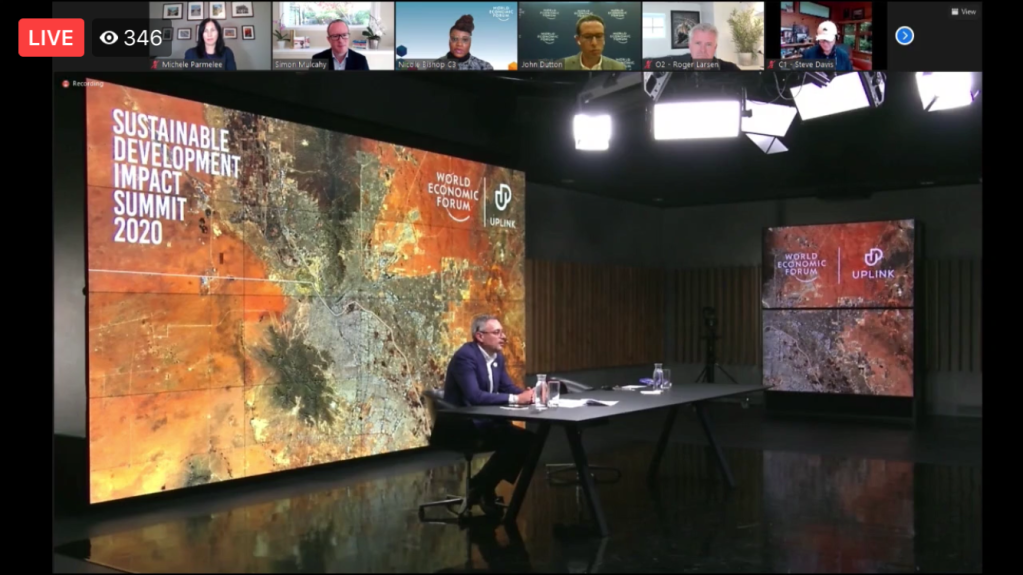
The answer to that question came into focus after listening to more than a half dozen livestreamed sessions of the World Economic Forum’s Sustainable Development Impact Summit Sept. 21-24 as part of the Great Re-set.

More light was shed on the ‘we will pay you’ carrot-before-club concept of ‘land banks’ in the U.S., when listening to former Vice President Joe Biden answer a farmer’s question about environmental regulations during CNN’s Town Hall in Moosic, Pennsylvania Sept. 18.

More illuminating yet is the flurry of global food company press announcements in recent days as they position themselves ahead of the Sept. 30 United Nations Biodiversity Summit in New York City. That’s where global leaders and the global business community will adopt targets to “restore” (re-wild) 30% of the earth’s land as Protected Areas by 2030 and 50% by 2050.

That’s half the world’s land by mid-Century, and leading this charge is WWF, along with companies like Walmart, Amazon, Nestle, Danone, Unilever and others involved in checkoff-funded pre-competitive collaboration through DMI’s Innovation Center for U.S. Dairy.

According to Survival International, an organization defending indigenous people and smallholder farms, these 2030 and 2050 sustainability targets of the Great Re-set “will be the biggest land grab in world history and will reduce hundreds of millions of people to landless poverty.”

The new narrative is that this massive target of land transfer is needed not just to “restore a trillion trees” as carbon sinks to cool the earth, but to end the Covid-19 pandemic and prevent future pandemics by creating more separation between humans and animals to avoid zoonotic disease transfer. These land targets call for a “critical overhaul of the food production system,” according to the summit agenda.

Even as California wildfires burn out of control — collectively emitting more GHG than tens of millions of cars annually and largely influenced by environmental policies that have led to neglect of the forests in terms of land management — re-wilding of more land is big on the Great Re-set agenda.

Meanwhile, as consumers prioritize health and economics over the ‘planetary diets’ hatched by the Silicon Valley billionaires funding fake meat and fake dairy, the ‘biodiversity’ angle on these land targets is the new hook linking pandemic fears to climate action and the UN Sustainable Development Goals (SDGs) through diet.

Some of the themes are familiar in dairy industry discussions about DMI’s Sustainability Framework and Net Zero Initiative — both rooted in the Great Re-set they have been participating in planning for over a decade through alliances with WWF and its World Resources Institute doing the benchmarking for the global corporations driving it.

(Remember Starbucks’ announcement earlier this year? They are a DMI partner, and so is WWF, but after their WRI benchmarking, they announced ‘moving consumers away from dairy and toward plant-based options’ in their coffee beverages as the biggest of four areas of action! They even borrowed the ‘flat white’ name reserved for their lattes made with whole milk instead of default reduced fat milk to launch a new signature almond-‘milk’ latte. Talk about confusing the customer into making a choice desired by the diet-and-sustainability-elite-ruling-class.)

During a recent DMI ‘open mic’ call, CEO Tom Gallagher stated that these are the rules today and globalization is the world we live in. On the same call, president Barb O’Brien revealed dairy checkoff’s 13-year alliance with Walmart, a two-year partnership with Amazon, and on the Net Zero Initiative, she frequently mentioned Nestle, Unilever, Danone and Starbucks.

What do they all have in common?

They are the key global brands ramping up into plant-based and cell-based dairy and meat alternatives, and they are among the top global corporations that have set goals to ‘move consumers to planetary diets’ and to change the way food is produced.

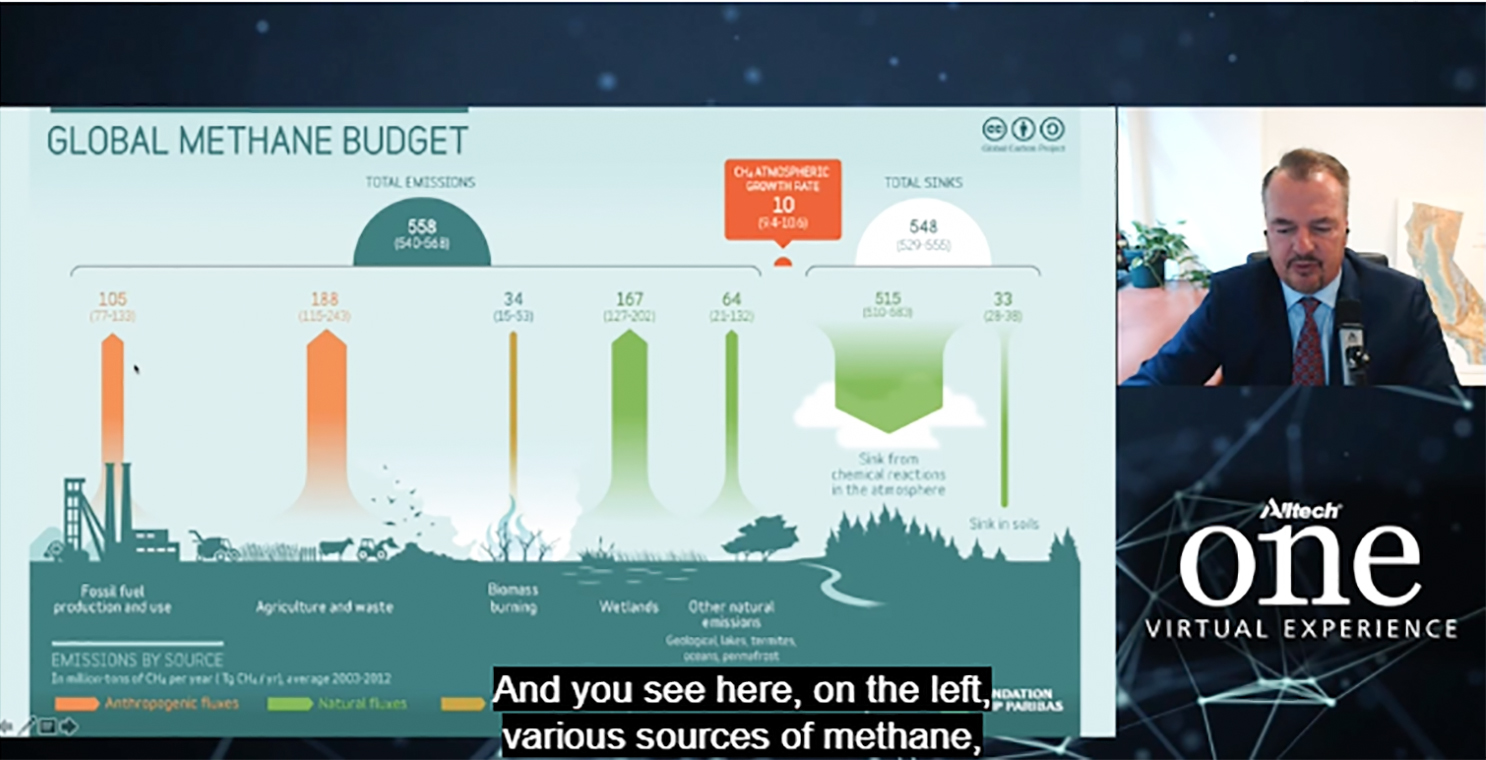
During the WEF livestream Tuesday Sept. 21 on 2030 land targets, Walmart’s Chief Sustainability Officer Kathleen McLaughlin described it this way:

“What we are talking about is massive transformation of societal systems — financial services, retail consumer goods, the things we bring into our home to eat or to wear or to decorate our homes with. Changing the way all of that gets produced is a massive systemic undertaking that will take business action. It will take philanthropy. It will take government action,” she said.

McLaughlin cited Danone, Nestle and Unilever as the suppliers “in the lead” on this.
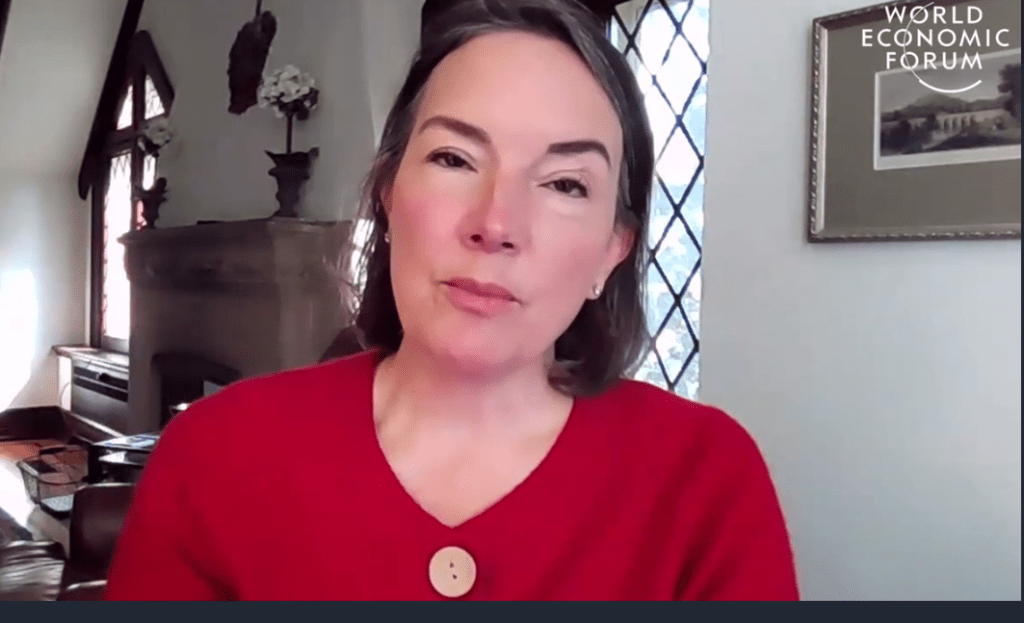
This image has an empty alt attribute; its file name is screenshot-860.png
livestream screenshot

“This is total ecosystem transformation,” said McLaughlin. “Our suppliers have stakeholders wanting this, and if there isn’t alignment among their stakeholders (for instance dairy), they are glad to be able to say: ‘Hey, Walmart wants us to do this so we have to do it.’ We help them figure out what to do and how to go faster on some of these things.”

She referenced Walmart’s Sept. 18 announcement that it will be net-zero by 2040 and will become a “regenerative” company “restoring” land to meet 2030 and 2050 targets.

“We will work at the landscape level with suppliers and philanthropy to restore 50 million acres of land — to change the way it gets managed, to decarbonize the supply chains, and change the way consumer products work in retail, as an industry, with traceability and transparency tools,” said McLaughlin.

She talked about Walmart having projects already for all three scopes of the Environmental, Social and Governance reporting (ESGs) that are being mainstreamed into financial markets in 2021. This is how the flow of capital will go to companies progressing toward these global targets.

McLaughlin talked about working with WWF to implement more standards and more certifications for suppliers and to move away from “segregated commodities” to “blended approaches” that use global traceability and transparency systems and document ESG reporting and progress on the SDGs each step of the way.

“It is clear we are exceeding boundaries of the planet, and as a company that sells food and apparel made of cotton, the business case is clear for the SDGs, said McLaughlin.

Asked what is Walmart’s ‘why’? McLaughlin revealed: “The benefits are clear: cost reductions, supply security, risk management, so that’s why we’re doing it.”
livestream screenshot

Speaker after speaker and company after company throughout the WEF Forum talked about how all business sectors will be collaborating on these global ESGs (capital) and SDGs (land).

Kristina Kloberdanz, Chief Sustainability Officer for MasterCard even talked about using their platform of over 3 billion customers interacting with retailers and merchants to “inform, inspire and enable consumers to take action, themselves, against their own carbon footprint.”

What is clear is that consumers will be led to where global companies want them to go. These global business leaders stated that “moving consumers” (not just suppliers) toward these goals is what they are working on.
livestream screenshot

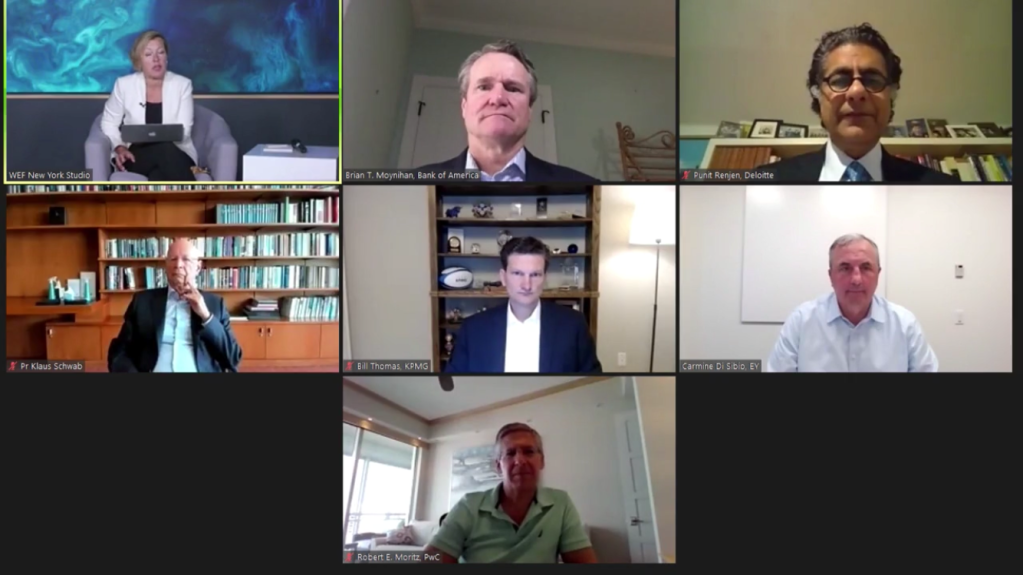
Bank of America’s CEO Brian Moynihan (top, center), who is also chair of the International Business Council, sat with heads of the four big accounting firms in one of the WEF livestream sessions about the launch of Stakeholder Capitalism Metrics, which they affectionately refer to as “accountant as activist” or “warrior accountants.”

Moynihan said that financial accounting for the investment sector — even lending — will be predicated on progress toward carbon-neutral and carbon-negative goals.

A glimpse of how land targets would be set in the U.S. was seen in former Vice President Biden’s response to a farmer’s question at the CNN Town Hall in Pennsylvania about environmental regulation, referencing the Obama-era WOTUS rules and the Green New Deal.
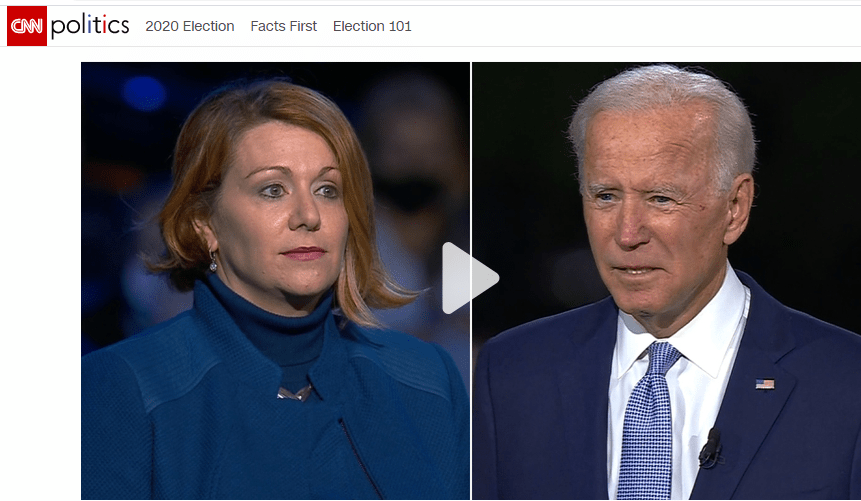
“We will have land banks,” said Biden. “You will be paid to put your land in land banks to create open space and be in a position where you will be paid to grow certain crops we want you to grow to sequester carbon from the air.”

He talked about his home state of Delaware with a $4 billion poultry industry and stated that, “manure is a consequence of chickens and it is polluting the bay. But we recently found out we can pelletize the manure and remove the methane,” said Biden.

Though Biden states that his climate policy is not the Green New Deal, the overlaps are there. The Green New Deal includes such references to “land banks”, where government will purchase land from “retiring farmers” and make it available “affordably to new farmers and cooperatives that pledge certain sustainability practices.”

Analyses of the Green New Deal’s land policies suggest rented ground — which comprises up to 40% of agricultural land — would be targeted first because environmentalists assume the active farmers renting this ground don’t care as much about its stewardship because they don’t own it.

Landlords who rent ground to active farmers and ranchers for cropping and grazing are easy targets for such a plan.

However, on the production side, rented ground is incredibly important to active farmers in many dairy states, like Pennsylvania and Wisconsin, for example, and it is how new and beginning farmers get a start.

The Great Re-set driven by climate goals and sustainability linked to pandemic fears and the Covid-19 impact on the global economy holds significant impacts for food and agriculture production. The “solutions” we see discussed are things former Secretary of Agriculture and current DMI executive Tom Vilsack has worked on for at least 13 years, maybe longer.

DMI leaders tell farmers that they are the reason farmers have a voice at the table to keep regulations from coming in that are unprofitable. But more apparently, DMI leaders are at the table helping to shape the dairy re-set that mirrors the global Great Re-set as pursued by WWF and global corporations like Walmart, Amazon, Nestle, Unilever, Danone. They are driving food system transformation in the Great Re-set — a one-world-order clothed in climate goals.

DMI has longstanding alliances with these partners, including WWF. But whose interests are counted at the table where the food system transformation game is being played? The global companies that partner with checkoff through DMI’s Innovation Center for U.S. Dairy and its Sustainability Alliance? Or the farmers mandatorily funding DMI’s existence?

Are farmers and ranchers really at the table? Their powerful integrator (checkoff) and buyers (global processors) most certainly are.

Who will stand for farmers and consumers at the grassroots level? What happens when food production is fully integrated and digitized under globalized control by fewer entities? The role of USDA’s Dietary Guidelines is just the tip of the iceberg, facilitating dietary control of the masses through institutional feeding — working to move us all to the pre-ordained ‘planetary diets.’

The public at large has no idea what’s coming and how their food choices are being manipulated.

Given DMI’s alliances with the big players in food system transformation, the answers should be clear.

-30-

-30-
Markets review and look-ahead, USDA pegs July ‘All-Milk’ at $20.50

U.S. All-Milk $20.50, DMC $12.41

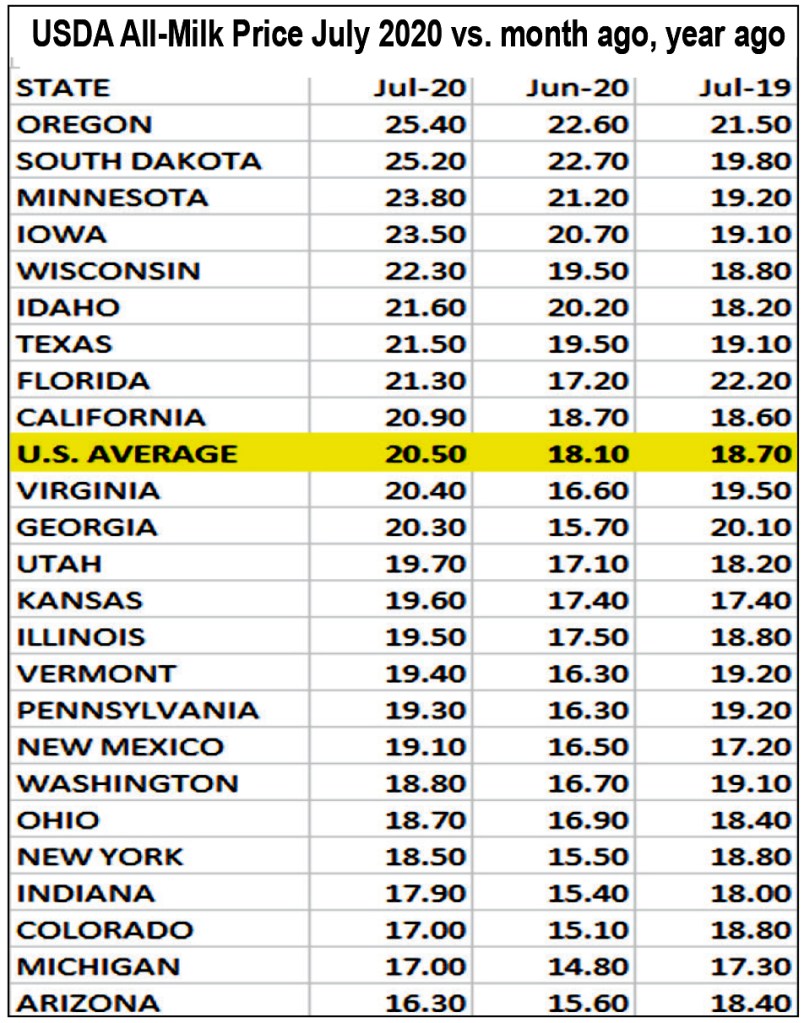
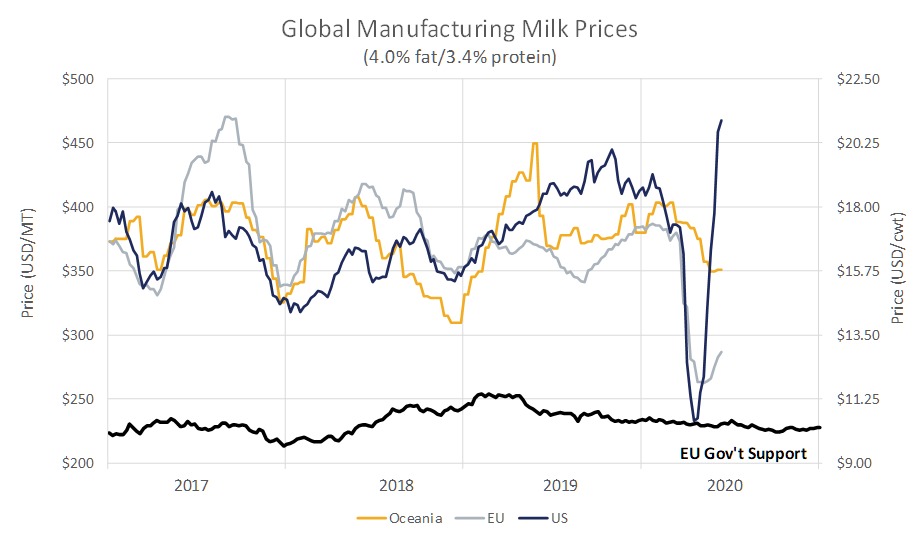
The USDA NASS Agricultural Prices report calculated a U.S. All-Milk price of $20.50 for July, up $2.40 from the June All-Milk price of $18.10 and $1.80 higher than a year ago. With this as the pegged U.S. average milk price, the July Dairy Margin Coverage (DMC) margin was calculated at $12.41, also $2.40 higher than June and $2.91 above the highest level of DMC coverage.

These July USDA numbers are welcome, but tell half the story.

The chart above lists the July 2020 USDA All-Milk price calculations for the top 24 milk-producing states in descending order with the U.S. average highlighted.

What stands out is the range from top to bottom. It has doubled from a more typical $3 to $4 spread to an $8 to $9 spread in June and July 2020. This is the widest we could find on record — with the U.S. average All-Milk price standing fully $4.00 higher than the state with the lowest All-Milk price in June and July 2020 compared with a more typical $1.50 difference a year ago.

A year ago, 7 of the 24 USDA milk production report states were below the U.S. average, a more typical occurrence. In June and July 2020, 15 of the 24 states were below the U.S. average All-Milk price.

On the up-side of the chart, we see that the highest states are $4 to $5 above the U.S. average, when normally that difference would be less than $3.00.

Actual mailbox price calculations won’t be released for five months, and when they are released, the range will likely be even wider from top to bottom than the $8 to $9 spread we see in All-Milk prices the past two months.

Unofficial milk check surveys of volunteered data from dairy producers in six federal orders for June and July show a whopping $14.00 per hundredweight range from top to bottom in gross pay and mailbox net pay.

As for the August All-Milk price, USDA won’t report that until the end of September. We will get Federal Order uniform price announcements for payment of August milk in mid-September. On Sept. 2, USDA did announce August Class and Component prices with Class III (cheese) milk at $19.77, which is $7.24 above the Class IV (butter / powder) price of $12.53. Class II was announced at $13.27. The August protein price was pegged at $4.44 and butterfat $1.63.

Margin ‘equity’ affected by wide spreads

For dairy producers enrolled in DMC — but in regions receiving the lower end of these All-Milk prices in June and July — the safety net program thresholds were not met by the ‘average’ margin even as that margin did not reflect their reality. For dairy producers using a variety of risk management options, new challenges have also emerged in the current market dynamic due to de-pooling of milk making negative producer price differentials (PPD) more negative in some areas.

While the spread between Class III and IV looked like it would narrow this fall, an upswing in Class III futures for October through December contracts this week — and lackluster performance on Class IV — show spreads in manufacturing class values could widen again, which tends to be an incentive for de-pooling in Federal Orders where a mix of products, including Class I beverage milk, are produced.

There are tools to navigate these challenges, say the experts, but a deeper concern is how closely the divergence can be related to the product mix of the CFAP food box government purchase rounds — and changes in U.S. dairy imports.

As the third round of CFAP Farmers to Families Food Box purchases are underway for fourth quarter 2020 delivery, USDA this time set parameters for food box dairy products to be more representative of Class II and IV products, along with the Class III cheese products. In addition, the third round defines the fluid milk in several solicitations to be 2% or whole milk. This will also help with fat value that has plummeted this year.

Still, the majority of government food box purchases continue to be cheese, and the markets responded last week as spot cheddar rallied back above $2.

CME spot cheese pushes higher — past $2/lb, butter and powder steady-ish

Cheese markets gained more than a dime in CME spot trade on Wed., Sept. 2 with 40 lb blocks pegged at $1.91/lb. From there, the market continued to move higher at $2.12 by Friday, Sept. 4, up 30 cents from the previous Friday with zero loads trading; 500-lb barrels were pegged at $1.70/lb, up 27 cents with a single load trading.

Spot butter managed to gain through midweek before losing some of that advance at the end of the week. On Friday, Sept. 4, a whopping 12 loads were traded on the CME spot market with the price pegged at $1.4925/lb — up a nickel from the previous Friday. Nonfat dry milk on the CME spot market gained a penny at 1.03/lb with 6 loads trading Friday.

Milk futures are improving again, divergence continues

Class III and IV milk futures for the next 12 months came a bit closer together, on average, but the fourth quarter 2020 contracts are still divergent as Class III milk futures rallied Wednesday while Class IV was stagnant through yearend.

Trade on Sept. 4 closed with the September Class III contract up $1.37 from previous week at $17.06, October up $1.27 at $18.89, November up 21 cents at $17.55, and December down 12 cents at $16.65. On Friday, Sept. 4, the next 12 months averaged $16.82.

Conversely, yearend Class IV futures closed with the September Class IV contract down 14 cents from a week ago at $12.82, October down a penny at $13.86, November down a dime at $14.39, and December down 9 cents at $14.69. The next 12 months (Sept. 2020 through Aug. 2021) averaged $15.03 on Sept. 4.

The average spread between III and IV over the next 12 months was $1.79/cwt.

Imports/export factors affect storage, which in turn affects markets

The USDA Cold Storage Report released at the end of August showed butter stocks at the end of July were up 3% compared with June and 13% above year ago. Total natural cheese stocks were 2% less than June and up only 2% from a year ago. Bear these numbers in mind as we look at exports and imports.

According to the U.S. Dairy Export Council (USDEC), total export volume is up 16% over year ago year-to-date – January through July – and July, alone, was up 22% over year ago. Half of the 7-month export volume was skim milk powder to Southeast Asia.  January through July export value is 14% above year ago.

However, butterfat exports are down 5% year-to-date. The big butter export number for July was not enough to make up for the cumulative decline over the previous 6 months.

On the import side, the difference between cheese and butter is stark. Cheese imports are down 10% below year ago, but the U.S. imported 13% more butter in the first 7 months of 2020 compared with a year ago.

When butterfat and butteroil as well as butter substitutes containing more than 45% butterfat are included in the total, the volume of imports is 14% higher than a year ago with the largest increases over year ago seen from March through June at the height of the pandemic when retail butter sales were 46% greater than year ago.

Looking at these butter imports another way, is it any wonder butter stocks are accumulating in cold storage to levels 13% above year ago at the end of July — putting a big damper on butter prices and therefore Class IV? The U.S. imported 13% more butter and 14% more butter and butterfat combined, plus exported 5% less butter and butterfat year to date.

As accumulating supplies pressured butter prices lower, the U.S. became the low price producer and exported a whopping 80% more butter in July compared with a year ago. This was the first year over year increase in butter exports in 17 months. Still, the record is clear, year-to-date butter exports remain 30% below year ago and total butterfat exports are down 5% year-to-date.

Experts suggest that butter and butterfat imports are higher because U.S. consumer demand for butterfat has been consistently higher even before the impact of the Coronavirus pandemic stimulated a run on butter at stores for at-home cooking and baking. This seems to be a difficult reasoning to justify — given there is 13% more butter currently stockpiled in cold storage vs. year ago.

If 14% more butter and butterfat are being imported, does this mean we need to import to serve consumer retail demand and keep larger inventory to serve that retail demand? If so, why is the inventory considered so bearish as to hold prices back so far as to amplify the Class III and IV divergence? Does month to month cold storage inventory represent excess or simply a difference in how inventory is managed in today’s times, where companies are not as willing to do “just in time” and “hand to mouth” — after having dealt with empty butter cases and limits on consumer purchases at the height of the pandemic shut down.

The trade has not sorted out the answers to these questions.

Meanwhile, these export, import, and government purchase factors impact the inventory levels of Class III and IV products very differently — and we see as a result the wide divergence between Class III and IV prices and between fat and protein component value.

Interestingly, USDA Dairy Programs in an email response about negative PPDs that have contributed to the wide range in “All-Milk” prices, says the higher value of components “is still in the marketplace” even if All-Milk and mailbox price calculations do not fully reflect it across more than half of the country.

— By Sherry Bunting

-30-
Iowa farms deal with derecho’s aftermath: ‘I’ve got all my family and cows alive, that’s everything.’

By Sherry Bunting, Farmshine, August 21, 2020

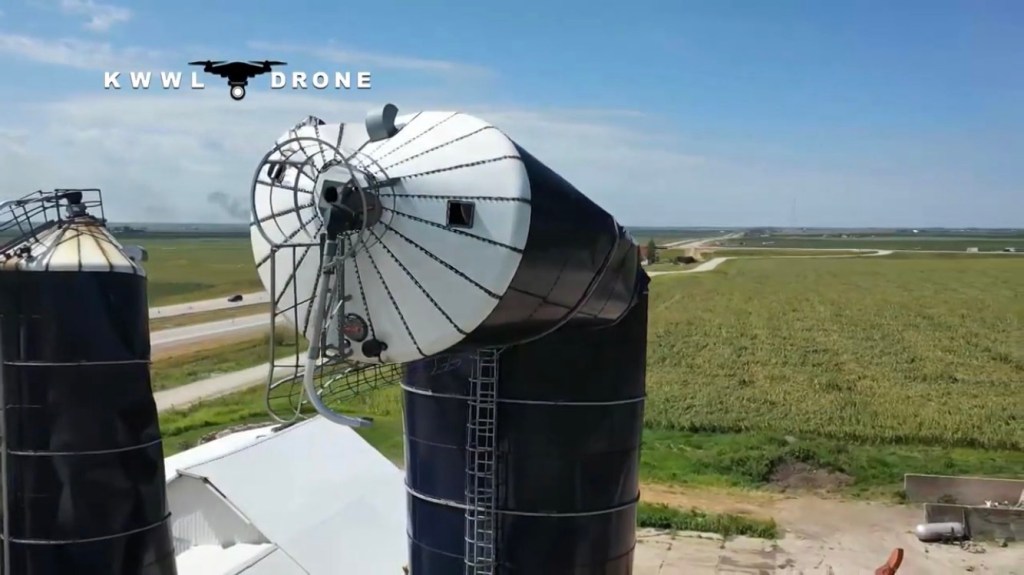
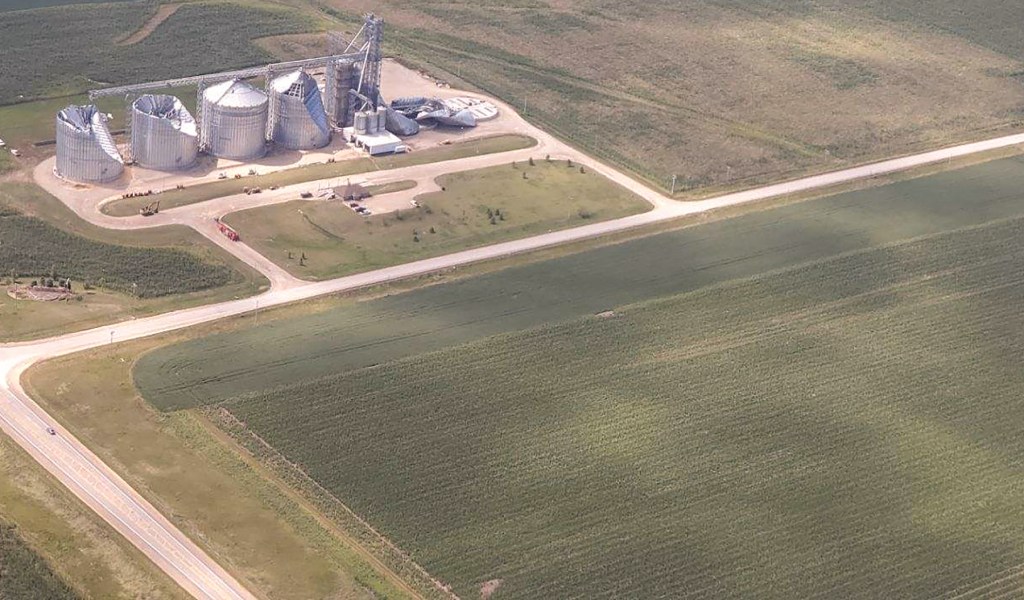
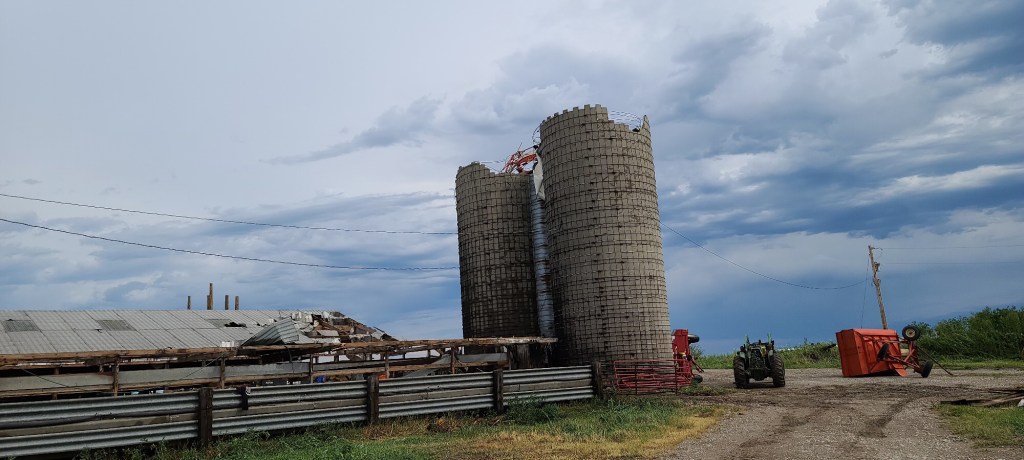
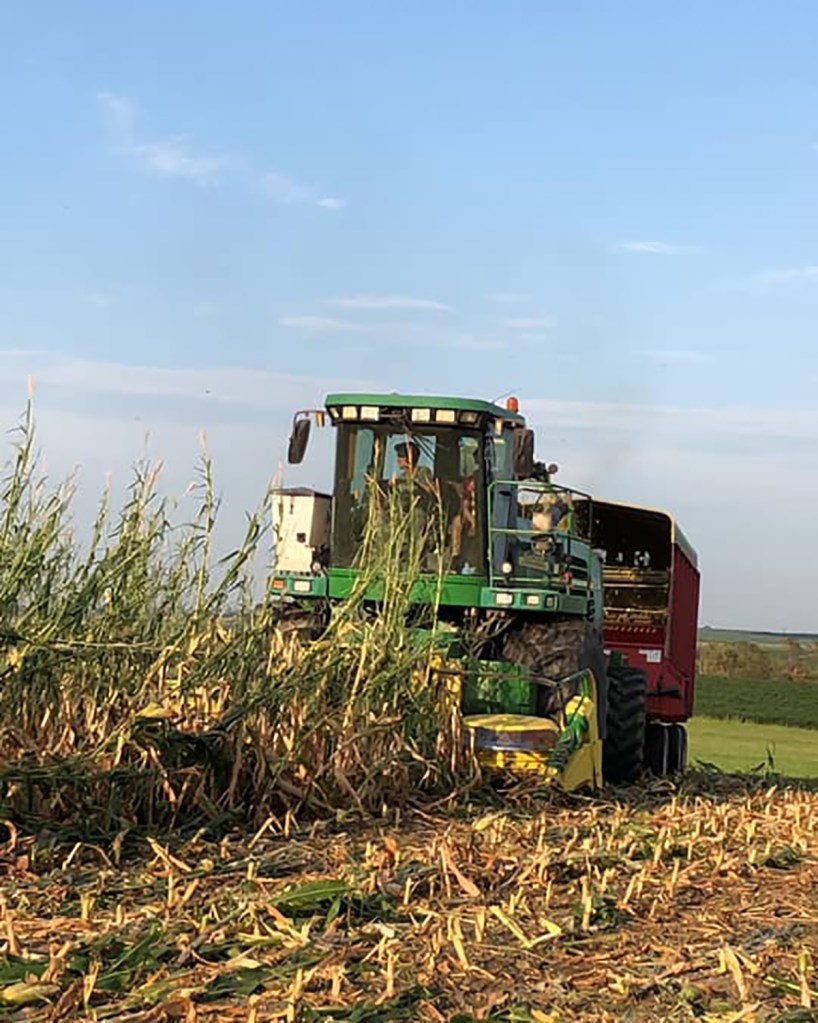
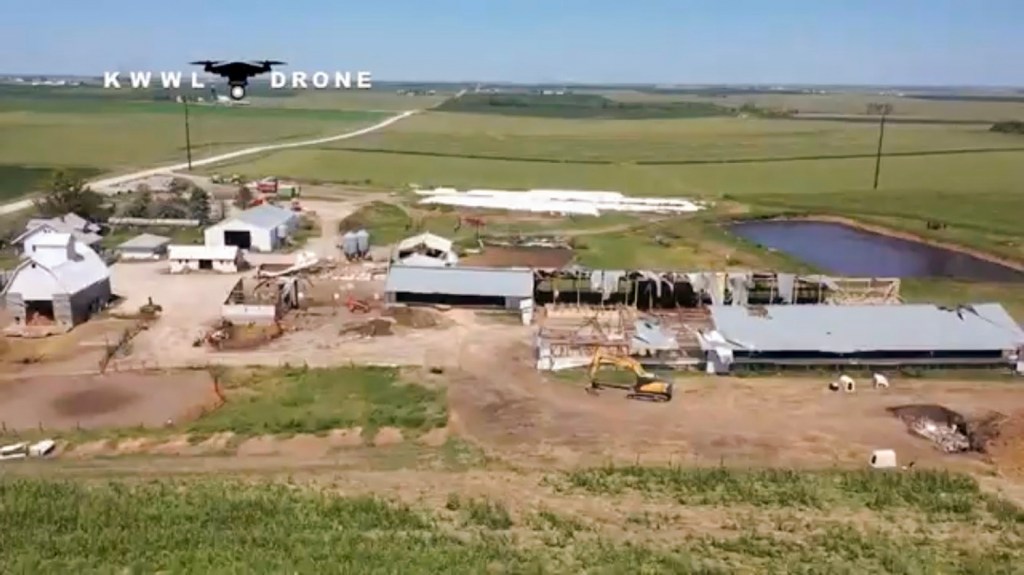
This farm in Benton County was just one of many east-central and northeast Iowa dairy farms sustaining damage to silos, bent, toppled and with top halves blown off. Behind it is a view many are looking at right now of flattened and greensnapped corn. Dairies are pushing to chop silage while it’s still green so it will feed through the chopper, especially where stalks are snapped. KWWL drone photo

NEWHALL, Iowa — Farmers in Iowa say they’ve not seen anything like the derecho storm that hit so many with so much impact on Monday, Aug. 10. It was 780 miles long and 50 miles wide, moving at 50 to 70 mph west to east from South Dakota to western Ohio, straight through the middle of Iowa. Wind speeds were recorded up to 112 mph at the epicenter, with most severe impacts toward the east-central and northeast counties of the Hawkeye State, with virtually no time to prepare.

The winds of the “derecho”– like a hurricane over the Heartland — impacted an estimated 40% of the state’s crops on what the Iowa Department of Agriculture estimated Tuesday (Aug. 18) to be 14 million acres of corn and soybeans across 57 counties in its path. Within the 36 hardest-hit counties, the greatest impact is estimated on 3.57 million acres of corn and 2.5 million acres of soybeans.

USDA Photo by Jeremy Davis.

The storm also left in its wake destruction to infrastructure, an estimated 8,300 structures – homes, businesses, hospitals, schools – damaged or destroyed in towns, and untold losses to farm structures.

On Tuesday, the Ag Department responded to our inquiry to say that no livestock losses have been officially reported; but of five farms with dairy and beef cattle we spoke with in a hard-hit three county area this week, a collective 4% of cattle were euthanized or culled due to injuries or displacement.

Miraculously, on one dairy farm in Benton County, between the hard-hit towns of Cedar Rapids and Marshalltown, calf huts were found half a mile away, but the calves are all okay. On another dairy farm in that area, 44 calf huts were thrown about by the wind, and only two calves were lost.

Unlike a tornado hitting one area, the span of the derecho was broad, including Iowa’s second-most populated city of Cedar Rapids, where damage was severe. The uprooting of its many trees, hundreds of years old, bore testimony to the sheer strength of the winds and intense directional pressures within them.

For most of the first week after the storm, up to half a million people were without power, and 9 days later, 50,000 remain so. Some residents in the towns are living in tents as many structures are condemned. Access to communications and necessities have been disrupted — from food, water, fuel, building and repair supplies to power, phone lines, cell towers and internet access.

President Trump approved a nearly $4 billion emergency declaration requested by Iowa Governor Kim Reynolds on Monday. These are emergency funds for the state, not covering the farm, business and individual homeowner losses, which will be accounted for later.

The President held a disaster recovery conference in Cedar Rapids Tuesday afternoon, not televised by any national news network, except The Weather Channel. In fact, aside from The Weather Channel, social media posts, regional news coverage and a few national print media stories, the world is largely unaware of the derecho and its devastation.

The Iowa Department of Agriculture estimates the magnitude of impact to the state’s corn and soybean industry, alone, may exceed $4 billion as grain storage is decimated on farms and area elevators, and crop damage is so significant and widespread, it can be seen in satellite photos.

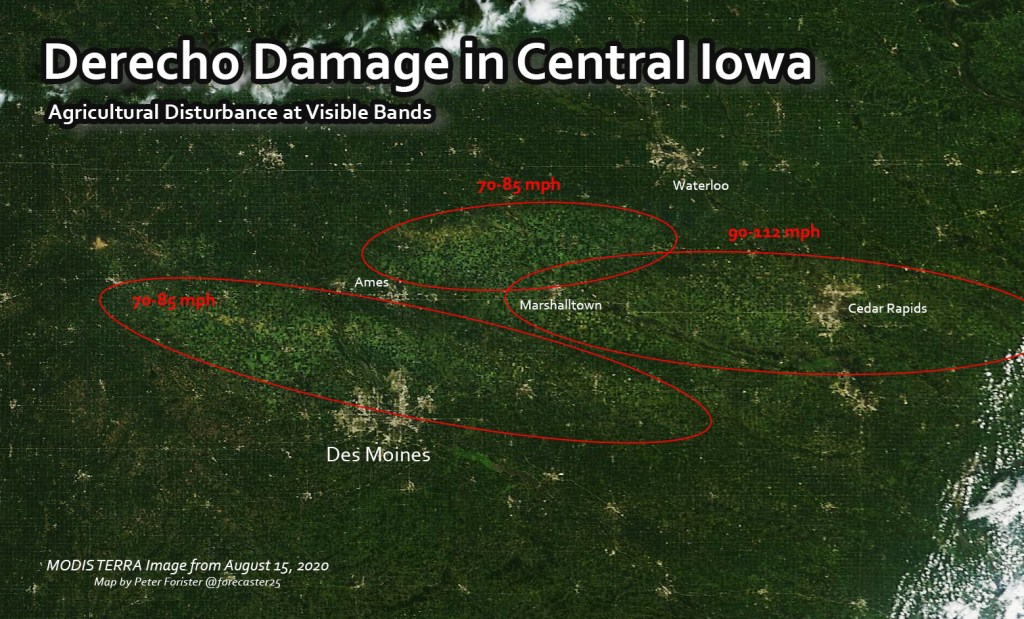
MODIS images like this one graphically illustrated by storm chaser and meteorologist Peter Forister are used by the Iowa Department of Agriculture and USDA Risk Management Agency to gauge the estimated crop damage across millions of acres at different wind speeds in the Aug. 10 derecho’s path across Iowa. Satellite photo provided by Peter Forister

Farmers are resourceful and resilient, and the farmers we spoke with in Iowa this week were also grateful their families and the vast majority of their animals are safe.

Through it all, Iowans are helping Iowans, despite their own troubles.

The Benton County Cattlemen’s Association grills meals for linemen, work crews and displaced families. Hy-Vee stores have been dropping water and necessities at farms and points in town. Farmers, with their own troubles at home, brought equipment to towns to help cleanup trees and debris so linemen could get in to work, including linemen from a dozen states responding to a nationwide call.

Churches are sending work crews and supplies. Insurance adjusters encourage farms to move quickly to recovery, to start fixing, harvesting as necessary, getting repairs scheduled. Vendors bring equipment, manpower and ideas to farms, many are donating products. These actions help everyone keep moving forward.

These dry cows have a makeshift area where a 100-cow robot barn once stood at Green Branch Farms in Newhall, just east of Cedar Rapids, Iowa. Brian Schanbacher moved his milk cows to other farms and is looking to rebuild.  Photo provided

Dairy producer Brian Schanbacher of Green Branch Farms, Newhall reports that a work crew from Oakview Church 200 miles south in Memphis, Missouri showed up on his hard-hit dairy to help with cleanup and stabilizing remaining components of structures to tend dry cows while milk cows went to new homes and a rebuilding assessment could begin.

Similar stories are shared throughout the area.

A field rep working with dairy farms in the area notes that five of his producers have serious building damage or destruction, but that all farms in the area are dealing with power outages and crop damage.

“They have to start chopping silage, and as long as it’s staying green, they are trying to get out and do it, focusing on fields with snapped corn first. They can only chop in one direction, and it’s difficult to get it to feed through the chopper,” he said. “It remains to be seen how this will go, but corn can do amazing things, but in this case, the damage is later in maturity.”

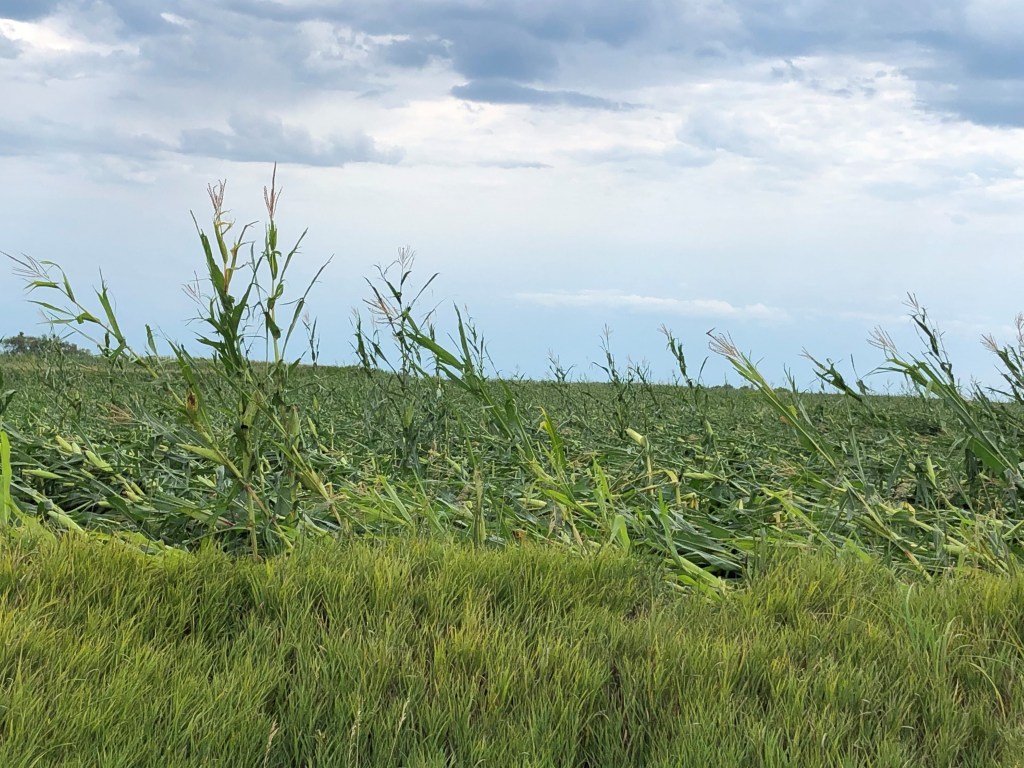
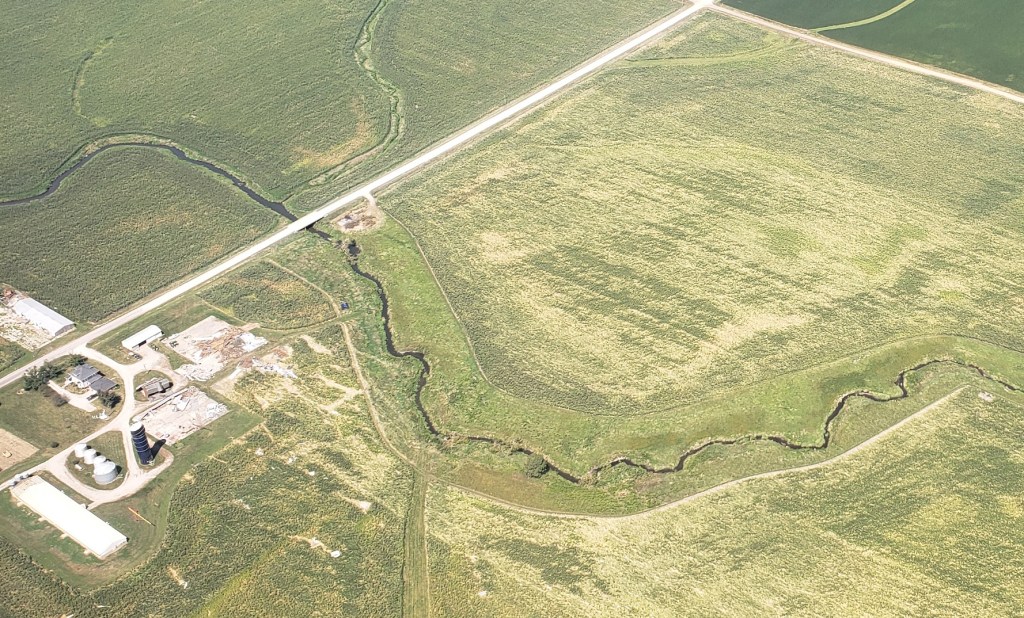
Flattened corn, some of it dead, shown here in an aerial photograph. After a tour to assess damage this week, Iowa Ag Secretary Mike Naig has asked USDA Risk Management Agency for a no-harvest crop insurance option, deeming some of the over 14 million affected acres will be unharvestable. At the same time, last year’s crop is affected by damage to grain bins at elevators and on farms. Corn took the brunt, while several farmers report their soybeans may come back. Drought is also a problem in Iowa, but derecho’s path flattened some of the most promising acres. Agriculture in northern Illinois and northwest Indiana was also impacted by the derecho spinning off potential tornadoes as it slowed down into Ohio. Photo credit Iowa Dept. of Agriculture and Land Stewardship

In driving across the region, the fields he sees “range from 100% ruined to slightly ruined.” This was confirmed by Iowa Secretary of Agriculture Mike Naig’s aereal report Tuesday, stating many affected acres will not be harvestable and tens of millions of bushels in grain storage is lost.

The hardest-hit area is mostly crop farms, with hogs and beef cattle, while Iowa’s heavier dairy area is to the north and west. At the storm’s epicenter are pockets of dairies and those working with farms there say many will have to have facilities totally re-done or significant repairs at a time when work crews are busy everywhere and lumber and tin are already in short supply at higher prices since the Coronavirus pandemic.

Three fatalities are attributed to the storm and many injuries.

“I’ve got all my family and cows alive. That’s everything,” says Brian Schanbacher. His three-row freestall barn is gone that had housed 100 cows and two Lely robots.

The derecho’s destruction at winds estimated between 100 and 112 through this part of the storm’s path through Iowa claimed the robot barn at Green Branch Farms, Newhall. Photo provided

“The only thing left standing is the north wall end with the robots. The cows were packed into that end of the barn in a 30 x 50-foot area, and no injuries to any of them,” Brian relates. “We lost a heifer and five others have injuries.”

Thirty of his cows went to Biercrest Holsteins, just a couple miles north in Van Horne, where Cary Bierschenk reports damage to facilities, feed storage and machine shop, but the parlor and freestall barn are operational. “Brian would do the same for me,” he says.

At Biercrest, the 150-cow freestall barn and milking parlor are functional, but with damage at one end. The recently remodeled barn for their show cows has its roof, fans and lights gone. The top halves of silos are gone, and a grain bin collapsed. But Cary and Kristen Bierschenk are moving forward one step at a time, even taking 30 cows needing a home from Green Branch Farms, because “Brian would do that for us too.” Photo provided

The Franck family of Newhall will also evaluate how to go about rebuilding. Their 200-cow freestall barn is destroyed, along with the old barn that housed the milking parlor. The milking equipment appears to be workable, but without a building, says Ron Franck, “we’re out of business right now.”

Ron and his wife Joan operate the dairy farm with their five children, ages 12 to 24. They sent half the herd to a farm 10 miles away and the other half an hour north. Like others in this situation, they truck feed to the cows that are nearby and help milk them, keeping dry cows at home and swapping fresh cows for dry going forward.

Ron recalls the first hours: “A pair of young kids just showed up around 4 p.m. when we were getting trailers around. Our boys were driving trailers and our daughters were getting cows out of stalls, and these kids could move and sort cows and set panels. The next day the hoof trimmer came with eight guys to clear a portion of the rubble to move dry cows to get feed and water and some shade. Our manure hauler brought 25 people here to canvas the corn fields, bringing out tin and debris, and my wife’s cousin brought a track hoe.

“We’ve not had to cook one meal. Too many people to mention have made sure of that,” he adds.

Photo credit Iowa Dept. of Agriculture and Land Stewardship

Attention this week turned from cleanup to crops. “Much of the corn is flat, leaning or snapped over, a bunch of stalks with the leaves stripped off,” Brian observes. He and others report their bean fields look like they may come back.

Salvaging corn silage is a priority for dairies. “We don’t feel like we get much done each day, but we are getting it done,” says Cary. He and Jennifer and their son Zachary and daughter Ally operate Biercrest Holsteins.

The tremendous crop he expected to harvest is now flat on the ground. He started chopping some fields this week, concerned that many had snapped stalks where the corn was dying.

Seven miles east of Brian Schanbacher’s Green Branch Farms, his cousins at Schanbacher Acres mainly lost feed storage, silos and stored feed that is either lost or inaccessible. They milk 280 cows, and the freestall barn and parlor are fine, they say, but are scrambling for what to feed. This week, Ron Franck and his sons began chopping fields for them before getting to their own, so at least the Schanbachers have green chop to feed. Photo provided

It’s a slow-go, chopping in just one direction, while hoping to avoid unseen debris in the fields that can stop progress in a hurry.

“Everyone has a story from this storm,” says Brian. They’ll remember where they were when it hit. He tells of his cousin who was baling hay in the middle of a field in a tractor and of a farmer grabbing the axel of the combine with his arms around his grandkids holding on to him as the machine shed broke apart around them.

“It’s therapy to talk about it, I guess,” says Brian. “This was no tornado, it lasted at least 20 minutes.” He and his wife Kristen were at home, and their children were 15 miles north where the damage was less severe.

Ron and his sons were also at home 10 miles north of the main farm when the derecho hit at lunchtime. “By the time we heard about Marshalltown, it was already here,” he recalls. “Our first warning was the emergency sirens, and 5 to 10 minutes later, it was on us.”

To a person, farmers recall how devastating the wind was in its duration. “A tornado comes through, lasts a few minutes and hits one area. This lasted 20 to 30 minutes or more and it covered a large area,” says Ron. “The meteorologists couldn’t keep up with it because as it hit the towns, it annihilated weather stations, cell phones went haywire, so they didn’t have data points.”

Even before the storm was completely over, Ron and his older sons knew they had to get back to the farm. “We got a mile or two south and it was pretty bad, straight west of the house, the farmstead was wrecked,” he reflects. “There must have been big variations in the pressure. We would see things look good on one place, and the next place, totally wiped out. Just no rhyme or reason to it.”

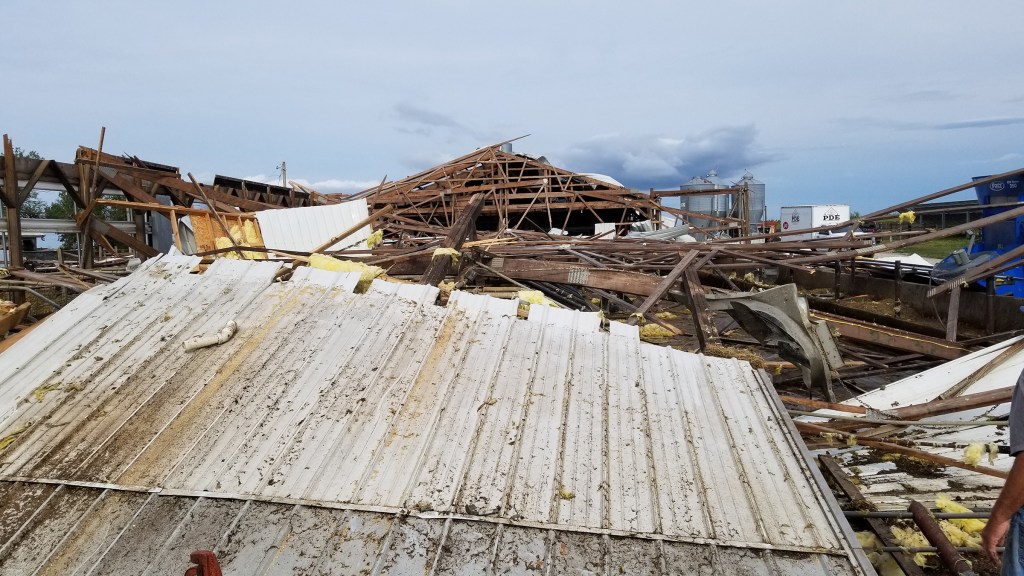
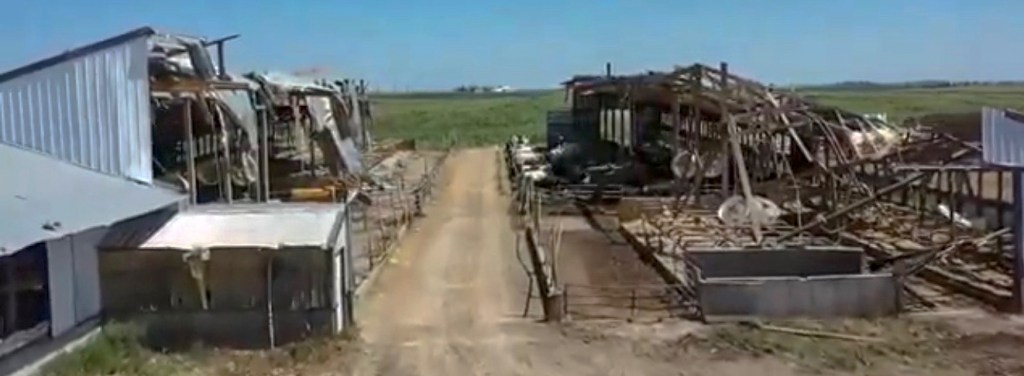
(Above and below) The derecho split the Franck family’s 200-cow freestall barn right down the middle and destroyed the building that housed the milking parlor. They’ve sent cows to other farms, keeping only dry cows at the main farm. Their attention this week is getting the flat corn chopped for neighbors who have cows to feed, but lost or can’t access their feed. The tall green bountiful corn crop close to normal chop date is now flat in the distance, but they are getting what they can. KWWL drone photos

What they found at their main farm was half the cowherd in the corn fields and the other half huddled against a corner with most of the barn gone — split right down the middle by the force of the winds.

By 11 p.m., all the milk cows were placed at other farms. By midnight, they had one area functional for dry cows.

While it’s hard to see forward more than a day at a time, producers talk of rebuilding – grateful for the help offered in the early hours and days — to help find animals, pull debris from fields, sort cattle to be moved, bring meals, lend a hand, give a hug.

“We have insurance and crop insurance, but we need profitability in agriculture to keep going. We need to be able to rebuild, and rebuild right, and to know we have a future. This is unlike anything we’ve seen. Trouble, we’ve seen before, but never so many at once,” said a beef producer during the President’s disaster recovery conference in Cedar Rapids.

Amid the significant challenges ahead, the recovery begins.To facilitate the neighbor-helping-neighbor process, the Iowa Farm Bureau has developed the Farming Community Disaster Exchange – an online message board.

“It’s a little overwhelming how much help we have had,” Ron says, pausing a moment to collect his thoughts.

“I will say this… six days after the storm, we are stabilized — as long as the weather is nice – from a cow health perspective with just the dry cows here now. Those little calves in the huts went for quite a ride, but we’ve modified things with what we have left to make pens, and my daughter has them looking pretty good again.”

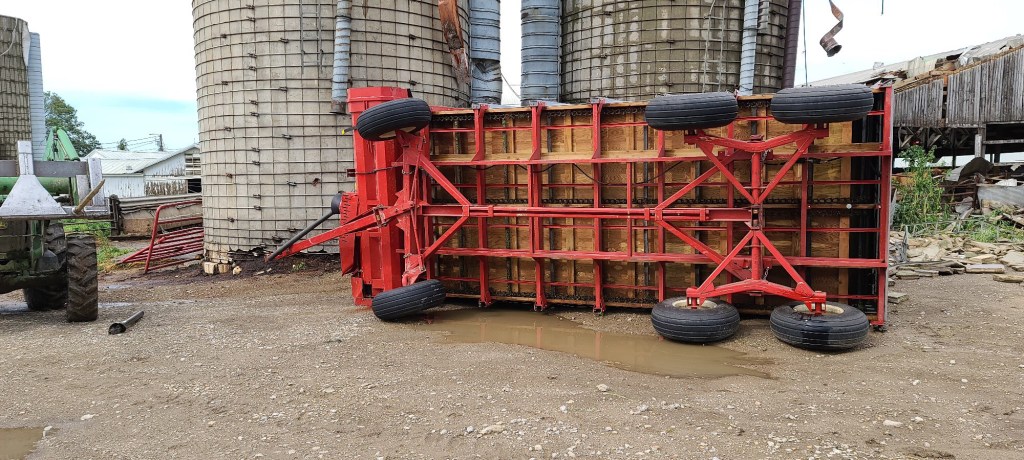
‘No rhyme or reason to it.’ Toppled silo wagons are to be expected in a massive storm like this. But what amazed some farmers we spoke with is how there was no rhyme or reason to it. One example, two wagons side by side – one knocked over while the other is found a mile away in a field, destroyed. Photo provided

-30-
DMI circles wagons around new ‘Net-Zero’ hire

By Sherry Bunting, Farmshine, Friday, August 7, 2020

BROWNSTOWN, Pa. – After last week’s Farmshine cover story, dairy producers across the country have been reaching out to DMI board members and staff seeking answers to questions posed about the Net Zero Initiative, direction of sustainability goals, and the newly hired Executive Director of Dairy Scale for Good, Caleb Harper. He was tapped in May to lead the effort to ‘scale up’ technologies for “U.S. Dairy” to meet its commitment, despite his history of involvement in cellular agriculture and other concerns.

DMI has not yet responded to the questions posed by Farmshine. However, producers are getting some responses. During Wednesday’s “open mic” call with DMI CEO Tom Gallagher, the topic was addressed at the top of the hour to indicate a future “open mic” would be devoted to this topic.

“We’ve been getting questions,” said DMI chairwoman Marilyn Hershey as she opened the call Wednesday. She referred the 350 people on the line — including 50 board members, 80 dairy farmers, along with media and staff — to her blog post at usdairy.com.

“The Net Zero Initiative has pathways for all size farms to be able to stand behind our sustainability goals,” she said.

“Our next ‘open mic’ will focus on sustainability because there is a lot going on in that arena. There is misinformation and good information, and we want to get the details and have National Milk and Newtrient — a company of dairy co-ops and people from the Innovation Center — on where we are going and why,” said Gallagher.

“The industry is focused on being net-zero, but profitable net-zero. That is something that will take time and hard work to get to. We are focused on all size farms — not just large, medium, or small — and on all regions,” he stated. “We know each region has different challenges.

“Most of the small farms are probably net-zero already,” he said.

Gallagher explained that DMI recently added several people in different parts of the organization. “One (new person) is Caleb Harper, and we are really glad to be able to attract him,” said Gallagher.

“We know Caleb is completely a dairy guy. Let’s face it,” said Gallagher. “Cell ag and other competitors are getting well-funded. Caleb is a smart guy, a guy who is pro dairy. He understands the playbook of the other team, so we are miles ahead.”

In the blog post callers were asked to read for answers, Hershey writes: “Caleb Harper joined our team in May to lead Dairy Scale for Good. Caleb is a former principal research scientist at Massachusetts Institute of Technology (MIT) and director of the Open Agriculture Initiative at the MIT Media Lab. He has a tremendous background of leading engineers, scientists and educators in the exploration and development of future food systems and technology.”

Hershey goes on to describe his responsibilities as “directing best practice and technology adoption and implementation on a handful of pilot farms. Harper will also develop third-party strategies to generate investments, partners and technologies that will keep farmers from bearing the entire commitment of this endeavor.”

Harper has already been visiting dairy farms in the Southwest and Upper Midwest after his first-ever dairy farm visit to Fair Oaks Farm.

Both in the blog post, and in other responses made in writing to producers from DMI staff, Harper is described as “coming from a family that raises horses and goats on a small ranch in Texas and crops and cows on a fifth-generation homestead in Kansas.”

What isn’t mentioned is that, according to a Sept. 2019  Chronicles of Higher Education story, Harper’s father, Steve Harper, was a grocery executive, actually Senior Vice-President of Marketing and Fresh Product Development, Procurement and Merchandising from 1993 to 2010 for the H-E-B supermarket chain in Texas and northern Mexico, among the largest supermarket chains in the U.S. in sales. He stayed on part-time through 2012 before retiring in 2015.

H-E-B was the first and longstanding partner of Mike and Sue McCloskey, when they were dairying in New Mexico and founded Select Milk Producers. They were working to get closer to the consumer, and the H-E-B alliance was instrumental, Sue explained in her presentation at the Pennsylvania Dairy Summit in February 2020, where she painted a picture of dairy’s future as seen by DMI’s Innovation Center for U.S. Dairy, and its food industry partners.

In fact, according to the Houston Chronicle, the McCloskeys worked with H-E-B, supplying their milk and in 1996 to produce Mootopia ultrafiltered milk, an H-E-B brand. This was the pre-cursor to fairlife, the ultrafiltered milk beverage line in which DMI partnered with the McCloskeys, Select, and Coca Cola to market and R&D. (On Jan. 3, 2020, the Coca-Cola Company announced it was sole owner of fairlife LLC after acquiring the remaining stake from its joint venture partner Select Milk Producers.)

Both Caleb Harper and Mike McCloskey currently serve on WWF’s “Markets Institute” Thought Leadership Group.

Hershey writes of Caleb Harper’s involvement in several non-profit organizations, including World Wildlife Fund (WWF), World Economic Forum, as an explorer for National Geographic, and at New Harvest (www.new-harvest.org), a cellular agriculture research institute, which has provided research funding to such startups as Perfect Day.

Meanwhile WWF — the DMI sustainability partner — will stop at nothing in its quest for food transformation away from animal use. WWF is currently using the Coronavirus pandemic and “threat of zoonotic diseases jumping from animals to humans” as the angle for pushing food transformation, with a “stop the next pandemic” campaign at the WWF website stating: “The conversion of land for unsustainable agricultural and livestock use drives wildlife, domestic animals, and humans in closer contact.”

Both New Harvest and WWF support and advocate for rewilding of lands as farms and ranches fold under the pressure of low prices, rapid consolidation, misinformation used to position new plant-based and cellular ag products as future of food replacements for meat, eggs and dairy, using climate change, sustainability and now pandemic fears to prepare people to accept these bio-engineered versions grown in fermentation vats and bio-reactors instead of farms and ranches.

“While (New Harvest) goes against the essence of who we are as farmers, and Caleb no longer serves on its board, his knowledge and insights in this area will be an asset,” writes Hershey. “I am very excited about Caleb’s ability to open new doors for dairy. He brings an astounding depth of relationships with other scientists, organizations and companies.”

New Harvest is more than a “cellular agriculture research institute.” It’s mission is to replace cattle and other livestock by growing portions of animals, separating protein excrement from yeast, and other ‘genetically altered and digitized” methods of displacing farmers and ranchers from the land. In 2017 and 2018, Harper was one of five board members for New Harvest. In fact, though canceled due to Covid, the New Harvest 2020 Conference was scheduled for the M.I.T. Lab in Cambridge, Mass., where Harper was a lead researcher until April 30, 2020.

In her blog post, Hershey writes that, “Earlier this year, the Innovation Center for U.S. Dairy set new environmental stewardship goals to further the progress and commitment that dairy farmers and the broader dairy community have to responsible production.”

She describes it as a “collective effort” expected to benefit all farms with a pathway for farms to voluntarily contribute. She writes that it will not be mandatory. Instead, she notes that it will provide opportunities for farms of all sizes to adopt technologies and practices and create revenue streams.

Stay tuned.

-30-
Farmers wonder what happened? June PPDs ugly, pool volume down 36%

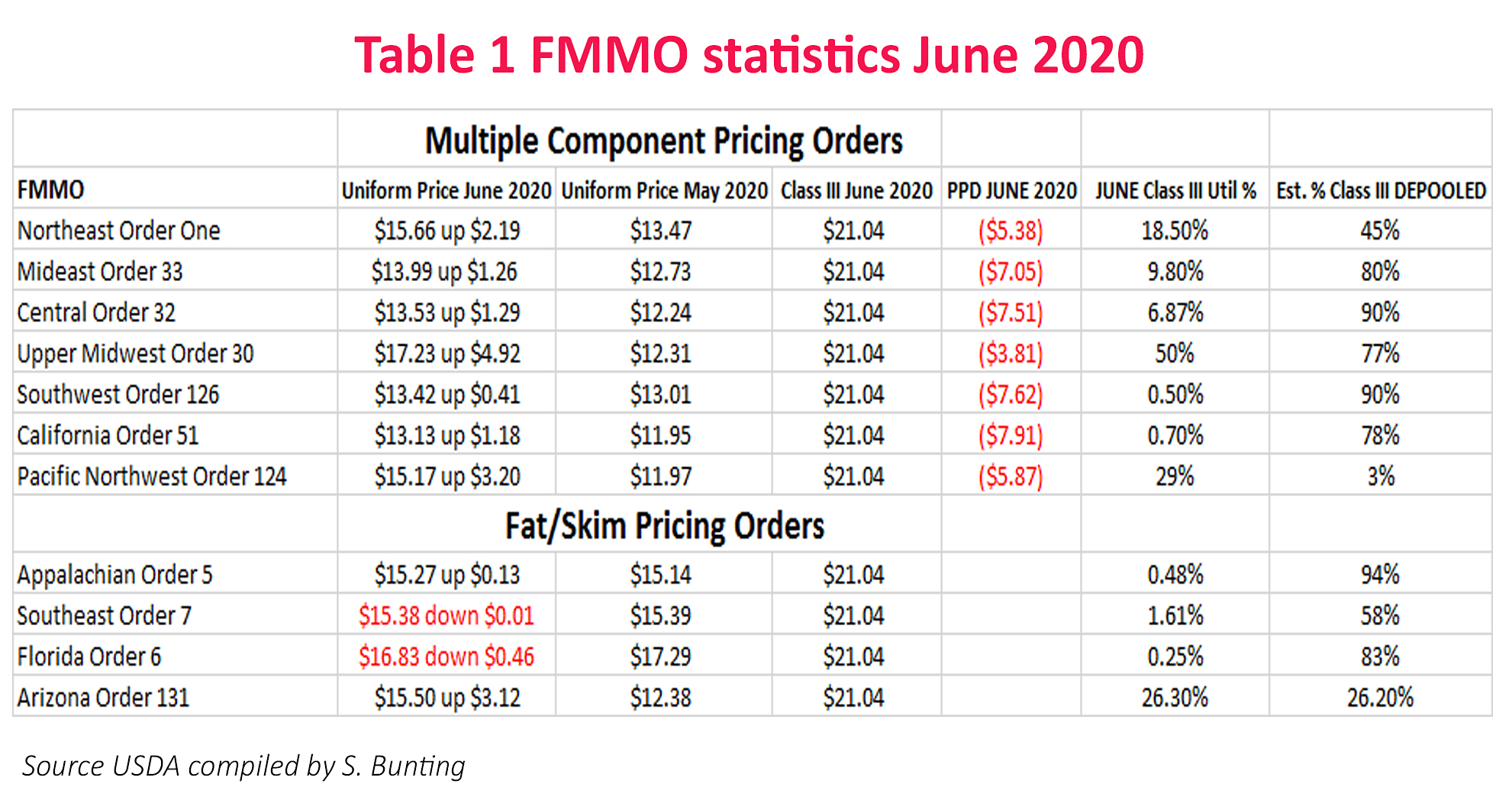
TableOne_FMMO_Statistics_June2020_Bunting (1)

By Sherry Bunting, Farmshine, July 17, 2020

BROWNSTOWN, Pa. — The negative PPDs are turning out to be whoppers as expected for June, and experts say the situation will repeat in July. In fact, by the looks of the milk futures markets, the wide spread between Class III and IV is projected to remain above the magic number of $1.48/cwt. through at least September and quite possibly through the end of the year.

That’s the big news. This divergence is messing with PPDs more than normal and changing the ‘basis’ for producers in a way that defies most risk management tools. While the Upper Midwest milk checks reflected some of the marketplace rally, other regions fell quite flat. The range in uniform prices among FMMO’s is $4 from the $13s in in California, the Southwest and Mideast (Ohio, western PA, Indiana, Michigan) to $15s in Northeast, Southeast, Appalachia to $16s in Florida and the highest uniform price in the $17s for the Upper Midwest.

In fact, depending what Federal Milk Marketing Order (FMMO) you are in, and depending upon how much of that higher Class III “marketplace” value makes it into payments by plants to co-ops and producers, this could alter how “real” the Dairy Margin Coverage margin is, as well as the workings of Dairy Revenue Protection (DRP) program insurance and other risk management options that play off Class III but settle out on an “All Milk” price USDA will calculate for June at the end of July.

Producers who purchased DRP policies and based them on components to stabilize their risk in markets that utilize a blend of classes, are realizing an indemnity they expected to receive as protein doubled from May to June is now deflated to a smaller number due to negative ‘basis’.

Experts admit —  There’s no good way to manage PPD risk (or as it’s referred to in the skim/fat Orders of the South “revenues available to pay”). Interestingly, Dairy Farmers of America (DFA), at its member risk management website, is touting it has “strategies” for members to “mitigate future negative PPD risk”.

(Read to the end to learn how to participate in the Farmshine Milk Market Moos milk check survey on this issue.)

So, what changed? Other than a pandemic disrupting things.

A big change is the new way USDA calculates the Class I Mover. This was implemented in May 2019 and is currently adding on to the largeness of the inverse relationship between Class III and the uniform price in multiple component pricing orders.

In fat/skim orders of the South, producers are seeing one price on their check but then “revenues available” to pay a different price. In some cases, the “revenues available” is reference to dispensing with “overbase penalties” in June because revenues were available to pay a better price on that milk.

There are no PPDs in the four FMMOs still pricing on a fat/skim basis. But those Orders are seeing a flat-out reduction in their uniform price as announced for Florida and the Southeast FMMOs being lower than May! Meanwhile the Appalachian Order gained just 13 cents over May. (See Table I above.)

During the formation of the 2018 Farm Bill, National Milk Producers Federation (NMPF) and International Dairy Foods Association (IDFA) agreed on this new way to price Class I so that Class I processors could find “stability” in their costs by forward pricing without having to “guess” which manufacturing class price contract would be the “higher of.”

Farm Bureau remained neutral at the time that this was going through, and their analysis showed, historically, this new way leveled out over time for dairy producers. In fact, supporters stated that the stability of averaging Class III and IV to make the Class I Mover offered stability in input costs to milk bottlers so they could forward price, which in turn would offer stability to farmers by keeping bottlers in a position of strength to invest for the future. These are the reasons we heard, and it wasn’t much debated at the time.

No hearings were held by USDA on this major change in Federal Order pricing for the one and only class that is actually regulated. It was done in the Farm Bill, legislatively, because cooperatives and processors agreed it was what they both wanted. (More information next week on what factors Covid and non-Covid-related that are contributing to these diverse trends between Class III and IV.)

Under the current method, instead of using advance pricing factors from the “higher of” Class III or IV to calculate the Class I Mover, the two classes are averaged together and 74 cents is arbitrarily added.

The reason this is such a big issue right now, and likely for months to come, is the size of the spread. Rapidly rising block Cheddar — which hit another record of $3.00 per pound on the CME spot market early this week – keep pushing the AMS end-product pricing higher, more than doubling the value of protein between May and June and pushing Class III milk futures further into the $20s.

In fact, Class III milk futures settled Tues., July 14 at $24.34 for July, $23.09 August, $20.23 September, $18.40 October, $17.44 November and $16.35 December. Meanwhile those months for Class IV milk futures settled Tuesday at $14.03 for July, $14.51 August, $14.85 September, $15.07 October, $15.31 November and $15.53 December. Not until December is the spread within the $1.48/cwt range where the new way of averaging the two classes returns from being so out of kilter to Class III.

Remember, these negative PPDs are the result of Class III being larger than the uniform blend price, and the large amount of depooling that resulted keeps that higher value from being shared in the pool. Class III handlers are accustomed to taking a draw, not writing a check, and there’s no requirement to be pooled unless a plant is a pool supplier or wants to stay qualified for the next month in most FMMOs.

A Farmshine article two weeks ago explained these price relationships in more detail.

Now the numbers are coming in. The recently announced uniform prices and PPDs range from nearly $4 to near $8 — just as leading dairy economists had estimated.

The least negative was the Upper Midwest FMMO 30, at minus-$3.81, where 50% of the milk utilization was Class III, and the uniform price gained a whopping $4.92 at $17.23 for June. In fact, producers in Wisconsin and Minnesota report $20 milk checks for June.

The most negative PPD was minus-$7.91 in California, where less than half of one percent of the milk utilization was Class III, and the uniform price gained just $1.18 at $13.13 for June.

The Southwest FMMO 126 wasn’t far from that at minus-$7.62 with a uniform price announced at $13.42 — up 41 cents from May.

In the Northeast FMMO One had a minus-$5.38 average marketwide PPD, but the uniform price gained $2.19 over May at $15.66 with 18.5% Class III milk utilization.

The Mideast Order PPD is minus-$7.05, and the uniform price gained $1.26 at $13.99 with just over 9% Class III utilization.

In the southern FMMOs, pricing is still on a fat/skim basis, not multiple components, but the inverse relationship of the Class I Mover to Class III pricing is keeping June uniform prices flat or lower compared with May. The Southeast FMMO 7 saw a penny decline in the uniform price to $15.38 in June, and Florida Order 6 uniform price fell 46 cents from $17.29 in May to $16.83 for June. The Appalachian FMMO 5 gained just 13 cents at $15.27 for June.

Nationwide, just over 9.5 billion pounds of milk was pooled across all Federal Orders in June, down 36% from 14.4 billion pounds a year ago and down 28% from the 13.2 billion pounds last month.

May milk production was down 1.5% compared with a year ago, but the pooling volume nationwide was already 13% lower than a year ago in May.

USDA confirms that handlers making just Class II, III or IV products are not required to pool the milk, and therefore, due to “expected price relationships,” some handlers decided to not pool some of their milk receipts in May, and most definitely elected not to pool in June.

“Only Class I handlers are required to pool all of their milk receipts no matter how it was used,” USDA Dairy Programs explained in an email response to Farmshine this week.

In Table I are the marketwide FMMO data for June from Market Administrator announcements on different dates over the past several days. Comparing Class III volumes reported to month ago and year ago, an estimated 45 to 94% of Class III milk was depooled in various FMMOs, with the exceptions of Arizona and the Pacific Northwest where depooling was less of a factor.

Looking at the Northeast FMMO, alone, the estimated 45% less Class III volume in the pool in June vs. May, kept just over $110 million in collective component value out of the Northeast pool.

The question is, since USDA confirms that money is “in the marketplace”, will that “marketplace money” make it to farm-level milk checks, 13th checks, reduced retains? And will the “Covid assessments” and “marketing or balancing fees” and “overbase penalties” be adjusted or eliminated in June?

Others wonder how this will affect the All Milk price for June as calculated by USDA NASS at the end of July. Will the erraticness of how this “value in the marketplace” could be handled make winners and losers in terms of the Dairy Margin Coverage? How will this situation translate to those margins as a national average?

USDA AMS Dairy Programs defined the NASS All Milk price in an email as follows: “The NASS U.S. All Milk Price is a measurement of what plants paid the non-members and cooperatives for milk delivered to the plant before deduction for hauling, and this includes quality, quantity and other premiums and is at test. The NASS price should include the amount paid for the “not pooled milk.”

USDA explained that, “The blend price (Statistical Uniform Price, or SUP) is a weighted average of the uses of milk that was pooled for the marketing period (month).  If some ‘higher value’ use milk is not in the ‘pool’, then the weighted average price will be lower.”

However, the USDA response also points out that, “It is important to note that the Class III money still exists in the marketplace.  It is just that manufacturing handlers are not required to share that money through the regulated pool.”

So, will it be shared at the producer level outside of the pool? From the looks of a few June milk check settlements that have been reported to Farmshine on the morning of July 15, it’s not looking like the higher Class III value is helping checks shared from the Southeast FMMO at this writing. How will that stack up to a margin that gets figured also looking at the Upper Midwest where the uniform price saw almost a $5 gain?

We’ll look at that more closely next week.

Dairy producers who want to participate in my Milk Market Moos survey of June milk checks, please email, call or text your June milk price, fat test and PPD, and the list of deduct line items, especially any “Covid-deducts,” and include any overbase penalties. Also, provide your location or in what FMMO your milk is marketed. All the information will be anonymously aggregated. Email agrite2011@gmail.com or call or text 717.587.3706.

The Jersey Cattle Association is doing a similar June milk check survey sampling across the country.

This is a big topic when risk management is based largely on components and Class III, even though Class III use is not regulated unless processors want it to be, and certainly not in a pricing scheme that no longer prices the higher of two divergent manufacturing price trends into the only truly regulated class — Class I fluid milk. 

-30-
Round bale art gets noticed at Thiele Dairy Farm: ‘I enjoy putting a smile on someone’s face.’

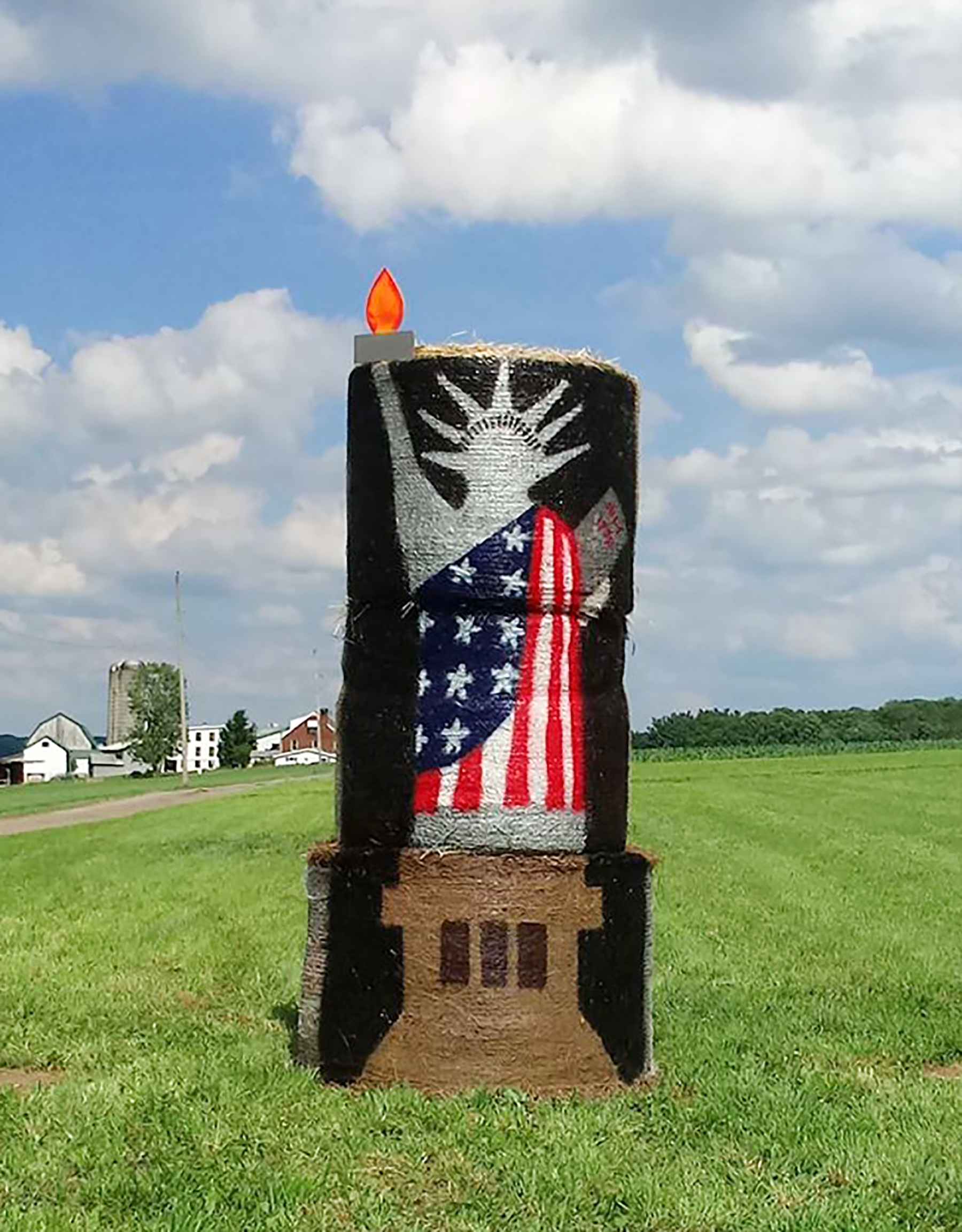
THIELE_MUST_StatueOfLiberty (1)

Lorraine Thiele went with the Statue of Liberty theme this week for the farm’s patriotic round bale art display ahead of July 4th. It’s attracting a lot of attention on state route 356 at the end of the farm lane just outside of Cabot, Pa. Photo by Lorraine Thiele

Round bale art gets noticed at Thiele Dairy Farm

By Sherry Bunting, Farmshine, July 3, 2020

CABOT, Pa. — The flag-draped Statue of Liberty round bale artwork at the end of the long lane leading to Thiele Dairy Farm in Butler County, Pennsylvania is attracting attention. The Thiele family placed it on their farm alongside state route 356 just outside of Cabot this week ahead of Independence Day.

“Everybody just loves it, especially in a time like this with what our country is going through, with the turmoil we are in,” says Lorraine Thiele when asked in a Farmshine interview about the community’s response. A photo of it has also created a lot of activity on the farm’s facebook page.

“We get a kick out of seeing people drive by, stop, back-up, and take their pictures with it,” she adds. “I enjoy putting a smile on someone’s face, to have something that can make people smile on their way to work or wherever they are going.”

THIELE_Family(MarburgerPic) (1)

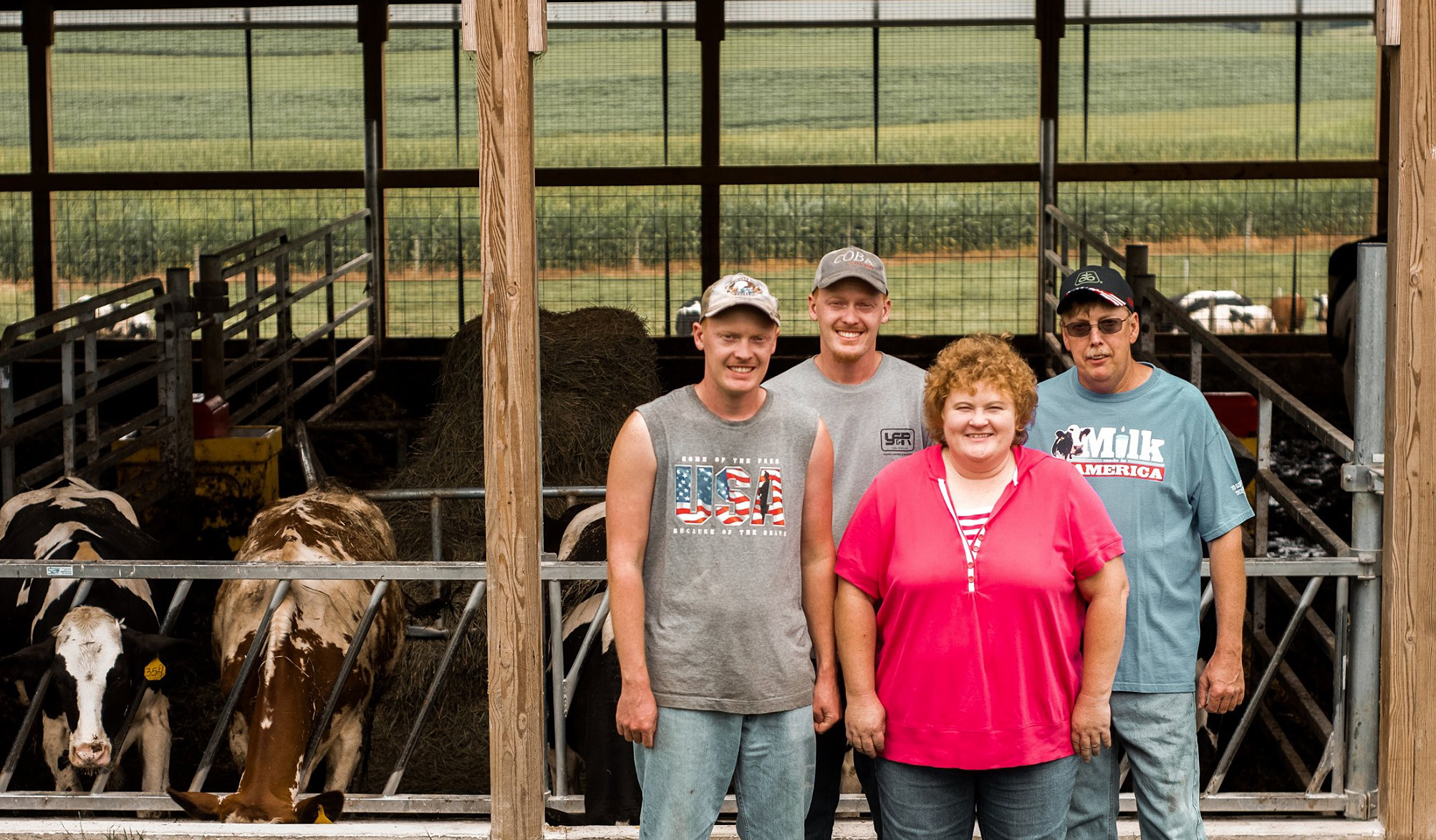
James, William, Lorraine and Edward Thiele at their sixth-generation dairy farm in Butler County, Pa. Photo courtesy Marburger’s Dairy

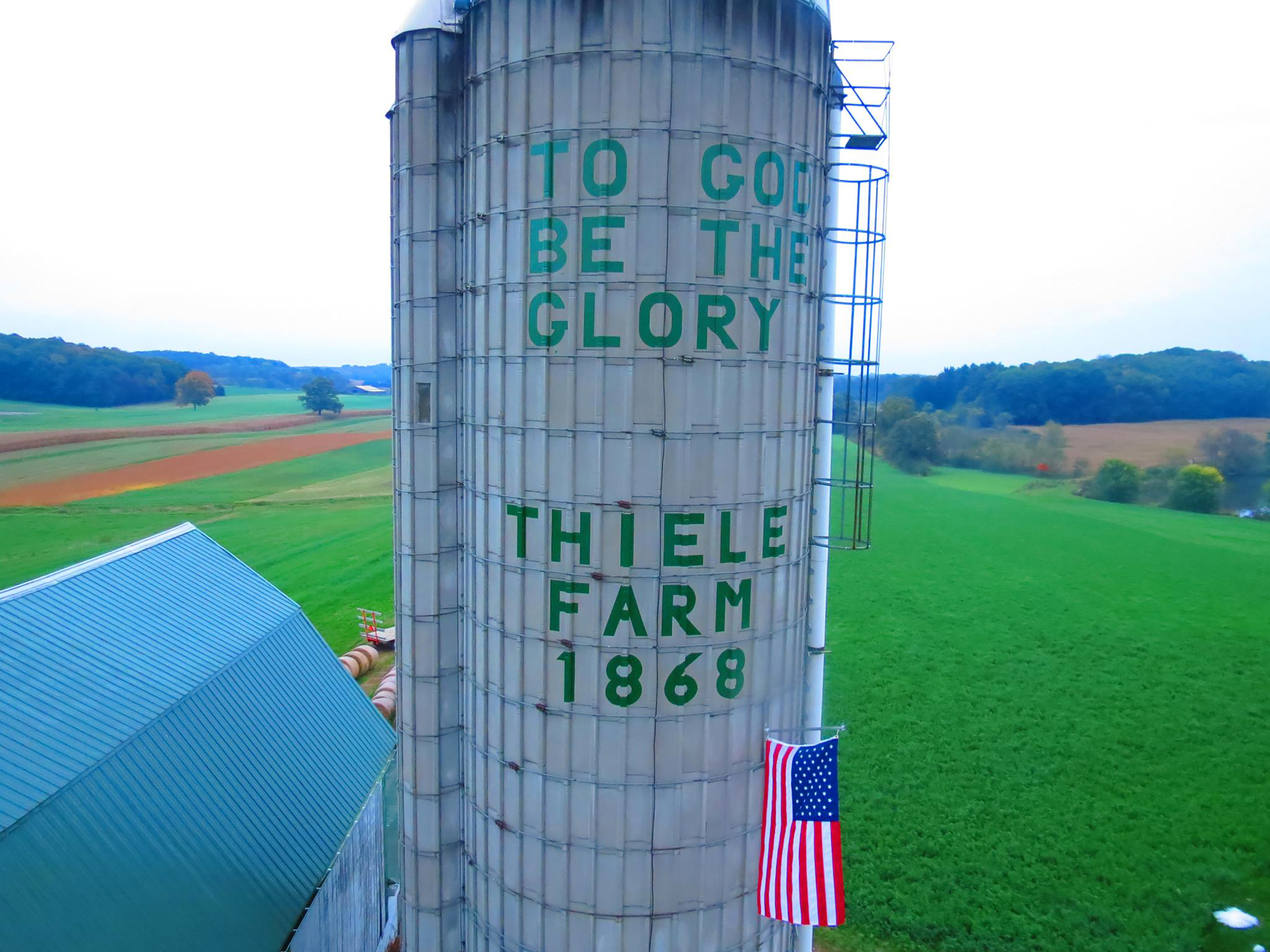
Edward and Lorraine Thiele and their twin sons William and James farm 300 acres of corn, soybeans, hay and oats and milk 40 cows at the sixth-generation Dairy of Distinction, established in 1868. Lorraine does the bookkeeping and all the feeding. She hops on the tractor and helps with other things when needed, although she doesn’t milk much anymore.

Lorraine is also the artist behind the series of round bale portraits that have been created over the past several years. She credits her husband and sons for helping with some of the technical strategy and by providing custom-sized round bales when she asks for them.

“When Ed sees me with the skid loader stacking and piling round bales, he’ll get involved and we’ll draw it out. He likes to help with the more technical side,” she adds.

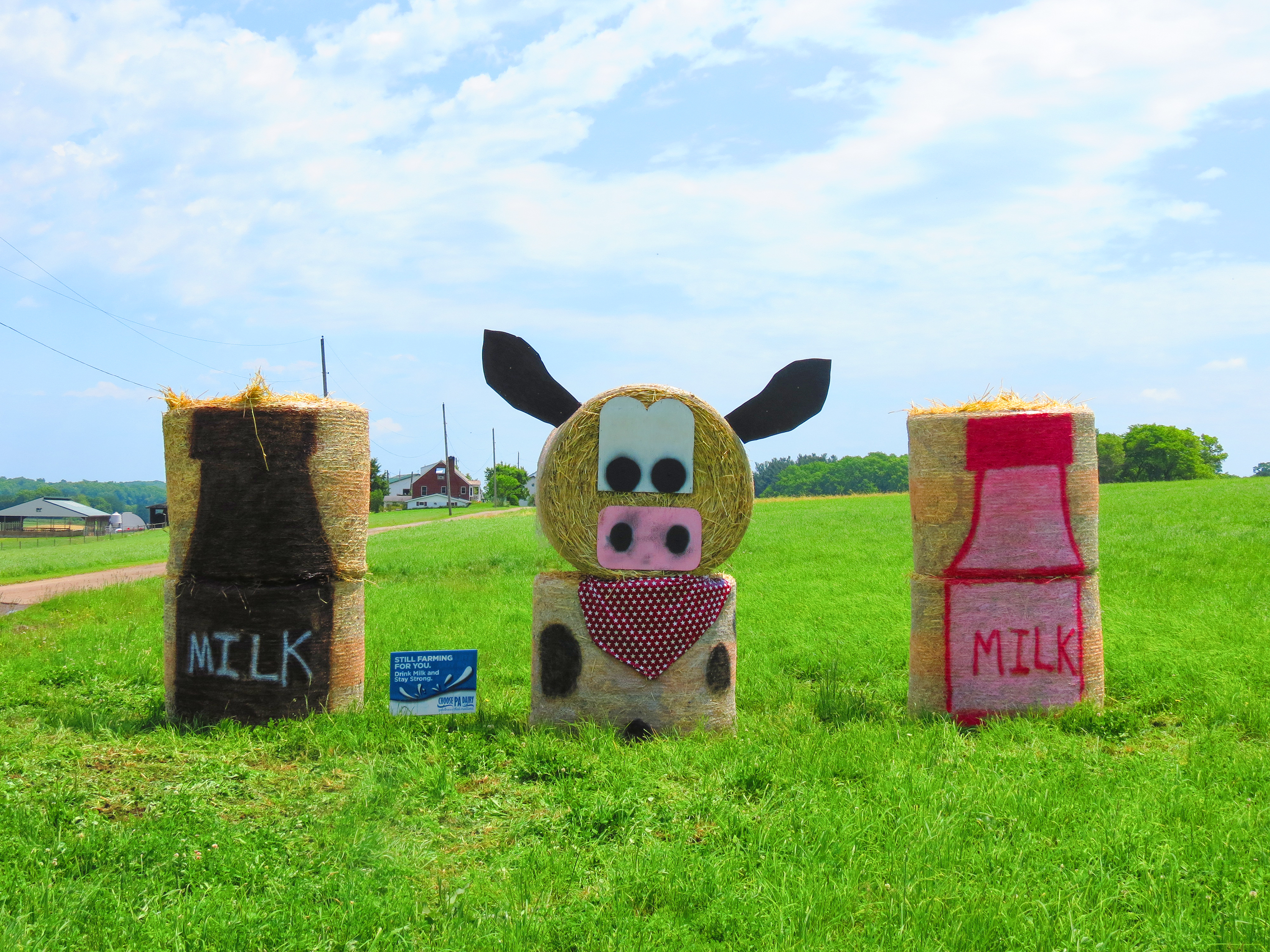
Her Statue of Liberty this year was painted on three large round bales. Last year she did just the American Flag on six. She’s been doing the round bale art projects for several years now – ranging from turkeys and pilgrims at Thanksgiving, to cows and milk jugs for June Dairy Month, and from tractors with wagons full of pumpkins in the fall, to Santa Claus, reindeer, Christmas trees (with lights) and a Nativity last Christmas.

“I try to do something different every year,” she says, explaining how she “googled” for some patriotic ideas to see what struck her fancy for the 2020 July 4th rendition. She came up with the Statue of Liberty.

“I can’t do faces, so I found a silhouette for the design. I also found a ceramic statue with the flag draped over and figured I would try that.

“I’m not an artist,” Lorraine states humbly. To guide what she calls her ‘graffiti style’ spray painting, she used big baler twine pinned to the stacked bales. If her design gets too big, she tailors it down with a background color.

She admits she has been surprised by how relatively easy it is to paint round bales. Their straw bales are not plastic wrapped, so they take a lot more paint than one would imagine.

“Always buy more spray paint than you think you need,” she suggests, adding that painting it on the net-wrapped side holds the paint better than painting the face of the bale of hay or straw, which “really sucks up the paint.”

She also likes to get creative, using items that are laying around. One year, Lorraine painted wood planks in different colors for the feathers on the Thanksgiving turkey.

One year, for June Dairy Month, she used black drain tile pipe and painted the tip white for the cow tail after Ed drilled-in a rod to hold it.

Once she gets an idea in her head, and thinks about it for a while, it comes together.

“It’s fun, and something different to do. It looks harder than it really is.

“Don’t be afraid to try something,” Lorraine encourages. “The nice thing is, if it doesn’t work out, throw it in for bedding and no one will ever know!”

While the Independence Day Statue of Liberty is creating the buzz right now. It was the reaction to the June Dairy Month art that really surprised Lorraine.

THIELE_JuneDairyMonthArt (1)

For June Dairy Month, the painted milk pints had many people turning into the farm lane to buy milk, but the Thiele family explained that all of their raw milk goes to the Marburger Farm Dairy plant in Evans City — a great local brand.  Photo by Lorraine Thiele

“I painted milk chugs — chocolate and strawberry milk pints — to put beside the bale-painted cow,” she explains. “You would not believe how many people turned in the lane and came up to the farm wanting to buy milk. I never would have thought just a straw bale done up as a milk pint would do that!”

In fact, the response was so great, Lorraine had to put a post on the Thiele Dairy Farm facebook page (and a sign by the artwork), explaining that the family does not sell milk right off the farm and that their raw milk all goes to Marburger Farm Dairy in Evans City — a great local brand.

The Statue of Liberty took about a week to finish, but she only works on round bale art when she has the time. After a painting is complete, they haul it down the lane to position it by the main road.

THIELE_Farm02 (1)

Faith, family and farming are alive and well on the Thiele family’s dairy farm.

The Thiele Dairy Farm facebook page is also something Lorraine enjoys. She started it almost 10 years ago through her love of photography and her desire to promote agriculture in a positive light.

“There’s a lot of negative out there,” she says. “Our son (William) has a drone, and he videos the baling, mowing, and planting. The average person doesn’t have a clue what we are talking about or how it is done or what is involved, so our sons love to show it, to do things like that to educate people about what we do.”

Each family member is a steadfast advocate for agriculture, and they are active in Butler County Farm Bureau and Dairy Promotion Committee. They participated in the Butler County milk donation drive-through back in April before the CFAP program. It was coordinated by Community Action Partnership with Farm Bureau, the Butler County Dairy Promotion Committee, Marburger Farm Dairy, AgCoice Farm Credit, and others, where 1200 gallons of milk were distributed along with a bag of groceries and a box of frozen products.

Lorraine is a positive person, and that was demonstrated in this interview and throughout her connections to the community in person and through social media. People appreciate it, even putting gifts or thank you notes to the family by the round bale Christmas tree at holiday time.

As difficult as things can be in the dairy business at times, Lorraine loves the farm and the cows and is thankful her family is farming together — where everyone in the family does everything on the farm.

As for the round bale art? If she can make someone else smile for even just a second. It is worth it.

THIELE_Farm (1)

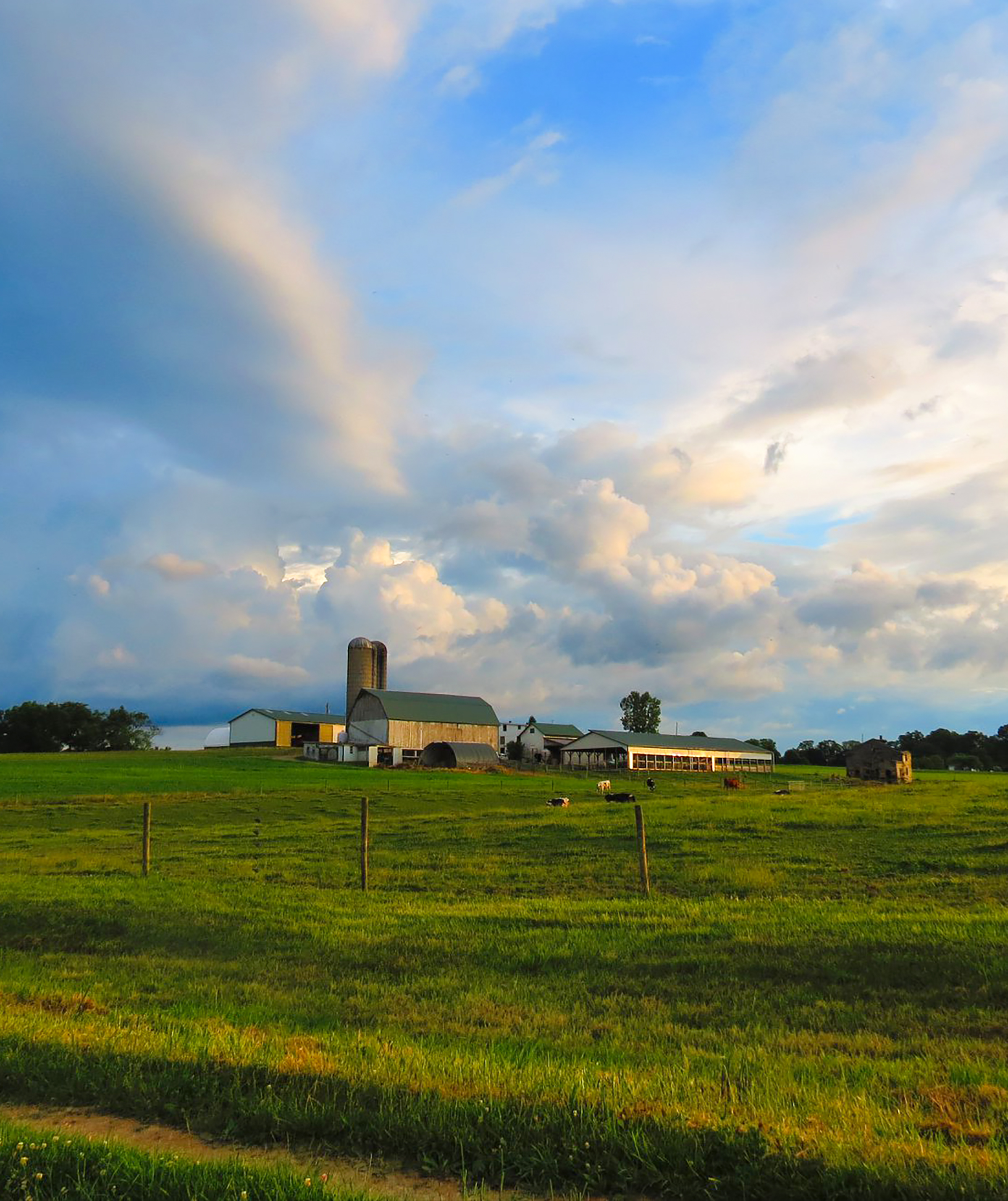
Summer sunset this week at Thiele Dairy Farm in Butler County, Pennsylvania. 
Lorraine loves taking photos on the dairy farm and the Thiele Dairy Farm facebook page is full of her photos as well as drone videos by her son William.  Photo by Lorraine Thiele

-30-
Industry, government follow grassroots donations lead, CFAP adds to dairy demand driving markets higher

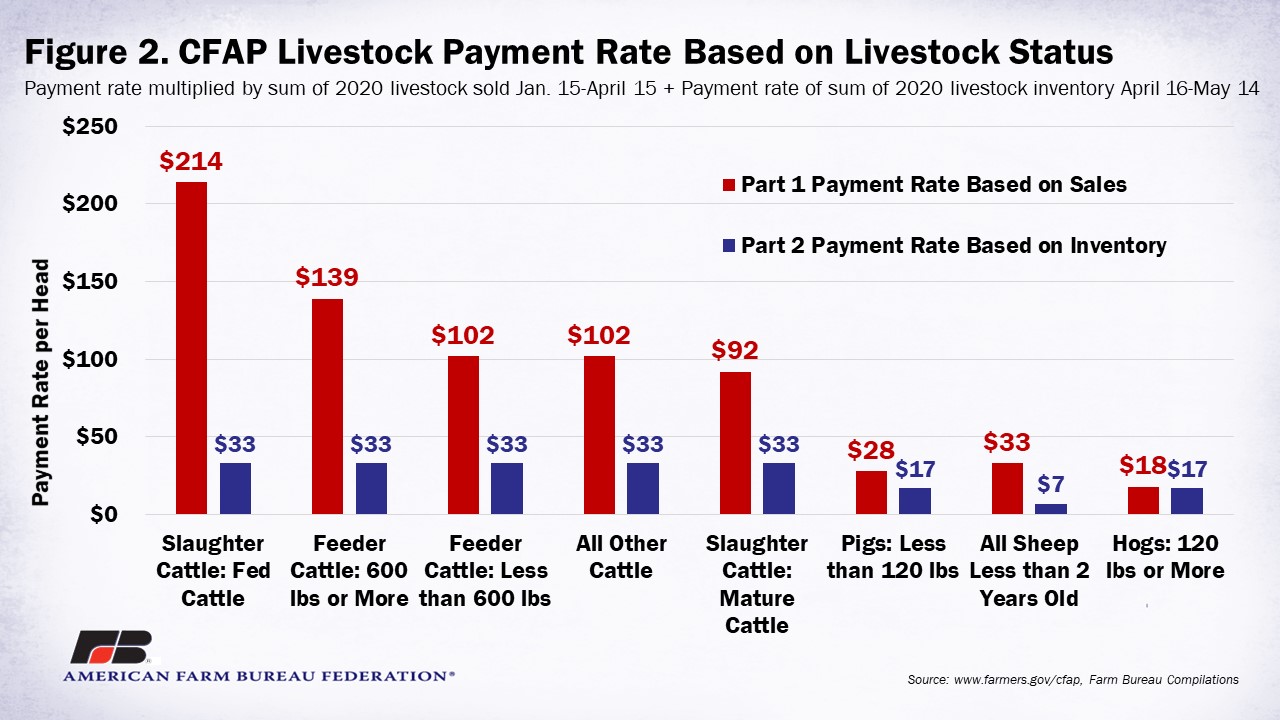
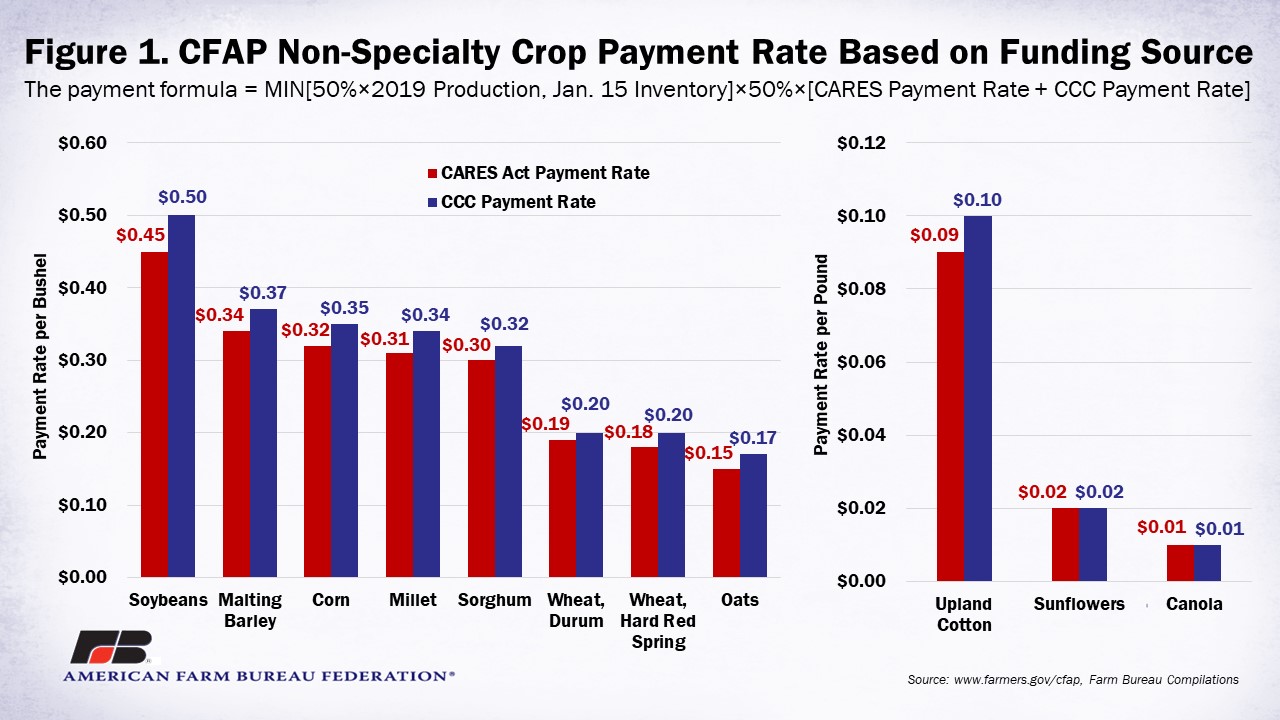
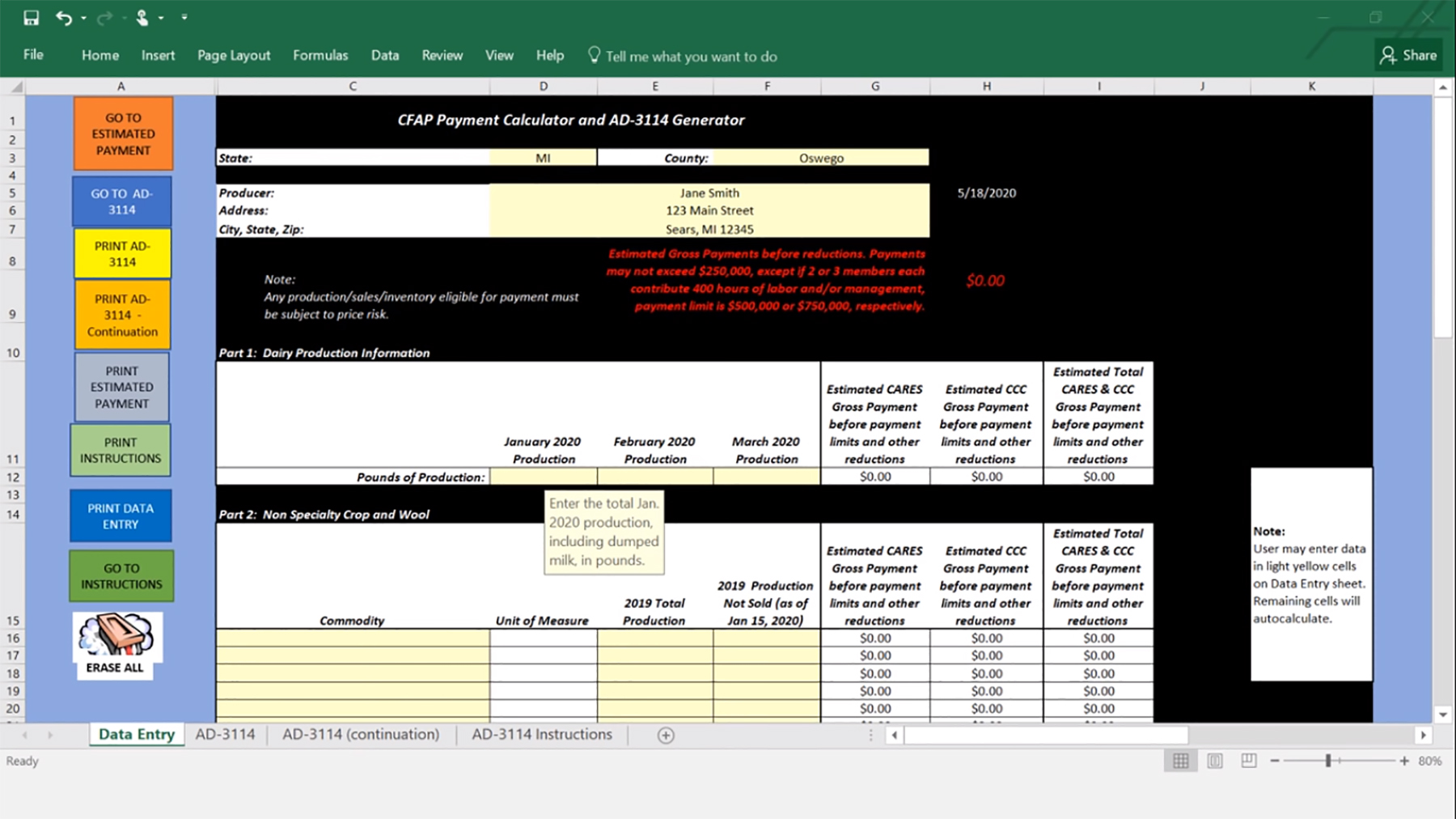
By Sherry Bunting, Farmshine, June 26, 2020

WASHINGTON, D.C. – Government and industry dairy donations and record-setting CME cheese prices all got their starter fuel from grassroots dairy producers in what has become one of the good news stories of the COVID-19 era.

Today, USDA has systemized the donating through the Coronavirus Food Assistance Program (CFAP), and dairy processors, cooperatives and checkoff organizations have partnered with food banks and non-profits to extend the reach of efforts begun originally by generous dairy producers and their agribusiness partners supplying grateful consumers.

In April, when milk dumping was at its height, and stores had purchase-limits or sparse supplies of milk and dairy products, farmers and their agribusiness partners and communities went into immediate action. Examples of milk donation drive-through events began popping up in succession – just a fraction of them featured in the pages of Farmshine.

Also in April, farmer-funded Dairy Pricing Association (DPA) purchased 228,000 pounds of block cheddar, immediately moving the CME block cheese price from its $1/lb plummet to $1.20 (adding $1.00 to Class III milk values at the same time).

This DPA move, working with charities for distribution and a Midwest processor to turn their CME-style bulk purchase into consumer-packaged goods for donation, gave a green light to other cheese market participants. Within a week of that purchase and the initial 20-cent gain in blocks that followed, block cheese continued its climb to $1.80/lb, and the upward momentum has not stopped — fueled now by huge government purchases and food-service pipeline re-stocking.

On the heels of these grassroots efforts, dairy checkoff organizations began getting involved to work with their partners and “convene” the industry to do big donations in May.

Meanwhile, the U.S. Congress had passed the Coronavirus Food Assistance Program (CFAP) in April, with $3 billion of the $19 billion set aside for the Farmers to Families Food box purchases. But it was mid-May before USDA announced those first-round contract awards totaling $1.2 billion in fresh food — $317 million of it for fluid milk and dairy products – for distribution May 15 through June 30.

This week, USDA Secretary Sonny Perdue called the food box program a “trifecta, win-win-win”, pointing out how the program is getting farmers, processors and non-profits together to directly provide fresh food to people without burdening food banks with refrigerated inventory they aren’t prepared to handle.

DPA_CHEESE (1)

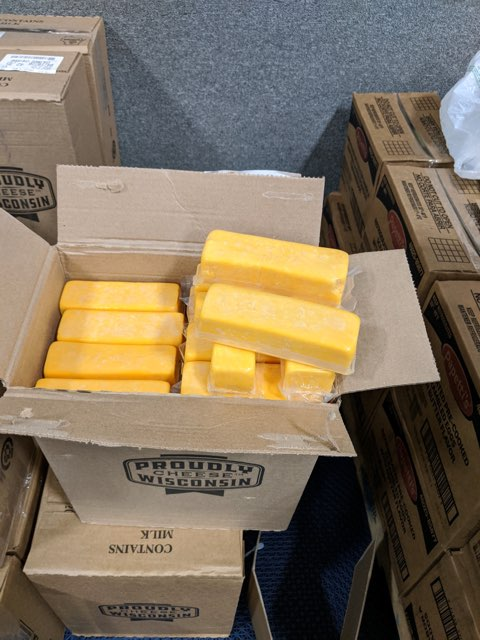
In April, when block cheddar was plummeting to $1.00/lb, the farmer-funded Dairy Pricing Association based in Wisconsin with member-contributors nationwide, purchased 228,000 pounds of block cheese to be cut-down for distribution by several charities. DPA Facebook photo

This was the model of grassroots groups and individuals on their own dime and time doing dairy donation drive-throughs, milk-drops, and whole milk gallon challenges from late March to the present. It was also the model of DPA, funded by voluntary dairy farmer milk check deductions, when DPA purchased the block cheese in April for cut-down and donation. Also in April, we saw the partnership initiated in Pennsylvania between 97 Milk and Blessings of Hope. They raised funds to buy local milk for donation to families in need.

As these grassroots efforts began having an impact, Midwest Dairy got approval from USDA in May to use checkoff funds to donate cheese, and UDIA of Michigan was allowed to provide minimal funding to food banks for “handling costs” associated with receiving cheese donated in May by DFA.

Now, with USDA systemizing that smart approach — started by grassroots efforts — the department stated in a news release that as of June 23, its CFAP Farmers to Families Food Box Program had delivered more than 20 million boxes of fresh food, including milk and dairy products, to families impacted by COVID-19.

The initial round of USDA CFAP contracts ends on June 30. But this week, USDA announced it will extend “well-performing” first-round contracts for similar amounts in a second-round from July 1 through August 31 to total an additional $1.16 billion.

The share of this second-round to be devoted to fluid milk and dairy purchases was not specified in the USDA announcement. One thing USDA did note is that even though most of the second-round dollars will be spent with “selected” current contract awardees, a few new contracts may be awarded to previous applicants that had been passed over due to technical errors or to provide boxes in areas identified as “underserved.”

Throughout the USDA CFAP food box delivery process, regional dairy checkoff organizations have been involved as “facilitators.”

Week after week, Farmshine has received press releases from dairy checkoff organizations, and there have been numerous social media posts, about the CFAP milk and dairy box donations. Regional checkoff organizations say they are working with processors, cooperatives and non-profits — in conjunction with the USDA CFAP food box program — and that area dairy farmers are involved as volunteers to hand out the boxes.

According to National Dairy Council president Barb O’Brien, dairy checkoff organizations began “convening the industry” before CFAP.

“We have leveraged the checkoff’s unique ability to convene companies from across the value chain to identify a number of ways to redistribute excess milk and other dairy products to families facing food insecurity,” writes O’Brien in an email response to Farmshine recently.

In a specific cheese example she had mentioned in a media call described as block cheese being purchased and cut into consumer size portions, our inquiry for details was met with this response:

“In response to lost food-service markets and dairy farmers being asked to dispose of milk, we’ve worked to connect coops to partners that donated processing capacity for any excess milk available for food banks,” O’Brien wrote. “Many other dairy companies — such as the example I gave from DFA of cheese donations in Michigan — provided massive quantities of dairy products to food banks before the USDA Farmers to Families Food Box Program was even put into place. Moving forward, it will be important that we continue working together as an industry to target the greatest needs and find long-term solutions to our nation’s hunger crisis.”

O’Brien cites DMI’s “long-time partner” Feeding America and other relationships with local food banks and pantries. Former Ag Secretary Tom Vilsack, now a top dairy checkoff executive with DMI, sits on the Feeding America board of directors.

O’Brien also noted in her response that dairy checkoff “counseled industry partners and others on how to direct dairy products toward the greatest needs.”

She reports that, “This widescale approach enabled us to pinpoint some of the biggest barriers in getting excess dairy products to hungry families during the pandemic” and to “rapidly initiate an industry response.”

As communities began doing their own grassroots efforts through the generosity of dairy farmers, agribusiness and individuals purchasing milk or contributing milk for dairy donations in the early days of the COVID-19 ‘stay-at-home’ orders, checkoff organizations took note and began to look at what they could do in terms of refrigeration equipment and setting up refrigeration trucks for industry and governmental efforts.

LancMilkGiveaway_5378

Grassroots whole milk donation events like this one just outside of Lancaster, Pa. in May, have been providing whole nutrition to families across the state and region since the height of COVID-19 ‘stay-at-home’ orders in April.  Photo by Michelle Kunjappu

While many of the grassroots-organized milk donations were comprised of whole milk purchases vs. low-fat milk, this week marked the first time a checkoff news release showed red-cap whole milk gallons or even referenced whole milk in their facilitation of USDA CFAP box deliveries. This is another win led by early grassroots efforts.

ADA Northeast (ADANE), for example, indicated in a press release this week that 200,000 gallons of milk will have been handed out in the Northeast / Mid-Atlantic region by the time June Dairy Month ends. The release stated that 20,000 gallons would be donated this week, alone, from DFA, Upstate Niagara and Schneider’s Dairy to be given out in New York and Pennsylvania through the Nourish New York state funds and CFAP food box federal funds.

ADANE_wholemilk (1)

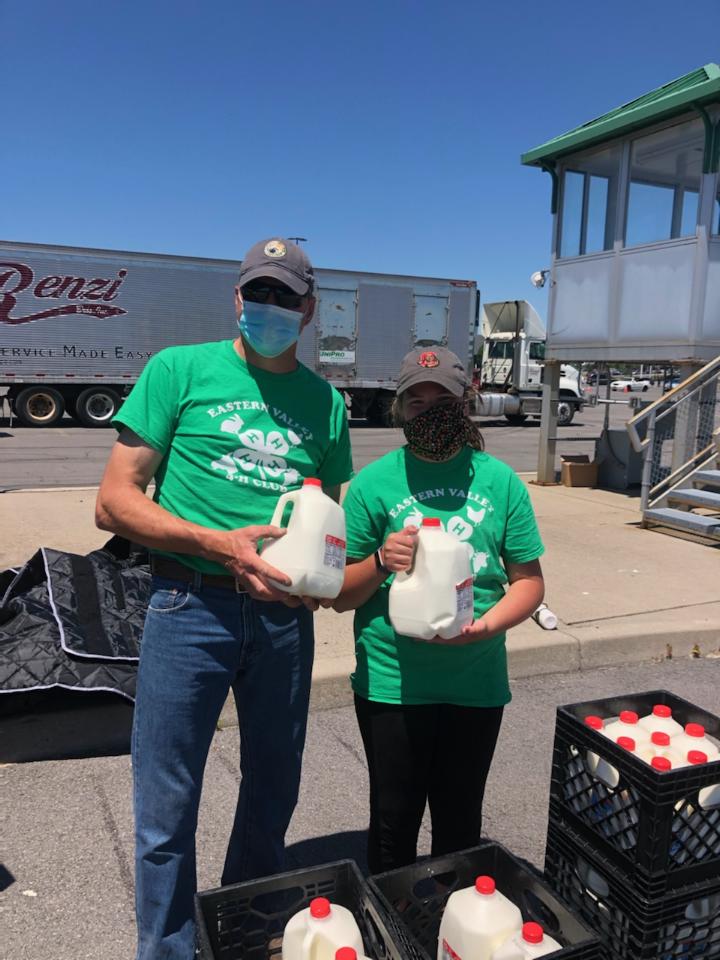
For the first time among the many news releases sent by ADA Northeast (ADANE) touting checkoff ‘facilitation’ of fluid milk and dairy donations, whole milk is in the box! Here, dairy farmer Joel Riehlman of Fabius, N.Y., and a 4-H member, hand out whole milk in mid-June at a Nourish New York and USDA CFAP Farmers to Families Food Box donation drop in Syracuse. Photo provided by ADANE

In a recent Watertown, New York drop point for these donations, ADANE board member Peggy Murray of Murcrest Farm, Copenhagen, N.Y. volunteered, and she noted in the ADANE press release that, “It was heartwarming to see their gratitude – especially for the whole milk — and to know that people really want the products that we produce on the farm.”

This has been the experience of so many farmers and ag community members involved in the grassroots distributions, as well as the industry and governmental distributions, because each event affirms that consumers love milk and dairy products, especially whole milk, and that they want to support local farms — as evidenced by their comments and long car-lines of families eager to receive these products. In some cases, recipients gave money asking it be put toward more drive-through dairy events.

In the Southeast and Midwest, CFAP contract recipients Borden and Prairie Farms have also been visible this month with Dairy Alliance and Midwest Dairy checkoff organizations often as partners, along with several state dairy producer group members joining in as volunteers and location coordinators.

Overall, the CFAP food boxes have been well-received. The program was designed by USDA to give farmers and food providers a presence within their communities, working with local food banks and non-profits without creating inventory hardships. In this way, USDA has taken what local communities were doing at the grassroots level — on their own dime and time — and systemized it with federal funds and contracts.

While dairy’s share has not been specified in USDA’s announcement of the second round of $1.16 billion in fresh food purchases in the contract extensions through August 31, it is believed fluid milk and dairy purchases will be similar to the first-round total of $317 million because several non-profits indicate they will be supplied with all their milk and dairy needs through the USDA until at least August 31.

This includes Blessings of Hope, which had partnered with 97 Milk in April, and raised over $50,000 for purchasing and/or processing local milk for families they serve in Pennsylvania.

Farms in southeast and southcentral Pennsylvania that were wanting to donate “over-base” milk for this 97 Milk / Blessings of Hope program will have to wait until after August 31, when the USDA CFAP food box program is set to end. It is possible that the CFAP program may again be extended until all $3 billion in food box funds are exhausted.

DPA_graph (1)

When Dairy Pricing Association (DPA) first ran an ad in the Cheese Reporter in early April looking for 200,000 pounds of USDA-graded cheddar cheese less than 30 days of age, the calls they received could not fill the order. By requesting USDA-graded cheese, the delay in their eventual purchase of 228,000 pounds showed a void in supplies that led to the initial turnaround in the plummeting block cheese price on the CME, which fueled the advances in manufacturing milk value. CME cheese prices drive Class III milk futures, which have risen rapidly since the DPA purchase bridged the gap in April. Current market strength has been extended through the large USDA food box program demand occurring at the same time as the re-opening of the food-service sector. DPA Facebook image

A positive outcome for farmers from all of these efforts — now extended by these large government purchases — is the real impact they are having in helping drive dairy markets higher since that first farmer-funded DPA purchase of block cheddar in April turned the CME away from its $1.00/lb record-low plummet.

Block cheese is traded every day around noon on the CME spot auction, and the price has set several new record-highs in June, including the most recent record-highs of $2.70/lb on Monday, June 22 and $2.81/lb on Tuesday, June 23.

This rally has pushed Class III milk futures into new contract highs for June, July, and August, while adding strength across the board.

In CME futures trading Monday (June 22) the June Class III milk contract hit $21, up $9 from the USDA-announced May Class III price of $12.14. July’s contract topped at $22.19, and August edged into the $20s. Monday’s Class III milk futures averaged $17.98 for the next 12 months, and Tuesday’s futures trading held most of that level, even adding to the July contract.

There is a supply side to this scenario also. See the related article on USDA milk statistics, pooling, production and dumping.

Trade sentiment is mixed on how long the upward momentum in dairy markets can last.

On the one hand, cheese prices are being driven by the combination of USDA CFAP purchases now continuing through August, re-stocking of food-service pipelines as the country re-opens, and the USDA Dairy Market News reports of consumer buying strength shown in strong pizza sales throughout the Covid period, and stable to strong retail sales meeting tighter supplies of milk and cream.

On the other hand, some experts warn of weakness ahead as these record-setting prices may prompt milk production expansion by fall when demand may wane after the USDA CFAP food box purchases end and food-service pipelines are re-stocked.

Much of the future will depend on how the re-opening of America goes for families, the food-service sector, schools, sports, and the economy at-large.

-30-

Eye on markets as reined-in supply vs. strong demand drive dairy higher

img_1123rgb 3

By Sherry Bunting

Trade sentiment is mixed on how long the upward momentum in dairy markets can last as producers wait for these higher levels to land in their milk checks.

On one hand, USDA Dairy Market News reports strong pizza sales, stable to strong retail sales, and government purchases all stoking demand against reined-in supply. On the other hand, some analysts see weakness ahead as higher prices may prompt milk expansion by fall when demand may wane after CFAP food box purchases end and food-service pipelines are re-stocked. Much will depend on how the economic re-opening goes for families and food-service, as well as what happens with schools and sports. Experts suggest producers evaluate their risk management tools while markets present positive margins in a tumultuous time.

To-date, the USDA Coronavirus Food Assistance Program (CFAP) Farmers to Families Food Box Program has delivered 18.5 million boxes. The first round of May 15-June 30 fresh food purchases totaled $1.2 billion, including $317 million for milk and dairy products. Now USDA is poised to announce a second round of $1.16 billion for July 15-Aug. 30, of which dairy’s share has not yet been specified.

Also, as of June 22, USDA paid $895 million in CFAP dairy farm payments, and a total of 15,222 dairy producers (about half) have applied. The dairy payment formula equates to $6.20 per hundredweight on Q1 milk (including dumped milk). CFAP enrollment continues through August 28, 2020.

Meanwhile, milk futures continued their multi-week march higher on the heels of record-setting CME block-cheese prices through June, pegged at $2.70/lb Monday, June 22 and then $2.81/lb Tues., June 23. Barrels shared the advance, but were a record 44-cent spread behind the block trade at $2.37/lb.

June’s Class III milk contract hit $21 Monday, up $9 from the USDA-announced May Class III price of $12.14. July’s contract topped at $22.19, and August edged into the $20s. Monday’s Class III milk futures averaged $17.98 for the next 12 months — up 69 cents from two weeks ago.

Part of the extent of Monday’s advance is attributed to new rules when higher trading surpasses the 75-cent limit, as happened Friday, the limit doubles for the next trading day, allowing more speculative activity up or down. But Monday’s spot cheese increase shored-up the gains, while after-hours trading hinted a 20-cent pull-back before another spot cheese market gain Tuesday noon narrowed the dip in fall milk futures. At mid-day Tuesday, summer 2020 front-months were another potential nickel or dime in the green, and penny to nickel gains were applied to 2021 Class III contracts.

IMG_8670

Screenshot of June-Sept. Class III milk futures trading at Noon CDT Tuesday, June 23 — just after the spot cheese auction on the CME in Chicago saw 40-lb block cheddar trade at yet another record high of $2.81/lb with 500-lb barrels also higher at $2.36/lb — behind blocks by a new record-setting 45-cent spread.

New block cheese futures at the CME were launched in 2020, helping processors manage the risk of the wide spreads between 40-lb block and 500-lb barrel cheddar that broke records in 2019, setting new record spreads again this week.

Class IV milk futures gains into this week have been less stellar as butter had melted off a previous advance, but firmed up late last week, then pegged a 2-penny loss at $1.81/lb Tuesday. Spot powder strengthened last week in active trade after the biweekly Global Dairy Trade auction index rose 1.9%. The first two days this week, the Grade A nonfat dry milk spot price remained pegged at $1.03/lb with just two loads changing hands on the CME.

The awaited June 22 USDA Cold Storage report confirmed that accumulating cheese moved to food-service with a seasonally-unusual and record-large natural cheese inventory pull-out for the month of May. Despite this inventory pull, cheese stocks remain 5% above year ago, and butter stocks are up 21% vs. year ago. Inventory is apparently not as negative to markets as it was pre-Covid due to the retail shortages experienced in April during the height of ‘stay-at-home’ orders. Some companies report wanting to keep more inventory instead of operating ‘hand-to-mouth.’

On the farm side, USDA confirmed 1.1% less milk was produced in May vs. year ago. USDA data also showed 13% less milk was pooled on Federal Orders vs. year ago — abruptly reducing the pooling of dumped and diverted milk. At 36 million pounds, the volume of milk pooled as “other use / dumpage” in May was a fraction of April’s 350 million pounds of “other use / dumpage” milk pooled.

DumpedMilk_Table(withMay2020)

‘GHG Guru’ talks about cows as key to ‘climate neutrality’

FrankMitloehner_UniversityPhoto

Innovation in the face of disruption, that was one of the themes of the Alltech ONE Virtual Experience last week. In fact, Alltech CEO and president Dr. Mark Lyons talked about how innovation has been the driving force behind 35 years of the annual “ideas conference”.

This year, due to COVID-19 preventing the conference from happening in-person, innovation turned the ONE conference into a virtual experience for the first time with participation by over 23,000 people from 144 countries.

“We live in a time of great opportunity, we have younger people asking questions, and when farmers get those questions, they should answer them and not defer,” said Dr. Frank Mitloehner. Friday’s ONE keynote speaker.

Dr. Mitloehner is a University of California-Davis animal science professor and air quality specialist as well as world renown greenhouse gas (GHG) emissions expert. He talked on his favorite subject: “Clearing the air: Debunking the myths of agriculture.”

Mitloehner is a foremost authority on air quality emissions and how to mitigate them within the context of livestock and agriculture, and he is an integral part of a benchmarking project for the environmental footprint for livestock.

The project he deems most important of his career is “getting animal agriculture to a place where we consider it climate neutral,” he said, adding that climate was top-of-mind before COVID-19, and will be again. “There’s a lot of interest in this.”

But the path to climate neutrality begins with proper accounting for methane and how it behaves in the biogenic cycle.

“The one missing entity is the media on this,” said Mitloehner. “We are seeing a major new narrative about animal agriculture and the accurate quantifying of methane, but it is problematic that media are not reporting about it.”

Despite lack of media coverage, Mitloehner expects the new narrative to take hold.

He gave a vivid example of why accurate measurement is needed. Speaking in Ireland recently, he compared photos of the Emerald Isle to photos of Los Angeles to photos of a coal-fired power plant in Europe.

Ireland is so green, with pastures, hedges and forages everywhere, he said. But the way carbon is conventionally quantified, Ireland would have the largest carbon footprint of the three examples.

“But the change in how we perceive GHG is materializing as we speak. We have to think about methane not just produced but also degraded, and how GHG is sequestered,” Mitloehner explained.

MitloehnerONE_02 (2)

In the old way of quantifying carbon by looking at methane budgets (left side of graphic), not only are methane’s short-lived properties as a ‘flow gas’ ignored, but also the sequestration (shown on the right side) provided by agriculture and forestry as part of a biogenic cycle. Screenshot from Friday’s keynote presentation by Dr. Frank Mitloehner during Alltech’s ONE Virtual Conference.

Using the old way, “They don’t think of sectors like forestry and agriculture serving as a sink for GHG,” he said, comparing the three GHGs — carbon dioxide, methane and nitrous oxide — in terms of their heat trapping capacity.

“So they look at methane and translate it to a CO2 equivalent. That’s what people have been doing since 1990,” he said. “At that time, scientists had several footnotes and caveats, but they were cut off and people ran with the slides without the footnotes. That is a dangerous situation that has gotten animal agriculture into a lot of trouble actually.”

He explained that CO2 is a long-lived climate pollutant, whereas methane is short lived. Methane is different. Unfortunately, when methane emissions are calculated globally for sectors each year, they don’t consider the whole picture.

“If we don’t get this question right, and the livestock moves, then we have ‘leakage,’” he said. “Most people add it up and stop discussion there, but they shouldn’t. On the right side of the graph are these sinks, and they amount to a respectable total, so the net methane per year is a fraction of the total number they are using.”

Another difference is the life span of these gases. CO2 lives 1000 years, nitrous oxide hundreds of years, methane 10 years, Mitloehner explained. “The methane our cows put out will be gone after 10 years, it is produced and destroyed.”

Dr. Mark Lyons brought up all the talk about “planetary diets” and the “spin and marketing” of eating for you and the planet.

Mitloehner said “the inference of diet on environment is greatly overplayed for PR purposes. The impacts are much lower than some people say who want to sell their alternatives. If and when comparing food groups, it must be done fairly. A pound of beef has a different footprint than a pound of lettuce, but it also has a vastly different nutritional profile.”

Another example he gave was dairy vs. almond juice. “Using the old way of assessing the impact of dairy milk, it is 10 times greater, but almond juice has a 17 times greater water footprint. You can make any food shine, but drill into it and there is no silver bullet. People will continue to eat animal sourced foods and the sound argument is to allow us to produce what people need and crave in the lowest impact possible and that is the route we are going.”

The good news, he said, is that for every one vegan, there are five former vegans. The retention is not good.

He talked the virtual ONE attendees through the process of where carbon comes from and where it ends up. This is why GHG from livestock are significantly different from other sources such as fossil fuel.

Plants need sunlight, carbon in the form of CO2, which is made into carbohydrate, cellulose or starch, ingested by the cow into the rumen where some of it is converted into methane. And after a decade, that methane is converted back into CO2 needed by the plants to make carbohydrate.

“The carbon from our methane originates in the atmosphere, goes through plants, to animals, to air, and again, on repeat,” said Mitloehner.

In this biogenic cycle, if there are constant livestock herds, “then you are not adding carbon to the atmosphere, it is all recycled,” he explained. “What I’m saying here doesn’t mean methane doesn’t matter, but the question really is: Do our livestock herds add to additional methane for additional warming, and the answer is NO.”

This is a total change in the narrative around livestock, and it will be the narrative in the years to come, according to Mitloehner. Because dairy and beef herds have declined so much since the 1950s and 1970s — producing more animal protein at the same time, “We have not caused an increasing amount of carbon in the atmosphere but have decreased the amount of carbon we put in the atmosphere,” said Mitloehner.

The difference between animal agriculture and fossil fuels is a cycle vs. a one-way street.

“Each time you drive to work, you put CO2 into the atmosphere that lasts 1000 years, and it is a stock gas that adds up each day,” Mitloener said. “Everytime we put it in the atmosphere we add to the existing stock. This is why the curve always goes up, because it is a long-lived climate pollutant. Methane on the other hand is flow gas. Cows can put in the air Monday, but on Tuesday a similar amount that is put in is also being taken out. By having a constant number of cows, you are not adding methane into the atmosphere. The only time you add is throughout the first 10 years of its existence or by increasing herd size.”

He quoted researchers from Oxford University who are also communicating this science and technical papers to the public. But again, the media in general are ignoring it.

What really gets Mitloehner energized are the concepts like biogas and use of it as a renewable fuel in vehicles, for example, and other technologies where dairy and livestock operations can take their climate neutrality and turn it into a cooling effect by counteracting the warming caused by other sectors.

“The current way of accounting for it is a flawed way of looking at it, because it does not account for the fact that keeping methane stable, the amount of warming added is actually zero,” he said. And this is where to build incentive to make up for other sectors that are actively adding to the warming.

“If we were to reduce methane, we could induce cooling,” he said. “We have the ability to do that. This is how agriculture, especially animal agriculture, can be the solution to the warming caused by other sectors of the economy and life.”

Mitloehner measures to quantify the impact of mitigation technologies to see if we can get to that point of reducing other emissions. He talked about California law mandating reduction of methane by 40% by 2030.

“They’ve reduced by 20%, using the carrot instead of the stick. The state incentivizes the financing of technologies that mitigate,” said Mitloehner. “We are now at 25% of the 40% total reduction. If we can do it here, it can be done in other parts of the country and the world… and it means our livestock sector will be on the path of climate neutrality.”

If you have a ‘beef’ with GHG reporting, contact Dr. Mitloehner on Twitter. You can follow him there @GHGGuru. He urges farmers to get involved, get engaged.

— By Sherry Bunting

-30-

New CFAP details emerge: Dairies eligible for payments on milk, cull cows, some youngstock, some crops

CFAP_GUIDE_FSA (1)
USDA Farm Service Agency has created this guide for farms applying for CFAP payments.

By Sherry Bunting, Farmshine, May 29, 2020

HARRISBURG, Pa. — When Coronavirus Food Assistance Program (CFAP)payment details were first released last week, the understanding was that payments for livestock price losses would not include dairy production cattle. Also noted at that time was that crops on dairy farms could only be claimed if they were cash crops.

This week, however, as USDA Farm Service Agency (FSA) began the enrollment process on May 26, new details about implementation have emerged, meaning dairy farms have multiple areas of assistance to apply for.

Dairy cull cows and youngstock sold for other than dairy purposes can be claimed under certain classes of livestock under CFAP.

“This was a confusing point, and some portions are still not clear yet,” said Cynthia Walters, FSA dairy programs specialist for Pennsylvania in a Center for Dairy Excellence industry call Tuesday.

“Dairy cows sold for beef from January 15 through April 15, 2020 are eligible for payment under the ‘slaughter cattle, mature cattle’ category. We are still waiting to find out if dairy cull cows can be listed in inventory for that second portion of the payment for second quarter,” she said.

Walters also explained that cattle kept on a dairy farm as beef inventory will qualify for the inventory calculation. This would pertain to animals fed for beef or youngstock intended for sale to a veal grower or beef feedlot, or fed for the beef market as part of the dairy farm operation.

As for feed crops, Walters explained that some calculations are still being worked out to convert dairy feeds grown on farms to grain rates under the “non specialty crop payments” portion of the spreadsheet.

CDE_table (1)

The Center for Dairy Excellence created this table to show examples of CFAP payments for various farm sizes based on first quarter milk production.

Milk payments

As reported in Farmshine last week, only the first quarter milk production on a dairy farm is used by FSA to calculate the farm’s total Q1and Q2 milk payments.

Walters explained that producers will “self-certify” and keep their documentation on hand in case they are pulled for spot checks. Farms will not provide this documentation to FSA but use their milk statements and other records (such as dumped milk recorded) to fill out the forms.

She confirmed that the only production information the producer puts on the form / spreadsheet are the pounds of milk produced from January 1, 2020 to March 31, 2020. This will be paid at a rate of $4.71 per hundredweight. The second quarter production will be calculated using the January through March production figure, multiplied by a factor of 1.014, and then paid at $1.47 per hundredweight.

The total payment — using these two formulas together — will then roughy equate to $6.20 per hundredweight for the equivalent of first quarter milk pounds.

Walters reminded dairy producers that all first quarter milk production is eligible, even those pounds that were enrolled in risk management programs.

CFAP_Livestock_Payment_Rate_Figure_2 (1)

Farm Bureau created this graph to show payments for eligible classes of livestock.

Cattle payments

There are two parts to the assistance for cattle: A payment per head for cattle sold between January 15, 2020 to April 15, 2020 and a different payment per head for cattle inventory subject to price risk on a date of the producer’s choosing between April 16 to May 14, 2020.

For example, cull dairy cows sold for beef between Jan. 15 and April 15 would be listed under ‘slaughter cattle, mature cattle” and qualify for $93 per head. The inventory method for after April 15 does not apply to dairy cows that are considered dairy inventory, only beef cattle inventory are eligible for the second type of cattle payment.

For calves and heifers sold for other than dairy purposes, the Jan 15 to April 15 marketings would be listed under Feeder Cattle. In the less than 600-pound category, the payment is $102 per head. In the over 600-pound category it is $139 per head.

As for choosing an inventory date between Apr. 15 and May 14 for youngstock that are intended for sale as beef, veal or feedlot animals, they can be listed for an additional $33 per head payment.

Dairies feeding Holstein or Dairy-cross cattle for the beef market or raising / backgrounding such calves for feedlots may apply for all relevant cattle payments.

USDA confirmed in a media call that livestock payments will only go to producers with eligible livestock. Processor-owned livestock are not eligible for these direct farm payments, and a separate program will be designed for livestock producers who were forced to euthanize animals due to COVID-19 supply chain disruptions.

CFAP_Non_Specialty_Payment_Rate_Figure_1 (1)

Farm Bureau has created this graph to show payments for eligible non-specialty crops.

Crop payments

Included under non-specialty crops are payment rates for malting barley, canola, corn, upland cotton, millet, oats, soybeans, sorghum, sunflowers, durum wheat and hard red spring wheat.

These crops, if grown on dairy farms for feed, are also eligible under inventory with conversions to grain prices — as long as these crops were “subject to price risk” or incurred market costs due to COVID-19 disruptions.

In the case of corn silage, for example, Walters said producers would use their Jan 15 inventory, the amount owned by the producer on January 15 that was subject to future price risk.

PaymentCalculator (1)
This payment calculator spreadsheet is part of the application form for CFAP payments. It can be downloaded at farmers.gov/cfap under “CFAP Application” or at this direct link 

FSA application process

“The direct financial assistance through CFAP is for commodities with 5% or greater price decline or market costs from disruptions due to the virus,” said Walters.

She noted that farm enrolled with FSA for other programs have their eligibility already on file (AGI forms, highly erodible lands conservation, banking information for direct deposit, and contact information). This streamlines the process for filling out the application electronically or faxing or mailing it in.

Walters said FSA employees can help dairy producers walk through these categories on the calculator spreadsheet that is now available at farmers.gov/cfap.

Producers can also enroll for CFAP payments online and do not have to set up an appointment with FSA as long as they have been an FSA customer in the past and have all of the FSA forms in place. The USDA has provided a payment calculator for farmers to download at farmer.gov/cfap under “CFAP Application.” It is also available at this direct link.

This gives producers the option to print the application after entering their data, and then sign it and submit it to their County FSA Office by email, fax, or mail.

Farm consultants, such as nutritionists, can assist their clients in downloading and using these forms and in calculating relevant feed crop inventory.

FSA offices are being inundated with calls. Walters noted that a CFAP Call Center is also available for producers who would like additional one-on-one support with the CFAP application process at 877-508-8364.

The main information needed to begin the application process includes:

1) Settlement milk checks for January through March 2020,

2) Receipts of cull cows sold January 15 through April 15, 2020,

3) Inventories of grain not under contract and inventories of corn silage on hand as of January 15 paid on grain conversion,

4) Direct deposit information,

5) Farm ownership structure if needed to be eligible for expanded payment limits for larger, multi-generational farms.

Walters was quick to point out that there is plenty of time to apply for CFAP payments.

“These funds are NOT first-come, first-served. The department is paying 80% of a farm’s total eligibility to be sure there is enough funding for all farms,” said Walters. “Applications will be accepted until August 28, 2020, and the other 20% of a farm’s payment will come later.”

In addition, USDA is purchased $437 million in additional milk and dairy products, including $317 mil. so far for the Farmers to Families Food Boxes as part of the CFAP program.

-30-