Editorial: What was really behind ‘rockier road’ this summer? USDA revisions show fewer cows, less milk June-August

By Sherry Bunting, Farmshine, October 27, 2023

EAST EARL, Pa. — In the June 30 and July 7 editions of Farmshine, we covered the milk market conditions behind the drama that sent farm-level milk prices spiraling lower. The two-part “rockier road for milk prices” series explored factors and asked questions about a situation that was not making sense.

Farmshine readers will recall that we questioned dubious math on the huge milk price losses in farm milk checks – far beyond the predictions for modest declines – in the April through August period. 

We questioned the accuracy of government milk production reports and the USDA’s World Ag Supply and Demand Estimates that kept telling us there would be more milk cows on farms and that milk production would continue higher for the year because of… more cows.

We doubted this was possible given the semiannual cattle inventory reports over the past year showing static to shrinking milk cow numbers and major shrinkage in the number of dairy heifer replacements (down 2% in Jan. 1 inventory, down 3% in mid-year inventory, a drop of over 100,000 head!). We have reported the escalating dairy replacement cattle prices setting multi-year record highs that are bearing these inventory numbers out.
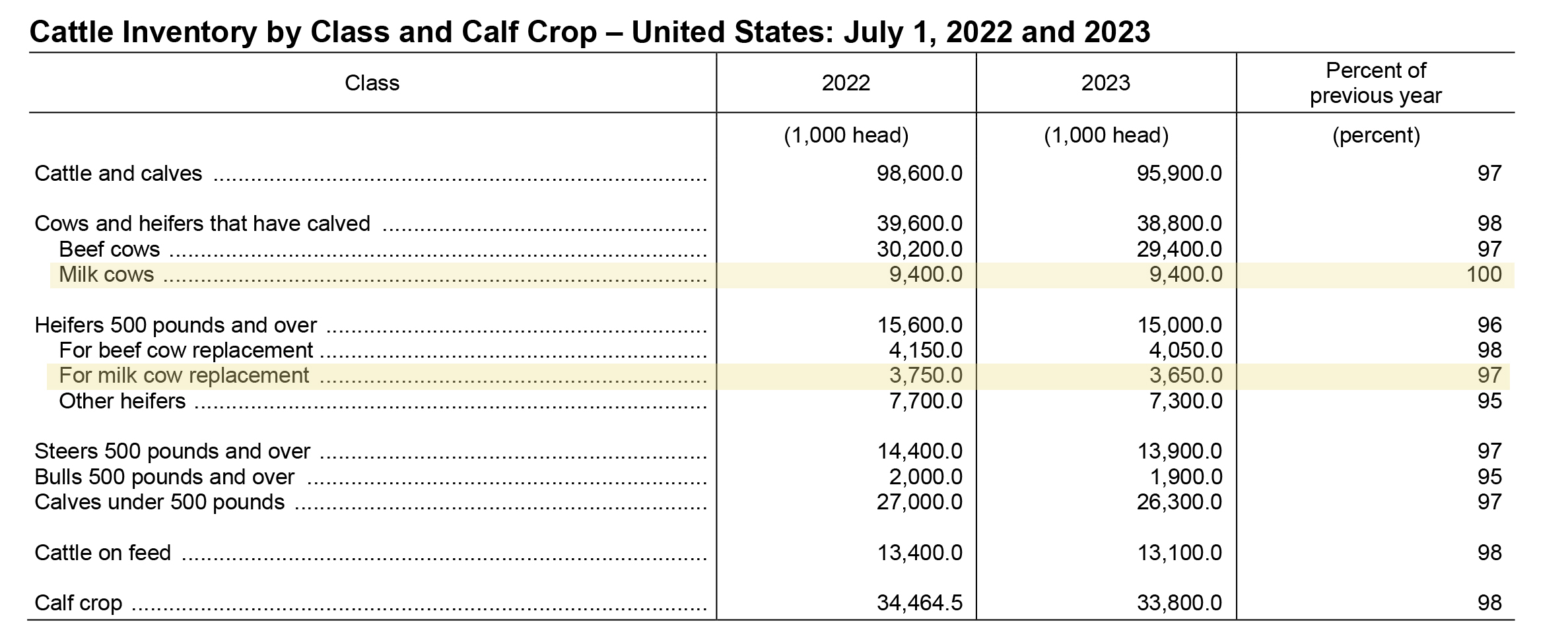
We asked: Where are all these cattle coming from?

The June and July two-part series also indicated the 51% increase in the volume of Whole Milk Powder (WMP) imports coming into the U.S. compared with a year earlier in the January through May period — the highest volume for that 5-month period since 2016. (WMP is basically dehydrated milk for use in making any product or reconstitution.)

We also consulted Calvin Covington for his read of the situation. He reported to us that his calculations showed a 15% cumulative increase in total milk solids imported January through April, and that this extra volume was equal to 63% of the year over year increase in ending stocks on a total solids basis.

Well, what do you know! On Thursday, October 19, USDA issued its monthly milk production report for September. The report also went back and revised downward the previously reported totals for milk production and cow numbers for April through August.

Lo, and behold, in June and July while markets crashed, U.S. farms milked 13,000 and 34,000, respectively, fewer cows than a year ago. The September Milk Production report has now gone back to shave around 0.1% off of several months of previously reported milk production, and it has revised milk cow numbers lower than previously reported as follows: The May revision added 1000 head vs. prior report, the June revision shaved 4000 head off the prior report, July’s revision shaved 11,000 head, and August 14,000 head.

How convenient that while the Milwaukee Sentinel and area news stations were reporting five weeks of milk dumping in the sewers during June and July, and USDA Dairy Market News was reporting six to eight weeks of spot milk loads selling at $10 to $11 under the abysmal Class III price as it hit multi-year lows, the USDA reports had been telling us we were milking more cows than a year earlier, and those cows were making more milk.

Prices had plunged by more than 37%, and no one was talking about the scale-back of mozzarella cheese production and the ramp up of whole milk powder imports.

Sure, they were talking about the softening of dairy exports, and maybe that’s the point. The industry had to get the U.S. price levels below global levels in a hurry to honor the global goals set by the national dairy checkoff under previous USDEC president Tom Vilsack to keep growing exports on a Net-Zero pathway to get to 20% of milk production on a solids basis.

We wrote with concern in June and July about how even those prior numbers did not make sense at those previously incorrect levels, how a tiny change such as milking 7000 more cows in May vs. year ago and a little more milk per cow through the period could result in prices falling this hard in June and July. We have even more questions as even those small supply-margin factors have now been edited by USDA to be lower than previously reported for the April through August period.

Cow numbers have always been a driver for milk prices. Now we know there was an average of 21,000 fewer cows milked in the June-July period. And, by July, there were actually 34,000 fewer cows on U.S. farms vs. year ago.

For the Q-3 July through September period, the revisions show an average of 33,000 fewer cows nationwide compared with the third-quarter of 2022. Maybe this will also be revised lower in the future — as it includes the number of milk cows on U.S. farms in September that is now said to be 9.37 million as a preliminary figure.

In the space of six months, U.S. total milk production has gone from running 1% above year ago in Q-1 to nearly 1% (0.7%) below year ago in Q-3. But within that difference lies a revision that begs big questions about what was really going on while prices were plunging.

According to the tables in the September milk production report, the reality of the situation in June and July — while milk prices hit rock bottom and milk was being dumped and sold for $10 to $11 under class — we were already milking 13,000 fewer cows in June compared with a year ago and a whopping 34,000 fewer cows in July vs. year ago, according to these revised numbers. Now, in September, we’re milking 36,000 fewer cows in the U.S. vs. year ago.

In fact, these revised reports show that milk cow numbers have fallen by 74,000 head from the March 2023 high-tide – an unrevised and supposed 9.444 million head — to the August revised number of 9.376 million head and the September preliminary 9.37 million.

Think about this for a moment. We had unprecedented sets of proposals for milk pricing formula changes flowing into USDA in April and May with USDA announcing in June that a hearing of 21 proposals in five categories of formula changes would begin August 23rd.

While this was staging, we saw milk pricing drama unfold.

How useful this drama was for processors during the first eight weeks of the USDA Federal Milk Marketing Order hearing that has now been postponed due to “scheduling conflicts” to pick up where it left off on Nov. 27. 

How convenient it was for processor representatives to be able to point to dumped milk, below-class spot milk prices and negative premiums as justification for their proposals to increase make allowances while attempting to block farm-friendly formula changes — all in the name of investments needed in capacity to handle “so much more milk!”

(A year earlier, Leprino CEO Mike Durkin warned Congress in a June 2022 Farm Bill hearing that, “The costs in the formula dramatically understate today’s cost of manufacturing and have resulted in distortions to the dairy manufacturing sector, which have constrained capacity to process producer milk,” he said, calling the situation “extremely urgent” and warning that immediate steps needed to be taken to “ensure adequate processing capacity remains.”)

Fast forward to the first eight weeks of the USDA FMMO hearing in Carmel, Indiana in August, September and October. We listened as large global processing representatives (especially Leprino) pontificated about how the make allowances are set too low, saying USDA is setting the milk prices too high. They pointed to all of the drama this summer as proof that farmers are suffering because processors can’t afford to invest or retain capacity to handle “all this extra milk.”

Now here we are, September milk production nationwide is down 0.2% from a year ago, product inventories are tight to adequate, prices have improved… but along the way the industry managed to shake out hundreds of dairy farms — large and small — that have liquidated during the steep downhill slide this summer that so few were prepared for, as no one had a clue it would be this bad given the tight number of milk cows and replacements steadily reported in inventory.

What was really behind the dairy cliff we just experienced, where even USDA Dairy Market News recently reported a significant number of herds milking 200 cows or less have recently liquidated in the Upper Midwest?

With record WMP imports, a pull-back in fresh Italian cheese production, and other elements behind the scenes… was the fall-out of a so-called milk surplus manufactured to prove a point? (Remember, Leprino’s Durkin warned that if make allowances aren’t raised, sufficient processing capacity may not remain. And take note that other Leprino representatives warned during the USDA FMMO hearing last month that they may not invest in U.S. processing capacity in the future, if make allowances are not raised and FMMO minimum prices lowered.)

Or was the fall-out this summer manufactured to fulfill the dairy checkoff’s goals for exports? You see, we are told there was excess product in Europe and New Zealand, and our overseas sales were softening, but still well above 2020 and about even with 2021. The industry is driven to get the deals to secure more global market each and every year, even if the means to those ends are detrimental to how we serve our domestic market in the future.

Given the pullback in mozzarella production during this “rockier road for milk prices”, we have to wonder about the testimony of Leprino representatives in the FMMO hearings. They have been doing the loudest complaining.

Leprino is also a major strategic partner with DMI and the organizations under that umbrella: USDEC, Innovation Center for U.S. Dairy, Net Zero Initiative, and on and on.

They want FMMO milk prices lowered, they said, so they can pay premiums again (?), and they believe you, the farmers, should help pay for their sustainability pledges within the make allowance formulas as a cost of doing business.

They likely want to free up capital out of the FMMO pricing levels to pay for Scope 3 emissions insets from RNG-project dairies to compete with other industries that can buy those renewable clean fuel credits as offsets.

They likely want to use your milk money to pay for concentrated manure-driven expansion in the Net Zero wheel-of-fortune pathway that has been constructed with your checkoff money.

They want FMMO make allowances high enough to cash flow plant capacity investments based on byproduct whey, while they make mozzarella cheese that is not surveyed, is not price-reported, and is not included in the end product pricing formulas for dairy farm milk checks.

-30-
Part Two: What drove rockier road for 2023 milk prices? Manure. Imports. Concentration.

— Along with more imports and shifts in cheese production, major manure-driven expansion in cheese-heavy Central U.S. put pressure on region’s ‘disrupted’ processing capacity

By Sherry Bunting, Farmshine, Updated in reflection from original publication in July 7, 2023 Farmshine

EAST EARL, Pa. — What has driven the rockier road for 2023 milk prices? Many things, and manure may be top on the list.

In fact, we’ll cover the ‘manure effect’ in a future article. But are we beginning to see the methane wheel-of-fortune behave with the ‘cobra effect’? (The British government, concerned about the number of venomous cobras in Delhi, offered a bounty for every dead cobra. Eventually, however, enterprising locals bred cobras for the income.)

This happened with greenhouse gases in the past. It happened with a byproduct gas of making refrigeration coolant. In 2005, when the UN Intergovernmental Panel on Climate Change began an incentive scheme. Companies disposing of gases were rewarded with carbon credits, which could eventually get converted into cash. The program set prices according to how serious the environmental damage was of the pollutant. (Like making cow methane seem like new methane when it’s not). As a result, companies began to produce more of the coolant in order to destroy more of the byproduct gas, and collect millions of dollars in credits. This increased production also caused the price of the refrigerant to decrease significantly.

With this prelude, let’s look back in retrospect on what I reported in the July 7, 2023 Farmshine when milk markets were in a tailspin hitting their low for the year — just 10 days before the gradual turnaround began.

As losses in the CME spot cheese markets and Class III milk futures markets continued through July 6, the Federal Order benchmark Class III price for June was pushed down to $14.91 per cwt. and protein down to $1.51/lb, July and August futures went well below the $15 mark, with Class III below $14.

Let’s look at the supply side of the January through June 2023 supply and demand equation.

Looking at the May Milk Production Report that was released in June, it’s hard to believe the bearish response we saw in milk futures and spot cheese markets that occurred based on a mere 13,000 more cows nationwide that month. It was a paltry 0.1% increase over a flat 2022, along with 11 more pounds of milk output per cow for the month (up 0.5% over flat 2022).

This flipped the switch from a gradually lower-than-2022 market to one that plunged sharply and suddently into the dumps – and all the analysts said: ‘We’ve got too much milk for demand.’ (In fact, two months later, processors are pointing to June and July milk dumping and $10 under class spot milk price as proof that USDA is setting Federal Milk Marketing Order minimum prices too high! — I digress).

As noted in Part One of this series that was published in the june 30 edition of Farmshine, other converging supply-and-demand factors plagued cheese markets that month until July 17 — despite basic fundamentals of these milk production reports not being all that bad. 

USDA Dairy Market News said spot loads of milk were being discounted in June by as much as $11 below the already abysmal FMMO Class III price in the Midwest. The milk dumping that reportedly began in May in Minnesota moved into Wisconsin through June and into July. The July 5th Milwaukee Journal Sentinel reported “Truckloads of fresh farm milk have been flushed down the drain into Milwaukee’s sewer system recently as dairy plants, filled to the brim, couldn’t accept more.” The story notes this had gone on for weeks, and the amount has declined to 5 trailer loads per week by the time The Milwaukee Journal Sentinel published its report.

For the price and milk dumping fallout, economists and analysts blamed the higher milk production (though it was modest on a national basis but huge in the Central U.S.). They blamed the higher cheddar cheese production (not accompanied by higher inventory), and they blamed the lower volume of exports (modestly below year ago on a year-to-date solids basis). 

Globally, milk production was up (it is declining this fall), they said, suggesting U.S. prices needed to get below the falling global prices in order to recover more export volume (instead of dumping in the sewer). Well, they got what they wanted as the U.S. prices dropped like a rock through June until the turnaround on July 17.

Of course, no one (but Farmshine) mentioned the rising imports that were reported in Part One of this series.

Looking for context on the imports, we reached out to retired cooperative executive Calvin Covington, who follows these things on a total solids basis and has been watching the whey market as a leading milk market indicator. We learned that his calculations on a total solids basis, pegged January through April 2023 imports of dairy products into the U.S. at levels 15% higher than a year ago!

“The 15% equals 39.3 million lbs. more solids,” Covington wrote in an email response to a Farmshine question. “Most of the imports are coming from Europe. Dairy demand is very weak in Europe, consumers have less money to spend. Those milk solids are moving out of Europe.”

Noted Covington in June: “On a total solids basis, ending dairy stocks as of April 30th are 3% higher than last April. The 3% equals 61.5 million lbs. more solids.”

This means the 15% increase in January through April dairy product imports — on a total solids basis — were equal to more than half (63%) of the 3% increase that was reported in April domestic ending stocks of all dairy product inventories on a total solids basis.

Think about that for a minute. Product came in and was inventoried while domestic milk was dumped, and producer prices were crushed so that the domestic price could fall below the global price so then the U.S. dairy exports could increase? It makes the head spin.

Class I sales were down during this time, especially in the Midwest where some fluid plants have closed. Fresh Italian cheese production was down, and that’s a big one for Wisconsin. Together these factors pushed more milk to make more American cheese at that time, some of it delivered to consumers in smaller packages (rationing). 

A wrinkle in the market-fabric comes from the dairy foods complex importing higher volumes, and there are the fake bioengineered microorganisms from which excrement is harvested and described as ‘dairy casein or whey protein without the cow.’ These analogs are being heavily marketed to large food manufacturers making dairy and bakery products as carbon-footprint-lowering dairy protein ‘extenders.’

So much so, that National Milk Producers Federation recently sent a letter to FDA asking the agency not to make the same mistake with these fake products as has been made with plant-based frauds.

However, as we look at the modest milk production increase for the first half of 2023, overall, and compare it to 2022, the total comparison was flattish then and it is declining now as we move toward Q3.

But there’s another major twist to this supply-demand equation:

The location and purpose of dairy expansion is undergoing accelerated transformation on a geographic and structural basis. This transformation is part of the “U.S. Dairy transformation” that the national dairy checkoff has promoted in its Pathways to Net Zero Initiative… and it is affecting the milk pricing for all U.S. dairy farmers, everywhere.

Here’s the problem: Milk production in the Central U.S. has expanded by much more than the national average. 

Even University of Wisconsin economics professor emeritus Bob Cropp noted in his writing after the May report that growth in the Midwest — where cheese rules the milk check — was outpacing processing capacity, and the existing capacity to process all this milk was being reduced by labor and transportation challenges.

The concentrated expansion of milk production in the Central U.S. has been accelerating since 2018, but a new paradigm is now in effect: New concrete is being poured in the targeted growth areas driven more by manure, than by milk, and new dairy processing plant construction that is completed and in the works is targeting the same areas.

This is creating a production bubble that is a flood within calmer seas.

Some are calling it the California RNG gold-rush as developers construct Renewable Natural Gas (RNG) projects — especially on new large dairies — for the California RNG market and to collect the low-carbon-fuel credits for the California exchange and other exchanges that are and will be emerging, thanks to the USDA Climate Smart wheel-of-fortune.

We’ve heard the national dairy checkoff managers from DMI talk about profitable sustainability, markets for manure, promotion of other revenue streams for dairy farms as part of the mantra the checkoff has assumed for itself as speaker for all-things-dairy for all-dairy-farmers on what is “sustainable” for the industry.

When the Net-Zero Initiative was launched — along with DMI’s industry transformation plan — it was something that had been in the works since 2008 and emerged more prominently in the 2017-21 period when the former and current U.S. Ag Secretary Tom Vilsack did his stint as top-paid DMI executive, presiding over the U.S. Dairy Export Center (USDEC) under DMI’s umbrella and as a top-talker on the Innovation Center for U.S. Dairy, also under DMI’s umbrella. 

All three: DMI, USDEC, and Innovation Center for U.S. Dairy are 501c6 non-profit organizations contracted to spend checkoff dollars. A 501c6 is essentially a non-profit that can lobby policymakers, whereas the 501c3 National Dairy Board cannot.

In 2020 and 2021, the Innovation Center — filing tax returns under the name Dairy Center for Strategic Innovation and Collaboration Inc. — doubled its revenue from around $100 to $150 million annually to $300 to $350 million.

We all heard it, read it, thought about it – maybe – that the checkoff was morphing into a facilitator for the transformation of the dairy industry led by manure-promotion, not necessarily milk promotion, with the mantra of feeding the world, being top-dog internationally, and meeting international climate targets with a Net Zero greenhouse gas pledge. (That pledge and the methane calculation are another story Farmshine readers are aware of, but we’ll leave that big driver off the table for this discussion.)

Here we are, now seeing an industry being created from within the broader dairy industry with new production driven by manure, in regions where new or expanding cheese, whey and ingredient plants are being located and potentially displacing production from plants and farms elsewhere that are not tied-into this manure-to-methane wheel-of-fortune using dubious science and math to overpeg a cow’s global warming impact.

While that production bubble is building in targeted growth regions with cheese-heavy milk checks, driven in part by manure-focused expansion, it bursted at the seams this summer due to a processing capacity bottleneck, compounded by supply chain disruptions and a sudden decrease in the production of fresh cheese at other plants and a sudden 18% decline in the amount of milk processed for Class I fluid use in the Upper Midwest.

Here’s the sticky wicket. A review of the 2022 end-of-year milk production report along with reports issued in the first half of 2023, revealed that, indeed, the Central U.S. was “awash in milk.” 

Zooming in on the milk production reports, we see South Dakota continuing its fast and uninterrupted growth — up 15.5% for 2022 vs. 2021, and up 7.4% Jan-May 2023 vs. 2022 — having leapfrogged Vermont, Oregon and Kansas and closing in on Indiana in the state rankings. 

Neighboring Iowa leapfrogged Ohio in 2022 with a 4.7% gain in milk production Jan-May 2023 vs. 2022. Number 7 Minnesota grew again after taking a breather with a 0.6% decline in 2022, then increasing 2% in production Jan-May 2023. 

The tristate I-29 corridor, where cheese processing capacity has been expanding, was up 3.3% in milk production collectively with 19,000 more cows Jan-May 2023. Add to this the 1.3% increase in number 2 Wisconsin’s May milk production, and we saw the quad-state’s collective increase was 203 million pounds of additional milk in the region vs. year ago in May, although Wisconsin’s contribution came from 3000 fewer cows, according to USDA.

Just west in number 3 Idaho, production jumped 3.1% with 7,000 more cows Jan-May 2023.

To the east in the Michigan-Indiana-Ohio tri-state region — where the large new cheese plant in St. John’s, Michigan is fully operational — collective milk output was up 2% over year ago with 11,000 more cows. In 2022, this tri-state region was down 2 to 3% for the year compared with 2021.

Number 5 New York made 2.1% more milk with 7,000 more cows in May vs. year ago, with most of this expansion in the western lake region. 

Number 1 California shrank milk production by 0.7% in May with 2000 fewer cows, and number 4 Texas flattened out its multi-year accelerated growth curve to make just 0.8% more milk in May than a year ago with just 1000 more cows, largely affected by the devastating Texas barn April fire resulting in the loss of around 20,000 cows. 

Neighboring New Mexico continued its multi-year downward slide, ranked number 9 behind a flat-to-slightly-lower milk output in number 8, Pennsylvania. 

Milk production in New Mexico fell 3.8% in May vs. year ago with 10,000 fewer cows. This followed an 8.4% decline in milk production and a 30,000-head cut in cow numbers for the year in 2022. Producers there cite well-access limitations, severe drought, high feed costs with reduced feed availability, as well as receiving the rock-bottom milk price as the reasons dairies in New Mexico are closing or relocating. 

With all of these factors in play, the production reports show a clear paradigm shift in how the dairy industry expands via transformation. It is being driven to where feed is available and milk output per cow is higher, and it’s now being driven by a non-milk-related factor: MANURE for the RNG ‘goldrush’

A saving grace is cattle are in short supply, with replacements bringing high prices. This fact is slowing the bubble, production is declining now, and prices are recovering from those unanticipated lows.

-30-

Part One: What’s driving rocky road for milk prices?

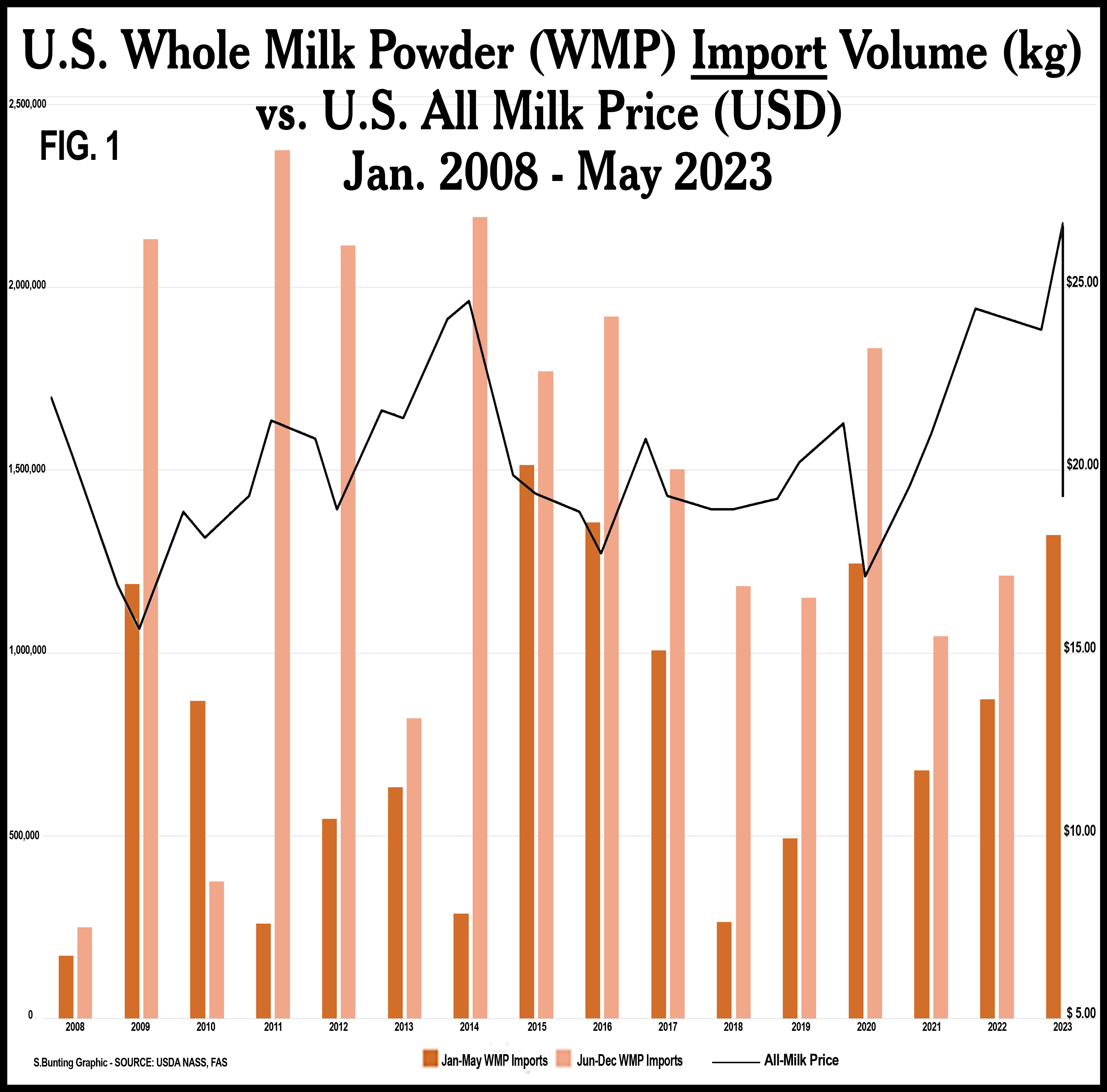
The stunner in the USDA FAS data is the U.S. imported 51% more Whole Milk Powder (WMP) in the January through May 2023 period vs. year ago. Looking at import volumes vs. All Milk prices, Fig. 1 shows the pattern: From 2008 to today, whenever there is a period of high farm milk prices, WMP imports increase, and farm milk prices fall. While cheese imports are down 3% YTD, non-cheese dairy exports are up 80% for a 9.2% total increase based on straight volume. Retired co-op executive Calvin Covington recently figured the January through April imports up 15% on a total solids basis. Graphic by Sherry Bunting compiled from USDA FAS and NASS data

— WMP and other imports accelerate, cow-less lab-protein analogs become ‘extenders,’

— Class I sales keep declining, fresh Italian cheese production down, inflation drives CPGs to reduce unit-sizes,

— RNG-driven dairy construction accelerates concentrated growth in cheese-heavy Central U.S.

By Sherry Bunting, Farmshine June 30, 2023

EAST EARL, Pa. — Current milk futures and dairy commodity markets have turned sharply lower and signal a rocky road ahead for farm level milk prices. Because of the lag times built into federal milk pricing, the most recent steep losses in spot cheese markets will hit the Class III price and create more Class I mover losses via the ‘average of’ method to hit milk checks in July, August and September. 

Factors driving this include: declining Class I sales and fresh Italian cheese production, inflation-driven unit-size shrinkage, two months of reduced dairy exports and five months of increased dairy imports, and the advertising of cow-less lab-protein analogs as ‘extenders’ for food processing.

The May Milk Production Report confirmed that the Central U.S. is, indeed, “awash in milk.” Part two of this series will zoom into the geographic shifts in the concentration of milk growth, driven largely by Renewable Natural Gas digester projects for the California RNG gold rush. Much of the new dairy construction in the cheese-heavy Central U.S. is focused on manure to energy, not necessarily on milk and cheese to consumers.

The Production Report was released after the futures closed on June 21. In the next four trading sessions from June 22 through 27, Class III contracts for July through September lost $1.50 per cwt, on top of previous losses of more than $2. 

By June 28, the expiring June Class III milk futures contract was at $14.92, and at $14.91 in the June USDA announced.

The ‘market’ has simply ignored USDA’s May 30 announcement that the government will bring in a ‘game changer’ to purchase 47 million pounds of cheese for food banks and schools as block and barrel cheese plunged to $1.31 and $1.39 per pound, respectively, by Tues., June 27.

USDA confirmed last week that the first round of its bid solicitations for the first phase of the 47 million pound cheese purchase won’t open until October. Bids and deliveries will come in stages from fourth quarter 2023 through mid-2024. 

This means cheap milk will make cheap cheese, which could get even cheaper if inventories build in anticipation of selling that cheese at a tidy profit into the seasonal demand increases that begin in October, along with these announced government cheese purchases. (Who needs a make-allowance raise with this game in town?)

For the past several weeks, USDA Dairy Market News has been reporting spot loads of milk in the Central U.S. selling as much as $11 per cwt below the Class III price. DMN also reports milk from the Central U.S. growth region is moving farther to find a home. We are also hearing from readers about substantial milk being dumped in the Midwest, while a few independent dairies in Minnesota, one milking over 1000 cows, have been told by their creamery that their milk is not needed after schools close.

May milk production, nationwide, was up only 0.6% from a year ago. The 24 major monthly states were up by 0.8%. Milk cow numbers did not grow from April to May and are running just 13,000 head above year ago. This modest increase comes on the heels of no net gain in milk production for 2022.

All year, the monthly USDA World Ag Supply and Demand Estimates (WASDE) kept increasing the 2023 U.S. milk production forecasts, based on what it said are ‘more milk cows and less output per cow.’ The most recent WASDE walked that production forecast back a bit, but still expects U.S. dairies will milk an average of 9.415 million cows in 2023. 

Then, somehow, the May Production Report pegged the number of milk cows on farms at 9.424 million head, even after the loss of 18,000 milk cows in a fire in west Texas in April. This is how tight the figuring has become on what we are told today is a surplus of milk and a lackluster demand.

The idea of a milk surplus that is big enough to drive these current price losses does not line up with USDA’s Jan. 1 cattle inventory report. So, in May, the WASDE began to walk it back, noting higher feed costs, reduced milk margins and higher beef cattle prices will slow the flow of milk.

Where are the cattle coming from? The Jan. 2023 inventory showed milk cow numbers were virtually unchanged from Jan. 2022 at 9.4 million head. The number of dairy heifers over 500 pounds was down 2% at 4.337 million head — the lowest number since 2006. Within that heifer number, expected calvings from Jan. 1, 2023 to Jan. 1, 2024 were also 2% lower than for Jan. 2022 to Jan. 2023. The next semi-annual cattle inventory report will be released in three weeks on July 21.

The Report’s smaller dairy replacement inventory is believable given the fact that offerings have been selling $300 to $500 per head above year ago levels, and the few weekly dairy cattle auctions throughout the U.S. have seen offerings down 30% below year ago… until June, when prices came under pressure on a suddenly increased offering at auctions over the past two weeks. 

Meanwhile, dairy cow slaughter rates are also increasing, according to USDA, especially in the Midwest and Southwest, up 31 and 47% above year ago, respectively.

While the WASDE has forecast per-cow output to fall by 55 pounds per cow per month in 2023, the May Production Report pegged an 11-pound per-cow per month increase.

This means, it took just 13,000 more cows nationwide, and just 11 more pounds of milk output per cow per month to flip the switch to sharply lower milk prices based on – suddenly — too much milk? (Geographic concentration of milk growth plays into this equation, and we’ll discuss that in Part Two.)

In Part One, we look at the other supply and demand factors that are having a direct impact on where farm level milk prices are headed. These factors fill in the gaps left by the perplexing and contradictory sets of USDA dairy data.

I.               Fresh fluid milk sales and fresh Italian cheese production both declined, pushing more available spring-flush milk into storable products.

Fluid milk sales January through April were down 2.8% from a year ago, and as bottlers slowed school packaging ahead of summer recess, the June 5th Dairy Products Report showed April production of fresh (made to order) Italian cheeses also declined 2.6% vs. year ago.

Meanwhile, butter production was down 4.9% while nonfat dry milk production increased just 1.9%, and skim milk powder production was down 22.4%. This put more of the available ‘spring flush’ milk into production of American cheese, up 2.3% vs. year ago in April, and the accompanying dry whey and whey protein concentrate production up 1.7 and 7.2%, respectively. 

Record volumes of dry whey and cheese have been coming to the daily CME spot auction, driving down the spot prices that drive the National Dairy Product Sales Report prices that are then used in federal class and component pricing formulas.

II.            Inflation pressures consumer demand, but inventories are not burdensome.

The May Cold Storage Report released on June 23 was a head-scratcher. Despite the ramped up American cheese production in the Dairy Products Report, the Cold Storage Report showed both the total amount of cheese in inventory, and the amount of American cheese in inventory, are both actually down 1% from a year ago at the end of May, while butter inventory was up 14% against last year’s higher-price-driving short supply.

Meanwhile, producers in the Midwest are being told that milk co-ops and buyers are facing cheese sales declines and that there’s not enough capacity to process all the milk now being produced in the region, with the existing capacity also experiencing labor and transport disruptions.

Dairy demand has stagnated, the analysts say, after months of high inflation. The May dairy consumer price index (CPI) was more bearish than the overall CPI. Dairy CPI was up 4.6%, with cheese up 3.6%, ice cream up 8% and other dairy products up 9.3% while whole milk decreased 3.4% and other non-whole milk increased 0.6%.

Inflationary pressure is driving some consumer packaged goods companies (CPGs) to trim unit-sizes for an appearance of stable consumer pricing. For example, we see unit-size shrinkage in cheese packages and slices. Not all American cheese slices today are 8 ounces, some are 6. Such moves effectively ration demand. 

III.            The stunner is dairy imports, up 9.2% with Whole Milk Powder imports up 51% year-to-date.

Looking at import volumes vs. All Milk prices, the pattern is clear (Fig.1). From 2008 to today, whenever there is a period of high farm milk prices, Whole Milk Powder (WMP) imports increase, and farm milk prices fall. 

WMP is basically farm milk from another country, in bulk dried form, not a specialized product. It can be used in processing virtually any dairy product, containing all of the milk components — both fat and skim solids.

From December 2022 through April 2023, the U.S. imported the highest percentage of dairy production equivalent since 2016. And there is more milk equivalent comparison today than in 2016. The National Milk Producers Federation’s monthly market report confirmed this. 

Then May imports worsened this trend. 

Digging into the June 12 USDA Foreign Ag Service (FAS) Import Circular, the U.S. imported 80% more non-cheese dairy products from January through May vs. year ago. At the same time, cheese imports were down 3.3%. Combined, the total cheese and non-cheese imports were up 9.2% vs. year ago.

But the stunner in the data is the U.S. imported 51% more WMP in the January through May 2023 period vs. year ago. 

It’s no wonder that the USDA Dairy Market News reported on June 15 that, “Dry whole milk processing (in the U.S.) is limited, despite hearty milk volumes.” 

The report went on to say that even as seasonal milk output recedes “market contacts suggest dry WMP market tones may remain steady (at the current lower price levels) due to lighter demand.”

Not surprising, given the U.S. imported more WMP in May (550,000 kg) than for any month since April of 2020. WMP was imported at a record-setting pace during the pandemic while milk was being dumped in the U.S. and production-base-programs were tightened on U.S. dairy farms by milk cooperatives and buyers. 

As the cumulative 2023 WMP imports accelerated in May, milk prices are set to take the sharp turn lower.

The year-to-date imports of butter, butterfat and butter oil are also well above year ago as part of that 80% increase in non-cheese imports January through May 2023 vs. year ago.

The June WASDE raised dairy import forecasts, yet again, especially on a fat basis, and it again lowered dairy export forecasts. The Report sees butter and nonfat dry milk (Class IV) continuing to sell stronger on better demand, while demand and prices for cheese and whey (Class III) are further reduced. 

This combination reduced the WASDE forecast for the 2023 All Milk price to $19.95, down 55 cents from the May forecast. Part of this is the Class IV over III divergence that is substantially lowering the Class I fluid milk price under the ‘average of’ method, which took more than $1.00 off the advance Class I price mover for July, announced last week at $17.32. It would have been $18.34 using the previous ‘higher of’ method.

IV.          Lab-created dairy protein analogs are advertised to processors as ‘extenders.’

Another emerging factor is the lab-created dairy protein analogs, which are the excrement of microorganisms that have been bioengineered with bovine DNA. These proteins are advertised in dairy food and manufacturing magazines as carbon-footprint-lowering, interchangeable ‘extenders’ for production of cheese, ice cream and other dairy foods.

The companies that are ramping up this fermentation-vat-lab-protein are doing limited consumer marketing. Mainly, they pursue a B2B model (business to business, not business to consumer) and try to capitalize on ESG scoring benefits based on who-knows-what-calculations that large processors are seeking as they navigate the investment, credit, and retail shelf-space ESG decisions up and down the supply chain.

No one knows how much lab-dairy-protein is being used at this time — or in what brands of dairy products — because these proteins do not have to be labeled, and they are not part of any dairy market or production report.

The Bioengineered Food Disclosure Law was passed by Congress in July 2016, and USDA established the national mandatory standard for disclosing foods that are, or may be, bioengineered in December of 2018. This Standard was implemented on Jan. 1, 2020 with mandatory compliance for all food manufacturers by Jan. 1, 2022.

According to USDA, the Standard defines bioengineered foods as “those that contain detectable genetic material that has been modified through certain lab techniques and cannot be created through conventional breeding or found in nature.”

The lab-dairy-protein-analogs are the harvested excrement of fermentation-vat-grown bioengineered yeast, fungi and bacteria, so BE labeling is not required due to the ‘detectable genetic material’ loophole. The modified genetic material is in the microorganisms, not their excrement.

-30-

Deep discounts on All-Milk prices bring new risk management challenges

NOTE: In the first part of this three-part series, we’ll look at some of the factors contributing to the huge divergence between Class III and IV at the root of current losses in milk income, especially for risk-managers who were caught off guard with no good tools to manage the misalignment and especially the de-pooling. In the next two parts, we’ll look at some of the advice for managing basis risk in CME-based tools and revenue insurance.

IMG-9043

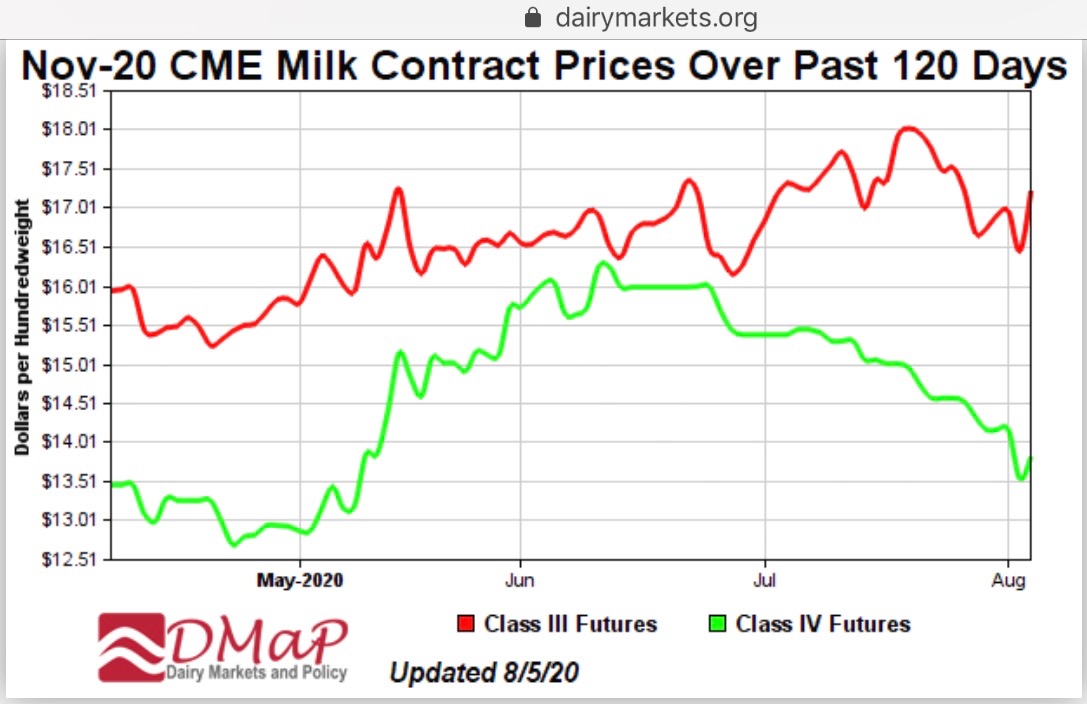
This graph at dairymarkets.org shows the divergence between Class III and IV milk futures at the root of deep discounts in All-Milk prices as compared with Class III.

By Sherry Bunting, Farmshine, Friday, August 7, 2020

BROWNSTOWN, Pa. — Dairy producers find themselves in uncharted territory, where a mixed bag of market factors, pricing structures, class price misalignments, Federal Milk Marketing Order (FMMO) provisions, product-in / product-out flows via imports and exports vs. inventory, as well as the government’s thumbprint on the scales in a pandemic shutdown of the economy and the dairy product purchases that followed. All have affected Class III and Class IV milk prices quite differently, creating deep discounts in blended farm milk prices vs. Class III.

“We’re seeing milk class wars,” said economist Dan Basse of AgResource Company, a domestic and international agricultural research firm located in Chicago, during a PDPW Dairy Signal webinar recently. Basse opined that the current four-class FMMO system is old and outdated with pitfalls creating new volatility issues for producers in the form of the $7 to $10 spread between Class III and Class IV in June / July.

He noted, as have others in the past, that a simpler pricing system with one manufacturing milk price and one fluid milk price is something that “dairy farmers could live within.”

Under the current four-class system, and the new way of calculating the Class I Mover via averaging, dairy farmers now find themselves “living on the edge, not knowing what the PPD (Producer Price Differential) will be,” said Basse.

“A $7.00 per hundredweight discount is a lot of capital, a lot of income and a lot of margin to lose with no way to hedge for it, no way to protect it, when the losses are not being made up at home (as reflected in) the PPD,” Basse related.

Previous Farmshine articles over the past few weeks have explained some of the FMMO factors reflected in the negative PPDs everyone is focused on because they are so large. While June’s PPD was primarily affected by lag-time, the next several months of negative PPDs are likely to occur based on the legislated change to the Class I Mover calculation in the last Farm Bill.

The significance of the PPD is that it indicates to the producer the value of the milk in FMMO-available pool dollars as compared to the announced Class III price. The PPD is how the FMMO pool revenue is balanced.

Normally, component values are paid by class, and the extra is divided by hundredweights in the pool to calculate a PPD reflected as the difference (usually positive) between the FMMO uniform price and the Class III price, according to Dr. Mark Stephenson, University of Wisconsin dairy economist in a recent PDPW Dairy Signal.

When higher-value Class III milk is de-pooled in this scenario, the dollars don’t stretch, so the pool has to be balanced by dividing the loss (negative PPD). Even in the southern FMMOs based on fat/skim the same shortfall occurs and shows up as milk being worth less than Class III, instead of more.

The problem faced right now is the Class III price does not represent the broader industry, and there are no straightforward tools for managing this type of risk, especially when the higher-value Class III milk is de-pooled or replaced with a lower class.

“It’s a terrible situation on the hedging side, with three material sources of the problem,” notes Bill Curley of Blimling and Associates in a Farmshine interview this week.

While he describes ways to manage some of these sources in building a risk management price or margin, such as using a mix of Class III and IV and other strategies that reflect a producer’s milk market blend of classes, “there’s no hedge for de-pooling,” he relates.

In fact, Stephenson illustrates this for the Upper Midwest FMMO 30, showing a difference of $7 between the level of negative PPD for July without de-pooling and the level of negative PPD with de-pooling.

While July de-pooling figures won’t be known until mid-August, the June de-pooling in the Northeast wasn’t as bad as in California, as an example. In California, so much milk is already sold outside the pool, that it is easy to replace virtually all of the Class III milk with lower-value Class IV in this divergent classified price scenario.

In the Upper Midwest, only so much de-pooling can occur due to qualifying criteria, so utilization that may normally be 75% Class III, was 50% in June. They don’t have enough Class IV to simply replace Class III and stay qualified on the Order.

Curley and others explain that this situation could leave producers unprotected, especially since they can’t control any of the sources of misalignment between their All-Milk price and Class III. The only factor they can control is whether or not to drop the hedges, which then leaves them unprotected for market risk at a volatile time in the midst of a pandemic as virus rates are reportedly re-surging.

Meanwhile, this week began with risk working its way back into markets as three consecutive days of steep losses in CME cheese and butter prices pushed both Class III and IV milk futures lower, but still with a $4 to $7 gap between them in the next few months.

For its part in balancing broader industry demand, USDA announced a third round of food box purchases for September and October, which will again include cheese, but this time will include more from Class II (sour cream, yogurt, cream cheese) as well as some butter from Class IV. All told, the government will have spent about $1 billion in three phases of dairy purchases for the Farmers to Families Food Box program.

Stephenson reminds producers of the silver lining in this cloud.

“Remember what the pandemic economy looked like just a little over two months ago,” he said. “It was absolutely devastating. Cheese was at $1.00/lb, and milk dumping was unprecedented.

“Now, as we look at things, it’s going to be better than we expected then,” he said showing the All-Milk price for 2020 is now forecast to come in at just under $18 for the year, but that many farms will net $20 per hundredweight for the year via the combination of Dairy Margin Coverage (DMC) and Coronavirus Food Assistance Program (CFAP) payments.

He estimates 2020 DMC payments at the $9.50 coverage level should net 66 cents across annual production for the year while CFAP payments have produced, so far, an impact equal to $1.55 per hundredweight across annual production.

For many producers, however, it won’t feel like $20. It might not even feel like $18.

Agricultural Prices 07/31/2020

USDA NASS reported June All-Milk prices last Friday, July 31. The range from high to low is $8, nearly double the normal range. At $18.10, the U.S. average All-Milk price did push the Dairy Margin Coverage milk margin above the highest payout level at $9.99.

Take June milk checks for example. USDA announced Friday, July 31 that the June U.S. All-Milk price was $18.10. That’s almost $3 below the Class III price of $21.04 for June, something we just don’t see.

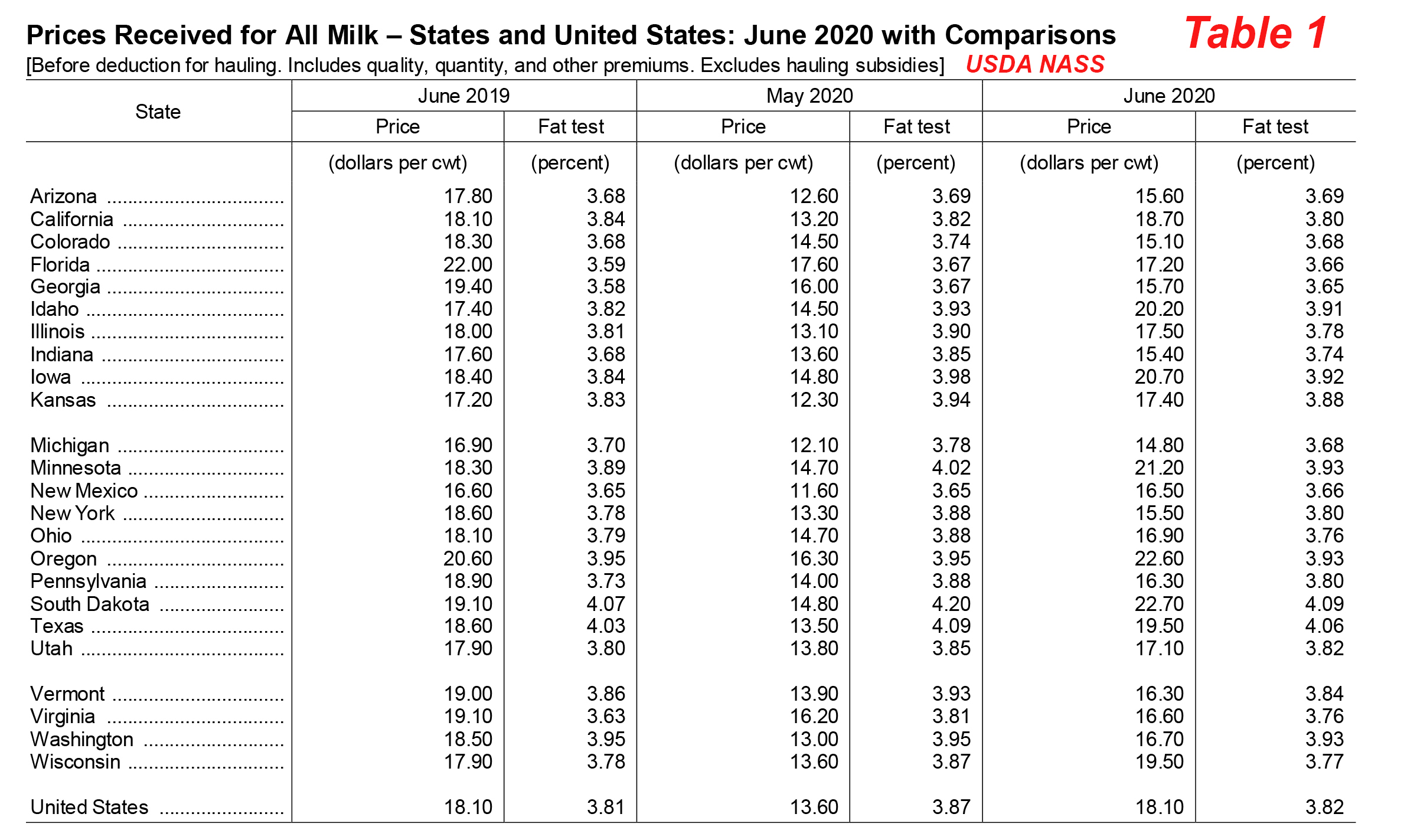
Worse, USDA’s own report showed an $8.00 per hundredweight spread between the lowest All-Milk price reported at $14.80 for Michigan and the highest reported at $22.70 for South Dakota. This unprecedented spread is almost double the normal range from top to bottom. (Table 1)

Also unprecedented is the Pennsylvania All-Milk price reported by USDA for June at $16.30. That’s a whopping $1.80 below the U.S. All-Milk price when normally the state’s All-Milk price is 30 to 60 cents above the U.S. average.

The same thing can be said for Southeast fluid markets and other regions where a mixed products, classes and de-pooling of higher-value milk left coffers lacking for producer payment in the pool, and results varied in how co-ops and handlers  compensated producers outside the pool.

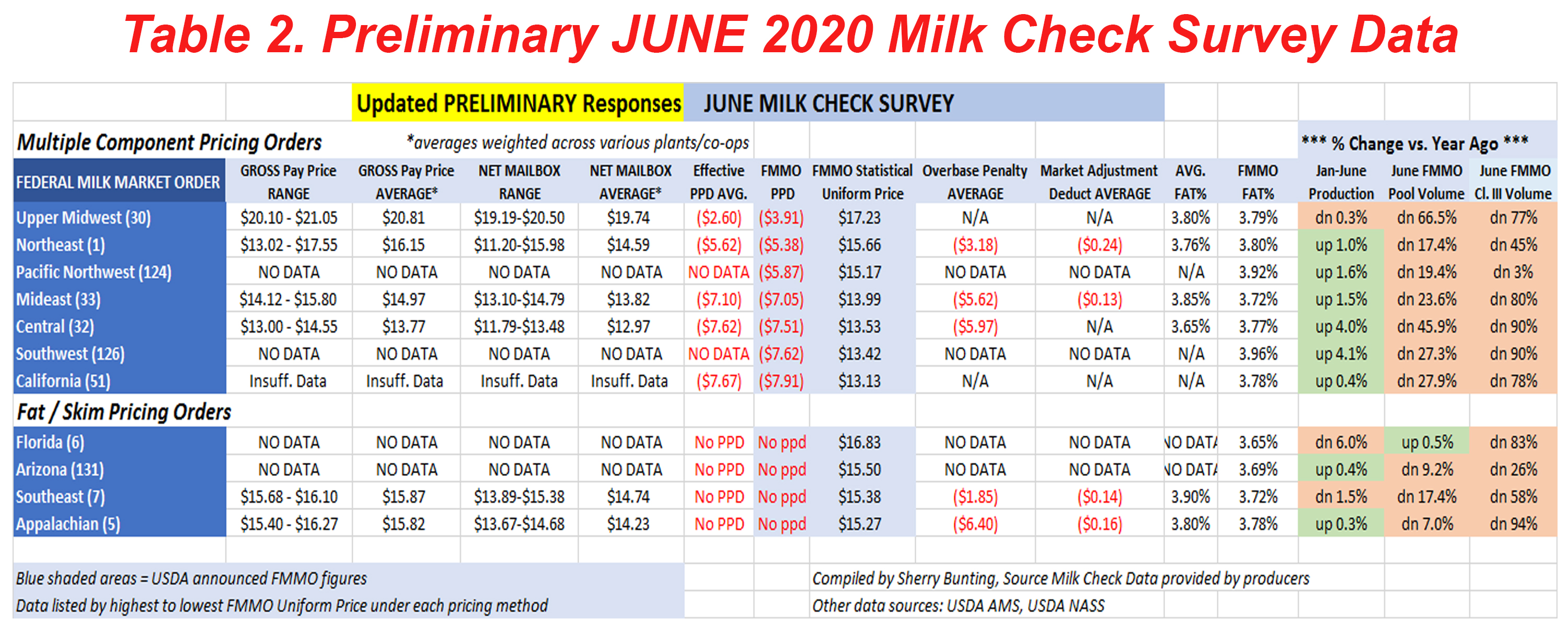
Dairy producers participating in the June milk check survey announced in Farmshine a few weeks ago, have reported gross pay prices that averaged fully $2 below the respective USDA All-Milk prices calculated for their state or region. Net prices, after deductions, averaged $4 below, and the same wide $8 spread from top to bottom averages was seen in this data from over 150 producers across six of the 11 Federal Orders. (Table 2)

This all creates an additional wrinkle in terms of the impact on the DMC margin, which was announced this week at $9.99 for June – 49 cents over the highest coverage level of $9.50 in the DMC program. This margin does not reflect anything close to reality on most farms in June and potentially July.

Large, unexpected and unprotected revenue gap

Normally the All Milk price is higher than Class III, and the cost of managing risk when the market moves higher is then covered by the performance of the cash price, or milk check, instead of the hedge, forward contract or revenue insurance. The inverse relationship in June and July between blend prices and Class III price, left a large, unexpected and unprotected revenue gap.

For its part, USDA AMS Dairy Programs defines the All Milk price in an email response recently as “a measurement of what plants paid the non-members and cooperatives for milk delivered to the plant before deduction for hauling, and this includes quality, quantity and other premiums and is at test. The NASS price should include the amount paid for the ‘not pooled milk.’”

USDA’s response to our query further confirmed that, “The Class III money still exists in the marketplace. It is just that manufacturing handlers are not required to share that money through the regulated pool.”

MilkCheckSurvey080320

By the looks of the milk check data from many areas (Table 2), most of this value was not shared back to producers, with a few notable exceptions. However, economists project the situation for July milk will be worse in this regard.

The factors depressing June and July FMMO uniform prices, USDA All-Milk prices and producer mailbox milk check prices are three-fold: the 6 to 8-week lag-time in advance-pricing of the Class I Mover, the new method of averaging to calculate the Class I Mover, and de-pooling of the higher-value Class III milk. All three factors are rooted in the $7 to $10 divergence between Class III and IV in June and July.

The part of the equation attributed to the new Class I Mover calculation is perhaps most discouraging because this is not money producers will eventually see. On the other hand, the lost value from the advance-pricing lag-time is eventually “caught up” in future milk checks. Most of the discount to come in July farm-level prices and negative PPDs in future months vs. Class III will be from the divergent factors that are not reconciled later.

Demand drivers differ for Class III vs. IV

Driving Class III $7 to $10 above Class IV was the abrupt turnaround in the cheese market, fed by strong retail demand, the resupply of foodservice channels, a significant May rebound in exports of cheese and whey, significant declines in cheese imports in the March through June period, and new government purchases of cheese for immediate distribution under CFAP.

On the flipside, Class IV value weakened at the same time as butter and powder did not have as many competing demand drivers. Additionally, butter stocks were overhanging the market, despite butter being the dairy product that saw the very highest increase in retail demand during the March through June Coronavirus shutdown period with retail butter sales up 46% over year ago.

Butter and powder production in the U.S. are mainly through co-op owned and managed facilities, while cheese production is a mix of co-op, private and mixed plant ownership.

When co-ops petitioned USDA for a temporary Class I floor hearing, most of the pushback came from the Midwest, and there were calls instead for government direct payments and cheese purchases for distribution to bring down what had been a growing cheese inventory. A stabilizer, or “snubber” on the Class I Mover calculation would have helped avoid much of this unrecouped discount on All-Milk price compared with Class III that affected most of the country.

While cheese moved to retail, foodservice, government purchases and export, butter was mainly relying on the surge in retail sales. Butter and milk powder were not draws in government CFAP purchases.

Overall, however, CFAP has not been the biggest driver in the cheese rally, according to Stephenson, although it added another demand driver to the Class III mix.

He notes that while the government CFAP purchases included a lot of cheese, those purchases accounted for 10% of the cheese price rally in June and July. The rest was fueled by retail demand staying strong and restaurants reopening and refilling supply chains, along with strong demand for other dairy products at retail, such as fluid milk. Producers were also pulling back to avoid overbase penalties. These factors combined to reduce cheese production in May and June, while demand drivers reduced inventory vs. demand.

Other dairy products also saw higher retail demand and were included to some degree in the USDA’s CFAP purchases, but without the same level of visible pull for the trade.

Import/export and inventory equation differs for Class III vs. IV

In taking a closer look at imports and exports relative to inventory to gauge differences between the product mix for Class III vs. Class IV, there are some key differences on both sides of that equation.

Exports of cheese in May were up 8%, and whey exports up 16% over year ago, according to U.S. Dairy Export Council.

Meanwhile butter and butterfat exports were down 7% in May, and down 21% below year ago year-to-date.

Powder exports did break records up 24% for May on skim milk powder. Whole milk powder exports were up 83% in May and 44% year-to-date.

On the import side of the equation, cheese imports were down 13% in the March through June period vs. year ago, according to USDA’s Dairy Import License Circular.

Non-cheese imports, on the other hand, were up 37% above year ago at the same time.

One factor hanging over Class IV markets is the butter inventory — up 11% over year ago — despite significant draw-down month-to-month and retail sales volume being almost 50% higher than a year ago throughout the Covid period.

While U.S. dairy imports are dwarfed in volume by U.S. exports, overall, it is notable that the 37% increase in non-cheese imports included 17% more butter and butter substitute imported compared with a year ago during the March through June period and up 28% year-to-date. Furthermore, whole milk powder imports were up by 25% in the March through June period.

Looking ahead

In a dairy market outlook recently, both Stephenson and professor emeritus Bob Cropp said these wide swings that are creating deep discounts are expected to begin moving toward more normal pricing relationships after August, with Class III and IV prices both forecast to be in the $16s by the end of the year, and in the $16s and $17s for 2021.

Already this week, CME cheese has slipped below the $2 mark, pushing August Class III futures under the $20 mark and September into the mid-to-high $16s. Spot butter tumbled to $1.50/lb, pushing Class IV futures down into the low $13s — keeping the divergence between Class III and IV in place.

Experts encourage producers to be thinking more holistically about the milk markets in planning risk management and not to look at Class III as the leading indicator of which direction the market will take.

This makes any discussion of “margin” based on a Class III milk price irrelevant to the reality under the present conditions. In short, risk management tools did what they were designed to do, but new challenges on the cash price, or milk check side, will change how producers implement and use these tools, or blends of tools, in the future.

“Class III might be a wonderful market for cheese, but it’s not reflecting the entire dairy industry. Risk managers are losing margin on contracts that were meant to protect them from market risk,” says Basse.

“We normally trade at an All-Milk premium to the CME Class III. Today, that has changed dramatically,” he adds. “We are at a significant discount to the CME. We just don’t see these discounts relative to the CME. It is unprecedented.”

-30-

Global dairy thoughts Part 5: First half 2018 butter, milk, cream imports climbed!

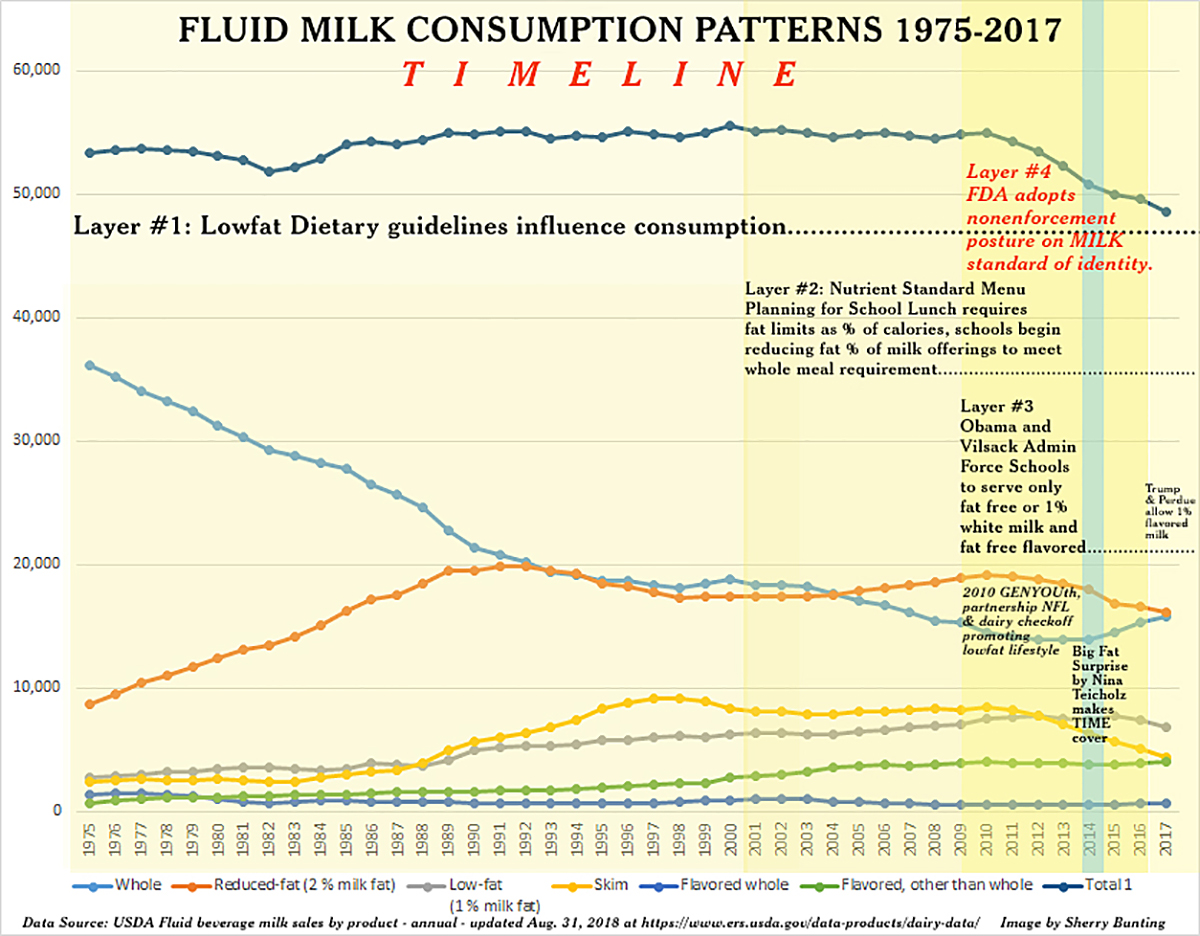
Timelines show how domestic dietary guidelines, Obama/Vilsack school milk rules and ramped up low-fat and fat-free dairy promotion through GENYOUth and FUTP60 all laid the groundwork for declining Class I fluid milk sales to pave the way for flat pricing and increased exports (now coincidentally under the industry leadership of former Sec Vilsack). Then consumers learned the truth and began coming back to whole milk and butter and full-fat cheeses even while the government turns a deaf ear in regards to the rules about feeding our schoolchildren. So what did U.S. companies and cooperatives do to keep that milk price flat enough for the export market this year? They imported more butter, milk and cream in first half 2018!

By Sherry Bunting, originally published in Farmshine, September 7, 2018

BROWNSTOWN, Pa. — Let’s take a look at the overall global dairy trade balance of the U.S.

In gross numbers, the balance is positive, showing the U.S. is winning new market share on the side of exports over imports. But this tells only part of the story, ignoring the potential milk market impacts of substantial increases in imports of milkfat at this critical time during the first six months of 2018.

In June 2018, Global Dairy Thoughts Part 3 and Part 4 covered some of the Federal Order pricing impacts of rapidly expanding exports alongside a diminishing Class I utilization. While per-capita milk consumption has steadily declined since 1980, the total packaged milk sales held their own due to population growth.

globalthoughtspartfive-chart1That is, until we hit 2009-10, when the third and fourth layers (see Chart 1 above) were added to the lowfat-push — that consequently pulled total fluid milk sales into the bucket at the same time that exports began their rapid ascent.
Expanding export utilization hits Class I utilization with a double-whammy: Smaller piece in a bigger pie, even if consumption losses are stabilized. We’ll revisit that in a future part of this series on dairy policy and logistics.

In looking at imports and doing trend comparisons for farm milk prices, fluid milk sales, total exports, total imports and the large increase so far this year in imports of butter and butteroil as well as steady increases in imports of milk and cream (condensed, non-condensed, liquid, powder, sweetened, unsweetened), there are some correlations. (Chart 2 below)

globalthoughtspartfive-chart-2

From 2005 forward, the national average all-milk price moved in patterns concave to the corresponding imports of butter/butteroil and milk/cream on the timeline. While the totals are not huge, we all know what “a little more” can mean on the supply side when it comes to milk prices.

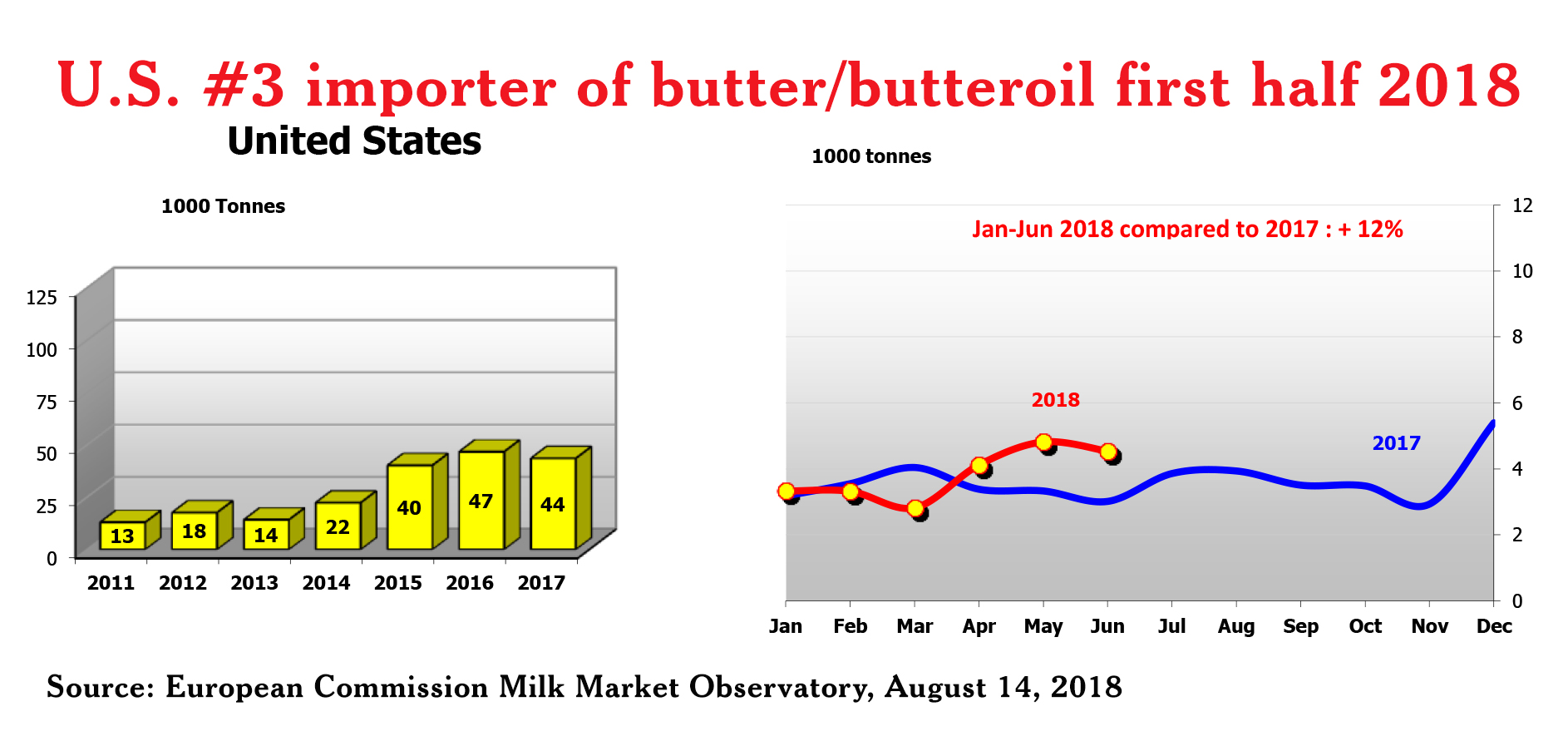
In the first-half of 2018, for example,  the U.S. imported 12% more butter and butteroil and 11% more condensed milk and cream, according to the European Commission’s Milk Market Observatory published August 14, 2018. (Charts 3 and 4 below)

globalthoughtspartfive-chart3

globalthoughtspartfive-chart4

While the U.S. Dairy Export Council (USDEC) reports that first half 2018 dairy exports of milk powders, cheese, butterfat, whey and lactose topped 1.14 mil. tons to set a new record-high – up 20% from year ago, some interesting things were also happening on the import side.

Even though the USDEC data dashboard continues to show total imports accounting for a flat line at 4% or less of the milk supply on a solids basis, while exports accounted for 16.8% in the first six months of 2018, there are some interesting aspects of the import picture related to ‘what’ and ‘when’.

According to the August 14 EC statistical report ranking top-10 importers and exporters of various dairy commodities, the U.S. ranked third in butter and butteroil imports, up 12% from year ago and not far behind China (1) and Russia (2) during the first half of 2018.

The U.S. also ranked fourth in imports of condensed milk and cream – up 11% compared with a year ago.

When butter substitutes, containing over 45% butterfat, are included in the butter and butteroil import total, as documented at the U.S. International Trade Commission (USITC) import monitoring website, the U.S. butter/butteroil total rises by more than 200% during the past three quarters (Sept. 2017 through June 2018) compared with the same nine months a year ago.

While half of the butter and butteroil imports came to the U.S. from EU countries, a majority of the other half came from Mexico, according to the USITC website listings under various Harmonized Tariff Schedule (HTS) codes.

In the condensed milk and cream category, 8% of U.S. imports came from the EU, according to the EC report.

Sifting through the tedious lists and multiple codes and combinations at the USITC website, it appears the U.S. imported quite a bit of condensed milk and cream from Mexico, a little from Canada (though less from Canada than a year ago), and the remainder from sources scattered around the globe — even China.

For the past nine months, Sept. 2017 through June 2018, the condensed milk and cream, unsweetened, category of imports was up 44% in powder or granular form compared with the same period a year ago, while milk and cream imports, unconcentrated, unsweetened, and still in liquid form, were up 22%.

Imports of sweetened condensed milk and cream were up 7% and mainly from Mexico.

Of course, the U.S. remains the top importer of casein and caseinates, even though those imports were down 15% from a year ago during the first half of 2018, according the EC report.

Doing the math on milk protein concentrate (MPC) imports for the nine months from September 2017 through June 2018 listed at the USITC site, MPC imports in both the 0404 and 3500 HTS codes, combined, were down 1.3% compared with the same period a year earlier.

On the other hand, imports of milk protein isolates (MPI) were up 31% from Sept. 2017 through June 2018 compared with the same three quarters a year ago.

Looking further into other categories, imports of “textured protein substance, including dairy” were up 40% for the past nine months compared with a year ago.

In the significant dairy-containing “food prep” categories — including infant formula and having various percentages of milk solids and butterfat — imports were up 7% during the past nine months compared with a year ago. In this particular category, including confectionary products containing significant milk solids, Canada was a primary source, along with EU countries as well as some of these imports coming from Chile and other South American countries.

Process cheese product imports were up 46% during the past nine months compared with a year earlier.

While U.S. imports of ice cream were down relative to year ago, the total when combined with import categories in other HTS codes for “edible ice containing dairy” tallied an import total that was up collectively by more than 200% over year ago during the past nine months.

To read Parts 1 through 4, click these links: Part 1, Part 2, Part 3, Part 4

And stay tuned for this series to continue as 2019 trends develop abroad and on the homefront.

-30-

In light of trade news, Canadian dairy quota, Cl. 7, tariff situation explained

Should Canada make major concessions on the high tariffs on dairy imports that are part of its supply-managed dairy system? In a word: No. There is room to negotiate thresholds, but what right does the U.S. have to demand that they end a system that works for them? What right, especially as Canada has taken steps to manage how it determines quota as fat demand and protein demand are not moving together? Here’s what you won’t read elsewhere about the new Class 7 pricing and why it was implemented in Canada so that Canadian processors can use competitively-priced Canadian-produced protein solids that ride along with the now high-demand butterfat (on which their quota is based). Canada and the U.S. import and export dairy products and milk back and forth across the border with low tariffs up to a certain threshold. Perhaps, in the case of Canada, the U.S. should just reciprocate with high over-quota tariffs and tighter quota thresholds on Canadian fluid milk exports we know head south of the border. Canadian farmers have taken a step to show a willingness to be responsible in this discussion. They have moved to control their exports by reducing quota up to 3% this year after seeing 25% growth related almost exclusively to butterfat demand over the past 4 years. 

By Sherry Bunting, Farmshine, August 24, 2018

Canada8854w.jpgALBANY, N.Y. — “Cycles don’t exist in a supply-managed system,” said Canadian dairy farmer Nick Thurler. He sits on the Dairy Farmers of Ontario (DFO) board and operates a dairy farm of 500 registered Holsteins with his brother and their sons.

Thurler9413wThurler was a presenter at the Dairy Summit organized by Agri-Mark in Albany, New York on August 13. The summit gathered 350 people, half of them dairy farmers, and many of the producers in attendance being on various U.S. milk cooperative boards.
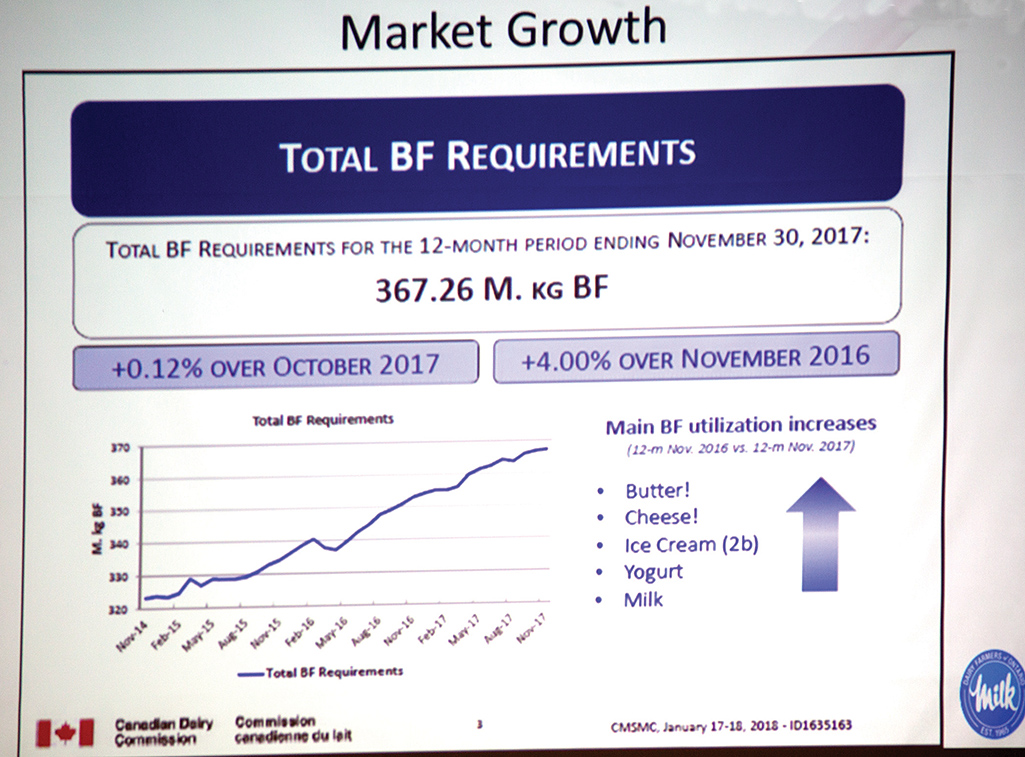
Thurler explained how the Canadian milk quota system works and some of the changes they have seen over the past three years in response to increased demand for butterfat.

He noted that the entire system is completely run by dairy farmers via provincial boards and that there are 450 processors in Canada with 80 to 85% of the country’s milk marketed to Parmalat, Saputo, Agropur, and Arla.

Thurler explained how the Canadian quota is based on kilograms of butterfat production per day.  All milk is sold to the provincial boards and they look after all the pickup and delivery of milk to the plants.

Canada9386web.jpgA government entity audits the processor stocks, which weighs into the market needs.
Quota value was capped some years ago at $24,000 per cow and new quota is distributed by dividing half equally over all producers and then the second half is prorated up to 10% of an individual producer’s current quota.

Meetings are held with processors and government once a year to “discuss the issues.”

The Canadian milk prices are determined with a formula that is 50% based on the change in cost of production at the farm level and 50% on the consumer price index.

Thurler said the current price to farmers stands at around $25 in U.S. dollars.

“It’s actually a little lower now because we have a little too much milk in the system,” he said, explaining that quota this year is being cut by up to 3% to balance that.

As noted around the world, demand for butterfat has increased, and since this is how Canadian quota is determined, increases in quotas continued higher over the past three to four years.

In addition, as demand for butter and cream increased, farmers became acutely aware of how their imports were increasing.

Thurler noted that when he got on the DFO board in 2014, “It drove me nuts the amount of butter we were importing.”

Canada allows imports to a certain threshold and after that, imposes high tariffs to protect its farmers. But as demand for butter increased — and Canadian farmers were just beginning to fill quota expansion to address that — U.S. processors (some of them Canadian-owned) saw the concentrated proteins product from the technology of ultrafiltered milk did not “fit” any category in the harmonized tariff schedule. Thus, the U.S. butter processors and cooperatives could, and did, export ultrafiltered milk (wet concentrated protein solids) to Canadian cheese and yogurt processors — free of tariffs.

Over the last three to four years, as Canadian dairy quota increased, producers had some difficulty keeping up with that progressive expansion of 4% per year in butterfat production, and could recoup their own previously-unfilled quota within a time frame.

These dynamics led to a combined surge in milk production in Canada coming into this year, up nearly 25% compared with four years ago.

As they were supplying more of the increased butterfat needs, they needed a market for the residual skim that was costing producers a lot in drying costs. This is why and when the Class 7 pricing was implemented to allow Canadian producers to offer skim solids associated with the butterfat demand growth their expanded quota supplies.

Under Class 7 pricing, these wet protein solids — remaining after the cream is separated — can be sold to their own processors at globally competitive prices, thereby avoiding the drying costs, and consequently at the same time, reducing the incentive for Canadian processors to import these protein solids (ultrafiltered milk) from the U.S. and other sources.

Thurler said in an interview after his presentation that it was never the intention to implement this Class 7 pricing as a tool for creating Canadian exports to compete with the U.S., but rather to align Canada’s milk production growth opportunities between producers and processors in a way that uses both the rapidly increasing demand for fat, on which their quota system is based, and the slower demand increase for skim. That pricing still uses an 83% to 17% split between domestic quota pricing and global pricing so that it still reasonably fits their supply-managed system.

Thurler had also indicated that Class 7 was put in place after a review by WTO lawyers to make sure it was compliant. Canada is allowed to export “some” dairy under its current trade agreements.

After this report was published, public statistics on global dairy trade were revealed, showing that Canada accounts for less than half of one percent of total global dairy exports.

Additional data for first 6 months 2018 from EU reporting (Milk Market Observatory)  These exporter rankings: Canada ranked 7th in SMP exports at 35,344 tons, up 14% over first half 2017, but just 2.8% of top 10 total (1.3 mil ton); U.S. was 2nd at 386,766 ton, +25%. In Casein exports, Canada ranked 9th at a paltry 210 ton, up 64% but just 0.02% (2/10ths of one percent) of top 10 total (90,000 ton); US ranked 4th at 1822 ton, up 3%. In Whey powder exports, Canada ranked 4th at 34,133 tons, up 8%, but 4.8% of top 10 total (711,931 ton); U.S. ranked 2nd at 282,893 tons, up 16%.

In the first 6 months of 2018, Canada imported 19% less butterfat and butteroil than year ago, but was still 10th in top 10 IMPORTER of butterfat at over 10,000 ton.

Interestingly, the U.S. was the 3rd highest butterfat and butteroil IMPORTER after China (1) and Russia (2). The U.S. imported 12% more butterfat and butteroil than year ago in the first 6 months of 2018, and more than twice as much as Canada, at over 22,000 tons. The U.S. also ranked 4th in condensed milk imports, up 11% at 18,117 tons during the first 6 months of 2018 — particularly in the so-called ‘spring flush’ months of April, May and June.

Stay tuned.

Dear Trump and Trudeau: The dairy debacle doesn’t have to be this way

canada-us-cowDairy epicenter of trade friction between leaders

By Sherry Bunting

originally published in Farmshine, June 15, 2018

QUEBEC — Dairy remains at the epicenter of a trade dispute between the U.S. and Canada.

President Donald Trump and his team have been busy renegotiating NAFTA and looking at the TPP, and while progress was being made in many areas, dairy has become a sticking point that has led to friction and word-volleys between President Trump and Canadian Prime Minister Justin Trudeau in the aftermath of the G7 meeting in Quebec in June.

Headlines after the G7 upset proclaimed that the U.S. is demanding an end to Canada’s dairy supply management system. Actually, President Trump is more specifically seeking an end to the 270% tariffs paid on U.S. dairy exports to Canada.

While the tariffs are much smaller on dairy exports that fall within Canada’s quota of 10% of their domestic production, these tariffs rise exponentially to as much as 313% on dairy exports to Canada beyond the import quota amounts.

On the U.S. side of the import/export coin, import license figures show that DFA holds much of the fluid milk import quota exported to the U.S. from Canada. Many other companies also import dairy products from Canada; however, the value of U.S. dairy imports from Canada is just 20% of the value of dairy the U.S. annually exports to Canada.

In other words, the U.S. exports five times the amount of dairy products to Canada that Canada exports to the U.S. (on a value, not volume, basis) even though Canadian tariffs are high, and U.S. tariffs are low.

Who is advising the President on dairy? National Milk Producers Federation? Dairy processing interests in Wisconsin (Speaker Paul Ryan’s home state) and New York (Senate Minority Leader Chuck Schumer’s home state)? Those two states had been selling ultrafiltered milk north of the border through a loophole that ended two years ago when Canada began its Class 7 pricing for milk destined to be used in products that are exported. This allowed expansion of Canadian quota to fill the growing demand for milkfat in domestic products by providing an off-valve to be competitive exporting the skim milk that rides along with that milkfat.

The issue arises from, first, the loss of a market for U.S. ultrafiltered dairy protein to Canadian manufacturers of cheese and other dairy products, which for several years has been exported to Canada — without tariffs — because it wasn’t a product defined in the tariff schedule.

What changed? Canada added its new Class 7, which allows Canadian processors to purchase milk  (skim) from Canadian farms at lower prices when it is used to offset the increase in butterfat demand (the other part of the milk) sold into their domestic market where pricing is governed by producer-run milk marketing boards to support the country’s milk production quota system.

Canada has allowed farms to increase milk production quotas by 4 to 6% annually over the past four years due to greater domestic demand for butterfat. This leaves more skim floating around to be absorbed in their relatively ‘closed’ dairy market.

The new Class 7, in Canada, allows processors to make skim milk powder — and other dairy protein ingredients — at much lower costs to be able to then export the excess at prices below the global market, because the majority of the producer pricing is still based on the stability of milk supply quotas set by domestic use on a milkfat basis. In spite of this, Canada exports less than 5% of the world’s skim milk powder but does export a modest amount of “food prep” products containing dairy.

The loss of an export market for U.S. ultrafiltered milk solids going to Canada is not the biggest concern. The growing U.S. concern is that the Canadian Class 7 pricing scheme has provided the means for Canada to sell increasing amounts of skim solids to Mexico, which is currently the number-one export destination for U.S. skim milk powder, and that this can increase as quotas expand, at the same time reducing the need for butterfat imports from the U.S. (Canada recently showed a sign of good faith by reducing quota by 3% this year even though quota is based on butterfat demand that is increasing. They are trying to manage the skim portion without exporting more than what they are supposed to in their supply-managed system).

Trudeau knows that his party will lose support from Quebec if he does not stand firm on the supply-managed system for dairy. Moreover, this system has been in place for over 60 years, and what makes it work is the protection from imports via high tariffs.

Does the U.S. have the right to demand our ally and trading partner, Canada, give up its dairy supply management system? And if they did give it up through a transitional process over 10 years, could they not become an even more competitive force on global markets?

Multi-national dairy processors have long sought an end to Canada’s dairy supply management system because their growth in Canada is limited by the fact that they must apply for processing quota — allotted for processors to make dairy products only in amounts that reflect Canada’s domestic supply and demand.

Canadian companies — like Saputo and Agropur — in fact, have expanded processing capacity in the U.S., in order to produce dairy products with U.S. milk for the U.S. and global markets.

That said, is it really smart for the U.S. to demand that Canada end its supply-managed dairy system?

When we say “America first” in trade, should we not expect Canada to reply with “Canada first” as they negotiate?

The point here is two-fold. First, the U.S. could learn something by evaluating how Canada is using its new export (Class 7) to price its “growth” milk, mainly the skim milk that rides along with the increased demand for milkfat.

As consumers learn the truth about full fat dairy, both here and around the world, more milk is needed to supply the increased demand for fat, while not all of the skim is in equally high demand until more processing innovations are in place.

This is a new dairy market development both nations must deal with in their respective systems that were designed to accommodate the past 40-years of flawed lowfat diet dogma.

Instead of simply pointing fingers at Canada, should the U.S. not be analyzing its own government-controlled pricing fixtures? After all, the relationship between USDA and NMPF is a tight one. Not only do their economists float from one entity to the other in their careers, the two jointly control the Federal Order rulemaking process from how petitions are submitted to how hearings are administrated to how NMPF member-cooperatives bloc-vote for their farmer member-owners.

We could benefit from better negotiations with our friend to the North, but now we have gotten into a spitting-match over a system that Canada’s dairy farmers have invested millions into and where most seem to oppose dismantling.

Yet Canada has found a way to participate in the global dairy market by making a pricing loophole to gain export sales for their dairy proteins while ending a loophole the U.S. dairy industry was previously exploiting by exporting ultrafiltered milk to Canada — a double-whammy for the U.S.

The U.S. and Canada have a long alliance on many fronts as nations, and also within dairy. One has only to attend the World Dairy Expo in Madison, Wisconsin and other dairy events and exchanges to see a legacy of competitive camaraderie between our nations.

Let’s not allow the agendas of multi-national dairy processors to drive a wedge.

Is the strong rhetoric surrounding this dairy dispute — and the demands about ending Canada’s supply management — just President Trump’s negotiating tactic of laying the whole game on the table before figuring out how to arrange the pieces in a way that both nations can accept?

If I had Trump’s ear on this issue, I would caution him about hidden agendas among those advising him on dairy.

I would ask him to spend time on a dairy farm, with a room full of dairy farmers, to understand that, yes, all is fair in business as they each seek markets and growth opportunities, but that most U.S. producers do not want to prop themselves up by tearing down their neighbors. There are far deeper problems in the U.S. dairy industry at the moment.

I would ask Trump to stand firm on explaining that Canada can’t have it both ways — with supply-managed dairy production and import tariffs on one side, plus selling their Class-7 priced milk powder at globally low prices to obtain new export markets for their excess on the other.

I would ask both leaders to grapple with their nation’s  respective choices: The U.S. has already chosen a global pathway for agriculture and dairy. Canada has chosen a domestic pathway with supply management. We can either compromise and work together to develop a hybrid approach, or we can each accept the consequences of the respective choices our nations have made in this regard.

The U.S. could put tariffs on Canadian milk and dairy products, and develop an export class for pricing our own excess growth milk to compete globally while stabilizing domestic-use prices — similar to Canada’s new construct — or we can convince our neighbors to limit their growth, within their supply-managed system, so as not to continue expanding via the Class 7 export pricing in a way that intrudes on the dairy export markets we have cultivated in other countries, such as Mexico.

A similar spitting-match between our countries ended the U.S. Country of Origin Labeling (COOL) for beef and pork. That was merely a labeling attempt to identify U.S. produced meat from conception to consumption so that U.S. consumers could choose to support U.S. farmers and ranchers. Canada was among the nations that had taken the U.S. to WTO court a few years ago, and the result was that the U.S. Congress ended COOL to avoid fines, and this has hurt U.S. beef producers.

President Trump has said recently that the U.S. is not planning to pull out of the WTO, but it does want treatment that is more fair.

Now, here we go again, with the shoe on the other foot. This time, Canada’s sacred cow — supply managed dairy and high import tariffs — are being questioned. But in reality, the Class 7 pricing policy is the more pragmatic concern.

Instead of both nations trying to have it both ways while our leaders volley back and forth in a spitting-match on tariffs and mandates and the like — maybe we could all concentrate on negotiating outcomes that are focused on the farming side and not so much the multi-national processing side — to make farming great again.

After all, as go our farmers, so go our nations.

Author’s July 14 update: It was reported within the past 10 days that Quebec, Canada’s largest dairy-producing province, may be softening its stance to reconsider the Class 7 milk price policy to ease tensions between the U.S. and Canada. Bloomberg News reported that Quebec Premier Philippe Couillard met with U.S. Ag Secretary Sonny Perdue, noting that the Class 7 pricing policy is the main sticking point — not Canada’s supply management system of domestic milk quotas and import tariffs. In a recent televised interview, Secretary Perdue said: “The U.S. is not about trying to get Canada to ditch its supply management system…” He explained that if Canada is going to have a supply management system, “you’ve got to manage the supply, and not over-produce and not over-quota to where you dump milk solids on the world market and depress prices for our producers.” The Canadian Class 7 export pricing — in place for the past 18 months — has facilitated the export of excess milk proteins while blocking most dairy product imports. The U.S. is not alone in this concern as other countries are also affected by the movement of the lower-priced Canadian skim milk powder (SMP) to markets served by nations that do not have a supply-managed system and which do not place extremely high tariffs on dairy imports. For the first four months of 2018, Canada has doubled its SMP exports compared with year ago and by 95% over the levels prior to the 2017 start of the Class 7 pricing, which allows milk to be priced much lower when used for products that are exported, and this is doable when the main portion of Canadian farm milk pricing is stable and higher because it is matched to their domestic usage on a milkfat basis.